• Trade
  • Markets
  • Copy
  • Contests
  • News
  • 24/7
  • Calendar
  • Q&A
  • Chats
Trending
Screeners
SYMBOL
LAST
BID
ASK
HIGH
LOW
NET CHG.
%CHG.
SPREAD
SPX
S&P 500 Index
6815.80
6815.80
6815.80
6861.30
6801.50
-11.61
-0.17%
--
DJI
Dow Jones Industrial Average
48365.16
48365.16
48365.16
48679.14
48285.67
-92.88
-0.19%
--
IXIC
NASDAQ Composite Index
23097.14
23097.14
23097.14
23345.56
23012.00
-98.02
-0.42%
--
USDX
US Dollar Index
97.940
98.020
97.940
98.070
97.740
-0.010
-0.01%
--
EURUSD
Euro / US Dollar
1.17464
1.17473
1.17464
1.17686
1.17262
+0.00070
+ 0.06%
--
GBPUSD
Pound Sterling / US Dollar
1.33739
1.33746
1.33739
1.34014
1.33546
+0.00032
+ 0.02%
--
XAUUSD
Gold / US Dollar
4302.77
4303.18
4302.77
4350.16
4285.08
+3.38
+ 0.08%
--
WTI
Light Sweet Crude Oil
56.331
56.361
56.331
57.601
56.233
-0.902
-1.58%
--

Community Accounts

Signal Accounts
--
Profit Accounts
--
Loss Accounts
--
View More

Become a signal provider

Sell trading signals to earn additional income

View More

Guide to Copy Trading

Get started with ease and confidence

View More

Signal Accounts for Members

All Signal Accounts

Best Return
  • Best Return
  • Best P/L
  • Best MDD
Past 1W
  • Past 1W
  • Past 1M
  • Past 1Y

All Contests

  • All
  • Trump Updates
  • Recommend
  • Stocks
  • Cryptocurrencies
  • Central Banks
  • Featured News
Top News Only
Share

Goldman Sachs Says They Believe That The Copper Price Is Vulnerable To An Ai-Linked Price Correction

Share

Goldman Sachs Upgrades 2026 Copper Price Forecast To $11400 From $10,650

Share

Attempts By Ukrainian Troops To Advance From The South-West To Outskirts Of Kupiansk Are Being Thwarted

Share

Russian Troops Control All Of Kupiansk - IFX Cites Russian Military

Share

On Monday (December 15), The South Korean Won Ultimately Rose 0.60% Against The US Dollar, Closing At 1468.91 Won. The Won Was On An Upward Trend Throughout The Day, Rising Significantly At 17:00 Beijing Time And Reaching A Daily High Of 1463.04 Won At 17:36

Share

Health Ministry: Israeli Forces Kill Palestinian Teen In West Bank

Share

New York Federal Reserve President Williams: Over Time, The Size Of Reserves Could Grow From $2.9 Trillion

Share

New York Fed President Williams: AI Valuations Are High, But There Is A Real Driving Factor

Share

New York Federal Reserve President Williams: The Job Market Is In Very Good Shape

Share

New York Fed President Williams: 'Very Supportive' Of USA Central Bank's Decision To Cut Interest Rates Last Week

Share

New York Fed President Williams: 'Too Early To Say' What Central Bank Should Do At January Meeting

Share

New York Fed President Williams: Strong Markets Part Of Reason Why Economy Will Grow Robustly In 2026

Share

New York Fed President Williams: What Constitutes Ample Reserves Will Change Over Time

Share

New York Fed President Williams: Market Valuations 'Elevated,' But There Are Reasons For Pricing

Share

New York Fed President Williams: Ample Reserves System Working Very Well

Share

New York Fed President Williams: Some Signs That Parts Of Underlying Economy Not As Strong As GDP Data Suggests

Share

New York Fed President Williams: Expects Coming Job Data Will Show Gradual Cooling

Share

Ukraine President Zelenskiy: Monitoring Of Ceasefire Should Be Part Of Security Guarantees

Share

Ukraine President Zelenskiy: Ukraine Needs Clear Understanding On Security Guarantees Before Taking Any Decisions Regarding Frontlines

Share

U.S. Commerce Secretary Rutnick Praised Korea Zinc Co. Ltd., Stating That The United States Will Have Priority Access To The Company's Products In 2026

TIME
ACT
FCST
PREV
Japan Tankan Small Manufacturing Outlook Index (Q4)

A:--

F: --

P: --

Japan Tankan Large Non-Manufacturing Outlook Index (Q4)

A:--

F: --

P: --

Japan Tankan Large Manufacturing Outlook Index (Q4)

A:--

F: --

P: --

Japan Tankan Small Manufacturing Diffusion Index (Q4)

A:--

F: --

P: --

Japan Tankan Large-Enterprise Capital Expenditure YoY (Q4)

A:--

F: --

P: --

U.K. Rightmove House Price Index YoY (Dec)

A:--

F: --

P: --

China, Mainland Industrial Output YoY (YTD) (Nov)

A:--

F: --

P: --

China, Mainland Urban Area Unemployment Rate (Nov)

A:--

F: --

P: --

Saudi Arabia CPI YoY (Nov)

A:--

F: --

P: --

Euro Zone Industrial Output YoY (Oct)

A:--

F: --

P: --

Euro Zone Industrial Output MoM (Oct)

A:--

F: --

P: --

Canada Existing Home Sales MoM (Nov)

A:--

F: --

P: --

Canada National Economic Confidence Index

A:--

F: --

P: --

Canada New Housing Starts (Nov)

A:--

F: --

P: --
U.S. NY Fed Manufacturing Employment Index (Dec)

A:--

F: --

P: --

U.S. NY Fed Manufacturing Index (Dec)

A:--

F: --

P: --

Canada Core CPI YoY (Nov)

A:--

F: --

P: --

Canada Manufacturing Unfilled Orders MoM (Oct)

A:--

F: --

P: --

U.S. NY Fed Manufacturing Prices Received Index (Dec)

A:--

F: --

P: --

U.S. NY Fed Manufacturing New Orders Index (Dec)

A:--

F: --

P: --

Canada Manufacturing New Orders MoM (Oct)

A:--

F: --

P: --

Canada Core CPI MoM (Nov)

A:--

F: --

P: --

Canada Trimmed CPI YoY (SA) (Nov)

A:--

F: --

P: --

Canada Manufacturing Inventory MoM (Oct)

A:--

F: --

P: --

Canada CPI YoY (Nov)

A:--

F: --

P: --

Canada CPI MoM (Nov)

A:--

F: --

P: --

Canada CPI YoY (SA) (Nov)

A:--

F: --

P: --

Canada Core CPI MoM (SA) (Nov)

A:--

F: --

P: --

Canada CPI MoM (SA) (Nov)

A:--

F: --

P: --

Federal Reserve Board Governor Milan delivered a speech
U.S. NAHB Housing Market Index (Dec)

A:--

F: --

P: --

Australia Composite PMI Prelim (Dec)

--

F: --

P: --

Australia Services PMI Prelim (Dec)

--

F: --

P: --

Australia Manufacturing PMI Prelim (Dec)

--

F: --

P: --

Japan Manufacturing PMI Prelim (SA) (Dec)

--

F: --

P: --

U.K. 3-Month ILO Employment Change (Oct)

--

F: --

P: --

U.K. Unemployment Claimant Count (Nov)

--

F: --

P: --

U.K. Unemployment Rate (Nov)

--

F: --

P: --

U.K. 3-Month ILO Unemployment Rate (Oct)

--

F: --

P: --

U.K. Average Weekly Earnings (3-Month Average, Including Bonuses) YoY (Oct)

--

F: --

P: --

U.K. Average Weekly Earnings (3-Month Average, Excluding Bonuses) YoY (Oct)

--

F: --

P: --

France Services PMI Prelim (Dec)

--

F: --

P: --

France Composite PMI Prelim (SA) (Dec)

--

F: --

P: --

France Manufacturing PMI Prelim (Dec)

--

F: --

P: --

Germany Services PMI Prelim (SA) (Dec)

--

F: --

P: --

Germany Manufacturing PMI Prelim (SA) (Dec)

--

F: --

P: --

Germany Composite PMI Prelim (SA) (Dec)

--

F: --

P: --

Euro Zone Composite PMI Prelim (SA) (Dec)

--

F: --

P: --

Euro Zone Services PMI Prelim (SA) (Dec)

--

F: --

P: --

Euro Zone Manufacturing PMI Prelim (SA) (Dec)

--

F: --

P: --

U.K. Services PMI Prelim (Dec)

--

F: --

P: --

U.K. Manufacturing PMI Prelim (Dec)

--

F: --

P: --

U.K. Composite PMI Prelim (Dec)

--

F: --

P: --

Euro Zone ZEW Economic Sentiment Index (Dec)

--

F: --

P: --

Germany ZEW Current Conditions Index (Dec)

--

F: --

P: --

Germany ZEW Economic Sentiment Index (Dec)

--

F: --

P: --

Euro Zone Trade Balance (Not SA) (Oct)

--

F: --

P: --

Euro Zone ZEW Current Conditions Index (Dec)

--

F: --

P: --

Euro Zone Trade Balance (SA) (Oct)

--

F: --

P: --

Euro Zone Total Reserve Assets (Nov)

--

F: --

P: --

U.K. Inflation Rate Expectations

--

F: --

P: --

Q&A with Experts
    • All
    • Chatrooms
    • Groups
    • Friends
    Connecting
    .
    .
    .
    Type here...
    Add Symbol or Code

      No matching data

      All
      Trump Updates
      Recommend
      Stocks
      Cryptocurrencies
      Central Banks
      Featured News
      • All
      • Russia-Ukraine Conflict
      • Middle East Flashpoint
      • All
      • Russia-Ukraine Conflict
      • Middle East Flashpoint
      Search
      Products

      Charts Free Forever

      Chats Q&A with Experts
      Screeners Economic Calendar Data Tools
      Membership Features
      Data Warehouse Market Trends Institutional Data Policy Rates Macro

      Market Trends

      Market Sentiment Order Book Forex Correlations

      Top Indicators

      Charts Free Forever
      Markets

      News

      News Analysis 24/7 Columns Education
      From Institutions From Analysts
      Topics Columnists

      Latest Views

      Latest Views

      Trending Topics

      Top Columnists

      Latest Update

      Signals

      Copy Rankings Latest Signals Become a signal provider AI Rating
      Contests
      Brokers

      Overview Brokers Assessment Rankings Regulators News Claims
      Broker listing Forex Brokers Comparison Tool Live Spread Comparison Scam
      Q&A Complaint Scam Alert Videos Tips to Detect Scam
      More

      Business
      Events
      Careers About Us Advertising Help Center

      White Label

      Data API

      Web Plug-ins

      Affiliate Program

      Awards Institution Evaluation IB Seminar Salon Event Exhibition
      Vietnam Thailand Singapore Dubai
      Fans Party Investment Sharing Session
      FastBull Summit BrokersView Expo
      Recent Searches
        Top Searches
          Markets
          News
          Analysis
          User
          24/7
          Economic Calendar
          Education
          Data
          • Names
          • Latest
          • Prev

          View All

          No data

          Scan to Download

          Faster Charts, Chat Faster!

          Download App
          English
          • English
          • Español
          • العربية
          • Bahasa Indonesia
          • Bahasa Melayu
          • Tiếng Việt
          • ภาษาไทย
          • Français
          • Italiano
          • Türkçe
          • Русский язык
          • 简中
          • 繁中
          Open Account
          Search
          Products
          Charts Free Forever
          Markets
          News
          Signals

          Copy Rankings Latest Signals Become a signal provider AI Rating
          Contests
          Brokers

          Overview Brokers Assessment Rankings Regulators News Claims
          Broker listing Forex Brokers Comparison Tool Live Spread Comparison Scam
          Q&A Complaint Scam Alert Videos Tips to Detect Scam
          More

          Business
          Events
          Careers About Us Advertising Help Center

          White Label

          Data API

          Web Plug-ins

          Affiliate Program

          Awards Institution Evaluation IB Seminar Salon Event Exhibition
          Vietnam Thailand Singapore Dubai
          Fans Party Investment Sharing Session
          FastBull Summit BrokersView Expo

          Fed's Daly Says 'Reasonable' to Expect two Rate Cuts Before end of 2025

          Manuel

          Economic

          Central Bank

          Summary:

          Daly said at the Rocky Mountain Economic Summit in Victor, Idaho. But the Fed also doesn't want to keep rates restrictive for too long because that would unnecessarily hurt the labor market.

          San Francisco Federal Reserve President Mary Daly reiterated on Thursday it is "reasonable" to expect two interest rate cuts before the end of this year, particularly with the impact of President Donald Trump's tariffs looking more muted than originally expected.
          Inflation is still above the U.S. central bank's 2% target and there's still "some work to do" to bring it down, Daly said at the Rocky Mountain Economic Summit in Victor, Idaho. But the Fed also doesn't want to keep rates restrictive for too long because that would unnecessarily hurt the labor market, she said.
          "I don't think we need to slow precipitously to produce the last mile on inflation," Daly said. "I wouldn't want to see more weakness in the labor market ... I really wouldn't want to see that, which is why you can't wait forever" on cutting rates.
          Companies are figuring out ways to avoid tariffs and are not passing on all of their increased costs to their customers, and despite a doubling of the effective average tariff rate under Trump the increased levies on imports are not so far spilling more broadly into overall inflation.
          "We haven't seen any evidence that that's occurring," Daly said, though recent consumer price data does show the price of goods is rising. Offsetting that, however, is encouragingly lower inflation in non-housing-related services inflation, she said.
          Asked if she would support reducing the current policy rate range of 4.25%-4.50% when the Fed meets in two weeks, Daly noted that she expects rate cuts to resume as inflation falls, with the policy rate at an ultimate settling point of 3% or somewhere higher than that level.
          "Whether it happens in July or September or some other month is really not the most relevant piece," she said. More relevant, Daly added, is that rates will be reduced.
          "We don't want to unnecessarily tighten the economy in a way that hurts the labor market or growth. So that's the direction of travel," she said.
          Two of the Fed's 19 policymakers have said they believe a July rate cut could be appropriate; others have signaled they expect it to take longer to be able to judge the effect of the tariffs and other Trump policies on inflation and the labor market, and therefore to know if a rate cut would be appropriate.
          Financial markets reflect very little expectation for a rate cut at the Fed's July 29-30 meeting, with bets focused on the September 16-17 meeting as a much more likely time for the policy easing to resume.
          Trump has waged an escalating pressure campaign on Fed Chair Jerome Powell to cut rates immediately and raised the possibility of replacing him before his term as U.S. central bank chief expires next May. Powell has repeatedly said he intends to finish out his term as Fed chief.
          Daly declined to comment specifically about Trump's comments, but noted that all Fed policymakers participate in interest rate decisions.
          "We share equal responsibility when we take that vote" on rates, Daly said.

          Source: Reuters

          To stay updated on all economic events of today, please check out our Economic calendar
          Risk Warnings and Disclaimers
          You understand and acknowledge that there is a high degree of risk involved in trading. Following any strategies or investment methods may lead to potential losses. The content on the site is provided by our contributors and analysts for information purposes only. You are solely responsible for determining whether any trading assets, securities, strategy, or any other product is suitable for investing based on your own investment objectives and financial situation.
          Add to Favorites
          Share

          Some Fed officials hold firm on wait-and-see rate stance despite Trump pressure

          Adam

          Economic

          Some Federal Reserve policymakers are not budging from their view that rates should remain where they are despite the intensifying pressure from President Trump and his allies to ease monetary policy immediately.
          Federal Reserve governor Adriana Kugler and New York Fed president John Williams both made this argument in speeches delivered Thursday morning and Wednesday night, citing the risk of inflation pressure from tariffs.
          “With the unemployment rate still at historically low levels, elevated short-run inflation expectations, and goods inflation rising due to the upward pressure from tariffs, I find it appropriate to hold our policy rate at the current level for some time,” Kugler said in her Thursday speech in Washington, D.C.
          “I judge that inflation is likely to increase further as tariff effects build up during the rest of the year.”
          On Wednesday night, Williams stressed that he thinks that tariffs are already pushing up inflation and that will increase in the coming months. He expects tariffs will push up inflation by a full percentage point in the second half of this year and into the first part of 2026.
          “Maintaining this modestly restrictive stance of monetary policy is entirely appropriate to achieve our maximum employment and price stability goals," Williams said in his speech.
          Opposing camps are now forming inside the central bank on the question of Trump's tariffs and how they should affect what the Fed does on rates.
          Two other Fed governors, Christopher Waller and Michelle Bowman, have argued for cuts as early as the next meeting July 29-30, which is not an outcome investors expect.
          Waller last week reiterated that any inflation from tariffs will be temporary, justifying a looser monetary policy approach.
          “I think we're just too tight and we could consider cutting the policy rate in July,” said Waller, adding, “It’s not political.”
          Waller’s arguments carry increasing weight since he is considered to be among the candidates to replace Jerome Powell as Fed chair next May, when Powell’s term is up.
          “We're not seeing a lot of tariff inflation yet,” Waller added last week. “For that reason, I've been arguing that we could start lowering the policy rate from our current setting.”
          These views align with those of Trump, who has repeatedly called on the Fed and Powell to ease monetary policy, citing what he views as a lack of inflation thus far from tariffs and the savings that could be made if the US were paying lower interest on its debt.
          Powell has argued for more time to assess whether inflation does in fact move higher over the summer. Williams made a similar argument Wednesday, saying holding rates steady will allow more time to assess the data.
          He said he anticipates inflation will come in between 3 and 3.5% percent this year and then fall back to about 2.5% next year before reaching 2% in 2027. The Fed's goal is to get inflation back down to 2%.
          Kugler noted the still-restrictive policy stance is important to keep longer-run inflation expectations anchored.
          She said she is not seeing any progress on headline and core inflation the past six months, noting that goods inflation has gone up and that reflects some pass through of increased tariffs.
          Kugler stressed that businesses may not yet be passing the higher tariffs to their selling prices because they are waiting for greater clarity.
          She also noted that tariff rates could increase further, as seen in newly proposed reciprocal tariffs for several countries and the new tariffs on copper introduced last week, putting further upward pressure on prices.

          Source: finance.yahoo

          To stay updated on all economic events of today, please check out our Economic calendar
          Risk Warnings and Disclaimers
          You understand and acknowledge that there is a high degree of risk involved in trading. Following any strategies or investment methods may lead to potential losses. The content on the site is provided by our contributors and analysts for information purposes only. You are solely responsible for determining whether any trading assets, securities, strategy, or any other product is suitable for investing based on your own investment objectives and financial situation.
          Add to Favorites
          Share

          How Fed Could Inject Liquidity if Bond Yields Surge: What Investors Need to Know

          Adam

          Bond

          Economic

          If long-end bond yields spiral out of control, the Fed could start injecting liquidity again: a step-by-step guide of how it works.
          When a few weeks ago 30-year bond yields briefly flirted with the 5% level, the Fed’s Collins released an interview stating that ’’the Fed is absolutely ready to stabilize markets’’.
          To stabilize the bond market, they would ’’inject liquidity’’ through operations like the LSAP - Large Scale Asset Purchase or QE.
          Central Banks create bank reserves when they perform such operations.
          Bank reserves are often referred to as ’’Liquidity’’.
          When Central Banks engage in liquidity creation, they do that in the hope that it activates the so-called Portfolio Rebalancing Effect.
          To understand this, let’s start from what QE does to the balance sheet of a commercial bank - take a look at the chart below.
          Following the GFC, regulators forced banks to own more HQLA (high quality liquid assets) to meet depositor outflows.
          Bank reserves and bonds qualify as ’’HQLA’’ as they are liquid enough to be converted in cash to meet potential outflows quickly.
          But banks are not indifferent between owning bank reserves and bonds, and especially if the amount of reserves grows dramatically as a result of QE.
          Bank reserves are a zero-duration and low-yielding instrument which can be suboptimal to own in big sizes especially if compared with bonds which offer higher returns and duration hedging properties.
          And this is when the Portfolio Rebalancing Effect kicks in.
          Once QE starts, Central Banks take away bonds and inject new reserves in the banking system.
          Loaded with suboptimal reserves, banks will try to switch back the composition of their portfolios towards more bonds.
          They will bid up safer bonds first, and bid up riskier bonds later when the hunt for returns intensifies.
          This will kick in a virtuous cycle of low volatility and a hunt for riskier assets: the Portfolio Rebalancing Effect in action.
          Summarizing:
          Central Banks expand their balance sheet and purchase bonds
          Commercial Banks are on the receiving end of QE, and hence their portfolio composition tilts towards more reserves, and less bonds;
          But reserves are sub-optimal to own compared to regulatory-friendly bonds, and hence they look to rebalance their portfolios;
          They start buying the very same bonds QE is buying, hence suppressing volatility further and compressing credit spreads;
          Asset allocators and investors across the world are more and more encouraged to take additional risks in their portfolio, supporting the flow of credit and capital.
          Does the Portfolio Rebalancing Effect make sense to you?

          Source: investing

          To stay updated on all economic events of today, please check out our Economic calendar
          Risk Warnings and Disclaimers
          You understand and acknowledge that there is a high degree of risk involved in trading. Following any strategies or investment methods may lead to potential losses. The content on the site is provided by our contributors and analysts for information purposes only. You are solely responsible for determining whether any trading assets, securities, strategy, or any other product is suitable for investing based on your own investment objectives and financial situation.
          Add to Favorites
          Share

          3 Tax Breaks That Will Change This Year Because Of The 'Big, Beautiful Bill'

          Owen Li

          Economic

          KEY TAKEAWAYS

          • The 'Big, Beautiful Bill' increases some major tax deductions for the 2025 tax year, but also ends other credits.

          • The bill raises the standard deduction by $750 to $1,125 for taxpayers who don't itemize their 2025 taxes.

          • Taxpayers who do itemize can deduct four times more of what they paid in state and local taxes than in previous years.

          • The bill eliminates energy credits for clean vehicles and clean home installations.

          Your tax bill will look different this year thanks to the 'Big, Beautiful Bill' President Trump signed the into law this month.

          The law extends and expands the Tax Cuts and Jobs Act (TCJA) that Trump enacted in 2018 during his first term. Some tax credits and deductions from this act will increase during the 2025 tax year, but other clean energy credits will be eliminated.

          Tax credits are the amount of money taxpayers can subtract directly from the taxes they owe. Tax deductions are how much taxpayers can subtract from their taxable income, to lower the overall amount of taxes they owe.

          These are the most significant tax credit and deduction changes in the 'Big, Beautiful Bill' that will apply to next year's 2025 tax returns.

          The Standard Deduction Will Increase

          The 'Big, Beautiful Bill' permanently increases the standard deduction, a fixed amount that taxpayers who do not itemize their deductions can subtract from their taxable income.

          Under the bill, the standard deduction for single taxpayers and married individuals filing separately increases by $750 for the 2025 tax year. It will also increase by $1,125 for heads of households and by $1,500 for married couples filing jointly.

          Standard deductions will continue to rise annually to keep in line with inflation increases.

          The Increased 2025 Standard Deduction Under The 'Big, Beautiful Bill'

          Single Taxpayers and Married Filing Separately

          Heads of Households

          Married Filing Jointly

          $15,750

          $23,625

          $31,500

          SALT Deduction Expands

          The final bill temporarily increases the state and local tax (SALT) deduction. This deduction allows taxpayers who itemize their taxes to subtract all or some of what they paid in taxes to their state and local governments from their federal taxable income.

          The 'Big, Beautiful Bill' quadruples the original $10,000 cap that the TCJA put on SALT deductions to $40,000 for the 2025 tax year. That means taxpayers, specifically those with higher incomes or in high-tax states, can deduct more when they file their 2025 taxes next year.

          The bill also increases the cap every year to keep pace with inflation and wage growth. From 2026 to 2029, the cap will increase 1% annually until 2030, when the provision expires.

          Source: Yahoo Finance

          To stay updated on all economic events of today, please check out our Economic calendar
          Risk Warnings and Disclaimers
          You understand and acknowledge that there is a high degree of risk involved in trading. Following any strategies or investment methods may lead to potential losses. The content on the site is provided by our contributors and analysts for information purposes only. You are solely responsible for determining whether any trading assets, securities, strategy, or any other product is suitable for investing based on your own investment objectives and financial situation.
          Add to Favorites
          Share

          EURUSD at a tipping point

          Adam

          Forex

          The most traded Forex pair hasn't disappointed traders in terms of trends and volatility throughout 2025.
          Going from 1.02 to 1.18 highs in 7 months, there had been some decisive momentum to participate with as this strong buying took the Euro to highs unseen since 2021.The geopolitical mishandles from the Trump Administration earlier this year had led to European leaders putting back the Euro unification back on the table. After some major deals were announced from Germany and other Euro Nations, the Euro started its ascent. to up 15% on the year at one point.This theme got accompanied with general lack of confidence from the Trump Administration which led to some major US Dollar selling and financial flows rewiring.
          But, it seems today that markets are taking profits on these trends, leading to some intermediate tops in the Pair currently – Let's take a look at EURUSD Technicals to spot if there is any elements to help us see if the flows have really shifted or not.

          EURUSD Multi-Timeframe analysis going from the Daily to 1H Charts

          EURUSD Daily

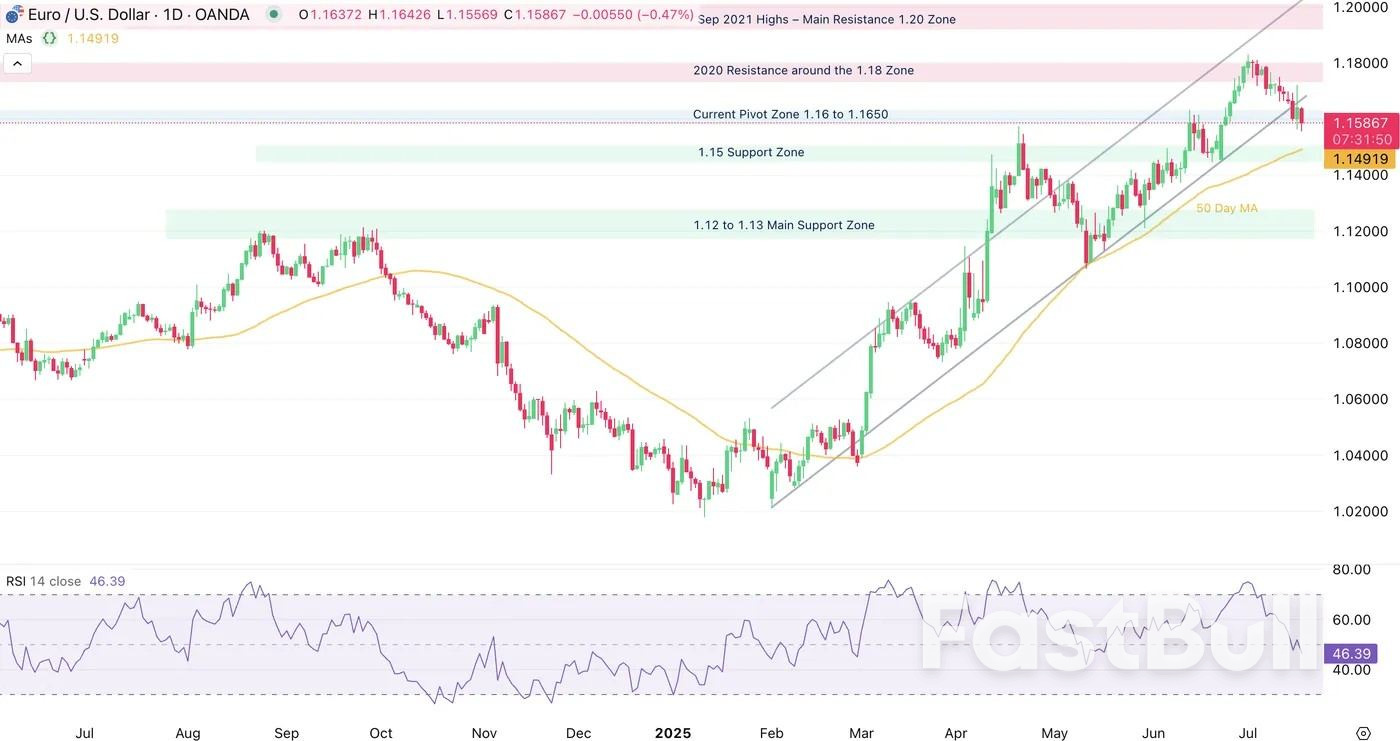
          EURUSD at a tipping point_1EUR/USD Daily Chart, July 17, 2025

          The Israel-Iranwar consolidation in the pair had led to a major relief rebound towards the 1.1830 2025 Highs in a strong fashion – from 1.1450 to the highs in 7 consecutive bull candles (Tight bull channel).However, since July 1st, all currencies have found some of their strength against the US Dollar taken back and the Euro hasn't been an exception.
          Almost all daily candles have been red since that day and prices are close to back to pre-end-of-war levels – Momentum just fell below the mid-line, indicating some seller strength which will have to decisively breach below. the 50-Day Moving average to regain more control.Higher timeframe levels to keep an eye on:
          Resistance Levels:
          Current Pivot Zone 1.16 to 1.1650
          2020 Resistance around the 1.18 Zone (2025 Highs)
          Sep 2021 Highs – Main Resistance 1.20 Zone
          Support Levels:
          1.15 Support Zone (Confluence with 50-Day MA)
          1.12 to 1.13 Main Support Zone
          1.10660 Last major pivot to the upside
          EURUSD 4H

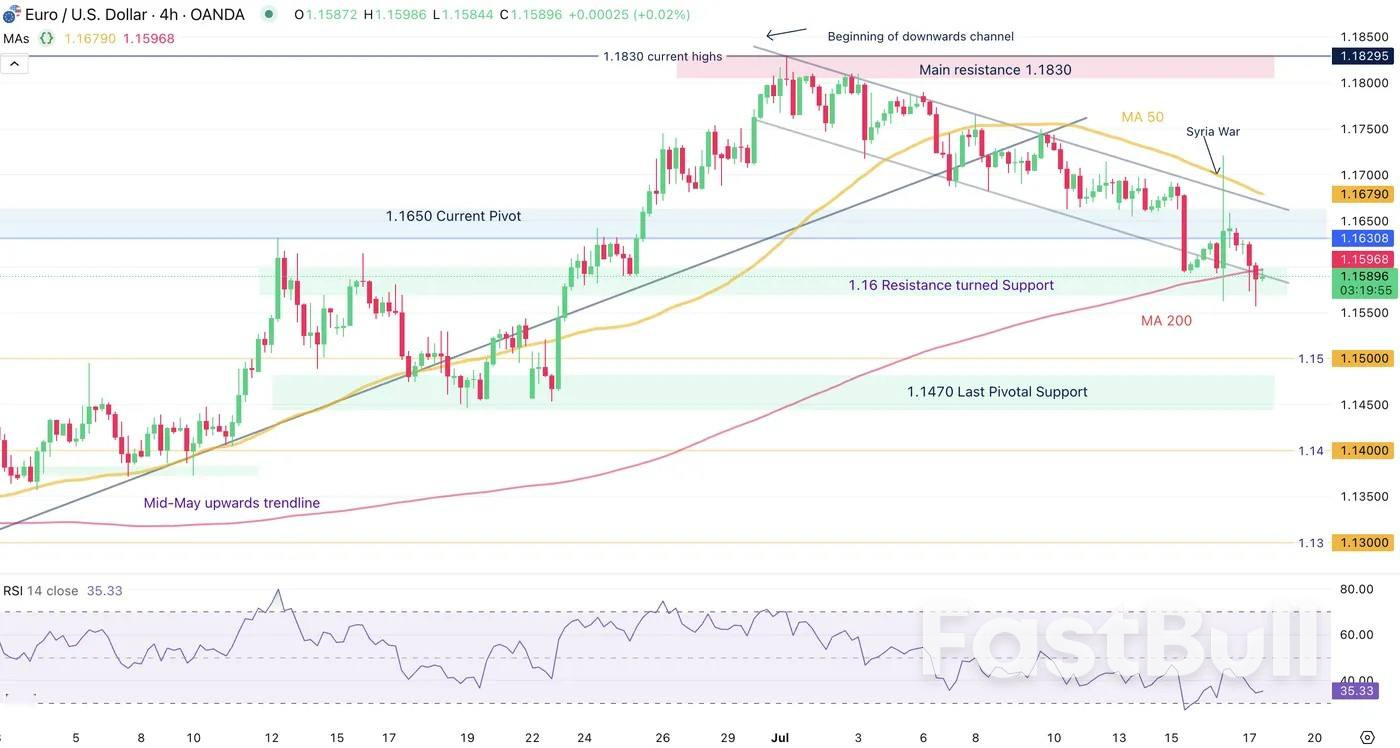
          EURUSD at a tipping point_2EUR/USD 4H Chart, July 17, 2025

          Looking closer allows to observe the current ongoing descending downwards channel were prices have trended down with some regularity but the move is currently stalling as markets approach oversold levels.Prices are currently evolving between the 50 and 200 4H Moving Averages as buyers held the 1.16 Support Zone (smaller timeframe support) to bid the Pair during the past day Syria War headlines.Monitor closely any decisive break below the 200 MA that is currently holding prices – We are currently trading just below that indicator but we would require a stronger move to assume more bearishness.In the meantime, there is a somewhat high probability to retest the high of the range that revisits the 50 MA at the same time around 1.1678 but prices will first have to cross the 1.1620 to 1.1650 Pivot Zone.
          EURUSD 1H

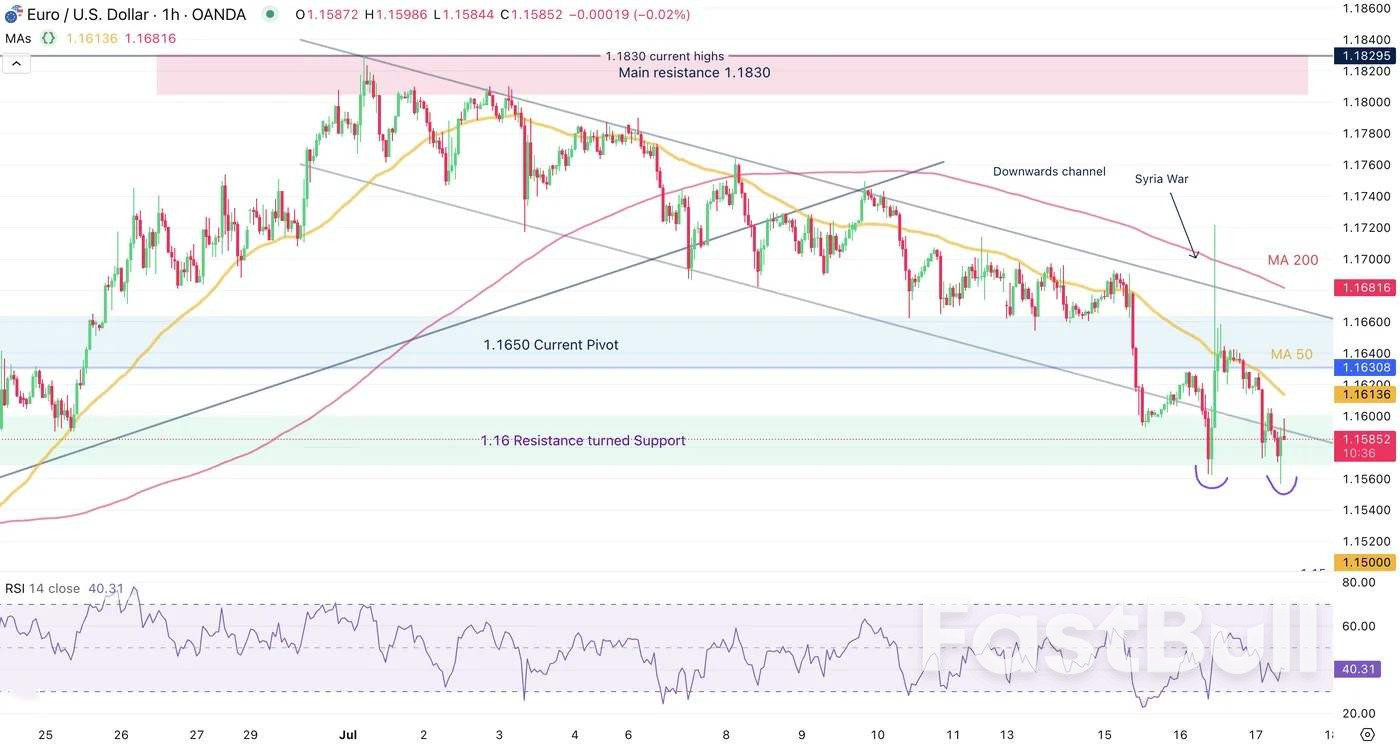
          EURUSD at a tipping point_3EUR/USD 1H Chart, July 17, 2025

          he ongoing session has begun with a double bottom right at the bottom of the 1.16 Support Zone (1.1560).Anyways, buyers will still have to breach back into the downwards channel (which has been broken out overnight – coincides with the 1.16 psychological Level) to avoid a further bearish continuation.Take a look at reactions at the low of the channel, the 1H MA 50 and the 1.1650 Pivot Zone if prices do get there.

          Source:marketpulse

          Risk Warnings and Disclaimers
          You understand and acknowledge that there is a high degree of risk involved in trading. Following any strategies or investment methods may lead to potential losses. The content on the site is provided by our contributors and analysts for information purposes only. You are solely responsible for determining whether any trading assets, securities, strategy, or any other product is suitable for investing based on your own investment objectives and financial situation.
          Add to Favorites
          Share

          Wall Street is coming to the Fed's defense

          Adam

          Economic

          Some of the biggest names on Wall Street are getting louder about the importance of an independent Federal Reserve as the White House pressure on Jerome Powell intensifies.
          JPMorgan Chase (JPM) CEO Jamie Dimon, Bank of America (BAC) CEO Brian Moynihan, Citigroup (C) CEO Jane Fraser, and Goldman Sachs (GS) CEO David Solomon all offered separate arguments this week about why it was so critical to financial markets for the central bank to operate autonomously.
          "Fed independence is very important, and it's something we should fight to preserve,” Solomon told CNBC on Wednesday.
          The stability of the US “is actually necessary and important to the whole world,” Moynihan added in a separate interview with CNBC on Wednesday, and he said, “I think a stable Fed, an independent Fed, is key to that.”
          “In a year, we'll have a new Fed chair, because that's the right of the president," he added, referring to the fact that Powell's term expires next May. "But I think if … the market would really look at a change prematurely as being something very different."
          Investors did, in fact, react negatively on Wednesday to multiple reports that Trump was close to firing Powell. Longer-term Treasury yields rose and the dollar dropped before Trump told reporters that he was "not planning" to fire Powell.
          Trump left the door open to that possibility, however. "I don't rule out anything, but I think it's highly unlikely, unless he has to leave for fraud," he said.
          Citigroup's Fraser was among the other big bank executives to make her views known publicly this week.
          In a statement shared with Yahoo Finance and other media outlets, she said that “the independence of the Federal Reserve drives its credibility. It is critical to the effectiveness of our capital markets and U.S. competitiveness.”
          But the CEO who first weighed in this week was JPMorgan's Dimon, someone with a lot of sway on Wall Street and in Washington. In April, Trump acknowledged listening to Dimon before pulling back on his "Liberation Day" tariffs, which triggered widespread market chaos.
          Dimon told reporters Tuesday that the independence of the Federal Reserve is "absolutely critical" for Powell and whoever succeeds him as chairman of the central bank.
          "Playing around with the Fed can often have adverse consequences," Dimon said after JPMorgan reported its first quarter earnings, adding that it can produce "the absolute opposite of what you may be hoping for."

          Source: finance.yahoo

          To stay updated on all economic events of today, please check out our Economic calendar
          Risk Warnings and Disclaimers
          You understand and acknowledge that there is a high degree of risk involved in trading. Following any strategies or investment methods may lead to potential losses. The content on the site is provided by our contributors and analysts for information purposes only. You are solely responsible for determining whether any trading assets, securities, strategy, or any other product is suitable for investing based on your own investment objectives and financial situation.
          Add to Favorites
          Share

          US retail sales shine, Dollar-Yen jumps, Japan inflation expected to ease

          Adam

          Forex

          Economic

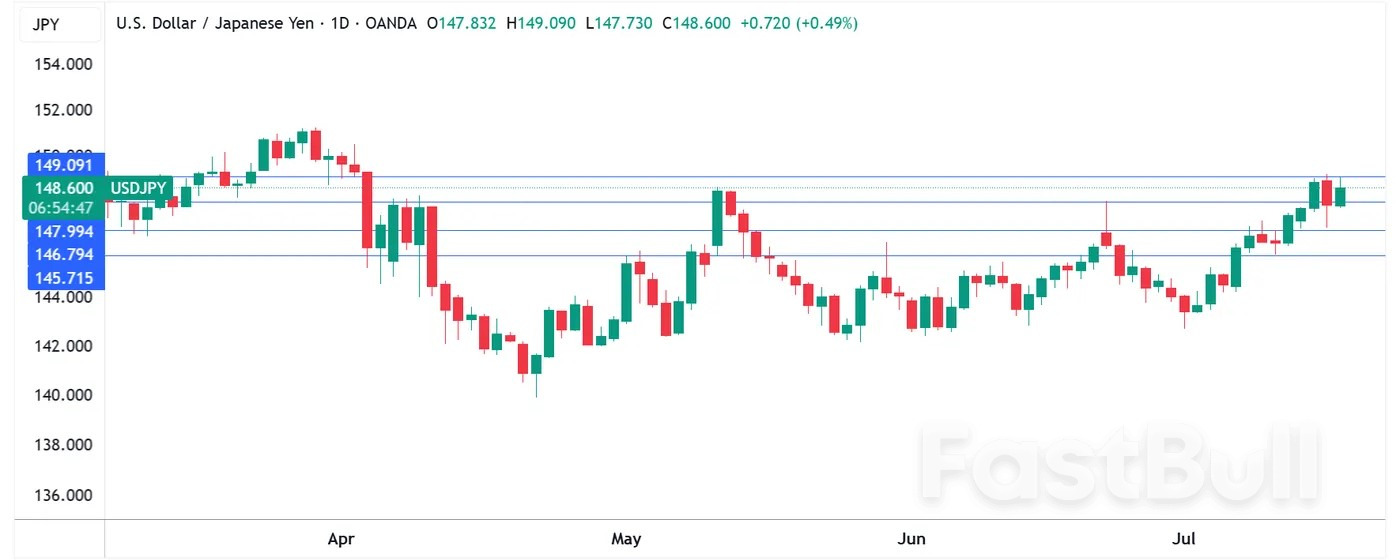
          The Japanese yen continues to have a busy week, with strong movement in both directions. In the North American session, USD/JPY is trading at 148.53, up 0.45% on the day. On Wednesday, USD/JPY strengthened to 149.18, its highest level since March.

          US retail sales surprise with 0.6% gain

          US retail sales have been in the doldrums of late, posting declines in April and May as consumers reacted with a thumbs-down to President Trump's tariffs, which took effect in April and made imported goods more expensive.
          The markets had anticipated a marginal gain of just 0.1% m/m in June but retail sales came in at an impressive 0.6%, bouncing back from -0.9% in May. Most sub-categories recording stronger activity in June.
          The US tariffs appear to have had a significant impact on retail sales, as consumers continue to time their purchases to minimize the effect of tariffs.
          Consumers increased spending ahead of the tariffs and cut back once the tariffs went into effect. With a truce in place between the US and China which has slashed tariff rates, consumers opened their wallets and purchased more on big-ticket items such as motor vehicles, which jumped 1.2% in June.
          With Trump threatening new rounds of tariffs against allies such as Canada and Japan on August 1 if no agreements are reached, it will be interesting to see if consumer spending reverses direction next month.

          Japan's inflation rate expected to ease

          This week, the US and UK posted higher inflation numbers for June, but Japan is not expected to follow suit. Headline inflation is projected to drop to 3.3% y/y from 3.7% in May and core CPI, which is closely watched by the Bank of Japan, is expected to drop to 3.3% from 3.5%. If inflation is higher than expected, it will raise expectations for a rate hike from the BoJ in the fourth quarter.
          USDJPY Technical
          There is resistance at 148.00 and 149.08
          146.80 and 145.72 are providing suppport
          US retail sales shine, Dollar-Yen jumps, Japan inflation expected to ease_1

          USDJPY Technical 1-Day, July 17, 2025

          Source: marketpulse

          To stay updated on all economic events of today, please check out our Economic calendar
          Risk Warnings and Disclaimers
          You understand and acknowledge that there is a high degree of risk involved in trading. Following any strategies or investment methods may lead to potential losses. The content on the site is provided by our contributors and analysts for information purposes only. You are solely responsible for determining whether any trading assets, securities, strategy, or any other product is suitable for investing based on your own investment objectives and financial situation.
          Add to Favorites
          Share
          FastBull
          Copyright © 2025 FastBull Ltd

          728 RM B 7/F GEE LOK IND BLDG NO 34 HUNG TO RD KWUN TONG KLN HONG KONG

          TelegramInstagramTwitterfacebooklinkedin
          App Store Google Play Google Play
          Products
          Charts

          Chats

          Q&A with Experts
          Screeners
          Economic Calendar
          Data
          Tools
          Membership
          Features
          Function
          Markets
          Copy Trading
          Latest Signals
          Contests
          News
          Analysis
          24/7
          Columns
          Education
          Company
          Careers
          About Us
          Contact Us
          Advertising
          Help Center
          Feedback
          User Agreement
          Privacy Policy
          Business

          White Label

          Data API

          Web Plug-ins

          Poster Maker

          Affiliate Program

          Risk Disclosure

          The risk of loss in trading financial instruments such as stocks, FX, commodities, futures, bonds, ETFs and crypto can be substantial. You may sustain a total loss of the funds that you deposit with your broker. Therefore, you should carefully consider whether such trading is suitable for you in light of your circumstances and financial resources.

          No decision to invest should be made without thoroughly conducting due diligence by yourself or consulting with your financial advisors. Our web content might not suit you since we don't know your financial conditions and investment needs. Our financial information might have latency or contain inaccuracy, so you should be fully responsible for any of your trading and investment decisions. The company will not be responsible for your capital loss.

          Without getting permission from the website, you are not allowed to copy the website's graphics, texts, or trademarks. Intellectual property rights in the content or data incorporated into this website belong to its providers and exchange merchants.

          Not Logged In

          Log in to access more features

          FastBull Membership

          Not yet

          Purchase

          Become a signal provider
          Help Center
          Customer Service
          Dark Mode
          Price Up/Down Colors

          Log In

          Sign Up

          Position
          Layout
          Fullscreen
          Default to Chart
          The chart page opens by default when you visit fastbull.com