• Trade
  • Markets
  • Copy
  • Contests
  • News
  • 24/7
  • Calendar
  • Q&A
  • Chats
Trending
Screeners
SYMBOL
LAST
BID
ASK
HIGH
LOW
NET CHG.
%CHG.
SPREAD
SPX
S&P 500 Index
6827.42
6827.42
6827.42
6899.86
6801.80
-73.58
-1.07%
--
DJI
Dow Jones Industrial Average
48458.04
48458.04
48458.04
48886.86
48334.10
-245.98
-0.51%
--
IXIC
NASDAQ Composite Index
23195.16
23195.16
23195.16
23554.89
23094.51
-398.69
-1.69%
--
USDX
US Dollar Index
97.920
98.000
97.920
98.070
97.810
-0.030
-0.03%
--
EURUSD
Euro / US Dollar
1.17452
1.17459
1.17452
1.17596
1.17262
+0.00058
+ 0.05%
--
GBPUSD
Pound Sterling / US Dollar
1.33853
1.33861
1.33853
1.33961
1.33546
+0.00146
+ 0.11%
--
XAUUSD
Gold / US Dollar
4332.64
4333.05
4332.64
4350.16
4294.68
+33.25
+ 0.77%
--
WTI
Light Sweet Crude Oil
56.905
56.935
56.905
57.601
56.789
-0.328
-0.57%
--

Community Accounts

Signal Accounts
--
Profit Accounts
--
Loss Accounts
--
View More

Become a signal provider

Sell trading signals to earn additional income

View More

Guide to Copy Trading

Get started with ease and confidence

View More

Signal Accounts for Members

All Signal Accounts

Best Return
  • Best Return
  • Best P/L
  • Best MDD
Past 1W
  • Past 1W
  • Past 1M
  • Past 1Y

All Contests

  • All
  • Trump Updates
  • Recommend
  • Stocks
  • Cryptocurrencies
  • Central Banks
  • Featured News
Top News Only
Share

Bank Of America Expects A Deficit In Aluminium Next Year And Sees Prices Pushing Above $3000/T

Share

Fed Data - USA Effective Federal Funds Rate At 3.64 Percent On 12 December On $102 Billion In Trades Versus 3.64 Percent On $99 Billion On 11 December

Share

Brazil's Petrobras Says No Impact Seen On Oil, Petroleum Products Output As Workers Start Planned Strike

Share

Statement: US Travel Group Warns New Proposed Trump Administration Requirements For Foreign Tourists To Provide Social Media Histories Could Mean Millions Of People Opting Not To Visit

Share

Blackrock: Kerry White Will Become Head Of Citi Investment Management At Citi Wealth

Share

Blackrock: Rob Jasminski, Head Of Citi Investment Management, Has Joined With Team

Share

Blackrock: Effective Dec 15, Citi Investment Management Employees Will Join Blackrock

Share

Blackrock: Formally Launch Citi Portfolio Solutions Powered By Blackrock

Share

According To Data From The Federal Reserve Bank Of New York, The Secured Overnight Funding Rate (Sofr) Was 3.67% On The Previous Trading Day (December 15), Compared To 3.66% The Day Before

Share

Peru Energy And Mines Ministry: Copper Production Up 4.8% Year-On-Year In October To 248192 Metric Tons

Share

Security Source: Ukrainian Drones Hits Russian Oil Infrastructure In Caspian Sea For Third Time

Share

Spot Palladium Extends Gains, Last Up 5% To $1562.7/Oz

Share

Mexico's Economy Ministry Announces Start Of Anti-Dumping Investigation And Anti-Subsidy Investigations Into USA Pork Imports

Share

Canada Nov CPI Common +2.8%, CPI Median +2.8%, CPI Trim +2.8% On Year

Share

NY Fed's Empire State Prices Paid Index +37.6 In December Versus+49.0 In November

Share

Canada Nov Consumer Prices +0.1% On Month, +2.2% On Year

Share

Canada Nov CPI Core -0.1% On Month, +2.9% On Year

Share

Canada Nov Core CPI, Seasonally Adjusted +0.2% On Month, Oct +0.3% (Unrevised)

Share

UK Health Minister Streeting On Doctors' Strike: Vote To Go Ahead Reveals The Bma's Shocking Disregard For Patient Safety

Share

Venezuelan State Oil Company Pdvsa Says Was Subject To Cyber Attack But Operations Unaffected

TIME
ACT
FCST
PREV
Japan Tankan Small Manufacturing Outlook Index (Q4)

A:--

F: --

P: --

Japan Tankan Large Non-Manufacturing Outlook Index (Q4)

A:--

F: --

P: --

Japan Tankan Large Manufacturing Outlook Index (Q4)

A:--

F: --

P: --

Japan Tankan Small Manufacturing Diffusion Index (Q4)

A:--

F: --

P: --

Japan Tankan Large Manufacturing Diffusion Index (Q4)

A:--

F: --

P: --

Japan Tankan Large-Enterprise Capital Expenditure YoY (Q4)

A:--

F: --

P: --

U.K. Rightmove House Price Index YoY (Dec)

A:--

F: --

P: --

China, Mainland Industrial Output YoY (YTD) (Nov)

A:--

F: --

P: --

China, Mainland Urban Area Unemployment Rate (Nov)

A:--

F: --

P: --

Saudi Arabia CPI YoY (Nov)

A:--

F: --

P: --

Euro Zone Industrial Output YoY (Oct)

A:--

F: --

P: --

Euro Zone Industrial Output MoM (Oct)

A:--

F: --

P: --

Canada Existing Home Sales MoM (Nov)

A:--

F: --

P: --

Canada National Economic Confidence Index

A:--

F: --

P: --

Canada New Housing Starts (Nov)

A:--

F: --

P: --
U.S. NY Fed Manufacturing Employment Index (Dec)

A:--

F: --

P: --

U.S. NY Fed Manufacturing Index (Dec)

A:--

F: --

P: --

Canada Core CPI YoY (Nov)

A:--

F: --

P: --

Canada Manufacturing Unfilled Orders MoM (Oct)

A:--

F: --

P: --

U.S. NY Fed Manufacturing Prices Received Index (Dec)

A:--

F: --

P: --

U.S. NY Fed Manufacturing New Orders Index (Dec)

A:--

F: --

P: --

Canada Manufacturing New Orders MoM (Oct)

A:--

F: --

P: --

Canada Core CPI MoM (Nov)

A:--

F: --

P: --

Canada Trimmed CPI YoY (SA) (Nov)

A:--

F: --

P: --

Canada Manufacturing Inventory MoM (Oct)

A:--

F: --

P: --

Canada CPI YoY (Nov)

A:--

F: --

P: --

Canada CPI MoM (Nov)

A:--

F: --

P: --

Canada CPI YoY (SA) (Nov)

A:--

F: --

P: --

Canada Core CPI MoM (SA) (Nov)

A:--

F: --

P: --

Canada CPI MoM (SA) (Nov)

A:--

F: --

P: --

Federal Reserve Board Governor Milan delivered a speech
U.S. NAHB Housing Market Index (Dec)

--

F: --

P: --

Australia Composite PMI Prelim (Dec)

--

F: --

P: --

Australia Services PMI Prelim (Dec)

--

F: --

P: --

Australia Manufacturing PMI Prelim (Dec)

--

F: --

P: --

Japan Manufacturing PMI Prelim (SA) (Dec)

--

F: --

P: --

U.K. 3-Month ILO Employment Change (Oct)

--

F: --

P: --

U.K. Unemployment Claimant Count (Nov)

--

F: --

P: --

U.K. Unemployment Rate (Nov)

--

F: --

P: --

U.K. 3-Month ILO Unemployment Rate (Oct)

--

F: --

P: --

U.K. Average Weekly Earnings (3-Month Average, Including Bonuses) YoY (Oct)

--

F: --

P: --

U.K. Average Weekly Earnings (3-Month Average, Excluding Bonuses) YoY (Oct)

--

F: --

P: --

France Services PMI Prelim (Dec)

--

F: --

P: --

France Composite PMI Prelim (SA) (Dec)

--

F: --

P: --

France Manufacturing PMI Prelim (Dec)

--

F: --

P: --

Germany Services PMI Prelim (SA) (Dec)

--

F: --

P: --

Germany Manufacturing PMI Prelim (SA) (Dec)

--

F: --

P: --

Germany Composite PMI Prelim (SA) (Dec)

--

F: --

P: --

Euro Zone Composite PMI Prelim (SA) (Dec)

--

F: --

P: --

Euro Zone Services PMI Prelim (SA) (Dec)

--

F: --

P: --

Euro Zone Manufacturing PMI Prelim (SA) (Dec)

--

F: --

P: --

U.K. Services PMI Prelim (Dec)

--

F: --

P: --

U.K. Manufacturing PMI Prelim (Dec)

--

F: --

P: --

U.K. Composite PMI Prelim (Dec)

--

F: --

P: --

Euro Zone ZEW Economic Sentiment Index (Dec)

--

F: --

P: --

Germany ZEW Current Conditions Index (Dec)

--

F: --

P: --

Germany ZEW Economic Sentiment Index (Dec)

--

F: --

P: --

Euro Zone Trade Balance (Not SA) (Oct)

--

F: --

P: --

Euro Zone ZEW Current Conditions Index (Dec)

--

F: --

P: --

Euro Zone Trade Balance (SA) (Oct)

--

F: --

P: --

U.S. Retail Sales MoM (Excl. Automobile) (SA) (Oct)

--

F: --

P: --

Q&A with Experts
    • All
    • Chatrooms
    • Groups
    • Friends
    Connecting
    .
    .
    .
    Type here...
    Add Symbol or Code

      No matching data

      All
      Trump Updates
      Recommend
      Stocks
      Cryptocurrencies
      Central Banks
      Featured News
      • All
      • Russia-Ukraine Conflict
      • Middle East Flashpoint
      • All
      • Russia-Ukraine Conflict
      • Middle East Flashpoint
      Search
      Products

      Charts Free Forever

      Chats Q&A with Experts
      Screeners Economic Calendar Data Tools
      Membership Features
      Data Warehouse Market Trends Institutional Data Policy Rates Macro

      Market Trends

      Market Sentiment Order Book Forex Correlations

      Top Indicators

      Charts Free Forever
      Markets

      News

      News Analysis 24/7 Columns Education
      From Institutions From Analysts
      Topics Columnists

      Latest Views

      Latest Views

      Trending Topics

      Top Columnists

      Latest Update

      Signals

      Copy Rankings Latest Signals Become a signal provider AI Rating
      Contests
      Brokers

      Overview Brokers Assessment Rankings Regulators News Claims
      Broker listing Forex Brokers Comparison Tool Live Spread Comparison Scam
      Q&A Complaint Scam Alert Videos Tips to Detect Scam
      More

      Business
      Events
      Careers About Us Advertising Help Center

      White Label

      Data API

      Web Plug-ins

      Affiliate Program

      Awards Institution Evaluation IB Seminar Salon Event Exhibition
      Vietnam Thailand Singapore Dubai
      Fans Party Investment Sharing Session
      FastBull Summit BrokersView Expo
      Recent Searches
        Top Searches
          Markets
          News
          Analysis
          User
          24/7
          Economic Calendar
          Education
          Data
          • Names
          • Latest
          • Prev

          View All

          No data

          Scan to Download

          Faster Charts, Chat Faster!

          Download App
          English
          • English
          • Español
          • العربية
          • Bahasa Indonesia
          • Bahasa Melayu
          • Tiếng Việt
          • ภาษาไทย
          • Français
          • Italiano
          • Türkçe
          • Русский язык
          • 简中
          • 繁中
          Open Account
          Search
          Products
          Charts Free Forever
          Markets
          News
          Signals

          Copy Rankings Latest Signals Become a signal provider AI Rating
          Contests
          Brokers

          Overview Brokers Assessment Rankings Regulators News Claims
          Broker listing Forex Brokers Comparison Tool Live Spread Comparison Scam
          Q&A Complaint Scam Alert Videos Tips to Detect Scam
          More

          Business
          Events
          Careers About Us Advertising Help Center

          White Label

          Data API

          Web Plug-ins

          Affiliate Program

          Awards Institution Evaluation IB Seminar Salon Event Exhibition
          Vietnam Thailand Singapore Dubai
          Fans Party Investment Sharing Session
          FastBull Summit BrokersView Expo

          Fed Rate-Cut Expectations Climb Following Weak Job Market Report

          Daniel Carter

          Central Bank

          Economic

          Summary:

          Disappointing employment data released Friday validated fears that the US labor market may be on the brink of a downturn and lifted expectations for how much the Federal Reserve will lower interest rates this year.

          Investors are now fully pricing in a quarter-point rate cut at the Fed's Sept. 16-17 policy gathering. They also pushed closer to anticipating a total of three rate cuts this year, according to futures contracts. Some Fed watchers said the weak jobs data could spur officials to consider a larger-than-typical half-point this month, though inflation data due next week could temper those expectations.
          "There's no question they're going to cut a quarter point," said Diane Swonk, chief economist for KPMG. "This underscores that the cracks in the labor market are getting wider and that is problematic."
          The reaction came after the Bureau of Labor Statistics said employers added 22,000 jobs in August and the unemployment rate rose to 4.3%. The figures — including revisions that showed payrolls were negative in June for the first time since December 2020 — locked down expectations that officials will need to intervene this month to support the labor market, even as inflation remains above the Fed's 2% target and may head higher because of tariffs.
          After this month, Fed officials will meet twice more in 2025, on Oct. 28-29 and Dec. 9-10.
          Even prior to the latest jobs report, a substantial slowdown in payroll growth over the summer had prompted comments from Fed Chair Jerome Powell and other policymakers that the balance of risks was shifting away from inflation and toward unemployment.
          Powell hinted at a coming rate cut in an Aug. 22 speech in Jackson Hole, Wyoming. And on Thursday, New York Fed President John Williams said it would be appropriate to cut rates "over time," also nodding to the shifting balance of risks.
          "The weakness in payroll data can no longer be ignored or chalked up as a one-off," said George Catrambone, head of fixed income at DWS Americas.
          But policymakers ready to lower rates may be in for a heated discussion at their next gathering. Some officials, including Cleveland Fed President Beth Hammack and Kansas City's Jeff Schmid, have expressed concerns about the risk that tariffs and other policies could reignite persistent price pressures.
          The divergence of the Fed's two mandates — with the labor market weakening while inflation remains above its 2% target — is a dreaded situation for central bankers, but also one they forecast a few months ago.
          In June, the last time Fed officials released economic projections, they forecast climbing unemployment and inflation around 3%. At the time, they signaled that would warrant two rate cuts this year, based on the median projection of 19 policymakers.
          What's played out since then — nearly exactly what they forecast save for somewhat stronger growth — argues for keeping to that same projected path for policy, said Brett Ryan, senior US economist at Deutsche Bank AG.
          "That is the anchor here," Ryan said of the June projections. "You could be revising growth and inflation up but your unemployment rate is the same, so why are you adding to cuts in that world?"
          But the Fed has also changed since June. At the July meeting, when officials left rates unchanged, two governors dissented in favor of a cut. A new vacancy on the board and a fast-tracked confirmation process for a Trump-appointed replacement means there will be even more support for a faster pace of rate cuts. The president has repeatedly urged the Fed to lower rates quickly and aggressively.
          Trump's pick to fill the vacancy on the Fed's Board of Governors, Stephen Miran, is expected by some to push for a half-point cut if he's confirmed by the Senate in time for the Sept. 16-17 gathering.
          Still, the weak employment report may not be enough to sway the rest of the committee, according to many Fed watchers.
          "I don't think this warrants a 50-basis-point cut in September," said Michael Gapen, chief US economist for Morgan Stanley. "But you could argue that maybe the Fed needs to move sequentially and cut by 25 per meeting rather than, say, 25 per quarter."

          Source: Bloomberg Europe

          To stay updated on all economic events of today, please check out our Economic calendar
          Risk Warnings and Disclaimers
          You understand and acknowledge that there is a high degree of risk involved in trading. Following any strategies or investment methods may lead to potential losses. The content on the site is provided by our contributors and analysts for information purposes only. You are solely responsible for determining whether any trading assets, securities, strategy, or any other product is suitable for investing based on your own investment objectives and financial situation.
          Add to Favorites
          Share

          China slaps preliminary duties on EU pork imports

          Adam

          Economic

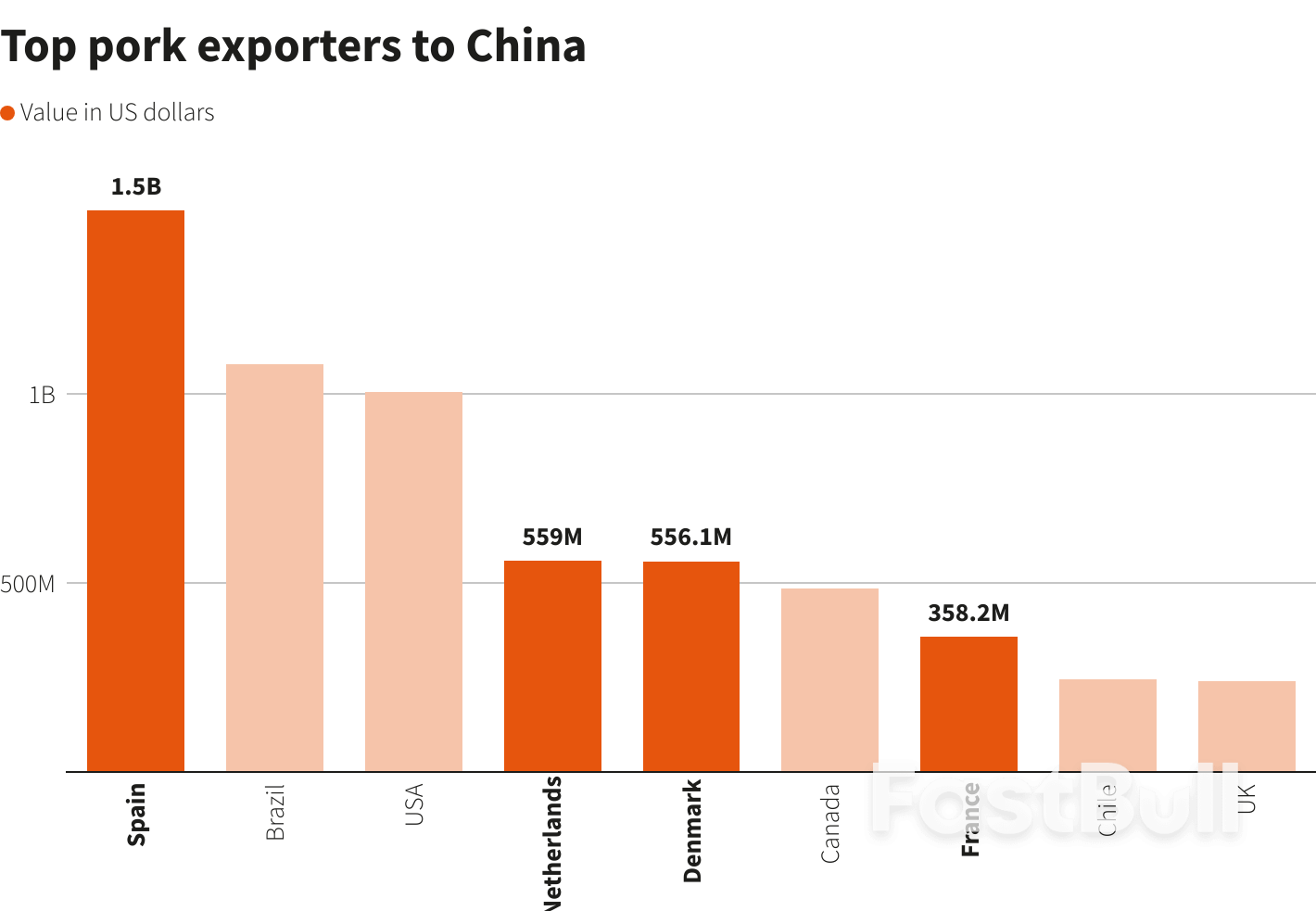
          China on Friday placed preliminary anti-dumping duties as high as 62.4% on pork imports worth over $2 billion from the European Union, deepening a trade dispute with the bloc arising from its tariffs on Chinese electric vehicles.
          The Ministry of Commerce's preliminary investigation into pork products found evidence of dumping that damaged the domestic industry and approved duties starting on September 10, according to a release on Friday.
          Companies that collaborated with the investigation, among them Spanish, Danish and Dutch firms, received duties ranging from 15.6% to 32.7%. All other firms were assigned 62.4%.
          Launched in June last year, the investigation is widely seen as retaliation for EU tariffs and has hit major producers such as Spain, the Netherlands and Denmark.
          A significant portion of the bloc's pork shipments to China consists of offal - including pig ears, noses and feet - highly valued in Chinese cuisine but with few alternative destinations.
          China slaps preliminary duties on EU pork imports_1
          Friday's decision is bad news for producers who had hoped Beijing’s decision to extend the investigation for six months in June this year meant a deal over the bloc’s electric vehicle tariffs was in the offing.
          The decision is only preliminary and could theoretically be changed before the investigation ends in December. There is also precedent for China extending investigations after levying tariffs, as in the case of Canadian canola.
          "The investigation was extended through December earlier this year, but that only leaves a few months to find a negotiated solution. The odds of that are increasingly slim," said Even Rogers Pay, an analyst at Beijing-based Trivium China who specialises in agriculture.
          In a separate release accompanying the decision, the Ministry of Commerce said it was willing to handle trade frictions with the European Union through dialogue and consultation.
          A significant portion of the bloc's pork shipments to China consists of offal - including pig ears, noses and feet - highly valued in Chinese cuisine but with few alternative destinations.

          Source: Reuters

          To stay updated on all economic events of today, please check out our Economic calendar
          Risk Warnings and Disclaimers
          You understand and acknowledge that there is a high degree of risk involved in trading. Following any strategies or investment methods may lead to potential losses. The content on the site is provided by our contributors and analysts for information purposes only. You are solely responsible for determining whether any trading assets, securities, strategy, or any other product is suitable for investing based on your own investment objectives and financial situation.
          Add to Favorites
          Share

          Rate-Cut Odds Surge After Soft Labor Market Signals; Here's What Wall Street Thinks...

          Damon

          Economic

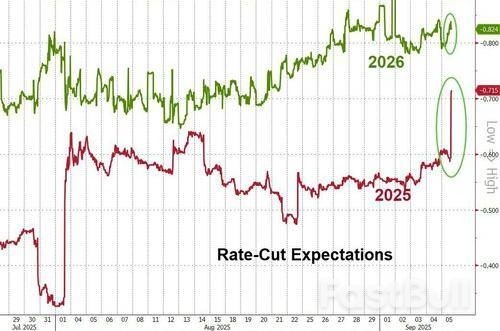
          Rate-cut expectations surged this morning following the weak labor market signals from the payrolls report with 2025 now pricing in 3 full cuts...

          Source: Bloomberg

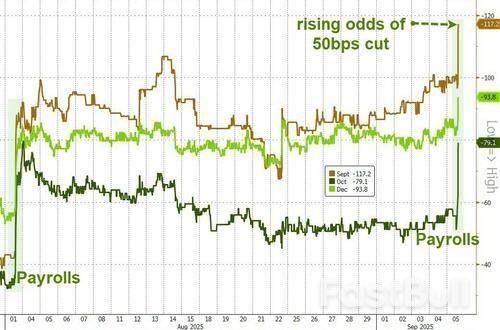
          As we predicted, the chance of a 50bps cut in September are also rising, but for now it appears 25bps in each of Sept, Oct, and Dec is the most likely outcome...

          Source: Bloomberg

          As The Wall Street Journal's fed Whisperer, Nick Timiraos, pointed out in a brief post on X:

          "Weak hiring this summer will make it easier for Fed policymakers to agree on a 25 bps cut at their meeting in two weeks but further muddies the debate over the pace of cuts after that."

          Consensus across Wall Street appears to be that Powell will cut in September, and continue to cut at each meeting this year at least:

          Gregory Faranello, head of US rates trading and strategy for AmeriVet Securities:

          “The job market has weakened and the transition between public to private sector job growth will require lower rates. The Fed will begin to lower rates this month and we expect a string of more cuts along the way. The forward curve has us down to neutral by the end of 2026 but that timeline could very well be sooner.”

          BI chief US interest-rate strategist Ira Jersey has a first take:

          “The bull steepening is no surprise given the overall payroll report. Negative revisions continue and hourly earnings growing more slowly point to the potential for a slowing in non-debt-fueled consumption growth in the next few quarters.”

          “Bull steepening should be maintained for the present, and we still target 10-year yields below 4% by year end, with 10-year yields having about a 0.5 beta to 2-year yields.”

          Matt Maley, chief market strategist at Miller Tabak:

          “[Bad news is good news for stocks] is the initial response. However, history tells us that if lower yields are signaling a significant slowdown in growth, it’s negative for stocks. So, we’re going to see how the market acts once the cash market opens.”

          Audrey Childe-Freeman, Bloomberg Intelligence’s chief G-10 FX strategist:

          “Dollar bears have just been given another lift, with the August employment report which will not only validate the September 25-bp Fed rate-cut talks, but is also likely to entertain speculation of more aggressive Fed easing going forward.”

          “This confirms our US yield-driven euro-dollar bullish case as we consider 4Q, with a break of $1.1750 now looming. Note that the euro context isn’t rosy at all — see French politics in particular — but for now, we expect this pair to be mainly driven by US considerations.”

          A jumbo rate cut?

          Brian Jacobsen, chief economist at Annex Wealth Management, goes there in his reaction to the data.

          "A 50 basis-point cut is back on the table. Everyone was probably more keyed-in on the revisions than the headline number. With revisions, there was nearly net zero job creation. Aggregate weekly hours were unchanged in August with broad declines across industries. Anything trade or tariff related saw declines in aggregate weekly hours worked.

          The diffusion index for private sector employment has been below 50, so it’s a top-heavy economy. You need some better breadth to remove the economic anxiety out there."

          BlackRock’s Jeff Rosenberg on the payrolls print on Bloomberg TV:

          “What it really puts on the table is a Fed that gets back in motion for cutting rates, and if the economy is not falling off a cliff, that’s a pretty good combination for risk assets.”

          Neil Dutta at Renaissance Macro says the numbers are a comprehensive defeat of the policy hawks and growth bulls.

          “To borrow from Powell, now is the time to unleash the great monetary power of the United States.”

          Seema Shah, chief global strategist, Principal Asset Management:

          “Today’s report just about strikes a balance between reinforcing market expectations for a sequence of Fed rate cuts and not yet inviting renewed concerns around recession, so the broad market response should be mildly positive. But concerns about the health of the economy are starting to creep in and a further deterioration in the health of the labor market would soon tip the balance to ‘bad news is simply bad news.’”

          Kevin Flanagan, head of fixed income strategy at WisdomTree says,

          “The markets are leading the Fed and the jobs report was the last data point needed for a quarter point cut this month. A half point is not out of the question, but at this stage of the game I would still lean to a quarter-point cut, now if we had seen a negative payroll, then a 50bps cut would be on the table.”

          Ali Jaffery‘s take at CIBC Capital Markets:

          While the macro case for easing policy isn’t so clear cut, with the economy looking fairly resilient in the face of a major trade war and an immigration crackdown, the politics of monetary policy are getting complicated and it’s likely not worth defending keeping rates on hold.

          Stephanie Roth, chief economist at Wolfe Research LLC, gave ger first thoughts on the report on Bloomberg Television’s Surveillance:

          “First take is another weak summer employment report. Immigration seems to be having another impact on the data. When you look at the household survey, the foreign-born population was again, sort of the weaker part of it.”

          “On Sept. 9, once we get the annual preliminary benchmark revisions, that’s going to be revised down to the tune of something like 600,000 — that’s going to be another really bad negative headline. Then beyond that, we think that the signs will look a little bit better.

          Finally, the factory sector is clearly showing pain and reflects ongoing uncertainty linked to the new tariffs and the need for lower borrowing costs, Alliance for American Manufacturing President Scott Paul says in a release:

          “The August jobs report should hopefully spur on two important actions. First, a cut in interest rates by the Federal Reserve. Second, concluding tariff actions and trade deals to provide businesses with the certainty they need to hire, invest in new capital equipment, and realign supply chains. Manufacturing will be treading water until we see those changes.”

          For now, stocks are higher, Treasury yields are significantly lower (and bull steepening), gold hit a new record high, and bitcoin is surging .

          Source: Zero Hedge

          To stay updated on all economic events of today, please check out our Economic calendar
          Risk Warnings and Disclaimers
          You understand and acknowledge that there is a high degree of risk involved in trading. Following any strategies or investment methods may lead to potential losses. The content on the site is provided by our contributors and analysts for information purposes only. You are solely responsible for determining whether any trading assets, securities, strategy, or any other product is suitable for investing based on your own investment objectives and financial situation.
          Add to Favorites
          Share

          Rupee hits record low on tariff jitters, but central bank caps decline

          Adam

          Forex

          The Indian rupee hit a lifetime low on Friday, pressured by worries over U.S. tariffs, leaving traders on edge even as likely central bank intervention helped limit losses.
          The Asian currency fell 0.14% to 88.2650 against the U.S. dollar, from 88.1450 in the previous session.
          Friday’s move ended a volatile week, during which the rupee largely stayed below the 88-mark, weighed down by persistent portfolio outflows and U.S. tariff-related uncertainties.
          Washington imposed a 50% tariff on key Indian exports from August 27 over what the White House sees as India's opportunistic purchases of cheap Russian oil.
          The rupee, which slipped past the 88-mark for the first time last week, slipped to its record low of 88.36 on Friday, as foreign banks and oil companies bought dollars and traders covered speculative positions.
          Foreign portfolio investors have pulled out $1.4 billion from Indian equities so far in September, taking the total outflow so far this year to over $16 billion.
          On the day, the Reserve Bank of India likely intervened in the forex market through state-run banks, which were spotted selling dollars above the 88.30 mark, traders said.
          Market participants expected support for the rupee at 88.70 levels, but the RBI came in much earlier to cap the slide, said Apurva Swarup, a vice president at Shinhan Bank.
          "Uncertainty around U.S. tariff is still spooking the market even as the Indian government is devising ways to counter the impact," Swarup said.
          India hopes to conclude a bilateral trade agreement with the U.S. by November.
          Meanwhile, Asian currencies strengthened against the dollar as traders positioned for a Federal Reserve rate cut this month. The Korean won led gains.
          The dollar index was 0.22% lower at 98.014. Traders await the U.S. nonfarm payrolls data, due after market hours.

          Source: Reuters

          Risk Warnings and Disclaimers
          You understand and acknowledge that there is a high degree of risk involved in trading. Following any strategies or investment methods may lead to potential losses. The content on the site is provided by our contributors and analysts for information purposes only. You are solely responsible for determining whether any trading assets, securities, strategy, or any other product is suitable for investing based on your own investment objectives and financial situation.
          Add to Favorites
          Share

          US Deploying Stealth Fighter Jets to Caribbean For Drug Fight As Tensions With Venezuela Rise, Sources Say

          Glendon

          Political

          The United States has ordered the deployment of 10 F-35 fighter jets to a Puerto Rico airfield to conduct operations against drug cartels, sources say, adding more firepower to intensifying U.S. military operations in the Caribbean that are stoking tension with Venezuela.

          The new deployment comes on top of an already bristling U.S. military presence in the southern Caribbean as President Donald Trump carries out a campaign pledge to crack down on groups he blames for funneling drugs into the United States.

          The disclosure about the F-35s came just hours after the Pentagon accused Venezuela of a "highly provocative" flight on Thursday by fighter jets over a U.S. Navy warship.

          It also follows a U.S. military strike on Tuesday that killed 11 people and sank a boat from Venezuela Trump said was transporting illegal drugs.

          At every turn, the Trump administration has sought to tie Venezuelan President Nicolas Maduro's government to narco-trafficking, allegations Caracas denies.

          More specifically, Trump has accused Maduro of running the Tren de Aragua gang, which his administration designated a terrorist organization in February.

          Venezuela's Communications Ministry did not respond to a request for comment about the F-35s or the allegations that Venezuelan fighter jets flew over a U.S. warship.

          The sources, speaking on condition of anonymity about the latest U.S. deployment, said the 10 fighter jets are being sent to conduct operations against designated narco-terrorist organizations operating in the southern Caribbean. The planes should arrive in the area by late next week, they said.

          F-35s are highly advanced stealth fighters and would be highly effective in combat against Venezuela's air force, which includes F-16 aircraft.

          A U.S. official, speaking on condition of anonymity, said two Venezuelan F-16s flew over the USS Jason Dunham on Thursday.

          The Dunham is one of at least seven U.S. warships deployed to the Caribbean, carrying more than 4,500 sailors and Marines.

          U.S. Marines and sailors from the 22nd Marine Expeditionary Unit have also been carrying out amphibious training and flight operations in southern Puerto Rico.

          The buildup has put pressure on Maduro, whom U.S. Defense Secretary Pete Hegseth has called "effectively a kingpin of a drug narco state."

          Maduro, at a rare news conference in Caracas on Monday, said the United States is "seeking a regime change through military threat."

          Speaking on Thursday, Hegseth defended Tuesday's deadly strike in comments to reporters and vowed that such activities would continue, citing the threat that illegal narcotics pose to public health in the United States.

          "The poisoning of the American people is over," Hegseth said.

          Rep. Ilhan Omar, a Democrat from Minnesota, condemned what she called Trump's "lawless" actions in the southern Caribbean.

          "Congress has not declared war on Venezuela, or Tren de Aragua, and the mere designation of a group as a terrorist organization does not give any President carte blanche to ignore Congress’s clear Constitutional authority on matters of war and peace," Omar said in a statement.

          U.S. officials have not clearly explained what legal justification was used for Tuesday's air strike on the boat or what drugs were on board.

          Trump said on Tuesday, without providing evidence, that the U.S. military had identified the crew of the vessel as members of Venezuelan gang Tren de Aragua.

          Source: Reuters

          Risk Warnings and Disclaimers
          You understand and acknowledge that there is a high degree of risk involved in trading. Following any strategies or investment methods may lead to potential losses. The content on the site is provided by our contributors and analysts for information purposes only. You are solely responsible for determining whether any trading assets, securities, strategy, or any other product is suitable for investing based on your own investment objectives and financial situation.
          Add to Favorites
          Share

          Canadian dollar eyes Canadian, US jobs data

          Adam

          Forex

          Economic

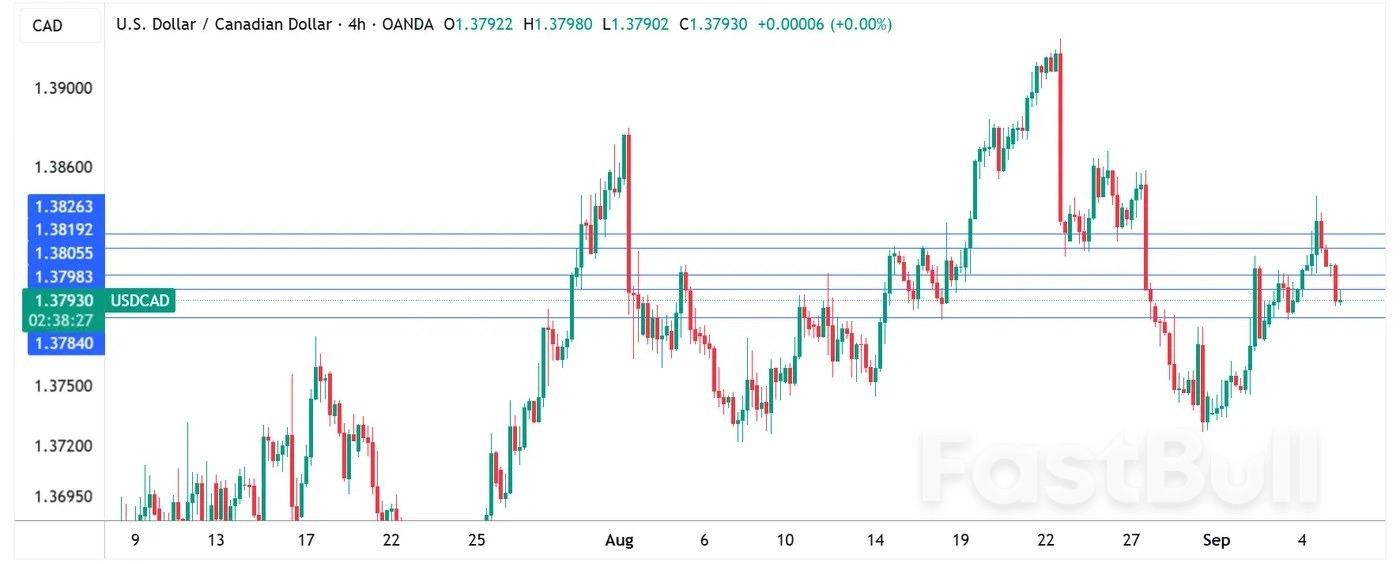
          The Canadian dollar has edged lower on Friday. In the European session, USD/CAD is trading at 1.3793, down 0.19% on the day. We could see stronger movement from the Canadian dollar later in the day, as Canada and the US release the August employment reports.

          Canada's employment expected to rebound

          Canada's labor market took a beating in July, with the loss of 40.8 thousand jobs, including 10 thousand job losses in manufacturing. The markets expect a rebound in August, with an estimate of 7.5 thousand new jobs. The unemployment rate is expected to tick up to 7.0% from 6.9%.
          The weak July reading was directly attributable to the US tariffs, which have hurt the Canadian economy. The US has slapped 35% tariffs on many Canadian products and Canada ships some 75% of its export to its southern neighbor. The two sides are yet to reach a trade agreement but Canada can ill afford a protracted trade war with the US.
          Markets brace for weak US NFP
          All eyes are on today's US employment report. With inflation largely under control, nonfarm payrolls are closely monitored and could move the US dollar.
          The markets are expecting virtually no change in nonfarm payrolls, with an estimate of 73 thousand for August after a gain of 75 thousand in July. The labor market is clearly cooling as employers remain cautious in an uncertain economic environment. The unemployment rate is expected to edge up to 4.3% from 4.2%, which would be the highest level since December 2021.
          The Federal Reserve is virtually certain to lower rates at the September 17 meeting, but a weak nonfarm payrolls report would likely lead to calls for the Fed to respond with a jumbo half-point cut.

          USD/CAD Technical

          USDCAD has pushed below support at 1.3798 and is testing 1.3798. Below, there is support at 1.3784
          There is resistance at 1.3819 and 1.3826
          Canadian dollar eyes Canadian, US jobs data_1

          USDCAD 4-Hour Chart, September 5, 2025

          Source: marketpulse

          To stay updated on all economic events of today, please check out our Economic calendar
          Risk Warnings and Disclaimers
          You understand and acknowledge that there is a high degree of risk involved in trading. Following any strategies or investment methods may lead to potential losses. The content on the site is provided by our contributors and analysts for information purposes only. You are solely responsible for determining whether any trading assets, securities, strategy, or any other product is suitable for investing based on your own investment objectives and financial situation.
          Add to Favorites
          Share

          Why Keynes’ Economic Theories Failed in Reality

          Adam

          Economic

          A recent post from Daniel Lacalle, “How Keynesians Got The US Economy Wrong Again,” exposed the widening gap between John Maynard Keynes’ economic theory and reality. Despite the confident forecasts of leading Keynesian economists, the U.S. economy in 2025 continues to defy expectations. The Federal Reserve’s tightening cycle failed to trigger the widely predicted “hard landing,” and growth has proven more resilient. Simultaneously, inflation remains somewhat sticky, but still declining, and the economy refuses to follow the neat, linear pathways that textbook models suggest.
          This latest embarrassment for Keynes’ orthodoxy is part of a much larger story. The failures aren’t isolated miscalculations but the predictable result of a flawed framework that policymakers have clung to for decades. Keynesian economics didn’t just “get it wrong” in 2025, but has repeatedly failed to deliver on its promises for over forty years. And the consequences are becoming impossible to ignore.
          At its core, Keynesian economics is deceptively simple. When demand for the private sector falls, the government should borrow and spend to fill the gap. The idea is that temporary fiscal stimulus injections will smooth business cycles, reduce unemployment, and quickly return the economy to full capacity.
          But the key word here is temporary. John Maynard Keynes was clear: governments should run deficits during downturns and surpluses during expansions. The debt incurred to rescue the economy should be repaid once conditions normalize.
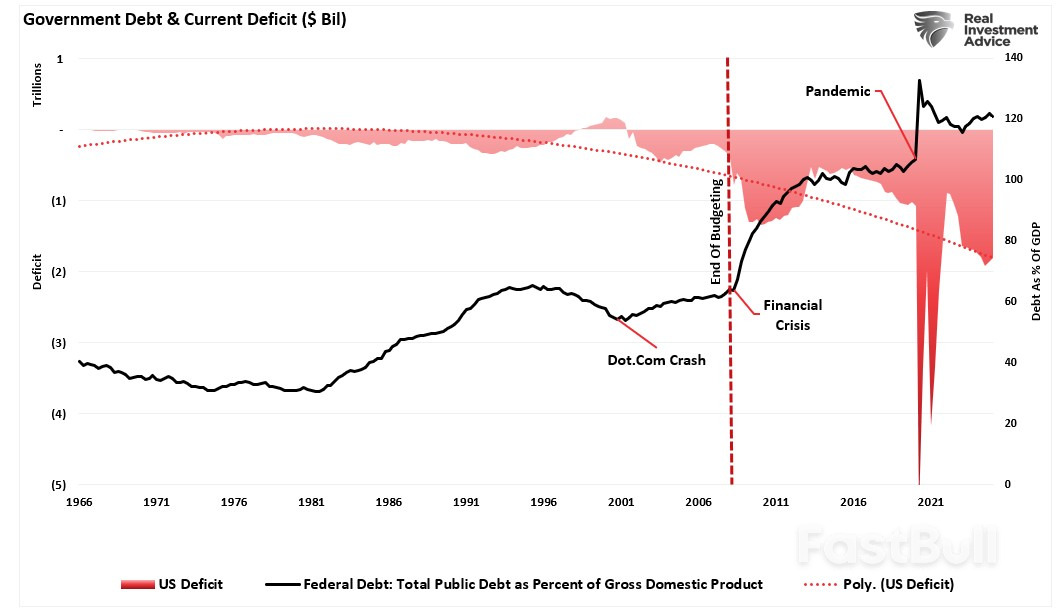
          However, in practice, this discipline never materialized. Politicians discovered that voters liked stimulus but hated austerity. Since the 1970s, deficits have become a permanent feature of U.S. fiscal policy, regardless of the business cycle. The results are sobering: the U.S. national debt now exceeds 120% of GDP, entitlement programs are structurally underfunded, and each crisis requires larger interventions with diminishing economic benefits.
          Why Keynes’ Economic Theories Failed in Reality_1
          The COVID-19 pandemic was the ultimate Keynes experiment. Between 2020 and 2022, the federal government injected over $5 trillion in fiscal stimulus into the economy, complemented by the Federal Reserve slashing interest rates to zero and expanding its balance sheet by $120 billion each month. According to the Keynesian model, this unprecedented monetary and fiscal stimulus should have ushered in a durable economic boom.
          The Failure of Artificial Growth
          However, as we noted in “MMT Was Tried And Failed,” the massive flood of stimulus temporarily boosted economic growth by “pulling forward” future demand, but it also created several problems.
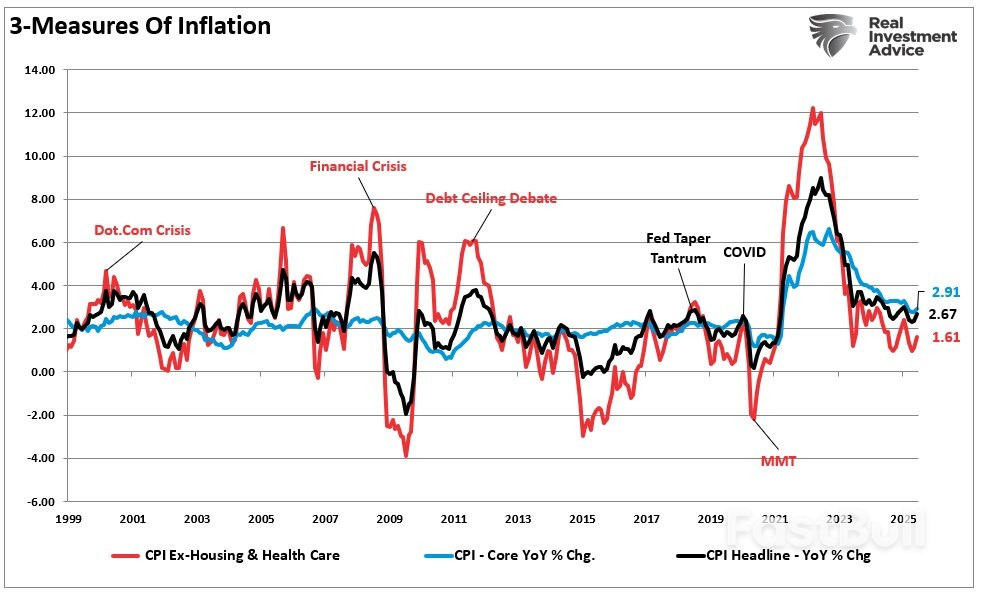
          “The most obvious problem was the impact of dramatically increasing demand on a supply-stricken economy. With the economy “shut down” due to Government-mandated restrictions, the flood of stimulus payments led to a demand boost. Given the basic economics of supply versus demand, prices rose. As expected would be the case, the implementation led to a massive surge in inflation. (Given most Americans’ have fixed healthcare and housing payments for a contractual period, the third measure shows what cost-of-living is for most every month.)”
          Crucially, inflation, excluding housing and healthcare, surged to nearly 12% during the pandemic-stimulus-infused spending spree. However, today, as the economy slows and the stimulus fades from the system, that inflation rate has declined to just 1.61%.
          Why Keynes’ Economic Theories Failed in Reality_2
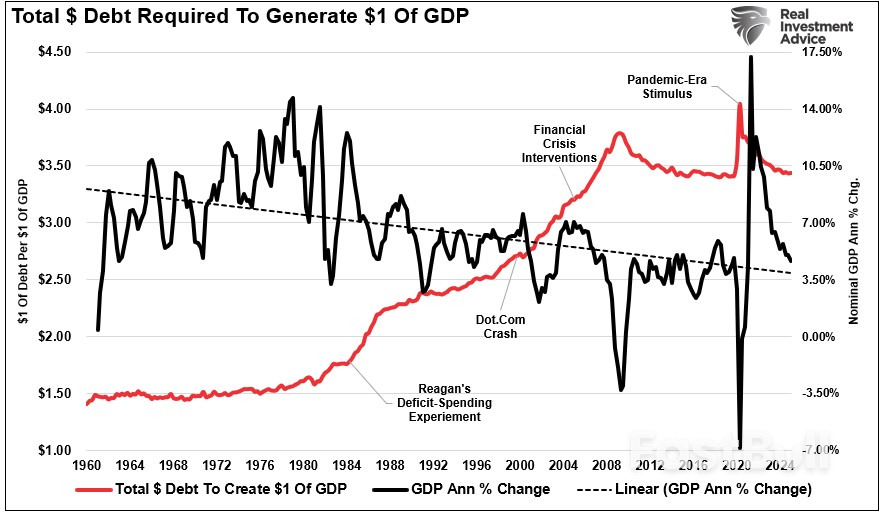
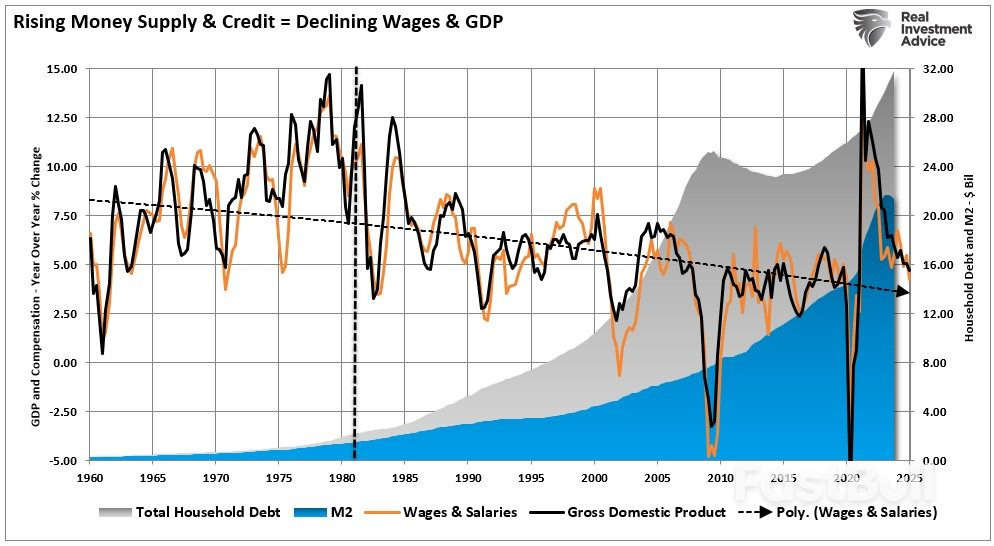
          Secondly, the “economic boom” created by the demand-pull stimulus continues to disappear as the economy normalizes slowly back to roughly $3.50 in debt to make $1 of economic activity. Following the pandemic shutdown, the economy surged to unprecedented levels, nearing 17.5% nominal growth. On a shuttered economy, the byproduct of all that demand was an inflation surge to 40-year highs, peaking above 9% in 2022. Five years later, inflation continues to decline towards the Fed’s 2% target, but remains sticky as remnants of monetary and fiscal stimulus continue to flow through the system.
          Why Keynes’ Economic Theories Failed in Reality_3
          The Broken Transmission of Monetary Policy
          A further failure of modern Keynesian policy is its overreliance on central banks. Through rate cuts and quantitative easing (QE), monetary stimulus has become the go-to solution for any economic slowdown. Yet the transmission mechanism between monetary policy and real economic activity has fundamentally broken. Artificial interventions and “MMT” failed to work in reality because the underlying transmission system failed.
          “The promise of something for nothing will never lose its luster. So MMT should be viewed as a form of political propaganda rather than any real economic or public policy. And like all propaganda, we must fight it with appeals to reality. MMT, where deficits don’t matter, is an unreal place.”
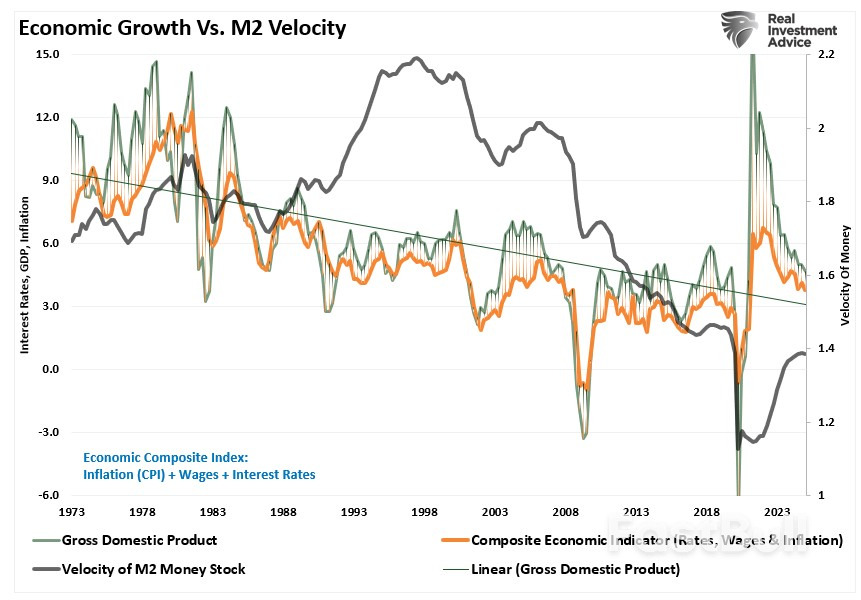
          Meanwhile, the velocity of money, the rate at which money changes hands in the economy, while recovering somewhat from the economic shutdown, continues to trend lower. In other words, the Fed can inject liquidity but fails to circulate productively. The velocity trend does not provide an encouraging outlook for GDP growth.
          Why Keynes’ Economic Theories Failed in Reality_4
          Given the weakening economic growth rates and subsequently declining inflation, a direct reflection of weakening consumer demand, banks have little incentive to expand lending at current rates, especially in an environment of tighter regulations and poor credit quality.
          One key problem is that Keynesian models assume a linear cause-and-effect relationship between government spending and economic output. They focus almost entirely on aggregate demand, neglecting critical dynamics like debt saturation, supply chain fragilities, and the feedback loops of global capital markets.
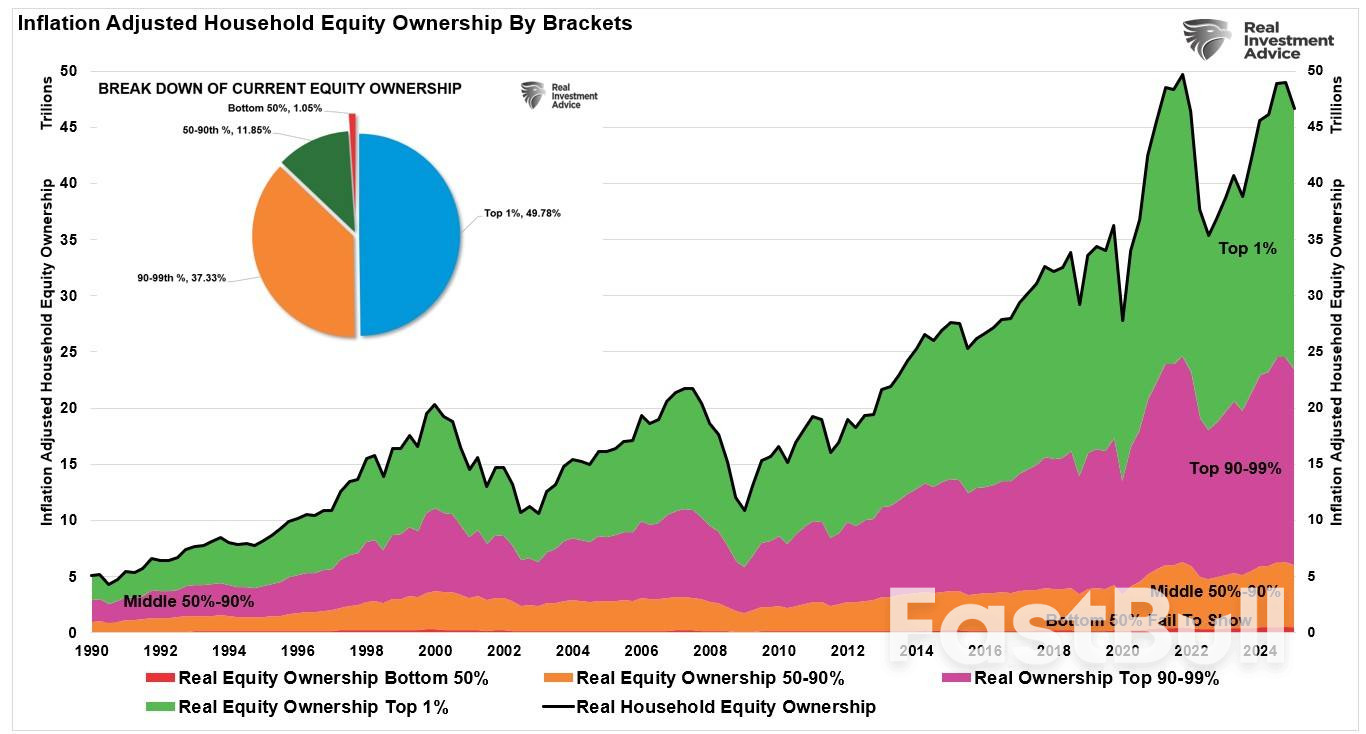
          In today’s highly financialized economy, government spending does not circulate efficiently. As noted, much of it gets trapped in financial markets, inflating asset prices rather than stimulating productive investment. Ultra-low interest rates, another hallmark of Keynesian policy, discourage savings and encourage debt-fueled speculation. This distorts capital allocation, causing malinvestment in unproductive assets like meme stocks, speculative real estate, and unprofitable tech ventures. Most benefits remain trapped in the top 10% of the economy, which owns roughly 88% of the inflation-adjusted financial assets.
          Why Keynes’ Economic Theories Failed in Reality_5
          In other words, the wealthy retain the monetary injections while inflation taxes them away from the poor.
          Mr. Lacallie highlighted this mismatch between Keynes’ theories and economic realities. As he noted, many mainstream economists repeatedly forecasted a 2023-2024 recession that never arrived, underestimated inflation persistence, and misread the impact of fiscal tightening. These forecasting errors expose deeper flaws in how Keynesians model the modern economy.
          Hayek’s Warnings Prove Prophetic
          The Austrian school of economics, particularly Friedrich Hayek’s views, starkly contrasts with Keynesian thinking. Austrian economists believe that a sustained period of low interest rates and excessive credit creation creates a dangerous imbalance between saving and investment. In other words, low interest rates tend to stimulate borrowing from the banking system, which leads, as one would expect, to the expansion of credit. This expansion of credit, then, in turn, increases the supply of money.
          Therefore, as one would ultimately expect, the credit-sourced boom becomes unsustainable as artificially stimulated borrowing seeks out diminishing investment opportunities. Finally, the credit-sourced boom results in widespread malinvestments. When the exponential credit creation is no longer be sustainable, a “credit contraction” occurs, ultimately shrinking the money supply. The markets eventually “clear,” which causes resources to be reallocated towards more efficient uses.
          Why Keynes’ Economic Theories Failed in Reality_6
          Modern policymakers refuse to allow this natural process. Each downturn results in more aggressive stimulus, which only delays the necessary corrections. The result has been a relentless build-up of economic imbalances. Inefficient businesses survive on cheap debt, zombie firms proliferate, and innovation suffers. Each economic expansion is weaker than the last, and each recovery depends on larger interventions to stay afloat.
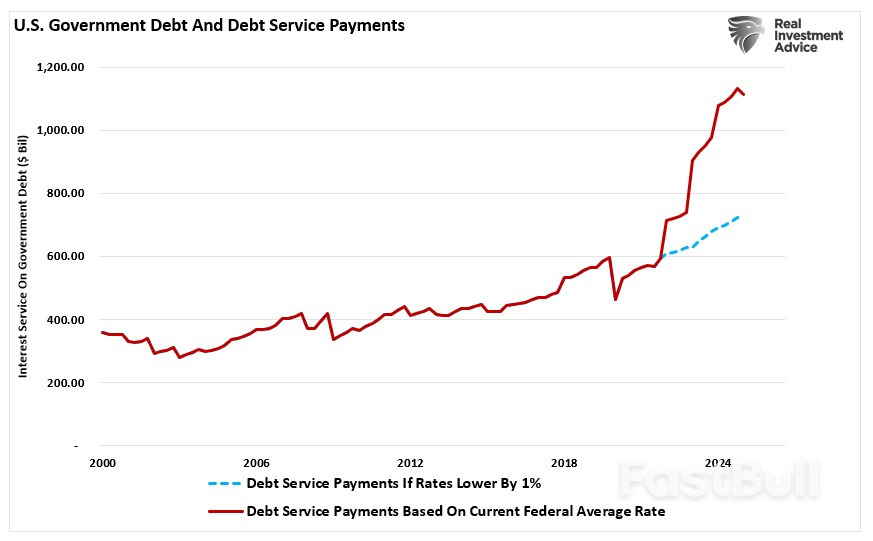
          Perhaps the greatest misconception perpetuated by Keynesian economists is that debt-financed stimulus is a free lunch. In reality, servicing the debt and rising debt service costs become a significant economic headwind. The Congressional Budget Office projects that U.S. interest payments will exceed national defense spending in the coming years and approach $1.5 trillion annually by 2030. Of course, that is assuming that rates stay where they are currently. The next crisis, which has become more common since the turn of the century, will significantly lower rates. As shown, a reduction in rates by 1% would dramatically impact future liabilities.
          Why Keynes’ Economic Theories Failed in Reality_7
          This is not just a fiscal issue—it’s a macroeconomic drag. Spending dollars on interest payments diverts them from infrastructure, education, or productive investment. Worse, rising debt levels crowd out private investment, distort capital markets, and reduce the flexibility to respond to future crises.
          Conclusion: Keynes’ Economic Theory Has Failed
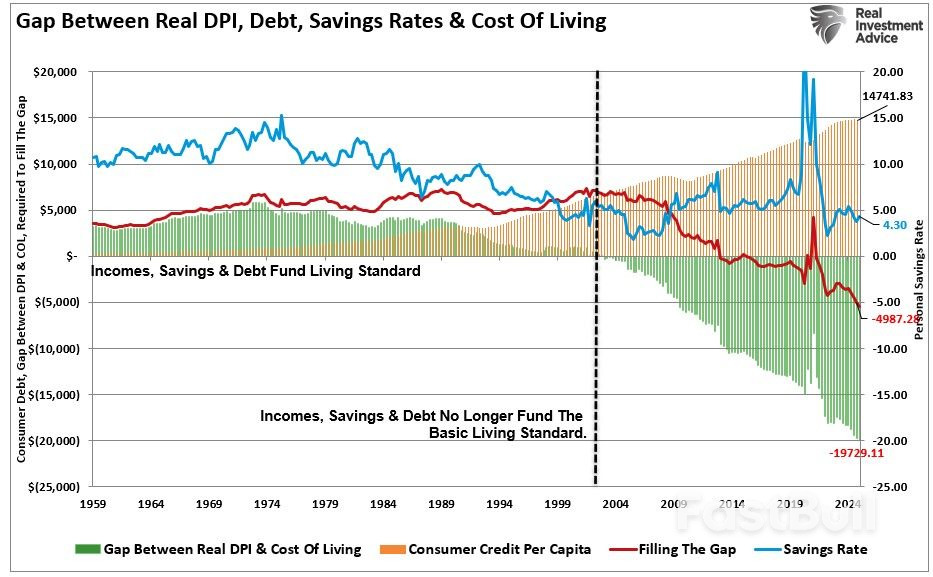
          For the last 40 years, each Administration and the Federal Reserve have continued to operate under Keynes’s monetary and fiscal policies, believing the model worked. The reality, however, is that most of the economy’s aggregate growth is financed by deficit spending, credit expansion, and a reduction in savings.
          This reduced productive investment and slowed the economy’s output. As the economy slowed and wages fell, the consumer took on more leverage, decreasing savings. The result of the increased leverage required more income to service the debt, rather than fuel increased consumption.
          Why Keynes’ Economic Theories Failed in Reality_8
          Secondly, most government spending programs redistribute income from workers to the unemployed. Keynes’ economists argue that this increases the welfare of many hurt by the recession. What their models ignore, however, is the reduced productivity that follows a shift of resources toward redistribution and away from productive investment.
          All of these issues have weighed on the overall prosperity of the economy. What is most telling is the inability of current economists, who maintain our monetary and fiscal policies, to realize the problem of trying to “cure a debt problem with more debt.”
          This is why Keynes’ economic policies have failed, from “cash for clunkers” to “Quantitative easing.” Each intervention either dragged future consumption forward or stimulated asset markets. Pulling future consumption forward leaves a “void” in the future that must be continually filled. However, creating an artificial wealth effect decreases savings, which could be used for productive investment.
          It’s time we wake up and realize we are on the same path.

          Source: investing

          To stay updated on all economic events of today, please check out our Economic calendar
          Risk Warnings and Disclaimers
          You understand and acknowledge that there is a high degree of risk involved in trading. Following any strategies or investment methods may lead to potential losses. The content on the site is provided by our contributors and analysts for information purposes only. You are solely responsible for determining whether any trading assets, securities, strategy, or any other product is suitable for investing based on your own investment objectives and financial situation.
          Add to Favorites
          Share
          FastBull
          Copyright © 2025 FastBull Ltd

          728 RM B 7/F GEE LOK IND BLDG NO 34 HUNG TO RD KWUN TONG KLN HONG KONG

          TelegramInstagramTwitterfacebooklinkedin
          App Store Google Play Google Play
          Products
          Charts

          Chats

          Q&A with Experts
          Screeners
          Economic Calendar
          Data
          Tools
          Membership
          Features
          Function
          Markets
          Copy Trading
          Latest Signals
          Contests
          News
          Analysis
          24/7
          Columns
          Education
          Company
          Careers
          About Us
          Contact Us
          Advertising
          Help Center
          Feedback
          User Agreement
          Privacy Policy
          Business

          White Label

          Data API

          Web Plug-ins

          Poster Maker

          Affiliate Program

          Risk Disclosure

          The risk of loss in trading financial instruments such as stocks, FX, commodities, futures, bonds, ETFs and crypto can be substantial. You may sustain a total loss of the funds that you deposit with your broker. Therefore, you should carefully consider whether such trading is suitable for you in light of your circumstances and financial resources.

          No decision to invest should be made without thoroughly conducting due diligence by yourself or consulting with your financial advisors. Our web content might not suit you since we don't know your financial conditions and investment needs. Our financial information might have latency or contain inaccuracy, so you should be fully responsible for any of your trading and investment decisions. The company will not be responsible for your capital loss.

          Without getting permission from the website, you are not allowed to copy the website's graphics, texts, or trademarks. Intellectual property rights in the content or data incorporated into this website belong to its providers and exchange merchants.

          Not Logged In

          Log in to access more features

          FastBull Membership

          Not yet

          Purchase

          Become a signal provider
          Help Center
          Customer Service
          Dark Mode
          Price Up/Down Colors

          Log In

          Sign Up
          Position
          Layout
          Fullscreen
          Default to Chart
          The chart page opens by default when you visit fastbull.com