• Trade
  • Markets
  • Copy
  • Contests
  • News
  • 24/7
  • Calendar
  • Q&A
  • Chats
Trending
Screeners
SYMBOL
LAST
BID
ASK
HIGH
LOW
NET CHG.
%CHG.
SPREAD
SPX
S&P 500 Index
6774.75
6774.75
6774.75
6816.12
6758.51
+53.32
+ 0.79%
--
DJI
Dow Jones Industrial Average
47951.84
47951.84
47951.84
48365.93
47849.48
+65.88
+ 0.14%
--
IXIC
NASDAQ Composite Index
23006.35
23006.35
23006.35
23149.61
22906.23
+313.02
+ 1.38%
--
USDX
US Dollar Index
98.060
98.140
98.060
98.110
98.050
0.000
0.00%
--
EURUSD
Euro / US Dollar
1.17274
1.17281
1.17274
1.17285
1.17097
+0.00041
+ 0.03%
--
GBPUSD
Pound Sterling / US Dollar
1.33842
1.33854
1.33842
1.33865
1.33696
+0.00039
+ 0.03%
--
XAUUSD
Gold / US Dollar
4324.15
4324.60
4324.15
4336.82
4309.03
-8.51
-0.20%
--
WTI
Light Sweet Crude Oil
55.817
55.872
55.817
55.932
55.700
+0.049
+ 0.09%
--

Community Accounts

Signal Accounts
--
Profit Accounts
--
Loss Accounts
--
View More

Become a signal provider

Sell trading signals to earn additional income

View More

Guide to Copy Trading

Get started with ease and confidence

View More

Signal Accounts for Members

All Signal Accounts

Best Return
  • Best Return
  • Best P/L
  • Best MDD
Past 1W
  • Past 1W
  • Past 1M
  • Past 1Y

All Contests

    Top News Only
    TIME
    ACT
    FCST
    PREV
    Q&A with Experts
      • All
      • Chatrooms
      • Groups
      • Friends
      Connecting
      .
      .
      .
      Type here...
      Add Symbol or Code

        No matching data

        Search
        Products

        Charts Free Forever

        Chats Q&A with Experts
        Screeners Economic Calendar Data Tools
        Membership Features
        Data Warehouse Market Trends Institutional Data Policy Rates Macro

        Market Trends

        Market Sentiment Order Book Forex Correlations

        Top Indicators

        Charts Free Forever
        Markets

        News

        News Analysis 24/7 Columns Education
        From Institutions From Analysts
        Topics Columnists

        Latest Views

        Latest Views

        Trending Topics

        Top Columnists

        Latest Update

        Signals

        Copy Rankings Latest Signals Become a signal provider AI Rating
        Contests
        Brokers

        Overview Brokers Assessment Rankings Regulators News Claims
        Broker listing Forex Brokers Comparison Tool Live Spread Comparison Scam
        Q&A Complaint Scam Alert Videos Tips to Detect Scam
        More

        Business
        Events
        Careers About Us Advertising Help Center

        White Label

        Data API

        Web Plug-ins

        Affiliate Program

        Awards Institution Evaluation IB Seminar Salon Event Exhibition
        Vietnam Thailand Singapore Dubai
        Fans Party Investment Sharing Session
        FastBull Summit BrokersView Expo
        Recent Searches
          Top Searches
            Markets
            News
            Analysis
            User
            24/7
            Economic Calendar
            Education
            Data
            • Names
            • Latest
            • Prev

            View All

            No data

            Scan to Download

            Faster Charts, Chat Faster!

            Download App
            English
            • English
            • Español
            • العربية
            • Bahasa Indonesia
            • Bahasa Melayu
            • Tiếng Việt
            • ภาษาไทย
            • Français
            • Italiano
            • Türkçe
            • Русский язык
            • 简中
            • 繁中
            Open Account
            Search
            Products
            Charts Free Forever
            Markets
            News
            Signals

            Copy Rankings Latest Signals Become a signal provider AI Rating
            Contests
            Brokers

            Overview Brokers Assessment Rankings Regulators News Claims
            Broker listing Forex Brokers Comparison Tool Live Spread Comparison Scam
            Q&A Complaint Scam Alert Videos Tips to Detect Scam
            More

            Business
            Events
            Careers About Us Advertising Help Center

            White Label

            Data API

            Web Plug-ins

            Affiliate Program

            Awards Institution Evaluation IB Seminar Salon Event Exhibition
            Vietnam Thailand Singapore Dubai
            Fans Party Investment Sharing Session
            FastBull Summit BrokersView Expo

            FACT FOCUS: Trump’s Glowing Account of Progress Is at Odds With His Government’s Own Stats

            Warren Takunda

            Economic

            Summary:

            President Trump touted falling prices, record investment and a landslide victory, but government data and historical records show inflation remains elevated, investment claims are overstated, and his election win was decisive but far from a landslide.

            President Donald Trump’s glowing account of progress under his watch Wednesday was out of tune with the experience of price-squeezed Americans and the story told by some of his government’s own statistics.
            In a speech from the White House, Trump assailed the record of his Democratic predecessor and boasted expansively about his record so far. Not all of those boasts were credible.
            Among them:

            On inflation

            TRUMP: He blamed Democrats for handing him an “inflation disaster,” “the worst in the history of our country,” and said that now, the prices of turkey and eggs have come down and “everything else is falling rapidly. And it’s not done yet. But boy, are we making progress.”
            THE FACTS: His claim that prices are falling rapidly is not seen in the inflation numbers, which are about where they were when he took office, after having fallen significantly before the end of Joe Biden’s presidency. Nor is it true that the Biden era gave the country its worst inflation ever.
            The consumer price index was 3% in September, the same rate as in January, a tick up from 2.9% in December, Biden’s last full month in office. In an AP-NORC poll this month, the vast majority of U.S. adults said they’ve noticed higher than usual prices for groceries, electricity and holiday gifts in recent months.
            Biden-era inflation peaked at 9.1% in June 2022, a consequence of supply chain interruptions, potentially excessive amounts of government aid and Russia’s invasion of Ukraine driving up food and energy costs. Americans have known even worse and more sustained inflation than that: higher than 13% in 1980 during an extended period of price pain. By some estimates, inflation approached 20% during World War I.
            Inflation had been falling during the first few months of Trump’s presidency, but it picked back up after the president announced his tariffs in April.

            On investment

            TRUMP: “I secured a record-breaking $18 trillion of investment into the United States.”
            THE FACTS: Trump has presented no evidence that he’s secured this much domestic or foreign investment for the United States. Based on statements from various companies, foreign countries and the White House’s own website, that figure appears to be exaggerated, highly speculative and far higher than the actual sum.
            Even the White House website offers a far lower number, $9.6 trillion, and that figure appears to include some investment commitments made during Biden’s presidency.
            Trump has routinely claimed rosy investment numbers, without offering the details to support them. Trump nailed down some of the investment terms in an October trip to Japan and South Korea, but they’re over multiple years and it remains to be seen how ironclad those commitments and others will be.

            A landslide?

            TRUMP: “I was elected in a landslide, winning the popular vote and all seven swing states and everything else, with a mandate to take on a sick and corrupt system.”
            THE FACTS: Trump won a decisive victory but hardly a landslide one, however you define a landslide. Trump, who became president with 312 electoral votes, won fewer than Democrats Barack Obama in 2008 (365) and 2012 (332) and Bill Clinton in 1992 (370) and 1996 (379).
            The electoral performance of those men pales in comparison with the sweeps by Franklin Roosevelt in 1936 (523), Lyndon Johnson in 1964 (486), Richard Nixon in 1972 (520) and Ronald Reagan (525) in 1984.
            Trump did win more popular votes than his Democratic opponent, Kamala Harris, but not quite a majority of them. His win in 2024 ranks among the more narrow.

            Source: AP

            To stay updated on all economic events of today, please check out our Economic calendar
            Risk Warnings and Disclaimers
            You understand and acknowledge that there is a high degree of risk involved in trading. Following any strategies or investment methods may lead to potential losses. The content on the site is provided by our contributors and analysts for information purposes only. You are solely responsible for determining whether any trading assets, securities, strategy, or any other product is suitable for investing based on your own investment objectives and financial situation.
            Add to Favorites
            Share

            US Core CPI Unexpectedly Eases to Slowest Pace Since 2021

            Glendon

            Forex

            Economic

            Underlying US inflation rose in November from a year earlier at the slowest pace since early 2021, marking a respite from months of stubborn price pressures, according to a report complicated by the federal government shutdown.

            The core consumer price index (CPI), which excludes the often-volatile food and energy categories, increased 2.6% in November, according to Bureau of Labor Statistics (BLS) data out Thursday. That compares with a 3% annual advance two months earlier. The overall CPI climbed 2.7% in November from a year ago.

            The BLS was unable to collect much of the October price data due to the government shutdown, limiting the agency's ability to determine month-over-month changes for the broader measures of inflation and many key categories in November.

            The BLS said the core CPI rose 0.2% over the two months ended in November, restrained by declines in costs of hotel stays, recreation and apparel. Prices of household furnishings and personal care products rose.

            Despite numerous caveats, the report offers hope that inflationary pressures are easing after remaining stuck in a narrow range since early this year.

            Stock-index futures extended gains, while Treasury yields and the dollar fell after the report.

            It's not clear whether the CPI report will sway Federal Reserve policymakers, who remain divided on the course of interest rates next year. Last week, the Fed lowered interest rates for a third straight meeting to guard against a more concerning deterioration in the labour market.

            Fed chair Jerome Powell said last week the CPI data "may be distorted" because of the record-long government shutdown that ended on Nov 12.

            Source: Theedgemarkets

            To stay updated on all economic events of today, please check out our Economic calendar
            Risk Warnings and Disclaimers
            You understand and acknowledge that there is a high degree of risk involved in trading. Following any strategies or investment methods may lead to potential losses. The content on the site is provided by our contributors and analysts for information purposes only. You are solely responsible for determining whether any trading assets, securities, strategy, or any other product is suitable for investing based on your own investment objectives and financial situation.
            Add to Favorites
            Share

            Oil News: Sanctions Risk Lifts Futures as Oil Demand and Supply Outlook Tighten

            Adam

            Commodity

            Light Crude Holds Firmer as Traders Assess Geopolitical Supply Threats

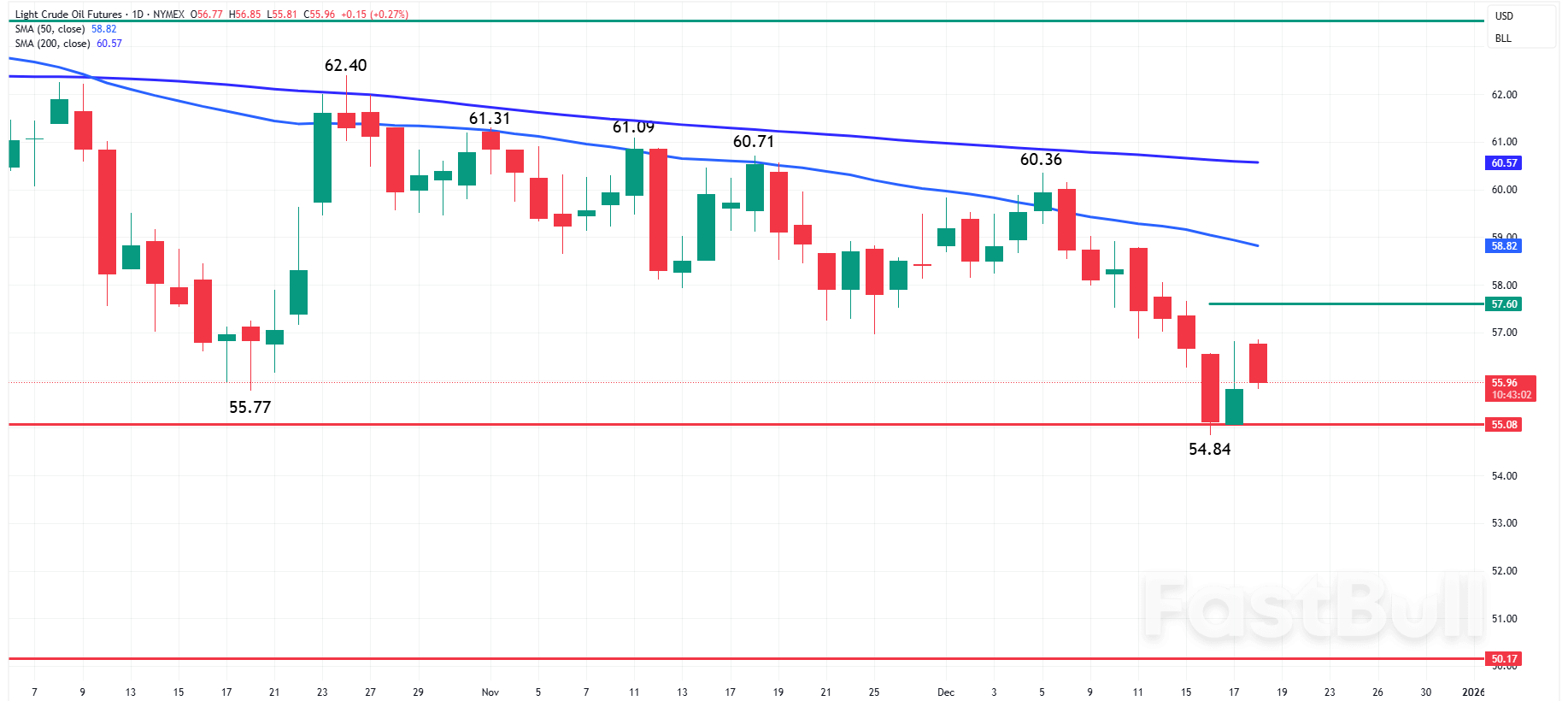
            Oil News: Sanctions Risk Lifts Futures as Oil Demand and Supply Outlook Tighten_1Daily Light Crude Oil Futures

            Light crude oil futures traded slightly higher on Thursday, stabilizing after surrendering earlier gains that lifted prices to an overnight high of $56.85. Futures are now leaning on the minor pivot at $55.845, a level that has taken on outsized importance after Tuesday’s drop to a five-year low at $54.84. The market’s response to this pivot is shaping short-term sentiment as traders gauge whether consolidation will hold or sellers will press for another test of the week’s lows.
            At 11:19 GMT, Light Crude Oil Futures are trading $55.92, up $0.11 or +0.20%.

            Geopolitical Pressure Builds: Are Sanctions the Next Catalyst for Oil Prices Forecast?

            Fresh headlines surrounding potential U.S. sanctions on Russia added a firm tone to crude early in the session. Bloomberg reported that Washington is preparing additional measures targeting Russia’s energy sector should Moscow refuse to move toward a peace agreement with Ukraine. While a White House official told Reuters that President Donald Trump has not made final decisions, traders treated the possibility as a credible risk that could tighten supplies. Analysts noted that expanded sanctions on Russian crude would likely carry more weight for the global market than the separate blockade threat tied to Venezuela.

            Venezuela Blockade Raises Supply Concerns but Enforcement Remains Unclear

            The proposed U.S. blockade of tankers carrying Venezuelan oil has introduced another layer of uncertainty. According to ING, as much as 600,000 barrels per day of Venezuelan exports—mostly destined for China—could be disrupted. About 160,000 bpd of flows to the United States would probably continue, supported by existing authorizations that allow Chevron vessels to depart. Most other Venezuelan shipments were halted on Wednesday, although PDVSA managed to restart loading after a cyberattack temporarily shut operations.

            Enforcement Questions Keep Traders Focused on Crude Oil News Today

            Uncertainty over implementation remains significant. The U.S. Coast Guard already seized a Venezuelan tanker last week, and sources indicated Washington may prepare for additional interdictions. Still, full details on how a blockade would function are unclear, keeping traders wary but not yet pricing in a severe supply shock. Venezuelan crude accounts for roughly 1% of global supply, meaning enforcement outcomes matter more than the headline volume alone.

            Market Levels and Oil Prices Projections Point to a Cautious Bullish Bias

            With futures consolidating between $54.84 and $56.85, holding the pivot at $55.845 is essential for any late-session rebound. A push higher would bring the short-term upside target of $57.60 into view, followed by resistance at $58.82 and the 200-day moving average at $60.57. Given the geopolitical backdrop and early buying interest, the near-term outlook leans cautiously bullish, provided the market maintains support above the pivot and avoids another test of the weekly low.

            Source: fxempire

            Risk Warnings and Disclaimers
            You understand and acknowledge that there is a high degree of risk involved in trading. Following any strategies or investment methods may lead to potential losses. The content on the site is provided by our contributors and analysts for information purposes only. You are solely responsible for determining whether any trading assets, securities, strategy, or any other product is suitable for investing based on your own investment objectives and financial situation.
            Add to Favorites
            Share

            Japan Nears 30-Year Rate High as BOJ Balances Inflation Control Against Economic Fragility

            Gerik

            Economic

            Forex

            BOJ Approaches Milestone Amid Economic Headwinds

            As 2025 draws to a close, the Bank of Japan is widely expected to raise its benchmark interest rate to 0.75%, marking a historic shift after decades of ultra-loose policy. Data from LSEG indicates an 86.4% market probability that this decision will be made at the year’s final monetary policy meeting, ending Friday. If confirmed, it would represent the highest policy rate since 1995, formally breaking away from Japan’s negative interest rate era that began in 2016.
            While the move is positioned as a necessary step toward monetary normalization, the decision comes at a time when Japan’s economic performance is showing significant weakness. The revised GDP data for Q3 2025 confirmed a sharper-than-expected contraction: a quarterly drop of 0.6% and an annualized fall of 2.3%. This downturn creates a fragile backdrop for a rate hike, suggesting the central bank is prioritizing structural monetary reforms over short-term growth support.

            Inflation and Currency Dynamics Drive Policy Decisions

            The principal motivation behind the BOJ’s rate hike is persistent inflation. Consumer prices have exceeded the BOJ’s 2% target for 43 consecutive months, weakening the credibility of its previous dovish stance. A higher interest rate is expected to help strengthen the yen against the U.S. dollar, potentially slowing imported inflation and relieving pressure on consumers. The yen has traded between 154 and 157 per dollar since November, reflecting ongoing depreciation that intensified after the October appointment of Prime Minister Sanae Takaichi, a known supporter of loose monetary policy.
            The relationship between rate increases and currency appreciation is based on the interest rate differential between Japan and its global counterparts, particularly the United States. As U.S. rates stabilize or decline, Japan’s upward adjustments reduce this differential, attracting capital inflows and bolstering the yen. However, the real impact will depend on the BOJ’s communication, especially any indication of a policy ceiling or “terminal rate.”

            Markets Focus on Neutral Rate Guidance

            Investors are increasingly focused not just on whether the BOJ will raise rates, but how far and how fast it intends to go. Governor Kazuo Ueda acknowledged earlier this month that estimating Japan’s neutral interest rate the rate at which monetary policy is neither expansionary nor contractionary remains challenging. The central bank currently estimates this rate to lie somewhere between 1% and 2.5%, a range too wide to guide investor expectations effectively.
            This vagueness complicates forward-looking assessments. If the BOJ signals confidence in a neutral rate closer to the lower end, markets may price in a shallower path of rate increases. Conversely, a higher estimate may fuel speculation about more aggressive tightening, which could further depress domestic economic activity already under pressure.

            Future Rate Trajectory: A Slow March or Sudden Turns?

            The pace of future hikes remains a matter of debate. According to ING, a follow-up rate hike may not occur until October 2026, while Bank of America projects June 2026, with a possibility of moving it forward to April if the yen experiences renewed depreciation. BofA expects the terminal rate to reach 1.5% by the end of 2027, assuming no disruptive external shocks.
            Nonetheless, analysts caution that several variables could derail this path. These include a sharp slowdown in the U.S. economy or heightened geopolitical tensions between China and Japan. In the absence of such shocks, the BOJ appears committed to a gradual, cautious tightening cycle. MFS Investment Management’s Carl Ang maintains that only a “material shock” would prompt a major deviation from the projected trajectory.

            Bond and Currency Markets Eye BOJ Signals

            The bond and currency markets will closely watch the tone and specifics of BOJ commentary. Allianz Global Investors' Gregor MA Hirt highlighted that any direct reference by Governor Ueda to the yen’s weakness could serve as a critical signal potentially a verbal intervention aimed at stabilizing currency expectations.
            Given that the BOJ has so far avoided making forex stability a central objective, any shift in language would suggest growing discomfort with the yen’s devaluation. Such a move could influence expectations not only around rates but also around other policy tools, including bond yield control mechanisms.

            Policy Normalization Meets Fragile Growth

            Japan's anticipated rate hike represents a bold step toward rebalancing decades of accommodative monetary policy. However, the timing is fraught with risk. On one hand, inflation control and yen stability support the case for higher rates. On the other, the recent economic contraction and unclear guidance on the terminal rate could amplify market volatility and investor uncertainty.
            The BOJ finds itself at a critical juncture: committed to reforming its monetary stance while navigating a sluggish economy and opaque global outlook. Whether this move marks the beginning of a stable normalization era or exacerbates Japan’s deflationary legacy depends heavily on future policy clarity, currency behavior, and the resilience of domestic demand. Investors and policymakers alike will be watching Friday’s decision and the language that follows with heightened scrutiny.

            Source: CNBC

            To stay updated on all economic events of today, please check out our Economic calendar
            Risk Warnings and Disclaimers
            You understand and acknowledge that there is a high degree of risk involved in trading. Following any strategies or investment methods may lead to potential losses. The content on the site is provided by our contributors and analysts for information purposes only. You are solely responsible for determining whether any trading assets, securities, strategy, or any other product is suitable for investing based on your own investment objectives and financial situation.
            Add to Favorites
            Share

            Political Stalemate and Strategic Misalignment Stall India-U.S. Trade Pact

            Gerik

            Economic

            Shifting From Symbolism to Stalemate

            At the start of 2025, the India-U.S. relationship appeared poised for a breakthrough. Prime Minister Narendra Modi and U.S. President Donald Trump met within hours of Trump’s inauguration and jointly announced an ambition to double bilateral trade to $500 billion by 2030. The optics were promising, yet nearly a year later, that momentum has faltered. India now faces one of the highest effective U.S. tariff rates globally exceeding even those imposed on China undermining the initial enthusiasm.
            This regression does not reflect a lack of mutual interest. The U.S. urgently seeks reliable supply chain alternatives beyond China, and India offers both capacity and geopolitical alignment. Conversely, India’s export-driven growth aspirations hinge on gaining meaningful access to the American market. Nonetheless, technical hurdles have turned into political paralysis, with each side unwilling to concede on core sensitivities.

            Negotiation Gridlock: Tariffs, Agriculture, and Political Calculus

            U.S. trade delegations have repeatedly visited New Delhi throughout 2025, but their efforts have yielded no substantial progress. One key factor constraining movement is the absence of sustained political commitment. As former U.S. trade representative Mark Linscott noted, the real barrier is not just policy but political will. He suggested that India might sway Washington through strategic energy deals, such as large-scale ethanol or sustainable aviation fuel purchases.
            The United States aims to rebalance its trade deficit with India by expanding agricultural and energy exports. India has shown partial willingness on energy but continues to resist liberalization of its agricultural sector, which remains highly politicized. Washington’s push for India to import genetically modified crops and open its dairy markets has encountered strong backlash from Indian farm lobbies, especially ahead of key state elections in West Bengal, Tamil Nadu, and Kerala. With Uttar Pradesh India’s largest agricultural state due for elections in 2027, concessions in this area appear increasingly unlikely.

            Russian Oil and the Sanctions Tightrope

            India’s energy policy has become another flashpoint. Washington has pressed India to reduce its Russian oil imports, arguing these purchases undermine Western sanctions on Moscow. In response, the U.S. imposed an additional 25% tariff on Indian goods in August 2025, lifting total duties to as high as 50%. However, India’s foreign ministry has maintained that private refiners base sourcing decisions on global price dynamics, not geopolitics. India has not officially committed to cutting Russian oil imports, and refiners resumed purchases from non-sanctioned Russian suppliers offering deep discounts by November.
            This illustrates a strategic divergence rather than a direct conflict. While India seeks affordable energy for its 1.4 billion citizens, Washington views commodity purchases through the lens of foreign policy leverage. Although the U.S. acknowledges a drop in Russian oil volumes, it remains insufficient to lift punitive tariffs. Analysts note that even if the Russia-Ukraine conflict were resolved, agricultural trade barriers would still block any comprehensive agreement.

            Economic Frictions and Market Volatility

            The lack of a trade agreement is generating measurable macroeconomic consequences. Anand Rathi’s Pradeep Gupta warned that prolonged uncertainty is leading to market hesitancy, especially in sectors reliant on U.S. demand. Volatility in capital flows and currency weakness, particularly a softening rupee, reflect broader investor anxiety. Gupta’s firm estimates that a 50% tariff burden could subtract up to 0.5 percentage points from India’s GDP. Goldman Sachs offers an even more cautious projection, suggesting a 0.6-point drag.
            Despite this, Indian exports have remained relatively resilient, with only a temporary decline in October. Analysts like Michael Kugelman of the Atlantic Council argue that India has managed to circumvent some tariff pressures. However, he cautions that deeper concessions especially those entailing political risk are inevitable if a deal is to be secured.

            Mounting Costs in the U.S. Domestic Market

            In the U.S., higher import tariffs are compounding inflationary pressures. American businesses, particularly small and mid-sized importers of pharmaceuticals, machinery, and household goods, are absorbing rising costs and passing them on to consumers. Some are resorting to high-interest loans to sustain operations amid cost inflation.
            Wayne Winegarden of the Pacific Research Institute argues that the current tariff regime damages both nations. He characterizes the Trump-led trade escalation as arbitrary and economically destructive, especially for U.S. families contending with inflated prices. The burden is especially heavy for those importing from India, where duties on key goods have doubled within months.

            Strategic Opportunity Lost For Now

            Despite strong strategic alignment and long-standing goodwill frequently emphasized by President Trump’s references to Modi as a “great friend” the two countries have failed to formalize a trade pact by year’s end. Citi economist Samiran Chakraborty captured the shift in sentiment when he remarked that India had gone from being a top trade-deal prospect to becoming the last in line.
            As 2026 approaches, whether new political incentives or external shocks can break the current impasse remains unclear. For now, the India-U.S. trade relationship is stalled not by the absence of logic, but by the lack of compromise on both sides. The future of this economic alliance will depend on the readiness to bridge this political divide with credible actions not just handshakes.

            Source: CNBC

            To stay updated on all economic events of today, please check out our Economic calendar
            Risk Warnings and Disclaimers
            You understand and acknowledge that there is a high degree of risk involved in trading. Following any strategies or investment methods may lead to potential losses. The content on the site is provided by our contributors and analysts for information purposes only. You are solely responsible for determining whether any trading assets, securities, strategy, or any other product is suitable for investing based on your own investment objectives and financial situation.
            Add to Favorites
            Share

            Trump Announces Military ‘Warrior Dividend’ Amid Inflation Woes

            Winkelmann

            Political

            Economic

            President Donald Trump announced plans to award 1.45 million service members $1,776 payments as he sought to reassure Americans concerned about his stewardship of the US economy.

            "Military service members will receive a special — we call Warrior Dividend — before Christmas, in honor of our nation's founding in 1776," Trump said.

            Trump announced the plan Wednesday during a prime-time address from the White House meant to extol his accomplishments this year and assuage Americans increasingly worried about their cost of living.

            The planned payments — pegged to the year the US declared its independence from Great Britain — are broadly in keeping with the administration's efforts to steer financial rewards to certain constituencies.

            Administration officials cast the address as an opportunity to highlight the president's accomplishments in his first year back in the White House and preview new policies for 2026, but the remarks come at a critical moment with Trump confronting mounting public anxiety about his economic agenda and his advisers struggling to hone their messaging.

            Voters returned Trump to office in part to address the persistent inflation that plagued former President Joe Biden. And Trump spent much of his remarks looking to lay the blame at the foot of his predecessor, detailing price increases during the prior administration.

            "11 months ago, I inherited a mess, and I'm fixing it," Trump said. "When I took office, inflation was the worst in 48 years, and some would say in the history of our country, which caused prices to be higher than ever before, making life unaffordable for millions and millions of Americans."

            Trump now finds himself facing the same economic headwinds. Surveys show Americans are worried about the cost of living and inflation, fears that powered rival Democrats to key electoral wins in November and pose a major threat to Trump and Republicans in 2026 elections that will decide control of Congress and the future of his legislative agenda.

            A Reuters/Ipsos poll released Tuesday showed Trump's approval rating had slipped to nearly its lowest level of his second term in office, with just 39% of US adults approving of his job performance.

            Trump's own inconsistent messaging on the economy has made his task harder. The president has vacillated between deriding voter anger over affordability as a Democratic "hoax" and at times emphasizing lower prices for gasoline and eggs as positive bellwethers.

            Trump graded his record on the economy as an "A-plus-plus-plus-plus-plus," while insisting that his administration needs more time to remedy what he says was a mess left by Biden. The president also is in the final stages of a search for a new Federal Reserve chair.

            "I'll soon announce our next chairman of the Federal Reserve, someone who believes in lower interest rates, by a lot, and mortgage payments will be coming down even further. Early in the new year, and you will see this in the new year, I will announce some of the most aggressive housing reform plans in American history," Trump said.

            Trump sought to rally viewers by touting his work on other issues, saying he had stopped the flow of undocumented migrants and drugs while bolstering the military and brokering a ceasefire in Gaza.

            "Boy, are we making progress. Nobody can believe what's going on," Trump said.

            Source: Bloomberg Europe

            To stay updated on all economic events of today, please check out our Economic calendar
            Risk Warnings and Disclaimers
            You understand and acknowledge that there is a high degree of risk involved in trading. Following any strategies or investment methods may lead to potential losses. The content on the site is provided by our contributors and analysts for information purposes only. You are solely responsible for determining whether any trading assets, securities, strategy, or any other product is suitable for investing based on your own investment objectives and financial situation.
            Add to Favorites
            Share

            U.S. CPI Misses Forecasts, Strengthening Case for Further Fed Rate Cuts

            Michelle

            Forex

            Economic

            Cooling CPI Print Lifts Rate-Cut Expectations and Risk Appetite

            U.S. inflation data delivered a clear downside surprise, giving traders fresh evidence that price pressures continue to ease and strengthening expectations for further Federal Reserve policy support. November consumer prices rose at a slower pace than forecast, reinforcing the view that the Fed's recent rate cuts are gaining traction across the economy.

            Headline and Core Inflation Undershoot Forecasts

            The Consumer Price Index increased 2.7% year over year in November, below the 3.1% consensus estimate. Core CPI, excluding food and energy, rose 2.6% from a year earlier, also undershooting expectations for a 3.0% gain. On a two-month, seasonally adjusted basis covering September through November, both headline and core prices advanced 0.2%. The report follows a disruption in October data collection due to a federal government shutdown, making this release especially important for policy and positioning.

            Energy and Shelter Remain Key Contributors

            Energy prices remain a notable upside factor, with the energy index up 4.2% year over year. Electricity prices climbed 6.9%, while natural gas surged 9.1%, highlighting ongoing cost pressure for households and utilities. Shelter inflation eased but stayed firm at 3.0% annually, confirming that housing costs are slowing gradually rather than collapsing. These components continue to shape inflation persistence even as broader price growth cools.

            Services Inflation Moderates as Goods Stay Contained

            Services excluding energy rose 3.0% over the past year, signaling moderation compared with earlier readings. Medical care services increased 3.3%, while transportation services advanced 1.7%. Goods inflation remained contained, with commodities excluding food and energy up just 1.4% year over year. Used cars and trucks rose 3.6%, but apparel prices increased only 0.2%, underscoring limited pricing power outside select categories.

            Federal Reserve Signal Turns More Supportive

            The softer CPI print follows the Fed's third consecutive 25-basis-point rate cut earlier this month. Market participants increasingly view the central bank as prioritizing labor market stability as inflation trends lower. Equity investors interpreted the data as reinforcing a policy backstop, while bond markets leaned toward expectations that easing may extend further than previously priced.

            Market Forecast: Short-Term Bullish Bias

            The November CPI report supports a short-term bullish bias for risk assets. Cooling headline and core inflation strengthen the case for continued Federal Reserve easing, improving sentiment across equities and credit while keeping pressure on yields. Unless upcoming data reverse this trend, markets are likely to favor growth exposure and rate-sensitive sectors in the near term.

            Source: FX Empire

            To stay updated on all economic events of today, please check out our Economic calendar
            Risk Warnings and Disclaimers
            You understand and acknowledge that there is a high degree of risk involved in trading. Following any strategies or investment methods may lead to potential losses. The content on the site is provided by our contributors and analysts for information purposes only. You are solely responsible for determining whether any trading assets, securities, strategy, or any other product is suitable for investing based on your own investment objectives and financial situation.
            Add to Favorites
            Share
            FastBull
            Copyright © 2025 FastBull Ltd

            728 RM B 7/F GEE LOK IND BLDG NO 34 HUNG TO RD KWUN TONG KLN HONG KONG

            TelegramInstagramTwitterfacebooklinkedin
            App Store Google Play Google Play
            Products
            Charts

            Chats

            Q&A with Experts
            Screeners
            Economic Calendar
            Data
            Tools
            Membership
            Features
            Function
            Markets
            Copy Trading
            Latest Signals
            Contests
            News
            Analysis
            24/7
            Columns
            Education
            Company
            Careers
            About Us
            Contact Us
            Advertising
            Help Center
            Feedback
            User Agreement
            Privacy Policy
            Personal Information Protection Statement
            Business

            White Label

            Data API

            Web Plug-ins

            Poster Maker

            Affiliate Program

            Risk Disclosure

            The risk of loss in trading financial instruments such as stocks, FX, commodities, futures, bonds, ETFs and crypto can be substantial. You may sustain a total loss of the funds that you deposit with your broker. Therefore, you should carefully consider whether such trading is suitable for you in light of your circumstances and financial resources.

            No decision to invest should be made without thoroughly conducting due diligence by yourself or consulting with your financial advisors. Our web content might not suit you since we don't know your financial conditions and investment needs. Our financial information might have latency or contain inaccuracy, so you should be fully responsible for any of your trading and investment decisions. The company will not be responsible for your capital loss.

            Without getting permission from the website, you are not allowed to copy the website's graphics, texts, or trademarks. Intellectual property rights in the content or data incorporated into this website belong to its providers and exchange merchants.

            Not Logged In

            Log in to access more features

            FastBull Membership

            Not yet

            Purchase

            Become a signal provider
            Help Center
            Customer Service
            Dark Mode
            Price Up/Down Colors

            Log In

            Sign Up

            Position
            Layout
            Fullscreen
            Default to Chart
            The chart page opens by default when you visit fastbull.com