
• Trade
  • Markets
  • Copy
  • Contests
  • News
  • 24/7
  • Calendar
  • Q&A
  • Chats
Trending
Screeners
SYMBOL
LAST
BID
ASK
HIGH
LOW
NET CHG.
%CHG.
SPREAD
SPX
S&P 500 Index
6827.42
6827.42
6827.42
6899.86
6801.80
-73.58
-1.07%
--
DJI
Dow Jones Industrial Average
48458.04
48458.04
48458.04
48886.86
48334.10
-245.98
-0.51%
--
IXIC
NASDAQ Composite Index
23195.16
23195.16
23195.16
23554.89
23094.51
-398.69
-1.69%
--
USDX
US Dollar Index
97.820
97.900
97.820
98.070
97.810
-0.130
-0.13%
--
EURUSD
Euro / US Dollar
1.17580
1.17587
1.17580
1.17590
1.17262
+0.00186
+ 0.16%
--
GBPUSD
Pound Sterling / US Dollar
1.33903
1.33910
1.33903
1.33940
1.33546
+0.00196
+ 0.15%
--
XAUUSD
Gold / US Dollar
4338.20
4338.61
4338.20
4350.16
4294.68
+38.81
+ 0.90%
--
WTI
Light Sweet Crude Oil
57.137
57.167
57.137
57.601
56.878
-0.096
-0.17%
--

Community Accounts

Signal Accounts
--
Profit Accounts
--
Loss Accounts
--
View More

Become a signal provider

Sell trading signals to earn additional income

View More

Guide to Copy Trading

Get started with ease and confidence

View More

Signal Accounts for Members

All Signal Accounts

Best Return
  • Best Return
  • Best P/L
  • Best MDD
Past 1W
  • Past 1W
  • Past 1M
  • Past 1Y

All Contests

  • All
  • Trump Updates
  • Recommend
  • Stocks
  • Cryptocurrencies
  • Central Banks
  • Featured News
Top News Only
Share

Canada Nov CPI Common +2.8%, CPI Median +2.8%, CPI Trim +2.8% On Year

Share

NY Fed's Empire State Prices Paid Index +37.6 In December Versus+49.0 In November

Share

Canada Nov Consumer Prices +0.1% On Month, +2.2% On Year

Share

Canada Nov CPI Core -0.1% On Month, +2.9% On Year

Share

Canada Nov Core CPI, Seasonally Adjusted +0.2% On Month, Oct +0.3% (Unrevised)

Share

UK Health Minister Streeting On Doctors' Strike: Vote To Go Ahead Reveals The Bma's Shocking Disregard For Patient Safety

Share

Venezuelan State Oil Company Pdvsa Says Was Subject To Cyber Attack But Operations Unaffected

Share

Russia Central Bank Says January-October Current Account Surplus At $37.1 Billion

Share

Polish Current Account Balance At +1924 Million Euros In October Versus+130 Million Euros Seen In Reuters Poll

Share

Statement: Germany, Ukraine Propose 10-Point Plan To Strengthen Armament Cooperation

Share

London Metal Exchange Three Month Copper Falls More Than 3% To $11541.50 A Metric Ton

Share

[Market Update] Spot Silver Surged $2.00 During The Day, Returning To $64/ounce, A Gain Of 3.23%

Share

European Central Bank: Italy's Recurrent Ad Hoc Tax Provisions Cause Uncertainty, Damage Investor Confidence, And May Affect Banks' Funding Costs

Share

Stats Office: Nigeria Consumer Inflation At 14.45% Year-On-Year In November

Share

European Central Bank: Italy's Budget Measures Weighing On Domestic Banks Could Have "Negative Implications" On Their Credit Liquidity

Share

Azerbaijan's January-November Oil Exports Via Btc Pipeline Down 7.1% Year-On-Year Data Shows

Share

Azerbaijan's Aliyev Plans A Large-Scale Prisoner Amnesty, Azertac Reports

Share

EU Commission Chief Von Der Leyen, NATO's Rutte Join Ukraine Talks In Berlin

Share

EU Announces Sanctions On Companies, Individuals For Moving Russian Oil

Share

ICE New York Cocoa Futures Fall More Than 5% To $5945 Per Metric Ton

TIME
ACT
FCST
PREV
Japan Tankan Small Manufacturing Outlook Index (Q4)

A:--

F: --

P: --

Japan Tankan Large Non-Manufacturing Outlook Index (Q4)

A:--

F: --

P: --

Japan Tankan Large Manufacturing Outlook Index (Q4)

A:--

F: --

P: --

Japan Tankan Small Manufacturing Diffusion Index (Q4)

A:--

F: --

P: --

Japan Tankan Large Manufacturing Diffusion Index (Q4)

A:--

F: --

P: --

Japan Tankan Large-Enterprise Capital Expenditure YoY (Q4)

A:--

F: --

P: --

U.K. Rightmove House Price Index YoY (Dec)

A:--

F: --

P: --

China, Mainland Industrial Output YoY (YTD) (Nov)

A:--

F: --

P: --

China, Mainland Urban Area Unemployment Rate (Nov)

A:--

F: --

P: --

Saudi Arabia CPI YoY (Nov)

A:--

F: --

P: --

Euro Zone Industrial Output YoY (Oct)

A:--

F: --

P: --

Euro Zone Industrial Output MoM (Oct)

A:--

F: --

P: --

Canada Existing Home Sales MoM (Nov)

A:--

F: --

P: --

Canada National Economic Confidence Index

A:--

F: --

P: --

Canada New Housing Starts (Nov)

A:--

F: --

P: --
U.S. NY Fed Manufacturing Employment Index (Dec)

A:--

F: --

P: --

U.S. NY Fed Manufacturing Index (Dec)

A:--

F: --

P: --

Canada Core CPI YoY (Nov)

A:--

F: --

P: --

Canada Manufacturing Unfilled Orders MoM (Oct)

A:--

F: --

P: --

U.S. NY Fed Manufacturing Prices Received Index (Dec)

A:--

F: --

P: --

U.S. NY Fed Manufacturing New Orders Index (Dec)

A:--

F: --

P: --

Canada Manufacturing New Orders MoM (Oct)

A:--

F: --

P: --

Canada Core CPI MoM (Nov)

A:--

F: --

P: --

Canada Trimmed CPI YoY (SA) (Nov)

A:--

F: --

P: --

Canada Manufacturing Inventory MoM (Oct)

A:--

F: --

P: --

Canada CPI YoY (Nov)

A:--

F: --

P: --

Canada CPI MoM (Nov)

A:--

F: --

P: --

Canada CPI YoY (SA) (Nov)

--

F: --

P: --

Canada Core CPI MoM (SA) (Nov)

A:--

F: --

P: --

Canada CPI MoM (SA) (Nov)

A:--

F: --

P: --

Federal Reserve Board Governor Milan delivered a speech
U.S. NAHB Housing Market Index (Dec)

--

F: --

P: --

Australia Composite PMI Prelim (Dec)

--

F: --

P: --

Australia Services PMI Prelim (Dec)

--

F: --

P: --

Australia Manufacturing PMI Prelim (Dec)

--

F: --

P: --

Japan Manufacturing PMI Prelim (SA) (Dec)

--

F: --

P: --

U.K. 3-Month ILO Employment Change (Oct)

--

F: --

P: --

U.K. Unemployment Claimant Count (Nov)

--

F: --

P: --

U.K. Unemployment Rate (Nov)

--

F: --

P: --

U.K. 3-Month ILO Unemployment Rate (Oct)

--

F: --

P: --

U.K. Average Weekly Earnings (3-Month Average, Including Bonuses) YoY (Oct)

--

F: --

P: --

U.K. Average Weekly Earnings (3-Month Average, Excluding Bonuses) YoY (Oct)

--

F: --

P: --

France Services PMI Prelim (Dec)

--

F: --

P: --

France Composite PMI Prelim (SA) (Dec)

--

F: --

P: --

France Manufacturing PMI Prelim (Dec)

--

F: --

P: --

Germany Services PMI Prelim (SA) (Dec)

--

F: --

P: --

Q&A with Experts
    • All
    • Chatrooms
    • Groups
    • Friends
    Connecting
    .
    .
    .
    Type here...
    Add Symbol or Code

      No matching data

      All
      Trump Updates
      Recommend
      Stocks
      Cryptocurrencies
      Central Banks
      Featured News
      • All
      • Russia-Ukraine Conflict
      • Middle East Flashpoint
      • All
      • Russia-Ukraine Conflict
      • Middle East Flashpoint
      Search
      Products

      Charts Free Forever

      Chats Q&A with Experts
      Screeners Economic Calendar Data Tools
      Membership Features
      Data Warehouse Market Trends Institutional Data Policy Rates Macro

      Market Trends

      Market Sentiment Order Book Forex Correlations

      Top Indicators

      Charts Free Forever
      Markets

      News

      News Analysis 24/7 Columns Education
      From Institutions From Analysts
      Topics Columnists

      Latest Views

      Latest Views

      Trending Topics

      Top Columnists

      Latest Update

      Signals

      Copy Rankings Latest Signals Become a signal provider AI Rating
      Contests
      Brokers

      Overview Brokers Assessment Rankings Regulators News Claims
      Broker listing Forex Brokers Comparison Tool Live Spread Comparison Scam
      Q&A Complaint Scam Alert Videos Tips to Detect Scam
      More

      Business
      Events
      Careers About Us Advertising Help Center

      White Label

      Data API

      Web Plug-ins

      Affiliate Program

      Awards Institution Evaluation IB Seminar Salon Event Exhibition
      Vietnam Thailand Singapore Dubai
      Fans Party Investment Sharing Session
      FastBull Summit BrokersView Expo
      Recent Searches
        Top Searches
          Markets
          News
          Analysis
          User
          24/7
          Economic Calendar
          Education
          Data
          • Names
          • Latest
          • Prev

          View All

          No data

          Scan to Download

          Faster Charts, Chat Faster!

          Download App
          English
          • English
          • Español
          • العربية
          • Bahasa Indonesia
          • Bahasa Melayu
          • Tiếng Việt
          • ภาษาไทย
          • Français
          • Italiano
          • Türkçe
          • Русский язык
          • 简中
          • 繁中
          Open Account
          Search
          Products
          Charts Free Forever
          Markets
          News
          Signals

          Copy Rankings Latest Signals Become a signal provider AI Rating
          Contests
          Brokers

          Overview Brokers Assessment Rankings Regulators News Claims
          Broker listing Forex Brokers Comparison Tool Live Spread Comparison Scam
          Q&A Complaint Scam Alert Videos Tips to Detect Scam
          More

          Business
          Events
          Careers About Us Advertising Help Center

          White Label

          Data API

          Web Plug-ins

          Affiliate Program

          Awards Institution Evaluation IB Seminar Salon Event Exhibition
          Vietnam Thailand Singapore Dubai
          Fans Party Investment Sharing Session
          FastBull Summit BrokersView Expo

          EURUSD Weekly Forecast: Still Range-bound, Focus On The Fed

          Samantha Luan

          Forex

          Technical Analysis

          Economic

          Summary:

          Expectations of a dovish Federal Reserve policy in September remain the main driver for the currency market.

          Expectations of a dovish Federal Reserve policy in September remain the main driver for the currency market. The probability of a rate cut currently stands at 98%. Profit-taking and cautious investor interest in risk assets add to pressure on the US dollar.

          EURUSD dynamics are shaped by the contrast between signals from the Fed and ECB, along with market reaction to fresh macroeconomic data. This review explores potential EURUSD scenarios in early September, considering revised US GDP figures, political pressure on the Fed, and developments within the eurozone.

          EURUSD forecast for this week: quick overview

          Market focus

          The EURUSD pair closed the week of 1-5 September near 1.1660, remaining in the middle of the recent months’ range.

          The dollar index hovered around 98 following weak US labour data (JOLTS showed job openings down to 7.18 million, the lowest since September 2024) and revised GDP growth of +3.3% q/q. The likelihood of a 25-basis-point Federal Reserve rate cut in September increased to 98%, up from 86% a week earlier. In the eurozone, the August CPI confirmed a slowdown in inflation (2.1% y/y), with unemployment stable at 6.2% and the PPI down to +0.2% y/y.

          Current trend

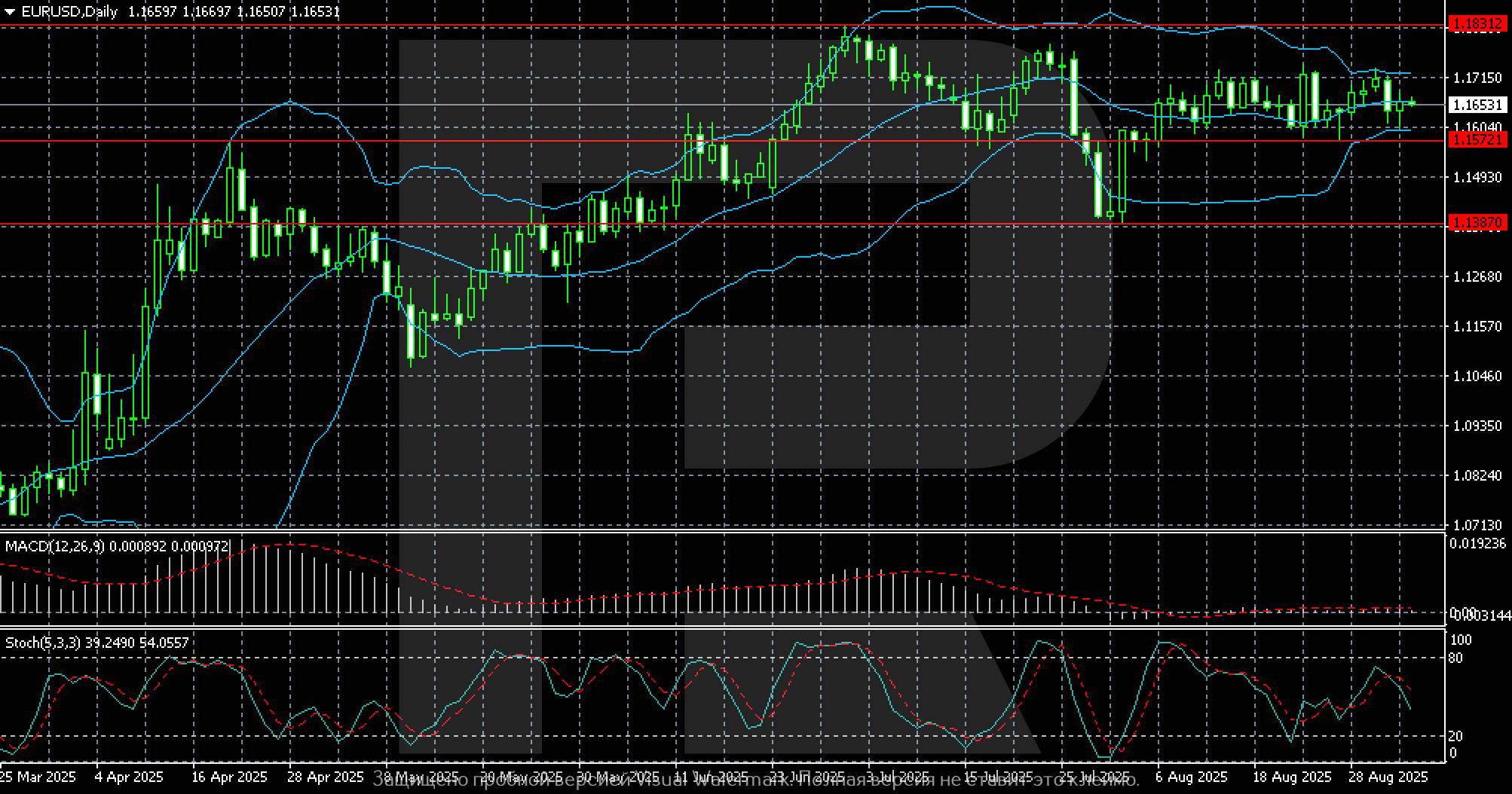
          The pair remains within the range between the 1.1570 support level and the 1.1740 resistance level. The dollar receives mixed signals: the likelihood of an imminent Fed rate cut weighs on the greenback, while strong GDP data and concerns over Fed independence amid political pressure from Donald Trump limit downside. The euro is supported by moderate inflation data and labour market stability.

          Outlook for 8-12 September

          The baseline scenario suggests continued trading within the 1.1570-1.1740 range. Upside is possible on weak US labour data and dovish Fed commentary, with the pair likely to test 1.1830 in this case. A breakout below 1.1570 would increase pressure and shift the target towards 1.1380. Overall, the balance of factors remains neutral-to-cautious: the euro benefits from dovish Fed expectations and moderate eurozone data, while the dollar is backed by strong US macroeconomic indicators and demand for safe-haven assets.

          EURUSD fundamental analysis

          Eurozone inflation data confirmed a decline in price pressure.

          The preliminary CPI came in at 2.1% y/y in August, matching forecasts (the previous reading was 2.0%). Core inflation also remains moderate. July unemployment held steady at 6.2%, indicating continued labour market tightness. Meanwhile, the July PPI showed a modest 0.2% year-on-year increase, below previous readings, confirming reduced inflation risks. Taken together, this data points to a gradual cooling of the region’s economy, which restrains the euro’s strength.

          In the US, labour market conditions continued to weaken.

          The June JOLTS data showed 7.181 million job openings, below the forecast of 7.380 million and the previous reading of 7.357 million, marking the lowest level since September 2024.This week, investors also reviewed updated labour figures for August. Despite job growth, hiring momentum slowed, reinforcing expectations of imminent Fed easing. At the same time, the political factor persists, with Donald Trump’s pressure on the Federal Reserve and his attacks on Lisa Cook fuelling doubts about the regulator’s independence, adding to dollar volatility.

          The key driver for the EURUSD pair remains Fed rate expectations. Markets now price in a 98% likelihood of a 25-basis-point rate cut in September. The euro remains supported by neutral inflation data and labour market stability in the eurozone, although the overall balance tilts in favour of the dollar as a safe-haven asset amid global political and debt instability.

          EURUSD technical analysis

          On the daily chart, the EURUSD pair is trading in a narrow sideways range around 1.1650. The key support level lies at 1.1570, with resistance at 1.1740. A higher resistance level is seen at 1.1830.Bollinger Bands are narrowing, signalling consolidation and lower volatility. The price is hovering near the centre of the range, without clear momentum towards either boundary.

          MACD remains near the zero line, indicating trend weakness and the lack of a strong impulse. The Stochastic oscillates in the mid-range, confirming neutral sentiment.Overall, the technical picture remains sideways, with the euro hovering between the 1.1570 support level and the 1.1740 resistance level. The future direction will depend on upcoming macroeconomic releases.
          EURUSD Weekly Forecast: Still Range-bound, Focus On The Fed_1

          EURUSD trading scenarios

          The EURUSD sentiment for the week remains neutral to cautious. Markets now price in a 98% probability of a Fed rate cut in September, up from 86% the previous week.The euro receives mixed signals: political tensions in France and dollar strength limit growth, yet the pair holds above 1.1620.

          Buy scenario (long)

          Long positions are possible if the pair holds above 1.1620-1.1650. Further confirmation would come from consolidation above 1.1650 and weak US macroeconomic data. Targets are 1.1710 and 1.1740; in a positive scenario, the pair may advance towards 1.1830.

          Stop-loss is below 1.1580; a breakout here would increase selling pressure.

          Sell scenario (short)

          Short positions are viable if the pair breaks below 1.1580, especially amid strong US data and political uncertainty in the eurozone. Targets are 1.1500 and 1.1380 in the case of a sustained downward impulse.

          Stop-loss is above 1.1675. Consolidation above this level would confirm a continued upward movement.

          Summary

          The EURUSD pair remains supported by expectations of a Federal Reserve rate cut in September. Markets now estimate the likelihood of a dovish move at 98%. Despite strong US economic data, including GDP growth and employment indicators, the dollar remains under pressure due to political instability around the Fed and tariff-related uncertainty.

          Overall, sentiment remains moderately positive for the euro.

          In the absence of new dollar catalysts, the pair has a chance to stay near the upper boundary of the current range.

          Source: RoboForex

          To stay updated on all economic events of today, please check out our Economic calendar
          Risk Warnings and Disclaimers
          You understand and acknowledge that there is a high degree of risk involved in trading. Following any strategies or investment methods may lead to potential losses. The content on the site is provided by our contributors and analysts for information purposes only. You are solely responsible for determining whether any trading assets, securities, strategy, or any other product is suitable for investing based on your own investment objectives and financial situation.
          Add to Favorites
          Share

          Telefonica Looks To M&A To Give European Telecoms Broader Vision

          Samantha Luan

          Economic

          Forex

          Stocks

          Spanish telecoms group Telefonica is looking to buy telecom assets and free up resources by selling its Spanish-speaking Latin American assets, as CEO Marc Murtra plots a broader vision for Europe's telco sector.The group is eyeing assets in Germany, the UK, Spain and Brazil, Murtra told Reuters as he prepares his first strategic plan for Telefonica after taking the helm in January.While wanting to chase scale, the Spanish group must maintain itsinvestment grade credit rating, he said.

          Regulators have long pushed back against mergers between European operators, fearing a few dominant players would be able to increase prices and margins to the disadvantage of the consumer, but Murtra argues that Europe's market is too fragmented.In 2024, there were 41 companies in Europe that offered mobile services to more than 500,000 customers each, compared with five in the United States, four each in China and Japan and three in South Korea, according to Connect Europe.Murtra, who was president of Spanish defence and technology group Indra until early this year, says the market is changing with the development of new technologies including AI, and Europe needs to keep up or lose out.

          European telecom groups should be allowed to expand and in exchange invest in other, related sectors such as cybersecurity and infrastructure including data centers, as a "social contract" between authorities and companies, he said."If Europe wants strategic autonomy and technology, we're going to have to have large or titanic European technology operators," Murtra, 52, told Reuters.

          "I don't want to be overly dramatic, but imagine a Europe where the satellite systems, the hyperscalers and artificial intelligence are in the hands of tech bros - and this could happen."Murtra, who is also Telefonica's executive chairman, has been speaking in recent months to regulators and leaders about his proposal, according to a person familiar with the talks. Reuters could not determine how those conversations were received."This does not require a titanic shift," Murtra said of his plan. "All it needs is to lift the brake pedal a little bit and allow the market to operate and consolidate."

          POTENTIAL TARGETS

          The sector is showing some signs of M&A activity, including reports that Orange, Bouygues and Iliad are exploring a deal to carve out Patrick Drahi's French telecom operator SFR. Owner Altice said it had not received any offer.To give Telefonica financial headroom to do more dealmaking, the company has agreed to sell its units in Argentina and Uruguay, and is working with advisors on potential sales in Chile, Mexico and Ecuador, according to three sources with knowledge of the talks. Telefonica declined to comment.

          Source: Yahoo Finance

          To stay updated on all economic events of today, please check out our Economic calendar
          Risk Warnings and Disclaimers
          You understand and acknowledge that there is a high degree of risk involved in trading. Following any strategies or investment methods may lead to potential losses. The content on the site is provided by our contributors and analysts for information purposes only. You are solely responsible for determining whether any trading assets, securities, strategy, or any other product is suitable for investing based on your own investment objectives and financial situation.
          Add to Favorites
          Share

          China’s U.S.-Bound Exports Collapse as Overall Growth Hits Six-Month Low

          Gerik

          Economic

          Sharp Drop in U.S. Shipments Drives Weak Export Growth

          China’s exports in August rose 4.4% year-on-year in dollar terms, missing Reuters’ 5% forecast and slowing sharply from the stronger gains seen earlier in the summer. While the headline figure still showed growth, shipments to the U.S. collapsed by 33%, underscoring the direct causal effect of U.S. trade policy on China’s export sector.
          Imports from the U.S. fell 16% over the same period, reflecting both the retaliatory 30% Chinese tariffs and weakening domestic demand. The sharp bilateral contraction stands in contrast to overall imports, which increased by 1.3% in August, extending a modest three-month growth streak but still falling short of economists’ expectations for 3%.

          Tariff Truce Fails to Deliver Momentum

          The August slowdown also reflects diminishing returns from the temporary tariff truce agreed on August 11, which locked in place punitive tariffs 55% on Chinese goods bound for the U.S. and 30% on U.S. exports to China. Despite this pause, no substantive breakthrough emerged during late-August talks in Washington with top Chinese negotiator Li Chenggang.
          The truce highlights a correlation rather than relief: while it prevented further escalation, existing tariffs remain prohibitively high. Economists warn that once tariffs breach 35%, U.S. demand for Chinese goods falls off steeply, a threshold already evident in the latest trade collapse.

          Transshipment Strategy Under Pressure

          Chinese exporters have increasingly rerouted goods through third countries in Southeast Asia, Latin America, and Africa to bypass U.S. tariffs. Yet this strategy faces mounting challenges. Washington’s July announcement of a 40% penalty tariff on suspected transshipped goods directly undermines such tactics, creating a cause-and-effect dynamic that threatens to squeeze Chinese exporters further.
          Although China has sought to diversify exports to the EU, which absorbed $541 billion of Chinese goods through August, the U.S. remains its largest single-country market with $283 billion in imports. The scale of U.S. demand cannot be easily replaced, leaving China exposed to policy risk.

          Mixed Signals from Manufacturing and Price Indicators

          Despite trade tensions, a private survey the RatingDog export-focused purchasing managers’ index reported a stronger-than-expected rebound in new export orders in August, suggesting resilient demand from non-U.S. markets. This correlation points to a partial offset: while U.S. shipments have collapsed, demand elsewhere is providing limited support.
          China’s inflation metrics, due later this week, will provide further insight into domestic conditions. Goldman Sachs forecasts the producer price index (PPI) to remain “deeply negative” at -2.9% year-on-year, though month-on-month readings may turn positive due to raw material price increases and Beijing’s “anti-involution” measures aimed at stabilizing pricing power. The consumer price index (CPI), meanwhile, is projected to dip 0.2%, reflecting persistent weakness in household demand.

          Trade Weakness Signals Structural Strain

          August’s export data reveal that China’s trade resilience is eroding under sustained U.S. tariff pressure. The 33% plunge in U.S.-bound shipments underscores a direct causal link between Trump’s tariff policies and China’s trade slowdown. While diversification efforts and modest manufacturing resilience offer partial relief, they remain insufficient to offset the loss of U.S. demand.
          With imports underperforming and inflation indicators pointing to soft domestic conditions, Beijing faces mounting pressure to roll out fiscal or industrial support in the fourth quarter. Absent such measures, China risks deeper trade and growth headwinds heading into 2026.

          Source: CNBC

          To stay updated on all economic events of today, please check out our Economic calendar
          Risk Warnings and Disclaimers
          You understand and acknowledge that there is a high degree of risk involved in trading. Following any strategies or investment methods may lead to potential losses. The content on the site is provided by our contributors and analysts for information purposes only. You are solely responsible for determining whether any trading assets, securities, strategy, or any other product is suitable for investing based on your own investment objectives and financial situation.
          Add to Favorites
          Share

          China’s Office Market Struggles as Developers Slash Rents and Add Incentives to Retain Tenants

          Gerik

          Economic

          Vacancy Rates Signal Persistent Weakness

          China’s office market is confronting its toughest challenge in decades, with vacancy rates in major cities reaching record highs. Shenzhen posted a vacancy rate of 30.6% at the end of June 2025, the highest among the four top-tier cities, followed by Shanghai at 23.7%, Guangzhou at 22.6%, and Beijing at 19.6%. The figures underscore that even in urban hubs with strong commercial activity, demand is failing to keep up with supply.
          This weakness cannot be explained by work-from-home patterns, as remote work is far less common in China than in Western economies. Instead, the causal driver is corporate retrenchment: domestic firms are cutting costs while multinational corporations scale back their presence in China. The correlation between weaker foreign corporate activity and rising office vacancies illustrates the broader geopolitical and economic headwinds affecting commercial real estate demand.

          Falling Rents and Tenant Incentives

          Grade-A office rents in China’s top cities have dropped between 20% and 40% since 2020, with Beijing experiencing the steepest decline, according to Savills data. This prolonged decline reflects both oversupply and lackluster demand. In an effort to keep tenants, landlords are adopting increasingly creative retention strategies.
          Developers such as China Merchants Commercial REIT are offering flexible leases and operational perks, including covering electricity costs for EV charging and providing building services that go beyond traditional office amenities. As Liu Zhongliu, one of the company’s managers, explained, these incentives are designed to increase tenant “stickiness,” compensating for the weaker fundamentals of the office market.
          The causal relationship here is straightforward: falling demand pressures landlords to lower rents and provide additional services. Yet the persistence of oversupply suggests that these measures function more as stopgap strategies than long-term solutions.

          Structural Adjustment in a Maturing Market

          Executives in the sector acknowledge that current difficulties reflect not just cyclical downturns but structural changes. After 30 to 40 years of rapid growth, the office market is undergoing a necessary correction driven by insufficient demand and an excess of supply. Policies, they argue, cannot restore balance instantly, as the sector must realign to a slower-growth environment.
          This diagnosis highlights that the weakness in the office market is not only correlated with broader economic deceleration marked by slowing exports, fragile consumer confidence, and a property sector downturn but also causally linked to decades of overbuilding and speculative investment that left the market oversaturated.

          Government and Market Responses

          Local authorities have begun rolling out measures to stabilize the sector, such as rental subsidies, repurposing old office buildings into residential housing, and halting new land sales for commercial development. However, as Savills Research’s James MacDonald points out, the government’s most effective role lies in supporting the overall economy rather than artificially propping up the office market.
          Developers, meanwhile, are facing harsh realities. Hang Lung Properties reported a 5% drop in China office rental revenues in the first half of 2025, with Shanghai under the most pressure due to ample new supply. CEO Weber Lo candidly noted that “if you want to retain tenants, you have to cut rents,” underscoring the lack of pricing power in a tenant-driven market.
          The strain extends beyond offices into the logistics warehouse sector. Shenzhen International, which serves clients such as JD.com and Walmart, is also facing challenges in retaining tenants, relying on intensive relationship management to maintain occupancy.

          A Market in Prolonged Adjustment

          China’s office property market is experiencing a structural correction after decades of rapid expansion. While developers are responding with rental concessions and added services, these measures can only temporarily cushion the blow of weak demand and oversupply. Vacancy rates above 20% in all top-tier cities reveal the scale of the challenge, while falling rents continue to erode returns for landlords.
          Ultimately, a sustainable recovery depends less on concessions and more on broader economic revitalization. Without stronger domestic demand and renewed foreign corporate investment, the office market’s adjustment is likely to be long and painful, leaving developers and policymakers with limited tools to accelerate stabilization.

          Source: Reuters

          To stay updated on all economic events of today, please check out our Economic calendar
          Risk Warnings and Disclaimers
          You understand and acknowledge that there is a high degree of risk involved in trading. Following any strategies or investment methods may lead to potential losses. The content on the site is provided by our contributors and analysts for information purposes only. You are solely responsible for determining whether any trading assets, securities, strategy, or any other product is suitable for investing based on your own investment objectives and financial situation.
          Add to Favorites
          Share

          Japan’s Q1 Growth Revised Upward as Consumer Spending Offsets Tariff and Political Concerns

          Gerik

          Economic

          Stronger Growth Momentum Than Expected

          Revised government data show that Japan’s real GDP grew at a 2.2% annualized pace in the April–June quarter, significantly higher than the preliminary estimate of 1.0%. On a quarterly basis, the economy expanded 0.5% compared with the initial 0.3% figure. This marks the fifth consecutive quarter of growth and reflects stronger-than-expected private consumption and inventory accumulation.
          The upward revision suggests that domestic demand played a more active role in sustaining growth than initially thought. Private consumption rose 0.4% in the quarter, doubling the earlier estimate of 0.2%. This improvement shifted domestic demand into positive territory with a 0.2% gain, rather than the previously reported 0.1% contraction. The causal link between consumer spending and headline GDP growth is evident here: stronger consumption directly lifted the overall growth rate.

          Tariffs and Trade Vulnerability

          Despite the robust Q1 performance, headwinds remain. The U.S. administration under President Donald Trump has raised tariffs on Japanese imports, with auto exports now facing a 15% duty compared to just 2.5% previously. For an export-driven economy like Japan, this policy shift represents a clear cause-and-effect risk: higher tariffs directly erode the competitiveness of Japanese goods in the U.S. market, threatening to offset domestic gains with external losses.
          The timing of the tariff increase creates particular vulnerability for Japan’s automotive sector, which has long been a cornerstone of its export strength. While Q1 growth was boosted by household spending, sustained pressure on exports could weaken momentum in subsequent quarters.
          Political Uncertainty Adds Another Layer of Risk
          Political developments are adding to the uncertainty. Prime Minister Shigeru Ishiba’s resignation as head of the ruling party has triggered an internal election and potential coalition reshuffling. While the Nikkei rose in early trading following the announcement suggesting markets partly welcomed the leadership change analysts caution that the medium-term implications remain unclear.
          The relationship here appears more correlational than causal: market optimism reflects expectations of reform or continuity rather than the resignation itself being a direct driver of economic growth. However, prolonged political instability could eventually weigh on investor confidence and policy effectiveness.

          Market Reaction and Investor Outlook

          The upward revision to growth figures provided a near-term boost to investor sentiment, with the Nikkei index rising in morning trading. Equity markets appeared to interpret the stronger consumption data as a signal of resilience, while Ishiba’s resignation was seen as an expected event rather than a disruptive shock.
          Still, analysts warn that markets may be underestimating the dual risks of trade pressure and political uncertainty. If tariffs persist and consumer momentum softens, fiscal stimulus may become necessary to sustain growth in the second half of 2025.
          Japan’s stronger-than-expected Q1 growth underscores the resilience of domestic demand, particularly household spending, in cushioning against external shocks. However, the economy’s reliance on exports leaves it vulnerable to tariff-related disruptions, while domestic political uncertainty adds another layer of risk. The upward revision is encouraging, but sustaining momentum will require careful policy navigation in both trade and fiscal domains.

          Source: Reuters

          To stay updated on all economic events of today, please check out our Economic calendar
          Risk Warnings and Disclaimers
          You understand and acknowledge that there is a high degree of risk involved in trading. Following any strategies or investment methods may lead to potential losses. The content on the site is provided by our contributors and analysts for information purposes only. You are solely responsible for determining whether any trading assets, securities, strategy, or any other product is suitable for investing based on your own investment objectives and financial situation.
          Add to Favorites
          Share

          China’s Export Engine Falters in August as U.S. Trade Tensions Resurface

          Gerik

          Economic

          Slowing Momentum Reflects Erosion of Tariff Truce Benefits

          China's export performance in August reveals a sharp deceleration, with outbound shipments growing only 4.4% year-on-year, significantly below both the 5% forecast and July's 7.2% result. This marks the slowest growth in half a year and reflects the diminishing returns of the temporary trade détente with the United States.
          The slowdown appears linked to fading momentum from the 90-day tariff truce agreed on August 11 between Beijing and Washington, which had initially stabilized trading conditions. The agreement locked in U.S. tariffs at 30% on Chinese goods and reciprocal 10% duties on American exports. However, without substantive progress in trade talks evidenced by the unproductive visit of China’s top trade envoy Li Chenggang to Washington the fragile truce is now struggling to support export dynamics.
          This suggests a correlation between the truce’s temporary relief and July’s stronger numbers, rather than a sustainable improvement in export competitiveness or external demand. As the trade ceasefire wears thin, China’s exports are once again vulnerable to policy uncertainty and tariff escalation.

          Deteriorating U.S.-Bound Shipments Undermine Trade Balance

          Export performance was notably dragged down by the rapid contraction in shipping volumes to the United States. According to Citi data, Chinese container ship departures to the U.S. plummeted by 24.9% in the 15 days ending September 3, accelerating from a 12.4% decline the previous week. This sharp fall indicates a clear cause-and-effect relationship between the uncertainty around U.S. trade policy and collapsing demand for Chinese goods in its largest market.
          The threat of new 40% tariffs from the Trump administration on goods suspected of transshipment further limits China's ability to circumvent duties through third countries. Exporters’ efforts to redirect goods to alternative markets in Asia, Africa, and Latin America have not yielded comparable volumes, exposing the limitations of trade diversification when set against the scale of U.S. consumption, which previously absorbed over $400 billion annually in Chinese exports.

          Imports Underwhelm, Domestic Demand Still Fragile

          Imports rose by only 1.3% in August, sharply down from July’s 4.1% and far below the 3% increase predicted by economists. This weak import figure reflects ongoing domestic demand stagnation, which is further complicated by Beijing’s cautious approach to fiscal stimulus.
          Although China’s trade surplus widened marginally to $102.3 billion from June’s $98.24 billion, it remains well below the $114.7 billion recorded in June. This reinforces the view that both internal consumption and external trade engines are underperforming in tandem.
          Policymakers have so far refrained from aggressively deploying new stimulus measures. Notably, funding for the government’s 'cash-for-clunkers' vehicle replacement program has not been replenished after several regions exhausted their allocations. This restraint suggests a desire to manage local debt levels more prudently, even at the cost of short-term growth.

          Base Effects Disguise True Weakness Ahead of Next Report

          Economists noted that part of August’s export growth stemmed from base effects rather than genuine improvement. This statistical advantage will likely vanish in September’s data, as August 2024 marked the fastest export growth in 18 months, setting a high comparative benchmark.
          As such, a clearer assessment of China's export resilience may emerge next month, absent any distortive year-on-year comparisons. If current trends hold, China could be on the cusp of reporting negative export growth for the first time since early 2024.
          August’s weak trade figures expose China’s continued vulnerability to external shocks, especially as the benefits of the U.S. tariff truce wane. The sharp drop in U.S.-bound shipments, combined with tepid import growth and fiscal restraint, creates a challenging environment for Beijing’s economic planners. Without a meaningful improvement in global trade sentiment or an acceleration in domestic policy support, the country risks deeper deceleration in the fourth quarter. Whether Beijing chooses to preserve its cautious policy stance or pivot to more aggressive fiscal measures will define the trajectory of China’s economy heading into 2026.

          Source: Reuters

          To stay updated on all economic events of today, please check out our Economic calendar
          Risk Warnings and Disclaimers
          You understand and acknowledge that there is a high degree of risk involved in trading. Following any strategies or investment methods may lead to potential losses. The content on the site is provided by our contributors and analysts for information purposes only. You are solely responsible for determining whether any trading assets, securities, strategy, or any other product is suitable for investing based on your own investment objectives and financial situation.
          Add to Favorites
          Share

          IC Markets Asia Fundamental Forecast | 08 September 2025

          IC Markets

          Commodity

          Forex

          Economic

          What happened in the U.S session?

          The U.S. session overnight was marked by a mix of disappointing jobs data and increased political tension regarding the Fed and tariff policy, sparking volatility across equities, Treasuries, the dollar, gold, and select tech stocks as markets rapidly recalibrated for further rate cut possibilities and renewed flight-to-safety. The most impacted financial instruments included U.S. stock indices, Treasury yields, the U.S. dollar, and gold, while select tech stocks saw notable earnings-linked swings.

          What does it mean for the Asia sessions?

          Asian markets open for the week in a fragile but opportunity-rich environment, driven by Fed rate cut anticipation, sector rotation into tech and value stocks, several major regional conferences, and volatile commodity moves. Traders should remain alert to U.S. data releases, policy signals, and sector- and event-specific catalysts, especially in technology, logistics, and commodities on Monday, 8th September 2025

          The Dollar Index (DXY)

          The US dollar faces significant headwinds entering Monday, September 8, 2025, following Friday’s weak jobs data that has locked in Fed rate cuts. With the DXY at 1.5-month lows and 100% market pricing for September easing, the dollar’s near-term outlook remains challenged by both fundamental weakness and political uncertainty surrounding Fed independence.Central Bank Notes:

          ● The Board of Governors of the Federal Reserve System voted unanimously to maintain the Federal Funds Rate in a target range of 4.25% to 4.50% at its meeting on July 29–30, 2025, keeping policy unchanged for the fifth consecutive meeting.
          ● The Committee reiterated its objective of achieving maximum employment and inflation at the rate of 2% over the longer run. While uncertainty around the economic outlook has diminished since earlier in the year, the Committee notes that challenges remain and continued vigilance is warranted.
          ● Policymakers remain highly attentive to risks on both sides of their dual mandate. The unemployment rate remains low, near 4.2%–4.5%, and labor market conditions are described as solid. However, inflation remains somewhat elevated, with the PCE price index at 2.6% and a core inflation forecast of 3.1% for year-end 2025, up from earlier projections; tariff-related pressures are cited as a contributing factor.
          ● The Committee acknowledged that recent economic activity has expanded at a solid pace, with second-quarter annualized growth estimates near 2.4%. However, GDP growth for 2025 has been revised downward to 1.4% (from 1.7% projected in March), reflecting expectations of a slowdown in the coming quarters.
          ● In the revised Summary of Economic Projections, the unemployment rate is expected to average 4.5% in 2025, and headline PCE inflation is forecast at 3.0% for the year, with core PCE at 3.1%. Policymakers continue to anticipate that inflation will moderate gradually, with ongoing risks from tariffs and global conditions.
          ● The Committee reaffirmed its data-dependent and risk-aware approach to future policy decisions. Officials stated they are prepared to adjust the stance of monetary policy as appropriate if risks emerge that could impede progress toward the Fed’s goals.
          ● As previously outlined, the Committee continues the measured run-off of its securities holdings. The pace of balance sheet reduction, which slowed since April (monthly redemption cap on Treasury securities reduced from $25B to $5B, while holding agency MBS cap steady at $35B), was left unchanged this month to support orderly market functioning and financial conditions.
          ● The next meeting is scheduled for 16 to 17 September 2025.

          Next 24 Hours Bias

          Medium Bearish

          Gold (XAU)

          Monday, September 8th, 2025, marks a continuation of gold’s historic rally, with prices consolidating above $3,600 per ounce following Friday’s jobs data disappointment. The convergence of dovish Fed expectations, persistent central bank buying, and technical momentum suggests further upside potential toward $3,700-$3,800 levels. However, traders should remain vigilant for potential volatility as extreme positioning and seasonal factors could trigger short-term corrections. The fundamental backdrop remains supportive for gold’s role as both an inflation hedge and portfolio diversification tool in an environment of monetary easing and geopolitical uncertainty.Next 24 Hours Bias

          Strong Bullish

          The Australian Dollar (AUD)

          The Australian Dollar’s positive performance on Monday, September 8, 2025, reflects several converging factors: robust Q2 GDP growth exceeding expectations, continued RBA monetary easing supporting domestic demand, stabilizing commodity prices, and improving China-Australia trade relations. While the currency faces headwinds from global uncertainty and commodity price volatility, the combination of domestic economic resilience and strategic trade partnerships positions the AUD favorably in the near term. Market participants remain focused on upcoming RBA meetings and China’s economic indicators as key drivers for the currency’s trajectory through the remainder of 2025.Central Bank Notes:

          ● The RBA held its cash rate steady at 3.85% at the August meeting on 11–12 August 2025, maintaining its stance after keeping rates unchanged in July. The decision was widely expected, reflecting confidence that inflation is settling sustainably within the target.
          ● Inflation continues to moderate, though headline outcomes for the September quarter are not yet available. Timely indicators suggest price pressures in housing-related services and insurance remain elevated, even as tradables inflation stays subdued.
          ● The RBA’s preferred measure, trimmed mean inflation, is estimated to track close to 2.8 — 2.9%, signaling continued progress toward the midpoint of the 2–3% target range. Headline CPI is likely near 2.3%, subject to volatility in energy and food prices.
          ● Global conditions remain a source of uncertainty. The market reaction to ongoing U.S.–EU trade frictions has tempered slightly, but volatility persists across equity and commodity markets. These developments continue to feed into Australia’s trade outlook and business sentiment.
          ● Domestic demand showed further signs of recovery. Household consumption strengthened modestly over the winter months, helped by improving real incomes and a stabilizing housing market. However, business investment intentions remain mixed, with service industries stronger than manufacturing and construction.
          ● Labour market conditions remain relatively tight, but indicators point to reduced momentum compared with the first half of 2025. Job vacancies have eased, and while employment growth continues, underutilization edged slightly higher for the first time this year.
          ● Wage growth has moderated further, consistent with easing labour demand, though unit labour costs remain above average due to weak productivity performance. The RBA continues to flag productivity as a medium-term risk to cost dynamics.
          ● Forward-looking indicators suggest consumption growth may be softer than previously assumed, with households cautious despite modest income gains. Elevated rents and high borrowing costs continue to weigh on discretionary spending.
          ● The Board reasserted the risk that household spending may underperform forecasts, potentially dampening business conditions and leading to weaker labour demand if confidence fails to strengthen.
          ● The overall stance of monetary policy remains mildly restrictive, consistent with inflation outcomes near target and ongoing progress toward balance in the economy. The Board judged it prudent to leave rates unchanged, while emphasizing that adjustments remain contingent on incoming data.
          ● The Reserve Bank reaffirmed its commitment to price stability and full employment, noting its readiness to adjust settings if conditions diverge materially from baseline projections.
          ● The next meeting is on 8 to 9 September 2025.
          Next 24 Hours Bias

          Weak BullishThe Kiwi Dollar (NZD)

          The New Zealand Dollar enters the week of September 8, 2025, from a position of cautious optimism, with recent technical momentum and supportive China data providing near-term strength around the 0.5880-0.5900 level. However, the currency remains vulnerable to broader economic uncertainties, with the RBNZ’s dovish policy stance and persistent domestic economic challenges likely to cap significant upside potential. The key drivers to watch include further RBNZ policy signals, China economic data releases, and any developments in US-New Zealand trade relations.Central Bank Notes:

          ● The Monetary Policy Committee (MPC) agreed to cut the Official Cash Rate (OCR) by 25 basis points to 3.00% on 20 August 2025, marking a three-year low and continuing the easing cycle after July’s pause. The vote was split 4-2, with two members advocating a 50-basis-point cut, highlighting diverging views within the Committee.
          ● Policymakers indicated that significant uncertainty and a stalling economic recovery prompted this move, leaving the door open for further rate cuts later in the year, with a possible trough around 2.5% by December.
          ● Annual consumer price index inflation rose to 2.7% in the June quarter and is expected to reach 3% for the September quarter—at the upper end of the MPC’s 1 to 3% target band—but medium-term expectations remain anchored near the 2% midpoint..
          ● Despite the near-term uptick, headline inflation is projected to return toward 2% by mid-2026, as tradables inflation pressures ease and significant spare capacity continues to dampen domestic price momentum.
          ● Domestic financial conditions are broadly aligning with MPC expectations, as lower wholesale rates have translated into reduced borrowing costs for households. However, declining consumption and investment demand, higher unemployment, and subdued wage growth reflect ongoing economic slack.
          ● GDP growth stalled in the second quarter of 2025, contrasting with earlier projections. High-frequency indicators point to continued weakness driven by rising prices for essentials, weakening household savings, and constrained business lending.
          ● The MPC cautioned that ongoing global tariff uncertainties and policy shifts, especially recent changes in US trade regulations, could amplify market volatility and present both upside and downside risks to New Zealand’s recovery.
          ● Subject to medium-term inflation pressures continuing to ease as projected, the MPC signaled scope for further OCR cuts, possibly down to 2.5% by year-end, consistent with the latest Monetary Policy Statement outlook.

          ● The next meeting is on 22 October 2025.

          Next 24 Hours Bias

          Medium Bearish

          The Japanese Yen (JPY)

          Monday, September 8, 2025, opens with significant political uncertainty following Prime Minister Ishiba’s resignation, likely creating additional downward pressure on the yen. While recent economic data shows some positive developments in wages and inflation trending toward target levels, the political instability and potential for looser monetary policy under new leadership are expected to dominate near-term yen movements. Analysts anticipate further yen weakness when Asian markets open, with the USD/JPY potentially testing higher levels as investors price in increased political and policy uncertainty.Central Bank Notes:

          ● The Policy Board of the Bank of Japan decided on 31 July, by a unanimous vote, to set the following guidelines for money market operations for the inter-meeting period:
          ● The Bank will encourage the uncollateralized overnight call rate to remain at around 0.5%.
          ● The BOJ will maintain its gradual reduction of monthly outright purchases of Japanese Government Bonds (JGBs). The scheduled amount of long-term government bond purchases will, in principle, continue to decrease by about ¥400 billion each quarter from January to March 2026, and by about ¥200 billion each quarter from April to June 2026 onward, targeting a purchase level near ¥2 trillion in January to March 2027.
          ● Japan’s economy is experiencing a moderate recovery overall, though some sectors remain sluggish. Overseas economies are generally growing moderately, but recent trade policies in major economies have introduced pockets of weakness. Exports and industrial production in Japan are essentially flat, with any uptick largely driven by front-loaded demand ahead of U.S. tariff increases.
          ● On the price front, the year-on-year rate of change in consumer prices (excluding fresh food) remains in the mid-3% range. This reflects continued wage pass-through, previous import cost surges, and further increases in food prices, particularly rice. Expectations for future inflation have begun to rise moderately.
          ● The effects of the earlier import price and food cost increases are expected to fade during the outlook period. There may be a temporary stagnation in core inflation as overall growth momentum softens.
          ● Looking forward, the economy is likely to see a slower growth pace in the near term as overseas economies feel the pinch of ongoing global trade policies, putting downward pressure on Japanese corporate profits. Accommodative financial conditions are expected to buffer these headwinds somewhat. In the medium term, as global growth recovers, Japan’s growth rate is also expected to improve.
          ● With renewed economic expansion, intensifying labor shortages, and a steady rise in medium- to long-term expected inflation rates, core inflation is projected to gradually pick up. By the latter half of the BOJ’s projection period, inflation is forecast to move in line with the 2% price stability target.
          ● There are multiple risks to the outlook, with especially elevated uncertainty regarding the future path of global trade policies and overseas price trends. The BOJ will continue to closely monitor their impact on financial and foreign exchange markets, as well as on Japan’s economy and inflation.
          ● The next meeting is scheduled for 17 to 18 September 2025.

          Next 24 Hours BiasMedium Bearish

          Oil

          Monday, September 8, 2025, represents a pivotal moment for oil markets as OPEC+ continues its production increase strategy despite clear signs of oversupply. With crude inventories building unexpectedly, technical indicators showing weakness, and fundamental analysis pointing to surplus conditions, oil prices face significant downward pressure. The market’s ability to hold key support levels around $60-$62 for WTI and $65-$67 for Brent will be crucial in determining whether the current bearish trend accelerates or finds stabilization. Geopolitical developments, particularly regarding the Ukraine conflict and US-Russia relations, remain the primary upside risk factors that could temporarily reverse the current downtrend.Next 24 Hours Bias

          Medium Bearish

          Source: IC Markets

          To stay updated on all economic events of today, please check out our Economic calendar
          Risk Warnings and Disclaimers
          You understand and acknowledge that there is a high degree of risk involved in trading. Following any strategies or investment methods may lead to potential losses. The content on the site is provided by our contributors and analysts for information purposes only. You are solely responsible for determining whether any trading assets, securities, strategy, or any other product is suitable for investing based on your own investment objectives and financial situation.
          Add to Favorites
          Share
          FastBull
          Copyright © 2025 FastBull Ltd

          728 RM B 7/F GEE LOK IND BLDG NO 34 HUNG TO RD KWUN TONG KLN HONG KONG

          TelegramInstagramTwitterfacebooklinkedin
          App Store Google Play Google Play
          Products
          Charts

          Chats

          Q&A with Experts
          Screeners
          Economic Calendar
          Data
          Tools
          Membership
          Features
          Function
          Markets
          Copy Trading
          Latest Signals
          Contests
          News
          Analysis
          24/7
          Columns
          Education
          Company
          Careers
          About Us
          Contact Us
          Advertising
          Help Center
          Feedback
          User Agreement
          Privacy Policy
          Business

          White Label

          Data API

          Web Plug-ins

          Poster Maker

          Affiliate Program

          Risk Disclosure

          The risk of loss in trading financial instruments such as stocks, FX, commodities, futures, bonds, ETFs and crypto can be substantial. You may sustain a total loss of the funds that you deposit with your broker. Therefore, you should carefully consider whether such trading is suitable for you in light of your circumstances and financial resources.

          No decision to invest should be made without thoroughly conducting due diligence by yourself or consulting with your financial advisors. Our web content might not suit you since we don't know your financial conditions and investment needs. Our financial information might have latency or contain inaccuracy, so you should be fully responsible for any of your trading and investment decisions. The company will not be responsible for your capital loss.

          Without getting permission from the website, you are not allowed to copy the website's graphics, texts, or trademarks. Intellectual property rights in the content or data incorporated into this website belong to its providers and exchange merchants.

          Not Logged In

          Log in to access more features

          FastBull Membership

          Not yet

          Purchase

          Become a signal provider
          Help Center
          Customer Service
          Dark Mode
          Price Up/Down Colors

          Log In

          Sign Up

          Position
          Layout
          Fullscreen
          Default to Chart
          The chart page opens by default when you visit fastbull.com