

Markets
News
Analysis
User
24/7
Economic Calendar
Education
Data
- Names
- Latest
- Prev



Signal Accounts for Members
All Signal Accounts
All Contests
 China, Mainland M1 Money Supply YoY (Nov)
A:--
F: --
P: --
 India CPI YoY (Nov)
A:--
F: --
P: --
India Deposit Gowth YoYA:--
F: --
P: --
 Brazil Services Growth YoY (Oct)
A:--
F: --
P: --
 Mexico Industrial Output YoY (Oct)
A:--
F: --
P: --
 Russia Trade Balance (Oct)
A:--
F: --
P: --
 Philadelphia Fed President Henry Paulson delivers a speech
 Canada Building Permits MoM (SA) (Oct)
A:--
F: --
P: --
Canada Wholesale Sales YoY (Oct)A:--
F: --
P: --
Canada Wholesale Inventory MoM (Oct)A:--
F: --
P: --
Canada Wholesale Inventory YoY (Oct)A:--
F: --
P: --
Canada Wholesale Sales MoM (SA) (Oct)A:--
F: --
P: --
 Germany Current Account (Not SA) (Oct)
A:--
F: --
P: --
U.S. Weekly Total Rig CountA:--
F: --
P: --
U.S. Weekly Total Oil Rig CountA:--
F: --
P: --
 Japan Tankan Small Manufacturing Outlook Index (Q4)
A:--
F: --
P: --
Japan Tankan Large Non-Manufacturing Diffusion Index (Q4)A:--
F: --
P: --
Japan Tankan Large Non-Manufacturing Outlook Index (Q4)A:--
F: --
P: --
Japan Tankan Large Manufacturing Outlook Index (Q4)A:--
F: --
P: --
Japan Tankan Small Manufacturing Diffusion Index (Q4)A:--
F: --
P: --
Japan Tankan Large Manufacturing Diffusion Index (Q4)A:--
F: --
P: --
Japan Tankan Large-Enterprise Capital Expenditure YoY (Q4)A:--
F: --
P: --
 U.K. Rightmove House Price Index YoY (Dec)
A:--
F: --
P: --
China, Mainland Industrial Output YoY (YTD) (Nov)A:--
F: --
P: --
China, Mainland Urban Area Unemployment Rate (Nov)A:--
F: --
P: --
 Saudi Arabia CPI YoY (Nov)
A:--
F: --
P: --
 Euro Zone Industrial Output YoY (Oct)
A:--
F: --
P: --
Euro Zone Industrial Output MoM (Oct)A:--
F: --
P: --
Canada Existing Home Sales MoM (Nov)A:--
F: --
P: --
U.K. Inflation Rate Expectations--
F: --
P: --
Euro Zone Total Reserve Assets (Nov)--
F: --
P: --
Canada National Economic Confidence Index--
F: --
P: --
Canada New Housing Starts (Nov)--
F: --
P: --
U.S. NY Fed Manufacturing Employment Index (Dec)--
F: --
P: --
U.S. NY Fed Manufacturing Index (Dec)--
F: --
P: --
Canada Core CPI YoY (Nov)--
F: --
P: --
Canada Manufacturing Unfilled Orders MoM (Oct)--
F: --
P: --
U.S. NY Fed Manufacturing Prices Received Index (Dec)--
F: --
P: --
U.S. NY Fed Manufacturing New Orders Index (Dec)--
F: --
P: --
Canada Manufacturing New Orders MoM (Oct)--
F: --
P: --
Canada Core CPI MoM (Nov)--
F: --
P: --
Canada Trimmed CPI YoY (SA) (Nov)--
F: --
P: --
Canada Manufacturing Inventory MoM (Oct)--
F: --
P: --
Canada CPI YoY (Nov)--
F: --
P: --
Canada CPI MoM (Nov)--
F: --
P: --
Canada CPI YoY (SA) (Nov)--
F: --
P: --
Canada Core CPI MoM (SA) (Nov)--
F: --
P: --
Canada CPI MoM (SA) (Nov)--
F: --
P: --
Federal Reserve Board Governor Milan delivered a speech U.S. NAHB Housing Market Index (Dec)--
F: --
P: --
 Australia Composite PMI Prelim (Dec)
--
F: --
P: --
Australia Services PMI Prelim (Dec)--
F: --
P: --
Australia Manufacturing PMI Prelim (Dec)--
F: --
P: --
Japan Manufacturing PMI Prelim (SA) (Dec)--
F: --
P: --
U.K. 3-Month ILO Employment Change (Oct)--
F: --
P: --
U.K. Unemployment Claimant Count (Nov)--
F: --
P: --
U.K. Unemployment Rate (Nov)--
F: --
P: --
U.K. 3-Month ILO Unemployment Rate (Oct)--
F: --
P: --
U.K. Average Weekly Earnings (3-Month Average, Including Bonuses) YoY (Oct)--
F: --
P: --
U.K. Average Weekly Earnings (3-Month Average, Excluding Bonuses) YoY (Oct)--
F: --
P: --


No matching data

Latest Views
Latest Views
Trending Topics
Top Columnists
Latest Update
White Label
Data API
Web Plug-ins
Affiliate Program
View All
No data
The Euro remains firm and rises to the highest in seven weeks on Thursday, in extension of Wednesday's 0.6% advance, mainly seen in post-Fed acceleration.
The Euro remains firm and rises to the highest in seven weeks on Thursday, in extension of Wednesday's 0.6% advance, mainly seen in post-Fed acceleration.
The single currency benefited from Fed rate cut and more hawkish than expected monetary policy projections for 2026, which further deflated the US dollar.
Rise above significant barriers at 1.1700 zone (psychological / near 50% retracement of 1.1918/1.1468 / daily Ichimoku cloud top) generated bullish signal which need to be verified on sustained break above these levels and keep bullish structure for attack at 1.1746 (Fibo 61.8%) and potential extension towards 1.1800.
Daily studies in full bullish setup (daily Tenkan/Kijun-sen in steep ascend and diverging after formation of bull-cross /strong bullish momentum, with thick daily cloud underpinning the action) contribute to positive fundamentals and keep the door open for further advance.
Broken top of daily Ichimoku cloud (1.1693, also broken bull-channel upper boundary) reverted to strong support, which should contain dips and keep fresh bulls in play.
Res: 1.1746; 1.1778; 1.1812; 1.1830
Sup: 1.1693; 1.1680; 1.1653; 1.1603
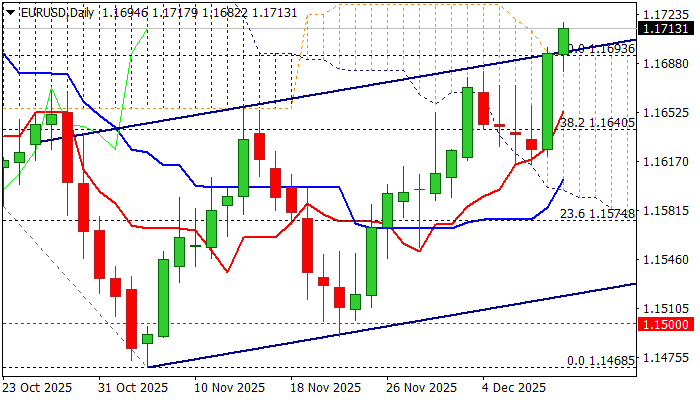
 Fig. 1: Percentage of Nasdaq 100 component stocks trading above 20-day & 50-day moving averages as of 10 Dec 2025
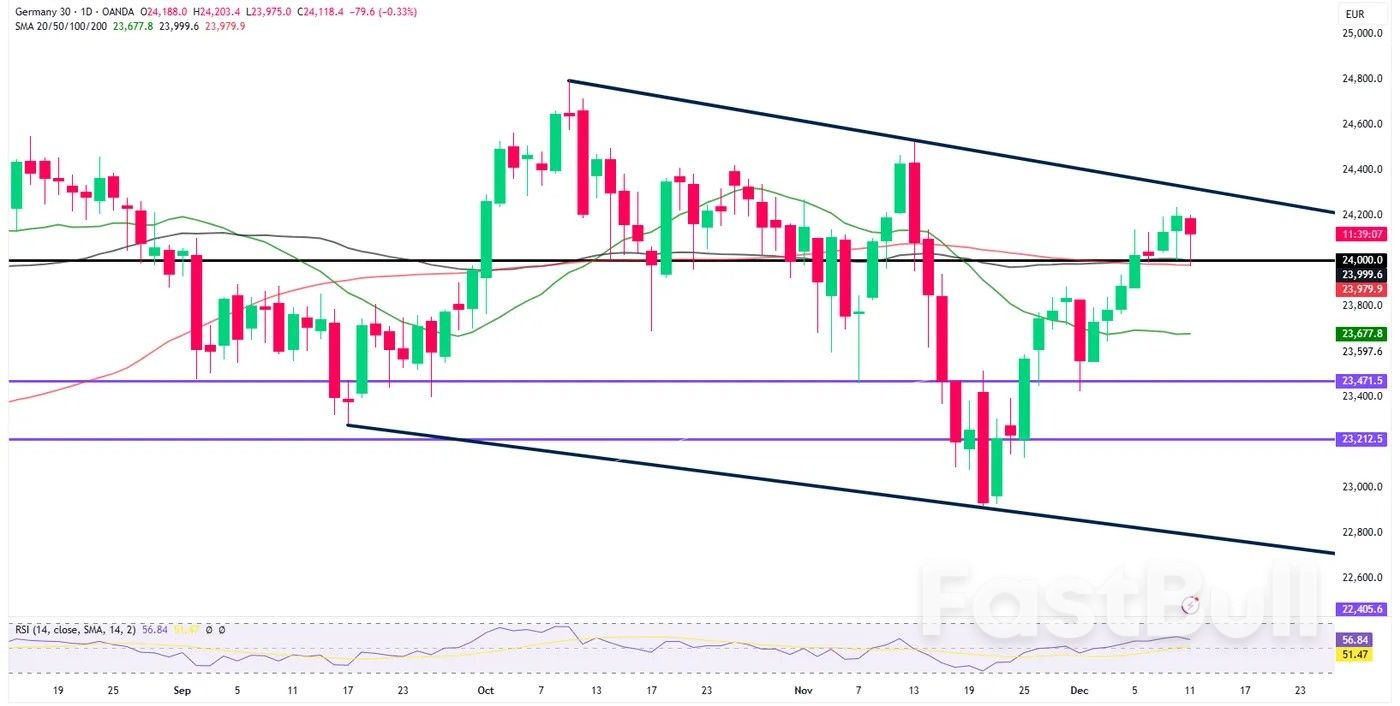
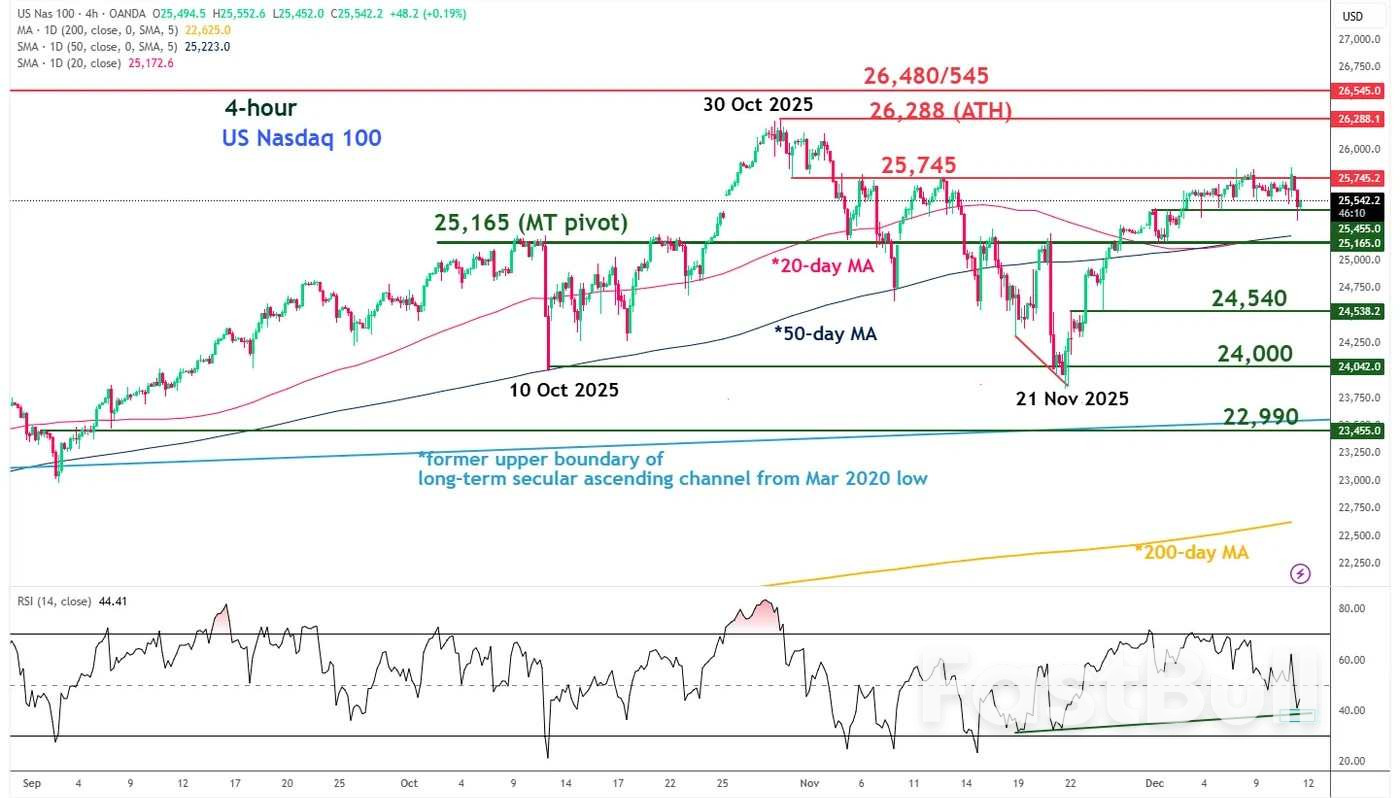 Fig. 2: US Nasdaq 100 CFD Index medium-term trend as of 11 Dec 2025
The Republican-controlled U.S. Congress is poised to allow tax credits to lapse for 24 million Americans this month, as a December 31 deadline approaches with no sign of a healthcare compromise before the Senate votes on Thursday on dueling proposals that lack enough support to pass.
The Democratic proposal on the subsidies under the Affordable Care Act, popularly known as Obamacare, would extend COVID-era subsidies for three years to keep insurance premiums from soaring for many. Those premiums could more than double in cost on average, according to KFF, a health policy organization.
A Republican bill by U.S. Senators Bill Cassidy of Louisiana and Mike Crapo of Idaho would send up to $1,500 to individuals earning less than 700% of the federal poverty level — about $110,000 for an individual or $225,000 for a family of four in 2025. Those funds could not be used for abortion or gender transition procedures and would require verification of beneficiaries' immigration or citizenship status — provisions Democrats reject.
Each party's leader in the Senate has panned the rival party's bill, with 60 votes needed to pass either measure in a Senate that Republicans control 53-47.
President Donald Trump has largely sat out the brawl over healthcare, although he ultimately embraced the Cassidy-Crapo approach.
The $1,500 payments in the Republican bill are meant to cover some of the out-of-pocket costs that people on lower-cost "Bronze" or "Catastrophic" Obamacare plans need to pay before their insurance kicks in.
However, it is far below the plans' deductibles, meaning that even after that payment, a patient would be on the hook for up to $7,500 in out-of-pocket medical expenses before their insurance would start to pay for part of their care.
Those costs can rack up quickly for people with lower-cost plans, with a visit to a U.S. emergency room costing between $1,000 and $3,000, while an ambulance ride can cost anywhere from $500 to over $3,500.
With 2026 congressional elections coming into focus, many Republicans are nervous about the prospect of stiff premium increases hitting every state, including many that backed Trump's 2024 reelection. Polling indicates voters could mostly punish Republicans, who control Congress and the White House.
Republican U.S. Senator Josh Hawley of Missouri told reporters on Monday it would be unacceptable to close out the year without a healthcare fix. Even in a state Trump carried by 18 points, Hawley said constituents tell him: "We can't afford our premiums now, let alone if they would go up by 50 or 100%."
Congress' failure to send a solution to Trump would mean tens of millions of Americans being forced to make difficult spending decisions as voters cite affordability as their top worry.
"What are they going to cut back on?" top Senate Democrat Chuck Schumer of New York asked on Wednesday. "Their healthcare or their food or their ability to buy some Christmas presents for their kids?"
Insurance companies have warned customers of the rising premiums in the new year, and Democrats argue there isn't enough time to do anything but a clean extension of the tax credits. Congress aims to leave town by the end of next week until January 5.
A new Reuters/Ipsos poll found Americans back a healthcare subsidy continuation. Some 51% of respondents — including three-quarters of Democrats and a third of Republicans — said they support extending the subsidies. Only 21% said they were opposed.
Other healthcare bills are swirling, including four from Senate Republicans this week. Schumer said Republicans' ideas "are loaded with poison pills, unworkable restrictions and don't do anything to bring down premiums."
Meanwhile, some bipartisan House measures would temporarily extend the subsidy and add some restrictions, but House Republican leaders have rejected any extension.
Moderate Republican Representative Brian Fitzpatrick of Pennsylvania is spearheading a bipartisan bill to extend the subsidy through 2027. He is hoping to garner enough support to circumvent leadership and force votes on the measure by the full House.
It is unclear what healthcare legislation Republican House Speaker Mike Johnson will unveil in time for House votes next week. He has given no sign of consulting Democrats, whom he blames for skyrocketing premiums.
"You cannot be an arsonist and a firefighter at the same time," Johnson said of Democrats.
Investors in a key piece of bank capital were left puzzled after the European Central Bank proposed changing the market without explaining how.
The idea to make so-called AT1 bonds more like equity capital came with "no details" on how that would work, KBW analysts led by Andrew Stimpson said in a note. "We are a little confused over what the ECB means here."
The ECB on Thursday presented recommendations on how to simplify banking regulation, and the question of how banks can use AT1s to meet their capital requirements has loomed large in the debate. The report included another proposal, which had previously been floated by the German Bundesbank, to ban banks from using AT1s to meet a certain regulatory capital level they need to achieve during normal times.
"Enhancing the capacity of AT1 must fully consider the potential impact on banks' funding costs, market availability and lending capacity," Caroline Liesegang, an official at the lobby group AFME, said in a statement. "It would be counterproductive if simplification ultimately increased the cost of capital and reduced the competitiveness of the banking sector."
Additional Tier 1 bonds have grown to a market worth about $275 billion in Europe as they allow banks to boost regulatory capital at a lower cost than issuing common equity. AT1 holders rank above equity holders when a bank fails, which, alongside other terms in the bonds, limit their downside compared to stocks.
Introduced after the global financial crisis to ensure that bondholders foot the bill when a bank gets into trouble instead of taxpayers, AT1s are some of the most complex instruments in the global credit market. They have come under fire over the years and particularly after the demise of Credit Suisse, when more than $17 billion of bonds were wiped out.
Despite the confusion, prices of AT1 bonds issued in major currencies by European lenders were little changed on the secondary market on Thursday, based on data compiled by Bloomberg.
"We are talking about how these characteristics of AT1 should evolve over time and that they should have as I have said before a more equity profile," ECB Vice President Luis de Guindos said on Thursday when asked during a press conference to provide more details on the proposal. "Going down to the details will depend on the legislator, but there are several elements that can be modified," he said.
Radical changes to the AT1 market could make the asset class "an unattractive form of equity," said Romain Miginiac, a fund manager and head of research at Atlanticomnium. He highlighted "very high triggers" as an example, referring to the capital level at which some AT1 bonds get wiped out or converted to equity.
As deeply subordinated bonds with many bells and whistles, AT1s have been very lucrative for investors. European banks' AT1s are on track to return more than 10% in 2025 on US dollar-hedged terms, after gains of about 13% the year before, based on Bloomberg indexes.
Still, Miginiac's base-case scenario is no or limited changes to the bonds. He was also unclear what Thursday's announcements meant regarding specific changes to the bonds. "What it does mean is that getting rid of AT1s is a non-starter," he said.
China's robust stockpiling of crude is expected to continue next year, helping to cushion global markets from a swelling surplus, but masking a broader trend of slowing oil demand growth.
Buying for commercial and strategic petroleum reserves propped up global oil prices in 2025, as the market grappled with the rapid return of idled output from OPEC+ and rising supply from other producers. Underpinned in part by energy security needs, Chinese stockpiling is expected to expand further next year, according to forecasts from Citigroup Inc. and FGE NexantECA.
China's SPR is a tightly held state secret, and absolute levels and the pace of crude buying can be difficult to gauge, but third-party providers often run the numbers to provide some insight. Energy Aspects estimates the nation's overall storage capacity — including commercial — is around 2 billion barrels, and is expected to expand by nearly 260 million barrels next year.
"Actual imports could be much higher than our forecasts," especially in the latter half of next year, if Beijing issues a fresh mandate to fill storage, said Jianan Sun, an analyst with Energy Aspects. The group currently expects inbound shipments of about 11.4 million barrels a day, roughly flat year-on-year.
Under a previous directive, China plans to buy as much as 140 million barrels for its SPR for delivery between October and March, as long as prices hold below $80 a barrel. Global benchmark Brent was briefly near that level in June, but is now trading around $62 due to concerns about the glut.
Citigroup forecasts China's stockpiling could continue at a rate of about 900,000 barrels a day next year, up from daily average builds since March of around 800,000 barrels. FGE predicts the country may add 600,000 barrels a day, compared with 480,000 barrels a day in 2025.
The country's network of coastal tanks and caverns are currently around half full, according to analytics firm OilX, providing plenty of room for additional barrels, especially with oil prices facing downward pressure into 2026.
China's buying for stockpiles has captured market attention, but it's distracted from the nation's continuing trend of slowing oil demand growth due to well-documented factors, such as the uptake of electric vehicles. Beijing is also seeking to consolidate its refining industry, partly due to green goals.
That consolidation means a huge refining and petrochemical venture between Saudi Aramco and its Chinese partners in Liaoning province will likely fill the void of some trimmed capacity, rather than significantly boost consumption. The complex is expected to be operational next year, according to JLC.
The nation's oil demand growth started to weaken in 2024 following a surge the previous year after Covid lockdowns were lifted, according to the International Energy Agency. The rate rose by 0.8% in 2024, well below the annual average prior to the pandemic, the IEA said.
China's oil demand growth is forecast to be 150,000 barrels a day next year, according to the median estimate in a Bloomberg survey of analysts. Energy Aspects was the most bullish, expecting daily growth at 320,000 barrels, mainly on rising petrochemical demand. Still, the prediction is a year-on-year drop.
"It's an irreversible path," said Ye Lin, vice president of oil markets at consultancy Rystad Energy, which also forecasts demand growth falling in 2026. "The market is now feeling the impact of China's fast-growing EV fleet."
Chile's bustling cherry industry has flourished from a niche crop into a multi billion-dollar export sensation, generating more revenue for the country last year than its coveted battery metal lithium. Most shipments go to China.
China and Japan's diplomatic spat shows no sign of an offramp even as the leadership of a Japanese political party that helped break the ice in a previous dispute continues to talk with officials from Beijing behind the scenes.
Chinese artificial intelligence startup DeepSeek has relied on Nvidia Corp. chips that are banned in the country to develop an upcoming AI model, according to a new report in The Information.
728 RM B 7/F GEE LOK IND BLDG NO 34 HUNG TO RD KWUN TONG KLN HONG KONG


White Label
Data API
Web Plug-ins
Poster Maker
Affiliate Program
The risk of loss in trading financial instruments such as stocks, FX, commodities, futures, bonds, ETFs and crypto can be substantial. You may sustain a total loss of the funds that you deposit with your broker. Therefore, you should carefully consider whether such trading is suitable for you in light of your circumstances and financial resources.
No decision to invest should be made without thoroughly conducting due diligence by yourself or consulting with your financial advisors. Our web content might not suit you since we don't know your financial conditions and investment needs. Our financial information might have latency or contain inaccuracy, so you should be fully responsible for any of your trading and investment decisions. The company will not be responsible for your capital loss.
Without getting permission from the website, you are not allowed to copy the website's graphics, texts, or trademarks. Intellectual property rights in the content or data incorporated into this website belong to its providers and exchange merchants.
Not Logged In
Log in to access more features

FastBull Membership
Not yet
Purchase


Log In
Sign Up


