

Markets
News
Analysis
User
24/7
Economic Calendar
Education
Data
- Names
- Latest
- Prev



Signal Accounts for Members
All Signal Accounts
All Contests
 U.K. GfK Consumer Confidence Index (Dec)
A:--
F: --
P: --
 Japan Benchmark Interest Rate
A:--
F: --
P: --
BOJ Monetary Policy Statement Australia Commodity Price YoY
A:--
F: --
P: --
BOJ Press Conference Turkey Consumer Confidence Index (Dec)
A:--
F: --
P: --
U.K. Retail Sales YoY (SA) (Nov)A:--
F: --
U.K. Core Retail Sales YoY (SA) (Nov)A:--
F: --
 Germany PPI YoY (Nov)
A:--
F: --
P: --
Germany PPI MoM (Nov)A:--
F: --
P: --
Germany GfK Consumer Confidence Index (SA) (Jan)A:--
F: --
U.K. Retail Sales MoM (SA) (Nov)A:--
F: --
P: --
 France PPI MoM (Nov)
A:--
F: --
P: --
 Euro Zone Current Account (Not SA) (Oct)
A:--
F: --
P: --
Euro Zone Current Account (SA) (Oct)A:--
F: --
P: --
 Russia Key Rate
A:--
F: --
P: --
U.K. CBI Distributive Trades (Dec)A:--
F: --
P: --
U.K. CBI Retail Sales Expectations Index (Dec)A:--
F: --
P: --
 Brazil Current Account (Nov)
A:--
F: --
P: --
 Canada Retail Sales MoM (SA) (Oct)
A:--
F: --
Canada New Housing Price Index MoM (Nov)A:--
F: --
P: --
Canada Core Retail Sales MoM (SA) (Oct)A:--
F: --
 U.S. Existing Home Sales Annualized MoM (Nov)
A:--
F: --
U.S. UMich Consumer Sentiment Index Final (Dec)A:--
F: --
P: --
U.S. Conference Board Employment Trends Index (SA) (Nov)A:--
F: --
Euro Zone Consumer Confidence Index Prelim (Dec)A:--
F: --
P: --
U.S. UMich 1-Year-Ahead Inflation Expectations Final (Dec)A:--
F: --
P: --
U.S. UMich Consumer Expectations Index Final (Dec)A:--
F: --
P: --
U.S. UMich Current Economic Conditions Index Final (Dec)A:--
F: --
P: --
U.S. Existing Home Sales Annualized Total (Nov)A:--
F: --
U.S. Weekly Total Rig CountA:--
F: --
P: --
U.S. Weekly Total Oil Rig CountA:--
F: --
P: --
 China, Mainland 5-Year Loan Prime Rate
--
F: --
P: --
China, Mainland 1-Year Loan Prime Rate (LPR)--
F: --
P: --
U.K. Current Account (Q3)--
F: --
P: --
U.K. GDP Final YoY (Q3)--
F: --
P: --
U.K. GDP Final QoQ (Q3)--
F: --
P: --
 Italy PPI YoY (Nov)
--
F: --
P: --
 Mexico Economic Activity Index YoY (Oct)
--
F: --
P: --
Canada National Economic Confidence Index--
F: --
P: --
Canada Industrial Product Price Index YoY (Nov)--
F: --
P: --
U.S. Chicago Fed National Activity Index (Nov)--
F: --
P: --
Canada Industrial Product Price Index MoM (Nov)--
F: --
P: --
U.S. Dallas Fed PCE Price Index YoY (Oct)--
F: --
P: --
RBA Monetary Policy Meeting Minutes Euro Zone Total Reserve Assets (Nov)--
F: --
P: --
Mexico Trade Balance (Nov)--
F: --
P: --
Canada GDP YoY (Oct)--
F: --
P: --
Canada GDP MoM (SA) (Oct)--
F: --
P: --
U.S. Core PCE Price Index Prelim YoY (Q3)--
F: --
P: --
U.S. PCE Price Index Prelim YoY (Q3)--
F: --
P: --
U.S. Annualized Real GDP Prelim (Q3)--
F: --
P: --
U.S. Non-Defense Capital Durable Goods Orders MoM (Excl. Aircraft) (Oct)--
F: --
P: --
U.S. PCE Price Index Prelim QoQ (SA) (Q3)--
F: --
P: --
U.S. Core PCE Price Index Annualized QoQ Prelim (SA) (Q3)--
F: --
P: --
U.S. GDP Deflator Prelim QoQ (SA) (Q3)--
F: --
P: --
U.S. Durable Goods Orders MoM (Excl. Defense) (SA) (Oct)--
F: --
P: --
U.S. Durable Goods Orders MoM (Excl.Transport) (Oct)--
F: --
P: --
U.S. Real Personal Consumption Expenditures Prelim QoQ (Q3)--
F: --
P: --
U.S. Real GDP Annualized QoQ Prelim (SA) (Q3)--
F: --
P: --
U.S. Durable Goods Orders MoM (Oct)--
F: --
P: --


No matching data

Latest Views
Latest Views
Trending Topics
Top Columnists
Latest Update
White Label
Data API
Web Plug-ins
Affiliate Program
View All
No data
European Union (EU) countries on Thursday approved a deal to delay the anti-deforestation law by a year following pushback from industry and concerns the digital system to enforce it was not ready, the Council of the EU said, clearing the final legal hurdle for the delay to pass into law.
European Union (EU) countries on Thursday approved a deal to delay the anti-deforestation law by a year following pushback from industry and concerns the digital system to enforce it was not ready, the Council of the EU said, clearing the final legal hurdle for the delay to pass into law.
The world-first policy would ban imports into the EU of cocoa, palm oil and other commodities linked to forest destruction, requiring foreign exporters of these commodities to provide due diligence statements proving their products did not contribute to forest destruction.
Originally due to apply from December 2024, the law was designed as a key plank of the EU's green agenda. Brussels had already delayed it by a year, but that did not quell opposition from industry and trade partners including Brazil, Indonesia and the US, which said complying with the rules would be costly and hurt their exports to Europe.
Under the amended EU law, large companies will now have to comply from December 30, 2026, followed by smaller firms with a turnover of less than €10 million (RM47.88 million) in the products affected, from June 30, 2027.
The EU proposed delaying the law for a second time in September, citing concerns about the readiness of information-technology systems needed to support it.
Food majors such as Nestle, Ferrero and Olam Agri had warned that further delays to the law endangered forests worldwide. The policy aims to end the 10% of global deforestation fuelled by EU consumption of imported goods.
Europe has folded rather quickly on EU leaders' controversial plan to confiscate Russian assets held in Belgium's depository Euroclear to use as a reparations loan for Ukraine.
On Friday it became clear in the two day Brussels summit the EU was unable to agree on the plan, but instead has opted to raise €90 billion ($105 billion) in joint borrowing, with Hungary, the Czech Republic and Slovakia choosing not to take part.
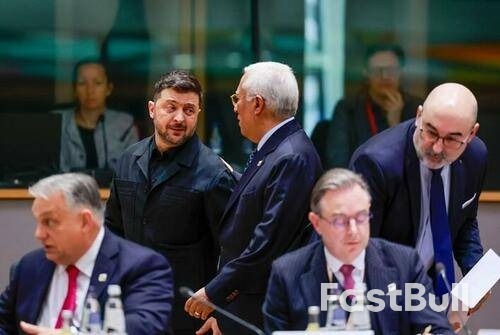 via Associated Press
Not only had objecting member states like Hungary sent EU leaders scrambling to circumvent a normal vote, but Belgium has remained unwavering in insisting on unlimited guarantees tied to assets held on its territory.
Fearing immediate Russian retaliation, Belgium wanted assurance that the rest of the EU would step in and absorb whatever retaliatory measures, including lawsuits, would result from the asset seizure.
Belgian Prime Minister Bart De Wever recently summed up the dilemma best: "We do not wish to be at war with Russia. We must negotiate based on reality, not fantasy. In reality, you don't steal money from a foreign central bank. Stealing from a central bank is like robbing an embassy."
So it appears EU leadership has backed down, perhaps having learned their lesson from Biden weaponizing the dollar early in the Ukraine war. As a reminder, here's what President Vladimir Putin had to say by way of warning back in spring of 2024:
"The dollar is the cornerstone of the United States' power... it is the main weapon used by the U.S. to preserve its power across the world," the Russian leader said. "As soon as the political leadership decided to use the dollar as a tool of political struggle, a blow was dealt to this American power."
As for the failed effort to permanently seize the some 210 billion euros ($247bn) in Russian assets held in Europe, EU officials had played down the possibility of an alternative plan right up to the eve of the summit.
And just like that, France's Macron calls for renewed push for diplomacy with Moscow...
German Chancellor Friedrich Merz spearheaded the efforts, but now the setback marks a blow for he and European Commission President Ursula von der Leyen, who had pitched the reparations loan hard while not presenting another alternative.
Still, Danish Prime Minister Mette Frederiksen proclaimed that the immediate objective had been met. "The bottom line is that our support for Ukraine is secured," Frederiksen told reporters. But Russia won't be the one being forced to pay for wartime destruction.
As it stands now, EU member states will borrow from financial markets and cover the interest costs themselves. The loan is intended to be interest-free for now, with no clear future plan on just how it will be recouped. European Council President Antonio Costa said that "technical aspects of the reparations loan" must still be "worked out."
In the end this marks another behind the scenes victory for Russia after ramping up the pressure on Belgium. RT underscores in its story headlined EU's plan to steal Russian assets for Ukraine fails that "Without the EU war chest, Zelensky faces a short-term economic crisis. Ukraine needs some €72 billion to repay a G7 loan and stay afloat fiscally."
Key points:
A growing number of Chinese companies are looking to domicile in Singapore, betting a move to the trade-focused city-state would reduce risks their operations get disrupted by Sino-U.S. geopolitical tensions.
The trend, billed as "Singapore washing" by some analysts, started gaining traction near the end of U.S. President Donald Trump's first presidency and has since accelerated, spreading to various sectors from critical minerals to tech and biotechnology, analysts and experts said.
"Demand has always been rising...and the key thing right now is that it's probably going to accelerate at a more rapid pace," said KG Tan, CEO of InCorp Group, which helps companies relocate or expand in nine Asia-Pacific locations.
There is no official data on how many Chinese companies are domiciled in Singapore, but Tan said interest from Chinese firms is "very strong" with about 15-20% more inquiries now year-on-year.
Singapore-domiciled companies include optical products maker Terahop, backed by China-based Zhongji Innolight, which set up shop in the city in 2018.
More recent additions include data centre operator DayOne, spun off from GDS Holdings; Manus AI, an artificial intelligence agent from China's Butterfly Effect; and ChemLex, an AI-powered chemical synthesis company.
Neither Manus AI's nor Terahop's websites make reference to their Chinese backers. ChemLex CEO Sean Lin said he considers his Shanghai-founded startup a Singapore company.
DayOne CEO Jamie Khoo said in July that it always intended to split from its Chinese parent, as both companies operate under different regulatory regimes. Manus AI and Terahop did not respond to requests for comment.
Singapore offers an attractive base for firms looking to navigate U.S. tariffs and maintain access to key American technologies whose sales are restricted in China. Washington imposes tariffs of just 10% on goods from Singapore.
"The Singapore brand is trusted worldwide. Singapore is valued for its international flavour, neutrality, and is culturally easy for Chinese firms and their expats to adapt to," said Maybank China economist Erica Tay.
"With a whopping 28 free trade agreements, it is also a good base from which to grow markets outside China."
But that advantage has also left Singapore on a tightrope, as the U.S. steps up its scrutiny over Chinese firms and as some of those foreign entities have been involved in criminal activities.
Singapore-based data centre firm Megaspeed, which split from a Chinese gaming firm in 2023, faces a U.S. probe for allegedly diverting Nvidiachips used for AI.
The Asian country also had its biggest money laundering case involving foreigners of Chinese origin in 2023, and is investigating a conglomerate, owned by a Cambodian citizen of Chinese origins and accused of running vast scam centre operations.
The U.S. Department of Commerce and China's Ministry of Commerce did not respond to requests for comment. Reuters has asked the Singapore government for comment.
While a relocation in theory offers businesses more flexibility in managing tariffs, export controls and other protective trade policies, such moves do not guarantee firms freedom from political or regulatory heat.
Fast fashion firm Shein and short video platform TikTok, among the early movers to Singapore, notably failed to shield their operations from Western scrutiny.
Shein ran into political opposition in the U.S. and the UK over its efforts to go public there and also had to seek Beijing's nod for its listing plans, despite having moved its headquarters from Nanjing to Singapore.
It is now seeking China's blessing for a stock market debut in Hong Kong, and reportedly considering relocation back to China.
TikTok, owned by China's ByteDance, saw its Singaporean CEO Chew Shou Zi repeatedly grilled over his links to the Chinese government at a Congressional hearing in Washington in 2024.
ByteDance, which is required to sell its U.S. operation to a consortium of American and global investors to meet national security requirements, signed off on the sale deal, TikTok said on Thursday.
A failed effort by Yuxiao Fund, a Singapore-registered Chinese investor, to boost its stake in Australian rare earths miner Northern Mineralsin 2024 due to its China link also highlights the limits of being based in Singapore.
Experts argue the strategy mostly works for smaller firms but provides less wriggle room for big businesses.
"It's the low-profile entities like family offices and trading companies which tend to have an easier time avoiding attention," said Chong Ja Ian, political scientist at the National University of Singapore.
Some have already taken note of the growing scrutiny.
Dou Changlin, the chief operating officer of Shandong Boan Biotechnology, which provides clinical services for global drugmakers, said its Singapore subsidiary is used to fund the company's U.S. operations.
While the structure has helped it meet funding needs from Singapore, not from China which has stepped up scrutiny of capital flows, Dou cautions U.S. authorities could eventually draw a connection with its Chinese parent company.
"We are very small in the U.S., I don't think we're on the radar of the U.S. government yet," he said.
728 RM B 7/F GEE LOK IND BLDG NO 34 HUNG TO RD KWUN TONG KLN HONG KONG


White Label
Data API
Web Plug-ins
Poster Maker
Affiliate Program
The risk of loss in trading financial instruments such as stocks, FX, commodities, futures, bonds, ETFs and crypto can be substantial. You may sustain a total loss of the funds that you deposit with your broker. Therefore, you should carefully consider whether such trading is suitable for you in light of your circumstances and financial resources.
No decision to invest should be made without thoroughly conducting due diligence by yourself or consulting with your financial advisors. Our web content might not suit you since we don't know your financial conditions and investment needs. Our financial information might have latency or contain inaccuracy, so you should be fully responsible for any of your trading and investment decisions. The company will not be responsible for your capital loss.
Without getting permission from the website, you are not allowed to copy the website's graphics, texts, or trademarks. Intellectual property rights in the content or data incorporated into this website belong to its providers and exchange merchants.
Not Logged In
Log in to access more features

FastBull Membership
Not yet
Purchase


Log In
Sign Up


