• Trade
  • Markets
  • Copy
  • Contests
  • News
  • 24/7
  • Calendar
  • Q&A
  • Chats
Trending
Screeners
SYMBOL
LAST
BID
ASK
HIGH
LOW
NET CHG.
%CHG.
SPREAD
SPX
S&P 500 Index
6870.39
6870.39
6870.39
6895.79
6858.28
+13.27
+ 0.19%
--
DJI
Dow Jones Industrial Average
47954.98
47954.98
47954.98
48133.54
47871.51
+104.05
+ 0.22%
--
IXIC
NASDAQ Composite Index
23578.12
23578.12
23578.12
23680.03
23506.00
+72.99
+ 0.31%
--
USDX
US Dollar Index
98.890
98.970
98.890
98.960
98.730
-0.060
-0.06%
--
EURUSD
Euro / US Dollar
1.16519
1.16526
1.16519
1.16717
1.16341
+0.00093
+ 0.08%
--
GBPUSD
Pound Sterling / US Dollar
1.33217
1.33228
1.33217
1.33462
1.33136
-0.00095
-0.07%
--
XAUUSD
Gold / US Dollar
4204.66
4205.07
4204.66
4218.85
4190.61
+6.75
+ 0.16%
--
WTI
Light Sweet Crude Oil
59.273
59.303
59.273
60.084
59.247
-0.536
-0.90%
--

Community Accounts

Signal Accounts
--
Profit Accounts
--
Loss Accounts
--
View More

Become a signal provider

Sell trading signals to earn additional income

View More

Guide to Copy Trading

Get started with ease and confidence

View More

Signal Accounts for Members

All Signal Accounts

Best Return
  • Best Return
  • Best P/L
  • Best MDD
Past 1W
  • Past 1W
  • Past 1M
  • Past 1Y

All Contests

  • All
  • Trump Updates
  • Recommend
  • Stocks
  • Cryptocurrencies
  • Central Banks
  • Featured News
Top News Only
Share

Ukraine President Zelenskiy: No Accord So Far On Eastern Ukraine In US Talks

Share

NATO: Ukrainian President Zelenskiy Will Meet NATO's Rutte And EU Commission Chief Von Der Leyen And Costa In Brussels On Monday

Share

China Finance Ministry: To Reopen 119 Billion Yuan 10-Year Bonds On Dec 12

Share

Sudan's Paramilitary RSF Say They Controlled Oil-Rich Area Of Heglig In Kordofan

Share

German Government Spokesperson: We See Russia As A Threat To Our Security

Share

Thai Army Chief Of Staff: Thailand Seeking To Cripple Cambodia's Military Capability

Share

German Government Spokesperson: We Reject Criticism Of Europe In New US National Security Strategy

Share

Ivory Coast 2025/26 Cocoa Arrivals Reached 803000 T By December 7 Versus 820000 T A Year Ago - Exporters' Estimate

Share

EU To Delay Proposals For Automotive Sector, Including Co2 Emissions, To Dec 16, Draft EU Commission Document Shows

Share

Kremlin: India Buys Energy Where It Is Profitable To And As Far As We Understand They Will Continue To Do That

Share

Turkey's Main Banking Index Up 2.5%

Share

Turkey's Main BIST-100 Index Up 1.9%

Share

Hungary's Preliminary November Budget Balance Huf -403 Billion

Share

Indian Rupee Down 0.1% At 90.07 Per USA Dollar As Of 3:30 P.M. Ist, Previous Close 89.98

Share

India's Nifty 50 Index Provisionally Ends 0.96% Lower

Share

[JPMorgan: US Stock Rally May Stagnate Following Fed Rate Cut] JPMorgan Strategists Say The Recent Rally In US Stocks May Stall As Investors Take Profits Following The Anticipated Fed Rate Cut. The Market Currently Predicts A 92% Probability Of The Fed Lowering Borrowing Costs On Wednesday. Expectations Of A Rate Cut Have Continued To Rise, Fueled By Positive Signals From Policymakers In Recent Weeks. "Investors May Be More Inclined To Lock In Gains At The End Of The Year Rather Than Increase Directional Exposure," Mislav Matejka's Team Wrote In A Report

Share

Russian Defence Ministry: Russian Forces Take Control Of Novodanylivka In Ukraine's Zaporizhzhia Region

Share

Russian Defence Ministry: Russian Forces Take Control Of Chervone In Ukraine's Donetsk Region

Share

French Finance Ministry: Government Started Process To Block Temporarily Shein Platform

Share

Finance Minister: Indonesia To Impose Coal Export Tax Of Up To 5% Next Year

TIME
ACT
FCST
PREV
France Industrial Output MoM (SA) (Oct)

A:--

F: --

P: --
France Trade Balance (SA) (Oct)

A:--

F: --

P: --
Euro Zone Employment YoY (SA) (Q3)

A:--

F: --

P: --
Canada Part-Time Employment (SA) (Nov)

A:--

F: --

P: --

Canada Unemployment Rate (SA) (Nov)

A:--

F: --

P: --

Canada Full-time Employment (SA) (Nov)

A:--

F: --

P: --

Canada Labor Force Participation Rate (SA) (Nov)

A:--

F: --

P: --

Canada Employment (SA) (Nov)

A:--

F: --

P: --

U.S. PCE Price Index MoM (Sept)

A:--

F: --

P: --

U.S. Personal Income MoM (Sept)

A:--

F: --

P: --

U.S. Core PCE Price Index MoM (Sept)

A:--

F: --

P: --

U.S. PCE Price Index YoY (SA) (Sept)

A:--

F: --

P: --

U.S. Core PCE Price Index YoY (Sept)

A:--

F: --

P: --

U.S. Personal Outlays MoM (SA) (Sept)

A:--

F: --

P: --
U.S. 5-10 Year-Ahead Inflation Expectations (Dec)

A:--

F: --

P: --

U.S. Real Personal Consumption Expenditures MoM (Sept)

A:--

F: --

P: --
U.S. Weekly Total Rig Count

A:--

F: --

P: --

U.S. Weekly Total Oil Rig Count

A:--

F: --

P: --

U.S. Consumer Credit (SA) (Oct)

A:--

F: --

P: --
China, Mainland Foreign Exchange Reserves (Nov)

A:--

F: --

P: --

Japan Trade Balance (Oct)

A:--

F: --

P: --

Japan Nominal GDP Revised QoQ (Q3)

A:--

F: --

P: --

China, Mainland Imports YoY (CNH) (Nov)

A:--

F: --

P: --

China, Mainland Exports (Nov)

A:--

F: --

P: --

China, Mainland Imports (CNH) (Nov)

A:--

F: --

P: --

China, Mainland Trade Balance (CNH) (Nov)

A:--

F: --

P: --

China, Mainland Exports YoY (USD) (Nov)

A:--

F: --

P: --

China, Mainland Imports YoY (USD) (Nov)

A:--

F: --

P: --

Germany Industrial Output MoM (SA) (Oct)

A:--

F: --

P: --
Euro Zone Sentix Investor Confidence Index (Dec)

A:--

F: --

P: --

Canada National Economic Confidence Index

--

F: --

P: --

U.K. BRC Like-For-Like Retail Sales YoY (Nov)

--

F: --

P: --

U.K. BRC Overall Retail Sales YoY (Nov)

--

F: --

P: --

Australia Overnight (Borrowing) Key Rate

--

F: --

P: --

RBA Rate Statement
RBA Press Conference
Germany Exports MoM (SA) (Oct)

--

F: --

P: --

U.S. NFIB Small Business Optimism Index (SA) (Nov)

--

F: --

P: --

Mexico 12-Month Inflation (CPI) (Nov)

--

F: --

P: --

Mexico Core CPI YoY (Nov)

--

F: --

P: --

Mexico PPI YoY (Nov)

--

F: --

P: --

U.S. Weekly Redbook Index YoY

--

F: --

P: --

U.S. JOLTS Job Openings (SA) (Oct)

--

F: --

P: --

China, Mainland M1 Money Supply YoY (Nov)

--

F: --

P: --

China, Mainland M0 Money Supply YoY (Nov)

--

F: --

P: --

China, Mainland M2 Money Supply YoY (Nov)

--

F: --

P: --

U.S. EIA Short-Term Crude Production Forecast For The Year (Dec)

--

F: --

P: --

U.S. EIA Natural Gas Production Forecast For The Next Year (Dec)

--

F: --

P: --

U.S. EIA Short-Term Crude Production Forecast For The Next Year (Dec)

--

F: --

P: --

EIA Monthly Short-Term Energy Outlook
U.S. API Weekly Gasoline Stocks

--

F: --

P: --

U.S. API Weekly Cushing Crude Oil Stocks

--

F: --

P: --

U.S. API Weekly Crude Oil Stocks

--

F: --

P: --

U.S. API Weekly Refined Oil Stocks

--

F: --

P: --

South Korea Unemployment Rate (SA) (Nov)

--

F: --

P: --

Japan Reuters Tankan Non-Manufacturers Index (Dec)

--

F: --

P: --

Japan Reuters Tankan Manufacturers Index (Dec)

--

F: --

P: --

Japan Domestic Enterprise Commodity Price Index MoM (Nov)

--

F: --

P: --

Japan Domestic Enterprise Commodity Price Index YoY (Nov)

--

F: --

P: --

China, Mainland PPI YoY (Nov)

--

F: --

P: --

Q&A with Experts
    • All
    • Chatrooms
    • Groups
    • Friends
    Connecting
    .
    .
    .
    Type here...
    Add Symbol or Code

      No matching data

      All
      Trump Updates
      Recommend
      Stocks
      Cryptocurrencies
      Central Banks
      Featured News
      • All
      • Russia-Ukraine Conflict
      • Middle East Flashpoint
      • All
      • Russia-Ukraine Conflict
      • Middle East Flashpoint
      Search
      Products

      Charts Free Forever

      Chats Q&A with Experts
      Screeners Economic Calendar Data Tools
      Membership Features
      Data Warehouse Market Trends Institutional Data Policy Rates Macro

      Market Trends

      Market Sentiment Order Book Forex Correlations

      Top Indicators

      Charts Free Forever
      Markets

      News

      News Analysis 24/7 Columns Education
      From Institutions From Analysts
      Topics Columnists

      Latest Views

      Latest Views

      Trending Topics

      Top Columnists

      Latest Update

      Signals

      Copy Rankings Latest Signals Become a signal provider AI Rating
      Contests
      Brokers

      Overview Brokers Assessment Rankings Regulators News Claims
      Broker listing Forex Brokers Comparison Tool Live Spread Comparison Scam
      Q&A Complaint Scam Alert Videos Tips to Detect Scam
      More

      Business
      Events
      Careers About Us Advertising Help Center

      White Label

      Data API

      Web Plug-ins

      Affiliate Program

      Awards Institution Evaluation IB Seminar Salon Event Exhibition
      Vietnam Thailand Singapore Dubai
      Fans Party Investment Sharing Session
      FastBull Summit BrokersView Expo
      Recent Searches
        Top Searches
          Markets
          News
          Analysis
          User
          24/7
          Economic Calendar
          Education
          Data
          • Names
          • Latest
          • Prev

          View All

          No data

          Scan to Download

          Faster Charts, Chat Faster!

          Download App
          English
          • English
          • Español
          • العربية
          • Bahasa Indonesia
          • Bahasa Melayu
          • Tiếng Việt
          • ภาษาไทย
          • Français
          • Italiano
          • Türkçe
          • Русский язык
          • 简中
          • 繁中
          Open Account
          Search
          Products
          Charts Free Forever
          Markets
          News
          Signals

          Copy Rankings Latest Signals Become a signal provider AI Rating
          Contests
          Brokers

          Overview Brokers Assessment Rankings Regulators News Claims
          Broker listing Forex Brokers Comparison Tool Live Spread Comparison Scam
          Q&A Complaint Scam Alert Videos Tips to Detect Scam
          More

          Business
          Events
          Careers About Us Advertising Help Center

          White Label

          Data API

          Web Plug-ins

          Affiliate Program

          Awards Institution Evaluation IB Seminar Salon Event Exhibition
          Vietnam Thailand Singapore Dubai
          Fans Party Investment Sharing Session
          FastBull Summit BrokersView Expo

          Ethereum 'Mega Whales' Are Stacking Harder Than Pre-95% Rally in 2022

          Warren Takunda

          Cryptocurrency

          Summary:

          Ethereum is eyeing a breakout toward $3,400 as it consolidates within a bull pennant, echoing classic continuation patterns from past rallies.
          Key takeaways:
          Ethereum mega whales have increased their holdings by 9.31%, a stronger buildup than before the 2022 rally.
          ETH is consolidating inside a bull pennant, with a breakout potentially targeting $3,400 by August.
          Ethereum wallets holding at least 10,000 Ether ETH $2,561 are ramping up accumulation faster than before the 95% rally in mid-2022.

          Ether whales reclaim the most supply since 2020

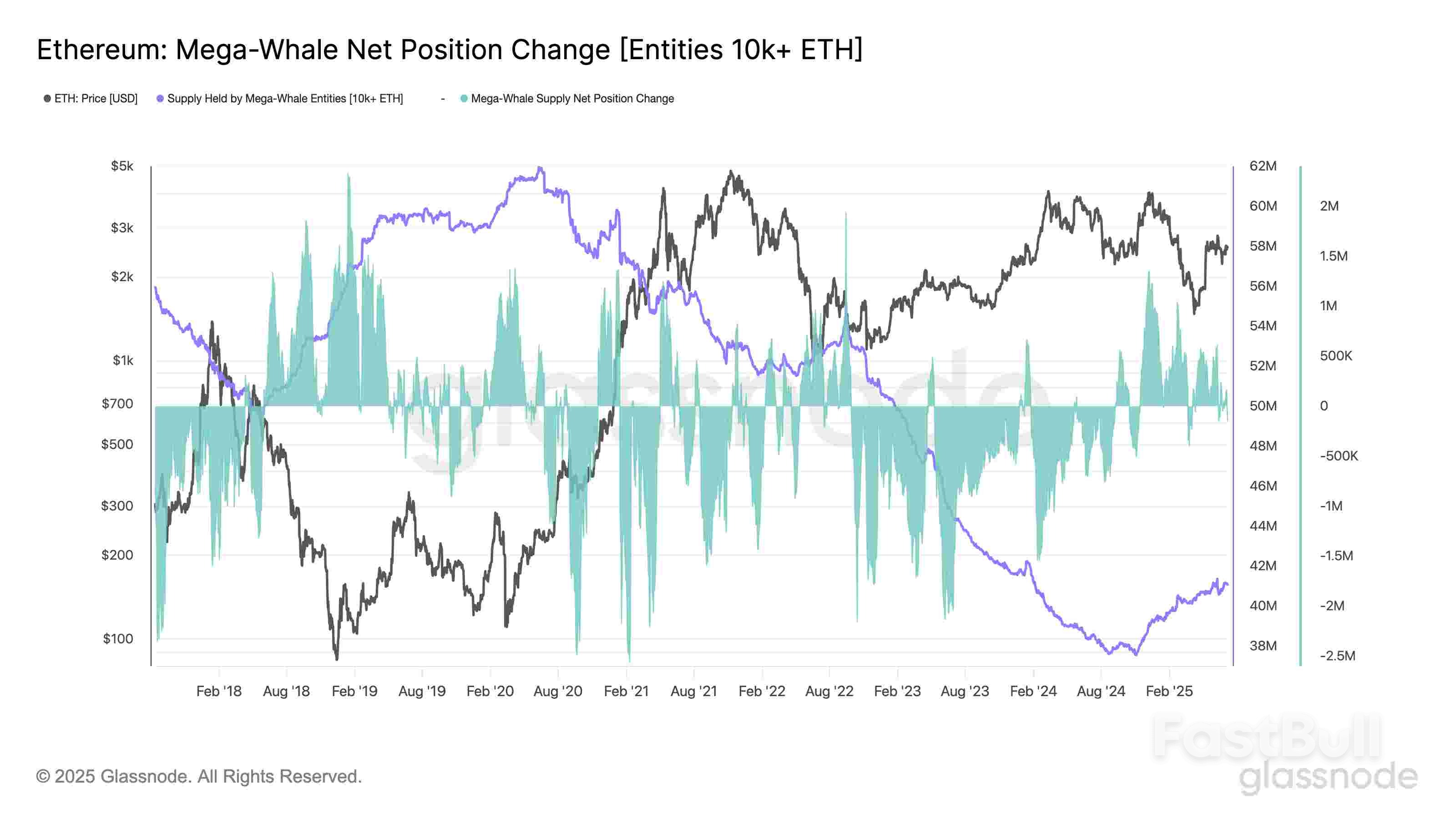
          The total ETH held by these “mega whales” recovered to over 41.06 million ETH as of July 7 from 37.56 million ETH—a record low—in October 2024, according to Glassnode data.Ethereum 'Mega Whales' Are Stacking Harder Than Pre-95% Rally in 2022_1

          Ethereum mega-whale net position change vs. supply. Source: Glassnode

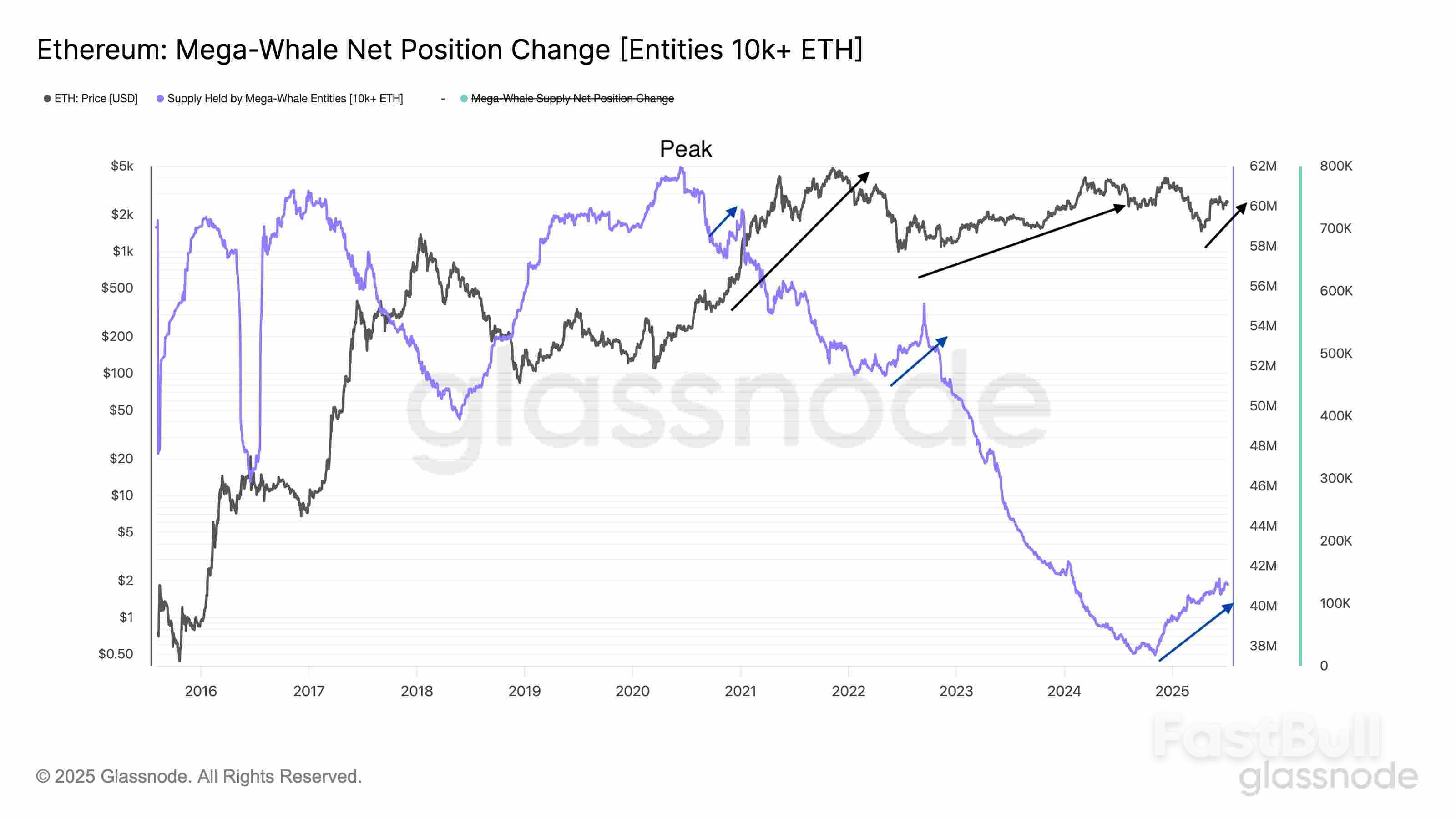
          That marks a 9.31% increase, almost double the accumulation pace seen between May and September 2022, before ETH price rallied from ~$1,000 to over $1,950, a 95% increase.
          A similar trend played out between November 2020 and January 2021, when whale holdings rose 4%, and ETH jumped from $460 to $1,220.Ethereum 'Mega Whales' Are Stacking Harder Than Pre-95% Rally in 2022_2

          Ethereum mega-whale supply. Source: Glassnode

          Large holders began accumulating well before the broader market caught on in both instances. ETH price action has remained relatively flat in recent weeks, suggesting that the current accumulation phase is still flying under the radar.
          This silent buildup could be a precursor to a significant upside move that may not be priced in yet, if the past patterns play out again.
          The ongoing rise in mega whales’ Ether holdings further coincides with increasing flows into Ethereum-focused investment funds, including ETFs. The supply recovery is also the strongest and most sustained since the metric’s long-term downtrend began in June 2020.

          Bull pennant targets 30% ETH price gains

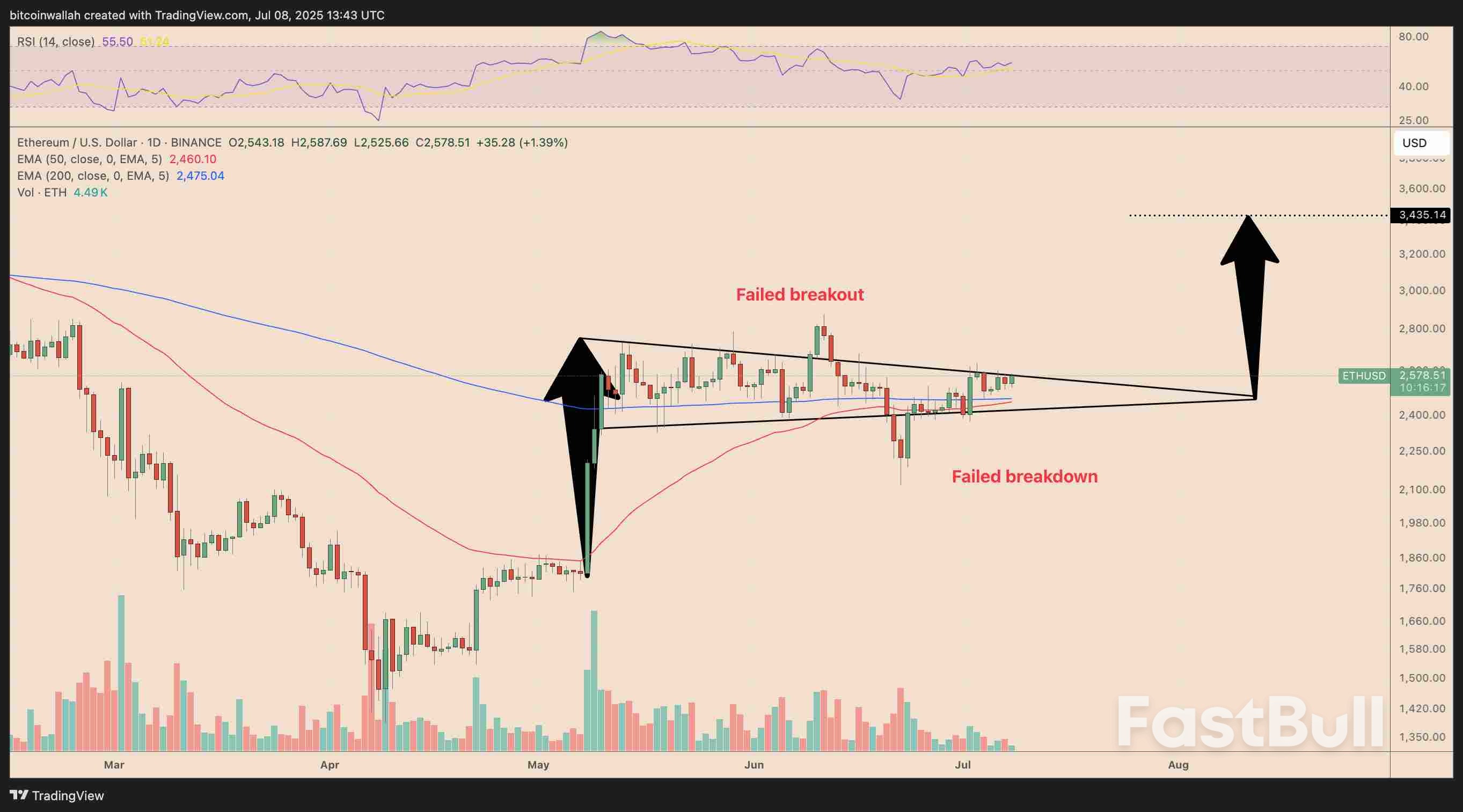
          Ether is also trading within a textbook bull pennant pattern on the daily chart. The setup typically signals a continuation move, often resolved by a breakout in the direction of the prior trend.
          Interestingly, both a failed breakout and a failed breakdown have occurred within the structure, suggesting strong consolidation.Ethereum 'Mega Whales' Are Stacking Harder Than Pre-95% Rally in 2022_3

          ETH/USD daily price chart. Source: TradingView

          A decisive move above the pennant’s upper boundary could push ETH toward the $3,400 level by August. Some indicators even see the price hitting $5,000 by year’s end.
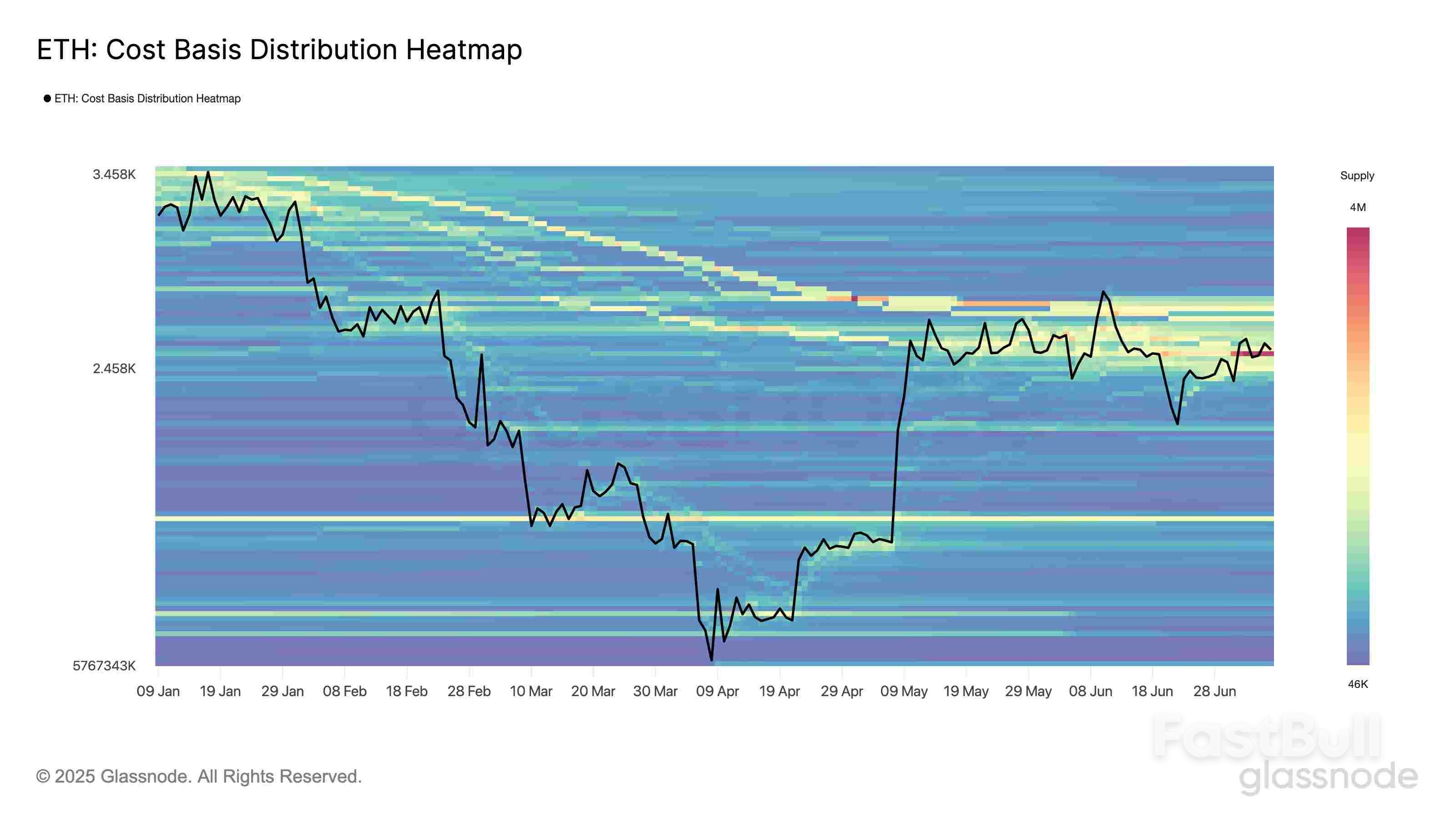
          Ethereum’s cost basis distribution heatmap shows the $2,500–$2,536 range as one of the strongest accumulation zones in recent months, according to Glassnode data.Ethereum 'Mega Whales' Are Stacking Harder Than Pre-95% Rally in 2022_4

          ETH cost basis distribution heatmap. Source: Glassnode

          Over 3.45 million ETH have their cost basis within this range, underscoring it as a key support level.
          Such a heavy concentration of long-term holders near $2,500 reinforces the idea that Ether’s current consolidation phase is forming a solid foundation for the next leg up.

          Source: Cointelegraph

          Risk Warnings and Disclaimers
          You understand and acknowledge that there is a high degree of risk involved in trading. Following any strategies or investment methods may lead to potential losses. The content on the site is provided by our contributors and analysts for information purposes only. You are solely responsible for determining whether any trading assets, securities, strategy, or any other product is suitable for investing based on your own investment objectives and financial situation.
          Add to Favorites
          Share

          Tariffs, explained: What Trump wants from all these trade deals

          Adam

          Economic

          President Donald Trump and his administration are racing to get trade deals done ahead of a self-imposed deadline, at which point tariffs are set to rise for dozens of countries across the world.
          News about the on-again, off-again tariffs has become such a daily fixture of the second Trump administration that, at times, it can be hard to remember why the president started down this path in the first place. Trump has given many different reasons for why he believes tariffs are a crucial part of his policy agenda, but they can be categorized into four main goals:
          Restore America’s manufacturing prowess.
          Grow US revenue.
          Equalize the balance of trade.
          Pressure foreign countries into setting policies that benefit the United States.
          Trump has often treated tariffs like a panacea — a catch-all economic tool that can simultaneously restore blue-collar jobs, pay off the US deficit, bring foreign nations to heel on key disputes and reduce Americans’ tax burdens.
          In his first months in office, Trump has used tariffs to make progress on each of those goals.
          Some companies have announced that they’ll invest in US factories, citing the costly tariffs. Tens of billions of dollars of tariff revenue are coming in to the United States every month. America’s trade deficit was cut in half in April — a dramatic decrease. And Trump has brought several countries to the negotiating table after threatening high tariffs — all without dramatically increasing inflation.
          However, early indicators of success may be more of a sign of an initial shock to the system, as companies, consumers and businesses make rapid adjustments to the new reality of higher US tariffs.
          Economists and business leaders maintain that tariffs probably won’t lead to a major American factory boom. They argue revenue from tariffs will remain a drop in the bucket compared to the massive budget deficit that was just exacerbated by Trump signing his expensive domestic policy agenda and tax cuts into law. Tariffs and trade deals probably won’t dramatically increase demand for US goods in foreign countries. And some trading partners have already shown there’s a limit to how much tariff threats can achieve.
          Manufacturing jobs
          “I’m telling you, you just watch. We’re going to have jobs. We’re going to have open factories. It’s going to be great,” Trump said on Air Force One in March.
          To accomplish that, Trump has often advocated for lower taxes at home and higher taxes for goods made abroad.
          Trump during his joint address to Congress in March made an oft-since-repeated threat: “If you don’t make your product in America, … under the Trump administration, you will pay a tariff and, in some cases, a rather large one.”
          Trump has notched a handful of early PR victories after imposing tariffs. Apple in February said it would invest $500 billion in US manufacturing. GE Appliances said last month it would also spend a half a billion dollars to move a factory from China to make washing machines in the United States. And General Motors said in June it would spend $4 billion to increase its production in the United States. Many other companies have made similar announcements.
          However, many of those decisions were made prior to or independently of Trump’s tariffs, the companies say. That’s because factories can take years to plan, build and begin operations.
          Another major complication: Skilled manufacturing labor is hard to come by in the United States. That’s why in May, the Labor Department reported 414,000 job openings in the manufacturing sector: There just aren’t enough people in the United States who want to or are skilled enough to complete the work. And American labor can be much more expensive than in other countries. That’s why some industry experts estimate the cost of an iPhone would surge to over $3,000 if it were made in the USA.
          Meanwhile, manufacturing jobs are not booming — quite the opposite. After Trump declared victory with gains of 9,000 manufacturing jobs in his first two full months in office, they have since tumbled by 7,000 jobs in each of the past two months, and the number of manufacturing jobs is now lower since Trump took office than when he started.
          Tariffs may ultimately help to restore some manufacturing in America. But as Trump routinely reminds companies: If you make products in America, you pay no tariffs. That means if companies do as Trump asks, then America can’t raise tariff revenue from them.

          Raising revenue

          Trump has made astronomical estimates about how much money tariffs can raise, arguing tariffs could bring in trillions of dollars in annual revenue.
          “We’re going to make a lot of money, and we’re going to cut taxes for the people of this country,” Trump said before boarding Air Force One for his return from Pope Francis’ funeral in April. “It’ll take a little while before we do that, but we’re going to be cutting taxes, and it’s possible we’ll do a complete tax cut, because I think the tariffs will be enough to cut all of the income tax.”
          To accomplish that, tariffs would need to be exceedingly high — significantly higher than the already historic levels at which the Trump administration has set them today, or even the 60% to 70% Trump threatened to impose on some countries beginning in August.
          The federal government raises about $3 trillion a year from income taxes. The United States also happens to import around $3 trillion worth of goods annually. So that means tariffs would have to be at least 100% on all imported goods for the levies to replace income taxes, said Torsten Slok, chief economist at Apollo Global Management.
          It’s not quite that simple: Demand would fall as prices rise. So Slok estimates tariffs may have to be set at 200% to replace all federal income tax revenue.
          Tariffs aren’t bringing in anything close to that amount right now: The Treasury Department said Trump has raised less than $100 billion in tariff revenue since taking office, bringing in around $20 billion a month in each of the past several months.
          But there’s a problem: Some of the most punishing tariffs aren’t designed to remain in place that long. The Trump administration, for example, has placed 25% tariffs on Canada and Mexico and 20% on China to incentivize them to reduce the flow of fentanyl into the United States. If that is successful, Trump has said the tariffs will “come off.” And his trade deals are set to lower the tariff rate on some countries’ goods and services — not raise them.

          Restoring fairness

          Trump has often spoken about tariffs in terms of “fairness,” saying other countries are “ripping off” Americans with high trade barriers. He has repeatedly said he envisions America as a highly desirable department store and views tariffs as a “cost of doing business in America.”
          As a result, Trump on April 2 introduced “reciprocal” tariffs, which were calculated by effectively measuring America’s goods trade deficit with foreign countries and cutting that in half. So the countries from which America imported a large number of goods but exported little were punished with the highest reciprocal tariffs.
          When America is charged a higher tariff and has a trade imbalance with other countries, Trump has often incorrectly labeled that a “subsidy” or a “loss.” But economists largely agree that trade deficits are not losses or subsidies. In fact, they can be a reflection of a strong economy.
          Nevertheless, Trump’s tariffs initially had a major effect on the goods trade deficit, narrowing it from about $130 billion in April to around $60 billion in May, according to the US Commerce Department. US imports tumbled, primarily as 145% tariffs the Trump administration imposed on Canada created an effective blockade on Chinese goods entering the United States. The trade gap widened again in May after tariffs fell on Chinese goods and as foreign countries reduced their purchases of US exports.
          Over time, however, tariffs aren’t likely to meaningfully narrow the trade gap America has with other countries, economists argue. Many countries make goods more cheaply in other countries, and many products simply cannot be grown or produced in America.
          If the trade gap continued to fall, it could be a signal that America’s spending power was diminishing.

          Pressuring countries

          Trump has repeatedly threatened tariffs as a kind of anvil dangling over the heads of countries, companies or industries. On Monday, he posted two letters on Truth Social, to the heads of South Korea and Japan, noting that both countries will face a 25% tariff come August 1. That deadline potentially gives countries more time to negotiate deals. And the subjects of Trump’s tariff threats have, at times, immediately come to the negotiating table.
          The most recent example was last week, when Canada backed off its digital services tax that was set to go into effect. Trump had railed against the tax on online companies, including US corporations that do business in Canada. He threatened to end trade talks with America’s northern neighbor. Trump also said he would set a new tariff for Canada, which ultimately backed down, saying it would drop the tax to help bring the countries back to the table.
          But it doesn’t always work. Trump’s tariffs have not stopped the flow of fentanyl into the United States, although that was always an unreasonably lofty goal. The threat of tariffs has also failed to convince Apple to bring iPhone manufacturing to the United States, Hollywood to make more movies in Los Angeles, or US automakers to close their Canadian and Mexican factories.
          If and when targets of tariffs ultimately acquiesce to Trump’s demands, those tariffs also have to go away, which hurts the administration’s revenue-raising goals.

          The big contradiction

          Trump has notched several early wins with his tariffs — both politically and economically. But, in the long run, tariffs probably can’t achieve all of his lofty goals at the same time. That’s because Trump’s aims are often contradictory.
          For example, if tariffs are a pressure campaign, they have to go away once the countries acquiesce — meaning there will be no tariffs to restore the trade balance. If tariffs are designed to promote America’s manufacturing sector, they can’t also raise revenue to offset deficits. If Americans switch to made-in-the-USA goods, then who pays the tariff on foreign products?
          When used effectively, tariffs can help boost production at home by making foreign goods more expensive. Because America is an enormous and diverse economy that doesn’t rely on trade as much as its neighbors, the United States could use tariffs to inflict serious damage on other countries’ economies without plunging itself into a recession. Revenue raised by tariffs could help offset some of its deficits.
          Achieving all those outcomes simultaneously, however, may not be possible.

          Source : cnn

          To stay updated on all economic events of today, please check out our Economic calendar
          Risk Warnings and Disclaimers
          You understand and acknowledge that there is a high degree of risk involved in trading. Following any strategies or investment methods may lead to potential losses. The content on the site is provided by our contributors and analysts for information purposes only. You are solely responsible for determining whether any trading assets, securities, strategy, or any other product is suitable for investing based on your own investment objectives and financial situation.
          Add to Favorites
          Share

          Here’s How the New Trump Accounts Work — and Why Financial Experts Don’t Love Them

          Warren Takunda

          Economic

          Pretty soon, every newborn American will be the proud owner of their very own “Trump account.”
          President Trump's sprawling tax law creates a new, tax-advantaged investment account prefunded with $1,000 for each child born from the beginning of 2025 through the end of 2028. Kids born before this year are eligible for the IRA-style accounts but not the $1,000 seed money.
          The idea’s backers say the accounts are a way to get all kids into saving and investing early in life, while helping them save for goals like college or a home.
          But financial advisers who spoke with Yahoo Finance warned that, aside from the free seed money, the benefits the accounts offer are relatively paltry compared to other tax-shielded savings options Americans already have available, including the 529 accounts parents use to put away money for college and IRAs for retirement. The new Trump accounts also come tied up with a fairly complex and potentially confusing set of rules.
          As a result, putting any money into them beyond what the government offers might not make sense for most families, they said.
          “It’s not very attractive,” Ann Reilley, CEO of Alpha Financial Advisors, said of the program. “It just seems like they’re complicating things for no reason.”
          Under the new program, parents will have the option to open Trump accounts for any child under age 18 at a bank of their choice. Contributions will be capped at $5,000 per year, including up to $2,500 tax-free from a parent's employer. The money grows tax-free until it’s withdrawn and must be invested in a broad stock index.
          Account holders can make partial withdrawals when they turn 18 and access the full amount at age 25, but only for "qualified purposes" including paying for college, starting a business, or buying a first home. They get full access to the funds at age 30 to use for any purpose.
          Once cashed out, distributions will be taxed as long-term capital gains if the funds are used for a qualifying purpose. Money spent on anything else will be treated as ordinary income.
          Overall, it’s a less generous deal than putting money into a 529 account for higher education or Roth IRA for retirement, since both of those options allow investors to withdraw their money entirely tax-free.
          The Trump account could theoretically be useful for families who are already comfortable with their retirement savings and whose children don’t plan to pursue college, since the money can be used for other purposes like homebuying without a penalty. But even then, there might be pitfalls.
          For instance: Say a child ends up spending the money on anything other than education, a business, or a house and gets hit with the higher ordinary income rate. In that case, their family would have been better off investing in a normal brokerage account, said Zach Teutsch, a managing partner at Values Added Financial.
          “The giving kids money aspect is generally good,” Teutsch said. “The account structure seems ill-considered.” He added that a family would need to be “shockingly sure” that their child wasn’t going to college before it would make sense to invest in a Trump account instead of a 529.
          The concept of providing every child a small, prefunded investment account isn’t new in Washington. Progressives have long-pitched a version of the idea known as “baby bonds,” which they’ve argued could help close the racial wealth gap. Among Republicans, Texas Sen. Ted Cruz is credited for originating the Trump account proposal — he called them Invest In America Accounts — which he has described as a way to help hook kids on investing and broader capitalist values.
          “There are many Americans who don’t own stocks or bonds, are not invested in the market, and may not feel particularly invested in the American free enterprise system. This will give everyone a stake,” Cruz recently told Semafor.
          The experiment is not especially expensive in the scheme of the GOP’s massive tax package: Trump accounts will cost the government about $17 billion over 10 years, according to Congress’s Joint Committee on Taxation. But Republicans appear to have kept costs down in large part by loading the proposal with restrictions that limit the value of the program, said Alan Cole, a senior economist at the Tax Foundation.
          “It’s like, thank you, government, for the free money, but I care about the usefulness,” Cole said. “And realistically, this is the sixth or seventh best tax-free savings account option.”

          Source: Yahoofinance

          To stay updated on all economic events of today, please check out our Economic calendar
          Risk Warnings and Disclaimers
          You understand and acknowledge that there is a high degree of risk involved in trading. Following any strategies or investment methods may lead to potential losses. The content on the site is provided by our contributors and analysts for information purposes only. You are solely responsible for determining whether any trading assets, securities, strategy, or any other product is suitable for investing based on your own investment objectives and financial situation.
          Add to Favorites
          Share

          Inflation Expectations Drift Back Down To Pre-tariff Levels, New York Fed Survey Shows

          Olivia Brooks

          Economic

          Fears earlier this year that President Donald Trump's tariffs would result in a sharp inflation spike have completely receded, according to a New York Federal Reserve survey released Tuesday.

          The central bank's monthly Survey of Consumer Expectations shows that respondents in June saw inflation at 3% 12 months from now. That's the same level it was in January — before Trump took office and began saber-rattling over trade.

          The level marked a 0.2 percentage point decline from May and a retreat from the 3.6% peak hit in March and April.

          Since April, Trump has gone from slapping across-the-board 10% tariffs plus a menu of so-called reciprocal duties against U.S. trading partner to a more conciliatory approach involving ongoing negotiations.

          Thus far, tariffs have yet to show up in most inflation readings. The consumer price index rose just 0.1% in May, according to the Bureau of Labor Statistics, though the annual inflation rate of 2.4% remains above the Fed's 2% goal.

          Inflation expectations at the three- and five-year horizons were unchanged at 3% and 2.6% respectively, according to the survey.

          While the headline inflation outlook eased, respondents still expect higher prices in several key individual categories. The survey pointed to expectations for a 4.2% increase in gas prices, 9.3% for medical care — the highest since June 2023 — and 9.1% for both college education and rent. The outlook for food price increases was unchanged at 5.5%.

          Employment metrics also showed some improvement, with a 1.1 percentage decrease in the expectation for a higher unemployment rate a year from now. Also, the average expectation for losing one's job fell to 14%, a 0.8 percentage point drop and the lowest reading since December.
          Source: CNBC

          To stay updated on all economic events of today, please check out our Economic calendar
          Risk Warnings and Disclaimers
          You understand and acknowledge that there is a high degree of risk involved in trading. Following any strategies or investment methods may lead to potential losses. The content on the site is provided by our contributors and analysts for information purposes only. You are solely responsible for determining whether any trading assets, securities, strategy, or any other product is suitable for investing based on your own investment objectives and financial situation.
          Add to Favorites
          Share

          Trump Issues New Tariff Rates, Still Open to Negotiations

          Adam

          Economic

          President Donald Trump unveiled a wave of letters again threatening key trading partners with high tariff rates even as he delayed the increased duties until Aug. 1 and suggested that he was still open to negotiations.
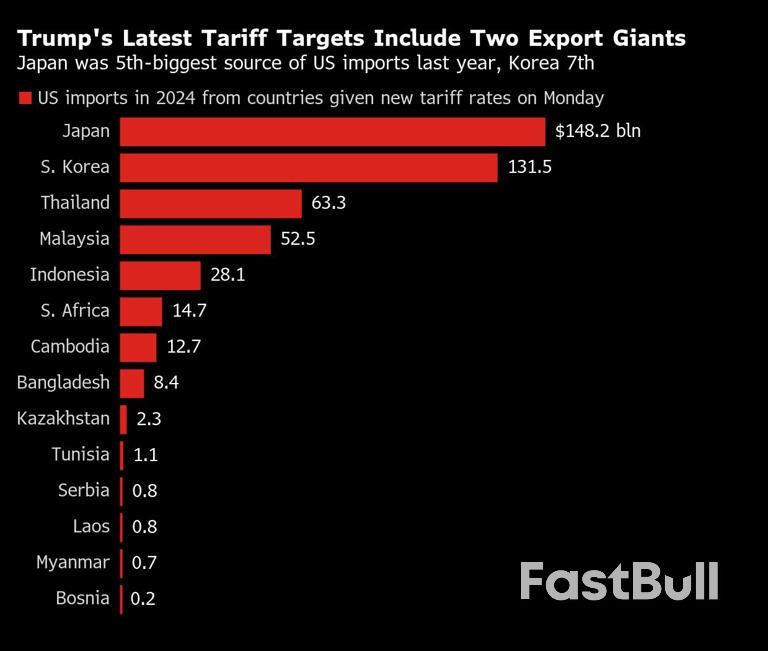
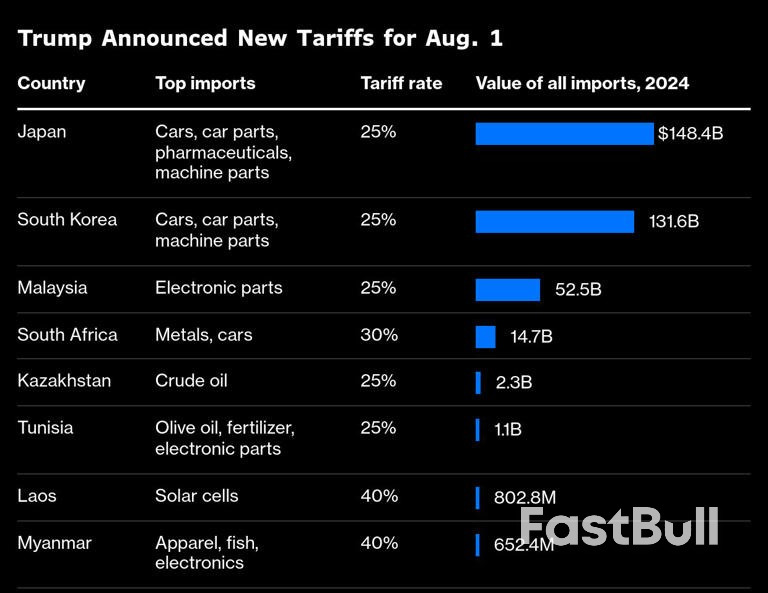
          Trump posted letters to various nations on social media on Monday, starting with his intent to impose 25% levies on goods from Japan and South Korea. A dozen more followed throughout the afternoon, outlining plans to tariff goods from trading partners including South Africa, Indonesia, Thailand and Cambodia.
          Later at the White House, Trump signed an executive order that further delayed the so-called “reciprocal” tariffs, effectively buying each affected nation an extra three weeks to cut a deal. He said that “for the most part” he was content to simply impose the duties, even as he indicated he was continuing negotiations.
          “We’ve made a deal with United Kingdom, we’ve made a deal with China, we’ve made a deal — we’re close to making a deal with India,” Trump said. “Others we met with, we don’t think we’re going to be able to make a deal. So we just send them a letter.”
          Still, the US president said the Aug. 1 deadline was “not 100% firm” and signaled he might tweak the rates further.
          “Maybe adjust a little bit, depending,” Trump said, indicating he would look favorably on countries continuing to offer additional concessions. “We’re not going to be unfair.”
          Asia’s equity indexes were mixed with modest moves after Trump left the door open for additional trade talks. The MSCI regional stock benchmark edged up 0.1%, after swinging between small gains and losses earlier Tuesday. S&P 500 futures were little changed. South Korea’s won strengthened, while a gauge of the dollar dipped 0.2%. The euro gained on a report the US offered a deal to the European Union with a 10% tariff level.
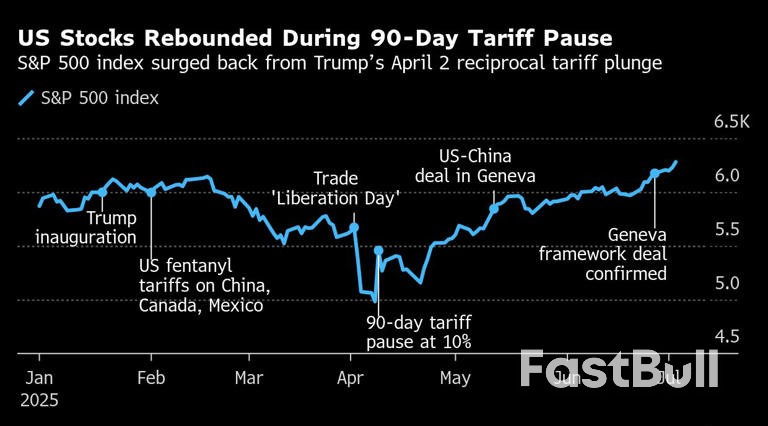
          The flurry of letters was the latest turn of the screw for an overhaul of trade policy that has roiled markets and trade across the globe. One week after announcing the tariffs at a Rose Garden event on April 2, Trump offered a 90-day reprieve, lowering duties to 10% to allow time for negotiations. The steady flow of tariff threats has fueled uncertainty for markets, central bankers and executives trying to game out the effect on production, inventories, hiring, inflation and consumer demand.
          Trump and other White House officials faced questions about whether the letters were simply a novel method of once again punting a looming July 9 deadline for his reciprocal tariffs, which were first announced on April 2. Most of the tariff rates, shared on his Truth Social platform, were largely in line with what Trump had already announced nations were likely to face.
          White House Press Secretary Karoline Leavitt said additional letters will arrive in the coming days. Trump in the missives also warned nations against retaliation.
          “If for any reason you decide to raise your Tariffs, then, whatever the number you choose to raise them by will be added” to the threatened levels, Trump wrote.
          Few nations successfully negotiated deals in the short time given. In the interim, Trump announced framework agreements with the United Kingdom and Vietnam and a trade truce with China.
          Trump Issues New Tariff Rates, Still Open to Negotiations_1

          Trump Announced New Tariffs for Aug. 1

          Trump said the reciprocal rates didn’t include any sectoral-specific tariffs that the administration implemented or planned in key industries. Both Japan and South Korea are major auto exporters, and are also facing US tariffs on steel.
          Asked why Trump had chosen to hit Japan and South Korea first, Leavitt said it was “the president’s prerogative,” adding that “those are the countries he chose.” She added that the administration is “close” to securing agreements with some other trading partners, adding that Trump “wants to ensure these are the best deals possible.”
          For many of the nations, engaging Trump in trade negotiations on his accelerated timeline has proven difficult.
          Even though Japan and Korea are two of the US’s closest allies in Asia, they’re both dealing with domestic situations where cutting trade deals might be risky politically. South Korean President Lee Jae-myung only took office on June 4, and elections in Japan’s upper house later this month made the government of Prime Minister Shigeru Ishiba reluctant to offer too much in concessions.
          The European Union wasn’t expecting to receive a letter setting tariff rates Monday, according to a person familiar with those discussions, who requested anonymity.
          Trump’s levies are adding additional funds to the Treasury at a time when investors are worried about the nation’s mounting debt, particularly after Congress passed much of the president’s economic agenda in a $3.4 trillion tax cut and spending package last week. The dollar has slumped and longer-term borrowing costs remain elevated.
          Despite Trump’s contention that foreign countries pay his tariffs directly, the burden actually falls to American importers, which must contend with tighter profit margins, weigh raising prices for consumers or seek discounts from foreign suppliers.
          “All of that new revenue is just a tax on US businesses,” Jonathan Gold, vice president of supply chain and customs policy at the National Retail Federation, wrote in a LinkedIn post Friday.
          Trump Issues New Tariff Rates, Still Open to Negotiations_2

          US Stocks Rebounded During 90-Day Tariff Pause | S&P 500 index surged back from Trump’s April 2 reciprocal tariff

          At the Rose Garden ceremony on April 2, the Trump administration announced steeper levies on more than 50 trading partners ranging as high as 50% – a shock to the economic outlook that sent financial markets into a tailspin. A week later, the president suspended those peak rates.
          The negotiating tracks have been different for the US’s three largest trading partners — Mexico, Canada and China. Beijing and Washington have negotiated truces that lowered tariffs on Chinese products that soared to 145% and eased export controls on key supplies. As partners in the US-Mexico-Canada Agreement, the two US neighbors aren’t subject to the reciprocal tariffs and instead are trying to negotiate lower rates on sectoral levies.
          On top of market jitters and economic headwinds, legal challenges offer a potential check on the reciprocal tariffs, which Trump declared under executive authority known as the International Emergency Economic Powers Act, or IEEPA.
          The US Court of International Trade ruled on May 28 that the vast majority of Trump’s levies were issued illegally under IEEPA and ordered them blocked. A day later, an appeals court gave the administration a temporary reprieve from the ruling and decided that the tariffs can remain in place until it hears the case. Arguments are scheduled for July 31.
          Trump Issues New Tariff Rates, Still Open to Negotiations_3

          Trump's Latest Tariff Targets Include Two Export Giants | Japan was 5th-biggest source of US imports last year, Korea 7th

          Yet the Trump administration is using another presidential power to impose tariffs – Section 232 of the Trade Expansion Act – on specific sectors so far including autos, steel and aluminum. Other 232 sectoral cases are in the works, potentially allowing Trump to cover a wide range of US imported raw materials as well as finished consumer goods in case the courts strike down the IEEPA levies.
          Another friction point for Trump on tariffs is the Federal Reserve. Jerome Powell, the chair of the US central bank, has held off on lowering rates this year — despite intense pressure and name-calling — in part to determine whether tariff-driven price hikes might evolve into more persistent cost-of-living pressures.
          Bloomberg Economics estimates that if all reciprocal tariffs are raised to their threatened level on July 9, average duties on all US imports could climb to around 20% from less than 3% before Trump’s inauguration in January. That would add to growth and inflation risks for the US economy.
          Between higher tariffs, oil prices and immigration restrictions in the US, “the bottom line is that we should see inflation move higher over the coming months,” Torsten Slok, chief economist with Apollo Global Management, wrote in a note Sunday.

          source : Bloomberg

          To stay updated on all economic events of today, please check out our Economic calendar
          Risk Warnings and Disclaimers
          You understand and acknowledge that there is a high degree of risk involved in trading. Following any strategies or investment methods may lead to potential losses. The content on the site is provided by our contributors and analysts for information purposes only. You are solely responsible for determining whether any trading assets, securities, strategy, or any other product is suitable for investing based on your own investment objectives and financial situation.
          Add to Favorites
          Share

          New Board Member Hints At Possible Raising Of BOJ Price Outlook

          Damon

          Central Bank

          One of the Bank of Japan’s newest board members alluded to a possible upward revision to the central bank’s inflation view this month, an outcome that would keep open the possibility of another rate increase this year.

          “Inflation for rice and food-related items has been stronger than expected,” Junko Koeda said Monday in her first media interview since joining the board in March. “I’m closely watching potential secondary effects on underlying inflation from rice, which is a staple food.”

          Koeda spoke before President Donald Trump announced a new tariff level of 25% on Japan. The board member stressed there are high economic uncertainties stemming from the US levies as she underscored the need to assess incoming data before considering any policy moves.

          “Given ongoing high uncertainties, it’s inappropriate to talk about a specific timing for the next rate hike,” Koeda said. “We need to decide by closely looking at the economy, inflation and financial markets without missing a sign of change.”

          Governor Kazuo Ueda’s board delivers its next policy decision on July 31 and will update its quarterly economic outlook. With a stand-pat decision widely expected, the main focus is on whether the BOJ will raise its inflation forecasts, a key factor in mulling the likely timing of rate hikes once there’s more clarity over US tariffs.

          Trump has now set Aug. 1 as the new day when higher “reciprocal tariffs” kick in, thereby giving countries another three weeks or so to reach trade deals.

          Japan’s key inflation gauge showed an acceleration to 3.7% from a year earlier in May, the highest level among Group of Seven nations. Price growth has remained at or above the BOJ’s 2% target for more than three years with the cost of rice among the drivers recently. The nation’s staple food surged 102% in May, the fastest pace in half a century.

          The central bank currently expects the cost of living to rise 2.2% in the year ending March 2026, lower than 2.4%, the median estimate of private economists.

          “There are both upside and downside risks for inflation,” Koeda said, echoing Ueda’s remarks last month. The comments suggest a potential change in the BOJ’s risk balance assessment, after the central bank’s April outlook report mentioned only downside risks for prices in that section.

          Koeda assumed her five-year term on March 26 in a career shift from her position as an economics professor at Tokyo’s Waseda University. She became known among BOJ watchers after the BOJ’s think tank published a paper of hers in 2018, highlighting positive aspects of scrapping the negative interest rate policy. The paper was perceived as a hint at coming changes and contributed to her reputation for leaning toward hawkishness.

          Koeda is also known for her research on the BOJ’s balance sheet and Japan’s debt market. While the central bank has trimmed its bond buying over the last year, it decided last month to slow down its withdrawal from the market after super-long bond yields hit a record high in May in a sign of instability.

          Despite the central bank’s move, the market continues to be hit by volatility, with 30-year bond yields rising Tuesday on concerns over fiscal policy after an upper house election on July 20.

          “Long-term interest rates should be determined by financial markets in principle,” Koeda said. The BOJ should step into the market only “in exceptional cases when yields surge in an abnormal manner.”

          At 49, Koeda is the youngest of the nine-member board and her presence marks the first time the board has had two female members, a sign of progress in raising the representation of women at the bank. She said the BOJ is well positioned to achieve its goal of having women fill 20% of management positions by June next year.

          “Productivity overall can be boosted by making the work environment friendlier to the needs of each employee,” Koeda said.

          Source: Bloomberg Europe

          Risk Warnings and Disclaimers
          You understand and acknowledge that there is a high degree of risk involved in trading. Following any strategies or investment methods may lead to potential losses. The content on the site is provided by our contributors and analysts for information purposes only. You are solely responsible for determining whether any trading assets, securities, strategy, or any other product is suitable for investing based on your own investment objectives and financial situation.
          Add to Favorites
          Share

          Trump unveils 25% tariffs on South Korea and Japan, nearly identical to his 'Liberation Day' rates

          Adam

          Economic

          President Trump began unveiling his "UNITED STATES TARIFF Letters" Monday with the threat of 25% duties on South Korea and Japan, two top trading partners.
          The new rates — which aren’t scheduled to take effect until Aug. 1 — track closely with what the president first announced on "Liberation Day" this spring before he offered a 90-day pause that had been scheduled to expire on July 8.
          Back in April, Trump announced plans for a 25% rate on South Korea and a 24% rate on Japan.
          Trump posted other letters Monday afternoon to a dozen other trading partners, from Malaysia (a 25% rate) to South Africa (30%) to Serbia (35%).
          On Tuesday, Japan and South Korea stocks gained, with the Nikkei 225 (^N225) closing up 0.2% and South Korea's Kospi (^KS11) rising 1.8%.
          By and large, the rates in Monday's letter closely tracked what Trump had promised back in April but with a few exceptions. Cambodia saw its rate drop from 49% to 36%. Laos went from a 48% rate to 40% while Myanmar saw a 4 percentage point drop to 40%.
          All the letters also suggested more negotiations could be in the offing with Trump noting that if these targeted countries change their trade policies "we will, perhaps, consider an adjustment to this letter."
          Stocks sank Monday on the news falling even as the letters were paired with a delayed deadline that means none of these countries will see rate changes this week at least.
          White House press secretary Karoline Leavitt confirmed Monday afternoon that Trump's overall "reciprocal" tariff deadlines would be delayed by executive order to move the deadline for these nations and over 100 more from July 8 until Aug. 1.
          Leavitt added that many other countries are set to receive letters in the coming days, saying: "Keep your eyes on Truth Social."

          A focus on South Korea and Japan

          Negotiations with both South Korea and Japan are sure to continue for the next three weeks as the two nations look to avoid the tariffs coming into place, but Monday's move from the president underlined his desire to move aggressively after country-by-country negotiations have proven slower than he had hoped.
          Monday’s announcement does represent somewhat of a win for Japan, which had seen Trump threaten 35% tariffs just a few days ago in comments where he called the nation "so spoiled."
          South Korea, meanwhile, had initially been seen as a country that was near the front of the line for a deal and was even reportedly in Washington this past weekend for talks, but saw progress slow in part because of the nation’s recent elections.
          If Trump does follow through with these tariffs, Paul Ashworth of Capital Economics noted Monday afternoon that a higher baseline for these two countries at least may “have a relatively modest impact on the average effective tariff rates" because both economies are heavily focused on goods that are subject to different sector-specific tariffs.
          Ashworth calculates that Trump following through would hit about half of the exports from the two nations, with key industries like autos, electronics, and pharmaceuticals subject to other Trump tariff actions and expected to sidestep these new tariffs at least.
          The letters, addressed to the leaders of the nations, often offered identical language in many cases, with Trump touting both "the strength and commitment of our Trading Relationship" to South Korea and Japan while also lambasting "these longterm, and very persistent Trade Deficits" that he blamed on both countries.
          “If, for any reason you decide to raise your Tariffs, then, whatever the number you choose to raise them by will be added onto the 25% we charge,” Trump noted in his letters, adding that goods transshipped from another country would also face a higher rate.
          Transshipment has been a key issue for Trump — and was also included in an agreement last week with Vietnam — in response to Chinese shippers often looking to the practice to avoid tariffs.

          Other countries still outstanding

          The total number of letters could top 100 in the coming days.
          Perhaps the highest stakes shoe to drop in the coming days could be an update on where things stand with the European Union, a bloc that represents the top trading partner of the US.
          The EU had previously signaled it would be willing to accept a 10% universal tariff but Trump has often promised much higher duties as a range of issues from how specific sectors like autos are treated to the continent's digital service taxes has making negotiations slow.
          A spokesperson for the European Commission said Monday it is still hoping for a deal this week but Trump has promised a 50% tariff rate if no agreement is reached.
          Another closely watched negotiation is with India, which reportedly said it has made its final offer and said a deal is in Trump’s hands.
          Monday’s announcement also comes after Trump continued to bring other issues into the trade talks, including with an overnight announcement that he planned to use a 10% tariff to dissuade nations from lining up against him through an intergovernmental organization comprising 10 countries known as BRICS.
          As for the market reaction, Terry Haines of Pangaea Policy suggested that the initial market reaction could even out, especially if deals are announced later this week in addition to Monday's unilateral tariff threats.
          "Quickly following this shallow dip is very likely to be multiple trade deals upside by midweek," he wrote adding, "Watch particularly for a phase 1 US-India deal."

          Source : finance.yahoo

          To stay updated on all economic events of today, please check out our Economic calendar
          Risk Warnings and Disclaimers
          You understand and acknowledge that there is a high degree of risk involved in trading. Following any strategies or investment methods may lead to potential losses. The content on the site is provided by our contributors and analysts for information purposes only. You are solely responsible for determining whether any trading assets, securities, strategy, or any other product is suitable for investing based on your own investment objectives and financial situation.
          Add to Favorites
          Share
          FastBull
          Copyright © 2025 FastBull Ltd

          728 RM B 7/F GEE LOK IND BLDG NO 34 HUNG TO RD KWUN TONG KLN HONG KONG

          TelegramInstagramTwitterfacebooklinkedin
          App Store Google Play Google Play
          Products
          Charts

          Chats

          Q&A with Experts
          Screeners
          Economic Calendar
          Data
          Tools
          Membership
          Features
          Function
          Markets
          Copy Trading
          Latest Signals
          Contests
          News
          Analysis
          24/7
          Columns
          Education
          Company
          Careers
          About Us
          Contact Us
          Advertising
          Help Center
          Feedback
          User Agreement
          Privacy Policy
          Business

          White Label

          Data API

          Web Plug-ins

          Poster Maker

          Affiliate Program

          Risk Disclosure

          The risk of loss in trading financial instruments such as stocks, FX, commodities, futures, bonds, ETFs and crypto can be substantial. You may sustain a total loss of the funds that you deposit with your broker. Therefore, you should carefully consider whether such trading is suitable for you in light of your circumstances and financial resources.

          No decision to invest should be made without thoroughly conducting due diligence by yourself or consulting with your financial advisors. Our web content might not suit you since we don't know your financial conditions and investment needs. Our financial information might have latency or contain inaccuracy, so you should be fully responsible for any of your trading and investment decisions. The company will not be responsible for your capital loss.

          Without getting permission from the website, you are not allowed to copy the website's graphics, texts, or trademarks. Intellectual property rights in the content or data incorporated into this website belong to its providers and exchange merchants.

          Not Logged In

          Log in to access more features

          FastBull Membership

          Not yet

          Purchase

          Become a signal provider
          Help Center
          Customer Service
          Dark Mode
          Price Up/Down Colors

          Log In

          Sign Up

          Position
          Layout
          Fullscreen
          Default to Chart
          The chart page opens by default when you visit fastbull.com