Markets
News
Analysis
User
24/7
Economic Calendar
Education
Data
- Names
- Latest
- Prev


Signal Accounts for Members
All Signal Accounts
All Contests


U.K. Trade Balance (Oct)A:--
F: --
P: --
U.K. Services Index MoMA:--
F: --
P: --
U.K. Construction Output MoM (SA) (Oct)A:--
F: --
P: --
U.K. Industrial Output YoY (Oct)A:--
F: --
P: --
U.K. Trade Balance (SA) (Oct)A:--
F: --
P: --
U.K. Trade Balance EU (SA) (Oct)A:--
F: --
P: --
U.K. Manufacturing Output YoY (Oct)A:--
F: --
P: --
U.K. GDP MoM (Oct)A:--
F: --
P: --
U.K. GDP YoY (SA) (Oct)A:--
F: --
P: --
U.K. Industrial Output MoM (Oct)A:--
F: --
P: --
U.K. Construction Output YoY (Oct)A:--
F: --
P: --
France HICP Final MoM (Nov)A:--
F: --
P: --
China, Mainland Outstanding Loans Growth YoY (Nov)A:--
F: --
P: --
China, Mainland M2 Money Supply YoY (Nov)A:--
F: --
P: --
China, Mainland M0 Money Supply YoY (Nov)A:--
F: --
P: --
China, Mainland M1 Money Supply YoY (Nov)A:--
F: --
P: --
India CPI YoY (Nov)A:--
F: --
P: --
India Deposit Gowth YoYA:--
F: --
P: --
Brazil Services Growth YoY (Oct)A:--
F: --
P: --
Mexico Industrial Output YoY (Oct)A:--
F: --
P: --
Russia Trade Balance (Oct)A:--
F: --
P: --
Philadelphia Fed President Henry Paulson delivers a speech
Canada Building Permits MoM (SA) (Oct)A:--
F: --
P: --
Canada Wholesale Sales YoY (Oct)A:--
F: --
P: --
Canada Wholesale Inventory MoM (Oct)A:--
F: --
P: --
Canada Wholesale Inventory YoY (Oct)A:--
F: --
P: --
Canada Wholesale Sales MoM (SA) (Oct)A:--
F: --
P: --
Germany Current Account (Not SA) (Oct)A:--
F: --
P: --
U.S. Weekly Total Rig CountA:--
F: --
P: --
U.S. Weekly Total Oil Rig CountA:--
F: --
P: --
Japan Tankan Large Non-Manufacturing Diffusion Index (Q4)--
F: --
P: --
Japan Tankan Small Manufacturing Outlook Index (Q4)--
F: --
P: --
Japan Tankan Large Non-Manufacturing Outlook Index (Q4)--
F: --
P: --
Japan Tankan Large Manufacturing Outlook Index (Q4)--
F: --
P: --
Japan Tankan Small Manufacturing Diffusion Index (Q4)--
F: --
P: --
Japan Tankan Large Manufacturing Diffusion Index (Q4)--
F: --
P: --
Japan Tankan Large-Enterprise Capital Expenditure YoY (Q4)--
F: --
P: --
U.K. Rightmove House Price Index YoY (Dec)--
F: --
P: --
China, Mainland Industrial Output YoY (YTD) (Nov)--
F: --
P: --
China, Mainland Urban Area Unemployment Rate (Nov)--
F: --
P: --
Saudi Arabia CPI YoY (Nov)--
F: --
P: --
Euro Zone Industrial Output YoY (Oct)--
F: --
P: --
Euro Zone Industrial Output MoM (Oct)--
F: --
P: --
Canada Existing Home Sales MoM (Nov)--
F: --
P: --
Euro Zone Total Reserve Assets (Nov)--
F: --
P: --
U.K. Inflation Rate Expectations--
F: --
P: --
Canada National Economic Confidence Index--
F: --
P: --
Canada New Housing Starts (Nov)--
F: --
P: --
U.S. NY Fed Manufacturing Employment Index (Dec)--
F: --
P: --
U.S. NY Fed Manufacturing Index (Dec)--
F: --
P: --
Canada Core CPI YoY (Nov)--
F: --
P: --
Canada Manufacturing Unfilled Orders MoM (Oct)--
F: --
P: --
Canada Manufacturing New Orders MoM (Oct)--
F: --
P: --
Canada Core CPI MoM (Nov)--
F: --
P: --
Canada Manufacturing Inventory MoM (Oct)--
F: --
P: --
Canada CPI YoY (Nov)--
F: --
P: --
Canada CPI MoM (Nov)--
F: --
P: --
Canada CPI YoY (SA) (Nov)--
F: --
P: --
Canada Core CPI MoM (SA) (Nov)--
F: --
P: --
Canada CPI MoM (SA) (Nov)--
F: --
P: --


No matching data
Latest Views
Latest Views
Trending Topics
Top Columnists
Latest Update
White Label
Data API
Web Plug-ins
Affiliate Program
View All

No data
The U.S. dollar steadied in early Asian trading Friday as investors absorbed the Federal Reserve's cautious rate cut and shifted focus to the Bank of Japan...
Key Highlights
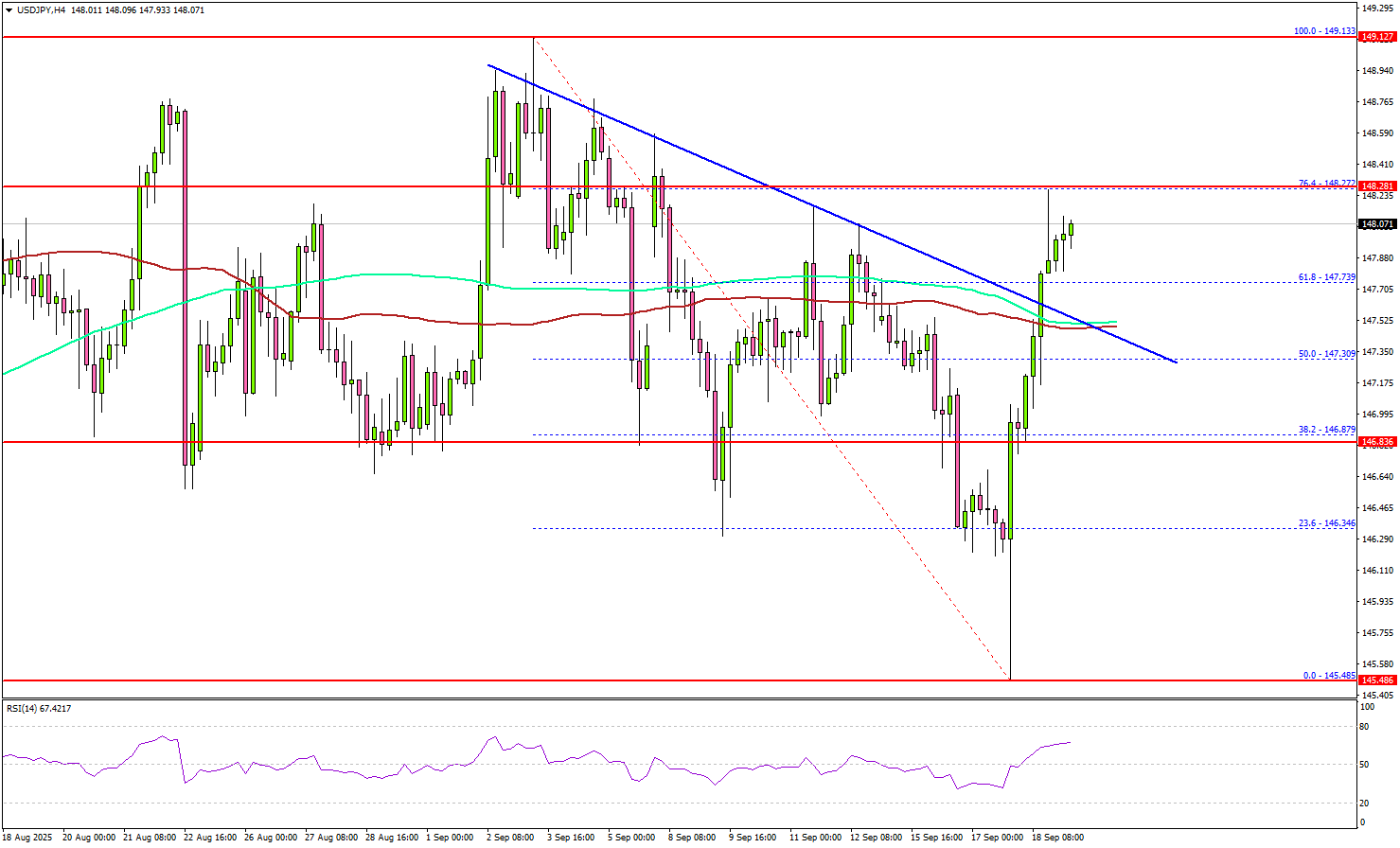
The US Dollar declined sharply against the Japanese Yen during the Fed rate decision. USD/JPY spiked to 145.50 before there was a sharp recovery.
Looking at the 4-hour chart, the pair climbed above the 146.50 and 147.00 resistance levels. More importantly, the pair cleared a major bearish trend line with resistance at 147.50. It opened the doors for more gains above the 50% Fib retracement level of the downward move from the 149.13 swing high to the 145.48 low.
The pair settled above the 147.50 level, the 100 simple moving average (red, 4-hour), and the 200 simple moving average (green, 4-hour).
On the upside, the pair could face resistance near the 148.25 level or the 76.4% Fib retracement level of the downward move from the 149.13 swing high to the 145.48 low. The first major hurdle for the bulls could be 148.50.A close above 148.50 could set the pace for a steady recovery wave. In the stated case, the pair could rise toward 149.20, above which the bulls could aim for a move toward 148.65. Any more upsides could send the pair toward 150.00.
On the downside, immediate support is 147.50. The next key area of interest might be near the 147.20 zone. The main support could be 146.50. Any more losses might increase selling pressure and send USD/JPY toward 146.00.Looking at EUR/USD, the pair failed to continue higher above 1.1920 and recently started a downside correction.
Upcoming Key Economic Events:
South Korea rolled out measures aimed at redirecting bank funds from property lending to critical industries including semiconductors and artificial intelligence.The so-called “productive finance” initiative lowers the regulatory burden on banks’ equity investments while tightening capital requirements for mortgage lending. The risk weight for banks’ equity investments will fall to 250% from 400%, while the floor for mortgage loan risk weights will rise to 20% from 15%. The new rules are set to take effect in the first quarter of next year.
The government also plans to encourage long-term asset investment by insurers, with changes to capital rules under the Korea Insurance Capital Standard to be detailed in October. Large securities firms will be allowed to issue promissory notes and operate integrated management accounts, though a portion of funds raised must be deployed as risk capital.
South Korean policymakers have long argued that excessive capital has been funneled into the real estate market, locking up financial resources that might otherwise fuel more dynamic sectors of the economy. They warn that the concentration of wealth in property has come at the expense of critical areas such as technology, manufacturing, and small business investment, leaving the broader economy vulnerable and slowing innovation.
By redirecting lending away from speculative housing and toward more productive industries, officials aim to strike a better balance and stimulate sustainable growth.In a move to broaden financing channels for smaller companies, Seoul will introduce security token offerings. It also pledged to publish a roadmap to achieve inclusion in MSCI Inc.’s developed-market index.
As part of the strategy, authorities outlined details of a previously announced 150 trillion won ($110 billion) fund to nurture high-tech industries. The fund will draw 75 trillion won from the government, with the rest coming from private, public and financial institutions. At least 30 trillion won will be earmarked for artificial intelligence and 20.9 trillion won for semiconductor development.
Asian central banks may find more room to ease policy after the Federal Reserve cut interest rates by a quarter percentage point Wednesday and signaled more reductions ahead, as the region contends with trade headwinds and currency pressures.The cut brought the Fed's benchmark overnight lending rate to 4%-4.25%. Fed Chair Jerome Powell framed the decision as a "risk management cut," rather than something more directed at shoring up a weak economy, and indicated two more cuts are likely this year.
The Fed's move may have also narrowed the gap between U.S. and Asian bond yields, easing currency concerns and giving some Asian economies — particularly those facing greater domestic headwinds — more room to lower rates, said Peiqian Liu, Asia economist at Fidelity International."The overall policy stance across the region will likely become more accommodative," Liu said.Some Asian banks have already begun to run ahead of the Fed to blunt the impact of the Trump administration's tariffs.These include the Bank of Korea, which cut its policy rate to an almost three-year low in May, while the Reserve Bank of Australia slashed rates to a two-year low in August. India's central bank delivered an outsized cut of 50 basis points in June.
Still, differences will persist due to varying economic conditions in these countries, Liu said, pointing to domestic inflation and the lingering effects of exports being rushed out before the U.S. tariffs took effect.Export-dependent economies like Japan, South Korea and Singapore all posted better-than-expected economic growth in the second quarter of the year, with Seoul and Singapore narrowly avoiding a technical recession.Several Asian central banks, including the Bank of Korea and the Reserve Bank of India, are likely to continue to cut rates in the fourth quarter, said Betty Wang, lead economist at Oxford Economics.
"Earlier concerns about rapid currency depreciation have proven overstated, and a weaker dollar has instead created additional room for Asian central banks to ease further towards the end of this year in a response to rising growth concerns," Wang said.Chi Lo, senior market strategist Asia Pacific at BNP Paribas Asset Management, echoed that view, noting that real interest rates across much of Asia remain above historic averages, giving central banks room for further rate cuts.A notable exception has been India, which posted strong economic growth over the last two quarters, driven by domestic demand rather than exports.
India will likely prioritize domestic growth due to the weaker external demand and higher U.S. tariffs, with further policy easing, Fidelity's Liu said.India's inflation rose in August for the first time in 10 months to 2.07%, just above the lower bound of the RBI's 2%–6% target range. There is "ample room" for further policy easing to cushion growth headwinds if needed," Liu said.BNP Paribas' Lo noted the Fed is still caught between slower growth and fears about higher inflation in the U.S., which constrains it to a "short rate cut cycle."Economic fundamentals in Asia, including resilient growth figures and low inflation, suggest that the region could see a longer rate cut cycle, especially with the U.S. dollar on a weak trend, Lo added.
However, two major Asian economies have defied the rate-cutting trend: China and Japan.For Japan, its central bank is not only holding rates, but is aiming to raise them as it strives to normalize its monetary policy.Economists expect the Bank of Japan to keep policy steady at its meeting Friday, with further hikes later this year as inflation has stayed above the BOJ's 2% target for over three years.China's central bank also left its short-term rate unchanged Thursday at 1.4% in the wake of the Fed's rate cut, balancing the need for stimulus with concerns of fueling a stock market bubble that could repeat the crash of 2015.
China's economy has shown signs of fatigue in August, with export growth slowing more than expected and key economic indicators like retail sales and industrial output coming in lower than economists' estimates.The Chinese yuan will likely retain its strength amid a dollar downcycle as "the current consideration for China is probably not to let the renminbi appreciate too much, rather than defending it from depreciation," said Tianchen Xu, senior economist at Economist Intelligence Unit.The offshore yuan has gained about 3% against the dollar this year and last traded at 7.1083 on Thursday.
Economists largely expect the yuan to strengthen to 7 against the greenback by the end of this year as Beijing focuses on countering deflation and bolstering growth.Nonetheless, the Fed's cut opens up options for the People's Bank of China, Xu said, expecting China to press ahead with monetary easing in the medium term, given its domestic economic challenges.
White Label
Data API
Web Plug-ins
Poster Maker
Affiliate Program
The risk of loss in trading financial instruments such as stocks, FX, commodities, futures, bonds, ETFs and crypto can be substantial. You may sustain a total loss of the funds that you deposit with your broker. Therefore, you should carefully consider whether such trading is suitable for you in light of your circumstances and financial resources.
No decision to invest should be made without thoroughly conducting due diligence by yourself or consulting with your financial advisors. Our web content might not suit you since we don't know your financial conditions and investment needs. Our financial information might have latency or contain inaccuracy, so you should be fully responsible for any of your trading and investment decisions. The company will not be responsible for your capital loss.
Without getting permission from the website, you are not allowed to copy the website's graphics, texts, or trademarks. Intellectual property rights in the content or data incorporated into this website belong to its providers and exchange merchants.
Not Logged In
Log in to access more features

FastBull Membership
Not yet
Purchase
Log In
Sign Up