Markets
News
Analysis
User
24/7
Economic Calendar
Education
Data
- Names
- Latest
- Prev


Signal Accounts for Members
All Signal Accounts
All Contests


Japan Tankan Large Non-Manufacturing Outlook Index (Q4)A:--
F: --
P: --
Japan Tankan Large Manufacturing Outlook Index (Q4)A:--
F: --
P: --
Japan Tankan Small Manufacturing Diffusion Index (Q4)A:--
F: --
P: --
Japan Tankan Large Manufacturing Diffusion Index (Q4)A:--
F: --
P: --
Japan Tankan Large-Enterprise Capital Expenditure YoY (Q4)A:--
F: --
P: --
U.K. Rightmove House Price Index YoY (Dec)A:--
F: --
P: --
China, Mainland Industrial Output YoY (YTD) (Nov)A:--
F: --
P: --
China, Mainland Urban Area Unemployment Rate (Nov)A:--
F: --
P: --
Saudi Arabia CPI YoY (Nov)A:--
F: --
P: --
Euro Zone Industrial Output YoY (Oct)A:--
F: --
P: --
Euro Zone Industrial Output MoM (Oct)A:--
F: --
P: --
Canada Existing Home Sales MoM (Nov)A:--
F: --
P: --
Canada National Economic Confidence IndexA:--
F: --
P: --
Canada New Housing Starts (Nov)A:--
F: --
U.S. NY Fed Manufacturing Employment Index (Dec)A:--
F: --
P: --
U.S. NY Fed Manufacturing Index (Dec)A:--
F: --
P: --
Canada Core CPI YoY (Nov)A:--
F: --
P: --
Canada Manufacturing Unfilled Orders MoM (Oct)A:--
F: --
P: --
U.S. NY Fed Manufacturing Prices Received Index (Dec)A:--
F: --
P: --
U.S. NY Fed Manufacturing New Orders Index (Dec)A:--
F: --
P: --
Canada Manufacturing New Orders MoM (Oct)A:--
F: --
P: --
Canada Core CPI MoM (Nov)A:--
F: --
P: --
Canada Trimmed CPI YoY (SA) (Nov)A:--
F: --
P: --
Canada Manufacturing Inventory MoM (Oct)A:--
F: --
P: --
Canada CPI YoY (Nov)A:--
F: --
P: --
Canada CPI MoM (Nov)A:--
F: --
P: --
Canada CPI YoY (SA) (Nov)A:--
F: --
P: --
Canada Core CPI MoM (SA) (Nov)A:--
F: --
P: --
Canada CPI MoM (SA) (Nov)A:--
F: --
P: --
Federal Reserve Board Governor Milan delivered a speech
U.S. NAHB Housing Market Index (Dec)--
F: --
P: --
Australia Composite PMI Prelim (Dec)--
F: --
P: --
Australia Services PMI Prelim (Dec)--
F: --
P: --
Australia Manufacturing PMI Prelim (Dec)--
F: --
P: --
Japan Manufacturing PMI Prelim (SA) (Dec)--
F: --
P: --
U.K. 3-Month ILO Employment Change (Oct)--
F: --
P: --
U.K. Unemployment Claimant Count (Nov)--
F: --
P: --
U.K. Unemployment Rate (Nov)--
F: --
P: --
U.K. 3-Month ILO Unemployment Rate (Oct)--
F: --
P: --
U.K. Average Weekly Earnings (3-Month Average, Including Bonuses) YoY (Oct)--
F: --
P: --
U.K. Average Weekly Earnings (3-Month Average, Excluding Bonuses) YoY (Oct)--
F: --
P: --
France Services PMI Prelim (Dec)--
F: --
P: --
France Composite PMI Prelim (SA) (Dec)--
F: --
P: --
France Manufacturing PMI Prelim (Dec)--
F: --
P: --
Germany Services PMI Prelim (SA) (Dec)--
F: --
P: --
Germany Manufacturing PMI Prelim (SA) (Dec)--
F: --
P: --
Germany Composite PMI Prelim (SA) (Dec)--
F: --
P: --
Euro Zone Composite PMI Prelim (SA) (Dec)--
F: --
P: --
Euro Zone Services PMI Prelim (SA) (Dec)--
F: --
P: --
Euro Zone Manufacturing PMI Prelim (SA) (Dec)--
F: --
P: --
U.K. Services PMI Prelim (Dec)--
F: --
P: --
U.K. Manufacturing PMI Prelim (Dec)--
F: --
P: --
U.K. Composite PMI Prelim (Dec)--
F: --
P: --
Euro Zone ZEW Economic Sentiment Index (Dec)--
F: --
P: --
Germany ZEW Current Conditions Index (Dec)--
F: --
P: --
Germany ZEW Economic Sentiment Index (Dec)--
F: --
P: --
Euro Zone Trade Balance (Not SA) (Oct)--
F: --
P: --
Euro Zone ZEW Current Conditions Index (Dec)--
F: --
P: --
Euro Zone Trade Balance (SA) (Oct)--
F: --
P: --
U.S. Retail Sales MoM (Excl. Automobile) (SA) (Oct)--
F: --
P: --


No matching data
Latest Views
Latest Views
Trending Topics
Top Columnists
Latest Update
White Label
Data API
Web Plug-ins
Affiliate Program
View All

No data
The morning NA session follows a quasi-dead European overnight trading.
This tends to happen when a lack of data adds to the Summer trading when volumes are typically subdued.
The Dollar Index had been in the middle of many headwinds, as per usual. After a stellar July followed by and N-shaped (for nope) downward spiral in the beginning of August, it has been difficult to spot where the Greenback is heading.
Forex volatility tends to calm during summers and lack of decisive trends exacerbate this rangebound trading – When the path is unclear, rangebound trading is typical (particularly in currencies.)
With Markets awaiting more developments after the White House gathered heads from Russia, Ukraine and the EU, the Dollar is forming a temporary bottom around the 98.00 Handle.
This region had already formed the post-Liberation day bottom (quickly broken in May).
The White House meetings went well and the US will now attempt to create a Putin-Zelenskyy meeting.
Donald Trump, the author of the Art of the Deal, is an unpredictable leader but one sure thing, he is a monster negotiator, and this is giving back some confidence in the US.
In our most recent DXY analysis, we mentioned an expectation of a more balanced Dollar as a lack of continuation upwards and a not-broken bottom show indecision.
Let’s see if this indecision shall continue, at least to the technical side.
Dollar Index Daily Chart
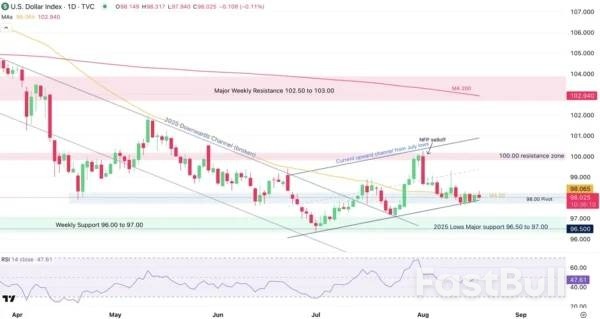
The US Dollar is holding its low-sloped ascending channel in a 5 day consolidation around the 98.00 handle.
The post-CPI data had created a new offer for the US Dollar as Markets rushed to price the September cut to 97% before the surprising PPI data changed the course of action.
With the future US inflation expectations rising considerably, the fundamental background for the Dollar (like its rate outlook) is more uncertain.
The Daily RSI is way into the Neutral territory and the Daily doji is an indecision one. All of this is also happening right around the 50-Day MA (currently at 98.065).
Such indecisive price action doesn’t warrant analysis across many timeframes – it is better in this environment to look at where we see the most.
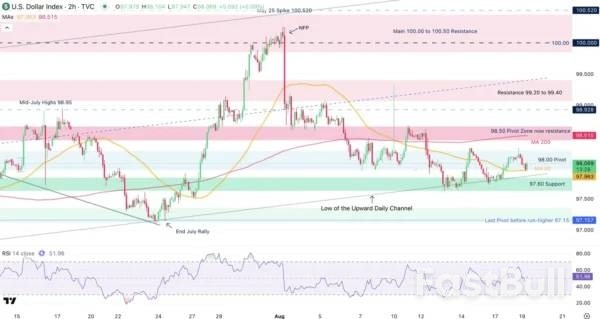
The Dollar Index is stuck between the 97.60 Support and the 98.50 Resistance Zones.
With the Price action rebounding from the lows of the Daily upward Channel supplemented by the 2H MA 50 acting as support, it seems that the preferred path would be to the upside.
If things were so sure however, the Dollar would have risen already to test the following resistance zone.
Typically, in this environment, it is good to look at the highs (98.30) and lows of the session (97.94) to see where if the action breaks out from there.
To the upside, look at the 2H MA 200 currently at 98.515.
To the downside, look at the 97.60 Support Zone, then the 97.15 July upward pivot.
Levels to place on your DXY Charts:
Resistance Levels
Support Levels
Safe Trades!
World cocoa prices are currently on the rise, thus making the crop a commodity with high potential to generate lucrative returns.The Malaysian Cocoa Board (LKM) in a statement on Tuesday said that in 2024, the average price of dry cocoa beans grew by 141% to RM24,274 per tonne compared to RM10,073 per tonne in the previous year.“The Cocoa Cultivation Promotion Programme for the Plantation Sector will be implemented by the board from 2025 to 2030 with an allocation of RM550,000 per year.
“Via this programme, LKM will distribute high-quality cocoa seedlings for free, provide technical guidance, practical training and continuous monitoring to ensure that cocoa planting is carried out according to the best agricultural practices,” the board said.So far, it said, several Malaysian plantation companies have participated in the programme, with a total area of 360 hectares.Companies selected to participate in the programme would receive incentives in the form of 5,000 high-quality cocoa seedlings worth RM50,000, in addition to technical advisory services including nursery development, planting systems and others, it said.
“Within five years, the programme aims to expand the cocoa plantation area by 2,750 hectares nationwide.“The plantation sector is an important driver in increasing cocoa production sustainably to meet the demand of local manufacturers, while supporting efforts to make Malaysia a producer of premium cocoa and ‘single origin’ cocoa beans, which are increasingly gaining traction in the world market,” said LKM.Earlier, LKM organised the Cocoa Cultivation Promotion Engagement Programme for the Plantation Sector for the Sarawak Region here on Tuesday.
Officiated by the Ministry of Plantation and Commodities’s cocoa and pepper industry development division secretary Cheah Chee Fong, the event was attended by 94 participants, consisting of plantation companies, individual entrepreneurs, farmer groups, and representatives of relevant government agencies.It aimed to provide information on the incentives offered to plantation companies to cultivate cocoa crops, as well as the potential of the industry.
Headline CPI inflation for July came in at 1.7% year-on-year (y/y), cooling from the 1.9% in June and below expectations for a 1.8% y/y print.
Gasoline prices falling 0.7% on the month on lower geopolitical tensions and increased OPEC+ output were a drag on the index.
Shelter price inflation rose for the first time since February 2024, rising 3.0% y/y from 2.9% in June. This was mostly attributed to a greater influence from the natural gas and rent indexes. The contraction in natural gas prices slowed in July, propping up shelter costs while tent inflation increased to 5.1% y/y, from 4.7% in June.
The Bank of Canada’s (BoC) CPI-trim measure was unchanged for the third month in a row at 3.0% y/y, while the CPI-median index ticked higher to 3.1% y/y. The CPI excluding food and energy ticked down to 2.5% y/y from 2.6% the month prior and the CPI excluding the eight most volatile components and indirect taxes (CPIX) also took a step back to 2.6% y/y (from 2.7% in June). All four of the core measures decelerated on a seasonally adjusted monthly basis in July, with the trim and median registering 0.18% m/m and 0.19% m/m, respectively, while the CPI excluding food and energy and CPIX were effectively flat at 0.06% m/m.
Energy prices continue to do the heavy lifting on the top-line measure, but the softer trend in core inflation is what really jumps out from this report. The monthly pattern is suggestive of an economy where prices pressures are increasingly offset by growing economic slack.
On a go-forward basis this report builds on what we saw last month, slowing momentum in core prices as slack in the economy builds. Between February (when trade tensions really flared) and July the economy has added a total of 27k jobs, and now core inflation appears to be losing steam. All together this looks like the scenario the BoC highlighted as giving rise to the “need for a further reduction in the policy interest rate”. From our lens, we think the BoC will have room to deliver more easing later this year as the economic slack continues to build and offset inflation pressure.
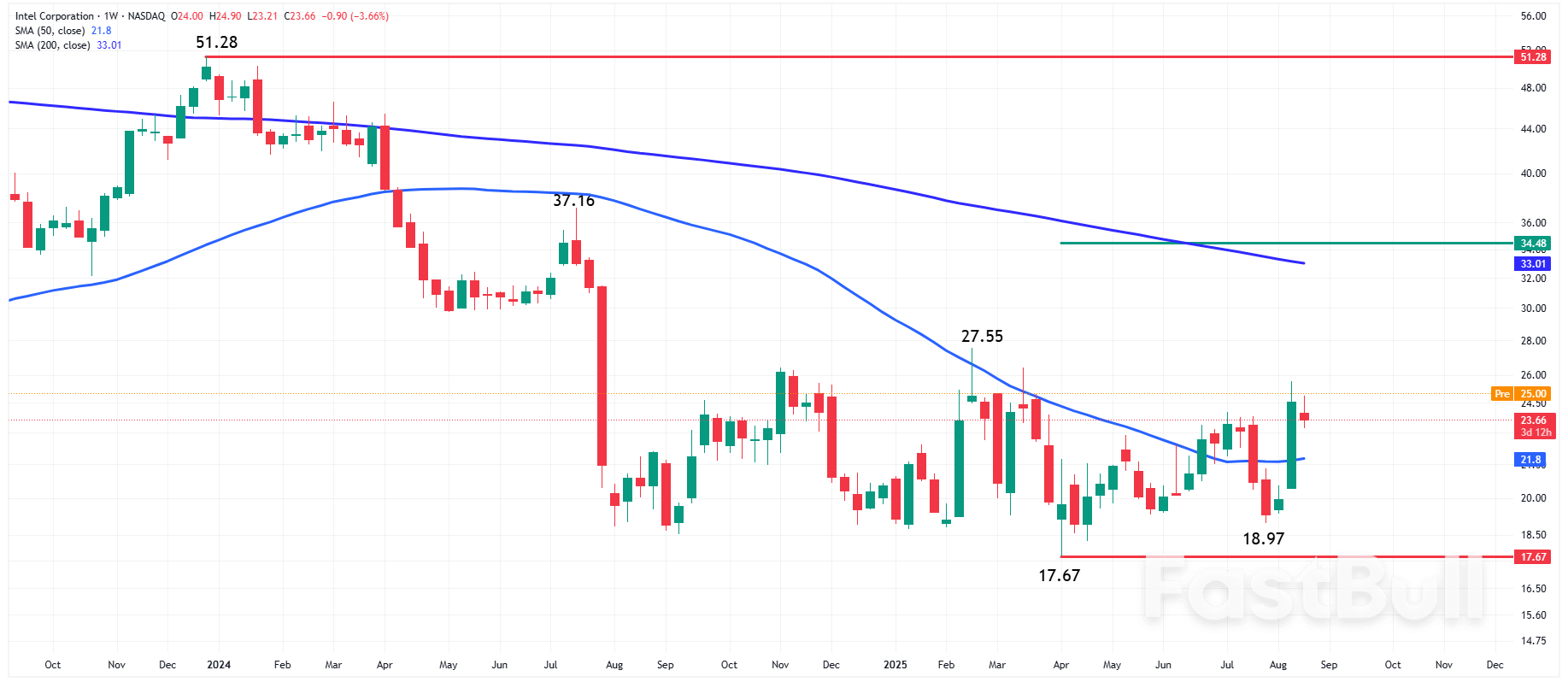
Weekly Intel CorporationWhile Malaysia's exports saw a stronger-than-expected rebound in July, economists say the country's overall trade outlook remains clouded by the risks of US tariffs and softening global demand.
Malaysia's exports climbed 6.8% year on year to RM140.45 billion — the highest since September 2022 — reversing two consecutive months of contraction, thanks largely to a 22.5% jump in electrical and electronics (E&E) shipments, according to the Ministry of Investment, Trade and Industry (Miti).
While the rebound offered short-term relief, RHB Investment Bank said it maintains "a cautious view on the trade outlook, as the impact of tariffs would gradually set in later in the year, likely affecting Malaysia’s trade and manufacturing sectors".
In a note, the bank added that two factors could support exports in the second half of 2025, namely "clearer guidance on US tariffs on Malaysia and easing US–China trade tensions". It also flagged the potential introduction of sector-specific levies, particularly on semiconductors, as a key downside risk.
UOB Global Economics & Markets Research said July's positive surprise was mainly a result of "revived front-loading activities ahead of higher US reciprocal tariffs confirmed on Aug 1 and effective from Aug 8".
While UOB has maintained its full-year export growth forecast at 3.8%, it cautioned that Malaysia’s trade outlook for the remainder of the year is still subject to downside risks, including the progress of the US-China trade truce, the confirmation of sector-specific tariffs, the effects of higher reciprocal tariffs, and weaker demand.
Similarly, MBSB Research expects a moderation after July's surge, reflecting a more cautious outlook amid ongoing trade uncertainties. While E&E exports provided a buffer, MBSB warned that "the 19% US tariff on Malaysia’s exports is expected to lead to slower trade in the latter part of the year, with softer demand from key trading partners adding to the downside risks."
The research house added that "efforts to diversify markets and deepen bilateral ties should cushion the US tariff impact, while resilient domestic consumption will remain a key driver to sustain growth in Malaysia’s economy amid external uncertainties".
CIMB Treasury and Markets Research, who also noted that the July rebound was partly fuelled by tariff-related front-loading, noted this was especially for E&E shipments through Singapore. "Growth in exports to the US, Hong Kong, and Singapore was partly driven by tariff-related front-loading, while higher imports from mainland China and Taiwan point to stockpiling of intermediate goods," it said.
According to Miti, July's export rebound was also supported by gains in optical and scientific equipment, processed food, and machinery, equipment and parts. However, petroleum products, palm oil, and liquefied natural gas exports contracted.
Imports rose 0.6% year-on-year, driven by capital goods, while intermediate and consumption goods saw a decline. This lifted the trade surplus to RM14.98 billion, more than double the previous month.
White Label
Data API
Web Plug-ins
Poster Maker
Affiliate Program
The risk of loss in trading financial instruments such as stocks, FX, commodities, futures, bonds, ETFs and crypto can be substantial. You may sustain a total loss of the funds that you deposit with your broker. Therefore, you should carefully consider whether such trading is suitable for you in light of your circumstances and financial resources.
No decision to invest should be made without thoroughly conducting due diligence by yourself or consulting with your financial advisors. Our web content might not suit you since we don't know your financial conditions and investment needs. Our financial information might have latency or contain inaccuracy, so you should be fully responsible for any of your trading and investment decisions. The company will not be responsible for your capital loss.
Without getting permission from the website, you are not allowed to copy the website's graphics, texts, or trademarks. Intellectual property rights in the content or data incorporated into this website belong to its providers and exchange merchants.
Not Logged In
Log in to access more features

FastBull Membership
Not yet
Purchase
Log In
Sign Up