• Trade
  • Markets
  • Copy
  • Contests
  • News
  • 24/7
  • Calendar
  • Q&A
  • Chats
Trending
Screeners
SYMBOL
LAST
BID
ASK
HIGH
LOW
NET CHG.
%CHG.
SPREAD
SPX
S&P 500 Index
6827.42
6827.42
6827.42
6899.86
6801.80
-73.58
-1.07%
--
DJI
Dow Jones Industrial Average
48458.04
48458.04
48458.04
48886.86
48334.10
-245.98
-0.51%
--
IXIC
NASDAQ Composite Index
23195.16
23195.16
23195.16
23554.89
23094.51
-398.69
-1.69%
--
USDX
US Dollar Index
97.950
98.030
97.950
98.500
97.950
-0.370
-0.38%
--
EURUSD
Euro / US Dollar
1.17394
1.17409
1.17394
1.17496
1.17192
+0.00011
+ 0.01%
--
GBPUSD
Pound Sterling / US Dollar
1.33707
1.33732
1.33707
1.33997
1.33419
-0.00148
-0.11%
--
XAUUSD
Gold / US Dollar
4299.39
4299.39
4299.39
4353.41
4257.10
+20.10
+ 0.47%
--
WTI
Light Sweet Crude Oil
57.233
57.485
57.233
58.011
56.969
-0.408
-0.71%
--

Community Accounts

Signal Accounts
--
Profit Accounts
--
Loss Accounts
--
View More

Become a signal provider

Sell trading signals to earn additional income

View More

Guide to Copy Trading

Get started with ease and confidence

View More

Signal Accounts for Members

All Signal Accounts

Best Return
  • Best Return
  • Best P/L
  • Best MDD
Past 1W
  • Past 1W
  • Past 1M
  • Past 1Y

All Contests

  • All
  • Trump Updates
  • Recommend
  • Stocks
  • Cryptocurrencies
  • Central Banks
  • Featured News
Top News Only
Share

Thai Leader Anutin: Landmine Blast That Killed Thai Soldiers 'Not A Roadside Accident'

Share

Thai Leader Anutin: Thailand To Continue Military Action Until 'We Feel No More Harm'

Share

Cambodian Prime Minister Hun Manet Says He Had Phone Calls With Trump And Malaysian Leader Anwar About Ceasefire

Share

Cambodia's Hun Manet Says USA, Malaysia Should Verify 'Which Side Fired First' In Latest Conflict

Share

Cambodia's Hun Manet: Cambodia Maintains Its Stance In Seeking Peaceful Resolution Of Disputes

Share

Nasdaq Companies: Allergan, Ferrovia, Insmed, Monolithic Power Systems, Seagate Technology, And Western Digital Will Be Added To The NASDAQ 100 Index. Biogen, CdW, GlobalFoundries, Lululemon, ON Semiconductor, And Tradedesk Will Be Removed From The NASDAQ 100 Index

Share

Witkoff Headed To Berlin This Weekend To Meet With Zelenskiy, European Leaders -Wsj Reporter On X

Share

Russia Attacks Two Ukrainian Ports, Damaging Three Turkish-Owned Vessels

Share

[Historic Flooding Occurs In At Least Four Rivers In Washington State Due To Days Of Torrential Rains] Multiple Areas In Washington State Have Been Hit By Severe Flooding Due To Days Of Torrential Rains, With At Least Four Rivers Experiencing Historic Flooding. Reporters Learned On The 12th That The Floods Caused By The Torrential Rains In Washington State Have Destroyed Homes And Closed Several Highways. Experts Warn That Even More Severe Flooding May Occur In The Future. A State Of Emergency Has Been Declared In Washington State

Share

Trump Says Proposed Free Economic Zone In Donbas Would Work

Share

Trump: I Think My Voice Should Be Heard

Share

Trump Says Will Be Choosing New Fed Chair In Near Future

Share

Trump Says Proposed Free Economic Zone In Donbas Complex But Would Work

Share

Trump Says Land Strikes In Venezuela Will Start Happening

Share

US President Trump: Thailand And Cambodia Are In A Good Situation

Share

State Media: North Korean Leader Kim Hails Troops Returning From Russia Mission

Share

The 10-year Treasury Yield Rose About 5 Basis Points During The "Fed Rate Cut Week," And The 2/10-year Yield Spread Widened By About 9 Basis Points. On Friday (December 12), In Late New York Trading, The Yield On The Benchmark 10-year US Treasury Note Rose 2.75 Basis Points To 4.1841%, A Cumulative Increase Of 4.90 Basis Points For The Week, Trading Within A Range Of 4.1002%-4.2074%. It Rose Steadily From Monday To Wednesday (before The Fed Announced Its Rate Cut And Treasury Bill Purchase Program), Subsequently Exhibiting A V-shaped Recovery. The 2-year Treasury Yield Fell 1.82 Basis Points To 3.5222%, A Cumulative Decrease Of 3.81 Basis Points For The Week, Trading Within A Range Of 3.6253%-3.4989%

Share

Trump: Lots Of Progress Being Made On Russia-Ukraine

Share

NOPA November US Soybean Crush Estimated At 220.285 Million Bushels

Share

SPDR Gold Trust Reports Holdings Up 0.22%, Or 2.28 Tonnes, To 1053.11 Tonnes By Dec 12

TIME
ACT
FCST
PREV
U.K. Trade Balance Non-EU (SA) (Oct)

A:--

F: --

P: --

U.K. Trade Balance (Oct)

A:--

F: --

P: --

U.K. Services Index MoM

A:--

F: --

P: --

U.K. Construction Output MoM (SA) (Oct)

A:--

F: --

P: --

U.K. Industrial Output YoY (Oct)

A:--

F: --

P: --

U.K. Trade Balance (SA) (Oct)

A:--

F: --

P: --

U.K. Trade Balance EU (SA) (Oct)

A:--

F: --

P: --

U.K. Manufacturing Output YoY (Oct)

A:--

F: --

P: --

U.K. GDP MoM (Oct)

A:--

F: --

P: --

U.K. GDP YoY (SA) (Oct)

A:--

F: --

P: --

U.K. Industrial Output MoM (Oct)

A:--

F: --

P: --

U.K. Construction Output YoY (Oct)

A:--

F: --

P: --

France HICP Final MoM (Nov)

A:--

F: --

P: --

China, Mainland Outstanding Loans Growth YoY (Nov)

A:--

F: --

P: --

China, Mainland M2 Money Supply YoY (Nov)

A:--

F: --

P: --

China, Mainland M0 Money Supply YoY (Nov)

A:--

F: --

P: --

China, Mainland M1 Money Supply YoY (Nov)

A:--

F: --

P: --

India CPI YoY (Nov)

A:--

F: --

P: --

India Deposit Gowth YoY

A:--

F: --

P: --

Brazil Services Growth YoY (Oct)

A:--

F: --

P: --

Mexico Industrial Output YoY (Oct)

A:--

F: --

P: --

Russia Trade Balance (Oct)

A:--

F: --

P: --

Philadelphia Fed President Henry Paulson delivers a speech
Canada Building Permits MoM (SA) (Oct)

A:--

F: --

P: --

Canada Wholesale Sales YoY (Oct)

A:--

F: --

P: --

Canada Wholesale Inventory MoM (Oct)

A:--

F: --

P: --

Canada Wholesale Inventory YoY (Oct)

A:--

F: --

P: --

Canada Wholesale Sales MoM (SA) (Oct)

A:--

F: --

P: --

Germany Current Account (Not SA) (Oct)

A:--

F: --

P: --

U.S. Weekly Total Rig Count

A:--

F: --

P: --

U.S. Weekly Total Oil Rig Count

A:--

F: --

P: --

Japan Tankan Large Non-Manufacturing Diffusion Index (Q4)

--

F: --

P: --

Japan Tankan Small Manufacturing Outlook Index (Q4)

--

F: --

P: --

Japan Tankan Large Non-Manufacturing Outlook Index (Q4)

--

F: --

P: --

Japan Tankan Large Manufacturing Outlook Index (Q4)

--

F: --

P: --

Japan Tankan Small Manufacturing Diffusion Index (Q4)

--

F: --

P: --

Japan Tankan Large Manufacturing Diffusion Index (Q4)

--

F: --

P: --

Japan Tankan Large-Enterprise Capital Expenditure YoY (Q4)

--

F: --

P: --

U.K. Rightmove House Price Index YoY (Dec)

--

F: --

P: --

China, Mainland Industrial Output YoY (YTD) (Nov)

--

F: --

P: --

China, Mainland Urban Area Unemployment Rate (Nov)

--

F: --

P: --

Saudi Arabia CPI YoY (Nov)

--

F: --

P: --

Euro Zone Industrial Output YoY (Oct)

--

F: --

P: --

Euro Zone Industrial Output MoM (Oct)

--

F: --

P: --

Canada Existing Home Sales MoM (Nov)

--

F: --

P: --

Euro Zone Total Reserve Assets (Nov)

--

F: --

P: --

U.K. Inflation Rate Expectations

--

F: --

P: --

Canada National Economic Confidence Index

--

F: --

P: --

Canada New Housing Starts (Nov)

--

F: --

P: --

U.S. NY Fed Manufacturing Employment Index (Dec)

--

F: --

P: --

U.S. NY Fed Manufacturing Index (Dec)

--

F: --

P: --

Canada Core CPI YoY (Nov)

--

F: --

P: --

Canada Manufacturing Unfilled Orders MoM (Oct)

--

F: --

P: --

Canada Manufacturing New Orders MoM (Oct)

--

F: --

P: --

Canada Core CPI MoM (Nov)

--

F: --

P: --

Canada Manufacturing Inventory MoM (Oct)

--

F: --

P: --

Canada CPI YoY (Nov)

--

F: --

P: --

Canada CPI MoM (Nov)

--

F: --

P: --

Canada CPI YoY (SA) (Nov)

--

F: --

P: --

Canada Core CPI MoM (SA) (Nov)

--

F: --

P: --

Q&A with Experts
    • All
    • Chatrooms
    • Groups
    • Friends
    Connecting
    .
    .
    .
    Type here...
    Add Symbol or Code

      No matching data

      All
      Trump Updates
      Recommend
      Stocks
      Cryptocurrencies
      Central Banks
      Featured News
      • All
      • Russia-Ukraine Conflict
      • Middle East Flashpoint
      • All
      • Russia-Ukraine Conflict
      • Middle East Flashpoint
      Search
      Products

      Charts Free Forever

      Chats Q&A with Experts
      Screeners Economic Calendar Data Tools
      Membership Features
      Data Warehouse Market Trends Institutional Data Policy Rates Macro

      Market Trends

      Market Sentiment Order Book Forex Correlations

      Top Indicators

      Charts Free Forever
      Markets

      News

      News Analysis 24/7 Columns Education
      From Institutions From Analysts
      Topics Columnists

      Latest Views

      Latest Views

      Trending Topics

      Top Columnists

      Latest Update

      Signals

      Copy Rankings Latest Signals Become a signal provider AI Rating
      Contests
      Brokers

      Overview Brokers Assessment Rankings Regulators News Claims
      Broker listing Forex Brokers Comparison Tool Live Spread Comparison Scam
      Q&A Complaint Scam Alert Videos Tips to Detect Scam
      More

      Business
      Events
      Careers About Us Advertising Help Center

      White Label

      Data API

      Web Plug-ins

      Affiliate Program

      Awards Institution Evaluation IB Seminar Salon Event Exhibition
      Vietnam Thailand Singapore Dubai
      Fans Party Investment Sharing Session
      FastBull Summit BrokersView Expo
      Recent Searches
        Top Searches
          Markets
          News
          Analysis
          User
          24/7
          Economic Calendar
          Education
          Data
          • Names
          • Latest
          • Prev

          View All

          No data

          Scan to Download

          Faster Charts, Chat Faster!

          Download App
          English
          • English
          • Español
          • العربية
          • Bahasa Indonesia
          • Bahasa Melayu
          • Tiếng Việt
          • ภาษาไทย
          • Français
          • Italiano
          • Türkçe
          • Русский язык
          • 简中
          • 繁中
          Open Account
          Search
          Products
          Charts Free Forever
          Markets
          News
          Signals

          Copy Rankings Latest Signals Become a signal provider AI Rating
          Contests
          Brokers

          Overview Brokers Assessment Rankings Regulators News Claims
          Broker listing Forex Brokers Comparison Tool Live Spread Comparison Scam
          Q&A Complaint Scam Alert Videos Tips to Detect Scam
          More

          Business
          Events
          Careers About Us Advertising Help Center

          White Label

          Data API

          Web Plug-ins

          Affiliate Program

          Awards Institution Evaluation IB Seminar Salon Event Exhibition
          Vietnam Thailand Singapore Dubai
          Fans Party Investment Sharing Session
          FastBull Summit BrokersView Expo

          Currency War Fears Resurface: Global Instability Looms as Dollar Weakens, but Vietnam Urged to Stay Focused on Internal Growth

          Gerik

          Forex

          China–U.S. Trade War

          Summary:

          Fears of a currency war are rising as China devalues the yuan to offset U.S. tariffs, the dollar weakens sharply, and concerns grow over global financial stability..

          Trade war risks morphing into a currency war

          On April 8, China surprised markets by lowering its yuan reference rate after months of keeping it steady, aiming to cushion the impact of escalating U.S. tariffs. The yuan immediately fell to a 19-month low, sparking widespread concerns that the global trade conflict could mutate into a full-scale currency war.
          Dr. Hồ Quốc Tuấn from the University of Bristol warned that if countries start following China's devaluation to maintain competitiveness, they risk being labeled currency manipulators by the U.S., triggering foreign capital flight and greater instability. Given the yuan’s critical role as a regional anchor, even small shifts can produce outsized ripple effects across global markets.
          As the U.S.–China tariff battle intensifies, investor fears of global supply chain disruptions, slowing trade, and weaker corporate profits are translating into heightened financial market volatility. Companies are delaying investments, consumers are growing cautious, and currencies are swinging wildly.
          Adding to worries, Santiago Fernández de Lis of BBVA noted that the unusual combination of rising U.S. bond yields and a weakening dollar signals eroding faith in the U.S.'s role as the world's safe haven. For decades, the stability of U.S. assets — particularly $27 trillion in government bonds — underpinned the global financial system. But the Trump administration's tariff escalations and perceived fiscal recklessness are now shaking that foundation.

          Currency devaluation: a risky temptation

          Historically, nations engaged in currency wars have sought to devalue their currencies to boost exports at the expense of trading partners. Although many Asian economies today are better prepared — with stronger foreign exchange reserves, tighter financial supervision, and deeper local capital markets — the dangers remain real.
          The U.S. dollar has depreciated over 9% against a basket of major currencies since its January peak, including a sharp 2% drop in April alone, raising concerns that global investors might be quietly pulling out of U.S. assets not due to low returns but due to rising systemic risks.
          The Economist warns that if U.S. political dysfunction continues — ignoring ballooning public debt and resorting to erratic policy moves — a global financial earthquake could follow. Rumors already suggest that large foreign investment funds are discreetly selling off U.S. dollar holdings.

          Vietnam urged to avoid the currency war trap

          Despite the heightened global risk environment, experts believe Vietnam should refrain from joining a competitive devaluation race. According to Phạm Lưu Hưng, Chief Economist at SSI Securities, chasing short-term export advantages through devaluation could backfire, offering minimal real benefits while risking financial instability.
          Instead, Vietnam is advised to focus on sustainable, internally driven growth. Domestic consumption and public investment are now the primary engines powering the country's economy, providing resilience even amid external shocks.
          "We should not be lured into currency devaluation just to boost exports slightly," Hưng emphasized. "The meaningful path forward is to strengthen Vietnam’s economic fundamentals and foster durable growth."
          As currency markets grow increasingly volatile, nations face difficult choices. While some may resort to competitive devaluations to shield their economies, Vietnam's current strategy of prioritizing internal demand and maintaining macroeconomic stability appears more prudent. The emerging global financial turbulence highlights not only the dangers of unchecked trade and currency wars but also the urgent need for countries like Vietnam to remain focused, cautious, and forward-looking.

          Source: The Economist

          Risk Warnings and Disclaimers
          You understand and acknowledge that there is a high degree of risk involved in trading. Following any strategies or investment methods may lead to potential losses. The content on the site is provided by our contributors and analysts for information purposes only. You are solely responsible for determining whether any trading assets, securities, strategy, or any other product is suitable for investing based on your own investment objectives and financial situation.
          Add to Favorites
          Share

          ECB Faces Complex Meeting In June, Dutch Central Bank Governor Knot Says In FD Report

          Patricia Franklin

          Economic

          Central Bank

          The European Central Bank's next policy meeting will be complex, as policymakers need to balance the uncertainty around inflation risks from U.S. tariffs, Dutch central bank governor Klaas Knot said in an interview with Dutch financial daily FD.

          "In the short term, it's 100% clear that the demand shock will dominate, so inflation will go down," Knot said, speaking about the effects of tariffs imposed by U.S. President Donald Trump.

          "But the ECB looks at inflation risks in the middle to long term. In the longer term inflation risks are definitely two-sided. I think the June meeting will be really complex."

          ECB policymakers are becoming increasingly confident about cutting interest rates in June as inflation continues its march lower, but there is little to no appetite for a big move, six sources told Reuters last week.

          Many governors were now seeing growing chances of an eighth quarter-point cut at the June 4 meeting, when the ECB will update its own economic forecasts, they said. The ECB trimmed its benchmark rate to 2.25% earlier this month.

          Source: Reuters

          To stay updated on all economic events of today, please check out our Economic calendar
          Risk Warnings and Disclaimers
          You understand and acknowledge that there is a high degree of risk involved in trading. Following any strategies or investment methods may lead to potential losses. The content on the site is provided by our contributors and analysts for information purposes only. You are solely responsible for determining whether any trading assets, securities, strategy, or any other product is suitable for investing based on your own investment objectives and financial situation.
          Add to Favorites
          Share

          Waves of Order Cancellations Hit China: Factories Struggle, Workers Laid Off, and New Markets Sought Amid U.S. Tariff Shock

          Gerik

          China–U.S. Trade War

          Factories in China grind to a halt as U.S. orders collapse

          The escalating tariff war initiated by the U.S., with duties on Chinese goods now exceeding 100%, is beginning to seriously paralyze manufacturing hubs across China. In export-heavy cities like Yiwu and Dongguan, factories are partially shutting down operations and placing workers on unpaid leave, while desperately hoping for a reduction in tariffs to revive orders.
          According to Cameron Johnson of Tidalwave Solutions, industries producing low-cost consumer goods like toys, sporting equipment, and general merchandise for dollar stores have been the hardest hit. With U.S. imports from China falling drastically, Goldman Sachs estimates that up to 20 million Chinese workers, who are directly or indirectly tied to U.S. exports, could be at risk.
          Small manufacturers, particularly those with only a few million dollars in working capital, now face an acute survival crisis. Ash Monga of Imex Sourcing Services described this tariff impact as “far worse than the COVID-19 disruption,” warning that a wave of bankruptcies is imminent if the current trade standoff persists.

          Chinese exporters pivot to livestreaming and new sales strategies

          Faced with plummeting export demand, Chinese companies are pivoting aggressively to the domestic market through livestream e-commerce platforms. For instance, Woodswool, a sportswear manufacturer based near Shanghai, quickly launched a livestream channel via Baidu’s AI-driven virtual hosts, securing new domestic sales despite losing all its U.S. business.
          Baidu, JD.com, and Meituan are rolling out major support packages to help exporters transition to domestic sales. Baidu’s offer of free AI "virtual characters" for livestreaming and JD.com’s 200 billion yuan ($27 billion) purchasing program demonstrate the scale of efforts. Yet these initiatives still only cover a fraction of the $524 billion worth of goods China exported to the U.S. last year.
          Michael Hart from the American Chamber of Commerce in China warned that many Chinese exporters find it difficult to repurpose products originally designed for American suburban consumers to fit urban Chinese lifestyles, creating another barrier to domestic market adaptation.

          Expanding beyond U.S. markets: A new lifeline

          Facing stricter U.S. customs controls against rerouting through third countries, Chinese companies are increasingly shifting production investments to India and Southeast Asia, and redirecting exports to Latin America and parts of Europe.
          Examples include Beijing Mingyuchu, a company specializing in bathroom products for Brazil, and Cotrie Logistics in Ghana, which facilitates Chinese exports to Africa. China's exports to Brazil have doubled between 2018 and 2024, signaling growing trade ties outside traditional Western markets.
          While supply chain challenges such as currency volatility and high shipping costs persist, Chinese exporters like Liu Xu of Mingyuchu see these emerging markets as critical buffers against U.S.-driven disruptions.
          The sudden evaporation of American orders marks the beginning of a deeper restructuring for Chinese exporters. Layoffs, factory slowdowns, and the race to capture new markets through innovative sales channels like livestreaming highlight a volatile transition phase. Whether these companies can successfully reinvent themselves amid escalating global trade tensions remains an open question — but one thing is clear: the era of heavy reliance on the U.S. market is rapidly coming to an end for many Chinese manufacturers.

          Source: CNBC

          Risk Warnings and Disclaimers
          You understand and acknowledge that there is a high degree of risk involved in trading. Following any strategies or investment methods may lead to potential losses. The content on the site is provided by our contributors and analysts for information purposes only. You are solely responsible for determining whether any trading assets, securities, strategy, or any other product is suitable for investing based on your own investment objectives and financial situation.
          Add to Favorites
          Share

          EU’s Record Fines Against Apple and Meta Threaten to Deepen Trade Tensions with the U.S.

          Gerik

          Political

          Economic

          Europe strikes hard against tech giants to assert digital sovereignty

          The European Commission (EC) has delivered a strong signal to the world’s technology giants by announcing record-breaking fines against Apple and Meta for violating the newly enforced Digital Markets Act (DMA). This historic move showcases Europe’s determination to ensure fair competition and protect consumer rights in the digital landscape.
          According to findings by the EC, Apple faces a proposed fine of up to 500 million euros for leveraging its dominant App Store position to restrict developers from informing users about alternative purchasing options outside its ecosystem. Such practices contravene the DMA’s explicit requirements aimed at preserving consumer choice and market fairness.
          Similarly, Meta could be fined around 200 million euros over its controversial “pay or consent” model implemented on Facebook and Instagram since November 2023. This model allegedly coerced users into surrendering personal data for targeted advertising unless they paid a subscription fee, undermining fundamental principles of data privacy and voluntary consent embedded in the DMA.

          A new chapter of regulatory enforcement in the digital economy

          This marks the first time financial penalties are applied under the DMA framework, which officially took full effect in May 2024. The EC emphasized that these fines are not punitive for their own sake but are designed to enforce rigorous compliance and foster a competitive digital environment.
          Both Apple and Meta have been given 60 working days to implement corrective measures. Failure to comply could expose them to supplementary fines reaching up to 5% of their daily global turnover, underscoring the EC’s serious commitment to enforcement.
          A spokesperson for the EC reiterated that all companies operating within the EU, regardless of their origin, must adhere strictly to European law, dismissing any accusations of geopolitical bias.

          Risk of escalating EU-U.S. trade tensions

          These actions unfold against an already strained backdrop in EU-U.S. relations, particularly in the digital policy arena. Under President Donald Trump, the U.S. government has criticized European regulatory initiatives like the DMA and the Digital Services Act (DSA) as discriminatory against American tech firms.
          Although the EC firmly denies any geopolitical motivations, stating that the laws apply equally to all companies, the timing and severity of these penalties could deepen existing transatlantic frictions. Washington has often viewed Europe's tech regulations as protective barriers designed to curb the influence of dominant U.S. companies.
          By directly targeting major players like Apple and Meta, Europe signals that even the largest and most influential corporations are not above its laws. The decision highlights the EU’s broader ambition to shape a digital economy that prioritizes consumer rights, transparency, and fair competition—values seen as increasingly essential in an era marked by technological concentration and growing concerns over privacy.
          The EC’s enforcement of the DMA with severe fines represents a watershed moment in global digital governance. Europe’s bold stance could inspire similar regulatory frameworks worldwide while simultaneously testing its delicate trade relationship with the United States. As both sides brace for potential diplomatic and economic repercussions, one thing is clear: the future of digital market regulation is set to become a central battleground in global commerce.

          Source: BBC

          To stay updated on all economic events of today, please check out our Economic calendar
          Risk Warnings and Disclaimers
          You understand and acknowledge that there is a high degree of risk involved in trading. Following any strategies or investment methods may lead to potential losses. The content on the site is provided by our contributors and analysts for information purposes only. You are solely responsible for determining whether any trading assets, securities, strategy, or any other product is suitable for investing based on your own investment objectives and financial situation.
          Add to Favorites
          Share

          Turning Crisis into Opportunity: How India Could Redefine Its Role Amid U.S.-China Trade Tensions

          Gerik

          Economic

          India stands at a crossroads as global supply chains are shaken

          The escalating trade war between the United States and China, intensified by President Donald Trump’s decision to impose tariffs of up to 145% on Chinese goods, has created significant upheaval across global supply chains. While the immediate battle rages between the world’s two largest economies, the ripple effects are reaching far and wide — and India finds itself close enough to feel the heat, yet also poised to seize new opportunities.
          In the short term, India’s heavy reliance on Chinese imports exposes its economy to risks. Sectors such as pharmaceuticals, electronics, steel, automotive, and textiles could face severe disruptions. Notably, over 71% of India's pharmaceutical raw materials are sourced from China, making the sector vulnerable to supply shocks. Simultaneously, cheaper Chinese steel and textiles flooding the market could pressure domestic producers like Tata Steel and local textile hubs such as Surat.
          Export industries are also under strain. Indian diamond exports, a major revenue source, fell by nearly 17% in the past financial year due to weakened demand from both the U.S. and China, key markets now entangled in the trade dispute.

          Opportunity amidst adversity: India’s chance to rise

          However, alongside the looming challenges lies a strategic opening for India to reposition itself as an essential node in the restructured global supply chains. American and other foreign companies are actively seeking alternatives to China for manufacturing and sourcing, and India’s competitive labor costs, growing infrastructure, and evolving industrial base make it an attractive choice.
          Key indicators of this trend are already visible. Apple plans to shift its iPhone assembly for the U.S. market entirely to India as early as next year. Semiconductor giants like AMD and Applied Materials have committed significant investments into Indian facilities. Similarly, restrictions on U.S. technology exports to China are prompting greater engagement with India under the iCET framework, which promotes cooperation in critical areas such as AI, semiconductors, and quantum computing.
          India also stands to benefit from China’s reduced imports of American agricultural products, providing an opening for Indian exports like soybeans and cotton to gain traction.

          Strategic moves required to secure long-term gains

          To transform these short-term advantages into sustained leadership, India must act decisively. Strengthening domestic production through programs like the Production Linked Incentive (PLI) scheme is crucial for reducing dependence on Chinese imports, especially for electronics and active pharmaceutical ingredients (APIs).
          In parallel, India must shield its industries from potential dumping of Chinese goods, particularly steel, textiles, and auto parts, by enforcing strict anti-dumping duties and promoting local sourcing requirements.
          Furthermore, India’s policymakers need to address supply chain vulnerabilities and focus on building capabilities in green energy technologies and advanced manufacturing to ensure that the country not only absorbs diverted investments but also becomes indispensable to the future global economy.
          As the tectonic plates of global trade shift under the weight of U.S.-China tensions, India faces a defining moment. The choice is clear: by embracing reforms, incentivizing local production, and strategically integrating into new global value chains, India can move from being a reactive player to a proactive leader in the new economic order. Prime Minister Narendra Modi’s call to turn adversity into opportunity (Aapda ko avsar mein badalna) resonates now more than ever — offering a roadmap for India to secure its place as a central pillar in the evolving global trade architecture.

          Source: Financial Times

          To stay updated on all economic events of today, please check out our Economic calendar
          Risk Warnings and Disclaimers
          You understand and acknowledge that there is a high degree of risk involved in trading. Following any strategies or investment methods may lead to potential losses. The content on the site is provided by our contributors and analysts for information purposes only. You are solely responsible for determining whether any trading assets, securities, strategy, or any other product is suitable for investing based on your own investment objectives and financial situation.
          Add to Favorites
          Share

          Asian Markets Open Cautiously as Investors Await China’s Stimulus and U.S. Trade Talks Progress

          Gerik

          Stocks

          Markets tread carefully amid stimulus expectations and tariff concerns

          Asian financial markets began the week with cautious movements as investors kept a close watch on China's potential stimulus measures and ongoing U.S. trade negotiations. With global uncertainty persisting, trading volumes remained modest, and market sentiment appeared fragile.
          Early in Monday’s session, U.S. dollar indexes stayed steady against major currencies, while futures for American equities edged lower. Japan’s market hinted at early gains, buoyed by a weaker yen, while Australian and Hong Kong markets saw little change.

          China’s policy stance under scrutiny

          Chinese Finance Minister Lan Fuan reaffirmed over the weekend that China would implement "more proactive and effective" policies to sustain growth and stabilize the global economy. Investors are awaiting further clarity as the People’s Bank of China (PBOC) and other regulatory agencies are scheduled to hold press conferences later today.
          Tony Sycamore, a market analyst at IG in Sydney, highlighted a critical uncertainty: whether China will introduce genuinely new stimulus measures or merely advance previously announced plans. After several months of dashed hopes around stimulus headlines, markets remain cautious and reluctant to react prematurely.
          This cautious stance is underpinned by a pattern of past disappointments, where anticipated economic support measures from China fell short of expectations, undermining market confidence.

          Focus on U.S.-Asia trade negotiations

          At the same time, investors are watching developments in U.S.-Asia trade talks closely. President Donald Trump reiterated that it is unlikely he will extend the 90-day tariff suspension granted earlier this month, raising stakes for countries such as South Korea, Japan, Vietnam, and Thailand, all of which are working toward temporary agreements before early July.
          With punitive tariffs looming, Asia’s proactive negotiation efforts contrast with the slower, more calculated strategies being pursued by European and North American partners.

          Mixed movements across key markets

          As of Monday morning in Asia:
          Futures for the S&P 500 dipped by 0.4% as of 8:23 AM Tokyo time, indicating a tentative pullback after recent gains.Futures for Hong Kong’s Hang Seng Index edged up 0.2%, while Australia's S&P/ASX 200 futures showed little change.Currency markets remained subdued, with the Bloomberg Dollar Spot Index holding steady. The euro weakened slightly to $1.1350, and the Japanese yen hovered at 143.80 per dollar. Offshore yuan traded at 7.2943 per dollar without significant movement.
          In the cryptocurrency sector, Bitcoin slipped 0.5% to $93,834.04, and Ether declined 0.6% to $1,792.60.
          Among commodities, West Texas Intermediate (WTI) crude oil rose 0.4% to $63.29 a barrel, while spot gold fell 0.5% to $3,304.49 an ounce.

          Macroeconomic indicators under the spotlight

          Beyond immediate stimulus and trade headlines, investors are bracing for a series of crucial economic reports. Key releases this week include China’s manufacturing activity data, the Bank of Japan’s interest rate decision, the U.S. jobs report, GDP figures, and the Federal Reserve’s preferred inflation gauge.
          According to Win Thin, global market strategist at Brown Brothers Harriman, this batch of data will likely reveal the first tangible impacts of tariff tensions on the world's two largest economies. However, he cautioned that even by July, it may still be too early to expect any tariff reversals, given the prevailing geopolitical and economic uncertainty.
          As global trade tensions and economic policy ambiguities persist, Asian investors are adopting a defensive stance. Markets will likely remain range-bound until firmer signals emerge regarding China’s stimulus efforts and the outcome of U.S. trade negotiations. In the meantime, volatility could spike as critical economic data in the coming days sheds more light on the underlying strength—and vulnerabilities—of the global economy.

          Source: Nikkei Asia

          Risk Warnings and Disclaimers
          You understand and acknowledge that there is a high degree of risk involved in trading. Following any strategies or investment methods may lead to potential losses. The content on the site is provided by our contributors and analysts for information purposes only. You are solely responsible for determining whether any trading assets, securities, strategy, or any other product is suitable for investing based on your own investment objectives and financial situation.
          Add to Favorites
          Share

          US Dollar Gains Amid Trade Uncertainty and Fed Rate Cut Hints: DXY Eyes Critical Resistance

          Balogun Opeyemi

          Forex

          Fundamental Analysis

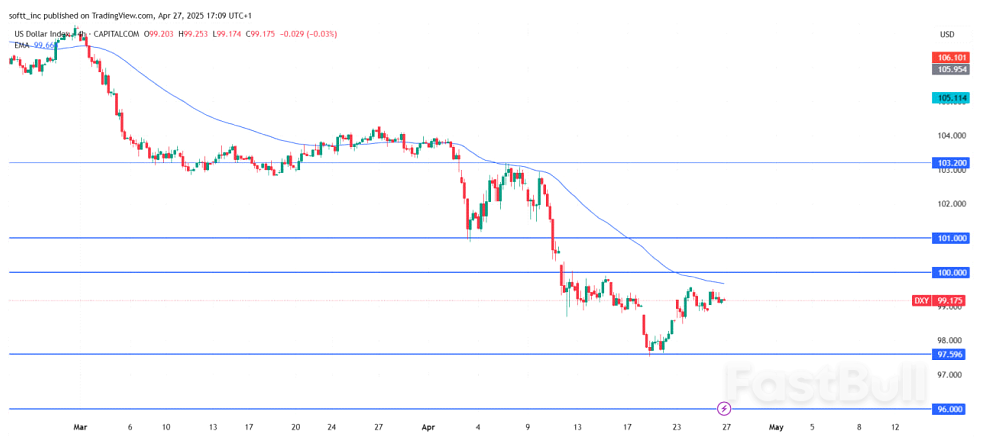
          The U.S. Dollar (USD) strengthened slightly on Friday, closing the week with gains as markets navigated conflicting signals regarding U.S.-China trade negotiations. President Trump hinted that tariff talks were ongoing; however, Chinese officials firmly denied any current discussions. This divergence injected volatility into markets but ultimately supported the Greenback, with the U.S. Dollar Index (DXY) ending the week up 0.35%, around the 99.17 zone.
          The broader sentiment remains cautious as the market enters a data-light period ahead of the highly anticipated Federal Open Market Committee (FOMC) meeting on May 7. Despite optimism earlier in the week that China might ease tariffs on certain U.S. goods, including medical equipment, Beijing’s firm denial dampened risk appetite. Meanwhile, dovish signals emerged from the Federal Reserve: Cleveland Fed President Beth Hammack noted that a rate cut could be considered as early as June if upcoming data shows signs of a weakening economy.
          These mixed factors trade uncertainty and possible monetary easing create a complex backdrop for the dollar, suggesting that volatility could persist into the coming weeks.

          Technical Analysis: DXY Testing Key Resistance Levels

          US Dollar Gains Amid Trade Uncertainty and Fed Rate Cut Hints: DXY Eyes Critical Resistance_1
          The U.S. Dollar Index (DXY) is currently trading near 99.17, approaching the significant psychological resistance at the 100.0 mark. A successful break and daily close above 100.0 could pave the way for further upside, potentially targeting the next resistance levels around 100.40 and 101.00. This would reinforce the bullish momentum that has been building over the past two weeks.
          However, if buyers fail to breach the 100.0 barrier, the DXY may face a pullback. Initial support is identified at 97.59, a critical level that previously acted as a pivot zone. A decisive move below 97.59 could expose the DXY to deeper losses, with the 96.00 psychological level as the next target. A breach of this zone would tilt the bias back in favor of the sellers, suggesting a potential trend reversal in the medium term.
          Risk Warnings and Disclaimers
          You understand and acknowledge that there is a high degree of risk involved in trading. Following any strategies or investment methods may lead to potential losses. The content on the site is provided by our contributors and analysts for information purposes only. You are solely responsible for determining whether any trading assets, securities, strategy, or any other product is suitable for investing based on your own investment objectives and financial situation.
          Add to Favorites
          Share
          FastBull
          Copyright © 2025 FastBull Ltd

          728 RM B 7/F GEE LOK IND BLDG NO 34 HUNG TO RD KWUN TONG KLN HONG KONG

          TelegramInstagramTwitterfacebooklinkedin
          App Store Google Play Google Play
          Products
          Charts

          Chats

          Q&A with Experts
          Screeners
          Economic Calendar
          Data
          Tools
          Membership
          Features
          Function
          Markets
          Copy Trading
          Latest Signals
          Contests
          News
          Analysis
          24/7
          Columns
          Education
          Company
          Careers
          About Us
          Contact Us
          Advertising
          Help Center
          Feedback
          User Agreement
          Privacy Policy
          Business

          White Label

          Data API

          Web Plug-ins

          Poster Maker

          Affiliate Program

          Risk Disclosure

          The risk of loss in trading financial instruments such as stocks, FX, commodities, futures, bonds, ETFs and crypto can be substantial. You may sustain a total loss of the funds that you deposit with your broker. Therefore, you should carefully consider whether such trading is suitable for you in light of your circumstances and financial resources.

          No decision to invest should be made without thoroughly conducting due diligence by yourself or consulting with your financial advisors. Our web content might not suit you since we don't know your financial conditions and investment needs. Our financial information might have latency or contain inaccuracy, so you should be fully responsible for any of your trading and investment decisions. The company will not be responsible for your capital loss.

          Without getting permission from the website, you are not allowed to copy the website's graphics, texts, or trademarks. Intellectual property rights in the content or data incorporated into this website belong to its providers and exchange merchants.

          Not Logged In

          Log in to access more features

          FastBull Membership

          Not yet

          Purchase

          Become a signal provider
          Help Center
          Customer Service
          Dark Mode
          Price Up/Down Colors

          Log In

          Sign Up

          Position
          Layout
          Fullscreen
          Default to Chart
          The chart page opens by default when you visit fastbull.com