• Trade
  • Markets
  • Copy
  • Contests
  • News
  • 24/7
  • Calendar
  • Q&A
  • Chats
Trending
Screeners
SYMBOL
LAST
BID
ASK
HIGH
LOW
NET CHG.
%CHG.
SPREAD
SPX
S&P 500 Index
6825.87
6825.87
6825.87
6861.30
6801.50
-1.54
-0.02%
--
DJI
Dow Jones Industrial Average
48438.02
48438.02
48438.02
48679.14
48317.93
-20.02
-0.04%
--
IXIC
NASDAQ Composite Index
23133.67
23133.67
23133.67
23345.56
23012.00
-61.49
-0.27%
--
USDX
US Dollar Index
97.800
97.880
97.800
98.070
97.740
-0.150
-0.15%
--
EURUSD
Euro / US Dollar
1.17598
1.17607
1.17598
1.17686
1.17262
+0.00204
+ 0.17%
--
GBPUSD
Pound Sterling / US Dollar
1.33904
1.33912
1.33904
1.34014
1.33546
+0.00197
+ 0.15%
--
XAUUSD
Gold / US Dollar
4324.30
4324.64
4324.30
4350.16
4294.68
+24.91
+ 0.58%
--
WTI
Light Sweet Crude Oil
56.666
56.696
56.666
57.601
56.601
-0.567
-0.99%
--

Community Accounts

Signal Accounts
--
Profit Accounts
--
Loss Accounts
--
View More

Become a signal provider

Sell trading signals to earn additional income

View More

Guide to Copy Trading

Get started with ease and confidence

View More

Signal Accounts for Members

All Signal Accounts

Best Return
  • Best Return
  • Best P/L
  • Best MDD
Past 1W
  • Past 1W
  • Past 1M
  • Past 1Y

All Contests

  • All
  • Trump Updates
  • Recommend
  • Stocks
  • Cryptocurrencies
  • Central Banks
  • Featured News
Top News Only
Share

Slovak Prime Minister Fico Says He Will Travel To United States, Meet President Trump In Relation To Nuclear Power Deal During 2026 Soccer World Cup

Share

[California Sues Trump Administration Over Commercial Vehicle Safety Program] California Is Suing The Trump Administration Over Allegations That Its Failure To Crack Down On Foreign Drivers Resulted In The Withholding Of $33 Million In Federal Funding. According To The Lawsuit Filed On December 12 In The U.S. District Court For The Northern District Of California, The State Claims That The Federal Motor Transportation Safety Administration (FMSA) Issued A Preliminary Notice Stating That California Failed To Comply With Requirements To Prevent Drivers Without English Language Skills From Driving, Violating The Administrative Procedure Act And Constituting "arbitrary And Capricious" Behavior

Share

EU's Foreign Policy Chief Kallas: Everybody Understands Belgium's Worries And Is Willing To Share Burden

Share

African Stock Market Closing Report | On Monday (December 15), The South African FTSE/Jse Africa Leading 40 Trading Index Closed Down 0.43%, Nearing 105,200 Points

Share

The Athens Stock Exchange Composite Index Closed Up 0.15% At 2107.43 Points

Share

The Offshore Yuan Broke Through 7.04 Against The US Dollar

Share

Fbi Director: A Fifth Individual Believed To Be Planning A Separate Attack Arrested By Fbi New Orleans

Share

New York Fed President Williams: The 2% Inflation Target Must Be Achieved Without Impacting The Job Market

Share

New York Fed President Williams: Monetary Policy Very Focused On Balancing Job, Inflation Risks

Share

New York Fed President Williams Expects USA Unemployment To Be 4.5% By End Of 2025

Share

New York Fed President Williams: Labor Market Risks Have Risen As Risks To Inflation Have Eased

Share

New York Fed President Williams Expects Inflation To Move To 2.5% In 2026, 2% In 2027

Share

New York Fed President Williams Sees Tariffs As A One-Off Price Adjustment, Not Spilling Over Into Broader Inflation

Share

New York Fed President Williams: Labor Market Cooling Has Been Gradual Process

Share

New York Fed President Williams Expects Active Usage Of Standing Repo Facility To Manage Liquidity

Share

New York Fed President Williams: Critical For USA Central Bank To Get Inflation Back To 2%

Share

New York Fed President Williams Expects 2026 GDP Growth To Hit 2.25%, Well Above 2025 Rate

Share

New York Fed President Williams Projects Jobless Rate Will Come Back Down Over Next Few Years

Share

New York Fed President Williams: Fed Policy Has Moved Toward Neutral From Modestly Restrictive

Share

Federal Reserve Governor Milan: I Would Be Happy To Vote For The Re-election Of Regional Fed Presidents

TIME
ACT
FCST
PREV
Japan Tankan Small Manufacturing Outlook Index (Q4)

A:--

F: --

P: --

Japan Tankan Large Non-Manufacturing Outlook Index (Q4)

A:--

F: --

P: --

Japan Tankan Large Manufacturing Outlook Index (Q4)

A:--

F: --

P: --

Japan Tankan Small Manufacturing Diffusion Index (Q4)

A:--

F: --

P: --

Japan Tankan Large-Enterprise Capital Expenditure YoY (Q4)

A:--

F: --

P: --

U.K. Rightmove House Price Index YoY (Dec)

A:--

F: --

P: --

China, Mainland Industrial Output YoY (YTD) (Nov)

A:--

F: --

P: --

China, Mainland Urban Area Unemployment Rate (Nov)

A:--

F: --

P: --

Saudi Arabia CPI YoY (Nov)

A:--

F: --

P: --

Euro Zone Industrial Output YoY (Oct)

A:--

F: --

P: --

Euro Zone Industrial Output MoM (Oct)

A:--

F: --

P: --

Canada Existing Home Sales MoM (Nov)

A:--

F: --

P: --

Canada National Economic Confidence Index

A:--

F: --

P: --

Canada New Housing Starts (Nov)

A:--

F: --

P: --
U.S. NY Fed Manufacturing Employment Index (Dec)

A:--

F: --

P: --

U.S. NY Fed Manufacturing Index (Dec)

A:--

F: --

P: --

Canada Core CPI YoY (Nov)

A:--

F: --

P: --

Canada Manufacturing Unfilled Orders MoM (Oct)

A:--

F: --

P: --

U.S. NY Fed Manufacturing Prices Received Index (Dec)

A:--

F: --

P: --

U.S. NY Fed Manufacturing New Orders Index (Dec)

A:--

F: --

P: --

Canada Manufacturing New Orders MoM (Oct)

A:--

F: --

P: --

Canada Core CPI MoM (Nov)

A:--

F: --

P: --

Canada Trimmed CPI YoY (SA) (Nov)

A:--

F: --

P: --

Canada Manufacturing Inventory MoM (Oct)

A:--

F: --

P: --

Canada CPI YoY (Nov)

A:--

F: --

P: --

Canada CPI MoM (Nov)

A:--

F: --

P: --

Canada CPI YoY (SA) (Nov)

A:--

F: --

P: --

Canada Core CPI MoM (SA) (Nov)

A:--

F: --

P: --

Canada CPI MoM (SA) (Nov)

A:--

F: --

P: --

Federal Reserve Board Governor Milan delivered a speech
U.S. NAHB Housing Market Index (Dec)

A:--

F: --

P: --

Australia Composite PMI Prelim (Dec)

--

F: --

P: --

Australia Services PMI Prelim (Dec)

--

F: --

P: --

Australia Manufacturing PMI Prelim (Dec)

--

F: --

P: --

Japan Manufacturing PMI Prelim (SA) (Dec)

--

F: --

P: --

U.K. 3-Month ILO Employment Change (Oct)

--

F: --

P: --

U.K. Unemployment Claimant Count (Nov)

--

F: --

P: --

U.K. Unemployment Rate (Nov)

--

F: --

P: --

U.K. 3-Month ILO Unemployment Rate (Oct)

--

F: --

P: --

U.K. Average Weekly Earnings (3-Month Average, Including Bonuses) YoY (Oct)

--

F: --

P: --

U.K. Average Weekly Earnings (3-Month Average, Excluding Bonuses) YoY (Oct)

--

F: --

P: --

France Services PMI Prelim (Dec)

--

F: --

P: --

France Composite PMI Prelim (SA) (Dec)

--

F: --

P: --

France Manufacturing PMI Prelim (Dec)

--

F: --

P: --

Germany Services PMI Prelim (SA) (Dec)

--

F: --

P: --

Germany Manufacturing PMI Prelim (SA) (Dec)

--

F: --

P: --

Germany Composite PMI Prelim (SA) (Dec)

--

F: --

P: --

Euro Zone Composite PMI Prelim (SA) (Dec)

--

F: --

P: --

Euro Zone Services PMI Prelim (SA) (Dec)

--

F: --

P: --

Euro Zone Manufacturing PMI Prelim (SA) (Dec)

--

F: --

P: --

U.K. Services PMI Prelim (Dec)

--

F: --

P: --

U.K. Manufacturing PMI Prelim (Dec)

--

F: --

P: --

U.K. Composite PMI Prelim (Dec)

--

F: --

P: --

Euro Zone ZEW Economic Sentiment Index (Dec)

--

F: --

P: --

Germany ZEW Current Conditions Index (Dec)

--

F: --

P: --

Germany ZEW Economic Sentiment Index (Dec)

--

F: --

P: --

Euro Zone Trade Balance (Not SA) (Oct)

--

F: --

P: --

Euro Zone ZEW Current Conditions Index (Dec)

--

F: --

P: --

Euro Zone Trade Balance (SA) (Oct)

--

F: --

P: --

U.S. Retail Sales MoM (Excl. Gas Stations & Vehicle Dealers) (SA) (Oct)

--

F: --

P: --

U.S. Retail Sales MoM (Excl. Automobile) (SA) (Oct)

--

F: --

P: --

Q&A with Experts
    • All
    • Chatrooms
    • Groups
    • Friends
    Connecting
    .
    .
    .
    Type here...
    Add Symbol or Code

      No matching data

      All
      Trump Updates
      Recommend
      Stocks
      Cryptocurrencies
      Central Banks
      Featured News
      • All
      • Russia-Ukraine Conflict
      • Middle East Flashpoint
      • All
      • Russia-Ukraine Conflict
      • Middle East Flashpoint
      Search
      Products

      Charts Free Forever

      Chats Q&A with Experts
      Screeners Economic Calendar Data Tools
      Membership Features
      Data Warehouse Market Trends Institutional Data Policy Rates Macro

      Market Trends

      Market Sentiment Order Book Forex Correlations

      Top Indicators

      Charts Free Forever
      Markets

      News

      News Analysis 24/7 Columns Education
      From Institutions From Analysts
      Topics Columnists

      Latest Views

      Latest Views

      Trending Topics

      Top Columnists

      Latest Update

      Signals

      Copy Rankings Latest Signals Become a signal provider AI Rating
      Contests
      Brokers

      Overview Brokers Assessment Rankings Regulators News Claims
      Broker listing Forex Brokers Comparison Tool Live Spread Comparison Scam
      Q&A Complaint Scam Alert Videos Tips to Detect Scam
      More

      Business
      Events
      Careers About Us Advertising Help Center

      White Label

      Data API

      Web Plug-ins

      Affiliate Program

      Awards Institution Evaluation IB Seminar Salon Event Exhibition
      Vietnam Thailand Singapore Dubai
      Fans Party Investment Sharing Session
      FastBull Summit BrokersView Expo
      Recent Searches
        Top Searches
          Markets
          News
          Analysis
          User
          24/7
          Economic Calendar
          Education
          Data
          • Names
          • Latest
          • Prev

          View All

          No data

          Scan to Download

          Faster Charts, Chat Faster!

          Download App
          English
          • English
          • Español
          • العربية
          • Bahasa Indonesia
          • Bahasa Melayu
          • Tiếng Việt
          • ภาษาไทย
          • Français
          • Italiano
          • Türkçe
          • Русский язык
          • 简中
          • 繁中
          Open Account
          Search
          Products
          Charts Free Forever
          Markets
          News
          Signals

          Copy Rankings Latest Signals Become a signal provider AI Rating
          Contests
          Brokers

          Overview Brokers Assessment Rankings Regulators News Claims
          Broker listing Forex Brokers Comparison Tool Live Spread Comparison Scam
          Q&A Complaint Scam Alert Videos Tips to Detect Scam
          More

          Business
          Events
          Careers About Us Advertising Help Center

          White Label

          Data API

          Web Plug-ins

          Affiliate Program

          Awards Institution Evaluation IB Seminar Salon Event Exhibition
          Vietnam Thailand Singapore Dubai
          Fans Party Investment Sharing Session
          FastBull Summit BrokersView Expo

          Crypto Winter Triggers Darwinian Shakeout for Digital Asset Treasury Firms

          Gerik

          Economic

          Cryptocurrency

          Summary:

          A sharp downturn in bitcoin has exposed weaknesses in digital asset treasury companies, triggering a wave of investor skepticism, declining valuations, and potential consolidation, as only firms with solid business models are likely to survive....

          Bitcoin Crash Exposes Fragility of Treasury-Led Crypto Strategy

          After soaring through much of 2025, digital asset treasury (DAT) companies those holding crypto like bitcoin or ether on their balance sheets have stumbled into a harsh correction. The catalyst was bitcoin’s sudden October plunge, which left many of these firms sitting on steep unrealized losses. Public companies that had mirrored Michael Saylor’s Strategy (MSTR) approach issuing debt and equity to amass bitcoin now face pressure from falling token prices and declining investor confidence.
          Since October 10, Strategy’s share price has dropped about 40%, while peers like KindlyMD, American Bitcoin (ABTC), and ProCap Financial have seen even steeper declines of up to 65%. The broader sell-off has especially punished firms with no underlying cash-generating businesses, exposing the limits of a strategy that relied heavily on token appreciation.

          The mNAV Metric Becomes a Market Litmus Test

          At the center of investor concerns is a valuation metric called mNAV (market cap to net asset value), which compares a firm’s equity value to the crypto it holds. When mNAV falls below 1, it suggests investors view the company as worth less than its digital holdings signaling fears that the firm may be forced to liquidate assets to meet debt or dividend obligations.
          Strategy’s mNAV hovered close to 1x in late November, prompting scrutiny of its sustainability. To ease concerns, the firm announced a $1.44 billion reserve to fund dividends and debt payments over the next 21 months, effectively buying time to weather continued volatility. CEO Phong Le has rejected comparisons to ETFs, asserting that Strategy is a growth-oriented tech firm with bitcoin-backed products not a passive holding vehicle.
          Copycats Falter While Fundamentals Take Priority
          The post-crash phase is exposing deep differences between companies. Of the 100+ bitcoin-holding firms with available data, 65 acquired their tokens above current prices. As a result, five treasury firms collectively sold 1,883 bitcoins last month to limit losses or meet obligations.
          According to analysts at Bernstein, Strategy is expected to survive the downturn due to its scale and cash cushion. However, they warn that imitators who lacked operational depth or over-relied on crypto price appreciation may not recover. Without diversified revenue streams or capital-raising ability, these firms could be permanently discounted or face insolvency.
          Matt Zhang of Hivemind Capital likens the situation to the early 2000s dot-com bust. Firms that merely added “crypto” to their strategy without viable business models are now being weeded out. His firm reviewed more than 100 DATs this year but invested in only a fraction, emphasizing the need for cash flow-generating operations beyond mere token holdings.

          A Darwinian Phase and Potential Consolidation Ahead

          The current turmoil marks the beginning of what Galaxy Digital analyst Will Owens calls a “Darwinian phase” for treasury companies. As capital dries up and valuations compress, consolidation is likely. Stronger players may absorb distressed peers, while others could pivot or vanish altogether.
          New entrants like Twenty One Capital (XXI), backed by Tether and SoftBank, have faced immediate skepticism. Despite holding more bitcoin than Coinbase, its stock fell 19% during its public debut. CEO Jack Mallers insists that XXI should not be compared to passive firms like Strategy, arguing it will build products and cash flow around its crypto base.
          The correction in crypto markets has reset expectations around digital asset treasuries. What was once a momentum-fueled trade now demands operational resilience, capital efficiency, and a clear value proposition. As Strategy fights to defend its model and new players seek to differentiate, only those with scalable, cash-generating businesses will thrive. The era of passive crypto balance sheet plays appears to be ending, replaced by a more mature, competitive, and selective phase of digital asset treasury evolution.

          Source: Yahoo Finance

          To stay updated on all economic events of today, please check out our Economic calendar
          Risk Warnings and Disclaimers
          You understand and acknowledge that there is a high degree of risk involved in trading. Following any strategies or investment methods may lead to potential losses. The content on the site is provided by our contributors and analysts for information purposes only. You are solely responsible for determining whether any trading assets, securities, strategy, or any other product is suitable for investing based on your own investment objectives and financial situation.
          Add to Favorites
          Share

          China's Property Woes Cast Shadow Over Global Markets as Year-End Nears

          Gerik

          Economic

          Vanke Crisis Revives Fears in China’s Fragile Property Market

          As the final full trading week of 2025 begins, the spotlight has returned to China’s ailing property sector, with state-backed developer Vanke struggling to extend a maturing bond. After failing to gain bondholder approval for a one-year extension on a payment due Monday, Vanke announced it would convene a second meeting, triggering sharp declines in its stock across Shenzhen and Hong Kong. The looming possibility of default has reignited deep-rooted concerns about the structural health of China’s real estate sector.
          The timing of this development is particularly sensitive, as global markets are already navigating a crowded macroeconomic calendar, including five G10 central bank decisions and multiple delayed U.S. economic data releases. Against this backdrop, Vanke’s troubles have amplified risk aversion, dampening hopes for a traditional “Santa rally” as the year winds down.

          Weakening Home Prices Underscore Structural Demand Deficit

          Adding to the unease, official Chinese data released Monday revealed that new home prices continued to fall in November. This marks yet another month of decline despite repeated government pledges to stabilize the housing market. The persistence of falling prices suggests that underlying demand remains weak and that policy interventions so far have failed to reverse the sector’s downward trajectory.
          This deterioration is not occurring in isolation. The broader macro environment is signaling stagnation, with recent factory output and retail sales data also missing expectations. The yuan's appreciation to its strongest level in over a year while typically a sign of strength now adds policy complications for Chinese authorities trying to support exports and avoid further tightening of financial conditions.

          Investors Retreat from Risk Amid Deteriorating Sentiment

          The souring mood in Asia was reflected in market action on Monday. The MSCI Asia-Pacific ex-Japan index fell by 1.2%, with South Korea’s benchmark shedding 2.7%, erasing some of the year’s substantial gains. This retreat reflects a broader shift in investor positioning, as many begin locking in profits and scaling back risk exposure heading into the end-of-year holiday period.
          In contrast, early European futures indicated cautious optimism, with the pan-region index, Germany’s DAX, and the U.K.’s FTSE each up between 0.3% and 0.4%. These gains may reflect a temporary decoupling from Asia’s woes, but sentiment remains fragile and highly sensitive to upcoming macroeconomic data and central bank guidance.

          Global Macro Events Loom Large in Market Calculus

          This week’s market direction will also be heavily shaped by policy decisions from the European Central Bank, Bank of England, Bank of Japan, Sweden’s Riksbank, and Norway’s Norges Bank. While the ECB is expected to hold rates steady at 2%, the Bank of Japan may raise its policy rate by 25 basis points, while the Bank of England is seen possibly implementing a modest rate cut. Eurozone and UK inflation figures, due Wednesday, will add further weight to these decisions.
          Delayed U.S. data releases, including nonfarm payrolls, retail sales, and the November CPI, will also play a crucial role in determining global sentiment. These indicators could either reinforce the recent shift away from high-growth tech stocks or restore confidence in the global growth outlook.
          China’s unresolved property crisis is once again exerting a gravitational pull on global market sentiment. The Vanke situation, combined with falling home prices and disappointing macro data, underscores the persistent fragility of domestic demand in the world’s second-largest economy. As global markets brace for a wave of central bank decisions and data prints, the resurgence of China-related risks may limit investor appetite for risk assets, keeping year-end rallies in check and reinforcing a defensive positioning across asset classes.

          Source: Reuters

          To stay updated on all economic events of today, please check out our Economic calendar
          Risk Warnings and Disclaimers
          You understand and acknowledge that there is a high degree of risk involved in trading. Following any strategies or investment methods may lead to potential losses. The content on the site is provided by our contributors and analysts for information purposes only. You are solely responsible for determining whether any trading assets, securities, strategy, or any other product is suitable for investing based on your own investment objectives and financial situation.
          Add to Favorites
          Share

          Short-term USDCAD Dynamics Remain Bearish

          Blue River

          Forex

          Technical Analysis

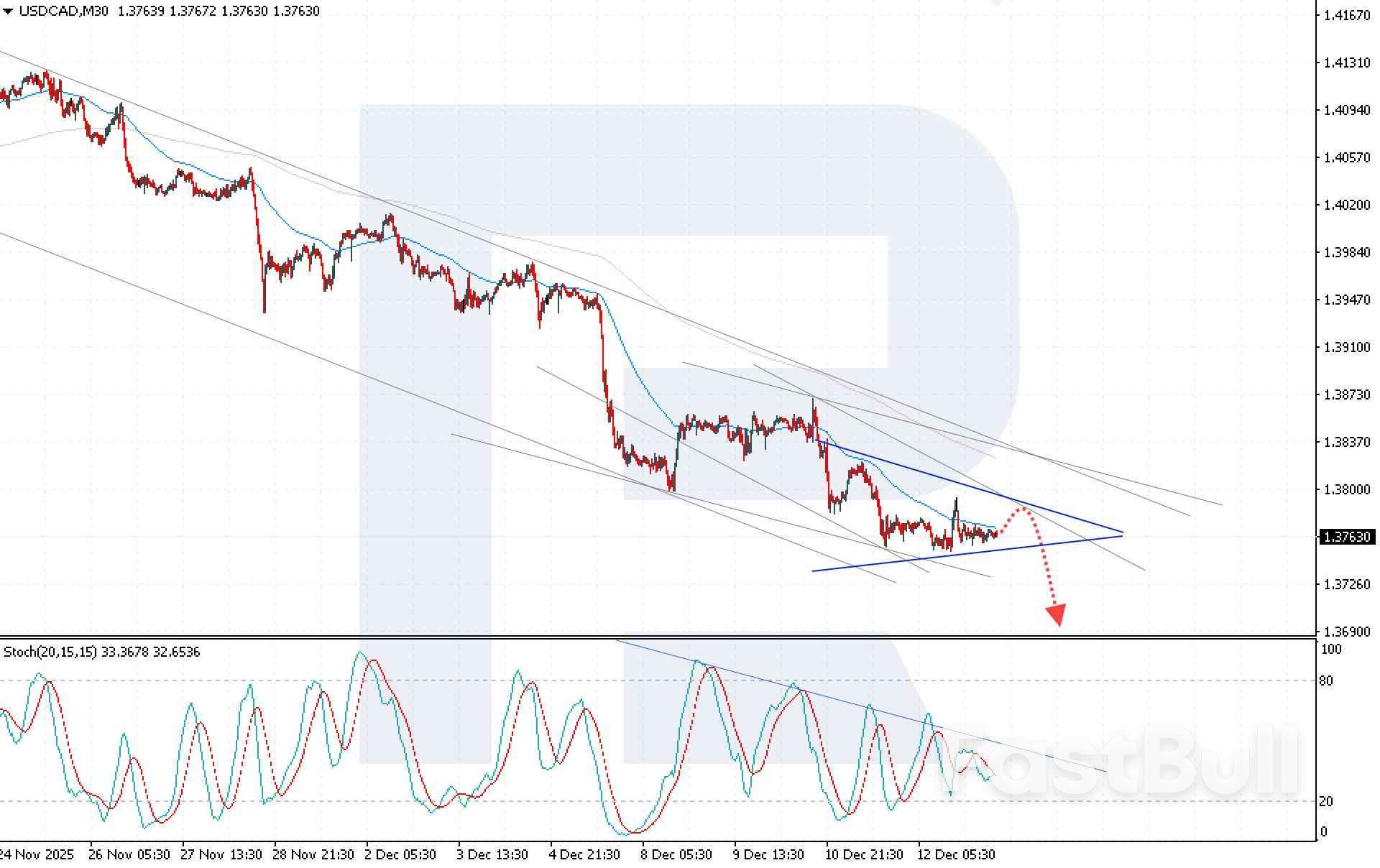
          The USDCAD pair continues to decline amid positive macroeconomic data from Canada. The current quote stands at 1.3763. Details — in our analysis for 15 December 2025.

          USDCAD forecast: key trading points

          • In October 2025, Canada's wholesale trade volume increased by 0.1% month-over-month
          • Growth in building permits in Canada in October 2025 was the fastest since June 2024
          • Positive signals from individual sectors of the Canadian economy increase pressure on USDCAD
          • USDCAD forecast for 15 December 2025: 1.3690

          Fundamental analysis

          The USDCAD pair is correcting but remains under selling pressure. Investors' attention is still focused on the geopolitical environment, which continues to generate heightened volatility in commodity and currency markets.

          Macroeconomic data from Canada present a mixed picture. In October 2025, wholesale trade volumes rose by 0.1% month-over-month to CAD 86.0 billion, while the market had expected a decline of 0.1%. Additional support for domestic demand came from the construction sector. In October 2025, the value of building permits issued surged by 14.9% compared to the previous month, reaching CAD 13.8 billion — the fastest pace of growth since June 2024.

          Positive signals from individual sectors of the Canadian economy are increasing pressure on USDCAD, strengthening the Canadian dollar and keeping the short-term outlook for USDCAD bearish.

          USDCAD technical analysis

          The USDCAD pair is consolidating below the EMA-65, confirming persistent bearish pressure. The price structure points to the formation of a Triangle pattern with a projected target near 1.3680. The USDCAD outlook for today suggests a continuation of the decline, with the nearest target at 1.3690.

          An additional signal in favor of the bearish scenario is provided by the Stochastic Oscillator: the signal lines are bouncing off the descending trend line, indicating that bearish momentum remains intact.

          A firm consolidation below the 1.3745 level will confirm the downside scenario and signal a breakout below the lower boundary of the Triangle pattern.

          Summary

          Short-term USDCAD dynamics remain under pressure. Technical analysis of USDCAD points to a continuation of the bearish move with a target at 1.3680, provided that the price holds below the 1.3745 level.

          Source: RoboForex

          Risk Warnings and Disclaimers
          You understand and acknowledge that there is a high degree of risk involved in trading. Following any strategies or investment methods may lead to potential losses. The content on the site is provided by our contributors and analysts for information purposes only. You are solely responsible for determining whether any trading assets, securities, strategy, or any other product is suitable for investing based on your own investment objectives and financial situation.
          Add to Favorites
          Share

          Emerging Markets Surge as Currency Volatility Redraws Global FX Landscape

          Gerik

          Economic

          Forint Leads EM Currency Boom as Dollar Declines

          In a year marked by geopolitical disruption and diverging global monetary policies, 2025 has seen a striking resurgence in emerging market (EM) currencies. The Hungarian forint has strengthened nearly 20% against the U.S. dollar, placing it among the best-performing EM currencies in over two decades. This reflects a broader rally across the space, as evidenced by the MSCI Emerging Market Currency Index, which hit a record high in July and is on track for its strongest annual return since 2017 with a gain exceeding 6%.
          This EM currency surge is not viewed as an anomaly by market participants. Analysts, fund managers, and strategists widely interpret this as the early stage of a new cycle one in which emerging currencies reclaim relevance after years of underperformance. According to Jonny Goulden of JPMorgan, the tide is turning after a 14-year bear market for EM currencies, driven by a weakening U.S. dollar and a global portfolio rebalancing away from dollar-dominated assets.

          Dollar Weakness and Developed Market Volatility Shift Capital Flows

          A key catalyst for this trend has been the dollar's retreat. As developed economies navigate divergent policy paths and increased domestic volatility, investors are increasingly scrutinizing long-held assumptions about the greenback’s dominance. The weakening dollar has reawakened interest in EM assets, particularly currencies backed by stable macro fundamentals or central banks that remain hawkish relative to peers.
          Surprisingly, much of the volatility in 2025 has originated not in developing markets but in the developed world. Elina Theodorakopoulou of Manulife observed that emerging markets were not the primary source of FX turbulence this year. Instead, shocks such as the U.S. “Liberation Day” tariffs, shifting trade alliances, and interest rate divergence among G10 central banks have created fertile ground for EM outperformance.

          Carry Trades Reemerge as Currency Markets Stabilize

          As short-term volatility has eased from its April peak when developed market currency swings hit a two-year high carry trades have reentered the spotlight. Traders have increasingly borrowed in low-yielding currencies to invest in high-yielding EM instruments, benefiting from the wider interest rate differentials and renewed stability in the FX landscape. Systematic hedge funds and bank FX desks have been among the largest beneficiaries of these shifts, reaping profits on well-timed directional bets.
          The scale of this transformation is underscored by the latest Bank for International Settlements data, which shows global FX trading volumes rising nearly 30% over the past three years. This structural growth has enhanced liquidity but also raised systemic concerns due to the concentration of trading among a small number of major banks.

          IMF Flags Structural Risks Amid Surging Volumes

          While investors capitalize on the newfound dynamism in EM currencies, the International Monetary Fund has issued cautionary warnings. In its recent financial stability report, the IMF pointed to rising risk in currency markets, particularly due to the concentration of FX flows among a few large institutions. Should these banks withdraw during times of stress, liquidity could dry up rapidly, intensifying volatility and disrupting capital flows to and from vulnerable economies.
          Governments, too, are navigating a delicate balance. On one hand, stronger currencies improve their ability to service external debt and attract foreign investment. On the other hand, sharp appreciation can dampen export competitiveness and stifle manufacturing-led recoveries, particularly in smaller, trade-dependent economies.

          From Margins to Mainstream EM Currencies Regain Global Prominence

          As 2025 draws to a close, EM currencies have reasserted themselves at the center of global FX markets. The narrative has shifted from fragility to opportunity, driven by structural changes in global capital allocation, declining dollar dominance, and newfound resilience across many developing economies.
          While risks remain from concentration in FX intermediaries to geopolitical unpredictability the trajectory suggests a sustained recalibration. As hedge funds and institutional investors continue to reposition, and carry trades gain momentum, emerging markets may no longer be the periphery of global finance, but a central pillar of the next currency cycle.

          Source: Reuters

          To stay updated on all economic events of today, please check out our Economic calendar
          Risk Warnings and Disclaimers
          You understand and acknowledge that there is a high degree of risk involved in trading. Following any strategies or investment methods may lead to potential losses. The content on the site is provided by our contributors and analysts for information purposes only. You are solely responsible for determining whether any trading assets, securities, strategy, or any other product is suitable for investing based on your own investment objectives and financial situation.
          Add to Favorites
          Share

          European Markets Open Higher Ahead of Pivotal Central Bank Decisions

          Gerik

          Economic

          Stocks

          European Equities Advance as Markets Eye Policy Clarity

          European stock markets kicked off a high-stakes week with modest gains across major indices. The pan-European Stoxx 600 rose 0.38% in early trading on Monday, signaling broad optimism as investors turned their focus to a series of key central bank meetings. National benchmarks followed suit, with the FTSE 100 gaining 0.43%, Germany’s DAX up 0.44%, France’s CAC 40 climbing 0.30%, and Italy’s FTSE MIB rising by 0.63%.
          These advances reflect investor confidence heading into the final European Central Bank (ECB) meeting of the year, where policymakers are expected to keep interest rates unchanged at 2%. The anticipation of stable rates paired with potentially upgraded growth forecasts has provided a constructive backdrop for European equities to extend their gains.

          Central Banks Take Center Stage as 2025 Winds Down

          This week represents a critical juncture in Europe’s monetary policy trajectory, with several central banks the ECB, Bank of England, Sweden’s Riksbank, and Norway’s Norges Bank set to announce their final decisions of the year. While the ECB is broadly expected to hold rates steady, the Bank of England may opt for a small rate cut, reflecting diverging inflationary pressures and domestic growth conditions.
          ECB President Christine Lagarde recently hinted at an upward revision to the eurozone’s GDP outlook for 2026, following a September upgrade to 1.2%. This reinforces a narrative of cautious optimism among European policymakers, even as geopolitical and macroeconomic risks remain in the background.
          UK and eurozone inflation data due Wednesday could further guide investor expectations. A downside surprise in these figures might reinforce the case for policy easing in early 2026, while stickier inflation may prompt central banks to maintain a more hawkish posture heading into the new year.

          Geopolitical Stakes Rise Amid Ukraine Funding Talks

          Beyond monetary policy, European leaders will face mounting geopolitical pressure this week as they convene in Brussels to discuss a €210 billion loan package for Ukraine. A controversial element of the proposal involves potentially reallocating frozen Russian assets to support Kyiv, a move that could carry both financial and diplomatic ramifications.
          The decision will test the EU’s ability to maintain unity in the face of prolonged conflict and fiscal fatigue. From a market perspective, a positive outcome could reinforce confidence in Europe's political cohesion, while any deadlock may revive concerns over internal fragmentation.

          Global Macro Trends Influence Sentiment

          Overnight trends from the U.S. and Asia-Pacific regions are also influencing European market behavior. Wall Street closed last week in a mixed fashion, as a broad rotation away from high-growth tech stocks into lower-valuation sectors created volatility. Futures remained flat on Sunday night, reflecting continued uncertainty ahead of a flood of delayed U.S. economic data due this week.
          Key among those reports are the nonfarm payrolls and retail sales data originally delayed by the U.S. government shutdown and the November consumer price index. These indicators will likely shape near-term expectations for the Federal Reserve’s next moves and could reverberate through global asset markets, including Europe.
          Meanwhile, Asian markets fell on Monday, echoing Wall Street’s tech-driven declines, and offering a cautionary signal to investors still bullish on global equities heading into the year-end.

          A Pivotal Week for Policy and Markets

          European markets are entering a decisive stretch, balancing between cautious optimism and lingering macro uncertainties. While the ECB is expected to maintain a steady hand, subtle shifts in tone, growth forecasts, and inflation commentary could signal the region’s 2026 policy direction. Coupled with high-stakes geopolitical decisions and global macro developments, this week’s events may set the tone for early 2026 investor behavior.
          Whether current market gains can be sustained will depend heavily on the clarity, unity, and credibility of policy announcements in the days ahead.
          To stay updated on all economic events of today, please check out our Economic calendar
          Risk Warnings and Disclaimers
          You understand and acknowledge that there is a high degree of risk involved in trading. Following any strategies or investment methods may lead to potential losses. The content on the site is provided by our contributors and analysts for information purposes only. You are solely responsible for determining whether any trading assets, securities, strategy, or any other product is suitable for investing based on your own investment objectives and financial situation.
          Add to Favorites
          Share

          Euro Zone Industry Growth Picks Up, Boosting Resilience Narrative

          Samantha Luan

          Forex

          Economic

          Blast furnaces at a ThyssenKrupp steel factory in Duisburg, Germany, November 5, 2025. REUTERS/Leon Kuegeler

          Euro zone industrial output growth accelerated in October, bolstering views that the bloc is picking up momentum as trade uncertainty is dissipating, the labour market remains tight and consumption is inching up.

          Industry expanded by 0.8% on the month after a 0.2% increase in September, in line with expectations, data from the EU's statistics agency Eurostat showed on Monday.

          Compared to a year earlier, output growth accelerated to 2.0% in October from 1.2% in September, beating expectations for 1.9% in a Reuters poll of economists.

          German industry, expanding by 1.4% on the month, was among the top performers, offsetting a 1.0% drop in Italy and lukewarm growth in France.

          The euro zone economy has proven surprisingly resilient this year, and European Central Bank President Christine Lagarde has already said that another upgrade in the growth outlook is coming this week.

          Still, expansion is far from spectacular. The bloc is only growing at a rate just above 1%, near its so-called potential, as exports, the main driver of the economy in recent decades, remain weak and the domestic sector is producing nearly all growth.

          Industrial exports have struggled for years as surging energy costs have put the bloc at a cost disadvantage just as China was expanding its high-tech industrial base, grabbing market share.

          While industry might be bottoming out this year, there is no boom in sight and it is still somewhat unclear how the new U.S. tariff regime will alter global trading patterns.

          Nevertheless the bloc appears to be adjusting well, and even if there is no boom underway, the downside risk also appears limited.

          "Incoming high-frequency indicators continue to point to positive momentum in activity heading into year-end," Barclays said in a note.

          Source: Reuters

          To stay updated on all economic events of today, please check out our Economic calendar
          Risk Warnings and Disclaimers
          You understand and acknowledge that there is a high degree of risk involved in trading. Following any strategies or investment methods may lead to potential losses. The content on the site is provided by our contributors and analysts for information purposes only. You are solely responsible for determining whether any trading assets, securities, strategy, or any other product is suitable for investing based on your own investment objectives and financial situation.
          Add to Favorites
          Share

          Fear And Greed Index in Fear 30% of The Past Year, Bitcoin Back in Extreme Fear

          Glendon

          Cryptocurrency

          Technical Analysis

          As bitcoin BTC$89.907,85 struggles to hold above $90,000, market sentiment has once again slipped into extreme fear.

          Over the past year, fear or extreme fear has accounted for more than 30% of all readings on the Crypto Fear and Greed Index. The index currently stands at 17, firmly within the extreme fear section.

          Fear has dominated sentiment since the October liquidation crash more than two months ago, as bitcoin dropped 36% from its October all-time high. While the cryptocurrency market has yet to stage a meaningful recovery. With bitcoin currently trading nearly 30% below its all-time high, investor caution remains elevated.

          A similar disconnect is occurring in U.S. equities. Sentiment currently sits at 42, which signals fear, according to the CNN Fear and Greed Index, even as the S&P 500 trades around 6,827, just a few percentage points below its all-time high.

          Across both U.S. equities and cryptocurrencies, fear continues to dominate investor psychology.

          Bitcoin entered a death cross in November, a technical pattern where the 50-day moving average falls below the 200 day moving average. In this instance, the death cross coincided with a local bottom near $80,000 on Nov. 21. Notably, every death cross during the current market cycle since 2023 has marked a significant local bottom, reinforcing its relevance as a contrarian indicator in this cycle.

          Source: CoinDesk

          Risk Warnings and Disclaimers
          You understand and acknowledge that there is a high degree of risk involved in trading. Following any strategies or investment methods may lead to potential losses. The content on the site is provided by our contributors and analysts for information purposes only. You are solely responsible for determining whether any trading assets, securities, strategy, or any other product is suitable for investing based on your own investment objectives and financial situation.
          Add to Favorites
          Share
          FastBull
          Copyright © 2025 FastBull Ltd

          728 RM B 7/F GEE LOK IND BLDG NO 34 HUNG TO RD KWUN TONG KLN HONG KONG

          TelegramInstagramTwitterfacebooklinkedin
          App Store Google Play Google Play
          Products
          Charts

          Chats

          Q&A with Experts
          Screeners
          Economic Calendar
          Data
          Tools
          Membership
          Features
          Function
          Markets
          Copy Trading
          Latest Signals
          Contests
          News
          Analysis
          24/7
          Columns
          Education
          Company
          Careers
          About Us
          Contact Us
          Advertising
          Help Center
          Feedback
          User Agreement
          Privacy Policy
          Business

          White Label

          Data API

          Web Plug-ins

          Poster Maker

          Affiliate Program

          Risk Disclosure

          The risk of loss in trading financial instruments such as stocks, FX, commodities, futures, bonds, ETFs and crypto can be substantial. You may sustain a total loss of the funds that you deposit with your broker. Therefore, you should carefully consider whether such trading is suitable for you in light of your circumstances and financial resources.

          No decision to invest should be made without thoroughly conducting due diligence by yourself or consulting with your financial advisors. Our web content might not suit you since we don't know your financial conditions and investment needs. Our financial information might have latency or contain inaccuracy, so you should be fully responsible for any of your trading and investment decisions. The company will not be responsible for your capital loss.

          Without getting permission from the website, you are not allowed to copy the website's graphics, texts, or trademarks. Intellectual property rights in the content or data incorporated into this website belong to its providers and exchange merchants.

          Not Logged In

          Log in to access more features

          FastBull Membership

          Not yet

          Purchase

          Become a signal provider
          Help Center
          Customer Service
          Dark Mode
          Price Up/Down Colors

          Log In

          Sign Up

          Position
          Layout
          Fullscreen
          Default to Chart
          The chart page opens by default when you visit fastbull.com