• Trade
  • Markets
  • Copy
  • Contests
  • News
  • 24/7
  • Calendar
  • Q&A
  • Chats
Trending
Screeners
SYMBOL
LAST
BID
ASK
HIGH
LOW
NET CHG.
%CHG.
SPREAD
SPX
S&P 500 Index
6841.75
6841.75
6841.75
6878.28
6841.15
-28.65
-0.42%
--
DJI
Dow Jones Industrial Average
47750.15
47750.15
47750.15
47971.51
47709.38
-204.83
-0.43%
--
IXIC
NASDAQ Composite Index
23509.23
23509.23
23509.23
23698.93
23505.52
-68.88
-0.29%
--
USDX
US Dollar Index
99.120
99.200
99.120
99.160
98.730
+0.170
+ 0.17%
--
EURUSD
Euro / US Dollar
1.16241
1.16248
1.16241
1.16717
1.16162
-0.00185
-0.16%
--
GBPUSD
Pound Sterling / US Dollar
1.33186
1.33193
1.33186
1.33462
1.33053
-0.00126
-0.09%
--
XAUUSD
Gold / US Dollar
4190.07
4190.48
4190.07
4218.85
4175.92
-7.84
-0.19%
--
WTI
Light Sweet Crude Oil
58.968
58.998
58.968
60.084
58.837
-0.841
-1.41%
--

Community Accounts

Signal Accounts
--
Profit Accounts
--
Loss Accounts
--
View More

Become a signal provider

Sell trading signals to earn additional income

View More

Guide to Copy Trading

Get started with ease and confidence

View More

Signal Accounts for Members

All Signal Accounts

Best Return
  • Best Return
  • Best P/L
  • Best MDD
Past 1W
  • Past 1W
  • Past 1M
  • Past 1Y

All Contests

  • All
  • Trump Updates
  • Recommend
  • Stocks
  • Cryptocurrencies
  • Central Banks
  • Featured News
Top News Only
Share

In The Past 24 Hours, The Marketvector Digital Asset 100 Small Cap Index Rose 1.96%, Currently At 4135.44 Points. The Sydney Market Initially Exhibited An N-shaped Pattern, Hitting A Daily Low Of 3988.39 Points At 06:08 Beijing Time, Before Steadily Rising To A Daily High Of 4206.06 Points At 17:07, Subsequently Stabilizing At This High Level

Share

[Sovereign Bond Yields In France, Italy, Spain, And Greece Rose By More Than 7 Basis Points, Raising Concerns That The ECB's Interest Rate Outlook May Push Up Financing Costs] In Late European Trading On Monday (December 8), The Yield On French 10-year Bonds Rose 5.8 Basis Points To 3.581%. The Yield On Italian 10-year Bonds Rose 7.4 Basis Points To 3.559%. The Yield On Spanish 10-year Bonds Rose 7.0 Basis Points To 3.332%. The Yield On Greek 10-year Bonds Rose 7.1 Basis Points To 3.466%

Share

Oil Falls 1% Amid Ongoing Ukraine Talks, Ahead Of Expected US Interest Rate Cut

Share

Azeri Btc Crude Oil Exports From Ceyhan Port Set At 16.2 Million Barrels In January Versus 17.0 Million In December, Schedule Shows

Share

USA - Greenland Joint Committee Statement: The United States And Greenland Look Forward To Building On Momentum In The Year Ahead And Strengthening Ties That Support A Secure And Prosperous Arctic Region

Share

MSCI Nordic Countries Index Fell 0.4% To 356.64 Points. Among The Ten Sectors, The Nordic Healthcare Sector Saw The Largest Decline. Novo Nordisk, A Heavyweight Stock, Closed Down 3.4%, Leading The Losses Among Nordic Stocks

Share

France's CAC 40 Down 0.2%, Spain's IBEX Up 0.1%

Share

Europe's STOXX Index Up 0.1%, Euro Zone Blue Chips Index Flat

Share

Germany's DAX 30 Index Closed Up 0.08% At 24,044.88 Points. France's Stock Index Closed Down 0.19%, Italy's Stock Index Closed Down 0.13% With Its Banking Index Up 0.33%, And The UK's Stock Index Closed Down 0.32%

Share

The STOXX Europe 600 Index Closed Down 0.12% At 578.06 Points. The Eurozone STOXX 50 Index Closed Down 0.04% At 5721.56 Points. The FTSE Eurotop 300 Index Closed Down 0.05% At 2304.93 Points

Share

Israeli Prime Minister Netanyahu: Hamas Has Violated The Ceasefire Agreement, And We Will Never Allow Its Members To Re-arm Themselves And Threaten US

Share

Israeli Prime Minister Netanyahu: We Are Working To Return The Body Of Another Detainee From The Gaza Strip

Share

Iraq's West Qurna 2 Oil Field Will Increase Oil Production Beyond Normal Levels To Compensate For The Production Stoppage Caused By The Trump Administration's Sanctions Against Russia

Share

Israeli Prime Minister Netanyahu: We Are Close To Completing The First Phase Of Trump’s Plan And Will Now Focus On Disarming Gaza And Seizing Hamas Weapons

Share

Moody's Affirmed Burberry's Long-term Rating Of Baa3 And Revised Its Outlook (from Negative) To Stable

Share

The Trump Administration Supports Iraq's Plan To Transfer Russian Oil Company Lukoil Pjsc's Assets In The West Qurna 2 Oil Field To An American Company

Share

JMA: Tsunami Of 70 Centimetres Observed In Japan's Kuji Port In Iwate Prefecture

Share

The U.S. Bureau Of Labor Statistics Plans To Release A Press Release On January 15, 2026, For November 2025, Along With Data For October

Share

Tiger Global Has Established A New Fund, Aiming To Raise $2 Billion To $3 Billion

Share

The U.S. Bureau Of Labor Statistics Announced That It Will Not Release A Press Release Regarding The U.S. Import And Export Price Index (MXP) For October 2025

TIME
ACT
FCST
PREV
France Trade Balance (SA) (Oct)

A:--

F: --

P: --
Euro Zone Employment YoY (SA) (Q3)

A:--

F: --

P: --
Canada Part-Time Employment (SA) (Nov)

A:--

F: --

P: --

Canada Unemployment Rate (SA) (Nov)

A:--

F: --

P: --

Canada Full-time Employment (SA) (Nov)

A:--

F: --

P: --

Canada Labor Force Participation Rate (SA) (Nov)

A:--

F: --

P: --

Canada Employment (SA) (Nov)

A:--

F: --

P: --

U.S. PCE Price Index MoM (Sept)

A:--

F: --

P: --

U.S. Personal Income MoM (Sept)

A:--

F: --

P: --

U.S. Core PCE Price Index MoM (Sept)

A:--

F: --

P: --

U.S. PCE Price Index YoY (SA) (Sept)

A:--

F: --

P: --

U.S. Core PCE Price Index YoY (Sept)

A:--

F: --

P: --

U.S. Personal Outlays MoM (SA) (Sept)

A:--

F: --

P: --
U.S. 5-10 Year-Ahead Inflation Expectations (Dec)

A:--

F: --

P: --

U.S. Real Personal Consumption Expenditures MoM (Sept)

A:--

F: --

P: --
U.S. Weekly Total Rig Count

A:--

F: --

P: --

U.S. Weekly Total Oil Rig Count

A:--

F: --

P: --

U.S. Consumer Credit (SA) (Oct)

A:--

F: --

P: --
China, Mainland Foreign Exchange Reserves (Nov)

A:--

F: --

P: --

Japan Trade Balance (Oct)

A:--

F: --

P: --

Japan Nominal GDP Revised QoQ (Q3)

A:--

F: --

P: --

China, Mainland Imports YoY (CNH) (Nov)

A:--

F: --

P: --

China, Mainland Exports (Nov)

A:--

F: --

P: --

China, Mainland Imports (CNH) (Nov)

A:--

F: --

P: --

China, Mainland Trade Balance (CNH) (Nov)

A:--

F: --

P: --

China, Mainland Exports YoY (USD) (Nov)

A:--

F: --

P: --

China, Mainland Imports YoY (USD) (Nov)

A:--

F: --

P: --

Germany Industrial Output MoM (SA) (Oct)

A:--

F: --

P: --
Euro Zone Sentix Investor Confidence Index (Dec)

A:--

F: --

P: --

Canada National Economic Confidence Index

A:--

F: --

P: --

U.K. BRC Like-For-Like Retail Sales YoY (Nov)

--

F: --

P: --

U.K. BRC Overall Retail Sales YoY (Nov)

--

F: --

P: --

Australia Overnight (Borrowing) Key Rate

--

F: --

P: --

RBA Rate Statement
RBA Press Conference
Germany Exports MoM (SA) (Oct)

--

F: --

P: --

U.S. NFIB Small Business Optimism Index (SA) (Nov)

--

F: --

P: --

Mexico 12-Month Inflation (CPI) (Nov)

--

F: --

P: --

Mexico Core CPI YoY (Nov)

--

F: --

P: --

Mexico PPI YoY (Nov)

--

F: --

P: --

U.S. Weekly Redbook Index YoY

--

F: --

P: --

U.S. JOLTS Job Openings (SA) (Oct)

--

F: --

P: --

China, Mainland M1 Money Supply YoY (Nov)

--

F: --

P: --

China, Mainland M0 Money Supply YoY (Nov)

--

F: --

P: --

China, Mainland M2 Money Supply YoY (Nov)

--

F: --

P: --

U.S. EIA Short-Term Crude Production Forecast For The Year (Dec)

--

F: --

P: --

U.S. EIA Natural Gas Production Forecast For The Next Year (Dec)

--

F: --

P: --

U.S. EIA Short-Term Crude Production Forecast For The Next Year (Dec)

--

F: --

P: --

EIA Monthly Short-Term Energy Outlook
U.S. API Weekly Gasoline Stocks

--

F: --

P: --

U.S. API Weekly Cushing Crude Oil Stocks

--

F: --

P: --

U.S. API Weekly Crude Oil Stocks

--

F: --

P: --

U.S. API Weekly Refined Oil Stocks

--

F: --

P: --

South Korea Unemployment Rate (SA) (Nov)

--

F: --

P: --

Japan Reuters Tankan Non-Manufacturers Index (Dec)

--

F: --

P: --

Japan Reuters Tankan Manufacturers Index (Dec)

--

F: --

P: --

Japan Domestic Enterprise Commodity Price Index MoM (Nov)

--

F: --

P: --

Japan Domestic Enterprise Commodity Price Index YoY (Nov)

--

F: --

P: --

China, Mainland PPI YoY (Nov)

--

F: --

P: --

China, Mainland CPI MoM (Nov)

--

F: --

P: --

Q&A with Experts
    • All
    • Chatrooms
    • Groups
    • Friends
    Connecting
    .
    .
    .
    Type here...
    Add Symbol or Code

      No matching data

      All
      Trump Updates
      Recommend
      Stocks
      Cryptocurrencies
      Central Banks
      Featured News
      • All
      • Russia-Ukraine Conflict
      • Middle East Flashpoint
      • All
      • Russia-Ukraine Conflict
      • Middle East Flashpoint
      Search
      Products

      Charts Free Forever

      Chats Q&A with Experts
      Screeners Economic Calendar Data Tools
      Membership Features
      Data Warehouse Market Trends Institutional Data Policy Rates Macro

      Market Trends

      Market Sentiment Order Book Forex Correlations

      Top Indicators

      Charts Free Forever
      Markets

      News

      News Analysis 24/7 Columns Education
      From Institutions From Analysts
      Topics Columnists

      Latest Views

      Latest Views

      Trending Topics

      Top Columnists

      Latest Update

      Signals

      Copy Rankings Latest Signals Become a signal provider AI Rating
      Contests
      Brokers

      Overview Brokers Assessment Rankings Regulators News Claims
      Broker listing Forex Brokers Comparison Tool Live Spread Comparison Scam
      Q&A Complaint Scam Alert Videos Tips to Detect Scam
      More

      Business
      Events
      Careers About Us Advertising Help Center

      White Label

      Data API

      Web Plug-ins

      Affiliate Program

      Awards Institution Evaluation IB Seminar Salon Event Exhibition
      Vietnam Thailand Singapore Dubai
      Fans Party Investment Sharing Session
      FastBull Summit BrokersView Expo
      Recent Searches
        Top Searches
          Markets
          News
          Analysis
          User
          24/7
          Economic Calendar
          Education
          Data
          • Names
          • Latest
          • Prev

          View All

          No data

          Scan to Download

          Faster Charts, Chat Faster!

          Download App
          English
          • English
          • Español
          • العربية
          • Bahasa Indonesia
          • Bahasa Melayu
          • Tiếng Việt
          • ภาษาไทย
          • Français
          • Italiano
          • Türkçe
          • Русский язык
          • 简中
          • 繁中
          Open Account
          Search
          Products
          Charts Free Forever
          Markets
          News
          Signals

          Copy Rankings Latest Signals Become a signal provider AI Rating
          Contests
          Brokers

          Overview Brokers Assessment Rankings Regulators News Claims
          Broker listing Forex Brokers Comparison Tool Live Spread Comparison Scam
          Q&A Complaint Scam Alert Videos Tips to Detect Scam
          More

          Business
          Events
          Careers About Us Advertising Help Center

          White Label

          Data API

          Web Plug-ins

          Affiliate Program

          Awards Institution Evaluation IB Seminar Salon Event Exhibition
          Vietnam Thailand Singapore Dubai
          Fans Party Investment Sharing Session
          FastBull Summit BrokersView Expo

          China’s Trade Surplus Tops $1 Trillion as Its Exports Surge While Imports Lag Behind

          Warren Takunda

          Economic

          Summary:

          China’s exports rebounded sharply in November, lifting its 2025 trade surplus past $1 trillion for the first time as export growth outpaced modest import gains.

          China’s exports returned to growth in November after an unexpected contraction in October, pushing its trade surplus in dollar terms for 2025 past the $1 trillion mark for the first time, according to data released Monday.
          Exports climbed 5.9% from a year earlier in November while imports rose just under 2%.
          The customs data released on Monday also showed that shipments to the U.S. dropped nearly 29% year-on-year. But as trade with the U.S. weakens, China is diversifying its export markets throughout Southeast Asia, Africa, Europe and Latin America.
          China’s exports had contracted just over 1% in October. November’s worldwide exports of $330.3 billion exceeded economists’ estimates. Imports totaled $218.6 billion for the month.
          The nearly $1.08 trillion trade surplus for the first 11 months of this year is a record high, surpassing the $992 billion surplus for all of 2024, based on official data compiled by FactSet.
          A year-long trade truce between China and the U.S. was reached at a meeting between U.S. President Donald Trump and Chinese leader Xi Jinping in late October in South Korea. The U.S. has lowered its tariffs on China, and China has promised to halt its export controls related to rare earths.“It’s likely that November exports have yet to fully reflect the tariff cut, which should feed through in the coming months,” ING Bank chief economist for Greater China Lynn Song wrote in a report.
          China’s factory activity contracted for an eighth straight month in November, according to an official survey, and economists said it was still early to determine whether there was a real rebound in external demand following the U.S.-China trade truce.
          With exports still going strong, economists generally expect China to meet its target of around 5% annual growth for this year.
          Chinese leaders outlined a focus on advanced manufacturing for the next five years following a high-level meeting in October. It also highlighted the need to boost domestic consumption, which could help address trade imbalances.
          A meeting of the ruling Chinese Communist Party’s decision-making Politburo was held on Monday, led by Xi, to discuss economic plans for 2026, according to the Xinhua state news agency. It said Chinese leaders reiterated a focus on “pursuing progress while ensuring stability.”
          A readout from Xinhua said China needs to better coordinate its domestic economic work in the face of global “trade struggles.”
          Businesses and investors are paying close attention to China’s annual Central Economic Work Conference, which is expected to take place later this month and could map out economic priorities for the next year in more details.
          “Trade diversification will remain a long-term strategy for China to fight the trade war and manage external exigencies,” said Chi Lo, Global Market Strategist at BNP Paribas Asset Management.
          The recent stabilization of trade relations with Washington is unlikely to last long and the global trade environment will probably continue to be volatile, he said, as China-U.S. relations “remain in a stalemate” despite their temporary trade truce.
          Still, some economists believe that China will continue to gain export market share in coming years.
          Morgan Stanley predicts by 2030, China’s market share in global exports will reach 16.5%, up from about 15% currently, fueled by its edge in advanced manufacturing and high-growth sectors such as electric vehicles, robotics and batteries.
          “Despite persistent trade tensions, continued protectionism, and G20 economies taking up active industrial policies, we believe China will gain more share in the global goods export market,” Morgan Stanley Chief Asia Economist Chetan Ahya said in a recent note.

          Source: AP

          To stay updated on all economic events of today, please check out our Economic calendar
          Risk Warnings and Disclaimers
          You understand and acknowledge that there is a high degree of risk involved in trading. Following any strategies or investment methods may lead to potential losses. The content on the site is provided by our contributors and analysts for information purposes only. You are solely responsible for determining whether any trading assets, securities, strategy, or any other product is suitable for investing based on your own investment objectives and financial situation.
          Add to Favorites
          Share

          Argentina’s Railway Privatization Faces Uphill Battle Despite Promises of Export Revival

          Gerik

          Economic

          Ambitious Goals Meet Harsh Realities in Railway Overhaul

          Argentina, a leading global exporter of soybeans, corn, and lithium, is embarking on an ambitious initiative to modernize and privatize its neglected freight railway network. The move, led by President Javier Milei, is a centerpiece of his broader strategy to reduce state burdens, attract foreign investment, and revitalize the economy. The first tender set for early 2026 will cover the Belgrano Cargas network, comprising the country’s three largest freight lines spanning nearly 8,000 kilometers.
          The overarching goal is to drastically lower freight costs for inland producers and boost export competitiveness, especially from remote agricultural and mining regions. But while the plan holds long-term economic promise, the structural degradation of the railway system poses a steep challenge to implementation.

          Historical Decline Undermines Present Capacity

          According to Alejandro Núñez, president of Belgrano Cargas y Logística, Argentina’s current rail cargo volumes are lower than in 1970, despite agricultural output having multiplied sixfold since then. Today, the network transports just 7.5 million tons annually 60% of which are agricultural goods often on rails so deteriorated that derailments are common and cargo theft, especially of soybeans, is a recurring issue.
          This mismatch between production growth and transport infrastructure exposes the core causal barrier to competitiveness: Argentina’s logistics system is outdated, inefficient, and overdependent on costly road freight. While rail accounts for just 5% of domestic cargo transport, Brazil moves 20% by rail and the U.S. and Canada exceed 40%.

          Privatization Linked to Broader Economic Strategy

          The privatization effort aligns with President Milei’s ideological push to shrink the public sector and attract capital into critical sectors. Officials view railway upgrades as essential to achieving the government’s export target of $100 billion annually by 2032, up from $71.5 billion recorded through October 2025. Foreign Minister Pablo Quirno has underscored that reducing inland transport costs especially from provinces like Salta to Rosario’s port zone will be key to this export push.
          In practical terms, transporting grain from Salta to Rosario is currently more expensive than shipping the same volume from Rosario to Vietnam. This reveals a direct cost inefficiency rooted not in global trade dynamics, but in domestic infrastructure failure.

          Investment Interest and Infrastructure Cost Outlook

          The modernization plan will require significant capital. Núñez estimates a minimum of $800 million to bring current lines up to standard. That figure could rise substantially as additional 11,000 kilometers of idle rail lines are included in future tenders.
          Major players are already showing interest. Grupo México Transportes (GMXT) is expected to bid and is reportedly prepared to invest up to $3 billion if awarded the contract. Media reports also suggest agricultural giants like Bunge, Cargill, and Louis Dreyfus, along with Rio Tinto, may join the bidding process. While none of the companies have publicly confirmed their plans, their involvement would inject considerable momentum into the project.

          Boosting Agricultural and Mining Logistics

          Experts argue that a revamped railway system could transform Argentina’s internal supply chain. Alfredo Sesé of the Rosario Stock Exchange notes that over half of Argentina’s agricultural production lies more than 300 kilometers from port. Given that trucking costs range from 7 to 9 cents per ton per kilometer, compared to rail’s sub-5 cent average, the savings from improved rail access would be substantial, especially for distant farms.
          Mining, particularly lithium and copper, also stands to benefit. Roberto Cacciola of the Argentine Chamber of Mining Companies emphasized the need for reliable logistics to support existing projects and bring new extraction operations online in the coming years. As the world’s fourth-largest lithium exporter, Argentina is under pressure to streamline its mineral logistics to meet rising global demand.
          While Argentina’s railway privatization and modernization initiative offers a bold blueprint for economic renewal, its success will hinge on overcoming entrenched inefficiencies, securing substantial investment, and navigating a complex political and logistical landscape. If realized, the project could redefine Argentina’s position in global grain and mineral markets. But with decades of underinvestment and structural decay to reverse, the journey from vision to reality will be a long one.

          Source: Reuters

          To stay updated on all economic events of today, please check out our Economic calendar
          Risk Warnings and Disclaimers
          You understand and acknowledge that there is a high degree of risk involved in trading. Following any strategies or investment methods may lead to potential losses. The content on the site is provided by our contributors and analysts for information purposes only. You are solely responsible for determining whether any trading assets, securities, strategy, or any other product is suitable for investing based on your own investment objectives and financial situation.
          Add to Favorites
          Share

          Five Things to Watch in China’s EV Market Next Year

          Michelle

          Stocks

          Economic

          It's been another frenetic year in China's electric vehicle market. Xiaomi continued its stunning rise from smartphone maker to EV darling, while market leader BYD's runaway growth stalled out.

          Regulatory scrutiny increased, with policymakers focusing their attention on everything from the long-running price war, zero-mileage used cars and flush door handles.

          Technology advances continued apace, with BYD and CATL going head-to-head to develop ultra-fast charging batteries and carmakers increasingly making advanced driver-assistance systems more widely available.

          So what does 2026 have in store? Here are five key things to watch:

          Can BYD Bounce Back?

          BYD started this year with a target to sell 5.5 million vehicles, building on last year's record 4.25 million. But after a strong start, sales have tailed off — particularly after steep price cuts invoked the wrath of government regulators — forcing the company to lower its objective for this year. BYD's earnings have declined the past two quarters, and the stock has slumped around 36% from its May peak.

          The question is whether this ends up being just a blip for China's biggest EV maker, or the start of a tougher phase as it faces increased competition from the likes of Geely and Xiaomi, as well as heightened regulatory scrutiny. Analysts are still bullish, with 34 rating the stock a buy, compared to just three sells, according to data compiled by Bloomberg.

          Deutsche Bank analysts see BYD's ultra-fast charging batteries, God's-Eye driver-assist features and new models helping drive sales to 5.6 million units in 2026. Chairman Wang Chuanfu blamed BYD's slowdown in domestic sales on a lack of compelling technological upgrades and said during a shareholder meeting last week that breakthroughs are ahead in the years to come.

          Competition Curbs

          While China's auto industry has long been the beneficiary of government support, the tables turned somewhat this year as part of the country's anti-involution drive pushing back against aggressive price wars and industry overcapacity.

          In June, the chiefs of major carmakers were summoned to Beijing and given a dressing down for their "rat race competition." The government also took aim at the practice of offloading unsold cars into the secondhand market while boosting sales figures.

          A continued hard line from Beijing could act as a damper on the EV market in 2026. The government has yet to renew its trade-in subsidy that encourages drivers to swap older cars for EVs or more fuel-efficient models. Tax rebates are also set to be wound back next year ahead of their total abolition in 2027, as policymakers look to wean the sector off state support.

          The uncertain fate of the subsidies has had the effect of pulling car purchases into the final months of this year and could mean a rocky start to 2026.

          Xiaomi's Next Act

          Tech giant Xiaomi has enjoyed a stellar year with its EVs, consistently beating internal sales targets — it now expects to deliver 400,000 vehicles this year — and reaching profitability in less than half the time it took Tesla.

          But there are constraints to the company's growth. It currently has just two models — the SU7 sedan and YU7 midsize sport utility vehicle — and with just one factory in Beijing, there's a lengthy wait time for its EVs. That should ease with a new production line, speeding delivery for some trims.

          For the smartphone and home-device maker's next act, it's reportedly working on a full-size sport utility vehicle to compete with the likes of Nio and Li Auto in the highly competitive premium EV segment. The new model is key to bringing fresh impetus to Xiaomi's small lineup that also may need a refresh to stay competitive.

          Global Domination

          Given the feverish competition at home, Chinese automakers are accelerating their push into global markets. BYD has been at the forefront, opening factories in Brazil and Thailand, with Hungary and Turkey to follow.

          The diversification is paying off, with the stock jumping last week after the company reported that exports climbed even as overall shipments fell in November.

          BYD is aiming for export sales of 1.6 million vehicles in 2026, up from around 1 million this year, according to Citi analysts. Geely is targeting 600,000 international sales next year, which would be up to 80% higher than 2025.

          Even with the key North American market effectively closed off due to tariffs, Europe, South America, Southeast Asia, Australia and even the Middle East are proving to be fertile ground for Chinese automakers.

          Battery giant CATL is also pushing ahead with its overseas expansion efforts in a bid to localize production and be closer to customers, with a key factory in Hungary to come on line next year.

          Make-or-Break for Nio

          Nio faces a critical year, with founder William Li's goal to reach profitability this quarter looking like a stretch. The company was once the rising star of Chinese EV startups, taking on Tesla in the premium end of the market and building a cult-like following with its clubby Nio Houses and showy investor days.

          It has failed to live up to the early promises, racking up $20 billion in losses and counting. The stock is down more than 90% from the heady peak of 2021, when the automaker was valued at almost $100 billion. Sales are hovering around 40,000 a month, a fraction of market leaders.

          Nio heads into 2026 with limited visibility of its sales performance, according to Citi analyst Jeff Chung. As more rivals start to leapfrog Nio in deliveries, it adds pressure to its finances and finite cash reserves.

          Renault supports France's call for EVs sold in Europe to contain locally sourced parts, but is warning against making the content requirements too onerous. Electric-car batteries are still mostly made outside Europe and are the most expensive part of an EV, Chief Strategy Officer Josep Maria Recasens said in an interview. Rather than single out EVs, the EU should impose a 60% local-content rule across all passenger vehicle types, including combustion models, he said.
          Source: Bloomberg Europe

          To stay updated on all economic events of today, please check out our Economic calendar
          Risk Warnings and Disclaimers
          You understand and acknowledge that there is a high degree of risk involved in trading. Following any strategies or investment methods may lead to potential losses. The content on the site is provided by our contributors and analysts for information purposes only. You are solely responsible for determining whether any trading assets, securities, strategy, or any other product is suitable for investing based on your own investment objectives and financial situation.
          Add to Favorites
          Share

          European Midday Briefing: Shares Steady Ahead of Fed's Next Policy Move

          Adam

          Economic

          MARKET WRAPS Stocks:

          European shares were struggling for direction as the trading week kicked off, with investors turning their attention to the upcoming Federal Reserve policy meeting.
          After recent weak U.S. jobs data, the Fed could deliver its third and final 25 basis-point rate cut for 2025 on Wednesday, although the decision is unlikely to be unanimous, Deutsche Bank said.
          "We expect Powell to emphasize that the hurdle for further cuts in early 2026 is high, signalling a near-term pause ," it said.
          An interest-rate cut by the Fed is fully priced in, while consensus is growing that it will be framed as hawkish, BNY said. That means that further monetary policy easing would depend on weaker data or lower inflation in March and June 2026.
          The coming Fed Chair transition also presents a risk , as markets evaluate any new leadership, BNY added.
          In Europe, the eurozone's data calendar for the coming week will be light. Italian industrial production data for October are due Wednesday. Final CPI data for November are due Friday from Germany, France and Spain.
          Elsewhere, Chinese government data earlier on Monday showed that its trade surplus topped $1 trillion this year, comfortably beating forecasts.
          U.S. Markets:
          Stock futures inched higher early Monday, led by Nasdaq-100 contracts.
          Dovish comments from some Fed officials and the latest U.S. labor market data are supporting the case of a rate cut this week.
          However, traders are cautiously waiting for Powell's speech for more cues on the path ahead. "What happens next is the part no one agrees on, " said Swissquote.
          Forex:
          The euro rose after European Central Bank policymaker Isabel Schnabel indicated that the ECB's next move in interest rates could be a rise rather than a cut , ING said.
          Commerzbank said the currency could come under pressure if the EU uses frozen Russian sovereign assets to provide much-needed financial aid to Ukraine.
          Such a move could " undermine the attractiveness of the eurozone as an investment destination and, in turn, cause long-term damage to the euro itself," it added.
          The dollar fell as investors awaited the Fed rate decision.
          Sterling fell slightly as last week's rally lost steam. "We caution that the pound's recent strength could prove fragile if global conditions deteriorate or if attention swings back to the U.K.'s challenges," Monex Europe said.
          Bonds:
          Global rates could be set to test higher levels , said ING. While the Fed was expected to cut interest rates, it could be cautious about prospects for further reductions and this could put some pressure on yields, it added.
          Eurozone government bond yields rose, with the 10-year Bund yield rising to their highest level since March , according to LSEG.
          Treasury yields edged higher in early trading hours.
          Energy:
          Oil prices were steady as investors monitored geopolitical risks and awaited the Fed's decision.
          A peace deal to end the war in Ukraine looks distant at the moment, while continued attacks on Russian energy infrastructure raise the risk premium , according to market watchers.
          Metals:
          Gold inched lower, but continued to be supported by expectations of a Fed interest-rate cut this week and a softer dollar.
          Gold's outlook for 2026 is likely defined by ongoing geoeconomic uncertainty , the World Gold Council said.
          Copper
          Copper prices extended last week's gains, surging to fresh record highs on fears of global supply shortages.
          "Supply shortages continue to spark panic buying ," ANZ said.
          Iron
          Iron ore prices were lower in early trade. On the supply side, cumulative global iron ore shipments in 2025 continue to rise on year, while port inventories are also building, Nanhua Futures said.

          EMEA HEADLINES

          German Industrial Output Accelerates Again
          Industrial production in Europe's largest economy continued to accelerate in October, surpassing expectations as the sector awaits large-scale government investment.
          Output jumped 1.8% on month, Germany's statistics agency Destatis said Monday, compared with a 1.1% increase in September. Economists polled by The Wall Street Journal expected a rise of 0.3%.
          L'Oreal Doubles Stake in Swiss Skincare Company Galderma
          L'Oreal is buying a stake in Galderma from an investor group, doubling its holding in the Swiss company to 20% in a deal that expands its footprint in dermatology.
          Financial terms weren't disclosed. The package of about 24 million Galderma shares would be valued at 3.9 billion francs ($4.85 billion) based on Friday's closing price of 162.80 francs. The seller is an investment group led by Sweden's EQT and includes Sunshine SwissCo, Abu Dhabi Investment Authority and Auba Investment, L'Oreal said.
          Repsol, HitecVision to Merge JV With TotalEnergies UK's Upstream Business
          Repsol and HitecVision said they would merge their joint venture Neo Next Energy with TotalEnergies' U.K. offshore oil and gas production business.
          The Spanish energy company said Monday that under the terms of the transaction, TotalEnergies UK would acquire a 47.5% stake in Neo Next Energy.
          Kloeckner & Co Shares Rise on Takeover Talks With Worthington Steel
          Shares in Kloeckner & Co surged Monday on takeover talks with U.S. metals processor Worthington Steel.
          Shares were 21% higher in early European trade and have now risen 64% in the year to date.

          GLOBAL NEWS

          China's Exports Bounce Back, Trade Surplus Powers Past $1 Trillion
          China's trade surplus has topped $1 trillion this year, with fresh data showing that exports bounced back last month despite a sharper drop in shipments to the U.S.
          Outbound shipments rose 5.9% on the year in November, reversing from October's 1.1% drop, government data showed Monday.
          Japan Is Out Spending. Bond Markets Seem Nervous About Picking Up the Tab.
          TOKYO-Japanese Prime Minister Sanae Takaichi says her $135 billion stimulus package will prop up the world's fourth-largest economy.
          Some see a danger in swelling a debt pile that is already one of the largest globally. But many economists say fears of a fiscal unraveling are overblown.
          German Industrial Output Accelerates Again
          Industrial production in Europe's largest economy continued to accelerate in October, surpassing expectations as the sector awaits large-scale government investment.
          Output jumped 1.8% on month, Germany's statistics agency Destatis said Monday, compared with a 1.1% increase in September. Economists polled by The Wall Street Journal expected a rise of 0.3%.
          Israel Closes In on Hamas Fighters Trapped in Tunnels, Testing Cease-Fire
          For most of the year, a couple hundred Hamas militants have manned fighting positions in the tunnels under southern Gaza. But the walls are closing in.
          The U.S.-brokered cease-fire in October left them on the wrong side of the line dividing the parts of the enclave controlled by Hamas and Israel. Food and especially water are running low, Arab intelligence and Israeli military officials briefed on the fighters' situation said. And with the hostages and the bodies of all but one of the dead captives now returned by Hamas, Israel has a freer hand to tear up tunnels looking for its enemy.
          Trump's Firing Spree Gives Supreme Court the Chance to Remake Government
          WASHINGTON-President Trump's firing spree at federal agencies has snowballed into a Supreme Court showdown over how modern American government should work.
          Dangling by a thread is the tradition that certain sensitive policy details-from regulating nuclear reactors to setting safety standards for consumer products-should be managed by bipartisan panels of technocrats, whose jobs are insulated from political pressure.
          Putin Wanted AI Supremacy. Now Russia Is Struggling to Stay in the Race.
          President Vladimir Putin has often proclaimed that Russia must lead the world in artificial intelligence. In reality, the country is stuck on the sidelines as others pull ahead.
          As the U.S. and China race to dominate AI models and applications and countries in Europe and the Middle East pour resources into building computing infrastructure, the Ukraine war has derailed Russia's once lofty ambitions.
          Trump-Brokered Cease-Fire Crumbles on Thai-Cambodian Border
          Thailand's military on Monday launched airstrikes on targets across its disputed border with Cambodia, shattering a volatile cease-fire agreement between the two Southeast Asian countries brokered by President Trump.
          Thai officials said they acted after soldiers stationed near the border came under fire from Cambodian troops on Sunday and Monday morning. Cambodian officials, meanwhile, blamed the Thai military for restarting the fighting.

          Source: morningstar

          To stay updated on all economic events of today, please check out our Economic calendar
          Risk Warnings and Disclaimers
          You understand and acknowledge that there is a high degree of risk involved in trading. Following any strategies or investment methods may lead to potential losses. The content on the site is provided by our contributors and analysts for information purposes only. You are solely responsible for determining whether any trading assets, securities, strategy, or any other product is suitable for investing based on your own investment objectives and financial situation.
          Add to Favorites
          Share

          Zelenskiy Says No Agreement on Donbas as Peace Talks With U.S. Stall Over Key Security Issues

          Gerik

          Political

          Russia-Ukraine Conflict

          Peace Talks Deadlocked Over Donbas and Security Assurances

          Efforts to broker a peace agreement between Ukraine and Russia, mediated by the United States, have hit a major roadblock as Ukrainian President Volodymyr Zelenskiy revealed that no consensus has been reached regarding control of eastern Ukraine’s Donetsk and Luhansk provinces. Speaking in an interview with Bloomberg, Zelenskiy stated that the various visions of the U.S., Russia, and Ukraine remain fundamentally misaligned, especially regarding sovereignty over the Donbas region, one of the most contested areas since Russia’s 2022 full-scale invasion.
          The core of the deadlock lies in the contrasting territorial expectations. While Ukraine demands full restoration of its territorial integrity, including Donbas, other stakeholders appear to entertain compromise scenarios. This divergence has created a causal impediment to advancing negotiations, with Zelenskiy emphasizing that Ukraine cannot proceed without ironclad security guarantees, particularly from the United States.

          Tensions Rise After Trump Criticizes Kyiv’s Stance

          Zelenskiy’s comments came shortly after U.S. President Donald Trump voiced disappointment with Ukraine’s approach to the proposed settlement, stating that Zelenskiy had not “yet read the proposal.” This public rebuke represents a shift in tone from Trump, who had previously focused on Russia’s response. The criticism places additional pressure on Kyiv to respond to Washington’s framework while simultaneously managing its domestic expectations and long-standing war aims.
          Zelenskiy pushed back, pointing out the existential stakes for his country. “There is one question I and all Ukrainians want to get an answer to: if Russia again starts the war, what will our partners do?” he asked, underlining Ukraine’s insistence on binding guarantees that would activate Western support in the event of renewed aggression. This concern underscores a deeper strategic mistrust, where Ukraine fears becoming a buffer zone without firm commitments.

          European Engagement Grows as Leaders Prepare to Convene

          As the diplomatic situation intensifies, Zelenskiy is en route to London for high-level talks with key European leaders, including UK Prime Minister Keir Starmer, German Chancellor Friedrich Merz, and French President Emmanuel Macron. The scheduled meetings are expected to focus heavily on the U.S. peace proposal, especially its provisions related to territorial control and international security assurances.
          The inclusion of major European leaders at this stage indicates that the transatlantic alliance is seeking to present a more unified position. However, internal divisions within NATO and differing national priorities could complicate any consolidated front. European powers have previously expressed a more cautious approach to long-term military guarantees, preferring phased security arrangements over blanket commitments.
          Ukraine’s refusal to concede control over Donbas without robust security guarantees continues to stall progress in U.S.-led peace talks. As Kyiv balances geopolitical pressures from Washington and Moscow with domestic imperatives of sovereignty and security, President Zelenskiy’s upcoming meetings with European leaders could prove pivotal. Still, without a breakthrough on territorial consensus and Western security commitments, a lasting settlement remains elusive. The coming weeks may determine whether diplomacy advances or freezes further in the shadows of an unresolved war.

          Source: Bloomberg

          Risk Warnings and Disclaimers
          You understand and acknowledge that there is a high degree of risk involved in trading. Following any strategies or investment methods may lead to potential losses. The content on the site is provided by our contributors and analysts for information purposes only. You are solely responsible for determining whether any trading assets, securities, strategy, or any other product is suitable for investing based on your own investment objectives and financial situation.
          Add to Favorites
          Share

          Oil Prices Pull Back Amid Narrow Range Trading as Russian Supplies and Oversupply Risks Dominate Market Sentiment

          Gerik

          Economic

          Commodity

          Oil Markets Stabilize After Rally, With Eyes on Russian Flow and Demand Uncertainty

          After a brief upward momentum, oil prices retreated modestly on Monday, with Brent crude futures slipping in rangebound trading that has persisted since early November. The market remains constrained within a $4-per-barrel bandwidth, signaling a state of indecision shaped by geopolitical tensions, uncertain demand recovery, and growing concerns about supply imbalances.
          A key driver of oil price sentiment is the ongoing realignment of Russia’s crude exports, especially its increasing flow to India. President Vladimir Putin’s recent promise of “uninterrupted shipments” to India has reassured markets about short-term supply stability, though it also signals Russia’s long-term pivot toward Asian buyers in response to Western sanctions. This strategy could alter global trade flows and undercut the impact of sanctions, reinforcing supply levels and contributing to future price softness.
          The correlation between Russia’s redirection of exports and Brent’s resilience within its narrow band illustrates how geopolitical maneuvering is now a key variable in crude pricing. With U.S. negotiators arriving in India for trade talks, the strategic energy partnership between Moscow and New Delhi is likely to influence broader diplomatic and energy dynamics.

          Geopolitical Tensions Persist but Are Priced In

          While diplomatic developments around a possible peace deal between Russia and Ukraine remain in play, they have so far produced limited price disruption. U.S. President Donald Trump’s recent expression of disappointment with President Zelenskiy’s handling of a peace proposal underlines continued uncertainty. Nevertheless, markets appear to have priced in the war’s protracted nature, with only material changes such as a ceasefire or expanded conflict likely to trigger sharp volatility.
          Beyond geopolitics, structural supply dynamics are increasingly exerting downward pressure on oil prices. Output is rising not just from OPEC+ countries, but also from major non-OPEC producers including the United States, Brazil, and Guyana. This expanded production base threatens to outpace what remains a tepid demand recovery, setting the stage for potential oversupply in early 2026.
          According to Vivek Dhar, an analyst at Commonwealth Bank of Australia, Russian oil exports are gradually bypassing sanctions and flowing into alternative markets, making the threat of oversupply more tangible. He anticipates that these conditions will push Brent crude down toward $60 per barrel through 2026, especially if demand growth fails to reaccelerate. This prediction reflects a direct causal link: as new supply increasingly reaches markets unrestricted, downward price pressure becomes a structural inevitability rather than a temporary fluctuation.

          Market Outlook Reports Could Reframe Sentiment

          The near-term trajectory of oil may be shaped by upcoming market reports from the U.S. Energy Information Administration (EIA), the International Energy Agency (IEA), and OPEC. These reports are expected to clarify global inventory trends, production adjustments, and revised demand forecasts. If data supports the oversupply narrative or downgrades demand, oil could decisively break below its current range.
          Oil markets are navigating a delicate balance of geopolitical maneuvering and supply-side buildup. While political developments around Ukraine and India-Russia energy cooperation have kept Brent trading steady within a narrow range, the underlying risks of a global supply glut remain unresolved. Unless demand accelerates or significant supply cuts emerge, the structural indicators point toward sustained pressure on prices heading into 2026. For now, the market’s calm may prove temporary as economic data and policy reports provide the next directional cues.

          Source: Bloomberg

          To stay updated on all economic events of today, please check out our Economic calendar
          Risk Warnings and Disclaimers
          You understand and acknowledge that there is a high degree of risk involved in trading. Following any strategies or investment methods may lead to potential losses. The content on the site is provided by our contributors and analysts for information purposes only. You are solely responsible for determining whether any trading assets, securities, strategy, or any other product is suitable for investing based on your own investment objectives and financial situation.
          Add to Favorites
          Share

          Euro-to-Dollar Week Ahead Forecast: Staying Constructive

          Warren Takunda

          Economic

          The euro to dollar exchange rate (EUR/USD) technical setup has improved markedly, and this week's Federal Reserve interest rate cut will underscore the fundamental case for ongoing resilience.
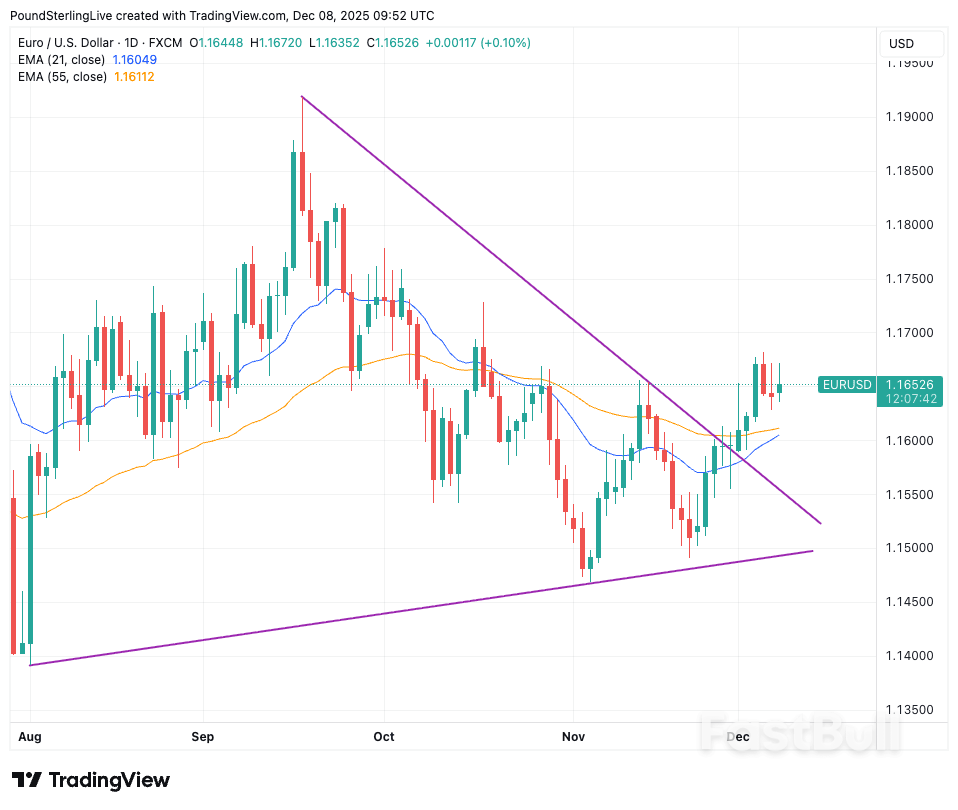
          The pair rallied to a high of 1.1681 last week, a level last seen in mid-October, and in doing so broke above the 21- and 55-day exponential moving averages (EMA).
          The move above these two momentum indicators provides a clean technical signal that the outlook has flipped from the downside to upside in the short-term.
          Euro-to-Dollar Week Ahead Forecast: Staying Constructive_1
          In sympathy with this, we would anticipate further gains in the coming week.
          That being said, a pullback ahead of Wednesday's Federal Reserve decision cannot be ruled out, as this could be a high-stakes event for currency markets.
          Weakness should be limited to the 1.1610 area where the 21- and 55-day EMAs are converging, confirming this to be the line-in-the-sand for the coming week.
          Of course, should the Fed strike a hawkish tone, euro-dollar can come under significant pressure and a break back into the 1.15s will transpire, putting the exchange rate back under pressure into year-end.
          However, our base case is that the Fed won't have the data to 'shake the boat' to the degree required to trip up the euro's rally.
          This is why we would anticipate setbacks to the euro's advance to be shallow, and ultimately why 1.17 is in scope in the coming days.
          There is some EUR-based interest due Wednesday when European Central Bank (ECB) Governor Christine Lagarde addresses the FT Global Boardroom event in London, where she is expected to touch on Eurozone monetary policy.
          Expect her to maintain the view that interest rates are in a good place, which will broadly underpin the view the ECB won't be cutting anytime soon, which confers support to the euro.
          Recent industrial production improvements and firming inflation data should underpin the case for Lagarde to maintain a steady stance.
          The divergent path between U.S. and European interest rates will become all the more stark this week when the ECB's steady hand comes up against that of an active Federal Reserve.
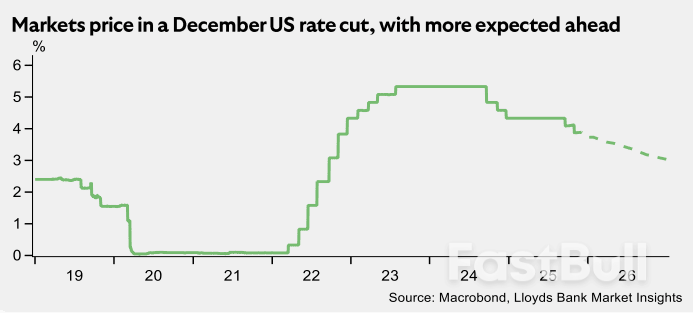
          The week's highlight for EUR/USD is the Federal Reserve policy decision, due Wednesday, and markets have almost fully priced in a 25 basis point interest rate cut, which would take the Fed funds target range to 3.50–3.75%.
          The decision to cut will rest on a series of economic surveys that confirm the labour market is softening.
          Last week saw EUR/USD jump to 1.1681 after the U.S. November ADP employment report read -32k, disappointing consensus expectations for a 10k gain in employment, in the process sealing this Wednesday's rate cut.
          The rate cut itself won't be remarkable enough to drive any sizeable FX market reaction.
          Instead, it's the outlook for interest rates in 2026 that will be of greater interest. Here, there's uncertainty owing to divisions within the Fed's FOMC.
          "Some members remain concerned about inflation staying above target, while others place greater emphasis on signs of labour market weakness," says Hann-Ju Ho, Senior Economist at Lloyds Market Insights.
          The Fed’s statement and Chair Powell’s press conference, along with updated economic projections, will also provide insight into policy intentions for 2026. This meeting includes updated forecasts, including interest rate projections (the dot plot).
          Euro-to-Dollar Week Ahead Forecast: Staying Constructive_2

          Above: What markets expect from the Fed. Image courtesy of Lloyds Bank.

          "The September projections showed a consensus of 3.625% for end-2025, consistent with a 25bp cut on Wednesday, but only 25bp of additional easing in 2026, less than markets currently expect. It will be interesting to see whether the dot plot projection shifts, given the current divisions within the Committee," says Hann-Ju Ho.

          Source: Poundsterlinglive

          To stay updated on all economic events of today, please check out our Economic calendar
          Risk Warnings and Disclaimers
          You understand and acknowledge that there is a high degree of risk involved in trading. Following any strategies or investment methods may lead to potential losses. The content on the site is provided by our contributors and analysts for information purposes only. You are solely responsible for determining whether any trading assets, securities, strategy, or any other product is suitable for investing based on your own investment objectives and financial situation.
          Add to Favorites
          Share
          FastBull
          Copyright © 2025 FastBull Ltd

          728 RM B 7/F GEE LOK IND BLDG NO 34 HUNG TO RD KWUN TONG KLN HONG KONG

          TelegramInstagramTwitterfacebooklinkedin
          App Store Google Play Google Play
          Products
          Charts

          Chats

          Q&A with Experts
          Screeners
          Economic Calendar
          Data
          Tools
          Membership
          Features
          Function
          Markets
          Copy Trading
          Latest Signals
          Contests
          News
          Analysis
          24/7
          Columns
          Education
          Company
          Careers
          About Us
          Contact Us
          Advertising
          Help Center
          Feedback
          User Agreement
          Privacy Policy
          Business

          White Label

          Data API

          Web Plug-ins

          Poster Maker

          Affiliate Program

          Risk Disclosure

          The risk of loss in trading financial instruments such as stocks, FX, commodities, futures, bonds, ETFs and crypto can be substantial. You may sustain a total loss of the funds that you deposit with your broker. Therefore, you should carefully consider whether such trading is suitable for you in light of your circumstances and financial resources.

          No decision to invest should be made without thoroughly conducting due diligence by yourself or consulting with your financial advisors. Our web content might not suit you since we don't know your financial conditions and investment needs. Our financial information might have latency or contain inaccuracy, so you should be fully responsible for any of your trading and investment decisions. The company will not be responsible for your capital loss.

          Without getting permission from the website, you are not allowed to copy the website's graphics, texts, or trademarks. Intellectual property rights in the content or data incorporated into this website belong to its providers and exchange merchants.

          Not Logged In

          Log in to access more features

          FastBull Membership

          Not yet

          Purchase

          Become a signal provider
          Help Center
          Customer Service
          Dark Mode
          Price Up/Down Colors

          Log In

          Sign Up

          Position
          Layout
          Fullscreen
          Default to Chart
          The chart page opens by default when you visit fastbull.com
