Markets
News
Analysis
User
24/7
Economic Calendar
Education
Data
- Names
- Latest
- Prev


Signal Accounts for Members
All Signal Accounts
All Contests


France Trade Balance (SA) (Oct)A:--
F: --
Euro Zone Employment YoY (SA) (Q3)A:--
F: --
Canada Part-Time Employment (SA) (Nov)A:--
F: --
P: --
Canada Unemployment Rate (SA) (Nov)A:--
F: --
P: --
Canada Full-time Employment (SA) (Nov)A:--
F: --
P: --
Canada Labor Force Participation Rate (SA) (Nov)A:--
F: --
P: --
Canada Employment (SA) (Nov)A:--
F: --
P: --
U.S. PCE Price Index MoM (Sept)A:--
F: --
P: --
U.S. Personal Income MoM (Sept)A:--
F: --
P: --
U.S. Core PCE Price Index MoM (Sept)A:--
F: --
P: --
U.S. PCE Price Index YoY (SA) (Sept)A:--
F: --
P: --
U.S. Core PCE Price Index YoY (Sept)A:--
F: --
P: --
U.S. Personal Outlays MoM (SA) (Sept)A:--
F: --
U.S. 5-10 Year-Ahead Inflation Expectations (Dec)A:--
F: --
P: --
U.S. Real Personal Consumption Expenditures MoM (Sept)A:--
F: --
U.S. Weekly Total Rig CountA:--
F: --
P: --
U.S. Weekly Total Oil Rig CountA:--
F: --
P: --
U.S. Consumer Credit (SA) (Oct)A:--
F: --
China, Mainland Foreign Exchange Reserves (Nov)A:--
F: --
P: --
Japan Trade Balance (Oct)A:--
F: --
P: --
Japan Nominal GDP Revised QoQ (Q3)A:--
F: --
P: --
China, Mainland Imports YoY (CNH) (Nov)A:--
F: --
P: --
China, Mainland Exports (Nov)A:--
F: --
P: --
China, Mainland Imports (CNH) (Nov)A:--
F: --
P: --
China, Mainland Trade Balance (CNH) (Nov)A:--
F: --
P: --
China, Mainland Exports YoY (USD) (Nov)A:--
F: --
P: --
China, Mainland Imports YoY (USD) (Nov)A:--
F: --
P: --
Germany Industrial Output MoM (SA) (Oct)A:--
F: --
Euro Zone Sentix Investor Confidence Index (Dec)A:--
F: --
P: --
Canada National Economic Confidence IndexA:--
F: --
P: --
U.K. BRC Like-For-Like Retail Sales YoY (Nov)--
F: --
P: --
U.K. BRC Overall Retail Sales YoY (Nov)--
F: --
P: --
Australia Overnight (Borrowing) Key Rate--
F: --
P: --
RBA Rate Statement
RBA Press Conference
Germany Exports MoM (SA) (Oct)--
F: --
P: --
U.S. NFIB Small Business Optimism Index (SA) (Nov)--
F: --
P: --
Mexico 12-Month Inflation (CPI) (Nov)--
F: --
P: --
Mexico Core CPI YoY (Nov)--
F: --
P: --
Mexico PPI YoY (Nov)--
F: --
P: --
U.S. Weekly Redbook Index YoY--
F: --
P: --
U.S. JOLTS Job Openings (SA) (Oct)--
F: --
P: --
China, Mainland M1 Money Supply YoY (Nov)--
F: --
P: --
China, Mainland M0 Money Supply YoY (Nov)--
F: --
P: --
China, Mainland M2 Money Supply YoY (Nov)--
F: --
P: --
U.S. EIA Short-Term Crude Production Forecast For The Year (Dec)--
F: --
P: --
U.S. EIA Natural Gas Production Forecast For The Next Year (Dec)--
F: --
P: --
U.S. EIA Short-Term Crude Production Forecast For The Next Year (Dec)--
F: --
P: --
EIA Monthly Short-Term Energy Outlook
U.S. API Weekly Gasoline Stocks--
F: --
P: --
U.S. API Weekly Cushing Crude Oil Stocks--
F: --
P: --
U.S. API Weekly Crude Oil Stocks--
F: --
P: --
U.S. API Weekly Refined Oil Stocks--
F: --
P: --
South Korea Unemployment Rate (SA) (Nov)--
F: --
P: --
Japan Reuters Tankan Non-Manufacturers Index (Dec)--
F: --
P: --
Japan Reuters Tankan Manufacturers Index (Dec)--
F: --
P: --
Japan Domestic Enterprise Commodity Price Index MoM (Nov)--
F: --
P: --
Japan Domestic Enterprise Commodity Price Index YoY (Nov)--
F: --
P: --
China, Mainland PPI YoY (Nov)--
F: --
P: --
China, Mainland CPI MoM (Nov)--
F: --
P: --
Italy Industrial Output YoY (SA) (Oct)--
F: --
P: --


No matching data
Latest Views
Latest Views
Trending Topics
Top Columnists
Latest Update
White Label
Data API
Web Plug-ins
Affiliate Program
View All

No data
:China's new restrictions on rare earth exports have sent shockwaves through global markets, prompting fears of a supply chain crisis. The move has intensified geopolitical tensions, particularly with the U.S. and Europe...
The U.K. labor market deteriorated further in the three months to August 2025, with unemployment rising to 4.8% – its highest level since May 2021.The latest Office for National Statistics data revealed a concerning mix of rising joblessness and persistent wage pressures that complicated the Bank of England’s (BOE) policy outlook.
The latest reports suggest that U.K. businesses are reducing hiring or choosing not to replace departing workers as economic uncertainty mounts. The deteriorating employment conditions also partly reflected the impact of higher National Insurance contributions and increased minimum wages implemented earlier in 2025.
Key Takeaways:
While the weakening labor market suggested economic momentum was fading – potentially justifying further rate cuts – the 5.0% wage growth remained well above levels consistent with the BOE’s 2% inflation target.
The sustained decline in job vacancies for nearly 10 years also signaled persistent weakness in labor demand, suggesting that businesses remained cautious about expansion amid ongoing economic uncertainties. This broad-based deterioration in labor market indicators pointed to potential challenges for U.K. growth in the months ahead.
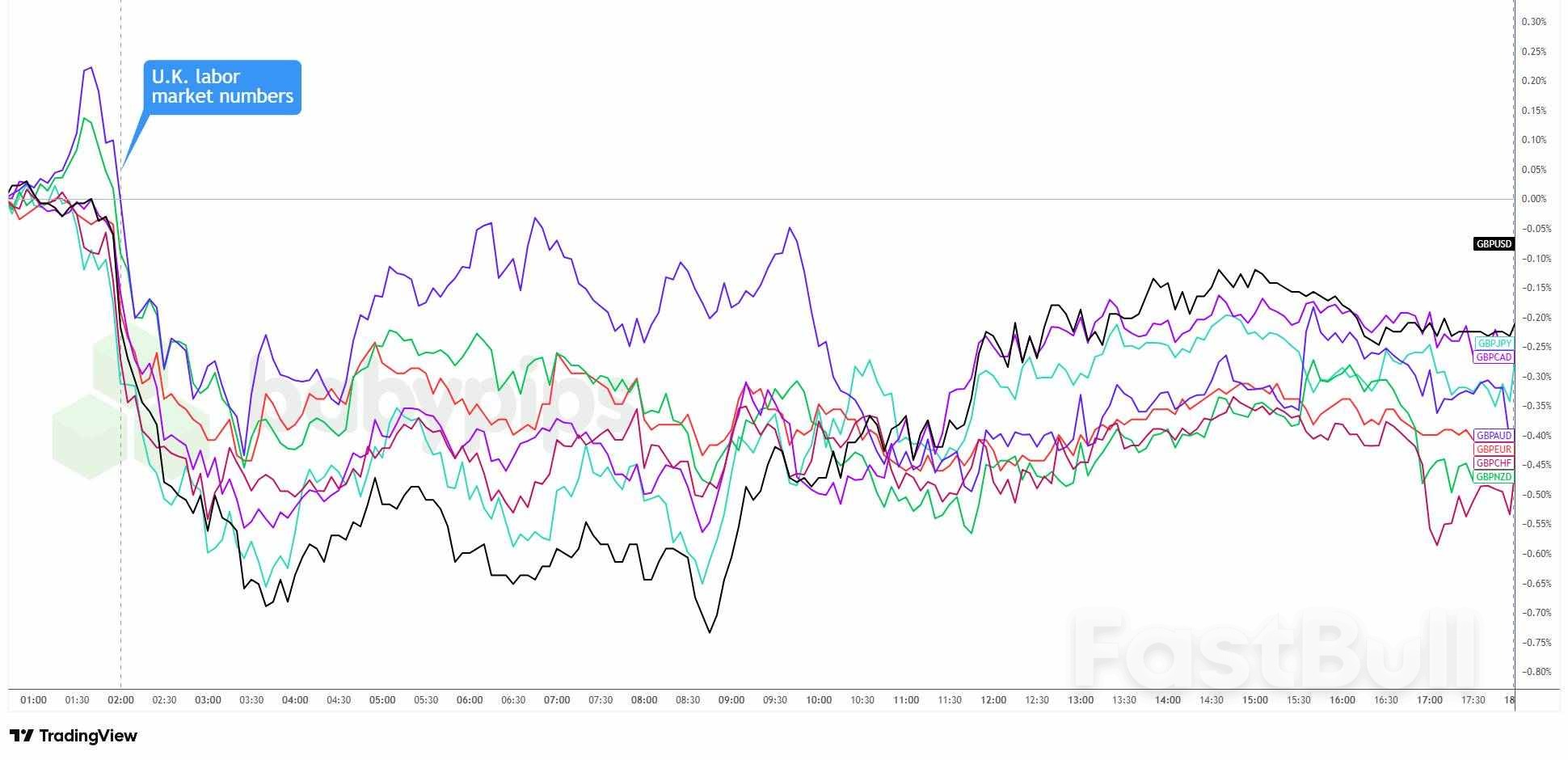
British Pound vs. Major Currencies: 5-min

Currency traders appeared to focus more on the deteriorating employment picture, with futures markets immediately pricing in higher odds of BOE rate cuts before year-end.The significant jump in the claimant count and the breach of the psychologically important 4.8% unemployment level likely reinforced expectations that the U.K. economy was losing steam more rapidly than anticipated.
The British pound, which had been taking cues from countercurrency flows, got slammed broadly and sharply after the data hit. Sterling took the hardest beating against the Canadian dollar and safe-haven currencies like the dollar, yen, and franc before clawing back some losses an hour later.The pound chopped around through most of the day, but the early London selloff set the tone. By the time New York closed up shop, GBP ended lower across the board, except against commodity-related currencies like the Aussie and Kiwi.
China’s deflation eased in September, leaving the country on track for the longest streak of economy-wide price declines since market reforms in the late 1970s.Prices at the factory gate fell 2.3% from a year earlier, the 36th straight month of declines that was in line with forecasts. Consumer prices dropped 0.3%, the National Bureau of Statistics said Wednesday, below the median estimate of minus 0.2% in a Bloomberg survey of economists.The core consumer price index, which excludes volatile items such as food and energy, rose to an 19-month high of 1%.
“An improvement in demand and supply has stabilized prices in some industries, such as coal mining and solar equipment,” Dong Lijuan, chief statistician at the NBS, said in a statement.The world’s second-biggest economy has been mired in deflation since the end of the pandemic, with the housing market crash compounding weak consumer demand. Overcapacity in some industries has led to a glut of production, forcing firms to cut prices to survive.
Deflationary pressures have persisted despite government attempts to slow or stop the crushing price wars and competition among manufacturers. China’s GDP deflator — the broadest measure of prices — has been in decline for over two years in the longest stretch since the quarterly data began in 1992.Nine straight quarters of economy-wide price declines reflect a mismatch between supply and demand, weighing on the balance sheets of companies and pushing down the earnings of both households and the government. Citigroup Inc. estimates the GDP deflator stayed around minus 1.3% in the third quarter.
China’s government reduced its official target for consumer inflation to around 2% for 2025, the lowest level in over two decades. Even so, price growth has been near zero or negative for much of this year.China is set to announce third-quarter data for economic activity on Oct. 20, with most analysts predicting a slowdown from the first half of the year.A strong showing in the first two quarters likely means China will reach the official growth target of around 5%, with fresh stimulus probably not on the agenda for a meeting of the ruling Communist Party later this month.
Far-right U.S. influencer Candace Owens has lost her bid to enter Australia after the country’s highest court on Wednesday backed the government’s decision to deny her a visa over concerns she could “incite discord” in the community.Owens, who has built a large online following for her controversial conservative views, applied for a visa to undertake a speaking tour in November 2024.Her application was rejected in October 2024 by Home Affairs Minister Tony Burke, citing her record of downplaying the Holocaust and Islamophobic comments. Burke has powers to deny non-citizens entry based on character requirements under the Migration Act.
Owens appealed to the High Court on the grounds that the power burdened the freedom of political communication, an implied right. Unlike the U.S., Australia does not have an express constitutional right to free speech.The High Court on Wednesday sided with Burke and ordered Owens to pay the government's legal costs.The court said the Migration Act provisions imposed a burden on political communication but served a legitimate and justifiable purpose in protecting the Australian community from visitors who would "stir up or encourage dissension or strife on political matters".
“The implied freedom is not a ‘personal right’, is not unlimited and is not absolute,” said High Court Judges Stephen Gageler, Michelle Gordon and Robert Beech-Jones in a joint judgment.The judges noted Burke denied Owens’ visa after examining her views and comments on areas including “Holocaust denial, Islamophobia", anti-racism, Black Lives Matter and antisemitism, women's and LGBTQIA+ rights, and COVID-19 and anti-vaccination”.Burke found her views to be “extremist and inflammatory comments towards Muslim, Black, Jewish and LGBTQIA+ communities which generate controversy and hatred”, concluding that meant she failed the “character test” required for a visa and that allowing her into the country would not be in the national interest.
“Ms Owens Farmer's submissions should be emphatically rejected,” said High Court Judge James Edelman in a separate judgment.In July, Australia also cancelled the visa of U.S. rapper Ye, formerly known as Kanye West, over concerns he promoted Nazi ideologies in his song “Heil Hitler” released in May.
Iraq's Prime Minister Mohammed Shia Al-Sudani said he hopes to end the country's $4 billion reliance on Iranian gas by 2028, in an effort to diversify the major oil-producer's economy. Decades of mismanagement, underinvestment and corruption have strained the power grid of Iraq, which is OPEC's second-largest oil producer after Saudi Arabia. Gas from Tehran fuels nearly a third of Iraq's electricity generation, yet frequent and prolonged outages remain common, forcing residents to rely on costly, polluting private generators.
"We developed a clear vision to address this structural imbalance that affects our ability to generate and produce electricity and provide it to citizens," Al-Sudani told CNBC's Dan Murphy in Baghdad. The Prime Minister added that Baghdad had signed deals with TotalEnergies, along with Chinese and Emirati firms, to invest in capturing gas that is now flared — worth $4 billion to $5 billion a year. Oil production releases large volumes of gas that are typically burned off, a process also known as flaring. Recovering and processing that gas, instead of wasting it, could ease Iraq's chronic power shortages. "For the first time in Iraq's history , there is a clear plan and daily action to resolve this issue, with a deadline of early 2028 set for zero gas flaring," Al-Sudani pledged. Washington, Beijing or Riyadh? Iraq, which maintains ties with the U.S. and Iran, strikes a delicate balance as it courts Chinese investment to rebuild infrastructure and Gulf partners to help improve its strained power grid.
The U.S., which led a 2003 invasion that toppled former Iraqi dictator Saddam Hussein, is a key defense partner and has about 2,500 troops on the ground — a figure expected to fall further. Al-Sudani described his government's approach as "multi-pronged," noting interest from Chinese, Russian, European and American firms, as well as Gulf investors. "Our economy and our relations have never been one-sided," Al-Sudani said. "We recently signed agreements in principle with Chevron, Exxon Mobil, Halliburton and SLB (Schlumberger)," Al-Sudani told CNBC, adding that Qatari investments in Iraq exceeded $5 billion. Saudi and Emirati private sector investments also span several projects, including an agreement with the United Arab Emirates's renewable champion Masdar to produce 1,000 megawatts of energy.
Iran's shadow looms large Despite Al-Sudani's "multi-pronged" diplomatic approach, Iraq could be hit hard by renewed sanctions on neighboring Iran. In August, European powers triggered the "snapback" mechanism to restore sanctions that were lifted in 2015, when Iran agreed to limit its nuclear activities in exchange for economic relief under the Joint Comprehensive Plan of Action. During President Trump's first term, the U.S. Treasury issued exemptions for Iraq to import Iranian electricity, despite the implementation of his "maximum pressure" campaign on Tehran. Iran's influence on Iraq still lingers, both politically and financially. Despite a bloody war fought between the two neighbors from 1980 to 1988, Baghdad remains one of Tehran's few remaining footholds in the region.
Syria, under Bashar Assad, and Lebanon, through Hezbollah, once took cues from the Iranian Revolutionary Guard Corps. Now, with many of those proxies weakened, Iraq has become one of the last strongholds of Iranian influence. The renewed sanctions could also drive Tehran to intensify its efforts to evade restrictions, possibly using Iraqi banks to move dollars illicitly. Earlier this year, several Iraqi lenders were banned from engaging in dollar transactions after the U.S. Treasury cracked down on money laundering and currency smuggling.
In 2019, demonstrators took to the streets in mass protests dubbed the "October Revolution," calling for an end to endemic corruption and Iranian influence for strangling the country's economy. Al-Sudani, who rose to power after that upheaval, insisted his government had taken tangible steps to restore public trust, such as economic progress and political stability. "This government has begun reforming regulatory institutions responsible for combating corruption, as well as establishing mechanisms that promote transparency and procedural integrity," Al-Sudani said.
He added that recent financial and banking reforms have "strengthened the presence of investment companies." Al-Sudani pointed to the inauguration of a new Pharmaceutical Manufacturing City in Iraq, involving major American and British firms. "This environment encouraged them to enter and transfer their expertise and technology to establish the important pharmaceutical industry that Iraq needs," he said. Despite these reforms, the International Monetary Fund has said corruption "remains a significant hurdle for growth." Political stability Iraqis will head to the polls on Nov. 11, voting for the seventh time since the 2003 U.S.-led invasion.
That election, which will select members of Iraq's 329-seat parliament, comes amid rising unemployment, which continues to weigh on Iraq's young and restless population. Iraq's Prime Minister Mohammed Shia Al-Sudani told CNBC's Dan Murphy the election marks "one of the benchmarks in the history of the country," describing it as proof that Iraq's democratic process remains intact. "It is a peaceful transfer of power … and the government has fulfilled all requirements and prepared the appropriate atmosphere for participation," he said. However, youth unemployment continues to be a challenge.
Around 60% of Iraq's nearly 46 million citizens are under the age of 30, a demographic that could determine whether the election reinvigorates a stagnant political system or deepens disillusionment. The 2021 parliamentary election drew only 43% turnout, according to the electoral commission, in a vote that had to be brought forward after anti-government protests. "According to the latest census data, the Iraqi society is a youthful society," Al-Sudani said. "This places responsibility on the state to find solutions to problems of the youth, the most important of which is creating job opportunities. We have achieved [an unemployment] decrease of more than 2%, according to official estimates."
To that end, Al-Sudani added that his government is "encouraging the private sector to welcome more job seekers" while fostering industries tied to digital transformation. "We have established a National Center for Digital Transformation and a Center for Cybersecurity," he said, adding that a higher committee for artificial intelligence is preparing a national strategy to absorb a larger share of young workers. "We have achieved a significant amount of services and economic reforms," he added, citing a "clear stability in Iraq" and a "feeling of optimism ... and hope for a better future" among citizens.
Federal Reserve Chair Jerome Powell signaled the US central bank is on track to deliver another quarter-point interest-rate cut later this month, even as a government shutdown significantly reduces its read on the economy.
Powell, in a speech Tuesday at the National Association for Business Economics annual meeting, said that the economic outlook appeared unchanged since policymakers met in September, when they lowered interest rates and projected two more this year.
“A rate cut in October is done,” said Julia Coronado, founder of the research firm MacroPolicy Perspectives and a former Fed economist. “Nothing has changed the perspective that there’s still downside risks to the labor market.”
Powell pointed several times to the low pace of hiring and noted that it may weaken further.
“You’re at a place where further declines in job openings might very well show up in unemployment,” Powell said during a question-and-answer session following his prepared remarks. “You’ve had this amazing time where you came straight down, but I just think you’re going to reach a point where unemployment starts to go up.”
Expectations for a rate cut in October were little changed after Powell’s remarks. Investors see a nearly 100% chance of a reduction, according to federal funds futures contracts.
The Fed’s September cut was their first since December, and followed a sharp summer slowdown in hiring. Still, the unemployment rate has so far remained relatively low, ticking up to 4.3% in August. The Labor Department delayed the release of the September payrolls report due to the ongoing government shutdown, but has recalled staff to prepare September consumer price index data for release later this month.
“Right now, the risks to the employment side of the mandate are rising,” Yelena Shulyatyeva, senior US economist at the Conference Board, said on the sidelines of the NABE conference. “That’s what is going to drive the decision in the near term.”
The Fed is scheduled to meet again Oct. 28-29. Last month, the median projection from its 19 policymakers pointed to two more rate cuts this year. But nine officials saw one or fewer cuts as appropriate.
That division among policymakers is also making Powell more cautious about the path for rates next year, said Diane Swonk, chief economist at KPMG.
“Those are the cues of, ‘We don’t really know where we’re going longer term,’” she said.
The absence of a full suite of official economic data has ramped up concern that the Fed won’t get a clear read on how the economy is evolving, increasing the potential for policy mistakes.
It’s a particularly difficult time for the Fed to go without data. Its mandates of price stability and maximum employment are pulling officials in opposite directions, with the labor market cooling while inflation remains above the central bank’s 2% target.
Powell said he and his colleagues are looking to alternative, private-sector data sources but emphasized the importance of government data, which he called the “gold standard.”
“We don’t expect that we’d be able to replace the data we’re not getting,” Powell said. “We’ll start to miss that data, and particularly the October data. If this goes on for a while they won’t be collecting it, and it could become more challenging.”
Powell also signaled the central bank may stop shrinking its balance sheet in the coming months, an important shift necessary to preserve liquidity in overnight funding markets.
The U.S. and China on Tuesday began charging additional port fees on ocean shipping firms that move everything from holiday toys to crude oil, making the high seas a key front in the trade war between the world's two largest economies.A return to an all-out trade war appeared imminent last week, after China announced a major expansion of its rare earths export controls and President Donald Trump threatened to raise tariffs on Chinese goods to triple digits.
But after the weekend, both sides sought to reassure traders and investors, highlighting cooperation between their negotiating teams and the possibility they could find a way forward.China said it had started to collect the special charges on U.S.-owned, operated, built or flagged vessels but clarified that Chinese-built ships would be exempted from the levies.In details published by state broadcaster CCTV, China spelled out specific provisions on exemptions, which also include empty ships entering Chinese shipyards for repair.
Similar to the U.S. plan, the new China-imposed fees would be collected at the first port of entry on a single voyage or for the first five voyages within a year."This tit-for-tat symmetry locks both economies into a spiral of maritime taxation that risks distorting global freight flows," Athens-based Xclusiv Shipbrokers said in a research note.Early this year, the Trump administration announced plans to levy the fees on China-linked ships to loosen the country's grip on the global maritime industry and bolster U.S. shipbuilding.
An investigation during the former Biden administration concluded that China uses unfair policies and practices to dominate the global maritime, logistics and shipbuilding sectors, clearing the way for those penalties.China hit back last week, saying it would impose its own port fees on U.S.-linked vessels from the same day the U.S. fees took effect."We are in the hectic stage of the disruption where everyone is quietly trying to improvise workarounds, with varying degrees of success," said independent dry bulk shipping analyst Ed Finley-Richardson. He said he has heard reports of U.S. shipowners with non-Chinese vessels trying to sell their cargoes to other countries while en route so the vessels can divert. Reuters was not immediately able to confirm.
Analysts expect China-owned container carrier COSCO to be most affected by the U.S. fees, shouldering nearly half of that segment's expected $3.2 billion cost from those fees in 2026.Major container lines, including Maersk, Hapag-Lloyd and CMA CGM, slashed their exposure by switching China-linked ships out of their U.S. shipping lanes. Trade officials there reduced fees from initially proposed levels and exempted a broad swath of vessels after heavy pushback from the agriculture, energy and U.S. shipping industries.
USTR did not immediately respond to a request for comment.
China's commerce ministry on Tuesday said, "If the U.S. chooses confrontation, China will see it through to the end; if it chooses dialogue, China's door remains open."In a related move, Beijing also imposed sanctions on Tuesday against five U.S.-linked subsidiaries of South Korean shipbuilder Hanwha Ocean which it said had "assisted and supported" a U.S. probe into Chinese trade practices.Hanwha, one of the world's largest shipbuilders, owns Philly Shipyard in the U.S. and has won contracts to repair and overhaul U.S. Navy ships. Its entities also will build a U.S.-flagged LNG carrier.
Hanwha said it is aware of the announcement and is closely monitoring the potential business impact, and that it will continue to provide services to its customers, "including through our investments in the U.S. maritime industry and via Hanwha Philly Shipyard."
Hanwha Ocean's shares sank nearly 6%.
China also launched an investigation into how the U.S. probe affected its shipping and shipbuilding industries.
A Shanghai-based trade consultant said the new fees may not cause significant upheaval."What are we going to do? Stop shipping? Trade is already pretty disrupted with the U.S., but companies are finding a way," said the consultant, who requested anonymity because he was not authorised to speak with the media.The U.S. announced last Friday a carve-out for long-term charterers of China-operated vessels carrying U.S. ethane and LPG, deferring the port fees for them through December 10.
Meanwhile, ship-tracking company Vortexa identified 45 LPG-carrying VLGCs - 11% of the total fleet - that would be subject to China's port fee.
Clarksons Research said in a report that China's new port fees could affect oil tankers accounting for 15% of global capacity. Jefferies analyst Omar Nokta estimated that 13% of crude tankers and 11% of container ships in the global fleet would be affected.
In a reprisal against China curbing exports of critical minerals, Trump on Friday threatened to slap additional 100% tariffs on goods from China and put new export controls on "any and all critical software" by November 1.Administration officials hours later warned that countries voting in favor of a plan by the U.N. International Maritime Organization to reduce planet-warming greenhouse gas emissions from ocean shipping this week could face sanctions, port bans, or punitive vessel charges. China has publicly supported the IMO plan.
"The weaponisation of both trade and environmental policy signals that shipping has moved from being a neutral conduit of global commerce to a direct instrument of statecraft," Xclusiv said.Shares in Shanghai-listed COSCO rose more than 2% in early trading on Tuesday. The company said its board had approved a plan to buy back up to 1.5 billion yuan ($210.3 million) worth of its shares within the next three months to maintain corporate value and safeguard shareholder interests.
White Label
Data API
Web Plug-ins
Poster Maker
Affiliate Program
The risk of loss in trading financial instruments such as stocks, FX, commodities, futures, bonds, ETFs and crypto can be substantial. You may sustain a total loss of the funds that you deposit with your broker. Therefore, you should carefully consider whether such trading is suitable for you in light of your circumstances and financial resources.
No decision to invest should be made without thoroughly conducting due diligence by yourself or consulting with your financial advisors. Our web content might not suit you since we don't know your financial conditions and investment needs. Our financial information might have latency or contain inaccuracy, so you should be fully responsible for any of your trading and investment decisions. The company will not be responsible for your capital loss.
Without getting permission from the website, you are not allowed to copy the website's graphics, texts, or trademarks. Intellectual property rights in the content or data incorporated into this website belong to its providers and exchange merchants.
Not Logged In
Log in to access more features

FastBull Membership
Not yet
Purchase
Log In
Sign Up