• Trade
  • Markets
  • Copy
  • Contests
  • News
  • 24/7
  • Calendar
  • Q&A
  • Chats
Trending
Screeners
SYMBOL
LAST
BID
ASK
HIGH
LOW
NET CHG.
%CHG.
SPREAD
SPX
S&P 500 Index
6827.42
6827.42
6827.42
6899.86
6801.80
-73.58
-1.07%
--
DJI
Dow Jones Industrial Average
48458.04
48458.04
48458.04
48886.86
48334.10
-245.98
-0.51%
--
IXIC
NASDAQ Composite Index
23195.16
23195.16
23195.16
23554.89
23094.51
-398.69
-1.69%
--
USDX
US Dollar Index
97.920
98.000
97.920
98.070
97.810
-0.030
-0.03%
--
EURUSD
Euro / US Dollar
1.17451
1.17458
1.17451
1.17596
1.17262
+0.00057
+ 0.05%
--
GBPUSD
Pound Sterling / US Dollar
1.33848
1.33856
1.33848
1.33961
1.33546
+0.00141
+ 0.11%
--
XAUUSD
Gold / US Dollar
4331.65
4332.06
4331.65
4350.16
4294.68
+32.26
+ 0.75%
--
WTI
Light Sweet Crude Oil
56.840
56.870
56.840
57.601
56.789
-0.393
-0.69%
--

Community Accounts

Signal Accounts
--
Profit Accounts
--
Loss Accounts
--
View More

Become a signal provider

Sell trading signals to earn additional income

View More

Guide to Copy Trading

Get started with ease and confidence

View More

Signal Accounts for Members

All Signal Accounts

Best Return
  • Best Return
  • Best P/L
  • Best MDD
Past 1W
  • Past 1W
  • Past 1M
  • Past 1Y

All Contests

  • All
  • Trump Updates
  • Recommend
  • Stocks
  • Cryptocurrencies
  • Central Banks
  • Featured News
Top News Only
Share

Portugal Treasury Expects 2026 Net Financing Needs At 29.4 Billion Euros, Up From 25.8 Billion In 2025

Share

Bank Of America Says With Indonesia's Smelter Now Ramping Up, It Expects Aluminium Supply Growth To Accelerate To 2.6% Year On Year In 2026

Share

Bank Of America Expects A Deficit In Aluminium Next Year And Sees Prices Pushing Above $3000/T

Share

Fed Data - USA Effective Federal Funds Rate At 3.64 Percent On 12 December On $102 Billion In Trades Versus 3.64 Percent On $99 Billion On 11 December

Share

Brazil's Petrobras Says No Impact Seen On Oil, Petroleum Products Output As Workers Start Planned Strike

Share

Statement: US Travel Group Warns New Proposed Trump Administration Requirements For Foreign Tourists To Provide Social Media Histories Could Mean Millions Of People Opting Not To Visit

Share

Blackrock: Kerry White Will Become Head Of Citi Investment Management At Citi Wealth

Share

Blackrock: Rob Jasminski, Head Of Citi Investment Management, Has Joined With Team

Share

Blackrock: Effective Dec 15, Citi Investment Management Employees Will Join Blackrock

Share

Blackrock: Formally Launch Citi Portfolio Solutions Powered By Blackrock

Share

According To Data From The Federal Reserve Bank Of New York, The Secured Overnight Funding Rate (Sofr) Was 3.67% On The Previous Trading Day (December 15), Compared To 3.66% The Day Before

Share

Peru Energy And Mines Ministry: Copper Production Up 4.8% Year-On-Year In October To 248192 Metric Tons

Share

Security Source: Ukrainian Drones Hits Russian Oil Infrastructure In Caspian Sea For Third Time

Share

Spot Palladium Extends Gains, Last Up 5% To $1562.7/Oz

Share

Mexico's Economy Ministry Announces Start Of Anti-Dumping Investigation And Anti-Subsidy Investigations Into USA Pork Imports

Share

Canada Nov CPI Common +2.8%, CPI Median +2.8%, CPI Trim +2.8% On Year

Share

NY Fed's Empire State Prices Paid Index +37.6 In December Versus+49.0 In November

Share

Canada Nov Consumer Prices +0.1% On Month, +2.2% On Year

Share

Canada Nov CPI Core -0.1% On Month, +2.9% On Year

Share

Canada Nov Core CPI, Seasonally Adjusted +0.2% On Month, Oct +0.3% (Unrevised)

TIME
ACT
FCST
PREV
Japan Tankan Small Manufacturing Outlook Index (Q4)

A:--

F: --

P: --

Japan Tankan Large Non-Manufacturing Outlook Index (Q4)

A:--

F: --

P: --

Japan Tankan Large Manufacturing Outlook Index (Q4)

A:--

F: --

P: --

Japan Tankan Small Manufacturing Diffusion Index (Q4)

A:--

F: --

P: --

Japan Tankan Large Manufacturing Diffusion Index (Q4)

A:--

F: --

P: --

Japan Tankan Large-Enterprise Capital Expenditure YoY (Q4)

A:--

F: --

P: --

U.K. Rightmove House Price Index YoY (Dec)

A:--

F: --

P: --

China, Mainland Industrial Output YoY (YTD) (Nov)

A:--

F: --

P: --

China, Mainland Urban Area Unemployment Rate (Nov)

A:--

F: --

P: --

Saudi Arabia CPI YoY (Nov)

A:--

F: --

P: --

Euro Zone Industrial Output YoY (Oct)

A:--

F: --

P: --

Euro Zone Industrial Output MoM (Oct)

A:--

F: --

P: --

Canada Existing Home Sales MoM (Nov)

A:--

F: --

P: --

Canada National Economic Confidence Index

A:--

F: --

P: --

Canada New Housing Starts (Nov)

A:--

F: --

P: --
U.S. NY Fed Manufacturing Employment Index (Dec)

A:--

F: --

P: --

U.S. NY Fed Manufacturing Index (Dec)

A:--

F: --

P: --

Canada Core CPI YoY (Nov)

A:--

F: --

P: --

Canada Manufacturing Unfilled Orders MoM (Oct)

A:--

F: --

P: --

U.S. NY Fed Manufacturing Prices Received Index (Dec)

A:--

F: --

P: --

U.S. NY Fed Manufacturing New Orders Index (Dec)

A:--

F: --

P: --

Canada Manufacturing New Orders MoM (Oct)

A:--

F: --

P: --

Canada Core CPI MoM (Nov)

A:--

F: --

P: --

Canada Trimmed CPI YoY (SA) (Nov)

A:--

F: --

P: --

Canada Manufacturing Inventory MoM (Oct)

A:--

F: --

P: --

Canada CPI YoY (Nov)

A:--

F: --

P: --

Canada CPI MoM (Nov)

A:--

F: --

P: --

Canada CPI YoY (SA) (Nov)

A:--

F: --

P: --

Canada Core CPI MoM (SA) (Nov)

A:--

F: --

P: --

Canada CPI MoM (SA) (Nov)

A:--

F: --

P: --

Federal Reserve Board Governor Milan delivered a speech
U.S. NAHB Housing Market Index (Dec)

--

F: --

P: --

Australia Composite PMI Prelim (Dec)

--

F: --

P: --

Australia Services PMI Prelim (Dec)

--

F: --

P: --

Australia Manufacturing PMI Prelim (Dec)

--

F: --

P: --

Japan Manufacturing PMI Prelim (SA) (Dec)

--

F: --

P: --

U.K. 3-Month ILO Employment Change (Oct)

--

F: --

P: --

U.K. Unemployment Claimant Count (Nov)

--

F: --

P: --

U.K. Unemployment Rate (Nov)

--

F: --

P: --

U.K. 3-Month ILO Unemployment Rate (Oct)

--

F: --

P: --

U.K. Average Weekly Earnings (3-Month Average, Including Bonuses) YoY (Oct)

--

F: --

P: --

U.K. Average Weekly Earnings (3-Month Average, Excluding Bonuses) YoY (Oct)

--

F: --

P: --

France Services PMI Prelim (Dec)

--

F: --

P: --

France Composite PMI Prelim (SA) (Dec)

--

F: --

P: --

France Manufacturing PMI Prelim (Dec)

--

F: --

P: --

Germany Services PMI Prelim (SA) (Dec)

--

F: --

P: --

Germany Manufacturing PMI Prelim (SA) (Dec)

--

F: --

P: --

Germany Composite PMI Prelim (SA) (Dec)

--

F: --

P: --

Euro Zone Composite PMI Prelim (SA) (Dec)

--

F: --

P: --

Euro Zone Services PMI Prelim (SA) (Dec)

--

F: --

P: --

Euro Zone Manufacturing PMI Prelim (SA) (Dec)

--

F: --

P: --

U.K. Services PMI Prelim (Dec)

--

F: --

P: --

U.K. Manufacturing PMI Prelim (Dec)

--

F: --

P: --

U.K. Composite PMI Prelim (Dec)

--

F: --

P: --

Euro Zone ZEW Economic Sentiment Index (Dec)

--

F: --

P: --

Germany ZEW Current Conditions Index (Dec)

--

F: --

P: --

Germany ZEW Economic Sentiment Index (Dec)

--

F: --

P: --

Euro Zone Trade Balance (Not SA) (Oct)

--

F: --

P: --

Euro Zone ZEW Current Conditions Index (Dec)

--

F: --

P: --

Euro Zone Trade Balance (SA) (Oct)

--

F: --

P: --

U.S. Retail Sales MoM (Excl. Automobile) (SA) (Oct)

--

F: --

P: --

Q&A with Experts
    • All
    • Chatrooms
    • Groups
    • Friends
    Connecting
    .
    .
    .
    Type here...
    Add Symbol or Code

      No matching data

      All
      Trump Updates
      Recommend
      Stocks
      Cryptocurrencies
      Central Banks
      Featured News
      • All
      • Russia-Ukraine Conflict
      • Middle East Flashpoint
      • All
      • Russia-Ukraine Conflict
      • Middle East Flashpoint
      Search
      Products

      Charts Free Forever

      Chats Q&A with Experts
      Screeners Economic Calendar Data Tools
      Membership Features
      Data Warehouse Market Trends Institutional Data Policy Rates Macro

      Market Trends

      Market Sentiment Order Book Forex Correlations

      Top Indicators

      Charts Free Forever
      Markets

      News

      News Analysis 24/7 Columns Education
      From Institutions From Analysts
      Topics Columnists

      Latest Views

      Latest Views

      Trending Topics

      Top Columnists

      Latest Update

      Signals

      Copy Rankings Latest Signals Become a signal provider AI Rating
      Contests
      Brokers

      Overview Brokers Assessment Rankings Regulators News Claims
      Broker listing Forex Brokers Comparison Tool Live Spread Comparison Scam
      Q&A Complaint Scam Alert Videos Tips to Detect Scam
      More

      Business
      Events
      Careers About Us Advertising Help Center

      White Label

      Data API

      Web Plug-ins

      Affiliate Program

      Awards Institution Evaluation IB Seminar Salon Event Exhibition
      Vietnam Thailand Singapore Dubai
      Fans Party Investment Sharing Session
      FastBull Summit BrokersView Expo
      Recent Searches
        Top Searches
          Markets
          News
          Analysis
          User
          24/7
          Economic Calendar
          Education
          Data
          • Names
          • Latest
          • Prev

          View All

          No data

          Scan to Download

          Faster Charts, Chat Faster!

          Download App
          English
          • English
          • Español
          • العربية
          • Bahasa Indonesia
          • Bahasa Melayu
          • Tiếng Việt
          • ภาษาไทย
          • Français
          • Italiano
          • Türkçe
          • Русский язык
          • 简中
          • 繁中
          Open Account
          Search
          Products
          Charts Free Forever
          Markets
          News
          Signals

          Copy Rankings Latest Signals Become a signal provider AI Rating
          Contests
          Brokers

          Overview Brokers Assessment Rankings Regulators News Claims
          Broker listing Forex Brokers Comparison Tool Live Spread Comparison Scam
          Q&A Complaint Scam Alert Videos Tips to Detect Scam
          More

          Business
          Events
          Careers About Us Advertising Help Center

          White Label

          Data API

          Web Plug-ins

          Affiliate Program

          Awards Institution Evaluation IB Seminar Salon Event Exhibition
          Vietnam Thailand Singapore Dubai
          Fans Party Investment Sharing Session
          FastBull Summit BrokersView Expo

          China Urges Disciplined Growth in AI Sector Amid Surging Investment and Overcapacity Risks

          Gerik

          Economic

          Summary:

          Beijing has cautioned against uncoordinated and excessive competition in the artificial intelligence sector, urging a balanced and complementary development model across provinces to avoid repeating past mistakes in overinvestment....

          Coordinated AI Expansion Replaces Frenzied Investment Climate

          In a clear policy signal, China’s top economic planning body, the National Development and Reform Commission (NDRC), has emphasized the need to rein in disorderly competition in the nation’s booming artificial intelligence industry. At a Friday briefing, Zhang Kailin of the NDRC urged provinces to adopt a complementary and coordinated strategy, aligning local AI development efforts with regional strengths and industrial foundations rather than racing to duplicate initiatives.
          This guidance represents a causal response to the overheated capital influx in AI-related sectors, especially data center construction, chip procurement, and infrastructure buildout. It also reflects Beijing’s desire to prevent the kind of overcapacity that has plagued industries like electric vehicles a phenomenon that has contributed to deflationary pressure and resource misallocation.

          Xi Jinping’s Influence and Lessons from the EV Sector

          The NDRC’s caution mirrors President Xi Jinping’s warning last month about the dangers of excessive local government investment in frontier technologies. These policy interventions suggest that the central government is intent on avoiding bubbles and supply gluts, particularly in sectors seen as foundational to China's long-term economic resilience and global technological competitiveness.
          The reference to “orderly flow of talent, capital and resources” signals that Beijing aims to mitigate regional redundancies in AI project launches a move that could affect tech suppliers like Cambricon Technologies, Lenovo Group, and Huawei Technologies. Cambricon shares fell as much as 11% on Friday following the announcement, underscoring a direct market reaction to the state’s intent to moderate speculative fervor.

          Balancing Caution with Long-Term AI Ambition

          Despite tempering the pace of growth, China is not retreating from AI as a strategic priority. On the contrary, the NDRC reiterated its support for private-sector-led breakthroughs and emphasized national-level AI planning. The government’s aim is to nurture innovation “dark horses,” referencing startups such as DeepSeek, whose efficient and powerful AI model earlier this year triggered a wave of enthusiasm across Chinese tech circles.
          This policy approach reflects a dual-track strategy: discourage irrational exuberance while encouraging sustainable innovation leadership. For example, Bloomberg data shows Chinese firms plan to deploy over 115,000 Nvidia AI chips in western-region data centers, indicating the state's ambition remains intact albeit now filtered through a more disciplined investment lens.

          Private Sector Role in National Infrastructure and Consumption

          In parallel to refining its AI roadmap, China is also seeking to deepen private investment across traditional infrastructure sectors such as railways, nuclear energy, and pipelines. NDRC spokeswoman Li Chao announced plans to set minimum private shareholding thresholds in these ventures a causal policy lever designed to redistribute risk and capital away from debt-burdened local governments.
          Additionally, to address persistent weak domestic consumption, authorities are considering increased central government investment in welfare-linked projects. These include pre-school education and childcare subsidies part of a broader strategy to stimulate long-term household consumption, a structural weak point in China’s growth engine.
          China’s latest AI policy announcement represents a significant turning point in its management of the sector’s explosive growth. By prioritizing rational development over hype, the government is attempting to strike a balance between preventing overcapacity and sustaining technological momentum. The broader investment climate including infrastructure and social spending reflects a shift toward more sustainable, inclusive economic drivers. As China recalibrates its high-tech ambitions, investors and tech firms alike must now navigate a landscape where innovation is encouraged but exuberance will be met with restraint.

          Source: Bloomberg

          To stay updated on all economic events of today, please check out our Economic calendar
          Risk Warnings and Disclaimers
          You understand and acknowledge that there is a high degree of risk involved in trading. Following any strategies or investment methods may lead to potential losses. The content on the site is provided by our contributors and analysts for information purposes only. You are solely responsible for determining whether any trading assets, securities, strategy, or any other product is suitable for investing based on your own investment objectives and financial situation.
          Add to Favorites
          Share

          North Korea Achieves Highest Economic Growth Since 2016 Amid Deepening Ties with Russia

          Gerik

          Economic

          North Korea’s 2024 Growth Surges on Russian Trade and Industrial Expansion

          According to the Bank of Korea (BOK), North Korea’s economy posted a 3.7% growth rate in 2024 its most robust performance since 2016. This marked a significant acceleration from 3.1% in 2023 and a mere 0.2% contraction in 2022. Though the North does not release official economic figures, the BOK’s annual estimates, grounded in intelligence and trade data, are widely regarded as the most credible source for evaluating the country’s economic health.
          This sharp uptick was causally linked to two main developments: the expansion of national policy projects within North Korea and deepening economic cooperation with Russia. These external and internal shifts have spurred industrial output and altered the strategic direction of the North’s economic revival.

          Heavy Industry and Mining Lead the Growth Story

          The most notable gain came from the heavy chemical sector, which grew an unprecedented 10.7% the highest rate ever recorded in this category. This growth was directly associated with increased production of metal products, believed to be exported to Russia for military purposes. In parallel, the mining sector expanded by 8.8%, marking its strongest performance since 1999. These sectors benefited from both demand from Russia and state-driven industrial mobilization.
          This growth pattern reveals a causal relationship between North Korea’s military-industrial production and external economic engagement, specifically with Moscow. It also signals Pyongyang’s pivot toward industrial rearmament as an economic engine, despite facing ongoing international sanctions.

          Trade Remains Fragile but Exports Edge Higher

          While overall trade volume fell by 2.6% to $2.7 billion still below pre-pandemic levels exports rose 10.8% to $360 million. Curiously, items such as wigs and watches were among the key contributors. This divergence indicates a correlational recovery in certain light industries, though trade remains a weak point in the broader economic profile.
          Despite improvements, North Korea’s per capita gross national income was estimated at just 1.72 million won ($1,239), or 3.4% of South Korea’s 50.1 million won, underscoring the vast disparity that persists between the two Koreas. This stark contrast reaffirms that even with growth, North Korea remains deeply economically marginalized in global terms.

          Geopolitical Alignment with Russia and China Shapes Outlook

          North Korea’s economic resurgence is unfolding alongside a significant shift in its foreign relations. The country has sent armaments and troops to support Russia’s military operations in Ukraine a move that has intensified military and economic integration between the two nations. Simultaneously, leader Kim Jong Un is preparing to attend a major military parade in China, a rare public alignment with both Beijing and Moscow.
          This strategic realignment both causally and symbolically linked to growth through geopolitical partnerships highlights North Korea’s bid to diversify its economic and diplomatic dependencies away from the West. It also suggests an emerging axis of sanctioned states cooperating to sustain each other through military and trade support.
          North Korea’s 3.7% economic growth in 2024 reflects more than a numerical rebound it signals a broader strategic transformation. With Russia’s backing and China’s continued support, Pyongyang is leveraging industrial production and military exports to offset the constraints of global isolation. While structural weaknesses remain and income disparities with South Korea persist, North Korea’s integration into alternative trade networks may mark the beginning of a more durable, albeit politically risky, economic trajectory.

          Source: Bloomberg

          To stay updated on all economic events of today, please check out our Economic calendar
          Risk Warnings and Disclaimers
          You understand and acknowledge that there is a high degree of risk involved in trading. Following any strategies or investment methods may lead to potential losses. The content on the site is provided by our contributors and analysts for information purposes only. You are solely responsible for determining whether any trading assets, securities, strategy, or any other product is suitable for investing based on your own investment objectives and financial situation.
          Add to Favorites
          Share

          Gold Set to Post Monthly Gain; All Eyes on PCE Data

          Michelle

          Economic

          Commodity

          Gold prices edged lower on Friday, but were set for a monthly gain ahead of U.S. inflation data that will provide more cues on the Federal Reserve's rate cut trajectory.

          Spot goldwas down 0.1% at $3,414.07 per ounce, as of 0818 GMT. Bullion has gained 3.6% in August and hit $3,423.16 on Thursday, its highest level since July 23.

          U.S. gold futuresfor December delivery eased 0.1% to $3,471.70.

          "Besides the dollar's slight advance, gold is also feeling the gravitational forces typically found around big, round numbers. Markets appear reluctant to let gold stray far from the psychological $3,400 level ahead of PCE data," said Han Tan, chief market analyst at Nemo.Money.

          The dollarrose, but was set for a monthly drop of 2.2%. Benchmark 10-year yieldswere slightly above a two-week low hit on Thursday, but were headed for a monthly loss.

          All eyes are on the Personal Consumption Expenditures (PCE) Price Index, the Fed's preferred inflation gauge, due later in the day.

          "As long as the uptick in inflation is not worse than feared, bullion bulls should be able to hold their ground above $3,400. However, if the PCE prints dash market expectations for Fed rate cuts this year, spot gold may slide back into sub-$3,400 domain once more," Tan said.

          Non-yielding gold typically performs well in a low-interest-rate environment.

          Fed Governor Waller on Thursday stepped up his call for cutting short-term U.S. borrowing costs, saying he would support an interest rate cut next month.

          Traders expect an 85% chance of a 25-basis point rate cut at the September policy meeting, according to the CME FedWatch Tool.

          Meanwhile, demand for physical gold in India picked up slightly this week, despite a recovery in prices, as jewellers stocked up ahead of the festive season.

          Source: Reuters

          To stay updated on all economic events of today, please check out our Economic calendar
          Risk Warnings and Disclaimers
          You understand and acknowledge that there is a high degree of risk involved in trading. Following any strategies or investment methods may lead to potential losses. The content on the site is provided by our contributors and analysts for information purposes only. You are solely responsible for determining whether any trading assets, securities, strategy, or any other product is suitable for investing based on your own investment objectives and financial situation.
          Add to Favorites
          Share

          Reliance Faces Strategic Crossroads as Russian Oil Deals Draw U.S. Scrutiny

          Gerik

          Economic

          Commodity

          Russian Crude at Center Stage as Reliance Holds Its Annual Gathering

          Reliance Industries Ltd., India’s most valuable company, enters its annual investor gathering amid intensifying geopolitical and commercial pressure surrounding its oil business. The spotlight this year has shifted from long-term visionary plans to urgent questions about the company's energy sourcing strategy specifically its deepening relationship with Russia through discounted crude purchases.
          While shareholders remain eager for updates on telecom, retail, and green energy operations, Reliance’s oil business long the foundation of its financial strength is under scrutiny following the U.S. decision to double tariffs on India. This escalation is causally linked to the country’s continued imports of Russian oil, with Reliance singled out as a key beneficiary through its long-term supply deal with Rosneft.

          Savings and Exposure: A Double-Edged Advantage

          According to Bloomberg calculations, Reliance saved roughly $571 million from Russian oil imports in the first half of 2025, adding substantial margin to its refining business. ICRA estimates total savings for India at $3.8 billion for the full fiscal year, with Reliance playing a major role in that figure. However, these economic gains come at a political cost. The U.S. has not directly named Mukesh Ambani, but recent rhetoric from Washington including accusations of war profiteering creates an implicit threat, positioning Reliance in the crosshairs of a broader trade conflict.
          This exposure is exacerbated by the scale of the company's Jamnagar refining complex, which gives it an unmatched capacity to process discounted, high-sulfur crudes. While this technical edge has historically allowed Reliance to exploit price arbitrage opportunities, it now risks becoming a causal liability in a geopolitical landscape where source matters as much as price.

          Ambani’s Strategic Silence on Oil Amid Investor Focus on Digital and Green Growth

          Despite the tensions, sources close to the matter suggest that Ambani’s highly anticipated speech at the AGM will avoid direct reference to Russia. Instead, the focus will be on Reliance’s expanding digital arm (Jio), artificial intelligence initiatives, and the scale-up of its renewables manufacturing complex. This approach appears designed to protect investor sentiment and avoid stoking further regulatory risk, particularly as Ambani attempts to attract additional capital for non-oil ventures.
          This strategic deflection reflects the company’s broader narrative: that it is moving beyond fossil fuels. Yet, oil and gas still account for over 50% of annual revenue and around 40% of EBITDA, underlining the reality that Reliance’s transformation remains incomplete. The ongoing cash flow from crude is still vital for funding its forward-looking businesses.

          Balancing Acts and Subtle Repositioning

          While avoiding headline statements, Reliance has shown signs of tactical adjustment. The recent purchase of 2 million barrels of U.S. crude, scheduled for October loading, may serve as a symbolic olive branch to the Biden and Trump administrations alike. Moreover, exploration of new supply sources in West Africa and the Middle East suggests a hedging strategy to gradually reduce exposure to sanctioned or politically sensitive flows.
          The case of Nayara Energy another Indian refiner now under EU sanctions serves as a cautionary tale. Though not under sanctions itself, Reliance risks similar disruption if Western pressure continues to mount. Analysts such as Rachel Ziemba warn that compliance and political risks are increasing, possibly opening the door for financial penalties or tighter operating conditions.

          Long-Term Transformation vs. Short-Term Risk

          Reliance’s decade-long pivot to consumer services and green energy has been funded largely by its legacy oil business. Jio revolutionized India’s mobile internet market, while the firm’s 19,000-store retail network has cemented its footprint in every major Indian city. The company's clean energy investments spanning solar, battery, and electrolyzer manufacturing represent India’s most ambitious private-sector decarbonization agenda.
          Yet this transformation remains structurally interdependent on oil-derived capital. Exiting Russian crude would mean higher input costs and shrinking margins in refining, which could slow the pace of diversification or force Reliance to raise capital externally under less favorable terms.
          Mukesh Ambani’s Reliance stands at a strategic inflection point. While shareholders and global investors celebrate the firm’s digital and green evolution, its core dependence on a politically risky oil supply chain threatens to overshadow its broader ambitions. With U.S. tariffs increasing and Washington applying pressure on India’s energy ties with Moscow, the challenge for Reliance will be how to navigate compliance risk without surrendering profitability. Ambani’s silence on the issue may be tactically wise but geopolitics is no longer an external variable. It is now embedded in Reliance’s bottom line.

          Source: Bloomberg

          To stay updated on all economic events of today, please check out our Economic calendar
          Risk Warnings and Disclaimers
          You understand and acknowledge that there is a high degree of risk involved in trading. Following any strategies or investment methods may lead to potential losses. The content on the site is provided by our contributors and analysts for information purposes only. You are solely responsible for determining whether any trading assets, securities, strategy, or any other product is suitable for investing based on your own investment objectives and financial situation.
          Add to Favorites
          Share

          German Unemployment Tops Three Million For First Time In A Decade

          Samantha Luan

          Forex

          Economic

          The number of unemployed people in Germany has topped three million for the first time in a decade, labour office figures showed on Friday, raising the stakes for the government's huge investment plans to deliver quick results.A total of 3.02 million people were unemployed in August in seasonally unadjusted terms, with an increase of 46,000 in the number of people out of work from the previous month."The labour market is still shaped by the economic slump of recent years," said labour office head Andrea Nahles.

          Germany has been struggling with a persistently weak economy, and US President Donald Trump's import tariffs could lead to a third year without growth for the first time.The seasonally adjusted jobless rate remained stable at 6.3%, in line with analysts' forecast in a Reuters poll.But labour demand is slowing. There were 631,000 job openings in August, 68,000 fewer than a year ago.

          "The global economic uncertainties and Russia's war of aggression against Ukraine are still leading to economic weakness," Labour Minister Baerbel Bas said. "The cyclical headwinds continue to leave their mark on the labour market and require countermeasures."Bas said the government was providing a big investment boost for the economy, including a €500-billion (US$585 billion or RM2.4 trillion) special fund for infrastructure, after loosening fiscal rules.

          But economists and business associations say it will take years for the spending to fully take effect, and extra measures are needed to address the deep-rooted structural problems in Europe's biggest economy."Three million unemployed is a damning indictment of the refusal to reform in recent years," said Rainer Dulger, president of the BDA employers' association. "Germany needs a genuine 'autumn of reforms.'"

          Less shopping

          Many households are saving more because they are worried about the future and this will increase with bad news from the labour market, even if the rise in unemployment is not very large and no surprise, Ifo president Clemens Fuest said.German retail sales fell much more than expected in July, separate data showed on Friday, clouding the outlook for consumption in the third quarter.Retail sales fell 1.5% from June. Analysts polled by Reuters had predicted a 0.4% decrease.

          Some analysts had been hoping that, with US tariffs cooling foreign demand, domestic consumers would pick up the slack."However, these hopes were disappointed in July," said Cyrus de la Rubia, chief economist at Hamburg Commercial Bank.

          Import prices down

          German import prices fell 1.4% year-on-year in July, the statistics office said on Friday. Analysts polled by Reuters had predicted a 1.2% decrease.Since Germany buys many primary products and raw materials from abroad, higher import prices are reflected in inflation data with a time lag.Inflation rose in four of the biggest German states in August, preliminary data showed on Friday, suggesting national inflation could also increase this month, in line with analysts' forecasts for a rise to 2.0% from 1.8% in July.

          Source: Theedgemarkets

          To stay updated on all economic events of today, please check out our Economic calendar
          Risk Warnings and Disclaimers
          You understand and acknowledge that there is a high degree of risk involved in trading. Following any strategies or investment methods may lead to potential losses. The content on the site is provided by our contributors and analysts for information purposes only. You are solely responsible for determining whether any trading assets, securities, strategy, or any other product is suitable for investing based on your own investment objectives and financial situation.
          Add to Favorites
          Share

          China Signals Yuan Strengthening as Economic Momentum Builds and Tariff Pressure Eases

          Gerik

          Economic

          Forex

          PBOC Calibrates Yuan Appreciation Amid Economic Stabilization

          The People’s Bank of China (PBOC) has subtly adjusted its foreign exchange strategy, allowing the yuan to strengthen at a pace not seen in nearly a year. By setting the daily reference rate at 7.1030 against the U.S. dollar the firmest level since November the central bank is offering a calibrated signal to both global markets and domestic stakeholders. This change reflects more than short-term currency management; it indicates a causal shift in macroeconomic confidence, driven by unexpectedly strong export data and a temporary easing of trade hostilities with the U.S.
          Although the U.S. dollar remained largely flat, the PBOC’s stronger fixing suggests Beijing is increasingly comfortable with, and potentially encouraging, a higher yuan trajectory. This contrasts with earlier efforts to stabilize or even cap the currency during periods of heightened trade tensions and economic fragility.

          Yuan Appreciation: Strategic Benefits for Domestic Demand and Global Positioning

          A stronger yuan provides direct economic advantages for China. It enhances household purchasing power, which can stimulate domestic consumption a long-standing weakness in China’s growth model. According to Gavekal Research’s He Wei, this currency dynamic has a causal effect on investor confidence and broader market sentiment, providing a psychological boost that could amplify the impact of previous monetary easing.
          From a geopolitical lens, yuan strength also helps Beijing counter criticisms of currency manipulation, especially as trade talks resume with the Trump administration. A stronger yuan reduces the appeal of arguments that China artificially weakens its exchange rate to support exports. Moreover, as the U.S. dollar softens under the weight of Trump’s expanded tariffs and fiscal pressure, a firmer yuan could enhance China’s ambitions to internationalize its currency.

          FX Traders Position for Momentum, But Policy Ambiguity Remains

          The yuan’s recent performance gaining over 2% year-to-date has caught the attention of global FX traders. Analysts from Bloomberg and Goldman Sachs suggest the yuan could continue to grind lower against the dollar, possibly breaching the 7.00 threshold. This reflects a correlational relationship between improved macro signals and currency appreciation, though not all market observers agree on the sustainability of this trend.
          For example, BNP Paribas strategist Chi Lo cautions that the PBOC remains committed to exchange rate stability as its core policy. While some daily fixes may allow for appreciation, he notes the central bank has not fundamentally altered its long-standing approach. Similarly, Claudio Piron from Bank of America emphasizes that the yuan’s rise must be backed by more robust domestic data and expanded fiscal stimulus to become a self-sustaining trend.

          Export Strength and Policy Leeway Amplify Yuan’s Rebound

          The most recent export surge the strongest since April provides critical support for the PBOC’s maneuver. With China’s goods proving resilient abroad despite the trade war narrative, authorities now have a broader buffer to allow the yuan to appreciate without significantly damaging competitiveness. Additionally, the yuan remains below its five-year average relative to a trade-weighted basket of currencies, providing further policy space for guided strengthening.
          Barclays analysts argue that the PBOC’s move may also serve a diplomatic function, sending “a positive signal to U.S. officials” to reinforce trust in the trade détente. The yuan’s current valuation offers flexibility, especially as other global currencies remain under pressure.
          China’s recent yuan guidance reflects a measured return to economic confidence and a growing readiness to use currency appreciation as both a domestic stimulus and a diplomatic tool. While policymakers remain cautious given ongoing weaknesses in household spending and fixed investment, the strong export backdrop and political momentum provide space for a more assertive FX posture. If sustained, this subtle recalibration could shift not only China’s growth trajectory but also the structure of global trade relations in the face of prolonged tariff and geopolitical uncertainty.

          Source: Bloomberg

          To stay updated on all economic events of today, please check out our Economic calendar
          Risk Warnings and Disclaimers
          You understand and acknowledge that there is a high degree of risk involved in trading. Following any strategies or investment methods may lead to potential losses. The content on the site is provided by our contributors and analysts for information purposes only. You are solely responsible for determining whether any trading assets, securities, strategy, or any other product is suitable for investing based on your own investment objectives and financial situation.
          Add to Favorites
          Share

          Alphabet (GOOGL) Shares Set An All-Time High

          FXOpen

          Economic

          Stocks

          Forex

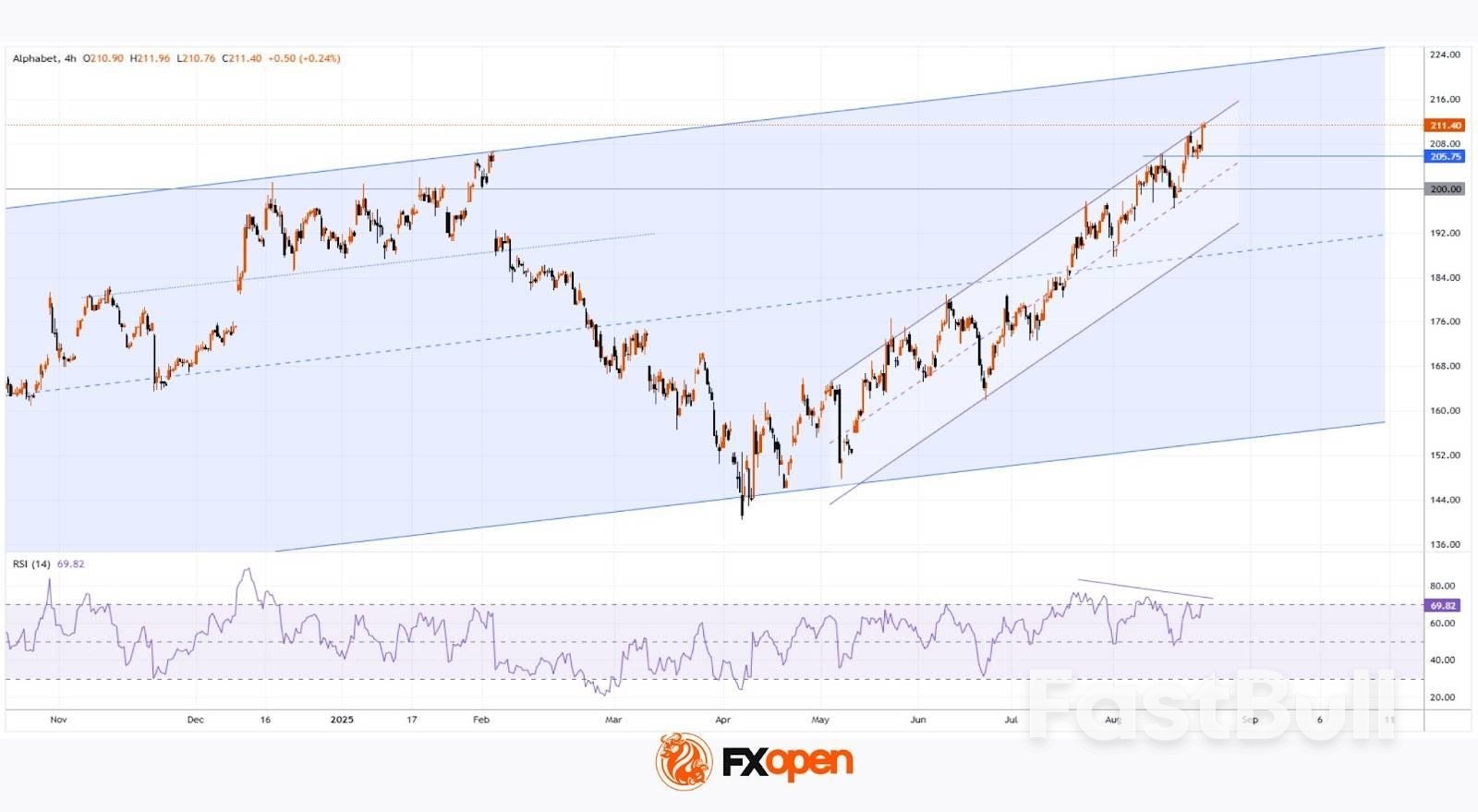
          As the chart of Alphabet shares shows, the price in August exceeded the February high. For the first time in history, the close price moved above $210.The positive market sentiment is being driven by the development of AI technologies, as well as Alphabet’s ambition to maintain a leading position in this field. Among the latest news, it is worth noting that Meta Platforms has signed an agreement to use Google Cloud’s infrastructure for its AI projects, which is expected to bring Alphabet around $10 billion in revenue.

          Technical Analysis of GOOGL Shares

          In the long-term context, price fluctuations are forming an ascending channel (shown in blue). After falling to the lower boundary in early April (when Trump first announced his tariffs), the balance of sentiment shifted, and the price has since been moving within a new medium-term ascending channel (shown in purple), approaching the upper boundary of the blue channel.

          At the same time, we can make the following observations, which generally point to a bullish market:
          → the price has confidently broken above the median line of the long-term channel;
          → the price has consolidated above the psychological level of $200, which acted as resistance at the start of the year;
          → this summer, the price has been trading near the upper boundary of the medium-term channel, highlighting strong demand – short-term declines towards the median line of the medium-term channel have quickly attracted buyers;
          → in August, the $205.75 level switched its role from resistance to support.

          From a bearish perspective, the RSI indicator is showing signs of divergence, suggesting that the rally may be running out of steam. However, it seems that more significant drivers would be needed to shift the current positive sentiment:

          → Technically, Alphabet’s share price reaching the upper boundary (which looks realistic given the bullish factors listed) could motivate buyers to take profits.

          → Major economic news, such as a change in the Federal Reserve’s interest rate policy.

          Source: FXOpen

          To stay updated on all economic events of today, please check out our Economic calendar
          Risk Warnings and Disclaimers
          You understand and acknowledge that there is a high degree of risk involved in trading. Following any strategies or investment methods may lead to potential losses. The content on the site is provided by our contributors and analysts for information purposes only. You are solely responsible for determining whether any trading assets, securities, strategy, or any other product is suitable for investing based on your own investment objectives and financial situation.
          Add to Favorites
          Share
          FastBull
          Copyright © 2025 FastBull Ltd

          728 RM B 7/F GEE LOK IND BLDG NO 34 HUNG TO RD KWUN TONG KLN HONG KONG

          TelegramInstagramTwitterfacebooklinkedin
          App Store Google Play Google Play
          Products
          Charts

          Chats

          Q&A with Experts
          Screeners
          Economic Calendar
          Data
          Tools
          Membership
          Features
          Function
          Markets
          Copy Trading
          Latest Signals
          Contests
          News
          Analysis
          24/7
          Columns
          Education
          Company
          Careers
          About Us
          Contact Us
          Advertising
          Help Center
          Feedback
          User Agreement
          Privacy Policy
          Business

          White Label

          Data API

          Web Plug-ins

          Poster Maker

          Affiliate Program

          Risk Disclosure

          The risk of loss in trading financial instruments such as stocks, FX, commodities, futures, bonds, ETFs and crypto can be substantial. You may sustain a total loss of the funds that you deposit with your broker. Therefore, you should carefully consider whether such trading is suitable for you in light of your circumstances and financial resources.

          No decision to invest should be made without thoroughly conducting due diligence by yourself or consulting with your financial advisors. Our web content might not suit you since we don't know your financial conditions and investment needs. Our financial information might have latency or contain inaccuracy, so you should be fully responsible for any of your trading and investment decisions. The company will not be responsible for your capital loss.

          Without getting permission from the website, you are not allowed to copy the website's graphics, texts, or trademarks. Intellectual property rights in the content or data incorporated into this website belong to its providers and exchange merchants.

          Not Logged In

          Log in to access more features

          FastBull Membership

          Not yet

          Purchase

          Become a signal provider
          Help Center
          Customer Service
          Dark Mode
          Price Up/Down Colors

          Log In

          Sign Up

          Position
          Layout
          Fullscreen
          Default to Chart
          The chart page opens by default when you visit fastbull.com