• Trade
  • Markets
  • Copy
  • Contests
  • News
  • 24/7
  • Calendar
  • Q&A
  • Chats
Trending
Screeners
SYMBOL
LAST
BID
ASK
HIGH
LOW
NET CHG.
%CHG.
SPREAD
SPX
S&P 500 Index
6827.42
6827.42
6827.42
6899.86
6801.80
-73.58
-1.07%
--
DJI
Dow Jones Industrial Average
48458.04
48458.04
48458.04
48886.86
48334.10
-245.98
-0.51%
--
IXIC
NASDAQ Composite Index
23195.16
23195.16
23195.16
23554.89
23094.51
-398.69
-1.69%
--
USDX
US Dollar Index
98.000
98.080
98.000
98.070
97.920
+0.050
+ 0.05%
--
EURUSD
Euro / US Dollar
1.17320
1.17327
1.17320
1.17447
1.17283
-0.00074
-0.06%
--
GBPUSD
Pound Sterling / US Dollar
1.33552
1.33563
1.33552
1.33740
1.33546
-0.00155
-0.12%
--
XAUUSD
Gold / US Dollar
4328.37
4328.82
4328.37
4329.64
4294.68
+28.98
+ 0.67%
--
WTI
Light Sweet Crude Oil
57.540
57.577
57.540
57.601
57.194
+0.307
+ 0.54%
--

Community Accounts

Signal Accounts
--
Profit Accounts
--
Loss Accounts
--
View More

Become a signal provider

Sell trading signals to earn additional income

View More

Guide to Copy Trading

Get started with ease and confidence

View More

Signal Accounts for Members

All Signal Accounts

Best Return
  • Best Return
  • Best P/L
  • Best MDD
Past 1W
  • Past 1W
  • Past 1M
  • Past 1Y

All Contests

  • All
  • Trump Updates
  • Recommend
  • Stocks
  • Cryptocurrencies
  • Central Banks
  • Featured News
Top News Only
Share

Hsi Closes Midday At 25736, Down 240 Pts, Hsti Closes Midday At 5537, Down 100 Pts, Hansoh Pharma Down Over 7%, Ping An, Youran Dairy, Logan Group Hit New Highs

Share

India Foreign Ministry: Foreign Minister To Visit United Arab Emirates And Israel

Share

Reuters Poll - Bank Of Thailand To Lower Key Policy Rate To 1.00% In Q1 Of 2026, Said A Majority Of Economists

Share

Reuters Poll - Bank Of Thailand To Cut Its Key Interest Rate To 1.25% On December 17, Said 26 Of 27 Economists

Share

Thai Finance Minister: Earlier Stimulus Measures To Shore Up Economy

Share

Thai Finance Minister: Strong Baht Driven By Capital Inflows

Share

Thai Finance Minister: Has Discussed With Central Bank To Handle Baht

Share

India's Nifty Bank Futures Down 0.1% In Pre-Open Trade

Share

India's Nifty 50 Futures Down 0.3% In Pre-Open Trade

Share

India's Nifty 50 Index Down 0.45% In Pre-Open Trade

Share

Indian Rupee Weakens Past 90.55 Versus USA Dollar To All-Time Low

Share

China's Fossil-Fuelled Power Generation Falls 4.2% Year-On-Year In November

Share

Indian Rupee Opens Down 0.1% At 90.5450 Per USA Dollar, Versus 90.4150 Previous Close

Share

Australia Home Minister: Father Involved In Bondi Gun Attack Came To Australia On Student Visa, Son Is An Australian-Born Citizen

Share

Australian Prime Minister Albanese: Stricter Gun Control Laws Will Include Restrictions On The Number Of Guns An Individual Can Own Or License To Use

Share

Australia's Prime Minister Albanese: We Are Considering A Review Of Gun Licenses For Some Time

Share

Australia's Prime Minister Albanese: Government Considering Tougher Gun Laws

Share

China Stats Bureau Spokesperson: Next Year, Adverse Impact Of Protectionism And Unilateralism May Continue

Share

China's Onshore Yuan Strengthens To A High Of 7.0516 Per Dollar, Strongest Level Since Oct 8, 2024

Share

Indonesia's November Refined Tin Exports At 7458.64 Metric Tons

TIME
ACT
FCST
PREV
U.K. Trade Balance (Oct)

A:--

F: --

P: --

France HICP Final MoM (Nov)

A:--

F: --

P: --

China, Mainland Outstanding Loans Growth YoY (Nov)

A:--

F: --

P: --

China, Mainland M2 Money Supply YoY (Nov)

A:--

F: --

P: --

China, Mainland M0 Money Supply YoY (Nov)

A:--

F: --

P: --

China, Mainland M1 Money Supply YoY (Nov)

A:--

F: --

P: --

India CPI YoY (Nov)

A:--

F: --

P: --

India Deposit Gowth YoY

A:--

F: --

P: --

Brazil Services Growth YoY (Oct)

A:--

F: --

P: --

Mexico Industrial Output YoY (Oct)

A:--

F: --

P: --

Russia Trade Balance (Oct)

A:--

F: --

P: --

Philadelphia Fed President Henry Paulson delivers a speech
Canada Building Permits MoM (SA) (Oct)

A:--

F: --

P: --

Canada Wholesale Sales YoY (Oct)

A:--

F: --

P: --

Canada Wholesale Inventory MoM (Oct)

A:--

F: --

P: --

Canada Wholesale Inventory YoY (Oct)

A:--

F: --

P: --

Canada Wholesale Sales MoM (SA) (Oct)

A:--

F: --

P: --

Germany Current Account (Not SA) (Oct)

A:--

F: --

P: --

U.S. Weekly Total Rig Count

A:--

F: --

P: --

U.S. Weekly Total Oil Rig Count

A:--

F: --

P: --

Japan Tankan Small Manufacturing Outlook Index (Q4)

A:--

F: --

P: --

Japan Tankan Large Non-Manufacturing Diffusion Index (Q4)

A:--

F: --

P: --

Japan Tankan Large Non-Manufacturing Outlook Index (Q4)

A:--

F: --

P: --

Japan Tankan Large Manufacturing Outlook Index (Q4)

A:--

F: --

P: --

Japan Tankan Small Manufacturing Diffusion Index (Q4)

A:--

F: --

P: --

Japan Tankan Large Manufacturing Diffusion Index (Q4)

A:--

F: --

P: --

Japan Tankan Large-Enterprise Capital Expenditure YoY (Q4)

A:--

F: --

P: --

U.K. Rightmove House Price Index YoY (Dec)

A:--

F: --

P: --

China, Mainland Industrial Output YoY (YTD) (Nov)

A:--

F: --

P: --

China, Mainland Urban Area Unemployment Rate (Nov)

A:--

F: --

P: --

Saudi Arabia CPI YoY (Nov)

--

F: --

P: --

Euro Zone Industrial Output YoY (Oct)

--

F: --

P: --

Euro Zone Industrial Output MoM (Oct)

--

F: --

P: --

Canada Existing Home Sales MoM (Nov)

--

F: --

P: --

Euro Zone Total Reserve Assets (Nov)

--

F: --

P: --

U.K. Inflation Rate Expectations

--

F: --

P: --

Canada National Economic Confidence Index

--

F: --

P: --

Canada New Housing Starts (Nov)

--

F: --

P: --

U.S. NY Fed Manufacturing Employment Index (Dec)

--

F: --

P: --

U.S. NY Fed Manufacturing Index (Dec)

--

F: --

P: --

Canada Core CPI YoY (Nov)

--

F: --

P: --

Canada Manufacturing Unfilled Orders MoM (Oct)

--

F: --

P: --

U.S. NY Fed Manufacturing Prices Received Index (Dec)

--

F: --

P: --

U.S. NY Fed Manufacturing New Orders Index (Dec)

--

F: --

P: --

Canada Manufacturing New Orders MoM (Oct)

--

F: --

P: --

Canada Core CPI MoM (Nov)

--

F: --

P: --

Canada Trimmed CPI YoY (SA) (Nov)

--

F: --

P: --

Canada Manufacturing Inventory MoM (Oct)

--

F: --

P: --

Canada CPI YoY (Nov)

--

F: --

P: --

Canada CPI MoM (Nov)

--

F: --

P: --

Canada CPI YoY (SA) (Nov)

--

F: --

P: --

Canada Core CPI MoM (SA) (Nov)

--

F: --

P: --

Canada CPI MoM (SA) (Nov)

--

F: --

P: --

Federal Reserve Board Governor Milan delivered a speech
U.S. NAHB Housing Market Index (Dec)

--

F: --

P: --

Australia Composite PMI Prelim (Dec)

--

F: --

P: --

Australia Services PMI Prelim (Dec)

--

F: --

P: --

Australia Manufacturing PMI Prelim (Dec)

--

F: --

P: --

Japan Manufacturing PMI Prelim (SA) (Dec)

--

F: --

P: --

U.K. Unemployment Rate (Nov)

--

F: --

P: --

U.K. 3-Month ILO Unemployment Rate (Oct)

--

F: --

P: --

Q&A with Experts
    • All
    • Chatrooms
    • Groups
    • Friends
    Connecting
    .
    .
    .
    Type here...
    Add Symbol or Code

      No matching data

      All
      Trump Updates
      Recommend
      Stocks
      Cryptocurrencies
      Central Banks
      Featured News
      • All
      • Russia-Ukraine Conflict
      • Middle East Flashpoint
      • All
      • Russia-Ukraine Conflict
      • Middle East Flashpoint
      Search
      Products

      Charts Free Forever

      Chats Q&A with Experts
      Screeners Economic Calendar Data Tools
      Membership Features
      Data Warehouse Market Trends Institutional Data Policy Rates Macro

      Market Trends

      Market Sentiment Order Book Forex Correlations

      Top Indicators

      Charts Free Forever
      Markets

      News

      News Analysis 24/7 Columns Education
      From Institutions From Analysts
      Topics Columnists

      Latest Views

      Latest Views

      Trending Topics

      Top Columnists

      Latest Update

      Signals

      Copy Rankings Latest Signals Become a signal provider AI Rating
      Contests
      Brokers

      Overview Brokers Assessment Rankings Regulators News Claims
      Broker listing Forex Brokers Comparison Tool Live Spread Comparison Scam
      Q&A Complaint Scam Alert Videos Tips to Detect Scam
      More

      Business
      Events
      Careers About Us Advertising Help Center

      White Label

      Data API

      Web Plug-ins

      Affiliate Program

      Awards Institution Evaluation IB Seminar Salon Event Exhibition
      Vietnam Thailand Singapore Dubai
      Fans Party Investment Sharing Session
      FastBull Summit BrokersView Expo
      Recent Searches
        Top Searches
          Markets
          News
          Analysis
          User
          24/7
          Economic Calendar
          Education
          Data
          • Names
          • Latest
          • Prev

          View All

          No data

          Scan to Download

          Faster Charts, Chat Faster!

          Download App
          English
          • English
          • Español
          • العربية
          • Bahasa Indonesia
          • Bahasa Melayu
          • Tiếng Việt
          • ภาษาไทย
          • Français
          • Italiano
          • Türkçe
          • Русский язык
          • 简中
          • 繁中
          Open Account
          Search
          Products
          Charts Free Forever
          Markets
          News
          Signals

          Copy Rankings Latest Signals Become a signal provider AI Rating
          Contests
          Brokers

          Overview Brokers Assessment Rankings Regulators News Claims
          Broker listing Forex Brokers Comparison Tool Live Spread Comparison Scam
          Q&A Complaint Scam Alert Videos Tips to Detect Scam
          More

          Business
          Events
          Careers About Us Advertising Help Center

          White Label

          Data API

          Web Plug-ins

          Affiliate Program

          Awards Institution Evaluation IB Seminar Salon Event Exhibition
          Vietnam Thailand Singapore Dubai
          Fans Party Investment Sharing Session
          FastBull Summit BrokersView Expo

          China RRR Cut: Significant PBOC Move to Boost Economy

          Michelle

          Forex

          Economic

          Summary:

          Big news from Beijing today! The People’s Bank of China (PBOC), the nation’s central bank, has just announced a significant move that could inject billions into the financial system and potentially send ripples across the global economy, including the ever-watchful crypto markets.

          Big news from Beijing today! The People’s Bank of China (PBOC), the nation’s central bank, has just announced a significant move that could inject billions into the financial system and potentially send ripples across the global economy, including the ever-watchful crypto markets. We’re talking about a 0.5% cut to the reserve requirement ratio (RRR) for financial institutions.

          This announcement, made by PBOC Governor Pan Gongsheng on May 7th, according to state-owned People’s Financial News, is a key piece of China RRR cut policy aimed at stimulating lending and bolstering economic activity. But what exactly does this mean, and why should anyone outside of China care?

          What Exactly is the RRR Cut and Why Does it Matter?

          Let’s break down this central banking jargon. The reserve requirement ratio (RRR) is the percentage of deposits that commercial banks and other financial institutions must hold as reserves, either in their vaults or on deposit at the central bank (the PBOC in this case). Think of it like a safety buffer or a mandated savings account for banks.

          When the PBOC cuts the RRR, it effectively lowers the amount of money banks are required to hold in reserve. This frees up more capital that banks can then lend out to businesses and consumers. It’s a classic tool of monetary easing – making it easier and potentially cheaper for money to flow through the economy.

          Why does it matter? In simple terms, a lower RRR means:

          • More Money Available for Lending: Banks have more funds at their disposal.
          • Potential for Lower Interest Rates: Increased supply of loanable funds can put downward pressure on borrowing costs.
          • Stimulus for the Economy: Cheaper and more accessible credit can encourage investment, spending, and business expansion.

          For a massive economy like China’s, even a 0.5% cut can release a substantial amount of liquidity into the system. Estimates often place the amount of freed-up capital in the hundreds of billions of yuan.

          Why is the PBOC Implementing This Monetary Easing Now?

          Central banks don’t cut the RRR just because. Such a move is typically a response to economic conditions and a forward-looking attempt to steer the economy in a desired direction. While the official reasons provided by the PBOC might be framed around maintaining ample liquidity and supporting credit growth, the underlying context is often related to the health and pace of the China economy.

          Recent economic data from China has shown signs of uneven recovery post-pandemic. While some sectors perform well, others, particularly property and domestic consumption, have faced headwinds. Export growth has also seen fluctuations.

          By implementing this monetary easing, the PBOC is signaling its commitment to providing support to the economy. It’s a proactive step designed to counter potential slowdowns, boost confidence, and ensure that businesses have access to the funding they need to invest and hire, and that consumers feel confident enough to spend.

          Consider these potential drivers for the decision:

          • Supporting Economic Growth Targets: China sets annual GDP growth targets, and the PBOC’s policies are crucial in helping achieve them.
          • Addressing Deflationary Pressures: Sometimes, RRR cuts are used to combat falling prices by stimulating demand.
          • Stabilizing Key Sectors: Providing liquidity can help distressed sectors, though the impact on specific areas like property might be limited without targeted measures.

          This move is part of a broader toolkit the PBOC uses, alongside adjusting interest rates and other liquidity operations.

          How Could This PBOC Move Ripple Through the Global Economy?

          China isn’t just a large economy; it’s a global economic powerhouse. Its policies have significant international implications. A China RRR cut doesn’t happen in a vacuum; its effects can be felt far beyond its borders.

          Here are a few ways this monetary easing could influence the rest of the world:

          1. Impact on Commodity Markets: As a major consumer of raw materials, increased economic activity in China (driven by more lending and investment) can lead to higher demand for commodities like oil, metals, and agricultural products. This can influence global prices.

          2. Currency Movements: Monetary easing in China can potentially lead to a weaker yuan relative to other currencies as liquidity increases. This can affect trade dynamics and capital flows.

          3. Capital Flows and Investment: Increased global liquidity originating from China could seek opportunities abroad, potentially flowing into emerging markets or even developed economies, depending on investor sentiment and relative returns.

          4. Demand for Goods and Services: A healthier China economy means stronger demand for imported goods and services from other countries, benefiting trading partners.

          Essentially, when the world’s second-largest economy makes a move to boost its internal engines, the vibrations are felt globally through trade, finance, and market sentiment.

          What Does China’s Monetary Easing Mean for Crypto?

          Now, let’s get to the question many in our audience are likely asking: How does a central bank policy in China, seemingly unrelated to digital assets, potentially impact the crypto market?

          The connection is often indirect but significant, primarily through the lens of global liquidity and risk appetite.

          Here’s the thinking:

          • Increased Global Liquidity: When a major central bank like the PBOC injects liquidity into its system, it adds to the overall pool of money circulating globally. While much of this stays within China, some can find its way into international markets and various asset classes, including potentially riskier ones like cryptocurrencies.
          • Search for Yield/Returns: In an environment where traditional assets might offer lower returns due to easing policies (both in China and potentially elsewhere), investors might look towards alternative assets like crypto for higher potential gains.
          • Market Sentiment: A proactive easing measure from China can be interpreted in different ways. It could be seen positively as a sign that authorities are serious about supporting growth, boosting overall market confidence. Conversely, it could be seen negatively if it suggests the underlying economic problems are more severe than previously thought, leading to risk-off sentiment.
          • Comparison to Other Central Banks: As other major central banks (like the US Federal Reserve or the European Central Bank) contemplate their own monetary policies, China’s actions provide a point of comparison and can influence the global macroeconomic narrative that often impacts crypto valuations.

          It’s crucial to understand that this isn’t a direct pipeline from the PBOC to Bitcoin’s price. The impact is nuanced, filtered through global financial markets, investor psychology, and the specific dynamics of the crypto ecosystem. However, changes in the tide of global liquidity are always relevant for assets like crypto that operate on a global scale and are sensitive to macroeconomic shifts.

          Challenges and Potential Downsides

          While the intention behind the China RRR cut is positive – to stimulate the economy – such measures aren’t without potential drawbacks:

          • Inflationary Risks: Injecting too much liquidity can, in some scenarios, lead to inflationary pressures if not managed carefully.
          • Asset Bubbles: Easier credit could potentially fuel excessive speculation in certain asset classes, like real estate or stocks, leading to bubbles.
          • Effectiveness: The impact of an RRR cut depends on various factors, including banks’ willingness to lend, businesses’ appetite to borrow and invest, and consumer confidence. If underlying demand is weak, the effect might be muted.
          • Debt Levels: China already faces significant debt levels, particularly in the corporate and local government sectors. More lending, while intended to boost growth, could exacerbate debt risks if not channeled productively.

          These challenges mean that while the RRR cut is a notable event, its ultimate success depends on a confluence of factors and complementary policies.

          Actionable Insights (Not Financial Advice!)

          For those tracking markets, including crypto:

          • Monitor China’s Economic Data: Keep an eye on future releases regarding lending, investment, consumption, and GDP growth to gauge the effectiveness of this easing measure.
          • Watch Global Market Reactions: Observe how global equity, bond, and commodity markets respond to this news and subsequent data points from China.
          • Assess Global Liquidity Trends: Consider the PBOC’s action in the broader context of monetary policies being pursued (or considered) by other major central banks. Changes in overall global liquidity can influence risk asset performance.
          • Understand Nuance: Avoid drawing simplistic, direct lines between the RRR cut and specific asset price movements. The relationship is complex and influenced by many variables.

          Conclusion: A Significant Step in China’s Monetary Policy

          The 0.5% China RRR cut announced by the PBOC is a significant step in its ongoing efforts to support the China economy through monetary easing. By freeing up capital for lending, the central bank aims to stimulate investment, consumption, and overall growth.

          While primarily focused on domestic objectives, this action contributes to the pool of global liquidity and can have ripple effects on international markets, including potential indirect influences on the crypto landscape. As with any major policy intervention, its ultimate success and full impact will unfold over time, requiring careful observation of economic data and market responses.

          This move underscores the interconnectedness of the global financial system and highlights how actions by major central banks, even those seemingly distant from the world of digital assets, can be relevant for understanding broader market dynamics.

          Source: CryptoSlate

          To stay updated on all economic events of today, please check out our Economic calendar
          Risk Warnings and Disclaimers
          You understand and acknowledge that there is a high degree of risk involved in trading. Following any strategies or investment methods may lead to potential losses. The content on the site is provided by our contributors and analysts for information purposes only. You are solely responsible for determining whether any trading assets, securities, strategy, or any other product is suitable for investing based on your own investment objectives and financial situation.
          Add to Favorites
          Share

          Capital Rotates to Europe and Japan as Trump’s Tariff Escalation Triggers Flight from U.S. Markets

          Gerik

          Economic

          China–U.S. Trade War

          Investor Sentiment Sours on U.S. Amid Tariff Turbulence

          In the week ending April 30, global investors responded decisively to rising geopolitical and trade tensions emanating from the United States. Bank of America (BofA) reported a staggering $8.9 billion outflow from U.S. equities during that week alone, as markets digested President Donald Trump’s rapidly evolving tariff strategy. The exodus reflects a growing lack of confidence in the U.S. market’s near-term stability, as erratic policymaking continues to unsettle investor expectations.
          Since the 2024 presidential election, every $100 of capital flowing into American stocks has now seen $5 pulled back out over just three weeks, suggesting a swift shift in portfolio preferences. The retreat coincides with a volatile phase in which Trump launched a series of sweeping tariffs under the banner of “Liberation Day,” targeting key partners such as China, the European Union, and the United Kingdom. This re-ignited trade war has injected fresh uncertainty into both corporate earnings forecasts and macroeconomic outlooks.

          Europe and Japan Attract Capital as Safe Havens and Opportunity Zones

          The capital leaving the U.S. is not going to the sidelines—it is being redeployed across international markets. Japanese equities received $4.4 billion in inflows, their strongest weekly gain since April 2024, while European equities attracted an additional $3.4 billion. These figures suggest investors are not simply de-risking but actively reallocating capital toward perceived regions of economic stability or undervalued opportunity.
          Japan’s inflow may reflect confidence in the country’s relatively stable monetary policy and a more contained inflation outlook, while Europe’s attraction likely stems from improved earnings momentum in cyclical sectors and relief from direct trade confrontation with Washington. This geographic diversification also mirrors broader strategies among global fund managers seeking to shield portfolios from the concentrated geopolitical exposure of the U.S. market.

          Risk-On Mood Emerges Despite Trade Shock

          Surprisingly, even as traditional U.S. assets such as Treasury bonds and gold saw a combined outflow of $6 billion, capital surged into higher-risk instruments. Cryptocurrencies absorbed $2.3 billion in new inflows, and high-yield bonds garnered $3.9 billion, indicating that some investors are opportunistically seeking alpha amid the dislocation.
          Rather than suggesting panic, these inflows into speculative assets signal a more nuanced investor mood. Market participants appear to be selectively reallocating—shunning politically volatile environments while still embracing risk where valuation or momentum seems favorable. This duality reflects the coexistence of concern over U.S. deflation with a search for yield in underexplored corners of the market.

          Shift Toward Deflation-Protective Assets Reveals Changing Macro Expectations

          Bank of America’s client data further illustrates a change in economic sentiment. With $3.7 trillion in managed assets, its private clients have begun repositioning toward sectors typically considered defensive under deflationary conditions. Utilities and low-volatility, high-dividend ETFs are gaining popularity, while traditional inflation hedges—such as TIPS (Treasury Inflation-Protected Securities), financial sector ETFs, and debt instruments—are being shed.
          This rotation suggests that concerns over inflation have waned, replaced by fears of slowing demand, softening corporate margins, and a cooling labor market. The shift in investor behavior is rooted not only in reaction to tariffs, but also in anticipation of a Federal Reserve that may delay further tightening or even resume easing.

          U.S. Market Volatility Drives Global Portfolio Realignment

          Trump’s trade actions and conflicting policy signals have created a climate of uncertainty that is reshaping global capital flows. As U.S. markets become increasingly sensitive to political headlines, investors are recalibrating their risk exposure by moving into geographies and asset classes perceived to be less vulnerable to American policy disruptions.
          Whether this realignment marks a temporary rotation or the start of a longer-term trend depends on the evolution of U.S. fiscal and trade policies, and how effectively other economies sustain their current appeal. For now, the message from the markets is clear: confidence is conditional, and capital will follow stability.

          Source: CNBC

          To stay updated on all economic events of today, please check out our Economic calendar
          Risk Warnings and Disclaimers
          You understand and acknowledge that there is a high degree of risk involved in trading. Following any strategies or investment methods may lead to potential losses. The content on the site is provided by our contributors and analysts for information purposes only. You are solely responsible for determining whether any trading assets, securities, strategy, or any other product is suitable for investing based on your own investment objectives and financial situation.
          Add to Favorites
          Share

          Why Indian Markets Are Undeterred By Strikes Against Pakistan

          Diana Wallace

          Political

          Bond

          Pakistani soldiers take security measures around the city as the people panic during blackout after India launches strikes on Pakistan, in Muzaffarabad, Pakistan on May 7, 2025.

          Investors are sticking with the India story, with optimism on its growth prospects dwarfing geopolitical fears.
          Indian markets shrugged off the latest tensions with Islamabad after New Delhi struck several targets within territory controlled by Pakistan in a military operation early Wednesday.
          "Structural reforms, resilient domestic demand, and strong macro fundamentals continue to offer a compelling case," said Mohit Mirpuri, an equity fund manager at SGMC Capital.
          "Investors may take a momentary pause, but this doesn't derail India's trajectory as a key allocation in emerging markets," added Mirpuri.
          Markets also appeared to be drawing support from the progress on India's trade talks with major trading partners, including a free trade agreement with the U.K. sealed Tuesday.
          The country is expected to be among the first in the region to strike a bilateral trade deal with the U.S., potentially before the third quarter of 2025, said Radhika Rao, a Singapore-based senior economist at DBS Bank.
          "We believe Indian assets will remain fairly contained despite the increase in geopolitical tensions with Pakistan," said Johanna Chua, global head of emerging market economics at Citi, in a note to clients shortly after India carried out the strikes.
          Chua said there were historical precedents for her team's views and pointed to investors' reaction in 2019, in the aftermath of the Pulwama attack where 40 Indian security personnel were killed in an ambush.
          Currency markets were "fairly contained" and 10-year Indian government bond yields traded within a range of 15 basis points despite an election year and interest rate cutting environment.
          While anticipating some knee-jerk market reaction, investors are hopeful for a swift de-escalation that could limit the fallout.
          Indian shares traded nearly flat in the wake of the military operation, having declined in the previous session.
          The benchmark Nifty 50 and the BSE Sensex were little changed, signaling investors so far were not perturbed by tensions between the two nuclear-armed countries. Though experts did not rule out a sharper market impact if the conflict escalated.
          Indian equities could still see some volatility over the near term with downside risks, followed by a gradual recovery, said Kranthi Bathini, director of equity strategy at WealthMills Securities.
          "The key question is whether this turns into a full-fledged conflict or remains a limited defense strike," Bathini said. "A wider escalation could dent investor sentiment, while a contained response may barely leave a mark on the markets, he said.
          The rupee weakened 0.33% to 84.562 against the greenback amid a broader depreciation across Asian currencies, though it was still hovering near three-month highs.
          Yield on Indian 10-year benchmark government bonds was marginally lower at 6.339%.

          Source: CNBC

          Risk Warnings and Disclaimers
          You understand and acknowledge that there is a high degree of risk involved in trading. Following any strategies or investment methods may lead to potential losses. The content on the site is provided by our contributors and analysts for information purposes only. You are solely responsible for determining whether any trading assets, securities, strategy, or any other product is suitable for investing based on your own investment objectives and financial situation.
          Add to Favorites
          Share

          China Unleashes Sweeping Monetary Easing to Counter Trade War Strain and Domestic Slowdown

          Gerik

          Economic

          China–U.S. Trade War

          PBOC Announces Broad-Based Stimulus to Reinforce Growth

          On May 6, 2025, the People’s Bank of China (PBOC) announced a decisive policy shift with a series of coordinated easing measures. At the center of the move is a 10 basis point reduction in the seven-day reverse repurchase rate, lowering it to 1.4%, which in turn brings down the nation’s benchmark loan prime rate. In parallel, the reserve requirement ratio (RRR) will be slashed by 50 basis points, releasing approximately 1 trillion yuan (about $138.6 billion) into the banking system to stimulate lending and improve market liquidity.
          These actions come amid increasing economic uncertainty driven by the resurgence of trade tensions with the United States. President Donald Trump’s imposition of tariffs as high as 145% on Chinese goods—and Beijing’s retaliation with 125% tariffs—has pushed Chinese policymakers to adopt a more forceful monetary stance. The timing of these announcements, just ahead of a planned meeting in Switzerland between Chinese Vice Premier He Lifeng and U.S. Treasury Secretary Scott Bessent, underscores China’s attempt to stabilize the domestic economy even as it re-engages diplomatically.

          Targeted Measures to Support Real Estate, Tech, and Consumption

          In addition to the headline rate cuts, PBOC introduced a range of sector-specific tools to revive weak spots in the economy. A 500-billion-yuan relending facility has been established to finance consumption and elderly care, while mortgage rates for first-time homebuyers under the state-run housing provident fund were cut by 25 basis points to 2.6%. These steps signal renewed attention to the struggling real estate sector, which has been a key drag on China’s economic momentum.
          Auto financing companies will also benefit from a phased reduction in reserve requirements—from 5% to zero—freeing up capital and encouraging credit expansion. While these actions indicate targeted fiscal loosening, economists note a potential constraint: domestic credit demand remains muted. As Tianchen Xu of the Economist Intelligence Unit observes, borrowing behavior has shown limited responsiveness to past rate cuts, raising questions about the efficacy of purely monetary solutions.

          Macroeconomic Backdrop: Stabilizing Currency and Market Sentiment

          China’s offshore yuan, which had weakened to a historic low of 7.4287 against the U.S. dollar earlier this month, has stabilized near the 7.22 level following the policy announcement. Analysts interpret this stabilization as a key enabler of the rate cuts. According to Zhiwei Zhang of Pinpoint Asset Management, reduced depreciation pressure gives the PBOC greater latitude to ease without triggering capital outflows or further currency instability.
          Still, observers point out that while monetary easing may shore up sentiment in the short term, fiscal policy remains conspicuously absent from the current mix. Analysts such as Lynn Song from ING suggest that Beijing may be reserving stronger fiscal interventions for scenarios where economic data reveals deeper structural weakness. His projections include an additional 20 basis points in interest rate cuts and another 50-basis-point reduction in the RRR before year-end, but likely only after the U.S. Federal Reserve resumes its own easing cycle.

          Trade War Escalation Adds Pressure for Policy Coordination

          The latest economic interventions come as trade tensions reach new highs. The confirmed Switzerland meeting between Vice Premier He Lifeng and Secretary Bessent will be the first formal dialogue between Beijing and Washington since Trump reignited tariff hostilities. With trade between the two nations severely impaired, these talks represent a potential inflection point—but confidence remains low due to the scale of the tariffs and the unpredictability of U.S. policy rhetoric.
          China’s current monetary stance appears to serve two parallel purposes: cushioning domestic sectors from external shocks and creating a more favorable macroeconomic environment ahead of critical trade negotiations. However, the absence of synchronized fiscal support may reduce the long-term potency of these measures unless reinforced by broader economic stimulus strategies.
          The policy announcements on May 6 mark a clear pivot from Beijing’s earlier, more restrained approach to stimulus. In contrast to the piecemeal responses earlier this year, the new measures reflect growing concern among top officials over deflationary signals, waning investor confidence, and the long-term implications of trade decoupling. While market reactions have been cautiously optimistic, the road to stabilization will depend heavily on sustained consumer activity, global demand resilience, and the outcomes of looming diplomatic encounters.

          Source: CNBC

          To stay updated on all economic events of today, please check out our Economic calendar
          Risk Warnings and Disclaimers
          You understand and acknowledge that there is a high degree of risk involved in trading. Following any strategies or investment methods may lead to potential losses. The content on the site is provided by our contributors and analysts for information purposes only. You are solely responsible for determining whether any trading assets, securities, strategy, or any other product is suitable for investing based on your own investment objectives and financial situation.
          Add to Favorites
          Share

          Canadian Manufacturers Reorient Trade Strategies Amid U.S. Tariff Strain and Political Uncertainty

          Gerik

          Economic

          Decades-Long Trade Reliance Disrupted by Tariff Surge

          The trade relationship between Canada and the United States—once among the world’s most stable bilateral partnerships—is now undergoing fundamental change. Following President Donald Trump’s intensification of protectionist measures, Canadian manufacturers are actively reconsidering their commercial priorities. According to data released in early May 2025, global firms operating across sectors such as pharmaceuticals, automotive components, and specialized consumer goods are searching for alternatives to U.S. markets, citing instability and increased costs.
          In the first quarter of 2025, a 25% tariff on steel and aluminum imports was followed by an equivalent tariff on automotive goods that did not comply with the revised North American free trade guidelines. Though these measures stopped short of full reciprocal tariffs, their uneven implementation and political volatility have forced Canadian businesses to question the long-term viability of their southern trade routes.

          Realignment in Strategy Reflects Institutional Demand for Predictability

          Canada has long relied on the U.S. for roughly 75% of its exports, and its manufacturing sector is deeply tied to cross-border supply chains. The Canadian government reports that 42% of manufacturing output is sold into the U.S. and 41% of the industry’s 1.7 million workers depend directly or indirectly on U.S. trade. Despite this deep interdependence, firms are increasingly acting to mitigate exposure. Several companies interviewed by Reuters have confirmed redirection of resources and strategic planning toward markets in Asia and beyond.
          This reorientation is driven not merely by tariffs themselves, but by the erratic nature of trade policy emanating from Washington. Prime Minister Mark Carney, elected on a platform to defend Canada’s sovereignty and economic stability, has declared that the traditional U.S.-Canada relationship is over. While his administration remains open to new trade frameworks, trust in the reliability of U.S. policy has eroded significantly.

          Emerging Trade Corridors Gain Traction

          PNP Pharmaceuticals, a contract drug manufacturer based in British Columbia, has begun seeking new partnerships in Asia, reflecting a growing trend of diversification. Although it currently faces no direct tariffs, LabelPak Printing Inc., another B.C.-based company that distributes packaging sourced from Asia, is planning to reduce its U.S. exposure, which currently accounts for 15% of its sales.
          These cases illustrate how firms are not waiting for retaliatory measures to act—they are proactively restructuring sales pipelines and client bases to insulate themselves from volatility. The move away from U.S. dependence is less a reaction to one policy than to the cumulative effect of uncertainty and unilateralism in recent trade governance.

          Political Discourse Fuels Commercial Hesitation

          Comments from the White House have further fueled business anxiety. Spokesman Kush Desai’s statement that tariffs “won’t be a problem when Canada becomes our cherished 51st state” was widely interpreted as a dismissive gesture toward Canada’s sovereignty and a troubling signal for serious economic diplomacy. Such rhetoric exacerbates investor concerns about the sustainability of cross-border relationships in a charged political environment.
          Moreover, Trump's attempt to justify the tariffs on Canada by linking them to fentanyl trafficking—despite evidence showing Canadian sources account for less than 1% of seizures—has been met with skepticism. Trade lawyers and advisors argue that the policy lacks coherence and appears driven more by political theater than by measurable risk.

          Outlook: Stability as the New Trade Premium

          For now, Canadian companies are prioritizing stability over scale. Many have accepted the near-term costs of reconfiguration in exchange for longer-term risk mitigation. As one trade consultant put it, “Owners want stability, banks want stability, private equity wants stability.” In this environment, the perceived reliability of a trading partner is becoming as valuable as tariff rates or profit margins.
          With manufacturing output and employment so heavily tied to external markets, Canada's export community is undergoing a significant recalibration. Whether the U.S. remains a central player or is gradually displaced by a multipolar trade strategy will depend on how policy evolves on both sides of the border in the coming months.

          Source: Reuters

          To stay updated on all economic events of today, please check out our Economic calendar
          Risk Warnings and Disclaimers
          You understand and acknowledge that there is a high degree of risk involved in trading. Following any strategies or investment methods may lead to potential losses. The content on the site is provided by our contributors and analysts for information purposes only. You are solely responsible for determining whether any trading assets, securities, strategy, or any other product is suitable for investing based on your own investment objectives and financial situation.
          Add to Favorites
          Share

          Global Trade Realigns as Countries Bypass U.S. Amid Trump’s Protectionist Stance

          Gerik

          Economic

          U.S. Leadership in Question as Trade Partners Look Elsewhere

          The global trade environment is undergoing significant restructuring as countries respond to the United States' increasingly erratic approach to economic diplomacy under President Donald Trump. Despite ongoing negotiations—such as upcoming trade talks between U.S. and Chinese officials in Switzerland—key economies are moving forward with new trade deals that notably exclude the U.S. This shift signals a broader trend toward trade diversification and reduced dependence on American demand, with nations choosing to hedge against U.S. unpredictability rather than wait for clarity.
          Trump’s statement during his May 6 meeting with Canadian Prime Minister Mark Carney—“They want a piece of our market. We don’t want a piece of their market”—directly undermines assurances from his own administration that trade deals remain a strategic priority. Financial markets reacted negatively to this rhetoric, as all major U.S. indices closed lower on Tuesday. The inconsistency between the White House’s stated goals and the president’s messaging is becoming a source of concern not only for allies but also for investors.

          New Bilateral Deals Signal a Bypassing of the U.S.

          A clear example of this new trade reality is the bilateral agreement signed between the United Kingdom and India. This deal will gradually eliminate tariffs on the majority of goods over the next ten years, with India slashing import duties on whisky and cars while the U.K. will remove tariffs on more than 99% of imports. Notably, this agreement reflects a growing preference for stable, mutually beneficial arrangements that circumvent U.S. uncertainty.
          Likewise, ASEAN members and China are scheduled to meet on May 19 to discuss updates to their own free trade framework. These developments suggest a reconfiguration of global trade alliances, with the Asia-Pacific region accelerating its internal economic integration even as Washington pivots inward.

          China’s Economic Stimulus and Market Optimism

          Meanwhile, China is reinforcing its domestic economy through monetary easing. On May 7, the People's Bank of China announced a 10 basis point cut in the seven-day reverse repurchase rate, reducing it to 1.4%, and lowered the reserve requirement ratio by 50 basis points. This move injects roughly $138.6 billion in liquidity into the banking system, signaling a proactive stance to support growth amid external pressures and shifting trade dynamics.
          Asian markets responded positively to the news, with the Hang Seng Index in Hong Kong rising by as much as 2% before paring gains. China’s internal stability and expanding domestic consumption—particularly in travel and tourism—are becoming anchors of regional confidence at a time when U.S. reliability as a trading partner is under scrutiny.

          Geopolitical Tensions Add Further Complexity

          Adding to the geopolitical complexity, India announced military strikes against targets in Pakistan-administered Jammu and Kashmir. This move, a response to recent militant attacks, could inject additional volatility into regional diplomacy and investor sentiment. However, India’s concurrent engagement in strategic trade partnerships reflects its dual approach of asserting military strength while deepening economic cooperation elsewhere.
          JPMorgan strategist Mislav Matejka recently warned that the U.S. may no longer serve as a financial safe haven in the event of a global downturn. Post-pandemic, U.S. markets had significantly outperformed peers, but the current blend of political inconsistency, trade friction, and fiscal uncertainty is beginning to erode investor confidence. These sentiments are amplified by the $800 billion cost impact on companies like AMD due to restrictions on AI chip exports to China, reinforcing fears of prolonged fragmentation in tech supply chains.
          The combination of Trump’s confrontational trade stance, unilateral policymaking, and strategic incoherence is catalyzing a shift toward a more multipolar trade order. Countries are striking new deals, forging regional alliances, and investing in domestic economic resilience—developments that collectively reduce the centrality of U.S. markets in global trade. While Washington remains economically powerful, its diminishing diplomatic predictability is prompting a global recalibration that may have lasting implications.

          Source: CNBC

          To stay updated on all economic events of today, please check out our Economic calendar
          Risk Warnings and Disclaimers
          You understand and acknowledge that there is a high degree of risk involved in trading. Following any strategies or investment methods may lead to potential losses. The content on the site is provided by our contributors and analysts for information purposes only. You are solely responsible for determining whether any trading assets, securities, strategy, or any other product is suitable for investing based on your own investment objectives and financial situation.
          Add to Favorites
          Share

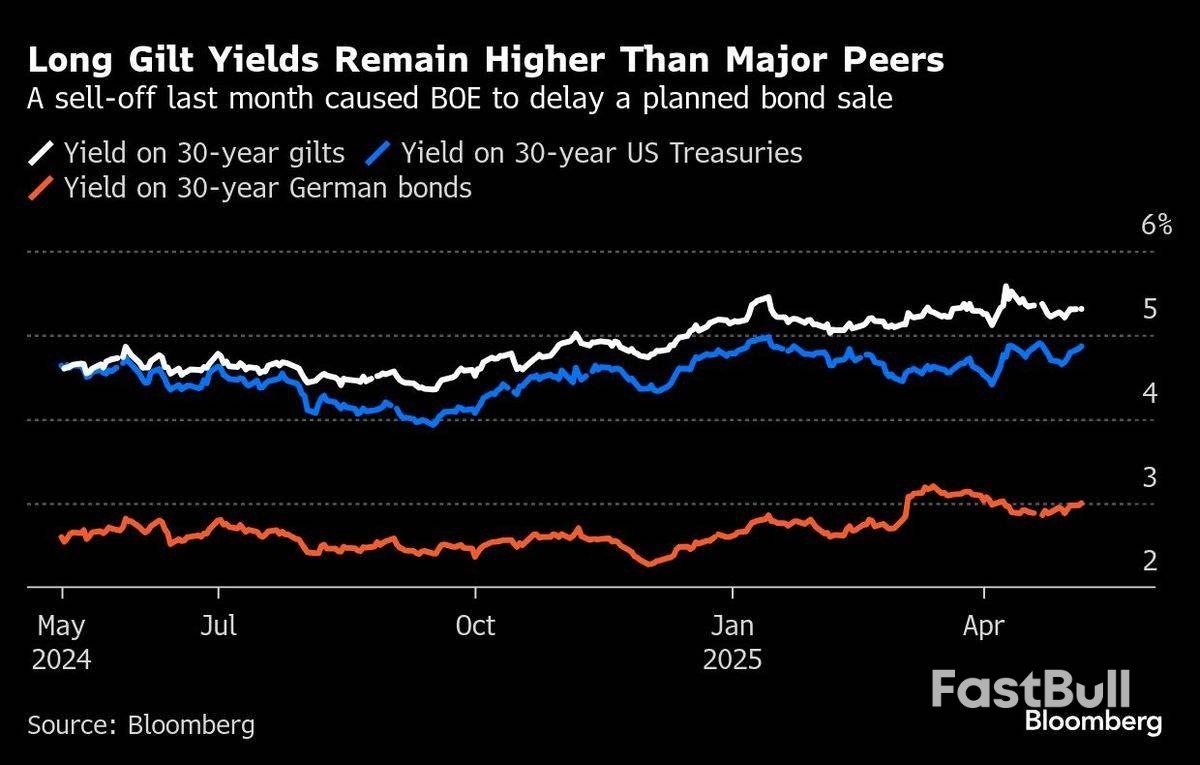
          UK Market Volatility Adds To Bets BOE Will Pause Bond Sales

          Catherine Richards

          Economic

          Central Bank

          Investors will seek clues over the future of the Bank of England's (BOE) bond-selling programme at its monetary policy meeting on Thursday, amid speculation that recent market turmoil may encourage officials to cease it later this year.
          Strategists at Bank of America Corp and BNP Paribas SA are bullish on long-maturity gilts in a bet that the BOE could stop the bond sales from October. That view is growing after the central bank's unusual decision to delay an auction of securities last month in the wake of global market turbulence.
          The bond sales are part of BOE's efforts to unwind its vast stimulus since the financial crisis and the pandemic. While it may be too early for officials to give a firm steer on the future of this so-called active quantitative tightening, any commentary will be studied ahead of a decision expected in September.
          “The Bank is keeping a close eye on market fragility and may be coming round to the idea that QT is having a more meaningful impact on the market,” said Bank of America strategists including Agne Stengeryte. They recommend buying 30-year gilts versus equivalent interest-rate swaps on the prospect of sales stopping.
          The country's 30-year debt has been buffeted the most by political and economic turmoil in recent years, as demand from traditional investors such as pension funds wanes. That led the UK's Debt Management Office to announce a historic skew away from longer-maturity debt this year, a move that supported the market.
          While the central bank has repeatedly said its QT programme has had minimal market impact, it temporarily halted the sale of long-dated bonds in April in “light of recent market volatility”. The BOE's chief economist Huw Pill said that reflected a “tactical approach”, adding that there is a question over whether QT may exacerbate rises in bond yields in times of market stress.
          “We have seen both the BOE and the DMO adapting to the recent market volatility, showing transparency and flexibility as they take steps to shield the gilt market from unjustified international pressure,” said a BNP Paribas team including Katherine Yoon. They now expect the BOE to pause its active gilt sales this year, citing it as a reason for their positive stance on long-maturity gilts.
          The BOE is not scheduled to share its quantitative-tightening plan for the year starting in October until the month beforehand, though officials have guided investors leading up to such decisions in the past.
          Policymakers use a mix of actively selling bonds and stopping reinvestments upon maturity to reduce the BOE’s balance sheet. Last year, officials voted to reduce its Asset Purchase Facility portfolio by £100 billion (US$134 billion or RM566.48 billion) over 12 months. Active sales accounted for £13 billion of that, with redemptions making up the rest.
          The BOE's decision later this year will follow the Federal Reserve slowing its QT programme. In March, the US central bank slashed its cap for how much in Treasuries it lets roll off its balance sheet every month to US$5 billion, from US$25 billion.
          “The way gilts have been caught up in US Treasury volatility is bound to pose questions about active QT, especially beyond September,” said Citigroup Inc strategists including Jamie Searle. “Long-end gilts may find a little comfort if the BOE reaffirms that ongoing QT is subject to market conditions and targeted QE is still a backstop.”

          Source: Theedgemarkets

          To stay updated on all economic events of today, please check out our Economic calendar
          Risk Warnings and Disclaimers
          You understand and acknowledge that there is a high degree of risk involved in trading. Following any strategies or investment methods may lead to potential losses. The content on the site is provided by our contributors and analysts for information purposes only. You are solely responsible for determining whether any trading assets, securities, strategy, or any other product is suitable for investing based on your own investment objectives and financial situation.
          Add to Favorites
          Share
          FastBull
          Copyright © 2025 FastBull Ltd

          728 RM B 7/F GEE LOK IND BLDG NO 34 HUNG TO RD KWUN TONG KLN HONG KONG

          TelegramInstagramTwitterfacebooklinkedin
          App Store Google Play Google Play
          Products
          Charts

          Chats

          Q&A with Experts
          Screeners
          Economic Calendar
          Data
          Tools
          Membership
          Features
          Function
          Markets
          Copy Trading
          Latest Signals
          Contests
          News
          Analysis
          24/7
          Columns
          Education
          Company
          Careers
          About Us
          Contact Us
          Advertising
          Help Center
          Feedback
          User Agreement
          Privacy Policy
          Business

          White Label

          Data API

          Web Plug-ins

          Poster Maker

          Affiliate Program

          Risk Disclosure

          The risk of loss in trading financial instruments such as stocks, FX, commodities, futures, bonds, ETFs and crypto can be substantial. You may sustain a total loss of the funds that you deposit with your broker. Therefore, you should carefully consider whether such trading is suitable for you in light of your circumstances and financial resources.

          No decision to invest should be made without thoroughly conducting due diligence by yourself or consulting with your financial advisors. Our web content might not suit you since we don't know your financial conditions and investment needs. Our financial information might have latency or contain inaccuracy, so you should be fully responsible for any of your trading and investment decisions. The company will not be responsible for your capital loss.

          Without getting permission from the website, you are not allowed to copy the website's graphics, texts, or trademarks. Intellectual property rights in the content or data incorporated into this website belong to its providers and exchange merchants.

          Not Logged In

          Log in to access more features

          FastBull Membership

          Not yet

          Purchase

          Become a signal provider
          Help Center
          Customer Service
          Dark Mode
          Price Up/Down Colors

          Log In

          Sign Up

          Position
          Layout
          Fullscreen
          Default to Chart
          The chart page opens by default when you visit fastbull.com