• Trade
  • Markets
  • Copy
  • Contests
  • News
  • 24/7
  • Calendar
  • Q&A
  • Chats
Trending
Screeners
SYMBOL
LAST
BID
ASK
HIGH
LOW
NET CHG.
%CHG.
SPREAD
SPX
S&P 500 Index
6846.50
6846.50
6846.50
6878.28
6827.18
-23.90
-0.35%
--
DJI
Dow Jones Industrial Average
47739.31
47739.31
47739.31
47971.51
47611.93
-215.67
-0.45%
--
IXIC
NASDAQ Composite Index
23545.89
23545.89
23545.89
23698.93
23455.05
-32.22
-0.14%
--
USDX
US Dollar Index
99.000
99.080
99.000
99.000
99.000
+0.050
+ 0.05%
--
EURUSD
Euro / US Dollar
1.16370
1.16379
1.16370
1.16388
1.16322
+0.00006
+ 0.01%
--
GBPUSD
Pound Sterling / US Dollar
1.33224
1.33235
1.33224
1.33234
1.33140
+0.00019
+ 0.01%
--
XAUUSD
Gold / US Dollar
4192.80
4193.24
4192.80
4193.27
4189.64
+3.10
+ 0.07%
--
WTI
Light Sweet Crude Oil
58.660
58.702
58.660
58.676
58.543
+0.105
+ 0.18%
--

Community Accounts

Signal Accounts
--
Profit Accounts
--
Loss Accounts
--
View More

Become a signal provider

Sell trading signals to earn additional income

View More

Guide to Copy Trading

Get started with ease and confidence

View More

Signal Accounts for Members

All Signal Accounts

Best Return
  • Best Return
  • Best P/L
  • Best MDD
Past 1W
  • Past 1W
  • Past 1M
  • Past 1Y

All Contests

  • All
  • Trump Updates
  • Recommend
  • Stocks
  • Cryptocurrencies
  • Central Banks
  • Featured News
Top News Only
Share

KCNA: North Korea's Supreme Leader Kim Jong UN Sends Condolences To Russian Embassy For Ambassador's Death

Share

Japan Prime Minister Takaichi: 30 Injuries Reported So Far From Monday Earthquake

Share

USA Senate Committee Votes To Advance Nomination Of Jared Isaacman To Head Nasa

Share

Singapore Post - New Rate For Standard Regular Mail & Standard Large Mail Will Be S$0.62 And S$0.90 Respectively

Share

Australia's S&P/ASX 200 Index Down 0.27% At 8601.10 Points In Early Trade

Share

Trump: The USA Needs Mexico To Release 200000 Acre-Feet Of Water Before December 31St, And The Rest Must Come Soon After

Share

Trump: I Have Authorized Documentation To Impose A 5% Tariff On Mexico If This Water Isn't Released

Share

Brazil's Sao Paulo State Governor Tarcisio De Freitas Says Flavio Bolsonaro Will Have His Support - Cnn Brasil

Share

Ukraine's Security Must Be Guaranteed, In The Long Term, As A First Line Of Defence For Our Union, Says European Commission President

Share

Ukraine's Sovereignty Must Be Respected, Says European Commission President

Share

The Goal Is A Strong Ukraine, On The Battlefield And At The Negotiating Table, Says European Commission President

Share

As Peace Talks Are Ongoing, The EU Remains Ironclad In Its Support For Ukraine, Says European Commission President

Share

Pepsico: Asking USA-Based Pepna Employees As Well As Pbus Division Offices And Pfus Region Offices To Work Remotely This Week

Share

A U.S. Judge Ruled That President Trump’s Ban On Several Wind Power Projects Was Illegal

Share

Senior USA Administration Official: We Continue To Monitor Drc-Rwanda Situation Closely, Continue To Work With All Sides To Ensure Commitments Are Honored

Share

Israeli Military Says It Has Struck Infrastructure Belonging To Hezbollah In Several Areas In Southern Lebanon

Share

SPDR Gold Holdings Down 0.11%, Or 1.14 Tonnes

Share

On Monday (December 8), In Late New York Trading, S&P 500 Futures Fell 0.21%, Dow Jones Futures Fell 0.43%, NASDAQ 100 Futures Fell 0.08%, And Russell 2000 Futures Fell 0.04%

Share

Morgan Stanley: Data Center ABS Spreads Are Expected To Widen In 2026

Share

(US Stocks) The Philadelphia Gold And Silver Index Closed Down 2.34% At 311.01 Points. (Global Session) The NYSE Arca Gold Miners Index Closed Down 2.17%, Hitting A Daily Low Of 2235.45 Points; US Stocks Remained Slightly Down Before The Opening Bell—holding Steady Around 2280 Points—before Briefly Rising Slightly

TIME
ACT
FCST
PREV
France Trade Balance (SA) (Oct)

A:--

F: --

P: --
Euro Zone Employment YoY (SA) (Q3)

A:--

F: --

P: --
Canada Part-Time Employment (SA) (Nov)

A:--

F: --

P: --

Canada Unemployment Rate (SA) (Nov)

A:--

F: --

P: --

Canada Full-time Employment (SA) (Nov)

A:--

F: --

P: --

Canada Labor Force Participation Rate (SA) (Nov)

A:--

F: --

P: --

Canada Employment (SA) (Nov)

A:--

F: --

P: --

U.S. PCE Price Index MoM (Sept)

A:--

F: --

P: --

U.S. Personal Income MoM (Sept)

A:--

F: --

P: --

U.S. Core PCE Price Index MoM (Sept)

A:--

F: --

P: --

U.S. PCE Price Index YoY (SA) (Sept)

A:--

F: --

P: --

U.S. Core PCE Price Index YoY (Sept)

A:--

F: --

P: --

U.S. Personal Outlays MoM (SA) (Sept)

A:--

F: --

P: --
U.S. 5-10 Year-Ahead Inflation Expectations (Dec)

A:--

F: --

P: --

U.S. Real Personal Consumption Expenditures MoM (Sept)

A:--

F: --

P: --
U.S. Weekly Total Rig Count

A:--

F: --

P: --

U.S. Weekly Total Oil Rig Count

A:--

F: --

P: --

U.S. Consumer Credit (SA) (Oct)

A:--

F: --

P: --
China, Mainland Foreign Exchange Reserves (Nov)

A:--

F: --

P: --

Japan Trade Balance (Oct)

A:--

F: --

P: --

Japan Nominal GDP Revised QoQ (Q3)

A:--

F: --

P: --

China, Mainland Imports YoY (CNH) (Nov)

A:--

F: --

P: --

China, Mainland Exports (Nov)

A:--

F: --

P: --

China, Mainland Imports (CNH) (Nov)

A:--

F: --

P: --

China, Mainland Trade Balance (CNH) (Nov)

A:--

F: --

P: --

China, Mainland Exports YoY (USD) (Nov)

A:--

F: --

P: --

China, Mainland Imports YoY (USD) (Nov)

A:--

F: --

P: --

Germany Industrial Output MoM (SA) (Oct)

A:--

F: --

P: --
Euro Zone Sentix Investor Confidence Index (Dec)

A:--

F: --

P: --

Canada National Economic Confidence Index

A:--

F: --

P: --

U.K. BRC Like-For-Like Retail Sales YoY (Nov)

--

F: --

P: --

U.K. BRC Overall Retail Sales YoY (Nov)

--

F: --

P: --

Australia Overnight (Borrowing) Key Rate

--

F: --

P: --

RBA Rate Statement
RBA Press Conference
Germany Exports MoM (SA) (Oct)

--

F: --

P: --

U.S. NFIB Small Business Optimism Index (SA) (Nov)

--

F: --

P: --

Mexico 12-Month Inflation (CPI) (Nov)

--

F: --

P: --

Mexico Core CPI YoY (Nov)

--

F: --

P: --

Mexico PPI YoY (Nov)

--

F: --

P: --

U.S. Weekly Redbook Index YoY

--

F: --

P: --

U.S. JOLTS Job Openings (SA) (Oct)

--

F: --

P: --

China, Mainland M1 Money Supply YoY (Nov)

--

F: --

P: --

China, Mainland M0 Money Supply YoY (Nov)

--

F: --

P: --

China, Mainland M2 Money Supply YoY (Nov)

--

F: --

P: --

U.S. EIA Short-Term Crude Production Forecast For The Year (Dec)

--

F: --

P: --

U.S. EIA Natural Gas Production Forecast For The Next Year (Dec)

--

F: --

P: --

U.S. EIA Short-Term Crude Production Forecast For The Next Year (Dec)

--

F: --

P: --

EIA Monthly Short-Term Energy Outlook
U.S. API Weekly Gasoline Stocks

--

F: --

P: --

U.S. API Weekly Cushing Crude Oil Stocks

--

F: --

P: --

U.S. API Weekly Crude Oil Stocks

--

F: --

P: --

U.S. API Weekly Refined Oil Stocks

--

F: --

P: --

South Korea Unemployment Rate (SA) (Nov)

--

F: --

P: --

Japan Reuters Tankan Non-Manufacturers Index (Dec)

--

F: --

P: --

Japan Reuters Tankan Manufacturers Index (Dec)

--

F: --

P: --

Japan Domestic Enterprise Commodity Price Index MoM (Nov)

--

F: --

P: --

Japan Domestic Enterprise Commodity Price Index YoY (Nov)

--

F: --

P: --

China, Mainland PPI YoY (Nov)

--

F: --

P: --

China, Mainland CPI MoM (Nov)

--

F: --

P: --

Italy Industrial Output YoY (SA) (Oct)

--

F: --

P: --

Q&A with Experts
    • All
    • Chatrooms
    • Groups
    • Friends
    Connecting
    .
    .
    .
    Type here...
    Add Symbol or Code

      No matching data

      All
      Trump Updates
      Recommend
      Stocks
      Cryptocurrencies
      Central Banks
      Featured News
      • All
      • Russia-Ukraine Conflict
      • Middle East Flashpoint
      • All
      • Russia-Ukraine Conflict
      • Middle East Flashpoint
      Search
      Products

      Charts Free Forever

      Chats Q&A with Experts
      Screeners Economic Calendar Data Tools
      Membership Features
      Data Warehouse Market Trends Institutional Data Policy Rates Macro

      Market Trends

      Market Sentiment Order Book Forex Correlations

      Top Indicators

      Charts Free Forever
      Markets

      News

      News Analysis 24/7 Columns Education
      From Institutions From Analysts
      Topics Columnists

      Latest Views

      Latest Views

      Trending Topics

      Top Columnists

      Latest Update

      Signals

      Copy Rankings Latest Signals Become a signal provider AI Rating
      Contests
      Brokers

      Overview Brokers Assessment Rankings Regulators News Claims
      Broker listing Forex Brokers Comparison Tool Live Spread Comparison Scam
      Q&A Complaint Scam Alert Videos Tips to Detect Scam
      More

      Business
      Events
      Careers About Us Advertising Help Center

      White Label

      Data API

      Web Plug-ins

      Affiliate Program

      Awards Institution Evaluation IB Seminar Salon Event Exhibition
      Vietnam Thailand Singapore Dubai
      Fans Party Investment Sharing Session
      FastBull Summit BrokersView Expo
      Recent Searches
        Top Searches
          Markets
          News
          Analysis
          User
          24/7
          Economic Calendar
          Education
          Data
          • Names
          • Latest
          • Prev

          View All

          No data

          Scan to Download

          Faster Charts, Chat Faster!

          Download App
          English
          • English
          • Español
          • العربية
          • Bahasa Indonesia
          • Bahasa Melayu
          • Tiếng Việt
          • ภาษาไทย
          • Français
          • Italiano
          • Türkçe
          • Русский язык
          • 简中
          • 繁中
          Open Account
          Search
          Products
          Charts Free Forever
          Markets
          News
          Signals

          Copy Rankings Latest Signals Become a signal provider AI Rating
          Contests
          Brokers

          Overview Brokers Assessment Rankings Regulators News Claims
          Broker listing Forex Brokers Comparison Tool Live Spread Comparison Scam
          Q&A Complaint Scam Alert Videos Tips to Detect Scam
          More

          Business
          Events
          Careers About Us Advertising Help Center

          White Label

          Data API

          Web Plug-ins

          Affiliate Program

          Awards Institution Evaluation IB Seminar Salon Event Exhibition
          Vietnam Thailand Singapore Dubai
          Fans Party Investment Sharing Session
          FastBull Summit BrokersView Expo

          China Reduces Tariffs on US Imports Amidst Trade Talks

          Michelle

          Economic

          Forex

          Summary:

          China's State Council Tariff Commission announced on May 13, 2025, that tariffs on US imports will drop from 34% to 10%, effective the following day. The move could affect economic relations.

          China's State Council Tariff Commission announced on May 13, 2025, that tariffs on US imports will drop from 34% to 10%, effective the following day. The move could affect economic relations. This tariff reduction, part of a reciprocal agreement, may influence market sentiment across various sectors. Cryptocurrencies could see indirect effects due to shifts in macroeconomic confidence.

          China's State Council Tariff Commission declared a significant tariff reduction on American goods. Effective May 14, 2025, the tariff rate drops from 34% to 10%, while the 24% surcharge will be suspended for 90 days. This decision aligns with a US-China trade agreement.

          China's Tariff Decision Sparks Market Watch

          These tariff changes are anticipated to enhance US-China economic relations temporarily. The immediate implications include potential stabilization of trade ties and a reduction in trade-related uncertainties. Markets sensitive to US-China interactions may respond accordingly.

          This adjustment may influence the broader economic environment and market sentiment, particularly for assets sensitive to US-China trade relations.

          This adjustment may influence the broader economic environment and market sentiment, particularly for assets sensitive to US-China trade relations. - China News Online

          Market Reactions and Future Outlook

          Did you know? The US and China have had a long history of trade negotiations, often impacting global markets significantly.

          Market reactions have been mixed, with stakeholders monitoring potential effects. While no prominent cryptocurrency industry figures have commented publicly, the broader market sentiment might shift, impacting digital assets tethered to economic conditions between these major economies.
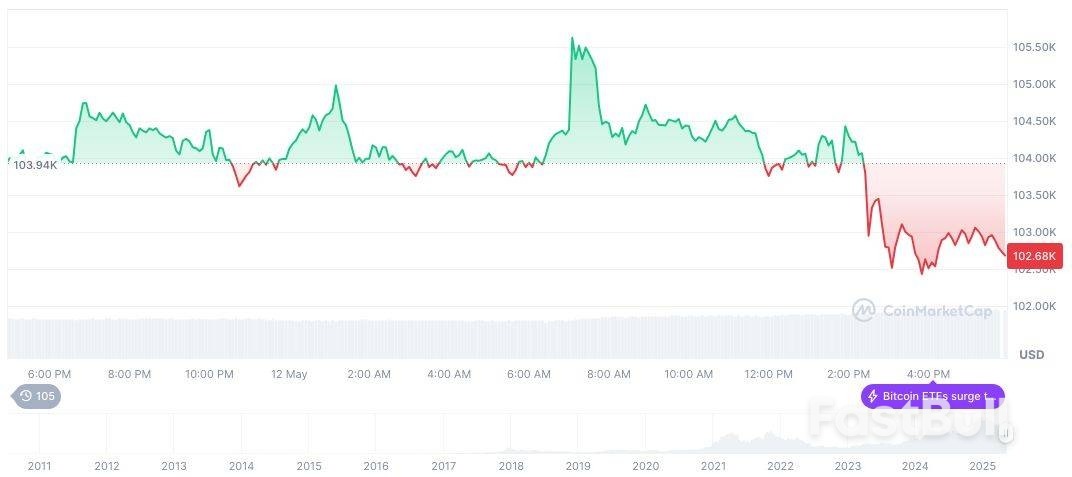
          Bitcoin(BTC), daily chart, screenshot on CoinMarketCap at 14:19 UTC on May 13, 2025. Source: CoinMarketCap

          Recent developments in multiple cryptocurrency policies, such as Binance's significant new investments, could add more layers of complexity to market reactions.
          Source: CryptoSlate

          To stay updated on all economic events of today, please check out our Economic calendar
          Risk Warnings and Disclaimers
          You understand and acknowledge that there is a high degree of risk involved in trading. Following any strategies or investment methods may lead to potential losses. The content on the site is provided by our contributors and analysts for information purposes only. You are solely responsible for determining whether any trading assets, securities, strategy, or any other product is suitable for investing based on your own investment objectives and financial situation.
          Add to Favorites
          Share

          U.S.-China trade war pushed global supply chain near breaking point, new data shows

          Adam

          Economic

          China–U.S. Trade War

          The trade truce reached between the U.S. and China arrived just as President Donald Trump’s tariffs took a big bite out of North American & Asian manufacturing, with a steep retreat in April purchasing activity after the rush to hoard supply, according to the GEP Global Supply Chain Volatility Index.
          “The pause on tariffs is a major relief for manufacturers in both the U.S. and China,” said John Piatek, vice president of consulting for GEP. “Our Supply Chain Volatility Index shows manufacturing demand in China is dropping steeply, and U.S. manufacturers are aggressively stockpiling key inputs to buffer against tariffs.”
          But according to Piatek, the trade deal won’t quickly quiet U.S. manufacturers’ anxiety about how to reduce risks related to China for the long-term. “As they maneuver to de-risk and limit exposure to China, the rapidly changing landscape and uncertainty is clouding manufacturers’ outlook and dampening their capital investment and supply chain,” he said.
          The GEP Global Supply Chain Volatility Index tracks demand conditions, shortages, transportation costs, inventories, and backlogs based on a monthly survey of 27,000 businesses.
          “The first blows of the tariff war have landed on global manufacturers,” Piatek said. The supply chain volatility data should serve as a warning about what would come next if the temporary pause in tariffs by the U.S. and China aren’t extended permanently after the 90-day pause and the trade war re-escalates.
          The data showed a “hockey stick”-like upturn in April, according to Piatek, with North American companies aggressively stockpiling inventory at what he described as a “concerning rate.” At the same time, “the first signs of manufacturers anticipating slower demand and supply shortages have emerged,” he said.
          Purchasing activity by manufacturers in Asia was at its weakest since December 2023.
          One bright spot to offset pull back in manufacturing is Europe, where an industrial recession is coming to an end. The U.K., the first nation to sign a preliminary trade deal with the U.S., recorded significant manufacturing weakness, with supplier activity down to a rate near a record low based on the past two decades of data. But supply chain capacity in Germany and France, which was underutilized over the past year, is reflecting growth. Piatek cautioned that this could reverse if global trade conditions worsen.
          The GEP data also shows an increase in spare capacity across Asian supply chains in April, led by China, Taiwan and South Korea.
          Stephen Edwards, CEO of the Port of Virginia, told CNBC in an interview published this week that if the supply chain future is less China and more Southeast Asia, South Asia and Europe, the U.S. port is positioned for that growth.
          “Our fastest growth over the last four years has been the Indian subcontinent, then Vietnam, then Europe,” said Edwards.
          Trade from China has been flat for the last four years at Port of Virginia.
          “It is our second-largest trading bloc after the European Union. So it’s still a big block,” he said. “But if that is going to migrate over time, whatever the new trade environment is, there’s an opportunity. We have not yet seen the trade agreements, but we believe that it’s going to be less China and more from Southeast Asia and Europe. I think we’re in a pretty good spot,” Edwards said.

          Source: cnbc

          To stay updated on all economic events of today, please check out our Economic calendar
          Risk Warnings and Disclaimers
          You understand and acknowledge that there is a high degree of risk involved in trading. Following any strategies or investment methods may lead to potential losses. The content on the site is provided by our contributors and analysts for information purposes only. You are solely responsible for determining whether any trading assets, securities, strategy, or any other product is suitable for investing based on your own investment objectives and financial situation.
          Add to Favorites
          Share

          What next for Nvidia? AI innovation, tariff challenges, and market outlook

          Adam

          Economic

          Nvidia's latest AI hardware innovations

          ​Nvidia continues to lead in artificial intelligence (AI) and graphics processing unit (GPU) advancements, navigating complex geopolitical landscapes and evolving market dynamics. The company's relentless focus on pushing the boundaries of computing power has maintained its position at the forefront of the artificial intelligence revolution.
          ​At GTC 2025, Nvidia unveiled its Blackwell Ultra GPUs, marking a significant leap in AI and graphics processing capabilities. These new chips represent a substantial improvement over the previous generation, with performance gains of up to 30% and enhanced power efficiency that addresses one of the key challenges facing data centres today.
          ​The RTX 50-Series Launch has brought next-generation technology to consumer graphics cards. The RTX 5060, priced at $299.00, is set to release on May 19, 2025, offering advanced features like DLSS 4 and GDDR7 memory. This continues Nvidia's strategy of making AI-enhanced graphics accessible to mainstream users.
          ​These innovations come at a critical time as competition in the GPU space intensifies. While Nvidia maintains its leadership position, rivals are making significant investments to challenge its dominance in both consumer and enterprise markets.

          ​Strategic partnerships and expansion plans

          ​Nvidia's growth strategy extends beyond product development to include key partnerships and strategic acquisitions that strengthen its ecosystem and market position. These moves demonstrate a long-term vision that goes well beyond selling chips.
          ​The Cadence Collaboration represents a significant enhancement of Nvidia's presence in the simulation and design space. Nvidia's GPUs power Cadence's new Millennium M2000 supercomputer, enhancing simulation speeds for industries like aerospace and biotech. This partnership highlights how Nvidia's technology is becoming increasingly embedded in critical industrial design processes.
          ​Silicon Valley Expansion reinforces Nvidia's commitment to its home market. The company acquired a 13-acre office complex in Santa Clara for $123 million, expanding its headquarters and reinforcing its commitment to US-based operations. This investment comes at a time when many tech firms are pursuing remote work models or looking to expand in lower-cost regions, although some have backtracked following President Trump’s re-election.
          ​These strategic moves align with Nvidia's broader vision of creating an AI ecosystem where its hardware, software, and partnerships create a competitive moat that extends beyond raw computing power. This approach has been central to the company's ability to maintain premium pricing and profit margins.

          ​Nvidia's massive AI infrastructure investment

          ​In a bold response to geopolitical pressures and growing demand for AI capabilities, Nvidia has announced an unprecedented investment plan focused on building out domestic infrastructure. This represents one of the largest corporate investments in US manufacturing in recent memory.
          ​Nvidia's $500 Billion Commitment to invest in US AI infrastructure over the next four years aims to bolster domestic manufacturing and reduce reliance on foreign supply chains. This massive investment demonstrates both the scale of AI's growth potential and Nvidia's determination to maintain its leadership position regardless of trade tensions.
          ​The investment plan includes the construction of new data centres specifically designed for AI training and inference, as well as research facilities dedicated to advancing semiconductor design and manufacturing techniques. These facilities will create thousands of high-skilled jobs across multiple states.
          ​Beyond the direct benefits to Nvidia's business, this investment signals a potential reshaping of the global semiconductor supply chain, with more critical components and technologies being developed and manufactured within the United States. The move has received bipartisan political support, highlighting the strategic importance of AI infrastructure.

          ​Navigating US tariffs and trade policies

          ​Nvidia faces significant challenges due to evolving US trade policies, particularly concerning exports to China. The company's response to these challenges demonstrates its strategic flexibility and determination to maintain access to key markets despite geopolitical headwinds.
          ​Export controls have limited Nvidia's ability to sell high-performance AI chips to China, prompting the company to develop a downgraded H20 chip variant to comply with regulations. This represents a delicate balancing act – maintaining access to the Chinese market while adhering to US government restrictions.
          ​The Market Impact of these restrictions is substantial. China accounts for approximately 13% of Nvidia's revenue and represents a significant growth opportunity. CEO Jensen Huang has emphasised the potential $50 billion loss if access to the Chinese AI market diminishes, highlighting the material impact of geopolitical tensions on the company's prospects.
          ​This weekend’s US-China trade negotiations have led to a 90-day reduction in tariffs, providing temporary relief and positively influencing Nvidia's share price. However, this reprieve may be short-lived, and the company continues to develop contingency plans for various trade policy scenarios.
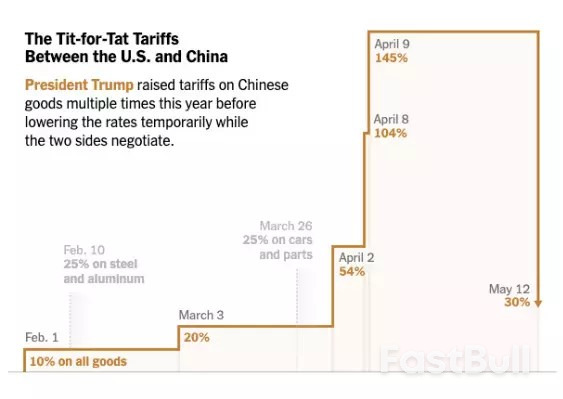
          US tariffs on China imports
          What next for Nvidia? AI innovation, tariff challenges, and market outlook_1

          Market performance and analyst expectations

          ​Despite the tariff challenges, Nvidia's market performance has remained strong, reflecting investor confidence in the company's strategic positioning and growth prospects in the AI market. The stock continues to be a bellwether for technology sector sentiment.
          ​Analyst Forecasts project a positive trajectory for Nvidia's stock, with expectations of reaching $134.00 by the end of May 2025, indicating a potential 9% increase from current levels (as of 13/05/2025). This optimism is driven by the company's continued revenue growth and expanding profit margins.
          ​The valuation metrics for Nvidia remain elevated compared to broader market averages, with a forward P/E ratio significantly above the S&P 500 average. However, analysts justify this premium based on the company's growth rate and dominant position in AI, which is viewed as a multi-decade growth opportunity.
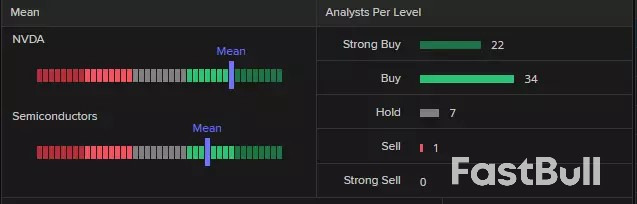
          ​According to LSEG Data & Analytics, 22 analysts have a ‘strong buy’ recommendation for Nvidia, 34 a ‘buy’, 7 a ‘hold’ and 1 a ‘sell’ (as of 13/05/2025).
          Nvidia LSEG Data & Analytics chart
          What next for Nvidia? AI innovation, tariff challenges, and market outlook_2
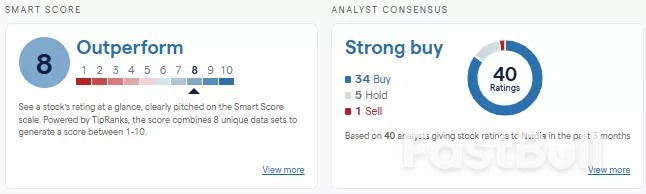
          Nvidia has a TipRanks Smart Score of ‘8 Outperform’ and is rated as a ‘strong buy’ with 34 ’buy’, 5 ‘hold’ and 1 ‘sell’ recommendation (as of 13/05/2025).
          Nvidia TipRanks Smart Score chart
          What next for Nvidia? AI innovation, tariff challenges, and market outlook_3

          Technical analysis of the Nvidia share price

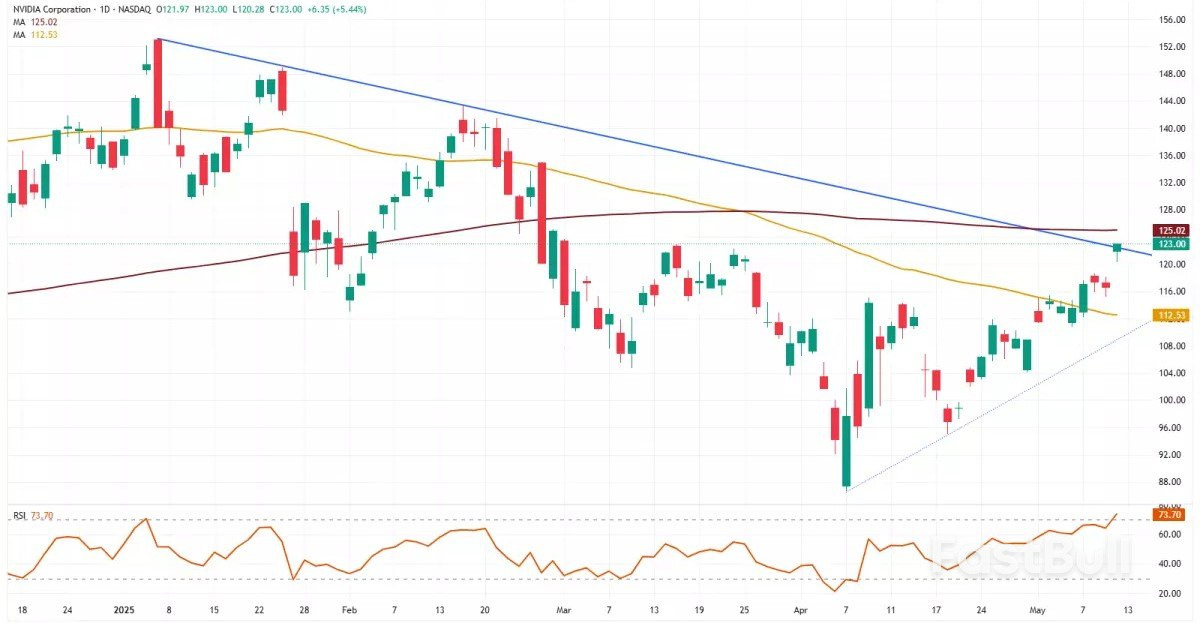
          ​The Nvidia share price, which dropped by around 42% from its $153.13 early January high to its $86.62 7 April low, has risen around 30% since then, to its 2025 downtrend line at $122.88. Together with the 200-day simple moving average (SMA) at $125.02 it may act as resistance, though.
          Nvidia daily candlestick chart
          What next for Nvidia? AI innovation, tariff challenges, and market outlook_4
          Despite the Nvidia’s recent share price rally, it still trades around 8% lower year-to-date. While the 30 April low at $104.08 underpins, the April-to-May uptrend is deemed to be intact.
          ​Minor support above this low can be seen between the early February low, 9 and 14 April and 2 May highs at $115.40-to-$113.01.

          ​Long-term outlook and competitive landscape

          ​The long-term prospects for Nvidia appear promising despite short-term challenges. The company's strategic investments and product innovations position it for sustained growth in the AI and semiconductor sectors, with several key factors supporting its continued leadership.
          ​The broader AI market continues to expand rapidly, with enterprise adoption accelerating across sectors from healthcare to financial services. Nvidia's first-mover advantage and comprehensive software ecosystem have created significant switching costs for customers, helping to insulate the company from competitive threats.
          ​Nevertheless, competition is intensifying from both traditional rivals and new entrants. AMD has made significant strides with its MI300 AI accelerators, while Intel is investing heavily to regain technological leadership. Additionally, cloud service providers like Google and Amazon are increasingly developing their own custom silicon.
          ​Perhaps the most significant long-term question for Nvidia is whether AI chip design will eventually commoditise, as has happened with other semiconductor categories. The company's strategy of continuously pushing performance boundaries while building a comprehensive software and services ecosystem aims to prevent this outcome.

          How to trade Nvidia shares

          ​For investors and traders looking to gain exposure to Nvidia's growth story or capitalise on its price movements, several approaches are available through IG's trading and investment platforms.
          ​Research Nvidia's market position, financial performance, and growth prospects to inform your trading decision.
          ​Decide whether you want to trade or invest in Nvidia shares based on your outlook for the company and the broader technology sector.
          ​Open an account with IG by visiting our website and completing the application process.​
          Search for 'Nvidia' or its ticker 'NVDA' on our trading platform or app.​
          Place your trade, ensuring you have appropriate risk management measures in place given the stock's volatility.
          ​Spread betting and CFD trading offer ways to potentially profit from both rising and falling Nvidia share prices, while also providing leverage for amplified exposure. However, it's important to remember that leverage increases both potential returns and risks.
          ​For those with a longer-term perspective who believe in Nvidia's continued AI dominance, share dealing provides direct ownership of Nvidia stock. This approach allows investors to benefit from both capital appreciation and any future dividend increases as the company matures.
          ​Nvidia stands at the intersection of multiple transformative technologies, from AI to advanced gaming and autonomous vehicles. While tariff challenges and geopolitical tensions create near-term uncertainty, the company's technological leadership and strategic investments position it to remain at the forefront of the AI revolution that continues to reshape global industries and create new market opportunities.​​

          Source:ig

          To stay updated on all economic events of today, please check out our Economic calendar
          Risk Warnings and Disclaimers
          You understand and acknowledge that there is a high degree of risk involved in trading. Following any strategies or investment methods may lead to potential losses. The content on the site is provided by our contributors and analysts for information purposes only. You are solely responsible for determining whether any trading assets, securities, strategy, or any other product is suitable for investing based on your own investment objectives and financial situation.
          Add to Favorites
          Share

          Reeves’s Tax Rises on Employers Start to Bite as Unemployment Jumps

          Warren Takunda

          Economic

          For the past few months, the true impact of Labour’s increases in labour costs has been clouded by a fog of contradictory data, but the latest jobs figures suggest that murkiness could be beginning to clear.
          Those who feared the rise in employers’ national insurance contributions (NICs) would lead to job losses are being proved right. The unemployment rate climbed by 0.2 percentage points to 4.5% between January and March – the highest level for nearly four years.
          Concerns that the number of vacancies would drop have also come true. Employers are refusing to take on new staff, pushing the vacancy rate back towards its pre-pandemic level.
          However, that’s not the whole picture, with data showing employers have begun to ease back on above-inflation pay growth. Average weekly earnings that exclude bonuses rose by 5.6% in the first three months of the year compared with the same quarter in 2024. That annual growth rate was down from 5.9% in the three months ending with February and below the consensus among City economists of a milder drop to 5.7%.
          There are other ways employers could adjust to the higher NICs and national living wage increase. They could reduce profits and increase prices.
          The Bank of England said last week that it expected private-sector employers to take a hit to their profits, sharing the pain with their shareholders. Unfortunately, the evidence for this is absent simply because the Office for National Statistics has not produced any data since last summer on the profitability of UK companies. So the Bank is guessing.
          Forecasts for inflation are also guesswork, though there is a growing suspicion that companies that exercised their monopoly pricing power during the pandemic will again try to convince consumers they need to pay much higher prices for their goods this year. Data out on Wednesday next week on the inflation rate in April will give the first signs as to whether that theory is correct.
          If lower average profits and slightly higher prices become part of the response, then you might say everyone is sharing the pain from higher employment taxes.
          The problem for Labour is that the biggest hit is felt most acutely by employers in very visible areas of the economy, such as retailers, hospitality businesses and the charity sector.
          Ministers must be concerned that the lower number of vacancies is colliding with a rising number of people wanting employment, making for a very large and discontented group of people who want to break into the labour market but cannot.
          It all suggests the hangover from the pandemic is still causing pain in the form of huge mismatches between what employers want and what workers can offer.
          The cure for this ill can only be investment in skills. Yet that is in short supply at the moment. And while Rachel Reeves blames the uncertainty caused by Donald Trump for depressing investment, and the economy more broadly, she must shoulder some of the blame.
          The tightrope she must walk to stick to her self-imposed fiscal rules is clearly another factor. To balance the books in the next budget, which the chancellor says she must, is going to be tough and might mean the government needs to impose even more tax rises on employers.
          If this worry persists among employers, it is sure to combine with Trump-induced uncertainty to delay any jobs recovery.

          Source: Theguardian

          To stay updated on all economic events of today, please check out our Economic calendar
          Risk Warnings and Disclaimers
          You understand and acknowledge that there is a high degree of risk involved in trading. Following any strategies or investment methods may lead to potential losses. The content on the site is provided by our contributors and analysts for information purposes only. You are solely responsible for determining whether any trading assets, securities, strategy, or any other product is suitable for investing based on your own investment objectives and financial situation.
          Add to Favorites
          Share

          How India And Pakistan Pulled Back From The Brink With U.S.-brokered Ceasefire

          Glendon

          India–Palestine conflict

          At 2.09 am on Saturday, Ahmad Subhan, who lives near an air base in the Pakistan military garrison city of Rawalpindi, heard the first explosion that rattled the windows of his house - and took South Asia to the brink of war.

          As dawn broke, the heaviest fighting in decades between nuclear-armed India and Pakistan reached a crescendo, after nearly three weeks of escalating tensions.

          Fighter jets and missiles crisscrossed the skies of one of the world's most populated regions. Pakistani officials said they would convene an emergency meeting of their top nuclear decision-making body.

          The critical eight-hour window also saw Indian missile barrages on three major Pakistan air bases and other facilities, including Nur Khan, which is ringed by civilian homes like Subhan's, and just a 20-minute drive to the capital, Islamabad.

          After the initial blast, Subhan and his wife grabbed their three children and ran out of their home. "We were just figuring out what had happened when there was another explosion," said the retired government employee, who remembered the precise time of the strike because he was just about to make a call.

          This account of Saturday's events - which began with the looming specter of a full-blown war and ended with an evening cease-fire announcement by U.S. President Donald Trump - is based on interviews with 14 people, including U.S., Indian and Pakistani officials, as well as Reuters' review of public statements from the three capitals.

          They described the rapid escalation of hostilities as well as behind-the-scenes diplomacy involving the U.S., India and Pakistan, and underscore the key role played by Washington in brokering peace.

          The attack on Nur Khan air base saw at least two missile strikes as well as drone attacks, according to Subhan and two Pakistani security officials, who like some of the people interviewed by Reuters, spoke on condition of anonymity.

          The barrage took out two roofs and hit the hangar of a refuelling plane, which was airborne at the time, according to one of the officials, who visited the base the next day.

          A senior Indian military officer, however, told reporters on Sunday that an operation command center at Nur Khan had been hit.

          "The attack on Nur Khan... close to our capital, that left us with no option but to retaliate," Pakistan Foreign Minister Ishaq Dar told Reuters.

          Nur Khan is located just over a mile from the military-run body responsible for Pakistan's nuclear planning.

          So, an attack on the facility may have been perceived as more dangerous than India intended - and the two sides shouldn't conclude that it is possible to have a conflict without it going nuclear, said Christopher Clary, an associate professor at the University at Albany in New York.

          "If you are playing Russian roulette and pull the trigger, the lesson isn't that you should pull the trigger again," said Clary.

          India's defense and foreign ministries, as well as Pakistan's military and its foreign ministry, did not immediately answer written questions submitted by Reuters.

          A U.S. State Department spokesperson did not directly respond to questions from Reuters about the American role, but said that further military escalation posed a serious threat to regional stability.
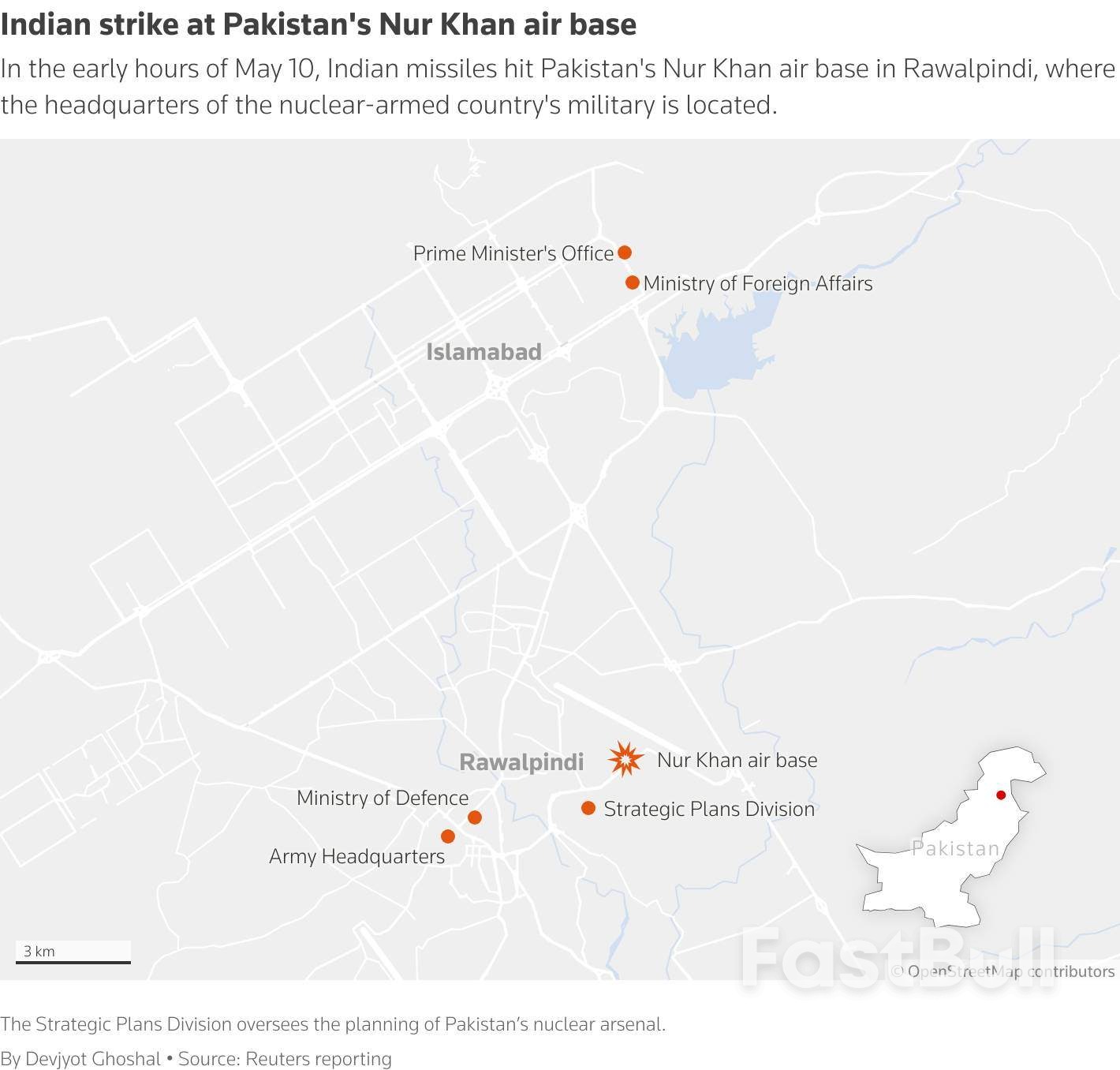
          In the early hours of May 10, Indian missiles hit Pakistan's Nur Khan air base in Rawalpindi, where the headquarters of the nuclear-armed country's military is located.

          VANCE CALLS MODI

          India and Pakistan have fought three major wars and been at loggerheads since their independence. The spark for the latest chaos was an April 22 attack in Indian Kashmir that killed 26 people, most of them tourists. New Delhi blamed the incident on "terrorists" backed by Pakistan, a charge denied by Islamabad.

          It was the latest of many disputes involving Kashmir, a Himalayan territory ravaged by an anti-India insurgency since the late 1980s. Both New Delhi and Islamabad claim the region in full but only control parts of it.

          Hindu-majority India has accused its Muslim-majority neighbor of arming and backing militant groups operating in Kashmir, but Pakistan maintains it only provides diplomatic support to Kashmiri separatists.

          After a go-ahead from Prime Minister Narendra Modi, the Indian military on May 7 carried out air strikes on what it called "terrorist infrastructure" in Pakistan, in response to the April attack in Kashmir.

          In air battles that followed, Pakistan said it shot down five Indian aircraft, including prized Rafale planes New Delhi recently acquired from France. India has indicated that it suffered losses and inflicted some of its own.

          Senior U.S. officials became seriously concerned by Friday, May 9 that the conflict was at risk of spiralling out of control, according to two sources familiar with the matter.

          That evening, Modi took a call from Vice President J.D. Vance, who presented a potential off-ramp to the Indian prime minister that he described as a path the Pakistanis would also be amenable to, the people said.

          Vance's intervention came despite him saying publicly on Thursday that the U.S. was "not going to get involved in the middle of war that's fundamentally none of our business."

          The sources didn't provide specifics but said that Modi was non-committal. One of the people also said that Modi told Vance, who had been visiting India during the Kashmir attack, that any Pakistani escalation would be met by an even more forceful response.

          Hours later, according to Indian officials, that escalation came: Pakistan launched attacks on at least 26 locations in India in the early hours of May 10.

          Pakistan said their strikes occurred only after the pre-dawn Indian attack on its air bases, including Nur Khan.

          NUCLEAR SIGNALS

          A little over an hour after that Indian attack began, Pakistan military spokesman Lt. Gen. Ahmed Sharif Chaudhry confirmed Indian strikes on three air bases.

          Some Indian strikes on Saturday, May 10 also utilized the supersonic BrahMos missile, according to a Pakistani official and an Indian source. Pakistan believes the BrahMos is nuclear-capable, though India says it carries a conventional warhead.

          By 5 a.m. local time on Saturday, Pakistan's military announced it had launched operations against Indian air bases and other facilities.

          About two hours later, Pakistani officials told journalists that Prime Minister Shehbaz Sharif had called a meeting of the National Command Authority, which oversees the nuclear arsenal.

          Dar told Reuters on Tuesday that any international alarm was overblown: "There was no such concern. There should not be. We are a responsible nation."

          But signalling an intention to convene NCA reflected how much the crisis had escalated and "may also have been an indirect call for external mediation," said Michael Kugelman, a Washington-based South Asia expert.

          About an hour after the NCA announcement, the U.S. said Secretary of State Marco Rubio had spoken to Pakistan Army Chief Gen. Asim Munir - widely regarded as the most powerful man in that country - and was pushing both sides to de-escalate.

          Rubio also soon got on the phone with Dar and Indian Foreign Minister S. Jaishankar.

          "Rubio said that Indians were ready to stop," Dar told Reuters. "I said if they are ready to stop, ask them to stop, we will stop."

          An Indian official with knowledge of Rubio's call with Jaishankar said that Rubio passed on a message that the Pakistanis were willing to stop firing if India would also cease.

          'GREAT INTELLIGENCE'

          Pakistan Defense Minister Khawaja Muhammad Asif, who only days earlier warned of conflict, dialled into a local TV news channel at around 10:30 am on Saturday.

          Two-and-a-half hours after Pakistani officials shared news of the NCA meeting, Asif declared that no such event had been scheduled, putting a lid on the matter.

          The international intervention anchored by Rubio paved the way to a cessation of hostilities formalized in a mid-afternoon phone call between the Directors General of Military Operations (DGMO) of India and Pakistan. The two spoke again on Monday.

          Pakistan Lt. Gen. Chaudhry said in a briefing that New Delhi had initially requested a call between the DGMOs after the Indian military's May 7 strikes across the border.

          Islamabad only responded to the request on Saturday, following its retaliation and requests from international interlocutors, according to Chaudhry, who did not name the countries.

          Almost exactly 12 hours after Pakistan said it had launched retaliatory strikes against India for hitting three key air bases, Trump declared on social media there would be a cessation of hostilities.

          "Congratulations to both Countries on using Common Sense and Great Intelligence," he said.
          Source: Reuters

          Risk Warnings and Disclaimers
          You understand and acknowledge that there is a high degree of risk involved in trading. Following any strategies or investment methods may lead to potential losses. The content on the site is provided by our contributors and analysts for information purposes only. You are solely responsible for determining whether any trading assets, securities, strategy, or any other product is suitable for investing based on your own investment objectives and financial situation.
          Add to Favorites
          Share

          US Treasuries Gain as Traders Eye Inflation for Clues on Fed

          Adam

          Bond

          Central Bank

          Treasuries gained ahead of the release of US inflation data, paring sharp losses sparked by the temporary US-China trade truce that’s dimmed the odds of a global recession.
          With market-implied expectations for Federal Reserve interest-rate cuts receding and a multi-trillion-dollar tax package seen likely to worsen the US government budget deficit, focus is now on Tuesday’s inflation data for any signs of a pickup in price pressures. The report will be the first to show tariff-related costs.
          The yield on policy-sensitive two-year bonds fell nearly three basis points to 3.98% on Tuesday, outperforming European peers. The rate surged 12 basis points on Monday after the world’s biggest economies agreed to temporarily cut tariffs, dimming the odds of a recession and fueling a rally in risk assets.
          “The ‘trade-relief rally’ has started to stall overnight,” said Evelyne Gomez-Liechti, a strategist at Mizuho International. The moves reflect “profit-taking and consolidation ahead of today’s CPI report. We think there’s room for more.”
          Economists forecast the annual pace of consumer price growth held the same as the month prior, according to estimates compiled by Bloomberg. Core inflation is expected to remain at a 2.8% level.
          Traders have lowered their expectations for Federal Reserve interest-rate cuts this year amid easing trade tensions, and swaps now favor a quarter-point cut by September and another to follow by year-end. At the end of last month, markets were betting on a first move by July, and a total of four cuts this year.
          Goldman Sachs said Monday that it now expects three quarter-point rate Fed cuts starting in December instead of July, with just a 35% probability of a recession versus 45% previously. Citigroup economists also pushed back their prediction for the Fed’s next rate cut to July from June after tempering of US-China tariffs.
          Barclays now expects the Federal Reserve to deliver just one interest-rate cut this year compared to two previously.
          “If you have to put a gun to my head and say what’s the most likely single view it probably would be that the Fed maintains rates on hold this year because inflation stays pretty elevated,” said Mark Dowding, chief investment officer of BlueBay Fixed Income.
          Fed Governor Adriana Kugler said even with the 90-day levy reduction on Chinese goods, President Donald Trump’s tariff policies risk sparking a rise in inflation and unemployment.
          Bloomberg Economics estimates the new tariff levels will translate into a 1.5% hit to US GDP and 0.9% boost to core PCE over a period of two to three years, about half the shock predicted before the US-China talks.
          Since the end of April, US government bonds have slumped, pushing yields across all maturities higher. Benchmark 10-year yields trade at 4.45%, well above the lows of this month of 4.12%. Policy sensitive two-year yields have risen nearly 40 basis points.
          Dowding said he is looking to buy 10-year Treasuries if yields move back to 4.8% — around the peak level of 2025 reached in mid-January — and sell them if rates fall below 4.2%.
          Tax Bill
          Despite the administration touting they can extend Trump’s 2017 tax cuts without worsening the US deficit, market participants are less clear that will pan out. The plan announced Monday will take a big step toward advancing through the House as soon as this week, with the House Ways and Means Committee scheduled to begin debate on it Tuesday.
          Economists at Deutsche Bank in a note earlier this month said the final package will likely keep the US deficit-to-GDP level stuck near 6.5% for the next few years.
          “If you look at what’s coming down the road out of Washington, the administration is talking about Independence Day for the tax package,” said Gregory Faranello, head of US rates trading and strategy for AmeriVet Securities. “So the Fed is going to wait that out,” as well as move slowly to monitor economic data.
          Faranello also sees rising Treasury yields as providing good opportunities to purchase more debt as he expects the labor market to crack and the Fed cutting rates sometime in the second half of the year.

          Source: finance.yahoo

          Risk Warnings and Disclaimers
          You understand and acknowledge that there is a high degree of risk involved in trading. Following any strategies or investment methods may lead to potential losses. The content on the site is provided by our contributors and analysts for information purposes only. You are solely responsible for determining whether any trading assets, securities, strategy, or any other product is suitable for investing based on your own investment objectives and financial situation.
          Add to Favorites
          Share

          History Rhymes? XRP Price Gained 400% the Last Time Whale Flows Flipped

          Warren Takunda

          Cryptocurrency

          Key takeaways:
          XRP price has risen 55% since April and is now flashing bullish continuation signals.
          Whale flows have flipped positive for the first time since November 2024, historically signaling trend reversals.
          A falling wedge breakout projects 40% gains ahead, but $2.80 may act as interim resistance.
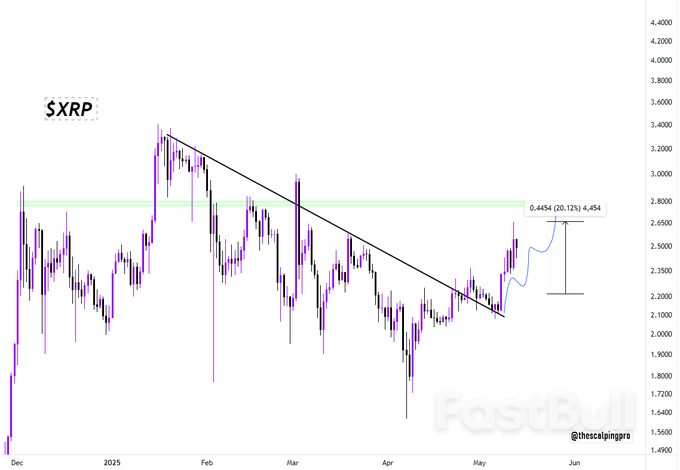
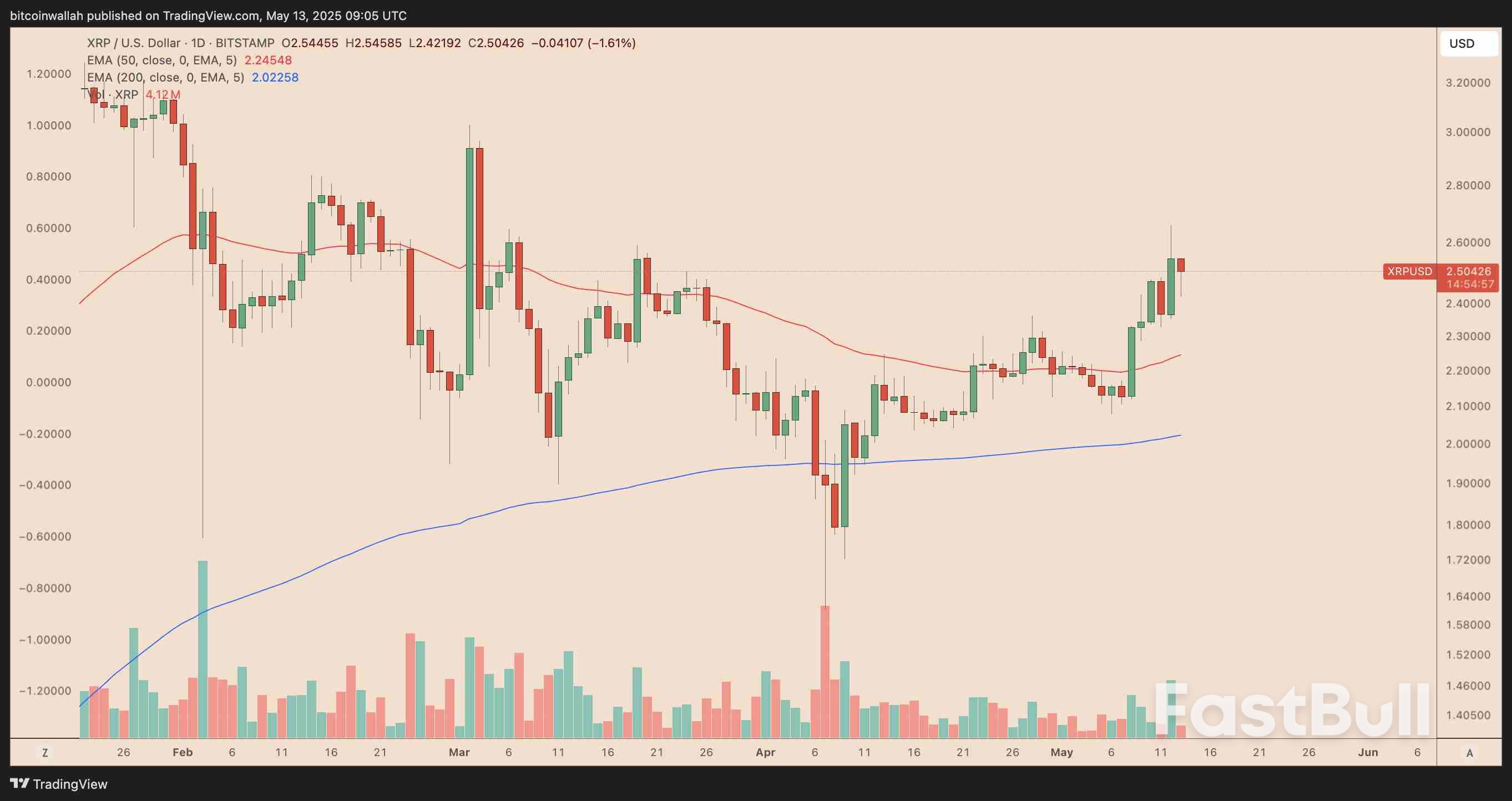
          XRP has bounced by more than 55% since forming a local bottom at around $1.61 in April. It now signals a further price surge owing to bullish technical patterns and onchain data.History Rhymes? XRP Price Gained 400% the Last Time Whale Flows Flipped_1

          XRP/USD daily price chart. Source: TradingView

          XRP’s whale flows mirror 2024 price boom

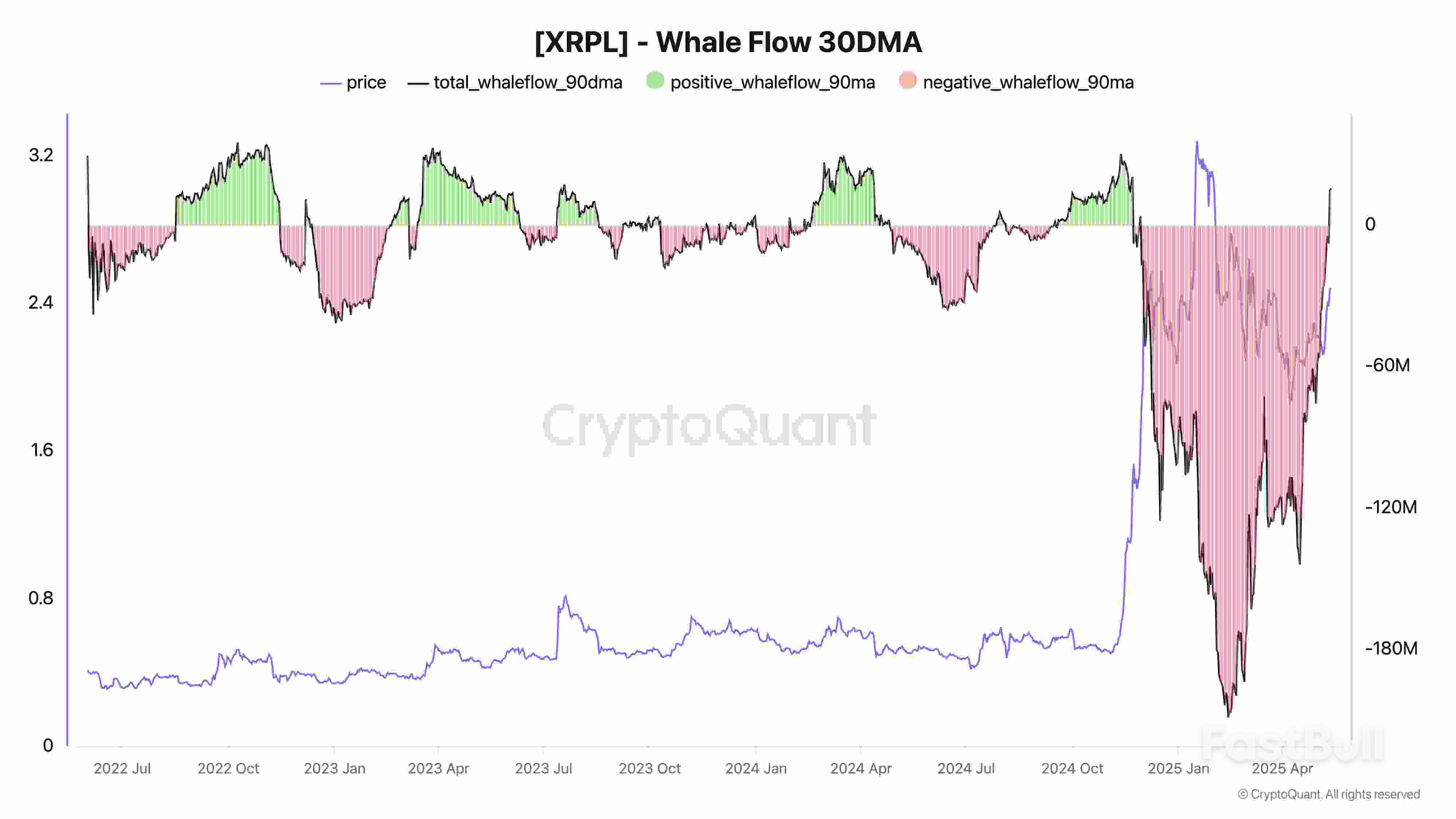
          XRP whale wallets (addresses holding large amounts of XRP) have been aggressively reducing their holdings since November 2024, according to data resource CryptoQuant.History Rhymes? XRP Price Gained 400% the Last Time Whale Flows Flipped_2

          XRP whale flow 30-day moving average vs. price. Source: CryptoQuant

          The trend pushed net flows deep into negative territory, preceding the sharp correction in XRP’s price from above $3.55 to under $2.00.
          As of mid-May 2025, however, the trend has reversed.
          Whale outflows have been slowing down, turning the 90-day moving average of net flows positive. In the past, most instances where whale flows turned positive after a prolonged negative trend has marked major bottoms or trend reversals.
          A notable example is XRP’s rally from around $0.43 in July 2024 to $3.55 in January 2025, or around 400% gains, which began as whale outflows slowed and eventually flipped to net inflows.

          XRP price technical breakout targets $3.45

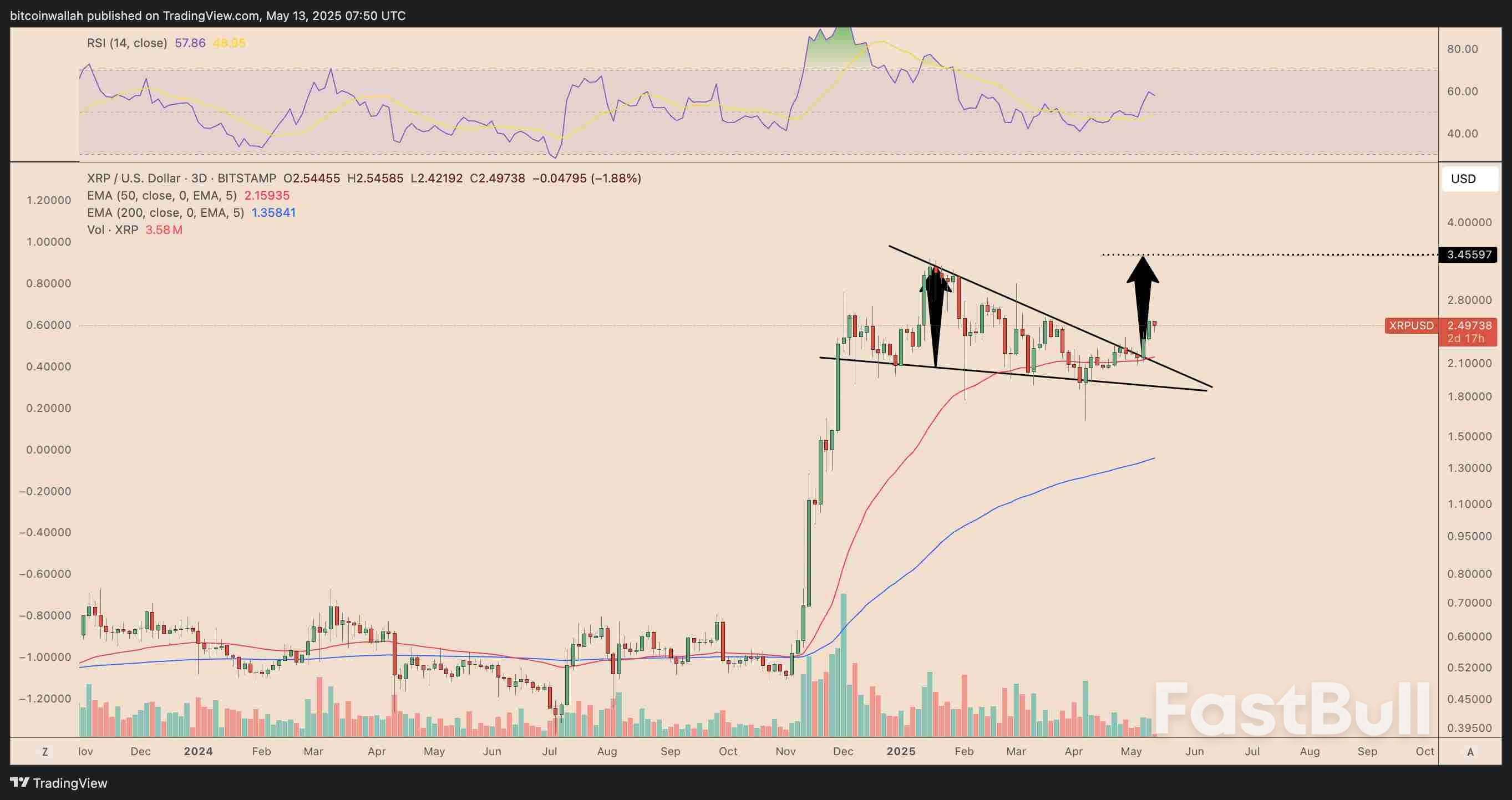
          XRP price technicals show it breaking out of a multimonth falling wedge pattern on the 3-day chart, typically viewed as a bullish reversal setup.
          The wedge, formed between December 2024 and early May 2025, had been compressing price action while volume declined, a classic sign of accumulation.History Rhymes? XRP Price Gained 400% the Last Time Whale Flows Flipped_3

          XRP/USD three-day price chart. Source: TradingView

          The breakout occurred in early May near the $2.25 level, just above the 50-period exponential moving average (EMA), which now acts as key support. Based on the wedge’s height, the breakout projects a price target near $3.45, around 40% above current levels.
          XRP’s relative strength index (RSI) also supports the bullish case, bouncing back above 57 and showing renewed buying momentum.
          The move may not be a straight shot to the target, however. Analyst Mags highlights a key resistance near $2.80 that could temporarily cap XRP’s upside.History Rhymes? XRP Price Gained 400% the Last Time Whale Flows Flipped_4

          Source: X/Mags

          In the near term, XRP may consolidate above its 50-day EMA, particularly as whale inflows often signal the start of an accumulation phase before a stronger price breakout.
          “The pace of outflows is slowing, and the bars are curling upward,” wrote Kripto Mavsimi, an analyst associated with CryptoQuant, adding:
          “It’s not full reversal yet — but it’s the first real sign of stabilization in months.”
          Such a base-building period would be a healthy development if consistent with how previous whale-driven rallies have unfolded.

          Source: Cointelegraph

          Risk Warnings and Disclaimers
          You understand and acknowledge that there is a high degree of risk involved in trading. Following any strategies or investment methods may lead to potential losses. The content on the site is provided by our contributors and analysts for information purposes only. You are solely responsible for determining whether any trading assets, securities, strategy, or any other product is suitable for investing based on your own investment objectives and financial situation.
          Add to Favorites
          Share
          FastBull
          Copyright © 2025 FastBull Ltd

          728 RM B 7/F GEE LOK IND BLDG NO 34 HUNG TO RD KWUN TONG KLN HONG KONG

          TelegramInstagramTwitterfacebooklinkedin
          App Store Google Play Google Play
          Products
          Charts

          Chats

          Q&A with Experts
          Screeners
          Economic Calendar
          Data
          Tools
          Membership
          Features
          Function
          Markets
          Copy Trading
          Latest Signals
          Contests
          News
          Analysis
          24/7
          Columns
          Education
          Company
          Careers
          About Us
          Contact Us
          Advertising
          Help Center
          Feedback
          User Agreement
          Privacy Policy
          Business

          White Label

          Data API

          Web Plug-ins

          Poster Maker

          Affiliate Program

          Risk Disclosure

          The risk of loss in trading financial instruments such as stocks, FX, commodities, futures, bonds, ETFs and crypto can be substantial. You may sustain a total loss of the funds that you deposit with your broker. Therefore, you should carefully consider whether such trading is suitable for you in light of your circumstances and financial resources.

          No decision to invest should be made without thoroughly conducting due diligence by yourself or consulting with your financial advisors. Our web content might not suit you since we don't know your financial conditions and investment needs. Our financial information might have latency or contain inaccuracy, so you should be fully responsible for any of your trading and investment decisions. The company will not be responsible for your capital loss.

          Without getting permission from the website, you are not allowed to copy the website's graphics, texts, or trademarks. Intellectual property rights in the content or data incorporated into this website belong to its providers and exchange merchants.

          Not Logged In

          Log in to access more features

          FastBull Membership

          Not yet

          Purchase

          Become a signal provider
          Help Center
          Customer Service
          Dark Mode
          Price Up/Down Colors

          Log In

          Sign Up

          Position
          Layout
          Fullscreen
          Default to Chart
          The chart page opens by default when you visit fastbull.com