• Trade
  • Markets
  • Copy
  • Contests
  • News
  • 24/7
  • Calendar
  • Q&A
  • Chats
Trending
Screeners
SYMBOL
LAST
BID
ASK
HIGH
LOW
NET CHG.
%CHG.
SPREAD
SPX
S&P 500 Index
6827.42
6827.42
6827.42
6899.86
6801.80
-73.58
-1.07%
--
DJI
Dow Jones Industrial Average
48458.04
48458.04
48458.04
48886.86
48334.10
-245.98
-0.51%
--
IXIC
NASDAQ Composite Index
23195.16
23195.16
23195.16
23554.89
23094.51
-398.69
-1.69%
--
USDX
US Dollar Index
97.950
98.030
97.950
98.500
97.950
-0.370
-0.38%
--
EURUSD
Euro / US Dollar
1.17394
1.17409
1.17394
1.17496
1.17192
+0.00011
+ 0.01%
--
GBPUSD
Pound Sterling / US Dollar
1.33707
1.33732
1.33707
1.33997
1.33419
-0.00148
-0.11%
--
XAUUSD
Gold / US Dollar
4299.39
4299.39
4299.39
4353.41
4257.10
+20.10
+ 0.47%
--
WTI
Light Sweet Crude Oil
57.233
57.485
57.233
58.011
56.969
-0.408
-0.71%
--

Community Accounts

Signal Accounts
--
Profit Accounts
--
Loss Accounts
--
View More

Become a signal provider

Sell trading signals to earn additional income

View More

Guide to Copy Trading

Get started with ease and confidence

View More

Signal Accounts for Members

All Signal Accounts

Best Return
  • Best Return
  • Best P/L
  • Best MDD
Past 1W
  • Past 1W
  • Past 1M
  • Past 1Y

All Contests

  • All
  • Trump Updates
  • Recommend
  • Stocks
  • Cryptocurrencies
  • Central Banks
  • Featured News
Top News Only
Share

Ukraine's Navy Says Russian Drone Attack Hit Civilian Turkish Vessel Carrying Sunflower Oil To Egypt On Saturday

Share

Israeli Military Says It Put Planned Strike On South Lebanon Site On Hold After Lebanese Army Requested Access

Share

Norwegian Nobel Committee: Calls On The Belarusian Authorities To Release All Political Prisoners

Share

Norwegian Nobel Committee: His Freedom Is A Deeply Welcome And Long-Awaited Moment

Share

Ukraine Says It Received 114 Prisoners From Belarus

Share

USA Embassy In Lithuania: Maria Kalesnikava Is Not Going To Vilnius

Share

USA Embassy In Lithuania: Other Prisoners Are Being Sent From Belarus To Ukraine

Share

Ukraine President Zelenskiy: Five Ukrainians Released By Belarus In US-Brokered Deal

Share

USA Vilnius Embassy: USA Stands Ready For "Additional Engagement With Belarus That Advances USA Interests"

Share

USA Vilnius Embassy: Belarus, USA, Other Citizens Among The Prisoners Released Into Lithuania

Share

USA Vilnius Embassy: USA Will Continue Diplomatic Efforts To Free The Remaining Political Prisoners In Belarus

Share

USA Vilnius Embassy: Belarus Releases 123 Prisoners Following Meeting Of President Trump's Envoy Coale And Belarus President Lukashenko

Share

USA Vilnius Embassy: Masatoshi Nakanishi, Aliaksandr Syrytsa Are Among The Prisoners Released By Belarus

Share

USA Vilnius Embassy: Maria Kalesnikava And Viktor Babaryka Are Among The Prisoners Released By Belarus

Share

USA Vilnius Embassy: Nobel Peace Prize Laureate Ales Bialiatski Is Among The Prisoners Released By Belarus

Share

Belarusian Presidential Administration Telegram Channel: Lukashenko Has Pardoned 123 Prisoners As Part Of Deal With US

Share

Two Local Syrian Officials: Joint US-Syrian Military Patrol In Central Syria Came Under Fire From Unknown Assailants

Share

Israeli Military Says It Targeted 'Key Hamas Terrorist' In Gaza City

Share

Rwanda's Actions In Eastern Drc Are A Clear Violation Of Washington Accords Signed By President Trump - Secretary Of State Rubio

Share

Israeli Military Issues Evacuation Warning In Southern Lebanon Village Ahead Of Strike - Spokesperson On X

TIME
ACT
FCST
PREV
U.K. Trade Balance Non-EU (SA) (Oct)

A:--

F: --

P: --

U.K. Trade Balance (Oct)

A:--

F: --

P: --

U.K. Services Index MoM

A:--

F: --

P: --

U.K. Construction Output MoM (SA) (Oct)

A:--

F: --

P: --

U.K. Industrial Output YoY (Oct)

A:--

F: --

P: --

U.K. Trade Balance (SA) (Oct)

A:--

F: --

P: --

U.K. Trade Balance EU (SA) (Oct)

A:--

F: --

P: --

U.K. Manufacturing Output YoY (Oct)

A:--

F: --

P: --

U.K. GDP MoM (Oct)

A:--

F: --

P: --

U.K. GDP YoY (SA) (Oct)

A:--

F: --

P: --

U.K. Industrial Output MoM (Oct)

A:--

F: --

P: --

U.K. Construction Output YoY (Oct)

A:--

F: --

P: --

France HICP Final MoM (Nov)

A:--

F: --

P: --

China, Mainland Outstanding Loans Growth YoY (Nov)

A:--

F: --

P: --

China, Mainland M2 Money Supply YoY (Nov)

A:--

F: --

P: --

China, Mainland M0 Money Supply YoY (Nov)

A:--

F: --

P: --

China, Mainland M1 Money Supply YoY (Nov)

A:--

F: --

P: --

India CPI YoY (Nov)

A:--

F: --

P: --

India Deposit Gowth YoY

A:--

F: --

P: --

Brazil Services Growth YoY (Oct)

A:--

F: --

P: --

Mexico Industrial Output YoY (Oct)

A:--

F: --

P: --

Russia Trade Balance (Oct)

A:--

F: --

P: --

Philadelphia Fed President Henry Paulson delivers a speech
Canada Building Permits MoM (SA) (Oct)

A:--

F: --

P: --

Canada Wholesale Sales YoY (Oct)

A:--

F: --

P: --

Canada Wholesale Inventory MoM (Oct)

A:--

F: --

P: --

Canada Wholesale Inventory YoY (Oct)

A:--

F: --

P: --

Canada Wholesale Sales MoM (SA) (Oct)

A:--

F: --

P: --

Germany Current Account (Not SA) (Oct)

A:--

F: --

P: --

U.S. Weekly Total Rig Count

A:--

F: --

P: --

U.S. Weekly Total Oil Rig Count

A:--

F: --

P: --

Japan Tankan Large Non-Manufacturing Diffusion Index (Q4)

--

F: --

P: --

Japan Tankan Small Manufacturing Outlook Index (Q4)

--

F: --

P: --

Japan Tankan Large Non-Manufacturing Outlook Index (Q4)

--

F: --

P: --

Japan Tankan Large Manufacturing Outlook Index (Q4)

--

F: --

P: --

Japan Tankan Small Manufacturing Diffusion Index (Q4)

--

F: --

P: --

Japan Tankan Large Manufacturing Diffusion Index (Q4)

--

F: --

P: --

Japan Tankan Large-Enterprise Capital Expenditure YoY (Q4)

--

F: --

P: --

U.K. Rightmove House Price Index YoY (Dec)

--

F: --

P: --

China, Mainland Industrial Output YoY (YTD) (Nov)

--

F: --

P: --

China, Mainland Urban Area Unemployment Rate (Nov)

--

F: --

P: --

Saudi Arabia CPI YoY (Nov)

--

F: --

P: --

Euro Zone Industrial Output YoY (Oct)

--

F: --

P: --

Euro Zone Industrial Output MoM (Oct)

--

F: --

P: --

Canada Existing Home Sales MoM (Nov)

--

F: --

P: --

Euro Zone Total Reserve Assets (Nov)

--

F: --

P: --

U.K. Inflation Rate Expectations

--

F: --

P: --

Canada National Economic Confidence Index

--

F: --

P: --

Canada New Housing Starts (Nov)

--

F: --

P: --

U.S. NY Fed Manufacturing Employment Index (Dec)

--

F: --

P: --

U.S. NY Fed Manufacturing Index (Dec)

--

F: --

P: --

Canada Core CPI YoY (Nov)

--

F: --

P: --

Canada Manufacturing Unfilled Orders MoM (Oct)

--

F: --

P: --

Canada Manufacturing New Orders MoM (Oct)

--

F: --

P: --

Canada Core CPI MoM (Nov)

--

F: --

P: --

Canada Manufacturing Inventory MoM (Oct)

--

F: --

P: --

Canada CPI YoY (Nov)

--

F: --

P: --

Canada CPI MoM (Nov)

--

F: --

P: --

Canada CPI YoY (SA) (Nov)

--

F: --

P: --

Canada Core CPI MoM (SA) (Nov)

--

F: --

P: --

Q&A with Experts
    • All
    • Chatrooms
    • Groups
    • Friends
    Connecting
    .
    .
    .
    Type here...
    Add Symbol or Code

      No matching data

      All
      Trump Updates
      Recommend
      Stocks
      Cryptocurrencies
      Central Banks
      Featured News
      • All
      • Russia-Ukraine Conflict
      • Middle East Flashpoint
      • All
      • Russia-Ukraine Conflict
      • Middle East Flashpoint
      Search
      Products

      Charts Free Forever

      Chats Q&A with Experts
      Screeners Economic Calendar Data Tools
      Membership Features
      Data Warehouse Market Trends Institutional Data Policy Rates Macro

      Market Trends

      Market Sentiment Order Book Forex Correlations

      Top Indicators

      Charts Free Forever
      Markets

      News

      News Analysis 24/7 Columns Education
      From Institutions From Analysts
      Topics Columnists

      Latest Views

      Latest Views

      Trending Topics

      Top Columnists

      Latest Update

      Signals

      Copy Rankings Latest Signals Become a signal provider AI Rating
      Contests
      Brokers

      Overview Brokers Assessment Rankings Regulators News Claims
      Broker listing Forex Brokers Comparison Tool Live Spread Comparison Scam
      Q&A Complaint Scam Alert Videos Tips to Detect Scam
      More

      Business
      Events
      Careers About Us Advertising Help Center

      White Label

      Data API

      Web Plug-ins

      Affiliate Program

      Awards Institution Evaluation IB Seminar Salon Event Exhibition
      Vietnam Thailand Singapore Dubai
      Fans Party Investment Sharing Session
      FastBull Summit BrokersView Expo
      Recent Searches
        Top Searches
          Markets
          News
          Analysis
          User
          24/7
          Economic Calendar
          Education
          Data
          • Names
          • Latest
          • Prev

          View All

          No data

          Scan to Download

          Faster Charts, Chat Faster!

          Download App
          English
          • English
          • Español
          • العربية
          • Bahasa Indonesia
          • Bahasa Melayu
          • Tiếng Việt
          • ภาษาไทย
          • Français
          • Italiano
          • Türkçe
          • Русский язык
          • 简中
          • 繁中
          Open Account
          Search
          Products
          Charts Free Forever
          Markets
          News
          Signals

          Copy Rankings Latest Signals Become a signal provider AI Rating
          Contests
          Brokers

          Overview Brokers Assessment Rankings Regulators News Claims
          Broker listing Forex Brokers Comparison Tool Live Spread Comparison Scam
          Q&A Complaint Scam Alert Videos Tips to Detect Scam
          More

          Business
          Events
          Careers About Us Advertising Help Center

          White Label

          Data API

          Web Plug-ins

          Affiliate Program

          Awards Institution Evaluation IB Seminar Salon Event Exhibition
          Vietnam Thailand Singapore Dubai
          Fans Party Investment Sharing Session
          FastBull Summit BrokersView Expo

          Central banks go for gold, investors still see value in silver, platinum may consolidate after rapid price rise – Heraeus

          Adam

          Commodity

          Summary:

          Central banks continue strong gold buying, supporting prices. Silver sees rising ETF inflows as investors bet on value. Platinum may consolidate after a sharp rally, with producers focusing on cost reduction.
          While gold hasn’t been making strong gains since its April highs, sovereign demand is providing plenty of support at these price levels, and while EFT flows show investors see further gains for silver, platinum may have topped out in the near term, according to precious metals analysts at Heraeus.
          In their latest precious metals update, the analysts noted that central banks continue to provide a solid floor for gold demand.
          “In May 2025, central banks added a net 20 tonnes of gold to their reserves, with Kazakhstan, Turkey and Poland leading the purchases,” they wrote. “Despite a slight moderation in pace, sentiment remains strongly bullish – 95% of surveyed central banks expect global gold holdings to rise, and 43% plan to increase their own reserves, a record high. This reflects a structural shift in reserve management, with growing diversification away from the US dollar and heightened demand for gold as a hedge against geopolitical and inflationary risks.”
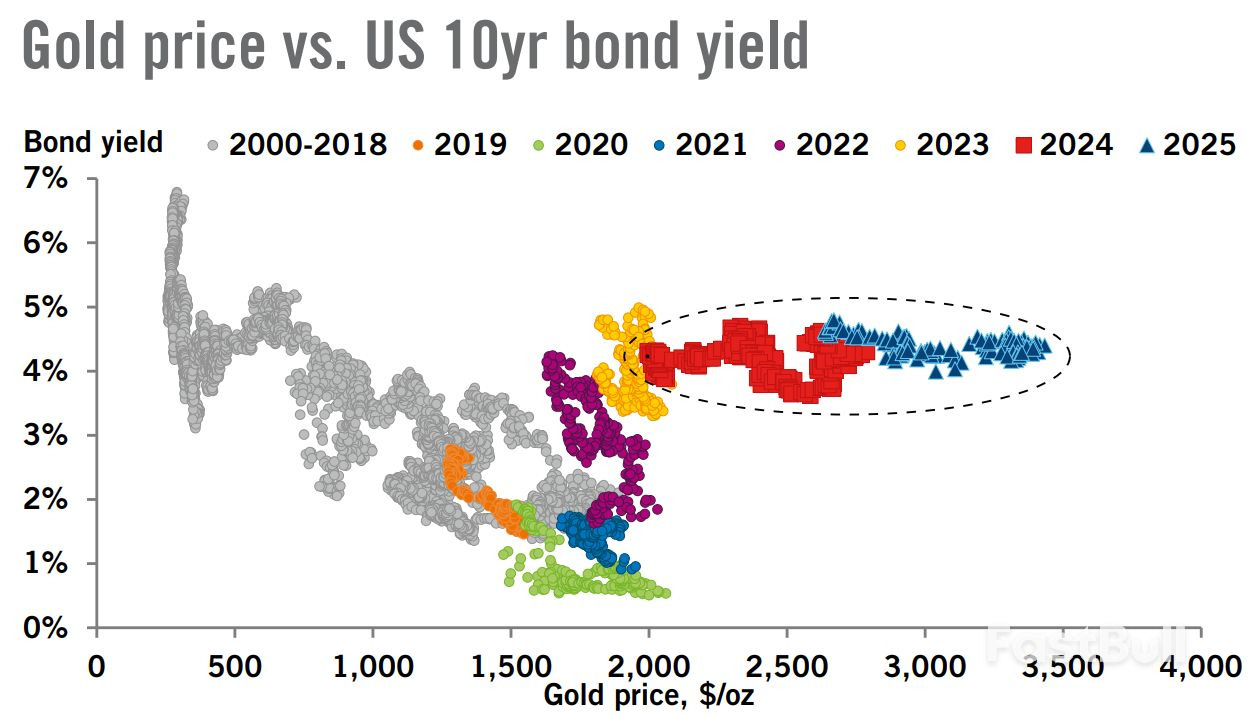
          Central banks have added over 1,000 tonnes of bullion to their reserves in each of the last three years, which is far above the long-term average. “This is likely to have been a driver of the gold price, even as correlations with other assets have broken down,” the analysts said. “For example, gold and the US Treasury 10-year bond yield were strongly negatively correlated until central banks began to ramp up purchases. Over the last 18 months, yields have largely traded between 3.5% and 5.0%, while the gold price has risen from $2,000/oz to ~$3,400/oz.”
          Central banks go for gold, investors still see value in silver, platinum may consolidate after rapid price rise – Heraeus_1
          “Ongoing central bank gold buying is expected to continue to underpin gold price performance through the remainder of 2025, providing emerging market banks continue to favour gold over other assets,” they said.
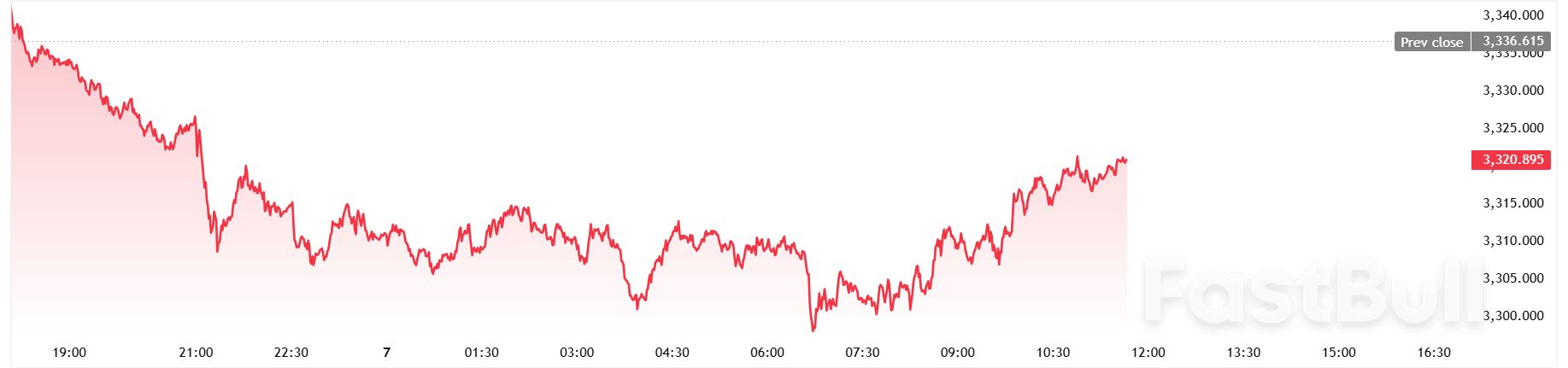
          After dipping briefly below support at $3,300 earlier this morning, spot gold is staging a modest recovery on Monday, last trading at $3,320.89 per ounce for a loss of 0.47% on the session.
          Central banks go for gold, investors still see value in silver, platinum may consolidate after rapid price rise – Heraeus_2
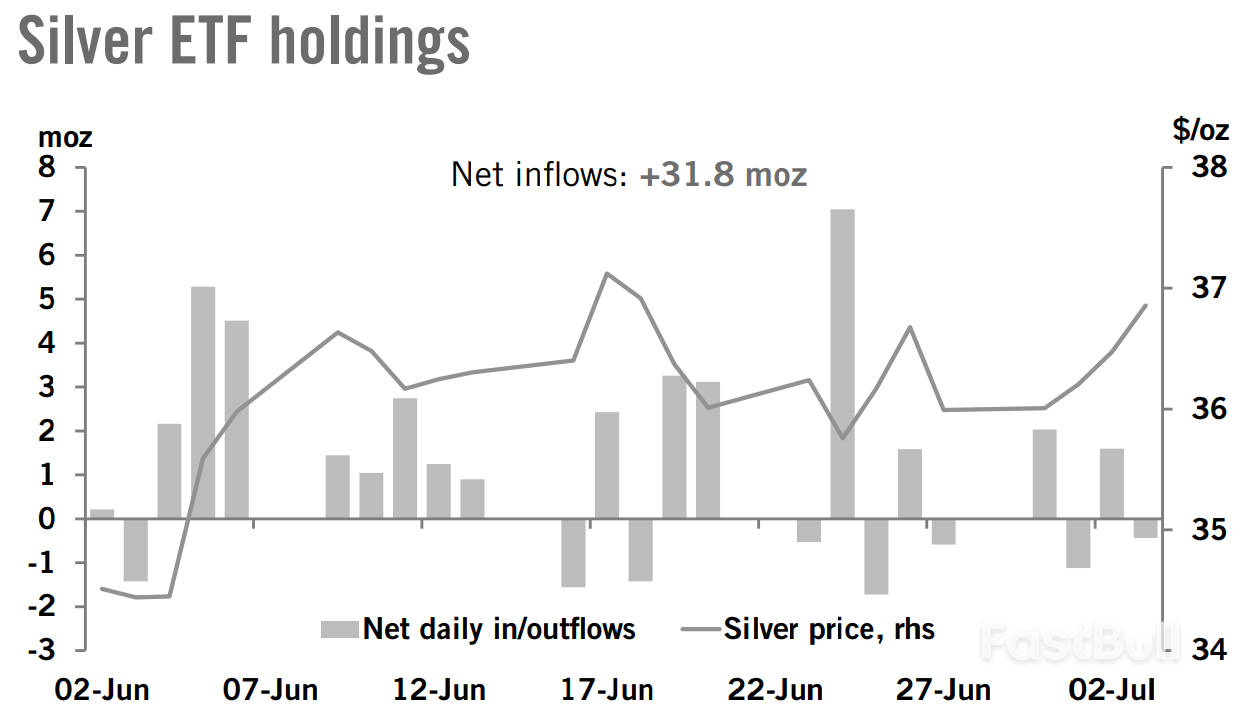
          Turning to silver, Heraeus analysts said the numbers show that investors continue to see value in silver.
          “Net ETF inflows of 990 tonnes have been made since the beginning of June to date (4 July),” they said. “Most of the inflows came from the price rallying in the first half of the month (+509 tonnes), followed by more opportunistic buying and selling as the silver price stabilised above $36/oz in the second half of the month and beginning of July. Since 14 June, net inflows have amounted to an additional 426 tonnes. In total, this accelerated investor interest over the last month or so has accounted for more than 50% of year-to-date net inflows into silver ETFs. This has helped to propel holdings to the highest level since August 2022, at more than 24,000 tonnes of metal.”
          Central banks go for gold, investors still see value in silver, platinum may consolidate after rapid price rise – Heraeus_3
          The analysts noted that as of Friday’s close, silver ETF holdings are valued at $28.5 billion. “Silver remains historically undervalued versus gold (Au:Ag = 90.3),” they said. “Should the silver price continue to appreciate, ETF inflows may continue, as investors, betting that the ratio will revert towards the 10-year average of 80.2, rejoin the trade.”
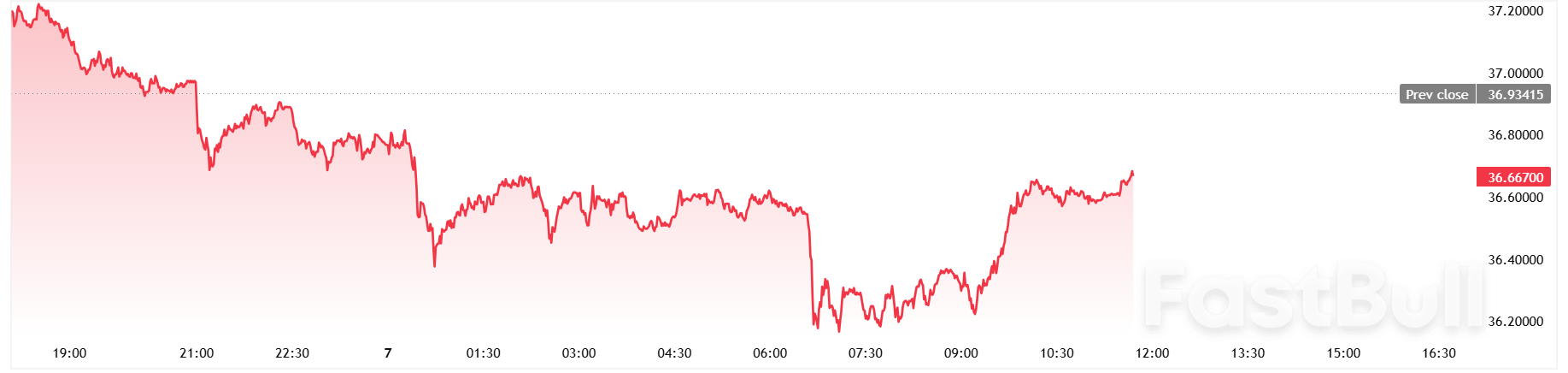
          Spot silver set a new high weekly close of $36.91 per ounce last week before falling along with gold earlier on Monday, but after multiple tests of the session low around $36.170 held, prices have moved back into the middle of their daily range. At the time of writing, spot silver last traded at $36.665 per ounce and is down 0.73% on the daily chart.
          Central banks go for gold, investors still see value in silver, platinum may consolidate after rapid price rise – Heraeus_4
          And on the platinum front, Heraeus wrote that producers are looking to reduce their costs to increase profitability.
          “Last week, Impala Platinum announced the official consolidation of the Impala and the Royal Bafokeng Platinum (RBP) operations in South Africa, following Impala’s acquisition of RBP in 2023,” they said. “The aim of the consolidation is to realise the synergies of the two contiguous operations, and lower unit costs across both. In CYH2’24, RBP shafts together were profitable, having successfully reduced costs by 2% year-on-year thanks to cost controls and labour restructuring efforts. Likewise, lower average labour costs at Impala helped to control costs, though mining inflation brought total costs up year-on-year.”
          “Given the contiguous nature of the Impala Lease Area and the Bafokeng lease, there is scope for costs to be reduced beyond overheads,” the analysts said. “It is feasible that accessing the underground ore from a more optimal shaft and optimal ore blending at the concentrating stage could have a positive impact on costs. The recent rise in the South African basket price will also be helping the country’s PGM producers’ bottom lines in the short term and ease pressure on the highest-cost operations.”
          They pointed out that platinum rose for a fifth straight week and saw the highest weekly close of the current rally at $1,394 per ounce. “Price action was choppy, swinging up to $50/oz intraday during the week,” the analysts noted. “The daily RSI is showing increasing divergence from the price, and after such a rapid rise a more prolonged period of consolidation is possible.”
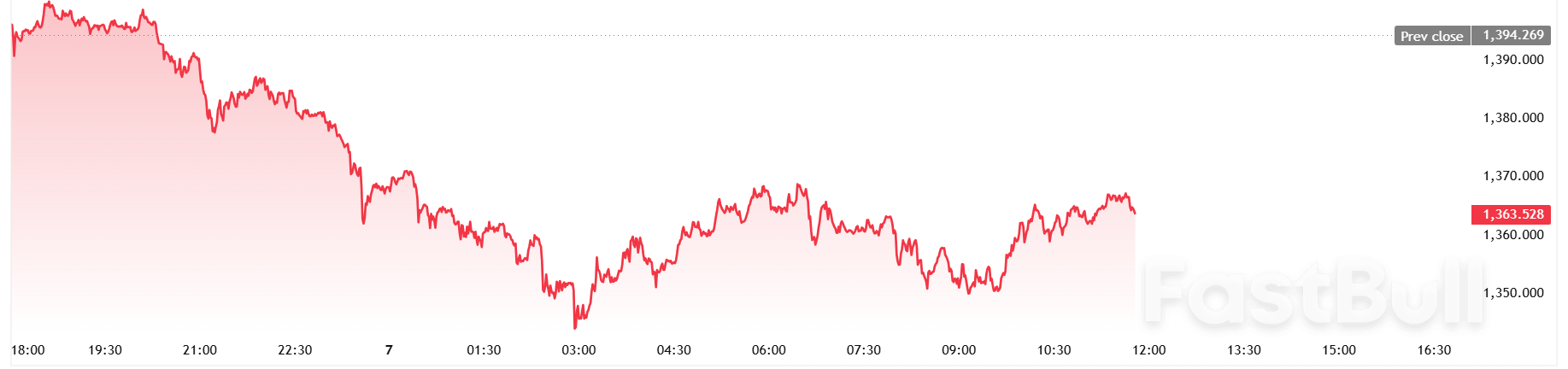
          After hitting a session low of $1,341.94 just before 3 am EDT, spot platinum is also recovering along with the broader precious metals complex, though it has significantly more ground to make up.
          Central banks go for gold, investors still see value in silver, platinum may consolidate after rapid price rise – Heraeus_5
          Spot platinum last traded at $1,363.53 per ounce for a loss of 2.20% on the session.

          Source: kitco

          Risk Warnings and Disclaimers
          You understand and acknowledge that there is a high degree of risk involved in trading. Following any strategies or investment methods may lead to potential losses. The content on the site is provided by our contributors and analysts for information purposes only. You are solely responsible for determining whether any trading assets, securities, strategy, or any other product is suitable for investing based on your own investment objectives and financial situation.
          Add to Favorites
          Share

          Trump Tariff Letters Are Here; The S&P 500 Won't Panic

          Adam

          Economic

          President Trump is threatening 25% tariffs on Japan and South Korea after months of trade talks have yet to seal a deal. The S&P 500 turned lower in Monday afternoon trading, but investors know there's a good chance this won't be the final word.
          Trump's "reciprocal" tariff pause announced on April 9 comes to an end on Wednesday. Trump and Treasury Secretary Scott Bessent have warned that countries which don't agree to a deal by then should expect their tariff rate to jump back to the April 2 level. Yet the U.S. has only struck deals with the U.K. and Vietnam over the past three months, though talks with China have an established framework and are progressing along a different timeline, with an Aug. 12 deadline.

          Trump Tariffs On Japan, South Korea

          In letters to South Korea and Japan, Trump informed the key trading partners that the U.S. would impose "a Tariff of only 25%" on South Korean and Japanese imports to the U.S. The figure excludes categories that are subject to sectoral tariffs, including autos and steel.
          Trump further threatened to escalate tariffs to match any retaliatory tariff imposed by either country.
          Auto imports have been a sticking point in talks with both countries, while rice has loomed large in talks with Japan. According to S&P Mobility, Japan exports 1.3 million vehicles a year to the U.S., while South Koreas sends 1.4 million vehicles. The U.S, exports 17,000 vehicles to Japan and 46,000 to South Korea.

          Trump Tariff Optimism Tested

          Investors betting on the TACO trade — Trump Always Chickens Out — rode the S&P 500 to a 26% gain through last week from the 52-week low on April 8. Markets won't start taking Trump's tariff threats at face value without a compelling reason. It's not clear whether the threats against South Korea and Japan provide that reason.
          Plus, Trump has already signaled that any big tariff announcements this week aim to prod trading partners to strike a deal. Though the 90-day pause ends Wednesday, new tariff levels announced this week won't take effect until 1Aug.
          Trump gave Mexico and Canada, America's two biggest trading partners, a pass from so-called reciprocal tariffs, so they won't come in the line of fire this week, nor will China. While Trump threatened the European Union with a 50% tariff in May, markets don't take that seriously. At the moment, reports suggest that the EU is still hopeful that a deal can be struck.
          Markets can tolerate the economic headwind from some level of tariffs. Yet, as the cycle of Trump tariff escalation and Chinese retaliation showed this spring, when tariffs get high enough to cancel out economic activity and trading partners strike back with retaliatory tariffs, the cost of tariffs spikes.
          While the risk of tit-for-tat tariffs with the EU remains, Trump probably also learned the lesson of dividing and conquering, rather than taking on all trading partners at one time as he did in April.

          How High Will Tariffs Go?

          While markets have taken a sanguine view ahead of this week's tariffs news, there's good reason to think that the average U.S. tariff rate is still heading higher in some places. Last week's deal with Vietnam probably shouldn't be seen in a vacuum. Would Vietnam have agreed to swallow 20% tariffs — down from the 46% rate announced on April 2 but double the 10% that actually took effect — unless officials had reason to believe that other Southeast Asian countries would face a similar rate.
          The agreement with Vietnam also puts in place a 40% tariff for Chinese goods shipped via Vietnam to the U.S. to dodge the higher tariffs for direct imports of Chinese goods to the U.S.
          "The draft Vietnam deal confirms that countries with sustained high trade surpluses with the U.S., and those acting as transshipment hubs for Chinese goods, may face higher baseline tariffs and additional duties on rerouted products," wrote Ulrike Hoffmann-Burchardi, chief investment officer of UBS Global Wealth Management in the Americas, in a July 3 note.
          Still, UBS viewed the U.S.-Vietnam deal as "a positive step toward more durable bilateral deals for the U.S. and toward greater clarity for investors."
          "While tariffs will likely slow U.S. growth and add some inflation pressure into 2026, we do not expect them to derail the economy or cause a recession," Hoffmann-Burchardi said.

          S&P 500

          The S&P 500 fell 0.8% in Monday afternoon stock market action. The S&P 500 had climbed 1.7% in the holiday-shortened week, pushing further into new-high ground.
          Be sure to read IBD's The Big Picture column after each trading day to get the latest on the prevailing stock market trend and what it means for your trading decisions.

          Source: investors

          To stay updated on all economic events of today, please check out our Economic calendar
          Risk Warnings and Disclaimers
          You understand and acknowledge that there is a high degree of risk involved in trading. Following any strategies or investment methods may lead to potential losses. The content on the site is provided by our contributors and analysts for information purposes only. You are solely responsible for determining whether any trading assets, securities, strategy, or any other product is suitable for investing based on your own investment objectives and financial situation.
          Add to Favorites
          Share

          Trump Unveils 25% Tariffs on Goods From Japan, South Korea in Letters to Leaders

          Manuel

          Economic

          China–U.S. Trade War

          President Donald Trump said on Monday the U.S. would impose a 25% tariff on imports from Japan and South Korea beginning Aug. 1 as he unveiled the first two of an expected 12 letters to trading partners outlining the new levies they face.
          "If for any reason you decide to raise your Tariffs, then, whatever the number you choose to raise them by, will be added onto the 25% that we charge," Trump said in letters to the leaders of the two Asian countries, which he posted on his Truth Social platform.
          Later, Trump also announced the U.S. will impose 25% tariffs on Malaysia and Kazakhstan, 30% on South Africa and 40% on Laos and Myanmar.
          The rate for South Korea is the same as Trump initially announced on April 2, while the rate for Japan is 1 point higher than first announced. A week later, he capped all of the so-called reciprocal tariffs at 10% until July 9 to allow for negotiations. Only two agreements have so far been reached, with Britain and Vietnam.
          There was no immediate response from the Japanese or South Korean embassies on the announcement.
          About 12 countries will receive letters from Trump, White House spokeswoman Karoline Leavitt said at a briefing without identifying them. She said Trump would sign an executive order on Monday formally delaying the July 9 deadline to August 1.
          "There will be additional letters in the coming days," Leavitt said, adding that "we are close" on some deals.
          The European Union will not be receiving a letter setting out higher tariffs, EU sources familiar with the matter told Reuters on Monday.
          U.S. stocks fell in response, the latest market ruction since Trump unleashed a global trade war on his return to office in January. His moves have repeatedly whipsawed financial markets and sent policymakers scrambling to protect their economies.
          U.S. stocks were driven to near bear-market territory by his cascade of tariff announcements through the early spring but quickly rebounded to record highs in the weeks after he put the stiffest levies on hold on April 9.
          The S&P 500 on Monday was down nearly 1%, its biggest drop in three weeks. U.S.-listed shares of Japanese automotive companies fell, with Toyota Motor down 4.1% at mid-afternoon trading and Honda Motor off by 3.8%. The dollar surged against both the Japanese yen and the South Korean won.
          U.S. Treasury Secretary Scott Bessent said earlier on Monday he expected several trade announcements to be made in the next 48 hours, adding that his inbox was full of last-ditch offers from countries to clinch a tariff deal by the deadline.
          Bessent did not say which countries could get deals and what they might contain. Trump has kept much of the world guessing on the outcome of months of talks with countries hoping to avoid the hefty tariff hikes he has threatened.
          Countries have scrambled to hammer out deals before the Wednesday deadline. South Korea and Indonesia dispatched representatives to Washington, while Thailand submitted a new trade proposal offering zero tariffs on many U.S. goods.
          "We've had a lot of people change their tune in terms of negotiations. So my mailbox was full last night with a lot of new offers, a lot of new proposals," Bessent said in an interview with CNBC. "So it's going to be a busy couple of days."

          BRICS THREAT

          For its part, the European Union still aims to reach a trade deal by July 9 after European Commission President Ursula von der Leyen and Trump had a "good exchange," a Commission spokesperson said.
          It was not clear, however, whether there had been a meaningful breakthrough in talks to stave off tariff hikes on the United States' largest trading partner.
          Adding to the pressure, Trump threatened to impose a 17% tariff on EU food and agriculture exports, it emerged last week.
          Trump had said on Sunday the U.S. was close to finalizing several trade pacts and would notify other countries by July 9 of higher tariff rates. He said they would not take effect until Aug. 1, a three-week reprieve.
          He also put members of the developing nations' BRICS group in his sights as its leaders met in Brazil, threatening an additional 10% tariff on any BRICS countries aligning themselves with "anti-American" policies.
          The new 10% tariff will be imposed on individual countries if they take anti-American policy actions, a source familiar with the matter said.
          The BRICS group comprises Brazil, Russia, India and China and South Africa along with recent joiners Egypt, Ethiopia, Indonesia, Iran and the United Arab Emirates.
          Trump's comments hit the South African rand.

          EU SEEKS EFFECTIVE APPROACH TO TRUMP

          The EU has been torn over whether to push for a quick and light trade deal or back its own economic clout in trying to negotiate a better outcome. It had already dropped hopes for a comprehensive trade agreement before the July deadline.
          "We want to reach a deal with the U.S. We want to avoid tariffs," the spokesperson said at a daily briefing.
          Without a preliminary agreement, broad U.S. tariffs on most imports would rise from their current 10% to the rates set out by Trump on April 2. In the EU's case, that would be 20%.
          Von der Leyen also held talks with the leaders of Germany, France and Italy at the weekend, Germany said. Chancellor Friedrich Merz has repeatedly stressed the need for a quick deal to protect industries vulnerable to tariffs ranging from cars to pharmaceuticals.
          The German spokesperson said the parties should allow themselves "another 24 or 48 hours to come to a decision."
          Germany's Mercedes-Benz (MBGn.DE), said on Monday its second-quarter unit sales of cars and vans had fallen 9%, blaming tariffs.
          Russia said BRICS was "a group of countries that share common approaches and a common world view on how to cooperate, based on their own interests."
          "And this cooperation within BRICS has never been and will never be directed against any third countries," said Kremlin spokesman Dmitry Peskov.

          Source: Reuters

          To stay updated on all economic events of today, please check out our Economic calendar
          Risk Warnings and Disclaimers
          You understand and acknowledge that there is a high degree of risk involved in trading. Following any strategies or investment methods may lead to potential losses. The content on the site is provided by our contributors and analysts for information purposes only. You are solely responsible for determining whether any trading assets, securities, strategy, or any other product is suitable for investing based on your own investment objectives and financial situation.
          Add to Favorites
          Share

          Why is the rise of the euro a problem for the ECB?

          Adam

          Forex

          Two European Central Bank (ECB) officials last week expressed concern that the rise of the euro could further weaken the still-recovering eurozone economy, while US tariffs of 10% on European exports now seem inevitable.
          Since the beginning of the year, the eurodollar has risen 14% and reached its highest level since September 2021.
          Investors seem keen to reduce their exposure to the dollar in the face of Donald Trump's unpredictable economic policy. At the same time, Germany's fiscal stimulus and rising military budgets in Europe have boosted the euro's appeal.

          "We can manage up to 1.20"

          Nevertheless, the currency's rapid rise is beginning to make the ECB uncomfortable. While a strong euro is a sign of market confidence and reduces imported inflation, there is also a downside. A more expensive currency weighs on exports by making them less competitive.
          The rise of the euro could therefore end up weighing on growth. This is particularly true given that the eurozone relies heavily on exports. "If you combine a 10% tax (customs duties) with a more than 10% appreciation of the exchange rate, that is enough to impact export momentum," warned Martins Kazaks, governor of the Latvian central bank, on the sidelines of the ECB's annual monetary policy forum in Sintra, Portugal.
          European leaders are now preparing for a 10% tax on exports to the US to become a reality. Long opposed to any form of customs duties, Europe now seems ready to accept a compromise: a 10% tax, with certain exemptions for key sectors.
          These risks to growth are therefore causing the ECB to worry about the rise of the euro. "We can manage a rise in the euro to $1.20. Beyond that, it will become much more complicated," ECB Vice President Luis de Guindos said last week on Bloomberg TV.
          This appreciation of the euro could push the ECB to lower interest rates further. After eight consecutive cuts that brought the deposit rate to 2%, the neutral level, the ECB is expected to pause in July.
          However, further adjustments are possible between now and the end of the year. With inflation back on target, the ECB could ease monetary policy slightly. Most strategists still anticipate one or two rate cuts in 2025.

          The consensus is always wrong

          This movement in the eurodollar certainly took investors by surprise. In the wake of Donald Trump's election last November, the rise of the dollar was fairly widely expected and many imagined a return of the eurodollar to parity. At the beginning of the year, the 1.02 level was reached, before the momentum reversed completely.
          The rationale behind this reasoning is that tariffs are inflationary in nature. Higher inflation means higher interest rates and therefore a stronger dollar.
          At the end of last year, the central scenario for tariffs was a universal rate of 10%, which was to be largely offset by currency adjustment (the rise of the dollar).
          But today, Europe has to contend with a eurodollar that has gained 14% since the beginning of the year and, most likely, 10% tariffs. This is a much less favorable scenario for growth.

          source : marketscreener

          Risk Warnings and Disclaimers
          You understand and acknowledge that there is a high degree of risk involved in trading. Following any strategies or investment methods may lead to potential losses. The content on the site is provided by our contributors and analysts for information purposes only. You are solely responsible for determining whether any trading assets, securities, strategy, or any other product is suitable for investing based on your own investment objectives and financial situation.
          Add to Favorites
          Share

          RBNZ Seen Holding Rates While Leaving Door Open To Further Cuts

          Jason

          Central Bank

          New Zealand’s central bank is expected to keep interest rates on hold this week amid uncertainty over the inflation outlook while leaving the door open to further easing if needed to bolster the weak economy.

          The Reserve Bank’s Monetary Policy Committee will leave the Official Cash Rate at 3.25% Wednesday in Wellington, according to 19 of 23 economists surveyed by Bloomberg. Four predict a quarter-point reduction, while investors are pricing a 13% chance of a cut.

          “We see the net data flow since May as dovish, easily justifying a cut,” said Sharon Zollner, chief New Zealand economist at ANZ Bank in Auckland. “Indeed, we think the RBNZ should cut. However, on balance we think the Committee will decide it is prudent and low-cost to wait for more data on inflation – and inflation expectations – before cutting in August.”

          The RBNZ has slashed its benchmark by 225 basis points since August last year, and said in May that the full impact of that easing has yet to flow through to households. While recent indicators suggest economic growth is sluggish, inflation has quickened to 2.5% and policymakers are wary of price expectations lifting again.

          The RBNZ will publish its decision at 2 p.m. local time Wednesday. Because it is a rate review rather than a Monetary Policy Statement, there is no press conference and the bank won’t update its economic forecasts.

          The Reserve Bank of Australia, which is less advanced in its easing cycle than the RBNZ, is expected to lower its cash rate by 25 basis points to 3.6% later today.

          After delivering a sixth straight cut on May 28, RBNZ Governor Christian Hawkesby said policymakers no longer had an explicit easing bias and a reduction in July was “not a done deal.” One unidentified member of the six-strong MPC also voted against a cut at that meeting.

          The RBNZ nevertheless lowered its forecast track for the OCR, suggesting it sees a chance of the benchmark falling below 3% later this year or early in 2026.

          Investors are betting on a cut to 3% in coming months and see a 60% chance of one further reduction next year, swaps data show.

          While the economy posted better-than-expected growth of 0.8% in the first quarter and business confidence is improving, the housing and labor markets remain soft and global uncertainty around US tariffs is clouding the outlook.

          Economists predict that growth slowed in the second quarter. The manufacturing and services industries contracted in May and a majority of firms reported a reduction in their own trading in the three months through June, according to a business survey.

          “We continue to believe the economy requires lower interest rates ahead and we still forecast a 2.75% OCR low point,” said Doug Steel, senior economist at Bank of New Zealand in Wellington.

          The latest string of weak data probably won’t be enough to “spook the MPC into continuing its easing cycle on Wednesday,” he said. “But the rapid loss of momentum adds to the case that further rate cuts will be required in due course.”

          Source: Bloomberg Europe

          Risk Warnings and Disclaimers
          You understand and acknowledge that there is a high degree of risk involved in trading. Following any strategies or investment methods may lead to potential losses. The content on the site is provided by our contributors and analysts for information purposes only. You are solely responsible for determining whether any trading assets, securities, strategy, or any other product is suitable for investing based on your own investment objectives and financial situation.
          Add to Favorites
          Share

          Why Trump's 'July 9' tariff deadline appears to be more like Aug. 1 (or even Labor Day)

          Adam

          Economic

          President Trump's trade plans are likely to be significantly clearer by the end of this week, with the president announcing that "UNITED STATES TARIFF Letters" will begin being delivered at 12 noon ET today and his team promising several new agreements by the end of the week.
          But an array of parallel comments from the president on down have also underlined to markets that this week is unlikely to provide finality on the Trump trade agenda.
          That's because even as Trump talks about being largely "done" on July 9, trade talks appear primed to continue unabated in the weeks ahead as his team acknowledges that ambitious early plans to finalize a wide array of trade deals around the world by this week haven't panned out.
          "The financial markets, understandably, may be confused," Greg Valliere of AGF Investments noted in a letter to clients, adding: "Get used to this."
          The back-and-forth comes as Treasury Secretary Scott Bessent promised Monday on CNBC that several trade deals will be announced in the next 48 hours, saying, "We've had a lot of people change their tune in terms of negotiations."
          Other countries that are further from a deal could see unilateral tariff hikes, but they appear to have additional weeks to negotiate before any duties actually change on Aug. 1.
          Trump revealed this new Aug. 1 deadline last week. "They'll start to pay on Aug. 1," he told reporters Friday of his still-to-be-unveiled letters. "The money will start to come into the United States on Aug. 1."
          The situation is similar as negotiations with major trading partners continued, and those negotiations are primed to see some combination of a letter or a deal this week — but again, with finality unlikely.
          At least one Trump aide offered a signal on Sunday that talks won't be ending. Stephen Miran, chair of Trump's Council of Economic Advisers, said on ABC's "This Week" that if a country is negotiating in good faith, "but the deal is just not there yet because it needs more time, my expectation would be that those countries get the date rolled."
          Other aides have offered similar messages, with Secretary Bessent previously talking about having trade issues "wrapped up by Labor Day" and Trump reminding that "we can do whatever we want."
          And Trump has continued to bring other issues into the trade talks, such as an announcement Monday morning that he planned to use a 10% tariff to dissuade nations from lining up against him through an intergovernmental organization comprising 10 countries known as BRICS.
          What it means for markets
          The push for deals this week also comes after Trump has scored a series of wins in recent weeks that could strengthen his hand. They range from signing his megabill into law to muted signs of tariff inflation thus far to increased influence overseas that led to a recent spending hike at NATO.
          But trade has proved more difficult. Trump has announced framework agreements so far with the likes of the UK and Vietnam, but other deals with key trading partners such as the European Union, India, Japan, and others are very much up in the air.
          Trump has lessened tensions with China, and negotiations between the world's two largest economies are now facing a separate early August deadline.
          As for what it means for markets, the effects of continued uncertainty could be muted. Capital Economics' Thomas Mathews wrote Monday morning that "despite the uncertainty about tariffs, we continue to expect US markets — especially equities and the dollar — to rally."
          The economic effects of tariffs — so far, at least — have proven less dramatic on inflation. And traders have become less reactive to Trump's trade pronouncements, noting he has proven to blink in the face of economic turmoil and often changes his mind later anyway.
          As Edward Yardeni, president of Yardeni Research, put it in a recent note: "In recent weeks, many investors bought stocks as they stopped panicking over Trump's trade war."

          source : finance.yahoo

          To stay updated on all economic events of today, please check out our Economic calendar
          Risk Warnings and Disclaimers
          You understand and acknowledge that there is a high degree of risk involved in trading. Following any strategies or investment methods may lead to potential losses. The content on the site is provided by our contributors and analysts for information purposes only. You are solely responsible for determining whether any trading assets, securities, strategy, or any other product is suitable for investing based on your own investment objectives and financial situation.
          Add to Favorites
          Share

          Gold prices: navigating a turbulent landscape amid global uncertainty

          Adam

          Commodity

          While the U.S. markets face numerous economic and geopolitical stressors, the prices for gold have proven extremely resilient, emphasizing the yellow metal's prized reputation as a haven asset. As the 10-year Treasury note yield has reached as high as 4.3715%, investors are intensely seeking the signal for stability in the face of growing concerns regarding trade hostilities, fiscal imbalances, and a rising dollar. In the following, we examine the key drivers in the price of gold as the United States reaches a crossroads in fiscal policy and the dynamics in the global marketplace.

          Tariff turbulence comes as a double-edged sword

          Both the United States and trading nations are caught in a trade standoff as President Donald Trump's threat of tariffs hangs ominously after August 1, which had already been delayed from July 9. In this atmosphere of uncertainty, investors have flocked towards the United States dollar, which remains one such safe haven currency. Generally, when the dollar strengthens, it puts downward pressure on the price of gold and poses challenges for foreign investors.
          However, the story so far has been anything but uneven. Even as the dollar has reflected strength, the precious metal gold has held steady above $3,300 per ounce, marking its continued status as a significant hedge against the upcoming apprehensions regarding trade wars and possible stagflation. Ahead of the release of the minutes of the Federal Open Market Committee (FOMC), market participants remain nervous and look towards signs regarding the attitude of the Federal Reserve towards monetary tightening, which may chart the future course of gold prices.

          Musk's political dance sends mixed signals

          It has brought in another dimension of unpredictability in the future prospects for the market. Establishing the "America Party," and publicly criticizing tariffs and promoting Bitcoin has raised eyebrows in investor circles. Musk promoting market-oriented principles in sharp contrast to Trump's policy of protectionism has come as a matter of grave concern for the future prospects for the economy in the United States.
          In the gold universe, this ideological conflict introduces some unpredictability. While volatility fueled by tariffs is encouraged in Trump’s policy, Musk’s free trade push and his adherence to digital currencies like Bitcoin go against conventional practices and can complicate gold’s role as a hedge, potentially. As investors weigh Musk’s influence in the midst of the turbulence in tariffs, the market in gold may encounter increased volatility, especially if his political campaign begins to gain traction.

          Safe-haven demand versus dollar strength

          Gold's 2025 first half behavior demonstrates its double function as both storage medium and haven in difficult times. The yellow precious metal has rallied with an impressive 25% increase driven by rising fears about the United States fiscal deficit and dangers posed by ongoing trade tensions. Against a backdrop in which inflationary risks and tariff risks loom larger, gold's attraction becomes especially vivid, serving as haven protective refuge in the face of possible turbulence in the economy.
          However, the advancing dollar, which has gained momentum with robust employment numbers, namely 147,000 nonfarm payrolls in June, continues to deter gold gains. As the dollar gains traction, tough times await gold. But if the war over tariffs gains momentum, gold will again gain a boost, especially as fears about stagflation and the trade war intensify.
          It's all about Central Banks and ETFs. Central banks remain upbeat about gold, as they had amassed 20 tonnes of fresh holdings in May 2025. This stunning number confirms their long-term faith in gold as insurance against future economic turbulence. By contrast, redemptions in ETFs dropped 19 tonnes in the same period. Those redemptions reflect short-term fears of some investors, which include fears about the economy in the very short term.
          Musk's potential United States gold reserve audit may set market rumblings in motion, particularly if fears about the United States dollar's strength and the validity of the country's gold reserves start growing in earnest. This panic about national reserves may increase demand for gold as investors seek a haven for funds.

          Contours of Geopolitical

          The geopolitical chessboard greatly influences the destiny of gold. Threats by Trump about tariffs, and most recently the expected 10% rise in imports coming in from BRICS nations, have greatly increased the status of gold as a haven. Speculation about Chinese and other retaliatory actions increases the uncertainty in the global marketplace and creates an environment in which gold can truly shine during market instability.
          In sharp contrast, Musk's plan for creating a tariff-free bloc between the U.S. and Europe may bring into play an entirely new set of dynamics. Though this agreement would ease trade challenges with Europe, it may heighten trade relationships with China and other major economies, creating increasingly complex geopolitical issues. As a result, the status of gold as a haven asset will probably be enhanced by these fleeting stresses.

          Price Action

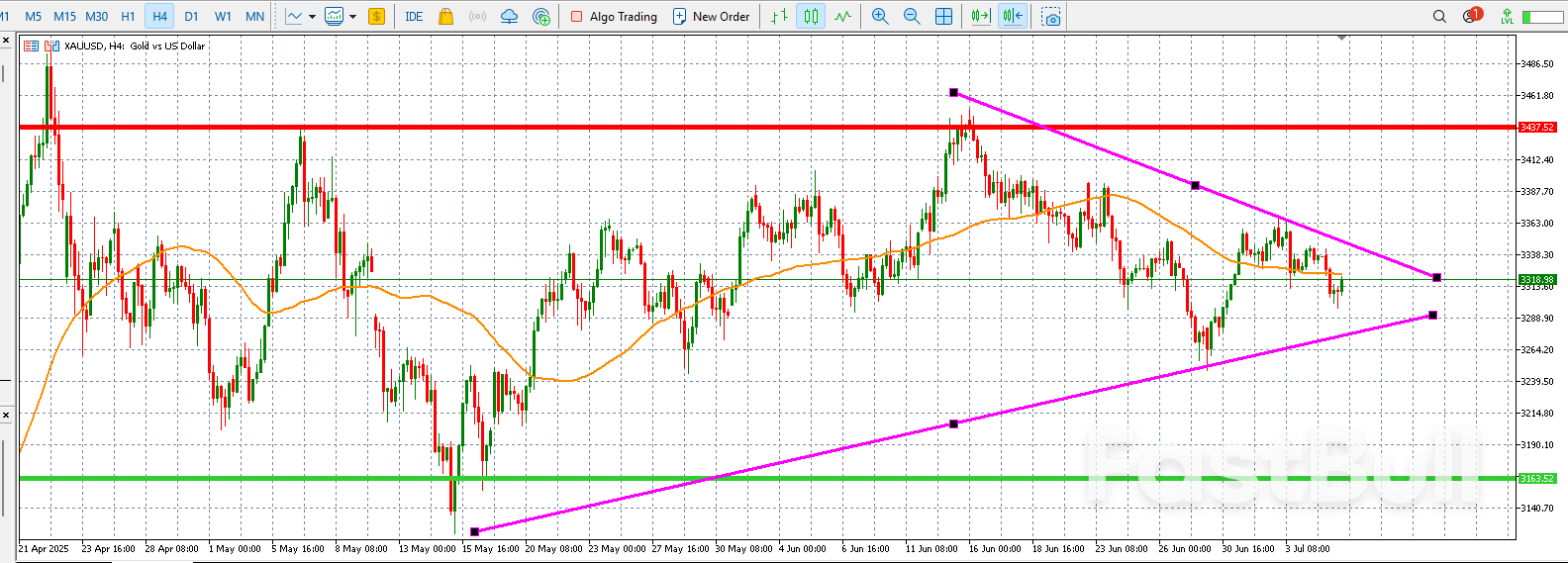
          The price of the shinning metal continues to look bullish and the below chart shown important price levels for the shining metal
          Gold prices: navigating a turbulent landscape amid global uncertainty_1

          Conclusion

          In 2025, the value of gold is determined by a combination of fiscal volatility, geopolitical conflict, and market dynamics' ever-shifting currents. Presidential candidate Donald Trump's policy of tariffs and Elon Musk's political grandstanding bring a certain volatility to the investor landscape. As the United States dollar continues the steady pressure towards prices for gold, its role as a hedge against coming trade war and potential stagflation takes hold and helps maintain value. As market currents shift with dizzying rapidity, gold remains a cornerstone asset for investors looking towards stabilizing a volatile economy.
          Where should investors' attention go? US Fiscal Policy: Be alert for upcoming FOMC minutes, which will provide insights into possible shifts in US monetary policy and insights into the future directions in the value of the dollar and the future price movement in gold. Geopolitical News: One must keep alert for any new commentary regarding tariffs, especially considering the growing tensions with China and the BRICS countries. This news could greatly increase the attractiveness of gold. Central Bank Activity: Pay close attention to the purchasing behavior of central banks, particularly as they continue with their gold acquisition. Any shift in this trend may signal the shift in global economic mood.

          Source: kitco

          Risk Warnings and Disclaimers
          You understand and acknowledge that there is a high degree of risk involved in trading. Following any strategies or investment methods may lead to potential losses. The content on the site is provided by our contributors and analysts for information purposes only. You are solely responsible for determining whether any trading assets, securities, strategy, or any other product is suitable for investing based on your own investment objectives and financial situation.
          Add to Favorites
          Share
          FastBull
          Copyright © 2025 FastBull Ltd

          728 RM B 7/F GEE LOK IND BLDG NO 34 HUNG TO RD KWUN TONG KLN HONG KONG

          TelegramInstagramTwitterfacebooklinkedin
          App Store Google Play Google Play
          Products
          Charts

          Chats

          Q&A with Experts
          Screeners
          Economic Calendar
          Data
          Tools
          Membership
          Features
          Function
          Markets
          Copy Trading
          Latest Signals
          Contests
          News
          Analysis
          24/7
          Columns
          Education
          Company
          Careers
          About Us
          Contact Us
          Advertising
          Help Center
          Feedback
          User Agreement
          Privacy Policy
          Business

          White Label

          Data API

          Web Plug-ins

          Poster Maker

          Affiliate Program

          Risk Disclosure

          The risk of loss in trading financial instruments such as stocks, FX, commodities, futures, bonds, ETFs and crypto can be substantial. You may sustain a total loss of the funds that you deposit with your broker. Therefore, you should carefully consider whether such trading is suitable for you in light of your circumstances and financial resources.

          No decision to invest should be made without thoroughly conducting due diligence by yourself or consulting with your financial advisors. Our web content might not suit you since we don't know your financial conditions and investment needs. Our financial information might have latency or contain inaccuracy, so you should be fully responsible for any of your trading and investment decisions. The company will not be responsible for your capital loss.

          Without getting permission from the website, you are not allowed to copy the website's graphics, texts, or trademarks. Intellectual property rights in the content or data incorporated into this website belong to its providers and exchange merchants.

          Not Logged In

          Log in to access more features

          FastBull Membership

          Not yet

          Purchase

          Become a signal provider
          Help Center
          Customer Service
          Dark Mode
          Price Up/Down Colors

          Log In

          Sign Up

          Position
          Layout
          Fullscreen
          Default to Chart
          The chart page opens by default when you visit fastbull.com