Markets
News
Analysis
User
24/7
Economic Calendar
Education
Data
- Names
- Latest
- Prev



Signal Accounts for Members
All Signal Accounts
All Contests
 Canada GDP YoY (Oct)
A:--
F: --
P: --
Canada GDP MoM (SA) (Oct)A:--
F: --
P: --
 U.S. Core PCE Price Index Prelim YoY (Q3)
A:--
F: --
P: --
U.S. PCE Price Index Prelim YoY (Q3)A:--
F: --
P: --
U.S. Annualized Real GDP Prelim (Q3)A:--
F: --
P: --
U.S. Non-Defense Capital Durable Goods Orders MoM (Excl. Aircraft) (Oct)A:--
F: --
U.S. Durable Goods Orders MoM (Excl. Defense) (SA) (Oct)A:--
F: --
P: --
U.S. Durable Goods Orders MoM (Excl.Transport) (Oct)A:--
F: --
U.S. Real Personal Consumption Expenditures Prelim QoQ (Q3)A:--
F: --
P: --
U.S. Durable Goods Orders MoM (Oct)A:--
F: --
U.S. Weekly Redbook Index YoYA:--
F: --
P: --
U.S. Manufacturing Output MoM (SA) (Nov)A:--
F: --
P: --
U.S. Manufacturing Capacity Utilization (Nov)A:--
F: --
U.S. Industrial Output YoY (Nov)A:--
F: --
P: --
U.S. Industrial Output MoM (SA) (Nov)A:--
F: --
P: --
U.S. Capacity Utilization MoM (SA) (Nov)A:--
F: --
U.S. Richmond Fed Manufacturing Shipments Index (Dec)A:--
F: --
P: --
U.S. Richmond Fed Services Revenue Index (Dec)A:--
F: --
P: --
U.S. Conference Board Consumer Expectations Index (Dec)A:--
F: --
P: --
U.S. Conference Board Present Situation Index (Dec)A:--
F: --
P: --
U.S. Richmond Fed Manufacturing Composite Index (Dec)A:--
F: --
P: --
U.S. Conference Board Consumer Confidence Index (Dec)A:--
F: --
Canada Federal Government Budget Balance (Oct)A:--
F: --
P: --
U.S. 5-Year Note Auction Avg. YieldA:--
F: --
P: --
U.S. Weekly Total Oil Rig CountA:--
F: --
P: --
U.S. Weekly Total Rig CountA:--
F: --
P: --
U.S. API Weekly Cushing Crude Oil StocksA:--
F: --
P: --
U.S. API Weekly Crude Oil StocksA:--
F: --
P: --
U.S. API Weekly Refined Oil StocksA:--
F: --
P: --
U.S. API Weekly Gasoline StocksA:--
F: --
P: --
 Mexico Unemployment Rate (Not SA) (Nov)
--
F: --
P: --
U.S. MBA Mortgage Application Activity Index WoW--
F: --
P: --
U.S. Dallas Fed PCE Price Index YoY (Oct)--
F: --
P: --
U.S. Weekly Continued Jobless Claims (SA)--
F: --
P: --
U.S. Weekly Initial Jobless Claims (SA)--
F: --
P: --
U.S. Initial Jobless Claims 4-Week Avg. (SA)--
F: --
P: --
U.S. EIA Weekly Crude Oil Imports Changes--
F: --
P: --
U.S. EIA Weekly Heating Oil Stock Changes--
F: --
P: --
Canada Federal Government Budget Balance (Oct)--
F: --
P: --
 Japan Construction Orders YoY (Nov)
--
F: --
P: --
Japan New Housing Starts YoY (Nov)--
F: --
P: --
 Turkey Capacity Utilization (Dec)
--
F: --
P: --
Japan Tokyo CPI YoY (Excl. Food & Energy) (Dec)--
F: --
P: --
Japan Unemployment Rate (Nov)--
F: --
P: --
Japan Tokyo Core CPI YoY (Dec)--
F: --
P: --
Japan Tokyo CPI YoY (Dec)--
F: --
P: --
Japan Jobs to Applicants Ratio (Nov)--
F: --
P: --
Japan Tokyo CPI MoM (Dec)--
F: --
P: --
Japan Tokyo CPI MoM (Excl. Food & Energy) (Dec)--
F: --
P: --
Japan Industrial Inventory MoM (Nov)--
F: --
P: --
Japan Retail Sales (Nov)--
F: --
P: --
Japan Industrial Output Prelim MoM (Nov)--
F: --
P: --
Japan Large-Scale Retail Sales YoY (Nov)--
F: --
P: --
Japan Industrial Output Prelim YoY (Nov)--
F: --
P: --
Japan Retail Sales MoM (SA) (Nov)--
F: --
P: --
Japan Retail Sales YoY (Nov)--
F: --
P: --
 India Deposit Gowth YoY
--
F: --
P: --















No matching data

Latest Views
Latest Views
Trending Topics
Top Columnists
Latest Update
White Label
Data API
Web Plug-ins
Affiliate Program
View All
No data
Canada's economy shrank by a greater-than-expected 0.3% in October, the largest drop in almost three years, but is expected to stage a partial recovery in November, official data showed on Tuesday.
Canada's economy shrank by a greater-than-expected 0.3% in October, the largest drop in almost three years, but is expected to stage a partial recovery in November, official data showed on Tuesday.
Analysts had forecast growth would dip by 0.2% from September as the economy continues to adjust to U.S. trade measures. Statistics Canada said initial data indicated GDP would grow by 0.1% in November.The month-on-month fall was the largest since the 0.3% decline seen in December 2022. The goods sector fell 0.7% while services contracted by 0.2%.
Bank of Canada Governor Tiff Macklem said on December 10 that he expected weak fourth quarter growth.
Money markets are predicting the Bank's next move will be a 25 basis point hike, most likely in July 2026.
"This is unlikely to materially change the outlook for monetary policy," said Stephen Brown, deputy chief North America economist at Capital Economics.
"Nonetheless, the economy's lack of momentum reinforces our view that markets have gotten ahead of themselves in terms of pricing in interest rate hikes for next year."
The manufacturing sector dropped by 1.5%, partly reflecting a 6.9% plunge in machinery output. Wood product manufacturing dropped by 7.3%, the largest decline since April 2020, following additional U.S. tariffs introduced on October 14.
Services-producing industries were hit by a nationwide work stoppage by Canada Post workers and a teachers' strike in the province of Alberta.
"The Canadian economy is skating on thin ice in Q4... we expect weak underlying momentum to carry through H1 2026," said Michael Davenport, Senior Canada Economist at Oxford Economics.
The Bank of Canada held its key policy rate steady at 2.25% on December 10. Macklem, noting the economy was proving resilient overall to tariffs, said the rate was at the right level to keep inflation close to the bank's 2% target.
The U.S. economy grew faster than expected in the third quarter, driven by robust consumer spending, but momentum appears to have faded amid the rising cost of living and recent government shutdown.
Gross domestic product increased at a 4.3% annualized rate last quarter, the Commerce Department's Bureau of Economic Analysis said in its initial estimate of third-quarter GDP on Tuesday. The economy grew at a 3.8% pace in the second quarter. Economists polled by Reuters had forecast GDP would rise at a 3.3% pace.
The data was delayed by the 43-day government shutdown and is now outdated. Consumer spending increased at a 3.5% rate last quarter after advancing at a 2.5% pace in the second quarter.
Much of the consumer spending acceleration resulted from a rush to buy electric vehicles before the September 30 expiration of tax credits. Motor vehicle sales dropped in October and November, while spending elsewhere was mixed.
The nonpartisan Congressional Budget Office has estimated the shutdown could slice between 1.0 percentage point and 2.0 percentage points off GDP in the fourth quarter. It projected most of the GDP drop would be recovered, but estimated between $7 billion and $14 billion would not.
Surveys suggest consumer spending is being driven by higher-income households, thanks to a stock market boom that has inflated household wealth. In contrast, middle- and lower-income consumers are struggling amid the rising cost of living resulting from President Donald Trump's sweeping tariffs, economists said, creating what they call a K-shaped economy.
That phenomenon also is playing out among businesses. Economists said large corporations have mostly managed to withstand the blow from the import duties, which have increased costs, and are investing in artificial intelligence. But smaller businesses are struggling with tariffs.
Trump's policies are contributing to what economists have termed an affordability crisis that is denting his approval ratings. Households also face higher utility bills as the rapid growth of AI and cloud computing data centers boosts electricity demand. Some will face skyrocketing health insurance premiums in 2026.
The Federal Reserve this month cut its benchmark overnight interest rate by another 25 basis points to the 3.50%-3.75% range, but signaled borrowing costs were unlikely to fall in the near term as policymakers await clarity on the direction of the labor market and inflation.

Korea will extend its consumption tax cut on passenger cars for an additional six months through the end of June next year, the finance ministry said Wednesday.
Under the latest extension, the individual consumption tax on passenger vehicles will be lowered to 3.5 percent from the original 5 percent, according to the Ministry of Economy and Finance.
The ministry said the measure will be terminated after June 30, 2026, taking into account recent signs of recovery in domestic demand.
The government first introduced the tax cut in July 2018 and has since repeatedly extended it to help boost domestic consumption, particularly during the COVID-19 pandemic.
Separately, the government will also extend its fuel tax cuts for an additional two months through the end of February to ease the burden on consumers amid continued volatility in global oil prices.
Under the latest extension, the current tax reductions — 7 percent on gasoline and 10 percent on diesel and liquefied petroleum gas (LPG) — will remain in place until Feb. 28.
The latest decision took into account the uncertainty in domestic and international oil prices, as well as consumer prices, and aims to alleviate fuel cost pressures on the public, according to the ministry.
Korea first introduced the fuel tax cut in November 2021 as a response to rising energy prices. The government has since extended the measure, adjusting the rates in accordance with changes in the global energy market.
This latest move marks the 19th extension of the fuel tax relief program.
Korea, which depends heavily on imports for energy, is particularly vulnerable to external price shocks, which often lead to domestic inflation.
Oil held a five-day gain as traders weighed escalating geopolitical tensions against swelling inventories.
West Texas Intermediate traded near $58 a barrel after gaining almost 6% in the prior five sessions, while Brent settled above $62 on Tuesday. Washington is still in pursuit of a third oil tanker off the coast of Venezuela as the White House ramps up pressure on Nicolás Maduro's government.
Meanwhile, Russian crude is building up at sea, with the volume jumping 48% since the end of August. The US actions in Venezuela may be raising concerns among shippers and buyers of Russian barrels, who worry their cargoes could also be targeted.
In the US, an industry report showed crude stockpiles increasing by 2.4 million barrels last week, with holdings of gasoline and distillate both rising. Official data is set to be released on Dec. 29, rather than Wednesday as originally planned, after President Donald Trump declared a federal holiday.
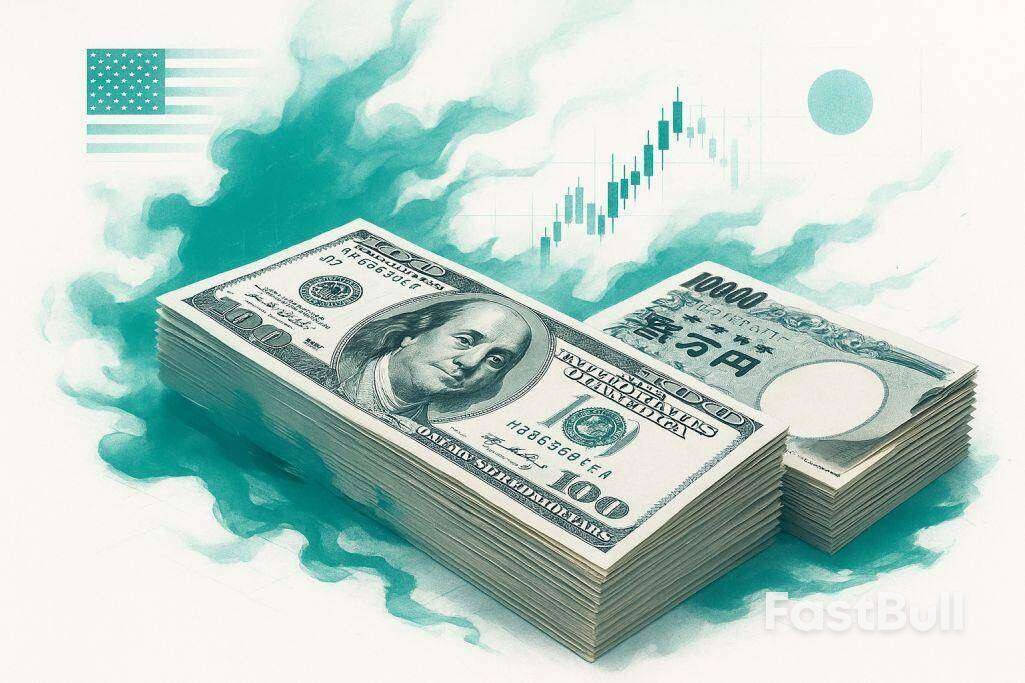
A Bank of Japan rate hike and surging Japanese Government Bond yields led to the unthinkable this week. USD/JPY rallied to 157.765 on December 19, while 10-year JGB yields soared to 2.1% on December 22, before dropping to 2.026% on December 23.
Monetary policy uncertainty, concerns about the coming year's fiscal budget and likely bond issuances, and intervention warnings clashed. Japan's Finance Minister Satsuki Katayama threatened yen interventions for two consecutive days as USD/JPY climbed toward 158. The two days of warnings briefly sent the pair below 156.
Fiscal concerns have festered since Prime Minister Sanae Takaichi became the frontrunner to be Japan's first woman prime minister. USD/JPY has risen 8.46% in H2 2025, while 10-year JGB yields have soared 0.60 basis points to 2.1%, the highest since February 1999.
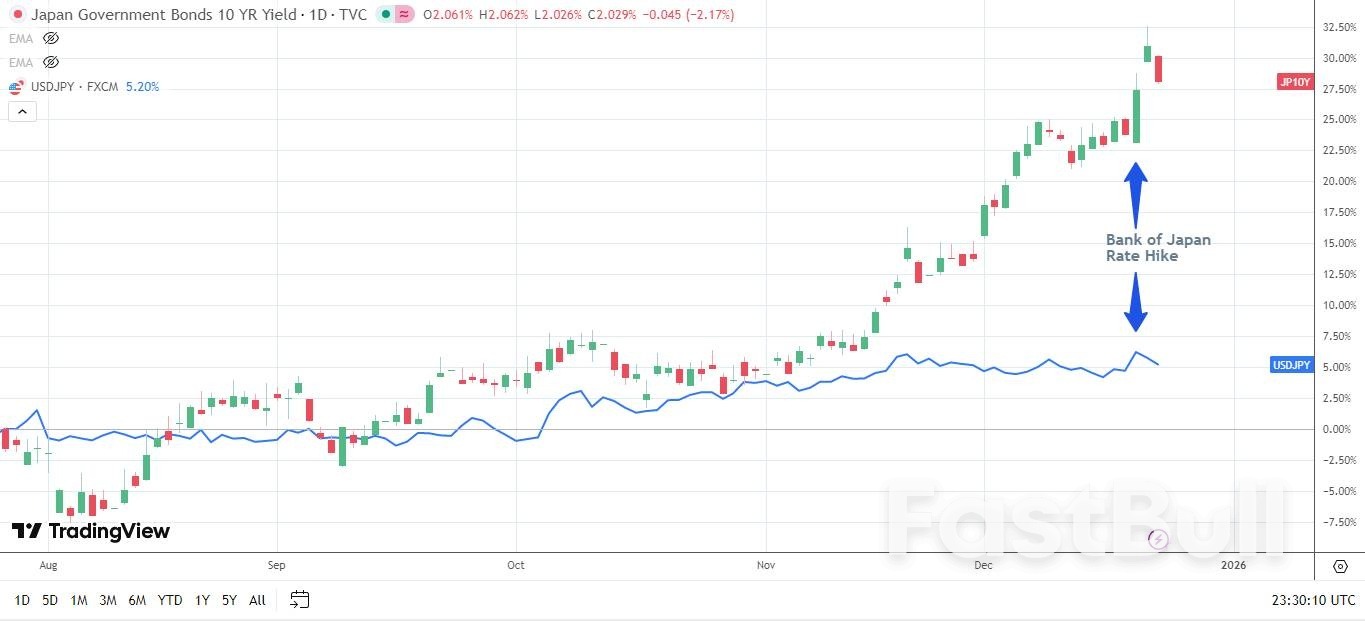 10-Year JGB Yields – USDJPY – Daily Chart – 241225
Crucially, intervention threats overshadowed fiscal concerns and strong US economic data, supporting a bearish USD/JPY outlook. Japanese economic indicators will likely add to the market volatility as the Japanese government and the BoJ grapple with yen stability.
Below, I'll discuss the macro backdrop, the near-term price catalysts, and technical levels traders should closely watch.
Following the choppy start to the week, the market focus will briefly shift to the Japanese economic calendar. The Conference Board Leading Economic Index (LEI) will give insights into the domestic demand outlook.
The LEI rose from 108.2 in September to 110.0 in October, indicating a pickup in business and consumer sentiment. Typically, a higher LEI reading indicates rising business investment, increasing employment, and stronger wage growth.
Higher wages would boost households' purchasing power, fueling consumer spending and demand-driven inflation. This chain of events would support a more hawkish BoJ policy stance, strengthening the yen.
However, the weaker yen has pushed import prices higher, dampening households' purchasing power and curbing private consumption. The effects of higher import prices on private consumption have been a key concern for the BoJ and the Japanese government, leading to yen intervention warnings.
An upward revision to the October LEI would align with improving sentiment toward the Japanese economy and strengthen the yen. However, USD/JPY losses will likely be limited, considering the ongoing fiscal concerns and the BoJ's cautious policy outlook and fading bets on a March Fed rate cut.
An unexpected surge in US GDP growth and a hotter-than-expected US price deflator tempered expectations of a March rate cut on Tuesday. A sharp increase in PCE prices signaled a sticky inflation outlook, while concerns mount about a decoupling of the labor market from GDP growth.
Later on Wednesday, initial jobless claims will come under scrutiny after last week's weak US jobs report. Economists forecast initial jobless claims to slip from 224k (week ending December 13) to 223k (week ending December 20).
A lower claims reading would ease immediate concerns about the labor market, while supporting a more hawkish Fed policy stance. However, an unexpected spike in claims could revive Fed rate cut bets, supporting a bearish USD/JPY price outlook.
According to the CME FedWatch Tool, the chances of a March Fed rate cut dropped from 52.9% on December 22 to 45.1% on December 23. The sharp drop reflected the impact of the Q3 US GDP report on sentiment toward the Fed policy stance.
While US data will influence US dollar demand and USD/JPY trends, risks of a yen carry trade unwind linger ahead of the holidays.
Elevated JGB and rising US Treasury yields will likely shift focus back to USD/JPY trends for early warning signs of an unwind. However, economists have mixed views on the USD/JPY's breaking point. 10-year JGB yields could boost demand from domestic investors. The prospect of a stronger yen on repatriations and higher yields reinforces the constructive short- to medium-term bias.
A drop below 155 could be crucial for the negative short- to medium-term bias, given Tuesday's low of 155.649.
With markets monitoring technical indicators and fundamentals, they will offer crucial signals into potential USD/JPY price trends.
Looking at the daily chart, USD/JPY remained above the 50-day and 200-day Exponential Moving Averages (EMAs), indicating a bullish bias. While technicals remained bullish, fundamentals are increasingly outweighing the technical structure, indicating a bearish outlook.
A drop below the 155 support level would bring the 50-day EMA into play. If breached, 150 would be the next key support level. Importantly, a sustained break below the 50-day EMA would signal a bearish near-term trend reversal, paving the way to the 200-day EMA and 150. A break below the 200-day EMA would reinforce the bearish medium- to longer-term USD/JPY price outlook.
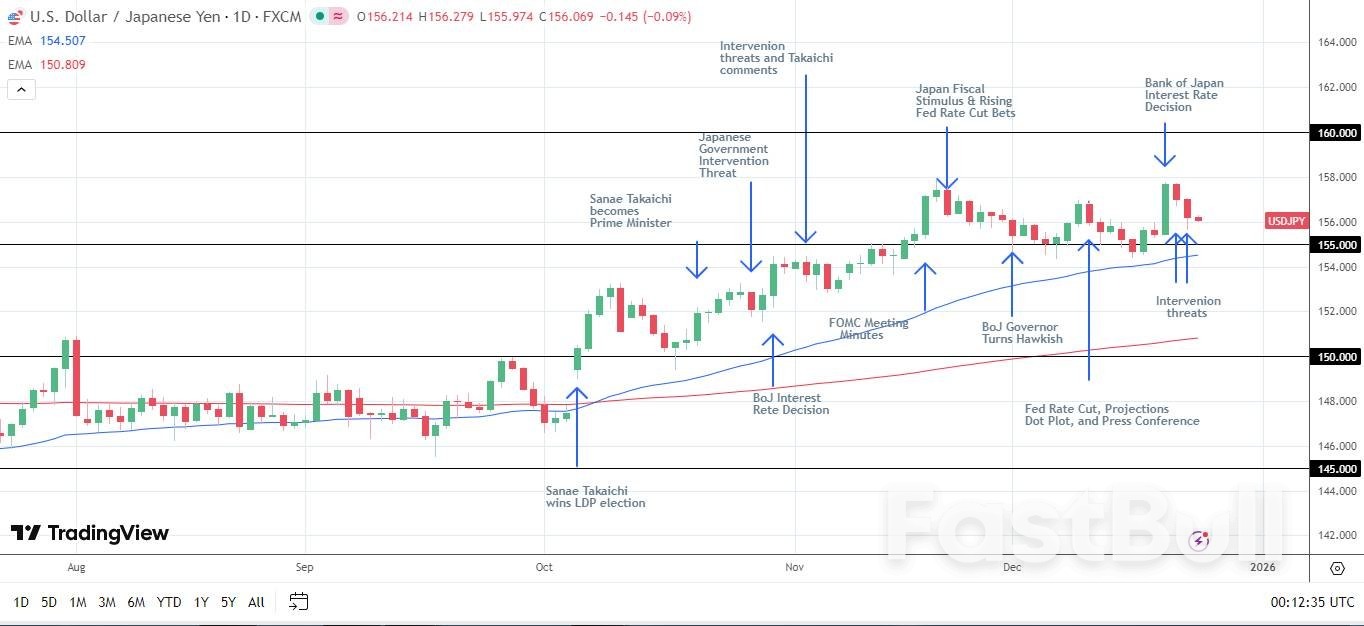 USDJPY – Daily Chart – 241225 – EMAs
In my view, intervention threats will continue to cap USD/JPY gains, while elevated JGB yields could boost yen demand, signaling a negative price outlook. However, the BoJ's messaging on the neutral interest rate will be crucial, given concerns about US inflation.
A higher neutral interest rate, neither accommodative nor restrictive, would signal multiple BoJ rate hikes and a sharp narrowing in US-Japan rate differentials. A less profitable yen carry trade into US assets and higher JGB yields would likely trigger a yen carry trade unwind, sending USD/JPY toward 130 in the longer term.
However, upside risks to the bearish outlook include:
This chain of events would fuel demand for the US dollar and send USD/JPY higher. However, yen intervention warnings are likely to cap the upside at around the 158 level, based on past communication.
In summary, USD/JPY trends reflect shifting sentiment toward narrowing rate differentials. Market focus remains on BoJ Governor Ueda's communications regarding the neutral rate.
A neutral rate at the higher end of the Bank's current 1% to 2.5% range would signal more aggressive rate hikes, supporting the bearish short- to medium-term outlook for USD/JPY. Furthermore, a more dovish Fed policy stance colliding with a hawkish BoJ will likely push USD/JPY toward 130 in the 6-12 month time horizon.
728 RM B 7/F GEE LOK IND BLDG NO 34 HUNG TO RD KWUN TONG KLN HONG KONG


White Label
Data API
Web Plug-ins
Poster Maker
Affiliate Program
The risk of loss in trading financial instruments such as stocks, FX, commodities, futures, bonds, ETFs and crypto can be substantial. You may sustain a total loss of the funds that you deposit with your broker. Therefore, you should carefully consider whether such trading is suitable for you in light of your circumstances and financial resources.
No decision to invest should be made without thoroughly conducting due diligence by yourself or consulting with your financial advisors. Our web content might not suit you since we don't know your financial conditions and investment needs. Our financial information might have latency or contain inaccuracy, so you should be fully responsible for any of your trading and investment decisions. The company will not be responsible for your capital loss.
Without getting permission from the website, you are not allowed to copy the website's graphics, texts, or trademarks. Intellectual property rights in the content or data incorporated into this website belong to its providers and exchange merchants.
Not Logged In
Log in to access more features

FastBull Membership
Not yet
Purchase


Log In
Sign Up