• Trade
  • Markets
  • Copy
  • Contests
  • News
  • 24/7
  • Calendar
  • Q&A
  • Chats
Trending
Screeners
SYMBOL
LAST
BID
ASK
HIGH
LOW
NET CHG.
%CHG.
SPREAD
SPX
S&P 500 Index
6857.66
6857.66
6857.66
6878.28
6857.66
-12.74
-0.19%
--
DJI
Dow Jones Industrial Average
47848.87
47848.87
47848.87
47971.51
47771.72
-106.11
-0.22%
--
IXIC
NASDAQ Composite Index
23564.53
23564.53
23564.53
23698.93
23564.53
-13.58
-0.06%
--
USDX
US Dollar Index
99.070
99.150
99.070
99.110
98.730
+0.120
+ 0.12%
--
EURUSD
Euro / US Dollar
1.16284
1.16293
1.16284
1.16717
1.16245
-0.00142
-0.12%
--
GBPUSD
Pound Sterling / US Dollar
1.33167
1.33177
1.33167
1.33462
1.33087
-0.00145
-0.11%
--
XAUUSD
Gold / US Dollar
4192.74
4193.08
4192.74
4218.85
4175.92
-5.17
-0.12%
--
WTI
Light Sweet Crude Oil
59.020
59.050
59.020
60.084
58.892
-0.789
-1.32%
--

Community Accounts

Signal Accounts
--
Profit Accounts
--
Loss Accounts
--
View More

Become a signal provider

Sell trading signals to earn additional income

View More

Guide to Copy Trading

Get started with ease and confidence

View More

Signal Accounts for Members

All Signal Accounts

Best Return
  • Best Return
  • Best P/L
  • Best MDD
Past 1W
  • Past 1W
  • Past 1M
  • Past 1Y

All Contests

  • All
  • Trump Updates
  • Recommend
  • Stocks
  • Cryptocurrencies
  • Central Banks
  • Featured News
Top News Only
Share

German Spy Chief: No Need To 'Break' With US Over Security Policy

Share

United Arab Emirates Official To Reuters: The United Arab Emirates Asserts That The Governance And Territorial Integrity Of Yemen Must Be Determined By Yemenis

Share

United Arab Emirates Official To Reuters: The United Arab Emirates's Position On The Yemen Crisis Is In Line With Saudi Arabia In Supporting A Political Process Based On An Initiative Backed By Gulf States

Share

French Presidential Residence Elysee: Work Will Be Intensified To Provide Ukraine With Robust Security Guarantees And To Plan Measures For The Reconstruction Of Ukraine

Share

French Presidential Residence Elysee: Meeting Of Leaders In The E3 Format And President Zelensky Allowed For The Continuation Of Joint Work On The US Plan

Share

US Dollar Extends Gains Versus Yen After Japan Earthquake, Last Up 0.2% At 155.64 Yen

Share

US Natural Gas Futures Drop 6% On Less Cold Forecasts, Near-Record Output

Share

Russian Central Bank: Sets Official Rouble Rate For December 9 At 77.2733 Roubles Per USA Dollar (Previous Rate - 76.0937)

Share

Russian Deputy Prime Minister Novak: Russia Will Restrict Gold Exports Starting In 2026

Share

US Dollar Touches Session High Versus Yen On Earthquake News, Last Up 0.5% At 155.81%

Share

NHK: A 40-centimeter-high Tsunami Has Reached Mutsuki Port In Aomori, Japan

Share

ICE Cotton Stocks Totalled To 13971 - December 08, 2025

Share

Japan Prime Minister Takaichi: Trying To Gather Information After Quake

Share

UK Trade Minister To Visit US This Week For Talks On Tariffs

Share

Head Of Yemen's Anti-Houthi Presidential Council Says Actions Of Southern Transitional Council Across South Yemen Undermines Legitimacy Of Internationally-Recognised Government

Share

Carvana Rose 9.1% And Crh Rose 6.8% As Both Companies Were Added To The S&P 500 Index

Share

Japanese Regulators Say No Problems Have Been Found At The Onagawa Nuclear Power Plant

Share

KYODO News: Some Tohoku Shinkansen Services Have Been Suspended Following The Earthquake In Japan

Share

The Japan Meteorological Agency Has Issued Tsunami Warnings For The Central Pacific Coast Of Hokkaido, The Pacific Coast Of Aomori Prefecture, And Iwate Prefecture

Share

Euro Hits Session High Versus Yen Following Strong Japan Quake, Last Up 0.3% At 181.36 Yen

TIME
ACT
FCST
PREV
France Trade Balance (SA) (Oct)

A:--

F: --

P: --
Euro Zone Employment YoY (SA) (Q3)

A:--

F: --

P: --
Canada Part-Time Employment (SA) (Nov)

A:--

F: --

P: --

Canada Unemployment Rate (SA) (Nov)

A:--

F: --

P: --

Canada Full-time Employment (SA) (Nov)

A:--

F: --

P: --

Canada Labor Force Participation Rate (SA) (Nov)

A:--

F: --

P: --

Canada Employment (SA) (Nov)

A:--

F: --

P: --

U.S. PCE Price Index MoM (Sept)

A:--

F: --

P: --

U.S. Personal Income MoM (Sept)

A:--

F: --

P: --

U.S. Core PCE Price Index MoM (Sept)

A:--

F: --

P: --

U.S. PCE Price Index YoY (SA) (Sept)

A:--

F: --

P: --

U.S. Core PCE Price Index YoY (Sept)

A:--

F: --

P: --

U.S. Personal Outlays MoM (SA) (Sept)

A:--

F: --

P: --
U.S. 5-10 Year-Ahead Inflation Expectations (Dec)

A:--

F: --

P: --

U.S. Real Personal Consumption Expenditures MoM (Sept)

A:--

F: --

P: --
U.S. Weekly Total Rig Count

A:--

F: --

P: --

U.S. Weekly Total Oil Rig Count

A:--

F: --

P: --

U.S. Consumer Credit (SA) (Oct)

A:--

F: --

P: --
China, Mainland Foreign Exchange Reserves (Nov)

A:--

F: --

P: --

Japan Trade Balance (Oct)

A:--

F: --

P: --

Japan Nominal GDP Revised QoQ (Q3)

A:--

F: --

P: --

China, Mainland Imports YoY (CNH) (Nov)

A:--

F: --

P: --

China, Mainland Exports (Nov)

A:--

F: --

P: --

China, Mainland Imports (CNH) (Nov)

A:--

F: --

P: --

China, Mainland Trade Balance (CNH) (Nov)

A:--

F: --

P: --

China, Mainland Exports YoY (USD) (Nov)

A:--

F: --

P: --

China, Mainland Imports YoY (USD) (Nov)

A:--

F: --

P: --

Germany Industrial Output MoM (SA) (Oct)

A:--

F: --

P: --
Euro Zone Sentix Investor Confidence Index (Dec)

A:--

F: --

P: --

Canada National Economic Confidence Index

A:--

F: --

P: --

U.K. BRC Like-For-Like Retail Sales YoY (Nov)

--

F: --

P: --

U.K. BRC Overall Retail Sales YoY (Nov)

--

F: --

P: --

Australia Overnight (Borrowing) Key Rate

--

F: --

P: --

RBA Rate Statement
RBA Press Conference
Germany Exports MoM (SA) (Oct)

--

F: --

P: --

U.S. NFIB Small Business Optimism Index (SA) (Nov)

--

F: --

P: --

Mexico 12-Month Inflation (CPI) (Nov)

--

F: --

P: --

Mexico Core CPI YoY (Nov)

--

F: --

P: --

Mexico PPI YoY (Nov)

--

F: --

P: --

U.S. Weekly Redbook Index YoY

--

F: --

P: --

U.S. JOLTS Job Openings (SA) (Oct)

--

F: --

P: --

China, Mainland M1 Money Supply YoY (Nov)

--

F: --

P: --

China, Mainland M0 Money Supply YoY (Nov)

--

F: --

P: --

China, Mainland M2 Money Supply YoY (Nov)

--

F: --

P: --

U.S. EIA Short-Term Crude Production Forecast For The Year (Dec)

--

F: --

P: --

U.S. EIA Natural Gas Production Forecast For The Next Year (Dec)

--

F: --

P: --

U.S. EIA Short-Term Crude Production Forecast For The Next Year (Dec)

--

F: --

P: --

EIA Monthly Short-Term Energy Outlook
U.S. API Weekly Gasoline Stocks

--

F: --

P: --

U.S. API Weekly Cushing Crude Oil Stocks

--

F: --

P: --

U.S. API Weekly Crude Oil Stocks

--

F: --

P: --

U.S. API Weekly Refined Oil Stocks

--

F: --

P: --

South Korea Unemployment Rate (SA) (Nov)

--

F: --

P: --

Japan Reuters Tankan Non-Manufacturers Index (Dec)

--

F: --

P: --

Japan Reuters Tankan Manufacturers Index (Dec)

--

F: --

P: --

Japan Domestic Enterprise Commodity Price Index MoM (Nov)

--

F: --

P: --

Japan Domestic Enterprise Commodity Price Index YoY (Nov)

--

F: --

P: --

China, Mainland PPI YoY (Nov)

--

F: --

P: --

China, Mainland CPI MoM (Nov)

--

F: --

P: --

Q&A with Experts
    • All
    • Chatrooms
    • Groups
    • Friends
    Connecting
    .
    .
    .
    Type here...
    Add Symbol or Code

      No matching data

      All
      Trump Updates
      Recommend
      Stocks
      Cryptocurrencies
      Central Banks
      Featured News
      • All
      • Russia-Ukraine Conflict
      • Middle East Flashpoint
      • All
      • Russia-Ukraine Conflict
      • Middle East Flashpoint
      Search
      Products

      Charts Free Forever

      Chats Q&A with Experts
      Screeners Economic Calendar Data Tools
      Membership Features
      Data Warehouse Market Trends Institutional Data Policy Rates Macro

      Market Trends

      Market Sentiment Order Book Forex Correlations

      Top Indicators

      Charts Free Forever
      Markets

      News

      News Analysis 24/7 Columns Education
      From Institutions From Analysts
      Topics Columnists

      Latest Views

      Latest Views

      Trending Topics

      Top Columnists

      Latest Update

      Signals

      Copy Rankings Latest Signals Become a signal provider AI Rating
      Contests
      Brokers

      Overview Brokers Assessment Rankings Regulators News Claims
      Broker listing Forex Brokers Comparison Tool Live Spread Comparison Scam
      Q&A Complaint Scam Alert Videos Tips to Detect Scam
      More

      Business
      Events
      Careers About Us Advertising Help Center

      White Label

      Data API

      Web Plug-ins

      Affiliate Program

      Awards Institution Evaluation IB Seminar Salon Event Exhibition
      Vietnam Thailand Singapore Dubai
      Fans Party Investment Sharing Session
      FastBull Summit BrokersView Expo
      Recent Searches
        Top Searches
          Markets
          News
          Analysis
          User
          24/7
          Economic Calendar
          Education
          Data
          • Names
          • Latest
          • Prev

          View All

          No data

          Scan to Download

          Faster Charts, Chat Faster!

          Download App
          English
          • English
          • Español
          • العربية
          • Bahasa Indonesia
          • Bahasa Melayu
          • Tiếng Việt
          • ภาษาไทย
          • Français
          • Italiano
          • Türkçe
          • Русский язык
          • 简中
          • 繁中
          Open Account
          Search
          Products
          Charts Free Forever
          Markets
          News
          Signals

          Copy Rankings Latest Signals Become a signal provider AI Rating
          Contests
          Brokers

          Overview Brokers Assessment Rankings Regulators News Claims
          Broker listing Forex Brokers Comparison Tool Live Spread Comparison Scam
          Q&A Complaint Scam Alert Videos Tips to Detect Scam
          More

          Business
          Events
          Careers About Us Advertising Help Center

          White Label

          Data API

          Web Plug-ins

          Affiliate Program

          Awards Institution Evaluation IB Seminar Salon Event Exhibition
          Vietnam Thailand Singapore Dubai
          Fans Party Investment Sharing Session
          FastBull Summit BrokersView Expo

          Canada's Unemployment Rate Jumps To 6.9% In April, Employment Little Changed

          Catherine Richards

          Economic

          Summary:

          Canada's unemployment rate rose to 6.9% in April, matching the November figure when joblessness in the country scaled an eight-year high outside of the pandemic era, data showed on Friday.

          Canada's unemployment rate rose to 6.9% in April, matching the November figure when joblessness in the country scaled an eight-year high outside of the pandemic era, data showed on Friday.

          The high unemployment rate in Canada, where the number of jobless people is inching towards 1.6 million, was partly a result of U.S. President Donald Trump's tariffs on a raft of Canadian imports, Statistics Canada said.Overall, the employment number was largely flat with minimal gains of net 7,400 jobs in April, Statistics Canada said. This was in contrast to a loss of 32,600 jobs the prior month.

          Analysts polled by Reuters had predicted employment to increase by 2,500 people and the unemployment rate to increase to 6.8%.

          Trump's tariffs on Canadian steel and aluminum in March and automobiles in April, along with import duties on a broad range of products with various reductions and exemptions has impacted businesses and households.

          The Bank of Canada has warned that growth would take a major hit in coming months as exports fall, prices increase, hiring reduces and layoffs accelerate. It has vowed to act decisively if the economy needs urgent support.

          Currency swap market bets show odds of a 25 basis point rate cut in June at 52% roughly.

          The Canadian dollar was trading up 0.08% to 1.3912 U.S. dollar, or 71.88 U.S. cents. Yields on two-year government bonds fell 2.4 basis points to 2.566% after the labor force data was released.

          The number of unemployed people, or those looking for work or on temporary layoff, increased by 39,000 or 2.6% in April and was up by 189,000 or 13.9% on a year-over-year basis.

          "People who were unemployed continued to face more difficulties finding work in April than a year earlier," Statscan said, adding that among those who were unemployed in March, 61% remained unemployed in April which was almost four percentage points higher than the same period last year.

          The tariffs and the uncertainty around them especially hit the manufacturing sector which shed 31,000 jobs in the month, Statscan said.

          The employment rate, or the proportion of the working age population that is employed, was at 60.8% in April, following a decline of 0.2 percentage points in March. This was a six-month low, the statistics agency said.

          The employment rate had been depressed for most of 2023 and 2024 as population growth outpaced employment gains. However, in recent months population growth has not been very high but employment gains have slowed.

          Employment in the public sector increased by 23,000 or up 0.5% in April, following three consecutive months of little change, especially due to increased temporary hiring for the federal election.

          The average hourly wage growth of permanent employees, a metric closely watched by the Canadian central bank to gauge inflationary trends, was at 3.5% in April, same as March.

          Source: Kitco

          To stay updated on all economic events of today, please check out our Economic calendar
          Risk Warnings and Disclaimers
          You understand and acknowledge that there is a high degree of risk involved in trading. Following any strategies or investment methods may lead to potential losses. The content on the site is provided by our contributors and analysts for information purposes only. You are solely responsible for determining whether any trading assets, securities, strategy, or any other product is suitable for investing based on your own investment objectives and financial situation.
          Add to Favorites
          Share

          Week Ahead – All Eyes On US CPI And Trade Talks Amid No End To Tariff Uncertainty

          XM

          Economic

          Central Bank

          US CPI report takes centre stage to gauge tariff impact.Progress in trade negotiations will also be watched, especially with China.US Retail Sales, UK and Japanese GDP on the agenda too.

          Will reciprocal tariffs show up in April CPI?

          Despite lingering worries about a recession, the available data suggests the US economy is at worst, headed for a slowdown. There are no signs yet either that inflation is accelerating, as both the CPI and PCE measures declined in March. However, the cooldown in inflation is likely to be temporary as the broad-based reciprocal tariffs kicked in on April 9. Although the higher levies that were set above the 10% universal rate were delayed for 90 days and some other exemptions were announced too, the price of most imports is expected to have gone up by at least the same amount, with many imports from China facing steeper 145% tariffs.

          Yet, it’s expected that very little of those costs were passed on to consumers in April. Many businesses frontloaded their imports before ‘Liberation Day’, while others are likely hoping that most of the tariffs will disappear soon and are holding off from raising prices. But this is contingent on the Trump administration reaching trade deals with its main trading partners within months, something that may not be very realistic.

          However, it does mean that the April CPI report won’t be the disaster it could have been. The consumer price index is expected to have increased by 0.3% month-on-month, staying unchanged at 2.4% on a yearly basis. Core CPI is also forecast to have risen by 0.3% over the month and to remain unchanged at 2.8% year-on-year.

          The Fed warned of rising risks to both inflation and unemployment at its May policy meeting so any upside surprises to the data on Tuesday could lead investors to further pare back their rate cut expectations for 2025.

          US Retail Sales, UoM survey also eyed

          But with the Fed also having full employment as part of its dual mandate, rate cut bets are a tradeoff between inflation and what’s happening in the rest of the economy. At the moment, the Fed is being careful about managing inflation expectations, hence, it’s holding firm on its wait-and-see stance. But any sudden deterioration in the economy would prompt it to reconsider this position, as has already been indicated by some Fed officials.

          Retail sales is one such dataset that could go in the opposite way of the inflation report. After surging by a revised 1.5% m/m in March, retail sales probably increased by just 0.1% in April. Those figures are out on Thursday alongside producer prices, industrial production and the Philly Fed manufacturing index. There’s a further flurry of releases on Friday, including building permits, housing starts, the Empire State manufacturing index and the University of Michigan’s preliminary consumer sentiment survey.

          The latter will be particularly important as the UoM’s inflation expectations metrics have jumped significantly in recent months, likely contributing to the Fed’s caution.

          Hopes are high for US-China trade progress

          But as investors desperately dissect all the data for clues, it’s possible that tariff-related headlines might have a bigger impact on the markets. US Treasury Secretary Scott Bessent and Trade Representative Jamieson Greer are due to hold talks with senior Chinese officials in Switzerland on Saturday.

          This is the first high-level meeting between the two countries since the escalation of trade tensions in February and the stakes are high. Markets are for the moment simply cheering the fact that two sides have agreed to engage in direct talks. But there’s plenty to suggest that Washington and Beijing are quite far apart on their starting points, so any disappointment could bring about a reversal in the positive sentiment, pulling risk assets lower at the start of the trading week.

          Can UK data propel the Pound higher?

          Any potential selloff might be less severe for the pound and UK stocks following the deal reached between the US and Britain on trade that reduces the 25% tariffs on cars and steel to the baseline 10% rate. Whilst it doesn’t appear that the UK has managed to win many concessions in this preliminary agreement, it comes hot on the heels of a deal with India too, as well as improving relations with the European Union.

          Subsequently, the pound has established strong support just above the $1.32 level, but at the same time, it’s lacking the momentum to make a convincing break above $1.34. In the absence of a global risk rally, next week’s UK economic releases might not be enough to recharge the bulls.

          UK employment numbers for March are out on Tuesday, with the Bank of England keeping a close watch on wage growth, which is proving very sticky. The BoE doesn’t expect inflation to reach its 2% target until 2027 but concerns about growth are keeping it on an easing path. An update on the economy is due on Thursday when first quarter GDP readings are published.

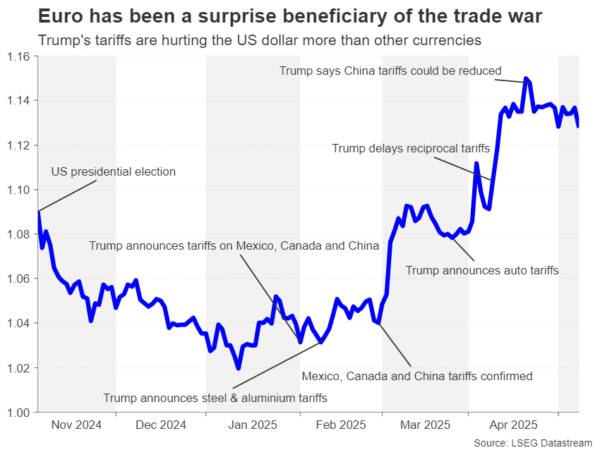
          Euro uptrend loses steam as US trade talks drag on

          Across the channel, it will be a relatively quiet week for the euro area, with US-EU trade negotiations likely being the main focus for investors. The EU is reportedly mulling higher tariffs on up to 95 billion euros worth of US goods that the bloc could impose should the talks fail. On the other hand, any signs of progress could spur the euro, which has been consolidating its trade war-led gains over the past three weeks.

          On the data front, the ZEW economic sentiment index out of Germany might attract some attention on Tuesday, while on Thursday, quarterly employment and the second estimate of Q1 GDP growth for the Eurozone will hit the wires.

          Japanese GDP might dent BoJ rate hike bets

          Japan is also eager to reach a new deal on trade with the United States as the fragile economic recovery likely ran into trouble in the first three months of 2025. GDP figures out on Friday are expected to show that the Japanese economy contracted mildly, by 0.1%, in Q1.

          The sluggish performance even before Trump’s tariffs have come into effect is one of the reasons why the Bank of Japan has turned less confident about hiking interest rates again. Having said that, policymakers are becoming increasingly concerned about the stickiness in food inflation, which may eventually push up underlying price pressures.

          Hence, a rate hike is by no means off the table and any unexpected strength in the economy would increase the likelihood of further tightening later in the year, boosting the yen.

          There might also be some hints on rate hike prospects in the BoJ’s Summary of Opinions of the April-May meeting that will be published on Monday. The Summary should shed some light on how strongly board members are sticking to their determination to normalize policy.

          Australian employment on tap

          Finally, in Australia, the labour market will be in the spotlight, as Q1 wage growth numbers are out on Wednesday, to be followed by the employment report for April on Thursday. Investors have priced in about a 90% probability that the Reserve Bank of Australia will cut rates for only a second time at its policy meeting later in May. It’s hard to see the job figures materially shifting those odds.

          Nevertheless, any big surprises could move the Australian dollar, although at the start of the week, the aussie’s focus will be on the developments from the weekend’s US-China trade talks, as well as on China’s CPI and PPI release on Saturday.

          Source: XM

          To stay updated on all economic events of today, please check out our Economic calendar
          Risk Warnings and Disclaimers
          You understand and acknowledge that there is a high degree of risk involved in trading. Following any strategies or investment methods may lead to potential losses. The content on the site is provided by our contributors and analysts for information purposes only. You are solely responsible for determining whether any trading assets, securities, strategy, or any other product is suitable for investing based on your own investment objectives and financial situation.
          Add to Favorites
          Share

          Wall Street rises as focus shifts to US-China trade talks

          Adam

          Stocks

          Wall Street's main indexes rose on Friday, marking their third straight day of gains, as investors assessed fresh comments from President Donald Trump regarding tariffs on China ahead of a key weekend meeting between the two countries.
          Futures had moved lower briefly earlier in the day after Trump said Beijing should open its market to the United States and that 80% tariffs on Chinese goods "seems right." The levies are currently at 145%.
          Representatives from the world's two biggest economies are scheduled to meet in Switzerland over the weekend to discuss tariffs, with investors hoping the talks will salve a bruising trade war that has raised concerns over global economic growth and left markets, companies and the U.S. Federal Reserve in wait-and-watch mode.
          "Anyone who thinks the deal is getting done at 80% is not seeing things clearly. You're going to see that they'll come to something more reasonable over time, but this was a step in the right direction," said Thomas Hayes, chairman at Great Hill Capital.
          On Thursday, Wall Street's main indexes closed higher as investors cheered a trade deal struck between Britain and the U.S. - the first of its kind since Trump paused his initial tariffs last month.
          Reuters reported India had offered to slash its tariff gap with the U.S. to less than 4% from nearly 13% now, in exchange for an exemption from Trump's tariffs, according to sources.
          "We're going to see multiple deals with major nations and that's going to allow CEOs to get some more confidence that they can start to plan and possibly invest all that has been on hold," said Hayes.
          At 09:45 a.m. ET, the Dow Jones Industrial Average rose 50.37 points, or 0.12%, to 41,418.82, the S&P 500 gained 15.49 points, or 0.27%, to 5,679.43 and the Nasdaq Composite gained 91.47 points, or 0.51%, to 18,019.61.
          Energy, up 0.8%, led gains among the 11 S&P 500 sectors. Funds tracking consumer discretionary stocks outperformed in the week ended Wednesday, while financials were hit the most, according to data compiled by LSEG.
          The S&P 500 and the Nasdaq are set for marginal declines this week, but are hovering near levels seen in late March, having recouped all the losses incurred in the aftermath of Trump's "Liberation day" tariff announcement last month.
          Days after the Federal Reserve left interest rates unchanged, Governor Michael Barr said Trump's trade policies will likely lift inflation, lower growth, and raise unemployment later this year.
          With the peak of the earnings season behind, about 76% of S&P 500 companies have surpassed profit expectations. But many have withdrawn their annual forecasts citing an uncertain trade environment.
          Expedia slipped 8.8% after the online travel platform missed quarterly revenue estimates.
          Trade Desk shares jumped 23.2% after the ad firm posted first-quarter revenue and profit above Wall Street estimates. Insulin delivery device maker Insulet jumped 18% after beating estimates for first-quarter profit on Thursday
          Advancing issues outnumbered decliners by a 2.68-to-1 ratio on the NYSE and by a 2.01-to-1 ratio on the Nasdaq.
          The S&P 500 posted three new 52-week highs and one new low while the Nasdaq Composite recorded 25 new highs and 39 new lows.

          Source: Reuters

          Risk Warnings and Disclaimers
          You understand and acknowledge that there is a high degree of risk involved in trading. Following any strategies or investment methods may lead to potential losses. The content on the site is provided by our contributors and analysts for information purposes only. You are solely responsible for determining whether any trading assets, securities, strategy, or any other product is suitable for investing based on your own investment objectives and financial situation.
          Add to Favorites
          Share

          Two Trade Deals and a Rate Cut in One Week … Are Things Looking Up for UK PLC?

          Warren Takunda

          Economic

          China–U.S. Trade War

          You wait three years for a trade deal and then two come along at once.
          As of Monday, the UK hadn’t announced a free trade agreement since 2022, when Boris Johnson’s government signed one with New Zealand, ranked number 52 among global economies.
          By the end of a week foreshortened by the bank holiday and which began with Donald Trump dropping a tariff bombshell on the British film industry, the government had unveiled a deal with India, as well as a more nebulous framework deal with the US, the fourth-largest and largest economies, respectively.
          Sandwiched in between the two announcements was an interest rate cut from the Bank of England, making it cheaper for UK businesses to borrow money to invest in the growth that the Labour government is so desperately chasing.
          Looking forward, opponents of tariff barriers are now crossing their fingers for a thawing of relations between the US and China, which would avert broader ripple effects depressing UK growth.
          The US deal also appears to have left the way clear for Starmer to seek stronger economic ties with the EU, another potential lever to boost economic output.
          Speaking on Thursday, after staging a transatlantic conference call with Trump, the prime minister hailed a “fantastic, historic day”.
          But have the events of this week really moved the dial for UK plc and the prospects for Britain’s lacklustre economic growth?
          David Henig, director of UK trade policy at the thinktank European Centre for International Political Economy, was a little more circumspect.
          “It’s middling,” he said, referring to the combined effect of the week’s trade announcements. “None of this is economically transformational but was anything you could have done ever going to be?”
          “It’s very Starmerish. It’s 1-0 to the Arsenal.”
          Henig’s assessment, via a footballing analogy, is typical of the broader reaction from economists and businesses: positive but muted.
          The impact on growth is “likely to be very small”, said Ben Caswell, senior economist at the National Institute of Economic and Social Research, but should fuel business confidence.
          The FTSE 100 offers one bellwether of the mood among those with money riding on it.Two Trade Deals and a Rate Cut in One Week … Are Things Looking Up for UK PLC?_1
          The Trump-Starmer announcement took place on Thursday as trading on the London market was nearing a close, giving investors relatively little time to digest it.
          There were some obvious winners straight away.
          Shares in luxury carmakerAston Martin soared as Trump confirmed that the tariff on UK vehicles, which was scheduled to rise to 27.5%, would instead be set at 10%.
          That is also a fillip for the UK’s biggest car exporter, Jaguar Land Rover (JLR), whose Solihull plant was apparently chosen as the venue for Starmer’s press conference for that very reason.
          In an interview with CNN on Thursday, the UK ambassador to the US, Peter Mandelson, suggested the deal had persuaded JLR to change its mind about planned lay-offs.
          “This deal has saved those jobs,” he said. “That’s a pretty big achievement, in my view, and I’m very pleased that the president has signed it.”
          The Society of Motor Manufacturers and Traders hailed the dissipation of a “severe and immediate threat”.
          However, tariffs on UK cars will still be four times the 2.5% they were before Trump’s “liberation day” tariff frenzy, while the lower rate will only apply to the first 100,000 exports, effectively capping the flow of British marques into America at just below the 102,000 level achieved last year.
          Rolls-Royce was another obvious beneficiary after UK negotiators secured an exemption for its engines, used on Boeing 787 passenger jets.
          The fragile British steel industry also appears likely to benefit from a cooperation agreement, although details are sketchy at present. Trump also signalled preferential treatment for the UK’s pharmaceutical industry, which exports £8.8bn a year to the US.
          On Friday morning, after investors had slept on it, firms with a US presence continued to make gains.
          “The FTSE 100 top risers’ list was full of UK-listed stocks that do business in the US, such as retailer JD Sports, rat catcher Rentokil and industrial groups Smiths [Group] and Spirax,” said Russ Mould, investment director at stockbroker AJ Bell.Two Trade Deals and a Rate Cut in One Week … Are Things Looking Up for UK PLC?_2
          However, more than 280 UK-listed companies have so far issued warnings about the impact of tariffs, according to investment firm Bowmore Wealth Group.
          Most of those are still facing up to the reality of a 10% tariff on exports to the US that didn’t exist just six months ago, or the collateral damage from the wider continuing trade war.

          Source: Theguardian


          To stay updated on all economic events of today, please check out our Economic calendar
          Risk Warnings and Disclaimers
          You understand and acknowledge that there is a high degree of risk involved in trading. Following any strategies or investment methods may lead to potential losses. The content on the site is provided by our contributors and analysts for information purposes only. You are solely responsible for determining whether any trading assets, securities, strategy, or any other product is suitable for investing based on your own investment objectives and financial situation.
          Add to Favorites
          Share

          Gold (XAUUSD) Price Forecast: Breakout or Breakdown? $3318.50 Pivot Holds The Key

          Michelle

          Economic

          Commodity

          Gold Eyes Resistance as Dollar Weakens and Trade Talks Loom

          Gold prices moved higher Friday, holding just above the short-term pivot at $3318.50, a level that could determine whether XAU/USD reclaims the $3351.08 threshold or retreats toward deeper support levels. The week has seen choppy trading, with sentiment split between geopolitical risk and profit-taking after last month’s record high at $3,500.20.

          At 11:31 GMT, XAU/USD is trading $3325.27, up $19.29 or +0.58%.

          Dollar Weakness Gives Gold Temporary Tailwind

          Daily US Dollar Index (DXY)

          A softer U.S. dollar provided a modest lift to gold, with the Dollar Index (DXY) slipping 0.3% on Friday. While the greenback is still up on the week—thanks in part to optimism around a limited U.S.-UK trade agreement and fading Fed rate cut bets—the short-term dip made gold more appealing to foreign currency holders. Despite the minor pullback, stronger dollar trends have weighed on gold for most of the week, acting as a headwind and capping rallies.

          Geopolitics and Trade Tensions Keep Bids Under Gold

          Investor focus is shifting to the U.S.-China trade discussions set for the weekend in Switzerland. The possibility of reduced tariffs on Chinese imports has buoyed some optimism, but broader tensions—especially fresh military activity between India and Pakistan—are keeping gold supported as a geopolitical hedge. Central bank demand, tariff concerns, and financial uncertainty remain key undercurrents in the market, although strong rallies are being met with increased profit-taking.

          Pattern Shift Hints at “Sell the Rally” Strategy

          Daily Gold (XAU/USD)

          Technically, the May 1 low at $3201.95 tagged the major retracement zone of $3228.38 to $3164.23, satisfying a typical “buy the dip” setup. However, with a lower top now in place at $3435.06, gold appears to be transitioning into a “sell the rally” mode. If bulls fail to clear $3351.08, price risks sliding back into the retracement zone, with deeper support eyed at the 50-day moving average of $3130.40. This zone could become the next value area for longer-term buyers.

          Gold Prices Forecast: Bearish Near-Term, Support Eyed Below $3200

          With the market trading below a lower high and failure to decisively reclaim $3351.00, the near-term outlook for gold leans bearish. A close below $3318.50 would expose the $3228.38–$3164.23 retracement zone, with a further test of the 50-day MA at $3130.40 likely if sellers stay in control.

          While safe-haven flows and trade risks support the broader bid, the technical setup now favors rallies being sold until a fresh breakout is confirmed. Traders should brace for a deeper pullback before renewed upside is considered.

          Source: Kitco

          To stay updated on all economic events of today, please check out our Economic calendar
          Risk Warnings and Disclaimers
          You understand and acknowledge that there is a high degree of risk involved in trading. Following any strategies or investment methods may lead to potential losses. The content on the site is provided by our contributors and analysts for information purposes only. You are solely responsible for determining whether any trading assets, securities, strategy, or any other product is suitable for investing based on your own investment objectives and financial situation.
          Add to Favorites
          Share

          US Tariffs Unlikely to Have 'dramatic' UK Impact, BoE Chief Economist Says

          Glendon

          Economic

          Forex

          U.S. tariffs are not likely to have a "dramatic" effect on Britain's economy and the Bank of England should not neglect longer-term domestic pressures that might push up on inflation, BoE Chief Economist Huw Pill said on Friday.

          Pill, who voted against Thursday's quarter-point BoE rate cut, said he understood the BoE's "gradual and careful" approach to future rate cuts as requiring it to be agile and alert to changes in the economy that might require a different approach.

          "The analysis in the baseline forecast does not suggest that there's a dramatic shift in the behaviour of the UK economy on the back of these trade announcements and trade uncertainties," Pill said in a presentation to businesses.

          On Thursday, the BoE said the impact of tariffs "should not be overstated" and was likely to lead to a 0.3% hit to the size of Britain's economy over three years and reduce inflation by 0.2 percentage points in two years' time.

          That was based on U.S. tariffs in effect on April 29, before a deal was announced on Thursday which should see a reduction in high tariffs on U.S. imports of British cars and steel, though a lower 10% tariff on most other goods will stay.

          Governor Andrew Bailey said earlier on Friday that this deal was "good news" , relatively speaking, but still left tariffs higher than they had been previously.

          Pill said the central bank would not allow the uncertainty over tariffs to distract it from returning inflation - set to rise to 3.5% later this year - back to its 2% target.

          "There are other forces - and maybe more long-lasting and underlying forces in the UK economy itself. Fergal (Shortall, BoE director of monetary analysis) emphasised the dynamics in pay and wages, and I think correctly so (which) certainly we should not neglect," he said.

          British wages are growing at an annual rate of around 6%, roughly double what most BoE policymakers think is a sustainable pace. On Thursday the BoE forecast private-sector wage growth would slow to 3.75% by the end of the year.

          Source: TradingView

          To stay updated on all economic events of today, please check out our Economic calendar
          Risk Warnings and Disclaimers
          You understand and acknowledge that there is a high degree of risk involved in trading. Following any strategies or investment methods may lead to potential losses. The content on the site is provided by our contributors and analysts for information purposes only. You are solely responsible for determining whether any trading assets, securities, strategy, or any other product is suitable for investing based on your own investment objectives and financial situation.
          Add to Favorites
          Share

          Euroviews: Are We Witnessing the End of US Exceptionalism — and the Beginning of a European Renaissance?

          Warren Takunda

          China–U.S. Trade War

          Economic

          There are decades where nothing happens, and then there are weeks where decades happen. The past few weeks have certainly fallen into the latter category, with remarkable intensity.
          Since Donald Trump’s Liberation day announcements, stock markets have made a round trip. After an initial collapse we saw one of the strongest and fastest rebounds in recent history.
          For the moment, things seem to have calmed down. Still, we are clearly not out of the woods yet. Or to put it in market terms: expect volatility to persist.
          This volatility originates from both the geopolitical and economic domains. As Neil Howe so eloquently argues in his book "The Fourth Turning Is Here," a fourth turning is unfortunately a period marked by wars and geopolitical tensions — an era in which extremist parties, both from the left and the right, gain strength, while the centre becomes smaller, weaker and increasingly powerless to make the decisions that, in the end, everyone knows must be made.
          It is also a point in history during which sitting presidents, parties, and governments of any colour, shape or ideology are typically voted out.
          The second big source of uncertainty and volatility originates from the economic sphere and is closely related to the first one. In a fourth turning, globalisation is under pressure. In our book "The New World Economy in 5 Trends," Koen De Leus and I discuss not deglobalisation but multi-globalisation.

          China, a pole of economic and military power

          We are no longer looking at a unipolar world solely centred around the US. Say hello to the multipolar world in which China is rapidly becoming a pole of economic and military power. Meanwhile, the old continent is struggling to speak with one voice and remain relevant.
          Just to say that the economic volatility that we are witnessing is closely related to the geopolitical fragmentation. Not so long ago, when the world was still truly globalised, we had one global business cycle. All the major blocks tended to move together on the waves of global expansion and global contraction.
          In this world, central banks’ action would sometimes differ a bit in an amplitude, but generally the direction would be the same. Today, it is not so hard to envision the US and the European economies to grow at a different pace and central banks as a consequence conduct and all together different policy.
          Also, China will, depending on the policies conducted, grow at a different speed. Japan is finally exiting more than four decades of deflation and its interest rates are on the rise, while in most other parts of the world they are coming down.
          We should look at this new economic reality in terms of tectonic plates. The blocks are no longer moving at the same speed in the same direction. Instead, the plates are shifting unpredictably at different speeds.
          It’s no wonder that we'll see collisions, leading to massive volatility in currency and interest rate markets as a logical consequence.
          In this world, volatility will be more the rule than the exception. The main conclusion of our book “The new world economy in 5 trends” is that after the COVID-19 pandemic, we have moved into a new economic paradigm in which both interest rates and inflation will be structurally higher than from 1982 until the pandemic.
          It all comes and goes in waves, it always does. And a huge wave is coming. The drivers of this totally new environment are the massive debts, aging of the population, multi-globalisation (including a new arms race) and climate change.
          Innovation may play a mitigating role and may in an extreme scenario be even powerful enough to counter the four other forces.

          Investors should focus on real assets

          All of this has deep and profound consequences for investors. Even though volatility will be huge, holding too much cash is not an option as inflation will eat up its purchasing power.
          Above all, investors should focus on real assets like equities, real estate, wine and gold and silver, for which the bull market has only just has begun. The same goes for the commodity space. We are only in the very first inning of the largest commodity bull market in time due to massive supply shortages that we foresee.
          For companies, it means that they should put in place hedging techniques for navigating a world of higher interest rates, higher inflation and higher and more volatile commodity prices.
          Countries have a unique opportunity to outperform in a fourth turning, at least for those who understand the rules of the new game. Those who don’t will have a hard time keeping the bond vigilantes off their backs.
          Maybe in 30 years’ time we will look back on today as both the start of the European Renaissance and the end of US Exceptionalism. This would bode well for both the euro and European equities.
          However, it will not be a walk in the park. The road that the old continent will have to travel to be once again a voice on the world stage will be long, hard and winding.

          Source: Euronews

          To stay updated on all economic events of today, please check out our Economic calendar
          Risk Warnings and Disclaimers
          You understand and acknowledge that there is a high degree of risk involved in trading. Following any strategies or investment methods may lead to potential losses. The content on the site is provided by our contributors and analysts for information purposes only. You are solely responsible for determining whether any trading assets, securities, strategy, or any other product is suitable for investing based on your own investment objectives and financial situation.
          Add to Favorites
          Share
          FastBull
          Copyright © 2025 FastBull Ltd

          728 RM B 7/F GEE LOK IND BLDG NO 34 HUNG TO RD KWUN TONG KLN HONG KONG

          TelegramInstagramTwitterfacebooklinkedin
          App Store Google Play Google Play
          Products
          Charts

          Chats

          Q&A with Experts
          Screeners
          Economic Calendar
          Data
          Tools
          Membership
          Features
          Function
          Markets
          Copy Trading
          Latest Signals
          Contests
          News
          Analysis
          24/7
          Columns
          Education
          Company
          Careers
          About Us
          Contact Us
          Advertising
          Help Center
          Feedback
          User Agreement
          Privacy Policy
          Business

          White Label

          Data API

          Web Plug-ins

          Poster Maker

          Affiliate Program

          Risk Disclosure

          The risk of loss in trading financial instruments such as stocks, FX, commodities, futures, bonds, ETFs and crypto can be substantial. You may sustain a total loss of the funds that you deposit with your broker. Therefore, you should carefully consider whether such trading is suitable for you in light of your circumstances and financial resources.

          No decision to invest should be made without thoroughly conducting due diligence by yourself or consulting with your financial advisors. Our web content might not suit you since we don't know your financial conditions and investment needs. Our financial information might have latency or contain inaccuracy, so you should be fully responsible for any of your trading and investment decisions. The company will not be responsible for your capital loss.

          Without getting permission from the website, you are not allowed to copy the website's graphics, texts, or trademarks. Intellectual property rights in the content or data incorporated into this website belong to its providers and exchange merchants.

          Not Logged In

          Log in to access more features

          FastBull Membership

          Not yet

          Purchase

          Become a signal provider
          Help Center
          Customer Service
          Dark Mode
          Price Up/Down Colors

          Log In

          Sign Up

          Position
          Layout
          Fullscreen
          Default to Chart
          The chart page opens by default when you visit fastbull.com