• Trade
  • Markets
  • Copy
  • Contests
  • News
  • 24/7
  • Calendar
  • Q&A
  • Chats
Trending
Screeners
SYMBOL
LAST
BID
ASK
HIGH
LOW
NET CHG.
%CHG.
SPREAD
SPX
S&P 500 Index
6827.42
6827.42
6827.42
6899.86
6801.80
-73.58
-1.07%
--
DJI
Dow Jones Industrial Average
48458.04
48458.04
48458.04
48886.86
48334.10
-245.98
-0.51%
--
IXIC
NASDAQ Composite Index
23195.16
23195.16
23195.16
23554.89
23094.51
-398.69
-1.69%
--
USDX
US Dollar Index
97.950
98.030
97.950
98.500
97.950
-0.370
-0.38%
--
EURUSD
Euro / US Dollar
1.17394
1.17409
1.17394
1.17496
1.17192
+0.00011
+ 0.01%
--
GBPUSD
Pound Sterling / US Dollar
1.33707
1.33732
1.33707
1.33997
1.33419
-0.00148
-0.11%
--
XAUUSD
Gold / US Dollar
4299.39
4299.39
4299.39
4353.41
4257.10
+20.10
+ 0.47%
--
WTI
Light Sweet Crude Oil
57.233
57.485
57.233
58.011
56.969
-0.408
-0.71%
--

Community Accounts

Signal Accounts
--
Profit Accounts
--
Loss Accounts
--
View More

Become a signal provider

Sell trading signals to earn additional income

View More

Guide to Copy Trading

Get started with ease and confidence

View More

Signal Accounts for Members

All Signal Accounts

Best Return
  • Best Return
  • Best P/L
  • Best MDD
Past 1W
  • Past 1W
  • Past 1M
  • Past 1Y

All Contests

  • All
  • Trump Updates
  • Recommend
  • Stocks
  • Cryptocurrencies
  • Central Banks
  • Featured News
Top News Only
Share

Ukraine's Navy Says Russian Drone Attack Hit Civilian Turkish Vessel Carrying Sunflower Oil To Egypt On Saturday

Share

Israeli Military Says It Put Planned Strike On South Lebanon Site On Hold After Lebanese Army Requested Access

Share

Norwegian Nobel Committee: Calls On The Belarusian Authorities To Release All Political Prisoners

Share

Norwegian Nobel Committee: His Freedom Is A Deeply Welcome And Long-Awaited Moment

Share

Ukraine Says It Received 114 Prisoners From Belarus

Share

USA Embassy In Lithuania: Maria Kalesnikava Is Not Going To Vilnius

Share

USA Embassy In Lithuania: Other Prisoners Are Being Sent From Belarus To Ukraine

Share

Ukraine President Zelenskiy: Five Ukrainians Released By Belarus In US-Brokered Deal

Share

USA Vilnius Embassy: USA Stands Ready For "Additional Engagement With Belarus That Advances USA Interests"

Share

USA Vilnius Embassy: Belarus, USA, Other Citizens Among The Prisoners Released Into Lithuania

Share

USA Vilnius Embassy: USA Will Continue Diplomatic Efforts To Free The Remaining Political Prisoners In Belarus

Share

USA Vilnius Embassy: Belarus Releases 123 Prisoners Following Meeting Of President Trump's Envoy Coale And Belarus President Lukashenko

Share

USA Vilnius Embassy: Masatoshi Nakanishi, Aliaksandr Syrytsa Are Among The Prisoners Released By Belarus

Share

USA Vilnius Embassy: Maria Kalesnikava And Viktor Babaryka Are Among The Prisoners Released By Belarus

Share

USA Vilnius Embassy: Nobel Peace Prize Laureate Ales Bialiatski Is Among The Prisoners Released By Belarus

Share

Belarusian Presidential Administration Telegram Channel: Lukashenko Has Pardoned 123 Prisoners As Part Of Deal With US

Share

Two Local Syrian Officials: Joint US-Syrian Military Patrol In Central Syria Came Under Fire From Unknown Assailants

Share

Israeli Military Says It Targeted 'Key Hamas Terrorist' In Gaza City

Share

Rwanda's Actions In Eastern Drc Are A Clear Violation Of Washington Accords Signed By President Trump - Secretary Of State Rubio

Share

Israeli Military Issues Evacuation Warning In Southern Lebanon Village Ahead Of Strike - Spokesperson On X

TIME
ACT
FCST
PREV
U.K. Trade Balance Non-EU (SA) (Oct)

A:--

F: --

P: --

U.K. Trade Balance (Oct)

A:--

F: --

P: --

U.K. Services Index MoM

A:--

F: --

P: --

U.K. Construction Output MoM (SA) (Oct)

A:--

F: --

P: --

U.K. Industrial Output YoY (Oct)

A:--

F: --

P: --

U.K. Trade Balance (SA) (Oct)

A:--

F: --

P: --

U.K. Trade Balance EU (SA) (Oct)

A:--

F: --

P: --

U.K. Manufacturing Output YoY (Oct)

A:--

F: --

P: --

U.K. GDP MoM (Oct)

A:--

F: --

P: --

U.K. GDP YoY (SA) (Oct)

A:--

F: --

P: --

U.K. Industrial Output MoM (Oct)

A:--

F: --

P: --

U.K. Construction Output YoY (Oct)

A:--

F: --

P: --

France HICP Final MoM (Nov)

A:--

F: --

P: --

China, Mainland Outstanding Loans Growth YoY (Nov)

A:--

F: --

P: --

China, Mainland M2 Money Supply YoY (Nov)

A:--

F: --

P: --

China, Mainland M0 Money Supply YoY (Nov)

A:--

F: --

P: --

China, Mainland M1 Money Supply YoY (Nov)

A:--

F: --

P: --

India CPI YoY (Nov)

A:--

F: --

P: --

India Deposit Gowth YoY

A:--

F: --

P: --

Brazil Services Growth YoY (Oct)

A:--

F: --

P: --

Mexico Industrial Output YoY (Oct)

A:--

F: --

P: --

Russia Trade Balance (Oct)

A:--

F: --

P: --

Philadelphia Fed President Henry Paulson delivers a speech
Canada Building Permits MoM (SA) (Oct)

A:--

F: --

P: --

Canada Wholesale Sales YoY (Oct)

A:--

F: --

P: --

Canada Wholesale Inventory MoM (Oct)

A:--

F: --

P: --

Canada Wholesale Inventory YoY (Oct)

A:--

F: --

P: --

Canada Wholesale Sales MoM (SA) (Oct)

A:--

F: --

P: --

Germany Current Account (Not SA) (Oct)

A:--

F: --

P: --

U.S. Weekly Total Rig Count

A:--

F: --

P: --

U.S. Weekly Total Oil Rig Count

A:--

F: --

P: --

Japan Tankan Large Non-Manufacturing Diffusion Index (Q4)

--

F: --

P: --

Japan Tankan Small Manufacturing Outlook Index (Q4)

--

F: --

P: --

Japan Tankan Large Non-Manufacturing Outlook Index (Q4)

--

F: --

P: --

Japan Tankan Large Manufacturing Outlook Index (Q4)

--

F: --

P: --

Japan Tankan Small Manufacturing Diffusion Index (Q4)

--

F: --

P: --

Japan Tankan Large Manufacturing Diffusion Index (Q4)

--

F: --

P: --

Japan Tankan Large-Enterprise Capital Expenditure YoY (Q4)

--

F: --

P: --

U.K. Rightmove House Price Index YoY (Dec)

--

F: --

P: --

China, Mainland Industrial Output YoY (YTD) (Nov)

--

F: --

P: --

China, Mainland Urban Area Unemployment Rate (Nov)

--

F: --

P: --

Saudi Arabia CPI YoY (Nov)

--

F: --

P: --

Euro Zone Industrial Output YoY (Oct)

--

F: --

P: --

Euro Zone Industrial Output MoM (Oct)

--

F: --

P: --

Canada Existing Home Sales MoM (Nov)

--

F: --

P: --

Euro Zone Total Reserve Assets (Nov)

--

F: --

P: --

U.K. Inflation Rate Expectations

--

F: --

P: --

Canada National Economic Confidence Index

--

F: --

P: --

Canada New Housing Starts (Nov)

--

F: --

P: --

U.S. NY Fed Manufacturing Employment Index (Dec)

--

F: --

P: --

U.S. NY Fed Manufacturing Index (Dec)

--

F: --

P: --

Canada Core CPI YoY (Nov)

--

F: --

P: --

Canada Manufacturing Unfilled Orders MoM (Oct)

--

F: --

P: --

Canada Manufacturing New Orders MoM (Oct)

--

F: --

P: --

Canada Core CPI MoM (Nov)

--

F: --

P: --

Canada Manufacturing Inventory MoM (Oct)

--

F: --

P: --

Canada CPI YoY (Nov)

--

F: --

P: --

Canada CPI MoM (Nov)

--

F: --

P: --

Canada CPI YoY (SA) (Nov)

--

F: --

P: --

Canada Core CPI MoM (SA) (Nov)

--

F: --

P: --

Q&A with Experts
    • All
    • Chatrooms
    • Groups
    • Friends
    Connecting
    .
    .
    .
    Type here...
    Add Symbol or Code

      No matching data

      All
      Trump Updates
      Recommend
      Stocks
      Cryptocurrencies
      Central Banks
      Featured News
      • All
      • Russia-Ukraine Conflict
      • Middle East Flashpoint
      • All
      • Russia-Ukraine Conflict
      • Middle East Flashpoint
      Search
      Products

      Charts Free Forever

      Chats Q&A with Experts
      Screeners Economic Calendar Data Tools
      Membership Features
      Data Warehouse Market Trends Institutional Data Policy Rates Macro

      Market Trends

      Market Sentiment Order Book Forex Correlations

      Top Indicators

      Charts Free Forever
      Markets

      News

      News Analysis 24/7 Columns Education
      From Institutions From Analysts
      Topics Columnists

      Latest Views

      Latest Views

      Trending Topics

      Top Columnists

      Latest Update

      Signals

      Copy Rankings Latest Signals Become a signal provider AI Rating
      Contests
      Brokers

      Overview Brokers Assessment Rankings Regulators News Claims
      Broker listing Forex Brokers Comparison Tool Live Spread Comparison Scam
      Q&A Complaint Scam Alert Videos Tips to Detect Scam
      More

      Business
      Events
      Careers About Us Advertising Help Center

      White Label

      Data API

      Web Plug-ins

      Affiliate Program

      Awards Institution Evaluation IB Seminar Salon Event Exhibition
      Vietnam Thailand Singapore Dubai
      Fans Party Investment Sharing Session
      FastBull Summit BrokersView Expo
      Recent Searches
        Top Searches
          Markets
          News
          Analysis
          User
          24/7
          Economic Calendar
          Education
          Data
          • Names
          • Latest
          • Prev

          View All

          No data

          Scan to Download

          Faster Charts, Chat Faster!

          Download App
          English
          • English
          • Español
          • العربية
          • Bahasa Indonesia
          • Bahasa Melayu
          • Tiếng Việt
          • ภาษาไทย
          • Français
          • Italiano
          • Türkçe
          • Русский язык
          • 简中
          • 繁中
          Open Account
          Search
          Products
          Charts Free Forever
          Markets
          News
          Signals

          Copy Rankings Latest Signals Become a signal provider AI Rating
          Contests
          Brokers

          Overview Brokers Assessment Rankings Regulators News Claims
          Broker listing Forex Brokers Comparison Tool Live Spread Comparison Scam
          Q&A Complaint Scam Alert Videos Tips to Detect Scam
          More

          Business
          Events
          Careers About Us Advertising Help Center

          White Label

          Data API

          Web Plug-ins

          Affiliate Program

          Awards Institution Evaluation IB Seminar Salon Event Exhibition
          Vietnam Thailand Singapore Dubai
          Fans Party Investment Sharing Session
          FastBull Summit BrokersView Expo

          Canada's April Trade Deficit Widens to Historic High As Tariffs Cripple Exports

          Michelle

          Economic

          Forex

          Summary:

          Canada's trade deficit in April widened to an all-time high of a whopping C$7.1 billion ($5.2 billion), data showed on Thursday, as tariffs imposed by President Donald Trump sucked out demand for Canadian goods from the United States.

          Canada's trade deficit in April widened to an all-time high of a whopping C$7.1 billion ($5.2 billion), data showed on Thursday, as tariffs imposed by President Donald Trump sucked out demand for Canadian goods from the United States.

          Its exports to the rest of the world rose, but could not compensate for the drop in exports to the U.S., data from Statistics Canada showed.Exports to the U.S. shrank by 15.7%, a third consecutive monthly decline, Statscan said, adding that exports south of the border have fallen by over 26% since the peak seen in January.Analysts polled by Reuters had expected the trade deficit to widen to C$1.5 billion for April. Statistics Canada also made a big revision to the trade deficit recorded in March to C$2.3 billion from C$506 million.

          Canada shipped 76% of its total exports to the U.S. last year and the trade between the two countries exceeded a trillion Canadian dollars for a third consecutive year in 2024.

          But a barrage of tariffs from Trump on Canada and its C$90 billion worth of retaliatory tariffs on U.S. imports have started disrupting trade between the two.

          Total exports in April plunged by 10.8% to C$60.4 billion, the lowest level seen in almost two years, Statscan said. This was the third consecutive monthly decline and the strongest percentage decrease in five years, it said.While exports to the U.S. led the drop, lower crude oil prices and a stronger Canadian dollar also contributed.

          The Canadian dollar was trading up 0.17% to 1.3651 to the U.S. dollar, or 73.25 U.S. cents. Yields on the two-year government bonds were down 0.4 basis points to 2.613%.

          Exports to the rest of the world were up 2.9% and in volume terms total exports registered a big decline of 9.1% in April.

          The biggest drop in exports came from motor vehicles and parts which lost 17.4% of trade in April from March and was almost entirely attributable to exports of passenger cars and light trucks, which fell 22.9% in April, Statscan said.

          Imports were down 3.5% in April to C$67.58 billion, but were partly offset by imports of unwrought gold.

          Due to the sharp decline in exports to the U.S., Canada's merchandise trade surplus with the United States narrowed to C$3.6 billion, the smallest surplus since December 2020, the statistics agency said.

          The deficit with rest of the world marginally increased to C$10.7 billion in April from C$9 billion in March.

          Source: Kitco

          To stay updated on all economic events of today, please check out our Economic calendar
          Risk Warnings and Disclaimers
          You understand and acknowledge that there is a high degree of risk involved in trading. Following any strategies or investment methods may lead to potential losses. The content on the site is provided by our contributors and analysts for information purposes only. You are solely responsible for determining whether any trading assets, securities, strategy, or any other product is suitable for investing based on your own investment objectives and financial situation.
          Add to Favorites
          Share

          US stocks heal from tariff pain but trade news to keep markets edgy

          Adam

          Stocks

          China–U.S. Trade War

          After months of Wall Street gyrations to the twists and turns of U.S. trade policy, signs suggest stock investors are becoming more resilient to developments and cautiously defaulting to optimism that they have weathered the worst of the tariff-related shocks.
          U.S. equities have edged higher over the past two weeks as they digest a sharp rally that has brought the benchmark S&P 500 within 3% of its February record high, fueled in part by easing fears about the economic fallout from tariffs.
          A case in point: stocks ended Monday's session higher even as markets had grappled with President Donald Trump's announcement of doubling steel tariffs to 50%.
          Trump's stunning "Liberation Day" tariff announcement on April 2 sent stocks plunging and set off some of the most extreme market swings since the onset of the COVID-19 pandemic five years ago.
          Since then, volatility measures have moderated considerably, and, with the market's rebound, there are signs that technical damage from the slide has healed. Still, investors are mindful that markets remain susceptible to daily swings stemming from negotiations between the U.S. and trading partners as key deadlines near in coming weeks, with elevated valuations making stocks more vulnerable to disappointments.
          "What has allowed this almost full recovery in the stock market hinges on the negotiations that are now under way," said Angelo Kourkafas, senior investment strategist at Edward Jones.
          "Markets, consumers and businesses have vested interest that we get clarity sooner than later," Kourkafas said. "So potentially it's going to be a critical summer that is going to test the market's momentum."
          After falling to the brink of confirming a bear market on April 8, the S&P 500 has surged back nearly 20% and erased its losses for the year. Near the halfway mark of 2025, the index is now up 1.5%.
          While Trump's tariffs remain a risk, the market no longer is perceiving them as "this big outlier event," said Keith Lerner, co-chief investment officer at Truist Advisory Services.
          "We went through a period where the only thing that mattered for the markets was tariffs," Lerner said. "And now we are in a period where tariffs still matter, but they are not the only thing that matters."
          Truist is among the firms becoming more upbeat on the outlook for equities, with RBC Capital Markets and Barclays this week lifting their year-end targets for the S&P 500.
          Deutsche Bank strategists this week boosted their year-end target to 6,550, about 10% above current levels, as they cited a less severe expected tariffs hit to corporate profits.
          The strategists noted they expect the rally to be "punctuated by sharp pullbacks on repeated cycles of escalation and de-escalation on trade policy."
          Several investors and strategists pointed to a "base case" on Wall Street emerging for Trump's tariffs - 10% broadly, 30% on China along with some specific sectoral levies.
          The market "started saying the worst is behind us in terms of this whole tariff discussion," said King Lip, chief strategist at BakerAvenue Wealth Management. "The U.S. and China still have a lot of things to work out, but likely the worst is behind us."
          MODERATING VOLATILITY
          Volatility measures indicate calming fears about trade. The Cboe Volatility Index, an options-based measure of investor anxiety, reached 52.33 in early April, its highest closing level in five years, but has steadily receded and hovered at 17.6 on Wednesday, around its long-term median.
          In another sign, the average daily range of the S&P 500 has fallen to about 75 points, on a 10-session basis, about one-third the size from April during the height of post-Liberation Day volatility.
          Meanwhile, the S&P 500 has traded above its 200-day moving average - a closely watched trend-line - for about three weeks. The percentage of S&P 500 stocks trading in some form of an uptrend has jumped from 29.4% at the April 8 low to 60% as of last week, said Adam Turnquist, chief technical strategist for LPL Financial.
          "There is a growing list of technical evidence that suggests this recovery is real," Turnquist said in a note this week.
          Options data also suggests growing bullishness. Over the last month, on average about 0.84 S&P 500 call options traded daily against every put contract traded, the most this measure of sentiment has favored call contracts in at least the last four years, according to a Reuters analysis of data from options analytics firm Trade Alert.
          Calls confer the right to buy stocks at a specific price and future date, while puts grant the right to sell shares.
          To be sure, some investors warn the threat of tariff disruptions is not going away anytime soon and are wary of market complacency.
          "There is still just so much uncertainty," said Matthew Miskin, co-chief investment strategist at John Hancock Investment Management.
          Indeed, talk of the acronym "TACO" - Trump Always Chickens Out - has spread on Wall Street as a rationale for why markets should not fear harsh tariffs because many believe they will likely be walked back. But some investors are worried about a backlash from the president.
          BCA Research strategists said they were wary of "relying on a TACO backstop."
          "Trade tensions may have peaked, but we are unwilling to assume they won't sporadically rise from current levels," BCA said in a note this week.
          Stock valuations also continue to swell, with the S&P 500's forward price-to-earnings ratio reaching 21.7, its highest level since late February and well above its long-term average of 15.8, according to LSEG Datastream.
          Stocks are at "a more vulnerable level," said Chuck Carlson, chief executive officer at Horizon Investment Services. "The market is probably going to be a little bit more sensitive to what it perceives as negative news."

          source :Reuters

          Risk Warnings and Disclaimers
          You understand and acknowledge that there is a high degree of risk involved in trading. Following any strategies or investment methods may lead to potential losses. The content on the site is provided by our contributors and analysts for information purposes only. You are solely responsible for determining whether any trading assets, securities, strategy, or any other product is suitable for investing based on your own investment objectives and financial situation.
          Add to Favorites
          Share

          Bonds are 'boring' — but they're critical to understand right now

          Adam

          Bond

          Economic

          Compared to the high-flying mega-cap tickers, the roller-coaster ride of crypto, or the rags-to-riches drama of meme stocks, the US bond market can seem like a sleepy affair.
          As millions of people flooded into the stock market over the past few years thanks to Robinhood (HOOD), COVID stimulus payments, and a booming S&P 500, general stock market literacy and an understanding of the things that move markets — Big Tech, earnings and outlooks, and even why economic data moves markets — seem to have made noticeable progress.
          Not, however, for bonds. Throughout it all, the bond market and its yields remain the uneaten vegetables on the plate. A chore. Something that is there for safety, not to bring you wealth. Something to be googled later.
          But with the slow drumbeat of bond market worries getting louder, now is the time to brush up.
          Clearly, the bond market and its relatively slower cadence can mask its huge importance. And its tremors and signals of trouble in recent weeks serve as an important reminder of why a keystone of the global financial system commands so much attention.
          Yields on US bonds have been elevated as investors recoil from shifts in trade policy and the prospects of an ever-widening national debt. Yields move in the opposite direction of prices, so as a sell-off intensifies, yields increase, reflecting heightened concerns that buying government debt carries more risk.
          Higher yields have a host of consequences that can be felt throughout the economy, as they set the cost of borrowing. High yields mean high mortgage rates, more expensive business loans, and slower economic activity — hence why they're "bad" for stocks and why bonds matter, whether you own them or not.
          Governments, massive borrowers themselves, may also find trouble financing the administration of the state if interest rates get high enough. The fear that greater government borrowing might lead to even higher rates and a default crisis has rattled the bond market.
          All of which is now at the center of debates in Washington and on Wall Street right now.
          "Bond yields — especially Treasury yields — represent the cost of financing for governments." Kathy Jones, Schwab’s chief fixed income strategist, told Yahoo Finance. "When the yields rise, government spending costs go up and vice versa."
          Concerns of spiraling US debt were reinforced Wednesday, as President Trump's signature tax bill is expected to increase deficits by $2.4 trillion over the next decade, according to an analysis by the nonpartisan Congressional Budget Office. Which is why the bond market — and Elon Musk — are blowing a raspberry.
          All the while, investors have also been behaving in ways that challenge the status of US Treasurys as a safe-haven asset. Bonds typically form part of an investment strategy that offsets riskier assets, like stocks, with more stable, but modest returns, which is why you own them if you have a target-date fund in your 401(k). Underpinning the reliability of bonds is the reputation of the US government: its institutions, economic stability, and integral role in global trade. Hence the controversy, once again.
          With investors keeping their distance from bonds during heightened volatility, it's clear how perceptions are shifting.
          "The recent volatility in the bond market reflects the combination of policies that are working at cross purposes," Jones said. "Fiscal policy is expansive at a time when the economy is growing at a relatively healthy rate and inflation is still far above the Fed’s 2% target. Meanwhile, tariffs and anti-immigration policies could mean slower growth and higher inflation, but they are being applied inconsistently. The market is caught between these forces and struggling to find a coherent path."
          And until that happens, bonds will continue to be in focus.

          Source: finance.yahoo

          To stay updated on all economic events of today, please check out our Economic calendar
          Risk Warnings and Disclaimers
          You understand and acknowledge that there is a high degree of risk involved in trading. Following any strategies or investment methods may lead to potential losses. The content on the site is provided by our contributors and analysts for information purposes only. You are solely responsible for determining whether any trading assets, securities, strategy, or any other product is suitable for investing based on your own investment objectives and financial situation.
          Add to Favorites
          Share

          With Tech on A Tear, Nasdaq Targets Its Highs

          Glendon

          Economic

          Stocks

          The Nasdaq compositeended Wednesday up for a third-straight day at 19,460.49. The prevailing trend has the tech-laden index aiming for key chart hurdles, including its record highs.

          Indeed, thanks to a resurgence in tech, the composite has now advanced 27.5% from its April 8 close, and as much as 32% from its April 7 intraday low. This puts the IXIC in positive territory for the year, up about 0.8%, and up 12.5% quarter-to-date.

          With this, it's now down just 3.54% from its December 16 record closing high, and 3.68% from its December 16 record intraday high.

          Of note, tech is the best performing S&P 500 indexsector so far this quarter, up about 15.5%. Chipsare doing even better with a 17.9% QTD rise. The NYSE FANG+ index, which provides exposure to 10 of today's highly traded tech giants, (including six of the Mag 7 stocks), has surged 22.3% QTD.

          In fact, this week, NYFANG has completely erased its February-April collapse, and is hitting fresh record highs.

          Meanwhile, the composite is now nearing the resistance line from its record intraday high, which now resides around 19,820, and presents a tough hurdle in itself:

          The early 2025 highs were at 20,110.12 and 20,118.61. The December 16 record close was at 20,173.89 and the record intraday high was at 20,204.58.

          Significant support resides in the 18,599.69-18,068.90 area. This zone includes the May 23 low at 18,599.69, the 200-day moving average (DMA) and the Fibonacci-based 233-DMA, which now reside in the 18,495-18,365 area. The March 25 high was at 18,281.13, and the May 12 weekly gap requires a fall to 18,096 for a fill (and 18,068.90 daily basis).

          On weakness, bulls would look for this zone to provide fertile ground for a resumption of the advance. The rising 50-DMA ended Wednesday around 17,768.

          Source: Reuters

          To stay updated on all economic events of today, please check out our Economic calendar
          Risk Warnings and Disclaimers
          You understand and acknowledge that there is a high degree of risk involved in trading. Following any strategies or investment methods may lead to potential losses. The content on the site is provided by our contributors and analysts for information purposes only. You are solely responsible for determining whether any trading assets, securities, strategy, or any other product is suitable for investing based on your own investment objectives and financial situation.
          Add to Favorites
          Share

          Wall Street futures muted as investors await key jobs data

          Adam

          Stocks

          stock index futures were muted on Thursday as investors looked ahead to the monthly jobs report to gauge the impact of President Donald Trump's trade policies on the labor market and the Federal Reserve's interest rate trajectory.
          Following Wednesday's weaker-than-expected U.S. private jobs and services sector data, Friday's non-farm payrolls report will come under sharp scrutiny as investors fear that Trump's erratic trade policies will drive a slowdown in economic growth.
          "The numbers weren't so bad as to revive fears about a recession ... investors were reluctant to over-interpret one day's data, not least given the big test is coming tomorrow with the U.S. jobs report," Jim Reid, global head of macro and thematic research at Deutsche Bank, said in a note.
          "But, the data led investors to price in more rate cuts this year ... and there's growing confidence that we'll see the first rate cut by September."
          The data comes ahead of the Fed's policy decision later this month, where policymakers are widely expected to hold interest rates. Traders currently see at least two rate cuts by the end of this year, as per pricing in money markets.
          Despite continued calls from Trump to slash interest rates, Fed Chair Jerome Powell has opted to stand pat so far, awaiting further data to help dictate the policy decision as tariff volatility prevails.
          On Wednesday, Washington's doubled tariffs on imported steel and aluminum came to effect and it also marked Trump's deadline for trading partners to make their best offers to avoid other punishing import levies from taking effect in early July.
          Investors focused on tariff negotiations between Washington and trading partners, with Trump and Chinese leader Xi Jinping expected to speak sometime this week as tensions simmer between the world's two biggest economies.
          U.S. equities rallied sharply in May, with investors boosting the S&P 500 index and the tech-heavy Nasdaq to their biggest monthly percentage gain since November 2023, thanks to a softening of Trump's harsh trade stance and upbeat earnings reports.
          The S&P 500 remains nearly 3% below record highs touched in February.
          Data scheduled for Thursday include initial jobless claims and international trade data at 08:30 a.m. ET.
          U.S. central bank officials including Fed Board Governor Adriana Kugler, Fed Kansas City President Jeffrey Schmid and Fed Philadelphia President Patrick Harker are scheduled to speak later in the day.
          At 6:58 a.m. ET, Dow E-minis were up 15 points, or 0.04%, S&P 500 E-minis rose 2.25 points, or 0.04%, and Nasdaq 100 E-minis were higher 9.75 points, or 0.04%.
          Most megacap and growth stocks were mixed in premarket trading. Tesla fell 1.8%.
          Shares of MongoDB jumped 16.4% after the software company gave an upbeat annual forecast and reported quarterly results above estimates.
          Chewy fell 2.6% after Jefferies downgraded the online pet products retailer to "hold" from "buy".

          source : Reuters

          Risk Warnings and Disclaimers
          You understand and acknowledge that there is a high degree of risk involved in trading. Following any strategies or investment methods may lead to potential losses. The content on the site is provided by our contributors and analysts for information purposes only. You are solely responsible for determining whether any trading assets, securities, strategy, or any other product is suitable for investing based on your own investment objectives and financial situation.
          Add to Favorites
          Share

          ECB Cuts Benchmark Interest Rate by Quarter Point as Trump Tariffs Threaten Economy

          Warren Takunda

          Economic

          China–U.S. Trade War

          The European Central Bank cut its benchmark interest rate for an eighth time, aiming to support businesses and consumers with more affordable borrowing as U.S. President Donald Trump’s trade war threatens to slow already tepid growth.
          The bank’s rate-setting council cut interest rates by a quarter of a point Thursday at the bank’s skyscraper headquarters in Frankfurt. Analysts expected a cut, given the gloomier outlook for growth since Trump announced a slew of new tariffs April 2 and subsequently threatened to impose a crushing 50% tariff, or import tax, on European goods.
          The bigger question remains how far the bank will go at subsequent meetings. Bank President Christine Lagarde’s remarks at a post-decision news conference will be scrutinized for hints about the bank’s outlook.
          Much depends on whether trade tensions can be resolved through negotiations, the bank indicated. “A further escalation of trade tensions over the coming months would result in growth and inflation being below the baseline projections,” the bank said in its accompanying monetary policy statement “By contrast, if trade tensions were resolved with a benign outcome, growth and, to a lesser extent, inflation would be higher.”
          While the trade war and the uncertainty that goes with it is holding back growth, the ECB said the economy should get additional stimulus from higher government spending on defense and infrastructure. European governments are stepping up plans for defense purchases to counter Russia and its invasion of Ukraine. The spending boosts arrive amid concern that the U.S. is no longer a fully committed ally in support of Ukraine.
          U.S. Defense Secretary Pete Hegseth did not attend a recent meeting of allied nations created to organize Ukraine’s military aid. It was the first time the U.S. was not present since the group was set up three years ago. Hegseth’s predecessor, Lloyd Austin, created the group after Russia launched all-out war on Ukraine in 2022.
          Given the different possible outcomes the bank said that it was “not committing to a particular rate path” for future policy meetings.
          Thursday’s decision took the bank’s benchmark rate to 2%, down from a peak of 4% in 2023-24.
          The bank raised rates to suppress an outbreak of inflation in 2021-23 that was triggered by Russia’s invasion of Ukraine, and by the rebound from the pandemic. But as inflation fell, the bank shifted gears toward supporting growth by lowering rates. With inflation now down to 1.9%, below the bank’s target of 2%, analysts say the bank has room to take rates even lower to support growth.
          Trump announced a 20% tariff, or import tax, on goods from the European Union. He later threatened to raise the tariff to 50% after expressing dissatisfaction with the progress of trade talks with the EU’s executive commission, which handles trade issues for the 27-member union. Trump and the EU’s executive commission have agreed to suspend implementation and any retaliation by the EU until July 14 as negotiators seek to reach agreement.
          Trump added more disruption this week by suddenly increasing a 25% tariff on steel imports to 50% for all countries except for the U.K. The threat of even higher tariffs has raised fears that growth will underperform already modest forecasts. The EU’s executive commission lowered its growth forecast for this year to 0.9% from 1.3% on the optimistic assumption that the 20% tariff rate can be negotiated down to no more than 10%.

          Source: AP

          To stay updated on all economic events of today, please check out our Economic calendar
          Risk Warnings and Disclaimers
          You understand and acknowledge that there is a high degree of risk involved in trading. Following any strategies or investment methods may lead to potential losses. The content on the site is provided by our contributors and analysts for information purposes only. You are solely responsible for determining whether any trading assets, securities, strategy, or any other product is suitable for investing based on your own investment objectives and financial situation.
          Add to Favorites
          Share

          Oil News: Sluggish Gasoline Demand Undermines Bullish Crude Inventory Data

          Adam

          Commodity

          Crude Oil News Today: Supply-Demand Mismatch Pressures Crude Rally

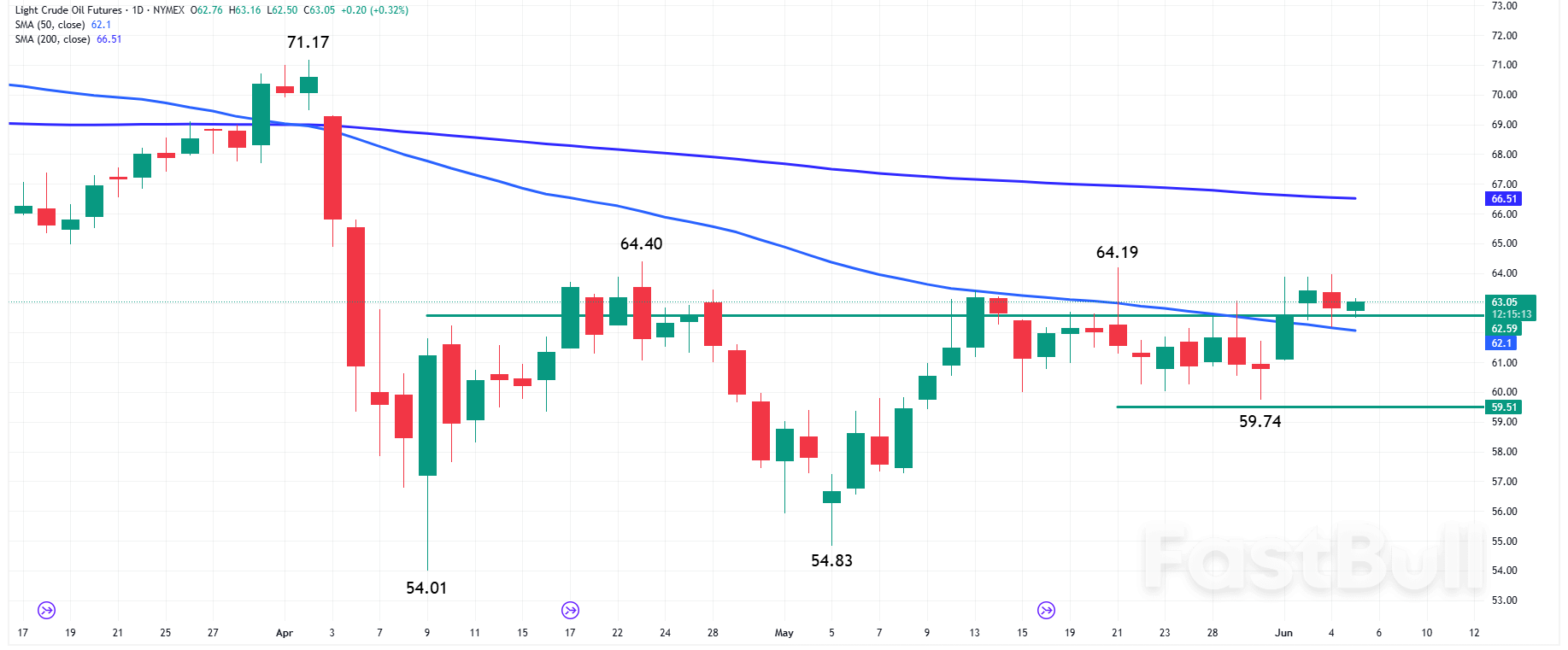
          Oil News: Sluggish Gasoline Demand Undermines Bullish Crude Inventory Data_1Daily Light Crude Oil Futures

          Light crude futures edged higher Thursday, but recent momentum is fading as the market runs into technical resistance and demand concerns mount. Prices remain above the 50-day moving average at $62.10, a level that initially sparked buying earlier this week.
          However, the rally stalled at $63.96—just shy of key resistance at $64.19 and $64.40. A breakout above those levels could open the path toward the 200-day moving average at $66.51. Without follow-through, the market risks drifting into a lower pivot range between $62.59 and $59.51.

          Saudi Price Cuts and OPEC+ Supply Moves Weigh on Sentiment

          Crude came under pressure midweek after Saudi Arabia reduced its July selling prices to Asia to the lowest in nearly two months. While the cuts were milder than expected, they reflect soft demand in a region typically driving summer buying strength.
          The timing follows OPEC+’s decision to raise July output by 411,000 barrels per day, signaling that major producers are prioritizing market share even as demand signals waver. This coordinated action from Saudi Arabia and Russia is seen as an attempt to discipline over-producers and tighten control of global supply dynamics.

          Refiners Drive Crude Draw, But Fuel Demand Falls Short

          Weekly EIA data delivered a mixed message. U.S. crude stocks dropped by 4.3 million barrels to 436.1 million, outpacing expectations and driven by a strong increase in refinery runs. Utilization rose to 93.4%, suggesting refiners are preparing for peak seasonal demand.
          Yet product supplied of gasoline, a reliable demand indicator, unexpectedly fell by 1.2 million barrels per day to 8.3 million—raising red flags. This disconnect between refinery activity and end-user demand triggered large builds in gasoline (+5.2 million barrels) and distillate inventories (+4.2 million barrels), undermining the bullish signal from the crude draw.

          U.S. Demand Underperforms Despite Summer Driving Season

          Despite the post-holiday kickoff to the U.S. driving season, demand remains sluggish. The gasoline supply drop came at a time when consumption typically rises.
          This underperformance contributed to a flat intraday price reaction, with U.S. crude last quoted near $63.07. Analysts point to the possibility that refiners overestimated near-term demand, which may keep inventories elevated in the short run.

          Outlook: Bearish Bias Until Demand Aligns with Supply

          The market is caught between tightening crude supplies and underwhelming fuel consumption. Without a recovery in gasoline demand to match refinery output, the risk of oversupply in refined products remains high.
          Unless price action breaks above $64.40 on strong volume and demand metrics improve, crude futures face a bearish outlook near term.

          source : fxempire

          Risk Warnings and Disclaimers
          You understand and acknowledge that there is a high degree of risk involved in trading. Following any strategies or investment methods may lead to potential losses. The content on the site is provided by our contributors and analysts for information purposes only. You are solely responsible for determining whether any trading assets, securities, strategy, or any other product is suitable for investing based on your own investment objectives and financial situation.
          Add to Favorites
          Share
          FastBull
          Copyright © 2025 FastBull Ltd

          728 RM B 7/F GEE LOK IND BLDG NO 34 HUNG TO RD KWUN TONG KLN HONG KONG

          TelegramInstagramTwitterfacebooklinkedin
          App Store Google Play Google Play
          Products
          Charts

          Chats

          Q&A with Experts
          Screeners
          Economic Calendar
          Data
          Tools
          Membership
          Features
          Function
          Markets
          Copy Trading
          Latest Signals
          Contests
          News
          Analysis
          24/7
          Columns
          Education
          Company
          Careers
          About Us
          Contact Us
          Advertising
          Help Center
          Feedback
          User Agreement
          Privacy Policy
          Business

          White Label

          Data API

          Web Plug-ins

          Poster Maker

          Affiliate Program

          Risk Disclosure

          The risk of loss in trading financial instruments such as stocks, FX, commodities, futures, bonds, ETFs and crypto can be substantial. You may sustain a total loss of the funds that you deposit with your broker. Therefore, you should carefully consider whether such trading is suitable for you in light of your circumstances and financial resources.

          No decision to invest should be made without thoroughly conducting due diligence by yourself or consulting with your financial advisors. Our web content might not suit you since we don't know your financial conditions and investment needs. Our financial information might have latency or contain inaccuracy, so you should be fully responsible for any of your trading and investment decisions. The company will not be responsible for your capital loss.

          Without getting permission from the website, you are not allowed to copy the website's graphics, texts, or trademarks. Intellectual property rights in the content or data incorporated into this website belong to its providers and exchange merchants.

          Not Logged In

          Log in to access more features

          FastBull Membership

          Not yet

          Purchase

          Become a signal provider
          Help Center
          Customer Service
          Dark Mode
          Price Up/Down Colors

          Log In

          Sign Up

          Position
          Layout
          Fullscreen
          Default to Chart
          The chart page opens by default when you visit fastbull.com