Markets
News
Analysis
User
24/7
Economic Calendar
Education
Data
- Names
- Latest
- Prev


Signal Accounts for Members
All Signal Accounts
All Contests


Euro Zone IHS Markit Construction PMI (Nov)A:--
F: --
P: --
Italy IHS Markit Construction PMI (Nov)A:--
F: --
P: --
U.K. Markit/CIPS Construction PMI (Nov)A:--
F: --
P: --
France 10-Year OAT Auction Avg. YieldA:--
F: --
P: --
Euro Zone Retail Sales MoM (Oct)A:--
F: --
P: --
Euro Zone Retail Sales YoY (Oct)A:--
F: --
P: --
Brazil GDP YoY (Q3)A:--
F: --
P: --
U.S. Challenger Job Cuts (Nov)A:--
F: --
P: --
U.S. Challenger Job Cuts MoM (Nov)A:--
F: --
P: --
U.S. Challenger Job Cuts YoY (Nov)A:--
F: --
P: --
U.S. Initial Jobless Claims 4-Week Avg. (SA)A:--
F: --
P: --
U.S. Weekly Initial Jobless Claims (SA)A:--
F: --
P: --
U.S. Weekly Continued Jobless Claims (SA)A:--
F: --
P: --
Canada Ivey PMI (SA) (Nov)A:--
F: --
P: --
Canada Ivey PMI (Not SA) (Nov)A:--
F: --
P: --
U.S. Non-Defense Capital Durable Goods Orders Revised MoM (Excl. Aircraft) (SA) (Sept)A:--
F: --
U.S. Factory Orders MoM (Excl. Transport) (Sept)A:--
F: --
P: --
U.S. Factory Orders MoM (Sept)A:--
F: --
P: --
U.S. Factory Orders MoM (Excl. Defense) (Sept)A:--
F: --
P: --
U.S. EIA Weekly Natural Gas Stocks ChangeA:--
F: --
P: --
Saudi Arabia Crude Oil ProductionA:--
F: --
P: --
U.S. Weekly Treasuries Held by Foreign Central BanksA:--
F: --
P: --
Japan Foreign Exchange Reserves (Nov)A:--
F: --
P: --
India Repo RateA:--
F: --
P: --
India Benchmark Interest RateA:--
F: --
P: --
India Reverse Repo RateA:--
F: --
P: --
India Cash Reserve RatioA:--
F: --
P: --
Japan Leading Indicators Prelim (Oct)A:--
F: --
P: --
U.K. Halifax House Price Index YoY (SA) (Nov)A:--
F: --
P: --
U.K. Halifax House Price Index MoM (SA) (Nov)A:--
F: --
P: --
France Current Account (Not SA) (Oct)--
F: --
P: --
France Trade Balance (SA) (Oct)--
F: --
P: --
France Industrial Output MoM (SA) (Oct)--
F: --
P: --
Italy Retail Sales MoM (SA) (Oct)--
F: --
P: --
Euro Zone Employment YoY (SA) (Q3)--
F: --
P: --
Euro Zone GDP Final YoY (Q3)--
F: --
P: --
Euro Zone GDP Final QoQ (Q3)--
F: --
P: --
Euro Zone Employment Final QoQ (SA) (Q3)--
F: --
P: --
Euro Zone Employment Final (SA) (Q3)--
F: --
Brazil PPI MoM (Oct)--
F: --
P: --
Mexico Consumer Confidence Index (Nov)--
F: --
P: --
Canada Unemployment Rate (SA) (Nov)--
F: --
P: --
Canada Labor Force Participation Rate (SA) (Nov)--
F: --
P: --
Canada Employment (SA) (Nov)--
F: --
P: --
Canada Part-Time Employment (SA) (Nov)--
F: --
P: --
Canada Full-time Employment (SA) (Nov)--
F: --
P: --
U.S. Personal Income MoM (Sept)--
F: --
P: --
U.S. Dallas Fed PCE Price Index YoY (Sept)--
F: --
P: --
U.S. PCE Price Index YoY (SA) (Sept)--
F: --
P: --
U.S. PCE Price Index MoM (Sept)--
F: --
P: --
U.S. Personal Outlays MoM (SA) (Sept)--
F: --
P: --
U.S. Core PCE Price Index MoM (Sept)--
F: --
P: --
U.S. UMich 5-Year-Ahead Inflation Expectations Prelim YoY (Dec)--
F: --
P: --
U.S. Core PCE Price Index YoY (Sept)--
F: --
P: --
U.S. Real Personal Consumption Expenditures MoM (Sept)--
F: --
P: --
U.S. 5-10 Year-Ahead Inflation Expectations (Dec)--
F: --
P: --
U.S. UMich Current Economic Conditions Index Prelim (Dec)--
F: --
P: --
U.S. UMich Consumer Sentiment Index Prelim (Dec)--
F: --
P: --
U.S. UMich 1-Year-Ahead Inflation Expectations Prelim (Dec)--
F: --
P: --
U.S. UMich Consumer Expectations Index Prelim (Dec)--
F: --
P: --


No matching data
Latest Views
Latest Views
Trending Topics
Top Columnists
Latest Update
White Label
Data API
Web Plug-ins
Affiliate Program
View All

No data
Key points: Canadian finance chief says tensions over US tariffs to continue G7 to discuss combating non-market practices, Champ
Key points:
Finance ministers from the Group of Seven industrial democracies will try to agree on policies to restore global growth and stability, Canadian Finance Minister Francois-Philippe Champagne said on Tuesday, acknowledging that tensions over newU.S. tariffswould continue.
The meetings over the next two days in the mountain resort town of Banff, Alberta, will be about "back to basics" and will include discussions about excess manufacturing capacity, non-market practices and financial crimes, Champagne told a news conference.
"I think to deliver for the citizens that we represent, our mission is really about restoring stability and growth," Champagne said
He said discussions would take place within the G7 and bilaterally with U.S. Treasury Secretary Scott Bessent about the impact of PresidentDonald Trump'snew tariffs on trading partners, and that there would always be tension around such issues.
"But at the same time, there's a lot we can achieve together," Champagne said. "There's a lot that we are looking to coordinate, our actions, and really tackle some of the big issues around over-capacity, non-market practices and financial crimes."
Bessent has sought to push G7 allies to more effectively confront China's state-led, export-driven economic policies, arguing that this has led to excess manufacturing capacity that is flooding the world with cheap goods and threatening G7 and other market economies.
But G7 members Japan, Germany, France and Italy all face a potential doubling of reciprocal U.S. duties to 20% or more in early July. Britain negotiated a limited trade deal that leaves it saddled with 10% U.S. tariffs on most goods, and host Canada is still struggling with Trump's separate 25% duty on many exports.
Champagne also said that the G7 group would discuss ways to better police low-value package shipments from China to combat smuggling. The Trump administration has ended a duty-free exemption for Chinese shipments valued under $800, which it has blamed for the trafficking of fentanyl and its precursor chemicals.
Reducing fentanyl trafficking is critical to lifting Trump's 25% duties on some Canadian and Mexican goods, as well as a 20% duty on Chinese goods.
Champagne appeared with Ukrainian Finance Minister Serhii Marchenko and pledged to continue Canada's support for Ukraine in its struggle againstRussia's invasion. He also said Canada is considering helping Ukraine build a Canadian-style pension system.
Marchenko told reporters that he would seek to reiterate Ukraine's arguments for strengthening sanctions against Russia , including through lowering the level of the G7-led $60-per-barrel price cap imposed on Russian crude oil exports.
Key Points:
Loretta Mester and Mary Daly from the Federal Reserve indicated a wait-and-see approach at an Atlanta Fed Bank meeting given current economic uncertainties.
The Federal Reserve's cautious stance accentuates market volatility, especially impacting cryptocurrencies like Bitcoin. Ether and altcoins reflect similar risk-off behaviors.
Federal Reserve Bank Presidents Loretta Mester and Mary Daly emphasized a cautious approach during a meeting in Atlanta, citing uncertainty in trade policy. Such vagueness limits precise monetary policy action. Monetary policy remains uncertain given the unpredictable fiscal backdrop, leading to elevated market volatility. Bitcoin and Ethereum showed caution-driven responses, with Bitcoin's price reacting sharply to recent announcements. The cryptocurrency market's reactions have demonstrated increased sensitivity, reflecting broader economic apprehensions.
Given the uncertainty surrounding the impact of the Trump administration's policies, the best course of action for the Fed now is to wait and then make any further policy decisions.
Did you know? In periods of Federal Reserve indecision, BTC and major altcoins display sharp market fluctuations—a trend seen during trade policy shifts and Fed reviews in 2020 and 2023.
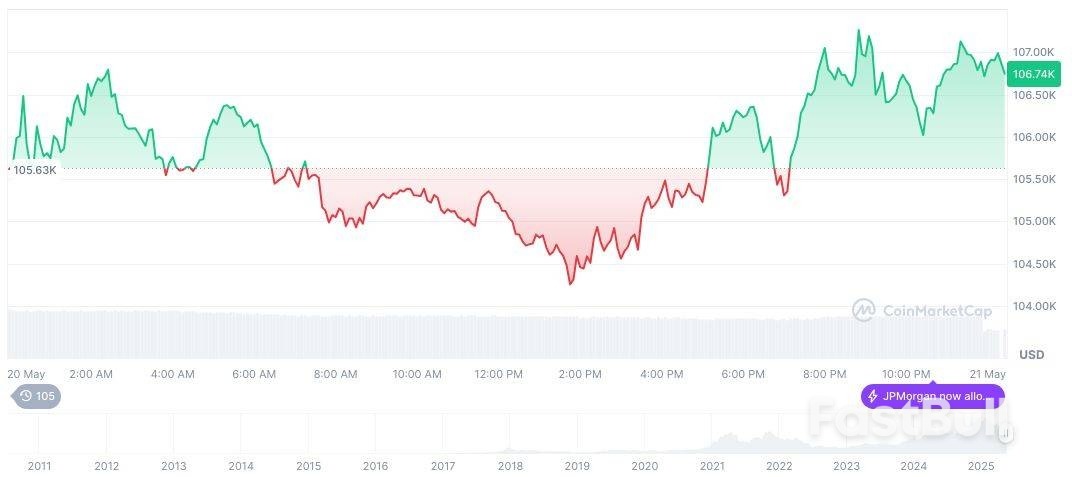
Bitcoin's current valuation stands at $106,790.79, with a market cap of $2.12 trillion and 24-hour trading volume dropping by 38.46%, according to CoinMarketCap. Bitcoin's dominant market position of 62.95% continues to impact broader sentiment.
Bitcoin(BTC), daily chart, screenshot on CoinMarketCap at 00:22 UTC on May 21, 2025. Source: CoinMarketCapCoincu research indicates that Federal Reserve policy ambiguity often precipitates cryptocurrency volatility. Historical patterns suggest increased market activity aligns with shifting monetary signals.
The Canadian dollar strengthened against its U.S. counterpart on Tuesday as investors slashed bets on a Bank of Canada interest rate cut next month after domestic data showed underlying inflation heating up.
The loonie was trading 0.2% higher at 1.3925 per U.S. dollar, or 71.81 U.S. cents, after moving in a range of 1.3918 to 1.3968.Canada's annual inflation rate fell to 1.7% in April due to a drop in energy prices but two core measures closely watched by the BoC moved above 3%."Ex-food and energy was probably a little bit hotter than expected," said Darcy Briggs, a portfolio manager at Franklin Templeton Canada. "I think it would give the Bank of Canada a chance to pause even further."
The Canadian overnight index swaps market was pricing in a 33% chance of an interest rate cut at the next BoC policy decision on June 4, down from 65% before the data. The central bank left its benchmark rate on hold at 2.75% last month, the first pause since the easing campaign began last June.
The U.S. dollar (.DXY), fell against a basket of major currencies, weighed down in part by the Federal Reserve's caution over the economy, while the price of oil , one of Canada's major exports, settled 0.2% lower at $62.56 a barrel.
Canadian government bond yields rose across the curve. The 10-year was up 11.6 basis points at 3.290%, after earlier touching its highest level since January 24 at 3.319%.
Reporting by Fergal Smith in Toronto; Editing by Nia Williams
Israel is preparing for a potential military strike on Iranian nuclear facilities, as the U.S. continues to pursue a diplomatic agreement with Tehran, CNN reported on Tuesday, citing multiple U.S. officials familiar with recent intelligence.
While Israeli leaders have not made a final decision, intercepted communications and observed military movements, including air munitions transfers and completed air drills, have heightened U.S. concerns, CNN said.
One source told CNN that the likelihood of an Israeli strike has "gone up significantly" in recent months. The person added that a US-Iran nuclear deal under President Donald Trump that doesn’t eliminate all Iranian uranium makes a strike more likely.
Any strike would represent a significant break with Trump, who has prioritized diplomacy but warned of possible military action should nuclear talks fail, the CNN report said.
Trump reportedly gave Iran’s Supreme Leader a 60-day deadline in March to reach a deal. That deadline has passed.
A strike could also inflame tensions in a region already destabilized by the war in Gaza. The CNN report stated that despite the risks, Israeli leaders appear willing to act if Washington pursues a deal they view as inadequate.
Israel lacks the capacity to destroy Iran’s nuclear program without U.S. military support, but could act alone to derail a prospective agreement, CNN reported.
Federal Reserve officials said on Tuesday that higher prices are coming on the back of rising U.S. import tariffs, with the open question now whether the inflation shock will be fleeting or more persistent.
"One thing that we've heard is that a lot of the tariff impact to date has actually not shown up in the numbers yet. There's been a lot of front-running, building inventories and all those sorts of things. And we are hearing from an increasing number of businesses that those strategies ... are starting to run their course," Atlanta Fed President Raphael Bostic said on the sidelines of a conference in Florida."If these pre-tariff strategies have run their course, we're about to see some changes in prices, and then we're going to learn how consumers are going to respond to that," said Bostic, who now expects the U.S. central bank will have to wait longer to have clarity about the economy's direction and make any changes to interest rates.
"We should wait and see where the economy is going before we do anything definitive," said Bostic, who now anticipates only a single quarter-percentage-point cut in the Fed's policy rate this year and several months on the sidelines waiting for the effect of Trump administration policies to become clear.
So far the main impact appears to be in sentiment surveys showing households and businesses are less confident about the economic horizon and expect higher inflation.
In an interview on Bloomberg Television on Tuesday, Stephen Miran, who chairs the White House's Council of Economic Advisers, pushed back on the idea that the tariffs imposed by the administration so far and potentially added in coming weeks would result in meaningful inflation.
"We have been introducing tariffs since day one of this administration," Miran said, yet there has "been no real meaningful effect on inflation," with recent consumer price index reports coming in weaker than expected.
But Fed officials and analysts say they expect the impact has just not filtered through yet to the economy.
Walmart , the world's largest retailer and a major importer of goods from China, said last week that price increases were on the way, comments that drew a rebuff from President Donald Trump.
"We can control what we can control," Walmart CEO Doug McMillon said during the company's quarterly earnings call. Even trimming the tariffs on Chinese goods to 30%, as the administration recently did in backing off a more exorbitant 145% levy, "will result in higher prices," he said.
The waiting game for Fed officials may prove a long one. The central bank has kept its policy rate in the current 4.25%-4.50% range since December, but says it will remain difficult to anticipate where the economy is heading until the tariff issue and other policies are settled for good - and enough time lapses after that to gauge the impact.
In comments to the Economic Club of Minnesota on Tuesday, St. Louis Fed President Alberto Musalem said the central bank needed to guard first and foremost against a rise in inflation expectations, and key to that effort will be assessing if coming price hikes seem like one-time increases or risk turning into something more persistent.
The tariff plans may have been scaled back, but still "seem likely to have a significant impact on the near-term economic outlook," Musalem said, with "direct one-off effects on the prices of imported final goods, indirect effects on the prices of domestically produced goods and services, and possibly second-round effects on inflation."
Deciding in advance that the effects will fade on their own, "runs the risk of underestimating the level and persistence," and creating more inflation trouble in the future, he said.
White Label
Data API
Web Plug-ins
Poster Maker
Affiliate Program
The risk of loss in trading financial instruments such as stocks, FX, commodities, futures, bonds, ETFs and crypto can be substantial. You may sustain a total loss of the funds that you deposit with your broker. Therefore, you should carefully consider whether such trading is suitable for you in light of your circumstances and financial resources.
No decision to invest should be made without thoroughly conducting due diligence by yourself or consulting with your financial advisors. Our web content might not suit you since we don't know your financial conditions and investment needs. Our financial information might have latency or contain inaccuracy, so you should be fully responsible for any of your trading and investment decisions. The company will not be responsible for your capital loss.
Without getting permission from the website, you are not allowed to copy the website's graphics, texts, or trademarks. Intellectual property rights in the content or data incorporated into this website belong to its providers and exchange merchants.
Not Logged In
Log in to access more features

FastBull Membership
Not yet
Purchase
Log In
Sign Up