
• Trade
  • Markets
  • Copy
  • Contests
  • News
  • 24/7
  • Calendar
  • Q&A
  • Chats
Trending
Screeners
SYMBOL
LAST
BID
ASK
HIGH
LOW
NET CHG.
%CHG.
SPREAD
SPX
S&P 500 Index
6827.42
6827.42
6827.42
6899.86
6801.80
-73.58
-1.07%
--
DJI
Dow Jones Industrial Average
48458.04
48458.04
48458.04
48886.86
48334.10
-245.98
-0.51%
--
IXIC
NASDAQ Composite Index
23195.16
23195.16
23195.16
23554.89
23094.51
-398.69
-1.69%
--
USDX
US Dollar Index
97.950
98.030
97.950
98.500
97.950
-0.370
-0.38%
--
EURUSD
Euro / US Dollar
1.17394
1.17409
1.17394
1.17496
1.17192
+0.00011
+ 0.01%
--
GBPUSD
Pound Sterling / US Dollar
1.33707
1.33732
1.33707
1.33997
1.33419
-0.00148
-0.11%
--
XAUUSD
Gold / US Dollar
4299.39
4299.39
4299.39
4353.41
4257.10
+20.10
+ 0.47%
--
WTI
Light Sweet Crude Oil
57.233
57.485
57.233
58.011
56.969
-0.408
-0.71%
--

Community Accounts

Signal Accounts
--
Profit Accounts
--
Loss Accounts
--
View More

Become a signal provider

Sell trading signals to earn additional income

View More

Guide to Copy Trading

Get started with ease and confidence

View More

Signal Accounts for Members

All Signal Accounts

Best Return
  • Best Return
  • Best P/L
  • Best MDD
Past 1W
  • Past 1W
  • Past 1M
  • Past 1Y

All Contests

  • All
  • Trump Updates
  • Recommend
  • Stocks
  • Cryptocurrencies
  • Central Banks
  • Featured News
Top News Only
Share

USA Embassy In Lithuania: Maria Kalesnikava Is Not Going To Vilnius

Share

USA Embassy In Lithuania: Other Prisoners Are Being Sent From Belarus To Ukraine

Share

Ukraine President Zelenskiy: Five Ukrainians Released By Belarus In US-Brokered Deal

Share

USA Vilnius Embassy: USA Stands Ready For "Additional Engagement With Belarus That Advances USA Interests"

Share

USA Vilnius Embassy: Belarus, USA, Other Citizens Among The Prisoners Released Into Lithuania

Share

USA Vilnius Embassy: USA Will Continue Diplomatic Efforts To Free The Remaining Political Prisoners In Belarus

Share

USA Vilnius Embassy: Belarus Releases 123 Prisoners Following Meeting Of President Trump's Envoy Coale And Belarus President Lukashenko

Share

USA Vilnius Embassy: Masatoshi Nakanishi, Aliaksandr Syrytsa Are Among The Prisoners Released By Belarus

Share

USA Vilnius Embassy: Maria Kalesnikava And Viktor Babaryka Are Among The Prisoners Released By Belarus

Share

USA Vilnius Embassy: Nobel Peace Prize Laureate Ales Bialiatski Is Among The Prisoners Released By Belarus

Share

Belarusian Presidential Administration Telegram Channel: Lukashenko Has Pardoned 123 Prisoners As Part Of Deal With US

Share

Two Local Syrian Officials: Joint US-Syrian Military Patrol In Central Syria Came Under Fire From Unknown Assailants

Share

Israeli Military Says It Targeted 'Key Hamas Terrorist' In Gaza City

Share

Rwanda's Actions In Eastern Drc Are A Clear Violation Of Washington Accords Signed By President Trump - Secretary Of State Rubio

Share

Israeli Military Issues Evacuation Warning In Southern Lebanon Village Ahead Of Strike - Spokesperson On X

Share

Belarusian State Media Cites US Envoy Coale As Saying He Discussed Ukraine And Venezuela With Lukashenko

Share

Belarusian State Media Cites US Envoy Coale As Saying That US Removes Sanctions On Belarusian Potassium

Share

Thai Prime Minister: No Ceasefire Agreement With Cambodia

Share

US, Ukraine To Discuss Ceasefire In Berlin Ahead Of European Summit

Share

Incoming Czech Prime Minister Babis: Czech Republic Will Not Take On Guarantees For Ukraine Financing, European Commission Must Find Alternatives

TIME
ACT
FCST
PREV
U.K. Trade Balance Non-EU (SA) (Oct)

A:--

F: --

P: --

U.K. Trade Balance (Oct)

A:--

F: --

P: --

U.K. Services Index MoM

A:--

F: --

P: --

U.K. Construction Output MoM (SA) (Oct)

A:--

F: --

P: --

U.K. Industrial Output YoY (Oct)

A:--

F: --

P: --

U.K. Trade Balance (SA) (Oct)

A:--

F: --

P: --

U.K. Trade Balance EU (SA) (Oct)

A:--

F: --

P: --

U.K. Manufacturing Output YoY (Oct)

A:--

F: --

P: --

U.K. GDP MoM (Oct)

A:--

F: --

P: --

U.K. GDP YoY (SA) (Oct)

A:--

F: --

P: --

U.K. Industrial Output MoM (Oct)

A:--

F: --

P: --

U.K. Construction Output YoY (Oct)

A:--

F: --

P: --

France HICP Final MoM (Nov)

A:--

F: --

P: --

China, Mainland Outstanding Loans Growth YoY (Nov)

A:--

F: --

P: --

China, Mainland M2 Money Supply YoY (Nov)

A:--

F: --

P: --

China, Mainland M0 Money Supply YoY (Nov)

A:--

F: --

P: --

China, Mainland M1 Money Supply YoY (Nov)

A:--

F: --

P: --

India CPI YoY (Nov)

A:--

F: --

P: --

India Deposit Gowth YoY

A:--

F: --

P: --

Brazil Services Growth YoY (Oct)

A:--

F: --

P: --

Mexico Industrial Output YoY (Oct)

A:--

F: --

P: --

Russia Trade Balance (Oct)

A:--

F: --

P: --

Philadelphia Fed President Henry Paulson delivers a speech
Canada Building Permits MoM (SA) (Oct)

A:--

F: --

P: --

Canada Wholesale Sales YoY (Oct)

A:--

F: --

P: --

Canada Wholesale Inventory MoM (Oct)

A:--

F: --

P: --

Canada Wholesale Inventory YoY (Oct)

A:--

F: --

P: --

Canada Wholesale Sales MoM (SA) (Oct)

A:--

F: --

P: --

Germany Current Account (Not SA) (Oct)

A:--

F: --

P: --

U.S. Weekly Total Rig Count

A:--

F: --

P: --

U.S. Weekly Total Oil Rig Count

A:--

F: --

P: --

Japan Tankan Large Non-Manufacturing Diffusion Index (Q4)

--

F: --

P: --

Japan Tankan Small Manufacturing Outlook Index (Q4)

--

F: --

P: --

Japan Tankan Large Non-Manufacturing Outlook Index (Q4)

--

F: --

P: --

Japan Tankan Large Manufacturing Outlook Index (Q4)

--

F: --

P: --

Japan Tankan Small Manufacturing Diffusion Index (Q4)

--

F: --

P: --

Japan Tankan Large Manufacturing Diffusion Index (Q4)

--

F: --

P: --

Japan Tankan Large-Enterprise Capital Expenditure YoY (Q4)

--

F: --

P: --

U.K. Rightmove House Price Index YoY (Dec)

--

F: --

P: --

China, Mainland Industrial Output YoY (YTD) (Nov)

--

F: --

P: --

China, Mainland Urban Area Unemployment Rate (Nov)

--

F: --

P: --

Saudi Arabia CPI YoY (Nov)

--

F: --

P: --

Euro Zone Industrial Output YoY (Oct)

--

F: --

P: --

Euro Zone Industrial Output MoM (Oct)

--

F: --

P: --

Canada Existing Home Sales MoM (Nov)

--

F: --

P: --

Euro Zone Total Reserve Assets (Nov)

--

F: --

P: --

U.K. Inflation Rate Expectations

--

F: --

P: --

Canada National Economic Confidence Index

--

F: --

P: --

Canada New Housing Starts (Nov)

--

F: --

P: --

U.S. NY Fed Manufacturing Employment Index (Dec)

--

F: --

P: --

U.S. NY Fed Manufacturing Index (Dec)

--

F: --

P: --

Canada Core CPI YoY (Nov)

--

F: --

P: --

Canada Manufacturing Unfilled Orders MoM (Oct)

--

F: --

P: --

Canada Manufacturing New Orders MoM (Oct)

--

F: --

P: --

Canada Core CPI MoM (Nov)

--

F: --

P: --

Canada Manufacturing Inventory MoM (Oct)

--

F: --

P: --

Canada CPI YoY (Nov)

--

F: --

P: --

Canada CPI MoM (Nov)

--

F: --

P: --

Canada CPI YoY (SA) (Nov)

--

F: --

P: --

Canada Core CPI MoM (SA) (Nov)

--

F: --

P: --

Q&A with Experts
    • All
    • Chatrooms
    • Groups
    • Friends
    Connecting
    .
    .
    .
    Type here...
    Add Symbol or Code

      No matching data

      All
      Trump Updates
      Recommend
      Stocks
      Cryptocurrencies
      Central Banks
      Featured News
      • All
      • Russia-Ukraine Conflict
      • Middle East Flashpoint
      • All
      • Russia-Ukraine Conflict
      • Middle East Flashpoint
      Search
      Products

      Charts Free Forever

      Chats Q&A with Experts
      Screeners Economic Calendar Data Tools
      Membership Features
      Data Warehouse Market Trends Institutional Data Policy Rates Macro

      Market Trends

      Market Sentiment Order Book Forex Correlations

      Top Indicators

      Charts Free Forever
      Markets

      News

      News Analysis 24/7 Columns Education
      From Institutions From Analysts
      Topics Columnists

      Latest Views

      Latest Views

      Trending Topics

      Top Columnists

      Latest Update

      Signals

      Copy Rankings Latest Signals Become a signal provider AI Rating
      Contests
      Brokers

      Overview Brokers Assessment Rankings Regulators News Claims
      Broker listing Forex Brokers Comparison Tool Live Spread Comparison Scam
      Q&A Complaint Scam Alert Videos Tips to Detect Scam
      More

      Business
      Events
      Careers About Us Advertising Help Center

      White Label

      Data API

      Web Plug-ins

      Affiliate Program

      Awards Institution Evaluation IB Seminar Salon Event Exhibition
      Vietnam Thailand Singapore Dubai
      Fans Party Investment Sharing Session
      FastBull Summit BrokersView Expo
      Recent Searches
        Top Searches
          Markets
          News
          Analysis
          User
          24/7
          Economic Calendar
          Education
          Data
          • Names
          • Latest
          • Prev

          View All

          No data

          Scan to Download

          Faster Charts, Chat Faster!

          Download App
          English
          • English
          • Español
          • العربية
          • Bahasa Indonesia
          • Bahasa Melayu
          • Tiếng Việt
          • ภาษาไทย
          • Français
          • Italiano
          • Türkçe
          • Русский язык
          • 简中
          • 繁中
          Open Account
          Search
          Products
          Charts Free Forever
          Markets
          News
          Signals

          Copy Rankings Latest Signals Become a signal provider AI Rating
          Contests
          Brokers

          Overview Brokers Assessment Rankings Regulators News Claims
          Broker listing Forex Brokers Comparison Tool Live Spread Comparison Scam
          Q&A Complaint Scam Alert Videos Tips to Detect Scam
          More

          Business
          Events
          Careers About Us Advertising Help Center

          White Label

          Data API

          Web Plug-ins

          Affiliate Program

          Awards Institution Evaluation IB Seminar Salon Event Exhibition
          Vietnam Thailand Singapore Dubai
          Fans Party Investment Sharing Session
          FastBull Summit BrokersView Expo

          BoE Houdt De Weg Van De Geleidelijkheid

          Michelle

          Economic

          Forex

          Summary:

          Geen echte verrassing vanuit Threadneedle Street gisteren. De Bank of England (BoE) hield de rente onveranderd op 4.25%. Er waren wel enkele accentverschuivingen, zowel in het stempatroon als in de inhoudelijke analyse.

          Geen echte verrassing vanuit Threadneedle Street gisteren. De Bank of England (BoE) hield de rente onveranderd op 4.25%. Er waren wel enkele accentverschuivingen, zowel in het stempatroon als in de inhoudelijke analyse. Het blijven onzekere tijden, maar voorzitter Bailey en zijn beleidscomité blijven op koers om de rente geflankeerd door een driemaandelijks beleidsrapport in augustus opnieuw met 25 bpn bij te vijlen. Dat tempo is al in voege sinds de start van de versoepelingscyclus in augustus vorig jaar.

          Inflatie ging de voorbije maanden over een hobbelig parcours. Na een stevige opwaartse verrassing in april, koelden prijsstijgingen in mei wat af. We schrijven wel nog steeds 3.4% J/J (was 2.6% in februari). De opsprong had onder meer te maken met wijzigingen in energie- en andere gereguleerde prijzen. Toch blijft de BoE hoopvol dat het onderliggende desinflatieproces zich doorzet. Omwille van technische factoren blijft inflatie dit jaar waarschijnlijk nog nabij het huidige niveau om volgend jaar (hopelijk) terug te keren richting 2%. De BoE blijft zich bewust van een tweezijdig risico (loonstijging & diensteninflatie, olieprijs, tariefonzekerheid versus het neerwaarts risico van een zwakkere vraag). Inzake groei zijn er na een sterk eerste kwartaal (0.7% kw/kw), tekenen van vertraging, zowel in de output als op de arbeidsmarkt. Dat laatste moet ook de loongroei temperen.

          Wat de concrete beleidsbeslissing betreft, stemden drie van de negen raadsleden om de rente nu al met 25 bpn te verlagen. Twee ‘standaard-duiven’ en één bijkomende stem. Zij hebben vooral oog voor de afkoeling op de arbeidsmarkt. De zes andere leden willen nog iets meer duidelijkheid/bevestiging. Het beleidscomité vindt hoe dan ook dat het beleid nog even restrictief moet blijven en enkel volgens de weg van de geleidelijkheid kan worden teruggeschroefd. De terughoudende toon van Bailey op de persconferentie in mei en de inflatieopsprong deed de markt vorige maand twijfelen of er ruimte was voor meer dan één bijkomende verlaging dit jaar. Na de recent softere data (bevestigd door de BoE-analyse gisteren) aligneerden die geldmarkten zich opnieuw met het ‘één-per-kwartaal patroon’ (cumulatief 50 bpn tegen jaareinde tot 3.75%).

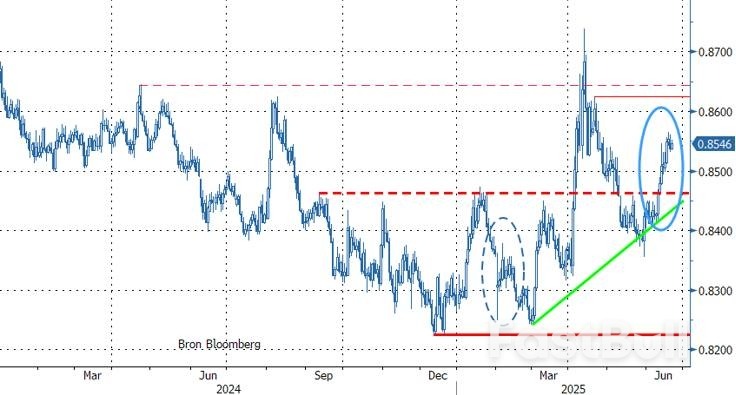
          Het recente verlies aan rentesteun was geen hulp voor het pond. Na een kortstondige test beneden EUR/GBP 0.84 eind mei, deemstert het pond opnieuw weg tot boven EUR/GBP 0.85. Dat had echter ook te maken met de algemene onzekerheid/risico-aversie en met de moeilijke Britse budgettaire context (beperkte beleidsruimte, mogelijke druk op het lange eind van de Britse rentecurve). Die thema’s blijven sluimeren en wegen evenzeer op de Britse munt. Die krijgt vanmorgen overigens nog bijkomende tegenwind van uiterst zwakke kleinhandelsverkopen (mei). We zien EUR/GBP geleidelijk hoger trekken in de 0.8350/0.8740 handelsband met 0.8600/24 als intermediaire weerstand.
          Source: KBC Bank

          To stay updated on all economic events of today, please check out our Economic calendar
          Risk Warnings and Disclaimers
          You understand and acknowledge that there is a high degree of risk involved in trading. Following any strategies or investment methods may lead to potential losses. The content on the site is provided by our contributors and analysts for information purposes only. You are solely responsible for determining whether any trading assets, securities, strategy, or any other product is suitable for investing based on your own investment objectives and financial situation.
          Add to Favorites
          Share

          U.S. Treasury Yields Little Changed As Trump Considers Strike On Iran

          Daniel Carter

          Bond

          Economic

          U.S. Treasury yields were little changed on Friday morning, as markets continued to monitor the conflict between Israel and Iran in which President Donald Trump is considering ordering direct U.S. intervention.
          The yield on the benchmark 10-year Treasury was last seen trading marginally higher, with yields on Treasurys across the board seeing little movement by 4:30 a.m. ET.
          One basis point is equivalent to 0.01%. Yields and prices move in opposite directions.
          As Israel and Iran continued trading fire on Thursday, White House Press Secretary Karoline Leavitt read a statement from Trump at a news briefing.
          "Based on the fact that there's a substantial chance of negotiations that may or may not take place with Iran in the near future, I will make my decision whether or not to go within the next two weeks," the message from the president said.
          That came a day after Trump said he had issued Tehran with an "ultimate ultimatum," telling reporters at the White House that he "may do it, may not do it," with regard to ordering a U.S. strike on Iran.
          Later on Friday, the Federal Reserve Bank of Philadelphia will publish its June Manufacturing Business Outlook Survey.

          Source: CNBC

          To stay updated on all economic events of today, please check out our Economic calendar
          Risk Warnings and Disclaimers
          You understand and acknowledge that there is a high degree of risk involved in trading. Following any strategies or investment methods may lead to potential losses. The content on the site is provided by our contributors and analysts for information purposes only. You are solely responsible for determining whether any trading assets, securities, strategy, or any other product is suitable for investing based on your own investment objectives and financial situation.
          Add to Favorites
          Share

          U.S. and China’s Strategic Oil Stockpiling May Absorb Surplus, Says Gazprom Neft CEO

          Gerik

          Economic

          China–U.S. Trade War

          Strategic Buying Counters Supply Increase

          Alexander Dyukov, CEO of Gazprom Neft, has stated that ongoing efforts by the United States and China to rebuild their strategic petroleum reserves (SPRs) will counterbalance the potential oversupply expected from rising OPEC+ production. His comments, delivered at the Saint Petersburg Economic Forum, come as OPEC+ — including key players like Saudi Arabia and Russia — gradually unwinds voluntary output cuts through July 2025.
          While the bloc is incrementally adding barrels back into the market, Dyukov emphasized that this increase is not anticipated to result in excess inventory or downward pressure on prices. Instead, large-scale reserve accumulation from the world’s two largest oil consumers is likely to absorb much of the additional supply.

          U.S. Strategic Reserve Refill to Support Demand

          Under the current U.S. administration, there is a renewed push to replenish the Strategic Petroleum Reserve (SPR), which had been drawn down to combat inflationary shocks and supply disruptions in recent years. Dyukov highlighted that the SPR has declined to about 400 million barrels — less than 20 days of national consumption — compared to its total capacity of over 700 million barrels. This shortfall implies substantial room for purchases in the coming months, offering a significant source of demand that could stabilize global oil prices even in the face of increased production.
          The decision to rebuild the SPR reflects both energy security concerns and efforts to re-establish a buffer against future geopolitical shocks. The pace of U.S. purchases, however, will also be influenced by prevailing price levels and political considerations, particularly as energy prices remain a sensitive issue in domestic economic debates.

          China’s Accelerated Reserve Accumulation Adds to Demand

          China, too, has publicly committed to accelerating the pace of its strategic fuel reserve accumulation in 2025. While exact volumes are not disclosed, Beijing’s state-directed purchases are widely viewed as an instrument for price stabilization and future economic insulation. The Chinese government often increases reserve purchases during periods of price moderation, effectively creating a price floor when market sentiment is soft.
          This behavior introduces a layer of artificial demand that can offset excess supply and dampen volatility. Dyukov’s assessment that these efforts will absorb surplus barrels underscores the geopolitical role of strategic reserves in moderating market balance, beyond purely commercial dynamics.

          Outlook for Prices and OPEC+ Policy

          OPEC+ is set to meet again in July to decide on August production levels. The return of approximately 1.2 million barrels per day to the market through July has so far been priced in by traders. According to Dyukov, continued stockpiling by the U.S. and China reduces the risk that this supply increase will lead to inventory buildup or downward price spirals.
          By acting as buffer buyers, both Washington and Beijing are providing stability to a market that remains sensitive to geopolitical flare-ups, particularly in the Middle East. If strategic purchasing continues at current or higher levels, Brent prices could remain supported in the $75–85 range, barring major new supply disruptions.
          Gazprom Neft’s outlook signals cautious confidence in the ability of strategic oil purchases by the U.S. and China to neutralize the short-term effects of increased OPEC+ production. These reserve accumulation efforts not only serve national energy security goals but also operate as a stabilizing force in global energy markets. As supply dynamics shift and geopolitical tensions linger, the interplay between strategic demand and voluntary output adjustments will play a central role in shaping oil market trajectories through the second half of 2025.

          Source: Reuters

          To stay updated on all economic events of today, please check out our Economic calendar
          Risk Warnings and Disclaimers
          You understand and acknowledge that there is a high degree of risk involved in trading. Following any strategies or investment methods may lead to potential losses. The content on the site is provided by our contributors and analysts for information purposes only. You are solely responsible for determining whether any trading assets, securities, strategy, or any other product is suitable for investing based on your own investment objectives and financial situation.
          Add to Favorites
          Share

          Rising Oil Prices Stir Global Markets as Middle East Tensions Escalate

          Gerik

          Economic

          Commodity

          Middle East Situation

          Oil Prices Rise Amid Geopolitical Caution

          Brent crude has approached $77 per barrel this month, marking its sharpest monthly increase since 2020. This rise is not yet fueled by supply interruptions, but investors are recalibrating expectations due to the heightened risk of disruption, particularly in the Strait of Hormuz, a strategic chokepoint through which nearly 20% of the world’s oil passes. The spread between short-term and six-month Brent futures contracts has widened to a six-month high, reflecting investor unease about regional supply security. Market attention is now turning to whether prices could breach the $80–100 per barrel range — a level analysts believe would exert substantial pressure on global economic activity.
          While OPEC+ has announced an additional 1.2 million barrels per day in output, the market remains unconvinced. According to Svelland Capital, no material shipments have been delivered, and maritime logistics may become a bottleneck if the conflict intensifies. Disruptions in oil shipping lanes would exacerbate the problem, especially if China — home to the largest spare refining capacity — begins large-scale buying. Freight rates are thus seen as an early indicator of broader energy market shifts. For now, stable freight costs suggest that China has not yet engaged in panic purchasing, but any change in that behavior could accelerate a global price response.

          Macroeconomic Effects of Oil-Driven Inflation

          The recent price movement has revived memories of the inflation spike following Russia’s invasion of Ukraine. Economists warn that if oil prices sustain above $100 per barrel, global GDP could fall by 1%, and inflation could rise by the same margin. This dynamic is particularly threatening for net importers such as Turkey, India, Pakistan, and eastern European economies. Oil’s role as an inelastic input means there are few short-term alternatives, leaving these economies vulnerable to margin erosion and currency depreciation.
          Even moderate increases can shift inflation expectations. In the United States, RBC estimates that if oil hovers around $75, core CPI could increase by 0.5 percentage points by year-end. In Europe, long-term inflation gauges like the five-year, five-year forward swap have already climbed to near-monthly highs.

          Currency Dynamics: Dollar Weakness Softens the Blow

          Traditionally, a surge in oil prices has been accompanied by a rising U.S. dollar, but 2025 has broken that trend. The dollar has weakened about 9% year-to-date, partly due to waning investor confidence in U.S. leadership under President Trump. The muted reaction of the dollar to the oil rally — gaining just 0.4% in the past week — suggests broader market skepticism about U.S. policy stability.
          A weaker dollar partially offsets the inflationary impact of rising oil for many importing countries by making dollar-priced commodities relatively cheaper. For Europe, Japan, and emerging markets dependent on crude imports, this offers short-term relief, though underlying vulnerabilities persist.

          Equity Markets Remain Cautious But Resilient

          Global equity markets have, so far, shown a surprising level of calm. In the absence of an actual supply shock, investors appear inclined to wait rather than react. Energy and defense sectors have outperformed, particularly in the United States and Europe. Israeli equities have surged 6% in a week, reflecting both geopolitical risk pricing and possible investor hedging. Conversely, sectors sensitive to fuel costs — notably airlines — have been underperformers.
          Gulf markets experienced initial volatility but have since stabilized, aided by the prospect of improved fiscal revenues from higher oil prices. Analysts at Goldman Sachs argue that until there is compelling evidence of deeper regional escalation, global equities will likely continue to hover near historical highs.
          Brent crude’s steep climb in June 2025 serves as a warning signal for policymakers and investors alike. Although there has been no immediate supply interruption, market behavior indicates heightened sensitivity to geopolitical risks, especially those tied to the Middle East. While energy producers benefit and oil exporters see stronger revenues, the broader inflationary implications could soon challenge central banks, global consumption, and corporate margins. Whether oil stabilizes or surges further will determine whether this episode is a temporary flare-up — or the beginning of a renewed global energy crisis.

          Source: Reuters

          To stay updated on all economic events of today, please check out our Economic calendar
          Risk Warnings and Disclaimers
          You understand and acknowledge that there is a high degree of risk involved in trading. Following any strategies or investment methods may lead to potential losses. The content on the site is provided by our contributors and analysts for information purposes only. You are solely responsible for determining whether any trading assets, securities, strategy, or any other product is suitable for investing based on your own investment objectives and financial situation.
          Add to Favorites
          Share

          Stellantis and Renault Urge EU Deregulation Amid Growing Threat from Chinese Small EVs

          Gerik

          Economic

          A Strategic Shift to Save Europe’s Small Car Market

          European automakers Stellantis and Renault have launched a joint lobbying campaign aimed at convincing EU regulators to ease safety and emissions rules for a new class of compact electric vehicles. This comes as Chinese carmakers — notably BYD — rapidly expand their footprint in Europe, offering feature-rich electric vehicles at significantly lower prices. Stellantis Chairman John Elkann and Renault CEO Luca de Meo are advocating for a European version of Japan’s “kei cars,” dubbed the “e-car,” that would help revive the once-thriving small car segment.
          The shift represents both a defensive and proactive strategy. While Europe’s automakers had previously abandoned many compact models due to rising regulatory costs and shrinking margins, the market dynamics have changed. Chinese entrants are undercutting European brands by thousands of euros, and EU automakers now risk ceding not just low-end market share but long-term influence in the EV segment.

          Chinese Competition Intensifies in Urban Mobility

          Chinese manufacturers have so far focused on mid-sized and large EVs, but the launch of models like BYD’s Dolphin Surf — priced below €20,000 — signals their ambition to disrupt the affordable compact EV space. This is precisely the category Stellantis and Renault argue needs reform. The Dolphin Surf features amenities like a rotating touchscreen and anti-fog mirrors, yet remains significantly cheaper than comparable European models such as the Renault 5, which starts at nearly €25,000 with similar features.
          The regulatory gap is central to this price difference. EU General Safety Regulations 2 (GSR2) mandates a series of safety technologies — including side airbags, driver drowsiness detection, lane assist, and stricter crash test compliance — that can increase production costs by €850 to €1,400 per car. Stellantis and Renault argue that these requirements are excessive for urban-focused vehicles that are unlikely to engage in high-speed travel.

          The M0 Category: A Proposal for Deregulated Urban EVs

          Backed by the European Automobile Manufacturers Association (ACEA), the lobbying effort calls for the creation of a new EU vehicle class known as M0, or “e-car.” This classification would allow for lighter safety and emissions standards tailored to city use. The European Commission is reviewing the proposal, but regulators face the challenge of balancing cost competitiveness with consumer safety expectations.
          Skepticism remains high. Euro NCAP’s Matthew Avery cautioned that dismissing highway risks for small cars is misguided, as urban vehicles still encounter higher-speed environments. Lowering regulatory standards could result in models with only two or three stars in crash tests, significantly diminishing their appeal in corporate fleets and among safety-conscious buyers.

          Industry Divides and Market Perception

          BYD and other Chinese manufacturers oppose the deregulation push. Emmanuel Bret, deputy head of BYD France, dismissed European complaints as “a lot of excuses,” asserting that affordable and compliant EVs are possible under existing regulations. BYD has committed to selling small EVs that retain full EU safety compliance, challenging the narrative that high standards inherently make vehicles unaffordable.
          This disagreement reveals a fundamental divergence in strategy. European manufacturers are seeking regulatory relief to maintain competitiveness, while Chinese entrants aim to demonstrate that cost and safety can coexist — potentially capturing the trust of both regulators and consumers.

          Market Implications and Future Outlook

          Although small cars currently represent only 5% of the European market, they once accounted for as much as 50% in the 1980s. Analysts at S&P Global believe the segment could rebound to 600,000 annual units by 2030 — a 20% increase from 2024 — if regulatory and pricing barriers are addressed. The lobbying by Stellantis and Renault signals not just short-term cost pressures, but a broader concern about losing relevance in an increasingly price-sensitive and innovation-driven EV market.
          Whether the EU ultimately revises safety standards for compact EVs will determine how the competitive landscape evolves. For now, the contest between regulatory reform and cost-effective compliance is a defining test for the future of Europe’s automotive industry in a globalized EV economy.
          The lobbying efforts by Stellantis and Renault underscore a growing urgency among European automakers to recalibrate industrial policy in response to surging Chinese competition. While their push for deregulation seeks to protect domestic production and revive the small car segment, resistance from regulators and rivals reflects the complexity of aligning safety, affordability, and innovation in a fast-changing EV market. As the EU weighs its options, the outcome will shape not only the future of urban mobility but also Europe’s position in the global electric vehicle race.

          Source: Reuters

          To stay updated on all economic events of today, please check out our Economic calendar
          Risk Warnings and Disclaimers
          You understand and acknowledge that there is a high degree of risk involved in trading. Following any strategies or investment methods may lead to potential losses. The content on the site is provided by our contributors and analysts for information purposes only. You are solely responsible for determining whether any trading assets, securities, strategy, or any other product is suitable for investing based on your own investment objectives and financial situation.
          Add to Favorites
          Share

          German Auto Exports to U.S. Take €500 Million Hit in April Amid Trump Tariffs

          Gerik

          Economic

          Tariff Impact Intensifies Pressure on German Auto Industry

          The German Association of the Automotive Industry (VDA) has confirmed that carmakers faced an estimated half a billion euros in tariff-related expenses last April, highlighting the mounting toll of renewed trade tensions between Berlin and Washington. Hildegard Müller, the head of VDA, shared the estimate in an interview with Funke media group, attributing the spike in costs to U.S. import duties on vehicles manufactured in Germany.
          This financial burden underscores the vulnerability of Germany’s export-dependent car industry to unilateral trade measures. The United States remains one of the largest non-European markets for German auto exports, particularly for premium brands such as BMW, Mercedes-Benz, and Volkswagen’s Audi. Tariffs not only raise the direct cost of exports but also erode the competitive price advantage German vehicles typically enjoy abroad.

          Trade Disruption Linked to Policy Shift in Washington

          The resurgence of trade protectionism under President Trump has reintroduced volatility into the global automotive supply chain. While exact tariff rates were not disclosed in the statement, previous measures under Trump’s administration in his first term involved duties as high as 25% on imported autos and parts. The renewed application of such tariffs appears to be part of a broader effort to revive domestic U.S. manufacturing and reduce the country’s trade deficit — a strategy that has re-escalated trade friction with long-standing allies like Germany.
          For the German auto sector, these policy shifts present not only a pricing challenge but also a logistical one. Some manufacturers may begin to accelerate investment in North American production capacity to offset tariffs — a move that would involve significant long-term capital outlay.

          Strategic Risks and Supply Chain Realignments

          The tariff-related cost spike could also influence corporate strategy among major German automakers. Firms that export directly from Germany may face growing pressure to localize production or diversify export markets. However, such shifts come with trade-offs in cost, quality control, and brand perception.
          Beyond individual companies, the broader German economy is also exposed. The auto sector is a pillar of Germany’s industrial base, accounting for a substantial share of GDP, employment, and export revenue. Continued trade friction with the U.S. could therefore carry macroeconomic consequences, especially if compounded by other challenges such as weak domestic demand in China or rising input costs from the energy transition.
          The €500 million in estimated tariff-related costs borne by German car manufacturers in April illustrates the direct consequences of renewed U.S. trade barriers. While the figure is significant in financial terms, its strategic implications may be even greater. As Germany’s auto sector grapples with a complex external environment — spanning geopolitics, electrification, and supply chain reconfiguration — policymakers and executives alike will need to reassess how best to safeguard competitiveness in an era of escalating economic nationalism.

          Source: Yahoo Finance

          To stay updated on all economic events of today, please check out our Economic calendar
          Risk Warnings and Disclaimers
          You understand and acknowledge that there is a high degree of risk involved in trading. Following any strategies or investment methods may lead to potential losses. The content on the site is provided by our contributors and analysts for information purposes only. You are solely responsible for determining whether any trading assets, securities, strategy, or any other product is suitable for investing based on your own investment objectives and financial situation.
          Add to Favorites
          Share

          Europe Pushes Diplomacy As Israel-Iran Air War Enters Second Week

          Daniel Carter

          Political

          Middle East Situation

          Israel began attacking Iran last Friday, saying it aimed to prevent its longtime enemy from developing nuclear weapons. Iran retaliated with missile and drone strikes on Israel. It says its nuclear programme is peaceful.
          Israeli air attacks have killed 639 people in Iran, the Human Rights Activists News Agency said. Those killed include the military's top echelon and nuclear scientists. Israel has said at least two dozen Israeli civilians have died in Iranian missile attacks. Reuters could not independently verify the death toll from either side.
          Israel has targeted nuclear sites, missile capabilities, while also hitting civilian areas, as it tries to shatter the government of Supreme Leader Ayatollah Ali Khamenei, according to Western and regional officials.
          "Are we targeting the downfall of the regime? That may be a result, but it's up to the Iranian people to rise for their freedom," Israeli Prime Minister Benjamin Netanyahu said on Thursday.
          Iran has said it is targeting military and defence-related sites in Israel, although it has also hit a hospital and other civilian sites.
          Israel accused Iran on Thursday of deliberately targeting civilians through the use of cluster munitions, which disperse small bombs over a wide area. Iran's mission to the United Nations did not immediately respond to a request for comment.
          Iran's emergency services said on Friday that five hospitals had been damaged in Israeli strikes.
          With neither country backing down, the foreign ministers of Britain, France and Germany along with the European Union foreign policy chief were due to meet Iran's Foreign Minister Abbas Araqchi in Geneva to try to de-escalate the conflict on Friday.
          "Now is the time to put a stop to the grave scenes in the Middle East and prevent a regional escalation that would benefit no one," said British Foreign Minister David Lammy.
          U.S. Secretary of State Marco Rubio also met Lammy on Thursday and held separate calls with his counterparts from Australia, France and Italy.
          The U.S. State Department said Rubio and the foreign ministers agreed that "Iran can never develop or acquire a nuclear weapon."
          Lammy said the same on X while adding that a "window now exists within the next two weeks to achieve a diplomatic solution."
          However, Araqchi told Iranian state television on Friday that Tehran would not agree to talks while Israeli strikes continued.
          Russian President Vladimir Putin and Chinese President Xi Jinping both condemned Israel and agreed that de-escalation is needed, the Kremlin said on Thursday.
          The role of the United States remained uncertain. President Donald Trump's special envoy to the region, Steve Witkoff, has spoken with Araqchi several times since last week, sources say.
          The White House said Trump will take part in a national security meeting on Friday morning. The president has alternated between threatening Tehran and urging it to resume nuclear talks that were suspended over the conflict.

          MISSILE STRIKES

          At dawn on Friday, the Israeli military issued a fresh warning of an incoming barrage of missiles from Iran. At least one made a direct impact in Beersheba, Israel's largest southern city, which has been targeted in recent days.
          The missile struck near residential apartments, office buildings, and industrial facilities, leaving a large crater and ripping off the facade of at least one apartment complex while damaging several others.
          "We have a direct strike next to one of the buildings. The damage here is quite (extensive)," paramedic Shafir Botner said.
          Israeli public broadcaster Kan aired footage showing cars engulfed in flames, thick plumes of smoke and shattered windows at apartment buildings.
          At least six people sustained light injuries in the blast, according to Botner, who said that first responders were still searching apartments for casualties.
          On Thursday, Iran hit a major hospital in Beersheba, Israel's largest city in the south. Iran said it was targeting Israeli military headquarters near the hospital but Israel has denied there were any such facilities in the area.
          Israel's military also said it had carried out several overnight strikes in the heart of the Iranian capital. The targets included missile production sites and a facility for nuclear weapons research and development, it said.
          Foreign Minister Israel Katz warned of action against Iranian ally Hezbollah on Friday, a day after the Lebanese militant group suggested it would come to Iran's aid.
          Trump has mused about striking Iran, possibly with a "bunker buster" bomb that could destroy nuclear sites built deep underground. The White House said Trump would decide in the next two weeks whether to get involved in the war.
          That may not be a firm deadline. Trump has commonly used "two weeks" as a time frame for making decisions and allowed other economic and diplomatic deadlines to slide.
          With the Islamic Republic facing one of its greatest external threats since the 1979 revolution, any direct challenge to its 46-year-long rule would likely require some form of popular uprising.
          But activists involved in previous bouts of protest say they are unwilling to unleash mass unrest, even against a system they hate, with their nation under attack.
          "How are people supposed to pour into the streets? In such horrifying circumstances, people are solely focused on saving themselves, their families, their compatriots, and even their pets," said Atena Daemi, a prominent activist who spent six years in prison before leaving Iran.

          Source: Reuters

          Risk Warnings and Disclaimers
          You understand and acknowledge that there is a high degree of risk involved in trading. Following any strategies or investment methods may lead to potential losses. The content on the site is provided by our contributors and analysts for information purposes only. You are solely responsible for determining whether any trading assets, securities, strategy, or any other product is suitable for investing based on your own investment objectives and financial situation.
          Add to Favorites
          Share
          FastBull
          Copyright © 2025 FastBull Ltd

          728 RM B 7/F GEE LOK IND BLDG NO 34 HUNG TO RD KWUN TONG KLN HONG KONG

          TelegramInstagramTwitterfacebooklinkedin
          App Store Google Play Google Play
          Products
          Charts

          Chats

          Q&A with Experts
          Screeners
          Economic Calendar
          Data
          Tools
          Membership
          Features
          Function
          Markets
          Copy Trading
          Latest Signals
          Contests
          News
          Analysis
          24/7
          Columns
          Education
          Company
          Careers
          About Us
          Contact Us
          Advertising
          Help Center
          Feedback
          User Agreement
          Privacy Policy
          Business

          White Label

          Data API

          Web Plug-ins

          Poster Maker

          Affiliate Program

          Risk Disclosure

          The risk of loss in trading financial instruments such as stocks, FX, commodities, futures, bonds, ETFs and crypto can be substantial. You may sustain a total loss of the funds that you deposit with your broker. Therefore, you should carefully consider whether such trading is suitable for you in light of your circumstances and financial resources.

          No decision to invest should be made without thoroughly conducting due diligence by yourself or consulting with your financial advisors. Our web content might not suit you since we don't know your financial conditions and investment needs. Our financial information might have latency or contain inaccuracy, so you should be fully responsible for any of your trading and investment decisions. The company will not be responsible for your capital loss.

          Without getting permission from the website, you are not allowed to copy the website's graphics, texts, or trademarks. Intellectual property rights in the content or data incorporated into this website belong to its providers and exchange merchants.

          Not Logged In

          Log in to access more features

          FastBull Membership

          Not yet

          Purchase

          Become a signal provider
          Help Center
          Customer Service
          Dark Mode
          Price Up/Down Colors

          Log In

          Sign Up

          Position
          Layout
          Fullscreen
          Default to Chart
          The chart page opens by default when you visit fastbull.com