• Trade
  • Markets
  • Copy
  • Contests
  • News
  • 24/7
  • Calendar
  • Q&A
  • Chats
Trending
Screeners
SYMBOL
LAST
BID
ASK
HIGH
LOW
NET CHG.
%CHG.
SPREAD
SPX
S&P 500 Index
6837.46
6837.46
6837.46
6878.28
6833.87
-32.94
-0.48%
--
DJI
Dow Jones Industrial Average
47715.56
47715.56
47715.56
47971.51
47695.55
-239.42
-0.50%
--
IXIC
NASDAQ Composite Index
23499.22
23499.22
23499.22
23698.93
23481.60
-78.90
-0.33%
--
USDX
US Dollar Index
99.090
99.170
99.090
99.160
98.730
+0.140
+ 0.14%
--
EURUSD
Euro / US Dollar
1.16252
1.16261
1.16252
1.16717
1.16162
-0.00174
-0.15%
--
GBPUSD
Pound Sterling / US Dollar
1.33128
1.33138
1.33128
1.33462
1.33053
-0.00184
-0.14%
--
XAUUSD
Gold / US Dollar
4190.09
4190.50
4190.09
4218.85
4175.92
-7.82
-0.19%
--
WTI
Light Sweet Crude Oil
58.930
58.960
58.930
60.084
58.837
-0.879
-1.47%
--

Community Accounts

Signal Accounts
--
Profit Accounts
--
Loss Accounts
--
View More

Become a signal provider

Sell trading signals to earn additional income

View More

Guide to Copy Trading

Get started with ease and confidence

View More

Signal Accounts for Members

All Signal Accounts

Best Return
  • Best Return
  • Best P/L
  • Best MDD
Past 1W
  • Past 1W
  • Past 1M
  • Past 1Y

All Contests

  • All
  • Trump Updates
  • Recommend
  • Stocks
  • Cryptocurrencies
  • Central Banks
  • Featured News
Top News Only
Share

EU's Foreign Chief: Giving Ukraine The Resources It Needs To Defend Itself Doesn't Prolong The War, It Can Help End It

Share

EU's Foreign Chief: Securing Multi-Year Funding For Ukraine In December Is Absolutely Essential

Share

[Bank For International Settlements: US Tariffs Drive Record Global FX Trading Volume] Data From The Bank For International Settlements (BIS) Shows That Global FX Trading Volume Surged To A Record High This Year, With An Average Daily Trading Volume Of $9.5 Trillion In April, Amid Market Turmoil Triggered By US President Trump's Tariff Policies. On December 8, The Bank Released Its Quarterly Assessment, Citing Data From Its Triennial Survey, Stating That The Impact Of Tariffs Was "substantial," Leading To An Unexpected Depreciation Of The US Dollar And Accounting For Over $1.5 Trillion In Average Daily OTC Trading Volume In April. The Report Shows That Overall FX Trading Volume Increased By More Than A Quarter Compared To The Last Survey In 2022, Surpassing The Estimated Peak During The Market Turmoil Caused By The COVID-19 Pandemic In March 2020. This Data Is An Update Based On Preliminary Survey Results Released In September

Share

UN Secretary General Guterres Strongly Condemns Unauthorized Entry By Israeli Authorities Into UNRWA Compound In East Jerusalem

Share

Bank Of America: A Dovish Federal Reserve Poses A Key Risk To High-grade U.S. Bonds In 2026

Share

Bank CEOs Will Meet With U.S. Senators To Discuss The (regulatory) Framework For The Cryptocurrency Market

Share

The U.S. Supreme Court Has Hinted That It Will Support President Trump's Decision To Remove Heads Of Federal Government Agencies

Share

[BlackRock: The Surge Of Funds Into AI Infrastructure Is Far From Peaking] Ben Powell, Chief Investment Strategist For Asia Pacific At BlackRock, Stated That The Capital Expenditure Spree In The Artificial Intelligence (AI) Infrastructure Sector Continues And Is Far From Reaching Its Peak. Powell Believes That As Tech Giants Race To Increase Their Investments In A "winner-takes-all" Competition, The "shovel Sellers" (such As Chipmakers, Energy Producers, And Copper Wire Manufacturers) Who Provide The Foundational Resources For The Sector Are The Clearest Investment Winners

Share

[Ray Dalio: The Middle East Is Rapidly Becoming One Of The World's Most Influential AI Hubs] Bridgewater Associates Founder Ray Dalio Stated That The Middle East (particularly The UAE And Saudi Arabia) Is Rapidly Emerging As A Powerful Global AI Hub, Comparable To Silicon Valley, Due To The Region's Combination Of Massive Capital And Global Talent. Dalio Believes The Gulf Region's Transformation Is The Result Of Well-thought-out National Strategies And Long-term Planning, Noting That The UAE's Outstanding Performance In Leadership, Stability, And Quality Of Life Has Made It A "Silicon Valley For Capitalists." While He Believes The AI ​​rebound Is In Bubble Territory, He Advises Investors Not To Rush Out But Rather To Look For Catalysts That Could Cause The Bubble To "burst," Such As Monetary Tightening Or Forced Wealth Selling

Share

French President Emmanuel Macron Met With The Croatian Prime Minister At The Élysée Palace

Share

In The Past 24 Hours, The Marketvector Digital Asset 100 Small Cap Index Rose 1.96%, Currently At 4135.44 Points. The Sydney Market Initially Exhibited An N-shaped Pattern, Hitting A Daily Low Of 3988.39 Points At 06:08 Beijing Time, Before Steadily Rising To A Daily High Of 4206.06 Points At 17:07, Subsequently Stabilizing At This High Level

Share

[Sovereign Bond Yields In France, Italy, Spain, And Greece Rose By More Than 7 Basis Points, Raising Concerns That The ECB's Interest Rate Outlook May Push Up Financing Costs] In Late European Trading On Monday (December 8), The Yield On French 10-year Bonds Rose 5.8 Basis Points To 3.581%. The Yield On Italian 10-year Bonds Rose 7.4 Basis Points To 3.559%. The Yield On Spanish 10-year Bonds Rose 7.0 Basis Points To 3.332%. The Yield On Greek 10-year Bonds Rose 7.1 Basis Points To 3.466%

Share

Oil Falls 1% Amid Ongoing Ukraine Talks, Ahead Of Expected US Interest Rate Cut

Share

Azeri Btc Crude Oil Exports From Ceyhan Port Set At 16.2 Million Barrels In January Versus 17.0 Million In December, Schedule Shows

Share

USA - Greenland Joint Committee Statement: The United States And Greenland Look Forward To Building On Momentum In The Year Ahead And Strengthening Ties That Support A Secure And Prosperous Arctic Region

Share

MSCI Nordic Countries Index Fell 0.4% To 356.64 Points. Among The Ten Sectors, The Nordic Healthcare Sector Saw The Largest Decline. Novo Nordisk, A Heavyweight Stock, Closed Down 3.4%, Leading The Losses Among Nordic Stocks

Share

France's CAC 40 Down 0.2%, Spain's IBEX Up 0.1%

Share

Europe's STOXX Index Up 0.1%, Euro Zone Blue Chips Index Flat

Share

Germany's DAX 30 Index Closed Up 0.08% At 24,044.88 Points. France's Stock Index Closed Down 0.19%, Italy's Stock Index Closed Down 0.13% With Its Banking Index Up 0.33%, And The UK's Stock Index Closed Down 0.32%

Share

The STOXX Europe 600 Index Closed Down 0.12% At 578.06 Points. The Eurozone STOXX 50 Index Closed Down 0.04% At 5721.56 Points. The FTSE Eurotop 300 Index Closed Down 0.05% At 2304.93 Points

TIME
ACT
FCST
PREV
France Trade Balance (SA) (Oct)

A:--

F: --

P: --
Euro Zone Employment YoY (SA) (Q3)

A:--

F: --

P: --
Canada Part-Time Employment (SA) (Nov)

A:--

F: --

P: --

Canada Unemployment Rate (SA) (Nov)

A:--

F: --

P: --

Canada Full-time Employment (SA) (Nov)

A:--

F: --

P: --

Canada Labor Force Participation Rate (SA) (Nov)

A:--

F: --

P: --

Canada Employment (SA) (Nov)

A:--

F: --

P: --

U.S. PCE Price Index MoM (Sept)

A:--

F: --

P: --

U.S. Personal Income MoM (Sept)

A:--

F: --

P: --

U.S. Core PCE Price Index MoM (Sept)

A:--

F: --

P: --

U.S. PCE Price Index YoY (SA) (Sept)

A:--

F: --

P: --

U.S. Core PCE Price Index YoY (Sept)

A:--

F: --

P: --

U.S. Personal Outlays MoM (SA) (Sept)

A:--

F: --

P: --
U.S. 5-10 Year-Ahead Inflation Expectations (Dec)

A:--

F: --

P: --

U.S. Real Personal Consumption Expenditures MoM (Sept)

A:--

F: --

P: --
U.S. Weekly Total Rig Count

A:--

F: --

P: --

U.S. Weekly Total Oil Rig Count

A:--

F: --

P: --

U.S. Consumer Credit (SA) (Oct)

A:--

F: --

P: --
China, Mainland Foreign Exchange Reserves (Nov)

A:--

F: --

P: --

Japan Trade Balance (Oct)

A:--

F: --

P: --

Japan Nominal GDP Revised QoQ (Q3)

A:--

F: --

P: --

China, Mainland Imports YoY (CNH) (Nov)

A:--

F: --

P: --

China, Mainland Exports (Nov)

A:--

F: --

P: --

China, Mainland Imports (CNH) (Nov)

A:--

F: --

P: --

China, Mainland Trade Balance (CNH) (Nov)

A:--

F: --

P: --

China, Mainland Exports YoY (USD) (Nov)

A:--

F: --

P: --

China, Mainland Imports YoY (USD) (Nov)

A:--

F: --

P: --

Germany Industrial Output MoM (SA) (Oct)

A:--

F: --

P: --
Euro Zone Sentix Investor Confidence Index (Dec)

A:--

F: --

P: --

Canada National Economic Confidence Index

A:--

F: --

P: --

U.K. BRC Like-For-Like Retail Sales YoY (Nov)

--

F: --

P: --

U.K. BRC Overall Retail Sales YoY (Nov)

--

F: --

P: --

Australia Overnight (Borrowing) Key Rate

--

F: --

P: --

RBA Rate Statement
RBA Press Conference
Germany Exports MoM (SA) (Oct)

--

F: --

P: --

U.S. NFIB Small Business Optimism Index (SA) (Nov)

--

F: --

P: --

Mexico 12-Month Inflation (CPI) (Nov)

--

F: --

P: --

Mexico Core CPI YoY (Nov)

--

F: --

P: --

Mexico PPI YoY (Nov)

--

F: --

P: --

U.S. Weekly Redbook Index YoY

--

F: --

P: --

U.S. JOLTS Job Openings (SA) (Oct)

--

F: --

P: --

China, Mainland M1 Money Supply YoY (Nov)

--

F: --

P: --

China, Mainland M0 Money Supply YoY (Nov)

--

F: --

P: --

China, Mainland M2 Money Supply YoY (Nov)

--

F: --

P: --

U.S. EIA Short-Term Crude Production Forecast For The Year (Dec)

--

F: --

P: --

U.S. EIA Natural Gas Production Forecast For The Next Year (Dec)

--

F: --

P: --

U.S. EIA Short-Term Crude Production Forecast For The Next Year (Dec)

--

F: --

P: --

EIA Monthly Short-Term Energy Outlook
U.S. API Weekly Gasoline Stocks

--

F: --

P: --

U.S. API Weekly Cushing Crude Oil Stocks

--

F: --

P: --

U.S. API Weekly Crude Oil Stocks

--

F: --

P: --

U.S. API Weekly Refined Oil Stocks

--

F: --

P: --

South Korea Unemployment Rate (SA) (Nov)

--

F: --

P: --

Japan Reuters Tankan Non-Manufacturers Index (Dec)

--

F: --

P: --

Japan Reuters Tankan Manufacturers Index (Dec)

--

F: --

P: --

Japan Domestic Enterprise Commodity Price Index MoM (Nov)

--

F: --

P: --

Japan Domestic Enterprise Commodity Price Index YoY (Nov)

--

F: --

P: --

China, Mainland PPI YoY (Nov)

--

F: --

P: --

China, Mainland CPI MoM (Nov)

--

F: --

P: --

Q&A with Experts
    • All
    • Chatrooms
    • Groups
    • Friends
    Connecting
    .
    .
    .
    Type here...
    Add Symbol or Code

      No matching data

      All
      Trump Updates
      Recommend
      Stocks
      Cryptocurrencies
      Central Banks
      Featured News
      • All
      • Russia-Ukraine Conflict
      • Middle East Flashpoint
      • All
      • Russia-Ukraine Conflict
      • Middle East Flashpoint
      Search
      Products

      Charts Free Forever

      Chats Q&A with Experts
      Screeners Economic Calendar Data Tools
      Membership Features
      Data Warehouse Market Trends Institutional Data Policy Rates Macro

      Market Trends

      Market Sentiment Order Book Forex Correlations

      Top Indicators

      Charts Free Forever
      Markets

      News

      News Analysis 24/7 Columns Education
      From Institutions From Analysts
      Topics Columnists

      Latest Views

      Latest Views

      Trending Topics

      Top Columnists

      Latest Update

      Signals

      Copy Rankings Latest Signals Become a signal provider AI Rating
      Contests
      Brokers

      Overview Brokers Assessment Rankings Regulators News Claims
      Broker listing Forex Brokers Comparison Tool Live Spread Comparison Scam
      Q&A Complaint Scam Alert Videos Tips to Detect Scam
      More

      Business
      Events
      Careers About Us Advertising Help Center

      White Label

      Data API

      Web Plug-ins

      Affiliate Program

      Awards Institution Evaluation IB Seminar Salon Event Exhibition
      Vietnam Thailand Singapore Dubai
      Fans Party Investment Sharing Session
      FastBull Summit BrokersView Expo
      Recent Searches
        Top Searches
          Markets
          News
          Analysis
          User
          24/7
          Economic Calendar
          Education
          Data
          • Names
          • Latest
          • Prev

          View All

          No data

          Scan to Download

          Faster Charts, Chat Faster!

          Download App
          English
          • English
          • Español
          • العربية
          • Bahasa Indonesia
          • Bahasa Melayu
          • Tiếng Việt
          • ภาษาไทย
          • Français
          • Italiano
          • Türkçe
          • Русский язык
          • 简中
          • 繁中
          Open Account
          Search
          Products
          Charts Free Forever
          Markets
          News
          Signals

          Copy Rankings Latest Signals Become a signal provider AI Rating
          Contests
          Brokers

          Overview Brokers Assessment Rankings Regulators News Claims
          Broker listing Forex Brokers Comparison Tool Live Spread Comparison Scam
          Q&A Complaint Scam Alert Videos Tips to Detect Scam
          More

          Business
          Events
          Careers About Us Advertising Help Center

          White Label

          Data API

          Web Plug-ins

          Affiliate Program

          Awards Institution Evaluation IB Seminar Salon Event Exhibition
          Vietnam Thailand Singapore Dubai
          Fans Party Investment Sharing Session
          FastBull Summit BrokersView Expo

          Bitcoin Bull Run's 'Most Important Chart' Hits New $94 Trillion All-Time High

          Warren Takunda

          Cryptocurrency

          Summary:

          BTC price discovery is all but a given now that global liquidity is breaking into undiscovered territory, Bitcoin analysis suggests.
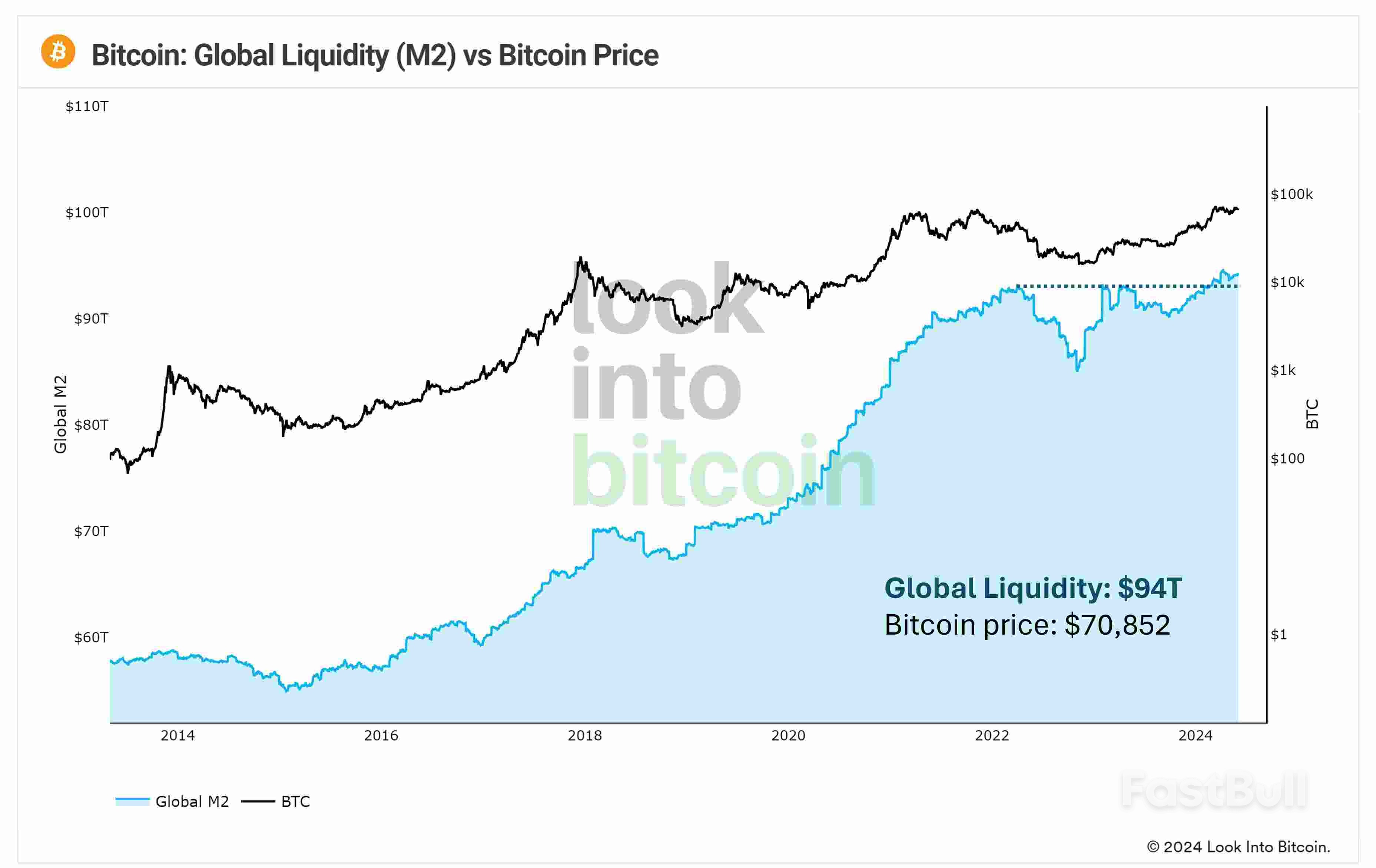
          Bitcoin stands to boost its current bull run thanks to a record high in global liquidity.
          New analysis published on June 5 by Philip Swift, creator of on-chain data platform LookIntoBitcoin, shows liquidity worldwide nearing $100 trillion.

          Global liquidity record calls for BTC price copycat move

          Bitcoin and crypto markets are famously sensitive to global liquidity trends, and in 2024, conditions could not be more conducive to BTC price upside.
          That is the conclusion from Swift, whose platform tracks the world’s M2 money supply and compares it to BTC price behavior.
          In United States dollar terms, M2 is now at $94 trillion — more than ever before and $3 trillion higher than when Bitcoin hit its old $69,000 all-time high in late 2021.
          Since hitting local lows of $85 trillion in late 2022 — coinciding with the pit of the crypto bear market — M2 has rebounded a full 10%.
          “The most important chart for this bull run has just made a new all-time high,” Swift wrote in part of accompanying commentary on X.

          “Are you ready?”Bitcoin Bull Run's 'Most Important Chart' Hits New $94 Trillion All-Time High_1Bitcoin vs. global M2 liquidity. Source: Philip Swift
          The data chimes with other recent liquidity-based findings, which have equally drawn bullish conclusions about where Bitcoin is headed.
          BTC versus the U.S. M1 money supply is in the process of breaking out from a seven-year consolidation period — the longest in Bitcoin’s history — with serious upside implications as a result.

          Bitcoin investor trend copies 2020

          As financial conditions ease, further analysis suggests an increasing appetite among institutional investors for crypto and risk assets.
          In its latest "Weekly Report” sent to Cointelegraph, the on-chain analytics platform CryptoQuant drew comparisons with investor behavior in 2020.
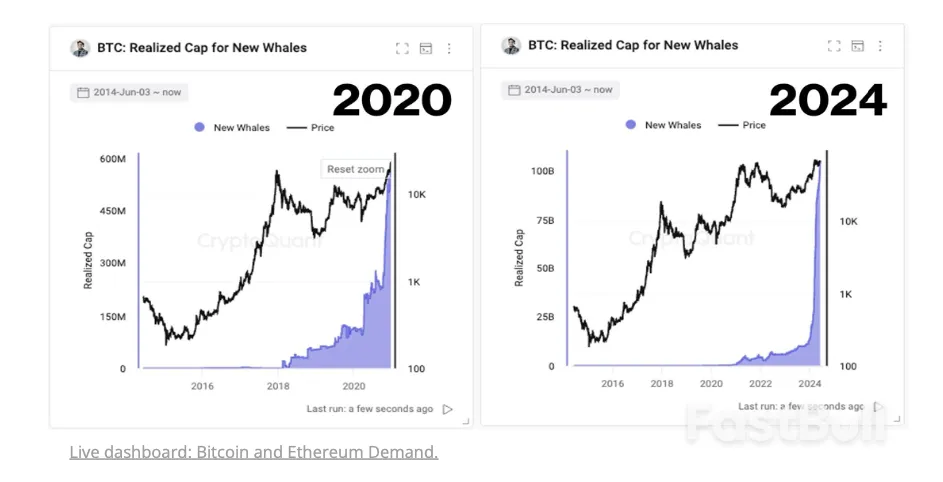
          “Indeed, large investors are adding about $1B into Bitcoin, paralleling 2020 before the rally from $10K to $70K. Back in 2020, Bitcoin hovered around $10k for 6 months with high on-chain activity, later revealed as OTC deals,” it revealed.
          “Now, despite low price volatility, on-chain activity remains high, with $1B added daily by new whale wallets, likely in the form of Bitcoin purchases from institutional investors entering into custody wallets.”

          Bitcoin Bull Run's 'Most Important Chart' Hits New $94 Trillion All-Time High_2Bitcoin new whale entity realized cap comparison (screenshot). Source: CryptoQuant
          An accompanying chart compares the aggregate cost basis, also known as the realized price, of new whales from 2020 to 2024.
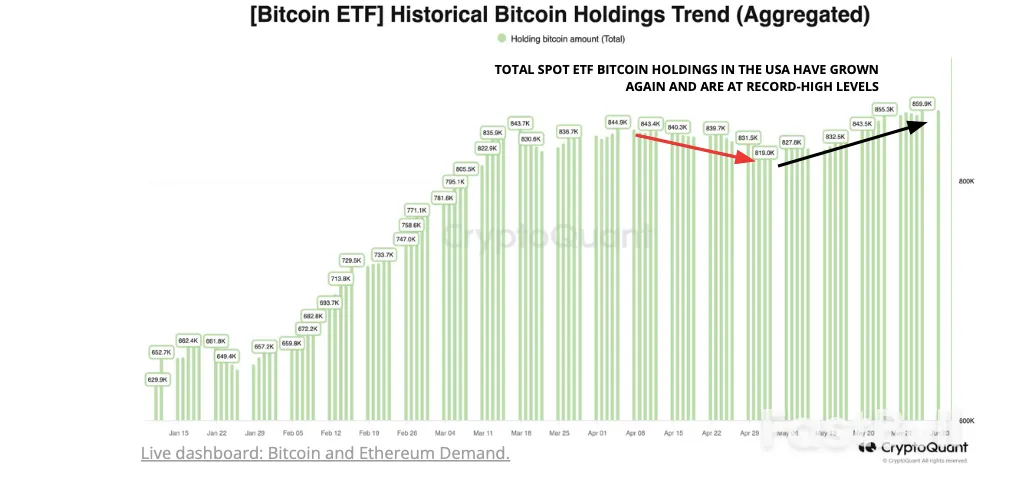
          CryptoQuant likewise highlighted increasing inflows to the U.S. spot Bitcoin exchange-traded funds, or ETFs, these seeing their second-highest net inflows on June 4.Bitcoin Bull Run's 'Most Important Chart' Hits New $94 Trillion All-Time High_3

          U.S. spot Bitcoin ETF holdings (screenshot). Source: CryptoQuant

          Source: Cointelegraph

          Risk Warnings and Disclaimers
          You understand and acknowledge that there is a high degree of risk involved in trading. Following any strategies or investment methods may lead to potential losses. The content on the site is provided by our contributors and analysts for information purposes only. You are solely responsible for determining whether any trading assets, securities, strategy, or any other product is suitable for investing based on your own investment objectives and financial situation.
          Add to Favorites
          Share

          Ahead of Schedule: Why the Fed Should Cut Rates in July, According to Mohamed El-Erian

          Thomas

          Economic

          Central Bank

          The Fed should start cutting interest rates in July, but likely won't, Mohamed El-Erian said."We've had nothing but negative surprises," he told Fox Business. These include disappointing retail sales and manufacturing prints, signaling a cooling economy.
          While markets dissect economic data points to determine whether interest-rate cuts will come this fall, Mohamed El-Erian says there's enough to support cuts in July.
          In an interview with Fox Business on Tuesday, the prominent economist cited a slew of cooling indicators that would support a Federal Reserve policy easing next month.
          "We've had nothing but negative surprises," he said. "All that is saying to us is that the economy is slowing much faster than most people expected, including the Fed."
          To back the point, El-Erian referenced disappointment in recent retail sales, as well as production data. Just this week, lower-than-expected results on the ISM Manufacturing index caused stock markets to stumble, followed on Tuesday by an underwhelming job vacancies report.
          He also listed Wednesday's service sector data as a crucial metric to watch. The ISM Service index ended up beating estimates, rising to 53.8 in May.
          Though his comments preceded the results that have since come out, he noted that the sector is a big driver of inflation, as well as growth.
          Few, including El-Erian, actually expect the Fed to cut in July, even if it's called for.
          Futures markets are currently indicating that a policy pivot is most likely to start in September instead, and odds of a summer rate cut stand at only 18.5%.
          In his view, the Fed will keep waiting as it's too reliant on data that reflective more of the past. For instance, that's as Fed Chairman Jerome Powell prefers to focus on three-month moving averages, as opposed to month-to-month changes.
          "Monetary policy acts with a lag," El-Erian said. "You are really targeting the economy of tomorrow; but if you do that based on yesterday's data, you're likely to get it wrong."
          El-Erian has also been an ongoing proponent of shifting the Fed's inflation target up to 3%, as opposed to the 2% rate the central bank is devoted to achieving. He's previously warned that the Fed risks damaging the economy by keeping rates elevated for too long.
          The economist would prefer that the Fed cut three times this year, but realistically expects no more than one or two cuts.

          Source: Business Insider

          To stay updated on all economic events of today, please check out our Economic calendar
          Risk Warnings and Disclaimers
          You understand and acknowledge that there is a high degree of risk involved in trading. Following any strategies or investment methods may lead to potential losses. The content on the site is provided by our contributors and analysts for information purposes only. You are solely responsible for determining whether any trading assets, securities, strategy, or any other product is suitable for investing based on your own investment objectives and financial situation.
          Add to Favorites
          Share

          Is Rumble Inc (RUM) Stock a Buy

          Glendon

          Economic

          Rumble Inc (NASDAQ: RUM) is a rapidly growing video-sharing platform that has gained significant traction in recent years. As a potential disruptor in the online video space, Rumble's stock has garnered considerable attention from investors. In this article, we'll delve into the company's business model, financial performance, and growth prospects to assess whether Rumble Inc (RUM) stock is a compelling investment opportunity.

          Company Overview

          Rumble operates a free-to-use video-sharing and livestreaming platform that allows creators to upload, share, and monetize their content. The platform aims to provide an alternative to established players like YouTube, offering creators greater freedom of expression and a more favorable revenue-sharing model.
          Rumble's core business revolves around two main segments:
          Video Platform: This is Rumble's flagship product, where users can access video-on-demand (VOD) and live content from creators across various genres, including news, entertainment, and sports.
          Cloud Services: Rumble offers cloud infrastructure services, including video transcoding, storage, and delivery, catering to businesses and content creators.

          Financial Performance

          Rumble has experienced rapid revenue growth in recent years, driven by the increasing popularity of its video platform and the expansion of its cloud services offerings. In 2023, the company reported revenue of $80.96 million, a staggering 105.57% increase compared to the previous year. However, Rumble is still operating at a loss, with a net loss of $116.42 million in 2023.
          While the company's high growth rate is impressive, its ability to achieve profitability remains a concern for investors. Rumble's path to profitability will depend on its ability to continue scaling its user base, attracting more creators, and effectively monetizing its platform through advertising and subscription revenue streams.

          Competitive Landscape

          Rumble operates in a highly competitive market, facing established players like YouTube, Twitch, and other video-sharing platforms. However, the company has positioned itself as a free speech-friendly alternative, appealing to creators who feel censored or restricted on other platforms.
          Rumble's unique selling proposition lies in its commitment to free expression and its favorable revenue-sharing model for creators. The platform offers a higher percentage of revenue share compared to its competitors, which could attract more content creators and drive user engagement.

          Growth Opportunities

          Expanding User Base: Rumble's growth potential is closely tied to its ability to attract and retain users. As the platform continues to gain traction, particularly among creators and audiences seeking alternative viewpoints, its user base is likely to expand.
          Monetization Strategies: Rumble has several monetization avenues, including advertising, subscriptions, and cloud services. As its user base grows, the company can leverage its data and audience insights to offer more targeted advertising opportunities, potentially increasing revenue per user.
          International Expansion: While Rumble currently operates primarily in the United States and Canada, the company has opportunities to expand its reach globally, tapping into new markets and audiences.
          Strategic Partnerships and Acquisitions: Rumble has shown a willingness to pursue strategic partnerships and acquisitions to enhance its offerings and accelerate growth. For example, the company recently acquired a livestreaming platform, Rumble Studio, to bolster its livestreaming capabilities.

          Risks and Challenges

          Competition: Despite its unique positioning, Rumble faces intense competition from well-established players with significant resources and user bases. Maintaining a competitive edge and attracting creators and users will be crucial for the company's long-term success.
          Content Moderation: While Rumble promotes free speech, it must strike a balance between allowing diverse viewpoints and moderating potentially harmful or illegal content. Failure to manage this effectively could damage the platform's reputation and user trust.
          Regulatory Risks: As a video-sharing platform, Rumble is subject to various regulations and laws related to content moderation, data privacy, and intellectual property rights. Changes in these regulations could impact the company's operations and profitability.
          Profitability Concerns: Despite its impressive revenue growth, Rumble's ability to achieve and sustain profitability remains a significant challenge. The company must continue to scale its operations efficiently while managing costs and increasing monetization opportunities.

          Analyst Opinions: A Mixed Bag

          Analyst opinions on RUM stock are divided:
          Bullish Stance: Some analysts see Rumble's potential for user base growth and future monetization opportunities as positive factors. They believe the stock is undervalued and poised for a rise.
          Bearish Concerns: Other analysts are concerned about Rumble's continued losses, its dependence on a specific demographic, and the competitive video-sharing landscape. They recommend a cautious approach.

          Conclusion

          Rumble Inc (RUM) stock represents an intriguing investment opportunity in the rapidly evolving video-sharing and livestreaming space. The company's commitment to free speech and creator-friendly revenue model have resonated with a growing user base, driving impressive revenue growth.
          However, investors should carefully consider the risks associated with Rumble's business model, including intense competition, content moderation challenges, regulatory risks, and the company's path to profitability. While Rumble's disruptive potential is undeniable, its long-term success will depend on its ability to navigate these challenges effectively and capitalize on growth opportunities.
          Ultimately, whether to invest in Rumble Inc (RUM) stock will depend on an investor's risk tolerance, investment horizon, and belief in the company's ability to execute its growth strategy and achieve sustainable profitability.
          To stay updated on all economic events of today, please check out our Economic calendar
          Risk Warnings and Disclaimers
          You understand and acknowledge that there is a high degree of risk involved in trading. Following any strategies or investment methods may lead to potential losses. The content on the site is provided by our contributors and analysts for information purposes only. You are solely responsible for determining whether any trading assets, securities, strategy, or any other product is suitable for investing based on your own investment objectives and financial situation.
          Add to Favorites
          Share

          Interest Rates Are Likely Headed Down, At Least in Europe

          Warren Takunda

          Economic

          The European Central Bank plans to move ahead of the U.S. Federal Reserve on Thursday in cutting interest rates, making the eurozone the biggest rich-world economy to start easing borrowing costs for businesses and consumers as the inflation that arose after Russia’s full-scale invasion of Ukraine slowly recedes.
          ECB President Christine Lagarde and other officials have made it clear that a quarter-point rate cut from the current record high of 4% is more than likely when the bank’s 26-member governing council meets at the institution’s skyscraper headquarters in Frankfurt, Germany.
          Lagarde said late last month that she was “really confident” inflation was under control in the eurozone, the 20 European Union countries that use the euro currency and for which the ECB sets monetary policy. Her remark and statements by other ECB officials have analysts convinced that a rate cut is a done deal for Thursday.
          Such a move would represent a switch from the onset of the inflation surge, when the Fed took the lead in tightening credit by raising rates starting in March 2022, sending mortgage costs higher but also boosting returns for savers with money in certificates of deposit or money market funds. The ECB started about four months later.
          Major central banks around the world now are leaning toward lowering interest rates. Central banks in smaller economies have already cut rates, including in Sweden, Switzerland, Hungary and the Czech Republic.
          The Bank of England’s policymakers are scheduled to meet on June 20, but it’s not clear whether the governing board will cut the rate from 5.25%. Japan, an economic outlier among the world big economies, has started raising rates after years of below-zero rates and low inflation.
          The inflation surge in Europe was unleashed by Russia cutting off most natural gas supplies to the continent, and by logjams in supplies of raw materials and parts as the global economy rebounded from the COVID-19 pandemic.
          Although the eurozone was hit first and hardest by the Russian cutoff, the resulting energy price spike has now largely subsided and inflation fell to 2.6% in May, down from a peak of 10.6% in October 2022 and within range of the ECB’s goal of 2%.
          The Federal Reserve faces a different economy, one in which government stimulus and pandemic recovery spending, and more robust growth fueled inflation. The U.S. consumer price index is at an annual 3.4%, some way from the Fed’s goal, also 2%.
          Fed Chair Jerome Powell has said the bank expects to cut rates this year from the current benchmark level of 5.25%-5.5%, but no change is expected at the Fed’s next policy meeting on June 11-12. With inflation cooling slowly in the U.S., economists and investors now increasingly expect only one or two cuts this year.
          Widening the rate gap between Europe and the U.S. could, in theory, weaken the euro against the dollar by pulling more investment money out of the eurozone and into dollar holdings in search of higher returns. That would hurt the ECB’s inflation battle by making imports more expensive.
          But the euro has actually strengthened recently — from $1.06 in mid-April to its current level around $1.09 — even though the ECB has telegraphed a rate shift for weeks.
          Rate increases combat inflation by making it more expensive to borrow in order to buy goods, lowering demand and taking the pressure off prices. But high rates also hold back growth, and that has been in short supply in the eurozone, where the economy has shown very little growth recently.
          Growth in economic output has hovered just above and below zero for more than a year before a modest upbeat surprise in the first three months of the year, when gross domestic product rose 0.3% from the quarter before.
          “While it is noteworthy that the ECB is forging well ahead of the U.S. Fed, the transatlantic difference in inflation and growth more than justifies this, in our view,” said Holger Schmieding, chief economist at Berenberg bank.
          “If anything, the five quarters of stagnation in the eurozone economy from autumn 2022 to the end of 2023 suggest that the ECB may have overreacted with its rate hikes,” Schmieding said. “Seen from this angle, somewhat lower rates make sense.”
          Analysts say a quarter-point cut on Thursday would likely not usher in a swift series of further cuts as the bank waits to make sure inflation is under control while easing credit to help the economy. Inflation in the services sectors, a broad category that includes everything from medical care and haircuts to hotels, restaurants and concert tickets, remains elevated at 4.1%
          Central bank benchmarks are a big deal both for markets and for ordinary people. They influence borrowing costs across the economy, so lower rates can mean lower mortgage costs and credit card charges for consumers. Lower rates also can increase stock prices and the value of retirement accounts since they lower returns on conservative holdings like bank accounts or certificates of deposit relative to stocks, and push investors toward riskier stocks.
          In Germany, the ECB’s higher rates quashed a nine-year-long rally in home prices and slammed construction activity, which is highly sensitive to borrowing costs. Higher rates have also raised the up-front costs for building new renewable energy production as part of Europe’s effort to transition away from fossil fuels and combat climate change under the 2015 Paris climate accords.

          Source: APNews

          To stay updated on all economic events of today, please check out our Economic calendar
          Risk Warnings and Disclaimers
          You understand and acknowledge that there is a high degree of risk involved in trading. Following any strategies or investment methods may lead to potential losses. The content on the site is provided by our contributors and analysts for information purposes only. You are solely responsible for determining whether any trading assets, securities, strategy, or any other product is suitable for investing based on your own investment objectives and financial situation.
          Add to Favorites
          Share

          Japan's Retail Trader Masses Get Right Back Into Yen Carry Trade

          Cohen

          Economic

          Forex

          Political upheavals, tumbling stock markets, spiking volatility and a flash crash from nowhere: None of it is enough to dissuade Japan's large cohort of individual investors from betting on emerging-market currencies.
          While election-related volatility has hit South Africa's rand, the Mexican peso and the Indian rupee, retail investors in Japan are sticking tight to carry trades that enable them to capture both shifts in exchange rates and the higher yields available in foreign currencies. Little wonder, when the strategy returned 58% since the start of 2023 via bets on the peso, even if the trades run the risk of losses if the yen strengthens or Japanese borrowing costs rise.
          Even as those emerging markets swung sharply, the ratio of trader positions that are long on Mexican peso against the yen stood at 96% as of June 4, down only 1 percentage point from the previous week, according to data from foreign exchange margin trading firm Gaitame.com. Data from Tokyo Financial Exchange‘s Click 365 exchange-traded forex margin market show a similar reading.
          Individuals in Japan are a significant force in the foreign-exchange market, making up nearly 30% of global currency trading by retail investors, according to a Bank of Japan report in 2023.
          “Carry has historically performed very well into cutting cycles,” Citigroup Inc. analysts led by Dirk Willer wrote in a note. “While the positioning clean-up may have slightly longer to run, we think carry should recover sooner rather than later.”
          The yen advanced to as much as 154.55 per dollar this week, the strongest in about three weeks, after weak US economic data fueled speculation that the Federal Reserve will cut interest rates at a faster pace. Concern about the carry trade's outlook may have added to the pressure.
          But with Japan's yield gap with the US still wide, the yen has reversed course since then and was trading around 156.15 late Thursday in Tokyo.
          “There is always demand for yen carry transactions,” said Hideki Shibata, senior strategist at Tokai Tokyo Intelligence Lab. If the yen appreciates beyond 155 against the dollar, “it is a good time to buy dollars.”
          Japanese individual investors' carry trade positions in the Mexican peso have tended to be low leverage and in small amounts so the impact from the currency's depreciation this week won't be significant, said Takuya Kanda, head of research at Gaitame.com Research Institute. Some of those investors may purchase more pesos to make up for losses from the declines given the nation's high policy interest rate at 11%, he said.

          Source: Bloomberg

          To stay updated on all economic events of today, please check out our Economic calendar
          Risk Warnings and Disclaimers
          You understand and acknowledge that there is a high degree of risk involved in trading. Following any strategies or investment methods may lead to potential losses. The content on the site is provided by our contributors and analysts for information purposes only. You are solely responsible for determining whether any trading assets, securities, strategy, or any other product is suitable for investing based on your own investment objectives and financial situation.
          Add to Favorites
          Share

          Markets Have Overreacted to OPEC's Plan To Phase Out Production Cuts

          Samantha Luan

          Commodity

          Economic

          OPEC+ agreed on Sunday to extend most of its oil output cuts well into 2025 amid tepid demand growth, rising U.S. production and high interest rates. OPEC+ is currently cutting output by a total of 5.86 million barrels per day (bpd), or about 5.7% of global demand, including 3.66 million bpd of cuts previously set to expire at the end of 2024, and voluntary cuts by eight members of 2.2 million bpd, expiring at the end of June 2024. The announcement led to an oil price selloff, with front-month Brent falling to a four-month low below $77 per barrel (bbl), good for a hefty $8/bbl decline from last week’s high and over $15/bbl lower from April’s YTD high.
          Commodity analysts at Standard Chartered have pointed out that the price undershooting was the consequence of markets being dominated by a combination of extreme macroeconomic pessimism; speculative shorts and over-enthusiastic algorithmic trading that crowded out more fundamentally-based traders. According to data from Bridgeton Research Group via Bloomberg, oil futures markets have now flipped to a net short position in Brent, compared with a net long position at the end of last week.
          StanChart says the oil price rout has been triggered by market expectations for a significant volume of OPEC+ oil returning to the global markets 2024; however, the analysts have argued that this explanation does not hold much water. According to StanChart, assuming market conditions are such that the increases can commence, the increase in Q4 relative to Q2 is likely to clock in at a relatively modest 360 kb/d, with the analysts saying that OPEC+ has room to increase production by 1 million b/d without upsetting market balance. Further, StanChart points out that the phase-out will be conditional depending on the state of global markets at the time with most general asset markets not expecting FOMC to follow all its current forward guidance to the letter regardless of future data and events. However, the reaction by oil markets seems to suggest that the forward guidance given by the eight OPEC+ countries concerned constitutes a determination to produce, regardless of whatever happens.
          StanChart has pointed out a number of other bullish factors that the markets have overlooked:
          The 1.65mb/d of voluntary cuts agreed in April 2023 have been extended to the end of 2025.
          The required production level for all OPEC+ countries across 2025 was reaffirmed.
          The agreement was finally reached in the long-running discussion with the UAE, resulting in a 300kb/d increase in the UAE’s required production level, spread out over nine months starting in January 2025.
          Russia, Iraq and Kazakhstan have agreed to produce a compensation schedule for H1 overproduction by the end of June.
          The discussion of targets in light of third-party consultant assessments of capacity was postponed until late-2025 when it may be a basis for discussion of 2026 required production.
          The Joint Ministerial Monitoring Committee (JMMC) was given authority to request an OPEC+ ministerial meeting at any time or hold additional meetings should it choose to.
          Overall, the analysts say that OPEC+ decisions will ultimately prove positive for oil prices. More importantly, the OPEC+ report has increased transparency with the likelihood of bearish tail-risk events materializing minimized.
          Meanwhile, StanChart has reported that there has been no change in the dominant dynamics of the European gas market, with inventories building slower than usual and the markets still proving highly sensitive to supply issues. According to Gas Infrastructure Europe (GIE) data, EU gas inventories stood at 81.75 billion cubic meters (bcm) on 2 June, good for a 1.1 bcm Y/Y increase and 14.9 bcm above the five-year average. Inventory build over the past week was 1.9 bcm, considerably lower than the five-year average for the same period of 2.8 bcm and last year’s 2.4 bcm. The experts also note that the surplus above the five-year average has fallen on 45 of the past 48 days.
          The natural gas supply-side continues to be plagued with challenges. The latest supply disruption that triggered a rally was a fault in Norway’s Sleipner gas field. StanChart has predicted that whereas the outage is likely to be short-lived (current estimates are that repairs should be over by the coming weekend), prices are likely to remain elevated bolstered by slower-than-average inventory builds. Dutch Title Transfer Facility (TTF) gas for January 2025 delivery reached a high of EUR 43.30 per megawatt hour (MWh) on 3 June while the front-month contract reached a five-month high of EUR 38.70/MWh on the same day before falling back to settle at EUR 36.014/MWh.

          Source:Oilprice

          To stay updated on all economic events of today, please check out our Economic calendar
          Risk Warnings and Disclaimers
          You understand and acknowledge that there is a high degree of risk involved in trading. Following any strategies or investment methods may lead to potential losses. The content on the site is provided by our contributors and analysts for information purposes only. You are solely responsible for determining whether any trading assets, securities, strategy, or any other product is suitable for investing based on your own investment objectives and financial situation.
          Add to Favorites
          Share

          Japan to Raise Cap on State Backing for Copper Mine Stakes to 75%

          Warren Takunda

          Economic

          Commodity

          The Japanese government will increase the limit on the stake it is allowed to hold in copper mines, Nikkei has learned, in a bid to encourage investment in global copper projects by the private sector and ensure stable supplies of the key resource.
          Japan's interests in copper mines are mainly in South America and Australia. With copper a key resource for building infrastructure, such as transmission wires, new investments are expected in projects in such places as Africa that carry higher risks.
          Under current rules, the state-run Japan Organization for Metals and Energy Security, or JOGMEC, can cover up to 50% of a public-private investment in a copper project. The Ministry of Economy, Trade and Industry, which oversees JOGMEC, will raise that limit to around 75% as soon as this fiscal year.
          The move seeks to mitigate the country risk faced by private-sector companies. A stake between 20% and 30% in a copper mine would still require an investment costing billions of dollars. Through the new framework, Japan will be better positioned to compete for copper interests.
          Nations worldwide are racing to secure copper interests to support industrial decarbonization efforts. Last year, the U.S. government added copper to a list of critical minerals eligible for supply-chain assistance.
          This year, the European Union implemented the Critical Raw Materials Act, geared toward stabilizing the supply chain for the materials. Copper is among the resources covered under the law.
          Japanese companies have seldom invested in projects in Africa, due to the significant country risk in the region. Meanwhile, China and Middle Eastern countries have moved to secure natural resource interests in African nations.
          In response, the industry ministry will present measures to stabilize future supplies at a meeting of experts beginning Thursday. JOGMEC's rule change will be part of those moves.
          JOGMEC has provided 75% financial backing for public-private investment in a rare metal project. Based on that track record, the industry ministry will work with the Ministry of Finance and other agencies to finalize provisions for the higher investment limit for copper, and to obtain government funding for the initiative.
          In addition, the industry ministry will expand support for companies engaged in high-risk exploration of a wide variety of minerals, including copper and rare metals.
          Under a new mechanism, JOGMEC will make initial investments in multiple projects in which Japanese businesses are planning to invest. These interests will later be transferred to those companies, which would take on certain cost burdens at that point.
          Japan's demand for copper will grow to roughly 1.35 million tonnes in 2040, according to JOGMEC, which would be about a 30% jump from 2022. Copper supplies from projects owned by Japanese interests are on track to decline, due in part to exhausted reserves.
          Global demand for copper is expected to exceed supplies from the 2030s, according to an analysis by S&P.
          Japan's strategic energy plan has set a goal of attaining 80% self-sufficiency in copper and other base metals supplied by Japanese-owned interests, up from the current ratio of less than 50%. The share is expected to shrink to around 40% in the late 2030s.

          Source: NikkeiAsia

          To stay updated on all economic events of today, please check out our Economic calendar
          Risk Warnings and Disclaimers
          You understand and acknowledge that there is a high degree of risk involved in trading. Following any strategies or investment methods may lead to potential losses. The content on the site is provided by our contributors and analysts for information purposes only. You are solely responsible for determining whether any trading assets, securities, strategy, or any other product is suitable for investing based on your own investment objectives and financial situation.
          Add to Favorites
          Share
          FastBull
          Copyright © 2025 FastBull Ltd

          728 RM B 7/F GEE LOK IND BLDG NO 34 HUNG TO RD KWUN TONG KLN HONG KONG

          TelegramInstagramTwitterfacebooklinkedin
          App Store Google Play Google Play
          Products
          Charts

          Chats

          Q&A with Experts
          Screeners
          Economic Calendar
          Data
          Tools
          Membership
          Features
          Function
          Markets
          Copy Trading
          Latest Signals
          Contests
          News
          Analysis
          24/7
          Columns
          Education
          Company
          Careers
          About Us
          Contact Us
          Advertising
          Help Center
          Feedback
          User Agreement
          Privacy Policy
          Business

          White Label

          Data API

          Web Plug-ins

          Poster Maker

          Affiliate Program

          Risk Disclosure

          The risk of loss in trading financial instruments such as stocks, FX, commodities, futures, bonds, ETFs and crypto can be substantial. You may sustain a total loss of the funds that you deposit with your broker. Therefore, you should carefully consider whether such trading is suitable for you in light of your circumstances and financial resources.

          No decision to invest should be made without thoroughly conducting due diligence by yourself or consulting with your financial advisors. Our web content might not suit you since we don't know your financial conditions and investment needs. Our financial information might have latency or contain inaccuracy, so you should be fully responsible for any of your trading and investment decisions. The company will not be responsible for your capital loss.

          Without getting permission from the website, you are not allowed to copy the website's graphics, texts, or trademarks. Intellectual property rights in the content or data incorporated into this website belong to its providers and exchange merchants.

          Not Logged In

          Log in to access more features

          FastBull Membership

          Not yet

          Purchase

          Become a signal provider
          Help Center
          Customer Service
          Dark Mode
          Price Up/Down Colors

          Log In

          Sign Up

          Position
          Layout
          Fullscreen
          Default to Chart
          The chart page opens by default when you visit fastbull.com