• Trade
  • Markets
  • Copy
  • Contests
  • News
  • 24/7
  • Calendar
  • Q&A
  • Chats
Trending
Screeners
SYMBOL
LAST
BID
ASK
HIGH
LOW
NET CHG.
%CHG.
SPREAD
SPX
S&P 500 Index
6848.58
6848.58
6848.58
6878.28
6841.15
-21.82
-0.32%
--
DJI
Dow Jones Industrial Average
47797.59
47797.59
47797.59
47971.51
47709.38
-157.39
-0.33%
--
IXIC
NASDAQ Composite Index
23533.38
23533.38
23533.38
23698.93
23505.52
-44.74
-0.19%
--
USDX
US Dollar Index
99.150
99.230
99.150
99.160
98.730
+0.200
+ 0.20%
--
EURUSD
Euro / US Dollar
1.16173
1.16180
1.16173
1.16717
1.16162
-0.00253
-0.22%
--
GBPUSD
Pound Sterling / US Dollar
1.33128
1.33136
1.33128
1.33462
1.33053
-0.00184
-0.14%
--
XAUUSD
Gold / US Dollar
4192.65
4193.06
4192.65
4218.85
4175.92
-5.26
-0.13%
--
WTI
Light Sweet Crude Oil
58.916
58.946
58.916
60.084
58.837
-0.893
-1.49%
--

Community Accounts

Signal Accounts
--
Profit Accounts
--
Loss Accounts
--
View More

Become a signal provider

Sell trading signals to earn additional income

View More

Guide to Copy Trading

Get started with ease and confidence

View More

Signal Accounts for Members

All Signal Accounts

Best Return
  • Best Return
  • Best P/L
  • Best MDD
Past 1W
  • Past 1W
  • Past 1M
  • Past 1Y

All Contests

  • All
  • Trump Updates
  • Recommend
  • Stocks
  • Cryptocurrencies
  • Central Banks
  • Featured News
Top News Only
Share

Israeli Prime Minister Netanyahu: Hamas Has Violated The Ceasefire Agreement, And We Will Never Allow Its Members To Re-arm Themselves And Threaten US

Share

Israeli Prime Minister Netanyahu: We Are Working To Return The Body Of Another Detainee From The Gaza Strip

Share

Iraq's West Qurna 2 Oil Field Will Increase Oil Production Beyond Normal Levels To Compensate For The Production Stoppage Caused By The Trump Administration's Sanctions Against Russia

Share

Israeli Prime Minister Netanyahu: We Are Close To Completing The First Phase Of Trump’s Plan And Will Now Focus On Disarming Gaza And Seizing Hamas Weapons

Share

Moody's Affirmed Burberry's Long-term Rating Of Baa3 And Revised Its Outlook (from Negative) To Stable

Share

The Trump Administration Supports Iraq's Plan To Transfer Russian Oil Company Lukoil Pjsc's Assets In The West Qurna 2 Oil Field To An American Company

Share

JMA: Tsunami Of 70 Centimetres Observed In Japan's Kuji Port In Iwate Prefecture

Share

The U.S. Bureau Of Labor Statistics Plans To Release A Press Release On January 15, 2026, For November 2025, Along With Data For October

Share

Tiger Global Has Established A New Fund, Aiming To Raise $2 Billion To $3 Billion

Share

The U.S. Bureau Of Labor Statistics Announced That It Will Not Release A Press Release Regarding The U.S. Import And Export Price Index (MXP) For October 2025

Share

The U.S. Bureau Of Labor Statistics (BLS) Will Not Release U.S. October CPI Data

Share

Government Negotiator: Dutch Political Center And Center Right Parties D66,  Cda And Vvd Advised To Start Talks On Possible Government

Share

New York Fed: November Home Price Rise Expectation Steady At 3%

Share

New York Fed: US Households' Personal Finance Worries Grew In November

Share

New York Fed: November Five-Year-Ahead Expected Inflation Rate Unchanged At 3%

Share

New York Fed: Households More Pessimistic On Current, Future Financial Situations In November

Share

New York Fed Report: USA Households' Year-Ahead Expected Inflation Rate Unchanged At 3.2% In November

Share

New York Fed: November Year-Ahead Expected Rise In Medical Costs Highest Since January 2014

Share

New York Fed: Labor Market Expectations Improved In November

Share

New York Fed: November Three-Year-Ahead Expected Inflation Rate Unchanged At 3%

TIME
ACT
FCST
PREV
France Trade Balance (SA) (Oct)

A:--

F: --

P: --
Euro Zone Employment YoY (SA) (Q3)

A:--

F: --

P: --
Canada Part-Time Employment (SA) (Nov)

A:--

F: --

P: --

Canada Unemployment Rate (SA) (Nov)

A:--

F: --

P: --

Canada Full-time Employment (SA) (Nov)

A:--

F: --

P: --

Canada Labor Force Participation Rate (SA) (Nov)

A:--

F: --

P: --

Canada Employment (SA) (Nov)

A:--

F: --

P: --

U.S. PCE Price Index MoM (Sept)

A:--

F: --

P: --

U.S. Personal Income MoM (Sept)

A:--

F: --

P: --

U.S. Core PCE Price Index MoM (Sept)

A:--

F: --

P: --

U.S. PCE Price Index YoY (SA) (Sept)

A:--

F: --

P: --

U.S. Core PCE Price Index YoY (Sept)

A:--

F: --

P: --

U.S. Personal Outlays MoM (SA) (Sept)

A:--

F: --

P: --
U.S. 5-10 Year-Ahead Inflation Expectations (Dec)

A:--

F: --

P: --

U.S. Real Personal Consumption Expenditures MoM (Sept)

A:--

F: --

P: --
U.S. Weekly Total Rig Count

A:--

F: --

P: --

U.S. Weekly Total Oil Rig Count

A:--

F: --

P: --

U.S. Consumer Credit (SA) (Oct)

A:--

F: --

P: --
China, Mainland Foreign Exchange Reserves (Nov)

A:--

F: --

P: --

Japan Trade Balance (Oct)

A:--

F: --

P: --

Japan Nominal GDP Revised QoQ (Q3)

A:--

F: --

P: --

China, Mainland Imports YoY (CNH) (Nov)

A:--

F: --

P: --

China, Mainland Exports (Nov)

A:--

F: --

P: --

China, Mainland Imports (CNH) (Nov)

A:--

F: --

P: --

China, Mainland Trade Balance (CNH) (Nov)

A:--

F: --

P: --

China, Mainland Exports YoY (USD) (Nov)

A:--

F: --

P: --

China, Mainland Imports YoY (USD) (Nov)

A:--

F: --

P: --

Germany Industrial Output MoM (SA) (Oct)

A:--

F: --

P: --
Euro Zone Sentix Investor Confidence Index (Dec)

A:--

F: --

P: --

Canada National Economic Confidence Index

A:--

F: --

P: --

U.K. BRC Like-For-Like Retail Sales YoY (Nov)

--

F: --

P: --

U.K. BRC Overall Retail Sales YoY (Nov)

--

F: --

P: --

Australia Overnight (Borrowing) Key Rate

--

F: --

P: --

RBA Rate Statement
RBA Press Conference
Germany Exports MoM (SA) (Oct)

--

F: --

P: --

U.S. NFIB Small Business Optimism Index (SA) (Nov)

--

F: --

P: --

Mexico 12-Month Inflation (CPI) (Nov)

--

F: --

P: --

Mexico Core CPI YoY (Nov)

--

F: --

P: --

Mexico PPI YoY (Nov)

--

F: --

P: --

U.S. Weekly Redbook Index YoY

--

F: --

P: --

U.S. JOLTS Job Openings (SA) (Oct)

--

F: --

P: --

China, Mainland M1 Money Supply YoY (Nov)

--

F: --

P: --

China, Mainland M0 Money Supply YoY (Nov)

--

F: --

P: --

China, Mainland M2 Money Supply YoY (Nov)

--

F: --

P: --

U.S. EIA Short-Term Crude Production Forecast For The Year (Dec)

--

F: --

P: --

U.S. EIA Natural Gas Production Forecast For The Next Year (Dec)

--

F: --

P: --

U.S. EIA Short-Term Crude Production Forecast For The Next Year (Dec)

--

F: --

P: --

EIA Monthly Short-Term Energy Outlook
U.S. API Weekly Gasoline Stocks

--

F: --

P: --

U.S. API Weekly Cushing Crude Oil Stocks

--

F: --

P: --

U.S. API Weekly Crude Oil Stocks

--

F: --

P: --

U.S. API Weekly Refined Oil Stocks

--

F: --

P: --

South Korea Unemployment Rate (SA) (Nov)

--

F: --

P: --

Japan Reuters Tankan Non-Manufacturers Index (Dec)

--

F: --

P: --

Japan Reuters Tankan Manufacturers Index (Dec)

--

F: --

P: --

Japan Domestic Enterprise Commodity Price Index MoM (Nov)

--

F: --

P: --

Japan Domestic Enterprise Commodity Price Index YoY (Nov)

--

F: --

P: --

China, Mainland PPI YoY (Nov)

--

F: --

P: --

China, Mainland CPI MoM (Nov)

--

F: --

P: --

Q&A with Experts
    • All
    • Chatrooms
    • Groups
    • Friends
    Connecting
    .
    .
    .
    Type here...
    Add Symbol or Code

      No matching data

      All
      Trump Updates
      Recommend
      Stocks
      Cryptocurrencies
      Central Banks
      Featured News
      • All
      • Russia-Ukraine Conflict
      • Middle East Flashpoint
      • All
      • Russia-Ukraine Conflict
      • Middle East Flashpoint
      Search
      Products

      Charts Free Forever

      Chats Q&A with Experts
      Screeners Economic Calendar Data Tools
      Membership Features
      Data Warehouse Market Trends Institutional Data Policy Rates Macro

      Market Trends

      Market Sentiment Order Book Forex Correlations

      Top Indicators

      Charts Free Forever
      Markets

      News

      News Analysis 24/7 Columns Education
      From Institutions From Analysts
      Topics Columnists

      Latest Views

      Latest Views

      Trending Topics

      Top Columnists

      Latest Update

      Signals

      Copy Rankings Latest Signals Become a signal provider AI Rating
      Contests
      Brokers

      Overview Brokers Assessment Rankings Regulators News Claims
      Broker listing Forex Brokers Comparison Tool Live Spread Comparison Scam
      Q&A Complaint Scam Alert Videos Tips to Detect Scam
      More

      Business
      Events
      Careers About Us Advertising Help Center

      White Label

      Data API

      Web Plug-ins

      Affiliate Program

      Awards Institution Evaluation IB Seminar Salon Event Exhibition
      Vietnam Thailand Singapore Dubai
      Fans Party Investment Sharing Session
      FastBull Summit BrokersView Expo
      Recent Searches
        Top Searches
          Markets
          News
          Analysis
          User
          24/7
          Economic Calendar
          Education
          Data
          • Names
          • Latest
          • Prev

          View All

          No data

          Scan to Download

          Faster Charts, Chat Faster!

          Download App
          English
          • English
          • Español
          • العربية
          • Bahasa Indonesia
          • Bahasa Melayu
          • Tiếng Việt
          • ภาษาไทย
          • Français
          • Italiano
          • Türkçe
          • Русский язык
          • 简中
          • 繁中
          Open Account
          Search
          Products
          Charts Free Forever
          Markets
          News
          Signals

          Copy Rankings Latest Signals Become a signal provider AI Rating
          Contests
          Brokers

          Overview Brokers Assessment Rankings Regulators News Claims
          Broker listing Forex Brokers Comparison Tool Live Spread Comparison Scam
          Q&A Complaint Scam Alert Videos Tips to Detect Scam
          More

          Business
          Events
          Careers About Us Advertising Help Center

          White Label

          Data API

          Web Plug-ins

          Affiliate Program

          Awards Institution Evaluation IB Seminar Salon Event Exhibition
          Vietnam Thailand Singapore Dubai
          Fans Party Investment Sharing Session
          FastBull Summit BrokersView Expo

          Bitcoin at $91,300: extreme fear spikes as big money buys the dip

          Adam

          Cryptocurrency

          Summary:

          Bitcoin plunges to $91,300 amid extreme fear, breaking key cycle supports. Despite bearish technicals and fragile market signals, institutions and ETFs are aggressively buying the dip, offsetting whale selling and stabilizing flows.
          Bitcoin is deep into its third 30 % correction of the cycle. After touching $89,310 on November 18, it now trades near $91,500. The Fear & Greed Index has collapsed to 10 —the lowest reading of the year — and sentiment feels entirely flushed.
          The alarm bells are understandable. Bitcoin has now broken levels it never lost earlier in the cycle. It has closed multiple times below three major thresholds: the Short-Term Holder realized price at $110,000, the 200-day moving average at $110,000, and the 365-day moving average at $102,000. In every previous cycle — 2014, 2018, 2022 — simultaneously losing these three levels marked the beginning of a multi-year bear market. That doesn’t guarantee we are in one now, but the risk is becoming increasingly difficult to ignore.

          Bitcoin market signals turn fragile

          Technically, the picture is fragile indeed. On the weekly chart, BTC has slipped below the lower Bollinger Band, with the stochastic oscillator deeply oversold, the MACD negative, and the RSI drifting toward 30. On the daily chart, the 50-day SMA has crossed below the 200-day — the classic death cross that signals fading momentum, even if it typically lags price.
          Support sits at $91,000–$90,000, with a stronger zone at $85,000–$84,000. Resistance remains at $96,000 and the psychological $100,000.
          Derivatives market echoes the sentiment. Thomas Young of Rumjog consultancy points out that bitcoin futures briefly flipped into backwardation — a situation where spot trades above futures. It’s rare and usually appears during stress events, forced de-risking, or capitulation. It is rare and generally emerges during stress, forced unwinding, or capitulation. Historically, backwardation has been a contrarian signal: either a reversal as panic exhausts, or a final washout that marks the bottom of the move.
          Context matters, though. In past cycles, these breakdowns followed vertical blow-off tops and months of euphoric distribution. Nothing like that occurred this time. There was no $200k mania, no media frenzy, no retail stampede. The ~$126k peak (if it was the peak) formed after a slow, institution-led grind. This is potentially good news for bitcoin, as institutions don’t appear ready to dump it just yet.

          Big players buy the dip

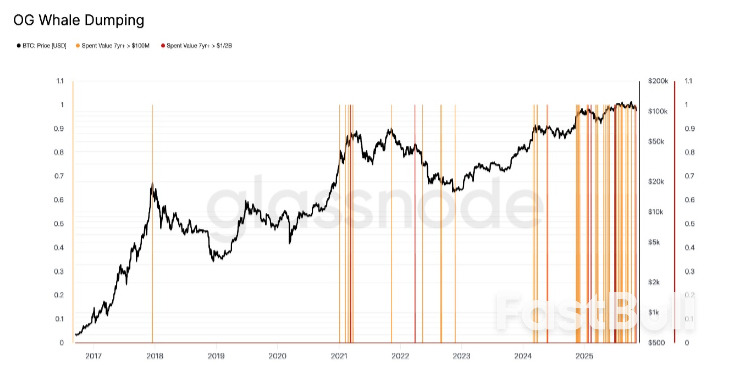
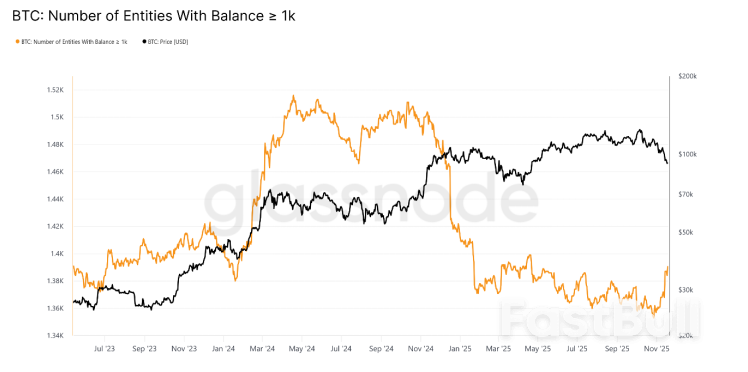
          One concern during this correction has been heavy selling from early bitcoin whales — entities holding at least 1,000 BTC. As Capriole fund’s Charles Edwards notes, 2025 has been a year where long-dormant whales, holding coins for seven years or more, have begun cashing out.
          Bitcoin at $91,300: extreme fear spikes as big money buys the dip_1
          Historically, when long-term whales sold in size, steeper declines usually followed. This cycle, however, a new dynamic is at play: large institutional buyers are absorbing the supply.
          CryptoQuant’s CEO argues that the sell-off reflects old holders rotating into new institutional ones. OG whales have been selling, but ETFs, MSTR, corporate treasuries, sovereign funds, pension funds, and multi-asset managers now provide constant inflows. “The cycle theory is dead until these liquidity channels stop running,” he writes.
          On-chain data from Glassnode shows the whale count spiking at the fastest pace since early 2024. After bottoming on October 26, whale numbers jumped from 1,353 to 1,391, signaling a wave of newly formed large holders.
          Bitcoin at $91,300: extreme fear spikes as big money buys the dip_2
          ETF flows are also holding up. Bloomberg ETF analyst Eric Balchunas notes that US Bitcoin ETFs saw $250m in outflows on Monday and $3bn over the past month —approximately 2.5% of assets. That still leaves 97.5% untouched and $23bn in net inflows this year — “not too bad,” considering the current extreme fear mood.Fresh liquidity continues to flow. Strategy Inc. (MSTR) launched its new euro-denominated 10% preferred stock, STRE, on November 3. Initially targeting €350m, the company ultimately raised $700m, extending its corporate-credit engine into Europe and reinforcing bitcoin-linked flows. El Salvador also joined the dip-buyers, adding another $100m to its national treasury on November 17.
          The market is clearly stressed. It is equally clear that large institutions are accumulating into that stress. As early adopters give way to Wall Street, the structure of the bitcoin market and the nature of its cycles are evolving.

          Source: marketscreener

          Risk Warnings and Disclaimers
          You understand and acknowledge that there is a high degree of risk involved in trading. Following any strategies or investment methods may lead to potential losses. The content on the site is provided by our contributors and analysts for information purposes only. You are solely responsible for determining whether any trading assets, securities, strategy, or any other product is suitable for investing based on your own investment objectives and financial situation.
          Add to Favorites
          Share

          U.S. Treasury Yields Dip as Market Awaits Fed Signals and Economic Clarity

          Gerik

          Economic

          Yields Ease Amid Mixed Economic Signals

          U.S. Treasury yields ticked lower on Friday morning as traders continued to assess the implications of recent economic data and awaited commentary from key Federal Reserve officials. The 10-year Treasury yield fell over 2 basis points to 4.075%, while the 2-year yield dropped more sharply by 5.3 basis points to 3.505%. The longer-dated 30-year yield also edged lower to 4.709%.
          These shifts reflect cautious positioning ahead of potentially pivotal insights from Fed officials and upcoming economic data prints, including the University of Michigan’s Consumer Sentiment Index and S&P Global’s Manufacturing PMI. The market is searching for clearer guidance on whether the Fed will maintain its current interest rate stance into early 2026 or pivot toward easing.

          September Jobs Data Complicates Fed Outlook

          Thursday’s delayed non-farm payrolls report painted a mixed picture. The U.S. added more jobs than forecast for September, suggesting underlying labor market resilience. However, the unemployment rate rose to 4.4% the highest since October 2021 highlighting possible soft spots in labor demand.
          The causal relationship between labor market data and Treasury yields is evident: better-than-expected job creation can push yields higher on fears of tighter monetary policy, but a simultaneous rise in unemployment introduces ambiguity, prompting modest declines in yields as traders hedge both inflation and recession risks.

          Rate Cut Odds Recede Further

          In response to the data, investor expectations for a December rate cut have declined. According to the CME FedWatch tool, markets now assign only a 35.1% probability of a cut next month, down sharply from previous estimates. This decline signals a growing belief that the Fed will keep rates on hold longer to ensure inflation continues its retreat toward the 2% target.
          The falling likelihood of a near-term rate cut is supporting short-term yields but keeping longer-term yields relatively contained, reflecting uncertainty around growth prospects and the eventual policy pivot.

          Upcoming Fed Speeches and Data May Steer Markets

          Markets are also watching for potential policy clues from scheduled appearances by Fed Governor Michael S. Barr and Vice Chair Philip N. Jefferson on Friday. While neither is expected to signal an imminent policy shift, their tone may influence expectations for early 2026.
          Alongside central bank rhetoric, Friday’s upcoming release of the University of Michigan Consumer Sentiment Index and S&P Global’s flash Manufacturing PMI will provide more granular insight into household confidence and industrial activity two areas that could either reinforce or challenge the Fed’s current pause.
          Friday’s modest decline in Treasury yields reflects a market caught between signs of economic resilience and emerging signs of slack. With the Fed expected to stay on the sidelines in December, traders are now parsing speeches and data for hints about the 2026 rate path. For now, bond markets are holding their breath, awaiting a clearer signal on whether disinflation, slowing growth, or a resurgent labor market will take the lead in shaping monetary policy.

          Source: CNBC

          To stay updated on all economic events of today, please check out our Economic calendar
          Risk Warnings and Disclaimers
          You understand and acknowledge that there is a high degree of risk involved in trading. Following any strategies or investment methods may lead to potential losses. The content on the site is provided by our contributors and analysts for information purposes only. You are solely responsible for determining whether any trading assets, securities, strategy, or any other product is suitable for investing based on your own investment objectives and financial situation.
          Add to Favorites
          Share

          Dollar hedging frenzy fades, bringing relief to greenback

          Adam

          Forex

          Just months after a U.S. tariff shock whacked the dollar, a rush by overseas investors to protect U.S. holdings from the sliding currency has slowed sharply - a vote of confidence that's helping the greenback recover from its worst rout in years.
          While analysts say investor hedging is higher than it has been historically, such activity has slowed from the period immediately after the April 2 "Liberation Day", when U.S. President Donald Trump announced sweeping trade tariffs.
          At that time, foreign investors holding U.S. assets were hit by tumbling stock and bond prices and a plummeting dollar. Nimble investors moved to hedge against a further dollar decline and the trend was expected to gain momentum. Instead, it has slowed, allowing the U.S. currency to stabilise.
          "The conversations we're having with clients now suggest that these (hedging) flows are less likely to come as imminently as the conversations we had back in May suggested they would," said David Leigh, Nomura's global head of FX and emerging markets.
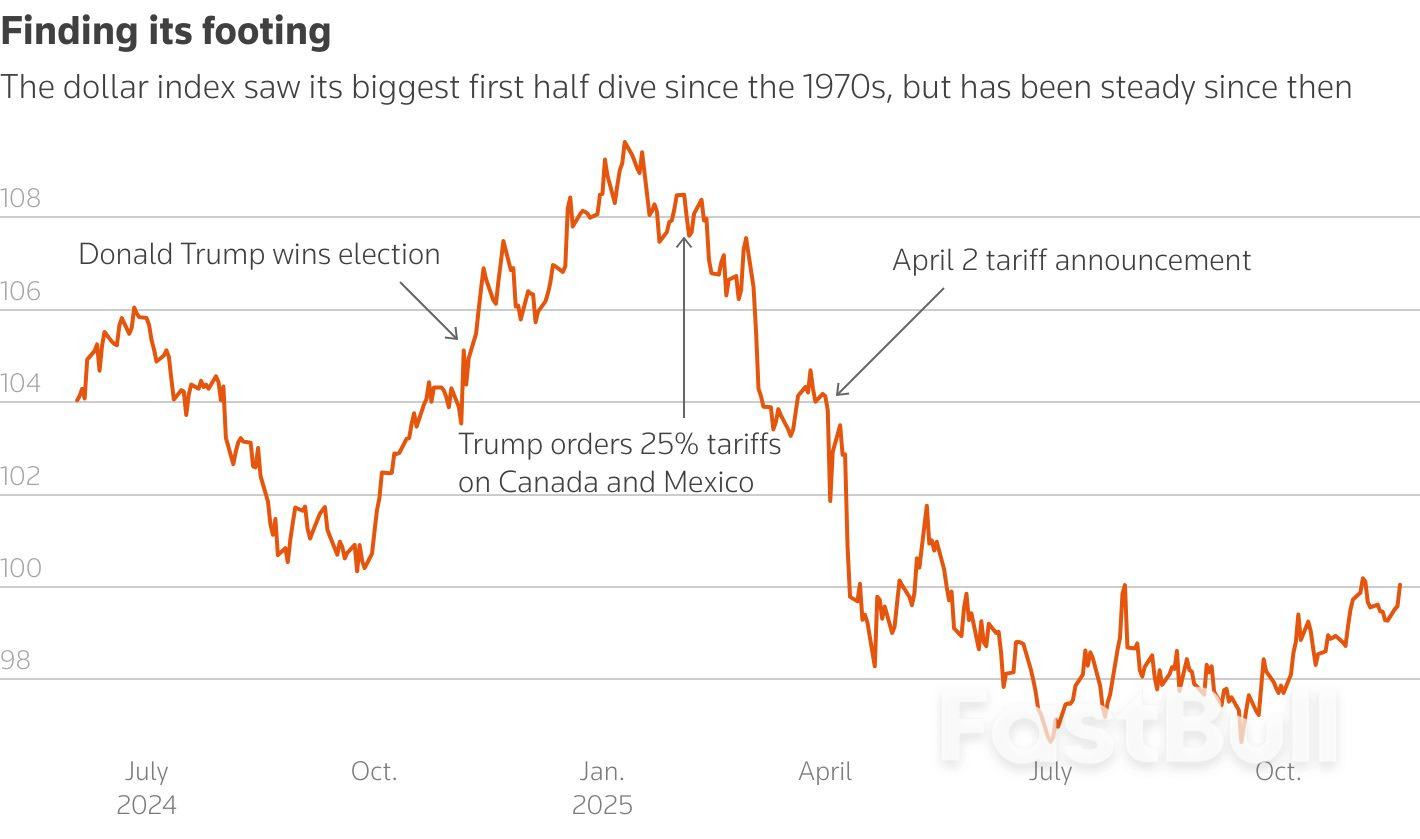
          The dollar index , which tracks the greenback against other major currencies, has rallied nearly 4% since the end of June, when it was nursing losses of almost 11% after its biggest first-half dive since the early 1970s.
          Dollar hedging frenzy fades, bringing relief to greenback_1

          Chart shows the dollar index since mid 2024

          Data on hedging is limited and analysts extrapolate from scarce public figures and numbers compiled by banks and custodians.
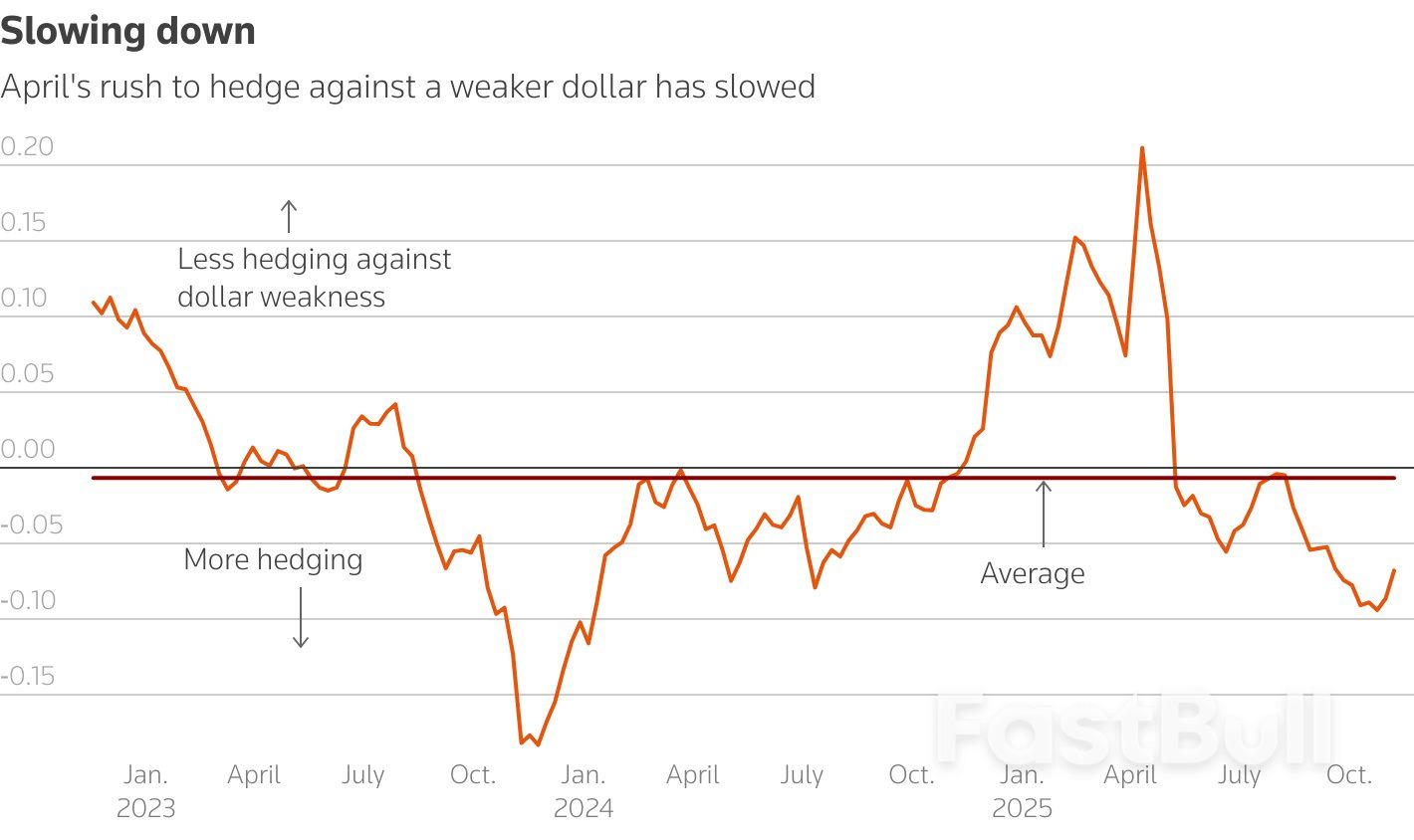
          Analysis of client positioning by BNY, one of the world's largest custodians, shows they were very long U.S. assets in early 2025, suggesting they didn't anticipate much additional dollar weakness and were happy to operate without much hedging.
          That changed in April and hedging is now higher than normal, although lower than in late 2023 when markets began to anticipate Federal Reserve rate cuts.
          "The dollar diversification story this year is more talked about than actioned upon," said Geoff Yu, BNY's senior market strategist.
          Dollar hedging frenzy fades, bringing relief to greenback_2

          Chart uses BNY data showing their clients' dollar positioning

          Other giant custodians reported a similar picture.
          State Street Markets' analysis of the assets State Street has under custody and administration showed that as of end October, foreign equity managers’ hedging of their dollar holdings was 24%, a 4 percentage-point increase since February, but well below the 30%-plus hedge ratio they have seen in the past.
          They too said it had slowed in recent weeks.
          It varies by market too. A November National Australia Bank survey of Australian pension funds found "no material change in hedging behaviour towards U.S. equities".
          Danish central bank data, however, shows hedging by pension funds there has stabilised after increasing post-April.
          Columbia Threadneedle CIO William Davies said that the firm initially moved to protect its U.S. stock holdings against further dollar weakness but has since unwound some of its hedges, betting the currency won't decline further.
          NO SNOWBALL EFFECT
          Hedging itself causes currencies to move - adding protection against dollar downside to a previously unhedged position effectively involves selling the greenback, and vice versa.
          If combined with shifting interest rates, the effect can be dramatic - a dollar selloff can spark more hedging, sending it lower still.
          "People, earlier this year, were getting excited that this snowball effect would develop, though in the end it didn't really," said HSBC's Paul Mackel, global head of FX research.
          For next year, "it's something to keep an eye on, but it's not our baseline scenario".
          Still investor behaviour may be shifting. BlackRock estimates that 38% of flows into Europe, Middle East and Africa-listed U.S. equity exchange-traded products this year have been into those with FX hedges, a meaningful change from 2024 when 98% of flows were unhedged.
          COST, CORRELATIONS AND COMPLICATIONS
          Cost is also a factor, and depends on rate differentials and so varies by market. This may help explain some of the reluctance to hedge positions.
          Japanese investors pay around an annualised 3.7% to hedge against dollar weakness, estimates Van Luu, Russell Investments' global head of solutions strategy for fixed income and FX.
          This is a sizeable sum - if dollar/yen holds steady for a year, an investor is down 3.7% versus an unhedged peer. The equivalent cost for a euro-funded investor is around 2%.
          "I have a rule of thumb for euro investors, if the cost is around 1% they don't care much, but if it's 2% then it becomes a factor," Luu said.
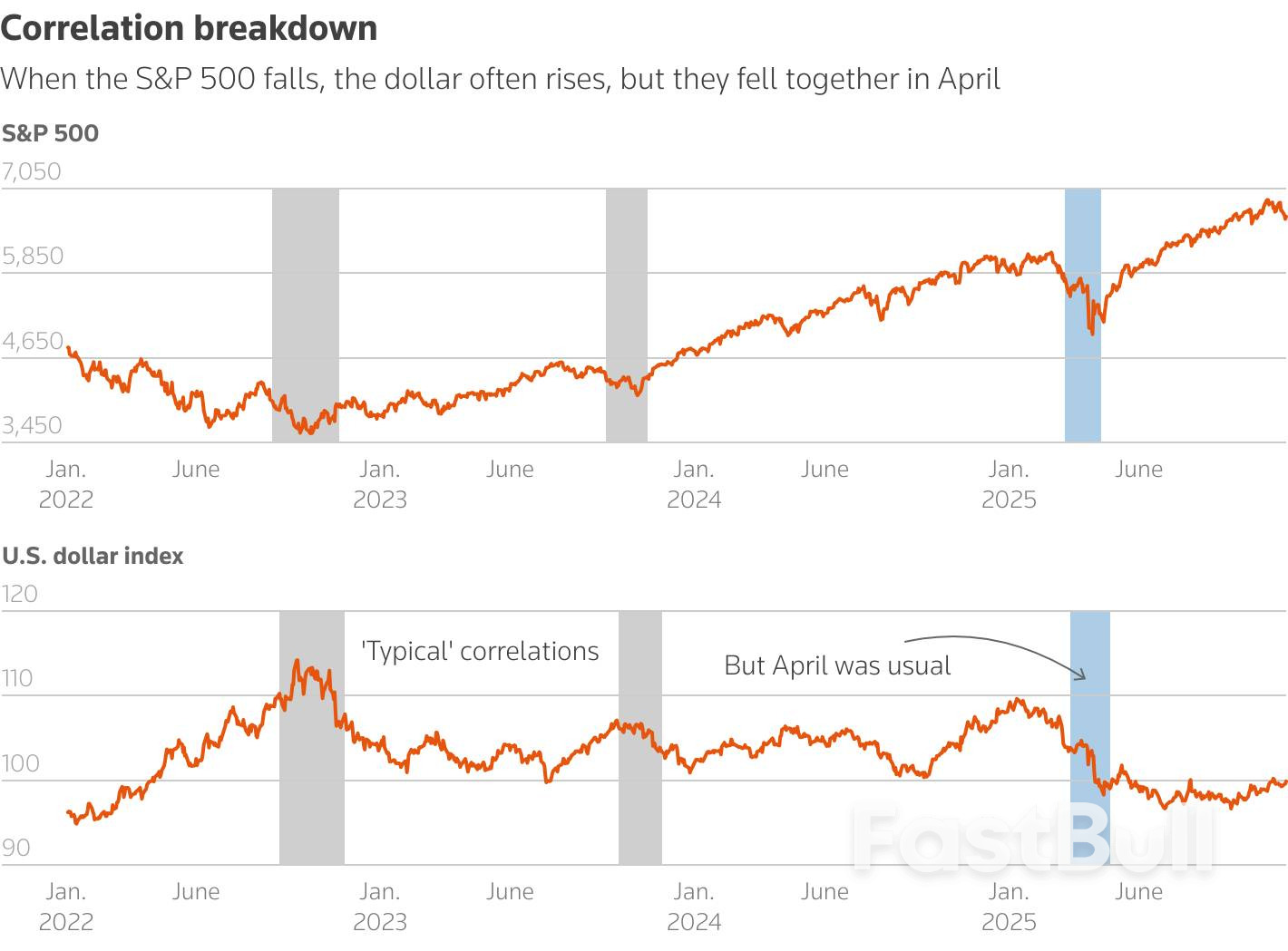
          Asset correlations matter too. Traditionally the dollar strengthens when stocks fall, meaning overseas investors are effectively protected on their U.S. positions.
          That did not happen in April, contributing to the hedging rush. This month, the dollar held steady as stocks tumbled again.
          Dollar hedging frenzy fades, bringing relief to greenback_3

          Chart shows S&P 500 and dollar index, flagging times their moves have overlapped

          Change is also complicated for the many investors who aim to outperform a fixed benchmark if that benchmark is unhedged.
          Fidelity International recommends Europe-based investors move gradually towards hedging 50% of their dollar exposure, but Salman Ahmed, head of macro and strategic asset allocation, notes it is a "very involved" process which can require governance and benchmark changes.
          If interest rates move against the dollar and it starts to weaken again, and hedges become cheaper, pressure for change may build.
          "There's still lots of scope for dollar investments to be hedged, whether that comes to pass and how quickly is an open question," said Nomura's Leigh.
          "That's what the FX market's trying to get its head around."
          Reporting by Alun John and Naomi Rovnick; additional reporting by Elisa Martinuzzi; Editing by Dhara Ranasinghe and Kirsten Donovan

          Reuters: source

          Risk Warnings and Disclaimers
          You understand and acknowledge that there is a high degree of risk involved in trading. Following any strategies or investment methods may lead to potential losses. The content on the site is provided by our contributors and analysts for information purposes only. You are solely responsible for determining whether any trading assets, securities, strategy, or any other product is suitable for investing based on your own investment objectives and financial situation.
          Add to Favorites
          Share

          Europe Again Stuck On The Sidelines As Ukraine Peace Talks Gain Steam

          Justin

          Russia-Ukraine Conflict

          Once again, Europe finds itself on the outside looking in as a peace plan for Ukraine takes shape.

          European Council President Antonio Costa confirmed at a press conference in South Africa today that the EU had not received communication about the US-Russia plan in advance. Now, the bloc is scrambling to respond, with the crisis set to overshadow the G20 meeting that starts tomorrow in Johannesburg.

          In a phone call around lunchtime today, Kyiv's biggest European allies lined up with President Volodymyr Zelenskiy to reject key elements of the plan.

          German Chancellor Friedrich Merz, France's Emmanuel Macron and Britain's Keir Starmer agreed that Ukraine's armed forces must remain capable of defending its sovereignty and that the current line of contact should be the starting point for any peace talks, according to a statement from the German government. Zelenskiy is also due to speak to Dutch Prime Minister Dick Schoof later today.

          Leaders, including European Commission President Ursula von der Leyen, will meet in person on the sidelines of the G20 tomorrow to map out next steps. Finnish President Alexander Stubb, who's earned a reputation as a Donald Trump whisperer, is also expected to fly in. The Europeans are hoping for a phone call with the US president, who has shunned the G20 gathering.

          If this all sounds familiar, it's because it is. The last-minute diplomacy on display is reminiscent of the frantic efforts that unfolded in August when EU leaders sought to get Trump's ear before and after his summit with Vladimir Putin in Alaska. They also eventually managed an impromptu meeting in the White House a few days later.

          The 28-point peace plan, obtained by Bloomberg, includes major concessions to Moscow. Among its proposals are that Crimea, Luhansk and Donetsk would be "recognized as de facto Russian, including by the United States," while Ukraine would be required to give up any hope of NATO membership.

          Zelenskiy said in his own statement this afternoon after the call with European leaders that Ukraine is "working on the document prepared by the American side," adding that it must ensure a "real and dignified peace."

          As Ukraine peace talks enter a crucial phase this weekend, the EU is still struggling to finalize its own nascent plan to tap immobilized Russian assets. The Commission said today that its work on the plan would continue regardless of the new US-Russia peace plan.

          With the US and Russia increasingly in the driving seat, Europe is feeling the pressure now more than ever to get its proposal over the line.

          In the eight years since French President Emmanuel Macron announced a flurry of defense projects with German Chancellor Angela Merkel, two have been scrapped, one shelved indefinitely and two, including the Future Combat Air System plane, hit with delays and infighting between partners. The problems with these projects may require a new approach, such as reworking them or focusing on suppliers' skillsets rather than nationality, to overcome self-interest and achieve success, writes Bloomberg Opinion columnist Lionel Laurent.

          Brexit has caused almost twice as much damage to the UK economy than estimated by official forecasts, according to a new paper from experts including a senior Bank of England economist. It shows that the 2016 vote to leave the EU has cost the country between 6% and 8% of GDP per person over the last decade, a hit of £180 billion to £240 billion.

          Preparations for a financial-market meltdown by Hungary's Prime Minister Viktor Orban are baffling investors who see little signs of a looming collapse in the country, one of the world's best-performing emerging markets. The five-term premier has spoken repeatedly about the need for a "US financial shield" to protect Hungary — whose sovereign debt is backed by investment-grade ratings — in case of a speculative attack. He even drew parallels with Argentina, which has secured a lifeline from US President Donald Trump.

          Source: Bloomberg Europe

          Risk Warnings and Disclaimers
          You understand and acknowledge that there is a high degree of risk involved in trading. Following any strategies or investment methods may lead to potential losses. The content on the site is provided by our contributors and analysts for information purposes only. You are solely responsible for determining whether any trading assets, securities, strategy, or any other product is suitable for investing based on your own investment objectives and financial situation.
          Add to Favorites
          Share

          Europe’s Economy Is Geared Towards a Disappearing World, Says ECB’s Lagarde

          Warren Takunda

          Economic

          Europe’s economy is “geared towards a world that is gradually disappearing”, according to a warning from Christine Lagarde that the EU needs reforms to spur growth.
          The president of the European Central Bank (ECB) said the EU’s dependence on international trade had left it vulnerable, as major partners had turned away from the trade that made the bloc’s exporters wealthy.
          Donald Trump has led a global turn towards protectionism and against globalisation, with steep tariffs imposed on almost every trading partner. At the same time, China has used its dominance of production of certain critical materials and products to exert pressure.
          Lagarde argued that Europe was vulnerable because of a “dependency on third countries for our security and the supply of critical raw materials”. She cited China’s control of the supply of rare earth metals that are crucial in electric motors and wind turbines, as well as the “choke point” of power chips made by Nexperia in China that threatened to shut down production across the global car industry.
          Speaking at the European Banking Congress in Frankfurt, Germany, Lagarde said Europe had failed to address its own problems. Policymakers had instead allowed its weaknesses to “erode growth quietly, as each new shock nudges us onto a slightly lower trajectory”.
          “Our internal market has stood still, especially in the areas that will shape future growth, like digital technology and artificial intelligence, as well as the areas that will finance it, such as capital markets,” she said.
          Europe also faced a “vicious circle” of its own savers allocating money to US stocks, helping the American economy to advance faster than the EU and leaving “stagnating productivity at home and growing dependence on others”, she said.
          Lagarde did highlight some European strengths as well, including a resilient labour market, increasing digital investment, and government spending, particularly on defence in response to Russia’s invasion of Ukraine, that has counteracted economic slowdown.
          Part of Lagarde’s prescription for recovery was lowering barriers to services and goods trade between EU countries. Those barriers are equivalent to a 100% tariff on services and 65% on goods, according to ECB analysis. Lowering those barriers to the same level as the Netherlands – a relatively open economy – would fully make up for the hit from US tariffs, she said.
          She called for mutual recognition of regulated companies, allowing them to sell across Europe when authorised by any one country. She also said the EU should adopt qualified majority voting on tax, preventing any single member state from vetoing changes.
          She argued that benefits would include allowing the harmonisation of VAT, making it easier for smaller European companies to gain access to the whole EU market without having to comply with 27 different tax regimes.

          Source: Theguardian

          To stay updated on all economic events of today, please check out our Economic calendar
          Risk Warnings and Disclaimers
          You understand and acknowledge that there is a high degree of risk involved in trading. Following any strategies or investment methods may lead to potential losses. The content on the site is provided by our contributors and analysts for information purposes only. You are solely responsible for determining whether any trading assets, securities, strategy, or any other product is suitable for investing based on your own investment objectives and financial situation.
          Add to Favorites
          Share

          Trump Puts Pakistan Back On World Stage As Ties With India Fray

          Justin

          Forex

          Political

          Economic

          Standing before US-based Pakistanis in June at a dinner in Washington, Asim Munir beamed after meeting US President Donald Trump in the Oval Office.

          Pakistan's most powerful army chief in decades told attendees that Trump had saved South Asia from catastrophe, crediting him with brokering a ceasefire that stopped a May clash with fellow nuclear power India, according to a person at the event, who asked not to be identified because it was private. Munir said he told Trump that Pakistan was ready for a new era of cooperation in areas like critical minerals and cryptocurrency after relations hit a fresh low under President Joe Biden, the person added.

          A year ago, India was a central piece of the US's strategy to work with allies and partners to pressure China, with Pakistan largely an afterthought. Now US-Pakistan relations are on the rise as Trump hits India with high tariffs, upending more than two decades of US policy aimed at improving relations with the world's biggest democracy.

          As Trump spars with Indian Prime Minister Narendra Modi, he's embraced Munir, the formerly obscure commander elevated to a national hero in the wake of the India clash. Pakistan lawmakers this month passed a constitutional amendment granting Munir, who holds the title of Field Marshal, lifelong immunity and control over all of the nation's armed forces, cementing his position as its strongest military leader since former dictator Mohammed Ayub Khan in the 1960s.

          Trump now regularly praises Munir when he speaks about the India-Pakistan conflict, calling him a "great guy" and putting him on equal footing with Modi, who has rejected the US president's claims that he helped broker a ceasefire.

          The shift in stance has revived Pakistan as a geopolitical power in the region. A close partner with China, which has poured money into the South Asian nation over the past decade, Pakistan signed a mutual-defense pact with Saudi Arabia in September and has mulled sending troops to the peacekeeping effort in Gaza.

          Trump's shift more broadly has driven a wedge into what had been a largely bipartisan consensus in Washington to court India as a counterweight to China. Kurt Campbell, US deputy secretary of state in the Biden administration, told Bloomberg Television this month that "almost all of our strategic interests lie with India" and the "wholesale collapse" of relations between Trump and Modi would likely lead to some lasting damage.

          At the same time, a healthy US-Pakistan relationship could also give the US leverage over India, according to Nisha Biswal, partner at The Asia Group and former US assistant secretary of state for South and Central Asian Affairs during the Obama administration. Ultimately, she said, "both relationships have to stand on their own merits."

          "The extent to which the US can exert leverage and pressure on Pakistan, and has the relationship to do so in times of crisis, is an important aspect," she said. "You don't want a Pakistan that is impervious to US influence."

          Across Pakistan, the shift in the nation's mood since the clash is palpable. Heroic portraits of Munir and other leaders adorn billboards, banners and magazine covers. Images of triumphant Pakistani aircraft downing Indian fighters are on display in government buildings in Islamabad as well as the atrium of the State Bank of Pakistan museum in Karachi. An artist's depiction of Pakistani warplanes zooming over a trio of battered Indian Rafale jets sits alongside historic rupee notes and portraits of graying central bankers.

          In recent interviews with Bloomberg News, Pakistani officials in the government, the military and businesses described a sense of national renewal. Many see the India fight as an unqualified victory, backed by Islamabad's claims — denied by New Delhi but acknowledged by Trump — to have downed seven Indian fighters. The clash, they said, has united Pakistan, brought global prestige and opened new doors in world capitals.

          "We defended ourselves and we won," Bilal Azhar Kayani, Pakistan's state minister of finance, said in an interview in Islamabad. "But in addition to that, the way we have conducted ourselves diplomatically in a changing and fluid global landscape has been commendable."

          One outcome of the May clash has been even firmer alignment between Pakistan's military and civilian leaders, according to Jay Truesdale, chief executive at geopolitical risk consulting firm TDI and a former chief of staff at the US Embassy in Islamabad. That dynamic was underscored in September, when Trump hosted both Munir and Prime Minister Shehbaz Sharif in the Oval Office at the same time.

          "The way the Americans intervened and the outcome that took place, the Pakistanis can claim that they had a victory, and this has further galvanized the unity of effort," Truesdale said.

          US officials say they aren't prioritizing Pakistan over India, and officials in Washington and New Delhi appear close to reaching a trade deal that would lower tariffs from 50% — among the highest rates in the world. "I don't think anything we're doing with Pakistan comes at the expense of our relationship or friendship with India, which is deep, historic and important," Secretary of State Marco Rubio told reporters last month.

          Still, Rubio acknowledged an opportunity with Pakistan. "Our job is to try to figure out how many countries we can find, how we can work with on things of common interest," he said.

          Pakistan and the US have been on-and-off partners since the Cold War, when Washington was looking for allies to stop the spread of communism. In 1971, Secretary of State Henry Kissinger used a Pakistani plane from Islamabad for a secret diplomatic mission to China. In the 1980s, Pakistan cooperated with the US to funnel support to Afghan insurgents battling the Soviet Union. Pakistan later provided logistical support in the US's so-called war on terror.

          As China emerged as Washington's chief rival, successive administrations drew closer to India, and ties with Pakistan — a longtime friend to Beijing — fell by the wayside. US-Pakistan ties further soured after the discovery of Osama bin Laden in a Pakistani compound, leading to his death in a daring American operation in 2011.

          This year saw a sudden reversal. In a speech to Congress in March, Trump praised Pakistan for arresting the alleged mastermind behind a bombing in Kabul in 2021 that killed 13 US troops. Then in May, when tensions between India and Pakistan exploded into a four-day armed conflict, Trump claimed he intervened and brokered a ceasefire, a boast that left Pakistan elated, but Indian officials fuming. Pakistan went on to nominate Trump for a Nobel Peace Prize, while Trump referred to Munir as "my favorite field marshal."

          Officials in Islamabad meanwhile prioritized areas close to Trump, including cryptocurrency and counterterrorism.

          During his June visit to Washington, Munir said he would work with the White House on cryptocurrency. Just months earlier, officials of World Liberty Financial Partners — a crypto venture with ties to the Trump family — signed an initial cooperation agreement. In July, Pakistan and the US reached a trade agreement that left the nation's goods with a 19% tariff, lower than other countries in Asia and well below India's levy.

          Pakistan has been shoring up its security on other fronts. Sharif signed an economic pact with Saudi Crown Prince Mohammed bin Salman last month, shortly after reaching a mutual-defense pact with the nation.

          "Not only the Americans, but the world everywhere, they find in Pakistan right now a leadership that — despite all the challenges — is handling the affairs in a great manner," General Ahmed Sharif Chaudhry, Pakistan's top military spokesman, said in an interview in Islamabad.

          A challenge for Pakistan is whether it can trust Trump and balance relations with the US and China, Islamabad's top supplier of weapons, infrastructure and aid. Sharif met with Chinese President Xi Jinping in Beijing during a regional summit in September, while Foreign Minister Wang Yi also met with Munir a few months earlier.

          "China has been a longstanding partner, so has the US," Finance Minister Muhammad Aurangzeb said in an interview in Islamabad. "They both know that we are well engaged on both ends."

          Among the most touted sectors for investment have been Pakistan's resource wealth. Trump in July touted Pakistan's "massive" oil reserves, and a top US diplomat in Pakistan in August said US firms are showing interest in the sector, which has seen production fall for years.

          A more promising sector is minerals. One prominent new US partner to date on this front is US Strategic Metals, a Missouri-based firm that in September signed a memorandum of understanding with an army-owned firm to develop Pakistan's rare earth resources.

          The deal came together after an August meeting with Munir with other business executives in Florida, according to the company's commercial director, Mike Hollomon. Munir urged him to visit Pakistan "as fast as you can," he said.

          Weeks later, Hollomon and other executives were in Islamabad meeting with Pakistani port operators. In October, the company began taking deliveries of small quantities of minerals for quality checks. The longer-term plan is to build rare-earths refining capacity in Pakistan, Hollomon said.

          "We'd like this to become a political win for America," he said.

          Source: Bloomberg Europe

          To stay updated on all economic events of today, please check out our Economic calendar
          Risk Warnings and Disclaimers
          You understand and acknowledge that there is a high degree of risk involved in trading. Following any strategies or investment methods may lead to potential losses. The content on the site is provided by our contributors and analysts for information purposes only. You are solely responsible for determining whether any trading assets, securities, strategy, or any other product is suitable for investing based on your own investment objectives and financial situation.
          Add to Favorites
          Share

          US Peace Plan Contains Unpalatable Proposals For Both Ukraine And Russia

          James Whitman

          Political

          Russia-Ukraine Conflict

          The United States has drafted a 28-point peace plan for ending the war in Ukraine which is being studied by Kyiv, Moscow and interested countries in Europe.

          The plan, seen by Reuters, gives Russia - which is inching forward on the battlefield and controls almost one-fifth of Ukraine - much of what it wants.

          But it also contains some unappetising proposals for Moscow which would leave it short of fully achieving its stated war aims and require its forces to pull back from some areas that they have captured.

          Following are some of the points that are likely to prove contentious.

          TERRITORY

          Under the proposals, Ukraine would have to cede the rest of the Donetsk region to Russia, a large area including the fortress cities of Sloviansk and Kramatorsk, which Ukraine still controls.

          Ukrainian President Volodymyr Zelenskiy has previously ruled out gifting Moscow any territory.

          The agreement would also permanently lock in Russia's battlefield gains since February 2022 in the four Ukrainian regions it claims as its own - Luhansk, Zaporizhzhia, Kherson and Donetsk. Russia's 2014 annexation of Crimea would become permanent too.

          Ukraine would also have to compromise on the status of the Russian-controlled Zaporizhzhia nuclear power station, which would be restarted and its power shared 50-50 between Russia and Ukraine.

          But recognition of those territories as Russian would be "de facto" - a status that Moscow might not want to accept.

          Russia would be left without full control of Kherson and Zaporizhzhia, where a line would be drawn along the current front line freezing the status quo.

          Russian troops would not be allowed to garrison the part of Donetsk that Ukraine would hand over. This would become a neutral demilitarised buffer zone controlled by and belonging to Moscow.

          Russian forces would also have to withdraw from two other regions where they have taken territory - Kharkiv and Dnipropetrovsk.

          Moscow says its forces have captured the city of Kupiansk in the Kharkiv region although Kyiv has denied this. Under the U.S. proposals, Moscow would have to retreat from Kupiansk.

          MONEY

          Western governments have frozen about $300 billion of Russian assets, mostly in Europe, to punish Moscow for the war.

          Russia wants those assets unfrozen and has threatened action against the European Union, which has produced a plan to issue a loan to Ukraine using cash balances accrued from the frozen securities.

          But under the U.S. plan, Russia would have to hand over $100 billion to Washington which would lead an effort to rebuild Ukraine, with the U.S. reaping 50% of the profits from that work.

          Another chunk of the frozen Russian assets would be ploughed into a joint U.S.-Russia investment vehicle, from which Moscow would get some benefit.

          But the plan would give neither Russia nor Ukraine an entirely free hand when it comes to spending the frozen funds.

          It could also torpedo EU plans to use the frozen funds to help Kyiv, though Russia would not get immediate relief from international sanctions: sanctions would be lifted in phases and on a case-by-case basis after discussions.

          Ukraine would be forced to swallow a bitter pill by not being able under the plan to seek reparations for war damage from Russia through the courts.

          SECURITY

          Under the plan, Zelenskiy would have to permanently drop one of his most cherished ambitions - for Ukraine to join the U.S.-led NATO military alliance. NATO would agree to never admit Ukraine and the Ukrainian constitution would be amended to reflect that.

          NATO itself would commit not to expand further, a key Russian demand, while there would be an "expectation" that Moscow would not invade its neighbours, cemented in a non-aggression pact between Russia and Ukraine and Europe.

          Ukraine is likely to be disappointed by the vague language on the security guarantees it would receive from Washington. Beyond calling them "robust" and saying Kyiv would have to pay for them, there is no mention of what they might entail.

          NATO troops could not be stationed in Ukraine, and Kyiv would have to commit to not becoming a nuclear-armed state under the proposals.

          Ukraine would also be forced to cap the size of its army at 600,000 troops. It has previously resisted suggestions the size of its military should be limited.

          The 600,000 figure is considerably less than the roughly 1 million people Ukraine says it has under arms. Russia has previously demanded Ukraine's army be cut to below 100,000 troops.

          JUSTICE

          Ukrainian politicians have long talked about holding Russia accountable for its actions, but under the plan Kyiv would have to drop plans to pursue any legal cases seeking to prove that Moscow committed war crimes, something Russia denies.

          Ukraine may also dislike proposals that would see Russia readmitted to the Group of Eight nations and re-integrated into the global economy.

          Another clause talks of large-scale investment and business cooperation between the U.S. and Russia in areas such as rare earths, energy and the Arctic.

          The plan also says Ukraine must be "de-Nazified," a reference to what Moscow says are nationalist anti-Russian military units and politicians. Kyiv says this portrayal is bogus.

          The plan, without referencing Ukraine, says "all Nazi ideology or activity should be renounced or forbidden."

          Source: Reuters

          Risk Warnings and Disclaimers
          You understand and acknowledge that there is a high degree of risk involved in trading. Following any strategies or investment methods may lead to potential losses. The content on the site is provided by our contributors and analysts for information purposes only. You are solely responsible for determining whether any trading assets, securities, strategy, or any other product is suitable for investing based on your own investment objectives and financial situation.
          Add to Favorites
          Share
          FastBull
          Copyright © 2025 FastBull Ltd

          728 RM B 7/F GEE LOK IND BLDG NO 34 HUNG TO RD KWUN TONG KLN HONG KONG

          TelegramInstagramTwitterfacebooklinkedin
          App Store Google Play Google Play
          Products
          Charts

          Chats

          Q&A with Experts
          Screeners
          Economic Calendar
          Data
          Tools
          Membership
          Features
          Function
          Markets
          Copy Trading
          Latest Signals
          Contests
          News
          Analysis
          24/7
          Columns
          Education
          Company
          Careers
          About Us
          Contact Us
          Advertising
          Help Center
          Feedback
          User Agreement
          Privacy Policy
          Business

          White Label

          Data API

          Web Plug-ins

          Poster Maker

          Affiliate Program

          Risk Disclosure

          The risk of loss in trading financial instruments such as stocks, FX, commodities, futures, bonds, ETFs and crypto can be substantial. You may sustain a total loss of the funds that you deposit with your broker. Therefore, you should carefully consider whether such trading is suitable for you in light of your circumstances and financial resources.

          No decision to invest should be made without thoroughly conducting due diligence by yourself or consulting with your financial advisors. Our web content might not suit you since we don't know your financial conditions and investment needs. Our financial information might have latency or contain inaccuracy, so you should be fully responsible for any of your trading and investment decisions. The company will not be responsible for your capital loss.

          Without getting permission from the website, you are not allowed to copy the website's graphics, texts, or trademarks. Intellectual property rights in the content or data incorporated into this website belong to its providers and exchange merchants.

          Not Logged In

          Log in to access more features

          FastBull Membership

          Not yet

          Purchase

          Become a signal provider
          Help Center
          Customer Service
          Dark Mode
          Price Up/Down Colors

          Log In

          Sign Up

          Position
          Layout
          Fullscreen
          Default to Chart
          The chart page opens by default when you visit fastbull.com