• Trade
  • Markets
  • Copy
  • Contests
  • News
  • 24/7
  • Calendar
  • Q&A
  • Chats
Trending
Screeners
SYMBOL
LAST
BID
ASK
HIGH
LOW
NET CHG.
%CHG.
SPREAD
SPX
S&P 500 Index
6827.42
6827.42
6827.42
6899.86
6801.80
-73.58
-1.07%
--
DJI
Dow Jones Industrial Average
48458.04
48458.04
48458.04
48886.86
48334.10
-245.98
-0.51%
--
IXIC
NASDAQ Composite Index
23195.16
23195.16
23195.16
23554.89
23094.51
-398.69
-1.69%
--
USDX
US Dollar Index
97.920
98.000
97.920
98.070
97.810
-0.030
-0.03%
--
EURUSD
Euro / US Dollar
1.17447
1.17454
1.17447
1.17596
1.17262
+0.00053
+ 0.05%
--
GBPUSD
Pound Sterling / US Dollar
1.33844
1.33853
1.33844
1.33961
1.33546
+0.00137
+ 0.10%
--
XAUUSD
Gold / US Dollar
4331.35
4331.78
4331.35
4350.16
4294.68
+31.96
+ 0.74%
--
WTI
Light Sweet Crude Oil
56.836
56.866
56.836
57.601
56.789
-0.397
-0.69%
--

Community Accounts

Signal Accounts
--
Profit Accounts
--
Loss Accounts
--
View More

Become a signal provider

Sell trading signals to earn additional income

View More

Guide to Copy Trading

Get started with ease and confidence

View More

Signal Accounts for Members

All Signal Accounts

Best Return
  • Best Return
  • Best P/L
  • Best MDD
Past 1W
  • Past 1W
  • Past 1M
  • Past 1Y

All Contests

  • All
  • Trump Updates
  • Recommend
  • Stocks
  • Cryptocurrencies
  • Central Banks
  • Featured News
Top News Only
Share

Portugal Treasury Expects 2026 Net Financing Needs At 29.4 Billion Euros, Up From 25.8 Billion In 2025

Share

Bank Of America Says With Indonesia's Smelter Now Ramping Up, It Expects Aluminium Supply Growth To Accelerate To 2.6% Year On Year In 2026

Share

Bank Of America Expects A Deficit In Aluminium Next Year And Sees Prices Pushing Above $3000/T

Share

Fed Data - USA Effective Federal Funds Rate At 3.64 Percent On 12 December On $102 Billion In Trades Versus 3.64 Percent On $99 Billion On 11 December

Share

Brazil's Petrobras Says No Impact Seen On Oil, Petroleum Products Output As Workers Start Planned Strike

Share

Statement: US Travel Group Warns New Proposed Trump Administration Requirements For Foreign Tourists To Provide Social Media Histories Could Mean Millions Of People Opting Not To Visit

Share

Blackrock: Kerry White Will Become Head Of Citi Investment Management At Citi Wealth

Share

Blackrock: Rob Jasminski, Head Of Citi Investment Management, Has Joined With Team

Share

Blackrock: Effective Dec 15, Citi Investment Management Employees Will Join Blackrock

Share

Blackrock: Formally Launch Citi Portfolio Solutions Powered By Blackrock

Share

According To Data From The Federal Reserve Bank Of New York, The Secured Overnight Funding Rate (Sofr) Was 3.67% On The Previous Trading Day (December 15), Compared To 3.66% The Day Before

Share

Peru Energy And Mines Ministry: Copper Production Up 4.8% Year-On-Year In October To 248192 Metric Tons

Share

Security Source: Ukrainian Drones Hits Russian Oil Infrastructure In Caspian Sea For Third Time

Share

Spot Palladium Extends Gains, Last Up 5% To $1562.7/Oz

Share

Mexico's Economy Ministry Announces Start Of Anti-Dumping Investigation And Anti-Subsidy Investigations Into USA Pork Imports

Share

Canada Nov CPI Common +2.8%, CPI Median +2.8%, CPI Trim +2.8% On Year

Share

NY Fed's Empire State Prices Paid Index +37.6 In December Versus+49.0 In November

Share

Canada Nov Consumer Prices +0.1% On Month, +2.2% On Year

Share

Canada Nov CPI Core -0.1% On Month, +2.9% On Year

Share

Canada Nov Core CPI, Seasonally Adjusted +0.2% On Month, Oct +0.3% (Unrevised)

TIME
ACT
FCST
PREV
Japan Tankan Small Manufacturing Outlook Index (Q4)

A:--

F: --

P: --

Japan Tankan Large Non-Manufacturing Outlook Index (Q4)

A:--

F: --

P: --

Japan Tankan Large Manufacturing Outlook Index (Q4)

A:--

F: --

P: --

Japan Tankan Small Manufacturing Diffusion Index (Q4)

A:--

F: --

P: --

Japan Tankan Large Manufacturing Diffusion Index (Q4)

A:--

F: --

P: --

Japan Tankan Large-Enterprise Capital Expenditure YoY (Q4)

A:--

F: --

P: --

U.K. Rightmove House Price Index YoY (Dec)

A:--

F: --

P: --

China, Mainland Industrial Output YoY (YTD) (Nov)

A:--

F: --

P: --

China, Mainland Urban Area Unemployment Rate (Nov)

A:--

F: --

P: --

Saudi Arabia CPI YoY (Nov)

A:--

F: --

P: --

Euro Zone Industrial Output YoY (Oct)

A:--

F: --

P: --

Euro Zone Industrial Output MoM (Oct)

A:--

F: --

P: --

Canada Existing Home Sales MoM (Nov)

A:--

F: --

P: --

Canada National Economic Confidence Index

A:--

F: --

P: --

Canada New Housing Starts (Nov)

A:--

F: --

P: --
U.S. NY Fed Manufacturing Employment Index (Dec)

A:--

F: --

P: --

U.S. NY Fed Manufacturing Index (Dec)

A:--

F: --

P: --

Canada Core CPI YoY (Nov)

A:--

F: --

P: --

Canada Manufacturing Unfilled Orders MoM (Oct)

A:--

F: --

P: --

U.S. NY Fed Manufacturing Prices Received Index (Dec)

A:--

F: --

P: --

U.S. NY Fed Manufacturing New Orders Index (Dec)

A:--

F: --

P: --

Canada Manufacturing New Orders MoM (Oct)

A:--

F: --

P: --

Canada Core CPI MoM (Nov)

A:--

F: --

P: --

Canada Trimmed CPI YoY (SA) (Nov)

A:--

F: --

P: --

Canada Manufacturing Inventory MoM (Oct)

A:--

F: --

P: --

Canada CPI YoY (Nov)

A:--

F: --

P: --

Canada CPI MoM (Nov)

A:--

F: --

P: --

Canada CPI YoY (SA) (Nov)

A:--

F: --

P: --

Canada Core CPI MoM (SA) (Nov)

A:--

F: --

P: --

Canada CPI MoM (SA) (Nov)

A:--

F: --

P: --

Federal Reserve Board Governor Milan delivered a speech
U.S. NAHB Housing Market Index (Dec)

--

F: --

P: --

Australia Composite PMI Prelim (Dec)

--

F: --

P: --

Australia Services PMI Prelim (Dec)

--

F: --

P: --

Australia Manufacturing PMI Prelim (Dec)

--

F: --

P: --

Japan Manufacturing PMI Prelim (SA) (Dec)

--

F: --

P: --

U.K. 3-Month ILO Employment Change (Oct)

--

F: --

P: --

U.K. Unemployment Claimant Count (Nov)

--

F: --

P: --

U.K. Unemployment Rate (Nov)

--

F: --

P: --

U.K. 3-Month ILO Unemployment Rate (Oct)

--

F: --

P: --

U.K. Average Weekly Earnings (3-Month Average, Including Bonuses) YoY (Oct)

--

F: --

P: --

U.K. Average Weekly Earnings (3-Month Average, Excluding Bonuses) YoY (Oct)

--

F: --

P: --

France Services PMI Prelim (Dec)

--

F: --

P: --

France Composite PMI Prelim (SA) (Dec)

--

F: --

P: --

France Manufacturing PMI Prelim (Dec)

--

F: --

P: --

Germany Services PMI Prelim (SA) (Dec)

--

F: --

P: --

Germany Manufacturing PMI Prelim (SA) (Dec)

--

F: --

P: --

Germany Composite PMI Prelim (SA) (Dec)

--

F: --

P: --

Euro Zone Composite PMI Prelim (SA) (Dec)

--

F: --

P: --

Euro Zone Services PMI Prelim (SA) (Dec)

--

F: --

P: --

Euro Zone Manufacturing PMI Prelim (SA) (Dec)

--

F: --

P: --

U.K. Services PMI Prelim (Dec)

--

F: --

P: --

U.K. Manufacturing PMI Prelim (Dec)

--

F: --

P: --

U.K. Composite PMI Prelim (Dec)

--

F: --

P: --

Euro Zone ZEW Economic Sentiment Index (Dec)

--

F: --

P: --

Germany ZEW Current Conditions Index (Dec)

--

F: --

P: --

Germany ZEW Economic Sentiment Index (Dec)

--

F: --

P: --

Euro Zone Trade Balance (Not SA) (Oct)

--

F: --

P: --

Euro Zone ZEW Current Conditions Index (Dec)

--

F: --

P: --

Euro Zone Trade Balance (SA) (Oct)

--

F: --

P: --

U.S. Retail Sales MoM (Excl. Automobile) (SA) (Oct)

--

F: --

P: --

Q&A with Experts
    • All
    • Chatrooms
    • Groups
    • Friends
    Connecting
    .
    .
    .
    Type here...
    Add Symbol or Code

      No matching data

      All
      Trump Updates
      Recommend
      Stocks
      Cryptocurrencies
      Central Banks
      Featured News
      • All
      • Russia-Ukraine Conflict
      • Middle East Flashpoint
      • All
      • Russia-Ukraine Conflict
      • Middle East Flashpoint
      Search
      Products

      Charts Free Forever

      Chats Q&A with Experts
      Screeners Economic Calendar Data Tools
      Membership Features
      Data Warehouse Market Trends Institutional Data Policy Rates Macro

      Market Trends

      Market Sentiment Order Book Forex Correlations

      Top Indicators

      Charts Free Forever
      Markets

      News

      News Analysis 24/7 Columns Education
      From Institutions From Analysts
      Topics Columnists

      Latest Views

      Latest Views

      Trending Topics

      Top Columnists

      Latest Update

      Signals

      Copy Rankings Latest Signals Become a signal provider AI Rating
      Contests
      Brokers

      Overview Brokers Assessment Rankings Regulators News Claims
      Broker listing Forex Brokers Comparison Tool Live Spread Comparison Scam
      Q&A Complaint Scam Alert Videos Tips to Detect Scam
      More

      Business
      Events
      Careers About Us Advertising Help Center

      White Label

      Data API

      Web Plug-ins

      Affiliate Program

      Awards Institution Evaluation IB Seminar Salon Event Exhibition
      Vietnam Thailand Singapore Dubai
      Fans Party Investment Sharing Session
      FastBull Summit BrokersView Expo
      Recent Searches
        Top Searches
          Markets
          News
          Analysis
          User
          24/7
          Economic Calendar
          Education
          Data
          • Names
          • Latest
          • Prev

          View All

          No data

          Scan to Download

          Faster Charts, Chat Faster!

          Download App
          English
          • English
          • Español
          • العربية
          • Bahasa Indonesia
          • Bahasa Melayu
          • Tiếng Việt
          • ภาษาไทย
          • Français
          • Italiano
          • Türkçe
          • Русский язык
          • 简中
          • 繁中
          Open Account
          Search
          Products
          Charts Free Forever
          Markets
          News
          Signals

          Copy Rankings Latest Signals Become a signal provider AI Rating
          Contests
          Brokers

          Overview Brokers Assessment Rankings Regulators News Claims
          Broker listing Forex Brokers Comparison Tool Live Spread Comparison Scam
          Q&A Complaint Scam Alert Videos Tips to Detect Scam
          More

          Business
          Events
          Careers About Us Advertising Help Center

          White Label

          Data API

          Web Plug-ins

          Affiliate Program

          Awards Institution Evaluation IB Seminar Salon Event Exhibition
          Vietnam Thailand Singapore Dubai
          Fans Party Investment Sharing Session
          FastBull Summit BrokersView Expo

          Argentine Economy Struggling

          Alex

          Economic

          Summary:

          New president aims to reverse nation's historic profligacy.

          The painful economic steps that Argentina's new president, Javier Milei, announced this week sound draconian: cutting the currency's value in half. Reducing aid to provincial governments. Suspending public works. Cutting subsidies for gas and electricity. Raising some taxes.
          Yet the South American country's economy is such a basket case -- and has been for so long -- that many analysts believe that only such radical measures offer a realistic opportunity to rescue the economy.
          "It was a good start," said Ivan Werning, an economist at the Massachusetts Institute of Technology. "If the economy were a house, it is already burning."
          Inflation in Argentina has hit 161%. Its economy is shrinking, in part because of a ruinous drought. In the past five years, its currency has lost about 90% of its value against the U.S. dollar. Its debts, including $45 billion that it owes the International Monetary Fund, are suffocating. One in four Argentinians lives in poverty.
          Whether Milei succeeds will depend partly on details that have yet to be worked out and compromises that need to be made to win political support for his program. He commands a fragile base in the Argentine Congress, with his party ranking a distant third in the number of seats it holds.
          But the critical question, economists say, is this: Will the Argentinian people -- who gave Milei, a libertarian economist, nearly 56% of the vote in a runoff election last month -- continue to back his plan once real economic pain inevitably sets in?
          "They appear to have the sense that the population has given them a mandate to do all these painful measures," said Monica de Bolle, senior fellow at the Peterson Institute for International Economics. "The moment [Argentinians] start seeing their empty pockets and nothing is really improving because it's going to take time ... people will get impatient, and that support can evaporate."
          What makes his challenge so difficult is that Milei's plan seems certain to make people's lives worse long before they get better. Reduced government subsidies mean that Argentinians will pay more for electricity and transportation. A devalued peso will make imports more expensive. The annual inflation rate, de Bolle said, could roughly double to 300%.
          In the meantime, the government spending cuts will derail economic growth.
          "A recession next year is unavoidable," said Martin Castellano, head of Latin American research at the Institute of International Finance, a banking trade group that is forecasting that Argentina's economy will shrink 1.3% in 2024. "We think it's going to be a painful year."
          The economy's troubles have been building for decades. The government, long dominated by the political descendants of the 1940s and 1950s populist strongman Juan Peron, has spent recklessly. The central bank has printed money -- and fueled explosive rates of inflation -- to finance the resulting debts. In the process, the Argentine peso has gone into freefall and lost credibility as a national currency.
          The previous government sought to deny reality by strictly limiting Argentinians' ability to exchange pesos into U.S. dollars or other foreign currencies. As a result, the official exchange rate made the peso look stronger than it actually was -- around 400 pesos for every $1 before the devaluation that Milei's government announced Tuesday. But no one was fooled. The black market has lately pegged the peso at around 1,000 per $1.
          Milei is targeting what many economists see as the root of Argentina's economic problems: out-of-control government spending. Milei proposes to balance the budget by the end of 2024 -- a bold goal -- by lowering spending and imposing some tax increases. He plans to increase aid to Argentina's poorest to help them cushion the pain.
          "Getting the fiscal house in order is mandatory, so these are the right step: a mix of taxes and spending adjustments," said Werning of MIT.
          The International Monetary Fund, which has repeatedly bailed out Argentina, has lent its critical support to Milei's plan.
          "These bold initial actions aim to significantly improve public finances in a manner that protects the most vulnerable in society and strengthen the foreign exchange regime," Julie Kozack, an IMF spokeswoman, said in a statement. "Their decisive implementation will help stabilize the economy and set the basis for more sustainable and private-sector led growth."
          At the heart of Milei's audacious economic agenda is his plan to devalue the peso from 400 to 800 per $1 and then by an additional 2% each month. Part of the goal is to make Argentina's exports less expensive -- and thus more competitive -- overseas and reduce the country's gaping trade deficit.
          And by making imports more expensive, the devaluation should not only help cut the trade gap but also slow the amount of money leaving Argentina. This would allow the central bank to replenish its depleted foreign-currency reserves, which are vital during financial crises.
          Some economists worry that Milei's devaluation doesn't actually go far enough. His plan would narrow -- but not close -- the gap between the official exchange rate and the 1,000-peso-to-$1 black market rate.
          "It's like pulling the Band-Aid halfway off," said Lawrence White, an economist at George Mason University and senior fellow at the libertarian Cato Institute.
          Milei's plan has also come under attack from critics on the political left who argue that it will cause needless pain to ordinary people. Juan Grabois, an activist who is close to former center-left President Cristina Fernández (2007-2015), said that Milei's government has announced "a social murder without flinching like a psychopath about to massacre his defenseless victims."
          Milei campaigned as a radical reformer, calling himself an "anarcho-capitalist" and theatrically brandishing a chainsaw to illustrate his commitment to budget cutting. He would close the country's discredited central bank, he said, and "dollarize" Argentina by replacing the beleaguered peso with the U.S. dollar.
          Since winning, though, he has shown some tentative signs of moderation. He named a former central bank chief as his economy minister. And he appears to have shelved the dollarization plan, perhaps out of necessity.
          "The truth of the matter is that Argentina could not dollarize, not right now," said Liliana Rojas-Suarez, an economist who is head of the Latin America program at the Center for Global Development. "It does not have the dollars to dollarize."
          De Bolle at the Peterson Institute said Argentina needs to scrap the existing peso, which has lost all credibility, and replace it -- not with dollars but with a new homegrown currency.
          In 1994, she noted, Brazil vanquished two decades of hyperinflation by replacing its currency with a new one, the real.
          "To this day, no hyperinflation came back," she said.
          For a new currency to be accepted, though, Argentinians would need to feel confident that the government was committed to controlling spending and containing inflation.
          For now, many economists express at least cautious optimism that Milei is taking the right steps.
          "It's a dysfunctional economy," Rojas-Suarez said. "Something has to be done about it. What Milei is trying to do is shock therapy. You go to the center of the problem, and attack."

          Source: NWA

          To stay updated on all economic events of today, please check out our Economic calendar
          Risk Warnings and Disclaimers
          You understand and acknowledge that there is a high degree of risk involved in trading. Following any strategies or investment methods may lead to potential losses. The content on the site is provided by our contributors and analysts for information purposes only. You are solely responsible for determining whether any trading assets, securities, strategy, or any other product is suitable for investing based on your own investment objectives and financial situation.
          Comments
          Add to Favorites
          Share

          Dollar Edges Higher but Set for Weekly Loss; Fed's Williams in Spotlight

          Zi Cheng

          Forex

          Economic

          Fed’s dovish pivot hits the dollar

          Both the European Central Bank and the Bank of England expressed their desire to keep policy tight well into next year to combat inflation, as they kept interest rates unchanged on Thursday.
          The ECB said policy easing was not even brought up in a two-day meeting, the BOE said rates would remain high for "an extended period."
          This contrasted with the Fed's pivot towards rate cuts, and means that the dollar will remain out of favor as the year comes to an end.
          “As the dust settles after a furious period for central bank meetings we are left to conclude that European policymakers have chosen to push back more than the Fed when it comes to what the market prices for 2024 rate cuts,” said analysts at ING, in a note.
          There’s more U.S. economic data to digest later in the session, including November industrial and manufacturing production as well as S&P PMI numbers, but most focus will be on a speech by Fed policymaker John Williams, as the market looks for confirmation that the debate has moved on to the timing of the first rate cut.
          “Should Williams mention rate cuts, we suspect the dollar will stay on the soft side today,” ING added.

          Euro, sterling fall back from recent highs

          EUR/USD fell 0.3% to 1.0953, just below 1.1009, a two-week high it touched on Thursday, after PMI data showed that German business activity deteriorated in December, increasing the likelihood of a recession in Europe's biggest economy at the end of the year.
          Still, while the ECB's next move should be a lowering of interest rates from record highs the central bank should "enjoy the view" for a while, French central bank chief Francois Villeroy de Galhau said on Friday, implying a rate cut was not imminent.
          GBP/USD fell 0.2% to 1.2747, with sterling having surged 1.1% to a four-month peak on Thursday after BoE's hawkish tilt.
          “Of the recent central bank meetings, the Bank of England probably offered the most pushback against dovish expectations,” said ING. “There was nothing in their statement to encourage dovish expectations for 2024.”

          Yen steadies ahead of next week’s BOJ meeting

          In Asia, USD/JPY traded 0.1% lower to 141.75, with the Japanese yen steadied near a four-month high to the dollar, having appreciated sharply against the greenback in recent sessions.
          But further gains in the yen were uncertain, with the Bank of Japan expected to maintain its ultra-dovish stance in its final meeting for the year next week.
          USD/CNY traded 0.1% lower at 7.1035, after the People’s Bank of China injected 1.45 trillion yuan ($200 billion) into the economy through its medium-term lending facility.
          Economic data also offered some positive cues on China. Industrial production grew more than expected in November, although retail sales and fixed asset investment missed expectations.
          AUD/USD rose 0.3% to 0.6717, as the Aussie dollar, a major indicator of Asian risk sentiment, rose to an over four-month high.

          Source: Investing.com

          To stay updated on all economic events of today, please check out our Economic calendar
          Risk Warnings and Disclaimers
          You understand and acknowledge that there is a high degree of risk involved in trading. Following any strategies or investment methods may lead to potential losses. The content on the site is provided by our contributors and analysts for information purposes only. You are solely responsible for determining whether any trading assets, securities, strategy, or any other product is suitable for investing based on your own investment objectives and financial situation.
          Comments
          Add to Favorites
          Share

          Euro and Pound Surge as ECB and BoE Diverge from Dovish Fed

          XM

          Economic

          No rate cut talk at the ECB and BoE
          Central banks in Britain and the euro area diverged from their US counterpart on Thursday, sidestepping any talk about rate cuts while reiterating the need to maintain higher rates for longer. The European Central Bank kept its main lending rates unchanged as expected, but President Christine Lagarde took markets by surprise with the hawkishness of tone.
          Although the ECB lowered its forecasts for inflation for this year and next, Lagarde displayed heightened wariness about elevated wage pressures, warning that policymakers shouldn't lower their guard. She also disappointed those anticipating some signal of a rate cut, telling reporters "We did not discuss rate cuts at all" in her press briefing.
          In a further hawkish twist, the ECB accelerated its quantitative tightening schedule by announcing an early end of its PEPP reinvestments.
          The Bank of England also delivered a hawkish pause, pointing to several upside risks to inflation. Higher services inflation and strong wage growth in particular are a bigger problem in the UK than elsewhere, so the BoE's stance is probably the least surprising. Nevertheless, it's far too evident how much more work the BoE still has in reining in inflation completely and that explains why the pound was the best performer yesterday, followed closely by the euro and the yen.
          Dollar selloff aids euro, pound and yen
          The pound came just shy of reclaiming the $1.28 level, while the euro briefly brushed the $1.10 mark. The yen has also been on a roll lately amid the US dollar's broad selloff and speculation that the Bank of Japan is inching closer to exiting negative interest rates. The dollar hit a four-and-a-half-week low of 140.94 yen on Wednesday.
          However, there's a bit of a pullback today for the euro following a very poor batch of flash PMI readings out of the Eurozone. The French and German PMIs have fallen deeper into contraction territory, dragging the Eurozone composite PMI down to 47.0 in December from 47.6 previously. Expectations were for a slight improvement to 48.0.
          The UK economy on the other hand seems to be faring notably better. Although the manufacturing PMI disappointed, the services sector appears to be bouncing back, pushing the composite PMI to a 6-month high of 51.7.
          Monetary policy divergence in the spotlight after latest data
          The latest data highlights how central banks have become at odds about the way forward on rates and is perhaps one of the reasons why investors are not listening to policymakers. Only yesterday, US retail sales beat expectations in November and weekly jobless claims declined. Yet, the Fed seems to be sending a clear signal that rate cuts are on the way, while the ECB wants to keep rates on hold for an extended duration despite the Eurozone economy being the weakest among the G10.
          Investors have not altered their view that the ECB will begin slashing rates in April, with the cumulative cuts for 2024 being ratcheted up after the PMI releases. As for the Fed, there is greater certainty that the first cut will come in March rather than May.
          Investors have also upped their bets for Bank of England rate cuts, but in the short term at least, the pound's bullish streak is likely to continue. The yen is another currency that could extend its gains in the coming days should the Bank of Japan offer clues about the possible timing of liftoff when it meets on Tuesday.
          Stocks remain buoyant
          For equity traders, though, the sharp slide in yields has turbo-charged the end-of-year rally, with even Hong Kong's Hang Seng index joining in today. China's central bank injected a record amount of liquidity into the economy after another batch of underwhelming economic data were released on Thursday. The cash injection, along with the relaxation of property restrictions in Beijing and Shanghai boosted sentiment in Asia.
          On Wall Street, the Dow Jones closed at another record high, while the S&P 500 and Nasdaq set new 2023 highs as tech behemoth, Apple, saw its share price hit an all-time high.
          To stay updated on all economic events of today, please check out our Economic calendar
          Risk Warnings and Disclaimers
          You understand and acknowledge that there is a high degree of risk involved in trading. Following any strategies or investment methods may lead to potential losses. The content on the site is provided by our contributors and analysts for information purposes only. You are solely responsible for determining whether any trading assets, securities, strategy, or any other product is suitable for investing based on your own investment objectives and financial situation.
          Comments
          Add to Favorites
          Share

          Pound to Euro Rate On Course for 1.17 After UK PMI and Consumer Confidence Improvement

          Warren Takunda

          Central Bank

          Economic

          The British Pound rose against the Euro ahead of the weekend after UK survey data pointed to a more upbeat picture of the economy in December, while a similar survey of the Eurozone warned of economic contraction.
          The S&P PMI survey showed services sector activity increased in December, building on November's improvement and raising the odds that a recession will be avoided.
          The services PMI read at 52.7, well above November's 50.9 and the expectation for 51.
          The composite PMI, which assesses the broader economy, read at 51.7, suggesting the economy is comfortably in expansionary territory. The market was expecting 50.9, a shave higher than November's 50.7.
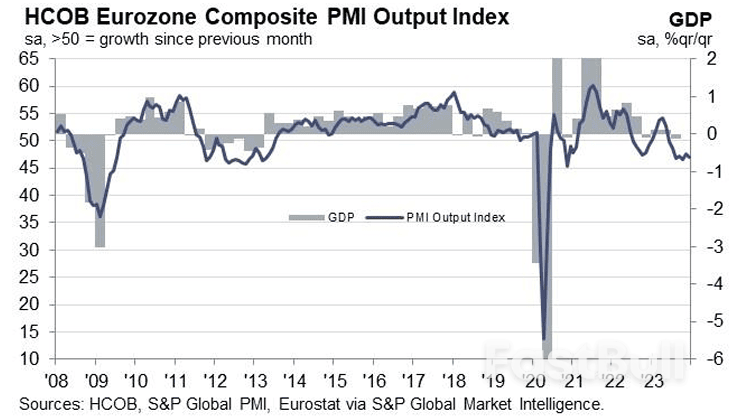
          These data contrast with the Eurozone's composite figure - released half an hour earlier - of 47, which was below consensus estimates and points to an ongoing contraction in the bloc.
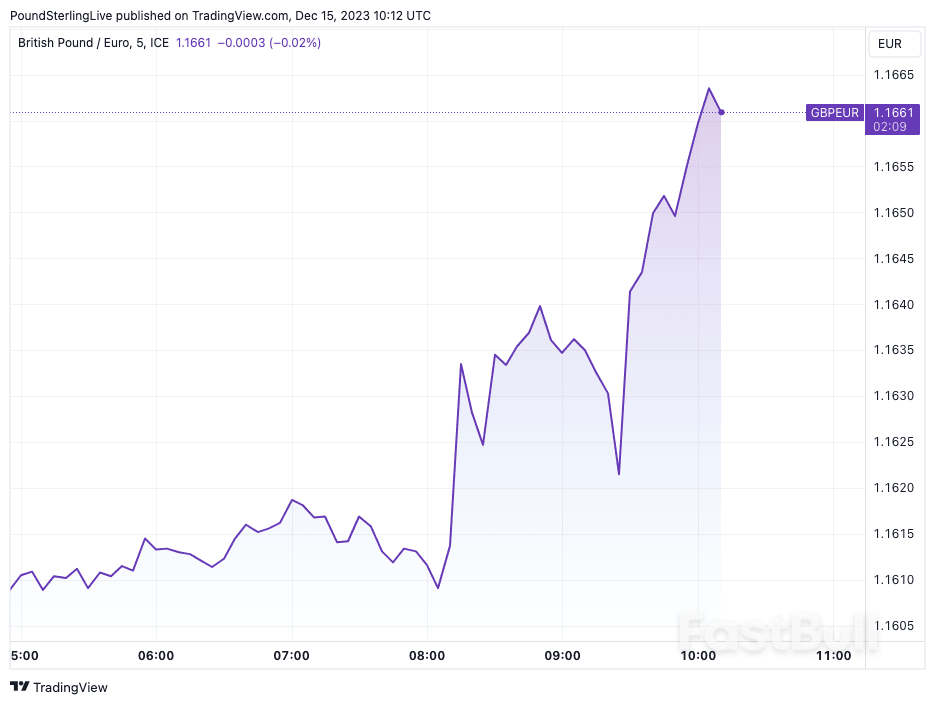
          The contrasting fortunes create a clear gulf between the UK and Eurozone economies that supports the Pound to Euro exchange rate, which has jumped a third of a per cent to 1.1650.
          "We see this as a more positive backdrop for sterling than the euro over coming months, a sentiment seemingly shared by markets this morning. GBPEUR is almost half a percent following this morning's prints, and now well on track for our year-end target of 1.17," says Nick Rees, FX Market Analyst at Monex Europe.
          "The Euro Area economy appears to be barrelling towards a technical recession in Q4," says Matthew Ryan, Head of Market Strategy at Ebury. "By contrast, the UK economy looks to be in a much healthier state... this should both quell investor concerns surrounding the possibility of a UK recession and vindicate the Bank of England’s ‘higher for longer’ stance on interest rates."
          The Pound to Dollar exchange rate is higher by 0.10% at 1.2777, taking its two-day gain to 1.70%.
          S&P Global says UK business activity was supported by a renewed improvement in order books, alongside efforts to work through post-pandemic backlogs.
          Meanwhile, the survey confirms that the Bank of England is right to be worried about persistent inflationary pressures in the services industry.
          S&P Global reports input cost inflation increased to its highest since August, driven by another sharp rise in operating expenses at service sector companies. This was widely linked to rising salary payments.
          Pound to Euro Rate On Course for 1.17 After UK PMI and Consumer Confidence Improvement_1
          "The increase in input costs shows inflation is proving stickier than hoped and indicates there is still some way to go before costs stabilise," says John Glen, Chief Economist at CIPS.
          The Bank of England kept interest rates unchanged on Thursday and warned rates could rise again owing to fears of ongoing inflation pressures linked to wages, particularly in services.
          The Pound rose in response to this message, and Friday's findings from the PMI survey give the Bank's stance added credibility.
          December data also indicated that UK private sector firms are optimistic overall about their own growth prospects for 2024.
          It's not just businesses that are increasingly optimistic about the next year; consumers are also more chipper.
          The recovery in consumer confidence extended into December, according to GfK's composite index of consumers' confidence, which rose to -22 in December from -24 in November. November had seen a marked improvement on October's reading, which suggests a trend is establishing.
          "The ongoing recovery in consumers’ confidence adds weight to our view that households’ spending will partially rebound in Q4, supported by an increase in real wages," says Gabriella Dickens, Senior UK Economist at Pantheon Macroeconomics.

          Source: poundsterlinglive.com

          To stay updated on all economic events of today, please check out our Economic calendar
          Risk Warnings and Disclaimers
          You understand and acknowledge that there is a high degree of risk involved in trading. Following any strategies or investment methods may lead to potential losses. The content on the site is provided by our contributors and analysts for information purposes only. You are solely responsible for determining whether any trading assets, securities, strategy, or any other product is suitable for investing based on your own investment objectives and financial situation.
          Comments
          Add to Favorites
          Share

          JPY Has the Greatest Scope to Outperform within G10 Next Year – MUFG

          Zi Cheng

          Forex

          Economic

          JPY to outperform notably as BoJ act

          "We expect the BoJ to end YCC and NIRP at the January meeting. This is partially priced but the tone of the BoJ is likely to fuel expectations of further policy tightening later in 2024."
          "We believe the JPY has the greatest scope to outperform within G10 next year. The global inflation shock is reversing and that has the greatest implications for JPY with even a partial reversal of the move in USD/JPY from 115.00 to 150.00 implying considerable scope to outperform."
          "After such a big move higher and given the attractive carry, short JPY positioning remains substantial but once expectations of a turn in the trend build further there is a risk of a more abrupt and even larger move stronger for the Yen than we currently forecast."

          Source: FXSTREET

          To stay updated on all economic events of today, please check out our Economic calendar
          Risk Warnings and Disclaimers
          You understand and acknowledge that there is a high degree of risk involved in trading. Following any strategies or investment methods may lead to potential losses. The content on the site is provided by our contributors and analysts for information purposes only. You are solely responsible for determining whether any trading assets, securities, strategy, or any other product is suitable for investing based on your own investment objectives and financial situation.
          Comments
          Add to Favorites
          Share

          Euro Pares Gains As Soft PMI Figures Undermine ECB's 'Higher for Longer'

          Warren Takunda

          Central Bank

          Enthusiasm for the Euro was curtailed by a disappointing survey of the Eurozone's economy that revealed activity fell in December and undermined the European Central Bank's message on interest rates.
          The Euro was softer against the Dollar and Pound after S&P Global's Eurozone manufacturing PMI read at 44.2 in December, which was unchanged on November but below the consensus expectation for 44.6.
          Services disappointed at 48.1, which was softer than November's 48.7 and below the expectation for 49. This takes the Eurozone's composite PMI measure to 47, down from 47.6 and below expectations for 48.
          The Euro had risen against the Dollar and other currencies on Thursday after the European Central Bank (ECB) released relatively upbeat projections for the economy, saying this justified interest rates remaining unchanged for the foreseeable future.
          These data, however, question this stance and will bolster market bets for a rate cut falling as early as March.
          "Any lack of material improvement in today’s Eurozone flash PMIs for December could somewhat curtail the relative optimism embedded in the ECB and EUR," says Valentin Marinov, Head of G10 FX Strategy at Crédit Agricole.
          The Euro to Dollar exchange rate has fallen back from the cusp of 1.10 to 1.0965 at the time of writing. The Euro to Pound rate is lower by 0.40% at 0.8580.
          "There’s a bit of a pullback today for the euro following a very poor batch of flash PMI readings out of the Eurozone," says Raffi Boyadjian, Lead Investment Analyst at XM.com. "The UK economy on the other hand seems to be faring notably better. Although the manufacturing PMI disappointed, the services sector appears to be bouncing back, pushing the composite PMI to a 6-month high of 51.7."
          Euro Pares Gains As Soft PMI Figures Undermine ECB's 'Higher for Longer'_1
          Business activity in the Eurozone fell at its fastest rate for 11 years, barring only the early 2020 pandemic months, said S&P Global.
          Jobs were cut for a second month running as firms scaled back operating capacity in line with the worsening order book situation
          Future sentiment remains well below its long-run average despite lifting slightly higher.Employment fell for a second consecutive month as companies scaled back capacity in line with the weakened demand environment, which will bolster market expectations for ECB rate cuts in 2024.
          The recent falls in employment were the first recorded since early 2021, suggesting the labour market is cooling in a manner consistent with slowing inflation rates.
          The data will cast doubts on the credibility of the ECB's recent guidance, which could undermine the Euro's ability to advance higher from current levels.
          SOURCE :Poundsterlinglive
          Risk Warnings and Disclaimers
          You understand and acknowledge that there is a high degree of risk involved in trading. Following any strategies or investment methods may lead to potential losses. The content on the site is provided by our contributors and analysts for information purposes only. You are solely responsible for determining whether any trading assets, securities, strategy, or any other product is suitable for investing based on your own investment objectives and financial situation.
          Comments
          Add to Favorites
          Share

          A Guide to Kagi Charts

          Glendon
          The world of financial analysis boasts a diverse arsenal of tools, each offering a unique perspective on market behavior. Among these stands the Kagi chart, a technical analysis tool with roots in 1870s Japan, designed to shed light on the interplay of supply and demand for various assets.

          Origins and Similarities: A Link to Point and Figure Charts

          Kagi charts, originating from Japan in the late 19th century, offer a unique way to chart price movements by focusing solely on price action and ignoring time, much like Point & Figure charts. Both techniques prioritize significant price swings over time-based data, providing a clearer view of underlying trends. However, unlike Point & Figure charts that utilize X-Columns (price rises) and O-Columns (price falls), Kagi charts employ a system of lines and thickness variations.

          Core Principles: Decoding the Lines

          Imagine a chart where vertical lines weave a narrative of price movements. This is the essence of a Kagi chart. These lines aren't static; they morph based on the price action of the underlying asset. Here's how:
          Direction Shifts: The chart changes direction only when the price undergoes a significant reversal, exceeding a predefined threshold known as the "reversal amount." This threshold ensures the chart focuses on substantial price movements.
          Line Speak Volumes: The thickness or color of the lines isn't random. Thick lines (often green) symbolize the price breaching a prior high, hinting at rising demand. Conversely, thin lines (often red) indicate a dip below the previous low, suggesting potential increased supply.
          Reversal Amount: The Customizable Factor The Kagi chart's sensitivity is determined by the reversal amount, which can be a fixed value or dynamic (based on a measure like Average True Range). This setting allows traders to tailor the chart to their specific needs.

          Beyond the Lines: Signals and Strategies

          While Kagi charts offer a distinct view, they aren't meant to operate in isolation. When combined with other forms of analysis, they can generate valuable trade signals:
          Pattern Power: Kagi charts excel at revealing chart patterns like swing highs and lows, which can foreshadow potential reversals. Formations like the "Three Buddha" bottom can offer valuable insights to seasoned traders.

          Standing Out from the Crowd: A Comparison

          Kagi vs. Renko: Both utilize reversal amounts, but Renko charts depict price movements as bricks with 45-degree angles. Unlike Renko, Kagi charts focus solely on the magnitude of price changes, independent of time. Kagi vs.
          Candlestick Charts: Candlestick charts, while popular, encompass more "noise" by reflecting price changes over time. Kagi charts, on the other hand, prioritize significant trends by filtering out minor fluctuations.

          Kagi Chart Mechanics

          Key Features of Kagi Charts:
          Reversal Amount: Essential to Kagi charts, the reversal amount is a set value that determines when the Kagi line changes direction. This can be a fixed number of points, a percentage, or based on the Average True Range (ATR), which adjusts with volatility. The reversal amount can focus on closing prices or the high-low range.
          Yin and Yang: Kagi charts depict yin (thin lines) and yang (thick lines), representing changes in price direction and market dynamics. A yang line indicates a break above a previous peak, while a yin line forms when the price drops below the prior trough.
          Implementing Kagi Charts:
          Setting the Reversal Amount: Users must define the minimum price change (reversal amount) for a Kagi line to reverse its direction. This setting impacts the sensitivity and the number of reversals on the chart.
          ATR vs. Fixed Amount: The reversal amount can be static (a fixed amount or percentage) or dynamic (based on ATR), affecting how the chart responds to new data and market volatility.
          Drawing Kagi Lines: These lines connect pivotal points on the price scale, emphasizing significant market moves. The lines change direction based on the reversal amount and vary in thickness to illustrate changes in market dynamics.

          Analyzing and Interpreting Kagi Charts

          Signals and Setups: Steve Nison's book "Beyond Candlesticks" details various Kagi chart signals and setups, such as new yin/yang lines, rising shoulders, falling waists, and multi-level breaks, which can indicate buying or selling opportunities.
          Support and Resistance: Kagi charts help identify key support and resistance levels through the analysis of shoulders (peaks) and waists (troughs), enabling traders to spot potential trend changes and breakout/breakdown points.
          Trend Lines and Levels: By analyzing the direction and thickness of Kagi lines and the break of trend lines and multi-level breaks, traders can gauge the strength of trends and make informed trading decisions.

          Pros and Cons

          Advantages

          Kagi charts offer several advantages, including Clarity in Trends: By filtering out minor fluctuations, Kagi charts provide a clear picture of underlying trends.
          Pattern Recognition: The distinct lines and formations on Kagi charts make identifying patterns that can signal potential trading opportunities easier.
          Long-Term Perspective: Kagi charts are well-suited for identifying long-term trends, making them valuable for long-term investment decisions.

          Disadvantages

          Lack of Time Dimension: The absence of a time component can make it challenging to pinpoint the exact timing of entries and exits.
          Omission of Price Gaps: Kagi charts don't reflect price gaps, which can be important for understanding market sentiment.
          Complexity in Interpretation: While Kagi charts offer a simplified view of price movements, interpreting them effectively requires practice and understanding of the underlying concepts.
          By understanding the strengths and weaknesses of Kagi charts, traders can leverage them as a valuable tool in their technical analysis toolbox. Used strategically and in combination with other indicators, Kagi charts can provide valuable insights into market trends and potential trading opportunities.

          Conclusion: A Complementary Tool in the Trader's Toolkit

          Like other Japanese charting techniques, Kagi charts aim to filter out market noise by focusing on significant price movements. They offer a distinct perspective on market trends, support and resistance levels, and potential trading signals by emphasizing price action over time. It's important to remember that Kagi charts are most effective when used in conjunction with other technical analysis tools. This allows traders to validate their market views and strategies, enabling a comprehensive approach to market analysis.
          Risk Warnings and Disclaimers
          You understand and acknowledge that there is a high degree of risk involved in trading. Following any strategies or investment methods may lead to potential losses. The content on the site is provided by our contributors and analysts for information purposes only. You are solely responsible for determining whether any trading assets, securities, strategy, or any other product is suitable for investing based on your own investment objectives and financial situation.
          Add to Favorites
          Share
          FastBull
          Copyright © 2025 FastBull Ltd

          728 RM B 7/F GEE LOK IND BLDG NO 34 HUNG TO RD KWUN TONG KLN HONG KONG

          TelegramInstagramTwitterfacebooklinkedin
          App Store Google Play Google Play
          Products
          Charts

          Chats

          Q&A with Experts
          Screeners
          Economic Calendar
          Data
          Tools
          Membership
          Features
          Function
          Markets
          Copy Trading
          Latest Signals
          Contests
          News
          Analysis
          24/7
          Columns
          Education
          Company
          Careers
          About Us
          Contact Us
          Advertising
          Help Center
          Feedback
          User Agreement
          Privacy Policy
          Business

          White Label

          Data API

          Web Plug-ins

          Poster Maker

          Affiliate Program

          Risk Disclosure

          The risk of loss in trading financial instruments such as stocks, FX, commodities, futures, bonds, ETFs and crypto can be substantial. You may sustain a total loss of the funds that you deposit with your broker. Therefore, you should carefully consider whether such trading is suitable for you in light of your circumstances and financial resources.

          No decision to invest should be made without thoroughly conducting due diligence by yourself or consulting with your financial advisors. Our web content might not suit you since we don't know your financial conditions and investment needs. Our financial information might have latency or contain inaccuracy, so you should be fully responsible for any of your trading and investment decisions. The company will not be responsible for your capital loss.

          Without getting permission from the website, you are not allowed to copy the website's graphics, texts, or trademarks. Intellectual property rights in the content or data incorporated into this website belong to its providers and exchange merchants.

          Not Logged In

          Log in to access more features

          FastBull Membership

          Not yet

          Purchase

          Become a signal provider
          Help Center
          Customer Service
          Dark Mode
          Price Up/Down Colors

          Log In

          Sign Up

          Position
          Layout
          Fullscreen
          Default to Chart
          The chart page opens by default when you visit fastbull.com