• Trade
  • Markets
  • Copy
  • Contests
  • News
  • 24/7
  • Calendar
  • Q&A
  • Chats
Trending
Screeners
SYMBOL
LAST
BID
ASK
HIGH
LOW
NET CHG.
%CHG.
SPREAD
SPX
S&P 500 Index
6827.42
6827.42
6827.42
6899.86
6801.80
-73.58
-1.07%
--
DJI
Dow Jones Industrial Average
48458.04
48458.04
48458.04
48886.86
48334.10
-245.98
-0.51%
--
IXIC
NASDAQ Composite Index
23195.16
23195.16
23195.16
23554.89
23094.51
-398.69
-1.69%
--
USDX
US Dollar Index
97.920
98.000
97.920
98.070
97.810
-0.030
-0.03%
--
EURUSD
Euro / US Dollar
1.17458
1.17466
1.17458
1.17596
1.17262
+0.00064
+ 0.05%
--
GBPUSD
Pound Sterling / US Dollar
1.33854
1.33861
1.33854
1.33961
1.33546
+0.00147
+ 0.11%
--
XAUUSD
Gold / US Dollar
4334.11
4334.54
4334.11
4350.16
4294.68
+34.72
+ 0.81%
--
WTI
Light Sweet Crude Oil
56.872
56.902
56.872
57.601
56.789
-0.361
-0.63%
--

Community Accounts

Signal Accounts
--
Profit Accounts
--
Loss Accounts
--
View More

Become a signal provider

Sell trading signals to earn additional income

View More

Guide to Copy Trading

Get started with ease and confidence

View More

Signal Accounts for Members

All Signal Accounts

Best Return
  • Best Return
  • Best P/L
  • Best MDD
Past 1W
  • Past 1W
  • Past 1M
  • Past 1Y

All Contests

  • All
  • Trump Updates
  • Recommend
  • Stocks
  • Cryptocurrencies
  • Central Banks
  • Featured News
Top News Only
Share

Fed Data - USA Effective Federal Funds Rate At 3.64 Percent On 12 December On $102 Billion In Trades Versus 3.64 Percent On $99 Billion On 11 December

Share

Brazil's Petrobras Says No Impact Seen On Oil, Petroleum Products Output As Workers Start Planned Strike

Share

Statement: US Travel Group Warns New Proposed Trump Administration Requirements For Foreign Tourists To Provide Social Media Histories Could Mean Millions Of People Opting Not To Visit

Share

Blackrock: Kerry White Will Become Head Of Citi Investment Management At Citi Wealth

Share

Blackrock: Rob Jasminski, Head Of Citi Investment Management, Has Joined With Team

Share

Blackrock: Effective Dec 15, Citi Investment Management Employees Will Join Blackrock

Share

Blackrock: Formally Launch Citi Portfolio Solutions Powered By Blackrock

Share

According To Data From The Federal Reserve Bank Of New York, The Secured Overnight Funding Rate (Sofr) Was 3.67% On The Previous Trading Day (December 15), Compared To 3.66% The Day Before

Share

Peru Energy And Mines Ministry: Copper Production Up 4.8% Year-On-Year In October To 248192 Metric Tons

Share

Security Source: Ukrainian Drones Hits Russian Oil Infrastructure In Caspian Sea For Third Time

Share

Spot Palladium Extends Gains, Last Up 5% To $1562.7/Oz

Share

Mexico's Economy Ministry Announces Start Of Anti-Dumping Investigation And Anti-Subsidy Investigations Into USA Pork Imports

Share

Canada Nov CPI Common +2.8%, CPI Median +2.8%, CPI Trim +2.8% On Year

Share

NY Fed's Empire State Prices Paid Index +37.6 In December Versus+49.0 In November

Share

Canada Nov Consumer Prices +0.1% On Month, +2.2% On Year

Share

Canada Nov CPI Core -0.1% On Month, +2.9% On Year

Share

Canada Nov Core CPI, Seasonally Adjusted +0.2% On Month, Oct +0.3% (Unrevised)

Share

UK Health Minister Streeting On Doctors' Strike: Vote To Go Ahead Reveals The Bma's Shocking Disregard For Patient Safety

Share

Venezuelan State Oil Company Pdvsa Says Was Subject To Cyber Attack But Operations Unaffected

Share

Russia Central Bank Says January-October Current Account Surplus At $37.1 Billion

TIME
ACT
FCST
PREV
Japan Tankan Small Manufacturing Outlook Index (Q4)

A:--

F: --

P: --

Japan Tankan Large Non-Manufacturing Outlook Index (Q4)

A:--

F: --

P: --

Japan Tankan Large Manufacturing Outlook Index (Q4)

A:--

F: --

P: --

Japan Tankan Small Manufacturing Diffusion Index (Q4)

A:--

F: --

P: --

Japan Tankan Large Manufacturing Diffusion Index (Q4)

A:--

F: --

P: --

Japan Tankan Large-Enterprise Capital Expenditure YoY (Q4)

A:--

F: --

P: --

U.K. Rightmove House Price Index YoY (Dec)

A:--

F: --

P: --

China, Mainland Industrial Output YoY (YTD) (Nov)

A:--

F: --

P: --

China, Mainland Urban Area Unemployment Rate (Nov)

A:--

F: --

P: --

Saudi Arabia CPI YoY (Nov)

A:--

F: --

P: --

Euro Zone Industrial Output YoY (Oct)

A:--

F: --

P: --

Euro Zone Industrial Output MoM (Oct)

A:--

F: --

P: --

Canada Existing Home Sales MoM (Nov)

A:--

F: --

P: --

Canada National Economic Confidence Index

A:--

F: --

P: --

Canada New Housing Starts (Nov)

A:--

F: --

P: --
U.S. NY Fed Manufacturing Employment Index (Dec)

A:--

F: --

P: --

U.S. NY Fed Manufacturing Index (Dec)

A:--

F: --

P: --

Canada Core CPI YoY (Nov)

A:--

F: --

P: --

Canada Manufacturing Unfilled Orders MoM (Oct)

A:--

F: --

P: --

U.S. NY Fed Manufacturing Prices Received Index (Dec)

A:--

F: --

P: --

U.S. NY Fed Manufacturing New Orders Index (Dec)

A:--

F: --

P: --

Canada Manufacturing New Orders MoM (Oct)

A:--

F: --

P: --

Canada Core CPI MoM (Nov)

A:--

F: --

P: --

Canada Trimmed CPI YoY (SA) (Nov)

A:--

F: --

P: --

Canada Manufacturing Inventory MoM (Oct)

A:--

F: --

P: --

Canada CPI YoY (Nov)

A:--

F: --

P: --

Canada CPI MoM (Nov)

A:--

F: --

P: --

Canada CPI YoY (SA) (Nov)

A:--

F: --

P: --

Canada Core CPI MoM (SA) (Nov)

A:--

F: --

P: --

Canada CPI MoM (SA) (Nov)

A:--

F: --

P: --

Federal Reserve Board Governor Milan delivered a speech
U.S. NAHB Housing Market Index (Dec)

--

F: --

P: --

Australia Composite PMI Prelim (Dec)

--

F: --

P: --

Australia Services PMI Prelim (Dec)

--

F: --

P: --

Australia Manufacturing PMI Prelim (Dec)

--

F: --

P: --

Japan Manufacturing PMI Prelim (SA) (Dec)

--

F: --

P: --

U.K. 3-Month ILO Employment Change (Oct)

--

F: --

P: --

U.K. Unemployment Claimant Count (Nov)

--

F: --

P: --

U.K. Unemployment Rate (Nov)

--

F: --

P: --

U.K. 3-Month ILO Unemployment Rate (Oct)

--

F: --

P: --

U.K. Average Weekly Earnings (3-Month Average, Including Bonuses) YoY (Oct)

--

F: --

P: --

U.K. Average Weekly Earnings (3-Month Average, Excluding Bonuses) YoY (Oct)

--

F: --

P: --

France Services PMI Prelim (Dec)

--

F: --

P: --

France Composite PMI Prelim (SA) (Dec)

--

F: --

P: --

France Manufacturing PMI Prelim (Dec)

--

F: --

P: --

Germany Services PMI Prelim (SA) (Dec)

--

F: --

P: --

Germany Manufacturing PMI Prelim (SA) (Dec)

--

F: --

P: --

Germany Composite PMI Prelim (SA) (Dec)

--

F: --

P: --

Euro Zone Composite PMI Prelim (SA) (Dec)

--

F: --

P: --

Euro Zone Services PMI Prelim (SA) (Dec)

--

F: --

P: --

Euro Zone Manufacturing PMI Prelim (SA) (Dec)

--

F: --

P: --

U.K. Services PMI Prelim (Dec)

--

F: --

P: --

U.K. Manufacturing PMI Prelim (Dec)

--

F: --

P: --

U.K. Composite PMI Prelim (Dec)

--

F: --

P: --

Euro Zone ZEW Economic Sentiment Index (Dec)

--

F: --

P: --

Germany ZEW Current Conditions Index (Dec)

--

F: --

P: --

Germany ZEW Economic Sentiment Index (Dec)

--

F: --

P: --

Euro Zone Trade Balance (Not SA) (Oct)

--

F: --

P: --

Euro Zone ZEW Current Conditions Index (Dec)

--

F: --

P: --

Euro Zone Trade Balance (SA) (Oct)

--

F: --

P: --

U.S. Retail Sales MoM (Excl. Automobile) (SA) (Oct)

--

F: --

P: --

Q&A with Experts
    • All
    • Chatrooms
    • Groups
    • Friends
    Connecting
    .
    .
    .
    Type here...
    Add Symbol or Code

      No matching data

      All
      Trump Updates
      Recommend
      Stocks
      Cryptocurrencies
      Central Banks
      Featured News
      • All
      • Russia-Ukraine Conflict
      • Middle East Flashpoint
      • All
      • Russia-Ukraine Conflict
      • Middle East Flashpoint
      Search
      Products

      Charts Free Forever

      Chats Q&A with Experts
      Screeners Economic Calendar Data Tools
      Membership Features
      Data Warehouse Market Trends Institutional Data Policy Rates Macro

      Market Trends

      Market Sentiment Order Book Forex Correlations

      Top Indicators

      Charts Free Forever
      Markets

      News

      News Analysis 24/7 Columns Education
      From Institutions From Analysts
      Topics Columnists

      Latest Views

      Latest Views

      Trending Topics

      Top Columnists

      Latest Update

      Signals

      Copy Rankings Latest Signals Become a signal provider AI Rating
      Contests
      Brokers

      Overview Brokers Assessment Rankings Regulators News Claims
      Broker listing Forex Brokers Comparison Tool Live Spread Comparison Scam
      Q&A Complaint Scam Alert Videos Tips to Detect Scam
      More

      Business
      Events
      Careers About Us Advertising Help Center

      White Label

      Data API

      Web Plug-ins

      Affiliate Program

      Awards Institution Evaluation IB Seminar Salon Event Exhibition
      Vietnam Thailand Singapore Dubai
      Fans Party Investment Sharing Session
      FastBull Summit BrokersView Expo
      Recent Searches
        Top Searches
          Markets
          News
          Analysis
          User
          24/7
          Economic Calendar
          Education
          Data
          • Names
          • Latest
          • Prev

          View All

          No data

          Scan to Download

          Faster Charts, Chat Faster!

          Download App
          English
          • English
          • Español
          • العربية
          • Bahasa Indonesia
          • Bahasa Melayu
          • Tiếng Việt
          • ภาษาไทย
          • Français
          • Italiano
          • Türkçe
          • Русский язык
          • 简中
          • 繁中
          Open Account
          Search
          Products
          Charts Free Forever
          Markets
          News
          Signals

          Copy Rankings Latest Signals Become a signal provider AI Rating
          Contests
          Brokers

          Overview Brokers Assessment Rankings Regulators News Claims
          Broker listing Forex Brokers Comparison Tool Live Spread Comparison Scam
          Q&A Complaint Scam Alert Videos Tips to Detect Scam
          More

          Business
          Events
          Careers About Us Advertising Help Center

          White Label

          Data API

          Web Plug-ins

          Affiliate Program

          Awards Institution Evaluation IB Seminar Salon Event Exhibition
          Vietnam Thailand Singapore Dubai
          Fans Party Investment Sharing Session
          FastBull Summit BrokersView Expo

          Analysts downplay AI bubble worries as Altman says some investors will be left ‘very burnt’

          Adam

          Economic

          Summary:

          Altman warns of AI bubble risks but sees lasting value; analysts argue strong earnings and structural digital growth make today’s boom more sustainable than past tech bubbles.

          The artificial intelligence boom that Sam Altman helped ignite with ChatGPT in late 2022 is starting to make even him uneasy.
          Startups with little more than a pitch deck are raising hundreds of millions. Valuations have become “insane.” Capital is chasing a “kernel of truth” with feverish speed.
          The OpenAI CEO still believes the long-term societal upside of AI will outweigh the froth, and he’s ready to keep spending in pursuit of that goal.
          “Are we in a phase where investors as a whole are overexcited about AI? My opinion is yes,” he said at a recent dinner with reporters. “Is AI the most important thing to happen in a very long time? My opinion is also yes.”
          He repeated the word ’bubble’ three times in 15 seconds, then half-joked, “I’m sure someone’s gonna write some sensational headline about that. I wish you wouldn’t, but that’s fine.”
          While Altman warned that valuations are now out of control, he’s ready to shell out on more infrastructure.
          “You should expect OpenAI to spend trillions of dollars on datacenter construction in the not very distant future,” Altman said. “And you should expect a bunch of economists wringing their hands, saying, ‘This is so crazy, it’s so reckless,’ and we’ll just be like, ‘You know what? Let us do our thing.’”
          OpenAI is already looking beyond Microsoft
          Azure’s cloud capacity, and is shopping around for more.
          The company signed a deal with Google Cloud this spring and, according to Altman, OpenAI is “beyond the compute demand” of what any one hyperscaler can offer.
          “You should expect us to take as much compute as we can,” he added. “Our bet is, our demand is going to keep growing, our training needs are going to keep going, and we will spend maybe more aggressively than any company who’s ever spent on anything ahead of progress, because we just have this very deep belief in what we’re seeing.”
          It’s not just OpenAI. All the megacaps are trying to keep up.
          In their most recent earnings, tech’s biggest names all raised capital expenditure guidance to keep pace with AI demand: Microsoft is now targeting $120 billion in full-year capital expenditures, Amazon
          is topping $100 billion, Alphabet raised its forecast to $85 billion, and Meta lifted the high end of its capex range to $72 billion.
          Wedbush’s Dan Ives said Monday on CNBC’s “Closing Bell” that demand for AI infrastructure has grown 30% to 40% in the last months, calling the capex surge a validation moment for the sector.
          Ives acknowledged “some froth” in parts of the market, but said the AI revolution with autonomous is only starting to play out and we are in the “second inning of a nine-inning game.”
          “The actual impact over the medium and long term is actually being underestimated,” he said.
          Citi’s Rob Rowe, speaking Monday on CNBC’s “Money Movers,” pushed back on comparisons between today’s AI boom and the dotcom bubble.
          “Back then, you had a lot of over-leveraged situations. You didn’t have a lot of companies that had earnings,” Rowe said. “Here you’re talking about companies that have very solid earnings, very strong cash flow, and they’re funding a lot of this growth through that cash flow. So in many respects, it’s a little different than that.”
          He added that the current wave of AI investment is being driven by structural shifts in the global economy, particularly the rapid growth of digital services, which now account for a large share of global exports. Also unlike the dotcom cycle of the late 90s, companies today are funding their infrastructure spending with strong cash flow rather than relying on debt.
          Still, concerns about overheating have been mounting.
          Alibaba co-founder Joe Tsai pointed to worrying signs in the AI sector well before the hyperscalers raised their annual capex guidance during the latest earnings prints.
          In March, he warned of a brewing AI bubble in the U.S.
          Speaking at HSBC’s Global Investment Summit in Hong Kong, Tsai said he was astounded by the scale of datacenter spending under discussion. Tsai questioned whether hundreds of billions in spending is necessary, and flagged concern about companies starting to build datacenters “on spec,” without clear demand.
          Altman, for his part, sees these cycles as part of the natural rhythm of technological progress.
          The dotcom crash wiped out scores of companies, but still gave rise to the modern internet. He expects AI to follow a similar path: a few high-profile wipeouts, followed by a lasting transformation.
          “I do think some investors are likely to get very burnt here, and that sucks. And I don’t want to minimize that,” he said. “But on the whole, it is my belief that... the value created by AI for society will be tremendous.”

          Source: cnbc

          To stay updated on all economic events of today, please check out our Economic calendar
          Risk Warnings and Disclaimers
          You understand and acknowledge that there is a high degree of risk involved in trading. Following any strategies or investment methods may lead to potential losses. The content on the site is provided by our contributors and analysts for information purposes only. You are solely responsible for determining whether any trading assets, securities, strategy, or any other product is suitable for investing based on your own investment objectives and financial situation.
          Add to Favorites
          Share

          Trump Widens Metal Tariffs to Target Baby Gear and Motorcycles

          Adam

          Economic

          President Donald Trump stunned the logistics industry on Friday by widening his steel and aluminum tariffs to include more than 400 consumer items that contain the metals, such as motorcycles and tableware. Customs brokers and importers in the US were given little notice to account for the change, which went into effect Monday and did not exclude goods in transit.
          The new tariff inclusion list was posted by the Customs and Border Protection agency just as many were leaving for the weekend and appeared in the Federal Register on Tuesday, creating fresh headaches for trade professionals. Official guidance has been muddled, especially for goods already on their way to the US, and it’s unclear whether the metals levies stack on top of country-by-country tariffs.
          Having weathered six months of Trump’s trade war and a pandemic that triggered mass supply disruptions, it’s hard to rattle the freight carriers, cargo owners and middlemen that keep cross-border commerce moving. But the scope and implementation speed of this latest notice took many by surprise.
          “We’ve had a lot of these 11th-hour implementations throughout 2025, this one in particular impacts every single client I have to an enormous degree,” Michigan-based customs broker Shannon Bryant said in an interview.
          “Earlier announcements at least had some in-transit exemptions so at least importers could make reasonable buying decisions,” said Bryant, president of trade compliance advisory service, Trade IQ. “This one was unique in that way — it’s very much a ‘gotcha.’”
          The new list includes auto parts, chemicals, plastics and furniture components — demonstrating the reach of Trump’s authority to use sectoral tariffs. That is separate from the executive power he invoked for his so-called reciprocal tariffs.
          “Basically, if it’s shiny, metallic, or remotely related to steel or aluminum, it’s probably on the list,” Brian Baldwin, a vice president of customs in the US at logistics giant Kuehne + Nagel International AG, wrote in a post on LinkedIn. “This isn’t just another tariff — it’s a strategic shift in how steel and aluminum derivatives are regulated.”
          Compliance Costs
          The difficulty with applying tariffs to derivative products lies in determining what percentage of an item is made from the targeted materials.
          Flexport, a digital freight forwarder, said in a blog post that “for many brands, this means chasing suppliers for detailed data: aluminum weight, percentage of customs value, and country of cast/smelt.”
          The compliance burden, Flexport said, “is significant.”
          This tranche of tariffs is also particularly expansive, including items such as motorcycles, cargo handling equipment, baby booster seats, tableware and personal care products that come in metal containers or packaging.
          Jason Miller, a professor of supply chain management at Michigan State University, conservatively estimates that the metals tariffs now cover about $328 billion worth of goods, based on 2024 import data. That’s six times greater than in 2018 and a big jump from the $191 billion worth of goods covered prior to the change, he said in an email to Bloomberg News.
          Broker’s Plea
          Bryant, whose clients include cosmetics and commercial cookware importers, sent a letter to her elected officials in Washington on Monday warning that the complexity of overlapping tariffs is becoming unworkable even for professionals. “For small importers,” she wrote, “it’s impossible.”
          “I’m trying to think of a client that’s not impacted,” Bryant said. “These are American companies that employ American people that are being ambushed by their own government.”
          Trump first imposed steel and aluminum tariffs in 2018 with the goal of boosting US output by making it more expensive for Americans to buy foreign material.
          But several major suppliers including Canada, Mexico and the European Union were ultimately exempted, and US industries have said they’re still struggling to compete with imports.
          Big Steel Applauds
          In June, Trump fulfilled a campaign promise by doubling the levy on steel and aluminum to 50% and also sought feedback from industry on how to broaden it further.
          Lourenco Goncalves, chief executive officer of US steelmaker Cleveland-Cliffs Inc., applauded the expanded tariff list in a statement on Monday, thanking the Trump administration for “taking decisive and concrete action that will deter tariff circumvention occurring in plain sight with stainless and electrical steel derivative products.”
          There’s very likely more to come. At the end of July, the Trump administration imposed a 50% duty on semi-finished copper imports valued at more than $15 billion and ordered officials to come up with a plan to slap tariffs on an array of other copper-intensive goods.
          “This isn’t over,” said Pete Mento, DSV’s global customs director, in a social media post on Monday. “The next list will surely be for copper and I expect that to be equally as miserable.”

          Source: Bloomberg

          To stay updated on all economic events of today, please check out our Economic calendar
          Risk Warnings and Disclaimers
          You understand and acknowledge that there is a high degree of risk involved in trading. Following any strategies or investment methods may lead to potential losses. The content on the site is provided by our contributors and analysts for information purposes only. You are solely responsible for determining whether any trading assets, securities, strategy, or any other product is suitable for investing based on your own investment objectives and financial situation.
          Add to Favorites
          Share

          Will Hong Kong’s interbank rates stay elevated after the recent spike?

          Adam

          Economic

          Unprecedented volatility in HIBOR

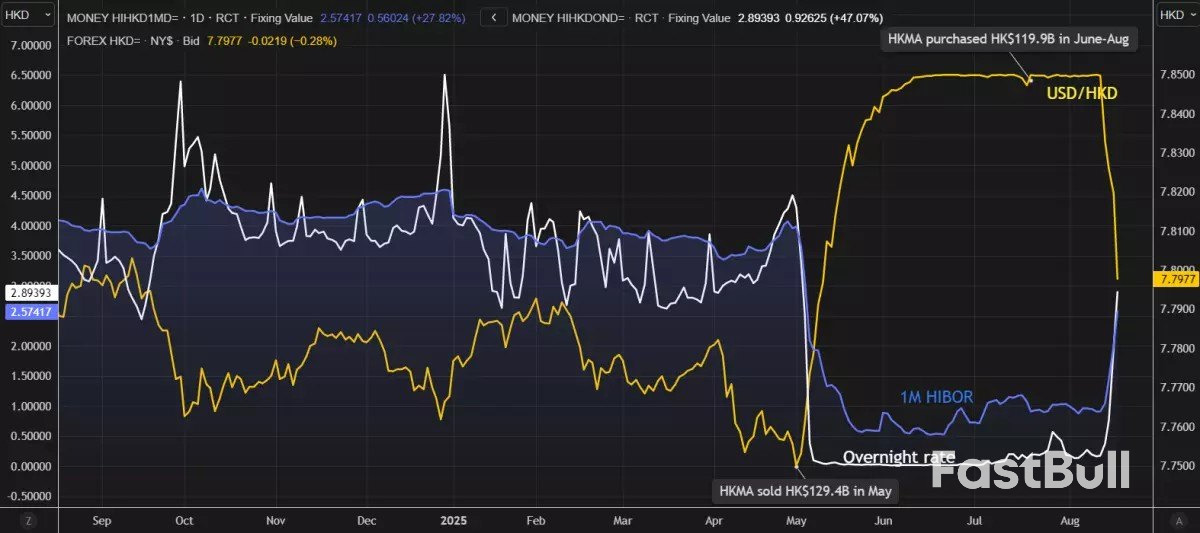
          Hong Kong's interbank offered rate (HIBOR) has experienced extraordinary volatility in 2025. The overnight rate plunged from 4.50% to nearly 0% in May, before rebounding sharply to 2.9% as of today. Similarly, the one-month HIBOR surged from approximately 0.9% to 2.6% within a week.
          This article explores the key drivers behind these dramatic movements, offers forward-looking insights, and discusses implications for market participants.
          Rates across all tenors rose for the first time since April 2024 on Tuesday as USD/HKD approaches the top of the currency peg range. This dramatic movement reflects the complex interplay between currency intervention and banking system liquidity.
          We will explore the key drivers behind these drastic moves, forward-looking views and implications for traders in this article.
          Figure 1: Hong Kong's interbank offered rates and USD/HKD exchange rate
          Will Hong Kong’s interbank rates stay elevated after the recent spike?_1

          Understanding the USD-HKD currency peg

          Hong Kong’s monetary policy is anchored by the Linked Exchange Rate System (LERS), established in October 1983. This framework maintains the Hong Kong dollar within a narrow band of HK$7.75-7.85 per US dollar.
          The system emerged after severe currency instability in summer 1983. Public confidence in the Hong Kong dollar had collapsed, creating intense selling pressure on the local currency.
          Under LERS, the Hong Kong Monetary Authority (HKMA) defends both ends of the band. It sells HKD when the currency strengthens beyond HK$7.75 per USD, and buys HKD when it weakens past HK$7.85 per USD. The monetary base remains fully backed by US dollar assets. This provides credibility and ensures Hong Kong can function as an international financial centre despite its small, open economy structure.

          Currency peg defence and HIBOR volatility

          In early May, the HKD approached the strong-side limit of HK$7.75 per USD, prompting the HKMA to sell HK$129 billion in exchange for USD to maintain the peg. This intervention led to a surge in banking system liquidity and a collapse in interbank rates, with overnight HIBOR falling from over 4% to near zero within weeks.
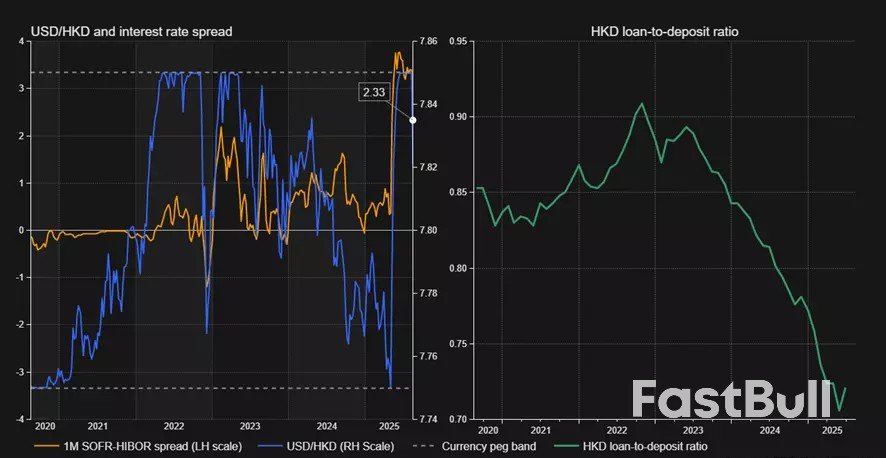
          The sharp decline in HIBOR created a significant interest rate differential with USD rates. The one-month SOFR-HIBOR spread widened to over 370 basis points, incentivising carry trades, i.e. borrowing low-cost HKD to invest in higher-yielding USD assets. This dynamic helped reverse the declining HKD loan-to-deposit ratio, which had been falling since May 2023.
          As HKD loans increased, the currency shifted towards the weak side of its trading band. Between June and August, the HKMA intervened 12 times to prevent the HKD from breaching the HK$7.85 threshold. These actions helped stabilise the currency around HK$7.80, but also led to a rapid withdrawal of HK$120 billion from the banking system. Consequently, Hong Kong’s aggregate balance fell from over HK$173 billion to HK$54 billion in just two months.
          Figure 2: Supply and demand dynamics of HKD
          Will Hong Kong’s interbank rates stay elevated after the recent spike?_2

          Market implications of elevated HIBOR

          In the short term, rising borrowing costs may dampen investment appetite and exert pressure on Hong Kong’s capital markets. Higher interest rates increase the cost of financing for both institutional and retail investors. For businesses, this means more expensive funding for projects. For stock traders, particularly those using margin accounts or leveraged strategies, elevated HIBOR translates into higher margin financing costs. This can reduce trading volumes, and ultimately weigh on market liquidity and sentiment.
          Sectoral impacts vary. The recovery in HIBOR offers some relief to local banks, which had faced projected low double-digit profit declines due to compressed net interest income (NII). Institutions with large HKD deposit bases, such as Bank of East Asia and Bank of China Hong Kong, stand to benefit if HIBOR remains at current levels.
          Conversely, real estate companies may underperform when HIBOR rises, as mortgage rates in Hong Kong typically follow interbank rate movements. Higher borrowing costs make property purchases less affordable, which can reduce demand. Between 23 May and 13 August, during a period of ultra-low HIBOR, the real estate sector within the Hang Seng Composite Index returned 15.7%. This outpaced the broader index, which gained 11.3%. However, this outperformance may not continue if HIBOR remains elevated.

          HIBOR outlook

          In our June publication, we anticipated that triggering the HKD’s weak-side convertibility undertaking would lead to a normalisation of interbank rates. Much of this adjustment has now occurred, and we believe further upside in HIBOR is limited.
          Two key factors support this view:
          Federal Reserve policy: The Fed’s projected two rate cuts this year are expected to cap USD funding costs, indirectly limiting HKD rate increases.
          Narrowing rate differential: The USD-HKD interest rate spread has narrowed significantly, suggesting that most of HIBOR’s recovery is already priced in. If the one-month differential reverts to its medium-term average of 0.9%, the upside potential for 1M HIBOR is limited to 80–90 basis points.
          However, we do not expect rates to return to the near-zero levels seen in June. One major reason is the sharp contraction in Hong Kong’s aggregate balance due to HKMA’s currency interventions. A lower aggregate balance tightens liquidity in the banking system, placing upward pressure on interbank rates. The Hong Kong Association of Banks has warned that HIBOR could rise sharply if the balance drops below HK$50 billion.
          Additionally, a robust pipeline of initial public offerings (IPO) is likely to support HKD demand. Christopher Hui, Secretary for Financial Services and the Treasury, recently disclosed that 210 companies are undergoing the listing process. High-profile candidates may include fashion retailer Shein, previously valued at $100 billion. This sustained IPO momentum should provide a natural floor for HKD strength and interest rates.

          Source: ig

          To stay updated on all economic events of today, please check out our Economic calendar
          Risk Warnings and Disclaimers
          You understand and acknowledge that there is a high degree of risk involved in trading. Following any strategies or investment methods may lead to potential losses. The content on the site is provided by our contributors and analysts for information purposes only. You are solely responsible for determining whether any trading assets, securities, strategy, or any other product is suitable for investing based on your own investment objectives and financial situation.
          Add to Favorites
          Share

          Iran’s Military Elite Emerges From War Bruised And Emboldened

          Winkelmann

          Economic

          Political

          On a quiet corner of Tehran’s mostly residential eastern suburbs, dozens of administrative staff busily file paperwork. Tea is brought in by an assistant, while young men on military service are ordered to fetch lunch.It’s a mundane picture of office life in a city of 10 million people. There’s little to suggest it’s part of an organization that’s had a profound influence on security in the Middle East for almost half a century and has often posed a direct challenge to the US and its allies.

          This is the human resources department of Iran’s Islamic Revolutionary Guard Corps., an organization known in the West for its elite forces defending Iran’s theocratic leadership, its proxy militias in the Middle East — and whose tentacles run so deep that efforts to destroy it are likely to make it stronger.Iran’s direct military confrontation with Israel over 12 days in June was the most damaging in the IRGC’s history, killing most of its top echelon and forcing a restructuring of Iran’s strategic decision making. And yet the bombing has left the group more critical to the survival of the Islamic Republic than ever before, according to observers.

          The Guard comprises a navy, ground troops, aerospace, an elite unit called the Quds Force and the Basij volunteer paramilitaries. It also has its own intelligence organization that’s known to directly compete with — and sometimes work against — the government’s Ministry of Intelligence.The IRGC also runs hospitals, universities, news agencies and TV stations. It has vast business holdings, including a huge engineering conglomerate involved in building oil pipelines and even Tehran’s metro system. Estimates of the number of direct IRGC personnel range up to almost 200,000.

          The announcement of a new National Defense Council this month underscored the Guard’s expanding role and influence on the state in the wake of the attacks by Israel and the US, which were designed to stop Iran producing nuclear weapons. The new body will be headed by President Masoud Pezeshkian and dominated by IRGC veterans and serving generals, according to the state-run Islamic Republic News Agency.“Israel’s attack reinforced the IRGC’s position in the Islamic Republic,” said Abdolrasool Divsallar, an expert on Iran’s military and security strategy and adjunct professor at the Universita Cattolica del Sacro Cuore in Milan. “The war affirmed just how important the IRGC is.”

          Few organizations in the world have drawn as much fascination and condemnation from the West as the IRGC. Its so-called Axis of Resistance abroad includes proxies in Syria, Hezbollah in Lebanon and Hamas in Gaza — all of which have now been critically depleted by Israeli forces.At home, it’s mostly feared by ordinary Iranians who associate it with the hardline ideology of Supreme Leader Ayatollah Ali Khamenei, crackdowns on dissent, corruption and a contempt for an increasingly secular middle class.

          The IRGC’s security forces, the Basij and its intelligence agencies have been condemned by rights groups, foreign governments and families of dead protesters, accused of torture and unlawful killing. Economically, the IRGC’s reach is so broad that it’s targeted successful businesses for takeover.But it’s seen by others as the great defender against the US and Israel, directly fighting America’s economic and military grip on the region and the only thing that stands in the way of an invasion.

          The “deep entrenchment” of the IRGC in Iran’s politics, economy and society mean it’s well positioned to “dominate the state’s emerging collective leadership and continue its gradual usurpation of state power,” said Ali Alfoneh, a senior fellow at the Arab Gulf States Institute.When a small band of Iranian revolutionaries decided to establish a “people’s army” in 1979 their ambitions were somewhat more modest. Their priority was to protect the nascent political system from a coup and prepare for what they thought was an inevitable military engagement with the US.

          At that time, Mohsen Sazegara, a founding member of what would become the IRGC, never imagined that what was essentially a guerilla army would evolve into what he now refers to as an unwieldy “seven-headed serpent.” The initial plan was to have 500 officers and around 50,000 volunteers, he said.“It wasn’t supposed to be a big organization,” Sazegara, who left the Guard shortly after it was established, said in an interview. “Now it’s a monster. It’s got a finger in every part of the country.”

          There are no official figures for the IRGC’s reach, but over the years academics and analysts have estimated that its business activities and assets represent anything between 20% to 40% of the Iranian economy.Sazegara reckons it has around 170,000 active personnel, including Basij paramilitaries often used to break up protests and police public behavior, as well as “a few million” people who are more informally employed by the organization and its wider business interests.

          The turning point was the war with Iraq in the 1980s. While the direct war with the US that Sazegara and his cohort feared didn’t transpire, Saddam Hussein instead started a full-scale military invasion from Iran’s southwestern border.That gave immediate purpose to the fledgling IRGC at a time when Supreme Leader Ayatollah Ruhollah Khomeini was concerned about the loyalty of Iran’s regular army and the risk of a foreign-backed coup.

          The conflict was used to galvanize support for the Islamic Republic and also its ability to suppress dissent. Military deaths were lionized and the conflict burnished the IRGC’s image as the defender of the revolution.In 1989, a year after the war ended, President Ayatollah Hashemi Rafsanjani sought to repair the economy with help from the IRGC and its experience building roads and bridges on the oil-rich wetlands of the Iran-Iraq border.

          “They became involved in contracting work, construction projects and trade and factories,” said Sazegara, who became an opponent of the Islamic regime and was imprisoned several times until he eventually went abroad for medical treatment following a hunger strike. “It went on from there and eventually they went into high-profit work.”After the war with Iraq, Iran needed everything — dams, roads, railways, ports and all sorts of infrastructure — and yet didn’t have the resources to get things done, so the IRGC stepped in. With the country battered again by foreign aggression, Iran is now in a similar situation, according to an Iranian official, who spoke on condition of anonymity.

          The most prominent example of the IRGC’s economic influence is the conglomerate Khatam al-Anbiya Construction Headquarters that was established in the aftermath of the war by then-commander Mohsen Rezaei. A key figure in Iran’s security apparatus for years, Rezaei is now on the new National Defense Council.

          Khatam has been involved in some of Iran’s biggest infrastructure projects including the Persian Gulf Star refinery, some 11,000 kilometers of pipelines, petrochemical companies, housing projects, shopping malls and telecoms.It’s taken over contracts from foreign companies when they’re forced out of Iran because of international sanctions and also profited from oil sales. It did particularly well during the presidency of hardliner Mahmoud Ahmadinejad, who oversaw a period of massive public spending at a time of high oil prices. When President Donald Trump abandoned the US’s nuclear deal with Iran in 2018, a fresh cycle of sanctions triggered another exodus and Khatam announced some $28 billion of new projects for the year ahead.

          The group also had some high-profile financial failures: It spent three years and more than $40 billion developing the giant South Pars gas field without producing any gas, according to the moderate government of Hassan Rouhani, which tried to curtail Khatam’s involvement in the energy sector.

          Iran became increasingly isolated after the collapse of the nuclear deal and the US assassination of the IRGC’s most powerful figure at the time, General Qassem Soleimani, in January 2020. That was, within days, followed by a self-inflicted calamity when the IRGC shot down a Ukrainian International Airlines passenger plane, killing 176 people, most of them Iranian nationals.The disaster sparked protests in Tehran and angry crowds were filmed ripping down and burning commemorative posters of Soleimani.

          Internally, these events served to marginalize Rouhani and the elected government. The Guard, for all the anger toward it among Iranians, exploited the situation and its hardline political allies gradually clawed back control of the state and its main institutions. Recent years have seen crackdowns on dissent and women’s rights increasing in both scope and violence.Now, the galvanizing impact of Israel’s attacks on nationalist sentiment in Iran may have already helped improve public support for the IRGC, according to Narges Bajoghli, associate professor of Middle East Studies at the School of Advanced International Studies, Johns Hopkins University.

          “People are angry at them, but they also realize that there is no other force in the country,” she said. “What they’re committed to today, is about sovereign independence and the idea of resistance to Western and Israeli imperialism.”The question is where it goes from here. For Sazegara, the IRGC’s biggest threat is itself. Management of its myriad divisions and departments is centralized around Khamenei, according to Sazegara, meaning that ultimately its fate is heavily tied to that of the 86-year-old supreme leader.

          What’s more, the Axis of Resistance allowed the IRGC to project power over the Middle East for almost two decades, and that pillar of its strategy no longer exists for the time being.That makes it more likely that the organization will look toward a nuclear deterrent, according to Alfoneh at the Arab Gulf States Institute. While Israel and the US hit Iran’s key nuclear facilities in June, its cache of enriched uranium hasn’t been seen since.

          Indeed, it would take a US ground invasion or a sustained bombardment by both the US and Israel to change the metrics for the IRGC, Alfoneh said. “The 12-day war exposed the IRGC’s counterintelligence failures,” he said. “However, the IRGC’s loss of prestige is unlikely to lead to its capitulation.”

          Source: Bloomberg Europe

          To stay updated on all economic events of today, please check out our Economic calendar
          Risk Warnings and Disclaimers
          You understand and acknowledge that there is a high degree of risk involved in trading. Following any strategies or investment methods may lead to potential losses. The content on the site is provided by our contributors and analysts for information purposes only. You are solely responsible for determining whether any trading assets, securities, strategy, or any other product is suitable for investing based on your own investment objectives and financial situation.
          Add to Favorites
          Share

          NZD/USD Technical Analysis – RBNZ and Fed Chair Powell on the agenda

          Adam

          Forex

          Fundamental Overview

          The USD came under some pressure at the start of last week following the US CPI report as the data came mostly in line with expectations. In the following days though, we got some hottish data with the US PPI beating expectations by a big margin, the US Jobless Claims improving further and the inflation expectations in the UMich survey surprising to the upside.
          Overall, we ended the week basically flat on the US dollar as the aggressive dovish expectations on the Fed got trimmed a bit. Nevertheless, given the overreaction from the Fed members to the last soft NFP, a September cut looks unavoidable now and only a hot NFP report in September might get us to a 50% probability (although it would certainly diminish expectations for rate cuts after the September one).
          The focus has now switched to Fed Chair Powell’s speech at the Jackson Hole Symposium on Friday. Traders will be eager to see if he changes his stance as well. Most likely though, he won’t pre-commit to anything and just reiterate that they will decide based on the totality of the data.
          On the NZD side, nothing has changed fundamentally, and we haven’t got any notable data other than the labour market report which came mostly in line with expectations and didn’t change much for the RBNZ pricing. The market still expects around 41 bps of easing by year-end with 94% probability of a cut tomorrow. Tomorrow’s cut would bring interest rates to the central bank’s estimated 3% neutral rate.

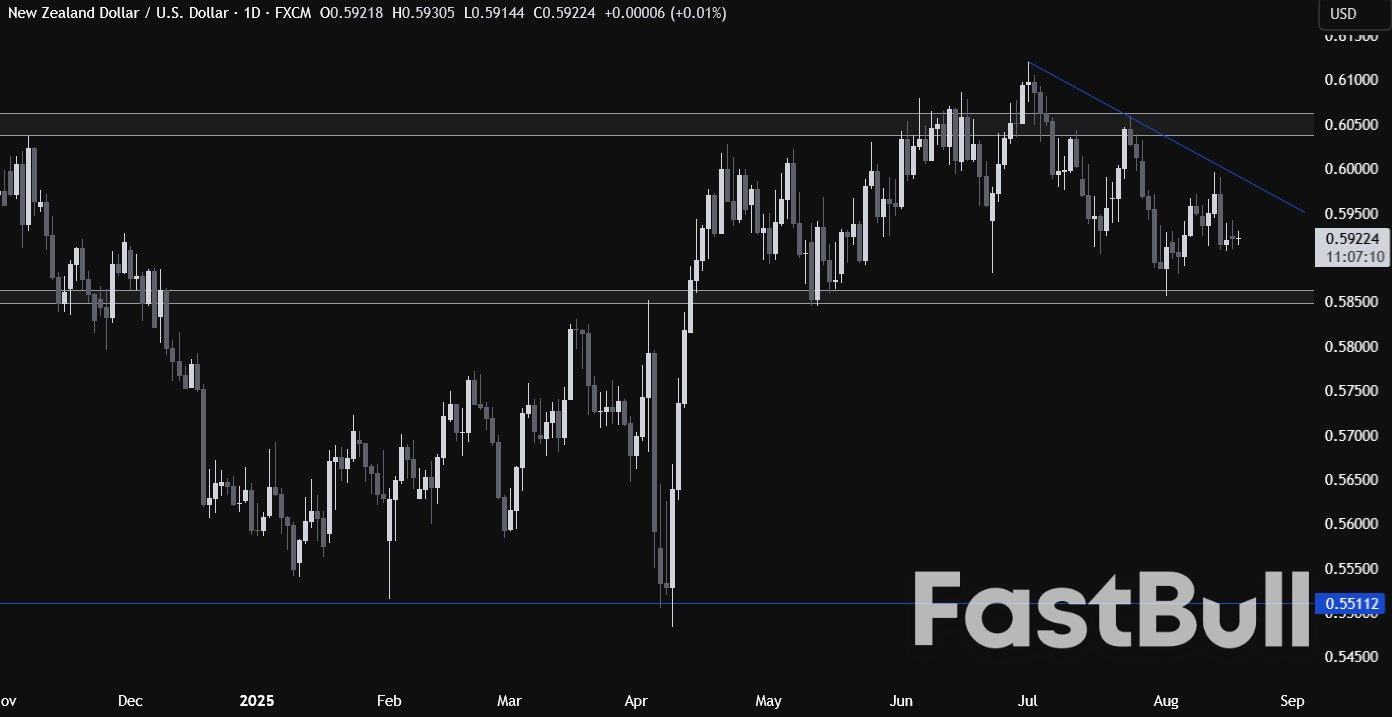
          NZDUSD Technical Analysis – Daily Timeframe

          NZD/USD Technical Analysis – RBNZ and Fed Chair Powell on the agenda_1NZDUSD Daily

          On the daily chart, we can see that the NZDUSD pair pulled back just before hitting the major trendline around the 0.60 handle. If we get another rally, we can expect the sellers to step in around the trendline with a defined risk above it to position for a drop into the key 0.5850 support zone. The buyers, on the other hand, will look for a break above the trendline to increase the bullish bets into the 0.6050 resistance next.

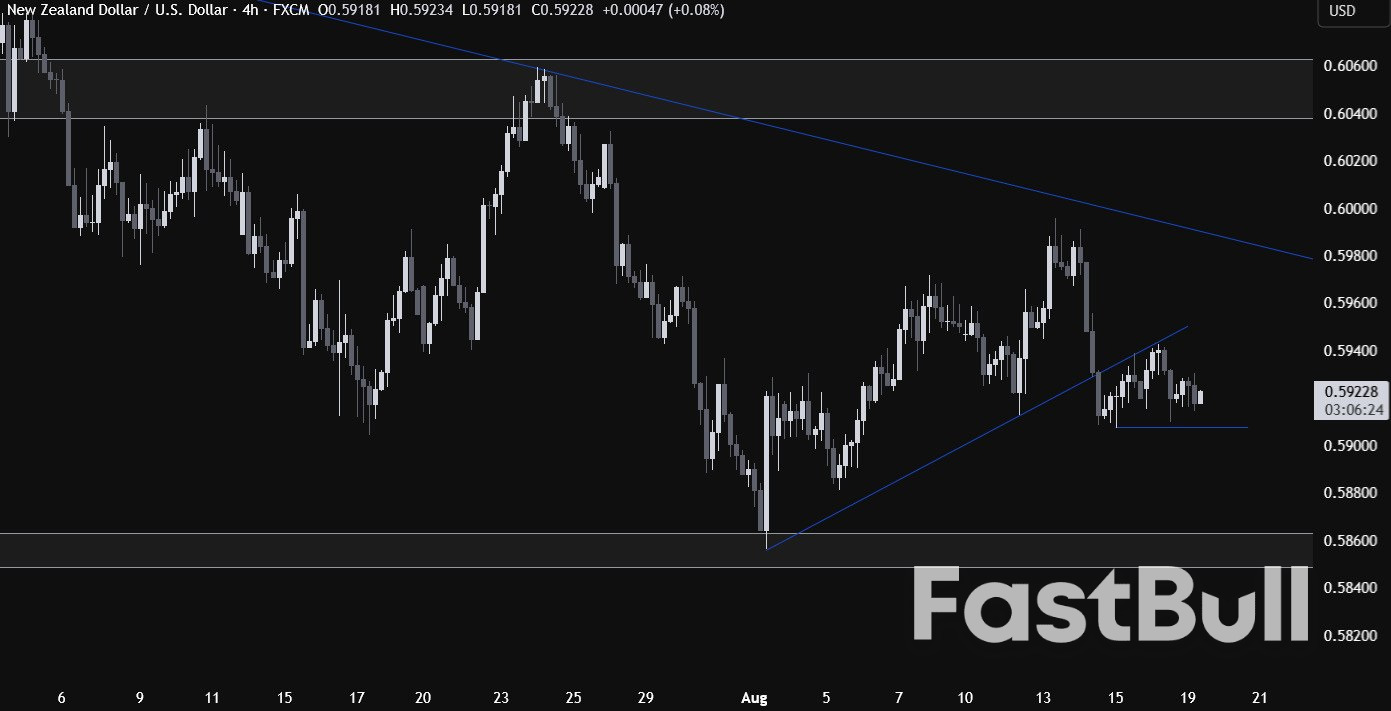
          NZDUSD Technical Analysis – 4 hour Timeframe

          NZD/USD Technical Analysis – RBNZ and Fed Chair Powell on the agenda_2NZDUSD 4 hour

          On the 4 hour chart, we can see that the price recently broke below the upward trendline that was defining the bullish momentum. This might be a signal for a deeper pullback into the 0.5850 support zone. If the price break below the recent low at 0.5906, we can expect the sellers to pile in to extend the drop into the support zone. The buyers, on the other hand, will have a much better risk to reward setup around the support zone to position for a rally into the 0.6050 resistance.

          NZDUSD Technical Analysis – 1 hour Timeframe

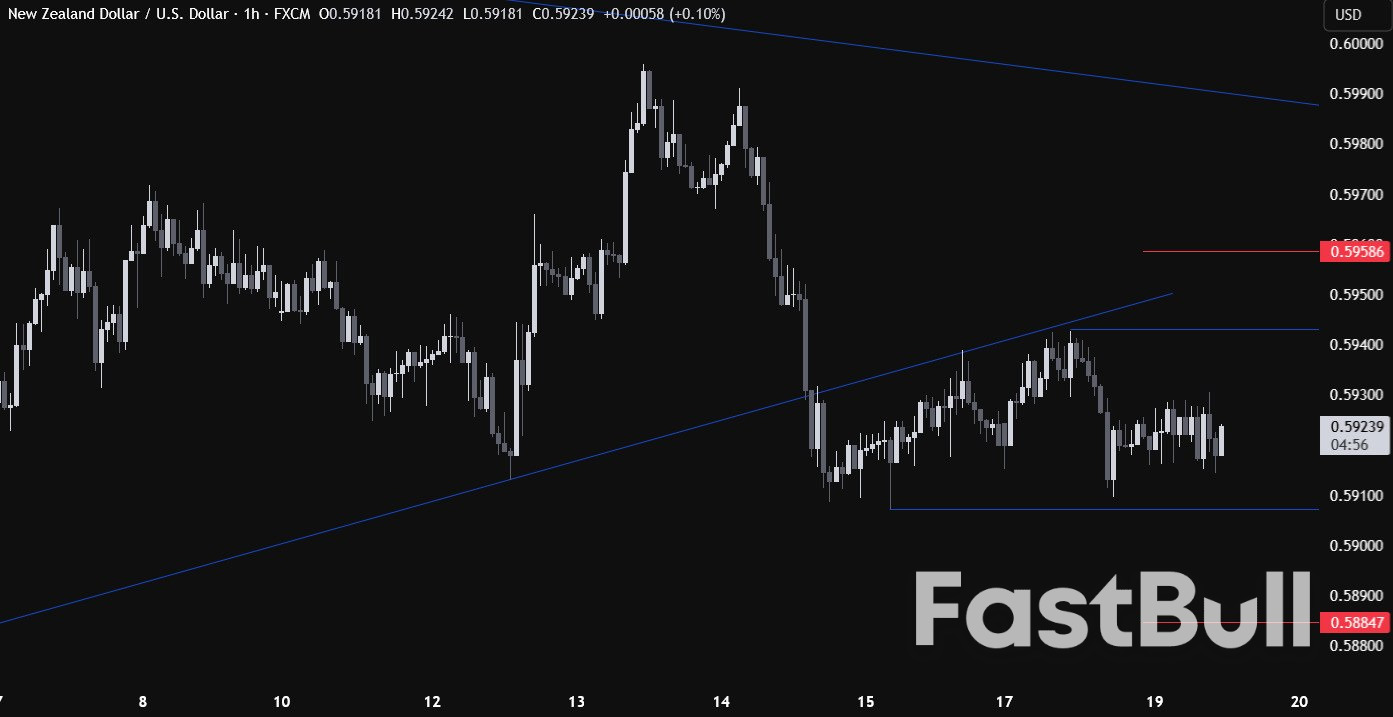
          NZD/USD Technical Analysis – RBNZ and Fed Chair Powell on the agenda_3NZDUSD 1 hour

          On the 1 hour chart, we can see that we could be forming a tight range between the 0.5944 and the 0.5906 level. Given that we have the RBNZ tomorrow, these levels might not mean much. If we get a hawkish decision, we can expect the buyers to pile in on a break above the 0.5944 level to target the major trendline. Conversely, a dovish decision should trigger a downside breakout and a move into the 0.5850 support. The red line define the average daily range for today.

          Upcoming Catalysts

          Tomorrowwe have the RBNZ rate decision, Fed’s Waller speaking and the FOMC meeting minutes. On Thursday, we get the US Flash PMIs as well as the US Jobless Claims figures. Finally, on Friday, we conclude the week with Fed Chair Powell speech at the Jackson Hole Symposium.

          Source: investinglive

          Risk Warnings and Disclaimers
          You understand and acknowledge that there is a high degree of risk involved in trading. Following any strategies or investment methods may lead to potential losses. The content on the site is provided by our contributors and analysts for information purposes only. You are solely responsible for determining whether any trading assets, securities, strategy, or any other product is suitable for investing based on your own investment objectives and financial situation.
          Add to Favorites
          Share

          EUR/USD Faces Tug-of-War Between Peace Hopes and Stubborn Inflation

          Adam

          Forex

          Markets were fed peace talk headlines out of Washington, but the tape traded like it had already discounted the choreography. Diplomatic theatre can move sentiment, but currencies and commodities don’t run on applause — they run on probabilities. And what traders see is that the core territorial horse-trading between Ukraine and Russia hasn’t even left the paddock. Until that stall door swings open, “roadmaps” and “security guarantees” are the diplomatic equivalent of option premium — all time value, little intrinsic.
          The euro wilted overnight, not dramatically, but enough to remind us that hope is not a strategy. Markets had priced a glimmer of peace; instead, they got the same ambiguous mixture of optimism and obstacles.
          The street is still leaning into Fed cuts — September odds sitting at -21bp, with two fully baked in by year-end — a setup that typically gives cover to buy EUR/USD dips. But July’s PPI was the kind of print that makes even the most dovish dealer flinch. Inflation risk hasn’t been extinguished, just smothered under softer labour signals. Heading into Jackson Hole, the posture feels textbook pre-event: plenty of anticipation, little conviction. That’s why you can sense traders quietly trimming EUR/USD length, lightening the load before Powell takes the stage.
          The euro could still squeeze higher this week — 1.1700 is very much in play — but for a moonshot, you’d need Powell to underwrite the move. Without him flipping the dovish switch, all you’ve got is positioning churn and tactical dip-buying. A push beyond 1.1800 demands more: softer U.S. data, Powell opening the rate-cut floodgates, and meaningful progress at the negotiating table. That cocktail hasn’t been mixed yet.
          The Washington summit added structure but not resolution. Trump talked up trilateral meetings, Zelenskyy agreed to face Putin, and NATO hinted at deeper security guarantees. That’s progress — but it’s the kind of progress that fills newswires, not order books.
          Territorial concessions remain the elephant in the room, and traders know those negotiations will be the hardest. Until we see even a hint of compromise there, peace optimism is more headlines than substance. The market knows how this story trades: every announcement sparks a glance at the screen, but unless maps are redrawn, the effect fades before the next candle closes.
          Short-end pricing screams conviction: cuts are coming. But the long end of the Treasury curve refuses to buy the fairy tale. 30-year yields drift higher, flashing warnings about supply, sticky inflation, and fiscal credibility. The market is effectively telling you: the Fed can provide insurance cuts up front, but it can’t wish away structural deficits or fiscal overhangs.
          For FX, that divergence matters. The short end weakens the dollar in the near-term, but the back end provides just enough resistance to keep the greenback from rolling over. The euro, by contrast, has to climb a wall of its own: a softening trade balance and a still-sluggish export engine. For now, it’s a race to see who blinks first — Powell with cuts, or Europe with more profound trade-driven weakness forcing the ECB’s hands.
          Equities have barely flinched. Traders have seen this movie before: peace chatter makes for great headlines, but forward earnings, tariffs, and rate cuts remain the bigger swing factors. The S&P 500 wavered after record highs, not because of geopolitics, but because no one wants to be caught offside if Powell makes a hawkish surprise. Like FX players, fast money stock traders are long anticipation, short conviction — waiting for Friday’s speech like gamblers eyeing a roulette wheel. Still, these are minor adjustments in the broader scheme of things.
          Bonds have been calm, too, though the elephant in the room remains supply indigestion. With issuance heavy and investors already loaded, spreads feel tight for a reason. The peace narrative may matter in theory, but for bond desks, funding dynamics and Fed policy matter far more.
          Crude showed more sensitivity. Brent slid toward $65, WTI near $63, the dip reflecting a market gaming out a ceasefire scenario where Russian barrels come back online just as OPEC+ ramps up production. Oversupply risk is back on the radar.
          But the geopolitical premium hasn’t vanished. Ukraine’s latest pipeline strike reminded traders that infrastructure remains a target. Sanctions are another wild card — Trump slapped India while letting China skate, proving that energy diplomacy is as selective as it is strategic. For oil bears , every handshake comes with a shadow of sabotage.
          Gold is trading steady near $3,340-40/oz, flat but tense. The metal has already had its glory run — up 27% YTD, ETFs stuffed, central banks still buying. But positioning feels more like a coiled spring than exhaustion. If Powell blinks dovish at Jackson Hole, gold won’t hesitate to make another run. Until then, it’s the classic trader’s hedge: a quiet insurance policy against both Fed error and geopolitical backsliding.
          The Washington summit was a step forward, but markets are disciplined beasts — they don’t run on political hope, they run on odds and outcomes. The hard negotiations are still ahead, and without them, traders default back to the one driver that actually moves the tape: the Fed.
          The setup into Jackson Hole is textbook: short-end screaming for cuts, long-end resisting, dollar still king but wobbling at the edges. EUR/USD is the hinge in this story — offered on peace noise, but still with scope to squeeze higher if Powell delivers. Oil is the barometer for peace optimism, gold the insurance policy, equities the tightrope walker waiting for the croupier to roll the dice.
          The curtain rises in Wyoming later this week. The peace roadmap may set the backdrop, but the Fed’s script will decide the play.

          Source: investing

          Risk Warnings and Disclaimers
          You understand and acknowledge that there is a high degree of risk involved in trading. Following any strategies or investment methods may lead to potential losses. The content on the site is provided by our contributors and analysts for information purposes only. You are solely responsible for determining whether any trading assets, securities, strategy, or any other product is suitable for investing based on your own investment objectives and financial situation.
          Add to Favorites
          Share

          Bitcoin Faces Rocky Path As Economic Pressures Mount

          Olivia Brooks

          Cryptocurrency

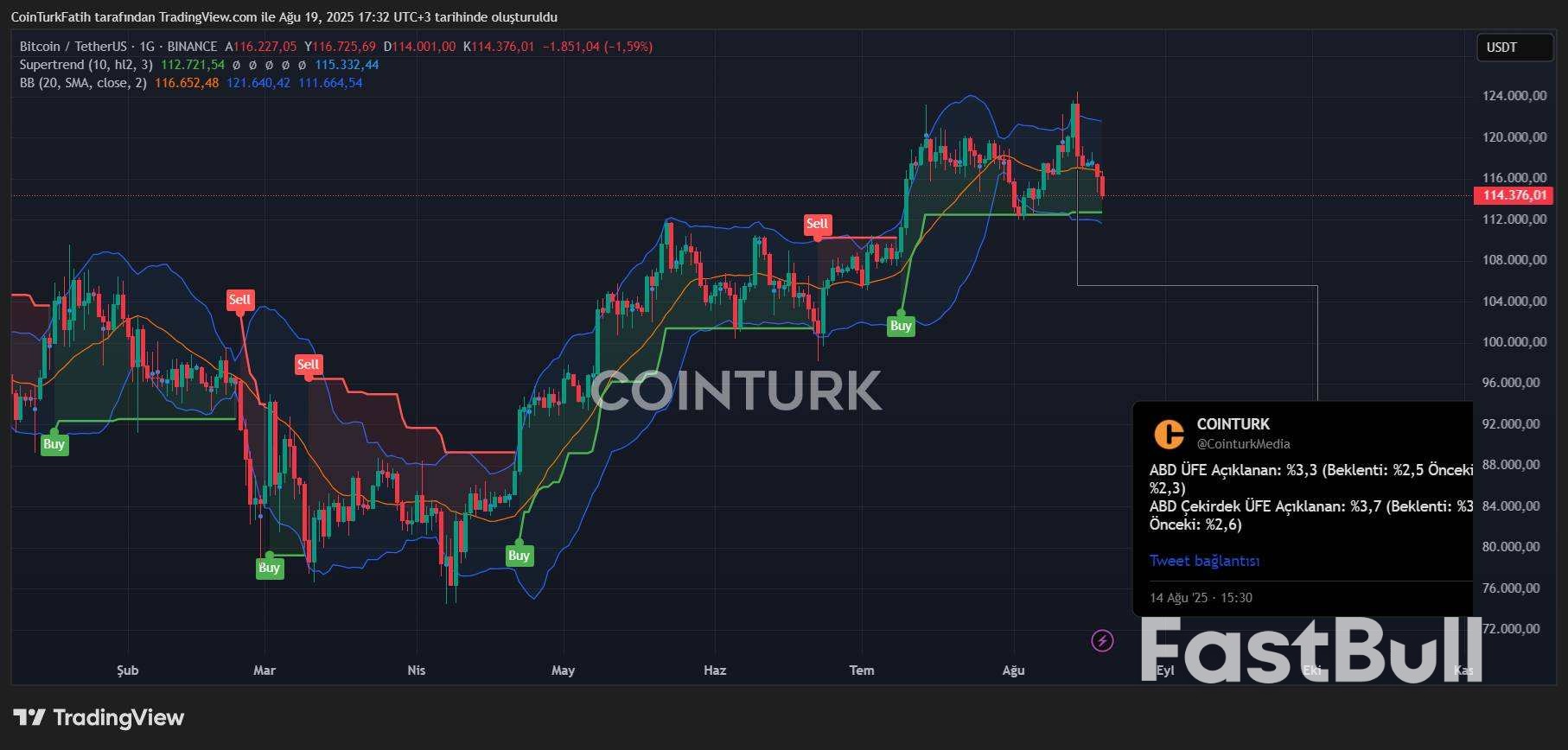
          As Bitcoin plunges to a daily low of $114,000, a loss of $3,000 within 24 hours has left investors deeply worried. Continuous tests around the $112,000 mark heighten these concerns. Our weekly report underscored expectations of a horizontal and downward trend in Bitcoin’s value, explaining the underlying reasons. This aligns perfectly with recent market movements, clarifying why cryptocurrencies are experiencing a downturn.

          Why are Cryptocurrencies Declining?

          Recent U.S. producer inflation figures released five days ago surpassed expectations, showing a rise of 3.3% against the anticipated 2.5%. Combined with a cooling labor market, these numbers paint a bleak picture. The Federal Reserve is in a bind: while a rate cut might support employment, it risks accelerating inflation. Recent PPI data reflects concerns over tariffs driving inflation upwards. The troubling aspect is the new effective tariff rates enforced in August, increasing for almost all countries.

          The base tariff, previously at 10%, has surged to a minimum of 15% for many countries. Consequently, the impact of tariffs is expected to be more pronounced this month, likely leading to September’s figures also exceeding estimates. As the Federal Reserve anticipates August data, crypto investors are already feeling the heat, fearing the consequences.

          Moreover, this week brings crucial developments that could further unsettle the crypto space. The Jackson Hole meeting is happening, followed by the release of Fed minutes tomorrow evening and a speech by Powell on Friday. These consecutive events are set to significantly impact cryptocurrencies, further dampening risk appetite.

          Investors’ anxiety is compounded by these successive challenges, casting uncertainties over market stability. The anticipation of pivotal economic data and Federal Reserve decisions looms large, contributing to the prevailing negative sentiment among crypto enthusiasts.

          Furthermore, the potential for heightened tariffs in the coming months adds an additional layer of complexity to the volatile crypto market. Stakeholders find themselves navigating through increasingly unstable financial tides.

          As the global economic landscape responds to these shifts, the repercussions on the cryptocurrency domain could be profound. Close monitoring of these economic indicators is essential for stakeholders aiming to refine their investment strategies amidst heightened market volatility.

          In the face of these challenges, the cryptocurrency market remains on edge, poised for potential fluctuations influenced by broader economic pressures and policy-related developments. The path ahead is fraught with challenges, urging careful attention and strategic navigation.

          Source: CryptoSlate

          Risk Warnings and Disclaimers
          You understand and acknowledge that there is a high degree of risk involved in trading. Following any strategies or investment methods may lead to potential losses. The content on the site is provided by our contributors and analysts for information purposes only. You are solely responsible for determining whether any trading assets, securities, strategy, or any other product is suitable for investing based on your own investment objectives and financial situation.
          Add to Favorites
          Share
          FastBull
          Copyright © 2025 FastBull Ltd

          728 RM B 7/F GEE LOK IND BLDG NO 34 HUNG TO RD KWUN TONG KLN HONG KONG

          TelegramInstagramTwitterfacebooklinkedin
          App Store Google Play Google Play
          Products
          Charts

          Chats

          Q&A with Experts
          Screeners
          Economic Calendar
          Data
          Tools
          Membership
          Features
          Function
          Markets
          Copy Trading
          Latest Signals
          Contests
          News
          Analysis
          24/7
          Columns
          Education
          Company
          Careers
          About Us
          Contact Us
          Advertising
          Help Center
          Feedback
          User Agreement
          Privacy Policy
          Business

          White Label

          Data API

          Web Plug-ins

          Poster Maker

          Affiliate Program

          Risk Disclosure

          The risk of loss in trading financial instruments such as stocks, FX, commodities, futures, bonds, ETFs and crypto can be substantial. You may sustain a total loss of the funds that you deposit with your broker. Therefore, you should carefully consider whether such trading is suitable for you in light of your circumstances and financial resources.

          No decision to invest should be made without thoroughly conducting due diligence by yourself or consulting with your financial advisors. Our web content might not suit you since we don't know your financial conditions and investment needs. Our financial information might have latency or contain inaccuracy, so you should be fully responsible for any of your trading and investment decisions. The company will not be responsible for your capital loss.

          Without getting permission from the website, you are not allowed to copy the website's graphics, texts, or trademarks. Intellectual property rights in the content or data incorporated into this website belong to its providers and exchange merchants.

          Not Logged In

          Log in to access more features

          FastBull Membership

          Not yet

          Purchase

          Become a signal provider
          Help Center
          Customer Service
          Dark Mode
          Price Up/Down Colors

          Log In

          Sign Up

          Position
          Layout
          Fullscreen
          Default to Chart
          The chart page opens by default when you visit fastbull.com