Markets
News
Analysis
User
24/7
Economic Calendar
Education
Data
- Names
- Latest
- Prev


Signal Accounts for Members
All Signal Accounts
All Contests


Euro Zone Employment YoY (SA) (Q3)A:--
F: --
P: --
Euro Zone GDP Final YoY (Q3)A:--
F: --
P: --
Euro Zone GDP Final QoQ (Q3)A:--
F: --
P: --
Euro Zone Employment Final QoQ (SA) (Q3)A:--
F: --
P: --
Euro Zone Employment Final (SA) (Q3)A:--
F: --
Brazil PPI MoM (Oct)A:--
F: --
P: --
Mexico Consumer Confidence Index (Nov)A:--
F: --
P: --
Canada Unemployment Rate (SA) (Nov)A:--
F: --
P: --
Canada Labor Force Participation Rate (SA) (Nov)A:--
F: --
P: --
Canada Employment (SA) (Nov)A:--
F: --
P: --
Canada Part-Time Employment (SA) (Nov)A:--
F: --
P: --
Canada Full-time Employment (SA) (Nov)A:--
F: --
P: --
U.S. Personal Income MoM (Sept)A:--
F: --
P: --
U.S. PCE Price Index YoY (SA) (Sept)A:--
F: --
P: --
U.S. PCE Price Index MoM (Sept)A:--
F: --
P: --
U.S. Personal Outlays MoM (SA) (Sept)A:--
F: --
P: --
U.S. Core PCE Price Index MoM (Sept)A:--
F: --
P: --
U.S. Core PCE Price Index YoY (Sept)A:--
F: --
P: --
U.S. UMich 5-Year-Ahead Inflation Expectations Prelim YoY (Dec)A:--
F: --
P: --
U.S. Real Personal Consumption Expenditures MoM (Sept)A:--
F: --
P: --
U.S. 5-10 Year-Ahead Inflation Expectations (Dec)A:--
F: --
P: --
U.S. UMich Current Economic Conditions Index Prelim (Dec)A:--
F: --
P: --
U.S. UMich Consumer Sentiment Index Prelim (Dec)A:--
F: --
P: --
U.S. UMich 1-Year-Ahead Inflation Expectations Prelim (Dec)A:--
F: --
P: --
U.S. UMich Consumer Expectations Index Prelim (Dec)A:--
F: --
P: --
U.S. Weekly Total Rig CountA:--
F: --
P: --
U.S. Weekly Total Oil Rig CountA:--
F: --
P: --
U.S. Unit Labor Cost Prelim (SA) (Q3)--
F: --
P: --
U.S. Consumer Credit (SA) (Oct)A:--
F: --
P: --
China, Mainland Foreign Exchange Reserves (Nov)A:--
F: --
P: --
China, Mainland Exports YoY (USD) (Nov)--
F: --
P: --
China, Mainland Imports YoY (CNH) (Nov)--
F: --
P: --
China, Mainland Imports YoY (USD) (Nov)--
F: --
P: --
China, Mainland Imports (CNH) (Nov)--
F: --
P: --
China, Mainland Trade Balance (CNH) (Nov)--
F: --
P: --
China, Mainland Exports (Nov)--
F: --
P: --
Japan Wages MoM (Oct)--
F: --
P: --
Japan Trade Balance (Oct)--
F: --
P: --
Japan Nominal GDP Revised QoQ (Q3)--
F: --
P: --
Japan Trade Balance (Customs Data) (SA) (Oct)--
F: --
P: --
Japan GDP Annualized QoQ Revised (Q3)--
F: --
China, Mainland Exports YoY (CNH) (Nov)--
F: --
P: --
China, Mainland Trade Balance (USD) (Nov)--
F: --
P: --
Germany Industrial Output MoM (SA) (Oct)--
F: --
P: --
Euro Zone Sentix Investor Confidence Index (Dec)--
F: --
P: --
Canada Leading Index MoM (Nov)--
F: --
P: --
Canada National Economic Confidence Index--
F: --
P: --
U.S. Dallas Fed PCE Price Index YoY (Sept)--
F: --
P: --
U.S. 3-Year Note Auction Yield--
F: --
P: --
U.K. BRC Overall Retail Sales YoY (Nov)--
F: --
P: --
U.K. BRC Like-For-Like Retail Sales YoY (Nov)--
F: --
P: --
Australia Overnight (Borrowing) Key Rate--
F: --
P: --
RBA Rate Statement
RBA Press Conference
Germany Exports MoM (SA) (Oct)--
F: --
P: --
U.S. NFIB Small Business Optimism Index (SA) (Nov)--
F: --
P: --
Mexico Core CPI YoY (Nov)--
F: --
P: --
Mexico 12-Month Inflation (CPI) (Nov)--
F: --
P: --
Mexico PPI YoY (Nov)--
F: --
P: --
Mexico CPI YoY (Nov)--
F: --
P: --
U.S. Weekly Redbook Index YoY--
F: --
P: --


No matching data
Latest Views
Latest Views
Trending Topics
Top Columnists
Latest Update
White Label
Data API
Web Plug-ins
Affiliate Program
View All

No data
Feeling boxed into a corner by the United States' intensifying tariff assault on China and any country that buys or assembles Chinese goods, is bracing for an economic war of attrition.
Washington last week imposed import tariffs of at least 10% on almost the entire world, and much higher levies on countries such as Vietnam, where Chinese factories have been shifting production. This drew retaliation from China, followed by new threats of escalation from U.S. President Donald Trump.
"Whoever surrenders first becomes the victim," said a Chinese policy adviser, asking for anonymity due to the topic's sensitivity. "It’s a matter of who can hold out longer."
China has no great options, though. It will court other markets in Asia, Europe and the rest of the world, but this may not be much of an escape valve.
Other countries have much smaller markets than the U.S., and local economies are also taking a hit from the tariffs. Many are also wary of allowing more cheap Chinese products in.
Domestically, a currency devaluation would be the simplest way to cushion the tariffs' impact but that could trigger capital outflows, while also alienating trade partners China may try to court. China has so far allowed very limited yuan depreciation.
More subsidies, export tax rebates or other forms of stimulus could be on the cards, but this also risks exacerbating industrial overcapacity and fuelling more deflationary pressures.
Analysts have advocated for years for policies that would boost domestic demand.
But despite Beijing's declarations, little has been done to meaningfully increase household consumption, given that the bold policy shifts that would be required could prove disruptive to the manufacturing sector in the short term.
Hitting back with its own tariffs and export controls may not be very effective, given China ships to the U.S. about three times as much in goods than around $160 billion it imports. But it may be the only option if Beijing believes it has a higher pain threshold than Washington has.
So far China has responded to last week's additional 34% U.S. tariffs with a similar blanket counter-levy. As Trump threatened escalation with an extra 50% hike, Beijing vowed to "fight to the end".
"China cannot inflict as much pain on the U.S. as it receives, since it runs the big trade surplus and, rare earths aside, still has more to lose from export controls," said Arthur Kroeber, head of research at Gavekal.
(April 8): US small-business confidence dropped for a third straight month in March, eroding most of the gains that followed President Donald Trump's election victory in November, amid rising concerns over the administration's trade policy despite early optimism about a potential business boost from expected tax cuts and deregulation.
The National Federation of Independent Business said on Tuesday its Small Business Optimism Index fell 3.3 points to 97.4, below the 51-year average and the biggest drop since June 2022. The slide mirrored declines in both consumer and business confidence in other recent surveys.
“The implementation of new policy priorities has heightened the level of uncertainty among small business owners over the past few months,” said NFIB chief economist Bill Dunkelberg. “Small business owners have scaled back expectations on sales growth as they better understand how these rearrangements might impact them.”
While the NFIB's uncertainty index eased, falling eight points to 96, from what had been the second-highest reading on record in February, it remained well above historical averages.
The share of owners expecting better business conditions dropped 16 points, to 21%, the lowest since October and the biggest drop since December 2020. The net share of businesses expecting higher sales in the next three months dropped to 3%, also the lowest since before the presidential election.
The survey was taken before Trump announced sweeping tariffs on April 2 that were far steeper than had been expected, triggering declines in global stock markets amid fears that the resultant changes to the world trade order will trigger recessions, including potentially in the United States. Fed chair Jerome Powell last week warned that tariffs could cause both inflation and slower economic growth.
"The impact of new tariffs is yet to be felt," the NFIB report said.
The NFIB survey showed the share of businesses raising average selling prices eased six percentage points from February to 26%, while the number planning to raise prices in the next three months ticked up to 30%, the highest in a year. Meanwhile a net 12% of businesses reported plans to increase hiring in the next three months, the lowest in 11 months.
The global stock marketrout didn’t spare gold as the precious metal fell alongside equities although ona much lesser scale. There's a common misconception with gold. People thinkit's a safe haven in crises times. But history suggests otherwise. If you lookback at the most recent recessions, you will notice that gold sold offalongside the stock market. It's not a protection against a market selloff.
When there's a tighteningin financial conditions stemming from an aggressive stock market selloff,widening credit spreads and recessionary fears, then all correlations go toone. The best times for gold is when the central bank cuts interest rates andthe market prices in better growth ahead.
But the absolute best timethough is during stagflationary expectations which we had in the past weeks andmonths. Those expectations got crushed by the tariffs announcement as it was sobad that the expectations switched to price in a recession.
We are now having atightening in financial conditions and this is going to weigh both on growthand inflation despite the expectations of more inflation from tariffs. In fact,market-based inflation expectations are going down now.
The risk of more inflationcould come only if the central banks start to ease aggressively and the currenttariffs remain in place, in which case, gold will rally hard. Conversely, if thecentral banks don't ease fast and the markets continue to sell off, then wewill just get a recession and potentially deflation which is a byproduct ofsuch crises and in this case, gold will collapse.
Of course, this doesn't take in consideration what happens with tariffs but an easing in fears and de-escalation should give gold a boost, while further escalation is likely to weigh more on the precious metal as it would increase recessionary fears.

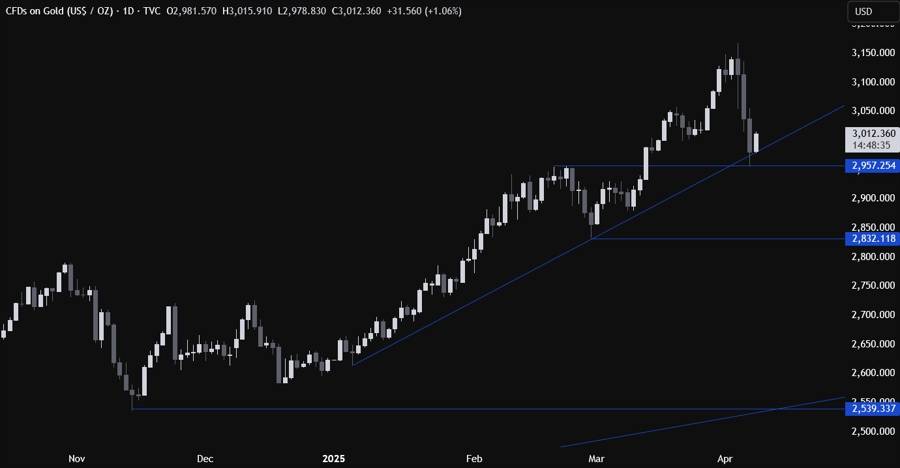
On the daily chart, we cansee that pulled all the way back to the major trendline around the 2957 level. Thisis where the buyers piled in with a defined risk below the trendline toposition for a rally into new all-time highs. The sellers, on the other hand,will want to see the price breaking lower to increase the bearish bets into the2832 level next.

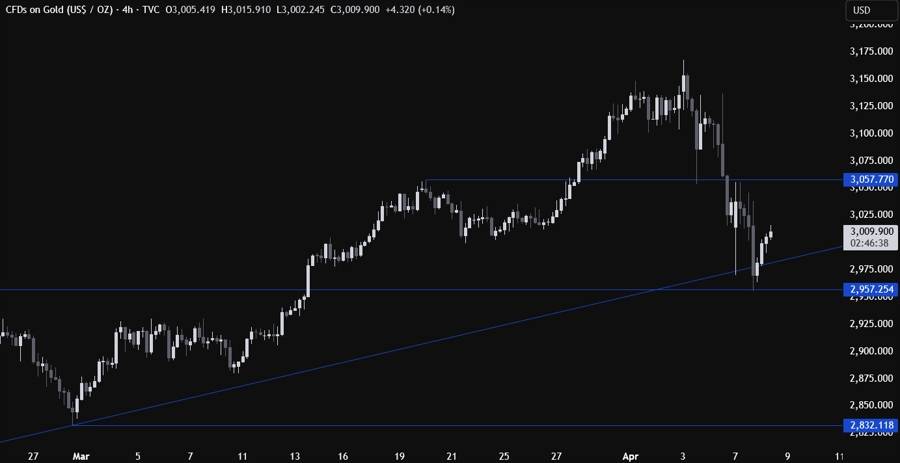
On the 4 hour chart, we cansee that we have also a key resistancearound the 3057 level. From a risk management perspective, the sellers willhave a better risk to reward setup around the resistance to target a breakbelow the trendline. The buyers, on the other hand, will want to see the pricebreaking above the resistance to increase the bullish bets into new highs.

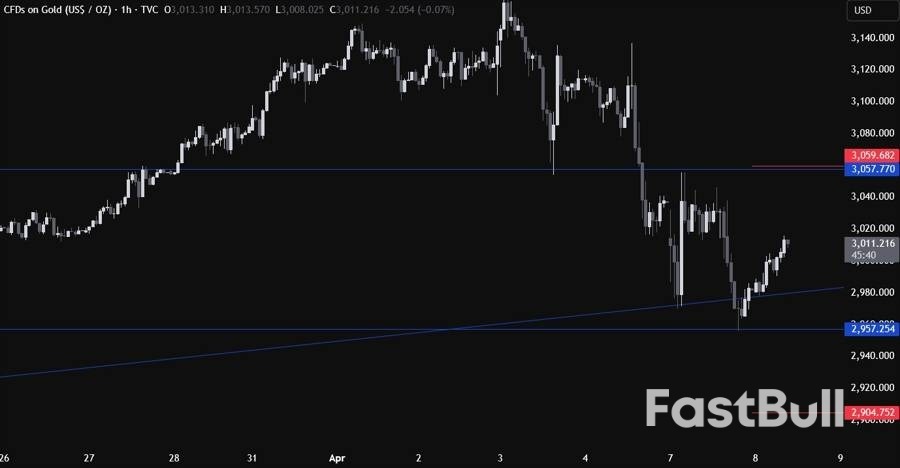
On the 1 hour chart, there’snot much we can add here as we could remain stuck in a range between the 2957support and the 3057 resistance. Nonetheless, the market participants will likelylean on the levels to position for the opposite moves and increase the bets onbreakouts. The red lines define the average daily range for today.
White Label
Data API
Web Plug-ins
Poster Maker
Affiliate Program
The risk of loss in trading financial instruments such as stocks, FX, commodities, futures, bonds, ETFs and crypto can be substantial. You may sustain a total loss of the funds that you deposit with your broker. Therefore, you should carefully consider whether such trading is suitable for you in light of your circumstances and financial resources.
No decision to invest should be made without thoroughly conducting due diligence by yourself or consulting with your financial advisors. Our web content might not suit you since we don't know your financial conditions and investment needs. Our financial information might have latency or contain inaccuracy, so you should be fully responsible for any of your trading and investment decisions. The company will not be responsible for your capital loss.
Without getting permission from the website, you are not allowed to copy the website's graphics, texts, or trademarks. Intellectual property rights in the content or data incorporated into this website belong to its providers and exchange merchants.
Not Logged In
Log in to access more features

FastBull Membership
Not yet
Purchase
Log In
Sign Up