• Trade
  • Markets
  • Copy
  • Contests
  • News
  • 24/7
  • Calendar
  • Q&A
  • Chats
Trending
Screeners
SYMBOL
LAST
BID
ASK
HIGH
LOW
NET CHG.
%CHG.
SPREAD
SPX
S&P 500 Index
6827.42
6827.42
6827.42
6899.86
6801.80
-73.58
-1.07%
--
DJI
Dow Jones Industrial Average
48458.04
48458.04
48458.04
48886.86
48334.10
-245.98
-0.51%
--
IXIC
NASDAQ Composite Index
23195.16
23195.16
23195.16
23554.89
23094.51
-398.69
-1.69%
--
USDX
US Dollar Index
97.950
98.030
97.950
98.500
97.950
-0.370
-0.38%
--
EURUSD
Euro / US Dollar
1.17394
1.17409
1.17394
1.17496
1.17192
+0.00011
+ 0.01%
--
GBPUSD
Pound Sterling / US Dollar
1.33707
1.33732
1.33707
1.33997
1.33419
-0.00148
-0.11%
--
XAUUSD
Gold / US Dollar
4299.39
4299.39
4299.39
4353.41
4257.10
+20.10
+ 0.47%
--
WTI
Light Sweet Crude Oil
57.233
57.485
57.233
58.011
56.969
-0.408
-0.71%
--

Community Accounts

Signal Accounts
--
Profit Accounts
--
Loss Accounts
--
View More

Become a signal provider

Sell trading signals to earn additional income

View More

Guide to Copy Trading

Get started with ease and confidence

View More

Signal Accounts for Members

All Signal Accounts

Best Return
  • Best Return
  • Best P/L
  • Best MDD
Past 1W
  • Past 1W
  • Past 1M
  • Past 1Y

All Contests

  • All
  • Trump Updates
  • Recommend
  • Stocks
  • Cryptocurrencies
  • Central Banks
  • Featured News
Top News Only
Share

Iranian Media Says 18 Crew Members Of Foreign Tanker Seized In Gulf Of Oman Over Carrying 'Smuggled Fuel' Detained

Share

Regional Governor: Two Killed In Ukrainian Drone Strike On Russia's Saratov

Share

Chinese Foreign Ministry - China Foreign Minister Met With United Arab Emirates Counterpart On Dec 12

Share

China's Central Financial And Economic Affairs Commission Deputy Director: Will Expand Export And Increase Import In 2026

Share

Thai Leader Anutin: Landmine Blast That Killed Thai Soldiers 'Not A Roadside Accident'

Share

Thai Leader Anutin: Thailand To Continue Military Action Until 'We Feel No More Harm'

Share

Cambodian Prime Minister Hun Manet Says He Had Phone Calls With Trump And Malaysian Leader Anwar About Ceasefire

Share

Cambodia's Hun Manet Says USA, Malaysia Should Verify 'Which Side Fired First' In Latest Conflict

Share

Cambodia's Hun Manet: Cambodia Maintains Its Stance In Seeking Peaceful Resolution Of Disputes

Share

Nasdaq Companies: Allergan, Ferrovia, Insmed, Monolithic Power Systems, Seagate Technology, And Western Digital Will Be Added To The NASDAQ 100 Index. Biogen, CdW, GlobalFoundries, Lululemon, ON Semiconductor, And Tradedesk Will Be Removed From The NASDAQ 100 Index

Share

Witkoff Headed To Berlin This Weekend To Meet With Zelenskiy, European Leaders -Wsj Reporter On X

Share

Russia Attacks Two Ukrainian Ports, Damaging Three Turkish-Owned Vessels

Share

[Historic Flooding Occurs In At Least Four Rivers In Washington State Due To Days Of Torrential Rains] Multiple Areas In Washington State Have Been Hit By Severe Flooding Due To Days Of Torrential Rains, With At Least Four Rivers Experiencing Historic Flooding. Reporters Learned On The 12th That The Floods Caused By The Torrential Rains In Washington State Have Destroyed Homes And Closed Several Highways. Experts Warn That Even More Severe Flooding May Occur In The Future. A State Of Emergency Has Been Declared In Washington State

Share

Trump Says Proposed Free Economic Zone In Donbas Would Work

Share

Trump: I Think My Voice Should Be Heard

Share

Trump Says Will Be Choosing New Fed Chair In Near Future

Share

Trump Says Proposed Free Economic Zone In Donbas Complex But Would Work

Share

Trump Says Land Strikes In Venezuela Will Start Happening

Share

US President Trump: Thailand And Cambodia Are In A Good Situation

Share

State Media: North Korean Leader Kim Hails Troops Returning From Russia Mission

TIME
ACT
FCST
PREV
U.K. Trade Balance Non-EU (SA) (Oct)

A:--

F: --

P: --

U.K. Trade Balance (Oct)

A:--

F: --

P: --

U.K. Services Index MoM

A:--

F: --

P: --

U.K. Construction Output MoM (SA) (Oct)

A:--

F: --

P: --

U.K. Industrial Output YoY (Oct)

A:--

F: --

P: --

U.K. Trade Balance (SA) (Oct)

A:--

F: --

P: --

U.K. Trade Balance EU (SA) (Oct)

A:--

F: --

P: --

U.K. Manufacturing Output YoY (Oct)

A:--

F: --

P: --

U.K. GDP MoM (Oct)

A:--

F: --

P: --

U.K. GDP YoY (SA) (Oct)

A:--

F: --

P: --

U.K. Industrial Output MoM (Oct)

A:--

F: --

P: --

U.K. Construction Output YoY (Oct)

A:--

F: --

P: --

France HICP Final MoM (Nov)

A:--

F: --

P: --

China, Mainland Outstanding Loans Growth YoY (Nov)

A:--

F: --

P: --

China, Mainland M2 Money Supply YoY (Nov)

A:--

F: --

P: --

China, Mainland M0 Money Supply YoY (Nov)

A:--

F: --

P: --

China, Mainland M1 Money Supply YoY (Nov)

A:--

F: --

P: --

India CPI YoY (Nov)

A:--

F: --

P: --

India Deposit Gowth YoY

A:--

F: --

P: --

Brazil Services Growth YoY (Oct)

A:--

F: --

P: --

Mexico Industrial Output YoY (Oct)

A:--

F: --

P: --

Russia Trade Balance (Oct)

A:--

F: --

P: --

Philadelphia Fed President Henry Paulson delivers a speech
Canada Building Permits MoM (SA) (Oct)

A:--

F: --

P: --

Canada Wholesale Sales YoY (Oct)

A:--

F: --

P: --

Canada Wholesale Inventory MoM (Oct)

A:--

F: --

P: --

Canada Wholesale Inventory YoY (Oct)

A:--

F: --

P: --

Canada Wholesale Sales MoM (SA) (Oct)

A:--

F: --

P: --

Germany Current Account (Not SA) (Oct)

A:--

F: --

P: --

U.S. Weekly Total Rig Count

A:--

F: --

P: --

U.S. Weekly Total Oil Rig Count

A:--

F: --

P: --

Japan Tankan Large Non-Manufacturing Diffusion Index (Q4)

--

F: --

P: --

Japan Tankan Small Manufacturing Outlook Index (Q4)

--

F: --

P: --

Japan Tankan Large Non-Manufacturing Outlook Index (Q4)

--

F: --

P: --

Japan Tankan Large Manufacturing Outlook Index (Q4)

--

F: --

P: --

Japan Tankan Small Manufacturing Diffusion Index (Q4)

--

F: --

P: --

Japan Tankan Large Manufacturing Diffusion Index (Q4)

--

F: --

P: --

Japan Tankan Large-Enterprise Capital Expenditure YoY (Q4)

--

F: --

P: --

U.K. Rightmove House Price Index YoY (Dec)

--

F: --

P: --

China, Mainland Industrial Output YoY (YTD) (Nov)

--

F: --

P: --

China, Mainland Urban Area Unemployment Rate (Nov)

--

F: --

P: --

Saudi Arabia CPI YoY (Nov)

--

F: --

P: --

Euro Zone Industrial Output YoY (Oct)

--

F: --

P: --

Euro Zone Industrial Output MoM (Oct)

--

F: --

P: --

Canada Existing Home Sales MoM (Nov)

--

F: --

P: --

Euro Zone Total Reserve Assets (Nov)

--

F: --

P: --

U.K. Inflation Rate Expectations

--

F: --

P: --

Canada National Economic Confidence Index

--

F: --

P: --

Canada New Housing Starts (Nov)

--

F: --

P: --

U.S. NY Fed Manufacturing Employment Index (Dec)

--

F: --

P: --

U.S. NY Fed Manufacturing Index (Dec)

--

F: --

P: --

Canada Core CPI YoY (Nov)

--

F: --

P: --

Canada Manufacturing Unfilled Orders MoM (Oct)

--

F: --

P: --

Canada Manufacturing New Orders MoM (Oct)

--

F: --

P: --

Canada Core CPI MoM (Nov)

--

F: --

P: --

Canada Manufacturing Inventory MoM (Oct)

--

F: --

P: --

Canada CPI YoY (Nov)

--

F: --

P: --

Canada CPI MoM (Nov)

--

F: --

P: --

Canada CPI YoY (SA) (Nov)

--

F: --

P: --

Canada Core CPI MoM (SA) (Nov)

--

F: --

P: --

Q&A with Experts
    • All
    • Chatrooms
    • Groups
    • Friends
    Connecting
    .
    .
    .
    Type here...
    Add Symbol or Code

      No matching data

      All
      Trump Updates
      Recommend
      Stocks
      Cryptocurrencies
      Central Banks
      Featured News
      • All
      • Russia-Ukraine Conflict
      • Middle East Flashpoint
      • All
      • Russia-Ukraine Conflict
      • Middle East Flashpoint
      Search
      Products

      Charts Free Forever

      Chats Q&A with Experts
      Screeners Economic Calendar Data Tools
      Membership Features
      Data Warehouse Market Trends Institutional Data Policy Rates Macro

      Market Trends

      Market Sentiment Order Book Forex Correlations

      Top Indicators

      Charts Free Forever
      Markets

      News

      News Analysis 24/7 Columns Education
      From Institutions From Analysts
      Topics Columnists

      Latest Views

      Latest Views

      Trending Topics

      Top Columnists

      Latest Update

      Signals

      Copy Rankings Latest Signals Become a signal provider AI Rating
      Contests
      Brokers

      Overview Brokers Assessment Rankings Regulators News Claims
      Broker listing Forex Brokers Comparison Tool Live Spread Comparison Scam
      Q&A Complaint Scam Alert Videos Tips to Detect Scam
      More

      Business
      Events
      Careers About Us Advertising Help Center

      White Label

      Data API

      Web Plug-ins

      Affiliate Program

      Awards Institution Evaluation IB Seminar Salon Event Exhibition
      Vietnam Thailand Singapore Dubai
      Fans Party Investment Sharing Session
      FastBull Summit BrokersView Expo
      Recent Searches
        Top Searches
          Markets
          News
          Analysis
          User
          24/7
          Economic Calendar
          Education
          Data
          • Names
          • Latest
          • Prev

          View All

          No data

          Scan to Download

          Faster Charts, Chat Faster!

          Download App
          English
          • English
          • Español
          • العربية
          • Bahasa Indonesia
          • Bahasa Melayu
          • Tiếng Việt
          • ภาษาไทย
          • Français
          • Italiano
          • Türkçe
          • Русский язык
          • 简中
          • 繁中
          Open Account
          Search
          Products
          Charts Free Forever
          Markets
          News
          Signals

          Copy Rankings Latest Signals Become a signal provider AI Rating
          Contests
          Brokers

          Overview Brokers Assessment Rankings Regulators News Claims
          Broker listing Forex Brokers Comparison Tool Live Spread Comparison Scam
          Q&A Complaint Scam Alert Videos Tips to Detect Scam
          More

          Business
          Events
          Careers About Us Advertising Help Center

          White Label

          Data API

          Web Plug-ins

          Affiliate Program

          Awards Institution Evaluation IB Seminar Salon Event Exhibition
          Vietnam Thailand Singapore Dubai
          Fans Party Investment Sharing Session
          FastBull Summit BrokersView Expo

          American Capital Reshapes European Soccer as Revenues Soar and Global Expansion Looms

          Gerik

          Economic

          Summary:

          Driven by revenue surges and limited U.S. sports investment options, American investors are acquiring stakes in Europe’s top soccer clubs, reshaping the industry’s ownership model and prompting new commercialization strategies, including overseas matches...

          Unprecedented Financial Growth Lures U.S. Investors

          The financial transformation of European soccer has reached new heights, drawing substantial American investment. From the 1996–1997 season to the 2023–2024 season, total revenues in Europe’s top five soccer leagues skyrocketed from €2.5 billion to €20.4 billion a staggering 750% increase. This long-term revenue surge, verified by Deloitte, is a primary causal factor behind the influx of U.S. capital, as investors are drawn to the reliable returns and global marketability of top-tier football clubs.
          This sharp appreciation in value is exemplified by Manchester United. Originally acquired by the Glazer family in 2005 for £790 million, the club's valuation surged to £5 billion in 2024 following a minority stake sale to Jim Ratcliffe. This reflects a broader causal relationship: the scarcity of domestic (U.S.) professional teams for acquisition particularly in the NFL and NBA has pushed investors toward European alternatives, which remain more accessible and poised for further growth.

          Widespread American Influence in Club Ownership

          Ownership data from PitchBook illustrates this transformation. A majority of English Premier League clubs including four of the traditional “Big Six” (Chelsea, Liverpool, Manchester United, and Arsenal) are now partially or fully owned by American investors. Across Europe, over 36 clubs in the top five leagues have received capital infusions from private equity, venture capital, or private debt firms. This reflects a causative trend, not merely a correlation: rising valuations and global fan engagement are actively motivating financial institutions to treat soccer as a growth asset class.
          According to Kieran Maguire of the University of Liverpool, this shift is enabled by the unprecedented accumulation of private wealth in the United States, coupled with the scarcity of elite sports franchises available for acquisition in domestic markets. For wealthy investors seeking prestige assets, European soccer clubs offer both visibility and potential returns.

          Private Equity Embraces Multi-Club Ownership Model

          A particularly noteworthy development is the emergence of the multi-club ownership model, in which one investment group owns stakes in multiple teams across countries. This approach allows for brand synergies, player development integration, and expanded marketing potential. Analyst Nicolas Moura from PitchBook explains that many U.S. investors are intentionally creating portfolios of football clubs to amplify commercial leverage.
          However, this model is now facing regulatory scrutiny. The European football governing body UEFA has started enforcing ownership separation rules. A notable example occurred when Crystal Palace, part-owned by American John Textor (who also owns France’s Lyon), was barred from participating in the UEFA Europa League. This indicates a direct causal link between the expansion of multi-club ownership and regulatory enforcement, which could constrain future investment structures.

          Revenue Growth Plateaus, New Avenues Explored

          While historical growth has been meteoric, Deloitte projects that revenue expansion may plateau in the 2025–2026 season due to stagnating broadcast rights values. This forecast has prompted clubs to aggressively pursue new commercial opportunities. A 6% rise in commercial revenues in the 2023–2024 season underscores the increasing reliance on sponsorship deals and diversified event hosting within stadiums.
          In response, U.S. private equity investors are increasingly investing in stadium infrastructure to create new revenue channels beyond media rights. By revamping stands or stadiums entirely, investors aim to increase matchday income and host non-soccer events, positioning clubs as entertainment venues rather than purely sporting organizations.

          International Expansion of Domestic Matches

          The pursuit of international fan engagement is entering a new phase. Spain’s La Liga will host its first regular season match abroad in 2025, as Barcelona faces Villareal in Miami. Italy’s Serie A is also set to follow, with formal plans approved for a game in Australia. Although such actions have previously been prohibited by FIFA rules, global governing bodies are now reconsidering their stance, likely driven by financial incentives.
          Despite Premier League CEO Richard Masters asserting that the English league remains reluctant to adopt international regular-season games, Professor Maguire predicts that financial pressures will eventually drive the league toward global expansion. If so, this would represent a causative shift, wherein declining domestic revenue growth pushes leagues toward monetizing global audiences more directly.
          The influx of U.S. investment is fundamentally altering the landscape of European soccer. What began as a financial opportunity has now expanded into a systemic transformation involving multi-club strategies, stadium reinventions, and overseas match planning. While the initial draw was financial driven by explosive revenue growth and limited U.S. sports ownership availability the consequences are structural, introducing new regulatory challenges and commercial dynamics. As clubs seek to sustain revenue amidst media rights stagnation, the path forward will likely be defined by internationalization and further professionalization of club operations, fueled by American capital and strategic intent.

          Source: CNBC

          To stay updated on all economic events of today, please check out our Economic calendar
          Risk Warnings and Disclaimers
          You understand and acknowledge that there is a high degree of risk involved in trading. Following any strategies or investment methods may lead to potential losses. The content on the site is provided by our contributors and analysts for information purposes only. You are solely responsible for determining whether any trading assets, securities, strategy, or any other product is suitable for investing based on your own investment objectives and financial situation.
          Add to Favorites
          Share

          Ethereum (ETH) Bull Market Over? Shiba Inu (SHIB) Risks Adding Zero Rocket, XRP's Last Level Before $2

          Winkelmann

          Cryptocurrency

          Forex

          Economic

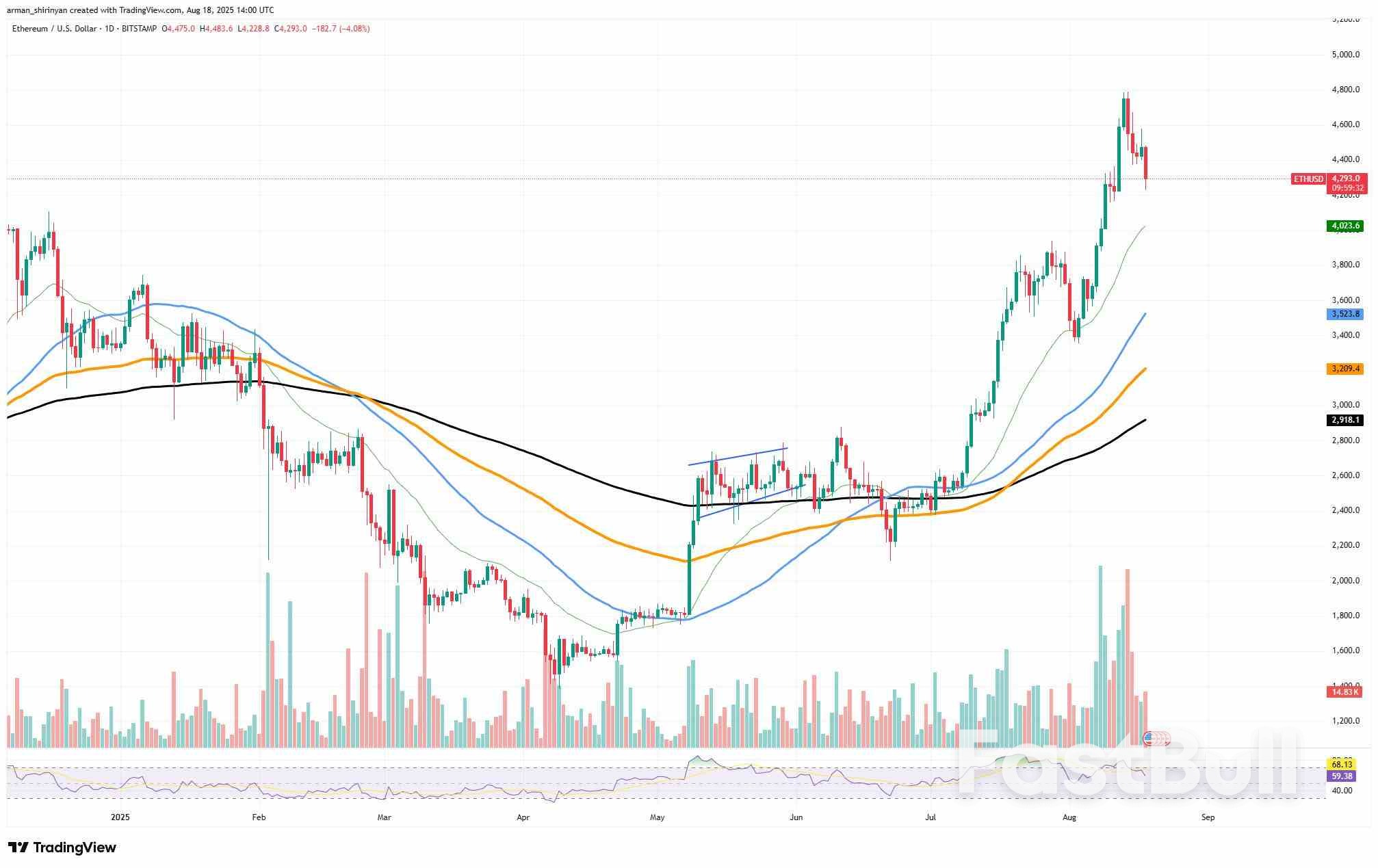
          Ethereum has most likely entered a corrective phase, which could be the beginning of the end of the bull market. Ethereum has been gradually declining after reaching a peak of about $4,800, and the price action is displaying the first discernible signs of weakness since July.

          Given that trading volume has decreased in comparison to earlier in the rally, the decline suggests that market momentum may be waning. Ethereum corrections following sharp rallies have historically tested important moving averages, and the 26-day EMA is currently the first crucial level to keep an eye on. A clean rebound prior to testing this zone would be a more convincing sign that buyers are still in control, but a drop toward this line would indicate a continuation of short-term selling pressure.

          Ethereum (ETH) Bull Market Over? Shiba Inu (SHIB) Risks Adding Zero Rocket, XRP's Last Level Before $2_1ETH/USDT Chart by TradingView'>

          The larger bullish structure would hold up if ETH could bounce back above recent highs, rather than tagging the 26 EMA, indicating that this move is merely a brief cooling off. With the next layers of support located close to the 50 EMA and psychological round levels around $4,000, additional downside may become possible if the 26 EMA breaks decisively.

          The more general question is whether the upward momentum of the cycle will end with this correction. Since long-term moving averages are still sloping upward, and Ethereum is currently trading comfortably above key support lines, it appears that the bull market is still going strong. But as Ethereum continues to decline, traders may grow increasingly wary, particularly as the market closes out derivative positions.

          Shiba Inu at risk

          Shiba Inu is once again close to adding a zero to its price. Following weeks of consolidation within an ascending triangle pattern, SHIB is currently close to losing the lower range, which could lead to more severe declines.The failure of SHIB to produce significant upward momentum is seen clearly on the daily chart. The token is continuing to retest the support line, rather than breaking higher, which indicates a weakening setup, even though the ascending triangle formation typically leans bullish. With today’s rejection, the likelihood of a breakdown is gradually increasing, and each bounce has been weaker than the one before.

          Due to the absence of strong support zones until much lower levels, the move may accelerate rapidly, if SHIB breaks below the triangle’s support. SHIB would most likely be forced to add another zero to its price as a result of such a decline, returning it to valuations not seen since the early summer.Lower trading volumes and the absence of whale-driven support both increase the descending momentum and lessen the likelihood of a recovery. The risk is increased by the fact that SHIB’s performance is still trailing, leading cryptocurrencies like Ethereum and Bitcoin, which have at least maintained stronger trends.

          XRP checks in

          XRP is not feeling that well, as the asset is close to entering a critical state. The token is currently declining and in danger of breaking below its 50-day exponential moving average (EMA) after failing to maintain momentum above $3. Although this level has historically been used as a temporary buffer, the current situation indicates that it might not last for very long.

          As XRP records a string of red candles, the market’s inability to maintain bullish sentiment is putting pressure on the 50 EMA. The next strong support is located much deeper in the $2.70-$2.75 range, and the $2.40 region, which is anchored by the 200 EMA if this level fails. A breakdown of this kind would wipe out most of XRP’s recent gains and expose the token to a possible retest nearer $2.00, a psychological level that will decide whether the larger bullish cycle holds up.

          Curiously, volume data presents a somewhat different picture, even though price action appears fragile. Indicating that bears are not fully committing to the sell-off, trading volumes have been continuously dropping during the downward move. This lack of conviction allows for a potential rebound, but XRP runs the risk of crashing lower toward significant support levels in the absence of an abrupt spike in demand.

          XRP needs to regain the $3.00 mark with significant buying pressure if bulls wish to regain control. If this is not done, there may be a chance for a more severe correction, with $2.00 acting as the final key level before sentiment turns sharply against the asset.

          Source: CryptoSlate

          To stay updated on all economic events of today, please check out our Economic calendar
          Risk Warnings and Disclaimers
          You understand and acknowledge that there is a high degree of risk involved in trading. Following any strategies or investment methods may lead to potential losses. The content on the site is provided by our contributors and analysts for information purposes only. You are solely responsible for determining whether any trading assets, securities, strategy, or any other product is suitable for investing based on your own investment objectives and financial situation.
          Add to Favorites
          Share

          Trump Administration Weighs 10% Stake in Intel Using Chips Act Funds

          Gerik

          Economic

          How the deal could work

          According to White House and industry sources, the government may take equity instead of paying out grants in tranches tied to project milestones. At Intel’s current market value, a 10% stake is worth about $10.5 billion, roughly equivalent to the amount of grant funding Intel is eligible for. This would make Washington Intel’s largest shareholder. The arrangement would not necessarily increase Intel’s overall government support but could accelerate access to funds.
          White House spokesman Kush Desai declined to confirm details, noting no deal is official. The Commerce Department, which oversees Chips Act awards, also declined comment. Intel has not issued a public response.

          Intel’s struggles and turnaround efforts

          Intel has lagged behind rivals Taiwan Semiconductor Manufacturing Co. (TSMC) and Samsung Electronics in advanced chipmaking. Under new CEO Lip-Bu Tan, Intel has focused on cost-cutting and job reductions, while delaying large-scale investments until customer commitments are secured. Its ambitious Ohio “mega-fab” project, originally billed as the world’s largest semiconductor facility, has faced repeated delays a political sore point given it sits in the home state of Vice President JD Vance.
          SoftBank recently announced a $2 billion investment in Intel, which briefly boosted investor confidence. Intel stock initially rallied on speculation of government equity but slipped 3.7% Monday after Bloomberg reported the possible size of the US stake.

          Political and strategic context

          The move reflects the administration’s broader push for a stronger US role in strategic industries. Trump’s team has already secured:
          A 15% cut of certain semiconductor sales to China,
          A “golden share” in US Steel Corp. tied to its sale to a Japanese firm, and
          A $400 million Pentagon equity stake in MP Materials, a rare-earth producer.
          Intel’s fate has long vexed policymakers. Both Trump and Biden administrations have viewed domestic chipmaking leadership as critical to US economic and national security. Previous efforts included talks with Nvidia and AMD to use Intel’s manufacturing, exploratory discussions with TSMC about operating Intel fabs, and even considering investment from the UAE.
          If finalized, this deal would mark one of the most direct government interventions in the semiconductor industry to date, signaling Washington’s willingness to act as both financier and shareholder in critical technology firms. The outcome could determine whether Intel regains competitiveness or cedes further ground to Asian rivals.

          Source: Bloomberg

          To stay updated on all economic events of today, please check out our Economic calendar
          Risk Warnings and Disclaimers
          You understand and acknowledge that there is a high degree of risk involved in trading. Following any strategies or investment methods may lead to potential losses. The content on the site is provided by our contributors and analysts for information purposes only. You are solely responsible for determining whether any trading assets, securities, strategy, or any other product is suitable for investing based on your own investment objectives and financial situation.
          Add to Favorites
          Share

          AUD/USD Faces Pressure, Downside Break Could Trigger Losses

          Samantha Luan

          Economic

          Forex

          Key Highlights

          ● AUD/USD struggled near 0.6565 and reacted to the downside.
          ● It traded below a key bullish trend line with support at 0.6505 on the 4-hour chart.
          ● GBP/USD is correcting gains from the 1.3590 resistance zone.
          ● EUR/USD is struggling to clear the 1.1720 resistance.

          AUD/USD Technical Analysis

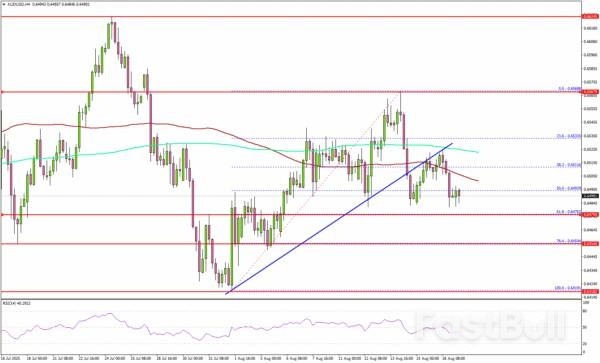
          The Aussie Dollar failed to continue higher above 0.6565 against the US Dollar. AUD/USD corrected gains and traded below the 0.6500 support.Looking at the 4-hour chart, the pair traded below a key bullish trend line with support at 0.6505. There was a move below the 50% Fib retracement level of the upward move from the 0.6419 swing low to the 0.6568 high.

          The pair is now trading below the 100 simple moving average (red, 4-hour) and the 200 simple moving average (green, 4-hour). On the downside, immediate support is 0.6475. It is close to the 61.8% Fib retracement level of the upward move from the 0.6419 swing low to the 0.6568 high.The next key support sits at 0.6455. Any more losses could send the pair toward the 0.6420 support zone. On the upside, the pair now faces resistance near the 0.6500 level.

          The next key resistance sits near 0.6525. A close above 0.6525 could set the pace for another increase. In the stated case, the pair could rise toward 0.6550, above which the bulls could aim for a move toward 0.6620.

          Source: ACTIONFOREX

          To stay updated on all economic events of today, please check out our Economic calendar
          Risk Warnings and Disclaimers
          You understand and acknowledge that there is a high degree of risk involved in trading. Following any strategies or investment methods may lead to potential losses. The content on the site is provided by our contributors and analysts for information purposes only. You are solely responsible for determining whether any trading assets, securities, strategy, or any other product is suitable for investing based on your own investment objectives and financial situation.
          Add to Favorites
          Share

          Japan’s Kono Urges Rate Hikes and Fiscal Discipline to Strengthen Yen

          Gerik

          Economic

          Call for tighter monetary policy

          In an interview with Reuters, Taro Kono, a senior member of the ruling Liberal Democratic Party and a former foreign minister, argued that Japan must accelerate the normalization of monetary policy. The Bank of Japan (BOJ) ended its decade-long stimulus program last year and lifted short-term rates to 0.5% in January, but Kono stressed that inflation-adjusted borrowing costs remain negative. The causal link is clear: prolonged negative real interest rates sustain a weak yen, which in turn fuels import-driven inflation.
          Kono stated that “it’s better to start early,” urging the BOJ to keep raising rates gradually to signal Japan’s determination to exit the era of negative real rates. While Governor Kazuo Ueda has cautioned that US tariffs could hurt Japan’s economy and thus warrant a slow pace of tightening, Kono argued that delay has already proven costly.

          Weak yen as a burden, not a benefit

          Traditionally seen as advantageous for Japan’s exporters, the weak yen has become a liability. With consumer inflation exceeding 2% for over three years, the currency’s depreciation has raised import costs, squeezed corporate margins, and eroded household purchasing power. Kono described the yen’s weakness as the primary driver of inflation that is particularly damaging for pensioners and low-income groups. The relationship here is causal rather than correlational: yen depreciation directly increases the cost of imported goods and energy, feeding into headline inflation.

          Beyond ‘Abenomics’: new policy framework

          Kono also called for a new economic framework to replace “Abenomics,” the policy mix of aggressive monetary easing and fiscal stimulus introduced by former Prime Minister Shinzo Abe in 2013. He argued that the BOJ should gradually raise rates while the government simultaneously pursues fiscal consolidation. This dual approach, he said, would stabilize the yen and restore confidence in Japan’s long-term economic management.
          Kono is seen as a potential candidate for Japan’s premiership, especially after the ruling party’s poor performance in recent upper house elections fueled speculation about leadership change. While he declined to confirm whether he would run if another leadership contest were held, his policy stance positions him as a reform-minded alternative in the ongoing debate over Japan’s economic direction.
          Kono’s remarks underscore growing impatience within Japan’s political class over the BOJ’s cautious stance. His argument that rate hikes and fiscal discipline are essential to reversing the weak yen reflects mounting pressure on policymakers to adjust strategy. Whether this vision becomes policy will depend not only on central bank decisions but also on Japan’s shifting political landscape.

          Source: Reuters

          To stay updated on all economic events of today, please check out our Economic calendar
          Risk Warnings and Disclaimers
          You understand and acknowledge that there is a high degree of risk involved in trading. Following any strategies or investment methods may lead to potential losses. The content on the site is provided by our contributors and analysts for information purposes only. You are solely responsible for determining whether any trading assets, securities, strategy, or any other product is suitable for investing based on your own investment objectives and financial situation.
          Add to Favorites
          Share

          S&P Maintains US Credit Rating at ‘AA+’ as Tariff Revenues Balance Fiscal Risks

          Gerik

          Economic

          Stable rating despite fiscal pressures

          S&P Global confirmed the United States’ long-term credit rating at ‘AA+’, underscoring that while the fiscal profile remains a structural weakness, the immediate risks are contained. The agency highlighted that President Trump’s newly enacted “One Big Beautiful Bill Act” a combination of tax cuts and increased government spending is deficit-expanding in nature. However, the causal factor mitigating this concern is the administration’s tariff regime, which has generated meaningful revenue to counterbalance part of the fiscal shortfall.
          According to S&P, tariff income provides the government with a short-term buffer against rising deficits. The causal link is straightforward: higher import duties increase government revenue, which partially offsets the spending-driven expansion of the deficit. Still, the reliance on trade tariffs introduces potential volatility since revenue depends on global trade flows and the resilience of import volumes amid tariff-induced costs.

          Outlook remains stable

          While S&P acknowledged that the US fiscal profile is its key weakness, the stable outlook suggests confidence that the world’s largest economy retains strong institutional capacity, monetary flexibility, and deep capital markets to absorb fiscal pressures. The affirmation signals that near-term risks, including the impact of expanded spending, remain balanced by tariff revenues and the US dollar’s status as the global reserve currency.
          The S&P decision reflects a cautious equilibrium: the US continues to face long-term fiscal vulnerabilities, but tariff revenues and institutional strengths are sufficient to maintain its current rating. The sustainability of this approach, however, depends on whether tariff inflows can persist without undermining trade relationships and economic growth in the longer term.

          Source: Reuters

          To stay updated on all economic events of today, please check out our Economic calendar
          Risk Warnings and Disclaimers
          You understand and acknowledge that there is a high degree of risk involved in trading. Following any strategies or investment methods may lead to potential losses. The content on the site is provided by our contributors and analysts for information purposes only. You are solely responsible for determining whether any trading assets, securities, strategy, or any other product is suitable for investing based on your own investment objectives and financial situation.
          Add to Favorites
          Share

          Vietnam Strengthens Economic Position Through FDI and Expanding OFDI

          Gerik

          Economic

          FDI as the backbone of modernization

          Vietnam’s journey with foreign direct investment began early, with the first Foreign Investment Ordinance in 1977 and the landmark 1987 Foreign Investment Law, which marked a decisive shift toward market-oriented reforms. Successive legal revisions, coupled with WTO accession in 2007 and participation in multiple free trade agreements, steadily improved Vietnam’s investment climate.
          FDI inflows have consistently fueled industrialization, bringing advanced technology, managerial know-how, and access to global markets. In 2024, disbursed FDI reached a record $25.35 billion. Major global corporations such as Samsung, Intel, LG, and Foxconn expanded their operations in Vietnam, reinforcing the country’s position as a strategic hub in electronics, high technology, and global supply chains. These investments illustrate a direct causal link: legal reforms and trade openness attracted capital, which in turn accelerated Vietnam’s modernization.

          OFDI: a rising channel of global integration

          Alongside inward investment, Vietnam has begun expanding outward foreign direct investment (OFDI), signaling the growing maturity of its private sector. In 2024, Vietnamese firms invested nearly $664.8 million abroad, a 57.7% increase over the previous year, raising cumulative OFDI to $22.59 billion across 1,825 projects. While modest compared with inbound FDI, this outward expansion demonstrates a shift toward two-way capital flows.
          Sectorally, OFDI has evolved beyond traditional resource-based projects. In 2024, professional services, science, and technology attracted 30.2% of capital, compared with zero in 2023. Manufacturing captured 21%, while electricity generation and distribution rose to 14.2%. Still, mining remains dominant with $7 billion, followed by agriculture ($3.4 billion) and telecom and IT services ($2.8 billion).
          Regionally, ASEAN remains the top destination, led by Laos ($5.7 billion) and Cambodia ($2.94 billion). This reflects both geographic proximity and lower entry costs, but also indicates a correlation: Vietnam’s integration into Southeast Asia’s production networks is deepening through capital as well as trade. Major Vietnamese players such as Viettel, FPT, Vinamilk, and TH Group are establishing footprints abroad, often through M&A and technology-driven investments.

          Challenges and reform needs

          Despite progress, OFDI faces structural weaknesses: small-scale projects, concentration in resource-based sectors, and limited engagement in high-tech or global services. The imbalance between large-scale inbound FDI and relatively modest outbound capital reflects a transitional phase. Experts argue that stronger institutional support, risk insurance funds, and managerial training are needed to help Vietnamese firms expand globally.
          Recognizing these constraints, the Ministry of Finance has proposed reforms to streamline procedures. The plan would eliminate multiple approval steps by shifting oversight to the State Bank of Vietnam for foreign exchange registration, thereby cutting red tape and reducing costs for firms. The causal expectation is that simpler rules will encourage more enterprises to pursue international expansion, aligning OFDI with national growth strategies.

          Strategic vision to 2045

          Vietnamese policymakers envision OFDI as a complementary force alongside FDI, creating a balanced “two-legged” growth model. By 2045, the goal is to foster Vietnamese multinational corporations in clean energy, IT, telecommunications, and financial services. This ambition aligns with the broader trajectory of building an independent yet globally integrated economy, one capable of sustaining competitiveness while reducing overreliance on foreign capital inflows.
          Vietnam’s economic narrative has evolved from independence in 1945 to FDI-led industrialization in the Đổi Mới era, and now toward OFDI-driven global integration. FDI remains the cornerstone of growth, but OFDI is emerging as a vital instrument for asserting Vietnam’s position in global value chains. Together, these twin engines reflect a country increasingly confident in shaping its own development path and projecting its economic influence beyond its borders.
          To stay updated on all economic events of today, please check out our Economic calendar
          Risk Warnings and Disclaimers
          You understand and acknowledge that there is a high degree of risk involved in trading. Following any strategies or investment methods may lead to potential losses. The content on the site is provided by our contributors and analysts for information purposes only. You are solely responsible for determining whether any trading assets, securities, strategy, or any other product is suitable for investing based on your own investment objectives and financial situation.
          Add to Favorites
          Share
          FastBull
          Copyright © 2025 FastBull Ltd

          728 RM B 7/F GEE LOK IND BLDG NO 34 HUNG TO RD KWUN TONG KLN HONG KONG

          TelegramInstagramTwitterfacebooklinkedin
          App Store Google Play Google Play
          Products
          Charts

          Chats

          Q&A with Experts
          Screeners
          Economic Calendar
          Data
          Tools
          Membership
          Features
          Function
          Markets
          Copy Trading
          Latest Signals
          Contests
          News
          Analysis
          24/7
          Columns
          Education
          Company
          Careers
          About Us
          Contact Us
          Advertising
          Help Center
          Feedback
          User Agreement
          Privacy Policy
          Business

          White Label

          Data API

          Web Plug-ins

          Poster Maker

          Affiliate Program

          Risk Disclosure

          The risk of loss in trading financial instruments such as stocks, FX, commodities, futures, bonds, ETFs and crypto can be substantial. You may sustain a total loss of the funds that you deposit with your broker. Therefore, you should carefully consider whether such trading is suitable for you in light of your circumstances and financial resources.

          No decision to invest should be made without thoroughly conducting due diligence by yourself or consulting with your financial advisors. Our web content might not suit you since we don't know your financial conditions and investment needs. Our financial information might have latency or contain inaccuracy, so you should be fully responsible for any of your trading and investment decisions. The company will not be responsible for your capital loss.

          Without getting permission from the website, you are not allowed to copy the website's graphics, texts, or trademarks. Intellectual property rights in the content or data incorporated into this website belong to its providers and exchange merchants.

          Not Logged In

          Log in to access more features

          FastBull Membership

          Not yet

          Purchase

          Become a signal provider
          Help Center
          Customer Service
          Dark Mode
          Price Up/Down Colors

          Log In

          Sign Up

          Position
          Layout
          Fullscreen
          Default to Chart
          The chart page opens by default when you visit fastbull.com