• Trade
  • Markets
  • Copy
  • Contests
  • News
  • 24/7
  • Calendar
  • Q&A
  • Chats
Trending
Screeners
SYMBOL
LAST
BID
ASK
HIGH
LOW
NET CHG.
%CHG.
SPREAD
SPX
S&P 500 Index
6870.39
6870.39
6870.39
6895.79
6858.28
+13.27
+ 0.19%
--
DJI
Dow Jones Industrial Average
47954.98
47954.98
47954.98
48133.54
47871.51
+104.05
+ 0.22%
--
IXIC
NASDAQ Composite Index
23578.12
23578.12
23578.12
23680.03
23506.00
+72.99
+ 0.31%
--
USDX
US Dollar Index
98.890
98.970
98.890
98.960
98.730
-0.060
-0.06%
--
EURUSD
Euro / US Dollar
1.16516
1.16523
1.16516
1.16717
1.16341
+0.00090
+ 0.08%
--
GBPUSD
Pound Sterling / US Dollar
1.33196
1.33205
1.33196
1.33462
1.33136
-0.00116
-0.09%
--
XAUUSD
Gold / US Dollar
4209.35
4209.76
4209.35
4218.85
4190.61
+11.44
+ 0.27%
--
WTI
Light Sweet Crude Oil
59.373
59.403
59.373
60.084
59.291
-0.436
-0.73%
--

Community Accounts

Signal Accounts
--
Profit Accounts
--
Loss Accounts
--
View More

Become a signal provider

Sell trading signals to earn additional income

View More

Guide to Copy Trading

Get started with ease and confidence

View More

Signal Accounts for Members

All Signal Accounts

Best Return
  • Best Return
  • Best P/L
  • Best MDD
Past 1W
  • Past 1W
  • Past 1M
  • Past 1Y

All Contests

  • All
  • Trump Updates
  • Recommend
  • Stocks
  • Cryptocurrencies
  • Central Banks
  • Featured News
Top News Only
Share

Russian Defence Ministry: Russian Forces Take Control Of Novodanylivka In Ukraine's Zaporizhzhia Region

Share

Russian Defence Ministry: Russian Forces Take Control Of Chervone In Ukraine's Donetsk Region

Share

French Finance Ministry: Government Started Process To Block Temporarily Shein Platform

Share

Finance Minister: Indonesia To Impose Coal Export Tax Of Up To 5% Next Year

Share

[Trump Considering Fired Homeland Security Secretary Noem? White House Denies] According To Reports From US Media Outlets Such As The Daily Beast And The UK's Independent, The White House Has Denied Reports That US President Trump Is Considering Firing Homeland Security Secretary Noem. White House Spokesperson Abigail Jackson Posted On Social Media On The 7th Local Time, Calling The Claims "fake News" And Stating That "Secretary Noem Has Done An Excellent Job Implementing The President's Agenda And 'making America Safe Again'."

Share

HKEX: Standard Chartered Bought Back 571604 Total Shares On Other Exchanges For Gbp9.5 Million On Dec 5

Share

Morgan Stanley Reiterates Bullish Outlook On US Stocks Due To Fed Rate Cut Expectations. Morgan Stanley Strategists Believe That The US Stock Market Faces A "bullish Outlook" Given Improved Earnings Expectations And Anticipated Fed Rate Cuts. They Expect Strong Corporate Earnings By 2026, And Anticipate The Fed Will Cut Rates Based On Lagging Or Mildly Weak Labor Markets. They Expect The US Consumer Discretionary Sector And Small-cap Stocks To Continue To Outperform

Share

China's National Development And Reform Commission Announced That Starting From 24:00 On December 8, The Retail Price Limit For Gasoline And Diesel In China Will Be Reduced By 55 Yuan Per Ton, Which Translates To A Reduction Of 0.04 Yuan Per Liter For 92-octane Gasoline, 0.05 Yuan Per Liter For 95-octane Gasoline, And 0.05 Yuan Per Liter For 0# Diesel

Share

Tkms CEO: US Security Strategy Highlights Need For Europe To Take Care Of Its Own Defences

Share

USA S&P 500 E-Mini Futures Up 0.1%, NASDAQ 100 Futures Up 0.18%, Dow Futures Down 0.02%

Share

London Metal Exchange (LME): Copper Inventories Increased By 2,000 Tons, Aluminum Inventories Decreased By 2,500 Tons, Nickel Inventories Increased By 228 Tons, Zinc Inventories Increased By 2,375 Tons, Lead Inventories Decreased By 3,725 Tons, And Tin Inventories Decreased By 10 Tons

Share

Swiss Sight Deposits Of Domestic Banks At 440.519 Billion Sfr In Week Ending December 5 Versus 437.298 Billion Sfr A Week Earlier

Share

Czech November Jobless Rate 4.6% Versus Mkt Fcast 4.7%

Share

Czech Jobless Rate Unchanged At 4.6% In November

Share

Singapore Central Bank Data: November Foreign Exchange Reserves At $400.0 Billion

Share

Fitch On EMEA Homebuilders Says Weak Demand Is Likely To Constrain Completions And New Starts, Despite Easing Inflation And Gradual Rate Cuts

Share

French Otc Day-Ahead Baseload Power Price At 22.50 EUR/Mwh, Down 35.3% From The Price Paid Friday For Monday Delivery - Lseg Data

Share

Cambodia Information Minister: 4 Cambodian Civilians Killed, 9 Injured Amid Conflict With Thailand

Share

Tkms CEO: With Meko Frigates We Are Offering To German Government An Alternative To Delayed F126 Frigates

Share

Tkms CEO: Expect Decision On Canadian Submarine Order In 2026

TIME
ACT
FCST
PREV
France Industrial Output MoM (SA) (Oct)

A:--

F: --

P: --
France Trade Balance (SA) (Oct)

A:--

F: --

P: --
Euro Zone Employment YoY (SA) (Q3)

A:--

F: --

P: --
Canada Part-Time Employment (SA) (Nov)

A:--

F: --

P: --

Canada Unemployment Rate (SA) (Nov)

A:--

F: --

P: --

Canada Full-time Employment (SA) (Nov)

A:--

F: --

P: --

Canada Labor Force Participation Rate (SA) (Nov)

A:--

F: --

P: --

Canada Employment (SA) (Nov)

A:--

F: --

P: --

U.S. PCE Price Index MoM (Sept)

A:--

F: --

P: --

U.S. Personal Income MoM (Sept)

A:--

F: --

P: --

U.S. Core PCE Price Index MoM (Sept)

A:--

F: --

P: --

U.S. PCE Price Index YoY (SA) (Sept)

A:--

F: --

P: --

U.S. Core PCE Price Index YoY (Sept)

A:--

F: --

P: --

U.S. Personal Outlays MoM (SA) (Sept)

A:--

F: --

P: --
U.S. 5-10 Year-Ahead Inflation Expectations (Dec)

A:--

F: --

P: --

U.S. Real Personal Consumption Expenditures MoM (Sept)

A:--

F: --

P: --
U.S. Weekly Total Rig Count

A:--

F: --

P: --

U.S. Weekly Total Oil Rig Count

A:--

F: --

P: --

U.S. Consumer Credit (SA) (Oct)

A:--

F: --

P: --
China, Mainland Foreign Exchange Reserves (Nov)

A:--

F: --

P: --

Japan Trade Balance (Oct)

A:--

F: --

P: --

Japan Nominal GDP Revised QoQ (Q3)

A:--

F: --

P: --

China, Mainland Imports YoY (CNH) (Nov)

A:--

F: --

P: --

China, Mainland Exports (Nov)

A:--

F: --

P: --

China, Mainland Imports (CNH) (Nov)

A:--

F: --

P: --

China, Mainland Trade Balance (CNH) (Nov)

A:--

F: --

P: --

China, Mainland Exports YoY (USD) (Nov)

A:--

F: --

P: --

China, Mainland Imports YoY (USD) (Nov)

A:--

F: --

P: --

Germany Industrial Output MoM (SA) (Oct)

A:--

F: --

P: --
Euro Zone Sentix Investor Confidence Index (Dec)

A:--

F: --

P: --

Canada National Economic Confidence Index

--

F: --

P: --

U.K. BRC Like-For-Like Retail Sales YoY (Nov)

--

F: --

P: --

U.K. BRC Overall Retail Sales YoY (Nov)

--

F: --

P: --

Australia Overnight (Borrowing) Key Rate

--

F: --

P: --

RBA Rate Statement
RBA Press Conference
Germany Exports MoM (SA) (Oct)

--

F: --

P: --

U.S. NFIB Small Business Optimism Index (SA) (Nov)

--

F: --

P: --

Mexico 12-Month Inflation (CPI) (Nov)

--

F: --

P: --

Mexico Core CPI YoY (Nov)

--

F: --

P: --

Mexico PPI YoY (Nov)

--

F: --

P: --

U.S. Weekly Redbook Index YoY

--

F: --

P: --

U.S. JOLTS Job Openings (SA) (Oct)

--

F: --

P: --

China, Mainland M1 Money Supply YoY (Nov)

--

F: --

P: --

China, Mainland M0 Money Supply YoY (Nov)

--

F: --

P: --

China, Mainland M2 Money Supply YoY (Nov)

--

F: --

P: --

U.S. EIA Short-Term Crude Production Forecast For The Year (Dec)

--

F: --

P: --

U.S. EIA Natural Gas Production Forecast For The Next Year (Dec)

--

F: --

P: --

U.S. EIA Short-Term Crude Production Forecast For The Next Year (Dec)

--

F: --

P: --

EIA Monthly Short-Term Energy Outlook
U.S. API Weekly Gasoline Stocks

--

F: --

P: --

U.S. API Weekly Cushing Crude Oil Stocks

--

F: --

P: --

U.S. API Weekly Crude Oil Stocks

--

F: --

P: --

U.S. API Weekly Refined Oil Stocks

--

F: --

P: --

South Korea Unemployment Rate (SA) (Nov)

--

F: --

P: --

Japan Reuters Tankan Non-Manufacturers Index (Dec)

--

F: --

P: --

Japan Reuters Tankan Manufacturers Index (Dec)

--

F: --

P: --

Japan Domestic Enterprise Commodity Price Index MoM (Nov)

--

F: --

P: --

Japan Domestic Enterprise Commodity Price Index YoY (Nov)

--

F: --

P: --

China, Mainland PPI YoY (Nov)

--

F: --

P: --

Q&A with Experts
    • All
    • Chatrooms
    • Groups
    • Friends
    Connecting
    .
    .
    .
    Type here...
    Add Symbol or Code

      No matching data

      All
      Trump Updates
      Recommend
      Stocks
      Cryptocurrencies
      Central Banks
      Featured News
      • All
      • Russia-Ukraine Conflict
      • Middle East Flashpoint
      • All
      • Russia-Ukraine Conflict
      • Middle East Flashpoint
      Search
      Products

      Charts Free Forever

      Chats Q&A with Experts
      Screeners Economic Calendar Data Tools
      Membership Features
      Data Warehouse Market Trends Institutional Data Policy Rates Macro

      Market Trends

      Market Sentiment Order Book Forex Correlations

      Top Indicators

      Charts Free Forever
      Markets

      News

      News Analysis 24/7 Columns Education
      From Institutions From Analysts
      Topics Columnists

      Latest Views

      Latest Views

      Trending Topics

      Top Columnists

      Latest Update

      Signals

      Copy Rankings Latest Signals Become a signal provider AI Rating
      Contests
      Brokers

      Overview Brokers Assessment Rankings Regulators News Claims
      Broker listing Forex Brokers Comparison Tool Live Spread Comparison Scam
      Q&A Complaint Scam Alert Videos Tips to Detect Scam
      More

      Business
      Events
      Careers About Us Advertising Help Center

      White Label

      Data API

      Web Plug-ins

      Affiliate Program

      Awards Institution Evaluation IB Seminar Salon Event Exhibition
      Vietnam Thailand Singapore Dubai
      Fans Party Investment Sharing Session
      FastBull Summit BrokersView Expo
      Recent Searches
        Top Searches
          Markets
          News
          Analysis
          User
          24/7
          Economic Calendar
          Education
          Data
          • Names
          • Latest
          • Prev

          View All

          No data

          Scan to Download

          Faster Charts, Chat Faster!

          Download App
          English
          • English
          • Español
          • العربية
          • Bahasa Indonesia
          • Bahasa Melayu
          • Tiếng Việt
          • ภาษาไทย
          • Français
          • Italiano
          • Türkçe
          • Русский язык
          • 简中
          • 繁中
          Open Account
          Search
          Products
          Charts Free Forever
          Markets
          News
          Signals

          Copy Rankings Latest Signals Become a signal provider AI Rating
          Contests
          Brokers

          Overview Brokers Assessment Rankings Regulators News Claims
          Broker listing Forex Brokers Comparison Tool Live Spread Comparison Scam
          Q&A Complaint Scam Alert Videos Tips to Detect Scam
          More

          Business
          Events
          Careers About Us Advertising Help Center

          White Label

          Data API

          Web Plug-ins

          Affiliate Program

          Awards Institution Evaluation IB Seminar Salon Event Exhibition
          Vietnam Thailand Singapore Dubai
          Fans Party Investment Sharing Session
          FastBull Summit BrokersView Expo

          Alibaba’s cloud unit shines even as rivalry heats up in China’s ‘instant commerce’ space

          Adam

          Economic

          Summary:

          Alibaba beat profit forecasts with net income up 78%, driven by strong cloud growth and e-commerce revival. Despite heavy instant commerce investment and softer revenue, shares surged 40% this year on AI-fueled cloud momentum.

          Alibaba posted a better-than-expected bottom line in the June quarter fueled by accelerated sales at its cloud computing unit and a continued revival of its e-commerce business.
          Still, the Chinese giant’s revenues came in under analyst forecasts.
          Alibaba’s stock was up around 4% in premarket trade in the U.S. after initially dipping.
          Here’s how Alibaba did in its fiscal first quarter ended June, compared with LSEG estimates:
          Revenue: 247.65 billion Chinese yuan ($34.6 billion), versus 252.9 billion yuan expected.
          Net income: 43.11 billion yuan, compared with 28.5 billion yuan expected.
          Revenue rose 2% year-on-year, while the company’s net income was up 78%. Alibaba attributed the increase in profit to gains in some of its equity investments and the disposal of Turkish e-commerce firm Trendyol. This was offset by a decrease in income from operations.
          However, excluding investment gains, Alibaba’s net income would have decreased 18% year-on-year as it continues to invest in the cut-throat instant commerce space in China.
          Alibaba has a delicate balancing act between investing areas such as artificial intelligence and new e-commerce models, while showing that it can continue to grow in China’s competitive market. So far, investors have rewarded Alibaba with a 40% rally in its U.S.-listed stock this year.
          That’s partly thanks a continued growth acceleration at its key cloud computing division as well as improvements at both its China and international e-commerce businesses.

          Cloud accelerates

          Cloud computing was one of the bright spots.
          Alibaba said revenue at the division totaled 33.4 billion yuan, up 26% year-on-year. That was faster than the 18% growth rate seen in the previous quarter. Alibaba’s cloud unit is seen as key to the company monetizing artificial intelligence, much like Microsoft or Google.
          “Driven by robust AI demand, Cloud Intelligence Group experienced accelerated revenue growth, and AI-related product revenue is now a significant portion of revenue from external customers,” Alibaba CEO Eddie Wu said in a statement.
          Investors are focused on Alibaba’s investments in artificial intelligence, where it has become a major global player. The company has aggressively launched various AI models and is selling services through its cloud computing division.
          While Alibaba has focused open source AI — meaning its models can be used for free and built on by developers — it also sells AI services through its cloud unit.
          Alibaba said AI-related product revenue “maintained triple-digit year-over-year growth for the eighth consecutive quarter.”
          Adjusted earnings before interest, taxes, and amortization (EBITA), a measure of profitability, jumped 26% year-on-year in the cloud unit.
          New York-listed Alibaba shares have risen more than 40% this year as revenue growth at its core China e-commerce business has improved and its cloud computing division has accelerated.
          The company is dealing with uncertainty in the Chinese economy, which lost momentum in July. Earlier this year, Beijing had launched initiatives to boost consumption.

          ‘Quick commerce’ wars

          Alibaba’s core e-commerce business, which accounts for more than 50% of revenue, had mixed results.
          Overall, revenue rose 10% year-on-year to 19.6 billion yuan. Customer management revenue, which Alibaba makes off of selling marketing and other services to merchants on its platform, jumped 10%. CMR accounts for the bulk of e-commerce revenue.
          However, adjusted earnings in the division fell 21% in the quarter on an annual basis. That’s because Alibaba has been investing heavily in so-called quick or instant commerce. This is a feature introduced on Taobao, one of Alibaba’s main Chinese e-commerce apps, this year that provides deliveries of certain products in China within an hour
          Competition is intense in China, with rivals including food delivery giant Meituan and JD.com, all involved. And the rivalry is already taking its toll on some of these firms, with Meituan this week posting an 89% plunge in second-quarter adjusted net profit.
          Alibaba’s own quick commerce division brought in revenue of more than 14.8 billion yuan, or $2 billion, rising 12% year-on-year.
          Still, investors appear okay with Alibaba’s instant commerce investments, because its cloud computing business continues to grow, while its international online shopping unit — which includes AliExpress — saw a 19% jump in revenue in the quarter as losses narrowed.

          Source: cnbc

          To stay updated on all economic events of today, please check out our Economic calendar
          Risk Warnings and Disclaimers
          You understand and acknowledge that there is a high degree of risk involved in trading. Following any strategies or investment methods may lead to potential losses. The content on the site is provided by our contributors and analysts for information purposes only. You are solely responsible for determining whether any trading assets, securities, strategy, or any other product is suitable for investing based on your own investment objectives and financial situation.
          Add to Favorites
          Share

          Argentina Again Tightens FX Rules For Banks As Peso Strengthens

          James Whitman

          Economic

          Forex

          Argentina increased foreign-currency restrictions at commercial lenders yet again, as President Javier Milei’s government ramps up efforts to support the peso and ease inflation ahead of midterm elections.

          The central bank issued new rules Friday in a bid to tighten oversight of the foreign-exchange market and curb volatility, according to a statement published on its website. The peso strengthened as much as 1.4% before paring the advance to almost 0.7% as of 11:45 am local time.

          Effective immediately, banks can’t increase their daily spot FX position on the last business day of the month, compared with the previous day’s balance. The measure is aimed at limiting end-of-month balance sheet maneuvers that could amplify demand for dollars and add to pressure on the peso.

          Starting Dec. 1, lenders will also be required to comply with the negative global net FX position limit on a daily basis, rather than the monthly average used until now. The change marks a shift toward stricter, day-to-day monitoring of bank exposure to the currency market.

          The rule limits the ability of banks to purchase foreign currency in the spot market on the same day their futures contracts mature, underscoring the monetary authority’s determination to curb dollar demand during periods of financial stress.

          Milei has been stepping up efforts to defend Argentina’s currency by tightening monetary policy, adding strain on the banking system and the broader economy as he fights inflation. This week, the government rolled over all of its notes in a debt auction. To ensure demand, policymakers increased the share of commercial bank deposits that must be parked at the central bank, effectively forcing them to absorb more government debt.

          Those measures drained liquidity and helped shore up a fragile peso that had threatened to reignite inflation. Friday’s move in the market may also be an extension of the post-auction rally.

          Milei’s libertarian party is looking to make gains in a Sept. 7 election in the province of Buenos Aires, which is home to nearly 40% of Argentina’s population and consistently votes for the Peronist opposition. Investors will be eyeing those results as a barometer of voter appetite for the president’s shock-therapy polices ahead of national midterms in October.

          Source: Bloomberg Europe

          To stay updated on all economic events of today, please check out our Economic calendar
          Risk Warnings and Disclaimers
          You understand and acknowledge that there is a high degree of risk involved in trading. Following any strategies or investment methods may lead to potential losses. The content on the site is provided by our contributors and analysts for information purposes only. You are solely responsible for determining whether any trading assets, securities, strategy, or any other product is suitable for investing based on your own investment objectives and financial situation.
          Add to Favorites
          Share

          Trump tariffs are increasingly forcing countries to pick sides between the US and China

          Adam

          Economic

          President Trump’s trade wars are increasingly forcing countries to choose between the US and its main adversaries, China and Russia.
          It’s a theme that has been evident for months but has been on heightened display this week, with headlines from India to Mexico underscoring that nations are not necessarily destined to choose the US.
          On one side is India, which is now facing 50% US tariffs on an array of goods. Those duties are set to be felt in everything from textiles to solar panels in part due to the country’s continued purchases of Russian oil.
          But a US pressure campaign to stop those purchases has, for now at least, clearly pushed India toward US adversaries.
          Not only do India’s imports of Russian oil appear set to continue, they are even likely to rise in September, according to a Reuters report.
          And Indian Prime Minister Narendra Modi is preparing for a high-profile visit to China later this week in what will be Modi's first visit to China in seven years.
          On the other side of the spectrum this week is Mexico. America’s southern neighbor is eyeing new tariffs on China that could distance it from Asia.
          It's a possible move that would deepen ties to the US ahead of high-stakes negotiations coming next year on renewing the United States-Mexico-Canada Agreement (USMCA).
          Bloomberg News is reporting that the Mexican government plans to formally unveil these new China tariffs next month and could focus on imports such as cars, textiles, and plastics as part of a 2026 budget proposal.
          Notably, the report added, the tariff increases may also target other Asian countries.
          As Capital Economics added in an analysis, it's evidence of a top Trump priority in getting Mexico's help to keep China out of US supply chains. It's also evidence, the report added, of how America’s southern neighbor “appeared particularly susceptible to US pressure to put tariffs on China given its dependence on US final demand.”
          But India appears headed in the opposite direction.
          Syracuse University professor of Economics Devashish Mitra said this week that India’s ties with China could deepen in the months ahead — and perhaps even open the possibility that it joins a China-led Asian free trade agreement.
          Mitra noted that with the “climate President Trump has created, it won’t be surprising if both India and China find this a mutually beneficial transaction."
          On Fox Business earlier this week, Treasury Secretary Scott Bessent said that the Indian team began negotiations early and that he "thought India could be one of the earlier deals, [but] they kind of tapped us along in terms of the negotiations."
          But Bessent predicted that "at the end of the day, we will come together" with plenty of points of negotiations to come over things like Apple (AAPL) iPhones and generic drugs (both of which are currently excluded from the 50% tariffs), and with Trump promising sector-specific tariffs on both fronts in the months ahead.
          Stuck in the middle
          In the meantime, other nations remain, perhaps, stuck in the middle with increasingly tense positions.
          Japan is an example of a nation that struck a deal with the US but has seen significant domestic pushback to the terms. Japan’s top trade negotiator, Ryosei Akazawa, was scheduled to visit the US but canceled at the last minute.
          He said at a press conference that more talks are needed in Tokyo as the nation pushes the US to follow through on a promise to lower duties on cars and car parts and resolve issues around "stacking" preexisting duties on top of what the nation hopes will be 15% universal tariffs.
          It was just the latest example of a bumpy road that has lain ahead of nations that struck high-profile deals with Trump as they work toward actually implementing the complex provisions.
          South Korea is in a similar boat, with that country's president visiting Washington this week in part to push the president for more favorable terms.
          At a Cabinet meeting, Trump noted "they wanted to see if they could do something," though he added that the gambit had little effect and "we just kept the same deal."
          The European Union also moved forward this week to advance legislation that would remove all tariffs on US industrial goods — a key demand from Trump before that deal can be fully implemented.

          Source: finance.yahoo

          To stay updated on all economic events of today, please check out our Economic calendar
          Risk Warnings and Disclaimers
          You understand and acknowledge that there is a high degree of risk involved in trading. Following any strategies or investment methods may lead to potential losses. The content on the site is provided by our contributors and analysts for information purposes only. You are solely responsible for determining whether any trading assets, securities, strategy, or any other product is suitable for investing based on your own investment objectives and financial situation.
          Add to Favorites
          Share

          Thai Prime Minister Removed By Court, Triggering Power Scramble

          James Whitman

          Political

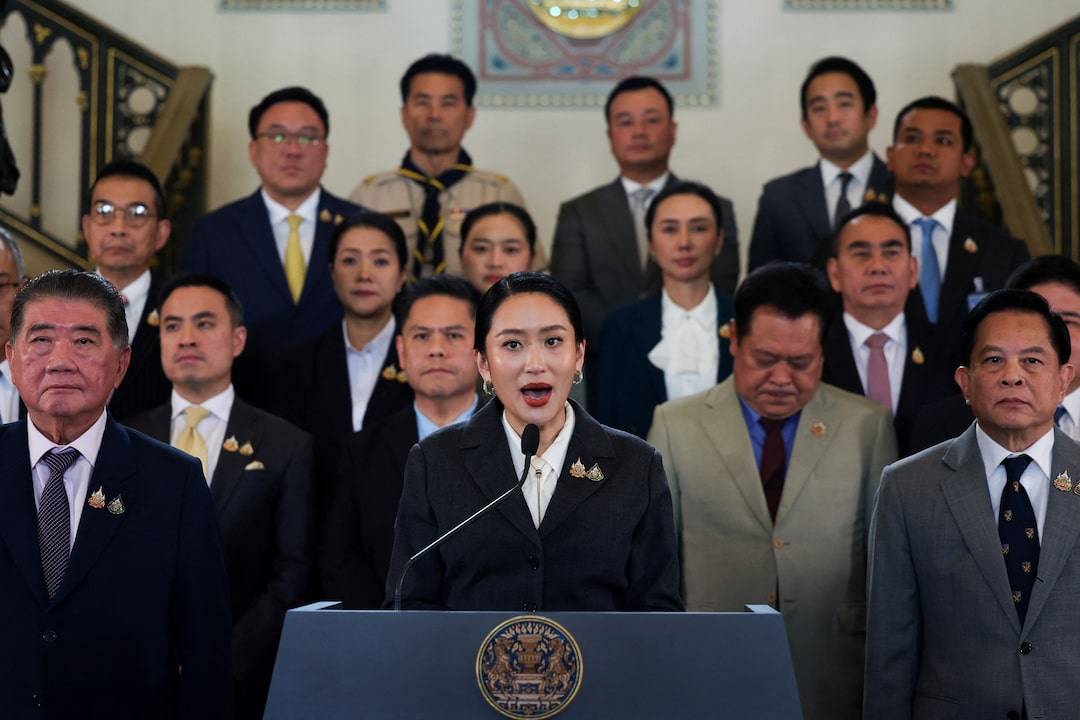
          Thailand's Constitutional Court dismissed Prime Minister Paetongtarn Shinawatra on Friday for an ethics violation, in another crushing blow to the Shinawatra political dynasty that triggered a flurry of deal-making aimed at filling the void.

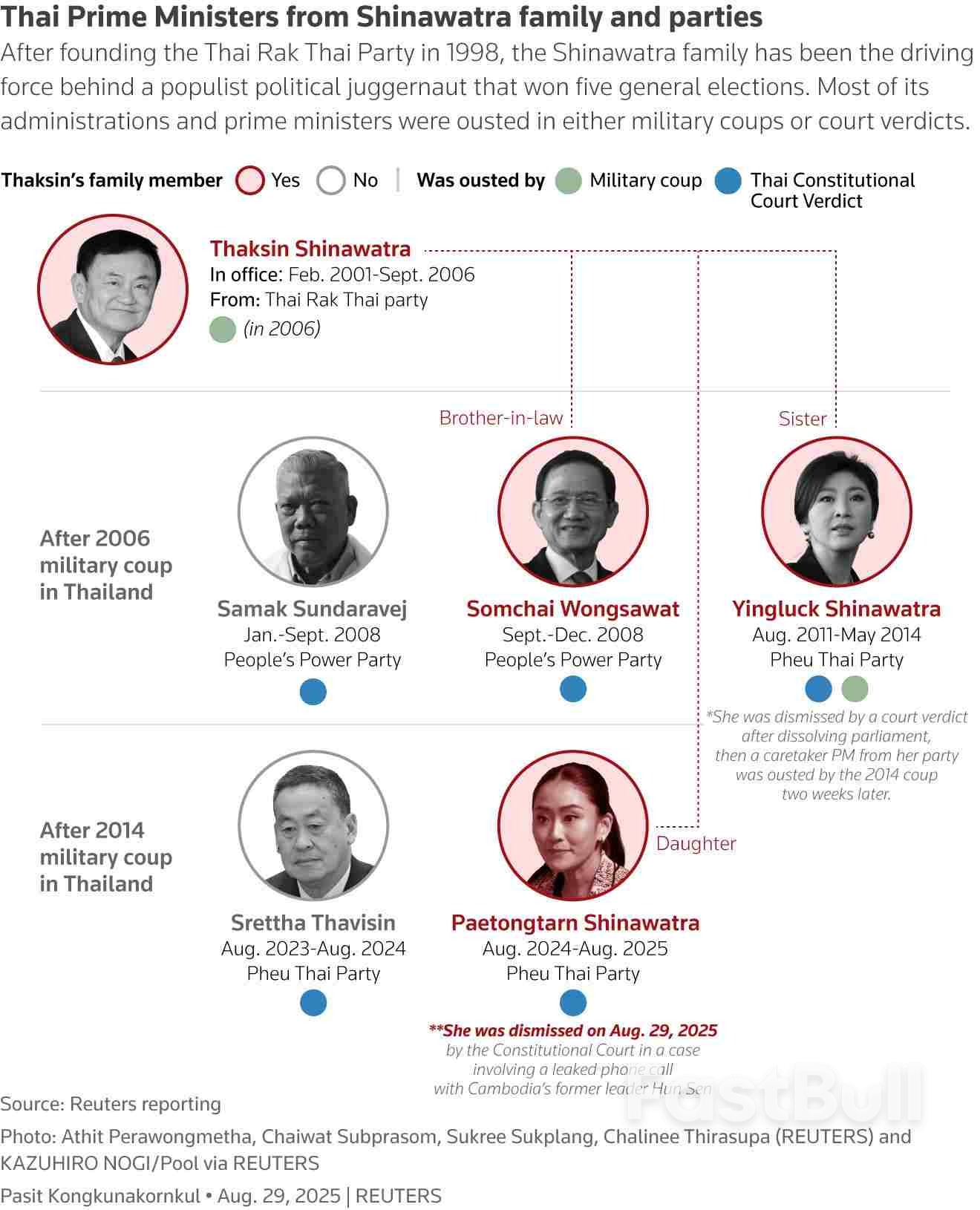
          Paetongtarn, who was Thailand's youngest prime minister, becomes the sixth premier from or backed by the billionaire Shinawatra family to be removed by the military or judiciary in a tumultuous two-decade battle for power between the country's warring elites.

          The ruling paves the way for the election by parliament of a new prime minister, a process that could be drawn out, with Paetongtarn's ruling Pheu Thai party losing bargaining power and facing a challenge to shore up a fragile alliance with a razor-thin majority.

          The court said Paetongtarn violated ethics in a leaked June telephone call, during which she appeared to kowtow to Cambodia's powerful former leader Hun Sen - until recently a close Shinawatra family ally - when both countries were on the brink of an armed conflict. Fighting erupted weeks later, lasting five days.

          Hours after the decision, the Bhumjaithai Party that had quit Paetongtarn's coalition over the call emerged as the early frontrunner in forming a new government, with leader Anutin Charnvirakul shuttling across Bangkok to rally support from parties, with pledges that included dissolving parliament within four months.

          The ruling brings a premature end to the premiership of the daughter and protégé of divisive tycoon Thaksin Shinawatra and will be a major test of his outsized political clout. Paetongtarn, 39, was a political neophyte when she was abruptly thrust into power after the surprise dismissal of Srettha Thavisin by the same court.

          Graphic: This diagram lists the Thai Prime Ministers from the Shinawatra family and parties

          In a 6-3 decision, the court said Paetongtarn had put her private interests before those of the nation and had damaged Thailand's reputation.

          "Due to a personal relationship that appeared aligned with Cambodia, the respondent was consistently willing to comply with or act in accordance with the wishes of the Cambodian side," it said.

          CALL FOR UNITY

          Reacting to the decision, Paetongtarn called for all parties to work together to bring political stability to Thailand.

          "All I wanted was to safeguard the lives of people, whether soldiers or civilians. I was determined to do all I can to protect their lives before the violent clashes," she said.

          She is the fifth premier in 17 years to be removed by the Constitutional Court, underlining its central role in an intractable power struggle between the governments of the Shinawatra clan and a nexus of powerful conservatives and royalist generals with far-reaching influence.

          The focus quickly shifted to who will replace Paetongtarn, with Thaksin expected to be in the thick of horse-trading between parties and other power-brokers to try to keep Pheu Thai at the helm.

          Deputy premier Phumtham Wechayachai will be in charge as caretaker until a new prime minister is elected by parliament, which on Friday called a special session from September 3-5 but made no mention of a vote on a new premier.

          Phumtham said the coalition was still together and would agree on a prime ministerial candidate with Pheu Thai at the core.

          Five people are eligible to become premier, with only one from Pheu Thai, 77-year-old Chaikasem Nitisiri, a former attorney general with limited cabinet experience, who has maintained a low profile.

          Others include ex-premier Prayuth Chan-ocha, who has retired from politics and led a military coup against the last Pheu Thai government in 2014, and former deputy prime minister Anutin, who late on Friday said he already had the votes.

          "This will be a government for the people, that will help find a way out for the country ... and return the power to the people," he said.

          The ruling thrusts Thailand into more uncertainty, with potential for political deadlock at a time of simmering public unease over stalled reforms and a stuttering economy.

          Any Pheu Thai-led administration would likely have a slender majority and could face street protests and parliamentary challenges from an opposition with huge public support that is pushing for an early election.

          "Appointing a new prime minister...will be difficult and may take considerable time," said Chulalongkorn University political scientist Stithorn Thananithichot. "Pheu Thai will be at a disadvantage."

          Source: Reuters

          Risk Warnings and Disclaimers
          You understand and acknowledge that there is a high degree of risk involved in trading. Following any strategies or investment methods may lead to potential losses. The content on the site is provided by our contributors and analysts for information purposes only. You are solely responsible for determining whether any trading assets, securities, strategy, or any other product is suitable for investing based on your own investment objectives and financial situation.
          Add to Favorites
          Share

          EU To Scrap Tariffs On US Goods To Pave Way For Lower Car Duties

          Winkelmann

          Economic

          Forex

          Political

          The European Commission proposed on Thursday removing duties on imported US industrial goods in return for reduced US tariffs on European cars, a key part of the trade agreement the EU and the US struck last month.The proposals mark the EU's first step in enacting the framework agreement between US President Donald Trump and Commission President Ursula von der Leyen on July 27, which saw the EU accept a broad 15% tariff to avoid a damaging trade war.

          The US agreed to reduce its tariffs on cars built in the EU to 15% from 27.5% from the first day of the month in which the EU's legislative proposal was presented — meaning now from Aug 1.The agreement ended conflict between the world's two largest trading and investment partners, although it is an asymmetric deal, with Brussels required to cut its duties and buy more US energy products while Washington retains tariffs on 70% of EU exports.

          Trump has periodically railed against the EU, saying in February that it was "formed to screw the United States" and has been critical of the US merchandise trade deficit with the EU, which in 2024 amounted to US$235 billion (RM990.99 billion).

          EU governments have broadly said they accept the deal as the lesser of evils, mindful that Trump was otherwise set to impose 30% tariffs on almost all imported EU goods.The impact of removing industrial goods tariffs may in fact be modest, with two-thirds already tariff-free. The average EU rate for US goods is 1.35%, according to economic think tank Bruegel, although the EU does charge 10% for cars.The EU proposals also include farm produce concessions, such as zero tariffs on potatoes, reduced rates for tomatoes and quotas with zero or low tariffs for pork, cocoa and pizza.

          It has excluded beef, poultry, rice and ethanol.

          "We are protecting our defensive interests there. What we are giving are commitments that are certainly meaningful, but at the same time, I would observe that are not very costly for us today," a Commission official said, adding that other G7 countries had already liberalised trade with the EU.

          The EU's legislative proposal will need to be approved by a majority of the EU's 27 members and by the European Parliament, which could take several weeks.Proponents of the deal recognise that increased US tariffs remain, but point to a unique arrangement for the European Union whereby pre-existing US duties, such as 2.5% for cars and up to 20% for cheeses, are not added to the broad 15% rate.Some products, including aircraft, cork and generic drugs are exempt from the 15% tariff, but steel, aluminium and copper are stuck at 50%.The agreement makes little mention of digital services. However, Trump on Monday threatened additional tariffs on all countries with digital taxes or regulations.

          Source: Theedgemarkets

          To stay updated on all economic events of today, please check out our Economic calendar
          Risk Warnings and Disclaimers
          You understand and acknowledge that there is a high degree of risk involved in trading. Following any strategies or investment methods may lead to potential losses. The content on the site is provided by our contributors and analysts for information purposes only. You are solely responsible for determining whether any trading assets, securities, strategy, or any other product is suitable for investing based on your own investment objectives and financial situation.
          Add to Favorites
          Share

          US Consumer Spending Strong In July; Services Inflation Warms Up

          Damon

          Economic

          U.S. consumer spending increased by the most in four months in July while services inflation picked up, but economists did not believe the signs of strong domestic demand would prevent the Federal Reserve from cutting interest rates next month against a backdrop of softening labor market conditions.

          The report from the Commerce Department on Friday showed mild price pressures fromtariffson imports. Economists said the import duties have been slow to feed through to inflation as businesses are selling stocks accumulated before PresidentDonald Trump'ssweeping duties kicked in. Businesses have also been absorbing some of the costs.

          "Sticky service sector inflation all point towards a difficult September policy decision in which we expect the Fed to cut rates by 25 basis points," said Joseph Brusuelas, chief economist at RSM.

          Consumer spending, which accounts for more than two-thirds of economic activity, rose 0.5% last month after an upwardly revised 0.4% gain in June, according to the Commerce Department's Bureau of Economic Analysis.

          Economists polled by Reuters had forecast spending would rise 0.5% after a previously reported 0.3% advance in June.

          Motor vehicle purchases led the broad increase in sales, helping to lift outlays on long-lasting manufactured goods by 1.9%. There were also increases in spending on recreational goods and vehicles, clothing and footwear as well as furnishings and durable household equipment. Spending on food and beverages jumped. But outlays on gasoline and other energy goods declined.

          Overall spending on goods increased 0.8% after rebounding 0.3% in June. Outlays on services rose 0.4%, matching June's gain, and were lifted by financial services and insurance, healthcare as well as housing and utilities. Spending at restaurants and bars as well as on hotel and motel rooms fell.

          Consumption is being supported by low layoffs that are underpinning solid wage growth. Wages increased 0.6% last month, but rising operating costs because of tariffs have left employers reluctant to increase headcount.

          Employment gains have averaged 35,000 jobs per month over the last three months through July compared to 123,000 during the same period in 2024, the government reported this month.

          A survey from the Conference Board on Tuesday showed the share of consumers viewing jobs as "hard to get" jumped to a 4-1/2-year high in August. Fed Chair Jerome Powell last week signaled a possible rate cut at the U.S. central bank's September 16-17 policy meeting, in a nod to increasing labor market risks, but also added that inflation remained a threat.

          The Fed has kept its benchmark overnight interest rate in the 4.25%-4.50% range since December.

          IMPORTS SURGE

          Economists anticipate inflation will start rising in the second half of the year due to rising business costs and an inventory drawdown in the second quarter. Companies from retailers to motor vehicle manufacturers have warned that tariffs are raising their costs, which economists expect will eventually be passed on to consumers.

          The Personal Consumption Expenditures (PCE) Price Index increased 0.2% last month after an unrevised 0.3% rise in June, the BEA said. Goods prices fell 0.1%, pulled down by a 1.7% drop in the costs of gasoline and other energy goods. Recreational goods and vehicles declined 0.9%.

          In the 12 months through July, the PCE Price Index rose 2.6%, matching the gain in June.

          Excluding the volatile food and energy components, the PCE Price Index increased 0.3% last month, matching the rise in June. Services prices increased 0.3%, the most since February, after rising 0.2% for four straight months. It was fueled by a 1.2% jump in the costs of financial services and insurance.

          In the 12 months through July, the so-called core inflation figure advanced 2.9%. That was the largest rise in core PCE inflation since February and followed a 2.8% increase in June. The Fed tracks the PCE price measures for its 2% inflation target.

          The solid consumer spending bodes well for economic growth in the third quarter. But the strong demand is pulling in imports, which could blunt some of the boost to gross domestic product from consumer spending.

          A separate report from the Commerce Department's Census Bureau showed the goods trade deficit soared 22.1% to $103.6 billion last month as imports jumped $18.6 billion to $281.5 billion. Goods exports dipped $0.1 billion to $178.0 billion.

          An ebb in import flows led to a sharp contraction in the trade deficit in the second quarter, which added a record 4.95 percentage points to GDP growth that period.

          The economy grew at a 3.3% annualized rate last quarter. GDP contracted at a 0.5% rate in the January-March quarter, weighed down by a sharp deterioration in the trade deficit that was driven by businesses front-running imports at a record pace as tariffs kicked in.

          Source: TradingView

          To stay updated on all economic events of today, please check out our Economic calendar
          Risk Warnings and Disclaimers
          You understand and acknowledge that there is a high degree of risk involved in trading. Following any strategies or investment methods may lead to potential losses. The content on the site is provided by our contributors and analysts for information purposes only. You are solely responsible for determining whether any trading assets, securities, strategy, or any other product is suitable for investing based on your own investment objectives and financial situation.
          Add to Favorites
          Share

          Pre-Budget Lift for Rachel Reeves as UK Business Confidence Rises

          Warren Takunda

          Economic

          Confidence among UK businesses has grown despite anxiety about the state of the economy, in a rare slice of positive news for the chancellor, Rachel Reeves, in the run-up to her autumn budget.
          An August poll of UK companies by Lloyds Bank showed that improved sentiment among manufacturers and retailers helped push overall optimism within UK plc up by two percentage points, with 54% of companies now feeling confident in the current environment.
          It marked the fourth consecutive monthly increase in overall business sentiment, according to the Lloyds business barometer, driven by a growing number of businesses – roughly 63% – feeling strong about their own trading prospects. On that measurement alone, confidence reached its highest level since 2014.
          About half of all businesses now expect to hire more staff in the coming year despite growing costs. The survey found 38% of companies are expecting to have to raise wages by 3% or more, with the vast majority – 83% – saying that higher employment-related costs would have a limited impact on hiring plans.
          Overall optimism across the private sector comes despite jitters over the state of the economy, with levels of positive sentiment falling for the first time since the drop seen in April, when Donald Trump’s sweeping tariff announcements prompted fears over the future of global trade. Economic confidence fell three points to 44% this month, Lloyds said, although that remained above the longer-term average of 19%.
          However, the fact that business confidence continues to rise amid the economic gloom will be a rare piece of good news for the chancellor, given fears that a fresh round of tax increases – meant to bolster the public finances – could knock confidence and investment across the private sector as companies try to recoup and offset costs. Reeves is expected to announce a date for her autumn budget within days.
          “This continued upward trend in business confidence suggests UK firms remain optimistic about their own trading prospects while there is a modest cooling of confidence in the wider UK economy,” Hann-Ju Ho, a senior economist at Lloyds Bank’s commercial banking arm, said. “Firms are focusing on what they can control, with many looking to pursue growth opportunities, including entering new markets and adopting new technologies.
          “Wage expectations have seen a notable shift this month, but it remains to be seen whether this signals the start of a sustained trend or a temporary uplift, as they have been broadly stable in recent months.”

          Source: Theguardian

          To stay updated on all economic events of today, please check out our Economic calendar
          Risk Warnings and Disclaimers
          You understand and acknowledge that there is a high degree of risk involved in trading. Following any strategies or investment methods may lead to potential losses. The content on the site is provided by our contributors and analysts for information purposes only. You are solely responsible for determining whether any trading assets, securities, strategy, or any other product is suitable for investing based on your own investment objectives and financial situation.
          Add to Favorites
          Share
          FastBull
          Copyright © 2025 FastBull Ltd

          728 RM B 7/F GEE LOK IND BLDG NO 34 HUNG TO RD KWUN TONG KLN HONG KONG

          TelegramInstagramTwitterfacebooklinkedin
          App Store Google Play Google Play
          Products
          Charts

          Chats

          Q&A with Experts
          Screeners
          Economic Calendar
          Data
          Tools
          Membership
          Features
          Function
          Markets
          Copy Trading
          Latest Signals
          Contests
          News
          Analysis
          24/7
          Columns
          Education
          Company
          Careers
          About Us
          Contact Us
          Advertising
          Help Center
          Feedback
          User Agreement
          Privacy Policy
          Business

          White Label

          Data API

          Web Plug-ins

          Poster Maker

          Affiliate Program

          Risk Disclosure

          The risk of loss in trading financial instruments such as stocks, FX, commodities, futures, bonds, ETFs and crypto can be substantial. You may sustain a total loss of the funds that you deposit with your broker. Therefore, you should carefully consider whether such trading is suitable for you in light of your circumstances and financial resources.

          No decision to invest should be made without thoroughly conducting due diligence by yourself or consulting with your financial advisors. Our web content might not suit you since we don't know your financial conditions and investment needs. Our financial information might have latency or contain inaccuracy, so you should be fully responsible for any of your trading and investment decisions. The company will not be responsible for your capital loss.

          Without getting permission from the website, you are not allowed to copy the website's graphics, texts, or trademarks. Intellectual property rights in the content or data incorporated into this website belong to its providers and exchange merchants.

          Not Logged In

          Log in to access more features

          FastBull Membership

          Not yet

          Purchase

          Become a signal provider
          Help Center
          Customer Service
          Dark Mode
          Price Up/Down Colors

          Log In

          Sign Up

          Position
          Layout
          Fullscreen
          Default to Chart
          The chart page opens by default when you visit fastbull.com