• Trade
  • Markets
  • Copy
  • Contests
  • News
  • 24/7
  • Calendar
  • Q&A
  • Chats
Trending
Screeners
SYMBOL
LAST
BID
ASK
HIGH
LOW
NET CHG.
%CHG.
SPREAD
SPX
S&P 500 Index
6827.42
6827.42
6827.42
6899.86
6801.80
-73.58
-1.07%
--
DJI
Dow Jones Industrial Average
48458.04
48458.04
48458.04
48886.86
48334.10
-245.98
-0.51%
--
IXIC
NASDAQ Composite Index
23195.16
23195.16
23195.16
23554.89
23094.51
-398.69
-1.69%
--
USDX
US Dollar Index
97.950
98.030
97.950
98.500
97.950
-0.370
-0.38%
--
EURUSD
Euro / US Dollar
1.17394
1.17409
1.17394
1.17496
1.17192
+0.00011
+ 0.01%
--
GBPUSD
Pound Sterling / US Dollar
1.33707
1.33732
1.33707
1.33997
1.33419
-0.00148
-0.11%
--
XAUUSD
Gold / US Dollar
4299.39
4299.39
4299.39
4353.41
4257.10
+20.10
+ 0.47%
--
WTI
Light Sweet Crude Oil
57.233
57.485
57.233
58.011
56.969
-0.408
-0.71%
--

Community Accounts

Signal Accounts
--
Profit Accounts
--
Loss Accounts
--
View More

Become a signal provider

Sell trading signals to earn additional income

View More

Guide to Copy Trading

Get started with ease and confidence

View More

Signal Accounts for Members

All Signal Accounts

Best Return
  • Best Return
  • Best P/L
  • Best MDD
Past 1W
  • Past 1W
  • Past 1M
  • Past 1Y

All Contests

  • All
  • Trump Updates
  • Recommend
  • Stocks
  • Cryptocurrencies
  • Central Banks
  • Featured News
Top News Only
Share

Iranian Media Says 18 Crew Members Of Foreign Tanker Seized In Gulf Of Oman Over Carrying 'Smuggled Fuel' Detained

Share

Regional Governor: Two Killed In Ukrainian Drone Strike On Russia's Saratov

Share

Chinese Foreign Ministry - China Foreign Minister Met With United Arab Emirates Counterpart On Dec 12

Share

China's Central Financial And Economic Affairs Commission Deputy Director: Will Expand Export And Increase Import In 2026

Share

Thai Leader Anutin: Landmine Blast That Killed Thai Soldiers 'Not A Roadside Accident'

Share

Thai Leader Anutin: Thailand To Continue Military Action Until 'We Feel No More Harm'

Share

Cambodian Prime Minister Hun Manet Says He Had Phone Calls With Trump And Malaysian Leader Anwar About Ceasefire

Share

Cambodia's Hun Manet Says USA, Malaysia Should Verify 'Which Side Fired First' In Latest Conflict

Share

Cambodia's Hun Manet: Cambodia Maintains Its Stance In Seeking Peaceful Resolution Of Disputes

Share

Nasdaq Companies: Allergan, Ferrovia, Insmed, Monolithic Power Systems, Seagate Technology, And Western Digital Will Be Added To The NASDAQ 100 Index. Biogen, CdW, GlobalFoundries, Lululemon, ON Semiconductor, And Tradedesk Will Be Removed From The NASDAQ 100 Index

Share

Witkoff Headed To Berlin This Weekend To Meet With Zelenskiy, European Leaders -Wsj Reporter On X

Share

Russia Attacks Two Ukrainian Ports, Damaging Three Turkish-Owned Vessels

Share

[Historic Flooding Occurs In At Least Four Rivers In Washington State Due To Days Of Torrential Rains] Multiple Areas In Washington State Have Been Hit By Severe Flooding Due To Days Of Torrential Rains, With At Least Four Rivers Experiencing Historic Flooding. Reporters Learned On The 12th That The Floods Caused By The Torrential Rains In Washington State Have Destroyed Homes And Closed Several Highways. Experts Warn That Even More Severe Flooding May Occur In The Future. A State Of Emergency Has Been Declared In Washington State

Share

Trump Says Proposed Free Economic Zone In Donbas Would Work

Share

Trump: I Think My Voice Should Be Heard

Share

Trump Says Will Be Choosing New Fed Chair In Near Future

Share

Trump Says Proposed Free Economic Zone In Donbas Complex But Would Work

Share

Trump Says Land Strikes In Venezuela Will Start Happening

Share

US President Trump: Thailand And Cambodia Are In A Good Situation

Share

State Media: North Korean Leader Kim Hails Troops Returning From Russia Mission

TIME
ACT
FCST
PREV
U.K. Trade Balance Non-EU (SA) (Oct)

A:--

F: --

P: --

U.K. Trade Balance (Oct)

A:--

F: --

P: --

U.K. Services Index MoM

A:--

F: --

P: --

U.K. Construction Output MoM (SA) (Oct)

A:--

F: --

P: --

U.K. Industrial Output YoY (Oct)

A:--

F: --

P: --

U.K. Trade Balance (SA) (Oct)

A:--

F: --

P: --

U.K. Trade Balance EU (SA) (Oct)

A:--

F: --

P: --

U.K. Manufacturing Output YoY (Oct)

A:--

F: --

P: --

U.K. GDP MoM (Oct)

A:--

F: --

P: --

U.K. GDP YoY (SA) (Oct)

A:--

F: --

P: --

U.K. Industrial Output MoM (Oct)

A:--

F: --

P: --

U.K. Construction Output YoY (Oct)

A:--

F: --

P: --

France HICP Final MoM (Nov)

A:--

F: --

P: --

China, Mainland Outstanding Loans Growth YoY (Nov)

A:--

F: --

P: --

China, Mainland M2 Money Supply YoY (Nov)

A:--

F: --

P: --

China, Mainland M0 Money Supply YoY (Nov)

A:--

F: --

P: --

China, Mainland M1 Money Supply YoY (Nov)

A:--

F: --

P: --

India CPI YoY (Nov)

A:--

F: --

P: --

India Deposit Gowth YoY

A:--

F: --

P: --

Brazil Services Growth YoY (Oct)

A:--

F: --

P: --

Mexico Industrial Output YoY (Oct)

A:--

F: --

P: --

Russia Trade Balance (Oct)

A:--

F: --

P: --

Philadelphia Fed President Henry Paulson delivers a speech
Canada Building Permits MoM (SA) (Oct)

A:--

F: --

P: --

Canada Wholesale Sales YoY (Oct)

A:--

F: --

P: --

Canada Wholesale Inventory MoM (Oct)

A:--

F: --

P: --

Canada Wholesale Inventory YoY (Oct)

A:--

F: --

P: --

Canada Wholesale Sales MoM (SA) (Oct)

A:--

F: --

P: --

Germany Current Account (Not SA) (Oct)

A:--

F: --

P: --

U.S. Weekly Total Rig Count

A:--

F: --

P: --

U.S. Weekly Total Oil Rig Count

A:--

F: --

P: --

Japan Tankan Large Non-Manufacturing Diffusion Index (Q4)

--

F: --

P: --

Japan Tankan Small Manufacturing Outlook Index (Q4)

--

F: --

P: --

Japan Tankan Large Non-Manufacturing Outlook Index (Q4)

--

F: --

P: --

Japan Tankan Large Manufacturing Outlook Index (Q4)

--

F: --

P: --

Japan Tankan Small Manufacturing Diffusion Index (Q4)

--

F: --

P: --

Japan Tankan Large Manufacturing Diffusion Index (Q4)

--

F: --

P: --

Japan Tankan Large-Enterprise Capital Expenditure YoY (Q4)

--

F: --

P: --

U.K. Rightmove House Price Index YoY (Dec)

--

F: --

P: --

China, Mainland Industrial Output YoY (YTD) (Nov)

--

F: --

P: --

China, Mainland Urban Area Unemployment Rate (Nov)

--

F: --

P: --

Saudi Arabia CPI YoY (Nov)

--

F: --

P: --

Euro Zone Industrial Output YoY (Oct)

--

F: --

P: --

Euro Zone Industrial Output MoM (Oct)

--

F: --

P: --

Canada Existing Home Sales MoM (Nov)

--

F: --

P: --

Euro Zone Total Reserve Assets (Nov)

--

F: --

P: --

U.K. Inflation Rate Expectations

--

F: --

P: --

Canada National Economic Confidence Index

--

F: --

P: --

Canada New Housing Starts (Nov)

--

F: --

P: --

U.S. NY Fed Manufacturing Employment Index (Dec)

--

F: --

P: --

U.S. NY Fed Manufacturing Index (Dec)

--

F: --

P: --

Canada Core CPI YoY (Nov)

--

F: --

P: --

Canada Manufacturing Unfilled Orders MoM (Oct)

--

F: --

P: --

Canada Manufacturing New Orders MoM (Oct)

--

F: --

P: --

Canada Core CPI MoM (Nov)

--

F: --

P: --

Canada Manufacturing Inventory MoM (Oct)

--

F: --

P: --

Canada CPI YoY (Nov)

--

F: --

P: --

Canada CPI MoM (Nov)

--

F: --

P: --

Canada CPI YoY (SA) (Nov)

--

F: --

P: --

Canada Core CPI MoM (SA) (Nov)

--

F: --

P: --

Q&A with Experts
    • All
    • Chatrooms
    • Groups
    • Friends
    Connecting
    .
    .
    .
    Type here...
    Add Symbol or Code

      No matching data

      All
      Trump Updates
      Recommend
      Stocks
      Cryptocurrencies
      Central Banks
      Featured News
      • All
      • Russia-Ukraine Conflict
      • Middle East Flashpoint
      • All
      • Russia-Ukraine Conflict
      • Middle East Flashpoint
      Search
      Products

      Charts Free Forever

      Chats Q&A with Experts
      Screeners Economic Calendar Data Tools
      Membership Features
      Data Warehouse Market Trends Institutional Data Policy Rates Macro

      Market Trends

      Market Sentiment Order Book Forex Correlations

      Top Indicators

      Charts Free Forever
      Markets

      News

      News Analysis 24/7 Columns Education
      From Institutions From Analysts
      Topics Columnists

      Latest Views

      Latest Views

      Trending Topics

      Top Columnists

      Latest Update

      Signals

      Copy Rankings Latest Signals Become a signal provider AI Rating
      Contests
      Brokers

      Overview Brokers Assessment Rankings Regulators News Claims
      Broker listing Forex Brokers Comparison Tool Live Spread Comparison Scam
      Q&A Complaint Scam Alert Videos Tips to Detect Scam
      More

      Business
      Events
      Careers About Us Advertising Help Center

      White Label

      Data API

      Web Plug-ins

      Affiliate Program

      Awards Institution Evaluation IB Seminar Salon Event Exhibition
      Vietnam Thailand Singapore Dubai
      Fans Party Investment Sharing Session
      FastBull Summit BrokersView Expo
      Recent Searches
        Top Searches
          Markets
          News
          Analysis
          User
          24/7
          Economic Calendar
          Education
          Data
          • Names
          • Latest
          • Prev

          View All

          No data

          Scan to Download

          Faster Charts, Chat Faster!

          Download App
          English
          • English
          • Español
          • العربية
          • Bahasa Indonesia
          • Bahasa Melayu
          • Tiếng Việt
          • ภาษาไทย
          • Français
          • Italiano
          • Türkçe
          • Русский язык
          • 简中
          • 繁中
          Open Account
          Search
          Products
          Charts Free Forever
          Markets
          News
          Signals

          Copy Rankings Latest Signals Become a signal provider AI Rating
          Contests
          Brokers

          Overview Brokers Assessment Rankings Regulators News Claims
          Broker listing Forex Brokers Comparison Tool Live Spread Comparison Scam
          Q&A Complaint Scam Alert Videos Tips to Detect Scam
          More

          Business
          Events
          Careers About Us Advertising Help Center

          White Label

          Data API

          Web Plug-ins

          Affiliate Program

          Awards Institution Evaluation IB Seminar Salon Event Exhibition
          Vietnam Thailand Singapore Dubai
          Fans Party Investment Sharing Session
          FastBull Summit BrokersView Expo

          A Strong U.S. Dollar Weighs on the World

          Cohen

          Economic

          Forex

          Summary:

          Every major currency in the world has fallen against the U.S. dollar this year...
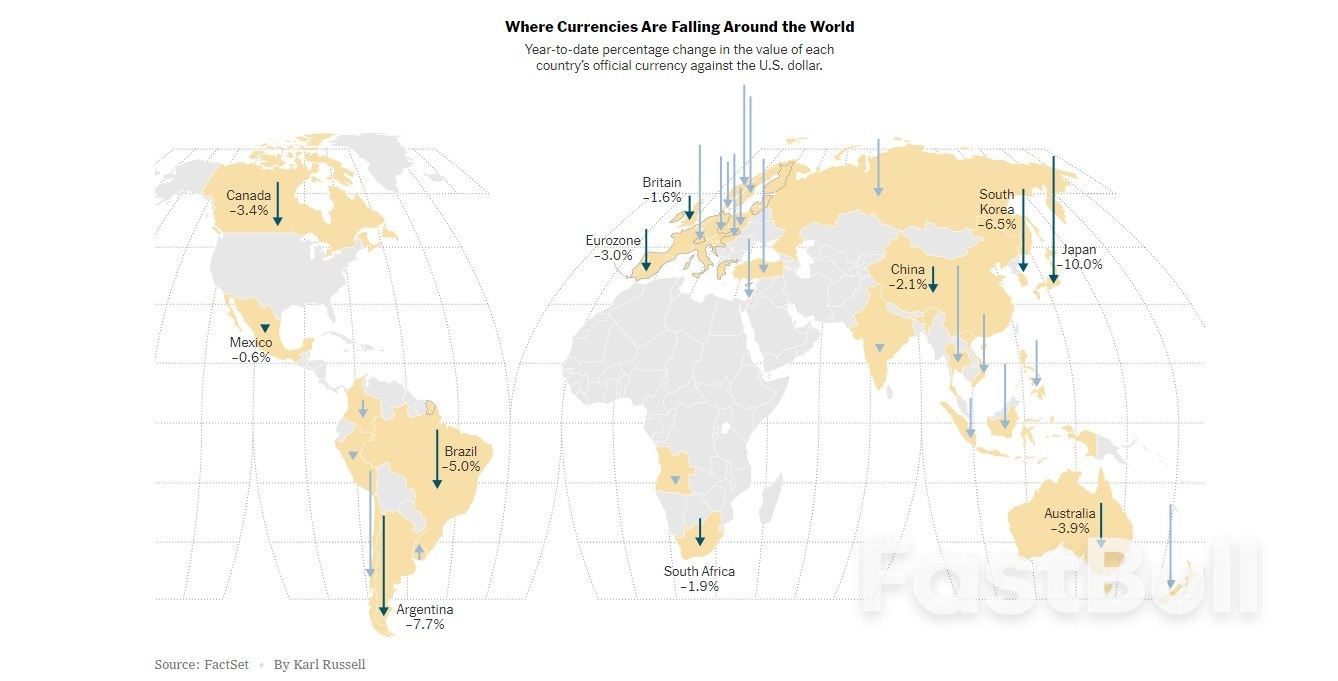
          A Strong U.S. Dollar Weighs on the World_1Every major currency in the world has fallen against the U.S. dollar this year, an unusually broad shift with the potential for serious consequences across the global economy.
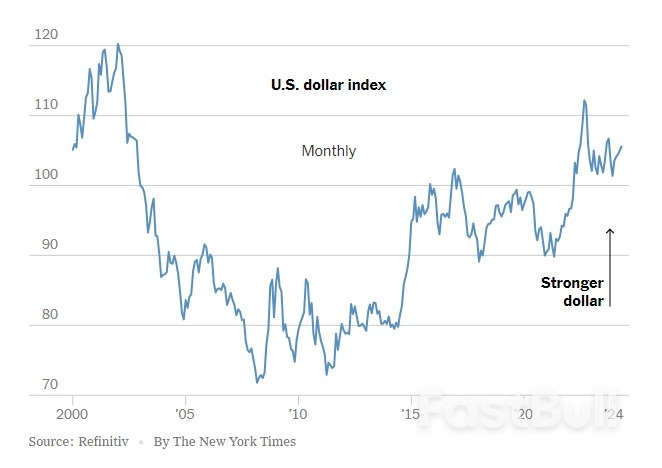
          Two-thirds of the roughly 150 currencies tracked by Bloomberg have weakened against the dollar, whose recent strength stems from a shift in expectations about when and by how much the Federal Reserve may cut its benchmark interest rate, which sits around a 20-year high.
          High Fed rates, a response to stubborn inflation, mean that American assets offer better returns than much of the world, and investors need dollars to buy them. In recent months, money has flowed into the United States with a force that's being felt by policymakers, politicians and people from Brussels to Beijing, Toronto to Tokyo.
          The dollar index, a common way to gauge the general strength of the U.S. currency against a basket of its major trading partners, is hovering at levels last seen in the early 2000s (when U.S. interest rates were also similarly high).
          The yen is at a 34-year low against the U.S. dollar. The euro and Canadian dollar are sagging. The Chinese yuan has shown notable signs of weakness, despite officials' stated intent to stabilize it.
          "It has never been truer that the Fed is the world's central bank," said Jesse Rogers, an economist at Moody's Analytics.
          A Strong U.S. Dollar Weighs on the World_2When the dollar strengthens, the effects can be fast and far-reaching.
          The dollar is on one side of nearly 90 percent of all foreign exchange transactions. A strengthening U.S. currency intensifies inflation abroad, as countries need to swap more of their own currencies for the same amount of dollar-denominated goods, which include imports from the United States as well as globally traded commodities, like oil, often priced in dollars. Countries that have borrowed in dollars also face higher interest bills.
          There can be benefits for some foreign businesses, however. A strong dollar benefits exporters that sell to the United States, as Americans can afford to buy more foreign goods and services (including cheaper vacations). That puts American companies that sell abroad at a disadvantage, since their goods appear more expensive, and could widen the U.S. trade deficit at a time when President Biden is promoting more domestic industry.
          Exactly how these positives and negatives shake out depends on why the dollar is stronger, and that depends on the reason U.S. interests rates might remain high.
          Earlier in the year, unexpectedly strong U.S. growth, which can lift the global economy, had begun to outweigh worries over stubborn inflation. But if U.S. rates remain high because inflation is sticky even as economic growth slows, then the effects could be more "sinister," said Kamakshya Trivedi, an analyst at Goldman Sachs.
          In that case, policymakers would be stuck between supporting their domestic economies by cutting rates or supporting their currency by keeping them high. "We are at the cusp of that," Mr. Trivedi said.
          The strong dollar's effects have been felt particularly sharply in Asia. This month, the finance ministers of Japan, South Korea and the United States met in Washington, and among other things they pledged to "consult closely on foreign exchange market developments." Their post-meeting statement also noted the "serious concerns of Japan and the Republic of Korea about the recent sharp depreciation of the Japanese yen and the Korean won."
          The Korean won is the weakest it has been since 2022, and the country's central bank governor recently called moves in the currency market "excessive."
          The yen has been tumbling against the dollar, and on Monday briefly slipped past 160 yen to the dollar for the first time since 1990. In sharp contrast to the Fed in the United States, Japan's central bank began raising interest rates only this year after struggling for decades with low growth.
          For Japanese officials, that means striking a delicate balance — increase rates, but not by too much in a way that could stifle growth. The consequence of that balancing act is a weakened currency, as rates have stayed near zero. The risk is that if the yen continues to weaken, investors and consumers may lose confidence in the Japanese economy, shifting more of their money abroad.
          A similar risk looms for China, whose economy has been battered by a real estate crisis and sluggish spending at home. The country, which seeks to hold its currency within a tight range, has recently relaxed its stance and allowed the yuan to weaken, a demonstration of the pressure exerted by the dollar in financial markets and on other countries' policy decisions.
          "A weaker yuan is not a sign of strength," said Brad Setser, a senior fellow at the Council on Foreign Relations and former Treasury Department economist. "It will lead to questions about whether China's economy is as strong as people thought."
          In Europe, policymakers at the European Central Bank have signaled that they could cut rates at their next meeting, in June. But even with inflation improving in the eurozone, there is a concern among some that by lowering interest rates before the Fed, the E.C.B. would widen the difference in interest rates between the eurozone and the United States, further weakening the euro.
          Gabriel Makhlouf, governor of Ireland's central bank and one of the 26 members of the E.C.B.'s governing council, said that when setting policy, "we can't ignore what's happening in the U.S."
          Other policymakers are confronting similar complications, with central banks in South Korea and Thailand among those also considering lowering interest rates.
          By contrast, Indonesia's central bank unexpectedly raised rates last week, in part to support the country's depreciating currency, a sign of how the dollar's strength is reverberating around the world in different ways. Some of the fastest-falling currencies this year, like those in Egypt, Lebanon and Nigeria, reflect domestic challenges made even more daunting by the pressure exerted by a stronger dollar.
          "We are on the edge of a storm," Mr. Rogers of Moody's said.

          Source: The New York Times

          To stay updated on all economic events of today, please check out our Economic calendar
          Risk Warnings and Disclaimers
          You understand and acknowledge that there is a high degree of risk involved in trading. Following any strategies or investment methods may lead to potential losses. The content on the site is provided by our contributors and analysts for information purposes only. You are solely responsible for determining whether any trading assets, securities, strategy, or any other product is suitable for investing based on your own investment objectives and financial situation.
          Add to Favorites
          Share

          The Fed Would Only Cut Rates to Help the U.S. Service Its Soaring Debt, Fund Manager Says

          Warren Takunda

          Economic

          Bond

          The only reason the Federal Reserve might be tempted to cut rates would be to help the U.S. cover interest payments for the national debt, according to fund manager Freddie Lait.
          His comments come ahead of the Federal Reserve’s monetary policy decision on Wednesday, which could shed some light on the U.S. central bank’s rate trajectory. The Fed is widely expected to keep its benchmark overnight borrowing rate in a range between 5.25%-5.5%.
          Traders are currently only pricing in about a 50% chance of a Fed rate cut taking place as early as September and expect just one quarter-percentage-point reduction by the end of the year, according to the CME FedWatch Tool.
          Speaking to CNBC’s “Squawk Box Europe” on Wednesday, Latitude Investment Management’s Lait said he believed the current level of interest rates was “perfectly fine” to balance the inflation and growth outlook for the world’s largest economy.
          “I think it is for the birds to think that in a world where inflation is bottoming, and in some cases turning up, and there’s early signs of life, partially due to the strong economy with massive government stimulus behind it, that they are going to be cutting in any meaningful way,” Lait said.
          “From the way we have thought about it for the last 15 years, and I think for longer too, there is no economic rationale for cutting. The reason they might cut is because the U.S. government can’t afford [them not doing] it — and that’s a much scarier reason to have to cut,” he added.
          A spokesperson for the Federal Reserve declined to comment.
          The U.S. government is paying more to service its ballooning debt after a period of rapid interest rate hikes, tax cuts, and massive stimulus programs designed to support the economy during the Covid-19 pandemic.
          A recent analysis by the Congressional Budget Office showed that U.S. federal spending on interest payments is expected to climb to $870 billion this year. The forecast reflects a 32% jump from last year’s interest expense of $659 billion.

          Growth in interest payments ‘quite staggering’

          Lait said that “exponential” growth in government spending on U.S. debt would likely pose a problem for whoever wins the November presidential election.
          “The facts are there now. You have borrowed the money. You’re running a fiscal deficit of 5, 6%. Either you withdraw all the stimulus programs and that still takes a wind down period, which is going to be a real challenge especially in somewhere like America where they are sort of legislated, or you have to borrow that money.”
          Asked whether he believed the U.S. government debt load may be becoming unattractive for a number of key international investors, Lait replied, “Yes and the solution would either be to live with much higher yields or [with] much lower government spending, because that would reduce issuance and solve the problem a different way.”
          He added, “It’s a little bit conspiracy theory-esque because the level of debt has never mattered. Debt to GDP has gone up every year since the war. And so, it’s gone up like a straight line and the markets have bull and bear markets.”
          However, Lait said the level of U.S. national debt was not the point.
          “It’s kind of the changes in it and the construction of it. And I think it is just the growth in those interest payments are really quite staggering,” he said.

          Source: CNBC

          To stay updated on all economic events of today, please check out our Economic calendar
          Risk Warnings and Disclaimers
          You understand and acknowledge that there is a high degree of risk involved in trading. Following any strategies or investment methods may lead to potential losses. The content on the site is provided by our contributors and analysts for information purposes only. You are solely responsible for determining whether any trading assets, securities, strategy, or any other product is suitable for investing based on your own investment objectives and financial situation.
          Add to Favorites
          Share

          XRP, SOL, DOGE Open Interest Falls a Combined 51% in the Last Month

          Warren Takunda

          Economic

          Cryptocurrency

          The open interest (OI) of major cryptocurrencies, including XRP
          XRP, Solana’s and Dogecoin have plunged a combined 51% in the last month.
          “Market participants are becoming disinterested, which is reflected in the drop in open interest,” crypto trader TheCryptoMann wrote in an April 30 post on X.
          OI measures the total value of all outstanding or unsettled crypto futures contracts across exchanges. It is a key metric traders and analysts use to assess market sentiment and anticipate future price movements.
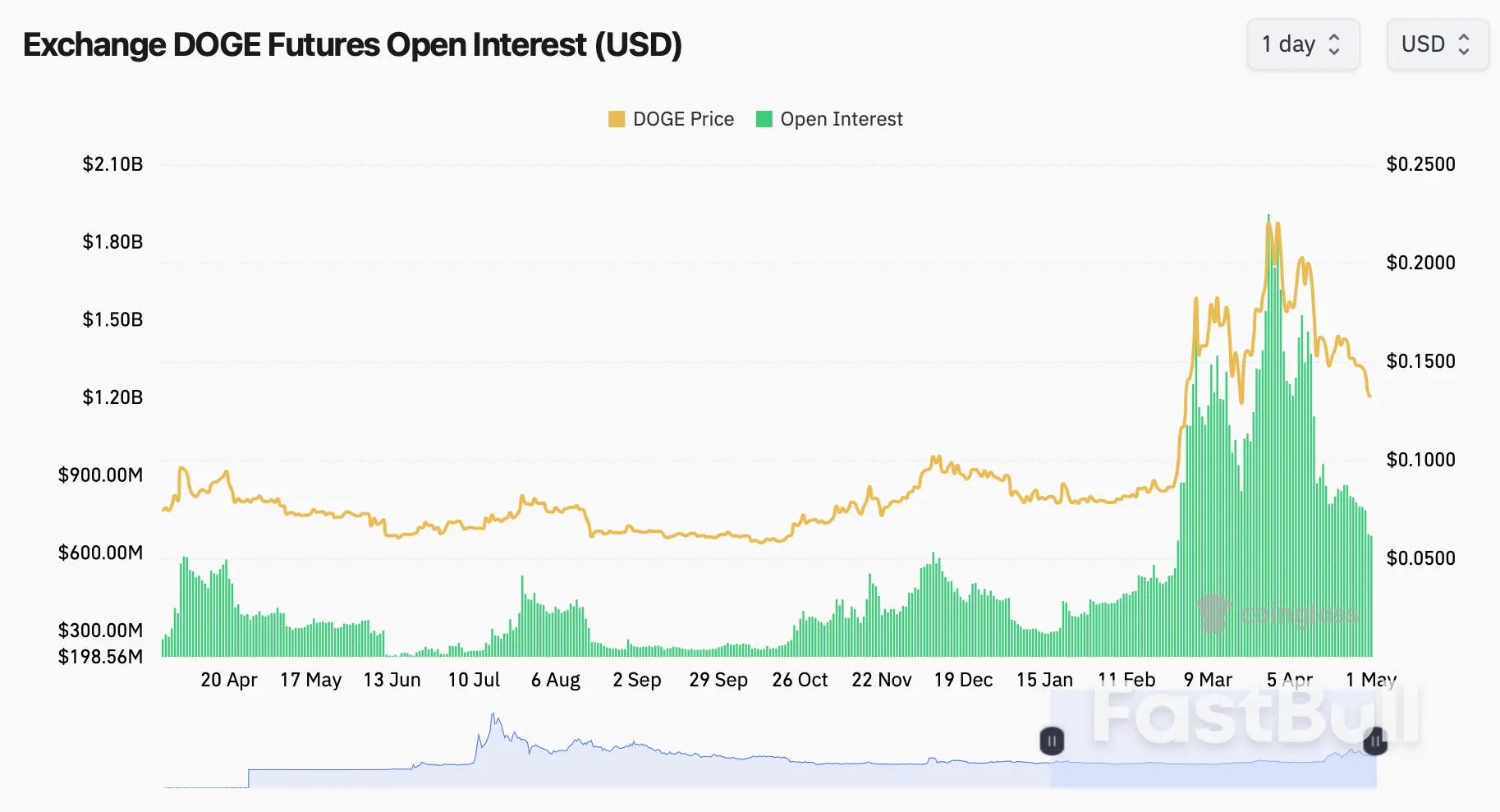
          Dogecoin experienced the largest decline in OI among the nine largest cryptocurrencies by market capitalization, falling 64% to $668.2 million since April 1, according to CoinGlass data.
          Solana’s open interest is currently at $1.51 billion, which represents a 47% decrease since April 1.
          Meanwhile, XRP’s OI stands at $497.67 million, marking a 44% decrease within the same time frame.XRP, SOL, DOGE Open Interest Falls a Combined 51% in the Last Month  _1

          Open interest of Dogecoin has declined 64% over the past month. Source: CoinGlass

          Market instability often contributes to declining OI, as traders become unsure about the market’s direction and are less willing to take bets on either side of the price action.
          “Open interest close to all-time lows since FTX nuke,” crypto trader TheoTrader wrote in an April 26 post on X, noting that the current OI levels are similar to those seen around the November 2022 collapse of the now-defunct crypto exchange FTX.
          The aftermath of the April 20 Bitcoin halving — which has seen Bitcoin miner revenue fall to new yearly lows — is another major catalyst of market uncertainty in the current conditions.
          There are expectations of a further market correction, but it’s unclear how severe it might be, causing fewer traders to take new positions.
          The two leading cryptocurrencies by market capitalization have also experienced a drop in OI coinciding with price declines across the wider market.
          Bitcoin open interest has decreased by 21% to $25.58 billion, while its price has fallen 14.87% to $60,149 at the time of publication, per CoinMarketCap data.
          Similarly, Ether has seen a 22% drop in open interest to $10.02 billion, with its price declining by 16.67% and currently trading slightly above the key support level at $3,005.
          Over the past 30 days, more capital has moved away from altcoins and into Bitcoin. As a result, Bitcoin dominance — BTC’s relative share of the total crypto market cap — has increased by 2.13%, reaching 54.77%, according to TradingView data.

          Source: Cointelegraph

          To stay updated on all economic events of today, please check out our Economic calendar
          Risk Warnings and Disclaimers
          You understand and acknowledge that there is a high degree of risk involved in trading. Following any strategies or investment methods may lead to potential losses. The content on the site is provided by our contributors and analysts for information purposes only. You are solely responsible for determining whether any trading assets, securities, strategy, or any other product is suitable for investing based on your own investment objectives and financial situation.
          Add to Favorites
          Share

          Pound to Dollar: Test of 1.22 Possible Says One Analyst

          Warren Takunda

          Economic

          Forex

          The Pound to Dollar exchange rate lost one per cent in value during April, but losses had extended to 2.50% before a late-month recovery.
          A recent relief rally back to 1.25 eases some near-term downside pressure, but analysts are looking for the selloff to resume and deliver lows not seen since last November ultimately.
          "GBP/USD and EUR/USD can take their cue from USD. GBP/USD can test support at 1.2298 if strong US data and/or a hawkish FOMC pushes up U.S. yields and the USD significantly," says Kristina Clifton, a strategist at Commonwealth Bank.
          The new month kicks off with the Federal Reserve interest rate decision, where policymakers are expected to sound less confident about the prospects of bringing inflation back to the 2.0% target anytime soon, meaning they will validate market expectations for later rate cuts.
          Markets entered the year expecting up to 150 basis points of cuts, but this now stands at just 25bps following a rerating in expectations that has propelled the Dollar to the top of the 2024 performance charts.
          The first rate cut is now anticipated by December, but the market could push this back into 2025 if Fed Chair Powell and his colleagues warn inflation is going in the wrong direction, which can offer the Dollar further support.
          "The FOMC is expected to leave the Funds rate unchanged. The focus of financial markets will be the post‑meeting statement and Chair Powell’s press conference. We expect Powell to be hawkish; the question is will he be more hawkish than market expectations. We would not be surprised if financial markets remove all rate cuts priced for 2024 this week, supporting the USD to lift above 107pts," says Clifton.
          Most major USD-based currency pairs are in short- to medium-term downtrends against the Dollar, with the Pound-Dollar exchange rate's trend clearly visible:
          Pound to Dollar: Test of 1.22 Possible Says One Analyst_1

          Above: GBP/USD at daily intervals.

          "It is quite possible that there could be more downside in cable if speculators build short positions, but the 1.22 level will likely be a near-term floor," says Chester Notifor, a foreign exchange strategist at BCA Research.
          The Dollar strengthened on April 30 after a measure of wages favoured by the Federal Reserve came in above expectations and added fresh evidence that inflationary pressures were building again.
          U.S. labour costs rose by 1.2% in the first quarter versus the 1.0% expected. "The Q1 reading for the Employment Cost Index (ECI) was yet another data point suggesting that progress on inflation is stalling out," says Sarah House, an economist at Wells Fargo.
          But, Bullish USD Positioning Opens the Door to Disappointment
          Wednesday's Federal Reserve policy decision will be followed by the non-farm payroll report at the end of the week, which will be the first of the major data releases from the U.S. for May.
          The labour market has consistently beaten analyst expectations and markets are primed for another strong reading.
          Given the already USD-hawkish setup of the foreign exchange markets, the bigger risks are to the downside on any unexpected weakness in the upcoming data.
          Paul Robson, a foreign exchange strategist at NatWest Markets says the market "is clearly positioned" for a continuation of U.S. economic and USD dominance.
          "That naturally ups the ante for US economic data to outperform a seemingly ever-rising bar," he says.
          In short, big beats to the upside are now required to derive substantive Dollar advances, whereas small downside surprises can deliver meaningful moves to the downside.
          While GBP/USD can still fall to a floor at 1.22, the prospect of some May relief cannot be discounted if some of the recent heat is taken out of the recent trend by more mundane economic releases.

          Source: Poundsterlinglive

          To stay updated on all economic events of today, please check out our Economic calendar
          Risk Warnings and Disclaimers
          You understand and acknowledge that there is a high degree of risk involved in trading. Following any strategies or investment methods may lead to potential losses. The content on the site is provided by our contributors and analysts for information purposes only. You are solely responsible for determining whether any trading assets, securities, strategy, or any other product is suitable for investing based on your own investment objectives and financial situation.
          Add to Favorites
          Share

          Dollar Near Five-Month Highs Ahead of Fed Policy Decision

          Warren Takunda

          Economic

          Forex

          The dollar edged towards its highest level this year against a basket of peers and U.S. share futures dipped on Wednesday ahead of a Federal Reserve policy decision, though trading was thin with many European and Asian markets closed.
          The dollar gained over 0.5% on Tuesday on all six currencies that make up the dollar index, leaving the gauge at 106.49, a whisker off its highest since November.
          The euro was under pressure at $1.0664, heading back to its mid April five-month lows, while the pound was at $1.2488.
          The latest move higher in the dollar came with after hotter-than-expected first-quarter U.S. employment cost growth on Tuesday, which sent Treasury yields higher and caused markets to further pare bets on Fed rate cuts this year.
          Traders are currently only pricing in one rate cut in 2024.
          The Fed is almost certain to hold its benchmark overnight interest rate steady later in the day, but a policy statement issued at 2 p.m. EDT (1800 GMT) and Chair Jerome Powell's press conference half an hour later should provide insight into how deeply – if at all – a stretch of three lost months in the inflation battle has affected the likelihood that borrowing costs will fall any time soon.
          "It's pretty clear from the way that the data has been that we're going to see a focus shift from the last Fed meeting, the question is the extent to which Powell has already previewed the shift of rhetoric when he last spoke," said Michael Sneyd, head of cross-asset and macro quantitative strategy, BNP Paribas.
          The Fed chair said in mid-April that monetary policy needs to be restrictive for longer.
          "Heading into the Fed, we see that from a short-term perspective the dollar is not looking cheap anywhere," said Sneyd.
          "Positioning-wise we're seeing the dollar looking well-owned, valuation-wise we see the dollar is either in line with a stronger dollar fair value or slightly rich, and so that demonstrates the market is preempting this more hawkish shift, and, if anything, opens up scope for disappointment."
          The benchmark 10-year Treasury yield was flat on the day at 4.690% , just shy of mid-April's 4.739% its highest in five months, having jumped 7 bps the day before.
          European bond markets were closed for the May 1 holiday as were most share markets in Europe and those in China, Hong Kong and much of Asia. U.S. S&P500 futures dipped 0.2%.
          Of those share markets that were trading, Britain's FTSE (.FTSE) edged up a touch, holding near its latest all-time intraday high hit the day before and Japan's Nikkei dipped 0.3%. (.N225)
          The British blue-chip index, which has underperformed world peers in recent months, was a rare gainer in April, rising 2.4% helped by commodities stocks, while MSCI's world index dropped 3.4%, its biggest monthly fall since September.
          The other focus in currency markets is the Japanese yen. The currency dropped to 160 per dollar on Monday, its lowest since 1990, before strengthening in several sharp bursts to as strong as 154.4 per dollar with traders pointing to likely official intervention.
          Japanese officials may have spent some 5.5 trillion yen($35.05 billion) in supporting the currency on Monday, Bank of Japan data suggested on Tuesday, but the yen was last at 157.9, over half way back to its pre-intervention level.
          Oil prices fell for a third day on Wednesday amid increasing hopes of a ceasefire agreement in the Middle East and rising crude inventories and production in the U.S., the world's biggest oil consumer.
          Brent was down 1% at $85.40 a barrel. U.S. crude was down 1.3% at $80.90.
          Gold was flat at $2284.4 an ounce down 6% from its mid-April record high, also affected by easing tensions in the Middle East.

          Source: Reuters

          To stay updated on all economic events of today, please check out our Economic calendar
          Risk Warnings and Disclaimers
          You understand and acknowledge that there is a high degree of risk involved in trading. Following any strategies or investment methods may lead to potential losses. The content on the site is provided by our contributors and analysts for information purposes only. You are solely responsible for determining whether any trading assets, securities, strategy, or any other product is suitable for investing based on your own investment objectives and financial situation.
          Add to Favorites
          Share

          Is Coca-Cola (KO) Stock A Buy? Analysis and Insights

          Glendon

          Economic

          For over a century, Coca-Cola (KO) has been a household name synonymous with refreshment and global brand recognition. But beyond the iconic red can lies a powerful publicly traded company – Coca-Cola stock. This article dives into the history, business model, strengths, and weaknesses of KO stock, helping you decide if it deserves a place in your investment portfolio.

          A Legacy of Refreshment: A Look Back at Coca-Cola's History

          The Coca-Cola story began in 1886 when John Pemberton, a pharmacist in Atlanta, Georgia, concocted a caramel-colored syrup. Fast forward to today, and Coca-Cola is a global beverage behemoth with a diverse portfolio of over 500 brands, including Sprite, Fanta, and Powerade.
          The company's success hinges on several key factors:
          Strong Brand Recognition: Coca-Cola is one of the world's most recognizable brands, with a loyal customer base and powerful marketing reach.
          Global Distribution Network: Coke products are available in over 200 countries, offering a vast and diverse market.
          Focus on Innovation: While Coca-Cola Classic remains a bestseller, the company continually innovates, introducing new products and flavors to cater to evolving consumer preferences.
          The Power of Bottling Franchises: Coca-Cola utilizes a unique franchise model, where local bottlers manufacture, distribute, and market its products, ensuring efficient global reach.The Business Model of Coca-Cola (KO) StockUnderstanding KO stock requires dissecting Coca-Cola's business model. Here's a breakdown:
          Concentrate Sales: The core business involves selling beverage concentrates to authorized bottlers, who then produce, bottle, and distribute finished drinks.
          Marketing and Advertising: Coca-Cola invests heavily in global marketing campaigns to maintain brand awareness and drive sales.
          Revenue Streams: Profits come from concentrate sales to bottlers, royalties on bottlers' sales volume, and income from company-owned bottling operations in certain regions.This model provides a steady stream of revenue and profitability, contributing to KO stock's appeal for income-oriented investors.

          Strengths of KO Stock: A Recipe for Long-Term Success

          Several factors make KO stock an attractive investment for some:
          Dividend Aristocrat: Coca-Cola boasts a long history of increasing its dividend payouts, making it a valuable holding for income investors seeking reliable dividends.
          Defensive Stock: As a consumer staple, Coca-Cola's products are in constant demand, making the stock less volatile during economic downturns.
          Global Presence: The company's vast global reach mitigates risk associated with any single market.
          Strong Brand Portfolio: With a diverse brand portfolio, Coca-Cola can cater to different consumer preferences and adapt to changing market trends.

          Weaknesses of KO Stock: Fizz or Flatline?

          KO stock also has some challenges to consider:
          Competition: The beverage industry is fiercely competitive, with established players like PepsiCo and emerging challenger brands vying for market share.
          Sugar Concerns: Growing health concerns about sugary drinks could impact future sales, especially in developed markets.
          Saturated Markets: Coca-Cola faces challenges in expanding market share in developed markets, forcing them to focus on emerging markets with potential growth.
          Currency Fluctuations: As a global company, Coca-Cola's earnings can be impacted by fluctuations in foreign currencies.

          Is KO Stock Right for You?

          The decision to invest in KO stock depends on your individual investment goals and risk tolerance. Here are some factors to weigh:
          Investment Horizon: KO stock is a good fit for long-term investors seeking dividend income and a stable holding.
          Risk Tolerance: The stock offers lower volatility compared to growth stocks, but still carries inherent market risks.
          Investment Goals: If consistent dividend income and a defensive play are your priorities, KO stock might be a good choice.

          Conclusion: Coke Stock - A Fizzy Investment with a Long History

          Coca-Cola (KO) stock has a long and successful history, offering investors a brand with global recognition, a stable business model, and a history of reliable dividends. While competition and changing consumer preferences pose challenges, KO stock remains a potential source of steady returns for long-term investors seeking a defensive play in their portfolio. However, thorough research and an understanding of your investment goals are crucial before making any investment decisions.
          To stay updated on all economic events of today, please check out our Economic calendar
          Risk Warnings and Disclaimers
          You understand and acknowledge that there is a high degree of risk involved in trading. Following any strategies or investment methods may lead to potential losses. The content on the site is provided by our contributors and analysts for information purposes only. You are solely responsible for determining whether any trading assets, securities, strategy, or any other product is suitable for investing based on your own investment objectives and financial situation.
          Add to Favorites
          Share

          10 Stocks to Consider Selling After Earnings Reports

          Glendon

          Economic

          Earnings reports often serve as pivotal moments for investors, influencing stock prices based on company performance and future outlook. In this article, we'll discuss ten specific stocks that investors may want to consider selling after their most recent earnings reports.

          1. Apple Inc. (AAPL)

          Apple, a technology giant known for its iPhones, iPads, and Mac computers, recently released its earnings report. While the company reported strong revenue, there were concerns about slowing iPhone sales and supply chain disruptions. Additionally, Apple issued cautious guidance for the upcoming quarter, leading to a decline in the stock price.
          Why Consider Selling: Given the uncertainties surrounding iPhone sales and supply chain issues, investors may want to consider selling Apple stock to mitigate potential losses.

          2. Tesla Inc. (TSLA)

          Tesla, a leader in electric vehicles and renewable energy, recently reported its earnings, which showed a profit but fell short of analysts' expectations. The company also issued conservative guidance for vehicle deliveries, citing global supply chain challenges and semiconductor shortages.
          Why Consider Selling: With concerns about supply chain disruptions and lower-than-expected earnings, investors may want to consider selling Tesla stock to avoid potential losses.

          3. Amazon.com Inc. (AMZN)

          Amazon, a dominant force in e-commerce and cloud computing, recently reported earnings that exceeded expectations. However, the company issued guidance that fell below analysts' estimates, citing increased spending on infrastructure and logistics.
          Why Consider Selling: Despite strong earnings, Amazon's conservative guidance and increased spending may impact future profitability, leading investors to consider selling their shares.

          4. Alphabet Inc. (GOOGL)

          Alphabet, the parent company of Google, recently reported earnings that beat expectations. However, the company's revenue growth rate has been slowing, and there are concerns about increased regulatory scrutiny and competition in the tech sector.
          Why Consider Selling: With slowing revenue growth and regulatory challenges, investors may want to consider selling Alphabet stock to avoid potential downside risk.

          5. Facebook, Inc. (FB)

          Facebook, a social media giant, recently reported earnings that were mixed, with revenue beating expectations but user growth slowing. Additionally, the company issued guidance that was lower than analysts' estimates, citing challenges in digital advertising.
          Why Consider Selling: With slowing user growth and challenges in digital advertising, investors may want to consider selling Facebook stock to mitigate potential losses.

          6. Microsoft Corporation (MSFT)

          Microsoft, a leader in software and cloud services, recently reported earnings that exceeded expectations. However, the company's growth rate has been slowing, and there are concerns about increased competition in the cloud computing market.
          Why Consider Selling: With slowing growth and increased competition, investors may want to consider selling Microsoft stock to avoid potential downside risk.

          7. Netflix, Inc. (NFLX)

          Netflix, a streaming video pioneer, recently reported earnings that missed expectations, with subscriber growth falling short. The company also issued guidance that was lower than analysts' estimates, citing increased competition in the streaming market.
          Why Consider Selling: With slowing subscriber growth and increased competition, investors may want to consider selling Netflix stock to avoid potential losses.

          8. Walmart Inc. (WMT)

          Walmart, a retail giant, recently reported earnings that beat expectations. However, the company's e-commerce growth has been slowing, and there are concerns about increased competition from online retailers.
          Why Consider Selling: With slowing e-commerce growth and increased competition, investors may want to consider selling Walmart stock to mitigate potential downside risk.

          9. Johnson & Johnson (JNJ)

          Johnson & Johnson, a healthcare conglomerate, recently reported earnings that were mixed, with revenue beating expectations but profits falling short. The company also issued guidance that was lower than analysts' estimates, citing increased competition in the healthcare sector.
          Why Consider Selling: With lower-than-expected profits and increased competition, investors may want to consider selling Johnson & Johnson stock to avoid potential losses.

          10. Exxon Mobil Corporation (XOM)

          Exxon Mobil, an oil and gas giant, recently reported earnings that missed expectations, with profits falling short. The company also issued guidance that was lower than analysts' estimates, citing challenges in the energy sector.
          Why Consider Selling: With lower-than-expected profits and challenges in the energy sector, investors may want to consider selling Exxon Mobil stock to mitigate potential downside risk.
          Conclusion While each stock's performance should be evaluated based on individual circumstances and investment goals, the recent earnings reports of these ten companies highlight factors that investors may want to consider when deciding whether to sell their shares.
          To stay updated on all economic events of today, please check out our Economic calendar
          Risk Warnings and Disclaimers
          You understand and acknowledge that there is a high degree of risk involved in trading. Following any strategies or investment methods may lead to potential losses. The content on the site is provided by our contributors and analysts for information purposes only. You are solely responsible for determining whether any trading assets, securities, strategy, or any other product is suitable for investing based on your own investment objectives and financial situation.
          Add to Favorites
          Share
          FastBull
          Copyright © 2025 FastBull Ltd

          728 RM B 7/F GEE LOK IND BLDG NO 34 HUNG TO RD KWUN TONG KLN HONG KONG

          TelegramInstagramTwitterfacebooklinkedin
          App Store Google Play Google Play
          Products
          Charts

          Chats

          Q&A with Experts
          Screeners
          Economic Calendar
          Data
          Tools
          Membership
          Features
          Function
          Markets
          Copy Trading
          Latest Signals
          Contests
          News
          Analysis
          24/7
          Columns
          Education
          Company
          Careers
          About Us
          Contact Us
          Advertising
          Help Center
          Feedback
          User Agreement
          Privacy Policy
          Business

          White Label

          Data API

          Web Plug-ins

          Poster Maker

          Affiliate Program

          Risk Disclosure

          The risk of loss in trading financial instruments such as stocks, FX, commodities, futures, bonds, ETFs and crypto can be substantial. You may sustain a total loss of the funds that you deposit with your broker. Therefore, you should carefully consider whether such trading is suitable for you in light of your circumstances and financial resources.

          No decision to invest should be made without thoroughly conducting due diligence by yourself or consulting with your financial advisors. Our web content might not suit you since we don't know your financial conditions and investment needs. Our financial information might have latency or contain inaccuracy, so you should be fully responsible for any of your trading and investment decisions. The company will not be responsible for your capital loss.

          Without getting permission from the website, you are not allowed to copy the website's graphics, texts, or trademarks. Intellectual property rights in the content or data incorporated into this website belong to its providers and exchange merchants.

          Not Logged In

          Log in to access more features

          FastBull Membership

          Not yet

          Purchase

          Become a signal provider
          Help Center
          Customer Service
          Dark Mode
          Price Up/Down Colors

          Log In

          Sign Up

          Position
          Layout
          Fullscreen
          Default to Chart
          The chart page opens by default when you visit fastbull.com