• Trade
  • Markets
  • Copy
  • Contests
  • News
  • 24/7
  • Calendar
  • Q&A
  • Chats
Trending
Screeners
SYMBOL
LAST
BID
ASK
HIGH
LOW
NET CHG.
%CHG.
SPREAD
SPX
S&P 500 Index
6860.31
6860.31
6860.31
6878.28
6858.25
-10.09
-0.15%
--
DJI
Dow Jones Industrial Average
47869.81
47869.81
47869.81
47971.51
47771.72
-85.17
-0.18%
--
IXIC
NASDAQ Composite Index
23574.53
23574.53
23574.53
23698.93
23574.53
-3.59
-0.02%
--
USDX
US Dollar Index
99.070
99.150
99.070
99.110
98.730
+0.120
+ 0.12%
--
EURUSD
Euro / US Dollar
1.16291
1.16298
1.16291
1.16717
1.16245
-0.00135
-0.12%
--
GBPUSD
Pound Sterling / US Dollar
1.33166
1.33173
1.33166
1.33462
1.33087
-0.00146
-0.11%
--
XAUUSD
Gold / US Dollar
4191.26
4191.67
4191.26
4218.85
4175.92
-6.65
-0.16%
--
WTI
Light Sweet Crude Oil
59.036
59.066
59.036
60.084
58.892
-0.773
-1.29%
--

Community Accounts

Signal Accounts
--
Profit Accounts
--
Loss Accounts
--
View More

Become a signal provider

Sell trading signals to earn additional income

View More

Guide to Copy Trading

Get started with ease and confidence

View More

Signal Accounts for Members

All Signal Accounts

Best Return
  • Best Return
  • Best P/L
  • Best MDD
Past 1W
  • Past 1W
  • Past 1M
  • Past 1Y

All Contests

  • All
  • Trump Updates
  • Recommend
  • Stocks
  • Cryptocurrencies
  • Central Banks
  • Featured News
Top News Only
Share

The S&P 500 Opened 4.80 Points Higher, Or 0.07%, At 6875.20; The Dow Jones Industrial Average Opened 16.52 Points Higher, Or 0.03%, At 47971.51; And The Nasdaq Composite Opened 60.09 Points Higher, Or 0.25%, At 23638.22

Share

Reuters Poll - Swiss National Bank Policy Rate To Be 0.00% At End-2026, Said 21 Of 25 Economists, Four Said It Would Be Cut To -0.25%

Share

USGS - Magnitude 7.6 Earthquake Strikes Misawa, Japan

Share

Reuters Poll - Swiss National Bank To Hold Policy Rate At 0.00% On December 11, Said 38 Of 40 Economists, Two Said Cut To -0.25%

Share

Traders Believe There Is A 20% Chance That The European Central Bank Will Raise Interest Rates Before The End Of 2026

Share

Toronto Stock Index .GSPTSE Rises 11.99 Points, Or 0.04 Percent, To 31323.40 At Open

Share

Japan Meteorological Agency: A Tsunami With A Maximum Height Of Three Meters Is Expected Following The Earthquake In Japan

Share

Japan Meteorological Agency: A 7.2-magnitude Earthquake Struck Off The Coast Of Northern Japan, And A Tsunami Warning Has Been Issued

Share

Japan Finance Minister Katayama: G7 Expected To Hold Another Meeting By The End Of This Year

Share

The Japan Meteorological Agency Reported That An Earthquake Occurred In The Sea Near Aomori

Share

Japan Finance Minister Katayama: The G7 Finance Ministers' Meeting Discussed The Critical Mineral Supply Chain And Support For Ukraine

Share

Japan Finance Minister Katayama: Held Onlinemeeting With G7 Finance Ministers

Share

Fed Data - USA Effective Federal Funds Rate At 3.89 Percent On 05 December On $88 Billion In Trades Versus 3.89 Percent On $87 Billion On 04 December

Share

Chinese Foreign Minister Wang Yi: One-China Principle Is An Important Political Foundation For China-Germany Relations, And There Is No Room For Ambiguity

Share

Chinese Foreign Minister Wang Yi: Hopes Germany To Understand, Support China's Position Regarding Japan Prime Minister's Remark On Taiwan

Share

Chinese Foreign Minister Wang Yi: Hopes Germany Will View China More Objectively And Rationally, Adhere To The Positioning Of China-Germany Partnership

Share

China Foreign Ministry: China's Foreign Minister Wang Yi Meets German Counterpart

Share

Israeli Government Spokesperson: Netanyahu Will Meet Trump On December 29

Share

Stc Did Not Ask Internationally-Government To Leave Aden - Senior Stc Official To Reuters

Share

Members Of Internationally-Recognised Government, Opposed To Northern Houthis, Have Left Aden - Senior Stc Official To Reuters

TIME
ACT
FCST
PREV
France Trade Balance (SA) (Oct)

A:--

F: --

P: --
Euro Zone Employment YoY (SA) (Q3)

A:--

F: --

P: --
Canada Part-Time Employment (SA) (Nov)

A:--

F: --

P: --

Canada Unemployment Rate (SA) (Nov)

A:--

F: --

P: --

Canada Full-time Employment (SA) (Nov)

A:--

F: --

P: --

Canada Labor Force Participation Rate (SA) (Nov)

A:--

F: --

P: --

Canada Employment (SA) (Nov)

A:--

F: --

P: --

U.S. PCE Price Index MoM (Sept)

A:--

F: --

P: --

U.S. Personal Income MoM (Sept)

A:--

F: --

P: --

U.S. Core PCE Price Index MoM (Sept)

A:--

F: --

P: --

U.S. PCE Price Index YoY (SA) (Sept)

A:--

F: --

P: --

U.S. Core PCE Price Index YoY (Sept)

A:--

F: --

P: --

U.S. Personal Outlays MoM (SA) (Sept)

A:--

F: --

P: --
U.S. 5-10 Year-Ahead Inflation Expectations (Dec)

A:--

F: --

P: --

U.S. Real Personal Consumption Expenditures MoM (Sept)

A:--

F: --

P: --
U.S. Weekly Total Rig Count

A:--

F: --

P: --

U.S. Weekly Total Oil Rig Count

A:--

F: --

P: --

U.S. Consumer Credit (SA) (Oct)

A:--

F: --

P: --
China, Mainland Foreign Exchange Reserves (Nov)

A:--

F: --

P: --

Japan Trade Balance (Oct)

A:--

F: --

P: --

Japan Nominal GDP Revised QoQ (Q3)

A:--

F: --

P: --

China, Mainland Imports YoY (CNH) (Nov)

A:--

F: --

P: --

China, Mainland Exports (Nov)

A:--

F: --

P: --

China, Mainland Imports (CNH) (Nov)

A:--

F: --

P: --

China, Mainland Trade Balance (CNH) (Nov)

A:--

F: --

P: --

China, Mainland Exports YoY (USD) (Nov)

A:--

F: --

P: --

China, Mainland Imports YoY (USD) (Nov)

A:--

F: --

P: --

Germany Industrial Output MoM (SA) (Oct)

A:--

F: --

P: --
Euro Zone Sentix Investor Confidence Index (Dec)

A:--

F: --

P: --

Canada National Economic Confidence Index

A:--

F: --

P: --

U.K. BRC Like-For-Like Retail Sales YoY (Nov)

--

F: --

P: --

U.K. BRC Overall Retail Sales YoY (Nov)

--

F: --

P: --

Australia Overnight (Borrowing) Key Rate

--

F: --

P: --

RBA Rate Statement
RBA Press Conference
Germany Exports MoM (SA) (Oct)

--

F: --

P: --

U.S. NFIB Small Business Optimism Index (SA) (Nov)

--

F: --

P: --

Mexico 12-Month Inflation (CPI) (Nov)

--

F: --

P: --

Mexico Core CPI YoY (Nov)

--

F: --

P: --

Mexico PPI YoY (Nov)

--

F: --

P: --

U.S. Weekly Redbook Index YoY

--

F: --

P: --

U.S. JOLTS Job Openings (SA) (Oct)

--

F: --

P: --

China, Mainland M1 Money Supply YoY (Nov)

--

F: --

P: --

China, Mainland M0 Money Supply YoY (Nov)

--

F: --

P: --

China, Mainland M2 Money Supply YoY (Nov)

--

F: --

P: --

U.S. EIA Short-Term Crude Production Forecast For The Year (Dec)

--

F: --

P: --

U.S. EIA Natural Gas Production Forecast For The Next Year (Dec)

--

F: --

P: --

U.S. EIA Short-Term Crude Production Forecast For The Next Year (Dec)

--

F: --

P: --

EIA Monthly Short-Term Energy Outlook
U.S. API Weekly Gasoline Stocks

--

F: --

P: --

U.S. API Weekly Cushing Crude Oil Stocks

--

F: --

P: --

U.S. API Weekly Crude Oil Stocks

--

F: --

P: --

U.S. API Weekly Refined Oil Stocks

--

F: --

P: --

South Korea Unemployment Rate (SA) (Nov)

--

F: --

P: --

Japan Reuters Tankan Non-Manufacturers Index (Dec)

--

F: --

P: --

Japan Reuters Tankan Manufacturers Index (Dec)

--

F: --

P: --

Japan Domestic Enterprise Commodity Price Index MoM (Nov)

--

F: --

P: --

Japan Domestic Enterprise Commodity Price Index YoY (Nov)

--

F: --

P: --

China, Mainland PPI YoY (Nov)

--

F: --

P: --

China, Mainland CPI MoM (Nov)

--

F: --

P: --

Q&A with Experts
    • All
    • Chatrooms
    • Groups
    • Friends
    Connecting
    .
    .
    .
    Type here...
    Add Symbol or Code

      No matching data

      All
      Trump Updates
      Recommend
      Stocks
      Cryptocurrencies
      Central Banks
      Featured News
      • All
      • Russia-Ukraine Conflict
      • Middle East Flashpoint
      • All
      • Russia-Ukraine Conflict
      • Middle East Flashpoint
      Search
      Products

      Charts Free Forever

      Chats Q&A with Experts
      Screeners Economic Calendar Data Tools
      Membership Features
      Data Warehouse Market Trends Institutional Data Policy Rates Macro

      Market Trends

      Market Sentiment Order Book Forex Correlations

      Top Indicators

      Charts Free Forever
      Markets

      News

      News Analysis 24/7 Columns Education
      From Institutions From Analysts
      Topics Columnists

      Latest Views

      Latest Views

      Trending Topics

      Top Columnists

      Latest Update

      Signals

      Copy Rankings Latest Signals Become a signal provider AI Rating
      Contests
      Brokers

      Overview Brokers Assessment Rankings Regulators News Claims
      Broker listing Forex Brokers Comparison Tool Live Spread Comparison Scam
      Q&A Complaint Scam Alert Videos Tips to Detect Scam
      More

      Business
      Events
      Careers About Us Advertising Help Center

      White Label

      Data API

      Web Plug-ins

      Affiliate Program

      Awards Institution Evaluation IB Seminar Salon Event Exhibition
      Vietnam Thailand Singapore Dubai
      Fans Party Investment Sharing Session
      FastBull Summit BrokersView Expo
      Recent Searches
        Top Searches
          Markets
          News
          Analysis
          User
          24/7
          Economic Calendar
          Education
          Data
          • Names
          • Latest
          • Prev

          View All

          No data

          Scan to Download

          Faster Charts, Chat Faster!

          Download App
          English
          • English
          • Español
          • العربية
          • Bahasa Indonesia
          • Bahasa Melayu
          • Tiếng Việt
          • ภาษาไทย
          • Français
          • Italiano
          • Türkçe
          • Русский язык
          • 简中
          • 繁中
          Open Account
          Search
          Products
          Charts Free Forever
          Markets
          News
          Signals

          Copy Rankings Latest Signals Become a signal provider AI Rating
          Contests
          Brokers

          Overview Brokers Assessment Rankings Regulators News Claims
          Broker listing Forex Brokers Comparison Tool Live Spread Comparison Scam
          Q&A Complaint Scam Alert Videos Tips to Detect Scam
          More

          Business
          Events
          Careers About Us Advertising Help Center

          White Label

          Data API

          Web Plug-ins

          Affiliate Program

          Awards Institution Evaluation IB Seminar Salon Event Exhibition
          Vietnam Thailand Singapore Dubai
          Fans Party Investment Sharing Session
          FastBull Summit BrokersView Expo

          A ‘huge win’ for bulls: Markets soar on U.S.-China deal as Wall Street sees more upside

          Adam

          Stocks

          China–U.S. Trade War

          Summary:

          Markets rallied globally after a surprise U.S.-China deal slashed tariffs, boosting investor sentiment. Analysts called it a “dream scenario,” expecting renewed risk appetite, trade recovery, and further gains for U.S. stocks.

          Market watchers have labeled the new U.S.-China deal to temporarily cut tariffs “better than expected,” “more workable” and even a “dream scenario” — and are expecting more near-term relief for investors.
          Under the deal, so-called reciprocal tariffs will drop from over 100% to 10% on both sides. The Trump administration will keep 20% fentanyl-related tariffs on China in place, meaning America’s total duties on Chinese imports will stand at 30% while the 90-day pause is effective.
          Stocks in Europe and Asia rallied after the terms of the U.S.-China agreement were announced, with Europe’s Stoxx 600 index gaining 1%, Germany’s DAX hitting a 1-year high, and Hong Kong-listed shares jumping by around 3%.
          On Wall Street, U.S. stock futures also pointed to a rally, with Nasdaq futures up 3.8%, S&P 500 futures rising by 2.8% and Dow Jones Industrial Average futures gaining 3.1%.
          Analysts and strategists said on Monday that the new U.S.-China arrangement could reignite risk-on sentiment, benefiting stocks and U.S. assets.
          In a note to clients on Monday, Tai Hui, chief market strategist for Asia Pacific at JPMorgan Asset Management, said the deal unveiled in Geneva was better than anticipated, but uncertainty remained.
          “The magnitude of this tariff reduction is larger than expected,” he said, although he noted that it would be difficult for Beijing and Washington to reach a more concrete trade arrangement in just three months.
          “The 90-day period may not be sufficient for the two sides to reach a detailed agreement, but it keeps the pressure on the negotiation process,” Hui said. “We are still waiting for further details on other terms of this agreement, for example, whether China would relax on rare earth export restrictions.”
          However, Hui acknowledged the positive market reaction to the news.
          “Overall, we expect the market to get back on to a risk-on sentiment in the near term,” he said. “Pressure on the [Federal Reserve] to cut rates may also ease for the time being.”

          End of the ‘Sell America’ narrative?

          Jordan Rochester, head of currency strategy EMEA and executive director at Mizuho Bank in London, touted the deal as “much better news than expected” in a Monday morning note. He argued that the developments would mean “the ‘Sell America’ narrative [gets] squeezed.”
          U.S. assets, including the dollar , Treasurys and stocks, have seen major volatility in the weeks since Trump unveiled the full extent of his tariffs plans.
          On Monday morning, the U.S. dollar index , which measures the value of the greenback against a basket of major currencies, was up 1%. The yield on the benchmark U.S. 10-year Treasury note was up by 6 basis points as the price edged lower.
          According to Rochester, the 90-day deal takes the effective U.S. tariff rate — what Chinese companies will actually end up paying — from 108.8% to 27%, which he noted was well above the market consensus of a reduction to the range of 50% to 60%.
          “It is also notable how [officials] played down the requirement for talks to continue past 90 days in the press conference with ‘as long as talks are constructive,‘” he said. “What this means for international trade is the de facto ‘tariff wall’ has been lowered to something more workable and also raises the market pricing of other countries to get similar treatment when in talks with the US down the line.”
          The better-than-expected results from the trade negotiations mean stocks could rally further, according to Wall Street strategists.
          “Although stocks have rebounded, there is still much dispersion [between] domestics and exporters under the hood, dollar risk premium remains high, and overall positioning is light/defensive,” Emmanuel Cau, head of European equity strategy at Barclays, said in an emailed statement. “Pain trade to the upside means stocks have room to overshoot.”

          ‘Stay bullish’

          Meanwhile, strategists at Deutsche Bank said their sentiment had been significantly boosted by the morning’s news. They are now expecting U.S. stocks to outperform their European rivals in the short term.
          “Today’s announcement even exceeds our constructive expectations,” they said. “In our view, this announcement is not only better than we expected but also better than the market would have expected back in March.
          “Although it is hard to tell how this will develop after the 90-day period, the implications for markets are clearly supportive ... Stay bullish and consider stepping back into China tariff-exposed sectors (ex Autos, Health Care and Chips).”
          Mikkel Emil Jensen, senior analyst at Sydbank, said the 90-day tariff pause marked a major de-escalation in the U.S.-China trade war.
          ″[It] removes a large chunk of uncertainty related to world trade — at least for now,” Mikkel Emil Jensen, senior analyst at Sydbank, told CNBC after the news was announced.
          “The deal might be temporary, but the deal is better than expected and could ignite positive ripple effects on global trade and increase the demand for container freight,” the Sydbank analyst said. Shares of shipping giant Maersk were over 12% higher on Monday morning.
          “More so, the temporary deal might boost the front-loading effect, triggering companies to increase inventories before a potential worsening of the trade war,” Jensen added.

          ‘Dream scenario’

          Also reacting to the news, Wedbush’s Dan Ives said he believed the U.S.-China deal was “clearly just the start of broader and more comprehensive negotiations,” describing the news as “a huge win for the market and bulls.”
          “We would expect both these tariff numbers to move down markedly over the coming months as deal talks progress,” he said in a note. “The baseline view heading into the weekend was some de-escalation of US/China tariffs and the agreement for more talks ... instead in a dream scenario this morning [officials] came out of these talks with massive cuts to reciprocal tariffs.”
          Ives, who’s known for his bullish outlook on tech, argued that the agreement meant new highs for markets and tech stocks were “now on the table in 2025.”
          Trade between the world’s two largest economies is expected to swiftly resume following the cut in tariffs, reversing the decline in freight vessels and shipping containers since the tariffs announcement in early April.
          Lindsay James, investment strategist at Quilter, said the new deal was “not quite as good as the 20% level that existed before so-called Liberation Day,” but added that the temporary agreement would enable “a considerable proportion of trade resume, albeit at slightly higher prices.”

          Cnbc: source

          Risk Warnings and Disclaimers
          You understand and acknowledge that there is a high degree of risk involved in trading. Following any strategies or investment methods may lead to potential losses. The content on the site is provided by our contributors and analysts for information purposes only. You are solely responsible for determining whether any trading assets, securities, strategy, or any other product is suitable for investing based on your own investment objectives and financial situation.
          Add to Favorites
          Share

          U.S.-China tariff delay gives Fed fresh reason to sit tight on rates

          Adam

          Economic

          China–U.S. Trade War

          The Federal Reserve got one more reason to wait on cutting interest rates after a delay of the most punitive tariffs imposed in the Trump administration's trade battle with China appeared to reduce the chance of a U.S. economic slowdown that would force the central bank to rush to the rescue by reducing borrowing costs.
          With U.S. bond yields rising and stock futures pointing to higher equity prices, traders of contracts tied to the Fed's benchmark interest rate pushed out bets for an initial rate reduction to September, and now see only a half-point reduction by year's end.
          A dollar rising after the announcement that tariffs would be lowered for now would also, all things equal, help temper inflation.
          The Fed last week kept its target for short-term borrowing costs in the 4.25%-4.50% range. Fed Chair Jerome Powell said that with few signs to far that tariffs are slowing the job market but inflation still above the Fed's 2% goal, the right move for now is to keep rates where they are until there is more clarity.
          Markets had been expecting that the Fed would see a need to cut by July, and priced in a total of three quarter-point interest-rate cuts over the course of the year, based on trading in futures that settle to the Fed's policy rate. Those expectations shifted after U.S. and Chinese negotiators said they would limit initial tariff increases for 90 days while discussing a more comprehensive deal.
          The U.S. lowering to 30% in tariffs that had reached 145% on Chinese imports "significantly reduces the risk of goods shortages and higher inflation," analysts from Citi said. "The Fed can now more comfortably stay 'patient.'

          Source: reuters

          To stay updated on all economic events of today, please check out our Economic calendar
          Risk Warnings and Disclaimers
          You understand and acknowledge that there is a high degree of risk involved in trading. Following any strategies or investment methods may lead to potential losses. The content on the site is provided by our contributors and analysts for information purposes only. You are solely responsible for determining whether any trading assets, securities, strategy, or any other product is suitable for investing based on your own investment objectives and financial situation.
          Add to Favorites
          Share

          Trump signs order aiming to cut some U.S. drug prices to match lower ones abroad

          Thomas

          Economic

          President Donald Trump on Monday revived a controversial policy that aims to slash drug costs by tying the prices of some medicine in the U.S. to the significantly lower ones abroad.
          Trump signed an executive order including several different actions to renew that effort, known as the “most favored nation” policy. He did not refer to specific nations, but signaled that he would target other developed countries because “there are some countries that need some additional help, and that’s fine.”
          “Basically, what we’re doing is equalizing,” Trump said during a press event on Monday. “We are going to pay the lowest price there is in the world. We will get whoever is paying the lowest price, that’s the price that we’re going to get.”
          White House officials did not disclose which medications the order will apply to, but said it will impact the commercial market as well as Medicare and Medicaid. They said Monday’s announcement will be broader than a similar policy that Trump tried to push during his first term, which only applied to Medicare Part B drugs.
          Officials added that the administration will have a particular focus on drugs that have the “largest disparities and largest expenditures,” which could include popular weight loss and diabetes treatments called GLP-1 drugs.
          It’s unclear how effective the policy will be at lowering costs for patients. In a social media post on Monday, Trump claimed drug prices will be cut by “59%, PLUS!”
          But Trump during the press event claimed drug prices may fall even more, between 59% and 80%, or “I guess even 90%.”
          Shares of U.S. drugmakers rose Monday. Merck’s stock added more than 4%, while Pfizer and Amgen climbed more than 2%

          How Trump’s drug pricing order will work

          Part of the order takes aim at nations abroad, which have more power to negotiate down drug prices with pharmaceutical companies.
          "Starting today, the United States will no longer subsidize the health care of foreign countries, which is what we were doing," Trump said, adding the U.S. "will no longer tolerate profiteering and price gouging from Big Pharma."
          He added that "it was really the countries that forced Big Pharma to do things that, frankly, I'm not sure they really felt comfortable doing."
          The order directs the Office of the U.S. Trade Representative and the Department of Commerce to crack down on "unreasonable and discriminatory policies" in foreign countries that "suppress" drug prices abroad, the officials said.
          "We are going to be working to make sure that countries aren't being unfair in their negotiations with pharmaceutical companies, right?" one official said. Drugmakers are "constantly complaining" about being put "in an untenable situation when in these negotiations" because those companies typically have to broker drug discounts with entire countries, the official added.
          Unlike the U.S., several foreign countries offer universal health coverage where the government is the sole payer, giving it significant leverage to negotiate or set drug prices.
          White House officials said they expect drugmakers to provide discounts across the board to "reciprocate" the actions the Trump administration is taking to address prices abroad.
          Trump's order also directs the secretary of the Department of Health and Human Services to establish a pathway for U.S. patients to buy their drugs directly from manufacturers at "most favored nation" prices, bypassing middlemen.
          "We're going to cut out the middlemen and facilitate the direct sale of drugs at the most favorite nation price, directly to the American citizen," Trump said.
          Within 30 days, the secretary will also have to set clear targets for price reductions across all markets in the U.S., according to the officials. That will open up a round of negotiations between HHS and the pharmaceutical industry, officials said, not providing exact details on the nature of those talks.
          If "adequate progress" is not made towards those price targets, HHS Secretary Robert F. Kennedy Jr. will impose the most favored nation pricing on drugs through rulemaking.
          The order also directs the Food and Drug Administration to consider expanding imports from other developed nations beyond Canada. Trump signed a separate executive order in April directing the Food and Drug Administration to improve the process by which states can apply to import lower-cost drugs from Canada, among other actions intended to lower drug prices.
          Monday's order also directs the Department of Justice and Federal Trade Commission to aggressively enforce "anti-competitive actions" that keep prices high in the U.S.
          The Department of Commerce will also consider export restrictions that "fuel and enable that low pricing abroad."
          It is Trump's latest effort to try to rein in U.S. prescription drug prices, which are two to three times higher on average than those in other developed nations – and up to 10 times more than in certain countries, according to the Rand Corporation, a public policy think tank.
          The order is a blow to the pharmaceutical industry, which is already bracing for Trump's planned tariffs on prescription drugs. Drugmakers have argued that the "most favored nation" policy would hurt their profits and ultimately, their ability to research and develop new medicines.
          White House officials contended that pharmaceutical companies will continue to make money after the price cuts if they realize that the U.S. "alone is not going to pay for innovation" and if they increase prices abroad to get additional revenues there.
          Drugmakers "should pursue deals where they get financially rewarded commensurate the value that they are providing to other nations, health systems," one official said.
          "Other countries should pay research and development too. It's for their benefit," Trump added on Monday.
          The policy could help patients by lowering prescription medication costs, which is an issue top of mind for many Americans. More than three in four adults in the U.S. say the cost of medications is unaffordable, according to a KFF poll from 2022.
          The industry also lobbied against similar Trump plans during his first term. He tried to push the policy through in the final months of that term, but a federal judge halted the effort following a lawsuit from the pharmaceutical industry. The Biden administration then rescinded that policy.
          White House officials initially pressed congressional Republicans to include a "most favored nation" provision in the major reconciliation bill they plan to pass in the coming months, but the policy would have specifically targeted Medicaid drug costs, Politico reported earlier this month. Several GOP members opposed that measure.

          The effects on patients, companies

          The industry's largest trade group, PhRMA, estimated that Trump's Medicaid proposal could cost drugmakers as much as $1 trillion over a decade.
          Some health policy experts have said a "most favored nation" drug policy may not be effective at lowering medication costs.
          For example, USC experts said the policy "can't undo the basic economics of the global drug marketplace," where 70% of pharmaceutical profits worldwide come from the U.S.
          "Facing a choice between deep cuts in their U.S. pricing or the loss of weakly profitable overseas markets, we can expect many firms to pull out from overseas markets at their earliest opportunity," experts said in a report in April.
          That will leave Americans paying the same amount for medications, drugmakers with lower profits and future generations of patients with less innovation, they said.
          "In sum, everyone loses," the experts said.
          Other experts have said another legal fight with the pharmaceutical industry could prevent the policy from taking effect.
          But even if the drug industry pushes back on Trump's executive order, his administration still has another tool to push down drug prices: Medicare drug price negotiations.
          It's a key provision of the Inflation Reduction Act that gives Medicare the power to negotiate certain prescription drug prices with manufacturers for the first time in history.
          Trump last month proposed a change to that policy that drugmakers have long sought. Lawmakers on both sides of the aisle could be receptive to the idea, which proposes changing rules that differentiate between small-molecule drugs and biologic medicines.
          Trump last week said he plans to announce tariffs on medicines imported into the U.S. within the next two weeks. Those planned levies aim to boost domestic drug manufacturing.
          Drugmakers, including Eli Lilly and Pfizer, are pushing back on those potential duties. Some companies have questioned whether the tariffs are necessary, given that several of them have already announced new U.S. manufacturing and research and development investments since Trump took office.
          Still, Trump last week doubled down on efforts to reshore drug manufacturing. He signed an executive order that streamlines the path for drugmakers to build new production sites.
          Caplan noted that even if the drug industry pushes back on the executive order, the administration still has another tool at its disposal: Medicare drug pricing negotiations.

          Source:CNBC

          To stay updated on all economic events of today, please check out our Economic calendar
          Risk Warnings and Disclaimers
          You understand and acknowledge that there is a high degree of risk involved in trading. Following any strategies or investment methods may lead to potential losses. The content on the site is provided by our contributors and analysts for information purposes only. You are solely responsible for determining whether any trading assets, securities, strategy, or any other product is suitable for investing based on your own investment objectives and financial situation.
          Add to Favorites
          Share

          USDCAD Stretches Above 1.4000 For First Time Since April 10

          Blue River

          Forex

          Technical Analysis

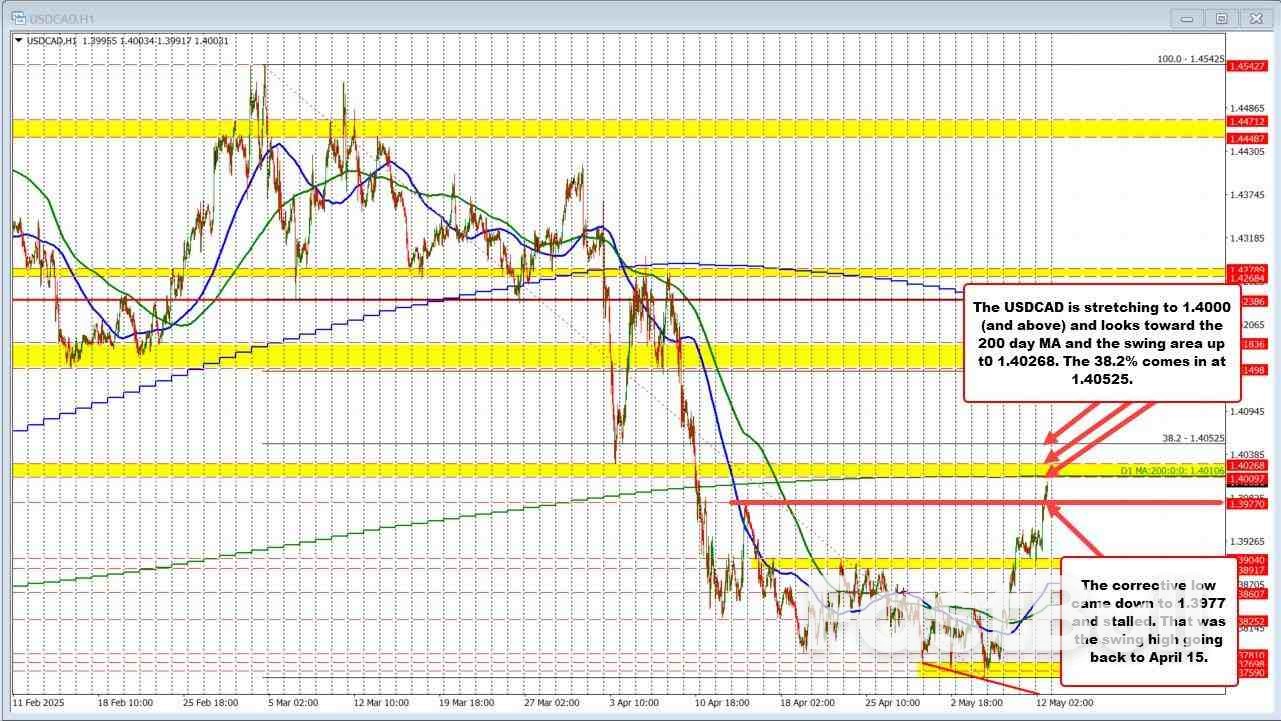
          USDCAD stretches to 1.4000. 200 day MA eyed

          The USDCAD has extended its gains and pushed above the key 1.4000 level, reaching a high of 1.40043. The next upside target comes in at the 200-day moving average at 1.40106, followed by resistance at 1.40268, a prior swing area high. Beyond that, the 38.2% retracement of the decline from the March 2025 high sits at 1.40525, marking a more significant hurdle for buyers.

          The earlier dip in price found support at 1.3977, the April 15 swing high, where buyers leaned in and reasserted control. That successful retest reinforced the bullish bias and helped fuel the move back toward and through 1.4000.

          While the break above 1.4000 is constructive, buyers still have work to do. A sustained move above the 200-day moving average, and ultimately the 1.40525 retracement level, is needed to confirm a stronger upside shift. For now, momentum remains with the buyers.

          Source: ForexLive

          Risk Warnings and Disclaimers
          You understand and acknowledge that there is a high degree of risk involved in trading. Following any strategies or investment methods may lead to potential losses. The content on the site is provided by our contributors and analysts for information purposes only. You are solely responsible for determining whether any trading assets, securities, strategy, or any other product is suitable for investing based on your own investment objectives and financial situation.
          Add to Favorites
          Share

          Trade War Truce Leaves 30% Tariff On China In Place—Why It Matters

          Adam

          Economic

          China–U.S. Trade War

          President Donald Trump's trade war truce with China still leaves a hefty 30% tariff in place, at least for the time being.
          On Monday, the White House announced that the U.S. and China had agreed to lower trade barriers with one another, simmering down a trade war that had exploded last month. The U.S. will pause the harshest tariffs for 90 days, while leaving a 10% "baseline" tariff in place, along with a 20% tariff that Trump said was to push China to crack down on fentanyl smuggling to the U.S. Tariffs of 25% remain on certain products including steel, aluminum, and automobiles.
          Although the trade deal announced Monday was a significant reduction and raised hopes that negotiations could further reduce import taxes, tariffs are still far higher than they were before Trump started raising them.
          The effective tariff rate on all U.S. imports after the tariff announcement is 15%, down from 24%, Abigail Watt, an economist with UBS, estimated in a commentary. Before Trump took office for the second time, the average tariff rate was 3%, according to an estimate by the Peterson Institute for International Economics.
          Economists predict merchants will pass those import taxes on to consumers, meaning the tariffs could push up the cost of living and risk reigniting high inflation. Lowering the tariffs reduces those risks, economists said.
          "The outcome of the U.S./China talks this weekend seem to take us back to pre-'Liberation Day' levels," Jim Reid, research strategist at Deutsche Bank, wrote in a commentary. "Increasingly, it’s as if the last six weeks have been a bad dream and never actually happened."
          Dialing back the trade wars could help the economy on several fronts.
          "This helps the economy in the short run," Jon Hilsenrath, senior advisor at StoneX, wrote in a commentary. "Tariffs squeeze corporate profit margins, so reducing them will help boost profits and stock values. Households will see their 401(k) retirement plans improve, which could help consumption. It also reduces the risk of consumer price inflation and shortages on store shelves. It will relieve some anxiety at the Federal Reserve about inflation; it could help to hold down interest rates. That's all good news."

          Source: investopedia

          To stay updated on all economic events of today, please check out our Economic calendar
          Risk Warnings and Disclaimers
          You understand and acknowledge that there is a high degree of risk involved in trading. Following any strategies or investment methods may lead to potential losses. The content on the site is provided by our contributors and analysts for information purposes only. You are solely responsible for determining whether any trading assets, securities, strategy, or any other product is suitable for investing based on your own investment objectives and financial situation.
          Add to Favorites
          Share

          Crude Oil Price Outlook – Crude Shoots Higher After Trade Talks

          Adam

          Commodity

          CL/WTI Technical Analysis

          The light sweet crude oil market has rallied rather significantly during the session here on Monday as we have reacted to the announcement over the weekend that the United States and China have cut tariffs quite drastically, with a 90-day ceasefire as it were between the two countries in order to work out a deal.
          This does bode well for the idea of global trade, which, of course, bodes well for the idea of crude oil rallying. Ultimately, as long as the market continues to see hope. I think it’s only a matter of time before we bottom here and oil really starts to take off. The $65 level though, needs to be overcome for the next leg higher. In the short term, I think pullbacks continue to offer buying opportunities, with a special focus on the $60 level.

          Brent Technical Analysis

          Brent markets, of course, have rallied significantly as well, with the 50-day EMA sitting right around the $67 level being a potential target. We, of course, are rallying here just as we are in the light sweet crude oil market, and therefore, I think the analysis is very similar. We’re looking for short-term pullbacks as buying opportunities in a market that quite frankly probably is in the process of forming a longer-term bottom.
          The $60 level below I think is a major support level as well. So, with that being said, I like the idea of buying Brent on dips. And if we can clear the $70 level, it’s likely that Brent will take off to the upside.

          source :fxempire

          Risk Warnings and Disclaimers
          You understand and acknowledge that there is a high degree of risk involved in trading. Following any strategies or investment methods may lead to potential losses. The content on the site is provided by our contributors and analysts for information purposes only. You are solely responsible for determining whether any trading assets, securities, strategy, or any other product is suitable for investing based on your own investment objectives and financial situation.
          Add to Favorites
          Share

          Gold price plummets as U.S.-China trade relations thawing

          Adam

          Commodity

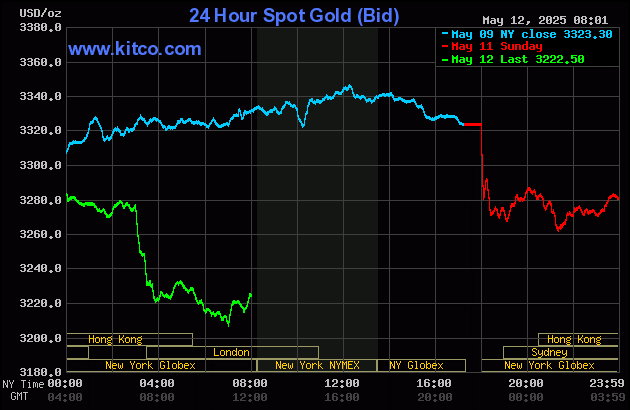
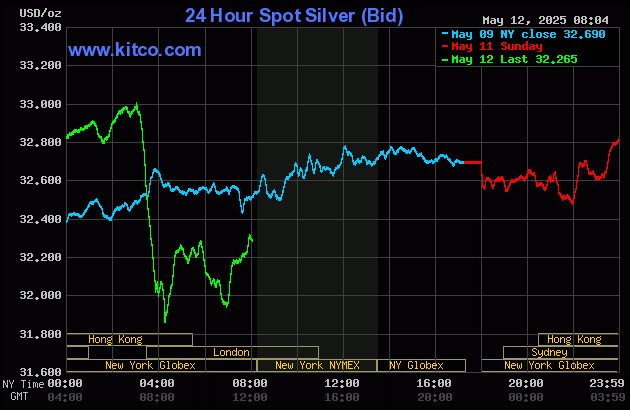
          Gold prices are sharply down and silver futures prices also lower in early U.S. trading Monday. Risk appetite has returned to the marketplace after the weekend news that the world’s two largest economies are seeing a significant thawing in their cold war on trade. June gold was last down $121.50 at $3,222.50. July silver prices were last down $0.469 at $32.445.
          Risk appetite is keen to start the trading week following the weekend news that the U.S. and China are working on better trade relations. Most tariffs were slashed on each other’s goods for a period of 90 days. The 90-day accord signals a notable de-escalation in the ongoing trade conflict between the two economic superpowers. The deal was announced after high-level negotiations in Geneva, Switzerland, and is seen as a crucial step toward stabilizing global markets and restoring business confidence. Joint statement: “After taking the aforementioned actions, the parties will establish a mechanism to continue discussions about economic and trade relations,” the joint statement said, adding this dialogue would be led by Chinese Vice Premier He Lifeng, U.S. Treasury Secretary Scott Bessent and U.S. Trade Representative Jamieson Greer.
          Asian and European stock markets were mostly higher in overnight trading. U.S. stock indexes are pointed to sharply higher openings today in New York.
          The key outside markets today see the U.S. dollar index sharply higher and at a four-week high. Nymex crude oil futures prices are sharply higher and trading around $63.25 a barrel. The yield on the benchmark 10-year U.S. Treasury note is presently at 4.457%.
          U.S. economic data due for release Monday includes the USDA monthly supply and demand report, and the U.S. Treasury monthly budget statement.
          Gold price plummets as U.S.-China trade relations thawing_1
          Technically, June gold futures bulls have lost their overall near-term technical advantage. Bulls’ next upside price objective is to produce a close above solid resistance at $3,350.00. Bears' next near-term downside price objective is pushing futures prices below solid technical support at $3,200.00. First resistance is seen at $3,250.00 and then at $3,275.00. First support is seen at the May low of $3,209.40 and then at $3,200.00. Wyckoff's Market Rating: 5.0.
          Gold price plummets as U.S.-China trade relations thawing_2
          July silver futures bulls have the slight overall near-term technical advantage. Silver bulls' next upside price objective is closing prices above solid technical resistance at $34.015. The next downside price objective for the bears is closing prices below solid support at $31.00. First resistance is seen at $33.00 and then at the overnight high of $33.20. Next support is seen at $32.00 and then at last week’s low of $31.86. Wyckoff's Market Rating: 5.5.

          Source: kitco

          Risk Warnings and Disclaimers
          You understand and acknowledge that there is a high degree of risk involved in trading. Following any strategies or investment methods may lead to potential losses. The content on the site is provided by our contributors and analysts for information purposes only. You are solely responsible for determining whether any trading assets, securities, strategy, or any other product is suitable for investing based on your own investment objectives and financial situation.
          Add to Favorites
          Share
          FastBull
          Copyright © 2025 FastBull Ltd

          728 RM B 7/F GEE LOK IND BLDG NO 34 HUNG TO RD KWUN TONG KLN HONG KONG

          TelegramInstagramTwitterfacebooklinkedin
          App Store Google Play Google Play
          Products
          Charts

          Chats

          Q&A with Experts
          Screeners
          Economic Calendar
          Data
          Tools
          Membership
          Features
          Function
          Markets
          Copy Trading
          Latest Signals
          Contests
          News
          Analysis
          24/7
          Columns
          Education
          Company
          Careers
          About Us
          Contact Us
          Advertising
          Help Center
          Feedback
          User Agreement
          Privacy Policy
          Business

          White Label

          Data API

          Web Plug-ins

          Poster Maker

          Affiliate Program

          Risk Disclosure

          The risk of loss in trading financial instruments such as stocks, FX, commodities, futures, bonds, ETFs and crypto can be substantial. You may sustain a total loss of the funds that you deposit with your broker. Therefore, you should carefully consider whether such trading is suitable for you in light of your circumstances and financial resources.

          No decision to invest should be made without thoroughly conducting due diligence by yourself or consulting with your financial advisors. Our web content might not suit you since we don't know your financial conditions and investment needs. Our financial information might have latency or contain inaccuracy, so you should be fully responsible for any of your trading and investment decisions. The company will not be responsible for your capital loss.

          Without getting permission from the website, you are not allowed to copy the website's graphics, texts, or trademarks. Intellectual property rights in the content or data incorporated into this website belong to its providers and exchange merchants.

          Not Logged In

          Log in to access more features

          FastBull Membership

          Not yet

          Purchase

          Become a signal provider
          Help Center
          Customer Service
          Dark Mode
          Price Up/Down Colors

          Log In

          Sign Up

          Position
          Layout
          Fullscreen
          Default to Chart
          The chart page opens by default when you visit fastbull.com