- GBPUSD
- XAUUSD
- XAGUSD
- WTI
- USDX


Markets
Analysis
User
24/7
Economic Calendar
Education
Data
- Names
- Latest
- Prev















Master the line between data and ideology. Explore 5 examples of positive and normative economics to sharpen your financial decision-making.
Economic analysis shapes everything from personal investment portfolios to global monetary policy, but not all economic statements are built on the same foundation. Distinguishing between objective data and subjective values is essential for evaluating whether a proposed policy or financial strategy is based on measurable facts or ideological goals. By understanding the core boundaries between testable metrics and ethical judgments, individuals and policymakers can make more rational, clear-eyed decisions. This article explores the defining characteristics of both frameworks and breaks down five real-world scenarios to illustrate how they operate in practice.
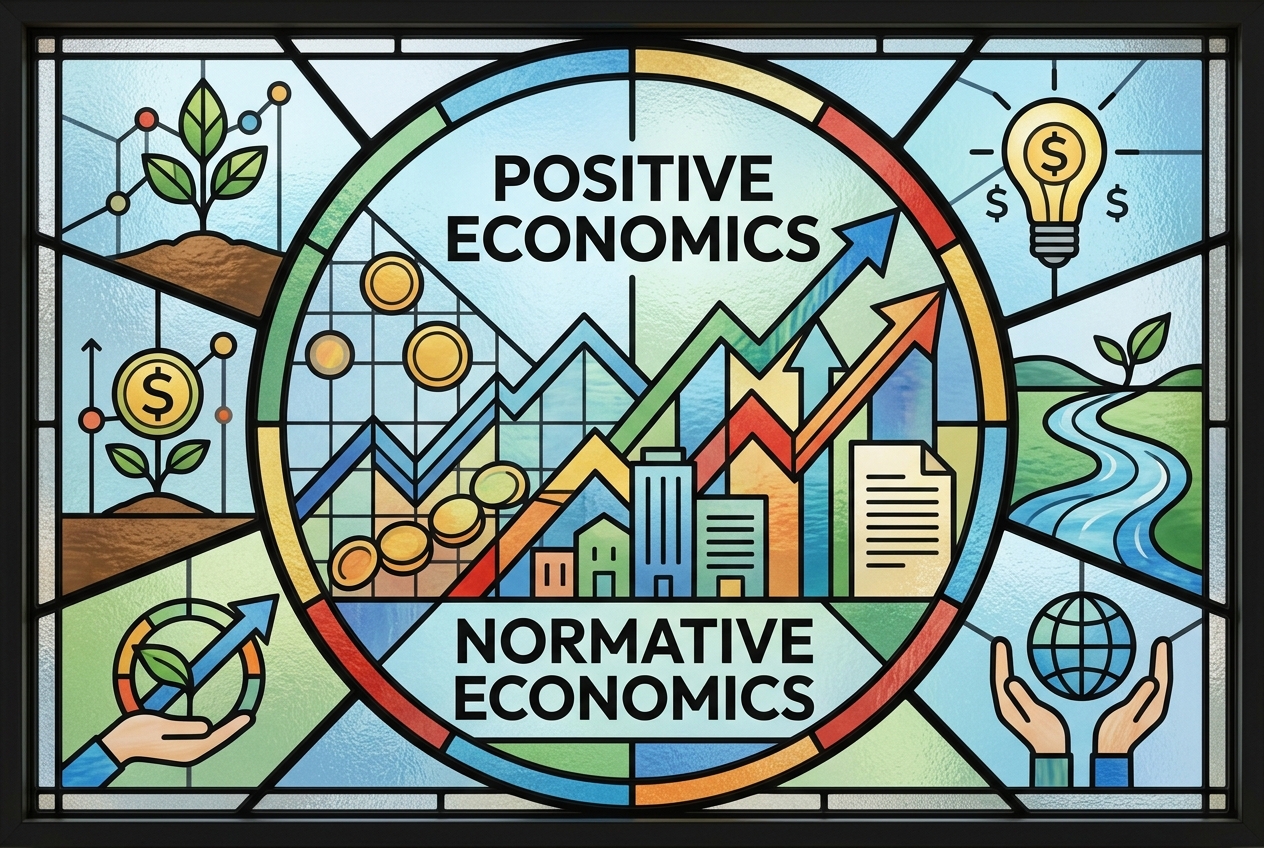
Positive economics deals with objective, verifiable facts and cause-and-effect relationships, while normative economics focuses on subjective value judgments and prescriptive policy recommendations. The fundamental difference between positive and normative economics lies entirely in empirical testability: a positive economic statement can be proven or disproven using data, whereas a normative statement rests on an individual's or society's moral framework.
To determine which framework is being used, analysts evaluate whether a claim describes reality as it currently exists or prescribes how reality ought to be. Note that a positive statement does not have to be mathematically correct; it simply must be testable against real-world evidence.
| Attribute | Positive Economics | Normative Economics |
|---|---|---|
| Core Function | Describes "what is" and quantifies relationships. | Prescribes "what should be" and evaluates outcomes. |
| Testability | Fully objective. Claims can be validated or refuted using historical data or mathematical models. | Wholly subjective. Claims cannot be scientifically proven or disproven. |
| Key Indicators | "Will," "causes," "is," "historically results in." | "Should," "ought to," "fair," "too high," "unjust." |
| Analytical Output | Data forecasts, historical correlations, elasticity measurements. | Policy recommendations, political platforms, ethical guidelines. |
| Example Concept | Measuring the exact percentage increase in the Consumer Price Index (CPI). | Arguing that the government must act because inflation is hurting the working class. |
Failing to separate "what is" from "what ought to be" leads directly to flawed financial modeling and misguided public policy. When investors, voters, or corporate strategists confuse an empirical forecast with an ideological goal, they misprice systemic risk and allocate capital inefficiently.
For example, a quantitative analyst stating "raising the corporate tax rate by 5% will reduce domestic capital investment by $100 billion" is operating strictly within the bounds of a positive economics definition. Even if the underlying calculation is flawed, the claim remains empirically testable. Conversely, a politician stating "corporations must pay a higher tax rate to ensure economic fairness" relies on a normative economics definition. The concept of "fairness" cannot be quantified on a balance sheet.
This strict separation drives decision-making across three specific real-world domains:
To see how this boundary between data and values plays out in practice, we can examine several major policy domains. While positive economics measures the mechanical outcomes of a policy using empirical data, normative economics dictates whether those outcomes are socially desirable based on ethical judgments.
| Economic Domain | Positive Economics Example (Testable Outcome) | Normative Economics Example (Subjective Value) |
|---|---|---|
| Minimum Wage | Raising the wage floor to $15/hr reduces teen employment by 2%. | The government must mandate a $15/hr living wage. |
| Inflation | A 50-basis-point interest rate hike lowers CPI by 0.5% over 18 months. | The Fed should prioritize price stability over job growth. |
| Tax Policy | Raising corporate taxes to 28% cuts capital investment by 1.5%. | Wealthy corporations ought to pay a higher fair share. |
| Healthcare | Medicare-for-All shifts $3 trillion from private to public ledgers. | Healthcare is a fundamental right that must be guaranteed. |
| Unemployment | Extending jobless benefits by 13 weeks delays hiring by 1.5 weeks. | Society must protect displaced workers during a recession. |
Minimum wage debates hinge on the tension between empirical employment elasticity and baseline living standards. The positive economics definition relies on observation and falsifiable claims to map this trade-off. For example, a positive statement notes that according to the Congressional Budget Office (CBO), raising the federal minimum wage to $15 per hour would lift 0.9 million people out of poverty while eliminating 1.4 million jobs. This evaluates the quantifiable elasticity of labor demand.
Conversely, the normative economics definition centers on prescriptive, value-based judgments regarding that exact same data. A normative statement asserts, "The government should enact a $15 minimum wage because no full-time worker should live below the poverty line." The positive analysis quantifies the mechanical trade-off—higher income for retained workers versus job loss for marginal workers—while the normative analysis decides which side of that trade-off is morally acceptable.
Inflation analysis separates the mechanical tracking of purchasing power from the political choice of who suffers during economic stabilization. A positive economic statement models the mechanism: "A 50-basis-point increase in the federal funds rate reduces headline Consumer Price Index (CPI) by 0.5% over 18 months, while simultaneously increasing short-term borrowing costs for businesses." This is verifiable using historical macroeconomic data and demonstrates the Phillips Curve, which illustrates the inverse relationship between inflation and unemployment.
The normative debate determines where on that curve a society ought to position itself. A normative claim argues, "The Federal Reserve should tolerate 3% inflation rather than inducing a recession, because job losses disproportionately harm low-income workers." This shifts the focus from how monetary policy works to whose economic pain the central bank should prioritize.
Tax economics divides the behavioral response to fiscal drag from the ethics of wealth redistribution. Positive economics relies on dynamic scoring to map revenue against deadweight loss. An analyst making a positive claim states, "Increasing the corporate tax rate from 21% to 28% generates an estimated $1.3 trillion in federal revenue over ten years but reduces domestic capital investment by 1.5%." This isolates the cause-and-effect relationship between marginal tax rates and corporate capital allocation.
The normative equivalent ignores the behavioral friction to focus on distributive justice. A politician makes a normative statement by claiming, "Corporations must pay a 28% tax rate to ensure they contribute their fair share to national infrastructure." The concept of a "fair share" cannot be empirically tested; it requires a subjective agreement on ethical taxation.
Healthcare economics isolates the structural costs of medical delivery from the moral obligations of care access. A positive statement evaluates budgetary reallocation: "Implementing a universal Medicare-for-All system would shift $3 trillion annually from private premiums to federal tax liabilities, reducing administrative overhead by 8%." This claim maps financial flows and administrative friction without assigning a moral weight to either.
The normative counterpart asserts a moral imperative, accepting the resulting tax friction as a necessary cost. The claim that "the United States ought to guarantee healthcare to all citizens regardless of their ability to pay" is pure normative economics. It prescribes a policy direction based on the belief that healthcare access is a human right, moving entirely outside the realm of objective cost tracking.
Unemployment figures measure labor market slack, while the subsequent policy debate judges the state's duty to intervene. Positive economics tracks the precise mechanics of safety nets on reservation wages. A positive statement observes, "Extending unemployment insurance benefits by 13 weeks increases the average duration of a recipient’s job search by 1.5 weeks." This evaluates behavioral responses to subsidies using labor participation data.
Normative economics dictates whether the welfare of the displaced worker outweighs the inefficiency of delayed labor market re-entry. The assertion that "the government must extend unemployment benefits during a recession to prevent undue hardship" cannot be proven true or false. It prioritizes the subjective value of worker protection over the measurable cost of reduced labor supply.
When analyzing these topics on your own, the defining boundary remains falsifiability. If a statement can be proven, disproven, or measured using empirical data, it utilizes positive economics. If it relies on value judgments, ethical metrics, or subjective definitions of fairness, it represents normative economics. Financial analysts and economists separate the two by applying the "data test": asking whether a comprehensive, perfect dataset could theoretically end the debate.
Syntactic markers immediately reveal whether an author is describing economic reality or prescribing policy. Positive economics relies on definitive verbs and quantifiable metrics, while normative economics utilizes modal verbs expressing obligation or subjective adjectives.
Linguistic Markers in Economic Analysis
| Statement Type | Typical Verbs & Modifiers | Analytical Function | Example Phrase |
|---|---|---|---|
| Positive | Is, was, will, causes, correlates, increases/decreases by | States a testable hypothesis, historical fact, or causal link. | "A 50-basis-point rate hike will reduce..." |
| Normative | Should, ought to, must, fair, unfair, excessive, justifiable | Expresses a policy preference, ethical stance, or value judgment. | "The central bank ought to prioritize..." |
To operationalize the difference between positive and normative economics, apply these two linguistic filters:
Yes, every economic issue can be analyzed through both descriptive (positive) and prescriptive (normative) frameworks. Serious policy research typically sequences the two: analysts use positive economics to model the mechanical trade-offs of a decision, then apply normative frameworks to recommend a specific action based on a society's priorities.
Below are distinct examples showing how a single policy area generates both types of analysis.
Topic 1: The Minimum Wage
Topic 2: Corporate Taxation
Topic 3: Carbon Pricing
Positive economics focuses on objective, fact-based statements that can be verified or tested using empirical data. In contrast, normative economics involves subjective opinions and value judgments about what economic outcomes are fair or desirable. Simply put, positive economics describes "what is," while normative economics describes "what ought to be".
Five examples of positive economics statements include stating that an increase in the minimum wage leads to a decrease in employment. Other examples are observing that progressive taxes reduce income inequality, and noting that unemployment benefits lower the incentive to work. Specific factual observations, such as measuring a nation's inflation rate at 2.5% or its unemployment rate at 3.7%, are also considered positive statements.
Five examples of normative economics statements include arguing that the government should increase taxes on the wealthy and that healthcare should be universally accessible. Additional examples are stating that unemployment benefits should be extended during economic recessions, or that the best way to handle crime is to hire more police. Finally, claiming that corporation taxes should be higher than personal income taxes is a normative statement because it relies on a value judgment.
The distinction allows policymakers to clearly separate objective data analysis from subjective societal goals. Positive economics provides the factual foundation needed to understand how a specific policy will actually impact the economy. Meanwhile, normative economics is necessary to determine which policy outcomes are considered ethical, fair, or desirable based on cultural values.
Navigating complex financial and political landscapes requires a clear boundary between testable mechanics and subjective values. By consistently isolating positive economics from normative economics, analysts, investors, and voters can accurately assess the true costs and trade-offs of any given policy. Acknowledging "what is" before debating "what should be" ensures that capital allocation and legislative decisions remain grounded in reality rather than assumption.

728 RM B 7/F GEE LOK IND BLDG NO 34 HUNG TO RD KWUN TONG KLN HONG KONG





The risk of loss in trading financial instruments such as stocks, FX, commodities, futures, bonds, ETFs and crypto can be substantial. You may sustain a total loss of the funds that you deposit with your broker. Therefore, you should carefully consider whether such trading is suitable for you in light of your circumstances and financial resources.
No decision to invest should be made without thoroughly conducting due diligence by yourself or consulting with your financial advisors. Our web content might not suit you since we don't know your financial conditions and investment needs. Our financial information might have latency or contain inaccuracy, so you should be fully responsible for any of your trading and investment decisions. The company will not be responsible for your capital loss.
Without getting permission from the website, you are not allowed to copy the website's graphics, texts, or trademarks. Intellectual property rights in the content or data incorporated into this website belong to its providers and exchange merchants.
Not Logged In
Log in to access more features


Log In
Sign Up