• Trade
  • Markets
  • Copy
  • Contests
  • News
  • 24/7
  • Calendar
  • Q&A
  • Chats
Trending
Screeners
SYMBOL
LAST
BID
ASK
HIGH
LOW
NET CHG.
%CHG.
SPREAD
SPX
S&P 500 Index
6847.63
6847.63
6847.63
6861.30
6847.62
+20.22
+ 0.30%
--
DJI
Dow Jones Industrial Average
48595.22
48595.22
48595.22
48679.14
48587.48
+137.18
+ 0.28%
--
IXIC
NASDAQ Composite Index
23268.69
23268.69
23268.69
23345.56
23268.69
+73.53
+ 0.32%
--
USDX
US Dollar Index
97.850
97.930
97.850
98.070
97.810
-0.100
-0.10%
--
EURUSD
Euro / US Dollar
1.17537
1.17544
1.17537
1.17596
1.17262
+0.00143
+ 0.12%
--
GBPUSD
Pound Sterling / US Dollar
1.33911
1.33919
1.33911
1.33961
1.33546
+0.00204
+ 0.15%
--
XAUUSD
Gold / US Dollar
4325.81
4326.24
4325.81
4350.16
4294.68
+26.42
+ 0.61%
--
WTI
Light Sweet Crude Oil
56.894
56.924
56.894
57.601
56.789
-0.339
-0.59%
--

Community Accounts

Signal Accounts
--
Profit Accounts
--
Loss Accounts
--
View More

Become a signal provider

Sell trading signals to earn additional income

View More

Guide to Copy Trading

Get started with ease and confidence

View More

Signal Accounts for Members

All Signal Accounts

Best Return
  • Best Return
  • Best P/L
  • Best MDD
Past 1W
  • Past 1W
  • Past 1M
  • Past 1Y

All Contests

  • All
  • Trump Updates
  • Recommend
  • Stocks
  • Cryptocurrencies
  • Central Banks
  • Featured News
Top News Only
Share

The S&P 500 Opened 32.78 Points Higher, Or 0.48%, At 6860.19; The Dow Jones Industrial Average Opened 136.31 Points Higher, Or 0.28%, At 48594.36; And The Nasdaq Composite Opened 134.87 Points Higher, Or 0.58%, At 23330.04

Share

Miran: Goods Inflation Could Be Settling In At A Higher Level Than Was Normal Before The Pandemic, But That Will Be More Than Offset By Housing Disinflation

Share

Miran, Who Dissented In Favor Of A Larger Cut At Last Fed Meeting, Repeats Keeping Policy Too Tight Will Lead To Job Losses

Share

Miran: Does Not Think Higher Goods Inflation Is Mostly From Tariffs, But Acknowledges Does Not Have A Full Explanation For It

Share

Toronto Stock Index .GSPTSE Rises 67.16 Points, Or 0.21 Percent, To 31594.55 At Open

Share

Miran: Excluding Housing And Non-Market Based Items, Core Pce Inflation May Be Below 2.3%, “Within Noise” Of The Fed's 2% Target

Share

Polish State Assets Minister Balczun Says Jsw Needs Over USD 830 Million Financing To Keep Liquidity For A Year

Share

Miran: Prices Are “Once Again Stable” And Monetary Policy Should Reflect That

Share

Fed's Miran: Current Excess Inflation Is Not Reflective Of Underlying Supply And Demand In The Economy

Share

Portugal Treasury Puts 2026 Net Financing Needs At 13 Billion Euros, Up From 10.8 Billion In 2025

Share

Portugal Treasury Expects 2026 Net Financing Needs At 29.4 Billion Euros, Up From 25.8 Billion In 2025

Share

Bank Of America Says With Indonesia's Smelter Now Ramping Up, It Expects Aluminium Supply Growth To Accelerate To 2.6% Year On Year In 2026

Share

Bank Of America Expects A Deficit In Aluminium Next Year And Sees Prices Pushing Above $3000/T

Share

Fed Data - USA Effective Federal Funds Rate At 3.64 Percent On 12 December On $102 Billion In Trades Versus 3.64 Percent On $99 Billion On 11 December

Share

Brazil's Petrobras Says No Impact Seen On Oil, Petroleum Products Output As Workers Start Planned Strike

Share

Statement: US Travel Group Warns New Proposed Trump Administration Requirements For Foreign Tourists To Provide Social Media Histories Could Mean Millions Of People Opting Not To Visit

Share

Blackrock: Kerry White Will Become Head Of Citi Investment Management At Citi Wealth

Share

Blackrock: Rob Jasminski, Head Of Citi Investment Management, Has Joined With Team

Share

Blackrock: Effective Dec 15, Citi Investment Management Employees Will Join Blackrock

Share

Blackrock: Formally Launch Citi Portfolio Solutions Powered By Blackrock

TIME
ACT
FCST
PREV
Japan Tankan Small Manufacturing Outlook Index (Q4)

A:--

F: --

P: --

Japan Tankan Large Non-Manufacturing Outlook Index (Q4)

A:--

F: --

P: --

Japan Tankan Large Manufacturing Outlook Index (Q4)

A:--

F: --

P: --

Japan Tankan Small Manufacturing Diffusion Index (Q4)

A:--

F: --

P: --

Japan Tankan Large Manufacturing Diffusion Index (Q4)

A:--

F: --

P: --

Japan Tankan Large-Enterprise Capital Expenditure YoY (Q4)

A:--

F: --

P: --

U.K. Rightmove House Price Index YoY (Dec)

A:--

F: --

P: --

China, Mainland Industrial Output YoY (YTD) (Nov)

A:--

F: --

P: --

China, Mainland Urban Area Unemployment Rate (Nov)

A:--

F: --

P: --

Saudi Arabia CPI YoY (Nov)

A:--

F: --

P: --

Euro Zone Industrial Output YoY (Oct)

A:--

F: --

P: --

Euro Zone Industrial Output MoM (Oct)

A:--

F: --

P: --

Canada Existing Home Sales MoM (Nov)

A:--

F: --

P: --

Canada National Economic Confidence Index

A:--

F: --

P: --

Canada New Housing Starts (Nov)

A:--

F: --

P: --
U.S. NY Fed Manufacturing Employment Index (Dec)

A:--

F: --

P: --

U.S. NY Fed Manufacturing Index (Dec)

A:--

F: --

P: --

Canada Core CPI YoY (Nov)

A:--

F: --

P: --

Canada Manufacturing Unfilled Orders MoM (Oct)

A:--

F: --

P: --

U.S. NY Fed Manufacturing Prices Received Index (Dec)

A:--

F: --

P: --

U.S. NY Fed Manufacturing New Orders Index (Dec)

A:--

F: --

P: --

Canada Manufacturing New Orders MoM (Oct)

A:--

F: --

P: --

Canada Core CPI MoM (Nov)

A:--

F: --

P: --

Canada Trimmed CPI YoY (SA) (Nov)

A:--

F: --

P: --

Canada Manufacturing Inventory MoM (Oct)

A:--

F: --

P: --

Canada CPI YoY (Nov)

A:--

F: --

P: --

Canada CPI MoM (Nov)

A:--

F: --

P: --

Canada CPI YoY (SA) (Nov)

A:--

F: --

P: --

Canada Core CPI MoM (SA) (Nov)

A:--

F: --

P: --

Canada CPI MoM (SA) (Nov)

A:--

F: --

P: --

Federal Reserve Board Governor Milan delivered a speech
U.S. NAHB Housing Market Index (Dec)

--

F: --

P: --

Australia Composite PMI Prelim (Dec)

--

F: --

P: --

Australia Services PMI Prelim (Dec)

--

F: --

P: --

Australia Manufacturing PMI Prelim (Dec)

--

F: --

P: --

Japan Manufacturing PMI Prelim (SA) (Dec)

--

F: --

P: --

U.K. 3-Month ILO Employment Change (Oct)

--

F: --

P: --

U.K. Unemployment Claimant Count (Nov)

--

F: --

P: --

U.K. Unemployment Rate (Nov)

--

F: --

P: --

U.K. 3-Month ILO Unemployment Rate (Oct)

--

F: --

P: --

U.K. Average Weekly Earnings (3-Month Average, Including Bonuses) YoY (Oct)

--

F: --

P: --

U.K. Average Weekly Earnings (3-Month Average, Excluding Bonuses) YoY (Oct)

--

F: --

P: --

France Services PMI Prelim (Dec)

--

F: --

P: --

France Composite PMI Prelim (SA) (Dec)

--

F: --

P: --

France Manufacturing PMI Prelim (Dec)

--

F: --

P: --

Germany Services PMI Prelim (SA) (Dec)

--

F: --

P: --

Germany Manufacturing PMI Prelim (SA) (Dec)

--

F: --

P: --

Germany Composite PMI Prelim (SA) (Dec)

--

F: --

P: --

Euro Zone Composite PMI Prelim (SA) (Dec)

--

F: --

P: --

Euro Zone Services PMI Prelim (SA) (Dec)

--

F: --

P: --

Euro Zone Manufacturing PMI Prelim (SA) (Dec)

--

F: --

P: --

U.K. Services PMI Prelim (Dec)

--

F: --

P: --

U.K. Manufacturing PMI Prelim (Dec)

--

F: --

P: --

U.K. Composite PMI Prelim (Dec)

--

F: --

P: --

Euro Zone ZEW Economic Sentiment Index (Dec)

--

F: --

P: --

Germany ZEW Current Conditions Index (Dec)

--

F: --

P: --

Germany ZEW Economic Sentiment Index (Dec)

--

F: --

P: --

Euro Zone Trade Balance (Not SA) (Oct)

--

F: --

P: --

Euro Zone ZEW Current Conditions Index (Dec)

--

F: --

P: --

Euro Zone Trade Balance (SA) (Oct)

--

F: --

P: --

U.S. Retail Sales MoM (Excl. Automobile) (SA) (Oct)

--

F: --

P: --

Q&A with Experts
    • All
    • Chatrooms
    • Groups
    • Friends
    Connecting
    .
    .
    .
    Type here...
    Add Symbol or Code

      No matching data

      All
      Trump Updates
      Recommend
      Stocks
      Cryptocurrencies
      Central Banks
      Featured News
      • All
      • Russia-Ukraine Conflict
      • Middle East Flashpoint
      • All
      • Russia-Ukraine Conflict
      • Middle East Flashpoint
      Search
      Products

      Charts Free Forever

      Chats Q&A with Experts
      Screeners Economic Calendar Data Tools
      Membership Features
      Data Warehouse Market Trends Institutional Data Policy Rates Macro

      Market Trends

      Market Sentiment Order Book Forex Correlations

      Top Indicators

      Charts Free Forever
      Markets

      News

      News Analysis 24/7 Columns Education
      From Institutions From Analysts
      Topics Columnists

      Latest Views

      Latest Views

      Trending Topics

      Top Columnists

      Latest Update

      Signals

      Copy Rankings Latest Signals Become a signal provider AI Rating
      Contests
      Brokers

      Overview Brokers Assessment Rankings Regulators News Claims
      Broker listing Forex Brokers Comparison Tool Live Spread Comparison Scam
      Q&A Complaint Scam Alert Videos Tips to Detect Scam
      More

      Business
      Events
      Careers About Us Advertising Help Center

      White Label

      Data API

      Web Plug-ins

      Affiliate Program

      Awards Institution Evaluation IB Seminar Salon Event Exhibition
      Vietnam Thailand Singapore Dubai
      Fans Party Investment Sharing Session
      FastBull Summit BrokersView Expo
      Recent Searches
        Top Searches
          Markets
          News
          Analysis
          User
          24/7
          Economic Calendar
          Education
          Data
          • Names
          • Latest
          • Prev

          View All

          No data

          Scan to Download

          Faster Charts, Chat Faster!

          Download App
          English
          • English
          • Español
          • العربية
          • Bahasa Indonesia
          • Bahasa Melayu
          • Tiếng Việt
          • ภาษาไทย
          • Français
          • Italiano
          • Türkçe
          • Русский язык
          • 简中
          • 繁中
          Open Account
          Search
          Products
          Charts Free Forever
          Markets
          News
          Signals

          Copy Rankings Latest Signals Become a signal provider AI Rating
          Contests
          Brokers

          Overview Brokers Assessment Rankings Regulators News Claims
          Broker listing Forex Brokers Comparison Tool Live Spread Comparison Scam
          Q&A Complaint Scam Alert Videos Tips to Detect Scam
          More

          Business
          Events
          Careers About Us Advertising Help Center

          White Label

          Data API

          Web Plug-ins

          Affiliate Program

          Awards Institution Evaluation IB Seminar Salon Event Exhibition
          Vietnam Thailand Singapore Dubai
          Fans Party Investment Sharing Session
          FastBull Summit BrokersView Expo

          London Midday: Stocks Pare Gains as Investors Assess US-EU Trade Deal

          Warren Takunda

          Economic

          Stocks

          Summary:

          London stocks edged higher by midday Monday as investors reacted to a US-EU trade deal that avoided steeper tariffs. Relief over the agreement lifted sentiment, though caution remained as the deal is still a framework.

          London stocks had pared earlier gains to trade just a touch higher by midday on Monday as investors continued to assess the impact of the US-EU trade deal struck over the weekend.
          The FTSE 100 was up 0.1% at 9,124.65.
          Sentiment was lifted after US President Donald Trump and European Commission President Ursula von der Leyen agreed a trade deal that will see the EU pay 15% tariffs on most goods entering the US. Trump had threatened to implement a 30% tariff from Friday.
          Russ Mould, investment director at AJ Bell, said: "The much-awaited trade agreement between the US and the EU has finally been struck, sending a wave of relief across financial markets.
          "As widely expected, the agreed tariffs aren’t as high as previously feared, which means investors are taking the trade agreement as a massive win.
          "In reality, this is far from a done deal. It is only a framework and still needs to be signed into law. Furthermore, Donald Trump has form in constantly tinkering at the edges and what he says one day might not be the same as the next.
          "Investors are taking each bit of news one day at a time and today is one of celebration. The agreement is significant because it avoids a trade war between the US and the EU, which could have been troublesome for economic growth and investor sentiment."
          On home shores, the latest survey from the Confederation of British Industry showed that retail sales continued to struggle in July as rising prices and economic uncertainty weighed on household demand, although the pace of decline slowed from June.
          The retail sales volume balance was -34%, up from -46% a month earlier, but marking the tenth consecutive month of decline.
          The balance of expected sales improved to -31 in July from -49 the month before, with retailers expecting sales to fall at a broadly similar pace next month.
          Martin Sartorius, principal economist at the CBI, said: "Retail annual sales volumes continued to fall in July, although the pace of decline moderated from June’s sharp drop. Firms reported that elevated price pressures - driven by rising labour costs - and economic uncertainty continue to weigh on household demand, which has contributed to sales volumes falling since October 2024. These trends of weak demand and uncertainty were mirrored across the wider distribution sector, with wholesale and motor trades also seeing declining sales.
          "With long-term strategic ambitions outlined, the government must now seek to build shorter term confidence in its growth mission. It can do this by collaborating with business to deliver an Autumn Budget that acknowledges the burden firms are facing and sets clear policy delivery targets. This includes providing clarity on how the government will deliver its action plan to tackle regulatory barriers to growth, position businesses to invest in the people they need through a flexible Growth and Skills Levy, and find an appropriate landing zone for the Employment Rights Bill."
          In equity markets, GSK rallied after saying it has entered into a partnership with Chinese pharmaceutical outfit Hengrui Pharma to jointly develop up to 12 medicines, providing new growth opportunities for the UK pharmaceutical group beyond 2031.
          FirstGroup advanced after saying it has bought Tetley's Coaches, a Leeds-based coach and bus operator that has been in operation for over 75 years, for an undisclosed sum.
          IT support and services firm Computacenter reversed earlier heavy losses as it said it continues to expect FY25 adjusted operating profits to be ahead of FY26 after delivering "strong” revenue growth in the first half.
          However, it also said it experienced softer trading in Germany and France in the second quarter, with the performance in France significantly weaker than last year.
          Computacenter said that while the broader geopolitical and macro uncertainty is expected to persist, it expects some recovery in public sector activity in Germany in the second half while France is expected to remain challenging.
          On the downside, food producer Cranswick turned lower after it held annual guidance as like-for-like revenue rose 7.9% on the back of new business wins and increasing consumer demand for natural protein.
          Cranswick still expects adjusted profit before tax to be in line with consensus expectations of between £206.5m and £213.6m.
          Ocean Wilsons - a supplier of maritime services in Brazil - tumbled after it agreed a £900m all-share merger with Hansa Investment Company.

          Source: Sharecast

          To stay updated on all economic events of today, please check out our Economic calendar
          Risk Warnings and Disclaimers
          You understand and acknowledge that there is a high degree of risk involved in trading. Following any strategies or investment methods may lead to potential losses. The content on the site is provided by our contributors and analysts for information purposes only. You are solely responsible for determining whether any trading assets, securities, strategy, or any other product is suitable for investing based on your own investment objectives and financial situation.
          Add to Favorites
          Share

          Japan: Opportunity Trumps Politics

          Winkelmann

          Stocks

          Economic

          The striking of a better-than-feared trade deal with the U.S. last week has removed a significant economic uncertainty for Japan, further bolstering the improving fundamentals of the country, and helping lift equities to near-record highs.

          Driving this was some relief among investors that while the agreed 15% tariffs on Japanese imports is higher than the 10% rate that was in force while the countries negotiated, it is lower than the 25% levy President Donald Trump had threatened. Importantly, Japan’s automotive sector, a pillar of the country’s economy and biggest contributor to its $63 billion trade surplus with the U.S., will incur the 15% rate and face no quotas on the volume of imports.The greater clarity that comes with the deal is welcome. However, in recent days, fresh political uncertainties have emerged in Japan following the July 20 elections, when the ruling coalition led by Prime Minister Ishiba lost control of the upper house of parliament.

          This was the third major election defeat after losing a majority of seats in the October 2024 lower house election and most recently in the Tokyo prefectural (metropolitan assembly) vote, which have led to calls within Ishiba’s own party for him to resign. Ishiba has said he has no plans to step down. However, mounting speculation over the Prime Minister’s potential successor and the prospect of them forming a coalition with any one of the resurgent opposition parties, which have been calling for more fiscal stimulus and lower taxes, has led to a fresh spike in long-dated Japanese government bond yields.

          As we highlighted in our analysis last month, Japan has led the march higher this year in long-dated government bond yields among advanced economies amid a renewed and sharper focus by investors on fiscal stability.

          Seeing Through the Politics

          In our view, such political machinations and volatility in the government bond market are to be closely watched, but they don’t alter our long-held constructive view on the country. We were overweight Japan equities before the U.S. trade deal was announced on July 22.

          Indeed, we see the election results as unsurprising given a number of factors—including the current administration’s mishandling of inflation and political scandals—and view any change in leadership as immaterial to Japan’s sustainable economic growth and development over the medium term. Seen another way, we believe any potential change in leadership (Ishiba was still in power at the time of writing although the situation is fluid) could even help to bring in new views and ideas on sustaining the country’s growth trajectory.There are fundamental reasons why we remain constructive on the country, as we outlined earlier this year in our white paper on Japanese equities and more recently in our Q3 Equity Market Outlook.

          First, Japan’s economy continues to gain momentum. Inflation is modestly stabilizing above the Bank of Japan’s targeted 2% and is high enough in our view to invigorate revenue and profit growth, while low unemployment and recent wage increases due to structural labor shortages have helped to boost spending among Gen-Z and Millennials. Meanwhile the stronger Japanese currency versus year-ago levels has helped to curb imported cost inflation.

          Second, thanks to the corporate governance and capital management reforms of the past several years, Japanese companies are becoming increasingly conscious of corporate value from a shareholder’s perspective. This has resulted in companies reducing their cash hoard and streamlining their cross-shareholdings, as well as making better use of their capital through growth investments, which we view as accretive for EPS growth over the medium to long term.

          Third, despite potentially stronger growth, record corporate buybacks and ongoing shareholder-friendly corporate reforms, Japanese equities remain under-owned and relatively attractive compared to global peers. For instance, the aggregate forward price-to-earnings ratio represented by the MSCI Japan Index currently stands at 15.2 times compared to 19.0 times and 22.4 times for the MSCI ACWI and S&P 500 indexes, respectively. *

          Long-Term Growth Opportunity

          As we continue to closely watch the political situation and any fresh developments in the government bond market, we maintain our constructive outlook on Japan, choosing to look through these short-term moments of flux in a country that is in a new period of economic transition.Clearly near-term risks remain, including volatile currency swings from monetary policy adjustments, which disrupted equity markets last August, but we believe high-quality Japanese companies may be an attractive long-term investment opportunity.

          Source: Neuberger Berman

          To stay updated on all economic events of today, please check out our Economic calendar
          Risk Warnings and Disclaimers
          You understand and acknowledge that there is a high degree of risk involved in trading. Following any strategies or investment methods may lead to potential losses. The content on the site is provided by our contributors and analysts for information purposes only. You are solely responsible for determining whether any trading assets, securities, strategy, or any other product is suitable for investing based on your own investment objectives and financial situation.
          Add to Favorites
          Share

          Key Elements of EU-US Trade Deal

          Michelle

          Economic

          The United States and the European Union agreed on aframework trade deal, ending months of uncertainty for industries and consumers on both sides of the Atlantic.

          Here are the main elements of the deal:

          * Almost all EU goods entering the U.S. will be subject to a 15% baseline tariff, including cars, which currently face 27.5%, as well as semiconductors and pharmaceuticals. The 15% tariff is the maximum tariff and is not added to any existing rates.

          * The U.S. is to announce the result of its 232 trade investigations in a few weeks and decide on tariff rates for the sectors under investigation. But the EU-U.S. deal already secures a 15% tariff for European chips and pharmaceuticals, so the results of the investigations will not change that, U.S. officials said. It is not yet clear, however, if the same 15% rate has been set for timber and copper, which are also under U.S. 232 investigation.

          * The U.S. and EU will have zero-for-zero tariffs on all aircraft and their components, certain chemicals, certain generic drugs, semiconductor equipment, some agricultural products, natural resources and critical raw materials. More products would be added.

          * The situation for wine and spirits - a point of friction on both sides of the Atlantic - is still to be established.

          * Tariffs on European steel and aluminium will stay at 50%, but European Commission President Ursula von der Leyen said these would later be cut and replaced by a quota system.

          * The EU pledged to make $750 billion in strategic purchases, covering oil, gas, nuclear, fuel and chips during U.S. President Donald Trump's term in office.

          * The EU pledged to buy U.S. military equipment.

          * European companies are to invest $600 billion in the U.S. over the course of Trump's second term. Unlike Japan’s package - which Tokyo says will consist of equity, loans and guarantees from state-run agencies of up to $550 billion to be invested at Trump's discretion - EU officials said the Europe's $600 billion investment pledge is based on private sector projects already in the pipeline.

          Source: Reuters

          To stay updated on all economic events of today, please check out our Economic calendar
          Risk Warnings and Disclaimers
          You understand and acknowledge that there is a high degree of risk involved in trading. Following any strategies or investment methods may lead to potential losses. The content on the site is provided by our contributors and analysts for information purposes only. You are solely responsible for determining whether any trading assets, securities, strategy, or any other product is suitable for investing based on your own investment objectives and financial situation.
          Add to Favorites
          Share

          EU And US Reach A Deal, Euro Slips

          Blue River

          Technical Analysis

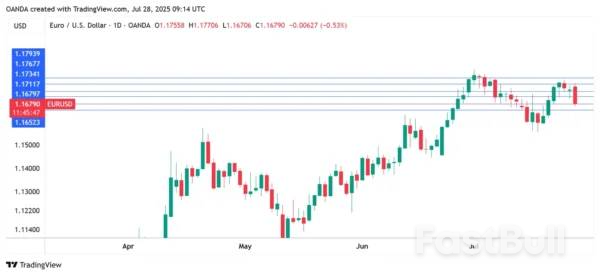
          The euro is busy on Monday morning. EUR/USD started the week in positive territory and rose as much as 0.30%, but has reversed directions in the European session and is trading at 1.1677, down 0.54% on the day.

          EU and the US reach a trade deal

          US President Trump can add another feather to his MAGA cap, with news that the European Union and the United States reached a trade agreement over the weekend. President Trump had threatened to hit the EU with 30% tariffs if a deal wasn’t reached by Aug. 1 and the specter of a nasty trade war between the largest two economies in the world has been averted.

          A deal is of course good news but it’s important to keep in mind that the sides have agreed to a framework agreement, which is thin on details. Some contentious issues remain, such as the US tariff of 50% on steel and aluminum.

          The deal mirrors the US-Japan agreement which was announced last week. The US will eliminate some tariffs, such as on aircraft parts and generic drugs, but most European products will face a tariff of 15%, which will make European imports more expensive for US consumers. The EU has also agreed to increase investment in the US by $600 billion and purchase $750 billion in US energy products.

          The German auto industry is one of the deal’s big winners, as the 15% tariff will be easier to swallow than the current rate of 27.5%. The US-Japan deal puts a 15% tariff on Japanese motor vehicles, which would have put European automakers at a major disadvantage without a EU-US deal.

          Trump is moving ahead and reaching deals with major trade partners, which is removing uncertainty and raising risk appetite. Investors are hoping that other key nations, such as Canada and South Korea, will follow soon with trade agreements with the US.

          EUR/USD Technical

          • EUR/USD has pushed below support at 1.1735 and 1.1710 and is testing 1.1677. Below, there is support at 1.1652
          • There is resistance at 1.1768 and 1.1793

          EURUSD 1-Day Chart, July 28, 2025

          Source: ACTIONFOREX

          Risk Warnings and Disclaimers
          You understand and acknowledge that there is a high degree of risk involved in trading. Following any strategies or investment methods may lead to potential losses. The content on the site is provided by our contributors and analysts for information purposes only. You are solely responsible for determining whether any trading assets, securities, strategy, or any other product is suitable for investing based on your own investment objectives and financial situation.
          Add to Favorites
          Share

          Understanding Dollar-Cost Averaging (DCA) In Crypto Trading

          Winkelmann

          Economic

          Cryptocurrency

          Dollar-Cost Averaging (DCA) is a popular investment strategy that involves consistently purchasing a fixed amount of an asset at regular intervals, regardless of its current market price. In the world of cryptocurrency — where volatility is the norm — DCA offers traders a way to reduce the emotional impact of price swings and potentially lower the average cost of their investment over time.

          For crypto traders, DCA is especially useful in mitigating the risk of buying into the market at the wrong time. Instead of attempting to time the market, which even experienced traders struggle with, DCA encourages a steady and disciplined approach. By purchasing smaller amounts at different price points, traders can avoid the pitfalls of buying a large position during a price peak.

          Let’s say a trader wants to invest $1,000 in Bitcoin. Rather than investing the entire amount in one go, they might choose to invest $100 every week for 10 weeks. If the price fluctuates during that time, the average purchase price could be lower than buying in a single lump sum at a high point. This approach helps smooth out the effects of volatility and can provide better long-term results for traders who are not trying to make quick profits.

          One of the key psychological benefits of DCA is that it reduces anxiety and impulsiveness. Crypto markets are known for their dramatic price shifts, and new investors often panic during downturns or become overly enthusiastic during bull runs. With DCA, the focus shifts from short-term market movements to long-term accumulation, encouraging patience and discipline.

          However, DCA is not a perfect strategy. It may lead to lower returns compared to investing a lump sum during a prolonged bull market. Also, in highly speculative altcoins with uncertain long-term prospects, DCA can magnify losses if the asset ultimately fails. Therefore, it’s important to combine DCA with solid research and sound asset selection.

          In summary, Dollar-Cost Averaging is a simple yet powerful strategy for crypto traders looking to navigate market volatility. By spreading out purchases over time, traders can minimize risk, reduce emotional decision-making, and build positions with greater consistency. While not foolproof, DCA remains a valuable tool — especially for those new to crypto or looking to build wealth steadily over time.

          Source: CryptoSlate

          To stay updated on all economic events of today, please check out our Economic calendar
          Risk Warnings and Disclaimers
          You understand and acknowledge that there is a high degree of risk involved in trading. Following any strategies or investment methods may lead to potential losses. The content on the site is provided by our contributors and analysts for information purposes only. You are solely responsible for determining whether any trading assets, securities, strategy, or any other product is suitable for investing based on your own investment objectives and financial situation.
          Add to Favorites
          Share

          Out-Gunned Europe Accepts Least-Worst US Trade Deal

          Michelle

          Economic

          Forex

          In the end, Europe found it lacked the leverage to pull Donald Trump's America into a trade pact on its terms and so has signed up to a deal it can just about stomach - albeit one that is clearly skewed in the U.S.'s favour.

          As such, Sunday's agreement on a blanket 15% tariff after a months-long stand-off is a reality check on the aspirations of the 27-country European Union to become an economic power able to stand up to the likes of the United States or China.

          The cold shower is all the more bracing given that the EU has long portrayed itself as an export superpower and champion of rules-based commerce for the benefit both of its own soft power and the global economy as a whole.

          For sure, the new tariff that will now be applied is a lot more digestible than the 30% "reciprocal" tariff which Trump threatened to invoke in a few days.

          While it should ensure Europe avoids recession, it will likely keep its economy in the doldrums: it sits somewhere between two tariff scenarios the European Central Bank last month forecast would mean 0.5-0.9% economic growth this year compared to just over 1% in a trade tension-free environment.

          But this is nonetheless a landing point that would have been scarcely imaginable only months ago in the pre-Trump 2.0 era, when the EU along with much of the world could count on U.S. tariffs averaging out at around 1.5%.

          Even when Britain agreed a baseline tariff of 10% with the United States back in May, EU officials were adamant they could do better and - convinced the bloc had the economic heft to square up to Trump - pushed for a "zero-for-zero" tariff pact.

          It took a few weeks of fruitless talks with their U.S. counterparts for the Europeans to accept that 10% was the best they could get and a few weeks more to take the same 15% baseline which the United States agreed with Japan last week.

          "The EU does not have more leverage than the U.S., and the Trump administration is not rushing things," said one senior official in a European capital who was being briefed on last week's negotiations as they closed in around the 15% level.

          That official and others pointed to the pressure from Europe's export-oriented businesses to clinch a deal and so ease the levels of uncertainty starting to hit businesses from Finland's Nokiato Swedish steelmaker SSAB.

          "We were dealt a bad hand. This deal is the best possible play under the circumstances," said one EU diplomat. "Recent months have clearly shown how damaging uncertainty in global trade is for European businesses."

          NOW WHAT?

          That imbalance - or what the trade negotiators have been calling "asymmetry" - is manifest in the final deal.

          Not only is it expected the EU will call off retaliation and remain broadly open to U.S. goods on more favourable terms, but it has also pledged $600 billion of investment in the United States over the course of Trump's term in office.

          As talks unfolded, it became clear that the EU came to the conclusion it had more to lose from all-out confrontation.

          The retaliatory measures it threatened totalled some 93 billion euros - less than half its U.S. goods trade surplus of nearly 200 billion euros.

          True, a growing number of EU capitals were also ready to envisage wide-ranging anti-coercion measures that would have allowed the bloc to target the services trade in which the United States had a surplus of some $75 billion last year.

          But even then, there was no clear majority for targeting the U.S. digital services which European citizens enjoy and for which there are scant homegrown alternatives - from Netflixto Uberto Microsoftcloud services.

          For now, the deal does not shift the dial significantly on the already modest near-term expectations for the European economy, which at least is seen buoyed by increased German spending on defence and infrastructure in the coming years.

          "We therefore still expect a modest slowing in (euro area) growth in 2H25," said Greg Fuzesi, euro area economist at JP Morgan, who also expected the ECB to make one further rate cut on top of 200 basis points of easing over the past year.

          It remains to be seen whether the lop-sided deal will prompt European leaders to push ahead with the economic reforms and diversification of trading allies to which they have long paid lip service but which have been held back by national divisions.

          Describing the deal as a painful compromise that was an "existential threat" for many of its members, Germany's BGA wholesale and export association said it was time for Europe to reduce its reliance on its biggest trading partner.

          "Let's look on the past months as a wake-up call," said BGA President Dirk Jandura. "Europe must now prepare itself strategically for the future - we need new trade deals with the biggest industrial powers of the world."

          Source: Reuters

          To stay updated on all economic events of today, please check out our Economic calendar
          Risk Warnings and Disclaimers
          You understand and acknowledge that there is a high degree of risk involved in trading. Following any strategies or investment methods may lead to potential losses. The content on the site is provided by our contributors and analysts for information purposes only. You are solely responsible for determining whether any trading assets, securities, strategy, or any other product is suitable for investing based on your own investment objectives and financial situation.
          Add to Favorites
          Share

          Hedge Funds Rotate Out of Tech and Into Consumer Staples Amid Valuation Concerns and Rate Uncertainty

          Gerik

          Economic

          Tech Sector Faces Sharp Sell-Off Amid Elevated Valuations

          In a marked shift in sentiment, hedge funds pulled out of technology stocks at the fastest pace in twelve months last week, even as the S&P 500 reached fresh all-time highs. According to a client note from Goldman Sachs seen by Reuters, the exodus reflects rising investor caution toward sectors with elevated valuations, particularly as 10-year bond yields remain high and unpredictable.
          The S&P 500, where seven of the ten largest companies by market cap are tech-related, has surged approximately 28% from its 2025 low, while the Nasdaq Composite has climbed 38% in the same period. Despite this strength, valuations are now stretched: the forward price-to-earnings ratio for the index sits at 23.11 near five-month highs and around 30% above the recent decade average.

          No Broad Shorting, But Clear Risk Reduction

          Rather than aggressively shorting tech, hedge funds have unwound long positions and exited trades, indicating a shift in conviction rather than outright pessimism. The rotation was concentrated in North American and European markets, with hedge funds selling off shares across all tech segments, including semiconductors, software, and IT services.
          This repositioning marks the largest tech sector liquidation by hedge funds since July 2024, according to Goldman. The move underscores a broader market reassessment: while high-growth tech names had led much of the post-2025 recovery, their sensitivity to interest rates and lofty valuations now make them vulnerable to macroeconomic uncertainty.

          Consumer Staples Emerge as Safe Haven

          In contrast to the tech retreat, consumer staples have seen a notable inflow. For the fourth consecutive week, hedge funds increased their exposure to companies in the food, beverage, and personal care sectors. These trades were almost entirely long positions indicating confidence in rising prices rather than hedging strategies.
          The rotation suggests hedge funds are seeking stability and defensiveness amid growing uncertainty around interest rates and stretched equity valuations. Florian Ielpo of Lombard Odier Investment Managers noted that future equity gains may rely on a decline in long-term interest rates, but current market dynamics offer no clear signal that such a shift is imminent.

          Positioning for Resilience Amid Macroeconomic Ambiguity

          The hedge fund flight from tech and shift toward consumer staples signals a recalibration of risk in an overheated equity market. With growth stocks trading at historically rich valuations and yields remaining elevated, institutional investors are rotating into sectors with steadier earnings and lower sensitivity to macro volatility.
          Until there is greater clarity on the Federal Reserve’s rate trajectory or a sustained cooling in bond yields, this defensive posture may persist. While the tech sector’s long-term prospects remain tied to innovation and AI expansion, hedge funds appear to be taking a tactical pause, opting instead for resilience over momentum.

          Source: Reuters

          To stay updated on all economic events of today, please check out our Economic calendar
          Risk Warnings and Disclaimers
          You understand and acknowledge that there is a high degree of risk involved in trading. Following any strategies or investment methods may lead to potential losses. The content on the site is provided by our contributors and analysts for information purposes only. You are solely responsible for determining whether any trading assets, securities, strategy, or any other product is suitable for investing based on your own investment objectives and financial situation.
          Add to Favorites
          Share
          FastBull
          Copyright © 2025 FastBull Ltd

          728 RM B 7/F GEE LOK IND BLDG NO 34 HUNG TO RD KWUN TONG KLN HONG KONG

          TelegramInstagramTwitterfacebooklinkedin
          App Store Google Play Google Play
          Products
          Charts

          Chats

          Q&A with Experts
          Screeners
          Economic Calendar
          Data
          Tools
          Membership
          Features
          Function
          Markets
          Copy Trading
          Latest Signals
          Contests
          News
          Analysis
          24/7
          Columns
          Education
          Company
          Careers
          About Us
          Contact Us
          Advertising
          Help Center
          Feedback
          User Agreement
          Privacy Policy
          Business

          White Label

          Data API

          Web Plug-ins

          Poster Maker

          Affiliate Program

          Risk Disclosure

          The risk of loss in trading financial instruments such as stocks, FX, commodities, futures, bonds, ETFs and crypto can be substantial. You may sustain a total loss of the funds that you deposit with your broker. Therefore, you should carefully consider whether such trading is suitable for you in light of your circumstances and financial resources.

          No decision to invest should be made without thoroughly conducting due diligence by yourself or consulting with your financial advisors. Our web content might not suit you since we don't know your financial conditions and investment needs. Our financial information might have latency or contain inaccuracy, so you should be fully responsible for any of your trading and investment decisions. The company will not be responsible for your capital loss.

          Without getting permission from the website, you are not allowed to copy the website's graphics, texts, or trademarks. Intellectual property rights in the content or data incorporated into this website belong to its providers and exchange merchants.

          Not Logged In

          Log in to access more features

          FastBull Membership

          Not yet

          Purchase

          Become a signal provider
          Help Center
          Customer Service
          Dark Mode
          Price Up/Down Colors

          Log In

          Sign Up

          Position
          Layout
          Fullscreen
          Default to Chart
          The chart page opens by default when you visit fastbull.com