• Trade
  • Markets
  • Copy
  • Contests
  • News
  • 24/7
  • Calendar
  • Q&A
  • Chats
Trending
Screeners
SYMBOL
LAST
BID
ASK
HIGH
LOW
NET CHG.
%CHG.
SPREAD
SPX
S&P 500 Index
6827.42
6827.42
6827.42
6899.86
6801.80
-73.58
-1.07%
--
DJI
Dow Jones Industrial Average
48458.04
48458.04
48458.04
48886.86
48334.10
-245.98
-0.51%
--
IXIC
NASDAQ Composite Index
23195.16
23195.16
23195.16
23554.89
23094.51
-398.69
-1.69%
--
USDX
US Dollar Index
97.900
97.980
97.900
98.070
97.810
-0.050
-0.05%
--
EURUSD
Euro / US Dollar
1.17477
1.17485
1.17477
1.17596
1.17262
+0.00083
+ 0.07%
--
GBPUSD
Pound Sterling / US Dollar
1.33857
1.33865
1.33857
1.33961
1.33546
+0.00150
+ 0.11%
--
XAUUSD
Gold / US Dollar
4335.99
4336.33
4335.99
4350.16
4294.68
+36.60
+ 0.85%
--
WTI
Light Sweet Crude Oil
56.892
56.922
56.892
57.601
56.789
-0.341
-0.60%
--

Community Accounts

Signal Accounts
--
Profit Accounts
--
Loss Accounts
--
View More

Become a signal provider

Sell trading signals to earn additional income

View More

Guide to Copy Trading

Get started with ease and confidence

View More

Signal Accounts for Members

All Signal Accounts

Best Return
  • Best Return
  • Best P/L
  • Best MDD
Past 1W
  • Past 1W
  • Past 1M
  • Past 1Y

All Contests

  • All
  • Trump Updates
  • Recommend
  • Stocks
  • Cryptocurrencies
  • Central Banks
  • Featured News
Top News Only
Share

Statement: US Travel Group Warns New Proposed Trump Administration Requirements For Foreign Tourists To Provide Social Media Histories Could Mean Millions Of People Opting Not To Visit

Share

Blackrock: Kerry White Will Become Head Of Citi Investment Management At Citi Wealth

Share

Blackrock: Rob Jasminski, Head Of Citi Investment Management, Has Joined With Team

Share

Blackrock: Effective Dec 15, Citi Investment Management Employees Will Join Blackrock

Share

Blackrock: Formally Launch Citi Portfolio Solutions Powered By Blackrock

Share

According To Data From The Federal Reserve Bank Of New York, The Secured Overnight Funding Rate (Sofr) Was 3.67% On The Previous Trading Day (December 15), Compared To 3.66% The Day Before

Share

Peru Energy And Mines Ministry: Copper Production Up 4.8% Year-On-Year In October To 248192 Metric Tons

Share

Security Source: Ukrainian Drones Hits Russian Oil Infrastructure In Caspian Sea For Third Time

Share

Spot Palladium Extends Gains, Last Up 5% To $1562.7/Oz

Share

Mexico's Economy Ministry Announces Start Of Anti-Dumping Investigation And Anti-Subsidy Investigations Into USA Pork Imports

Share

Canada Nov CPI Common +2.8%, CPI Median +2.8%, CPI Trim +2.8% On Year

Share

NY Fed's Empire State Prices Paid Index +37.6 In December Versus+49.0 In November

Share

Canada Nov Consumer Prices +0.1% On Month, +2.2% On Year

Share

Canada Nov CPI Core -0.1% On Month, +2.9% On Year

Share

Canada Nov Core CPI, Seasonally Adjusted +0.2% On Month, Oct +0.3% (Unrevised)

Share

UK Health Minister Streeting On Doctors' Strike: Vote To Go Ahead Reveals The Bma's Shocking Disregard For Patient Safety

Share

Venezuelan State Oil Company Pdvsa Says Was Subject To Cyber Attack But Operations Unaffected

Share

Russia Central Bank Says January-October Current Account Surplus At $37.1 Billion

Share

Polish Current Account Balance At +1924 Million Euros In October Versus+130 Million Euros Seen In Reuters Poll

Share

Statement: Germany, Ukraine Propose 10-Point Plan To Strengthen Armament Cooperation

TIME
ACT
FCST
PREV
Japan Tankan Small Manufacturing Outlook Index (Q4)

A:--

F: --

P: --

Japan Tankan Large Non-Manufacturing Outlook Index (Q4)

A:--

F: --

P: --

Japan Tankan Large Manufacturing Outlook Index (Q4)

A:--

F: --

P: --

Japan Tankan Small Manufacturing Diffusion Index (Q4)

A:--

F: --

P: --

Japan Tankan Large Manufacturing Diffusion Index (Q4)

A:--

F: --

P: --

Japan Tankan Large-Enterprise Capital Expenditure YoY (Q4)

A:--

F: --

P: --

U.K. Rightmove House Price Index YoY (Dec)

A:--

F: --

P: --

China, Mainland Industrial Output YoY (YTD) (Nov)

A:--

F: --

P: --

China, Mainland Urban Area Unemployment Rate (Nov)

A:--

F: --

P: --

Saudi Arabia CPI YoY (Nov)

A:--

F: --

P: --

Euro Zone Industrial Output YoY (Oct)

A:--

F: --

P: --

Euro Zone Industrial Output MoM (Oct)

A:--

F: --

P: --

Canada Existing Home Sales MoM (Nov)

A:--

F: --

P: --

Canada National Economic Confidence Index

A:--

F: --

P: --

Canada New Housing Starts (Nov)

A:--

F: --

P: --
U.S. NY Fed Manufacturing Employment Index (Dec)

A:--

F: --

P: --

U.S. NY Fed Manufacturing Index (Dec)

A:--

F: --

P: --

Canada Core CPI YoY (Nov)

A:--

F: --

P: --

Canada Manufacturing Unfilled Orders MoM (Oct)

A:--

F: --

P: --

U.S. NY Fed Manufacturing Prices Received Index (Dec)

A:--

F: --

P: --

U.S. NY Fed Manufacturing New Orders Index (Dec)

A:--

F: --

P: --

Canada Manufacturing New Orders MoM (Oct)

A:--

F: --

P: --

Canada Core CPI MoM (Nov)

A:--

F: --

P: --

Canada Trimmed CPI YoY (SA) (Nov)

A:--

F: --

P: --

Canada Manufacturing Inventory MoM (Oct)

A:--

F: --

P: --

Canada CPI YoY (Nov)

A:--

F: --

P: --

Canada CPI MoM (Nov)

A:--

F: --

P: --

Canada CPI YoY (SA) (Nov)

A:--

F: --

P: --

Canada Core CPI MoM (SA) (Nov)

A:--

F: --

P: --

Canada CPI MoM (SA) (Nov)

A:--

F: --

P: --

Federal Reserve Board Governor Milan delivered a speech
U.S. NAHB Housing Market Index (Dec)

--

F: --

P: --

Australia Composite PMI Prelim (Dec)

--

F: --

P: --

Australia Services PMI Prelim (Dec)

--

F: --

P: --

Australia Manufacturing PMI Prelim (Dec)

--

F: --

P: --

Japan Manufacturing PMI Prelim (SA) (Dec)

--

F: --

P: --

U.K. 3-Month ILO Employment Change (Oct)

--

F: --

P: --

U.K. Unemployment Claimant Count (Nov)

--

F: --

P: --

U.K. Unemployment Rate (Nov)

--

F: --

P: --

U.K. 3-Month ILO Unemployment Rate (Oct)

--

F: --

P: --

U.K. Average Weekly Earnings (3-Month Average, Including Bonuses) YoY (Oct)

--

F: --

P: --

U.K. Average Weekly Earnings (3-Month Average, Excluding Bonuses) YoY (Oct)

--

F: --

P: --

France Services PMI Prelim (Dec)

--

F: --

P: --

France Composite PMI Prelim (SA) (Dec)

--

F: --

P: --

France Manufacturing PMI Prelim (Dec)

--

F: --

P: --

Germany Services PMI Prelim (SA) (Dec)

--

F: --

P: --

Q&A with Experts
    • All
    • Chatrooms
    • Groups
    • Friends
    Connecting
    .
    .
    .
    Type here...
    Add Symbol or Code

      No matching data

      All
      Trump Updates
      Recommend
      Stocks
      Cryptocurrencies
      Central Banks
      Featured News
      • All
      • Russia-Ukraine Conflict
      • Middle East Flashpoint
      • All
      • Russia-Ukraine Conflict
      • Middle East Flashpoint
      Search
      Products

      Charts Free Forever

      Chats Q&A with Experts
      Screeners Economic Calendar Data Tools
      Membership Features
      Data Warehouse Market Trends Institutional Data Policy Rates Macro

      Market Trends

      Market Sentiment Order Book Forex Correlations

      Top Indicators

      Charts Free Forever
      Markets

      News

      News Analysis 24/7 Columns Education
      From Institutions From Analysts
      Topics Columnists

      Latest Views

      Latest Views

      Trending Topics

      Top Columnists

      Latest Update

      Signals

      Copy Rankings Latest Signals Become a signal provider AI Rating
      Contests
      Brokers

      Overview Brokers Assessment Rankings Regulators News Claims
      Broker listing Forex Brokers Comparison Tool Live Spread Comparison Scam
      Q&A Complaint Scam Alert Videos Tips to Detect Scam
      More

      Business
      Events
      Careers About Us Advertising Help Center

      White Label

      Data API

      Web Plug-ins

      Affiliate Program

      Awards Institution Evaluation IB Seminar Salon Event Exhibition
      Vietnam Thailand Singapore Dubai
      Fans Party Investment Sharing Session
      FastBull Summit BrokersView Expo
      Recent Searches
        Top Searches
          Markets
          News
          Analysis
          User
          24/7
          Economic Calendar
          Education
          Data
          • Names
          • Latest
          • Prev

          View All

          No data

          Scan to Download

          Faster Charts, Chat Faster!

          Download App
          English
          • English
          • Español
          • العربية
          • Bahasa Indonesia
          • Bahasa Melayu
          • Tiếng Việt
          • ภาษาไทย
          • Français
          • Italiano
          • Türkçe
          • Русский язык
          • 简中
          • 繁中
          Open Account
          Search
          Products
          Charts Free Forever
          Markets
          News
          Signals

          Copy Rankings Latest Signals Become a signal provider AI Rating
          Contests
          Brokers

          Overview Brokers Assessment Rankings Regulators News Claims
          Broker listing Forex Brokers Comparison Tool Live Spread Comparison Scam
          Q&A Complaint Scam Alert Videos Tips to Detect Scam
          More

          Business
          Events
          Careers About Us Advertising Help Center

          White Label

          Data API

          Web Plug-ins

          Affiliate Program

          Awards Institution Evaluation IB Seminar Salon Event Exhibition
          Vietnam Thailand Singapore Dubai
          Fans Party Investment Sharing Session
          FastBull Summit BrokersView Expo

          Three Rate Cuts in 24 Hours Show Europe’s Tariff Challenges

          Warren Takunda

          Economic

          Summary:

          Three surprise rate cuts in Europe—by central banks in Switzerland, Sweden, and Norway—signal growing concern over inflation and trade uncertainty, as officials diverge from the Fed and BOE amid fallout from Trump’s tariff threats.

          Three interest-rate cuts in just over 24 hours by central banks in Europe highlighted a shift as monetary officials seek to manage the fallout from Donald Trump’s unpredictable trade policies.
          Central bankers in Switzerland and Sweden had suggested as recently as March that they were most likely done loosening, but the Swiss National Bank instead trimmed borrowing costs by 25 basis points on Thursday, following a similar move by Sweden’s Riksbank a day earlier.
          Norway’s pivot, also on Thursday, was altogether more dramatic, with another quarter-point cut that none of the economists surveyed by Bloomberg predicted.
          With policy decisions from at least 18 central banks managing more than 40% of the global economy scheduled for this week, the easing in parts of Europe contrasted with a wait-and-see approach predominating around the world.
          The US Federal Reserve, Bank of Japan and Bank of England all held, as did policymakers from Pakistan to Turkey and Chile.
          All that comes against the backdrop of a July 9 deadline that could see the US reintroduce punitive trade tariffs across the world. Combined with continued uncertainty over the war in Ukraine and a potential US strike on Iran, it’s left policymakers unwilling or unable to move.
          What Bloomberg Economics Says...
          “Differing tariff impacts and labor market conditions help explain why the BOE and Fed are slower to cut rates than others. Right now, the war in Iran is driving another wedge. In the shale-rich US, higher oil prices raise inflation without hitting GDP, making it harder for the Fed to ease. In oil-importing Europe, higher inflation is accompanied by weaker growth, making the decision to cut an easier one.”
          —Jamie Rush, director of global economics.
          The reasons for the rate cuts in Sweden, Norway and Switzerland are all linked to inflation — even if the situations diverge.
          Swiss consumer prices fell 0.1% from a year ago in May and new SNB forecasts published Thursday show inflation will average just 0.2% this year. That’s primarily due to the haven franc, which has appreciated against the dollar and euro since Trump took office.
          Price pressure in Sweden has eased after a temporary spike at the start of the year and as a nascent rebound in the largest Nordic nation has fizzled out. That’s allowing space for more stimulus, Riksbank Governor Erik Thedeen said Wednesday.
          The krona has been the best performer this year in the G-10 of major currency holders, surging 15% against the dollar, and also helping to reduce the risk of imported inflation.
          In Norway, price growth has been stickier over the last year, partly due to a weaker performance of the krone.
          Even so, a core measure of consumer-price growth last month matched this year’s lowest level — 2.8%. The Norwegian central bank now sees headline price growth next year at 2.2%, down from 2.7% seen in March, while this year’s inflation is still seen at 3%.
          The three institutions are also at very different stages in their policy paths: Norway’s Thursday move is its first post-pandemic reduction in borrowing costs, while Sweden and Switzerland carried out their seventh and six moves respectively.
          Uniting them, however, is the fact that they all may cut again.
          Riksbank’s Thedeen and Norges Bank Governor Ida Wolden Bache both told reporters as much, while SNB President Martin Schlegel wouldn’t exclude such an option — even if that would push the Swiss rate into negative territory.

          Source: Bloomberg

          To stay updated on all economic events of today, please check out our Economic calendar
          Risk Warnings and Disclaimers
          You understand and acknowledge that there is a high degree of risk involved in trading. Following any strategies or investment methods may lead to potential losses. The content on the site is provided by our contributors and analysts for information purposes only. You are solely responsible for determining whether any trading assets, securities, strategy, or any other product is suitable for investing based on your own investment objectives and financial situation.
          Add to Favorites
          Share

          Bitcoin And MSTR Face Rising Downside Risk As Risk-Off Sentiment Grows Globally

          Glendon

          Cryptocurrency

          Bitcoin continues to hover near $104.7K as volatility tightens and macro headwinds grow. With rising geopolitical tensions and cautious monetary signals, global investors are shifting away from risk assets. This environment places downside pressure on Bitcoin and MicroStrategy (MSTR), which acts as a leveraged proxy to the cryptocurrency.

          Geopolitical Stress Triggers Risk Rotation

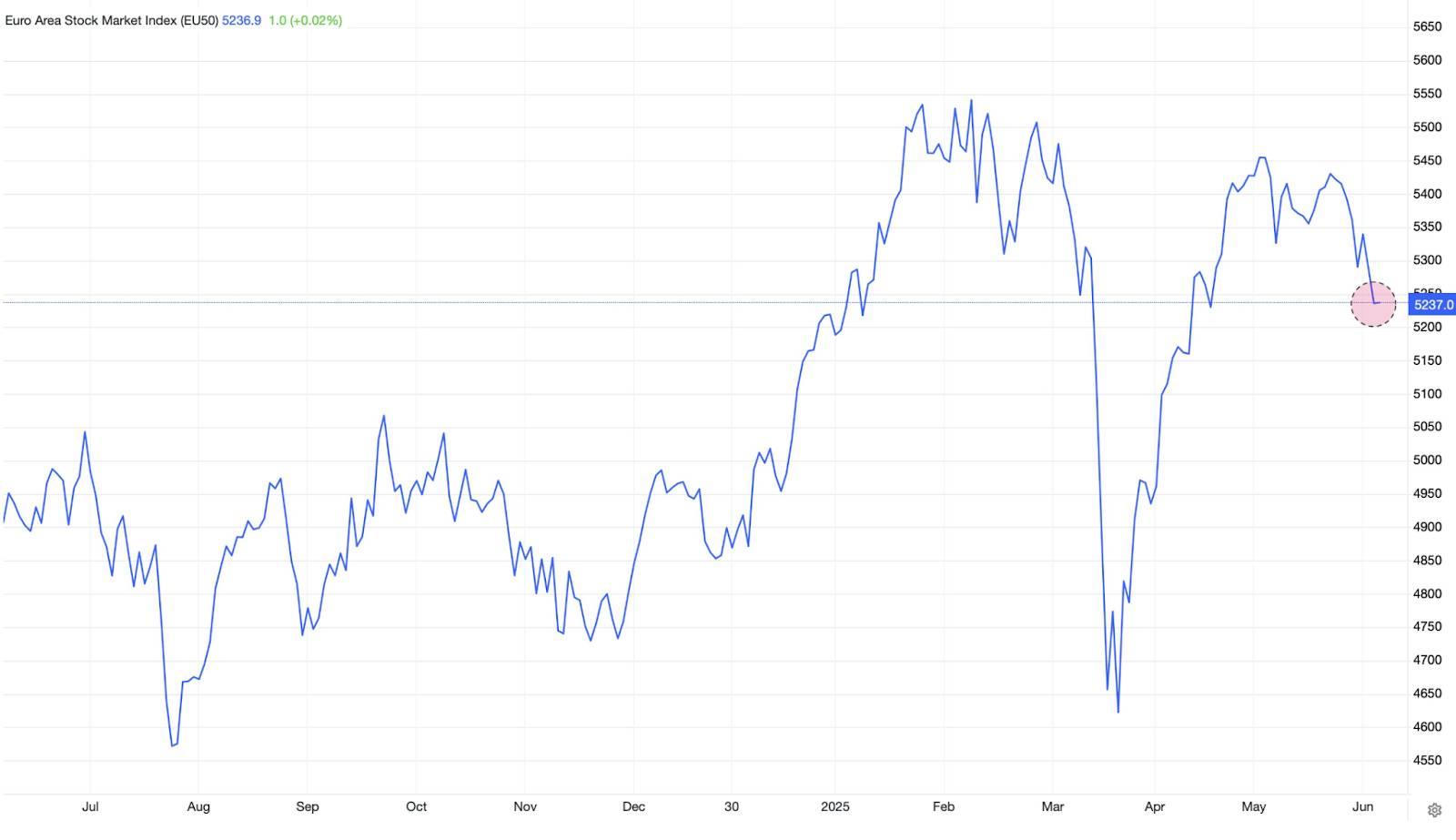
          Bitcoin traded around $104.7K this week, posting a 7-day decline of nearly 3%. The Euro Area Stock Market Index also retreated, closing near 5,237 amid weakening sentiment. These moves reflect heightened caution following reports of potential U.S. strikes in the Middle East.

          The Federal Reserve held rates steady but warned of renewed inflation risks tied to tariff policy. These developments reinforced risk-off behavior across global markets. As a result, capital rotated away from high-beta assets, including Bitcoin and crypto-related equities.

          Euro Area Stock Market Index (EU50) | Source : X

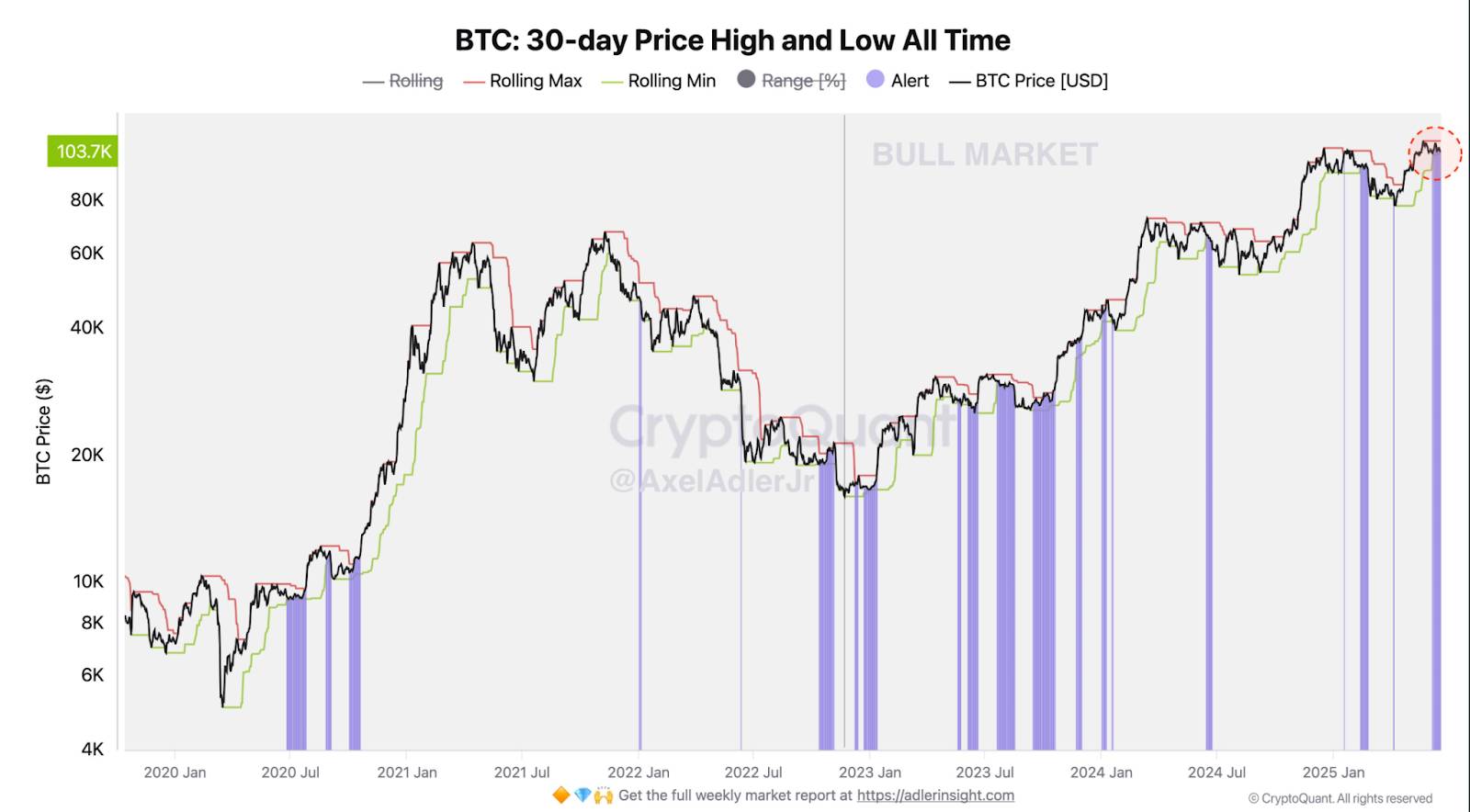
          Meanwhile, Bitcoin’s price has compressed into a tight 30-day range, reflecting a pronounced volatility squeeze. This setup often precedes a breakout, but the direction remains uncertain. Rolling high and low bands are narrowing, signalling indecision.

          BTC 30-day Price High and Low All-Time | Source : CryptoQuant

          Based on realised prices and moving averages, on-chain models show a confluence of support between $97K and $94K. The asset continues trading above key cost bases, but recent weakness raises the risk of downside breaks. If Bitcoin loses this cluster, broader liquidation may follow.

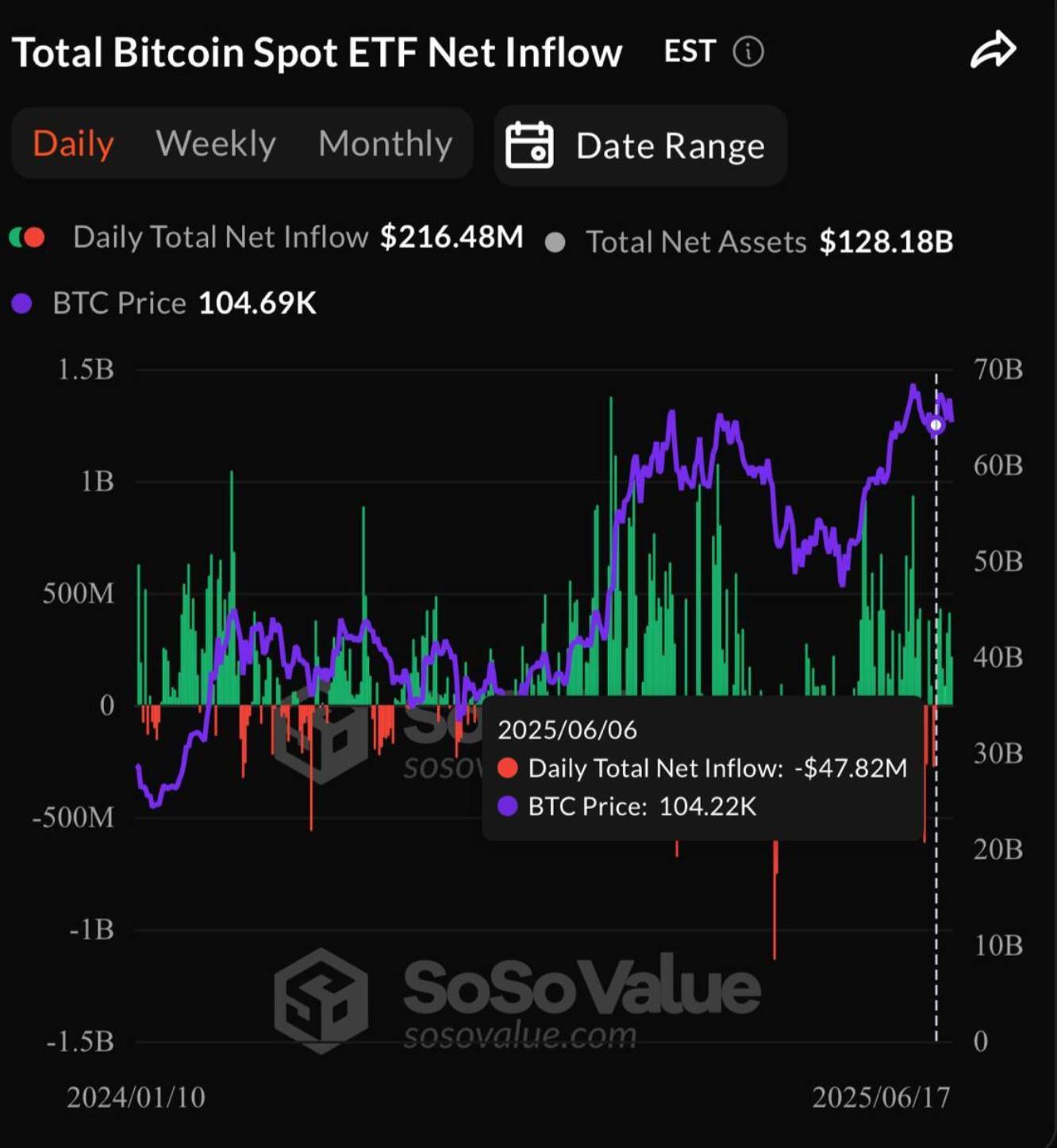
          Technical indicators show Bitcoin is trading just below its recent 30-day high of $111K. Momentum has slowed, and buyers have failed to reclaim resistance levels. However, Spot Bitcoin ETFs recorded $216.48 million in net inflows yesterday, marking seven consecutive days of positive flows.

          BTC Daily Toatl Net Inflow | Source : SoSoValue

          This steady accumulation signals sustained institutional interest despite market uncertainty. Continued inflows could eventually support a breakout from the current consolidation zone.

          Sentiment Weakens as Social Metrics Flash Warning

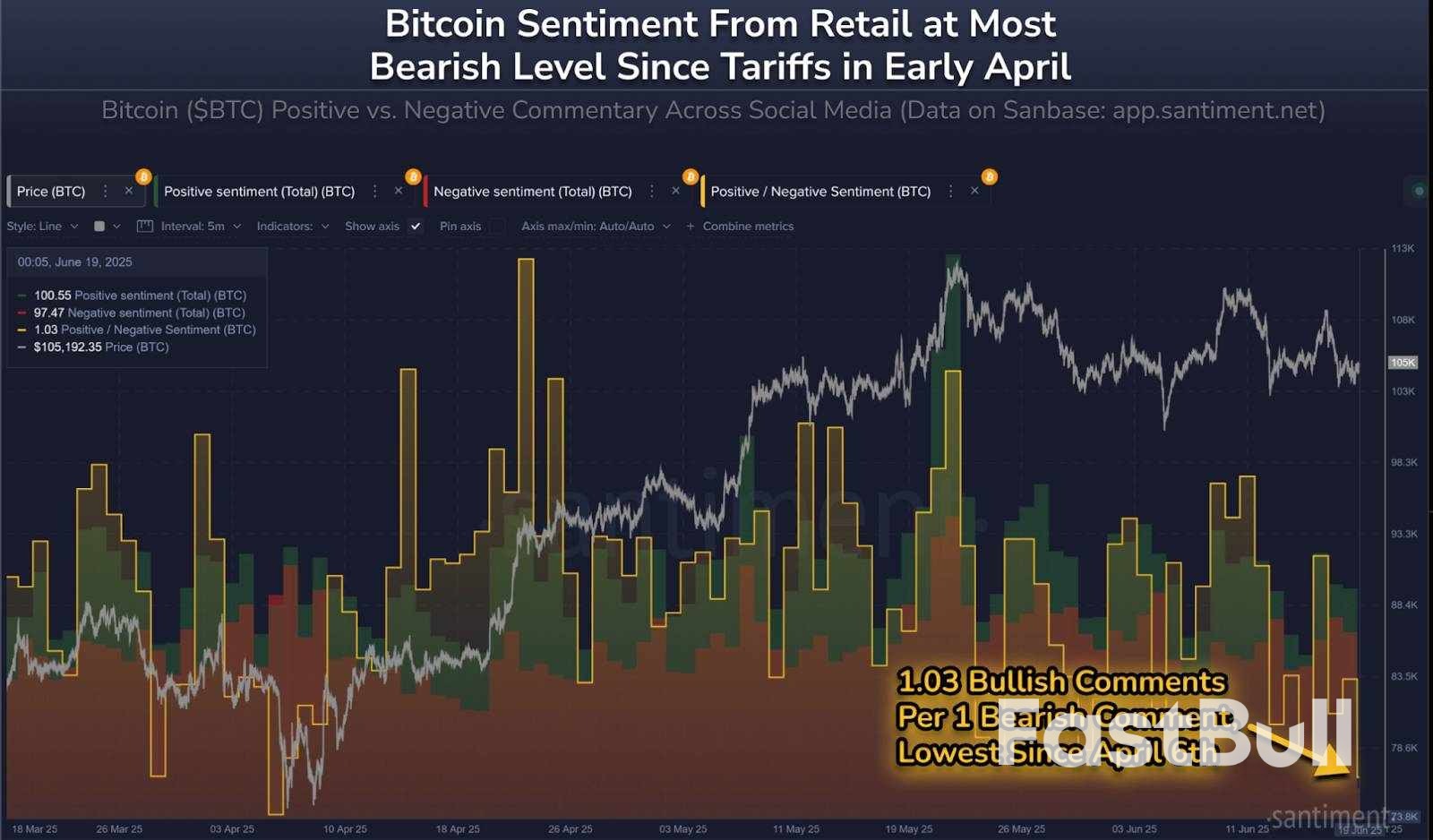
          Retail sentiment toward Bitcoin has deteriorated sharply, reaching its most bearish level since early April. The positive-to-negative comment ratio on social media has dropped to 1.03, reflecting growing investor frustration. Historically, such sentiment imbalance precedes increased volatility.

          Bitcoin Sentiment | Source : Santiment

          The Crypto Fear & Greed Index sits at 48, pointing to neutral sentiment with a tilt toward caution. Altcoin Season Index remains weak at 23, confirming that investors are staying close to large-cap assets like Bitcoin. Low enthusiasm across altcoins highlights the broader uncertainty.

          With bearish commentary rising and market participation thinning, price action could react sharply to external headlines. Bitcoin’s close tracking of macro indicators and social dynamics suggests it remains highly sensitive to global developments. MSTR is likely to follow in lockstep with Bitcoin’s next move.

          Source: CryptoSlate

          Risk Warnings and Disclaimers
          You understand and acknowledge that there is a high degree of risk involved in trading. Following any strategies or investment methods may lead to potential losses. The content on the site is provided by our contributors and analysts for information purposes only. You are solely responsible for determining whether any trading assets, securities, strategy, or any other product is suitable for investing based on your own investment objectives and financial situation.
          Add to Favorites
          Share

          Bank’s Rate Decision Leaves Frustrated Reeves Praying for an August Cut

          Warren Takunda

          Economic

          Last week’s spending review revealed Rachel Reeves’s plan for reviving the UK’s struggling economy – but one of the most powerful levers for unleashing growth lies out of her reach, at the Bank of England.
          Thursday’s no-change decision on interest rates from the Bank’s nine-member monetary policy committee (MPC) was widely expected; but the chancellor and her colleagues will be fervently hoping for a cut in August, perhaps sooner – and more before the year is up.
          The Bank’s governor, Andrew Bailey, had already warned the pace of rate cuts looked uncertain, as a result of Donald Trump’s trade wars. The alarming prospect of a fresh conflict in the Middle East is likely to have made MPC members even more cautious.
          The minutes from Thursday’s meeting suggested the MPC would “remain sensitive to heightened unpredictability in the economic and geopolitical environment,” and would “continue to update its assessment of risks to the economy”.
          Evidence of rising food prices in the latest inflation data is also likely to have preyed on their minds – driven in part by climactic challenges, including the poor harvests that triggered the largest annual increase in chocolate costs on record. Inflation is expected to remain around its current level of 3.4% for the rest of the year – well above the Bank’s 2% target.
          Yet the minutes did also suggest the balance of opinion is shifting towards loosening policy, as the jobs market continues to slow down, helping to alleviate concerns about bumper wage deals driving up inflation.
          The MPC now expects the impact of Trump’s tariffs to be less dramatic than at its last forecast in May, given various concessions and deals – though they stress that “trade policy uncertainty would nevertheless continue to have an impact on the UK economy”.
          Dave Ramsden, deputy governor, voted for a quarter-point cut, to 4% – joining the external members Alan Taylor and Swati Dhingra, both of whom wanted a bigger-than-consensus half-point reduction in May.
          The paragraph of the minutes that set out their argument pointed to the fact that “the cumulative evidence from a range of labour market data pointed to a material further loosening in labour market conditions”.
          Ramsden has previously been slightly ahead of the consensus in moving to cut – he was ready for rates to come down in May last year, three months before the eventual reduction in August; and wanted to see a cut in December, that didn’t happen until February.
          The other two doves voted for a bumper half-point cut in May, so it is no surprise that they would have liked to have seen another reduction on Thursday.
          Dhingra told MPs on the Treasury select committee recently that she was becoming increasingly concerned about the risk that holding policy “too tight” for an extended period – ie keeping rates high – risked undermining the economy’s potential to grow.
          Bailey confirmed alongside Thursday’s no-change decision that rates remained on a “gradual downward path”. That appears to point to another quarter-point cut in August. Reeves will be hoping the MPC picks up the pace.

          Source: Theguardian

          To stay updated on all economic events of today, please check out our Economic calendar
          Risk Warnings and Disclaimers
          You understand and acknowledge that there is a high degree of risk involved in trading. Following any strategies or investment methods may lead to potential losses. The content on the site is provided by our contributors and analysts for information purposes only. You are solely responsible for determining whether any trading assets, securities, strategy, or any other product is suitable for investing based on your own investment objectives and financial situation.
          Add to Favorites
          Share

          China Evacuates 1,600 From Iran And Hundreds From Israel, Warns of Border Congestion

          Glendon

          Political

          China has evacuated more than 1,600 citizens from Iran and hundreds more from Israel, a Chinese foreign ministry spokesperson said on Thursday, as evacuees clog border crossings amid the intensifying conflict between the two countries.

          Evacuation efforts are continuing and China has maintained communication with Iran, Israel, Egypt and Oman, spokesperson Guo Jiakun told a regular press conference while calling for immediate measures to cool down tensions as soon as possible.

          China urges parties to the conflict, especially Israel, to immediately cease fire, Guo said.

          Israel struck a key Iranian nuclear site on Thursday and Iranian missiles hit an Israeli hospital, as the conflict showed no signs of a detente nearly a week after Israel first launched what it called "pre-emptive strikes" against Iran.

          The Chinese embassy in Iran renewed calls for citizens to leave the country via land routes, while also warning people about longer immigration processing time as congestion has formed at two border checkpoints - Astara heading into Azerbaijan and Bajgiran into Turkmenistan.

          Those border crossing points are 490km (304 miles) and 910km away from Tehran, respectively.

          Chinese people can also leave Iran via Turkey, Armenia and Iraq, the embassy advised.

          Earlier on Thursday, China's embassy in Israel said it will begin evacuating people in batches from Friday, taking those who want to leave to the Taba Border Crossing into Egypt via bus, about 360 km from Tel Aviv.

          Source: Reuters

          Risk Warnings and Disclaimers
          You understand and acknowledge that there is a high degree of risk involved in trading. Following any strategies or investment methods may lead to potential losses. The content on the site is provided by our contributors and analysts for information purposes only. You are solely responsible for determining whether any trading assets, securities, strategy, or any other product is suitable for investing based on your own investment objectives and financial situation.
          Add to Favorites
          Share

          Oil surges 10% since start of Israel-Iran war: 'The wild card is the United States'

          Adam

          Commodity

          Middle East Situation

          Oil is up roughly 10% since the outbreak of the Israel-Iran conflict, with Wall Street warning of further upside risk if Iran — a major oil producer — is destabilized.
          On Thursday, oil fluctuated as the markets watched closely to see if President Trump would pull the US into conflict with Israel and Iran.
          West Texas Intermediate futures (CL=F) traded at $75.49 per barrel and Brent crude (BZ=F), the international benchmark settled at $76.22, following a slight uptick the day before.
          On Wednesday, West Texas Intermediate futures was little changed to settle at $75.14 per barrel, following a bigger than expected decrease of US oil inventories. Brent crude settled at $76.70 per barrel.
          Oil prices have been in a seesaw pattern over the past several sessions as traders grapple with the impact of the war in the Middle East, and social media posts from President Trump suggesting the possibility of a US involvement in the conflict in order to target Iran's nuclear program and leadership.
          "The question really becomes how much wider does this [conflict] get, and the wild card is the United States right now," Daniel Dicker, founder of the Energy Word, a newsletter about oil and gas markets, told Yahoo Finance.
          JPMorgan analysts note that while oil shocks from geopolitical conflicts are often short-lived, more enduring price risks could stem from regime changes in oil-producing nations, which can lead to major shifts in policy and production.
          "Since 1979, eight notable regime changes have occurred in oil-producing nations, with prices spiking by 76% from onset to peak and averaging a 30% increase, leaving lasting effects," JPMorgan's Natasha Kaneva and her team wrote in a Wednesday note.
          "If history serves as a guide, further destabilization of Iran could lead to significantly higher oil prices sustained over extended periods," she added.
          Iran, the fourth-largest producer in the OPEC+ alliance, has not seen any visible supply impacts from the fighting so far. OPEC had increased production quotas in the months leading up to Israel's strike.
          Analysts say if the conflict remains contained and no major oil infrastructure is hit, the recent price spike could ease. However, if Iran were to close the Strait of Hormuz — a key chokepoint for global oil flows — Wall Street expects oil could surge into triple-digit territory. That outcome remains unlikely, JPMorgan analysts said, "primarily because it would be considered an act of war," given that the US maintains a strong naval presence in the region.
          Meanwhile, tanker rates in the Middle East have surged as much as 50% since the start of the conflict, according to TORM, one of the world's largest product tanker operators.

          Source: finance.yahoo

          Risk Warnings and Disclaimers
          You understand and acknowledge that there is a high degree of risk involved in trading. Following any strategies or investment methods may lead to potential losses. The content on the site is provided by our contributors and analysts for information purposes only. You are solely responsible for determining whether any trading assets, securities, strategy, or any other product is suitable for investing based on your own investment objectives and financial situation.
          Add to Favorites
          Share

          Switzerland enters era of zero interest rates

          Adam

          Economic

          The Swiss National Bank on Thursday cut interest rates by a further 25 basis points to 0% — adding to concerns over a potential return to negative rates.
          The reduction was widely expected by markets ahead of the decision, after traders priced in an around 81% chance of a quarter-point cut and around a 19% chance of a bigger 50-basis-point cut.
          “Inflationary pressure has decreased compared to the previous quarter. With today’s easing of monetary policy, the SNB is countering the lower inflationary pressure,” the central bank said in a statement.
          “The SNB will continue to monitor the situation closely and adjust its monetary policy if necessary, to ensure that inflation remains within the range consistent with price stability over the medium term,” it added.
          While other nations continue to battle inflation, Switzerland faces deflation, with consumer prices falling by an annual 0.1% in May.
          Low levels of inflation are not unusual for Switzerland — the country has seen several periods of deflation in the 2010s and 2020s. The strength of the country’s currency, the Swiss franc, is a major contributor to this trend.
          “As a safe-haven currency, the Swiss franc tends to appreciate when there is stress on world markets,” said Charlotte de Montpellier, a senior economist covering France and Switzerland at ING.
          “This systematically pushes down the price of imported products. Switzerland is a small, open economy, and imports account for a large proportion of CPI [consumer price index] inflation,” Montpellier told CNBC ahead of the central bank’s announcement.
          Amid high levels of global economic uncertainty, the franc has continuously strengthened in recent months and is widely expected to continue on this path, suggesting ongoing challenges for the SNB.
          As the strength of the franc has been the primary driver of Switzerland’s low inflation, the SNB is now taking steps to constrain the currency’s rally by keeping rates “systematically lower than elsewhere,” Montpellier said.
          After the interest rate decision, the franc
          strengthened, with the U.S. dollar last trading flat against the Swiss currency.
          Negative rates?
          Adrian Prettejohn, Europe economist at Capital Economics, told CNBC ahead of Thursday’s interest rate decision that he expects rates to be cut to -0.25% this year, but noted that the SNB could go even lower.
          “There are risks that the SNB will go further in the future if inflationary pressures don’t start to increase, and the lowest the policy rate could go is -0.75%, the rate it reached in the 2010s,” he told CNBC.
          Prettejohn said interest cuts weigh on currencies, making borrowing cheaper and encouraging investment.
          However, there are also some concerns and risks attached to negative rates, including for savers, who could see any profit on their savings wiped out, and for banks, which will rake in lower returns on their loans.
          ING’s de Montpellier noted that eventually, negative rates might “distort financial markets, compress bank margins, and raise concerns about long-term financial stability.”

          Source: cnbc

          To stay updated on all economic events of today, please check out our Economic calendar
          Risk Warnings and Disclaimers
          You understand and acknowledge that there is a high degree of risk involved in trading. Following any strategies or investment methods may lead to potential losses. The content on the site is provided by our contributors and analysts for information purposes only. You are solely responsible for determining whether any trading assets, securities, strategy, or any other product is suitable for investing based on your own investment objectives and financial situation.
          Add to Favorites
          Share

          Global Shares Decline as Tensions Simmer in the Middle East

          Warren Takunda

          Economic

          Global shares retreated Thursday as worries persisted about conflict in the Middle East.
          On the seventh day of a conflict that began with a surprise wave of Israeli airstrikes targeting military sites, senior officers and nuclear scientists, Iranian state media reported that Iran’s foreign minister planned to meet with his European counterparts in Geneva.
          Meanwhile, Israel carried out strikes on Iran’s Arak heavy water reactor, in its latest attack on Iran’s sprawling nuclear program.
          The escalating warfare has shaken financial markets.
          France’s CAC 40 slipped 0.8% in early trading to 7,593.06. In Germany, the DAX fell 0.9% to 23,141.82. Britain’s FTSE 100 lost 0.5% to 8,797.24. The futures for the S&P 500 and the Dow Jones Industrial Average were 0.4% lower.
          The Federal Reserve opted Wednesday to keep its key interest rate unchanged, while its policymakers signaled they still expect to cut rates twice this year. They project that President Donald Trump’s higher import duties will fuel inflation. They also expect growth to slow and unemployment to edge higher.
          The Bank of England likewise was expected to keep its key interest rate unchanged at 4.25% at its meeting Thursday, after cutting it twice this year.
          Switzerland’s central bank cut its target interest rate by a quarter of a percentage point to zero on Thursday, saying that inflationary pressures have eased. It is among many central banks opting to go ahead and ease the cost of borrowing as uncertainty over Trump’s tariffs and geopolitical crises threaten global growth.
          In Asian trading, Japan’s benchmark Nikkei 225 shed 1.0% to finish at 38,488.34. Shares in Japan’s Nippon Steel Corp. jumped 2.3% after it announced that its acquisition of U.S. Steel, which met U.S. government opposition for more than a year, was finally completed.
          Hong Kong’s Hang Seng dropped 2.0% to 23,237.74 on heavy selling of tech-related shares, while the Shanghai Composite lost 0.8% to 3,362.11.
          Australia’s S&P/ASX 200 was little changed at 8,523.70 and in South Korea, the Kospi rose 0.2% to 2,977.74.
          U.S. financial markets will be closed Thursday for the Juneteenth holiday.
          So far, U.S. inflation has remained relatively tame, and it’s near the Fed’s target of 2%. But economists have been warning it may take months to feel the effects of tariffs. And inflation has been feeling upward pressure recently from a spurt in oil prices because of Israel’s fighting with Iran.
          Fed officials are waiting to see how big Trump’s tariffs will ultimately be, what they will affect and whether they will drive a one-time increase to inflation or something more dangerous. There is also still deep uncertainty about how much tariffs will grind down on the economy’s growth.
          “Because the economy is still solid, we can take the time to actually see what’s going to happen,” said Fed Chair Jerome Powell.
          “We’ll make smarter and better decisions if we just wait a couple months or however long it takes to get a sense of really what is going to be the passthrough of inflation and what are going to be the effects on spending and hiring and all those things,” he said.
          A report released Wednesday said fewer workers applied for unemployment benefits last week, possibly indicating fewer layoffs. But another said homebuilders broke ground on fewer homes last month than economists expected. That suggests higher mortgage rates may be casting a chill on the industry.
          In other dealings early Thursday, benchmark U.S. crude rose 13 cents to $73.63. Brent crude, the international standard, advanced 7 cents to $76.77 a barrel.
          Oil prices have been yo-yoing as fears rise and ebb that the conflict between Israel and Iran could disrupt the global flow of crude. Iran is a major producer of oil and also sits on the narrow Strait of Hormuz, through which much of the world’s crude passes.
          In currency trading, the U.S. dollar rose to 145.46 Japanese yen from 145.13 yen. The euro cost $1.1476, down from $1.1484.

          Source: AP

          To stay updated on all economic events of today, please check out our Economic calendar
          Risk Warnings and Disclaimers
          You understand and acknowledge that there is a high degree of risk involved in trading. Following any strategies or investment methods may lead to potential losses. The content on the site is provided by our contributors and analysts for information purposes only. You are solely responsible for determining whether any trading assets, securities, strategy, or any other product is suitable for investing based on your own investment objectives and financial situation.
          Add to Favorites
          Share
          FastBull
          Copyright © 2025 FastBull Ltd

          728 RM B 7/F GEE LOK IND BLDG NO 34 HUNG TO RD KWUN TONG KLN HONG KONG

          TelegramInstagramTwitterfacebooklinkedin
          App Store Google Play Google Play
          Products
          Charts

          Chats

          Q&A with Experts
          Screeners
          Economic Calendar
          Data
          Tools
          Membership
          Features
          Function
          Markets
          Copy Trading
          Latest Signals
          Contests
          News
          Analysis
          24/7
          Columns
          Education
          Company
          Careers
          About Us
          Contact Us
          Advertising
          Help Center
          Feedback
          User Agreement
          Privacy Policy
          Business

          White Label

          Data API

          Web Plug-ins

          Poster Maker

          Affiliate Program

          Risk Disclosure

          The risk of loss in trading financial instruments such as stocks, FX, commodities, futures, bonds, ETFs and crypto can be substantial. You may sustain a total loss of the funds that you deposit with your broker. Therefore, you should carefully consider whether such trading is suitable for you in light of your circumstances and financial resources.

          No decision to invest should be made without thoroughly conducting due diligence by yourself or consulting with your financial advisors. Our web content might not suit you since we don't know your financial conditions and investment needs. Our financial information might have latency or contain inaccuracy, so you should be fully responsible for any of your trading and investment decisions. The company will not be responsible for your capital loss.

          Without getting permission from the website, you are not allowed to copy the website's graphics, texts, or trademarks. Intellectual property rights in the content or data incorporated into this website belong to its providers and exchange merchants.

          Not Logged In

          Log in to access more features

          FastBull Membership

          Not yet

          Purchase

          Become a signal provider
          Help Center
          Customer Service
          Dark Mode
          Price Up/Down Colors

          Log In

          Sign Up

          Position
          Layout
          Fullscreen
          Default to Chart
          The chart page opens by default when you visit fastbull.com