


- XAUUSD
- XAGUSD
- WTI
- USDX


Markets
Analysis
User
24/7
Economic Calendar
Education
Data
- Names
- Latest
- Prev










Key takeaways
While companies like Strategy and Tesla made headlines, many others have discreetly added Bitcoin to their treasuries.
Firms use Bitcoin to hedge against inflation, fiat devaluation and macroeconomic shocks. Its fixed supply, digital scarcity and 24/7 liquidity make it appealing.
Firms like Arkham and Glassnode trace Bitcoin ownership through address clustering and timing correlation.
Bitcoin is making a significant shift. From a speculative investment, it has become a part of corporate treasuries. While companies like Strategy and Metaplanet gained attention for large Bitcoin purchases, others have quietly followed. Spanning diverse industries like technology and healthcare, these firms have strategically allocated portions of their balance sheets to Bitcoin reserves, often without public announcements.
This low-profile approach shows a growing trend among businesses aiming to protect against inflation, diversify assets or align with the digital economy. An increasing number of companies are incorporating Bitcoin into their balance sheets, inspired by the success of Strategy, led by Michael Saylor. According to BitcoinTreasuries.Net, 26 companies started holding Bitcoin in June 2025, bringing the total number of companies holding Bitcoin to 250 as of July 4, 2025.
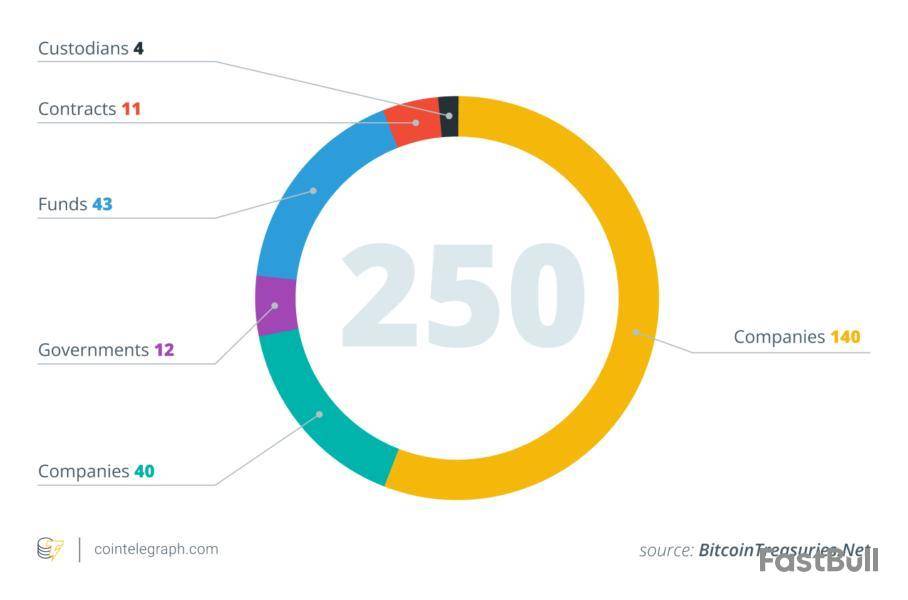
This article explores why companies are adopting Bitcoin as part of their corporate treasury and discusses 10 public companies that have quietly adopted Bitcoin as a financial strategy. It also sheds light on the role of blockchain analytics in revealing holdings, risks associated with a Bitcoin-heavy corporate strategy and various outcomes of Bitcoin accumulation by companies.
Why companies are turning to Bitcoin
Companies are increasingly incorporating Bitcoin into their treasury strategies for several compelling reasons. These factors collectively drive the growing inclusion of digital assets in corporate treasury strategies:
Protection against inflation and currency devaluation: Bitcoin serves as a potential hedge against inflation and the devaluation of fiat currencies. Unlike traditional money, which can lose value due to monetary expansion, Bitcoin’s fixed supply of 21 million coins makes it an attractive store of value during inflationary periods.
Digital scarcity and liquidity: Bitcoin offers a unique combination of digital scarcity and 24/7 liquidity, providing the growth potential of long-term investments while maintaining the accessibility of short-term assets.
Influence of early adopters: Pioneering corporate Bitcoin investors like Strategy and Tesla have significantly influenced this trend. Since 2020, Strategy has accumulated substantial Bitcoin reserves using stock and debt, inspiring other companies to adopt similar strategies.
Governance and portfolio diversification: Treasurers view Bitcoin as a non-correlated asset that enhances portfolio resilience against macroeconomic shocks, supporting governance and diversification goals.
Did you know? Strategy was the first public company to adopt a Bitcoin-first treasury strategy. Since 2020, it has acquired over 200,000 BTC, using both company funds and debt.
10 public companies you didn’t know are holding Bitcoin on their balance sheets
Several public companies have discreetly added Bitcoin to their balance sheets, opting for minimal publicity. Below is a list of such companies, their approaches and BTC holdings as of early July 2025:
BitFuFu
Profile: Singapore-based Bitcoin mining firm listed on Nasdaq (FUFU).
Holdings: 1,709 BTC ($185.85 million), 40% of its market cap.
Objective: Focus on scaling mining operations via owned and cloud-based infrastructure. Plans include boosting hashrates, expanding globally and using treasury reserves to fund low-cost energy access and innovation. Aims for steady BTC accumulation as both mining yield and store of value.
Cipher Mining
Profile: US-listed Bitcoin miner (CIFR) with a strong renewable-energy focus.
Holdings: 1,063 BTC ($115.49 million), 40% of its market cap.
Objective: Build a crypto treasury through mining facilities powered by renewable sources. Intend to stabilize revenue using BTC, reinvest in green energy projects and offer ESG-aligned shareholder value through sustainable crypto yield.
KULR Technology Group
Profile: US thermal and battery safety tech firm (KULR).
Holdings: 920 BTC ($100.04 million), 40% of its market cap.
Objective: Diversifying reserves through Bitcoin, reflecting its tech-centric treasury strategy. By allocating part of its balance sheet to BTC, KULR mitigates fiat risk, aligns with its innovative image and showcases confidence in crypto’s long-term security value.
Aker ASA
Profile: Norway’s industrial investment company (AKER.OL).
Holdings: 754 BTC ($82 million), 1.7% of its market cap.
Objective: Seek balanced capital allocation through BTC exposure while pursuing sustainability-investment themes. BTC acts as a hedge against inflation/currency fluctuations and underpins the firm’s diversification and value-creation strategies across industrial assets.
Méliuz
Profile: Brazilian fintech cashback and services platform (CASH3.SA).
Holdings: 595.7 BTC ($64.8 million), 45% of market cap.
Objective: Allocate 10% of cash reserves to Bitcoin, aiming to enhance treasury resilience. Used BTC as a hedge during currency volatility in Brazil while signaling innovation to fintech customers and investors through modern financial strategies.
MercadoLibre
Profile: Latin America’s leading e-commerce and fintech company (MELI).
Holdings: 570.4 BTC ($62 million); percentage of market cap not available.
Objective: Use BTC as an inflation hedge across volatile LATAM currencies. BTC exposure complements its fintech ecosystem, enabling integration with Mercado Pago and reinforcing leadership in digital payment innovation and reserve diversification.
Samara Asset Group
Profile: Malta-based investment manager (SRAG.DU).
Holdings: 525 BTC ($57.3 million), 28% of its market cap.
Objective: Employ Bitcoin as a reserve asset to safeguard capital with a long-term investment horizon. BTC aligns with Samara’s digital-asset-focused strategy, intended to reduce exposure to traditional markets and attract crypto-minded investors.
Jasmine International PCL
Profile: Thai telecom and data center operator (JAS.BK).
Holdings: 506.4 BTC ($55.25 million), 15.9% of market cap.
Objective: Preserve value by coupling BTC reserves with its data center and mining subsidiary (JTS). Aim to derive crypto revenues, diversify the balance sheet and scale digital infrastructure in Southeast Asia’s emerging market.
Alliance Resource Partners
Profile: US coal producer (ARLP).
Holdings: 481.9 BTC ($55.8 million), 1.5% of market cap.
Objective: Expand beyond energy revenues by diversifying into BTC. Intend to stabilize earnings during commodity downturns and bolster long-term reserve value amid inflationary pressures.
Rumble
Profile: Canadian video-sharing and cloud services platform (RUM).
Holdings: 210.8 BTC ($22.93 million), 0.8% of market cap.
Objective: Envisions BTC embedding crypto culture into Rumble’s core, strengthening ties with decentralization-minded users. While gaining interest from crypto-savvy investors, this move enhances Rumble’s financial resilience and supports further integration of blockchain themes into its platform.
Did you know? Fidelity and BlackRock, two of the world’s largest asset managers, offer institutional clients direct Bitcoin exposure through exchange-traded funds (ETFs), custody services and over-the-counter (OTC) desks, bringing Wall Street structure to the crypto world.
Top 10 public Bitcoin treasury companies
Now that you’ve seen how lesser-known public companies are quietly accumulating Bitcoin as a long-term strategic asset, it’s time to look at the heavyweights. These are the top 10 public companies that hold the largest Bitcoin reserves as of July 8, 2025.
Together, they represent the most influential institutional holders in the Bitcoin ecosystem, shaping market narratives, treasury trends and even regulatory conversations. While some made headlines early on, others have steadily built massive reserves behind the scenes.
Here’s a look at the corporate titans of Bitcoin treasuries:
Strategy (MSTR): 597,325 BTCFormerly MicroStrategy, the company leads all public entities in Bitcoin holdings by a wide margin, continuing its aggressive accumulation strategy.
MARA Holdings (MARA): 50,000 BTCA dominant player in Bitcoin mining, MARA maintains one of the largest self-mined BTC treasuries globally.
XXI (CEP): 37,230 BTCA newer entrant (Twenty One Capital) focused on treasury-centric Bitcoin acquisition now among the top corporate holders.
Riot Platforms (RIOT): 19,225 BTCA major mining firm with steady onchain accumulation through operational reserves and reinvested profits.
Metaplanet (3350.T): 15,555 BTCA standout from Japan, Metaplanet is often called the “Asian MicroStrategy” for its focused Bitcoin strategy.
Galaxy Digital Holdings (GLXY): 12,830 BTCA diversified financial services firm with deep exposure to crypto, including significant BTC on its balance sheet.
CleanSpark (CLSK): 12,502 BTCA sustainable Bitcoin miner with a growing treasury built on efficient energy practices and market timing.
Tesla (TSLA): 11,509 BTCDespite past fluctuations in strategy, Tesla continues to hold a substantial Bitcoin reserve.
Hut 8 Mining Corp (HUT): 10,273 BTCA long-standing mining firm known for holding mined Bitcoin instead of liquidating.
Coinbase Global (COIN): 9,267 BTCThe largest crypto exchange by volume in the West, Coinbase holds Bitcoin for both strategic and operational purposes.
Role of blockchain analytics in revealing corporate Bitcoin holdings
Blockchain analytics firms, such as Arkham Intelligence, Glassnode, Chainalysis and CryptoQuant, play a vital role in uncovering public companies’ holdings of Bitcoin that were previously undisclosed.
These firms use advanced methods like address clustering, timing correlation, behavioral heuristics and “dusting” analysis to connect pseudonymous Bitcoin wallets to corporate entities:
Address clustering: This technique groups wallet addresses by identifying shared patterns, such as coins moving through the same transaction paths or originating from known custodians.
Timing correlation: This method matches blockchain transactions with known purchase dates reported in US Securities and Exchange Commission filings or corporate disclosures.
Behavioral heuristics and dusting: These approaches analyze small test transactions, known as “dust,” and wallet usage patterns to identify ownership indicators.
For instance, Arkham Intelligence has traced 87%-97% of Strategy’s Bitcoin holdings, approximately 70,000-580,000 BTC, by combining wallet clustering and transaction analysis.
However, these methods aren’t foolproof and face several challenges:
Attribution uncertainty: Linking wallets to specific companies relies on assumptions, which can lead to errors, as seen in past mislabeling incidents involving Arkham.
Custody obfuscation: The use of third-party custodians, such as Fidelity or Coinbase Prime, can conceal corporate ownership.
Evolving privacy tactics: Companies may create new wallets, use mixing services or split holdings to evade detection.
Despite these limitations, blockchain analytics significantly improve transparency, providing investors with valuable insights into corporate Bitcoin accumulation.
Did you know? In 2021, Tesla briefly held $1.5 billion in Bitcoin, making it the second-largest corporate holder.
Risks associated with a Bitcoin-heavy corporate treasury strategy
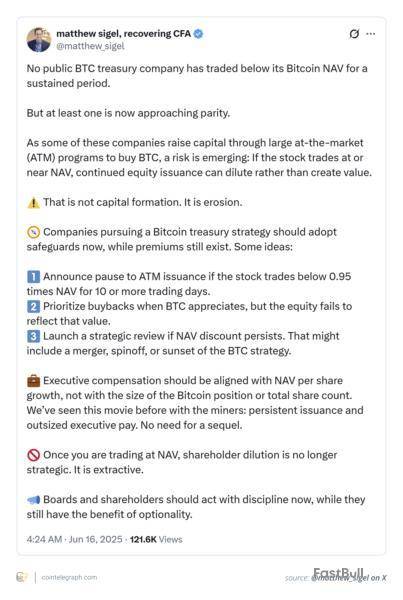
Matthew Sigel from VanEck warns that some companies face “capital erosion,” where their value decreases despite holding Bitcoin. This occurs when firms issue new stock or take on debt to buy Bitcoin.
If a company’s stock price is high, issuing shares can benefit shareholders by raising funds above the net asset value (NAV). However, if the stock price falls to or near its NAV, issuance of new shares dilutes value, potentially harming shareholders and leading to capital erosion.
If Semler’s market capitalization is lower than the value of its Bitcoin holdings, it becomes a concern, as in the case of Semler Scientific. This US medical technology company initially saw its stock price rise after adopting a Bitcoin-focused approach and purchasing large amounts of Bitcoin.
However, by mid-2025, despite Bitcoin’s increasing value, Semler’s stock had dropped by over 45%. What was more concerning was that the company’s market value fell below the worth of its Bitcoin holdings, meaning the market valued the entire business less than its cryptocurrency assets alone.
This is a peculiar situation that reveals the risk of a company relying too much on Bitcoin for its treasury. It may undervalue a company, particularly if investors lose confidence in its core operations. Moreover, while Bitcoin’s price swings may strengthen a company’s balance sheet during market uptrends, its volatility can harm stock performance and shake investor trust.
When a company’s market value falls below its Bitcoin reserves, it may face challenges raising funds through equity or debt, as issuing new shares at low prices reduces the value for existing shareholders.
Implications of Bitcoin accumulation by companies
With the growing acceptance of Bitcoin in business circles, even some risk-averse entities have quietly begun building Bitcoin treasuries. While ultra-conservative firms remain mainly on the sidelines, the number of companies open to accumulating Bitcoin as a backup is consistently growing.
Impact of supply and volatility: Corporate accumulation of Bitcoin removes it from circulation, tightening supply and potentially driving short- to medium-term price spikes. On the other hand, when prices drop, forced sell-offs may amplify volatility. Notably, only 0.26% of the world can own 1 BTC in the future.
Evolution of treasury strategy: This trend is reshaping corporate treasury models globally. Firms increasingly view BTC as a hedge against inflation, adding a non-correlated asset to their balance sheets. Global adoption now spans mid-market to multinational companies, suggesting a strategic normalization of Bitcoin in treasury operations.
Regulatory issues: Companies accumulating Bitcoin as corporate treasury assets may face regulatory challenges, including compliance with Anti-Money Laundering (AML) and Know Your Customer (KYC) laws. Tax implications, such as capital gains reporting and securities regulations, can complicate adoption. Jurisdictional differences and unclear crypto guidelines may also expose firms to legal risks and penalties.
Institutionalization effect: Corporate adoption of Bitcoin as a treasury asset signals mainstream acceptance. It stabilizes market perception and attracts institutional investors. This trend validates Bitcoin’s legitimacy, fostering broader financial integration with market dynamics.
Volatile yet strategic, corporate Bitcoin accumulation is shaping macro supply dynamics, redefining treasury models and adding new layers to market resilience.
This article is for general information purposes and is not intended to be and should not be taken as legal or investment advice. The views, thoughts, and opinions expressed here are the author’s alone and do not necessarily reflect or represent the views and opinions of Cointelegraph.

728 RM B 7/F GEE LOK IND BLDG NO 34 HUNG TO RD KWUN TONG KLN HONG KONG


The risk of loss in trading financial instruments such as stocks, FX, commodities, futures, bonds, ETFs and crypto can be substantial. You may sustain a total loss of the funds that you deposit with your broker. Therefore, you should carefully consider whether such trading is suitable for you in light of your circumstances and financial resources.
No decision to invest should be made without thoroughly conducting due diligence by yourself or consulting with your financial advisors. Our web content might not suit you since we don't know your financial conditions and investment needs. Our financial information might have latency or contain inaccuracy, so you should be fully responsible for any of your trading and investment decisions. The company will not be responsible for your capital loss.
Without getting permission from the website, you are not allowed to copy the website's graphics, texts, or trademarks. Intellectual property rights in the content or data incorporated into this website belong to its providers and exchange merchants.
Not Logged In
Log in to access more features


Log In
Sign Up


