• Trade
  • Markets
  • Copy
  • Contests
  • News
  • 24/7
  • Calendar
  • Q&A
  • Chats
Trending
Screeners
SYMBOL
LAST
BID
ASK
HIGH
LOW
NET CHG.
%CHG.
SPREAD
SPX
S&P 500 Index
6857.13
6857.13
6857.13
6865.94
6827.13
+7.41
+ 0.11%
--
DJI
Dow Jones Industrial Average
47850.93
47850.93
47850.93
48049.72
47692.96
-31.96
-0.07%
--
IXIC
NASDAQ Composite Index
23505.13
23505.13
23505.13
23528.53
23372.33
+51.04
+ 0.22%
--
USDX
US Dollar Index
98.840
98.920
98.840
98.980
98.740
-0.140
-0.14%
--
EURUSD
Euro / US Dollar
1.16590
1.16598
1.16590
1.16715
1.16408
+0.00145
+ 0.12%
--
GBPUSD
Pound Sterling / US Dollar
1.33556
1.33564
1.33556
1.33622
1.33165
+0.00285
+ 0.21%
--
XAUUSD
Gold / US Dollar
4224.99
4225.33
4224.99
4230.62
4194.54
+17.82
+ 0.42%
--
WTI
Light Sweet Crude Oil
59.397
59.427
59.397
59.469
59.187
+0.014
+ 0.02%
--

Community Accounts

Signal Accounts
--
Profit Accounts
--
Loss Accounts
--
View More

Become a signal provider

Sell trading signals to earn additional income

View More

Guide to Copy Trading

Get started with ease and confidence

View More

Signal Accounts for Members

All Signal Accounts

Best Return
  • Best Return
  • Best P/L
  • Best MDD
Past 1W
  • Past 1W
  • Past 1M
  • Past 1Y

All Contests

  • All
  • Trump Updates
  • Recommend
  • Stocks
  • Cryptocurrencies
  • Central Banks
  • Featured News
Top News Only
Share

Kremlin Aide Ushakov Says USA Kushner Is Working Very Actively On Ukrainian Settlement

Share

Norway To Acquire 2 More Submarines, Long-Range Missiles, Daily Vg Reports

Share

Ucb Sa Shares Open Up 7.3% After 2025 Guidance Upgrade, Top Of Bel 20 Index

Share

Shares In Italy's Mediobanca Down 1.3% After Barclays Cuts To Underweight From Equal-Weight

Share

Stats Office - Austrian November Wholesale Prices +0.9% Year-On-Year

Share

Britain's FTSE 100 Up 0.15%

Share

Europe's STOXX 600 Up 0.1%

Share

Taiwan November PPI -2.8% Year-On-Year

Share

Stats Office - Austrian September Trade -230.8 Million EUR

Share

Swiss National Bank Forex Reserves Revised To Chf 724906 Million At End Of October - SNB

Share

Swiss National Bank Forex Reserves At Chf 727386 Million At End Of November - SNB

Share

Shanghai Warehouse Rubber Stocks Up 8.54% From Week Earlier

Share

Turkey's Main Banking Index Up 2%

Share

French October Trade Balance -3.92 Billion Euros Versus Revised -6.35 Billion Euros In September

Share

Kremlin Aide Says Russia Is Ready To Work Further With Current USA Team

Share

Kremlin Aide Says Russia And USA Are Moving Forward In Ukraine Talks

Share

Shanghai Rubber Warehouse Stocks Up 7336 Tons

Share

Shanghai Tin Warehouse Stocks Up 506 Tons

Share

Reserve Bank Of India Chief Malhotra: Goal Is To Have Inflation Be Around 4%

Share

Ukmto Says Master Has Confirmed That The Small Crafts Have Left The Scene, Vessel Is Proceeding To Its Next Port Of Call

TIME
ACT
FCST
PREV
France 10-Year OAT Auction Avg. Yield

A:--

F: --

P: --

Euro Zone Retail Sales MoM (Oct)

A:--

F: --

P: --

Euro Zone Retail Sales YoY (Oct)

A:--

F: --

P: --

Brazil GDP YoY (Q3)

A:--

F: --

P: --

U.S. Challenger Job Cuts (Nov)

A:--

F: --

P: --

U.S. Challenger Job Cuts MoM (Nov)

A:--

F: --

P: --

U.S. Challenger Job Cuts YoY (Nov)

A:--

F: --

P: --

U.S. Initial Jobless Claims 4-Week Avg. (SA)

A:--

F: --

P: --

U.S. Weekly Initial Jobless Claims (SA)

A:--

F: --

P: --

U.S. Weekly Continued Jobless Claims (SA)

A:--

F: --

P: --

Canada Ivey PMI (SA) (Nov)

A:--

F: --

P: --

Canada Ivey PMI (Not SA) (Nov)

A:--

F: --

P: --

U.S. Non-Defense Capital Durable Goods Orders Revised MoM (Excl. Aircraft) (SA) (Sept)

A:--

F: --

P: --
U.S. Factory Orders MoM (Excl. Transport) (Sept)

A:--

F: --

P: --

U.S. Factory Orders MoM (Sept)

A:--

F: --

P: --

U.S. Factory Orders MoM (Excl. Defense) (Sept)

A:--

F: --

P: --

U.S. EIA Weekly Natural Gas Stocks Change

A:--

F: --

P: --

Saudi Arabia Crude Oil Production

A:--

F: --

P: --

U.S. Weekly Treasuries Held by Foreign Central Banks

A:--

F: --

P: --

Japan Foreign Exchange Reserves (Nov)

A:--

F: --

P: --

India Repo Rate

A:--

F: --

P: --

India Benchmark Interest Rate

A:--

F: --

P: --

India Reverse Repo Rate

A:--

F: --

P: --

India Cash Reserve Ratio

A:--

F: --

P: --

Japan Leading Indicators Prelim (Oct)

A:--

F: --

P: --

U.K. Halifax House Price Index YoY (SA) (Nov)

A:--

F: --

P: --

U.K. Halifax House Price Index MoM (SA) (Nov)

A:--

F: --

P: --

France Current Account (Not SA) (Oct)

A:--

F: --

P: --

France Trade Balance (SA) (Oct)

A:--

F: --

P: --

France Industrial Output MoM (SA) (Oct)

A:--

F: --

P: --

Italy Retail Sales MoM (SA) (Oct)

--

F: --

P: --

Euro Zone Employment YoY (SA) (Q3)

--

F: --

P: --

Euro Zone GDP Final YoY (Q3)

--

F: --

P: --

Euro Zone GDP Final QoQ (Q3)

--

F: --

P: --

Euro Zone Employment Final QoQ (SA) (Q3)

--

F: --

P: --

Euro Zone Employment Final (SA) (Q3)

--

F: --

P: --
Brazil PPI MoM (Oct)

--

F: --

P: --

Mexico Consumer Confidence Index (Nov)

--

F: --

P: --

Canada Unemployment Rate (SA) (Nov)

--

F: --

P: --

Canada Labor Force Participation Rate (SA) (Nov)

--

F: --

P: --

Canada Employment (SA) (Nov)

--

F: --

P: --

Canada Part-Time Employment (SA) (Nov)

--

F: --

P: --

Canada Full-time Employment (SA) (Nov)

--

F: --

P: --

U.S. Personal Income MoM (Sept)

--

F: --

P: --

U.S. Dallas Fed PCE Price Index YoY (Sept)

--

F: --

P: --

U.S. PCE Price Index YoY (SA) (Sept)

--

F: --

P: --

U.S. PCE Price Index MoM (Sept)

--

F: --

P: --

U.S. Personal Outlays MoM (SA) (Sept)

--

F: --

P: --

U.S. Core PCE Price Index MoM (Sept)

--

F: --

P: --

U.S. UMich 5-Year-Ahead Inflation Expectations Prelim YoY (Dec)

--

F: --

P: --

U.S. Core PCE Price Index YoY (Sept)

--

F: --

P: --

U.S. Real Personal Consumption Expenditures MoM (Sept)

--

F: --

P: --

U.S. 5-10 Year-Ahead Inflation Expectations (Dec)

--

F: --

P: --

U.S. UMich Current Economic Conditions Index Prelim (Dec)

--

F: --

P: --

U.S. UMich Consumer Sentiment Index Prelim (Dec)

--

F: --

P: --

U.S. UMich 1-Year-Ahead Inflation Expectations Prelim (Dec)

--

F: --

P: --

U.S. UMich Consumer Expectations Index Prelim (Dec)

--

F: --

P: --

U.S. Weekly Total Rig Count

--

F: --

P: --

U.S. Weekly Total Oil Rig Count

--

F: --

P: --

U.S. Consumer Credit (SA) (Oct)

--

F: --

P: --

Q&A with Experts
    • All
    • Chatrooms
    • Groups
    • Friends
    Connecting
    .
    .
    .
    Type here...
    Add Symbol or Code

      No matching data

      All
      Trump Updates
      Recommend
      Stocks
      Cryptocurrencies
      Central Banks
      Featured News
      • All
      • Russia-Ukraine Conflict
      • Middle East Flashpoint
      • All
      • Russia-Ukraine Conflict
      • Middle East Flashpoint

      Search
      Products

      Charts Free Forever

      Chats Q&A with Experts
      Screeners Economic Calendar Data Tools
      Membership Features
      Data Warehouse Market Trends Institutional Data Policy Rates Macro

      Market Trends

      Market Sentiment Order Book Forex Correlations

      Top Indicators

      Charts Free Forever
      Markets

      News

      News Analysis 24/7 Columns Education
      From Institutions From Analysts
      Topics Columnists

      Latest Views

      Latest Views

      Trending Topics

      Top Columnists

      Latest Update

      Signals

      Copy Rankings Latest Signals Become a signal provider AI Rating
      Contests
      Brokers

      Overview Brokers Assessment Rankings Regulators News Claims
      Broker listing Forex Brokers Comparison Tool Live Spread Comparison Scam
      Q&A Complaint Scam Alert Videos Tips to Detect Scam
      More

      Business
      Events
      Careers About Us Advertising Help Center

      White Label

      Data API

      Web Plug-ins

      Affiliate Program

      Awards Institution Evaluation IB Seminar Salon Event Exhibition
      Vietnam Thailand Singapore Dubai
      Fans Party Investment Sharing Session
      FastBull Summit BrokersView Expo
      Recent Searches
        Top Searches
          Markets
          News
          Analysis
          User
          24/7
          Economic Calendar
          Education
          Data
          • Names
          • Latest
          • Prev

          View All

          No data

          Scan to Download

          Faster Charts, Chat Faster!

          Download App
          English
          • English
          • Español
          • العربية
          • Bahasa Indonesia
          • Bahasa Melayu
          • Tiếng Việt
          • ภาษาไทย
          • Français
          • Italiano
          • Türkçe
          • Русский язык
          • 简中
          • 繁中
          Open Account
          Search
          Products
          Charts Free Forever
          Markets
          News
          Signals

          Copy Rankings Latest Signals Become a signal provider AI Rating
          Contests
          Brokers

          Overview Brokers Assessment Rankings Regulators News Claims
          Broker listing Forex Brokers Comparison Tool Live Spread Comparison Scam
          Q&A Complaint Scam Alert Videos Tips to Detect Scam
          More

          Business
          Events
          Careers About Us Advertising Help Center

          White Label

          Data API

          Web Plug-ins

          Affiliate Program

          Awards Institution Evaluation IB Seminar Salon Event Exhibition
          Vietnam Thailand Singapore Dubai
          Fans Party Investment Sharing Session
          FastBull Summit BrokersView Expo

          Volatility Looms as USD/JPY Trades into Macro Crossfire

          FOREX.com

          Forex

          Economic

          Summary:

          This week is shaping up to be a wild ride for USD/JPY traders with major U.S. economic data, rate decisions from the Fed and Bank of Japan, trade talks, tech earnings, and an update on U.S. borrowing needs fuelling volatility. Ahead of this convergence of event risk, price and momentum signals favour further USD/JPY upside. Whether that plays out is another story, especially given how quickly the macro landscape can shift in 2025.
          USD/JPY Back in Step With Long-End Yields

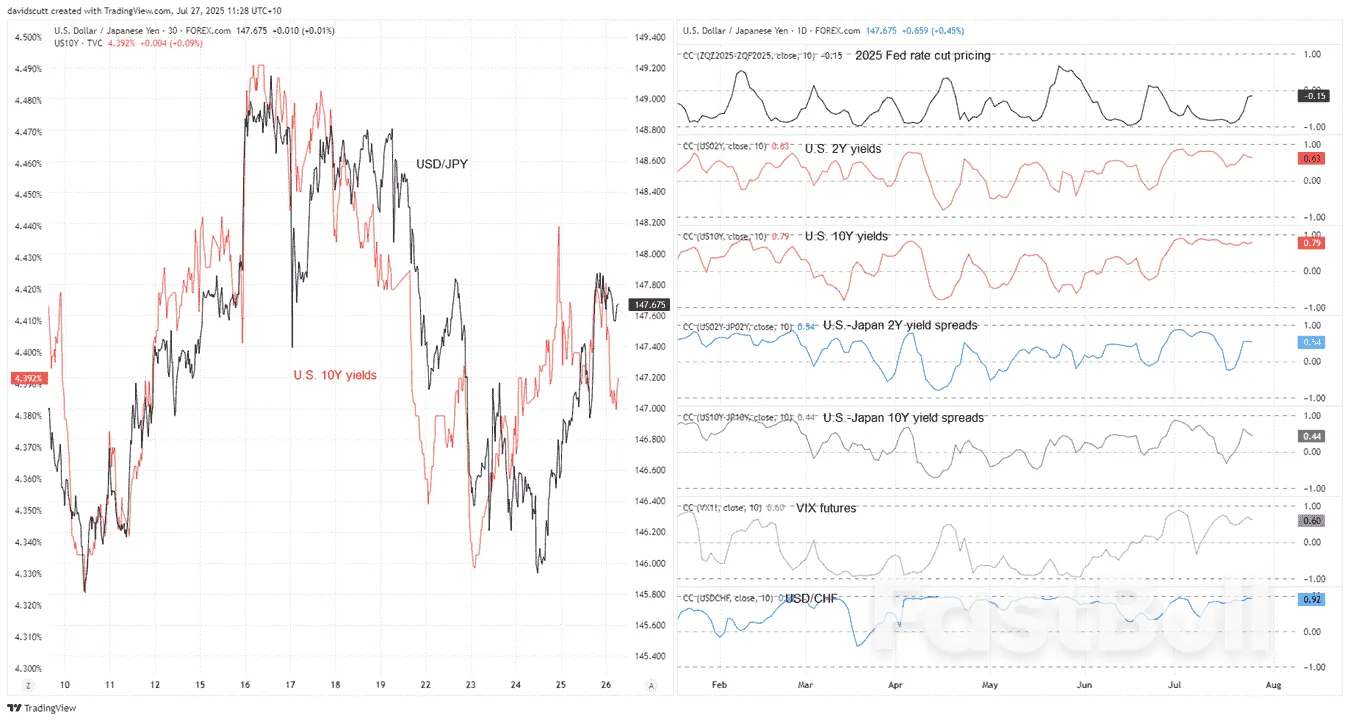
          Before diving into key events, it’s useful to look at the broader forces influencing USD/JPY in recent weeks. The first chart shows correlation coefficient scores between USD/JPY and a range of indicators across rates, volatility and FX over the past fortnight.
          Volatility Looms as USD/JPY Trades into Macro Crossfire_1

          Source: TradingView

          What stands out is a strengthening correlation between USD/JPY and U.S. 10-year Treasury yields, reverting to the historical relationship seen before the latest escalation in U.S. trade tensions. While a 0.79 correlation isn’t the strongest, it’s notably firmer than with short-dated yields or U.S.-Japan yield spreads. The fact it’s been sitting around this level for a while suggests upcoming developments that influence U.S. rate or fiscal expectations could have a major bearing on the pair this week.
          USD/JPY has also shown a mild positive correlation with VIX futures, reinforcing its role as a funding currency in carry trades. A 0.92 correlation with USD/CHF further supports this, pointing to risk appetite as another key influence this week.

          U.S.–EU Trade Talks: Deal Priced In, But Risks Skewed Lower

          While we’ll touch on the Fed and BoJ shortly, they’re not the main risks for USD/JPY. Instead, it’s events that could alter the rate outlooks for both nations that carry more weight, putting economic data and U.S.-E.U. trade talks front and centre.
          On trade, I won’t go into detail beyond noting that talks are scheduled in Scotland between Trump and E.U. President Ursula von der Leyen, and markets are looking for a deal. That means if no agreement is reached, USD/JPY could fall more than it would rise on confirmation. The risks are asymmetric.

          U.S. Data Deluge: NFP, GDP, and Core PCE All in Play

          Volatility Looms as USD/JPY Trades into Macro Crossfire_2

          Source: LSEG

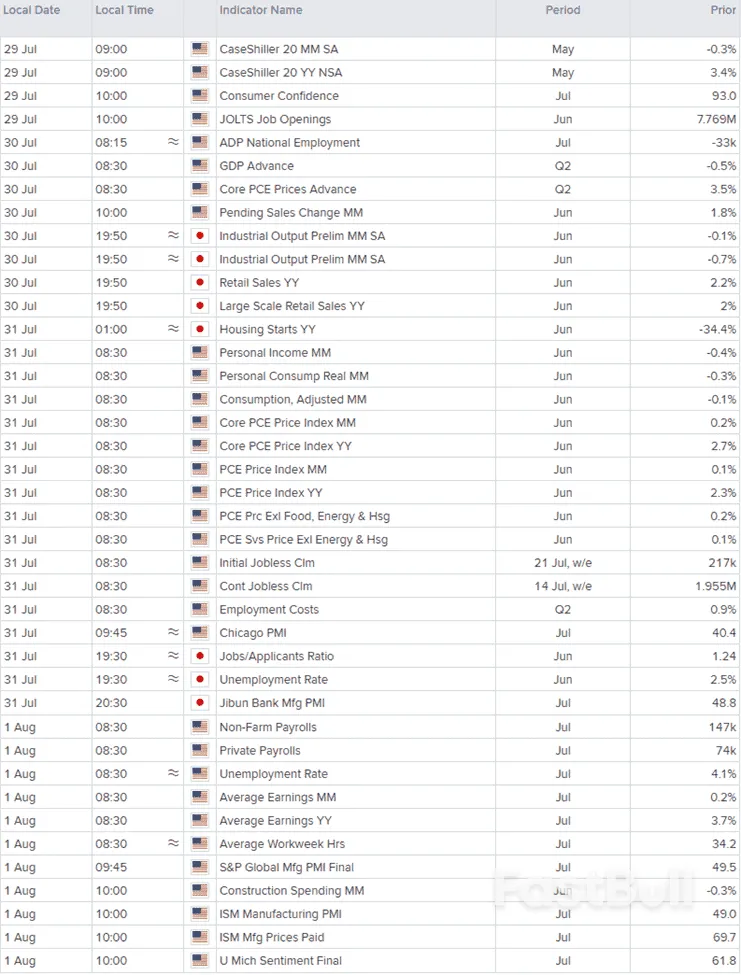
          The economic calendar alone is enough to get the pulse racing. The key event comes late in the week with U.S. non-farm payrolls. The recent pattern has been upside surprises alongside downward revisions to prior data. With jobless claims falling, that may continue. While the payrolls print grabs the headlines, it’s the unemployment rate that carries more weight for the Fed. If the two diverge, markets will likely focus on the unemployment read eventually.Before then, JOLTS job openings, ADP employment, and jobless claims will help shape expectations. Non-labour data including U.S. Q2 GDP, core PCE, income and consumption, and the ISM manufacturing PMI are also due. All could dominate in a normal week, which shows how critical the next five days are.
          Japan’s calendar is quieter, allowing some breathing space during Asian trade. The U.S. Treasury will auction new two, five and seven-year notes early in the week and release its Q3 borrowing update. Treasury previously flagged $554 billion in borrowing. That figure will be updated Monday, with issuance details due Wednesday.
          Volatility Looms as USD/JPY Trades into Macro Crossfire_3

          Source: LSEG

          Given the link between Treasury yields and USD/JPY, both could trigger volatility, especially if the borrowing need exceeds prior guidance or if Treasury opts to extend maturities. With long-end yields still elevated, that risk looks low for now.

          Fed, BOJ Preview

          Volatility Looms as USD/JPY Trades into Macro Crossfire_4

          Source: TradingView (U.S. ET)

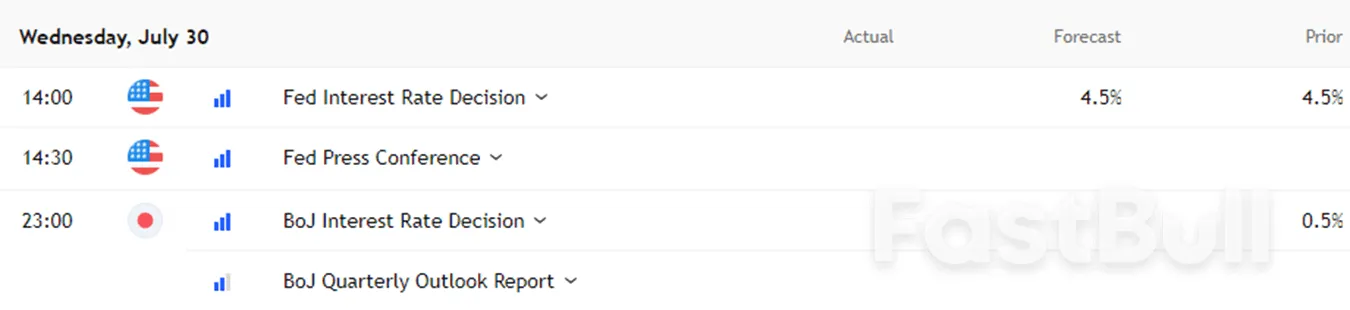
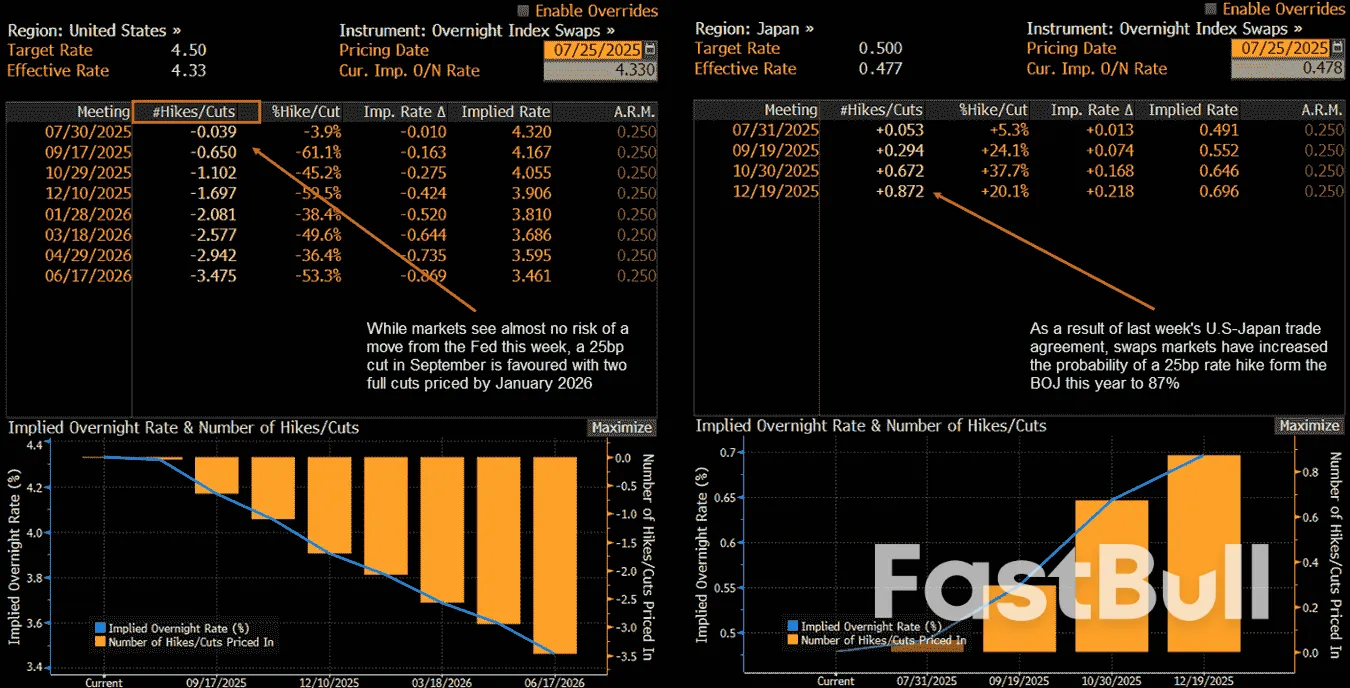
          Turning to the Fed and BoJ, neither are expected to change rates. The Fed funds rate is priced to remain at 4.25-50% with 96% probability, according to implied swaps pricing. The BoJ is seen holding steady at 0.5% with similar odds. With so little priced, volatility will be driven by guidance in the absence of a shock decision.
          Volatility Looms as USD/JPY Trades into Macro Crossfire_5

          Source: Bloomberg

          With no updated forecasts from the Fed, it’ll come down to the tone of the July statement, the vote split, and Chair Powell’s press conference. The tone likely won’t shift much given uncertainty, but the vote could be telling. Governor Waller is expected to dissent in favour of a cut. If others join him, markets may price in earlier cuts, potentially weighing on USD/JPY.
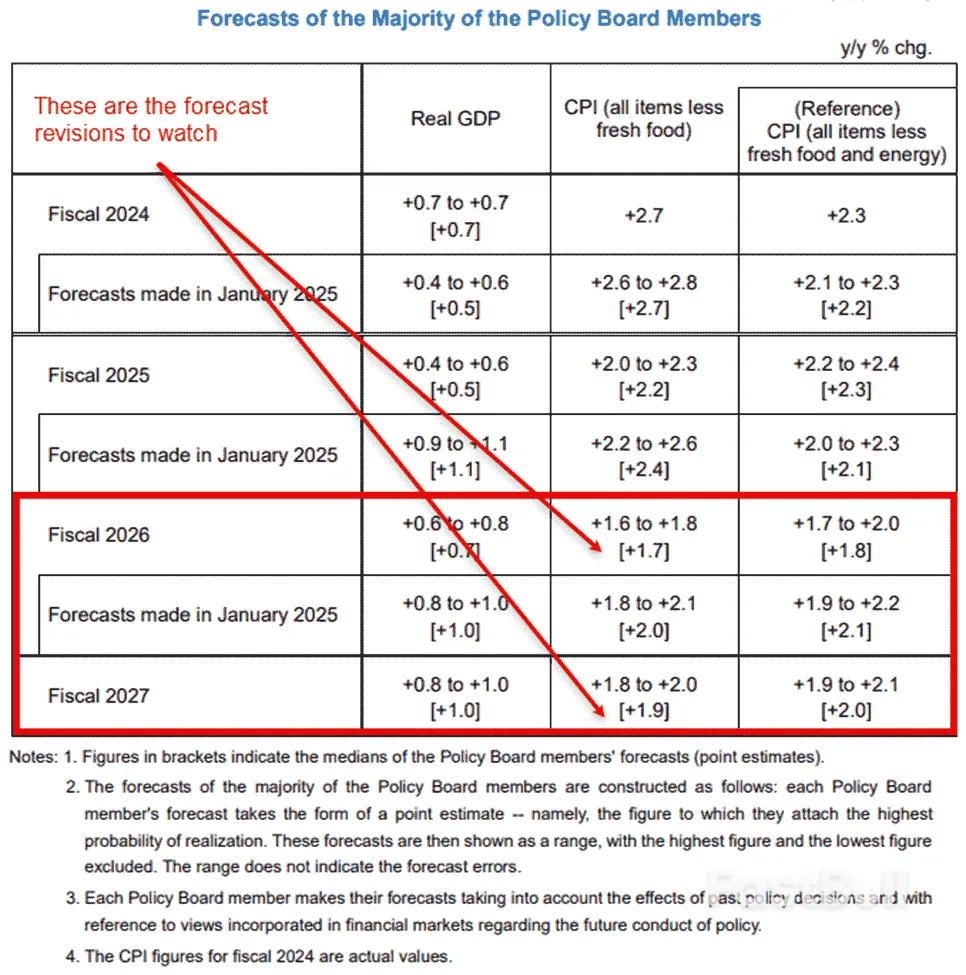
          The BoJ will release new GDP and inflation forecasts, offering a glimpse into how it views the impact of higher trade barriers. An upgrade to its FY2025 inflation forecast looks likely thanks to sticky food prices driven by rising rice costs. Whether last week’s U.S. trade deal alters its 2026 and 2027 views is unclear. Three months ago, the BoJ saw CPI ex-fresh food undershooting its 2 percent target, citing concerns over U.S. tariffs. If it sticks with that view, it could weaken the yen and lift USD/JPY. But if it sees inflation staying above target, it will be deemed hawkish, likely pressuring the pair lower.
          Volatility Looms as USD/JPY Trades into Macro Crossfire_6

          Source: BOJ

          Traders should also note that major U.S. tech earnings arrive this week. Meta reports after market close Wednesday, with Apple and Amazon following Thursday. These names often beat, and if they do again, it may bolster risk appetite and support carry trades, modestly aiding USD/JPY upside. But if they miss, carry positions could unwind, amplifying downside.

          USD/JPY Eyes 149.00 With Momentum Tilting Bullish

          Volatility Looms as USD/JPY Trades into Macro Crossfire_7

          Source: TradingView

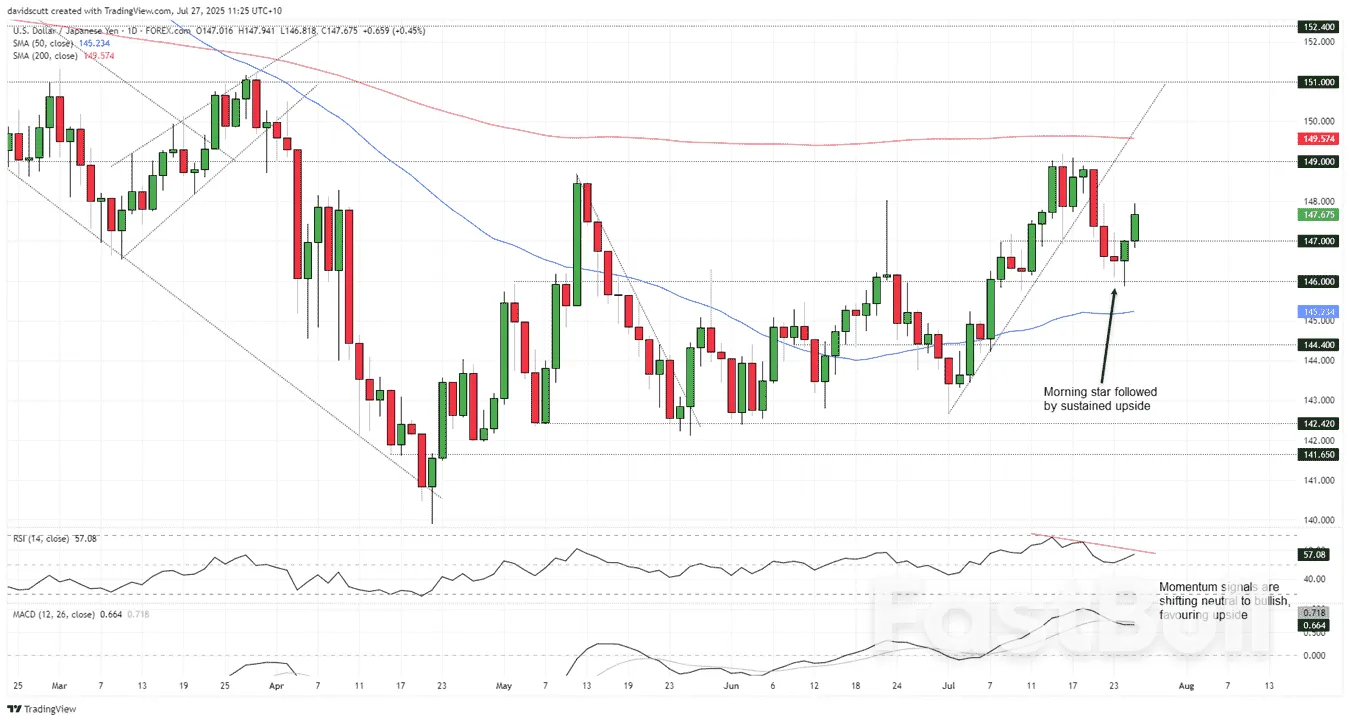
          The completion of a three-candle morning star pattern midway through last week set up Friday’s rally, pushing USD/JPY above 147.00 heading into the weekend. On the topside, 148.00 and 149.00 are resistance to watch, especially with USD/JPY recently clustering around big figures. 149.00 is a key hurdle after stalling there earlier this month. With the 200-day moving average just above, it may offer an attractive level to fade strength if the price action were to falter again. Support lies at 147.00 and 146.00 on the downside if a pullback occurs.
          The momentum picture from RSI (14) and MACD is tilting bullish with the former beginning to flick higher again while the latter is starting to move towards the signal line from below in positive territory. It’s not an outright bullish message, but it does favour upside over downside.

          Source:FOREX.com


          To stay updated on all economic events of today, please check out our Economic calendar
          Risk Warnings and Disclaimers
          You understand and acknowledge that there is a high degree of risk involved in trading. Following any strategies or investment methods may lead to potential losses. The content on the site is provided by our contributors and analysts for information purposes only. You are solely responsible for determining whether any trading assets, securities, strategy, or any other product is suitable for investing based on your own investment objectives and financial situation.
          Add to Favorites
          Share

          Global Stocks Climb as Markets Applaud Trump’s Tactical Trade Wins

          Gerik

          Economic

          Global Equities Respond to Trade Clarity

          Global stock markets reacted positively on Monday to the announcement of a framework trade agreement between the United States and the European Union, which imposed a 15% tariff on most European goods significantly lower than the threatened 30%. This reduction signaled a temporary easing of trade tensions and reassured markets that further escalation between allies would be avoided.
          The immediate impact was seen in financial markets: S&P 500 futures rose 0.4%, Nasdaq futures advanced 0.5%, and European futures gained nearly 1%. The euro appreciated against major currencies, reflecting renewed investor confidence. In Asia, MSCI’s index of Asia-Pacific shares excluding Japan rose 0.27%, near its four-year peak. Although Japan’s Nikkei slipped slightly, it remained close to its recent one-year high, suggesting resilience in regional equity markets.

          Reframing Trade Dynamics as a US Strategic Win

          Market analysts have framed the EU deal as a strategic maneuver that strongly favors US interests. The inclusion of forced European purchases of American energy and military goods, combined with the absence of EU retaliatory tariffs, tilted the balance in Washington’s favor. According to Prashant Newnaha of TD Securities, this lopsided outcome reflects the Trump administration’s negotiation playbook, praised by some as shrewd and effective in safeguarding US economic priorities.
          This perception is reinforced by recent US-Japan trade arrangements, which similarly placed US industries at an advantage. Together, these deals are reshaping global trade expectations, as countries now feel pressure to secure pacts before the August 1 tariff deadline.

          Reduced Risk of Trade War Amplifies Risk Appetite

          Tony Sycamore of IG noted that the combined progress in negotiations with Japan, the EU, and upcoming talks with China in Stockholm has significantly diminished fears of a protracted trade war. These developments have injected a sense of policy predictability, prompting a broader market appetite for risk. The Australian dollar, typically viewed as a risk proxy, rose 0.12% to $0.65725, approaching an eight-month high.
          The expected extension of the US-China trade truce by another 90 days would further contribute to market calm, even if a final agreement remains elusive. The cumulative effect of these agreements is fostering a perception that global trade will remain functional despite geopolitical tensions.

          Monetary Policy in Focus as Investors Await Signals

          The week ahead is pivotal not only due to trade but also because of scheduled policy meetings by the Federal Reserve and the Bank of Japan. Although neither is expected to adjust rates immediately, market participants will scrutinize official commentary for indications of future direction. The Fed is expected to exercise caution, especially as trade agreements could temporarily reduce inflation pressures, weakening the case for aggressive easing.
          However, political pressure on the Fed continues to mount. President Trump has publicly criticized Fed Chair Jerome Powell for maintaining current rate levels, while two Trump-appointed board members have expressed support for a rate cut. ING economists project that the Fed could begin cutting rates by December, possibly by as much as 50 basis points, particularly if employment and GDP data worsen further echoing the Fed’s methodical rate adjustments seen in 2024.
          In contrast, the Bank of Japan could consider tightening later this year, buoyed by improved trade conditions and rising inflation expectations. The recent trade breakthrough with the US has bolstered Japan’s economic outlook, possibly clearing the path for rate normalization in the months ahead.
          The positive response in global equities reflects short-term relief that a transatlantic trade rupture was avoided. However, the underlying fragility of these agreements, ongoing geopolitical risks, and central bank hesitancy underscore that markets are not yet on firm ground. Investors may continue to cheer the "art of the deal," but sustained momentum will depend on the follow-through from both trade partners and monetary authorities in the weeks ahead.

          Source: Reuters

          To stay updated on all economic events of today, please check out our Economic calendar
          Risk Warnings and Disclaimers
          You understand and acknowledge that there is a high degree of risk involved in trading. Following any strategies or investment methods may lead to potential losses. The content on the site is provided by our contributors and analysts for information purposes only. You are solely responsible for determining whether any trading assets, securities, strategy, or any other product is suitable for investing based on your own investment objectives and financial situation.
          Add to Favorites
          Share

          Eventful Week Of Central Bank Updates And Data Ahead

          Samantha Luan

          Forex

          Economic

          Eventful Week Of Central Bank Updates And Data Ahead_1

          European Central Bank (ECB)

          As I have noted in previous reports, the bar for additional policy easing from the ECB remains high. Not only have the central bank already reduced rates by 200 basis points (bps) since beginning its easing cycle – bringing the deposit facility rate to 2.0% – economic output is stable and inflation is at the 2.0% target. Notably, the deposit rate falls within the ECB’s estimated neutral rate band of 1.75% to 2.25%.

          Fortunately, we will not have to wait too long for updated GDP (Gross Domestic Product) and CPI inflation data (Consumer Price Index). Q2 25 preliminary GDP will be out on Wednesday and is expected to have stagnated, down from 0.6% recorded in Q1, while year-on-year (YY) GDP growth is forecast to have slowed to 1.2% from 1.5%. July CPI inflation will be released on Friday, expected to ease on both the headline (1.9% down from 2.0%) and core (2.0% down from 2.3%) levels YY.

          I think one of the concerns regarding inflation is that it may undershoot the ECB’s 2% target, especially if the euro (EUR) continues to gather steam, which makes exports more expensive and imports cheaper. In fact, this was the first question posed at the recent ECB press conference. When questioned about Vice-President Luis de Guindos’ comment regarding the EUR’s strength above US$1.20, Lagarde clarified that the ECB does not target any specific exchange rate. She emphasised, however, that the ECB closely monitors exchange rates because they are a crucial factor in their inflation forecasts, directly quoting de Guindos’s previous statement: ‘we take into account exchange rates to forecast inflation’.

          Should GDP growth dip into contractionary territory, this may trigger immediate weakness in the EUR – a weaker economy could eventually bring into question whether rates may need to move into accommodative territory and could serve as a headwind for the EUR.

          A 15% tariff appears to be the baseline for any deal between the US and the EU. While higher than the initial 10% blanket tariff, a deal would help reduce the uncertainty plaguing the markets and business, which in itself could boost growth as businesses can then begin planning around this new environment. This, by extension, could provide additional fuel for EUR upside.

          US President Donald Trump is golfing in Scotland over the weekend for a five-day trip, during which he will meet with the President of the European Commission, Ursula von der Leyen, on Sunday, which may provide more clarity on their relationship. As I am writing this, the situation remains uncertain. You may remember that the US plans to implement a 30% tariff on EU goods starting 1 August, which triggered warnings from EU officials of potential retaliatory measures.

          Overall, the strength in the EUR will likely continue to be seen versus the US dollar (USD) until the US$1.20 handle according to chart studies. This, of course, would likely be underpinned if the central bank signals they are nearing the end of their easing cycle.

          US Federal Reserve (Fed)

          In what was a visibly tense meeting between Trump and Fed Chair Jerome Powell at the main Federal Reserve building last week, Trump said he ‘got the impression’ that Powell was ready to lower rates. I would like ‘to be a fly on the wall’ on Wednesday when the Fed keep rates on hold. Unquestionably, a rate hold will trigger more direct abuse towards Powell from Trump via social media. Despite the President’s incessant pressure to lower rates, it is unlikely that the Fed will reduce rates at this week’s meeting, given the global uncertainty, and consequently, the target rate will remain on hold at 4.25% – 4.50%.

          From an economic standpoint, inflation has ticked higher, but not enough to warrant policy easing. GDP is expected to have grown in Q2 25, and while the jobs market is cooling, it is, again, not decelerating enough to justify easing policy.As a result, the primary focus at this week’s meeting will be on the central bank’s forward guidance relating to rates. As of writing, 18 bps worth of cuts are priced in for September’s meeting, with October fully priced in for a 25 bp reduction (-28 bps), and 44 bps of easing implied for the year-end, consistent with the Fed’s recent projections.

          One of the major questions for policymakers is whether the tariff-induced inflation will indeed be a one-time spike or something more long-term. If the Fed lowered rates at this week’s meeting, the central bank cannot be sure whether this would stoke inflation, both because of tariff-induced inflation, and also the economy may be running hot enough to further prompt an uptick in price pressures. Should they lower rates and inflation begins rising, the Fed would be in a tricky spot, and may trigger a rise in US Treasury yields as the Fed may have to hike again to undo their mistake. This is the dilemma that the central bank currently faces.

          The Fed has repeatedly stated that the economy is in a strong enough position to wait and see what happens with the economy and tariffs. This was evidenced in the last Summary of Economic Projections (SEP), which showed that seven Fed officials believed that the central bank should remain on hold this year, versus four members in the previous SEP – these are released on a quarterly basis, with the next batch out at September’s meeting. As you can see, the Fed is a voting committee. So, although Trump seems to think that it is solely down to Powell on whether the Fed lowers rates, it will need a majority to do so.

          Overall, I think this will be another data-dependent meeting with Powell sticking to the script. There will likely be dissent from Fed Governors Christopher Waller and Michelle Bowman – who were both appointed by Trump – but it won’t be enough to trigger a rate cut. However, should more members dissent, this could pressure the USD southbound.In terms of US data this week, we have a busy slate ahead. In addition to a slew of job numbers, we also receive the latest reading on June PCE data (Personal Consumption Expenditures).

          US Non-Farm Payrolls (NFP) data will be widely watched on Friday. Economists expect the July unemployment rate to have ticked higher to 4.2% (previous: 4.1%), with NFP data forecast that the economy added 110,000 new payrolls (previous: 147,000). Private payrolls, which essentially exclude government jobs, are expected to have added 100,000 new roles, up from June’s surprise fall of 74,000 in May. Before this, which will likely help shape market expectations further, we will see June JOLTS job openings (Job Openings and Labor Turnover Survey), July ADP employment (Automatic Data Processing), and weekly unemployment claims for the week ending 26 July.

          In terms of PCE inflation data, core YY numbers are expected to have risen by 2.7%, matching May’s print, while headline YY PCE is forecast to have increased by 2.5%, up from 2.3%.If unemployment rises by more than expected, this could trigger USD downside as investors reassess rate cuts. Should inflation show a notable increase, however, this could lead the USD higher as investors will likely forecast a higher-for-longer Fed rate.

          Bank of Canada (BoC)

          An update from the BoC is also scheduled for Wednesday. The central bank is widely expected to keep its overnight rate unchanged at 2.75%, marking a third consecutive meeting with no change. Notably, the BoC currently estimates the neutral rate of interest to be within a range of 2.25% to 3.25%. This range represents the interest rate level at which monetary policy is neither stimulative nor restrictive to economic growth. The BoC does not target this rate, but it is an essential consideration in their economic projections and policy decisions.

          The June meeting reiterated that the BoC is not offering forward guidance, although it did, to some extent. BoC Governor Tiff Macklem noted that the central bank believed ‘that there could be a need for a further reduction in the policy rate if the economy weakens and if price pressures are contained’, but caveated this, saying that this is not forward guidance. Whatever way you spin it, that is a signal from the BoC Governor, no? The overarching theme, however, remains one of tariff uncertainty.

          This week’s central bank announcement will follow June headline CPI inflation rising by 1.9%, following back-to-back increases of 1.7% in April and May. You will also note that the BoC’s preferred measures of inflation – the CPI Trim and Median – continue to fluctuate around the upper boundary of the central bank’s 1% – 3% inflation target band. Additionally, June unemployment fell back to 6.9% from May’s uptick to 7.0%, while Canadian employment rose by 83,000, which was considerably higher-than-expected, and far surpassed the 8,800 increase in May.

          Understandably, tariffs remain an issue for the BoC, and according to Trump, a deal between the US and Canada is unlikely to make it over the line ahead of the 1 August trade deadline. Trump recently said he has not had ‘much luck’ negotiating with Canada, and the country ‘could be one where they’ll just pay tariffs, not really a negotiation’. If this comes to fruition, it could potentially worsen Canadian business/consumer sentiment, weighing on the Canadian dollar (CAD). The USD/CAD has been rangebound since the beginning of June, but ultimately, the longer-term trend is higher.

          Given persistent inflationary pressures and a strong jobs market, it would be surprising to see the BoC alter rates this week. In fact, barring a notable deterioration in economic activity or a considerable rise in inflation, it is likely that the BoC will remain on hold for the remainder of this year, with markets pricing in just 13 bps of easing.

          Bank of Japan (BoJ)

          The BoJ is also expected to remain on the sidelines this week, with the nine-member policy committee forecast to keep the policy rate at 0.5% for a fourth straight meeting. 20 bps of hikes remain priced in by the market for this year.The previous meeting on 17 June saw the BoJ Governor Kazuo Ueda underscore that the central bank would continue to increase the policy rate provided the economic and price landscape improves, aligning with their goal of sustainably and stably meeting their price target.

          Since then, several developments warrant consideration for policymakers. First and foremost, the ruling coalition’s fierce loss in the upper house election introduced political uncertainty. While Prime Minister Shigeru Ishiba appears has not signalled that he will resign, this outcome may increase pressure for fiscal loosening, a factor the BoJ will be watching closely for its potential impact on inflation. Another key point to take into account is the more optimistic trade outlook has emerged with the US and Japan striking a deal, setting a 15% tariff on Japanese exports to the US, a reduction from earlier threats.

          The BoJ will also release updated quarterly economic projections for core inflation and growth, and given the central bank is expected to hold steady, this and communication from the rate statement and presser will be key. Some desks are expecting an upgrade to inflation here for 2025, which could underpin the Japanese yen (JPY). However, lower inflation forecasts, coupled with the BoJ’s signaling steady rates this year, could weaken the JPY. It will also be interesting to see if the BoJ update their 2026/27 forecasts given the trade deal announcement.

          Source: FP Markets

          To stay updated on all economic events of today, please check out our Economic calendar
          Risk Warnings and Disclaimers
          You understand and acknowledge that there is a high degree of risk involved in trading. Following any strategies or investment methods may lead to potential losses. The content on the site is provided by our contributors and analysts for information purposes only. You are solely responsible for determining whether any trading assets, securities, strategy, or any other product is suitable for investing based on your own investment objectives and financial situation.
          Add to Favorites
          Share

          U.S. and EU Reach Tariff Agreement with 15% Rate, Global Trade Structure May Change

          FastBull Featured

          Daily News

          [Quick Facts]

          1. U.S. and EU reach tariff agreement with 15% rate.
          2. South Korea-U.S. Finance and Foreign Ministers to hold separate meetings on tariffs this week.
          3. U.S. Secretary of State says Trump losing patience with Russia.
          4. Houthi Armed Forces escalate maritime blockade, vowing to attack ships linked to Israel.
          5. U.S.-Japan Trade Deal takes effect, but divergences emerge over $550B investment interpretation.
          6. Hamas responds to U.S. claim for not agreeing ceasefire: Israel is the real obstacle.

          [News Details]

          U.S. and EU reach tariff agreement with 15% rate
          On July 27, U.S. President Donald Trump stated that the United States has reached a tariff agreement with the European Union (EU) featuring a 15% tax rate. Trump noted that the EU will increase its investment in the U.S. by $600 billion compared to previous levels, purchase U.S. military equipment, and buy $150 billion worth of U.S. energy products. European Commission President Ursula von der Leyen said that both the EU and the U.S. have agreed to implement a unified 15% tariff rate, which will apply to various types of goods, including automobiles. Von der Leyen emphasized that these trade agreements with the U.S. will bring stability to the market.
          South Korea-U.S. Finance and Foreign Ministers to hold separate meetings on tariffs this week
          According to information released by the South Korean presidential office on July 26th, Deputy Prime Minister and Minister of Economy and Finance Koo Yun-cheol will meet with U.S. Treasury Secretary Scott Bessent this week to conduct final negotiations on South Korea-U.S. tariff issues. Foreign Minister Cho Hyun will also meet with U.S. Secretary of State Marco Rubio this week. Following a meeting on July 26th, the presidential office held consecutive emergency meetings on economic and trade countermeasures over two days to review progress in high-level South Korea-U.S. negotiations covering these issues and reiterated its commitment to striving for an agreement before the U.S. implements its planned "reciprocal tariffs" measures against South Korea starting from August 1st.
          U.S. Secretary of State says Trump losing patience with Russia
          U.S. Secretary of State Marco Rubio stated that President Trump's patience with Russia for taking action to end the Russia-Ukraine conflict is fading. Rubio made these remarks in an interview broadcast by Fox News Channel in the U.S. on July 26th. Rubio said: "Despite good interactions and calls with (Russian President) Putin, no substantial progress has been made, and I think this makes him (Trump) increasingly frustrated. Now is the time to take action, and I think the president has made this position clear. He (Trump) is losing patience and is no longer willing to continue waiting for Russia to take action to end this war."
          Trump recently stated that the U.S. will provide military aid to Ukraine through NATO sponsorship and warned that if Russia fails to reach a peace agreement with Ukraine within 50 days, the U.S. will impose very severe tariffs on Russia.
          Houthi Armed Forces escalate maritime blockade, vowing to attack ships linked to Israel
          Late on the evening of July 27th, Yahya Sarea, military spokesperson for Yemen's Houthis, issued a statement declaring that the Houthis would escalate their maritime blockade operations and launch the fourth phase of their sea blockade. The group announced it would target all ships belonging to shipping companies with cooperative ties to Israeli ports, regardless of location or the ship's nationality. The Houthis warned all shipping firms to immediately halt maritime cooperation with Israel following the release of the statement; otherwise, all vessels operated by such companies, wherever they sail, could face missile or drone attacks from the Houthis.
          U.S.-Japan Trade Deal takes effect, but divergences emerge over $550B investment interpretation
          Just days after the U.S. and Japan announced a "large-scale" trade agreement, differences in their interpretations of the deal surfaced. A report by the Japan Times on July 26th noted that Japanese Prime Minister Shigeru Ishiba explicitly stated on Friday that numerous details of the tariff agreement remained unspecified, with no immediate plan to sign a joint document. More strikingly, regarding the $550 billion in Japanese investment in the U.S. covered by the agreement, the U.S. side claims it will receive 90% of the profits, while official Japanese documents emphasize that profit sharing should be " based on each country's contributions and risk exposure." This hasty agreement has drawn skepticism from multiple quarters. Kyodo News reported on July 26th that markets are concerned the U.S. may shift its position again, casting a shadow over the deal's prospects.
          Hamas responds to U.S. claim for not agreeing to a ceasefire: Israel is the real obstacle
          On July 26 local time, Izzat al-Risheq, a member of the Political Bureau of the Palestinian Islamic Resistance Movement (Hamas), stated that tangible progress had been made in the new round of ceasefire negotiations in the Gaza Strip held in Doha, the capital of Qatar. However, he said U.S. President Donald Trump's remarks and those of U.S. Special Envoy for the Middle East Steve Witkoff were inconsistent with the negotiation process. In a social media post, al-Risheq noted that U.S. statements on negotiation progress overlooked the fact that the Netanyahu government of Israel was the real obstacle preventing a ceasefire agreement.
          Risheq urged the U.S. government to stop justifying Israel's aggressive occupation of Palestinian territories and to cease providing political and military cover for its military operations in the Gaza Strip. Risheq emphasized that Hamas has consistently demonstrated a responsible and highly flexible approach throughout the negotiations, committed to reaching a comprehensive agreement to end the conflict in the Gaza Strip and alleviate the suffering of local residents. He added that Qatar and Egypt, the mediating parties, have expressed appreciation for Hamas's stance. Al-Risheq also stated that Hamas's response to the Gaza ceasefire agreement proposal, submitted after comprehensive consultations with all Palestinian factions and mediating parties, was positive and flexible.

          [Today's Focus]

          UTC+8 20:00 The holding of OPEC+ Joint Ministerial Monitoring Committee (JMMC)
          Risk Warnings and Disclaimers
          You understand and acknowledge that there is a high degree of risk involved in trading. Following any strategies or investment methods may lead to potential losses. The content on the site is provided by our contributors and analysts for information purposes only. You are solely responsible for determining whether any trading assets, securities, strategy, or any other product is suitable for investing based on your own investment objectives and financial situation.
          Add to Favorites
          Share

          Oil Prices Edge Higher on US-EU Trade Deal and Global Demand Optimism

          Gerik

          Economic

          Commodity

          Trade Developments Revive Market Confidence

          On Monday, Brent crude futures increased by 22 cents to reach $68.66 per barrel, while US West Texas Intermediate (WTI) climbed to $65.38 per barrel, also up 22 cents. The modest rebound follows a three-week low for oil prices, which had been pressured by global trade tensions and expectations of increased supply from Venezuela. The newly announced trade deal between the United States and the European Union, coupled with possible progress in US-China negotiations, has eased market fears of a broader slowdown in economic activity that could curtail fuel consumption.
          The US-EU agreement imposes a 15% tariff on European imports, significantly lower than the 30% rate initially proposed by the Trump administration. This compromise between two major economic blocs together accounting for nearly one-third of global trade has reduced the perceived risk of a recession-inducing trade war, indirectly supporting expectations for steady oil demand. The correlation between trade policy clarity and market confidence is evident, as investors interpret lowered tariff threats as a stabilizing influence on cross-border commerce and energy consumption.

          US-China Truce Extension Talks Support Sentiment

          Further bolstering crude markets is the scheduled meeting in Stockholm between senior US and Chinese trade officials, aimed at extending the current truce before the August 12 deadline. Though a comprehensive agreement is not expected, the likelihood of a 90-day extension is high, which has encouraged investors to anticipate continuity in trade flows and manufacturing activity both of which heavily influence oil usage.
          While demand-side sentiment has improved, potential supply increases are capping oil’s upward momentum. Venezuela’s state oil company PDVSA is reportedly preparing to restart joint ventures under terms aligned with Biden-era oil swap agreements. These activities depend on President Trump’s reinstatement of operating authorizations, but they suggest a potential rise in global supply, which may weigh on prices if demand growth stalls.
          In addition, the OPEC+ coalition, including the Organization of the Petroleum Exporting Countries and allied producers, will hold a monitoring committee meeting later Monday. Though no changes are expected to the previously agreed plan to raise output by 548,000 barrels per day in August, the very prospect of supply expansion amid an already volatile geopolitical backdrop serves to temper bullish sentiment.

          Demand Outlook Remains Mixed

          According to JP Morgan, global oil demand rose by 600,000 barrels per day year-over-year in July, supported by seasonal summer consumption. However, the same report noted an increase in global oil inventories of 1.6 million barrels per day, highlighting the delicate balance between rising demand and surplus supply. This dynamic creates a conditional relationship: while short-term demand appears resilient, any mismatch in future production levels could quickly tip market sentiment.
          Further complicating the supply outlook is renewed instability in the Middle East. Yemen’s Houthi rebels issued a warning on Sunday that they would target ships linked to Israeli ports regardless of the flag they sail under. This threat, part of ongoing military tensions over the Gaza conflict, introduces another risk variable for oil transportation routes in the region. Although no immediate price spike followed the announcement, such threats tend to heighten background risk in oil futures trading.
          Oil’s modest rally reflects a cautious optimism that trade progress will support continued economic activity and fuel demand. However, lingering concerns over supply increases from both Venezuela and OPEC+ alongside persistent geopolitical instability, continue to anchor expectations. The market remains highly responsive to policy signals and trade developments, making upcoming negotiations and central bank decisions critical for shaping the next phase of oil pricing.

          Source: Reuters

          To stay updated on all economic events of today, please check out our Economic calendar
          Risk Warnings and Disclaimers
          You understand and acknowledge that there is a high degree of risk involved in trading. Following any strategies or investment methods may lead to potential losses. The content on the site is provided by our contributors and analysts for information purposes only. You are solely responsible for determining whether any trading assets, securities, strategy, or any other product is suitable for investing based on your own investment objectives and financial situation.
          Add to Favorites
          Share

          Euro Gains as Markets React to US-EU Tariff Compromise Amid Global Trade Uncertainty

          Gerik

          Economic

          Forex

          Currency Markets Respond to Tariff Truce

          The announcement of a trade framework between the United States and the European Union over the weekend lifted market sentiment, particularly in foreign exchange. Following the meeting in Scotland between US President Donald Trump and European Commission President Ursula von der Leyen, the euro rose 0.2% to $1.1763 and also gained against the yen. This movement reflected investor relief that the proposed 30% tariff hike would be avoided in favor of a 15% rate.
          The euro’s rise is tied to increased certainty over US-EU trade relations, which had been hanging in the balance. The deal followed weeks of intense negotiations and came just days before Trump’s initial August 1 deadline. Although a 15% tariff still represents a sharp increase from pre-Trump levels, it was received as a moderate outcome given the potential alternative.

          Clarity Promotes Investment Outlook

          According to Rodrigo Catril of the National Australia Bank, the newly established framework provides clearer rules, which could encourage renewed investor confidence and capital allocation both in the US and globally. He noted that with less ambiguity around trade policy, businesses might be more inclined to explore expansion and investment opportunities.
          While the immediate market reaction has been positive for the euro and several Asia-Pacific currencies, it is too early to predict whether this sentiment will sustain. The relative modesty of the euro's gains suggests that while the deal provides temporary relief, deeper structural concerns remain unresolved, especially given the 15% tariff floor.

          Further Implications for Trade Dynamics

          Beyond the eurozone, the deal also aligns closely with a similar agreement reached with Japan. The Japanese government has agreed to invest approximately $550 billion in the United States under the same 15% tariff structure. For Europe, Trump claimed that the EU will invest $600 billion in the US and increase purchases of American energy and military exports highlighting a pattern of Trump administration deals that favor US export sectors.
          Despite these headline investment figures, European exporters are likely to face higher costs and strategic uncertainty. The 15% base tariff remains a significant barrier, especially considering earlier EU hopes for a zero-for-zero tariff agreement. This illustrates a causal relationship between tariff structures and export planning, with immediate implications for production relocation, pricing strategy, and cross-border operations.

          Global Focus Shifts to US-China Talks and Central Banks

          Simultaneously, attention is turning to upcoming US-China trade discussions scheduled in Stockholm and central bank decisions in the US and Japan. While no breakthrough is expected in the China talks, a likely extension of the current 90-day truce may prevent further tariff escalation. Markets are also watching closely for post-meeting commentary from the Federal Reserve and the Bank of Japan, particularly regarding future interest rate decisions.
          The dollar index fell slightly to 97.534, reflecting the broader uncertainty in global currency markets. While the US dollar held steady against the yen, minor shifts were seen in other currencies: the British pound slipped, the Australian dollar edged up to $0.6576, and the New Zealand dollar remained flat.
          Although the euro’s modest rally reflects near-term optimism, the broader macroeconomic context continues to be shaped by evolving trade strategies and monetary policy. The markets welcomed the US-EU agreement as a stabilizing measure, but its long-term efficacy depends on whether it sets a sustainable precedent or simply delays more intense trade frictions. The euro’s resilience may hinge on whether European exporters can adapt effectively to the new tariff environment and whether upcoming global negotiations yield similarly stabilizing outcomes.

          Source: Reuters

          To stay updated on all economic events of today, please check out our Economic calendar
          Risk Warnings and Disclaimers
          You understand and acknowledge that there is a high degree of risk involved in trading. Following any strategies or investment methods may lead to potential losses. The content on the site is provided by our contributors and analysts for information purposes only. You are solely responsible for determining whether any trading assets, securities, strategy, or any other product is suitable for investing based on your own investment objectives and financial situation.
          Add to Favorites
          Share

          Fragile Relief: US-EU Trade Deal Temporarily Eases Tensions Amid Lingering Discontent

          Gerik

          Economic

          Initial Threats Spark Urgency

          In May, US President Donald Trump declared the trade talks with the EU futile and proposed a staggering 50% tariff on European goods. This abrupt escalation followed months of gridlock, largely due to disagreements over existing US tariffs on steel, aluminum, and pharmaceuticals. His post on Truth Social marked a turning point, prompting swift action from European leaders. A phone call from European Commission President Ursula von der Leyen, emphasizing the EU’s willingness to act swiftly, persuaded Trump to return to the negotiating table.
          Finalized during a meeting in Scotland just before the August 1 deadline, the resulting deal set a 15% blanket tariff on most European imports into the US higher than the pre-Trump era average of 2% and also above the 10% tariff imposed on April 2, but far below the threatened 50%. While this tariff rate avoids the devastating consequences of Trump’s earlier threats, it still significantly alters the trade environment for both regions.

          Mixed Reactions Reflect Uneasy Compromise

          Despite the relief that a trade war was averted, neither side celebrated the agreement. Trump stated confidently that the deal would “work out really well,” and von der Leyen framed it as a balance between enabling trade and protecting jobs. However, the modest gains in financial markets such as a 0.3% rise in S&P 500 futures suggest that investor optimism was limited.
          As part of the deal, Europe committed to increase investment in the US by $600 billion and agreed to purchase $750 billion worth of American energy products. The agreement also established a zero-tariff regime for selected sectors, including semiconductors, certain chemicals, aircraft parts, generic pharmaceuticals, and some agricultural goods. These sectors welcomed the announcement, seeing it as a chance to strengthen transatlantic economic cooperation.
          Yet this selective relief only benefits a portion of the market. Most goods still face the 15% baseline tariff, which is expected to raise prices for American consumers and diminish competitiveness for European producers. According to Alex Altmann of the British Chamber of Commerce in Germany, such tariffs will force EU businesses to reconsider their operational strategies and manufacturing locations.

          Disadvantages for US Automakers and Pharmaceutical Ambiguities

          A critical concern has emerged within the American automotive sector. While European cars now face a 15% import tariff, this is still below the 25% that US manufacturers pay when importing from Mexico. The imbalance mirrors similar dissatisfaction following a US-Japan deal and could harm Detroit-based automakers. Moreover, while von der Leyen claimed pharmaceuticals were included in the tariff exceptions, she admitted that Trump retains the authority to raise tariffs on imported drugs later, undermining the initial terms.
          The agreement appears to serve more as a temporary shield against economic fallout rather than a comprehensive solution. Although the avoidance of a trade war marks a positive development, the deal’s ambiguity and continued threat of tariff escalations leave key questions unresolved. While it illustrates how brinkmanship and personal diplomacy averted immediate disruption, the deeper structural tensions between the two economies persist.
          In essence, this agreement reflects a correlation between high-stakes negotiation pressure and last-minute compromise, but does not yet offer a reliable foundation for future cooperation. The real test lies in whether both sides can build on this framework to restore trust and achieve equitable long-term trade relations.

          Source: CNN

          To stay updated on all economic events of today, please check out our Economic calendar
          Risk Warnings and Disclaimers
          You understand and acknowledge that there is a high degree of risk involved in trading. Following any strategies or investment methods may lead to potential losses. The content on the site is provided by our contributors and analysts for information purposes only. You are solely responsible for determining whether any trading assets, securities, strategy, or any other product is suitable for investing based on your own investment objectives and financial situation.
          Add to Favorites
          Share
          FastBull
          Copyright © 2025 FastBull Ltd

          728 RM B 7/F GEE LOK IND BLDG NO 34 HUNG TO RD KWUN TONG KLN HONG KONG

          TelegramInstagramTwitterfacebooklinkedin
          App Store Google Play Google Play
          Products
          Charts

          Chats

          Q&A with Experts
          Screeners
          Economic Calendar
          Data
          Tools
          Membership
          Features
          Function
          Markets
          Copy Trading
          Latest Signals
          Contests
          News
          Analysis
          24/7
          Columns
          Education
          Company
          Careers
          About Us
          Contact Us
          Advertising
          Help Center
          Feedback
          User Agreement
          Privacy Policy
          Business

          White Label

          Data API

          Web Plug-ins

          Poster Maker

          Affiliate Program

          Risk Disclosure

          The risk of loss in trading financial instruments such as stocks, FX, commodities, futures, bonds, ETFs and crypto can be substantial. You may sustain a total loss of the funds that you deposit with your broker. Therefore, you should carefully consider whether such trading is suitable for you in light of your circumstances and financial resources.

          No decision to invest should be made without thoroughly conducting due diligence by yourself or consulting with your financial advisors. Our web content might not suit you since we don't know your financial conditions and investment needs. Our financial information might have latency or contain inaccuracy, so you should be fully responsible for any of your trading and investment decisions. The company will not be responsible for your capital loss.

          Without getting permission from the website, you are not allowed to copy the website's graphics, texts, or trademarks. Intellectual property rights in the content or data incorporated into this website belong to its providers and exchange merchants.

          Not Logged In

          Log in to access more features

          FastBull Membership

          Not yet

          Purchase

          Become a signal provider
          Help Center
          Customer Service
          Dark Mode
          Price Up/Down Colors

          Log In

          Sign Up

          Position
          Layout
          Fullscreen
          Default to Chart
          The chart page opens by default when you visit fastbull.com