

Markets
News
Analysis
User
24/7
Economic Calendar
Education
Data
- Names
- Latest
- Prev



Signal Accounts for Members
All Signal Accounts
All Contests
 Euro Zone IHS Markit Construction PMI (Nov)
A:--
F: --
P: --
 Italy IHS Markit Construction PMI (Nov)
A:--
F: --
P: --
 U.K. Markit/CIPS Construction PMI (Nov)
A:--
F: --
P: --
 France 10-Year OAT Auction Avg. Yield
A:--
F: --
P: --
Euro Zone Retail Sales MoM (Oct)A:--
F: --
P: --
Euro Zone Retail Sales YoY (Oct)A:--
F: --
P: --
 Brazil GDP YoY (Q3)
A:--
F: --
P: --
 U.S. Challenger Job Cuts (Nov)
A:--
F: --
P: --
U.S. Challenger Job Cuts MoM (Nov)A:--
F: --
P: --
U.S. Challenger Job Cuts YoY (Nov)A:--
F: --
P: --
U.S. Initial Jobless Claims 4-Week Avg. (SA)A:--
F: --
P: --
U.S. Weekly Initial Jobless Claims (SA)A:--
F: --
P: --
U.S. Weekly Continued Jobless Claims (SA)A:--
F: --
P: --
 Canada Ivey PMI (SA) (Nov)
A:--
F: --
P: --
Canada Ivey PMI (Not SA) (Nov)A:--
F: --
P: --
U.S. Non-Defense Capital Durable Goods Orders Revised MoM (Excl. Aircraft) (SA) (Sept)A:--
F: --
U.S. Factory Orders MoM (Excl. Transport) (Sept)A:--
F: --
P: --
U.S. Factory Orders MoM (Sept)A:--
F: --
P: --
U.S. Factory Orders MoM (Excl. Defense) (Sept)A:--
F: --
P: --
U.S. EIA Weekly Natural Gas Stocks ChangeA:--
F: --
P: --
Saudi Arabia Crude Oil ProductionA:--
F: --
P: --
U.S. Weekly Treasuries Held by Foreign Central BanksA:--
F: --
P: --
 Japan Foreign Exchange Reserves (Nov)
A:--
F: --
P: --
 India Repo Rate
A:--
F: --
P: --
India Benchmark Interest RateA:--
F: --
P: --
India Reverse Repo RateA:--
F: --
P: --
India Cash Reserve RatioA:--
F: --
P: --
Japan Leading Indicators Prelim (Oct)A:--
F: --
P: --
U.K. Halifax House Price Index YoY (SA) (Nov)A:--
F: --
P: --
U.K. Halifax House Price Index MoM (SA) (Nov)A:--
F: --
P: --
France Current Account (Not SA) (Oct)--
F: --
P: --
France Trade Balance (SA) (Oct)--
F: --
P: --
France Industrial Output MoM (SA) (Oct)--
F: --
P: --
Italy Retail Sales MoM (SA) (Oct)--
F: --
P: --
Euro Zone Employment YoY (SA) (Q3)--
F: --
P: --
Euro Zone GDP Final YoY (Q3)--
F: --
P: --
Euro Zone GDP Final QoQ (Q3)--
F: --
P: --
Euro Zone Employment Final QoQ (SA) (Q3)--
F: --
P: --
Euro Zone Employment Final (SA) (Q3)--
F: --
Brazil PPI MoM (Oct)--
F: --
P: --
 Mexico Consumer Confidence Index (Nov)
--
F: --
P: --
Canada Unemployment Rate (SA) (Nov)--
F: --
P: --
Canada Labor Force Participation Rate (SA) (Nov)--
F: --
P: --
Canada Employment (SA) (Nov)--
F: --
P: --
Canada Part-Time Employment (SA) (Nov)--
F: --
P: --
Canada Full-time Employment (SA) (Nov)--
F: --
P: --
U.S. Personal Income MoM (Sept)--
F: --
P: --
U.S. Dallas Fed PCE Price Index YoY (Sept)--
F: --
P: --
U.S. PCE Price Index YoY (SA) (Sept)--
F: --
P: --
U.S. PCE Price Index MoM (Sept)--
F: --
P: --
U.S. Personal Outlays MoM (SA) (Sept)--
F: --
P: --
U.S. Core PCE Price Index MoM (Sept)--
F: --
P: --
U.S. UMich 5-Year-Ahead Inflation Expectations Prelim YoY (Dec)--
F: --
P: --
U.S. Core PCE Price Index YoY (Sept)--
F: --
P: --
U.S. Real Personal Consumption Expenditures MoM (Sept)--
F: --
P: --
U.S. 5-10 Year-Ahead Inflation Expectations (Dec)--
F: --
P: --
U.S. UMich Current Economic Conditions Index Prelim (Dec)--
F: --
P: --
U.S. UMich Consumer Sentiment Index Prelim (Dec)--
F: --
P: --
U.S. UMich 1-Year-Ahead Inflation Expectations Prelim (Dec)--
F: --
P: --
U.S. UMich Consumer Expectations Index Prelim (Dec)--
F: --
P: --


No matching data

Latest Views
Latest Views
Trending Topics
Top Columnists
Latest Update
White Label
Data API
Web Plug-ins
Affiliate Program
View All
No data
This morning, the USD/CHF exchange rate slipped below 0.7944 for the first time since 1 October, as demand for safe-haven assets intensified — a trend also reflected in yesterday’s record gold price above $4,200.
This morning, the USD/CHF exchange rate slipped below 0.7944 for the first time since 1 October, as demand for safe-haven assets intensified — a trend also reflected in yesterday’s record gold price above $4,200.The traditionally stable Swiss franc is strengthening amid rising global uncertainty and risk aversion:
→ In Japan, the upcoming prime ministerial election could significantly impact monetary policy, while France faces ongoing political turmoil.
→ In the United States, the government shutdown continues, and traders are closely watching developments around a potential trade deal with China, possibly to be discussed during an expected meeting between the two countries’ leaders.
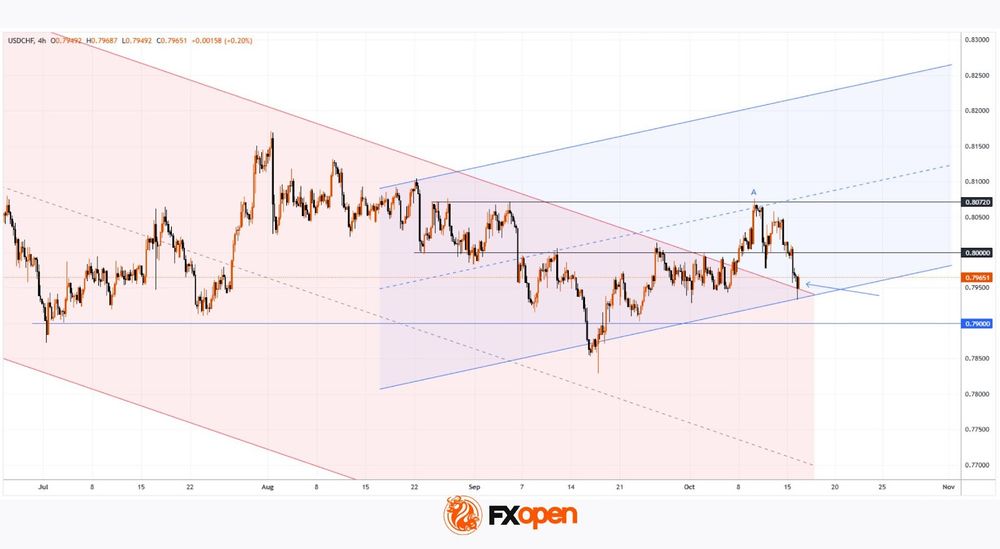
As noted in our 25 September analysis, the Swiss franc has appreciated through 2025 amid elevated geopolitical and macroeconomic risks, forming a downward channel on the USD/CHF chart (shown in red).
We also highlighted:
→ the possibility of a trend reversal around the 0.7900 support area;
→ potential breakout targets (shown in blue).
Since then, the bulls have indeed made progress, driving the price up towards point A and:
→ breaking above the red channel’s upper boundary;
→ overcoming the psychological 0.8000 level.
However, that progress has not been sustained. Among the bearish signals:
→ the median line of the blue channel acted as resistance;
→ the brief move above local highs around 0.8072 resembles a bearish liquidity grab.
From the bullish perspective, USD/CHF has now retreated into a zone that could act as support:
→ the upper boundary of the red channel;
→ the lower boundary of the blue channel.
The arrow highlights signs of a bullish engulfing pattern, suggesting that buyers may be using these support zones to stage a rebound within the blue channel. The 0.8000 psychological mark could serve as the first key test of their resolve.
Key points:
China has yet to secure much of its soybean supply for December and January as high premiums for Brazilian cargoes discourage buyers, a development that could prompt Beijing to tap state reserves to meet near-term needs, three trade sources said.China still needs to purchase about 8–9 million metric tons of soybeans for December-January shipment after covering cargoes through November with hefty purchases of Argentine beans in recent weeks, the sources said. Escalating Washington-Beijing trade tensions continue to shut out U.S. supplies.
"China is not buying U.S. beans because of the trade war and Brazilian beans are too expensive," said one oilseed trader at an international trading company which supplies agricultural products to China."China might end up using its own reserves for the year-end and early next year, before the new South American harvest comes in." he said.
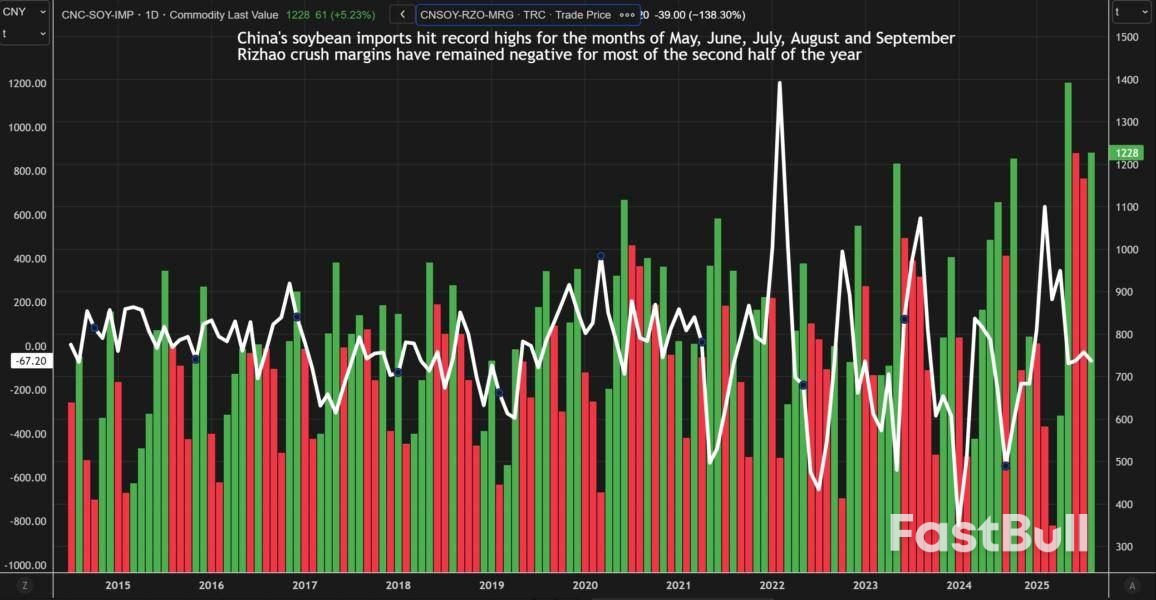
Brazilian soybean premiums are holding at $2.8-2.9 per bushel over the November Chicago soybean contract (SX25) compared with U.S. premiums at around $1.7 per bushel.Crush margins have been in negative territory (CNSOY-RZO-MRG) for most of the second half of the year.
Crushers have little motivation to secure December-January soybean cargoes as supplies from Brazil have squeezed their margins, said a Shanghai-based trader.Chinese buyers are hoping that an early and record soybean harvest in Brazil in early 2026 will help ease prices.Brazilian farmers are expected to harvest a record 177.64 million metric tons of soybeans in the 2025/26 season, around 6 million tons more than the previous year, crop agency Conab said.
"We think new crop shipments from Brazil can start at end of January," said a second oilseed trader. Sources declined to be named as they were not authorised to speak to media.
Chinese buyers have also not yet entirely written off U.S. supplies, with oilseed processors likely to make purchases for December-January if there is a trade agreement between the two governments, traders and analysts said."If a deal goes through, Chinese buyers will likely turn to U.S. beans for the two-month window, with prices more attractive than South American offers," said Johnny Xiang, founder of Beijing-based AgRadar Consulting.Soybeans are expected to feature on the agenda for a potential meeting between U.S. President Donald Trump and Chinese President Xi Jinping in South Korea. Beijing has, however, yet to publicly confirm the talks.
On Tuesday, Trump accused China of "purposefully" avoiding U.S. soybean purchases, calling it an "economically hostile act" that has "caused difficulties" for American soybean farmers.Since the first Trump administration, China has diversified its soybean imports. In 2024, China bought roughly 20% of its soybeans from the U.S., down from 41% in 2016, customs data shows.
The Ten Year Gold Price Chart reveals how global events, inflation, and interest rates shaped gold’s value from 2015 to 2025. By studying decade-long price movements, investors can identify key trends, understand market cycles, and make more informed decisions about long-term portfolio diversification.
Gold has experienced dramatic swings over the past decade, shaped by global economic cycles, inflation fears, and shifting interest rates. The gold price chart last 10 years highlights how major geopolitical events — from trade wars and the pandemic to rising central bank demand — have influenced investor sentiment and market direction.
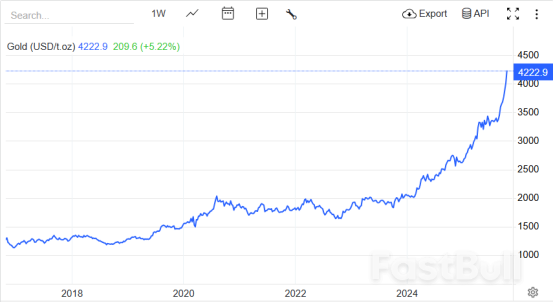
The decade-long pattern shows that gold remains a reliable store of value during crises and a portfolio diversifier when equity markets face turbulence. Studying the gold price chart last 10 years helps investors understand how macroeconomic shifts, monetary policy, and global sentiment align to drive long-term performance.
Key takeaways:
Understanding the Ten-Year Gold Price Chart requires more than just tracking numbers — it means interpreting the economic, political, and financial forces that shape gold’s long-term trajectory. Below are the key factors driving gold prices and the practical steps to analyze the trend over the past decade.
Several macroeconomic and market dynamics determine how gold performs over time. When reading the gold price chart last 10 years, investors should pay attention to the following factors:
Gold typically moves in the opposite direction of interest rates. When rates fall or remain low, the opportunity cost of holding gold decreases — boosting demand and prices. Conversely, higher rates strengthen bonds and currencies, often pressuring gold.
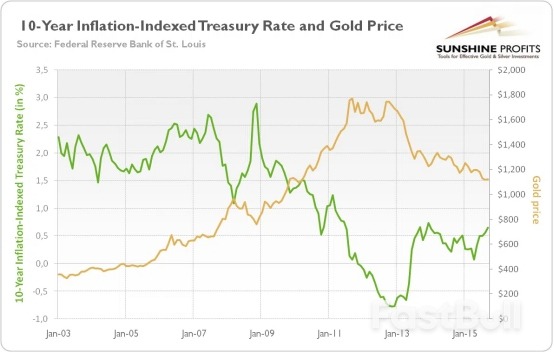
Interest Rate vs Gold Price Chart (2015–2025)
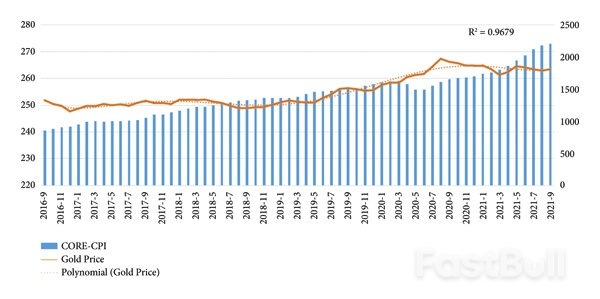
Gold is a classic hedge against inflation. During periods of rising consumer prices, investors turn to gold to preserve value. The inflation vs gold price chart over the past decade shows that gold tends to rally when inflation expectations surge. Overlay chart comparing CPI (Consumer Price Index) with gold price trends
A strong dollar often suppresses gold prices since the metal is priced in USD. When the dollar weakens, foreign investors can buy gold more cheaply, fueling demand.
Events such as wars, trade disputes, and financial crises trigger “safe-haven” buying. Each major global shock — from Brexit to the 2020 pandemic — has left visible spikes on the chart for gold prices for 10 years.
Central banks diversifying away from the dollar, along with ETF inflows, have supported long-term demand. A sustained increase in global gold reserves is often a bullish indicator.
To interpret the Ten-Year Gold Price Chart (2015–2025) effectively, follow these analytical steps:
Mark the key cycles:
Look at whether each successive high and low is rising or falling.
Compare gold’s movement with interest rates, inflation, and USD strength.
Mark price zones where gold repeatedly bounces (support) or struggles to break higher (resistance) — such as $1,200, $1,800, and $2,050. Breakouts beyond these levels often signal major market shifts.
Use moving averages (50-day, 200-day) and RSI or MACD to confirm trend strength. A crossover of short-term averages above long-term lines often indicates renewed bullish sentiment.
Monitoring the gold price chart in real time is crucial for investors who want to link short-term price action with long-term performance. By combining a live feed with the 10 year gold price chart, traders gain both context and precision — understanding whether today’s movement fits within a decade-long trend or signals a potential reversal.
Gold prices respond instantly to shifts in global interest rates, inflation expectations, and geopolitical risk. A real-time view complements the 10 year chart of gold prices, revealing how intraday fluctuations fit into broader market cycles.
Real-time tracking helps investors:
Modern tools make following both real-time data and long-term charts effortless:
When viewing live gold charts, integrate them with the 10 year gold price chart to separate noise from trend:
Short-term data shows momentum; long-term charts show conviction. By merging real-time monitoring with the 10 year gold price chart, investors can distinguish temporary volatility from structural shifts — the key to smarter portfolio timing and diversification.
Gold prices have risen roughly 60–70% over the last decade, reflecting strong demand during periods of inflation and global uncertainty.
The average annual return has been around 5–6%, depending on inflation and interest rate trends.
Yes — analysts view gold as a long-term hedge against inflation, currency risk, and market volatility. However, returns may vary with global economic cycles.
The Ten Year Gold Price Chart reveals how gold has evolved through changing interest rates, inflation cycles, and global events. By understanding long-term trends and tracking real-time data, investors can make informed, resilient portfolio decisions for the decade ahead.
728 RM B 7/F GEE LOK IND BLDG NO 34 HUNG TO RD KWUN TONG KLN HONG KONG


White Label
Data API
Web Plug-ins
Poster Maker
Affiliate Program
The risk of loss in trading financial instruments such as stocks, FX, commodities, futures, bonds, ETFs and crypto can be substantial. You may sustain a total loss of the funds that you deposit with your broker. Therefore, you should carefully consider whether such trading is suitable for you in light of your circumstances and financial resources.
No decision to invest should be made without thoroughly conducting due diligence by yourself or consulting with your financial advisors. Our web content might not suit you since we don't know your financial conditions and investment needs. Our financial information might have latency or contain inaccuracy, so you should be fully responsible for any of your trading and investment decisions. The company will not be responsible for your capital loss.
Without getting permission from the website, you are not allowed to copy the website's graphics, texts, or trademarks. Intellectual property rights in the content or data incorporated into this website belong to its providers and exchange merchants.
Not Logged In
Log in to access more features

FastBull Membership
Not yet
Purchase


Log In
Sign Up


