• Trade
  • Markets
  • Copy
  • Contests
  • News
  • 24/7
  • Calendar
  • Q&A
  • Chats
Trending
Screeners
SYMBOL
LAST
BID
ASK
HIGH
LOW
NET CHG.
%CHG.
SPREAD
SPX
S&P 500 Index
6857.13
6857.13
6857.13
6865.94
6827.13
+7.41
+ 0.11%
--
DJI
Dow Jones Industrial Average
47850.93
47850.93
47850.93
48049.72
47692.96
-31.96
-0.07%
--
IXIC
NASDAQ Composite Index
23505.13
23505.13
23505.13
23528.53
23372.33
+51.04
+ 0.22%
--
USDX
US Dollar Index
98.750
98.830
98.750
98.980
98.750
-0.230
-0.23%
--
EURUSD
Euro / US Dollar
1.16688
1.16695
1.16688
1.16692
1.16408
+0.00243
+ 0.21%
--
GBPUSD
Pound Sterling / US Dollar
1.33598
1.33607
1.33598
1.33601
1.33165
+0.00327
+ 0.25%
--
XAUUSD
Gold / US Dollar
4227.79
4228.22
4227.79
4230.62
4194.54
+20.62
+ 0.49%
--
WTI
Light Sweet Crude Oil
59.388
59.425
59.388
59.469
59.187
+0.005
+ 0.01%
--

Community Accounts

Signal Accounts
--
Profit Accounts
--
Loss Accounts
--
View More

Become a signal provider

Sell trading signals to earn additional income

View More

Guide to Copy Trading

Get started with ease and confidence

View More

Signal Accounts for Members

All Signal Accounts

Best Return
  • Best Return
  • Best P/L
  • Best MDD
Past 1W
  • Past 1W
  • Past 1M
  • Past 1Y

All Contests

  • All
  • Trump Updates
  • Recommend
  • Stocks
  • Cryptocurrencies
  • Central Banks
  • Featured News
Top News Only
Share

Equinor: Preliminary Estimates Indicate Reservoirs May Contain Between 5 -18 Million Standard Cubic Meters Of Recoverable Oil Equivalents

Share

Japan Chief Cabinet Secretary Kihara: Government To Take Appropriate Steps On Excessive And Disorderly Moves In Foreign Exchange Market, If Necessary

Share

[Report: Amazon Pays €180 Million To Italy To End Tax And Labor Investigations] Amazon Has Paid A Settlement And Dismantled Its Monitoring System For Delivery Drivers In Italy, Ending An Investigation Into Alleged Tax Fraud And Illegal Labor Practices. In July 2024, The Group's Logistics Services Division Was Accused Of Circumventing Labor And Tax Laws By Relying On Cooperatives Or Limited Liability Companies To Supply Workers, Evading VAT, And Reducing Social Security Payments. Sources Say The Group Has Now Paid Approximately €180 Million To Italian Tax Authorities As Part Of A €1 Billion Settlement Involving 33 Companies

Share

Airbus - Booked 797 Gross Aircraft Orders In January-November

Share

[Market Update] Spot Gold Broke Through $4,230 Per Ounce, Up 0.51% On The Day

Share

Reserve Bank Of India Chief Malhotra: There Will Be Ample Liquidity As Long As We Are In An Easing Cycle

Share

Reserve Bank Of India Chief Malhotra: Quantum Of System Liquidity Will Be Managed To Ensure Monetary Transmission Is Happening

Share

China's Foreign Ministry: World Bank, IMF, WTO Top Officials To Join

Share

China's Foreign Ministry: China To Hold 1+1 Dialogue With International Economic Orgs On Dec 9

Share

Reserve Bank Of India Chief Malhotra: 5% Of Inr Depreciation Leads To 35 Bps Of Inflation

Share

Eurostoxx 50 Futures Up 0.14%, DAX Futures Up 0.12%, CAC 40 Futures Up 0.26%, FTSE Futures Up 0.03%

Share

Getlink - Over 1 Million Trucks Crossed Channel Since January 2025

Share

Malaysia International Reserves At $124.1 Billion On November 28 Versus$124.1 Billion On November 14 - Central Bank

Share

Reserve Bank Of India Chief Malhotra: Conscious Effort On Diversifying Gold Reserves

Share

Russian President Putin Thanks Indian Prime Minister Modi For Attention To Ukraine Peace Efforts

Share

Russian President Putin: India-Russia Relations Should Grow And Touch New Heights

Share

Russian President Putin: India Is Not Neutral, India Is On The Side Of Peace

Share

Russian President Putin: We Support Every Effort Towards Peace

Share

Russian President Putin: The World Should Return To Peace

Share

India Prime Minister Modi: We Should All Pursue Peace Together

TIME
ACT
FCST
PREV
Euro Zone IHS Markit Construction PMI (Nov)

A:--

F: --

P: --

Italy IHS Markit Construction PMI (Nov)

A:--

F: --

P: --

U.K. Markit/CIPS Construction PMI (Nov)

A:--

F: --

P: --

France 10-Year OAT Auction Avg. Yield

A:--

F: --

P: --

Euro Zone Retail Sales MoM (Oct)

A:--

F: --

P: --

Euro Zone Retail Sales YoY (Oct)

A:--

F: --

P: --

Brazil GDP YoY (Q3)

A:--

F: --

P: --

U.S. Challenger Job Cuts (Nov)

A:--

F: --

P: --

U.S. Challenger Job Cuts MoM (Nov)

A:--

F: --

P: --

U.S. Challenger Job Cuts YoY (Nov)

A:--

F: --

P: --

U.S. Initial Jobless Claims 4-Week Avg. (SA)

A:--

F: --

P: --

U.S. Weekly Initial Jobless Claims (SA)

A:--

F: --

P: --

U.S. Weekly Continued Jobless Claims (SA)

A:--

F: --

P: --

Canada Ivey PMI (SA) (Nov)

A:--

F: --

P: --

Canada Ivey PMI (Not SA) (Nov)

A:--

F: --

P: --

U.S. Non-Defense Capital Durable Goods Orders Revised MoM (Excl. Aircraft) (SA) (Sept)

A:--

F: --

P: --
U.S. Factory Orders MoM (Excl. Transport) (Sept)

A:--

F: --

P: --

U.S. Factory Orders MoM (Sept)

A:--

F: --

P: --

U.S. Factory Orders MoM (Excl. Defense) (Sept)

A:--

F: --

P: --

U.S. EIA Weekly Natural Gas Stocks Change

A:--

F: --

P: --

Saudi Arabia Crude Oil Production

A:--

F: --

P: --

U.S. Weekly Treasuries Held by Foreign Central Banks

A:--

F: --

P: --

Japan Foreign Exchange Reserves (Nov)

A:--

F: --

P: --

India Repo Rate

A:--

F: --

P: --

India Benchmark Interest Rate

A:--

F: --

P: --

India Reverse Repo Rate

A:--

F: --

P: --

India Cash Reserve Ratio

A:--

F: --

P: --

Japan Leading Indicators Prelim (Oct)

A:--

F: --

P: --

U.K. Halifax House Price Index YoY (SA) (Nov)

A:--

F: --

P: --

U.K. Halifax House Price Index MoM (SA) (Nov)

A:--

F: --

P: --

France Current Account (Not SA) (Oct)

--

F: --

P: --

France Trade Balance (SA) (Oct)

--

F: --

P: --

France Industrial Output MoM (SA) (Oct)

--

F: --

P: --

Italy Retail Sales MoM (SA) (Oct)

--

F: --

P: --

Euro Zone Employment YoY (SA) (Q3)

--

F: --

P: --

Euro Zone GDP Final YoY (Q3)

--

F: --

P: --

Euro Zone GDP Final QoQ (Q3)

--

F: --

P: --

Euro Zone Employment Final QoQ (SA) (Q3)

--

F: --

P: --

Euro Zone Employment Final (SA) (Q3)

--

F: --

P: --
Brazil PPI MoM (Oct)

--

F: --

P: --

Mexico Consumer Confidence Index (Nov)

--

F: --

P: --

Canada Unemployment Rate (SA) (Nov)

--

F: --

P: --

Canada Labor Force Participation Rate (SA) (Nov)

--

F: --

P: --

Canada Employment (SA) (Nov)

--

F: --

P: --

Canada Part-Time Employment (SA) (Nov)

--

F: --

P: --

Canada Full-time Employment (SA) (Nov)

--

F: --

P: --

U.S. Personal Income MoM (Sept)

--

F: --

P: --

U.S. Dallas Fed PCE Price Index YoY (Sept)

--

F: --

P: --

U.S. PCE Price Index YoY (SA) (Sept)

--

F: --

P: --

U.S. PCE Price Index MoM (Sept)

--

F: --

P: --

U.S. Personal Outlays MoM (SA) (Sept)

--

F: --

P: --

U.S. Core PCE Price Index MoM (Sept)

--

F: --

P: --

U.S. UMich 5-Year-Ahead Inflation Expectations Prelim YoY (Dec)

--

F: --

P: --

U.S. Core PCE Price Index YoY (Sept)

--

F: --

P: --

U.S. Real Personal Consumption Expenditures MoM (Sept)

--

F: --

P: --

U.S. 5-10 Year-Ahead Inflation Expectations (Dec)

--

F: --

P: --

U.S. UMich Current Economic Conditions Index Prelim (Dec)

--

F: --

P: --

U.S. UMich Consumer Sentiment Index Prelim (Dec)

--

F: --

P: --

U.S. UMich 1-Year-Ahead Inflation Expectations Prelim (Dec)

--

F: --

P: --

U.S. UMich Consumer Expectations Index Prelim (Dec)

--

F: --

P: --

Q&A with Experts
    • All
    • Chatrooms
    • Groups
    • Friends
    Connecting
    .
    .
    .
    Type here...
    Add Symbol or Code

      No matching data

      All
      Trump Updates
      Recommend
      Stocks
      Cryptocurrencies
      Central Banks
      Featured News
      • All
      • Russia-Ukraine Conflict
      • Middle East Flashpoint
      • All
      • Russia-Ukraine Conflict
      • Middle East Flashpoint

      Search
      Products

      Charts Free Forever

      Chats Q&A with Experts
      Screeners Economic Calendar Data Tools
      Membership Features
      Data Warehouse Market Trends Institutional Data Policy Rates Macro

      Market Trends

      Market Sentiment Order Book Forex Correlations

      Top Indicators

      Charts Free Forever
      Markets

      News

      News Analysis 24/7 Columns Education
      From Institutions From Analysts
      Topics Columnists

      Latest Views

      Latest Views

      Trending Topics

      Top Columnists

      Latest Update

      Signals

      Copy Rankings Latest Signals Become a signal provider AI Rating
      Contests
      Brokers

      Overview Brokers Assessment Rankings Regulators News Claims
      Broker listing Forex Brokers Comparison Tool Live Spread Comparison Scam
      Q&A Complaint Scam Alert Videos Tips to Detect Scam
      More

      Business
      Events
      Careers About Us Advertising Help Center

      White Label

      Data API

      Web Plug-ins

      Affiliate Program

      Awards Institution Evaluation IB Seminar Salon Event Exhibition
      Vietnam Thailand Singapore Dubai
      Fans Party Investment Sharing Session
      FastBull Summit BrokersView Expo
      Recent Searches
        Top Searches
          Markets
          News
          Analysis
          User
          24/7
          Economic Calendar
          Education
          Data
          • Names
          • Latest
          • Prev

          View All

          No data

          Scan to Download

          Faster Charts, Chat Faster!

          Download App
          English
          • English
          • Español
          • العربية
          • Bahasa Indonesia
          • Bahasa Melayu
          • Tiếng Việt
          • ภาษาไทย
          • Français
          • Italiano
          • Türkçe
          • Русский язык
          • 简中
          • 繁中
          Open Account
          Search
          Products
          Charts Free Forever
          Markets
          News
          Signals

          Copy Rankings Latest Signals Become a signal provider AI Rating
          Contests
          Brokers

          Overview Brokers Assessment Rankings Regulators News Claims
          Broker listing Forex Brokers Comparison Tool Live Spread Comparison Scam
          Q&A Complaint Scam Alert Videos Tips to Detect Scam
          More

          Business
          Events
          Careers About Us Advertising Help Center

          White Label

          Data API

          Web Plug-ins

          Affiliate Program

          Awards Institution Evaluation IB Seminar Salon Event Exhibition
          Vietnam Thailand Singapore Dubai
          Fans Party Investment Sharing Session
          FastBull Summit BrokersView Expo

          September 2025 UK Inflation: Surprisingly Cool

          Pepperstone

          Forex

          Economic

          Summary:

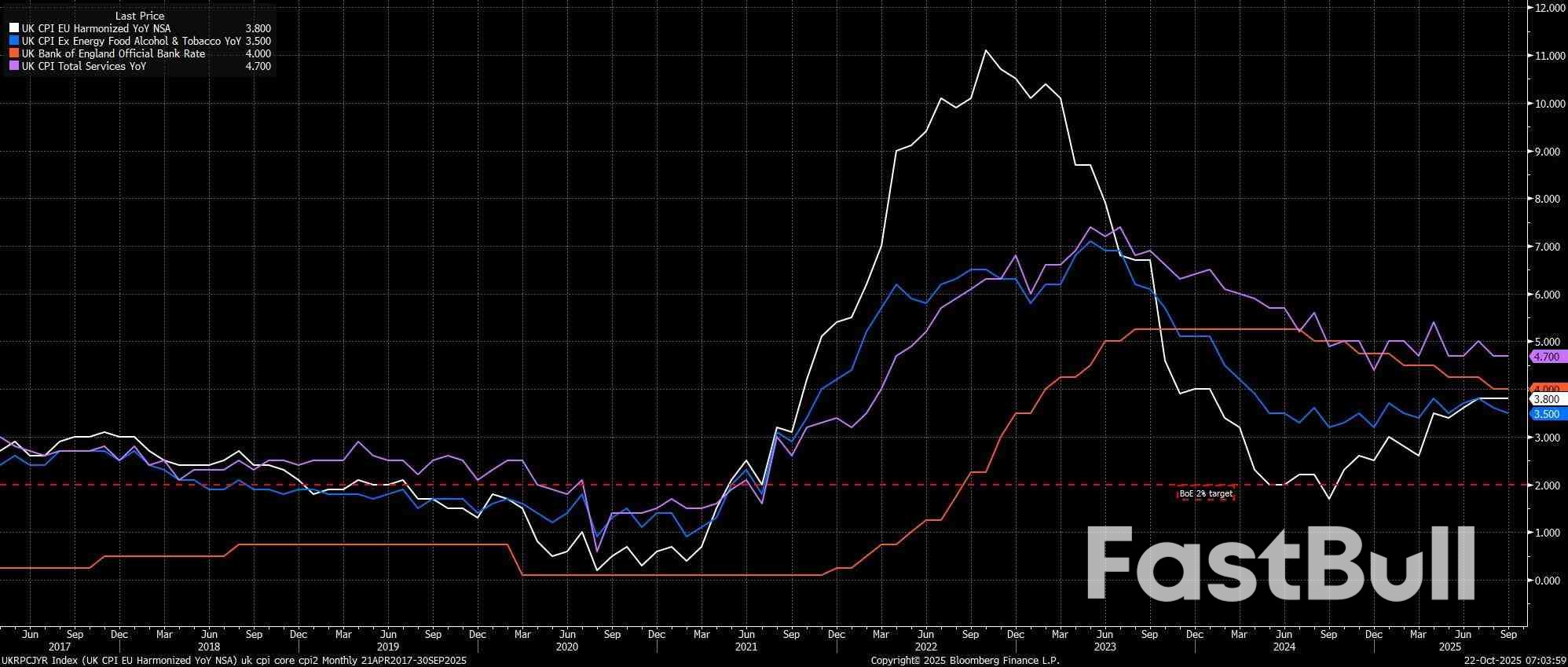
          Headline CPI rose 3.8% YoY in September, well below both market expectations, and the BoE's forecast for a 4.0% YoY rise, and unchanged from the pace seen in August.

          Headline CPI rose 3.8% YoY in September, well below both market expectations, and the BoE's forecast for a 4.0% YoY rise, and unchanged from the pace seen in August. Meanwhile, metrics of underlying price pressures also printed cooler than expected, as core CPI rose 3.5% YoY, and as services CPI rose 4.7% YoY, also unchanged from last time out, and considerably below the Bank's 5.0% YoY expectation.
          September 2025 UK Inflation: Surprisingly Cool_1

          The details of the report were also surprisingly optimistic, most notable as food prices fell 0.2% MoM, and rose by 4.5% YoY, mirroring declines seen elsewhere in Europe in recent months, and likely giving the MPC some cause for optimism, given how this component remains a key driver of consumer inflation expectations.

          On the whole, however, it seems highly unlikely that this morning's figures will materially move the needle in terms of the BoE policy outlook, despite the figures being considerably better than expected.

          While the 'Old Lady' expect September to mark the peak in terms of inflation this cycle, policymakers on the MPC will want to be sure that peak has indeed passed before taking further steps to remove restriction, something that is impossible to gleam from just one print.

          Furthermore, the huge degree of pre-Budget uncertainty, chiefly in terms of where upcoming tax hikes are likely to fall, and whether those tax increases again prove to be inflationary.

          Hence, while there remain significant splits among MPC members over the degree of slack emerging in the labour market, and the speed at which said slack is making itself known, it seems unlikely that a majority of policymakers will favour a rate reduction before the year comes to an end. As such, my base case remains that the MPC are now on hold until next February, at which point a 25bp cut is likely to be delivered, providing that greater certainty of inflation having peaked has been obtained. From then on, a resumption of the quarterly pace of 25bp cuts is likely, before Bank Rate gets to a terminal 3.25% this time next year.

          Source: Pepperstone

          To stay updated on all economic events of today, please check out our Economic calendar
          Risk Warnings and Disclaimers
          You understand and acknowledge that there is a high degree of risk involved in trading. Following any strategies or investment methods may lead to potential losses. The content on the site is provided by our contributors and analysts for information purposes only. You are solely responsible for determining whether any trading assets, securities, strategy, or any other product is suitable for investing based on your own investment objectives and financial situation.
          Add to Favorites
          Share

          China’s Daily $1 Billion in Exports Underscores Trade Resilience and Bargaining Leverage Amid US Tariffs

          Gerik

          Economic

          Chinese Exports Defy Tariff Pressure with Surprising Strength

          Six months into the renewed trade war under Donald Trump’s second administration, China’s export engine has proven more durable than expected. In the third quarter alone, over $100 billion worth of goods were shipped from China to the US, pushing the bilateral trade surplus to $67 billion. This occurred despite average US tariffs climbing to 55%, signaling that Chinese goods remain deeply embedded in American supply chains.
          The daily export value of Chinese goods to the US even rose in September compared to August. While overall trade volumes have contracted since early 2025, the sustained flow of high-demand products such as rare earths, electronics, and industrial inputs underlines China's pivotal role as a supplier.

          Structural Dependencies Create Negotiating Power for Xi

          This continued volume of trade, despite steep levies, underscores a structural asymmetry that benefits Beijing in ongoing trade negotiations. Bloomberg economists Chang Shu and David Qu note that China’s entrenched position in global supply chains gives it short-term leverage over US importers, who cannot easily shift sourcing to other countries.
          Although reshoring and diversification are long-term goals for the US, the slow pace of realignment means that China maintains bargaining power heading into upcoming trade talks, especially as the current 90-day tariff truce approaches expiration in November. President Trump has acknowledged the complexity, predicting a “good deal” with Xi Jinping while also hinting at the fragility of scheduled talks.

          Resilience of Key Sectors and Loopholes Soften Tariff Impact

          In-depth customs data reveal surprising areas of strength. Shipments of refined copper cathodes rose to $270 million last quarter, electrical cables surged 87% to $405 million, and e-bike exports topped $500 million an increase from 2024. Even e-cigarettes and small electronics held firm, with nearly $8 billion in smartphones, tablets, and computer components sent to the US.
          Some of this resilience is attributed to strategic tariff circumvention. According to ANZ strategist Zhaopeng Xing, many importers are leveraging transshipment through third countries like Vietnam and Mexico or using valuation strategies at customs to minimize levies. These legal and regulatory loopholes blunt the intended pressure of US tariffs and allow for continued access to low-cost Chinese goods.

          E-Commerce Sales Thrive Despite Policy Shifts

          Despite the closure of the “de minimis” exemption in May which once allowed duty-free entry for small packages Chinese e-commerce giants like Shein and Temu continue to reach US consumers. Chinese data show that about $5.4 billion worth of small parcels have still entered the US since the rule change, despite facing tariffs of 54%. This underscores the elasticity of US demand, even amid policy tightening.
          While many categories remain robust, others have seen sharp declines. LCD TV exports from China fell 73% last quarter as US buyers sought alternatives in Southeast Asia. Game consoles, once a major export, are now increasingly shipped from Vietnam by companies such as Nintendo and Microsoft, illustrating the gradual success of supply chain diversification in certain high-value segments.
          The decline in exports of commercial ships and similar large-scale equipment categories already facing earlier decoupling trends further illustrates the sector-by-sector nature of this trade realignment.

          IMF: Decoupling More Severe Than 2018–2019 Trade War

          According to the IMF, the scale of US-China trade fragmentation in 2025 has already surpassed the disruption of the first Trump presidency. In its latest report, the Fund emphasized that bilateral trade decoupling is occurring faster than during the 2018–2019 tariff shocks, reflecting both more aggressive US policy measures and a heightened strategic urgency to insulate critical industries.
          Nevertheless, both sides remain economically interlocked. Even Trump’s renewed tariff strategy cannot fully undo decades of supply chain integration in a matter of months. As Xi Jinping enters talks armed with a still-resilient export base, the real test may be whether US policy can deliver long-term structural change while navigating near-term economic interdependence.

          Source: Bloomberg

          To stay updated on all economic events of today, please check out our Economic calendar
          Risk Warnings and Disclaimers
          You understand and acknowledge that there is a high degree of risk involved in trading. Following any strategies or investment methods may lead to potential losses. The content on the site is provided by our contributors and analysts for information purposes only. You are solely responsible for determining whether any trading assets, securities, strategy, or any other product is suitable for investing based on your own investment objectives and financial situation.
          Add to Favorites
          Share

          Inter-American Development Bank Grants $500 Million Loan to Boost Argentina’s Public Healthcare

          Gerik

          Economic

          Strategic Investment to Support Public Health Reform

          On October 21, the Inter-American Development Bank (IDB) confirmed the approval of a $500 million loan package for Argentina. This long-term loan, with a 25-year maturity and a 5.5-year grace period, is designed to fund improvements in Argentina’s public healthcare system specifically focusing on retirees, pensioners, and individuals with chronic diseases.
          This financial assistance forms part of a broader health policy reform initiative, structured around meeting measurable performance goals tied to improved service delivery. The investment is expected to support approximately 5.4 million Argentinians, reflecting a significant intervention in a country where demographic aging and chronic illness burden are pressing challenges.

          Chronic Disease and Cancer Treatment as Core Priorities

          A central objective of the program is to enhance comprehensive care for patients with chronic conditions such as hypertension, diabetes, and kidney disease. By expanding the coverage of these high-prevalence illnesses, the program seeks to mitigate long-term complications and reduce hospital admissions a move that may improve cost efficiency in the public health sector over time.
          Another critical area is oncology. The IDB’s program prioritizes reducing surgical wait times for breast and colon cancer patients, reflecting a shift toward more timely intervention and equity in access to lifesaving treatments.

          Improved Access for the Elderly and Long-Term Care Recipients

          In addition to disease-specific measures, the funding targets broader structural reforms. Notably, the loan will finance the expansion of long-term care services for retirees and individuals requiring continuous assistance. This comes at a time when Argentina’s population is aging rapidly, placing new strains on the healthcare and social support system.
          The loan also enables the development of care models that better integrate elderly patients into formal health structures, aiming to close existing service gaps between urban and rural populations or between higher- and lower-income groups.

          Data-Driven Management as a Governance Pillar

          A distinguishing feature of the program is its emphasis on data-driven healthcare governance. The IDB highlights the critical role of systematized use of national health data collected by local and federal agencies in optimizing resource allocation, improving monitoring, and refining policy decisions. This signals a move toward more efficient, evidence-based public health management in Argentina.
          The integration of health informatics also introduces the potential for broader digital transformation, setting the foundation for AI-powered diagnostics, digital records, and centralized patient tracking systems in the future.

          Critical Support Amid Economic Strain

          This substantial health-focused loan arrives at a time when Argentina is grappling with severe fiscal constraints and high inflation. The infusion of external financing from the IDB not only provides necessary capital for urgent healthcare reform but may also relieve pressure on national public spending.
          By linking disbursement to performance indicators, the program encourages accountability and impact-based implementation. If executed effectively, the initiative could become a model for how multilateral development institutions can support middle-income countries in balancing social protection goals with macroeconomic sustainability.
          To stay updated on all economic events of today, please check out our Economic calendar
          Risk Warnings and Disclaimers
          You understand and acknowledge that there is a high degree of risk involved in trading. Following any strategies or investment methods may lead to potential losses. The content on the site is provided by our contributors and analysts for information purposes only. You are solely responsible for determining whether any trading assets, securities, strategy, or any other product is suitable for investing based on your own investment objectives and financial situation.
          Add to Favorites
          Share

          Calm Returns To Markets, Loonie Holds Firm, Yen Stays Weak

          Samantha Luan

          Commodity

          Stocks

          Forex

          Economic

          The forex market turned noticeably quieter in Asian session today, with traders taking a breather after the risk-on rally seen earlier in the week. Most major pairs and crosses remain confined within last week’s ranges, reflecting a more balanced tone as global sentiment stabilizes. Canadian Dollar continues to hold firm, extending support from Tuesday’s hotter-than-expected inflation data, while Aussie and Kiwi are also chalking up steady gains for the week.

          By contrast, the Japanese Yen remains under heavy pressure, ranking as the weakest performer among the majors, followed by Euro and Sterling. Dollar and Swiss Franc are trading in the middle of the pack. The consolidation reflects a market still awaiting the next round of data to offer clearer trading cues, including Friday’s U.S. CPI

          Nevertheless, the day’s spotlight turns to UK inflation figures first, expected to show headline CPI rising to 4% year-on-year in September — its highest since early 2024 and double the BoE’s 2% target. An upside surprise would bolster the case for the BoE to hold rates steady at its November 6 meeting, reinforcing arguments from policy hawks like Chief Economist Huw Pill.

          Meanwhile, even a mild downside surprise may not be sufficient to sway the MPC toward an immediate rate cut. The committee remains deeply divided, and with the UK Budget due on November 26, most members are likely to delay major policy moves until the fiscal outlook becomes clearer.

          Elsewhere, trade developments are drawing attention in South Asia. Indian media outlet Mint reported that the U.S. is preparing to substantially reduce tariffs on Indian exports as part of an emerging trade deal with New Delhi. According to the report, tariffs could be slashed to 15–16% from the current 50%, contingent on India agreeing to scale back its purchases of Russian oil. The move would mark a significant thaw in bilateral trade ties.

          U.S. President Donald Trump confirmed on Tuesday that he had spoken with Prime Minister Narendra Modi, who assured Washington that India would reduce its intake of Russian crude. In a post on X the following morning, Modi described the call as “productive,” saying both countries would continue to stand “united against terrorism in all its forms,” though he avoided any direct reference to energy imports.

          In Asia, at the time of writing, Nikkei is up 0.16%. Hong Kong HSI is down -1.12%. China Shanghai SSE is down -0.46%. Japan 10-year JGB yield is down -0.007 at 1.656. Overnight, DOW rose 0.47%. S&P 500 rose 0.00%. NASDAQ fell -0.16%. 10-year yield fell -0.023 to 3.963.

          Japan’s exports rise for first time in five months, but U.S. demand still weak

          Japan’s exports rose in September for the first time in five months, signaling tentative recovery in external demand even as shipments to the U.S. continued to contract sharply.

          Exports climbed 4.2% yoy to JPY 9.41T, slightly below expectations of 4.6%. The rebound was driven largely by strength in Asia, where exports jumped 9.2%, including a 5.8% rise to China. In contrast, shipments to the U.S. fell -13.3%, with auto exports down -24.2%, extending months of weakness despite being a smaller drop than August’s 28.4% decline.

          Imports also grew faster than expected, rising 3.3% yoy to JPY 9.65T, compared with forecasts of 0.6%. As a result, Japan posted a trade deficit of JPY 234.6B.

          The data come just weeks after Washington finalized a new trade agreement with Tokyo, implementing a 15% baseline tariff on nearly all Japanese imports, down from the initial 27.5% rate.

          Gold, Silver in brief healthy consolidation as speculative heat cools

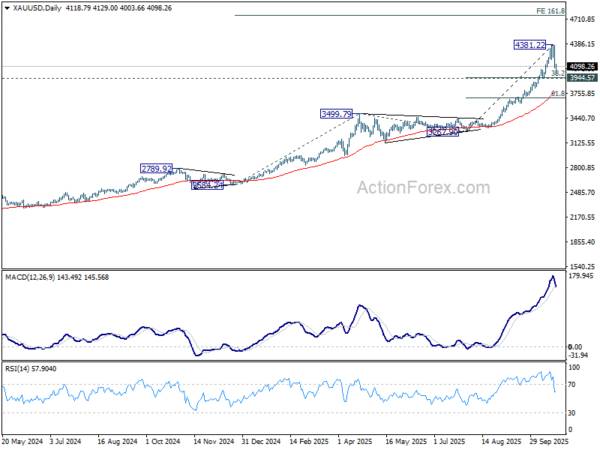
          Gold and Silver saw heavy selling this week, pausing their record-setting advance as traders took profits and liquidity conditions improved. The decline has raised questions about whether the market is entering a deeper downturn, but technicals suggest the move is more of a healthy correction within a still-bullish backdrop.Reports of increased Silver flows from the U.S. and China into London’s spot market added to the selling pressure, easing recent supply constraints that had intensified price momentum. The additional liquidity gave traders room to unwind speculative positions, accelerating the pullback but also helping to stabilize the market longer-term. This as part of a natural rebalancing after overbought conditions earlier in the month.

          While the losses have been sharp, there is no clear structural threat to the broader uptrend. The latest pullback reflects profit-taking and short-term positioning adjustments rather than a breakdown in investor confidence. Demand for precious metals remains underpinned by global macro uncertainty, moderate inflation expectations, and central bank diversification away from U.S. assets.Technically, Gold remains supported above 3,944.57 cluster, a level that separates sideway consolidation from deeper correction. As long as this level holds, consolidations from 4,381.22 should remain relatively brief. Sustained break above 4,381.22 would signal renewed strength, opening the path toward 161.8% projection of 2,584.24 to 3,499.79 from 3,267.90 at 4,749.25.

          However, break of 3,944.57 would argue the latest rise leg from 3,267.90 has completed, and bring deeper correction to 55 D EMA (now at 3,781.78). Such a move would extend consolidation but not necessarily signal a full trend reversal.
          Calm Returns To Markets, Loonie Holds Firm, Yen Stays Weak_1

          Silver is showing a similar pattern. As long as 47.30 cluster holds, correction from 54.44 should stay shallow and short-lived. Another rise to 200% projection of 28.28 to 39.49 from 36.93 at 59.30 should be seen sooner rather than later.

          However, a fall below 47.30, would trigger deeper pullback toward 55 D EMA (now at 44.76), before uptrend resumes.

          USD/JPY Daily Outlook

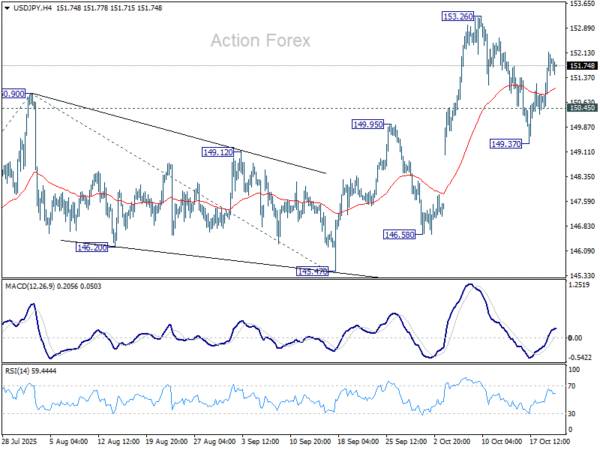
          Daily Pivots: (S1) 150.87; (P) 151.53; (R1) 152.58;

          Intraday bias in USD/JPY remains on the upside for retesting 153.26. Break there will resume larger rally from 139.87 to 100% projection of 142.66 to 150.90 from 145.47 at 153.71. Firm break there would prompt upside acceleration to 161.8% projection at 158.80. on the downside, below 150.45 minor support will dampen this bullish view and turn bias neutral again first.
          Calm Returns To Markets, Loonie Holds Firm, Yen Stays Weak_2

          In the bigger picture, current development suggests that corrective pattern from 161.94 (2024 high) has completed with three waves at 139.87. Larger up trend from 102.58 (2021 low) could be ready to resume through 161.94 high. On the downside, break of 145.47 support will dampen this bullish view and extend the corrective pattern with another falling leg.

          Source: ACTIONFOREX

          To stay updated on all economic events of today, please check out our Economic calendar
          Risk Warnings and Disclaimers
          You understand and acknowledge that there is a high degree of risk involved in trading. Following any strategies or investment methods may lead to potential losses. The content on the site is provided by our contributors and analysts for information purposes only. You are solely responsible for determining whether any trading assets, securities, strategy, or any other product is suitable for investing based on your own investment objectives and financial situation.
          Add to Favorites
          Share

          Global Carmakers Race to Secure Rare Earths Amid Chinese Export Crackdown

          Gerik

          Economic

          Rare Earth Supply Tightens as China Expands Export Controls

          Global automakers are facing mounting pressure to secure stable rare earth supplies as China, which dominates the industry, imposes tighter export restrictions. From fuel leak sensors to EV drive systems, rare earth elements like ytterbium, holmium, and europium are critical in modern automotive manufacturing. In electric vehicles (EVs), their role is even more integral powering magnetic motors essential to the car’s core function.
          Despite a recent trade agreement between the U.S. and China aimed at easing immediate tensions, the global stockpile of rare earths remains depleted due to similar curbs earlier this year. China now controls about 70% of global mining, 85% of refining, and 90% of alloy production. More critically, it holds 99.8% of the global refining capacity for heavy rare earths, leaving other nations with minimal alternatives.

          Western Firms Seek Alternatives But Face Infrastructure Gaps

          Manufacturers are urgently diversifying supply chains. According to Nadine Rajner of Germany’s NMD materials group, clients are “desperately searching for non-Chinese sources.” The U.S. and Australia recently signed a strategic minerals agreement to co-develop mining projects, yet many countries like Sweden, despite having large deposits, lack the mining and refining infrastructure needed for meaningful output.
          This reveals a structural constraint: even where reserves exist, operational capabilities lag, particularly for heavy rare earths. As a result, near-term substitution remains limited, and the global automotive sector remains functionally tethered to Chinese output.

          Bottlenecks Threaten to Disrupt Automotive Production

          Even if Chinese suppliers manage to ship orders before the November 8 export control deadline, long maritime shipping times up to 45 days to Europe risk compounding delays. A sudden spike in international orders has already strained available inventory. Three industry sources confirmed Chinese rare earth exporters received a surge in orders after China’s announcement on October 9, further tightening the supply.
          The threat of supply disruption is not limited to rare earths. China has also restricted exports of lithium-ion batteries and key materials for EV components. Additionally, intellectual property disputes such as a recent clash between China and the Netherlands involving chipmaker Nexperia have sparked fears of plant closures in Europe, given the company's importance in automotive chip supply.
          Bosch executive Bruno Gahery expects firms to boost rare earth stockpiles before the Chinese controls take effect. However, a magnet supplier for Hyundai noted their reserves stocked since early 2025 are nearly depleted, underscoring how rapidly inventory has been consumed.

          Industry Shifts Toward Rare-Earth-Free Technologies

          Faced with persistent risk, leading automakers are accelerating the shift to alternative technologies. General Motors, ZF, and BorgWarner are developing EV motors with reduced or zero rare earth content. BMW and Renault have already rolled out motors free of these materials.
          Meanwhile, UK-based Monumo is using AI-driven modeling to help carmakers reduce rare earth use in motors by an average of 24%. The company’s client list includes several of the world’s top 10 automakers. However, these technological innovations remain years from commercial viability, limiting their immediate impact on supply resilience.

          US Takes More Aggressive Strategic Posture Than Europe

          According to SC Insights co-founder Andy Leyland, the U.S. government has shown stronger policy urgency than European counterparts. While projects are underway in the West to build rare earth mining and refining infrastructure, China's ability to depress global prices through state-supported production still gives it asymmetric leverage over any emerging competition.
          This dynamic highlights a cause-effect link between China’s regulatory dominance and the West’s delayed strategic response. Without coordinated investment, the West may remain vulnerable not just to trade restrictions but to deliberate market destabilization through pricing power.

          Urgent Action Needed as Supply Fragility Deepens

          The automotive industry is now caught in a high-stakes race. On one hand, geopolitical friction and export controls threaten immediate disruption; on the other, the technological path toward rare-earth independence remains years away from maturity.
          With rare earths vital to both internal combustion and electric drivetrains, any prolonged disruption could ripple through global vehicle production lines. Toyota’s North America Supply Chain VP Ryan Grimm summarized the stakes: “China could halt the entire automotive industry within two months.” The window for preemptive adaptation is narrowing. Without accelerated diversification, innovation, and international collaboration, the rare earth crisis may evolve into a systemic bottleneck for the global automotive sector.
          To stay updated on all economic events of today, please check out our Economic calendar
          Risk Warnings and Disclaimers
          You understand and acknowledge that there is a high degree of risk involved in trading. Following any strategies or investment methods may lead to potential losses. The content on the site is provided by our contributors and analysts for information purposes only. You are solely responsible for determining whether any trading assets, securities, strategy, or any other product is suitable for investing based on your own investment objectives and financial situation.
          Add to Favorites
          Share

          UK Government Borrowing Hits £99.8 Billion, Highest in Five Years, Fueling Budget Pressures

          Gerik

          Economic

          Record Borrowing Reflects Rising Fiscal Strain

          According to data released by the UK’s Office for National Statistics (ONS) on October 21, the country’s borrowing between April and September 2025 climbed to £99.8 billion, marking a year-on-year increase of £11.5 billion. This figure not only surpasses the March forecast by the Office for Budget Responsibility (OBR) by £7.2 billion but also registers as the second-highest borrowing level since 1993 only behind pandemic-era records.
          Borrowing in September alone surged to £20.2 billion, the largest monthly total in five years. Although previous borrowing estimates were revised downward by £4.2 billion, the latest figures still point to a persistent upward trend that complicates the government's fiscal outlook.

          Tax Revenue Growth Fails to Offset Spending

          The rise in borrowing is particularly notable given that the UK economy has grown faster than anticipated, and inflation has exceeded the OBR’s earlier projections. Both factors theoretically should have strengthened tax revenues. However, the growth in government spending continues to outpace the expansion of the tax base, thereby exacerbating the fiscal gap.
          This illustrates a disconnect between macroeconomic indicators and fiscal outcomes highlighting that even in periods of higher-than-expected growth and inflation, structural spending pressures and policy commitments can override revenue gains.

          Budget Challenges Mount Ahead of Autumn Statement

          With Chancellor Rachel Reeves set to deliver the Autumn Budget on November 26, the higher-than-expected borrowing figures pose a major challenge. Analysts suggest the Treasury may need to implement further tax hikes to address a potential budget shortfall estimated at £20–30 billion.
          The Institute for Fiscal Studies (IFS) has emphasized that the borrowing spike is significant and troubling, especially as it arrives just weeks before the fiscal roadmap is unveiled. The fiscal headroom has narrowed despite improved economic conditions, forcing the Treasury to reconcile the gap through either austerity or enhanced revenue collection.

          Medium-Term Fiscal Path Faces Persistent Pressure

          Robert Wood of Pantheon Macroeconomics noted that even with recent downward revisions by the ONS, current debt levels remain well above the March baseline forecast. He warned that this trend is likely to persist into the medium term, further complicating the UK’s fiscal consolidation strategy.
          The causal relationship here is clear: higher borrowing is driven not only by cyclical spending but also by structural commitments, such as energy support, public sector wages, and welfare adjustments, which are not easily reversed in the near term. This indicates that the UK’s fiscal strategy may require long-term recalibration rather than temporary fixes.

          Structural Reform May Be Inevitable

          As the UK navigates a period of elevated borrowing and political transition, pressure is mounting on the government to deliver a budget that balances fiscal credibility with social and economic needs. While short-term borrowing can support growth during downturns, sustained high levels particularly during a period of economic expansion raise red flags about debt sustainability.
          Unless tax receipts grow substantially or spending is curtailed, the fiscal deficit risks becoming embedded. With the Autumn Budget looming, policymakers face a critical juncture: adjust course now or risk compounding imbalances that could limit future economic flexibility.
          To stay updated on all economic events of today, please check out our Economic calendar
          Risk Warnings and Disclaimers
          You understand and acknowledge that there is a high degree of risk involved in trading. Following any strategies or investment methods may lead to potential losses. The content on the site is provided by our contributors and analysts for information purposes only. You are solely responsible for determining whether any trading assets, securities, strategy, or any other product is suitable for investing based on your own investment objectives and financial situation.
          Add to Favorites
          Share

          Silver Surges Past Gold, But Goldman Sachs Warns Of Looming Correction

          Gerik

          Economic

          Commodity

          Silver Overtakes Gold In Performance, But Faces Structural Weakness

          While gold quietly ascended to a new record near $4,300 per ounce, silver exploded with a sharp rally, reaching $55.5 per ounce its highest in history. This marks a staggering 75% year-to-date surge, outpacing gold’s already impressive 50% gain. The rally in both metals has been driven by expectations of a U.S. Federal Reserve rate cut and renewed demand for safe-haven assets amid escalating U.S.-China trade tensions.
          However, Goldman Sachs advises investors to remain cautious. Despite silver’s accelerated rise up 35% since late August alone the bank emphasizes that silver’s upward trajectory is less structurally sound than gold’s, making it far more susceptible to volatility and abrupt reversals.

          Central Bank Support Distinguishes Gold From Silver

          According to Goldman Sachs, the divergence in market resilience between gold and silver stems from their differing institutional foundations. Gold continues to receive robust, long-term strategic buying from global central banks. In contrast, silver is excluded from the International Monetary Fund’s reserve framework and is almost entirely absent from central bank holdings. This creates an asymmetry in support: while gold benefits from policy-level demand stability, silver is left exposed to market sentiment and cyclical fluctuations.
          The causality here is institutional gold’s strategic accumulation by central banks acts as a demand floor, while silver’s reliance on industrial sectors like solar energy introduces cyclical vulnerability. When global risk sentiment turns, silver tends to experience sharper price swings due to its relatively shallow liquidity and narrower investor base.

          Liquidity Shortage Amplifies Short-Term Gains But Adds Risk

          Silver’s latest rally has been magnified by a liquidity crunch in London the world’s largest precious metals hub where inventories have dropped to multi-year lows. Goldman Sachs warns that this scarcity has distorted price movements, fueling speculative inflows that may reverse once the supply situation normalizes.
          The narrow market structure of silver, whose total size is just one-ninth that of gold, exacerbates both upward spikes and downside collapses. This structural fragility means silver behaves like a leveraged version of gold, offering sharper gains when sentiment is bullish but also steeper losses when risk appetite retreats.

          No Institutional Substitution Effect Between Gold And Silver

          Despite suggestions that rising gold prices might prompt central banks to switch to silver, Goldman rejects this theory. Central banks are value managers, not volume managers they can reduce gold volumes while maintaining the same portfolio value as gold prices rise. This negates the need to substitute with cheaper metals like silver.
          Gold’s intrinsic properties being 10 times rarer than silver, 80 times more valuable per ounce, and nearly twice as dense also make it vastly superior in terms of storage efficiency, security, and transport. Goldman’s metaphor captures this vividly: a billion dollars in gold fits inside a suitcase, while the same amount in silver would require an entire shipping container.

          High Reward, High Risk Environment For Silver

          In summary, Goldman Sachs characterizes silver as a “fast-forward version of gold” capable of outperforming in bullish markets but dangerously exposed in corrections. With silver’s gains driven by temporary supply disruptions and speculative sentiment, any easing in London’s liquidity crunch or a sudden shift in investor positioning could trigger a significant pullback.
          This relationship is more than correlation; it reflects a structural imbalance in institutional demand and market depth. While silver’s medium-term prospects remain positive if macroeconomic uncertainty persists, the short-term risks remain elevated.
          Gold’s climb may be gradual, but its base is firmer. For silver, the ascent has been spectacular but the descent, if it comes, may be just as swift. Investors chasing momentum should be prepared for both extremes.

          To stay updated on all economic events of today, please check out our Economic calendar
          Risk Warnings and Disclaimers
          You understand and acknowledge that there is a high degree of risk involved in trading. Following any strategies or investment methods may lead to potential losses. The content on the site is provided by our contributors and analysts for information purposes only. You are solely responsible for determining whether any trading assets, securities, strategy, or any other product is suitable for investing based on your own investment objectives and financial situation.
          Add to Favorites
          Share
          FastBull
          Copyright © 2025 FastBull Ltd

          728 RM B 7/F GEE LOK IND BLDG NO 34 HUNG TO RD KWUN TONG KLN HONG KONG

          TelegramInstagramTwitterfacebooklinkedin
          App Store Google Play Google Play
          Products
          Charts

          Chats

          Q&A with Experts
          Screeners
          Economic Calendar
          Data
          Tools
          Membership
          Features
          Function
          Markets
          Copy Trading
          Latest Signals
          Contests
          News
          Analysis
          24/7
          Columns
          Education
          Company
          Careers
          About Us
          Contact Us
          Advertising
          Help Center
          Feedback
          User Agreement
          Privacy Policy
          Business

          White Label

          Data API

          Web Plug-ins

          Poster Maker

          Affiliate Program

          Risk Disclosure

          The risk of loss in trading financial instruments such as stocks, FX, commodities, futures, bonds, ETFs and crypto can be substantial. You may sustain a total loss of the funds that you deposit with your broker. Therefore, you should carefully consider whether such trading is suitable for you in light of your circumstances and financial resources.

          No decision to invest should be made without thoroughly conducting due diligence by yourself or consulting with your financial advisors. Our web content might not suit you since we don't know your financial conditions and investment needs. Our financial information might have latency or contain inaccuracy, so you should be fully responsible for any of your trading and investment decisions. The company will not be responsible for your capital loss.

          Without getting permission from the website, you are not allowed to copy the website's graphics, texts, or trademarks. Intellectual property rights in the content or data incorporated into this website belong to its providers and exchange merchants.

          Not Logged In

          Log in to access more features

          FastBull Membership

          Not yet

          Purchase

          Become a signal provider
          Help Center
          Customer Service
          Dark Mode
          Price Up/Down Colors

          Log In

          Sign Up

          Position
          Layout
          Fullscreen
          Default to Chart
          The chart page opens by default when you visit fastbull.com
