Markets
News
Analysis
User
24/7
Economic Calendar
Education
Data
- Names
- Latest
- Prev
















Adrian Mer
ID: 4465924





In a research note sent to Rigzone by the HSBC team on Tuesday, HSBC Senior Global Oil and Gas Analyst Kim Fustier highlighted that the OPEC+ group hit the "pause, not stop button" at its latest meeting.
In a research note sent to Rigzone by the HSBC team on Tuesday, HSBC Senior Global Oil and Gas Analyst Kim Fustier highlighted that the OPEC+ group hit the "pause, not stop button" at its latest meeting.
"On 2 November, OPEC+ announced a 137,000 barrel per day quota increase for December, the third consecutive such increase and equivalent to 1/12th of the 1.65 million barrel per day voluntary cuts," Fustier said in the note.
"This was in line with market expectations and our forecast. The surprise came from the announcement of a three-month pause in output increase from January to March 2026, due to 'seasonality'," Fustier added.
"We have long warned that demand seasonality was working against OPEC+ in 4Q and 1Q, but OPEC+ had so far appeared determined to regain market share," Fustier continued.
In the note, the HSBC analyst noted that the decision should not be read as a major change in OPEC+'s strategy of regaining market share.
"Despite positive public statements by various OPEC ministers, seasonally weaker 1Q demand is a genuine concern for the group," Fustier said.
"OPEC's demand forecasts, while more optimistic than the IEA's [International Energy Agency], show a one million barrel per day drop in global demand from 4Q to 1Q26," the HSBC analyst pointed out.
Advertisement - Scroll to continue
Fustier went on to state in the note that, "even now that OPEC+ has paused", HSBC remains "very skeptical about the group reversing the unwinding and cutting again".
"We expect it to consider doing only if Brent remains below $55 per barrel for a prolonged period," Fustier said.
"This is because its own supply and demand balances remain far more optimistic than other agencies, with a small deficit expected for 2026 against consensus of a large oversupply," Fustier added.
The HSBC analyst noted that OPEC+'s first quarter 2026 pause has a "marginally positive impact" on HSBC's balances but added that this was "not enough to avoid a large surplus next year".
"In our updated supply and demand model, we assume that OPEC+ catches up with quota hikes equivalent to two monthly increases from May to July 2026," Fustier said in the note.
"We now forecast a 2.7 million barrel per day oversupply in 1Q26 (vs three million barrels per day previously), and 2.1 million barrels per day in 2026 on average (vs 2.4 million barrels per day previously)," Fustier highlighted.
In the research note, Fustier pointed out that HSBC made no changes to its Brent oil price assumption, "which remains $65 per barrel in 4Q 2025 and from 2026 onwards".
A BofA Global Research report sent to Rigzone by the BofA team on Monday outlined that the company expected OPEC+'s 137,000 barrel per day output adjustment but did not expect the first quarter pause.
"While OPEC attributed this three month pause to seasonality (typically less demand in the 1Q), it certainly suggests that OPEC+ recognizes the oversupply and likely suggests that they do not want to send oil prices far lower (i.e. below $50)," the report said.
"We expect this possible 'floor' to be viewed positively by investors. This supports our commodities team's longstanding view that Saudi is seeking a long, shallow price war that gets them to ~11 million barrels per day sustainably," it added.
The BofA Global Research report stated that, for the past year and a half, most viewed a 2025/26 oil oversupply as inevitable.
"This was exacerbated in April by OPEC's decision to begin bringing back barrels," the report added.
The BofA Global Research report went on to state that "the oversupply will still likely weigh on oil price into 2026".
In a market analysis sent to Rigzone on Monday, Wael Makarem, Financial Markets Strategists Lead at Exness, highlighted that "crude oil prices were relatively stable at the start of the week".
"Traders could remain cautious amid concerns about a supply glut and following OPEC's decision," Makarem added.
"The decision could relieve the market from further downside pressure as traders contend with risks of oversupply," Makarem continued.
"At the same time, the market could find support in continuing geopolitical risks," he went on to state.
Rigzone has contacted OPEC for comment on the HSBC research note, the BofA Global Research report, and Makarem's analysis. Rigzone has also contacted Saudi Arabia's Ministry of Foreign Affairs for comment on the BofA report. At the time of writing, neither have responded to Rigzone.
A statement posted on OPEC's website on Sunday revealed that Saudi Arabia, Russia, Iraq, the United Arab Emirates (UAE), Kuwait, Kazakhstan, Algeria, and Oman "decided to implement a production adjustment of 137,000 barrels per day" in a virtual meeting held that day.
"The eight OPEC+ countries, which previously announced additional voluntary adjustments in April and November 2023 … met virtually on 2 November 2025, to review global market conditions and outlook," that statement noted.
"In view of a steady global economic outlook and current healthy market fundamentals, as reflected in the low oil inventories, the eight participating countries decided to implement a production adjustment of 137,000 barrels per day from the 1.65 million barrels per day additional voluntary adjustments announced in April 2023," it added.
The statement said this adjustment will be implemented in December 2025. It also announced that, "beyond December, due to seasonality, the eight countries … decided to pause the production increments in January, February, and March 2026".
According to a table accompanying the statement, Saudi Arabia and Russia's December adjustment amounts to 41,000 barrels per day, each. Iraq's comes to 18,000 barrels per day, the UAE's is 12,000 barrels per day, Kuwait's is 10,000 barrels per day, Kazakhstan's is 7,000 barrels per day, Algeria's is 4,000 barrels per day, and Oman's is 4,000 barrels per day, the table outlined.
The table highlighted that December 2025, January 2026, February 2026, and March 2026 "required production" is 10.103 million barrels per day for Saudi Arabia, 9.574 million barrels per day for Russia, 4.273 million barrels per day for Iraq, 3.411 million barrels per day for the UAE, 2.580 million barrels per day for Kuwait, 1.569 million barrels per day for Kazakhstan, 971,000 barrels per day for Algeria, and 811,000 barrels per day for Oman.
"The eight participating countries reiterated that the 1.65 million barrels per day may be returned in part or in full subject to evolving market conditions and in a gradual manner," the OPEC statement noted.
"The countries will continue to closely monitor and assess market conditions, and in their continuous efforts to support market stability, they reaffirmed the importance of adopting a cautious approach and retaining full flexibility to continue pausing or reverse the additional voluntary production adjustments, including the previously implemented voluntary adjustments of the 2.2 million barrels per day announced in November 2023," it added.
"The eight OPEC+ countries also noted that this measure will provide an opportunity for the participating countries to accelerate their compensation," it continued.
The statement went on to note that the eight countries "reiterated their collective commitment to achieve full conformity with the Declaration of Cooperation, including the additional voluntary production adjustments that will be monitored by the Joint Ministerial Monitoring Committee (JMMC)".
"They also confirmed their intention to fully compensate for any overproduced volume since January 2024," it said.
According to the statement, the eight OPEC+ countries will hold monthly meetings to review market conditions, conformity, and compensation. The eight countries are next scheduled to meet on November 30, 2025.
In a separate statement posted on OPEC's site on November 2, the OPEC Secretariat announced that it had received updated compensation plans from Russia, Iraq, the UAE, Kazakhstan, and Oman.
A table accompanying this statement showed that these compensation plans amount to a total of 185,000 barrels per day in October, 236,000 barrels per day in November, 274,000 barrels per day in December, 393,000 barrels per day in January 2026, 574,000 barrels per day in February 2026, 718,000 barrels per day in March 2026, 681,000 barrels per day in April 2026, 738,000 barrels per day in May 2026, and 822,000 barrels per day in June 2026.

728 RM B 7/F GEE LOK IND BLDG NO 34 HUNG TO RD KWUN TONG KLN HONG KONG


The risk of loss in trading financial instruments such as stocks, FX, commodities, futures, bonds, ETFs and crypto can be substantial. You may sustain a total loss of the funds that you deposit with your broker. Therefore, you should carefully consider whether such trading is suitable for you in light of your circumstances and financial resources.
No decision to invest should be made without thoroughly conducting due diligence by yourself or consulting with your financial advisors. Our web content might not suit you since we don't know your financial conditions and investment needs. Our financial information might have latency or contain inaccuracy, so you should be fully responsible for any of your trading and investment decisions. The company will not be responsible for your capital loss.
Without getting permission from the website, you are not allowed to copy the website's graphics, texts, or trademarks. Intellectual property rights in the content or data incorporated into this website belong to its providers and exchange merchants.
Not Logged In
Log in to access more features


Log In
Sign Up



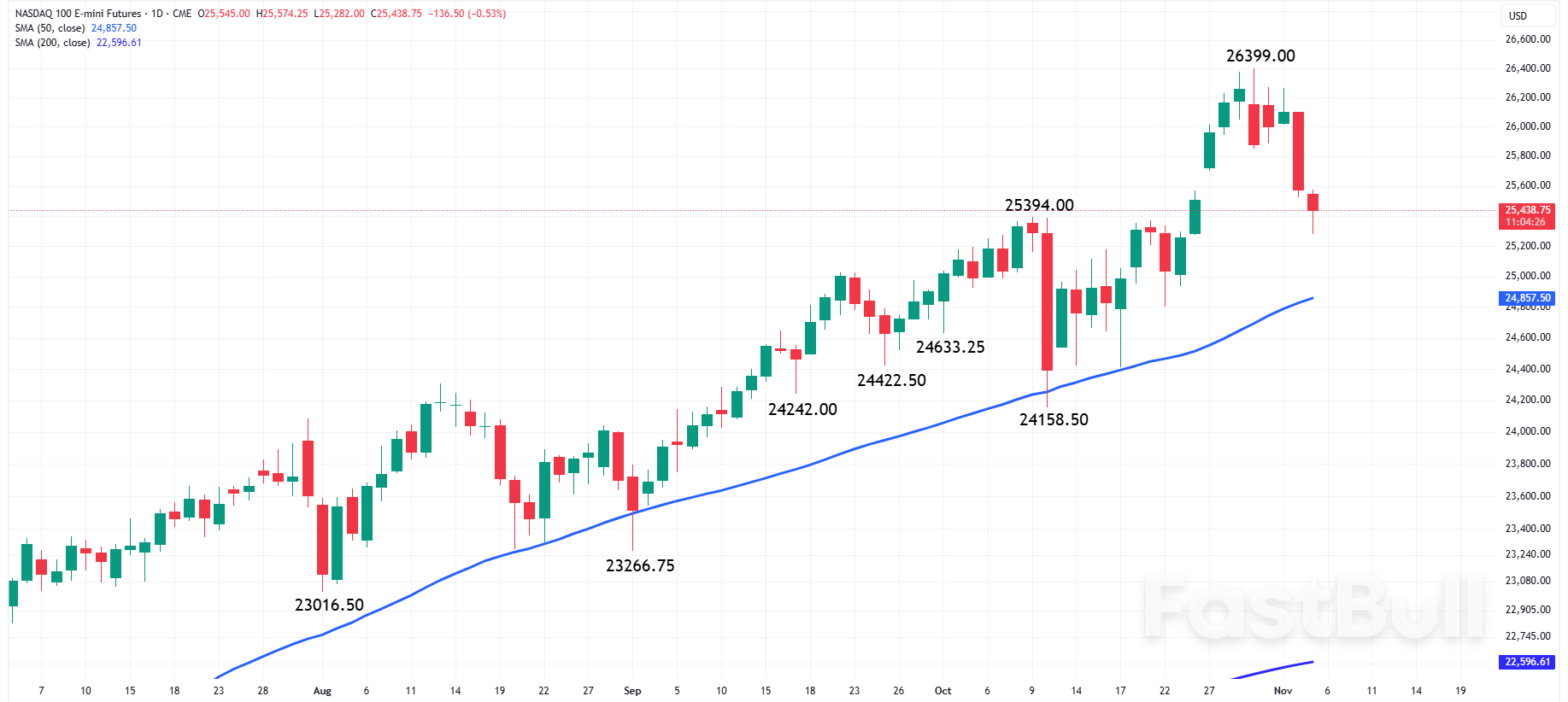 Daily E-mini Nasdaq 100 Index Futures
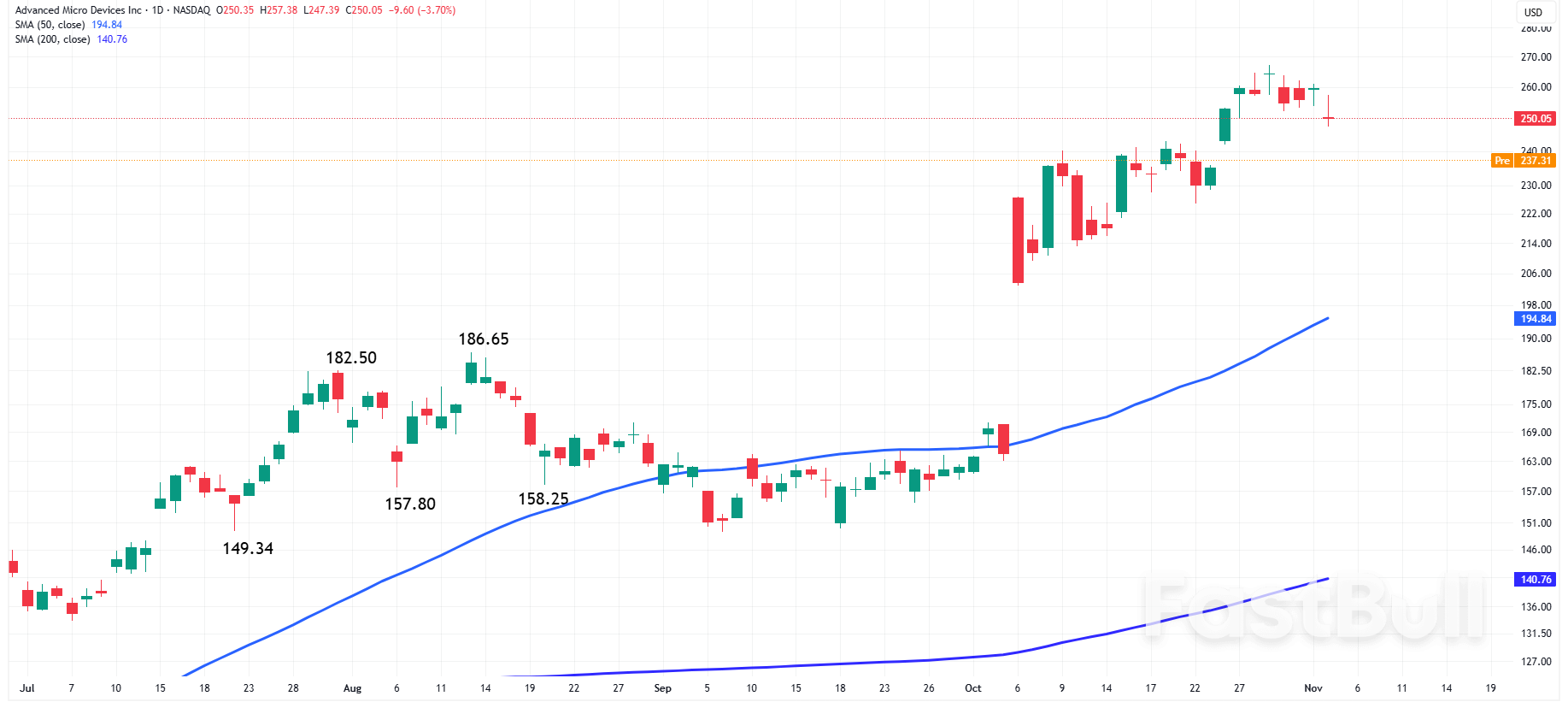 Daily Advanced Micro Devices (AMD)