• Trade
  • Markets
  • Copy
  • Contests
  • News
  • 24/7
  • Calendar
  • Q&A
  • Chats
Trending
Screeners
SYMBOL
LAST
BID
ASK
HIGH
LOW
NET CHG.
%CHG.
SPREAD
SPX
S&P 500 Index
6857.13
6857.13
6857.13
6865.94
6827.13
+7.41
+ 0.11%
--
DJI
Dow Jones Industrial Average
47850.93
47850.93
47850.93
48049.72
47692.96
-31.96
-0.07%
--
IXIC
NASDAQ Composite Index
23505.13
23505.13
23505.13
23528.53
23372.33
+51.04
+ 0.22%
--
USDX
US Dollar Index
98.850
98.930
98.850
98.980
98.740
-0.130
-0.13%
--
EURUSD
Euro / US Dollar
1.16586
1.16594
1.16586
1.16715
1.16408
+0.00141
+ 0.12%
--
GBPUSD
Pound Sterling / US Dollar
1.33517
1.33525
1.33517
1.33622
1.33165
+0.00246
+ 0.18%
--
XAUUSD
Gold / US Dollar
4223.04
4223.47
4223.04
4230.62
4194.54
+15.87
+ 0.38%
--
WTI
Light Sweet Crude Oil
59.334
59.364
59.334
59.480
59.187
-0.049
-0.08%
--

Community Accounts

Signal Accounts
--
Profit Accounts
--
Loss Accounts
--
View More

Become a signal provider

Sell trading signals to earn additional income

View More

Guide to Copy Trading

Get started with ease and confidence

View More

Signal Accounts for Members

All Signal Accounts

Best Return
  • Best Return
  • Best P/L
  • Best MDD
Past 1W
  • Past 1W
  • Past 1M
  • Past 1Y

All Contests

  • All
  • Trump Updates
  • Recommend
  • Stocks
  • Cryptocurrencies
  • Central Banks
  • Featured News
Top News Only
Share

Amd Chief Says Company Ready To Pay 15% Tax On Ai Chip Shipments To China

Share

Kremlin Aide Ushakov Says USA Kushner Is Working Very Actively On Ukrainian Settlement

Share

Norway To Acquire 2 More Submarines, Long-Range Missiles, Daily Vg Reports

Share

Ucb Sa Shares Open Up 7.3% After 2025 Guidance Upgrade, Top Of Bel 20 Index

Share

Shares In Italy's Mediobanca Down 1.3% After Barclays Cuts To Underweight From Equal-Weight

Share

Stats Office - Austrian November Wholesale Prices +0.9% Year-On-Year

Share

Britain's FTSE 100 Up 0.15%

Share

Europe's STOXX 600 Up 0.1%

Share

Taiwan November PPI -2.8% Year-On-Year

Share

Stats Office - Austrian September Trade -230.8 Million EUR

Share

Swiss National Bank Forex Reserves Revised To Chf 724906 Million At End Of October - SNB

Share

Swiss National Bank Forex Reserves At Chf 727386 Million At End Of November - SNB

Share

Shanghai Warehouse Rubber Stocks Up 8.54% From Week Earlier

Share

Turkey's Main Banking Index Up 2%

Share

French October Trade Balance -3.92 Billion Euros Versus Revised -6.35 Billion Euros In September

Share

Kremlin Aide Says Russia Is Ready To Work Further With Current USA Team

Share

Kremlin Aide Says Russia And USA Are Moving Forward In Ukraine Talks

Share

Shanghai Rubber Warehouse Stocks Up 7336 Tons

Share

Shanghai Tin Warehouse Stocks Up 506 Tons

Share

Reserve Bank Of India Chief Malhotra: Goal Is To Have Inflation Be Around 4%

TIME
ACT
FCST
PREV
France 10-Year OAT Auction Avg. Yield

A:--

F: --

P: --

Euro Zone Retail Sales MoM (Oct)

A:--

F: --

P: --

Euro Zone Retail Sales YoY (Oct)

A:--

F: --

P: --

Brazil GDP YoY (Q3)

A:--

F: --

P: --

U.S. Challenger Job Cuts (Nov)

A:--

F: --

P: --

U.S. Challenger Job Cuts MoM (Nov)

A:--

F: --

P: --

U.S. Challenger Job Cuts YoY (Nov)

A:--

F: --

P: --

U.S. Initial Jobless Claims 4-Week Avg. (SA)

A:--

F: --

P: --

U.S. Weekly Initial Jobless Claims (SA)

A:--

F: --

P: --

U.S. Weekly Continued Jobless Claims (SA)

A:--

F: --

P: --

Canada Ivey PMI (SA) (Nov)

A:--

F: --

P: --

Canada Ivey PMI (Not SA) (Nov)

A:--

F: --

P: --

U.S. Non-Defense Capital Durable Goods Orders Revised MoM (Excl. Aircraft) (SA) (Sept)

A:--

F: --

P: --
U.S. Factory Orders MoM (Excl. Transport) (Sept)

A:--

F: --

P: --

U.S. Factory Orders MoM (Sept)

A:--

F: --

P: --

U.S. Factory Orders MoM (Excl. Defense) (Sept)

A:--

F: --

P: --

U.S. EIA Weekly Natural Gas Stocks Change

A:--

F: --

P: --

Saudi Arabia Crude Oil Production

A:--

F: --

P: --

U.S. Weekly Treasuries Held by Foreign Central Banks

A:--

F: --

P: --

Japan Foreign Exchange Reserves (Nov)

A:--

F: --

P: --

India Repo Rate

A:--

F: --

P: --

India Benchmark Interest Rate

A:--

F: --

P: --

India Reverse Repo Rate

A:--

F: --

P: --

India Cash Reserve Ratio

A:--

F: --

P: --

Japan Leading Indicators Prelim (Oct)

A:--

F: --

P: --

U.K. Halifax House Price Index YoY (SA) (Nov)

A:--

F: --

P: --

U.K. Halifax House Price Index MoM (SA) (Nov)

A:--

F: --

P: --

France Current Account (Not SA) (Oct)

A:--

F: --

P: --

France Trade Balance (SA) (Oct)

A:--

F: --

P: --

France Industrial Output MoM (SA) (Oct)

A:--

F: --

P: --

Italy Retail Sales MoM (SA) (Oct)

--

F: --

P: --

Euro Zone Employment YoY (SA) (Q3)

--

F: --

P: --

Euro Zone GDP Final YoY (Q3)

--

F: --

P: --

Euro Zone GDP Final QoQ (Q3)

--

F: --

P: --

Euro Zone Employment Final QoQ (SA) (Q3)

--

F: --

P: --

Euro Zone Employment Final (SA) (Q3)

--

F: --

P: --
Brazil PPI MoM (Oct)

--

F: --

P: --

Mexico Consumer Confidence Index (Nov)

--

F: --

P: --

Canada Unemployment Rate (SA) (Nov)

--

F: --

P: --

Canada Labor Force Participation Rate (SA) (Nov)

--

F: --

P: --

Canada Employment (SA) (Nov)

--

F: --

P: --

Canada Part-Time Employment (SA) (Nov)

--

F: --

P: --

Canada Full-time Employment (SA) (Nov)

--

F: --

P: --

U.S. Personal Income MoM (Sept)

--

F: --

P: --

U.S. Dallas Fed PCE Price Index YoY (Sept)

--

F: --

P: --

U.S. PCE Price Index YoY (SA) (Sept)

--

F: --

P: --

U.S. PCE Price Index MoM (Sept)

--

F: --

P: --

U.S. Personal Outlays MoM (SA) (Sept)

--

F: --

P: --

U.S. Core PCE Price Index MoM (Sept)

--

F: --

P: --

U.S. UMich 5-Year-Ahead Inflation Expectations Prelim YoY (Dec)

--

F: --

P: --

U.S. Core PCE Price Index YoY (Sept)

--

F: --

P: --

U.S. Real Personal Consumption Expenditures MoM (Sept)

--

F: --

P: --

U.S. 5-10 Year-Ahead Inflation Expectations (Dec)

--

F: --

P: --

U.S. UMich Current Economic Conditions Index Prelim (Dec)

--

F: --

P: --

U.S. UMich Consumer Sentiment Index Prelim (Dec)

--

F: --

P: --

U.S. UMich 1-Year-Ahead Inflation Expectations Prelim (Dec)

--

F: --

P: --

U.S. UMich Consumer Expectations Index Prelim (Dec)

--

F: --

P: --

U.S. Weekly Total Rig Count

--

F: --

P: --

U.S. Weekly Total Oil Rig Count

--

F: --

P: --

U.S. Consumer Credit (SA) (Oct)

--

F: --

P: --

Q&A with Experts
    • All
    • Chatrooms
    • Groups
    • Friends
    Connecting
    .
    .
    .
    Type here...
    Add Symbol or Code

      No matching data

      All
      Trump Updates
      Recommend
      Stocks
      Cryptocurrencies
      Central Banks
      Featured News
      • All
      • Russia-Ukraine Conflict
      • Middle East Flashpoint
      • All
      • Russia-Ukraine Conflict
      • Middle East Flashpoint

      Search
      Products

      Charts Free Forever

      Chats Q&A with Experts
      Screeners Economic Calendar Data Tools
      Membership Features
      Data Warehouse Market Trends Institutional Data Policy Rates Macro

      Market Trends

      Market Sentiment Order Book Forex Correlations

      Top Indicators

      Charts Free Forever
      Markets

      News

      News Analysis 24/7 Columns Education
      From Institutions From Analysts
      Topics Columnists

      Latest Views

      Latest Views

      Trending Topics

      Top Columnists

      Latest Update

      Signals

      Copy Rankings Latest Signals Become a signal provider AI Rating
      Contests
      Brokers

      Overview Brokers Assessment Rankings Regulators News Claims
      Broker listing Forex Brokers Comparison Tool Live Spread Comparison Scam
      Q&A Complaint Scam Alert Videos Tips to Detect Scam
      More

      Business
      Events
      Careers About Us Advertising Help Center

      White Label

      Data API

      Web Plug-ins

      Affiliate Program

      Awards Institution Evaluation IB Seminar Salon Event Exhibition
      Vietnam Thailand Singapore Dubai
      Fans Party Investment Sharing Session
      FastBull Summit BrokersView Expo
      Recent Searches
        Top Searches
          Markets
          News
          Analysis
          User
          24/7
          Economic Calendar
          Education
          Data
          • Names
          • Latest
          • Prev

          View All

          No data

          Scan to Download

          Faster Charts, Chat Faster!

          Download App
          English
          • English
          • Español
          • العربية
          • Bahasa Indonesia
          • Bahasa Melayu
          • Tiếng Việt
          • ภาษาไทย
          • Français
          • Italiano
          • Türkçe
          • Русский язык
          • 简中
          • 繁中
          Open Account
          Search
          Products
          Charts Free Forever
          Markets
          News
          Signals

          Copy Rankings Latest Signals Become a signal provider AI Rating
          Contests
          Brokers

          Overview Brokers Assessment Rankings Regulators News Claims
          Broker listing Forex Brokers Comparison Tool Live Spread Comparison Scam
          Q&A Complaint Scam Alert Videos Tips to Detect Scam
          More

          Business
          Events
          Careers About Us Advertising Help Center

          White Label

          Data API

          Web Plug-ins

          Affiliate Program

          Awards Institution Evaluation IB Seminar Salon Event Exhibition
          Vietnam Thailand Singapore Dubai
          Fans Party Investment Sharing Session
          FastBull Summit BrokersView Expo

          HCOB Eurozone Manufacturing PMI

          S&P Global Inc.

          Forex

          Economic

          Summary:

          HCOB Eurozone Manufacturing PMI at 49.8 (Jun: 49.5). 36-month high.
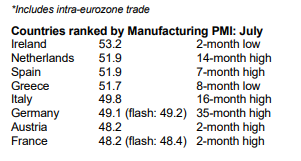
          Eurozone manufacturing output rises marginally again in July

          Key findings:
          ● HCOB Eurozone Manufacturing PMI at 49.8 (Jun: 49.5). 36-month high.
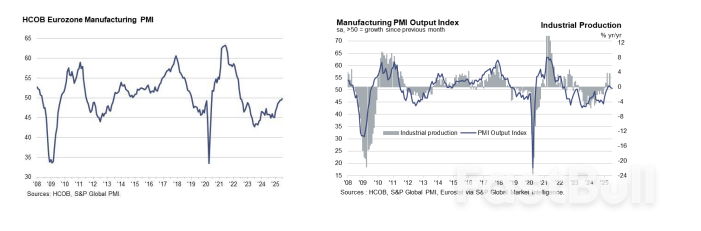
          ● HCOB Eurozone Manufacturing PMI Output Index at 50.6 (Jun: 50.8). 4-month low.
          ● Production volumes tick up despite marginal decrease in new orders
          Data were collected 10-24 July
          The euro area manufacturing sector recorded a broad stabilisation of operating conditions at the start of the third quarter.Output growth was sustained, although the upturn was the softest since March, while new orders saw a fresh (albeit marginal)reduction amid a deterioration in export* demand. Positively, factory job shedding cooled to its least pronounced in almost twoyears.As for prices, input costs were unchanged and this was practically true for output charges too. There was a slight easing inyear-ahead growth expectations, although forecasts remained slightly above their long-term average.
          The HCOB Eurozone Manufacturing PMI®, a measure of the overall health of eurozone factories compiled by S&P Global,edged up to a three-year high of 49.8 in July, from 49.5 in June. Posting only just below the 50.0 threshold, the latest figureindicated a near-stabilisation of operating conditions across the eurozone goods-producing sector.Of the euro area countries with Manufacturing PMI data available, Ireland had the strongest-performing factories in July, withgrowth slowing but remaining solid overall. Meanwhile, there were pick-ups in momentum across both the Netherlands andSpain, posting their fastest expansions in 14 and seven months, respectively. Greece continued its growth trend in July,extending the current sequence to two-and-a-half years. In the remaining countries, Manufacturing PMI prints rose butremained below the crucial 50.0 mark, signalling sustained but slower deteriorations on the month. Both Germany and Francesaw fractional increases in the headline PMI since June, with the former hitting its highest mark in close to three years. As forFrance, its manufacturing sector was tied with Austria as the worst-performing at the start of the third quarter.
          The eurozone as a whole saw factory production levels rise in July, marking five successive monthly expansions. The increaseslowed slightly from June, however, and was the softest since March. Weighing on output was a fresh decline in new business.The deterioration in demand was small, but nevertheless the quickest in four months. Export sales were a drag on total ordervolumes, latest survey data revealed, with new work received from international clients falling after stabilising in the previousmonth.Meanwhile, eurozone manufacturers dampened their retrenchment efforts in the latest survey period. Both input purchasing andemployment moved closer to stabilisation during July, posting their slowest reductions in 37 and 23 months, respectively.July survey data pointed to a slight intensification of supply chain pressures as average input lead times lengthened for asecond month in a row and to the greatest extent since November 2022. At the same time, pre- and post-production stockscontinued to decrease, although rates of depletion softened.
          The eurozone manufacturing sector registered stable prices during July. Input costs were unchanged, following three months ofdeclines, while prices charged saw virtually no movement.Looking ahead, eurozone goods producers remained optimistic of growth over the next 12 months. In fact, the overall level ofoptimism was just above its long-term average despite falling from June’s 40-month high.
          HCOB Eurozone Manufacturing PMI_1

          Comment

          Commenting on the PMI data, Dr. Cyrus de la Rubia, Chief Economist at Hamburg Commercial Bank, said:
          “Manufacturing in the eurozone is cautiously regaining momentum. It is primarily the smaller economies that offer reasonsfor optimism. The PMIs from Spain and the Netherlands indicate accelerated economic growth, while Ireland and Greeceremain in expansion territory. In the three largest economies as well as Austria, the PMI signals that the industrial recessionhas significantly eased. This broadens the scope of the recovery. With the newly agreed trade framework between the EUand the U.S., uncertainty should decline, and the signs point to a continued upward trend in the coming months.
          “France is currently the biggest drag on growth in the eurozone’s manufacturing sector. It is particularly discouraging thatproduction in France has declined over the past two months, while employment has slightly increased during the sameperiod. The problem lies in the resulting drop in productivity, which makes economic growth even harder to achieve. InGermany, the situation is reversed: production is growing while employment is being reduced. France is also burdened bythe prospect of an austerity budget and the associated risk of the current government stepping down. This contrasts withGermany, where much of the growth hopes rest on expansionary fiscal policy and the political situation is significantly morestable than in France. Less political and fiscal uncertainty in the eurozone’s second-largest economy would be important tohelp the eurozone manufacturing sector achieve sustainable growth overall.
          “Supply chains remain relatively strained. Delivery times have lengthened. Given the fragility of the recovery, it is notdemand that is causing customers to wait longer for their goods. Volatile U.S. tariff policies and uncertainty stemming fromgeopolitical tensions may play a key role here. We expect that companies will continue to face sudden supply chaindisruptions for the foreseeable future.”
          HCOB Eurozone Manufacturing PMI_2

          Source:S&P Global

          To stay updated on all economic events of today, please check out our Economic calendar
          Risk Warnings and Disclaimers
          You understand and acknowledge that there is a high degree of risk involved in trading. Following any strategies or investment methods may lead to potential losses. The content on the site is provided by our contributors and analysts for information purposes only. You are solely responsible for determining whether any trading assets, securities, strategy, or any other product is suitable for investing based on your own investment objectives and financial situation.
          Add to Favorites
          Share

          Euro Zone Manufacturing Approached Stability In July As PMI Hits Three-Year High

          Glendon

          Economic

          Forex

          Euro zone manufacturing moved closer to stabilization in July as factory activity contracted at its slowest pace in three years, despite a dip in new orders and slower output growth, a survey showed.

          The HCOB Eurozone Manufacturing Purchasing Managers' Index, compiled by S&P Global, edged up to 49.8 in July from 49.5 in June, reaching its highest level since July 2021.

          That matched a preliminary estimate and was only a whisker away from the 50.0 mark separating growth from contraction.

          Factory output grew for the fifth consecutive month but at a slower pace with the output index easing to 50.6 from 50.8, marking a four-month low.

          "Manufacturing in the euro zone is cautiously regaining momentum. With the newly agreed trade framework between the EU and the U.S., uncertainty should decline, and the signs point to a continued upward trend in the coming months," said Cyrus de la Rubia, chief economist at Hamburg Commercial Bank.

          The U.S. struck a framework trade agreement with the European Union on Sunday, imposing a 15% import tariff on most EU goods.

          Germany, Europe's largest economy, saw its manufacturing PMI rise to a 35-month high of 49.1, though still indicating contraction. France and Austria tied as the worst performers with identical readings of 48.2.

          Among euro zone countries, Ireland led manufacturing performance with a PMI of 53.2 although this represented a two-month low. The Netherlands and Spain both recorded 51.9, marking 14-month and seven-month highs respectively. Greece maintained its growth streak at 51.7.

          New orders declined marginally as export sales proved a drag following their brief stabilisation in June.

          Price pressures remained largely absent in July, with input costs unchanged following three months of declines, while output prices showed virtually no movement.

          The European Central Bank left interest rates unchanged last week and offered a modestly upbeat assessment of the currency union's economy.

          Business confidence regarding future output remained above the long-term average in July, though it retreated from June's 40-month high, suggesting manufacturers maintain a cautiously optimistic outlook for the year ahead.

          Source: Yahoo Finance

          To stay updated on all economic events of today, please check out our Economic calendar
          Risk Warnings and Disclaimers
          You understand and acknowledge that there is a high degree of risk involved in trading. Following any strategies or investment methods may lead to potential losses. The content on the site is provided by our contributors and analysts for information purposes only. You are solely responsible for determining whether any trading assets, securities, strategy, or any other product is suitable for investing based on your own investment objectives and financial situation.
          Add to Favorites
          Share

          Gold Set For Third Weekly Loss Amid Stronger Dollar, Reduced Fed Rate Cut Hopes

          Samantha Luan

          Commodity

          Forex

          Key points:

          ● Trump hits dozens of countries with steep tariffs
          ● US dollar index hovers near two-month high
          ● Silver, platinum, palladium set for weekly losses

          Gold prices held steady on Friday, but is poised for a third consecutive weekly loss pressured by a stronger dollar and diminished expectations for U.S. rate cuts, while uncertainty from U.S. tariffs on trading partners offered support.Spot goldwas steady at $3,288.89 per ounce, as of 0733 GMT. Bullion is down 1.4% so far this week.U.S. gold futuresedged down 0.3% to $3,339.90.The dollar indexhit its highest level since May 29, making gold more expensive for other currency holders.

          "Gold remains weighed by reduced bets for Fed rate cuts for the rest of 2025. This week's U.S. GDP, weekly jobless claims, and PCE figures also shored up the Fed's reluctance to commit to a rate cut," said Han Tan, chief market analyst at Nemo.Money.Fed held rates steady in the 4.25%-4.50% range on Wednesday and dampened expectations for a September rate cut.U.S. President Donald Trump slapped steep tariffs on exports from dozens of trading partners, including Canada, Brazil, India and Taiwan, pressing ahead with his plans to reorder the global economy ahead of a Friday trade deal deadline.

          "The precious metal should, however, remain supported amid the still-uncertain impact from U.S. tariffs on global economic growth," Tan said.U.S. inflation increased in June as tariffs on imports started raising the cost of some goods.Focus now shifts to U.S. jobs data, due later on Friday, as investors assess the Federal Reserve's policy trajectory, with July job growth expected to have slowed and the unemployment rate projected to rise to 4.2%.

          Gold, often considered a safe-haven asset during economic uncertainties, tends to perform well in a low-interest-rate environment.Physical gold demand in key Asian markets improved slightly this week as a pullback in prices sparked buying interest, though volatility kept some buyers cautious.Spot silverfell 0.7% to $36.50 per ounce, platinumlost 0.8% at $1,278.40 and palladiumwas down 0.2% to $1,188.28. All three metals were headed for weekly losses.

          Source: TradingView

          Risk Warnings and Disclaimers
          You understand and acknowledge that there is a high degree of risk involved in trading. Following any strategies or investment methods may lead to potential losses. The content on the site is provided by our contributors and analysts for information purposes only. You are solely responsible for determining whether any trading assets, securities, strategy, or any other product is suitable for investing based on your own investment objectives and financial situation.
          Add to Favorites
          Share

          Asian Markets Slide as Trump Tariff Bombshell Rattles Global Trade Outlook

          Gerik

          Economic

          Tariff Shock Sparks Sell-Off Across Asia

          Friday’s session saw widespread weakness across Asian equities after President Trump unexpectedly reinstated and expanded tariffs on dozens of countries, including key trade partners in Europe and Asia. The Nikkei 225 lost 0.4%, while the Kospi plunged 2.8%, reflecting South Korea’s acute vulnerability given its export-heavy economy and recent manufacturing slowdown.
          Markets across the region followed suit. Australia’s ASX 200 dropped 0.8%, the Hang Seng Index shed 0.2%, and Taiwan’s TAIEX fell 0.4%. The Shanghai Composite slipped 0.1%, despite China's efforts to cushion economic softness. India’s Sensex also declined 0.4% as investors weighed the prospect of higher input costs and reduced export competitiveness.

          ‘Imperial Trade’ and Regional Fallout

          Strategists voiced concern about the long-term implications of the U.S. trade move. Benjamin Picton of Rabobank warned of “imperial trade,” arguing that the U.S. is cherry-picking global markets to its own advantage by demanding preferential access while protecting high-value industries domestically.
          Mizuho Bank analysts noted an unexpected shift Southeast Asia, previously hurt by the "Liberation Day" tariff measures, may now stand to gain from relative tariff advantages compared to harder-hit economies such as Japan and South Korea. However, they cautioned that intra-regional tariff disparities are still narrow and the overall impact remains uncertain.

          Wall Street Reactions and Healthcare Drag

          U.S. equities mirrored the turbulence, with the S&P 500 falling for the third consecutive session down 0.4%. The Dow dropped 0.7% and the Nasdaq barely moved, finishing slightly lower. Healthcare stocks bore the brunt after the White House demanded that pharmaceutical companies cut prices within 60 days, sending shares of major players like UnitedHealth and Bristol-Myers sharply lower.
          Despite the pullback, gains from Big Tech offered some support. Meta surged over 11% after surpassing earnings expectations, while Microsoft added 3.9% on robust Azure cloud performance and AI momentum.

          Currency and Oil Markets React Cautiously

          The U.S. dollar edged higher to 150.68 yen, reflecting safe-haven demand, while the euro remained relatively steady at $1.1418. In the commodity space, oil prices paused their rally, with WTI slipping to $69.21 and Brent to $71.67 as traders digested Trump’s tariff order and its implications for global demand.
          Trump’s aggressive tariff escalation has reintroduced volatility into global markets, particularly in Asia, where export-driven economies are most exposed. As trade partners prepare retaliatory measures and central banks reconsider policy paths, the coming weeks are likely to see heightened market sensitivity to geopolitical developments.

          Source: Reuters

          To stay updated on all economic events of today, please check out our Economic calendar
          Risk Warnings and Disclaimers
          You understand and acknowledge that there is a high degree of risk involved in trading. Following any strategies or investment methods may lead to potential losses. The content on the site is provided by our contributors and analysts for information purposes only. You are solely responsible for determining whether any trading assets, securities, strategy, or any other product is suitable for investing based on your own investment objectives and financial situation.
          Add to Favorites
          Share

          UK House Prices Rebound With 0.6% Gain In July

          Daniel Carter

          Economic

          UK house prices bounced back in July in a sign demand is recovering after a tax increase in April discouraged prospective homebuyers, according to one of Britain's largest mortgage lenders.
          Nationwide Building Society said the average price of a home rose 0.6% to £272,664 ($359,980) following a 0.9% fall the month before. The increase was the strongest since December and larger than the 0.5% economists surveyed by Bloomberg had expected.
          The housing market is showing signs of stabilizing after a surge in transactions ahead of an increase in stamp-duty taxes turned into a sharp slow down once the higher rates took effect. Strong wage gains and easing mortgage rates are helping lure buyers back to market. However, headwinds remain from fears of job losses and tax rises, while buyers have a plentiful supply of properties to choose from.
          "Looking through the volatility generated by the end of the stamp duty holiday, activity appears to be holding up well," said Robert Gardner, Nationwide's chief economist. "Despite wider economic uncertainties in the global economy, underlying conditions for potential home buyers in the UK remain supportive."
          Mortgage approvals data provided further signs that the market is stabilizing. The number of UK home loans given the green light rose to a three-month high in June, according to Bank of England figures published Tuesday.

          Source: Bloomberg Europe

          To stay updated on all economic events of today, please check out our Economic calendar
          Risk Warnings and Disclaimers
          You understand and acknowledge that there is a high degree of risk involved in trading. Following any strategies or investment methods may lead to potential losses. The content on the site is provided by our contributors and analysts for information purposes only. You are solely responsible for determining whether any trading assets, securities, strategy, or any other product is suitable for investing based on your own investment objectives and financial situation.
          Add to Favorites
          Share

          Trade War Intensifies, Jobs and Inflation Data Drive Policy Decisions

          FastBull Featured

          Daily News

          [Quick Facts]

          1. Japan's job market remains tight in June, putting pressure on companies to raise wages.
          2. Most of Trump's tariffs face serious legal challenges.
          3. Trump writes to 17 global pharmaceutical giants, urging sharp cuts in U.S. drug prices.
          4. Brazilian President: Will stand firm whether U.S. wants a political fight or trade talks.
          5. Gaza Ceasefire Talks on the brink of collapse as Israel considers expanding military operations.
          6. U.S. announces 50% tariffs on imported copper products, NYMEX Copper Futures plunge 20%.
          7. U.S. labor and inflation data support Fed's decision to hold rates steady.
          8. Trump says U.S.-Mexico Tariff Deal extended by 90 days.

          [News Details]

          Japan's job market remains tight in June, putting pressure on companies to raise wages
          Japan's job market remains relatively tight, and policymakers are seeking to stimulate demand to drive economic growth, which is putting pressure on companies to increase wages. Data released by the Japanese government on Friday showed that the unemployment rate in June was 2.5%, unchanged from the previous month. Meanwhile, the ratio of job openings to job seekers edged down slightly from 1.24 to 1.22, meaning there were 122 job openings for every 100 job seekers. Economists had expected the ratio to be 1.25. Earlier this year, persistent labor shortages forced major Japanese companies to commit to wage increases of over 5% during annual negotiations with labor unions, marking the largest pay raise in more than three decades. The Bank of Japan is still monitoring whether these wage hikes will sustainably boost personal consumption. Adjusted for inflation, household spending in May rose 4.7% year-on-year, the biggest increase in nearly three years. However, whether this momentum will continue depends on whether wage growth outpaces inflation. June wage data will be released next Wednesday, and based on past records, most of the recent wage increases are likely to be reflected in June's figures.
          Most of Trump's tariffs face serious legal challenges
          The legality of U.S. President Donald Trump's broad imposition of global tariffs is being tested. A federal appeals court held a hearing on Thursday, just one day before higher tariffs on multiple countries were set to take effect. A panel of 11 judges took turns questioning a senior official from the U.S. Department of Justice, focusing on the Trump administration's claim that the persistent U.S. trade deficit constitutes a national emergency, allowing the president to bypass Congress and impose tariffs on multiple countries worldwide. Brett Shumate, head of the Civil Division at the Department of Justice, stated during the hearing that Trump's tariff policy aims to address the consequences of our widening trade deficit and to pressure other countries. He added that Trump determined the trade deficit had reached a critical point.
          Trump writes to 17 global pharmaceutical giants, urging sharp cuts in U.S. drug prices
          U.S. President Donald Trump sent letters to 17 of the world's largest pharmaceutical companies, including Eli Lilly, Novo Nordisk, and Pfizer, urging them to cut the prices of new drugs in the U.S. to the lowest levels paid in certain other countries. Trump demanded that the companies immediately lower existing drug prices charged to Medicaid and ensure that future drug launches are priced comparably to overseas markets. He said the U.S. government would work with them to ensure that any price increases overseas are matched domestically. Any gains companies make from price hikes in Europe and other regions must be passed on to the U.S. to reduce domestic costs.
          Brazilian President: Will stand firm whether the U.S. wants a political fight or trade talks
          The U.S. government had previously threatened to impose high tariffs on trade partners that fail to reach trade agreements with the U.S., starting on August 1st. As the deadline approaches, Brazil and India have stated they will not yield to U.S. pressure and will take all necessary measures to protect their national interests. Earlier, the U.S. announced a 50% tariff on imports from Brazil starting August 1st. On July 30th, The New York Times published an interview with Brazilian President Luiz Inácio Lula da Silva, in which he said he had tried to contact U.S. President Donald Trump but found no willingness on the latter's part to discuss the tariff issue. "There's no reason to be afraid," he continued. "I am worried, obviously, because we have economic interests, political interests, technological interests. But at no point will Brazil negotiate as if it were a small country up against a big country. Brazil will negotiate as a sovereign country."
          Gaza Ceasefire Talks on the brink of collapse as Israel considers expanding military operations
          Israeli Prime Minister Benjamin Netanyahu met on July 31st with visiting U.S. Middle East envoy Steve Witkoff. Israeli media subsequently reported that Israel believes Gaza ceasefire talks are on the verge of collapse and is considering expanding military operations to achieve the demilitarization of Gaza.
          According to Israeli media, Netanyahu and Witkoff discussed the matter for nearly three hours. A senior Israeli official told Hebrew-language outlets, including Israel Hayom and the Walla news site, that given Hamas's stance and the near-collapse of ceasefire negotiations, both Israel and the U.S. agreed to abandon efforts to secure a short-term truce or the release of some hostages. Instead, they would pursue a comprehensive deal: disarming Hamas, demilitarizing Gaza, and securing the release of all hostages. The official also noted that Hamas had cut off communication channels.
          U.S. announces 50% tariffs on imported copper products, NYMEX Copper Futures plunge 20%
          According to a fact sheet published by the White House on July 30 (local time), U.S. President Donald Trump signed a proclamation imposing a uniform 50% tariff on imported copper semis and high-copper-content derivatives starting August 1st. On the same day, copper futures on the New York Mercantile Exchange (NYMEX) plummeted by 20% in a single day. U.S. media analysts described the decision as yet another major shock to the copper market from the U.S. government. Earlier this year, when Trump first hinted at potential tariffs, U.S. copper prices surged sharply, sparking a rush to ship copper to the U.S. to avoid the duties. In July, Trump's announcement of a 50% tariff, which was double market expectations, drove copper prices to record highs.
          U.S. labor and inflation data support Fed's decision to hold rates steady
          The latest U.S. labor and inflation data support the Fed's decision to hold interest rates, though U.S. Treasury yields struggled to recover from overnight losses. The year-over-year growth in the core PCE price index accelerated to 2.6% in June from 2.4% in May. Meanwhile, initial jobless claims rose slightly to 218,000 from 217,000 the previous week. In other words, inflation remains above the Fed's target, and the labor market has not weakened significantly. As expected, the Fed left interest rates unchanged yesterday, with Chairman Jerome Powell stating that incoming data would guide the central bank's next decision in September. CME data shows a 61% probability of another rate hold. The 10-year Treasury yield stands at 4.347%, while the 2-year yield is at 3.938%.
          Trump says U.S.-Mexico Tariff Deal extended by 90 days
          On July 31 (local time), U.S. President Donald Trump announced on his social media platform "Truth Social" that he had just spoken with Mexican President Andrés Manuel López Obrador by phone. Trump noted that the complexity of reaching an agreement with Mexico differed from deals with other countries, but both sides agreed to extend their current arrangement for 90 days. He added that the "exact same Deal as we had" with Mexico will be extended during that time, which includes a "25% Fentanyl Tariff, 25% Tariff on Cars, and 50% Tariff on Steel, Aluminum, and Copper." Additionally, Mexico agreed to immediately remove many of the non-tariff trade barriers it had imposed. Over the next 90 days, the U.S. will engage in consultations with Mexico, aiming to finalize a comprehensive trade agreement within that timeframe or possibly longer. Both countries will continue cooperating on all aspects of border security, including drug trafficking, drug distribution, and illegal immigration.

          [Today's Focus]

          UTC+8 17:00 Eurozone July CPI (Flash)
          UTC+8 20:30 U.S. July Nonfarm Payrolls
          UTC+8 22:00 U.S. July ISM Manufacturing PMI
          Pending U.S. "Reciprocal Tariffs" Take Effect; 50% Import Tariff on Copper Begins
          Pending Hong Kong's "Stablecoin Bill" Comes into Force
          Risk Warnings and Disclaimers
          You understand and acknowledge that there is a high degree of risk involved in trading. Following any strategies or investment methods may lead to potential losses. The content on the site is provided by our contributors and analysts for information purposes only. You are solely responsible for determining whether any trading assets, securities, strategy, or any other product is suitable for investing based on your own investment objectives and financial situation.
          Add to Favorites
          Share

          Oil Rises on Tariff Tensions and Russian Pressure Amid Supply Uncertainty

          Gerik

          Economic

          Commodity

          Tariffs and Russia Threats Drive Oil Momentum

          West Texas Intermediate (WTI) crude has held steady above $69 per barrel, while Brent hovered close to $72, both eyeing their strongest weekly performance since the April conflict flare-up between Israel and Iran. The catalyst behind this week’s rally stems from President Donald Trump’s latest policy moves most notably, escalating economic pressure on Russia and imposing sweeping tariffs on multiple countries, with direct implications for global oil trade.
          Trump has threatened Moscow with further economic sanctions unless there is rapid de-escalation in Ukraine, while also singling out India for its continued purchase of Russian crude. These geopolitical pressures have triggered concerns about disruptions in Russian oil exports especially to Asia and have added a risk premium to prices.

          India Caught in Crosshairs

          India, which has imported more than a third of its oil from Russia this year, now faces a 25% U.S. tariff under Trump's latest executive order. Although oil remains exempt under the USMCA trade pact when it comes to Canada and Mexico, India's reliance on discounted Russian crude has drawn criticism from Washington.
          Reacting to the threat, Indian state-run refiners have reportedly begun scenario planning for sourcing non-Russian supplies. While this is not yet a formal shift, such adjustments could increase demand for Middle Eastern or U.S. crude, tightening global supply in the medium term.

          Market Eyes Retaliation and Supply Realignment

          The new tariff framework includes a 10% global minimum, while Canada faces a hike from 25% to 35% though oil is exempt under USMCA. However, the broader economic strain on key trade partners and the possibility of retaliatory tariffs are creating uncertainty for global demand forecasts.
          Still, the oil market has proven resilient, buoyed by the notion that supply disruptions or politically motivated adjustments could offset any short-term decline in consumption. Traders are now monitoring whether countries like India will pivot away from Russian barrels, and whether Russia might retaliate by withholding supply or rerouting exports.
          Despite broader market jitters around global trade tensions, oil has found support from escalating geopolitical risk. With Trump tightening the noose on Russia and reshaping global trade patterns, the market is pricing in potential supply reallocation and future shortages. As long as tensions remain elevated and retaliatory measures loom, oil prices are likely to retain a risk premium heading into next week.

          Source: Reuters

          To stay updated on all economic events of today, please check out our Economic calendar
          Risk Warnings and Disclaimers
          You understand and acknowledge that there is a high degree of risk involved in trading. Following any strategies or investment methods may lead to potential losses. The content on the site is provided by our contributors and analysts for information purposes only. You are solely responsible for determining whether any trading assets, securities, strategy, or any other product is suitable for investing based on your own investment objectives and financial situation.
          Add to Favorites
          Share
          FastBull
          Copyright © 2025 FastBull Ltd

          728 RM B 7/F GEE LOK IND BLDG NO 34 HUNG TO RD KWUN TONG KLN HONG KONG

          TelegramInstagramTwitterfacebooklinkedin
          App Store Google Play Google Play
          Products
          Charts

          Chats

          Q&A with Experts
          Screeners
          Economic Calendar
          Data
          Tools
          Membership
          Features
          Function
          Markets
          Copy Trading
          Latest Signals
          Contests
          News
          Analysis
          24/7
          Columns
          Education
          Company
          Careers
          About Us
          Contact Us
          Advertising
          Help Center
          Feedback
          User Agreement
          Privacy Policy
          Business

          White Label

          Data API

          Web Plug-ins

          Poster Maker

          Affiliate Program

          Risk Disclosure

          The risk of loss in trading financial instruments such as stocks, FX, commodities, futures, bonds, ETFs and crypto can be substantial. You may sustain a total loss of the funds that you deposit with your broker. Therefore, you should carefully consider whether such trading is suitable for you in light of your circumstances and financial resources.

          No decision to invest should be made without thoroughly conducting due diligence by yourself or consulting with your financial advisors. Our web content might not suit you since we don't know your financial conditions and investment needs. Our financial information might have latency or contain inaccuracy, so you should be fully responsible for any of your trading and investment decisions. The company will not be responsible for your capital loss.

          Without getting permission from the website, you are not allowed to copy the website's graphics, texts, or trademarks. Intellectual property rights in the content or data incorporated into this website belong to its providers and exchange merchants.

          Not Logged In

          Log in to access more features

          FastBull Membership

          Not yet

          Purchase

          Become a signal provider
          Help Center
          Customer Service
          Dark Mode
          Price Up/Down Colors

          Log In

          Sign Up

          Position
          Layout
          Fullscreen
          Default to Chart
          The chart page opens by default when you visit fastbull.com