• Trade
  • Markets
  • Copy
  • Contests
  • News
  • 24/7
  • Calendar
  • Q&A
  • Chats
Trending
Screeners
SYMBOL
LAST
BID
ASK
HIGH
LOW
NET CHG.
%CHG.
SPREAD
SPX
S&P 500 Index
6827.42
6827.42
6827.42
6899.86
6801.80
-73.58
-1.07%
--
DJI
Dow Jones Industrial Average
48458.04
48458.04
48458.04
48886.86
48334.10
-245.98
-0.51%
--
IXIC
NASDAQ Composite Index
23195.16
23195.16
23195.16
23554.89
23094.51
-398.69
-1.69%
--
USDX
US Dollar Index
97.950
98.030
97.950
98.500
97.950
-0.370
-0.38%
--
EURUSD
Euro / US Dollar
1.17394
1.17409
1.17394
1.17496
1.17192
+0.00011
+ 0.01%
--
GBPUSD
Pound Sterling / US Dollar
1.33707
1.33732
1.33707
1.33997
1.33419
-0.00148
-0.11%
--
XAUUSD
Gold / US Dollar
4299.39
4299.39
4299.39
4353.41
4257.10
+20.10
+ 0.47%
--
WTI
Light Sweet Crude Oil
57.233
57.485
57.233
58.011
56.969
-0.408
-0.71%
--

Community Accounts

Signal Accounts
--
Profit Accounts
--
Loss Accounts
--
View More

Become a signal provider

Sell trading signals to earn additional income

View More

Guide to Copy Trading

Get started with ease and confidence

View More

Signal Accounts for Members

All Signal Accounts

Best Return
  • Best Return
  • Best P/L
  • Best MDD
Past 1W
  • Past 1W
  • Past 1M
  • Past 1Y

All Contests

  • All
  • Trump Updates
  • Recommend
  • Stocks
  • Cryptocurrencies
  • Central Banks
  • Featured News
Top News Only
Share

USA Embassy In Lithuania: Maria Kalesnikava Is Not Going To Vilnius

Share

USA Embassy In Lithuania: Other Prisoners Are Being Sent From Belarus To Ukraine

Share

Ukraine President Zelenskiy: Five Ukrainians Released By Belarus In US-Brokered Deal

Share

USA Vilnius Embassy: USA Stands Ready For "Additional Engagement With Belarus That Advances USA Interests"

Share

USA Vilnius Embassy: Belarus, USA, Other Citizens Among The Prisoners Released Into Lithuania

Share

USA Vilnius Embassy: USA Will Continue Diplomatic Efforts To Free The Remaining Political Prisoners In Belarus

Share

USA Vilnius Embassy: Belarus Releases 123 Prisoners Following Meeting Of President Trump's Envoy Coale And Belarus President Lukashenko

Share

USA Vilnius Embassy: Masatoshi Nakanishi, Aliaksandr Syrytsa Are Among The Prisoners Released By Belarus

Share

USA Vilnius Embassy: Maria Kalesnikava And Viktor Babaryka Are Among The Prisoners Released By Belarus

Share

USA Vilnius Embassy: Nobel Peace Prize Laureate Ales Bialiatski Is Among The Prisoners Released By Belarus

Share

Belarusian Presidential Administration Telegram Channel: Lukashenko Has Pardoned 123 Prisoners As Part Of Deal With US

Share

Two Local Syrian Officials: Joint US-Syrian Military Patrol In Central Syria Came Under Fire From Unknown Assailants

Share

Israeli Military Says It Targeted 'Key Hamas Terrorist' In Gaza City

Share

Rwanda's Actions In Eastern Drc Are A Clear Violation Of Washington Accords Signed By President Trump - Secretary Of State Rubio

Share

Israeli Military Issues Evacuation Warning In Southern Lebanon Village Ahead Of Strike - Spokesperson On X

Share

Belarusian State Media Cites US Envoy Coale As Saying He Discussed Ukraine And Venezuela With Lukashenko

Share

Belarusian State Media Cites US Envoy Coale As Saying That US Removes Sanctions On Belarusian Potassium

Share

Thai Prime Minister: No Ceasefire Agreement With Cambodia

Share

US, Ukraine To Discuss Ceasefire In Berlin Ahead Of European Summit

Share

Incoming Czech Prime Minister Babis: Czech Republic Will Not Take On Guarantees For Ukraine Financing, European Commission Must Find Alternatives

TIME
ACT
FCST
PREV
U.K. Trade Balance Non-EU (SA) (Oct)

A:--

F: --

P: --

U.K. Trade Balance (Oct)

A:--

F: --

P: --

U.K. Services Index MoM

A:--

F: --

P: --

U.K. Construction Output MoM (SA) (Oct)

A:--

F: --

P: --

U.K. Industrial Output YoY (Oct)

A:--

F: --

P: --

U.K. Trade Balance (SA) (Oct)

A:--

F: --

P: --

U.K. Trade Balance EU (SA) (Oct)

A:--

F: --

P: --

U.K. Manufacturing Output YoY (Oct)

A:--

F: --

P: --

U.K. GDP MoM (Oct)

A:--

F: --

P: --

U.K. GDP YoY (SA) (Oct)

A:--

F: --

P: --

U.K. Industrial Output MoM (Oct)

A:--

F: --

P: --

U.K. Construction Output YoY (Oct)

A:--

F: --

P: --

France HICP Final MoM (Nov)

A:--

F: --

P: --

China, Mainland Outstanding Loans Growth YoY (Nov)

A:--

F: --

P: --

China, Mainland M2 Money Supply YoY (Nov)

A:--

F: --

P: --

China, Mainland M0 Money Supply YoY (Nov)

A:--

F: --

P: --

China, Mainland M1 Money Supply YoY (Nov)

A:--

F: --

P: --

India CPI YoY (Nov)

A:--

F: --

P: --

India Deposit Gowth YoY

A:--

F: --

P: --

Brazil Services Growth YoY (Oct)

A:--

F: --

P: --

Mexico Industrial Output YoY (Oct)

A:--

F: --

P: --

Russia Trade Balance (Oct)

A:--

F: --

P: --

Philadelphia Fed President Henry Paulson delivers a speech
Canada Building Permits MoM (SA) (Oct)

A:--

F: --

P: --

Canada Wholesale Sales YoY (Oct)

A:--

F: --

P: --

Canada Wholesale Inventory MoM (Oct)

A:--

F: --

P: --

Canada Wholesale Inventory YoY (Oct)

A:--

F: --

P: --

Canada Wholesale Sales MoM (SA) (Oct)

A:--

F: --

P: --

Germany Current Account (Not SA) (Oct)

A:--

F: --

P: --

U.S. Weekly Total Rig Count

A:--

F: --

P: --

U.S. Weekly Total Oil Rig Count

A:--

F: --

P: --

Japan Tankan Large Non-Manufacturing Diffusion Index (Q4)

--

F: --

P: --

Japan Tankan Small Manufacturing Outlook Index (Q4)

--

F: --

P: --

Japan Tankan Large Non-Manufacturing Outlook Index (Q4)

--

F: --

P: --

Japan Tankan Large Manufacturing Outlook Index (Q4)

--

F: --

P: --

Japan Tankan Small Manufacturing Diffusion Index (Q4)

--

F: --

P: --

Japan Tankan Large Manufacturing Diffusion Index (Q4)

--

F: --

P: --

Japan Tankan Large-Enterprise Capital Expenditure YoY (Q4)

--

F: --

P: --

U.K. Rightmove House Price Index YoY (Dec)

--

F: --

P: --

China, Mainland Industrial Output YoY (YTD) (Nov)

--

F: --

P: --

China, Mainland Urban Area Unemployment Rate (Nov)

--

F: --

P: --

Saudi Arabia CPI YoY (Nov)

--

F: --

P: --

Euro Zone Industrial Output YoY (Oct)

--

F: --

P: --

Euro Zone Industrial Output MoM (Oct)

--

F: --

P: --

Canada Existing Home Sales MoM (Nov)

--

F: --

P: --

Euro Zone Total Reserve Assets (Nov)

--

F: --

P: --

U.K. Inflation Rate Expectations

--

F: --

P: --

Canada National Economic Confidence Index

--

F: --

P: --

Canada New Housing Starts (Nov)

--

F: --

P: --

U.S. NY Fed Manufacturing Employment Index (Dec)

--

F: --

P: --

U.S. NY Fed Manufacturing Index (Dec)

--

F: --

P: --

Canada Core CPI YoY (Nov)

--

F: --

P: --

Canada Manufacturing Unfilled Orders MoM (Oct)

--

F: --

P: --

Canada Manufacturing New Orders MoM (Oct)

--

F: --

P: --

Canada Core CPI MoM (Nov)

--

F: --

P: --

Canada Manufacturing Inventory MoM (Oct)

--

F: --

P: --

Canada CPI YoY (Nov)

--

F: --

P: --

Canada CPI MoM (Nov)

--

F: --

P: --

Canada CPI YoY (SA) (Nov)

--

F: --

P: --

Canada Core CPI MoM (SA) (Nov)

--

F: --

P: --

Q&A with Experts
    • All
    • Chatrooms
    • Groups
    • Friends
    Connecting
    .
    .
    .
    Type here...
    Add Symbol or Code

      No matching data

      All
      Trump Updates
      Recommend
      Stocks
      Cryptocurrencies
      Central Banks
      Featured News
      • All
      • Russia-Ukraine Conflict
      • Middle East Flashpoint
      • All
      • Russia-Ukraine Conflict
      • Middle East Flashpoint

      Search
      Products

      Charts Free Forever

      Chats Q&A with Experts
      Screeners Economic Calendar Data Tools
      Membership Features
      Data Warehouse Market Trends Institutional Data Policy Rates Macro

      Market Trends

      Market Sentiment Order Book Forex Correlations

      Top Indicators

      Charts Free Forever
      Markets

      News

      News Analysis 24/7 Columns Education
      From Institutions From Analysts
      Topics Columnists

      Latest Views

      Latest Views

      Trending Topics

      Top Columnists

      Latest Update

      Signals

      Copy Rankings Latest Signals Become a signal provider AI Rating
      Contests
      Brokers

      Overview Brokers Assessment Rankings Regulators News Claims
      Broker listing Forex Brokers Comparison Tool Live Spread Comparison Scam
      Q&A Complaint Scam Alert Videos Tips to Detect Scam
      More

      Business
      Events
      Careers About Us Advertising Help Center

      White Label

      Data API

      Web Plug-ins

      Affiliate Program

      Awards Institution Evaluation IB Seminar Salon Event Exhibition
      Vietnam Thailand Singapore Dubai
      Fans Party Investment Sharing Session
      FastBull Summit BrokersView Expo
      Recent Searches
        Top Searches
          Markets
          News
          Analysis
          User
          24/7
          Economic Calendar
          Education
          Data
          • Names
          • Latest
          • Prev

          View All

          No data

          Scan to Download

          Faster Charts, Chat Faster!

          Download App
          English
          • English
          • Español
          • العربية
          • Bahasa Indonesia
          • Bahasa Melayu
          • Tiếng Việt
          • ภาษาไทย
          • Français
          • Italiano
          • Türkçe
          • Русский язык
          • 简中
          • 繁中
          Open Account
          Search
          Products
          Charts Free Forever
          Markets
          News
          Signals

          Copy Rankings Latest Signals Become a signal provider AI Rating
          Contests
          Brokers

          Overview Brokers Assessment Rankings Regulators News Claims
          Broker listing Forex Brokers Comparison Tool Live Spread Comparison Scam
          Q&A Complaint Scam Alert Videos Tips to Detect Scam
          More

          Business
          Events
          Careers About Us Advertising Help Center

          White Label

          Data API

          Web Plug-ins

          Affiliate Program

          Awards Institution Evaluation IB Seminar Salon Event Exhibition
          Vietnam Thailand Singapore Dubai
          Fans Party Investment Sharing Session
          FastBull Summit BrokersView Expo

          Has German Business Climate Bottomed Out?

          FxPro Group

          Forex

          Summary:

          Germany's Ifo business climate index held steady in September at the previous month's level despite expectations of further deterioration.

          Germany's Ifo business climate index held steady in September at the previous month's level despite expectations of further deterioration.
          The business climate indicator fell from 85.8 to 85.7, better than the expected 85.1 but still the lowest since mid-2020. Excluding this spike, the only time in modern history that sentiment was worse was in the nine months between November 2008 and July 2009.
          The Current Situation Index is trying to find a floor, falling from 89.0 to 88.7. Expectations have slightly improved, with the relevant component rising from 82.7 to 82.9. It may be too early to talk about a turnaround, but previous turning points in this component have coincided with the EURUSD's turnaround in the following months. From this perspective, it is a reliable leading indicator for the markets.
          Has German Business Climate Bottomed Out?_1On previous occasions, however, the expectations index reversed sharply because of monetary easing and fiscal stimulus. This is not the case now, and the improvement in sentiment is in response to a period of low gas prices and slowing inflation. However, neither the issue of reliable gas supplies and energy prices in general nor the slowdown in inflation has been resolved.
          Moreover, the ECB raised interest rates less than two weeks ago, in contrast to sharp cuts on previous occasions when business sentiment in Germany and the eurozone was similarly low. A further deterioration in sentiment cannot be ruled out without support from the government and ECB measures. In these circumstances, the scenario of a weaker single currency directly correlated with risk appetite remains a priority.Has German Business Climate Bottomed Out?_2
          Risk Warnings and Disclaimers
          You understand and acknowledge that there is a high degree of risk involved in trading. Following any strategies or investment methods may lead to potential losses. The content on the site is provided by our contributors and analysts for information purposes only. You are solely responsible for determining whether any trading assets, securities, strategy, or any other product is suitable for investing based on your own investment objectives and financial situation.
          Comments
          Add to Favorites
          Share

          Dollar Remains Bid on Yield and Safety

          SAXO

          Forex

          Dollar Remains Bid on Yield and Safety_1USD: Higher-for-longer keeps dollar as the sole winner in portfolios, 'Three S' risks ahead
          The Fed's higher-for-longer message is continuing to reverberate through the markets, and U.S. 10-year Treasury yields have now climbed above 4.5% for the first time since 2007. That is weighing on risk assets, and as a result, the shift in inflation regime has come back to haunt asset allocators, questioning once again the relevance of the 60-40 portfolios. In this scenario, cash remains king and exposure to the U.S. dollar remains key to hedge the downside risks in portfolios. Higher yields, U.S. resilience and quarter-end flows can continue to support the dollar this week, but risks are seen increasing into October.
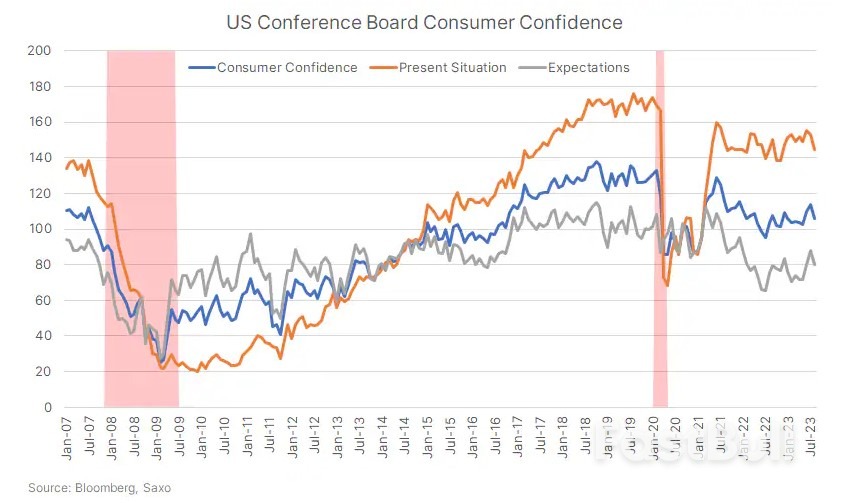
          This week is light on data but heavy on event risks. Today's consumer confidence data could be key in the U.S. as higher gasoline prices along with high borrowing costs and increasing spending concerns could weigh. August consumer confidence plunged to 106.1 from July's 114 as consumers' assessment of the labor market deteriorated. Entertainment spending should also have started to taper into September and Bloomberg consensus expects U.S. consumer confidence to plunge further to 105.5.
          Dollar Remains Bid on Yield and Safety_2Still, clear deterioration in data may only start to come after all the September data has been reported and there may be some more room for USD strength to sustain. This week's event risks, however, remain key to monitor and could bring some bumps. An adverse outcome could also risk a fast forward to stagflation concerns, and disrupt the USD rally momentarily. 'Three S' risks are lining up – including the student loan repayments that restart in October, the autoworker strikes that are now encompassing the supplier networks, and a potential government shutdown.
          Federal student loan repayments are set to restart on October 1 after having been suspended since March 2020, and Moody's estimates that 24 million borrowers will owe an average of $275 per month. This could curtail consumer spending, especially when pandemic-era savings are being exhausted. Meanwhile, the widening United Auto Worker (UAW) strikes against GM and Stellantis risk dampening U.S. industrial output and could result in higher car prices, suggesting stagflation risks. Lastly, a U.S. shutdown could arrive into the coming weekend if Congress fails to provide funding for the fiscal year starting October 1. This could mean thousands of federal workers may be furloughed without pay, again highlighting spending cut risks if the shutdown is prolonged.
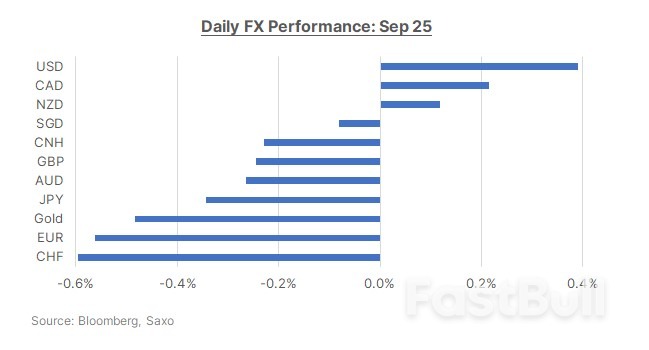
          While direct economic impact from strikes or shutdown could be limited, sentiment could turn around quickly with all these risks stacking up into the beginning of Q4. Dollar still remains attractive from a safe-haven perspective, given the cratering in yen and Swiss franc, however some consolidation may be likely with net positioning in the dollar also turning to a long after eight weeks. A look at previous shutdown from December 2018-Janauary 2019 showed that dollar declined for four consecutive weeks before gains returned when the resolution was reached. Gold could outperform on safe-haven demand, while sustained gains in oil prices could underpin CAD. If a shutdown is averted, USD bulls could come back stronger.
          Market Takeaway: Dollar remains king in portfolios, but uncertainty ahead could mean some consolidation. Risks to sentiment from government shutdown could bring gains in XAUUSD, and higher oil prices continue to underpin CAD.

          EUR and JPY face double whammy of higher dollar and gains in oil prices

          Eurozone's PMIs were mixed on Friday with German economy seemingly at a turnaround but France slipping further. Overall, Eurozone PMIs remained in contraction, signalling risks for Q3 GDP. Germany's Ifo also showed a marginal improvement, but remained insufficient to spark optimism. Focus is on monthly credit data due Wednesday and flash CPI later this week, and soft numbers could continue to put emphasis on peak ECB rates, bringing EUR downside. Break of key support at 1.0635 in EURUSD has opened the doors to 1.05.
          Meanwhile, higher Treasury yields and oil prices continue to push the Japanese yen lower. USDJPY was at fresh 11-month highs, and is testing the 149 handle with verbal intervention remaining lacklustre. Near-term risks is seen at the 150 handle with any real intervention potentially bringing the pair lower towards 145 temporarily but unlikely to reverse the weakness of the yen in any material way.
          Market Takeaway: USD strength and higher oil prices could bring fresh lows in EUR and JPY, although near-term intervention threat looms for yen traders.
          Risk Warnings and Disclaimers
          You understand and acknowledge that there is a high degree of risk involved in trading. Following any strategies or investment methods may lead to potential losses. The content on the site is provided by our contributors and analysts for information purposes only. You are solely responsible for determining whether any trading assets, securities, strategy, or any other product is suitable for investing based on your own investment objectives and financial situation.
          Comments
          Add to Favorites
          Share

          Asia Weakness Set to See Europe Open Lower

          CMC

          Forex

          European markets got off to a poor start to the week yesterday as concerns around sticky inflation, and low growth (stagflation), or recession served to push yields higher, pushing the DAX to its lowest levels since late March, pushing both it and the CAC 40 below the important technical level of the 200-day SMA.
          Recent economic data is already flashing warning signs over possible stagnation, especially in Europe while U.S. data is proving to be more resilient.
          Worries over the property sector in China didn't help sentiment yesterday after it emerged Chinese property group Evergrande said it was struggling to organise a process to restructure its debt, prompting weakness in basic resources.
          The increase in yields manifested itself in German and French 10-year yields, both of which rose to their highest levels in 12 years, with the DAX feeling the pressure along with the CAC 40, while the FTSE100 slipped to a one-week low.
          U.S. markets initially opened lower in the face of a similar rise in yields with the S&P500 opening at a 3-month low, as U.S. 10-year yields continued to push to fresh 16-year highs above 4.5%. These initial losses didn't last as U.S. stocks closed higher for the first time in 5 days.
          The U.S. dollar also made new highs for the year, rising to its best level since 30th November last year as traders bet that the Federal Reserve will keep rates higher for much longer than its counterparts due to the greater resilience of the U.S. economy.
          The focus this week is on the latest inflation figures from Australia, as well as the core PCE Deflator from the U.S., as well as the latest flash CPI numbers for September from France, Germany, Spain as well as the wider EU flash number which is due on Friday. This could show the ECB erred a couple of weeks ago when it tightened the rate hike screw further to a record high.
          On the data front today the focus will be on U.S. consumer confidence for September, after the sharp fall from July's 117.00 to August's 106.10. Expectations are for a more modest slowdown to 105.50 on the back of the continued rise in gasoline prices which has taken place since the June lows.
          Last night's late rebound in U.S. markets doesn't look set to translate into today's European open with Asia markets also coming under pressure this morning.
          Another warning from ratings agency Moody's about the impact of another government shutdown on the U.S. economy, and its credit rating, didn't help the overall mood, while Minneapolis Fed President Neel Kashkari said he expects another Fed rate rise before the end of the year helping to further boost the U.S. dollar as well as yields.
          EUR/USD – slid below the 1.0600 level yesterday potentially opening the prospect of further losses towards the March lows at 1 0515. Currently have resistance at 1.0740, which we need to get above to stabilise and minimise the risk of further weakness.
          GBP/USD – slipped to the 1.2190 area, and has since rebounded, however the bias remains for a retest of the 1.2000 area. Only a move back above the 1.2430 area and 200-day SMA stabilises and argues for a return to the 1.2600 area.
          EUR/GBP – currently have resistance at the 200-day SMA at 0.8720, which is capping the upside. A break here targets the 0.8800 area, however while below the bias remains for a pullback. If we slip below the 0.8660 area, we could see a move back to the 0.8620 area.
          USD/JPY – has continued to climb higher towards the 150.00 area with support currently at the lows last week at 147.20/30. Major support currently at the 146.00 area.

          Source: CMC

          Risk Warnings and Disclaimers
          You understand and acknowledge that there is a high degree of risk involved in trading. Following any strategies or investment methods may lead to potential losses. The content on the site is provided by our contributors and analysts for information purposes only. You are solely responsible for determining whether any trading assets, securities, strategy, or any other product is suitable for investing based on your own investment objectives and financial situation.
          Comments
          Add to Favorites
          Share

          China's Growth Is Slowing: What Does It Mean?

          Glendon

          Economic

          The economic slowdown is understandably causing concern among investors. However, while slower growth in China will impact the global economy and financial markets, we think the short-term pain is necessary to avoid bigger problems down the road. China's economy is in the early stages of a long-term transition away from an export-driven, investment-led model toward a more balanced one with more domestic consumption.
          During these large transitions, slowing growth is almost inevitable and—from a long-term perspective—desirable.

          A Much Bigger Economy Today…and One in Transition

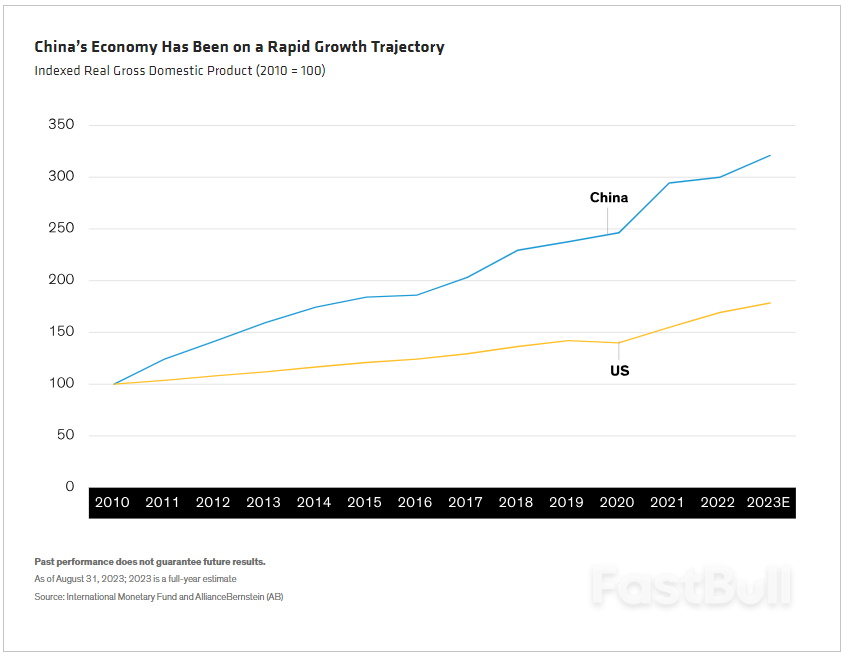
          Part of the growth downshift is simple math. China's economy has roughly tripled in size since the Global Financial Crisis (Display), making it much harder to sustain high growth rates. In fact, trying to boost growth could lead to excessive leverage and, in the case of China, overreliance on sectors with high economic multipliers, such as housing. That would only intensify existing imbalances in China's system, so we believe that slower, but more sustainable growth is a healthier medium-term path.
          China's Growth Is Slowing: What Does It Mean?_1
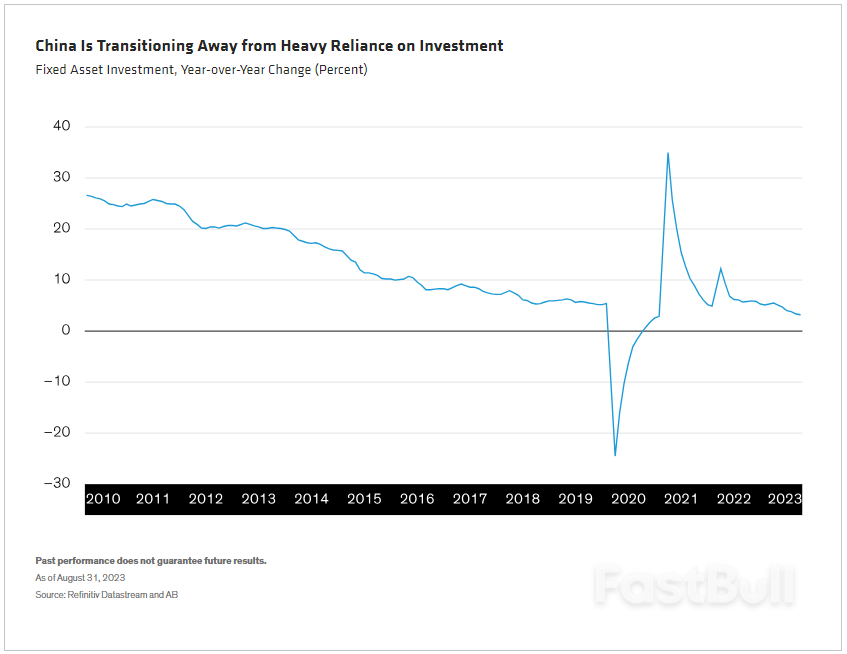
          The other main driver of slower growth is the transition away from a heavier reliance on physical investment (Display) and exports toward a more balanced economic framework. Because so many resources have been devoted to these industries, they have excess capacity today. Trapped capital translates into lower prices as spare capacity is absorbed, and it results in slower growth as wasted, or wasting, resources are eliminated or redeployed.
          China's Growth Is Slowing: What Does It Mean?_2
          Meanwhile, sectors with more positive medium-term outlooks continue to thrive, including consumer-facing staples, such as travel and restaurants. Solar and wind power projects are also humming, as are electric vehicle production and other high-tech and green products. It will take time for these industries to replace lost activity in real estate and heavy investment, which is why overall growth is slowing.

          A Shift in Global Growth Dynamics

          How should markets and the rest of the world process China's growth outlook?
          We think it's important to avoid focusing too much on the government's growth target—roughly 5% this year. Even if the economy grows at that pace, it won't feel like “good” growth to those outside China. The country's best-performing industries won't likely fuel expansion abroad as much as they have before. It takes massive commodity imports to build roads and bridges; selling movie tickets and restaurant meals doesn't.
          All this means that China's economy won't be as big an engine of global growth as it's been in the past. For markets, this evolution may seem disorienting—and is understandably causing jitters among many investors. Slower growth in the world's second most important economy likely means lower overall global growth, even more so because China's growth is becoming more domestically focused.

          Expect Targeted, Gradual Stimulus

          Much of the anxiety focuses on risks from the transition. Highly levered Chinese firms, particularly in property sectors, will likely feel stress, and policymakers won't be inclined to deliver large-scale support, because it would exacerbate imbalances and delay the transition. Property-developer defaults could become severe enough to imperil the banking sector or local government finances—but that's not our base case. The transmission mechanism from China's financial system to the world is limited in direct terms, though turmoil in China could rattle sentiment elsewhere.
          To sum things up, we share the view that China's economy is slowing, and that slower growth will likely last as the economy transitions. There are also financial-market risks associated with that slowdown. But in our view, the “cure” to that problem—piling more debt and leverage onto the economy and property sector—would be worse than the ailment.
          We think China's policymakers feel the same way, so we expect targeted, gradual stimulus to manage the slowdown, not a “big bang” stimulus to push growth into a faster trajectory.

          Source: AllianceBernstein

          To stay updated on all economic events of today, please check out our Economic calendar
          Risk Warnings and Disclaimers
          You understand and acknowledge that there is a high degree of risk involved in trading. Following any strategies or investment methods may lead to potential losses. The content on the site is provided by our contributors and analysts for information purposes only. You are solely responsible for determining whether any trading assets, securities, strategy, or any other product is suitable for investing based on your own investment objectives and financial situation.
          Comments
          Add to Favorites
          Share

          Could the 14th Amendment Bar Donald Trump From Becoming President Again?

          Michelle

          Political

          Could the 14th Amendment Bar Donald Trump From Becoming President Again?_1
          Donald trump's campaign for re-election is dogged with legal woes. The former president faces the prospect of four criminal trials on felony charges, which will overlap with the Republican primary season and the general-election campaign. But another type of legal trouble could further complicate his return to the White House.
          America's constitution—which Mr Trump swore to uphold on January 20th 2017—includes a provision barring people who have taken such an oath from holding federal office if they have “engaged in insurrection or rebellion” against the country or “given aid or comfort to the enemies thereof”. This language, found in Section 3 of the 14th Amendment, was ratified after the civil war to prevent former Confederate rebels from having a hand in running the country they had tried to saw in half. The disqualification clause has seen something of a renaissance. A year ago, Couy Griffin, then a county commissioner in New Mexico, was removed from office by a state judge for engaging in insurrection at the Capitol on January 6th. But could this constitutional provision really thwart Mr Trump's quest for a second presidential term?
          The idea gained prominence in August when two respected legal scholars from the right—Will Baude of the University of Chicago and Michael Stokes Paulsen of the University of St Thomas in Minneapolis—answered this question with an emphatic “yes”. In a 126-page article, to be published next year in the University of Pennsylvania Law Review, they contend that Section 3 “disqualifies” Mr Trump “and potentially many others” who played a role in “the attempted overthrow of the 2020 presidential election”. J. Michael Luttig, a judge appointed by George W. Bush, and Laurence Tribe, a law professor at Harvard University, endorsed the proposal.
          But other scholars on the left and right have voiced doubts that Mr Trump's contributions to the January 6th riot automatically bar him from office. Some question whether the former president can be said to have engaged in an insurrection. Many point to a precedent from 1869 in which Salmon Chase, the chief justice, ruled that Section 3 could only be enforced by Congress. Messrs Baude and Paulsen disagree. They argue that Section 3 is “self-enforcing”. Not having engaged in insurrection or not lending support to America's enemies, they say, is a requirement for public office in the same way that the presidential minimum age of 35 is—and secretaries of state in the 50 states are therefore empowered to remove Mr Trump's name from the ballot for the upcoming election.
          Lawsuits based on this theory are springing up. Eight voters in Minnesota filed one this month. In Colorado, Citizens for Responsibility and Ethics in Washington, the same watchdog that successfully sued Mr Griffin in New Mexico last year, is suing on behalf of six voters in the state. The organisation argues that Mr Trump is responsible for “recruiting, inciting and encouraging a violent mob that attacked the Capitol” and should not be listed on Colorado's Republican primary ballot. Similar challenges were brought against Marjorie Taylor Greene and Madison Cawthorn, respectively current and former members of the House of Representatives, but neither resulted in their disqualification. If courts rule that Mr Trump is ineligible to run for office, and secretaries of state begin removing his name from ballots, quick appeals would ensue. The issue would probably reach the Supreme Court, where the justices may want to provide clarity before the first primary votes are cast in January. The surge in attention to the disqualification clause will probably remain mostly academic: it would be remarkable for a majority of the court to subject a presidential election to a largely untested legal theory.

          Source: Economist

          Risk Warnings and Disclaimers
          You understand and acknowledge that there is a high degree of risk involved in trading. Following any strategies or investment methods may lead to potential losses. The content on the site is provided by our contributors and analysts for information purposes only. You are solely responsible for determining whether any trading assets, securities, strategy, or any other product is suitable for investing based on your own investment objectives and financial situation.
          Comments
          Add to Favorites
          Share

          September 26th Financial News

          FastBull Featured

          Daily News

          [Quick Facts]

          1. Fed's Goolsbee: Rates will have to stay higher for longer.
          2. Japan will compile a new economic stimulus package.
          3. ECB Lagarde: No rate cuts are being considered.
          4. U.S. 10-year bond yield hits a 16-year high and the long-treasury bond ETF sinks.

          [News Details]

          Fed's Goolsbee: Rates will have to stay higher for longer
          The risk of inflation staying higher than the Fed's target is the bigger risk, Chicago Fed President Austan Goolsbee said on Monday, It feels like rates will have to stay higher for longer than markets had expected, he added. The Fed would need to "play by ear" whether any further rate increases are needed.
          The debate over the current phase of Fed policy will "stop being how much more are they going to raise, and transform into well how long do we need to hold rates" at the peak level.
          Although the Federal Reserve has been raising interest rates, the United States is still possible to avoid a recession.
          At present, FOMC hawkish officials not only implied there would be one more rate hike in the year but also expected rates to stay high for longer. They lowered their forecast for next year's interest rate cuts to 50 basis points from 100 basis points.
          Japan will compile a new economic stimulus package
          Japanese Prime Minister Fumio Kishida on Monday unveiled the main elements of a new economic stimulus package to be formulated next month. The package will help ease the impact of rising prices on households and raise wages.
          Kishida will instruct his Cabinet on Tuesday to put together the package and quickly set up an extra budget to fund it.
          The package will include measures to protect people from cost-push inflation, support sustainable wage and income growth, promote domestic investment to spur economic growth, carry out reforms to overcome population decline and encourage infrastructure investment, etc.
          With the new economic measures, Kishida pledged to shift Japan's economy, which has tended to focus on cost-cutting, away from such practices. Kishida also warned investors who try to sell the yen, by saying that he was closely monitoring exchange rate movements with a high sense of urgency.
          ECB Lagarde: No rate cuts are being considered
          Our future decisions will ensure that the key ECB interest rates will be set at sufficiently restrictive levels for as long as necessary, said European Central Bank (ECB) President Christine Lagarde on Monday. There is little likelihood of easing monetary policy in the short term, and the prospect of a rate cut is not even being considered at the moment.
          The economic outlook for the euro area is deteriorating, with economic activity generally stagnating in the first half of 2023. Recent indicators pointed to further weakness in the third quarter. Lower demand for exports in the euro area and a tighter financing environment are dampening growth. The service sector is also weakening and job creation in the service sector is slowing.
          U.S. 10-year bond yield hits a 16-year high and the long-treasury bond ETF sinks
          As the market officially enters the final week of the third quarter this week, the sharp decline in U.S. Treasuries over the past few months continues. 10-year bond yield rose 10.4 basis points overnight to 4.539%, the highest since October 2007, and the 30-year yield rose as much as 13 basis points to 4.66%, a level not seen since April 2011, as markets anticipated the Fed to keep interest rates high, and the supply of new bonds was expected to keep rising as the federal government struggles with growing deficits.
          Additionally, the $39 billion iShares 20+ Year Treasury Bond ETF has lost 48% from its all-time high in 2020 and is trading at its lowest point since 2011.

          [Focus of the Day]

          UTC+8 15:00 ECB Governing Council member Simkus speaks
          UTC+8 16:00 ECB Governing Council member Kazimir delivers a speech
          UTC+8 22:00 U.S. New Home Sales MoM (Aug)
          UTC+8 00:30 Next Day: ECB Governing Council member Holzmann speaks
          TBD U.S. House of Representatives to vote on temporary spending bills
          Risk Warnings and Disclaimers
          You understand and acknowledge that there is a high degree of risk involved in trading. Following any strategies or investment methods may lead to potential losses. The content on the site is provided by our contributors and analysts for information purposes only. You are solely responsible for determining whether any trading assets, securities, strategy, or any other product is suitable for investing based on your own investment objectives and financial situation.
          Comments
          Add to Favorites
          Share

          Why Recession Predictions Have Been Wrong So Far

          Glendon

          Economic

          Stocks

          In investment management, past performance is no guarantee of future returns. In economics, we've seen many predictions of a U.S. recession that so far, at least, have not materialized. Investors should take note that the past performance of a key economic tenet — that a recession follows an inverted yield curve — may no longer be as reliable today as it once was.
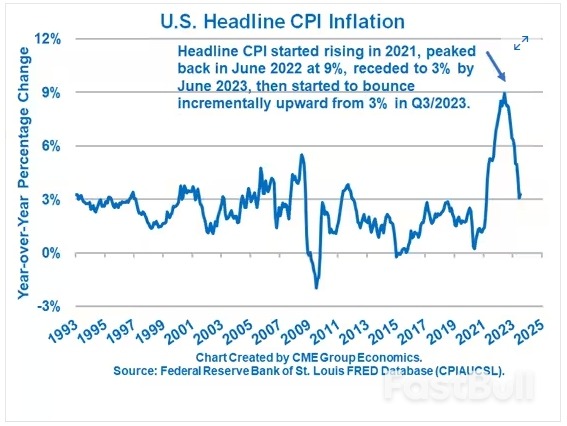
          Let's first look back at the pace of inflation. When it started to ramp higher in 2021, many economists, as well as the Federal Reserve, dismissed the pattern as “transitory.” But by March 2022, the Fed understood that the new inflation pattern was serious and commenced raising short-term rates. That November, the Fed's guidance hardened, with Fed Chair Jerome Powell stating that “reducing inflation is likely to require a sustained period of below-trend growth and some softening of labor market conditions.”
          Why Recession Predictions Have Been Wrong So Far_1
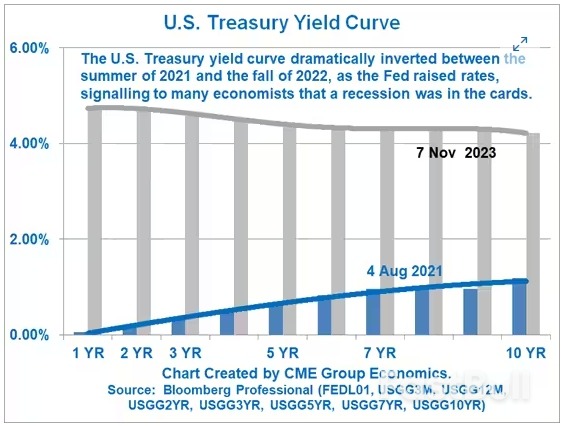
          At this point, the U.S. Treasury two-year yield was higher than the 10-year yield, creating an inverted yield curve, and rates were rising at the most rapid pace since the early 1980s. For the vast majority of economists, these facts were strong signals to forecast rising unemployment and a U.S. recession in 2023.
          Why Recession Predictions Have Been Wrong So Far_2
          Yet as the fourth quarter of 2023 approaches, signs of a U.S. recession are not so clear. The consensus of many economists has shifted away from the recession forecast, although some have merely pushed the timing into 2024, citing lags in monetary policy, or shifted to words like “mild” or “soft landing” to describe any possible future downturn.

          Yield-curve indicator breaks down

          Why the shift? Regardless of whether we eventually end up in a recession, the key here is how an inverted yield curve may not mean the same as it did 20 years ago. Has our economy become far more resilient in the face of restrictive interest rate policies?
          Let's look at what history shows us. Back in the 1950s, '60s and '70s, manufacturing was the engine of the U.S. economy, with the purchase of durable goods often facilitated by credit. If one wanted to buy a house, a 30-year fixed-rate mortgage was the only choice. Moreover, that choice was typically provided by a savings and loan institution that borrowed short-term from savers and lent long-term for houses or medium-term for cars.
          Taking interest-rate risk and surviving short periods of inverted yield curves was the savings and loan business model, since efficient rate hedging vehicles were not available. When the Fed hiked interest rates, lending slowed for houses and cars, the economy slumped, and unemployment eventually started to rise.
          Fast forward to today. The U.S. is a service-sector economy, and most service purchases do not involve a loan or credit. Mortgages come in all shapes, sizes, terms and maturities, and are originated by specialized brokers that package and sell the mortgages to investors who want to hold this risk. For financial institutions, the ability to hedge and manage interest-rate risk is further supported by deep markets in swaps, futures and options.
          Higher rates, which alter the time value of money, still have a profound impact on asset markets, from equities to fixed income. But the impact of those rates on the real economy is much less clear as the U.S. economy evolves. Yet, most econometric models still rely on historic relationships, which don't take into account recent structural changes impacting interest-rate sensitivity.
          Moreover, the last three serious recessions all required something big and systematic to break. In 1991, it was the savings and loan industry and the housing market, brought on by tighter credit conditions. In 2008, it was the financial crisis brought on by risk taking in subprime housing. In 2020, it was the Covid-19 pandemic, which had nothing to do with rates.
          This year, the failure of a few niche regional banks could have been the trigger for contagion and a serious banking system collapse. That was not the case because regulators quickly backstopped the system. Additionally, most banks had hedged their positions.
          Could it be that a less interest-rate sensitive economy and a regulatory network committed to preventing systemic financial-system breakdowns has reduced the power of an inverted yield curve to forecast a recession? Time will tell. Until then, investors should be cautious about relying on historical parallels as they prepare their portfolios for the risks ahead.

          Source: Market Watch

          To stay updated on all economic events of today, please check out our Economic calendar
          Risk Warnings and Disclaimers
          You understand and acknowledge that there is a high degree of risk involved in trading. Following any strategies or investment methods may lead to potential losses. The content on the site is provided by our contributors and analysts for information purposes only. You are solely responsible for determining whether any trading assets, securities, strategy, or any other product is suitable for investing based on your own investment objectives and financial situation.
          Comments
          Add to Favorites
          Share
          FastBull
          Copyright © 2025 FastBull Ltd

          728 RM B 7/F GEE LOK IND BLDG NO 34 HUNG TO RD KWUN TONG KLN HONG KONG

          TelegramInstagramTwitterfacebooklinkedin
          App Store Google Play Google Play
          Products
          Charts

          Chats

          Q&A with Experts
          Screeners
          Economic Calendar
          Data
          Tools
          Membership
          Features
          Function
          Markets
          Copy Trading
          Latest Signals
          Contests
          News
          Analysis
          24/7
          Columns
          Education
          Company
          Careers
          About Us
          Contact Us
          Advertising
          Help Center
          Feedback
          User Agreement
          Privacy Policy
          Business

          White Label

          Data API

          Web Plug-ins

          Poster Maker

          Affiliate Program

          Risk Disclosure

          The risk of loss in trading financial instruments such as stocks, FX, commodities, futures, bonds, ETFs and crypto can be substantial. You may sustain a total loss of the funds that you deposit with your broker. Therefore, you should carefully consider whether such trading is suitable for you in light of your circumstances and financial resources.

          No decision to invest should be made without thoroughly conducting due diligence by yourself or consulting with your financial advisors. Our web content might not suit you since we don't know your financial conditions and investment needs. Our financial information might have latency or contain inaccuracy, so you should be fully responsible for any of your trading and investment decisions. The company will not be responsible for your capital loss.

          Without getting permission from the website, you are not allowed to copy the website's graphics, texts, or trademarks. Intellectual property rights in the content or data incorporated into this website belong to its providers and exchange merchants.

          Not Logged In

          Log in to access more features

          FastBull Membership

          Not yet

          Purchase

          Become a signal provider
          Help Center
          Customer Service
          Dark Mode
          Price Up/Down Colors

          Log In

          Sign Up

          Position
          Layout
          Fullscreen
          Default to Chart
          The chart page opens by default when you visit fastbull.com