• Trade
  • Markets
  • Copy
  • Contests
  • News
  • 24/7
  • Calendar
  • Q&A
  • Chats
Trending
Screeners
SYMBOL
LAST
BID
ASK
HIGH
LOW
NET CHG.
%CHG.
SPREAD
SPX
S&P 500 Index
6857.13
6857.13
6857.13
6865.94
6827.13
+7.41
+ 0.11%
--
DJI
Dow Jones Industrial Average
47850.93
47850.93
47850.93
48049.72
47692.96
-31.96
-0.07%
--
IXIC
NASDAQ Composite Index
23505.13
23505.13
23505.13
23528.53
23372.33
+51.04
+ 0.22%
--
USDX
US Dollar Index
98.850
98.930
98.850
98.980
98.740
-0.130
-0.13%
--
EURUSD
Euro / US Dollar
1.16582
1.16591
1.16582
1.16715
1.16408
+0.00137
+ 0.12%
--
GBPUSD
Pound Sterling / US Dollar
1.33516
1.33525
1.33516
1.33622
1.33165
+0.00245
+ 0.18%
--
XAUUSD
Gold / US Dollar
4223.04
4223.45
4223.04
4230.62
4194.54
+15.87
+ 0.38%
--
WTI
Light Sweet Crude Oil
59.343
59.373
59.343
59.480
59.187
-0.040
-0.07%
--

Community Accounts

Signal Accounts
--
Profit Accounts
--
Loss Accounts
--
View More

Become a signal provider

Sell trading signals to earn additional income

View More

Guide to Copy Trading

Get started with ease and confidence

View More

Signal Accounts for Members

All Signal Accounts

Best Return
  • Best Return
  • Best P/L
  • Best MDD
Past 1W
  • Past 1W
  • Past 1M
  • Past 1Y

All Contests

  • All
  • Trump Updates
  • Recommend
  • Stocks
  • Cryptocurrencies
  • Central Banks
  • Featured News
Top News Only
Share

Amd Chief Says Company Ready To Pay 15% Tax On Ai Chip Shipments To China

Share

Kremlin Aide Ushakov Says USA Kushner Is Working Very Actively On Ukrainian Settlement

Share

Norway To Acquire 2 More Submarines, Long-Range Missiles, Daily Vg Reports

Share

Ucb Sa Shares Open Up 7.3% After 2025 Guidance Upgrade, Top Of Bel 20 Index

Share

Shares In Italy's Mediobanca Down 1.3% After Barclays Cuts To Underweight From Equal-Weight

Share

Stats Office - Austrian November Wholesale Prices +0.9% Year-On-Year

Share

Britain's FTSE 100 Up 0.15%

Share

Europe's STOXX 600 Up 0.1%

Share

Taiwan November PPI -2.8% Year-On-Year

Share

Stats Office - Austrian September Trade -230.8 Million EUR

Share

Swiss National Bank Forex Reserves Revised To Chf 724906 Million At End Of October - SNB

Share

Swiss National Bank Forex Reserves At Chf 727386 Million At End Of November - SNB

Share

Shanghai Warehouse Rubber Stocks Up 8.54% From Week Earlier

Share

Turkey's Main Banking Index Up 2%

Share

French October Trade Balance -3.92 Billion Euros Versus Revised -6.35 Billion Euros In September

Share

Kremlin Aide Says Russia Is Ready To Work Further With Current USA Team

Share

Kremlin Aide Says Russia And USA Are Moving Forward In Ukraine Talks

Share

Shanghai Rubber Warehouse Stocks Up 7336 Tons

Share

Shanghai Tin Warehouse Stocks Up 506 Tons

Share

Reserve Bank Of India Chief Malhotra: Goal Is To Have Inflation Be Around 4%

TIME
ACT
FCST
PREV
France 10-Year OAT Auction Avg. Yield

A:--

F: --

P: --

Euro Zone Retail Sales MoM (Oct)

A:--

F: --

P: --

Euro Zone Retail Sales YoY (Oct)

A:--

F: --

P: --

Brazil GDP YoY (Q3)

A:--

F: --

P: --

U.S. Challenger Job Cuts (Nov)

A:--

F: --

P: --

U.S. Challenger Job Cuts MoM (Nov)

A:--

F: --

P: --

U.S. Challenger Job Cuts YoY (Nov)

A:--

F: --

P: --

U.S. Initial Jobless Claims 4-Week Avg. (SA)

A:--

F: --

P: --

U.S. Weekly Initial Jobless Claims (SA)

A:--

F: --

P: --

U.S. Weekly Continued Jobless Claims (SA)

A:--

F: --

P: --

Canada Ivey PMI (SA) (Nov)

A:--

F: --

P: --

Canada Ivey PMI (Not SA) (Nov)

A:--

F: --

P: --

U.S. Non-Defense Capital Durable Goods Orders Revised MoM (Excl. Aircraft) (SA) (Sept)

A:--

F: --

P: --
U.S. Factory Orders MoM (Excl. Transport) (Sept)

A:--

F: --

P: --

U.S. Factory Orders MoM (Sept)

A:--

F: --

P: --

U.S. Factory Orders MoM (Excl. Defense) (Sept)

A:--

F: --

P: --

U.S. EIA Weekly Natural Gas Stocks Change

A:--

F: --

P: --

Saudi Arabia Crude Oil Production

A:--

F: --

P: --

U.S. Weekly Treasuries Held by Foreign Central Banks

A:--

F: --

P: --

Japan Foreign Exchange Reserves (Nov)

A:--

F: --

P: --

India Repo Rate

A:--

F: --

P: --

India Benchmark Interest Rate

A:--

F: --

P: --

India Reverse Repo Rate

A:--

F: --

P: --

India Cash Reserve Ratio

A:--

F: --

P: --

Japan Leading Indicators Prelim (Oct)

A:--

F: --

P: --

U.K. Halifax House Price Index YoY (SA) (Nov)

A:--

F: --

P: --

U.K. Halifax House Price Index MoM (SA) (Nov)

A:--

F: --

P: --

France Current Account (Not SA) (Oct)

A:--

F: --

P: --

France Trade Balance (SA) (Oct)

A:--

F: --

P: --

France Industrial Output MoM (SA) (Oct)

A:--

F: --

P: --

Italy Retail Sales MoM (SA) (Oct)

--

F: --

P: --

Euro Zone Employment YoY (SA) (Q3)

--

F: --

P: --

Euro Zone GDP Final YoY (Q3)

--

F: --

P: --

Euro Zone GDP Final QoQ (Q3)

--

F: --

P: --

Euro Zone Employment Final QoQ (SA) (Q3)

--

F: --

P: --

Euro Zone Employment Final (SA) (Q3)

--

F: --

P: --
Brazil PPI MoM (Oct)

--

F: --

P: --

Mexico Consumer Confidence Index (Nov)

--

F: --

P: --

Canada Unemployment Rate (SA) (Nov)

--

F: --

P: --

Canada Labor Force Participation Rate (SA) (Nov)

--

F: --

P: --

Canada Employment (SA) (Nov)

--

F: --

P: --

Canada Part-Time Employment (SA) (Nov)

--

F: --

P: --

Canada Full-time Employment (SA) (Nov)

--

F: --

P: --

U.S. Personal Income MoM (Sept)

--

F: --

P: --

U.S. Dallas Fed PCE Price Index YoY (Sept)

--

F: --

P: --

U.S. PCE Price Index YoY (SA) (Sept)

--

F: --

P: --

U.S. PCE Price Index MoM (Sept)

--

F: --

P: --

U.S. Personal Outlays MoM (SA) (Sept)

--

F: --

P: --

U.S. Core PCE Price Index MoM (Sept)

--

F: --

P: --

U.S. UMich 5-Year-Ahead Inflation Expectations Prelim YoY (Dec)

--

F: --

P: --

U.S. Core PCE Price Index YoY (Sept)

--

F: --

P: --

U.S. Real Personal Consumption Expenditures MoM (Sept)

--

F: --

P: --

U.S. 5-10 Year-Ahead Inflation Expectations (Dec)

--

F: --

P: --

U.S. UMich Current Economic Conditions Index Prelim (Dec)

--

F: --

P: --

U.S. UMich Consumer Sentiment Index Prelim (Dec)

--

F: --

P: --

U.S. UMich 1-Year-Ahead Inflation Expectations Prelim (Dec)

--

F: --

P: --

U.S. UMich Consumer Expectations Index Prelim (Dec)

--

F: --

P: --

U.S. Weekly Total Rig Count

--

F: --

P: --

U.S. Weekly Total Oil Rig Count

--

F: --

P: --

U.S. Consumer Credit (SA) (Oct)

--

F: --

P: --

Q&A with Experts
    • All
    • Chatrooms
    • Groups
    • Friends
    Connecting
    .
    .
    .
    Type here...
    Add Symbol or Code

      No matching data

      All
      Trump Updates
      Recommend
      Stocks
      Cryptocurrencies
      Central Banks
      Featured News
      • All
      • Russia-Ukraine Conflict
      • Middle East Flashpoint
      • All
      • Russia-Ukraine Conflict
      • Middle East Flashpoint

      Search
      Products

      Charts Free Forever

      Chats Q&A with Experts
      Screeners Economic Calendar Data Tools
      Membership Features
      Data Warehouse Market Trends Institutional Data Policy Rates Macro

      Market Trends

      Market Sentiment Order Book Forex Correlations

      Top Indicators

      Charts Free Forever
      Markets

      News

      News Analysis 24/7 Columns Education
      From Institutions From Analysts
      Topics Columnists

      Latest Views

      Latest Views

      Trending Topics

      Top Columnists

      Latest Update

      Signals

      Copy Rankings Latest Signals Become a signal provider AI Rating
      Contests
      Brokers

      Overview Brokers Assessment Rankings Regulators News Claims
      Broker listing Forex Brokers Comparison Tool Live Spread Comparison Scam
      Q&A Complaint Scam Alert Videos Tips to Detect Scam
      More

      Business
      Events
      Careers About Us Advertising Help Center

      White Label

      Data API

      Web Plug-ins

      Affiliate Program

      Awards Institution Evaluation IB Seminar Salon Event Exhibition
      Vietnam Thailand Singapore Dubai
      Fans Party Investment Sharing Session
      FastBull Summit BrokersView Expo
      Recent Searches
        Top Searches
          Markets
          News
          Analysis
          User
          24/7
          Economic Calendar
          Education
          Data
          • Names
          • Latest
          • Prev

          View All

          No data

          Scan to Download

          Faster Charts, Chat Faster!

          Download App
          English
          • English
          • Español
          • العربية
          • Bahasa Indonesia
          • Bahasa Melayu
          • Tiếng Việt
          • ภาษาไทย
          • Français
          • Italiano
          • Türkçe
          • Русский язык
          • 简中
          • 繁中
          Open Account
          Search
          Products
          Charts Free Forever
          Markets
          News
          Signals

          Copy Rankings Latest Signals Become a signal provider AI Rating
          Contests
          Brokers

          Overview Brokers Assessment Rankings Regulators News Claims
          Broker listing Forex Brokers Comparison Tool Live Spread Comparison Scam
          Q&A Complaint Scam Alert Videos Tips to Detect Scam
          More

          Business
          Events
          Careers About Us Advertising Help Center

          White Label

          Data API

          Web Plug-ins

          Affiliate Program

          Awards Institution Evaluation IB Seminar Salon Event Exhibition
          Vietnam Thailand Singapore Dubai
          Fans Party Investment Sharing Session
          FastBull Summit BrokersView Expo

          GBP/USD, USD/CAD Outlook: U.S. dollar under pressure as volatility fades

          FOREX.com

          Economic

          Forex

          Summary:

          A changing of the guard may be underway when it comes to what’s driving the G10 FX universe, with focus on the U.S. interest rate outlook diminishing over the past week, replaced by greater attention on broader risk appetite. While the jury is still out on the U.S. dollar’s once-concrete safe haven status, notably, it’s struggled in an environment of declining volatility and surging risk assets over the past fortnight. Should that trend persist, the path of least resistance for the dollar may continue to be lower.
          Return of USD Safe Haven Status?

          GBP/USD, USD/CAD Outlook: U.S. dollar under pressure as volatility fades_1

          Source: TradingView

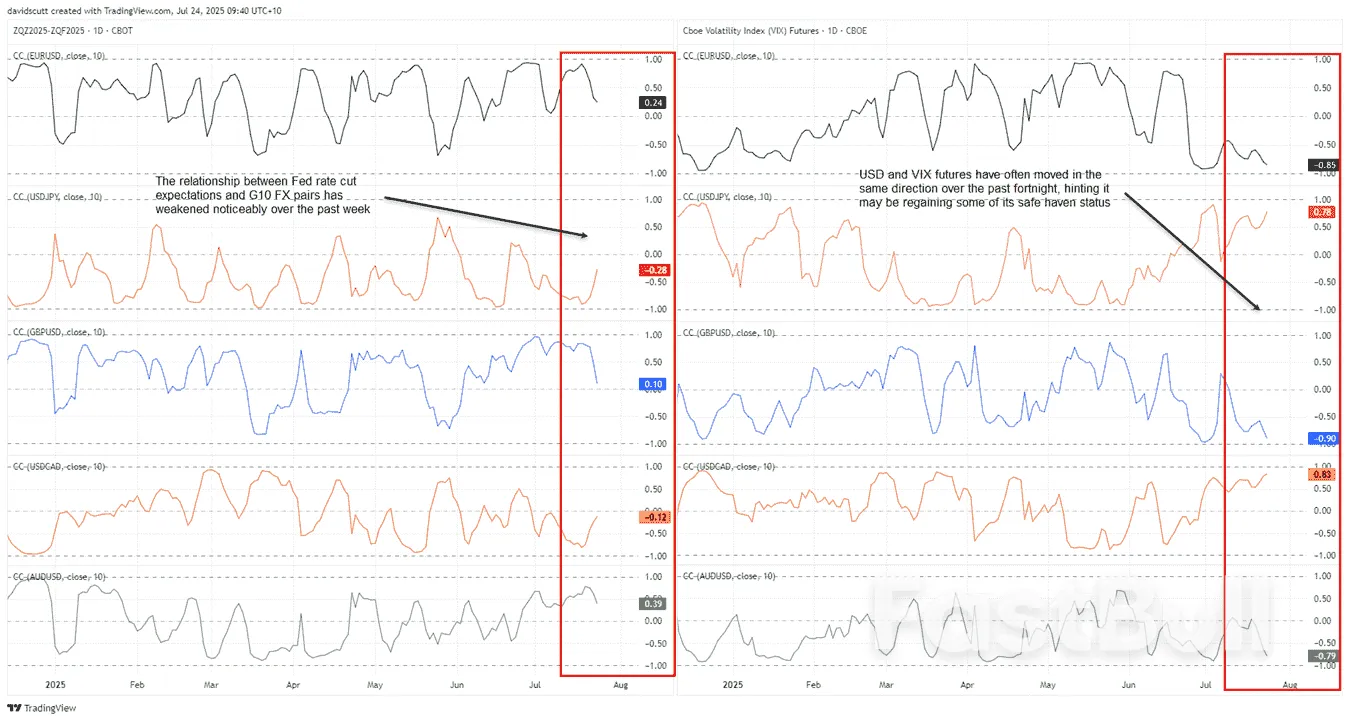
          The first chart looks at the rolling 10-day correlation between major G10 FX pairs and select market instruments over the past fortnight. On the left, we have market pricing for Fed rate cuts this year based on futures, with VIX futures on the right. Regarding the FX pairs, EUR/USD is shown in black, USD/JPY in red, GBP/USD in blue, USD/CAD in yellow, and AUD/USD in green.
          As discussed in posts over the past week, there had been a strong relationship between the FX universe and Fed rate cut expectations earlier in July. However, that relationship has waned in recent days, as demonstrated by the lower correlation coefficient scores.Interestingly, correlations with VIX futures have strengthened over the same period, with lower anticipated U.S. stock market volatility often coinciding with gains in major currencies against the U.S. dollar.
          While the U.S. dollar has often fluctuated in line with moves in benchmark 10-year Treasury yields—suggesting rate differentials may be a factor—it’s notable that as the trickle of trade agreements being reached with the U.S. government has accelerated ahead of the August 1 reciprocal tariff deadline, Treasury yields have generally been moving lower, reversing the trend seen when trade tensions were escalating.
          As many analysts noted at the time, Treasuries were unusually behaving like riskier asset classes, so the recent rally fits with the moves seen in other assets further out the risk spectrum over recent weeks. It also hints that the U.S. dollar may be slowly recapturing some form of safe haven status, with buoyant risk appetite helping to boost other currencies. The theory is yet to be tested as we’ve not seen a major market drawdown for a while, but it will be interesting to see what happens when the next non-U.S. government-initiated market wobble eventuates.For now, it appears to be boosting the likes of the British pound and Canadian dollar against the greenback.

          GBP/USD Bearish Break Rapidly Reversed

          GBP/USD, USD/CAD Outlook: U.S. dollar under pressure as volatility fades_2

          Source: TradingView

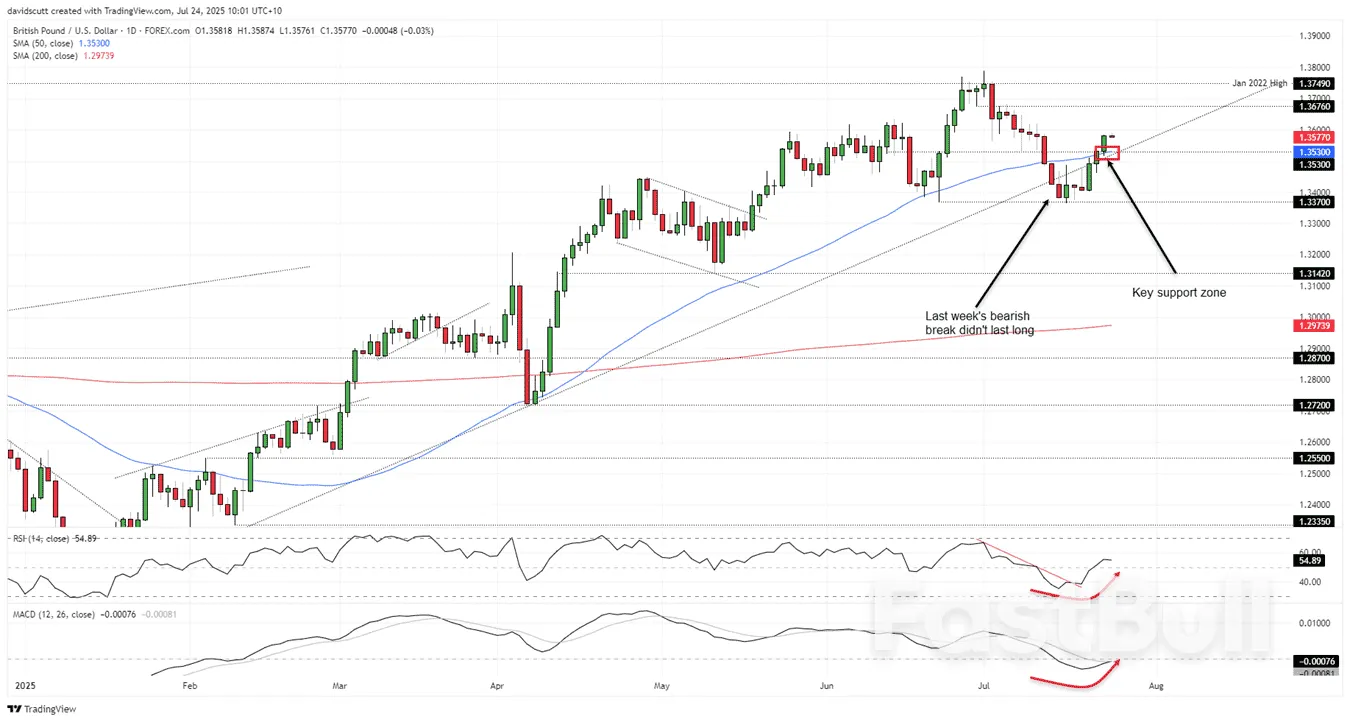
          Whether you’re talking price action or momentum, directional risks look to be tilting higher for GBP/USD in the near term. The break beneath long-running uptrend support didn’t last long with the pair attracting bids on dips below horizontal support at 1.3370. That may have contributed to the bounce seen this week, taking Cable not only back above the uptrend but also the important 50-day moving average and 1.3530—the latter a level that provided both support and resistance over the past month.
          The intersection of the uptrend, 1.3530 and 50-day moving average is now the key downside zone to watch, providing a potential base to build long setups around should we see a pullback. As for targets, offers may be encountered at 1.3600, with a push above that big figure opening the door for a run toward minor resistance at 1.3676 and the July swing high.
          Momentum indicators are shifting bullish, with RSI (14) comprehensively breaking its downtrend last week before pushing back above 50. MACD has also crossed the signal line from below and is on the cusp of moving above zero. It’s a more neutral picture rather than outright bullish, but it’s trending in that direction.Of course, if GBP/USD were to reverse back below the support zone and hold there, the bullish bias would be invalidated.

          USD/CAD Eyes June Swing Low

          GBP/USD, USD/CAD Outlook: U.S. dollar under pressure as volatility fades_3

          Source: TradingView

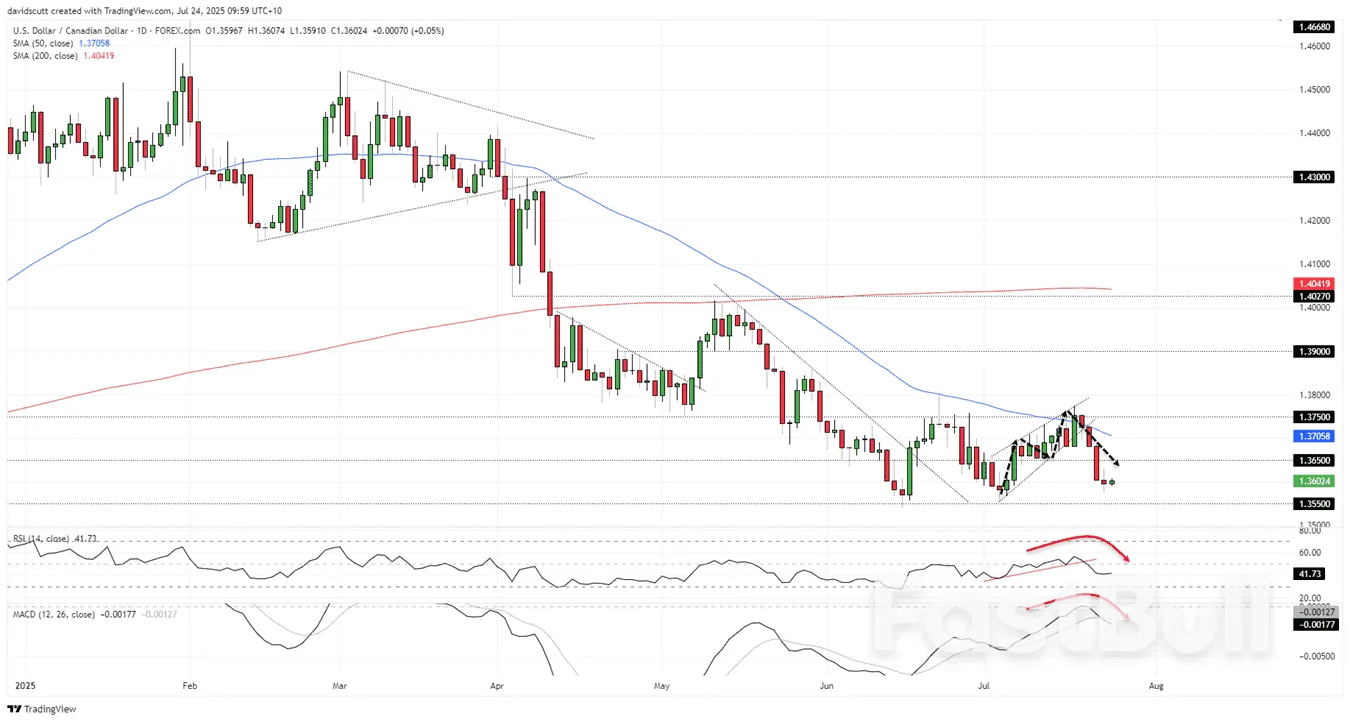
          The Canadian dollar looks like it may have resumed its broader strengthening trend against the U.S. dollar, with USD/CAD breaking the rising wedge it had been trading in last week after struggling to overcome sellers parked above 1.3750. The subsequent bearish break saw the pair slice through support at 1.3650, leaving it dangling just above the swing lows set in June. Convention following the wedge break suggests USD/CAD should retest 1.3550 again, although the bounce from just above the level earlier this month warns the near-term path for bears may be tricky.
          1.3650 remains the first topside level of note with 1.3550 the same on the downside. That’s the initial range to trade. If the latter were to be broken, 1.3500 will be in focus, with a push beyond that level bringing a retest of the September 2024 low of 1.3420 on the radar. If 1.3650 were to break on the upside, 1.3750 would naturally be seen as a target for longs.The momentum picture has shifted from bullish to mildly bearish recently, favouring selling rallies. RSI (14) has pushed below 50 while MACD has crossed the signal line from above—albeit in positive territory.

          Source:FOREX.com

          To stay updated on all economic events of today, please check out our Economic calendar
          Risk Warnings and Disclaimers
          You understand and acknowledge that there is a high degree of risk involved in trading. Following any strategies or investment methods may lead to potential losses. The content on the site is provided by our contributors and analysts for information purposes only. You are solely responsible for determining whether any trading assets, securities, strategy, or any other product is suitable for investing based on your own investment objectives and financial situation.
          Add to Favorites
          Share

          Oil Markets Gain as Trade Optimism Lifts Sentiment and US Stockpiles Shrink

          Gerik

          Economic

          Commodity

          Oil prices edge higher on improving trade sentiment

          Crude oil benchmarks moved higher on Thursday as global markets responded positively to signs of de-escalation in trade tensions between the United States and its key partners. Brent crude rose by 24 cents to reach $68.75 per barrel, while West Texas Intermediate (WTI) climbed 25 cents to $65.50. The gains reflect improved investor sentiment following trade agreements involving the US, Japan, and potentially the European Union, signaling a reduced risk to global economic growth and energy demand.
          This rebound comes on the heels of the US-Japan deal, which eliminated planned tariffs on Japanese goods, particularly auto imports, in exchange for a $550 billion commitment in US-bound investment and loans. In parallel, US-EU trade discussions are progressing, with European diplomats confirming movement toward a deal that may feature a 15% baseline tariff on EU goods along with selective exemptions. These diplomatic breakthroughs have fueled investor confidence, supporting energy prices as traders bet on increased economic activity and stable trade flows.
          While these developments are not direct causes of higher oil consumption, the correlation between trade normalization and anticipated growth in energy demand creates a supportive environment for crude pricing. As such, the upward movement in oil reflects expectations rather than immediate shifts in physical supply or demand.

          US crude inventories fall sharply, reinforcing supply-side support

          Additional momentum came from the supply side. The US Energy Information Administration reported that crude stockpiles declined by 3.2 million barrels last week, falling to 419 million barrels. This figure more than doubled analysts’ expectations of a 1.6 million-barrel draw. The larger-than-expected reduction suggests tightening supply conditions in the US, a key global producer, which typically acts as a bullish signal for markets.
          The drawdown may have been influenced by increased refinery activity, stronger domestic demand, or logistical bottlenecks that temporarily disrupted import levels. Regardless of the underlying drivers, this inventory contraction adds a fundamental basis for the recent price recovery, reinforcing the notion of a more balanced or tightening oil market.

          Geopolitical frictions remain a limiting factor

          Despite the bullish catalysts, geopolitical instability continues to constrain oil’s upward trajectory. Russia and Ukraine resumed peace negotiations in Istanbul, yet no significant breakthrough was reached. Discussions on further prisoner exchanges were held, but major divides remain on a formal ceasefire and leadership summit. These uncertainties keep risk premiums in the market elevated, especially given energy supply vulnerabilities in Eastern Europe.
          Moreover, oil exports through Russia’s Black Sea ports were temporarily disrupted by new shipping regulations. This halted shipments from Kazakhstan via a pipeline consortium partially owned by major US firms, raising concerns over regional supply consistency. Compounding the issue, the US is considering sanctions on Russian oil to intensify pressure on Moscow, while the EU approved its 18th sanctions package, which included lowering the price cap on Russian crude exports.
          These political and regulatory variables do not yet constitute a structural supply shock but inject volatility into the market. The resulting uncertainty limits bullish momentum, even as fundamentals and sentiment appear constructive.
          Oil prices are benefiting from a combination of easing trade tensions and unexpectedly sharp inventory drawdowns in the United States. These twin factors have lifted market sentiment and signaled possible strengthening in demand amid tighter supply conditions. However, geopolitical developments particularly surrounding Russia and Ukraine remain unresolved, restricting the pace and scope of further price increases. Analysts, including Hiroyuki Kikukawa, expect WTI to remain within a $60–$70 trading band for now, with short-term direction likely shaped by diplomatic progress, supply data, and geopolitical escalations.

          Source: Reuters

          To stay updated on all economic events of today, please check out our Economic calendar
          Risk Warnings and Disclaimers
          You understand and acknowledge that there is a high degree of risk involved in trading. Following any strategies or investment methods may lead to potential losses. The content on the site is provided by our contributors and analysts for information purposes only. You are solely responsible for determining whether any trading assets, securities, strategy, or any other product is suitable for investing based on your own investment objectives and financial situation.
          Add to Favorites
          Share

          Russia-Ukraine Talks Advance, Market Bets on More Aggressive Fed Rate Cuts

          FastBull Featured

          Daily News

          [Quick Facts]

          1. Japan's July manufacturing activity contracts.
          2. White House says Japan to increase U.S. rice imports by 75%​ immediately.
          3. Russia-Ukraine third round of direct talks concludes; both agree to new prisoner swap.
          4. Russia's Black Sea oil exports halted due to changes in port entry rules.
          5. The EU and the U.S. are said to be moving toward a Trade Deal with 15% Tariffs on most goods.
          6. Bond Traders increase bets on Fed rate cuts in 2026 after Powell criticism by Trump.
          7. Hamas says it responded positively to the temporary ceasefire deal proposal with Israel.
          8. Iranian Deputy FM: Iran will respond if 'EU3' decides to restore sanctions.

          [News Details]

          Japan's July manufacturing activity contracts
          A private sector survey released on Thursday showed that Japan's manufacturing activity contracted in July, weighed down by uncertainty over U.S. tariffs. The preliminary Caixin/Markit Manufacturing Purchasing Managers' Index (PMI) for Japan fell to 48.8 in July from 50.1 in June, marking the first time the index has dipped below the 50.0 threshold that separates expansion from contraction in 13 months. Meanwhile, Japan's services sector continued to outperform manufacturing, with activity growth accelerating to a five-month high, driven by strong demand. The survey revealed that key sub-indices, such as output and new orders, declined at their fastest paces in four and three months, respectively, as businesses assessed the impact of U.S. tariffs. Uncertainty over future trade policies dampened expectations for the coming year.
          White House says Japan to increase U.S. rice imports by 75%​ immediately
          On July 23rd, the White House stated that the U.S.-Japan investment agreement will focus on semiconductor design and manufacturing, natural gas, and new shipyards. Japan will immediately increase its imports of U.S. rice by 75% and significantly expand its import quotas. Japan will purchase $8 billion worth of U.S. goods, including corn, soybeans, fertilizers, bioethanol, and sustainable aviation fuel. The White House noted that the U.S. and Japan are discussing a new long−term purchase agreement for liquefied natural gas from Alaska. Additionally, Japan has committed to buying U.S.−made commercial aircraft, including a deal to purchase 100 Boeing planes. On Monday, Trump posted on social media that the U.S. and Japan had reached a trade agreement, reducing the originally planned 25% tariff to 15%, while Japan would invest $550 billion in the U.S. and open its agricultural markets, including rice.
          Russia-Ukraine third round of direct talks concludes; both agree to new prisoner swap
          On July 23rd, Russian presidential aide Dmitry Peskov stated after the conclusion of the third round of direct Russia-Ukraine talks that the two sides are currently exchanging 250 prisoners each, the final batch agreed upon in the second round of negotiations. Russia has returned over 7,000 bodies to Ukraine, and if Ukraine has sufficient refrigeration equipment, Russia is prepared to return an additional 3,000 Ukrainian soldiers' remains. Russia reiterated its proposal for a 24-48-hour ceasefire along the contact line to allow both sides to recover bodies and evacuate the wounded. The two sides agreed to conduct another prisoner swap involving over 1,200 people in the near future. Additionally, Russia suggested establishing three working groups on political, humanitarian, and military issues, with Ukraine pledging to consider the proposal. Peskov noted that the two sides spent considerable time discussing the memorandum from the previous exchange, but their positions remained far apart. However, they agreed to continue discussions at the delegation and working group levels. Peskov emphasized that a leaders' meeting could only be held after thorough discussions on the agreement, saying a leaders' meeting is meant to finalize an agreement, not to negotiate details now.
          Russia's Black Sea oil exports halted due to changes in port entry rules
          Reports indicate that oil loading at two major Russian Black Sea terminals has been suspended, reportedly due to paperwork related to new port entry safety regulations. Two industry insiders said the halt affects exports from the Port of Novorossiysk and the Yuzhnaya Ozereevka terminal, operated by the Caspian Pipeline Consortium. One of them noted that he expects the situation to be resolved within a day or two. The changes in entry rules for Russian seaports come after a series of mysterious tanker explosions in recent months. Earlier this week, Russian President Vladimir Putin signed a decree requiring ships arriving from foreign ports to obtain permission from the port captain and approval from Russia's Federal Security Service (FSB).
          The EU and the U.S. are said to be moving toward a Trade Deal with 15% Tariffs on most goods
          According to diplomats familiar with the negotiations, the European Union and the United States are moving toward an agreement that would set a 15% tariff rate on most goods. Diplomats said member states may be prepared to accept the 15% tariff, with EU officials pushing to apply this rate to sectors such as automobiles. One diplomat added that steel and aluminum imports exceeding certain quotas would face a 50% tariff. While EU officials expressed optimism about reaching a deal, they cautioned that any final agreement would require approval from U.S. President Donald Trump, whose final decision remains unpredictable.
          Bond Traders increase bets on Fed rate cuts in 2026 after Powell criticism by Trump
          Bond traders are ramping up bets that the Federal Reserve will cut interest rates more aggressively next year, as market speculation grows that a leadership change at the Fed could lead to the looser monetary policy demanded by U.S. President Donald Trump. This confidence is reflected in the yield spread between SOFR futures expiring in December 2025 and December 2026, which indicates market expectations for Fed rate cuts over that period. Although the spread has been gradually widening in recent months due to economic resilience, leading traders have anticipated delayed rate cuts. However, Trump's sharp criticism of Fed Chair Jerome Powell has accelerated this trend. Investors now expect 76 basis points of rate cuts next year, compared to just 25 basis points in April.
          Hamas says it responded positively to the temporary ceasefire deal proposal with Israel
          In the early hours of Tuesday, the Palestinian Islamic Resistance Movement (Hamas) issued a statement saying it had submitted its response to the ceasefire proposal for Gaza to the mediators. In a brief statement, Hamas said the response included its position and that of other Palestinian factions regarding the proposal. No further details were provided. Indirect negotiations between Israel and Hamas on a Gaza ceasefire and the exchange of hostages have been ongoing in Doha since July 6th. Media reports revealed that mediators Qatar, Egypt, and the U.S. submitted an updated ceasefire proposal to both sides on July 16th.
          Iranian Deputy FM: Iran will respond if 'EU3' decides to restore sanctions
          Kazem Gharibabadi, Iran's deputy foreign minister for international affairs, said Iran considers the upcoming meeting of the "EU3" (Britain, France, and Germany) important but emphasized that European countries should not coordinate their positions with the U.S.
          On July 21st, Iranian Foreign Ministry spokesman Esmaeil Baghaei announced that Iran and the EU3 would hold deputy foreign minister-level talks in Istanbul on July 25th to discuss the Iranian nuclear issue. Gharibabadi told reporters at a press conference that Friday's talks are important. Iran has always valued meetings with European countries, but an important issue has arisen. They have consistently told them that European countries should have an independent policy. They should not coordinate their positions with the U.S. Gharibabadi told the media that if the EU3 decides to restore sanctions on Iran, Tehran will respond.
          Gharibabadi told the media that if the EU3 decides to restore sanctions on Iran, Tehran will respond. "The snapback (the UN Security Council's mechanism for reimposing sanctions on Iran) process has no real legal standing." Gharibabadi explained that Iran will not remain silent but respond and take action if the snapback is activated. At the same time, Gharibabadi did not rule out the possibility of Iran withdrawing from the Treaty on the Non-Proliferation of Nuclear Weapons (NPT) if sanctions are reinstated, noting that countermeasures are still under consideration.

          [Today's Focus]

          Utc+8 11:05 RBA Governor Bullock Speaks
          Utc+8 15:15 France July Manufacturing PMI Flash
          Utc+8 15:30 Germany July Manufacturing PMI Flash
          Utc+8 16:00 Eurozone July Manufacturing PMI Flash
          Utc+8 16:30 UK July Manufacturing PMI Flash
          Utc+8 20:15 ECB July Interest Rate Decision
          Utc+8 20:30 Canada May Retail Sales MoM
          Utc+8 20:45 ECB President Lagarde Holds Monetary Policy Press Conference
          Utc+8 21:45 US July S&P Global Manufacturing PMI Flash
          Utc+8 22:00 US June New Home Sales (Annualized)
          Risk Warnings and Disclaimers
          You understand and acknowledge that there is a high degree of risk involved in trading. Following any strategies or investment methods may lead to potential losses. The content on the site is provided by our contributors and analysts for information purposes only. You are solely responsible for determining whether any trading assets, securities, strategy, or any other product is suitable for investing based on your own investment objectives and financial situation.
          Add to Favorites
          Share

          Yen and Euro Climb as Global Trade Tensions Ease and Risk Sentiment Improves

          Gerik

          Economic

          Forex

          Progress on trade boosts euro and yen stability

          Currency markets responded positively on Thursday to encouraging developments in global trade talks, particularly between the United States, Japan, and the European Union. The euro approached its highest level in nearly four years, trading at $1.1768, just shy of the $1.1830 peak recorded earlier in July. This appreciation is closely associated with reports from European diplomats that Washington and Brussels are progressing toward a trade agreement that may include a 15% baseline US tariff but with possible exemptions. Such developments have led to renewed optimism that the transatlantic trade standoff could be avoided, easing investor anxieties.
          This rise in the euro’s value appears to correlate with a broader improvement in risk sentiment rather than a direct causal link to the trade deal alone. However, the timing and alignment with recent diplomacy indicate a reinforcing effect, especially as fears of a retaliatory trade spiral between the EU and US appear to be receding. Carol Kong of the Commonwealth Bank of Australia emphasized that the market had previously priced in potential retaliation risks, and their dissipation has released upward pressure on the euro.

          Japanese yen strengthens despite domestic political tensions

          The Japanese yen also gained traction, with the US dollar falling to 146.38 yen, marking its fourth consecutive session of decline against the Japanese currency. While part of the yen’s strength stems from the US-Japan trade deal where Tokyo secured relief from new tariffs in exchange for a $550 billion investment and loan package the overall gains were limited due to unresolved political uncertainty in Japan. Prime Minister Shigeru Ishiba’s denial of resignation rumors, following reports of his intention to step down after an election defeat, has left markets cautious about Japan’s fiscal direction and potential implications for Bank of Japan policy.
          The yen’s appreciation, therefore, can be seen as a result of global market relief and favorable trade outcomes, partially offset by domestic governance volatility. Investors remain uncertain about whether the current policy framework will hold, thereby capping further appreciation of the yen in the immediate term.

          Risk appetite lifts risk-sensitive currencies

          The broader shift in sentiment has also lifted risk-sensitive currencies. The Australian dollar climbed to $0.6604, its highest in eight months, as investors moved out of the safe-haven US dollar and embraced higher-yielding assets. Similarly, the British pound remained firm at $1.3582 following a moderate gain, and the New Zealand dollar remained stable near $0.6046. The US dollar index, a measure of the dollar against a basket of major currencies, was flat at 97.21, suggesting broad-based weakening of the greenback as global trade risks diminish.
          Amid the currency movements driven by trade optimism, investor focus has also shifted to the European Central Bank’s upcoming rate decision. While no change in interest rates is expected, markets are particularly attuned to forward guidance. Speculation continues that the ECB may deliver another rate cut before the end of the year, with December viewed as the most probable window. Any dovish signals from the ECB could temper euro gains, highlighting how trade progress and central bank policy continue to jointly shape forex trends.
          The recent appreciation of the euro and yen reflects a convergence of trade optimism and improved investor sentiment, signaling a broader risk-on environment in global markets. However, structural uncertainty in Japan and anticipated policy decisions in Europe present limiting factors to further currency strength. As tariff concerns temporarily subside, the next phase of market dynamics will likely be shaped by domestic political developments and monetary policy recalibrations.

          Source: Reuters

          To stay updated on all economic events of today, please check out our Economic calendar
          Risk Warnings and Disclaimers
          You understand and acknowledge that there is a high degree of risk involved in trading. Following any strategies or investment methods may lead to potential losses. The content on the site is provided by our contributors and analysts for information purposes only. You are solely responsible for determining whether any trading assets, securities, strategy, or any other product is suitable for investing based on your own investment objectives and financial situation.
          Add to Favorites
          Share

          US-South Korea Tariff Talks Delayed Amid Rising Trade Tensions

          Gerik

          Economic

          Cancelled meeting raises uncertainty over tariff resolution

          A crucial round of trade negotiations between the United States and South Korea, intended to address the impact of newly announced US tariffs, has been postponed due to scheduling issues on the part of US Treasury Secretary Scott Bessent, according to South Korea’s Ministry of Economy and Finance. The meeting, which was to be held in Washington, was meant to include both finance and trade officials from both governments, including South Korean Finance Minister Koo Yun-cheol and Trade Minister Yeo Han-koo. Koo had planned to depart for the US on Thursday for the Friday session, hoping to secure exemptions from the impending 25% tariffs set to be enforced from August 1.
          While the cancellation was officially attributed to a scheduling conflict, the timing has added pressure to South Korea’s diplomatic position. The delay occurs just days after Japan successfully finalized a deal with the US. That agreement was promoted by President Trump as a significant win, granting US products particularly in the automotive and agricultural sectors enhanced market access in Japan. This development has created a precedent and potentially raised the negotiation bar for Seoul, which now faces not only the economic threat of tariffs but also increased comparative pressure following Japan’s swift concessions.

          Ongoing dialogues continue at working level despite leadership absence

          Although the top-level meeting was scrapped, South Korean trade envoy Yeo Han-koo and Industry Minister Kim Jung-kwan remain in Washington and have proceeded with scheduled meetings with their US counterparts. These interactions may lay the groundwork for a broader compromise once the postponed leadership meeting is rescheduled. The South Korean government has emphasized its willingness to resume high-level talks as soon as possible, indicating that the diplomatic channels remain active.
          The South Korean finance ministry also reiterated that the initial invitation for the talks came from the US side, underscoring that Seoul is acting in response to Washington’s overtures, not as an instigator. This framing may be a strategic attempt to shift the narrative from defensive negotiations to one of cooperative dialogue, especially given the domestic implications of the upcoming tariffs.
          With the August 1 deadline fast approaching, the cancellation of high-level trade talks has introduced greater uncertainty for South Korean industries vulnerable to American import restrictions. The juxtaposition with Japan’s recently concluded deal adds both competitive and diplomatic pressure on Seoul to accelerate negotiations. Although mid-level discussions remain underway, the lack of a clear path to a top-level resolution leaves the future of the US-South Korea trade relationship in a state of flux. Time constraints and geopolitical dynamics may ultimately determine whether Seoul can secure relief or brace for economic fallout.

          Source: Reuters

          To stay updated on all economic events of today, please check out our Economic calendar
          Risk Warnings and Disclaimers
          You understand and acknowledge that there is a high degree of risk involved in trading. Following any strategies or investment methods may lead to potential losses. The content on the site is provided by our contributors and analysts for information purposes only. You are solely responsible for determining whether any trading assets, securities, strategy, or any other product is suitable for investing based on your own investment objectives and financial situation.
          Add to Favorites
          Share

          Diverging Paths in Japan’s Economy: Manufacturing Weakens as Services Accelerate

          Gerik

          Economic

          Manufacturing contracts under pressure from trade policy shifts

          Japan's manufacturing performance fell back into contraction territory in July, with the S&P Global Japan Manufacturing Purchasing Managers’ Index (PMI) declining to 48.8 from June’s 50.1. This reversal marks a significant shift, as June had been the first time in over a year that the index crossed above the neutral 50.0 threshold. The sharp drop in the PMI reflects a decrease in both output and new orders, which recorded their fastest decline in four and three months, respectively. These trends suggest that businesses are reevaluating their production strategies in response to recent developments in international trade policy.
          The decline appears correlated with the announcement by US President Donald Trump of a new bilateral trade agreement with Japan. The deal includes a planned $550 billion Japanese investment in the United States and imposes a 15% tariff on Japanese imports. This policy change has created a cautious business climate, with S&P Global’s Annabel Fiddes noting a reduction in year-ahead expectations, highlighting that the current drop in activity may be a response to the perceived risk of worsening trade conditions. While the contraction could be partly coincidental with tariff announcements, the magnitude and timing suggest a plausible causal relationship, especially considering the targeted nature of the US policy shift toward Japanese goods.

          Services sector bolstered by resilient domestic demand

          In contrast to the weakening manufacturing activity, Japan’s services sector demonstrated robust momentum. The S&P Global Japan Services PMI rose to 53.5 in July, up from 51.7 in June. This uptick was largely propelled by domestic business growth, underlining the sector’s growing importance in sustaining overall economic activity amid external headwinds. Although new export orders within services declined for the first time in seven months and employment growth eased to a near two-year low, the overall service sector continued to grow. This divergence between external-facing and domestic-facing segments reflects how the Japanese economy is currently more shielded by internal consumption than by global trade flows.
          The resilience in services also appears to be partially offsetting the broader economic pressure caused by weak manufacturing. When combined, the S&P Global Composite PMI for Japan remained steady at 51.5 in July, unchanged from June. This stasis in the composite index suggests that while manufacturing weakness is a drag, the service sector's strength is keeping the broader economy just above stagnation.
          The latest PMI figures paint a picture of an uneven recovery within Japan’s economy. The manufacturing sector is showing signs of vulnerability to shifts in external trade policy, particularly in relation to US tariffs, which seem to be influencing corporate sentiment and activity. In contrast, the services sector is enjoying a modest expansion, bolstered by internal demand and relatively lower sensitivity to international pressures. This divergence indicates that Japan’s near-term growth prospects will likely depend on the interplay between domestic consumption resilience and the global trade environment’s volatility. The outlook remains cautiously positive but contingent on resolving uncertainties surrounding foreign policy and trade.

          Source: Reuters

          To stay updated on all economic events of today, please check out our Economic calendar
          Risk Warnings and Disclaimers
          You understand and acknowledge that there is a high degree of risk involved in trading. Following any strategies or investment methods may lead to potential losses. The content on the site is provided by our contributors and analysts for information purposes only. You are solely responsible for determining whether any trading assets, securities, strategy, or any other product is suitable for investing based on your own investment objectives and financial situation.
          Add to Favorites
          Share

          Dow Jones, S&P 500 Hit New Highs on Trade Optimism, ASX 200 To Follow?

          FOREX.com

          Economic

          Stocks

          The bullish mood extended to US and Australian equity futures, with traders maintaining a risk-on stance and eyeing higher targets. Below we break down the technical landscape for the S&P 500, Nasdaq 100, Dow Jones, and ASX 200 futures — along with today’s key economic events.

          Dow Jones, S&P 500 Hit Record Highs, ASX 200 May Follow

          Wall Street indices reached record highs by Wednesday’s close on trade deal optimism. Trump’s announcement of a trade deal with Japan via Truth Social during Asian trade had sent the Nikkei 225 futures above 41k and within striking distance of its 2024 high. This then sparked expectations of a trade deal with the EU, with some reports suggesting 15% tariffs on most exports from the block.

          Wall Street Futures Technical Analysis: S&P 500, Nasdaq 100, Dow Jones

          Wall Street indices continued higher, with the Dow Jones leading the way with a 1.1% gain and a close above 45,000. S&P 500 futures rose 0.8% to a new record high, while the Nasdaq 100 lagged behind.
          The S&P 500 continues to use the 10-day EMA as support, and bullish momentum has strengthened at the highs, reflecting strong demand for US equities. While the daily RSI (2) and RSI (14) are both overbought, there are no bearish divergences warning of a pullback.Until price action says otherwise, bulls are assumed to be in control and likely to retain a 'buy-the-dip' mentality. Note the gap target — projected from the April low to the runaway gap — sits around 6,638.
          The Nasdaq 100 is also using the 10-day EMA as dynamic support, but it remains the clear laggard of the Wall Street indices. Its daily high failed to surpass last week's high, leaving a potential double top pattern on the daily chart. The daily RSI (2) has also dipped from overbought levels, showing a bearish divergence and signalling a loss of bullish momentum.However, the bigger picture still assumes further upside, with its own runaway gap projecting an upside target around 23,365.
          Dow Jones futures delivered a strong bullish breakout from recent consolidation. As the strongest performer of the day, it also shows the cleanest price action and potential to close some of the performance gap with the S&P 500. A move to 46,000 and a potential retest of its all-time high at 76,326 could now be on the cards.
          Dow Jones, S&P 500 Hit New Highs on Trade Optimism, ASX 200 To Follow?_1

          Chart analysis by Matt Simpson, Source: TradingView, CME Futures, S&P 500 E-mini Futures, NASDAQ 100 E-mini Futures, Dow Jones E-mini Futures

          ASX 200 Futures (SPI 200) Technical Analysis

          I outlined my bullish bias for the ASX 200 and AUD/JPY in yesterday’s report, and both have turned higher amid the risk-on sentiment. The ASX 200 futures chart has formed a 3-day bullish reversal pattern known as a dark cloud cover. The fact it appeared at support (which previously acted as firm resistance) suggests we may have seen an important swing low on the daily chart.
          A decent bullish trend has also emerged on the ASX 200 intraday chart. Bullish momentum overnight saw an upside break of a retracement line, and it looks like bulls could target Friday’s cash-session VPOC (volume point of control) at 8737.I suspect we may see a bit of a shakeout or potential retracement around Friday’s high (8751), though like Wall Street traders, bulls seem more likely to view dips as opportunistic.
          Dow Jones, S&P 500 Hit New Highs on Trade Optimism, ASX 200 To Follow?_2

          Chart analysis by Matt Simpson - Source: TradingView, ASX SPI 200 Index Futures, S&P/ASX 200 Index

          Source:FOREX.com

          To stay updated on all economic events of today, please check out our Economic calendar
          Risk Warnings and Disclaimers
          You understand and acknowledge that there is a high degree of risk involved in trading. Following any strategies or investment methods may lead to potential losses. The content on the site is provided by our contributors and analysts for information purposes only. You are solely responsible for determining whether any trading assets, securities, strategy, or any other product is suitable for investing based on your own investment objectives and financial situation.
          Add to Favorites
          Share
          FastBull
          Copyright © 2025 FastBull Ltd

          728 RM B 7/F GEE LOK IND BLDG NO 34 HUNG TO RD KWUN TONG KLN HONG KONG

          TelegramInstagramTwitterfacebooklinkedin
          App Store Google Play Google Play
          Products
          Charts

          Chats

          Q&A with Experts
          Screeners
          Economic Calendar
          Data
          Tools
          Membership
          Features
          Function
          Markets
          Copy Trading
          Latest Signals
          Contests
          News
          Analysis
          24/7
          Columns
          Education
          Company
          Careers
          About Us
          Contact Us
          Advertising
          Help Center
          Feedback
          User Agreement
          Privacy Policy
          Business

          White Label

          Data API

          Web Plug-ins

          Poster Maker

          Affiliate Program

          Risk Disclosure

          The risk of loss in trading financial instruments such as stocks, FX, commodities, futures, bonds, ETFs and crypto can be substantial. You may sustain a total loss of the funds that you deposit with your broker. Therefore, you should carefully consider whether such trading is suitable for you in light of your circumstances and financial resources.

          No decision to invest should be made without thoroughly conducting due diligence by yourself or consulting with your financial advisors. Our web content might not suit you since we don't know your financial conditions and investment needs. Our financial information might have latency or contain inaccuracy, so you should be fully responsible for any of your trading and investment decisions. The company will not be responsible for your capital loss.

          Without getting permission from the website, you are not allowed to copy the website's graphics, texts, or trademarks. Intellectual property rights in the content or data incorporated into this website belong to its providers and exchange merchants.

          Not Logged In

          Log in to access more features

          FastBull Membership

          Not yet

          Purchase

          Become a signal provider
          Help Center
          Customer Service
          Dark Mode
          Price Up/Down Colors

          Log In

          Sign Up

          Position
          Layout
          Fullscreen
          Default to Chart
          The chart page opens by default when you visit fastbull.com