• Trade
  • Markets
  • Copy
  • Contests
  • News
  • 24/7
  • Calendar
  • Q&A
  • Chats
Trending
Screeners
SYMBOL
LAST
BID
ASK
HIGH
LOW
NET CHG.
%CHG.
SPREAD
SPX
S&P 500 Index
6870.39
6870.39
6870.39
6895.79
6858.28
+13.27
+ 0.19%
--
DJI
Dow Jones Industrial Average
47954.98
47954.98
47954.98
48133.54
47871.51
+104.05
+ 0.22%
--
IXIC
NASDAQ Composite Index
23578.12
23578.12
23578.12
23680.03
23506.00
+72.99
+ 0.31%
--
USDX
US Dollar Index
98.820
98.900
98.820
98.960
98.820
-0.130
-0.13%
--
EURUSD
Euro / US Dollar
1.16518
1.16527
1.16518
1.16529
1.16341
+0.00092
+ 0.08%
--
GBPUSD
Pound Sterling / US Dollar
1.33375
1.33383
1.33375
1.33378
1.33151
+0.00063
+ 0.05%
--
XAUUSD
Gold / US Dollar
4200.55
4200.93
4200.55
4211.68
4190.61
+2.64
+ 0.06%
--
WTI
Light Sweet Crude Oil
59.832
59.869
59.832
60.063
59.752
+0.023
+ 0.04%
--

Community Accounts

Signal Accounts
--
Profit Accounts
--
Loss Accounts
--
View More

Become a signal provider

Sell trading signals to earn additional income

View More

Guide to Copy Trading

Get started with ease and confidence

View More

Signal Accounts for Members

All Signal Accounts

Best Return
  • Best Return
  • Best P/L
  • Best MDD
Past 1W
  • Past 1W
  • Past 1M
  • Past 1Y

All Contests

  • All
  • Trump Updates
  • Recommend
  • Stocks
  • Cryptocurrencies
  • Central Banks
  • Featured News
Top News Only
Share

Most Active China Coke Contract Falls 6.1% To 1532 Yuan/Metric Ton

Share

Most Active China Coking Coal Contract Falls As Much As 6.6% To 1088.5 Yuan/Metric Ton

Share

China's Yuan Opens Trade At 7.0683 Per Dollar Versus Last Close At 7.0720

Share

Most Active China Coke Contract Falls 4.8%

Share

Most Active China Coking Coal Contract Falls More Than 5%

Share

China's Central Bank Sets Yuan Mid-Point At 7.0764 / Dlr Versus Last Close 7.0720

Share

Japan Chief Cabinet Secretary Kihara: Have Seen No Change In China's Export Of Rare Earths To Japan

Share

[Market Update] Spot Silver Fell Below $58/ounce, Down 0.47% On The Day

Share

Japan Chief Cabinet Secretary Kihara: Will Continue To Work Closely With USA With Heightening Regional Tension In Mind

Share

Japan Chief Cabinet Secretary Kihara: Japan Will Decide On Its Own What Is Appropriate For Its Defence Spending

Share

Japan Chief Cabinet Secretary Kihara: Ratio Of Defence Spending Versus GDP Is Not The Important Issue

Share

Taiwan Overnight Interbank Rate Opens At 0.805 Percent (Versus 0.805 Percent At Previous Session Open)

Share

USGS - Magnitude 5.8 Earthquake Strikes Yakutat, Alaska Region

Share

Japan Chief Cabinet Secretary Kihara: Very Important To Get Understanding Of Other Countries, Including USA, Over Japan's Stance

Share

[JPMorgan CEO Jamie Dimon Says Europe Has Big Problems And Internal Divisions Will Be A Major Challenge] JPMorgan Chase CEO Jamie Dimon Stated That European Bureaucracy Is Inefficient And Warned That A Weak European Continent Poses A Significant Economic Risk To The United States. Europe Has Big Problems. They've Done A Very Good Job With Social Security. But They've Also Driven Away Businesses, Investment, And Innovation. This Situation Is Gradually Improving. He Praised Some European Leaders, Saying They Are Aware Of These Problems, But He Also Cautioned That Politics Is "really Difficult."

Share

Thai Army Spokesman Says Military Launched Air Strikes In Disputed Border Area With Cambodia

Share

Bank Of Japan - Japan Nov Outstanding Bank Loans +4.2% Year-On-Year

Share

Japan's Nikkei Share Average Futures Up 0.4% In Early Trade

Share

Trump, Asked If He Would Restart Trade Talks With Canada, Says We'll Work It Out

Share

LG New Energy, A Core Subsidiary Of LG Group Specializing In Power Batteries, Has Secured A 2.06 Trillion Won Order From Mercedes-Benz

TIME
ACT
FCST
PREV
Canada Labor Force Participation Rate (SA) (Nov)

A:--

F: --

P: --

U.S. Personal Income MoM (Sept)

A:--

F: --

P: --

U.S. PCE Price Index YoY (SA) (Sept)

A:--

F: --

P: --

U.S. PCE Price Index MoM (Sept)

A:--

F: --

P: --

U.S. Personal Outlays MoM (SA) (Sept)

A:--

F: --

P: --

U.S. Core PCE Price Index MoM (Sept)

A:--

F: --

P: --

U.S. Core PCE Price Index YoY (Sept)

A:--

F: --

P: --

U.S. UMich 5-Year-Ahead Inflation Expectations Prelim YoY (Dec)

A:--

F: --

P: --

U.S. Real Personal Consumption Expenditures MoM (Sept)

A:--

F: --

P: --

U.S. 5-10 Year-Ahead Inflation Expectations (Dec)

A:--

F: --

P: --

U.S. UMich Current Economic Conditions Index Prelim (Dec)

A:--

F: --

P: --

U.S. UMich Consumer Sentiment Index Prelim (Dec)

A:--

F: --

P: --

U.S. UMich 1-Year-Ahead Inflation Expectations Prelim (Dec)

A:--

F: --

P: --

U.S. UMich Consumer Expectations Index Prelim (Dec)

A:--

F: --

P: --

U.S. Weekly Total Rig Count

A:--

F: --

P: --

U.S. Weekly Total Oil Rig Count

A:--

F: --

P: --

U.S. Unit Labor Cost Prelim (SA) (Q3)

--

F: --

P: --

U.S. Consumer Credit (SA) (Oct)

A:--

F: --

P: --

China, Mainland Foreign Exchange Reserves (Nov)

A:--

F: --

P: --

China, Mainland Exports YoY (USD) (Nov)

--

F: --

P: --

China, Mainland Imports YoY (CNH) (Nov)

--

F: --

P: --

China, Mainland Imports YoY (USD) (Nov)

--

F: --

P: --

China, Mainland Imports (CNH) (Nov)

--

F: --

P: --

China, Mainland Trade Balance (CNH) (Nov)

--

F: --

P: --

China, Mainland Exports (Nov)

--

F: --

P: --

Japan Wages MoM (Oct)

A:--

F: --

P: --

Japan Trade Balance (Oct)

A:--

F: --

P: --

Japan Nominal GDP Revised QoQ (Q3)

A:--

F: --

P: --

Japan Trade Balance (Customs Data) (SA) (Oct)

A:--

F: --

P: --

Japan GDP Annualized QoQ Revised (Q3)

A:--

F: --

P: --
China, Mainland Exports YoY (CNH) (Nov)

--

F: --

P: --

China, Mainland Trade Balance (USD) (Nov)

--

F: --

P: --

Germany Industrial Output MoM (SA) (Oct)

--

F: --

P: --

Euro Zone Sentix Investor Confidence Index (Dec)

--

F: --

P: --

Canada Leading Index MoM (Nov)

--

F: --

P: --

Canada National Economic Confidence Index

--

F: --

P: --

U.S. Dallas Fed PCE Price Index YoY (Sept)

--

F: --

P: --

China, Mainland Trade Balance (USD) (Nov)

--

F: --

P: --

U.S. 3-Year Note Auction Yield

--

F: --

P: --

U.K. BRC Overall Retail Sales YoY (Nov)

--

F: --

P: --

U.K. BRC Like-For-Like Retail Sales YoY (Nov)

--

F: --

P: --

Australia Overnight (Borrowing) Key Rate

--

F: --

P: --

RBA Rate Statement
RBA Press Conference
Germany Exports MoM (SA) (Oct)

--

F: --

P: --

U.S. NFIB Small Business Optimism Index (SA) (Nov)

--

F: --

P: --

Mexico Core CPI YoY (Nov)

--

F: --

P: --

Mexico 12-Month Inflation (CPI) (Nov)

--

F: --

P: --

Mexico PPI YoY (Nov)

--

F: --

P: --

Mexico CPI YoY (Nov)

--

F: --

P: --

U.S. Weekly Redbook Index YoY

--

F: --

P: --

U.S. JOLTS Job Openings (SA) (Oct)

--

F: --

P: --

China, Mainland M2 Money Supply YoY (Nov)

--

F: --

P: --

China, Mainland M0 Money Supply YoY (Nov)

--

F: --

P: --

China, Mainland M1 Money Supply YoY (Nov)

--

F: --

P: --

U.S. EIA Short-Term Crude Production Forecast For The Next Year (Dec)

--

F: --

P: --

U.S. EIA Short-Term Crude Production Forecast For The Year (Dec)

--

F: --

P: --

U.S. EIA Natural Gas Production Forecast For The Next Year (Dec)

--

F: --

P: --

EIA Monthly Short-Term Energy Outlook
U.S. 10-Year Note Auction Avg. Yield

--

F: --

P: --

U.S. API Weekly Cushing Crude Oil Stocks

--

F: --

P: --

Q&A with Experts
    • All
    • Chatrooms
    • Groups
    • Friends
    Connecting
    .
    .
    .
    Type here...
    Add Symbol or Code

      No matching data

      All
      Trump Updates
      Recommend
      Stocks
      Cryptocurrencies
      Central Banks
      Featured News
      • All
      • Russia-Ukraine Conflict
      • Middle East Flashpoint
      • All
      • Russia-Ukraine Conflict
      • Middle East Flashpoint

      Search
      Products

      Charts Free Forever

      Chats Q&A with Experts
      Screeners Economic Calendar Data Tools
      Membership Features
      Data Warehouse Market Trends Institutional Data Policy Rates Macro

      Market Trends

      Market Sentiment Order Book Forex Correlations

      Top Indicators

      Charts Free Forever
      Markets

      News

      News Analysis 24/7 Columns Education
      From Institutions From Analysts
      Topics Columnists

      Latest Views

      Latest Views

      Trending Topics

      Top Columnists

      Latest Update

      Signals

      Copy Rankings Latest Signals Become a signal provider AI Rating
      Contests
      Brokers

      Overview Brokers Assessment Rankings Regulators News Claims
      Broker listing Forex Brokers Comparison Tool Live Spread Comparison Scam
      Q&A Complaint Scam Alert Videos Tips to Detect Scam
      More

      Business
      Events
      Careers About Us Advertising Help Center

      White Label

      Data API

      Web Plug-ins

      Affiliate Program

      Awards Institution Evaluation IB Seminar Salon Event Exhibition
      Vietnam Thailand Singapore Dubai
      Fans Party Investment Sharing Session
      FastBull Summit BrokersView Expo
      Recent Searches
        Top Searches
          Markets
          News
          Analysis
          User
          24/7
          Economic Calendar
          Education
          Data
          • Names
          • Latest
          • Prev

          View All

          No data

          Scan to Download

          Faster Charts, Chat Faster!

          Download App
          English
          • English
          • Español
          • العربية
          • Bahasa Indonesia
          • Bahasa Melayu
          • Tiếng Việt
          • ภาษาไทย
          • Français
          • Italiano
          • Türkçe
          • Русский язык
          • 简中
          • 繁中
          Open Account
          Search
          Products
          Charts Free Forever
          Markets
          News
          Signals

          Copy Rankings Latest Signals Become a signal provider AI Rating
          Contests
          Brokers

          Overview Brokers Assessment Rankings Regulators News Claims
          Broker listing Forex Brokers Comparison Tool Live Spread Comparison Scam
          Q&A Complaint Scam Alert Videos Tips to Detect Scam
          More

          Business
          Events
          Careers About Us Advertising Help Center

          White Label

          Data API

          Web Plug-ins

          Affiliate Program

          Awards Institution Evaluation IB Seminar Salon Event Exhibition
          Vietnam Thailand Singapore Dubai
          Fans Party Investment Sharing Session
          FastBull Summit BrokersView Expo

          FTSE 100 Index Closes at An All-Time High

          FXOpen

          Technical Analysis

          Summary:

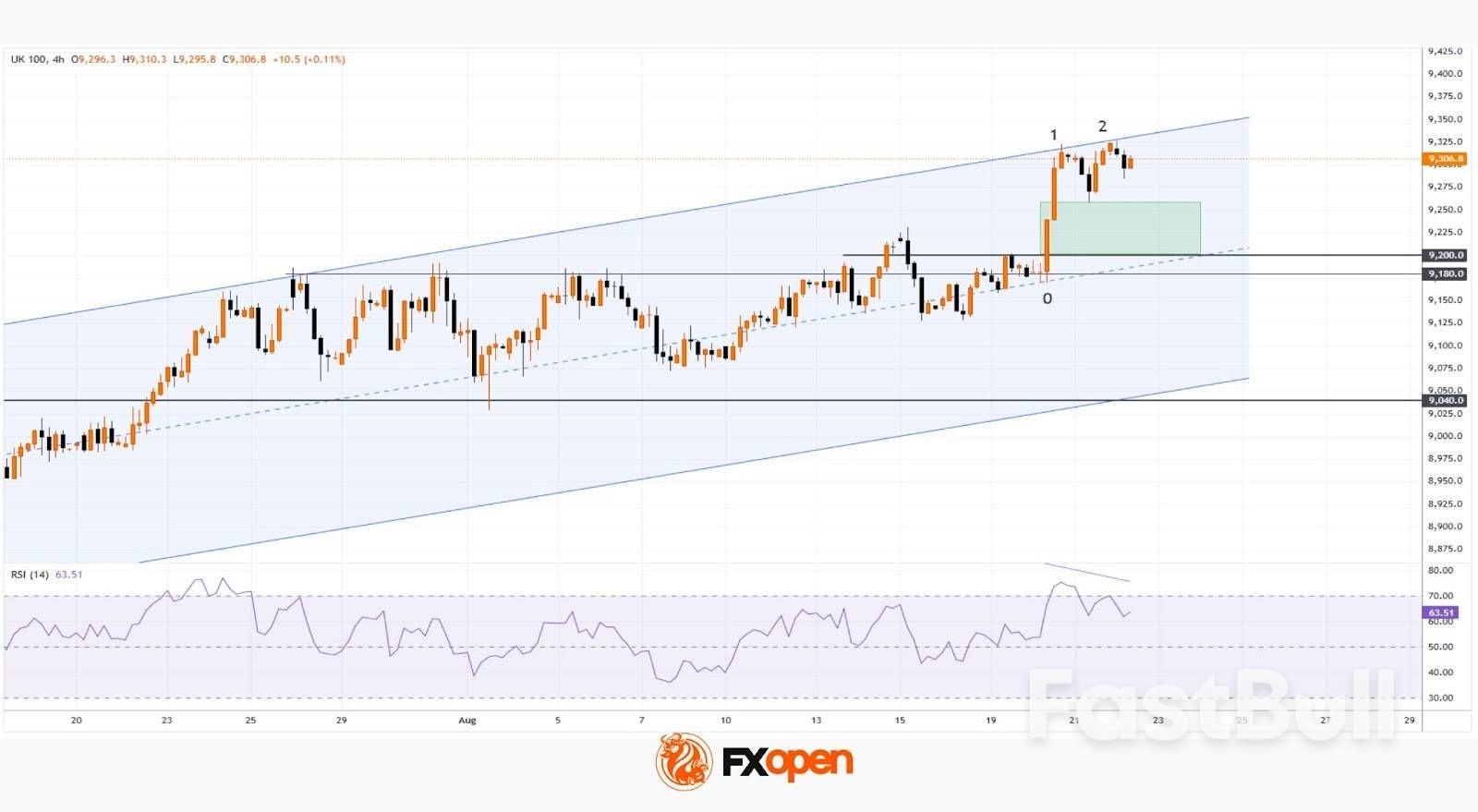
          Earlier, when analysing the chart of the UK’s FTSE 100 stock index (UK 100 on FXOpen), we outlined an ascending channel and anticipated a scenario with a continued upward trend and an attempt to establish a new historical high.

          Earlier, when analysing the chart of the UK’s FTSE 100 stock index (UK 100 on FXOpen), we outlined an ascending channel and anticipated a scenario with a continued upward trend and an attempt to establish a new historical high.

          Since then:

          → The index has risen by almost 5%. The channel structure has shifted slightly, but not dramatically – after adjustment, it remains relevant given the latest price dynamics.

          → Yesterday, the stock index climbed to 9,325, thereby setting an all-time high.

          Bullish sentiment was supported by news of a shrinking public sector deficit and increased private sector output. How might the situation develop further?
          Technical Analysis of the FTSE 100 Chart

          From a bullish perspective:

          → The market remains in bullish territory.

          → The price successfully broke through the resistance zone at 9,180–9,200 (in effect since late July).

          → The 0→1 impulse was strong, signalling buyers’ dominance.

          → The price remains above the 50% Fibonacci retracement of the 0→1 impulse, which may serve as support during a pullback.

          → Additional support could come from the green zone, where bulls were strong during the breakout above the 9,180–9,200 resistance area.

          From a bearish perspective: the upper boundary of the channel has confirmed its role as resistance. At the same time, peaks 1 and 2 have formed:

          → They show signs of a bearish Double Top pattern, creating bearish divergence with the RSI indicator.

          → The fact that the second peak is slightly above the first adds weight to the bearish case: this could have been a bull trap for late buyers, while in reality the rally may already be exhausted.

          The ability of bulls to keep the price above the green zone may confirm the strength of the FTSE 100 (UK 100 on FXOpen). Nevertheless, in the short term, scenarios involving pullbacks and retests of the mentioned support levels might be realised (as seen in early August, when the 9,040 level was tested in an aggressive manner).

          Source: FXOpen

          Risk Warnings and Disclaimers
          You understand and acknowledge that there is a high degree of risk involved in trading. Following any strategies or investment methods may lead to potential losses. The content on the site is provided by our contributors and analysts for information purposes only. You are solely responsible for determining whether any trading assets, securities, strategy, or any other product is suitable for investing based on your own investment objectives and financial situation.
          Add to Favorites
          Share

          Malaysia's Foreign Reserves Reach New 10-year Peak Of US$122b As Of Mid-August

          Daniel Carter

          Forex

          Economic

          Malaysia's international reserves continued to climb to reach a new 10-year high of US$122 billion as at Aug 15, 2025, from US$121.3 billion at end-July, according to Bank Negara Malaysia (BNM).
          The current reserves position is sufficient to finance 4.8 months of imports of goods and services and is equivalent to 0.9 times the country's total short-term external debt, the central bank said.
          Short-term external debt refers to borrowings by residents from non-residents with a maturity of one year or less. These are mostly taken by domestic banks for foreign currency liquidity management and by multinational corporations borrowing from their overseas parent entities.
          Such obligations are typically met through the borrowers' own external assets and do not pose direct claims on BNM's reserves.
          As at mid-August, foreign currency reserves stood at US$108.4 billion, up from US$107.7 billion at end-July. Malaysia's reserve position with the International Monetary Fund (IMF) remained at US$1.3 billion.
          Special drawing rights, the IMF-allocated reserve assets based on a basket of major currencies, were unchanged at US$5.9 billion, while the central bank's gold holdings also stayed steady at US$4.1 billion.
          Other reserve assets were maintained at US$2.3 billion.

          Source: Theedgemarkets

          To stay updated on all economic events of today, please check out our Economic calendar
          Risk Warnings and Disclaimers
          You understand and acknowledge that there is a high degree of risk involved in trading. Following any strategies or investment methods may lead to potential losses. The content on the site is provided by our contributors and analysts for information purposes only. You are solely responsible for determining whether any trading assets, securities, strategy, or any other product is suitable for investing based on your own investment objectives and financial situation.
          Add to Favorites
          Share

          US Dollar Index (DXY) Rises Ahead Of Fed Chair’s Speech

          FXOpen

          Forex

          Political

          Economic

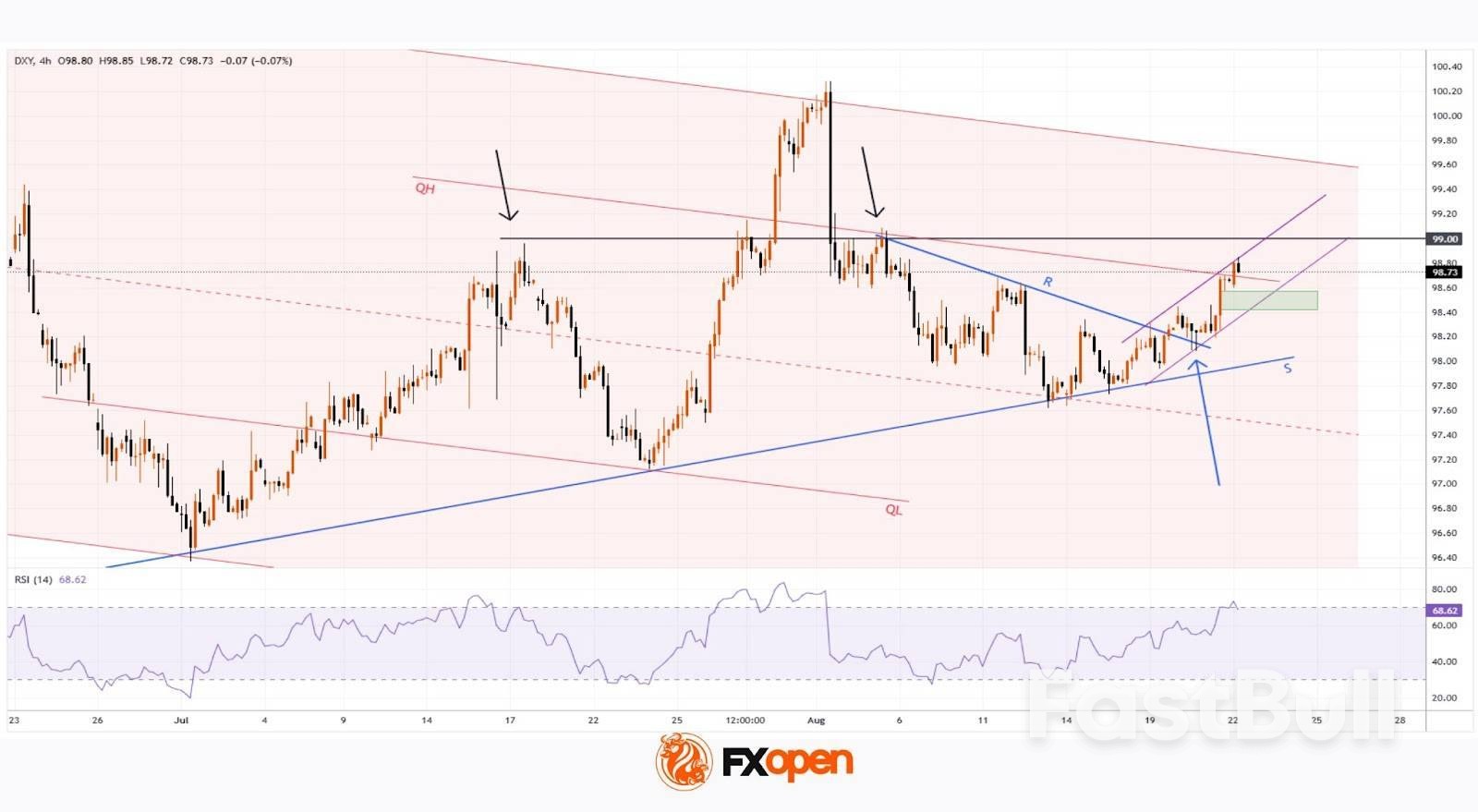
          On Monday, we:

          ● noted that the US Dollar Index (DXY) was consolidating at the start of a week packed with key events;

          ● outlined a descending channel (shown in red);

          ● highlighted that the price was trading around the channel’s median line, signalling a balanced market;

          ● suggested that a test of one of the quarter lines (QL or QH), which divide the channel into four parts, could take place.

          As the DXY chart indicates, since then the balance has shifted in favour of buyers, with the price forming an upward trajectory (shown in purple lines) and breaking through short-term resistance R (which has now turned into support, as marked by the blue arrow). Support line S remains relevant.

          Today brings the key event that may have the greatest impact on the US Dollar Index (DXY) this week – Jerome Powell’s speech at the annual Jackson Hole Symposium.

          This appearance is particularly significant because:

          ● it is likely to be Powell’s last speech after seven years as Fed Chair, with his term expiring in May amid ongoing tensions with President Trump;

          ● market participants will closely monitor the tone of his remarks, as a rate cut is expected in September, while recent economic data – namely the rise in the Producer Price Index – suggest that the US economy could face renewed inflationary pressures due to Trump’s tariffs.

          US Dollar Index (DXY) Rises Ahead Of Fed Chair’s Speech_1

          Technical analysis of the DXY chart

          From a bullish perspective, in the short term the US dollar is advancing within the purple channel, supported by:

          ● the lower boundary of this channel;

          ● the demand imbalance zone in favour of buyers (shown in green), confirmed by yesterday’s sharp bullish candle.

          From a bearish perspective:

          ● the RSI has entered overbought territory;

          ● bullish momentum may fade after a breakout above the QH line;

          ● a key resistance at the 99 level lies nearby – a level that reclaimed its role as resistance at the beginning of August (indicated by black arrows).

          A corrective pullback in the US Dollar Index (DXY) could happen after its rally to the highest level since 6 August. However, the further trajectory will largely depend on Powell’s words this evening. According to Forex Factory, the speech is scheduled for 17:00 GMT+3.

          Source: FXOpen

          To stay updated on all economic events of today, please check out our Economic calendar
          Risk Warnings and Disclaimers
          You understand and acknowledge that there is a high degree of risk involved in trading. Following any strategies or investment methods may lead to potential losses. The content on the site is provided by our contributors and analysts for information purposes only. You are solely responsible for determining whether any trading assets, securities, strategy, or any other product is suitable for investing based on your own investment objectives and financial situation.
          Add to Favorites
          Share

          Nikkei 225 Technical: A Potential Bullish Reversal Looms After 4% Decline As Market Breadth Improves With Earnings Upgrade

          MarketPulse by OANDA Group

          Economic

          Stocks

          Forex

          Technical Analysis

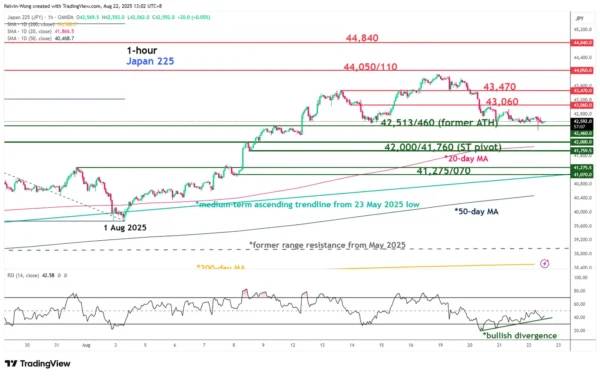
          The Japan 225 CFD Index (a proxy of the Nikkei 225 futures) rallied as expected and hit the first resistance level of 43,560 as mentioned in our previous report. It printed a fresh intraday record high of 43,943 on Monday, 18 August.Thereafter, it staged a decline of -4% to record an intraday low of 42,330 on Friday, 22 August, before it recovered to an intraday level of 42,570 at the time of writing.Several technical elements and a fundamental factor suggest that the ongoing 5-day decline is likely a minor corrective decline within its medium-term uptrend phase rather than the start of a medium-term bearish trend.

          Fig. 1: Japan 225 CFD Index minor trend as of 22 Aug 2025 (Source: TradingView)

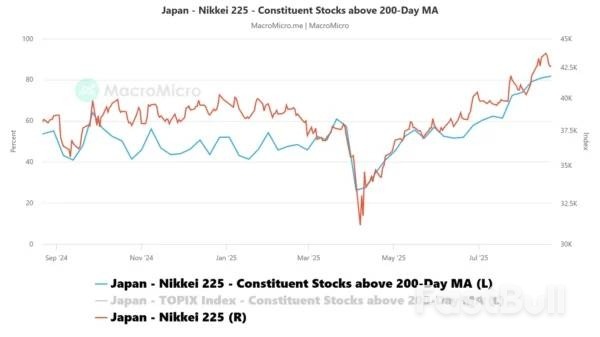
          Fig. 2: Nikkei 225 component stocks above 200-day as of 22 Aug 2025 (Source: MacroMicro)

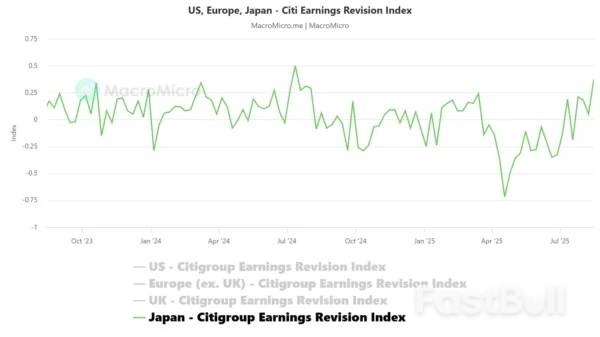
          Fig. 3: Japan Citigroup Earnings Revision Index as of 15 Aug 2025 (Source: MacroMicro)

          Preferred trend bias (1-3 days)

          Maintain a bullish bias with short-term pivotal support at 42,000/41,760 for the Japan 225 CFD Index, and a clearance above 43,060 sees the next intermediate resistances coming at 43,470 and 44,050/44,110 (Fibonacci extension cluster levels) (see Fig. 1).

          Key elements

          ● The 42,000/41,760 key support zone is likely an inflection point, a potential bullish reversal as it confluences with the 20-day moving average and 50% Fibonacci retracement of the prior minor up move from 1 August 2025 low to 18 August 2025 high.
          ● The hourly RSI momentum indicator has traced out a bullish divergence condition after it dropped towards its oversold region on Wednesday, 20 August. These observations suggest bearish momentum of the ongoing 5-day decline has started to ease.
          ● Market breadth has continued to improve; the percentage of the Nikkei 225 component stocks trading above their respective key 200-day moving averages has increased steadily since 1 August’s print of 74% to 82% as of Friday, August (see Fig. 2).
          ● Analysts, on average, have continued to upgrade their earnings outlook on Japanese corporations. The Citigroup Earnings Revision Index has been on a path of a steady uptrend since 18 April 2025’s 5-year low of -0.72; it has jumped to 0.37 as of 15 August 2025 from -0.19 printed on 18 July 2025 (see Fig. 3).

          Alternative trend bias (1 to 3 days)

          A break below the 41,760 key support invalidates the bullish recovery to see an extension of the corrective decline to expose the 41,275/41,070 medium-term support zone.

          Source: OANDA

          To stay updated on all economic events of today, please check out our Economic calendar
          Risk Warnings and Disclaimers
          You understand and acknowledge that there is a high degree of risk involved in trading. Following any strategies or investment methods may lead to potential losses. The content on the site is provided by our contributors and analysts for information purposes only. You are solely responsible for determining whether any trading assets, securities, strategy, or any other product is suitable for investing based on your own investment objectives and financial situation.
          Add to Favorites
          Share

          Germany’s Economy Contracts More Sharply as Tariff Pressures Weigh on Growth

          Gerik

          Economic

          Revised contraction reveals deeper weakness

          Official data released by the Federal Statistical Office showed that Germany’s economy contracted by 0.3% in the April–June period, compared with an earlier estimate of 0.1%. The revision underscores that both manufacturing and construction underperformed expectations, while household spending was also weaker than previously assessed. This follows modest growth of 0.3% in the first quarter, suggesting that the economy remains trapped in a fragile cycle of brief upticks followed by setbacks.
          Economists highlight the causal role of U.S. trade policy in shaping Germany’s second-quarter downturn. ING’s Carsten Brzeski pointed out that the strong first-quarter performance was artificially boosted by “front-loading,” where German exporters accelerated shipments to the U.S. ahead of tariff implementation. Once tariffs took effect in the second quarter, this temporary demand collapsed, causing a reversal. The direct causation here is clear: U.S. tariffs not only raised costs for German exports but also distorted the timing of shipments, leaving a vacuum of demand afterward.

          Domestic structural challenges

          Beyond tariffs, Germany’s contraction reflects structural weaknesses in industry and consumption. Output in both manufacturing and construction was revised downward, signaling persistent inefficiencies in sectors critical to economic resilience. Household spending also fell short, pointing to fragile consumer confidence amid high uncertainty. These factors are correlated with Germany’s broader struggles over the past two years, where repeated contractions have eroded momentum and contributed to the eurozone’s sluggish performance.
          Chancellor Friedrich Merz’s administration has made economic revitalization its central priority since taking office in May. The government has pledged a €500 billion ($582 billion) infrastructure and modernization fund over the next 12 years, designed to upgrade Germany’s outdated transport and digital networks. At the same time, dozens of companies have committed to invest €631 billion ($731.7 billion) in the country over the next three years, signaling corporate confidence despite near-term headwinds. While some of these pledges were previously planned, their consolidation is meant to strengthen investor sentiment and counteract external pressures.

          Outlook and recovery prospects

          Economists caution that recovery will take time. Brzeski noted that it may not be until 2026 that a more sustained rebound materializes, as Germany works through both the direct consequences of U.S. tariffs and internal bottlenecks. The causal chain here is twofold: trade restrictions directly suppress export demand, while domestic underinvestment and lagging digitization slow Germany’s ability to adapt. Correlationally, global uncertainty amplifies these weaknesses, as companies hesitate to expand amid volatile trade relations.
          Germany’s sharper-than-expected contraction illustrates how external shocks and internal inefficiencies can reinforce one another. While massive investment commitments offer long-term hope, the near-term trajectory suggests continued vulnerability until trade tensions ease and domestic reforms begin to bear fruit.

          Source: AP

          To stay updated on all economic events of today, please check out our Economic calendar
          Risk Warnings and Disclaimers
          You understand and acknowledge that there is a high degree of risk involved in trading. Following any strategies or investment methods may lead to potential losses. The content on the site is provided by our contributors and analysts for information purposes only. You are solely responsible for determining whether any trading assets, securities, strategy, or any other product is suitable for investing based on your own investment objectives and financial situation.
          Add to Favorites
          Share

          China’s Rare Earth Imports from U.S. Spike Amid Supply Shift

          Gerik

          Economic

          Commodity

          Final shipments from MP Materials

          China’s July customs data revealed a sharp increase in rare earth ore imports from the U.S., reaching 4,719 metric tons after recording zero in June. Analysts attribute this spike to the final accounting of shipments from MP Materials, the sole U.S. rare earth miner. Despite the surge, the company had already ceased exports to China by July after the U.S. Department of Defense invested in MP, effectively becoming its largest shareholder. This move was aimed at reshaping the causal structure of global supply chains: Washington sought to reduce U.S. dependence on Chinese processing capacity while simultaneously preventing U.S.-sourced minerals from reinforcing Beijing’s dominance.
          MP clarified that its last shipments were sent in the second quarter, suggesting that July’s customs spike was due to logistical factors such as ocean transit times and warehousing delays. The discrepancy between actual export cessation and customs reporting highlights a correlation between administrative lags and trade data volatility. This does not signal a renewed trade flow but rather the clearing of existing contracts.

          China’s rare earth magnet rebound

          Coinciding with the surge in ore imports, China’s exports of rare earth magnets critical components in electric vehicles, wind turbines, and defense systems rose significantly. Exports to the U.S. increased by 75.5% month-on-month to 619 tons, representing a 4.8% year-on-year rise. The timing suggests a correlation: while U.S. ore shipments were winding down, China was ramping up downstream product exports, underlining its entrenched strength in processing and value-added segments of the supply chain.
          The developments reflect a shifting balance in rare earth trade. On one hand, the U.S. is seeking to secure supply chains domestically through MP and government investment, showing a causal link between policy intervention and reshoring attempts. On the other hand, China remains the dominant processor and exporter of finished rare earth products, reinforcing its central role in industries tied to clean energy and defense. The dual trend underscores how raw material trade restrictions may not immediately diminish China’s leverage, as its control lies primarily in processing capacity rather than raw extraction.
          The July data underscores a transitional moment: U.S. raw ore shipments are ending, yet China continues to strengthen its grip on rare earth magnet exports. This divergence illustrates the complexity of supply chain realignment, where U.S. policy intervention may secure resources domestically but does not quickly offset China’s strategic advantage in refining and high-value manufacturing.

          Source: Reuters

          To stay updated on all economic events of today, please check out our Economic calendar
          Risk Warnings and Disclaimers
          You understand and acknowledge that there is a high degree of risk involved in trading. Following any strategies or investment methods may lead to potential losses. The content on the site is provided by our contributors and analysts for information purposes only. You are solely responsible for determining whether any trading assets, securities, strategy, or any other product is suitable for investing based on your own investment objectives and financial situation.
          Add to Favorites
          Share

          India and Russia Strengthen Economic Ties Despite U.S. Tariff Pressure

          Gerik

          Economic

          Political

          Energy cooperation as strategic foundation

          At a joint press conference in Moscow, Indian foreign minister Subrahmanyam Jaishankar and his Russian counterpart Sergei Lavrov reaffirmed their intention to expand trade. India plans to boost exports of pharmaceuticals, agriculture, and textiles to Russia in order to narrow the imbalance created by soaring energy imports. Bilateral trade reached $68.7 billion in the year ended March 2025, yet India’s reliance on Russian oil contributed to a $59 billion deficit. This demonstrates a direct causal link: increased energy imports drive the widening trade gap, prompting India to diversify exports as a corrective measure.
          Energy remains the cornerstone of the relationship. Russia has committed to maintaining crude shipments to India, with plans for joint ventures in the Russian Far East and Arctic shelf. Lavrov described these initiatives as vital for regional security and stability. India’s crude purchases averaged 1.6 million barrels per day in the first half of 2025, a dramatic rise from just 50,000 bpd in 2020. This escalation correlates with Moscow’s need for alternative buyers amid Western sanctions, while causally securing India cheaper supplies and reinforcing its energy security. In turn, Washington views this trade as undercutting its sanctions regime, intensifying U.S. scrutiny of New Delhi.

          Labor and economic integration

          Jaishankar also highlighted plans to send Indian workers with skills in IT, engineering, and construction to Russia to alleviate its labor shortages. This initiative illustrates a causal mechanism: Russia’s workforce constraints, exacerbated by war-related disruptions and demographic decline, create demand for foreign labor, which India can supply. For New Delhi, the arrangement secures employment opportunities abroad while further embedding economic interdependence with Moscow.
          The Trump administration has threatened tariffs of up to 50% on Indian exports in response to its Russian oil purchases, contrasting sharply with Washington’s softer stance toward China, which imports even more Russian crude at around 2 million bpd. Analysts note a discrepancy: while China’s purchases are treated as continuity of pre-war trade, India’s sharp increase is framed as profiteering. This shows a correlation rather than a strict causal policy logic, as U.S. pressure reflects strategic leverage-seeking rather than purely sanctions enforcement. Experts argue the true aim is to extract concessions from New Delhi in parallel with attempts to influence Russia toward a ceasefire in Ukraine.

          Strategic resilience of India-Russia ties

          Despite external pressure, both sides stress that their partnership dating back to the 1970s remains one of the most stable in global geopolitics. Research fellow Daniel Balazs suggested that U.S. tariffs could paradoxically act as a catalyst for India to deepen ties with Russia and even participate in a trilateral framework with China. This dynamic highlights a feedback loop: external pressure from Washington accelerates alternative alignments in Eurasia, potentially shifting the regional balance of power.
          India’s strategy illustrates a calculated balancing act. By diversifying exports, supplying labor, and doubling down on energy cooperation, New Delhi strengthens its economic and political bond with Moscow. U.S. tariffs, intended as a deterrent, may instead reinforce this partnership, underscoring how external pressure can sometimes harden rather than weaken strategic alignments.

          Source: CNBC

          To stay updated on all economic events of today, please check out our Economic calendar
          Risk Warnings and Disclaimers
          You understand and acknowledge that there is a high degree of risk involved in trading. Following any strategies or investment methods may lead to potential losses. The content on the site is provided by our contributors and analysts for information purposes only. You are solely responsible for determining whether any trading assets, securities, strategy, or any other product is suitable for investing based on your own investment objectives and financial situation.
          Add to Favorites
          Share
          FastBull
          Copyright © 2025 FastBull Ltd

          728 RM B 7/F GEE LOK IND BLDG NO 34 HUNG TO RD KWUN TONG KLN HONG KONG

          TelegramInstagramTwitterfacebooklinkedin
          App Store Google Play Google Play
          Products
          Charts

          Chats

          Q&A with Experts
          Screeners
          Economic Calendar
          Data
          Tools
          Membership
          Features
          Function
          Markets
          Copy Trading
          Latest Signals
          Contests
          News
          Analysis
          24/7
          Columns
          Education
          Company
          Careers
          About Us
          Contact Us
          Advertising
          Help Center
          Feedback
          User Agreement
          Privacy Policy
          Business

          White Label

          Data API

          Web Plug-ins

          Poster Maker

          Affiliate Program

          Risk Disclosure

          The risk of loss in trading financial instruments such as stocks, FX, commodities, futures, bonds, ETFs and crypto can be substantial. You may sustain a total loss of the funds that you deposit with your broker. Therefore, you should carefully consider whether such trading is suitable for you in light of your circumstances and financial resources.

          No decision to invest should be made without thoroughly conducting due diligence by yourself or consulting with your financial advisors. Our web content might not suit you since we don't know your financial conditions and investment needs. Our financial information might have latency or contain inaccuracy, so you should be fully responsible for any of your trading and investment decisions. The company will not be responsible for your capital loss.

          Without getting permission from the website, you are not allowed to copy the website's graphics, texts, or trademarks. Intellectual property rights in the content or data incorporated into this website belong to its providers and exchange merchants.

          Not Logged In

          Log in to access more features

          FastBull Membership

          Not yet

          Purchase

          Become a signal provider
          Help Center
          Customer Service
          Dark Mode
          Price Up/Down Colors

          Log In

          Sign Up
          Position
          Layout
          Fullscreen
          Default to Chart
          The chart page opens by default when you visit fastbull.com