
• Trade
  • Markets
  • Copy
  • Contests
  • News
  • 24/7
  • Calendar
  • Q&A
  • Chats
Trending
Screeners
SYMBOL
LAST
BID
ASK
HIGH
LOW
NET CHG.
%CHG.
SPREAD
SPX
S&P 500 Index
6827.42
6827.42
6827.42
6899.86
6801.80
-73.58
-1.07%
--
DJI
Dow Jones Industrial Average
48458.04
48458.04
48458.04
48886.86
48334.10
-245.98
-0.51%
--
IXIC
NASDAQ Composite Index
23195.16
23195.16
23195.16
23554.89
23094.51
-398.69
-1.69%
--
USDX
US Dollar Index
97.950
98.030
97.950
98.500
97.950
-0.370
-0.38%
--
EURUSD
Euro / US Dollar
1.17394
1.17409
1.17394
1.17496
1.17192
+0.00011
+ 0.01%
--
GBPUSD
Pound Sterling / US Dollar
1.33707
1.33732
1.33707
1.33997
1.33419
-0.00148
-0.11%
--
XAUUSD
Gold / US Dollar
4299.39
4299.39
4299.39
4353.41
4257.10
+20.10
+ 0.47%
--
WTI
Light Sweet Crude Oil
57.233
57.485
57.233
58.011
56.969
-0.408
-0.71%
--

Community Accounts

Signal Accounts
--
Profit Accounts
--
Loss Accounts
--
View More

Become a signal provider

Sell trading signals to earn additional income

View More

Guide to Copy Trading

Get started with ease and confidence

View More

Signal Accounts for Members

All Signal Accounts

Best Return
  • Best Return
  • Best P/L
  • Best MDD
Past 1W
  • Past 1W
  • Past 1M
  • Past 1Y

All Contests

  • All
  • Trump Updates
  • Recommend
  • Stocks
  • Cryptocurrencies
  • Central Banks
  • Featured News
Top News Only
Share

Iranian Media Says 18 Crew Members Of Foreign Tanker Seized In Gulf Of Oman Over Carrying 'Smuggled Fuel' Detained

Share

Regional Governor: Two Killed In Ukrainian Drone Strike On Russia's Saratov

Share

Chinese Foreign Ministry - China Foreign Minister Met With United Arab Emirates Counterpart On Dec 12

Share

China's Central Financial And Economic Affairs Commission Deputy Director: Will Expand Export And Increase Import In 2026

Share

Thai Leader Anutin: Landmine Blast That Killed Thai Soldiers 'Not A Roadside Accident'

Share

Thai Leader Anutin: Thailand To Continue Military Action Until 'We Feel No More Harm'

Share

Cambodian Prime Minister Hun Manet Says He Had Phone Calls With Trump And Malaysian Leader Anwar About Ceasefire

Share

Cambodia's Hun Manet Says USA, Malaysia Should Verify 'Which Side Fired First' In Latest Conflict

Share

Cambodia's Hun Manet: Cambodia Maintains Its Stance In Seeking Peaceful Resolution Of Disputes

Share

Nasdaq Companies: Allergan, Ferrovia, Insmed, Monolithic Power Systems, Seagate Technology, And Western Digital Will Be Added To The NASDAQ 100 Index. Biogen, CdW, GlobalFoundries, Lululemon, ON Semiconductor, And Tradedesk Will Be Removed From The NASDAQ 100 Index

Share

Witkoff Headed To Berlin This Weekend To Meet With Zelenskiy, European Leaders -Wsj Reporter On X

Share

Russia Attacks Two Ukrainian Ports, Damaging Three Turkish-Owned Vessels

Share

[Historic Flooding Occurs In At Least Four Rivers In Washington State Due To Days Of Torrential Rains] Multiple Areas In Washington State Have Been Hit By Severe Flooding Due To Days Of Torrential Rains, With At Least Four Rivers Experiencing Historic Flooding. Reporters Learned On The 12th That The Floods Caused By The Torrential Rains In Washington State Have Destroyed Homes And Closed Several Highways. Experts Warn That Even More Severe Flooding May Occur In The Future. A State Of Emergency Has Been Declared In Washington State

Share

Trump Says Proposed Free Economic Zone In Donbas Would Work

Share

Trump: I Think My Voice Should Be Heard

Share

Trump Says Will Be Choosing New Fed Chair In Near Future

Share

Trump Says Proposed Free Economic Zone In Donbas Complex But Would Work

Share

Trump Says Land Strikes In Venezuela Will Start Happening

Share

US President Trump: Thailand And Cambodia Are In A Good Situation

Share

State Media: North Korean Leader Kim Hails Troops Returning From Russia Mission

TIME
ACT
FCST
PREV
U.K. Trade Balance Non-EU (SA) (Oct)

A:--

F: --

P: --

U.K. Trade Balance (Oct)

A:--

F: --

P: --

U.K. Services Index MoM

A:--

F: --

P: --

U.K. Construction Output MoM (SA) (Oct)

A:--

F: --

P: --

U.K. Industrial Output YoY (Oct)

A:--

F: --

P: --

U.K. Trade Balance (SA) (Oct)

A:--

F: --

P: --

U.K. Trade Balance EU (SA) (Oct)

A:--

F: --

P: --

U.K. Manufacturing Output YoY (Oct)

A:--

F: --

P: --

U.K. GDP MoM (Oct)

A:--

F: --

P: --

U.K. GDP YoY (SA) (Oct)

A:--

F: --

P: --

U.K. Industrial Output MoM (Oct)

A:--

F: --

P: --

U.K. Construction Output YoY (Oct)

A:--

F: --

P: --

France HICP Final MoM (Nov)

A:--

F: --

P: --

China, Mainland Outstanding Loans Growth YoY (Nov)

A:--

F: --

P: --

China, Mainland M2 Money Supply YoY (Nov)

A:--

F: --

P: --

China, Mainland M0 Money Supply YoY (Nov)

A:--

F: --

P: --

China, Mainland M1 Money Supply YoY (Nov)

A:--

F: --

P: --

India CPI YoY (Nov)

A:--

F: --

P: --

India Deposit Gowth YoY

A:--

F: --

P: --

Brazil Services Growth YoY (Oct)

A:--

F: --

P: --

Mexico Industrial Output YoY (Oct)

A:--

F: --

P: --

Russia Trade Balance (Oct)

A:--

F: --

P: --

Philadelphia Fed President Henry Paulson delivers a speech
Canada Building Permits MoM (SA) (Oct)

A:--

F: --

P: --

Canada Wholesale Sales YoY (Oct)

A:--

F: --

P: --

Canada Wholesale Inventory MoM (Oct)

A:--

F: --

P: --

Canada Wholesale Inventory YoY (Oct)

A:--

F: --

P: --

Canada Wholesale Sales MoM (SA) (Oct)

A:--

F: --

P: --

Germany Current Account (Not SA) (Oct)

A:--

F: --

P: --

U.S. Weekly Total Rig Count

A:--

F: --

P: --

U.S. Weekly Total Oil Rig Count

A:--

F: --

P: --

Japan Tankan Large Non-Manufacturing Diffusion Index (Q4)

--

F: --

P: --

Japan Tankan Small Manufacturing Outlook Index (Q4)

--

F: --

P: --

Japan Tankan Large Non-Manufacturing Outlook Index (Q4)

--

F: --

P: --

Japan Tankan Large Manufacturing Outlook Index (Q4)

--

F: --

P: --

Japan Tankan Small Manufacturing Diffusion Index (Q4)

--

F: --

P: --

Japan Tankan Large Manufacturing Diffusion Index (Q4)

--

F: --

P: --

Japan Tankan Large-Enterprise Capital Expenditure YoY (Q4)

--

F: --

P: --

U.K. Rightmove House Price Index YoY (Dec)

--

F: --

P: --

China, Mainland Industrial Output YoY (YTD) (Nov)

--

F: --

P: --

China, Mainland Urban Area Unemployment Rate (Nov)

--

F: --

P: --

Saudi Arabia CPI YoY (Nov)

--

F: --

P: --

Euro Zone Industrial Output YoY (Oct)

--

F: --

P: --

Euro Zone Industrial Output MoM (Oct)

--

F: --

P: --

Canada Existing Home Sales MoM (Nov)

--

F: --

P: --

Euro Zone Total Reserve Assets (Nov)

--

F: --

P: --

U.K. Inflation Rate Expectations

--

F: --

P: --

Canada National Economic Confidence Index

--

F: --

P: --

Canada New Housing Starts (Nov)

--

F: --

P: --

U.S. NY Fed Manufacturing Employment Index (Dec)

--

F: --

P: --

U.S. NY Fed Manufacturing Index (Dec)

--

F: --

P: --

Canada Core CPI YoY (Nov)

--

F: --

P: --

Canada Manufacturing Unfilled Orders MoM (Oct)

--

F: --

P: --

Canada Manufacturing New Orders MoM (Oct)

--

F: --

P: --

Canada Core CPI MoM (Nov)

--

F: --

P: --

Canada Manufacturing Inventory MoM (Oct)

--

F: --

P: --

Canada CPI YoY (Nov)

--

F: --

P: --

Canada CPI MoM (Nov)

--

F: --

P: --

Canada CPI YoY (SA) (Nov)

--

F: --

P: --

Canada Core CPI MoM (SA) (Nov)

--

F: --

P: --

Q&A with Experts
    • All
    • Chatrooms
    • Groups
    • Friends
    Connecting
    .
    .
    .
    Type here...
    Add Symbol or Code

      No matching data

      All
      Trump Updates
      Recommend
      Stocks
      Cryptocurrencies
      Central Banks
      Featured News
      • All
      • Russia-Ukraine Conflict
      • Middle East Flashpoint
      • All
      • Russia-Ukraine Conflict
      • Middle East Flashpoint

      Search
      Products

      Charts Free Forever

      Chats Q&A with Experts
      Screeners Economic Calendar Data Tools
      Membership Features
      Data Warehouse Market Trends Institutional Data Policy Rates Macro

      Market Trends

      Market Sentiment Order Book Forex Correlations

      Top Indicators

      Charts Free Forever
      Markets

      News

      News Analysis 24/7 Columns Education
      From Institutions From Analysts
      Topics Columnists

      Latest Views

      Latest Views

      Trending Topics

      Top Columnists

      Latest Update

      Signals

      Copy Rankings Latest Signals Become a signal provider AI Rating
      Contests
      Brokers

      Overview Brokers Assessment Rankings Regulators News Claims
      Broker listing Forex Brokers Comparison Tool Live Spread Comparison Scam
      Q&A Complaint Scam Alert Videos Tips to Detect Scam
      More

      Business
      Events
      Careers About Us Advertising Help Center

      White Label

      Data API

      Web Plug-ins

      Affiliate Program

      Awards Institution Evaluation IB Seminar Salon Event Exhibition
      Vietnam Thailand Singapore Dubai
      Fans Party Investment Sharing Session
      FastBull Summit BrokersView Expo
      Recent Searches
        Top Searches
          Markets
          News
          Analysis
          User
          24/7
          Economic Calendar
          Education
          Data
          • Names
          • Latest
          • Prev

          View All

          No data

          Scan to Download

          Faster Charts, Chat Faster!

          Download App
          English
          • English
          • Español
          • العربية
          • Bahasa Indonesia
          • Bahasa Melayu
          • Tiếng Việt
          • ภาษาไทย
          • Français
          • Italiano
          • Türkçe
          • Русский язык
          • 简中
          • 繁中
          Open Account
          Search
          Products
          Charts Free Forever
          Markets
          News
          Signals

          Copy Rankings Latest Signals Become a signal provider AI Rating
          Contests
          Brokers

          Overview Brokers Assessment Rankings Regulators News Claims
          Broker listing Forex Brokers Comparison Tool Live Spread Comparison Scam
          Q&A Complaint Scam Alert Videos Tips to Detect Scam
          More

          Business
          Events
          Careers About Us Advertising Help Center

          White Label

          Data API

          Web Plug-ins

          Affiliate Program

          Awards Institution Evaluation IB Seminar Salon Event Exhibition
          Vietnam Thailand Singapore Dubai
          Fans Party Investment Sharing Session
          FastBull Summit BrokersView Expo

          2025 Global Market Outlook: The Mechazilla Moment

          RussellInvestments

          Economic

          Summary:

          2025 will be another year of overcoming challenges and redefining limits against a backdrop of high U.S. equity market valuations, mega-cap dominance, and the uncertainty surrounding the policy agenda of U.S. President-elect Donald Trump. Our focus is on building resilient portfolios that can adapt to a wide range of scenarios.

          Despite the tightest U.S. Federal Reserve (Fed) policy since the early 2000s and a deeply inverted Treasury yield curve, the U.S. economy defied expectations with above-trend GDP growth, robust job creation, a 25% surge in the S&P 500 Index, and double-digit earnings growth.
          2025 will be another year of overcoming challenges and redefining limits against a backdrop of high U.S. equity market valuations, mega-cap dominance, and the uncertainty surrounding the policy agenda of U.S. President-elect Donald Trump. Our focus is on building resilient portfolios that can adapt to a wide range of scenarios.
          Key economic views

          Looking into 2025, we anticipate a soft landing for the U.S. economy. Our assumption is that the new administration will ease its more aggressive stances on tariffs and immigration. With these dynamics in mind, here are our key economic views for 2025:
          U.S. Growth and Policy Trade-offs
          The U.S. economy is expected to grow at a trend-like pace of 2.0% in 2025 in response to the lagged impact of tight Fed monetary policy. Core personal consumption expenditures (PCE) inflation is projected to move closer to the Fed’s 2% target, while the central bank eases rates gradually, with the fed funds rate likely to reach 3.25% by year-end—aligning with its neutral level.
          The Trump administration’s policies present a delicate balancing act. Tax reforms and deregulation are likely to stimulate growth, particularly in domestic and cyclical sectors. Tariffs and immigration restrictions, however, could trigger a stagflationary shock that might have the Fed contemplating a rate hike as the economy weakens.
          Our working assumption is that the new administration will not aggressively pursue policies that create inflation risk. One clear message from the election is that U.S. voters were unhappy with the inflation of the Biden years. Tariffs and immigration controls are likely to be implemented, but their extent will be constrained by the inflation outlook. On balance, we see the policy mix as supportive for business confidence, which is likely to drive a resurgence in capital markets and provide positive tailwinds for private assets.
          Global Headwinds and Policy Divergences
          Outside the U.S., growth will likely remain under pressure. Trade policy uncertainty and tariffs will weigh heavily on Europe. The European Central Bank (ECB) is likely to cut its deposit rate to 1.5% by year-end to offset the tariff impact and the continued stagnation of the German economy.
          The UK faces sluggish productivity growth, labor constraints, and inflationary impacts from higher taxes under the new Labour government. The Bank of England’s (BoE) capacity to ease is constrained, with the base rate likely to decline only modestly to 3.75%–4.0%.
          Japan remains an outlier, supported by a virtuous wage-price spiral that will anchor inflation expectations near 2%, allowing the Bank of Japan (BoJ) to further normalize policy. Rates could rise to a 30-year high of 0.75% by year-end.
          China faces headwinds from the property market collapse, deflation pressures, and U.S. tariffs. The policy response continues to be reactionary, rather than one where proactive steps are taken to solve structural problems such as high savings and low household consumption. There are downside risks to consensus expectations for 4.5% GDP (gross domestic product) growth in 2025.
          Market Sentiment and Valuations
          Three defining features of the market outlook for 2025 are the elevated level of the S&P 500 forward P/E (price-to-earnings) ratio at 22x, the potential for further U.S. dollar strength, and the direction of the U.S. 10-year Treasury yield.
          Elevated equity valuations make the U.S. market vulnerable to negative surprises, and further dollar strength will challenge emerging markets. Sustained U.S. Treasury yields above 4.5% could challenge equities, diminishing the earnings yield advantage stocks have enjoyed over bonds since 2002.
          Looking into 2025, we anticipate a soft landing for the U.S. economy. Our assumption is that the new administration will ease its more aggressive stances on tariffs and immigration. With these dynamics in mind, here are our key economic views for 2025:
          U.S. Growth and Policy Trade-offs
          The U.S. economy is expected to grow at a trend-like pace of 2.0% in 2025 in response to the lagged impact of tight Fed monetary policy. Core personal consumption expenditures (PCE) inflation is projected to move closer to the Fed’s 2% target, while the central bank eases rates gradually, with the fed funds rate likely to reach 3.25% by year-end—aligning with its neutral level.
          The Trump administration’s policies present a delicate balancing act. Tax reforms and deregulation are likely to stimulate growth, particularly in domestic and cyclical sectors. Tariffs and immigration restrictions, however, could trigger a stagflationary shock that might have the Fed contemplating a rate hike as the economy weakens.
          Our working assumption is that the new administration will not aggressively pursue policies that create inflation risk. One clear message from the election is that U.S. voters were unhappy with the inflation of the Biden years. Tariffs and immigration controls are likely to be implemented, but their extent will be constrained by the inflation outlook. On balance, we see the policy mix as supportive for business confidence, which is likely to drive a resurgence in capital markets and provide positive tailwinds for private assets.
          Global Headwinds and Policy Divergences
          Outside the U.S., growth will likely remain under pressure. Trade policy uncertainty and tariffs will weigh heavily on Europe. The European Central Bank (ECB) is likely to cut its deposit rate to 1.5% by year-end to offset the tariff impact and the continued stagnation of the German economy.
          The UK faces sluggish productivity growth, labor constraints, and inflationary impacts from higher taxes under the new Labour government. The Bank of England’s (BoE) capacity to ease is constrained, with the base rate likely to decline only modestly to 3.75%–4.0%.
          Japan remains an outlier, supported by a virtuous wage-price spiral that will anchor inflation expectations near 2%, allowing the Bank of Japan (BoJ) to further normalize policy. Rates could rise to a 30-year high of 0.75% by year-end.
          China faces headwinds from the property market collapse, deflation pressures, and U.S. tariffs. The policy response continues to be reactionary, rather than one where proactive steps are taken to solve structural problems such as high savings and low household consumption. There are downside risks to consensus expectations for 4.5% GDP (gross domestic product) growth in 2025.
          Market Sentiment and Valuations
          Three defining features of the market outlook for 2025 are the elevated level of the S&P 500 forward P/E (price-to-earnings) ratio at 22x, the potential for further U.S. dollar strength, and the direction of the U.S. 10-year Treasury yield.
          Elevated equity valuations make the U.S. market vulnerable to negative surprises, and further dollar strength will challenge emerging markets. Sustained U.S. Treasury yields above 4.5% could challenge equities, diminishing the earnings yield advantage stocks have enjoyed over bonds since 2002.

          Key portfolio themes

          Portfolio Considerations for 2025
          As we navigate 2025, the interplay between the shifting policy landscapes and evolving market conditions calls for thoughtful portfolio construction. Building on the macroeconomic backdrop—defined by resilience in U.S. growth, potential disruptions from trade and immigration policies, emerging opportunities in AI (artificial intelligence)-driven productivity and growth in private markets—three strategic themes guide our approach:
          Balancing U.S. Growth Amid Policy Shifts
          The U.S. economy is resilient as it enters 2025, but the road ahead will be shaped by shifting policy dynamics. On the positive side, tax cuts and deregulation could provide a meaningful growth boost, particularly to domestic and cyclical sectors. Given lower valuations and improving sentiment, we are more positive on U.S. small cap equity than we have been in prior years. Large cap dominance in both earnings and price appreciation will require a catalyst to shift returns in the small cap direction. Potential deregulation and lower interest rates could be such a catalyst. We believe companies leveraging AI technologies to enhance productivity—especially in industrials and healthcare—could see material improvements to operating fundamentals.
          On the flip side, rising trade tensions and potential restrictions on immigration could disrupt labor markets and supply chains, creating risks to growth. This balancing act introduces greater volatility across markets, providing more opportunities for our active managers.
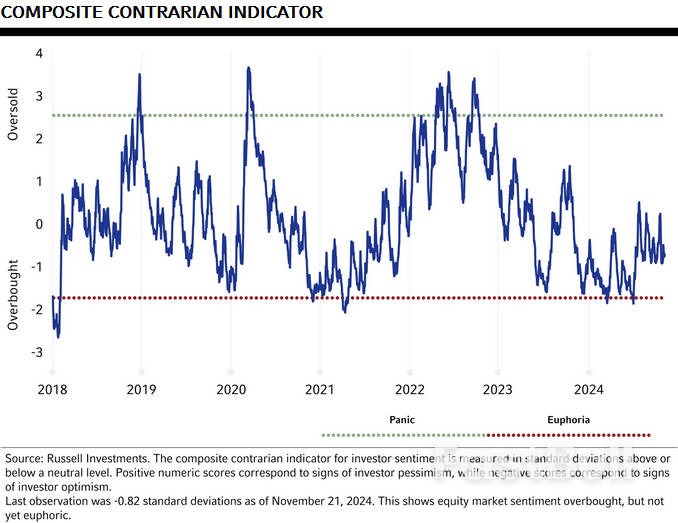
          We also expect more opportunities in the next 12 months to tactically calibrate total portfolio risks around a robust strategic asset allocation. For example, in July 2024, we reduced equity risk as our analysis indicated that markets were stretched, and investor sentiment was overly optimistic. When markets corrected in early August amid concerns about slowing U.S. growth, sentiment shifted, creating an opportunity to add risk back into portfolios. This disciplined approach serves as a model for navigating the dynamic market environment we anticipate in 2025.2025 Global Market Outlook: The Mechazilla Moment_1
          Asset Class Implications:
          Equity: We are focused on U.S. small caps, where post-election dynamics, improving earnings, and attractive valuations may create compelling opportunities. We also see growth managers targeting high-growth cyclicals like software, while value managers identify M&A (mergers and acquisitions) potential in financials and healthcare. Core managers are balancing cyclical exposure and managing risks in rate-sensitive sectors.
          In addition, we expect increased market volatility from U.S. foreign policy actions to create opportunities for active managers to find quality companies temporarily impacted by headline risks.
          Fixed Income: We see a steepening yield curve offering opportunities in short-term bonds, as short-term rates are expected to decline faster than long-term yields. Credit markets may have limited upside due to tight spreads, particularly in U.S. high-yield and investment-grade bonds. This creates an opportunity to expand fixed income exposure into areas with more attractive risk/return trade-offs, such as emerging-market U.S. dollar bonds and private credit.
          Currencies: The U.S. dollar is expected to face upward pressure from tariffs, the strength of the U.S. economy, and a less dovish Fed compared to other central banks. However, its valuation remains high, and emerging market currencies have already been under pressure. Given this, we are keeping currency bets in portfolios limited for 2025, while staying alert to any opportunities and risks that may arise throughout the year.
          Private Markets: The New Growth Engine
          Private markets continue to play an increasingly vital role in the evolving landscape of capital flows, as the shift away from public markets accelerates with fewer IPOs (initial public offerings) and later-stage listings. This transformation is particularly evident in AI opportunities, where venture capital investments now make up 27% of deals and 41% of capital raised.In our view investors can benefit from broadening portfolios into private markets. The upcoming policy environment may also be more favorable for private markets, with stabilizing interest rates, easing regulations, and rising M&A activity. However, the influx of capital into U.S. private markets has led to sourcing challenges, which makes international opportunities more attractive. In particular, Europe offers compelling middle-market consolidation opportunities in fragmented industries, Japan benefits from ongoing corporate reforms and asset divestitures, and the Persian Gulf states are emerging as dynamic investment hubs thanks to progressive regulations and large-scale development initiatives. Infrastructure also presents a key opportunity, as hybrid investment models that incorporate both private and public markets unlock substantial growth potential.
          We believe a multi-manager approach is crucial in this landscape. By diversifying across specialized managers, particularly in real assets, investors can access a broader range of opportunities that blend public and private market investments. This strategy creates more resilient portfolios and allows investments in sectors such as data centers and warehousing, where combining private and public market exposures is especially productive for a total portfolio.
          Market Implications:
          Private Equity: We are focused on private equity opportunities in European middle-market consolidation, along with continued growth in Japan and the Persian Gulf states. Managers with sector-specific expertise are outperforming generalists, and we believe that portfolios can benefit from this trend.
          AI and Tech: We believe private market ventures in AI, particularly those focused on scaling innovative technologies across industries, will continue to be key drivers of long-term growth. We are actively looking for investments in AI-driven companies that are poised to enhance productivity and reshape industries.
          Private Credit: We see private credit as a resilient asset class, particularly in the current higher-rate environment. With asset-based lending and European direct lending providing attractive relative value, we are broadening our fixed income exposures into these areas to capture higher yields and better diversification.
          Infrastructure: We are favorable to infrastructure as a long-term growth anchor and a hedge against inflation. The asset class has proven resilient during recent market volatility and benefits from long-term trends such as the energy transition, renewable energy, and digitalization. Increasing demand for sustainable and digital infrastructure continues to drive significant capital inflows. Additionally, hybrid models combining private and public market exposure are unlocking new growth potential.
          Venture Capital: We see significant opportunities in AI-driven venture capital, particularly in early-stage companies with the potential to reshape industries. As the VC market stabilizes, we are concentrating on firms with strong fundamentals, a track record of innovation, and a capacity to scale effectively.
          The Broadening out of Market Leadership
          While mega-cap AI stocks have driven market returns in recent years, leadership is shifting to companies using AI to create real-world efficiencies. The new U.S. administration’s focus on deregulation and tariff-based policies may provide an added boost to smaller, domestically oriented companies, which are less exposed to international trade disruptions than mega caps with significant foreign revenue, such as Apple.
          We see this shift reducing market concentration and opening the door for alpha opportunities. Active managers will likely play a critical role in identifying under-covered firms that are adopting AI to drive productivity and gain competitive advantages. As AI adoption accelerates, driven by falling costs, we expect companies leveraging these innovations to benefit from enhanced productivity and improved competitiveness. Additionally, with interest rates stabilizing and valuations improving, real assets such as real estate and infrastructure are becoming increasingly attractive, offering growth, income stability, and inflation protection amid policy uncertainties.
          Market Implications:
          Equity: Active equity managers have been challenged by the recent severe market concentration. Our research indicates that even a flattening out of these trends—which could be driven by policy shifts, or changing sentiment around earnings growth and valuations for mega caps—can be quite supportive for active manager outperformance. We and our active managers are focused on sectors where AI adoption is accelerating, such as industrials, healthcare, and consumer goods. We believe companies leveraging AI for productivity improvements are well-positioned to gain a lasting competitive edge and generate strong returns. Skilled active managers can seek out these companies, especially those in less-covered segments of the market.
          Real Assets: We see attractive investment opportunities in real estate and infrastructure, particularly in areas benefiting from stabilizing long-term interest rates and favorable relative valuations compared to other growth assets. AI applications in real estate, such as data centers and healthcare facilities, are emerging as key growth areas. Additionally, infrastructure investments are gaining momentum from energy utilities and pipeline exposures, especially with the U.S. administration's focus on expanding LNG (liquified natural gas) production.

          Fat tails and alternative scenarios

          It’s a cliché to say that uncertainty is high, but the return of Donald Trump to the White House adds an additional layer of complexity to the 2025 outlook. Alongside the usual business cycle risks, there is the unknown of how the new administration’s policy priorities and sequencing will unfold. We don’t know how aggressively President-elect Trump will implement his campaign promises of sweeping tariffs, lower immigration, and forced deportations. An early focus on tax cuts and deregulation would likely be well-received by equity investors. However, if the first major policy moves target tariffs and immigration, investor sentiment could sour.
          On the business cycle, we expect the U.S. economy to slow to trend-like growth as the lagged effects of Fed tightening take hold. The risk remains that the economy could tip into a mild recession, with job market weakness triggering a consumer pullback. We’re closely monitoring jobless claims—sustained claims above 260,000 per week would signal a more painful adjustment. Claims below that level would suggest the economy is resilient despite tight monetary policy.2025 Global Market Outlook: The Mechazilla Moment_2
          The other scenarios we will be monitoring are U.S. inflation risks and potential positive surprises for Europe and China.
          U.S. inflation risks could arise from economic overheating fueled by tax cuts and deregulation, which may sustain stronger-than-expected demand and limit the Fed’s ability to ease policy. Additionally, tariffs and immigration controls could tighten labor markets and disrupt supply chains, driving costs higher. If these pressures keep inflation elevated, the Fed might raise rates rather than ease, pushing U.S. Treasury yields above 4.5%. This would challenge the equity market, as the S&P 500’s earnings yield of 4.5% has consistently exceeded 10-year Treasury yields since 2002. A sustained reversal of this dynamic would strain equity valuations.
          Despite a pessimistic consensus on Europe and China, both regions present potential for positive surprises. Europe’s equity valuations are compelling, with forward price-to-earnings multiples at a 45% discount to the U.S. Aggressive ECB easing could revive eurozone demand, with improving bank lending—a key indicator—signaling potential outperformance.
          In China, policy shifts or improved corporate governance could deliver unexpected upside. Share buybacks have begun reversing years of dilution, enabling 11% earnings-per-share (EPS) growth in the year to November 2024, despite a struggling economy. With a low forward multiple of 10 times, another year of double-digit EPS growth could drive outsized returns for the MSCI China Index.
          Conclusion: Overcoming the improbable requires discipline and strategy
          Markets in 2025 will demand more than conventional wisdom about U.S. outperformance and global headwinds. While our composite contrarian sentiment indicator signals investor optimism, it remains below critical correction thresholds. This creates a tactical opening for disciplined investors.
          We believe success will require nimble allocation across public and private markets, backed by rigorous analysis and unwavering investment discipline. A projected U.S. soft landing, coupled with expected policy moderation on trade and immigration, opens specific opportunities for well-positioned portfolios.
          Just as robot chopsticks can catch spacecraft in 2024, it’s plausible that markets can remain resilient through policy uncertainty in 2025. A disciplined approach to building total portfolios will be critical to investor outcomes.2025 Global Market Outlook: The Mechazilla Moment_3

          Regional snapshots

          United States
          U.S. exceptionalism leads into year-end, with low layoffs and improving corporate earnings supporting a soft landing. The election results introduce uncertainty around tariffs, immigration, and market-friendly policies like tax cuts and deregulation, though we expect a balanced approach. A post-election bounce in business confidence is encouraging. The Federal Reserve is likely to implement gradual rate cuts to a new normal of 3.25%, with market pricing reflecting this. Our U.S. equity strategies focus on diversification and security selection, particularly in small cap cyclicals. U.S. fixed income and multi-asset strategies have reduced interest rate sensitivity, anticipating much of the recent yield rise to be justified by the evolving policy and fundamental landscape.
          Canada
          The Canadian economy lagged the U.S. in 2024 but avoided a recession. Inflation has dropped, and the Bank of Canada is expected to continue rate cuts into 2025. Despite this, Canada faces headwinds from elections, weak population growth, and trade policy uncertainty. We anticipate a fragile outlook into the new year.
          Eurozone
          The eurozone faces persistent challenges. Germany’s stagnating economy is burdened by poor productivity, high energy costs, and weak export demand, particularly from China. France is grappling with rising bond yields due to fiscal pushback. Tariff threats in 2025 could dampen growth as businesses delay hiring. The baseline outlook is for a weaker euro, sluggish GDP growth, and higher peripheral spreads. The opportunity lies in cheap equity valuations and aggressive ECB easing to support domestic activity.
          United Kingdom
          The UK faces low productivity, labor supply constraints, and inflationary pressures from tax increases by the new Labour government. It’s less exposed to U.S. tariffs than the eurozone but still faces trade policy uncertainty. Sticky inflation limits the Bank of England’s ability to ease, with our strategists projecting the base rate will only be lowered 3-4 times to 3.75-4.0% over the next year.
          China
          China continues to struggle with deflation, weak consumer confidence, and potential U.S. tariffs. Stimulus programs remain underwhelming. The focus for next year will be on policy announcements and consumer behavior. Despite the challenges, Chinese equities are cheap, and return on equity has been improving. We expect modest depreciation of the yuan in 2025.
          Japan
          Japan’s inflation is likely to stay near the Bank of Japan’s 2% target, marking a key economic milestone. The economy is expected to perform well by Japanese standards in 2025, with the Bank of Japan gradually normalizing policy. Japanese equities are supported by strong fundamentals but face modestly expensive valuations. Japanese bonds are less attractive, while the yen remains cheap and should benefit from narrowing interest rate differentials.
          Australia and New Zealand
          The Reserve Bank of Australia (RBA) is set to begin gradual rate cuts in 2025, supporting modest economic growth. With elections expected in May, a potential government change could trigger fiscal stimulus. Australian equities’ discount to global peers has narrowed, and government bonds offer a healthy spread over U.S. bonds. The Australian dollar may face volatility from tariff risks, especially given exposure to China.
          In New Zealand, easing monetary policy is improving the outlook. Risks include China-related exposure and trade surplus, though we expect the Reserve Bank of New Zealand to cut rates more aggressively than the RBA.

          Source:Russell Investments

          To stay updated on all economic events of today, please check out our Economic calendar
          Risk Warnings and Disclaimers
          You understand and acknowledge that there is a high degree of risk involved in trading. Following any strategies or investment methods may lead to potential losses. The content on the site is provided by our contributors and analysts for information purposes only. You are solely responsible for determining whether any trading assets, securities, strategy, or any other product is suitable for investing based on your own investment objectives and financial situation.
          Add to Favorites
          Share

          BTC Price 'Breakdown Confirmed?' 5 Things to Know in Bitcoin This Week

          Warren Takunda

          Cryptocurrency

          Bitcoin counts down to the end of 2024 trading in a crucial area for its latest bull run.
          Bitcoin price volatility is “brewing” in short timeframes, according to analysis, as monthly support comes into view.
          Jobless claims are the macro event of the week, but “stagflation” concerns are the real elephant in the room for risk-asset traders into 2025.
          Is Bitcoin due for a bounce? Short-term holder profitability is at a turning point.
          Whales stay curious in crypto despite the holiday period seeing apathy among retail investors.
          Stablecoin reserves on Binance remain near historical all-time highs despite the market dip.

          Bitcoin hovers near range lows — for now

          After a flat weekend was punctured by fresh BTC price downside, Bitcoin is hovering near the lows of its December trading range, data from Cointelegraph Markets Pro and TradingView shows.BTC Price 'Breakdown Confirmed?' 5 Things to Know in Bitcoin This Week_1

          BTC/USD 1-day chart. Source: Cointelegraph/TradingView

          A lack of overall momentum has characterized the Christmas period, but as the last two Wall Street trading days of 2024 get underway, there are signs of short-term change.
          “Price is currently trading around key VAL , last week’s low & HTF trend,” trader Skew wrote in part of his latest post on X, referencing the value area low and weekly open.
          “Volatility is brewing imo.”BTC Price 'Breakdown Confirmed?' 5 Things to Know in Bitcoin This Week_2

          BTC/USDT 4-hour chart. Source: Skew/X

          Skew suggested that the weekly open, which came in at around $93,550 on Bitstamp, would continue to play an important role in short-term price action.
          BTC/USD managed to fill some “inefficiencies” to the downside highlighted the previous day by fellow trader CrypNuevo.
          “In terms of market efficiency, price should fill these imbalances (OI gaps) probably next week,” he predicted, showing target levels toward $93,500.BTC Price 'Breakdown Confirmed?' 5 Things to Know in Bitcoin This Week_3

          BTC/USD 1-hour chart. Source: CrypNuevo/X

          Areas of high liquidations could dictate further dips, he continued, with these currently around the $92,000 mark.
          “Zones with high amounts of liquidations tend to act as magnets,” he told X followers.
          “Sometimes we can see reversals from these zones, so keep an eye on them.”BTC Price 'Breakdown Confirmed?' 5 Things to Know in Bitcoin This Week_4

          BTC/USD chart with liquidity data. Source: CrypNuevo/X

          As Cointelegraph reported, BTC price downside expectations already favor a revisit of $90,000, with some seeing genuine odds of a considerably deeper correction next quarter.
          “Old supports are acting as new resistance,” popular trader and analyst Rekt Capital warned in his own market observations prior to the weekly close.
          “As a result, technically, the breakdown has been confirmed.”

          Stagflation risks becoming “the theme of 2025”

          Another quiet holiday week for US markets means that unemployment figures again form the key macroeconomic data print for the coming days.
          Initial jobless claims are due on Jan. 2, marking the first significant macro numbers for risk assets of 2025.
          Against a background of “stagflation” cues, crypto continues to be sensitive to employment shocks.
          While the Federal Reserve has one month to go until its next meeting on interest rates, markets continue to price out the likelihood of further rate cuts next year.
          “Investors are worried that we will see a repeat of the 1970s inflation situation. The Fed is cutting rates due to a weaker labor market while inflation rebounds,” trading resource The Kobeissi Letter wrote in an X thread on Dec. 29.
          “The beginning of stagflation is here and the Fed has yet to acknowledge it. We could see 4%+ inflation next year.”
          An inflation rebound could significantly hurt crypto and risk-asset progress, while the “stagflation” scenario — rising inflation with rising unemployment — remains a headache after recent macro data.
          Kobeissi said it expects stagflation to become “the theme of 2025.”
          “In fact, 55% of high net worth investors expect stagflation in 2025,” it concluded, referencing data from a survey by Bank of America (BoA).
          “Just 6 months ago, Fed Chair Powell said he's ‘not seeing the stag or the flation.’”BTC Price 'Breakdown Confirmed?' 5 Things to Know in Bitcoin This Week_5

          BoA economic outlook survey. Source: The Kobeissi Letter/X

          Seller exhaustion begins as metric nears 3-month lows

          As Cointelegraph recently reported, despite the Bitcoin bull run taking a break at $108,000, the December BTC price downside remains modest.
          The recent 15% dip is decidedly on the lower end of historical behavior when comparing bull market drawdowns to previous cycles.
          Data from onchain analytics platform Glassnode puts the trip toward $90,000 in context.BTC Price 'Breakdown Confirmed?' 5 Things to Know in Bitcoin This Week_6

          Bitcoin bull market correction drawdowns. Source: Glassnode

          After BTC/USD hit old all-time highs of $73,800 in March, Glassnode pointed to short-term holders (STHs) to identify when the market could bounce.
          It suggested that Bitcoin’s Market Value to Realized Value (MVRV) metric, as well as realized losses, both played a part.
          “We now have a compass to uncover structures where the short-term holders potentially reach seller exhaustion,” it wrote in an edition of its weekly newsletter, “The Week Onchain,” published on April 30.
          Originally created by ARK Invest, a metric comparing STH supply in profit to that in loss, which Glassnode says “detects local bottoms in bull markets and local tops in bear markets,” is now at its breakeven point.
          The last time that Point-In-Time Short-Term Holder (STH) Profit/Loss Ratio saw levels below 1 was in early October when BTC/USD traded at $60,000.BTC Price 'Breakdown Confirmed?' 5 Things to Know in Bitcoin This Week_7

          Point-In-Time Short-Term Holder (STH) Profit/Loss Ratio. Source: Glassnode

          Whales keep bullish hopes alive

          Crypto markets may just have what it takes to end 2024 on a high — albeit not a new all-time high, research suggests.
          In some of its latest market analysis on Dec. 28, research firm Santiment flagged whales as a potential source of “green” candles into the new year.
          The reason, it said, was an absence of overall trading volume and apathy setting in among retail investors as short-term bullish momentum wanes.
          “In the final days of 2024, trading volume is way down across crypto sectors,” it reported.
          “Overall, there has been -64% less trading in the past week compared to the previous week (which included Bitcoin's all-time high).”
          Santiment said that whales conversely remain keen on adding market exposure, and if this continues, the results should be obvious.
          “The trading downtrend of trading, particularly among speculative altcoins, is not a surprising development. With the holidays here and traders getting their year-end finances in order, the final week of December is often one of the least active times of each year,” it continued.
          “With all of this said, if whales continue showing their strong accumulation trend, the lack of retail participation may actually lead to at least one final big unexpected 2024 pump while retail pays little attention.”BTC Price 'Breakdown Confirmed?' 5 Things to Know in Bitcoin This Week_8

          Crypto trading volume data. Source: Santiment/X

          Binance stablecoin reserves point to market health

          In a positive development amid a short-term crypto downturn, stablecoin reserves point the way to investor confidence.
          In one of its Quicktake blog posts on Dec. 30, onchain analytics platform CryptoQuant revealed that the largest global exchange Binance had recently accumulated record stablecoin reserves.BTC Price 'Breakdown Confirmed?' 5 Things to Know in Bitcoin This Week_9

          Binance ERC-20 stablecoin reserves (screenshot). Source: CryptoQuant

          On Dec. 11, Binance’s aggregate stablecoin reserves hit $31 billion, marking a nearly fivefold increase in 18 months.
          “With reserves remaining around the $30 billion level, it suggests that investors remain actively positioned in the market, potentially maintaining a strong buying pressure,” contributor Darkfost wrote in an accompanying commentary.
          Since then, the Binance reserve tally has dipped only modestly to around $29.7 billion as of Dec. 29, CryptoQuant shows.BTC Price 'Breakdown Confirmed?' 5 Things to Know in Bitcoin This Week_10

          Binance ERC-20 stablecoin reserves. Source: CryptoQuant

          High stablecoin levels among exchanges have traditionally been linked to the crypto market upside, but the relationship is disputed.
          In November, CryptoQuant CEO Ki Young Ju said that high reserves on their own were not apt to spark a BTC price bull run.
          “Stablecoins alone can’t provide enough buy-side liquidity for Bitcoin,” he told X followers, referencing the BTC-to-stablecoin reserve ratio metric.
          Last week, Cointelegraph reported on various predictions for the stablecoin sector in 2025, including a $300 billion market cap.

          Source: Cointelegraph

          Risk Warnings and Disclaimers
          You understand and acknowledge that there is a high degree of risk involved in trading. Following any strategies or investment methods may lead to potential losses. The content on the site is provided by our contributors and analysts for information purposes only. You are solely responsible for determining whether any trading assets, securities, strategy, or any other product is suitable for investing based on your own investment objectives and financial situation.
          Add to Favorites
          Share

          Challenges Facing European Markets Set to Persist Through 2025

          Warren Takunda

          Economic

          The European stock markets have broadly underperformed their global peers, particularly Wall Street throughout the year. Several factors have contributed to this trend, including a lack of robust technology components, political instability, China's slowdown, and geopolitical tensions.
          Looking ahead, these challenges are expected to persist in 2025, with two key global events poised to play pivotal roles: Trump's presidency and China's growth trajectory. Domestically, the German and French political turmoil will remain a significant drag on market sentiment.

          Trump's tariff threat

          The European economic outlook is closely tied to global markets, with many companies relying heavily on international revenues. This makes Trump's proposed tariffs a critical concern, especially for Germany, Europe's largest economy.
          During his presidential campaign, Trump threatened to impose tariffs on German car manufacturers unless they relocated production to the United States. "I want them to build their plants here", he said, calling tariffs "one of the most beautiful words".
          Last month, he announced plans to impose new tariffs of 25% on Canada and Mexico, and an additional 10% on China, effective upon taking office in January. Although no specific tariffs targeting the eurozone have been confirmed, the European carmaker's stocks experienced a sharp selloff on the day of the announcement, underscoring their vulnerabilities to global trade dynamics.
          If the US proceeds with tariffs on European goods, the car manufacturing sector could be among the hardest hit. Already under pressure from the prolonged Ukraine conflict and weak demand in China, the European automotive industry faces a deepening recession.
          The Euro Stoxx Automobiles & Parts Index has fallen 13% year-to-date, making it one of the worst-performing sectors in the European markets, in contrast to the 7% rally in the broader Euro Stoxx 600 index. German car maker stocks, including Mercedes-Benz, Porsche, Volkswagen, and BMW, have suffered declines of 13% to 25% this year.

          Weak Chinese consumer demands

          The sluggish Chinese consumer demand has been a key factor that dragged on European market performance this year, particularly seen in luxury consumer stocks. Despite the ongoing stimulus measures, China's economic recovery has been faltering.
          "Unless Chinese authorities shift towards stimulating domestic demand, stimulus is unlikely to provide a sustained boost for European stocks, with the positive spill-over of said measures relatively limited", said Michael Brown, a senior research strategist at Pepperstone London.
          On a positive note, the Chinese government recently provided its strongest pledge to bolster the economy through "proactive fiscal policy and more moderative easing monetary policy".
          Economists anticipate that China will further reduce interest rates and increase its deficit level in 2025. Chinese officials have also emphasised the prioritisation of improving domestic consumer demand in the coming year. Should these policies be effectively implemented, the European consumer sector could see a meaningful recovery.
          However, risks remain. A potentially renewed US-China trade war could devalue the Chinese yuan further, eroding consumer purchasing power and dampening the demand for European goods.

          Political instabilities

          Political uncertainties in France and Germany will certainly remain a bearish factor for the European stocks. The French equity market has been the worst performer in major global economies, with the benchmark CAC 40 posting negative growth this year, in contrast to strong rallies in the US and parts of Asia.
          In Germany, though, the DAX mirrored global trends and reached fresh highs, thanks to the outperformance in the technology and defence sectors. Markets will closely watch the German snap election in February, triggered by a ruling coalition's fallout, which is seven months ahead of schedule. However, the party coalition negotiations could take months to settle.
          Meanwhile, France continues to grapple with soaring government debt and political gridlock over the 2025 budget. With public debt reaching 112% of GDP and ongoing political upheaval, the banking sector faces mounting pressure amid concerns over public finances.
          The absence of stable leadership in Europe's largest economies is expected to weigh on market sentiment.
          Michael Brown noted: "Eurozone assets will likely continue to carry a greater risk premium than their peers".
          This increased risk premium is reflected in rising government bond yields, which could constrain borrowing and limit liquidity.

          Source: Euronews

          To stay updated on all economic events of today, please check out our Economic calendar
          Risk Warnings and Disclaimers
          You understand and acknowledge that there is a high degree of risk involved in trading. Following any strategies or investment methods may lead to potential losses. The content on the site is provided by our contributors and analysts for information purposes only. You are solely responsible for determining whether any trading assets, securities, strategy, or any other product is suitable for investing based on your own investment objectives and financial situation.
          Add to Favorites
          Share

          Stock Market Today: Asian Shares Mixed After Wall Street Slips, Weighed Down by Tech Giants

          Warren Takunda

          Stocks

          Asian shares were mixed on Monday after stocks fell broadly on Friday as Wall Street closed out a holiday-shortened week on a down note.
          U.S. futures were lower while oil prices were little changed.
          Tokyo’s Nikkei 225 index lost 1% to 39,894.62. The dollar gained against the Japanese yen, trading at 157.93 yen, up from 157.75 yen. The Tokyo market wrapped up trading for 2024 with a yearend ceremony as Japan began its New Year holidays, the biggest festival of the year.
          South Korea’s Kospi added 0.2% to 2,409.91. But shares of Jeju Air Co. lost 9% after one of the company’s jets skidded off a runway, slammed into a concrete wall and burst into flames Sunday in South Korea as its landing gear failed to deploy. 179 people died in the crash.
          The disaster was yet another blow for Boeing in a dispiriting year, following a machinists strike, further safety problems with its troubled top-selling aircraft and a plunging stock price.
          Political turmoil persisted in South Korea as law enforcement officials requested a court warrant Monday to detain impeached President Yoon Suk Yeol. They are investigating whether his martial law decree on Dec. 3 amounted to rebellion.
          The Hang Seng in Hong Kong was flat at 20,090.30 while the Shanghai Composite index gained 0.2% to 3,407.33. Australia’s S&P/ASX 200 dipped 0.3% to 8,235.00.
          On Friday, the S&P 500 fell 1.1% to 5,970.84. Roughly 90% of stocks in the benchmark index lost ground, but it managed to hold onto a modest gain of 0.7% for the week.
          The Dow Jones Industrial Average fell 0.8% to 42,992.21. The tech-heavy Nasdaq composite fell 1.5%, to 19,722.03.
          The losses were made worse by sharp declines for the Big Tech stocks known as the “Magnificent 7”, which can heavily influence the direction of the market because of their large size.
          A wide range of retailers also fell. Amazon fell 1.5% and Best Buy slipped 1.5%. The sector is being closely watched for clues on how it performed during the holiday shopping season.
          The S&P 500 gained nearly 3% over a 3-day stretch before breaking for the Christmas holiday. On Thursday, the index posted a small decline.
          Despite Friday’s drop, the market is moving closer to another standout annual finish. The S&P 500 is on track for a gain of around 25% in 2024. That would mark a second consecutive yearly gain of more than 20%, the first time that has happened since 1997-1998.
          The gains have been driven partly by upbeat economic data showing that consumers continued spending and the labor market remained strong. Inflation, while still high, has also been steadily easing.
          A report on Friday showed that sales and inventory estimates for the wholesales trade industry fell 0.2% in November, following a slight gain in October. That weaker-than-expected report follows an update on the labor market Thursday that showed unemployment benefits held steady last week.
          The stream of upbeat economic data and easing inflation helped prompt a reversal in the Federal Reserve’s interest rate policy this year. Expectations for interest rate cuts also helped drive market gains. The central bank recently delivered its third cut to interest rates in 2024.
          Even though inflation has come closer to the central bank’s target of 2%, it remains stubbornly above that mark and worries about it heating up again have tempered the forecast for more interest rate cuts.
          Inflation concerns have added to uncertainties heading into 2025, which include the labor market’s path ahead and shifting economic policies under incoming President Donald Trump. Worries have risen that Trump’s preference for tariffs and other policies could lead to higher inflation, a bigger U.S. government debt and difficulties for global trade.
          In other dealings early Monday, U.S. benchmark crude oil lost 45cents to $70.55 per barrel. Brent crude, the international standard, shed 7 cents to $73.72 per barrel.
          The euro rose to $1.0429 from $1.0427.

          Source: AP

          Risk Warnings and Disclaimers
          You understand and acknowledge that there is a high degree of risk involved in trading. Following any strategies or investment methods may lead to potential losses. The content on the site is provided by our contributors and analysts for information purposes only. You are solely responsible for determining whether any trading assets, securities, strategy, or any other product is suitable for investing based on your own investment objectives and financial situation.
          Add to Favorites
          Share

          London Pre-Open: Stocks Set to Dip at the Start of Trading

          Warren Takunda

          Economic

          UK stock market futures were pointing to slight losses at the start of the last full trading session of 2024.
          As of 0841 BST, futures tracking the FTSE 100 were slipping by 32.50 points to 8,122.50.
          Weighing on investor sentiment was the retreat seen during the preceding session on Wall Street, during which the S&P 500 had yielded 1.11% to 5,970.84, alongside a 1.49% drop for the Nasdaq Composite to 19,722.03.
          Dragging on US stocks had been the continued rise in longer-term US Treasury note yields.
          On the economic calendar for Monday, at 1445 BST MNI would release its US Chicago Purchasing Managers' Index for December.
          It would be followed a quarter of an hour later by the National Association of Realtors Pending Home Sales Index and at 1530 BST by the Federal Reserve Bank of Dallas's regional factory sector index.
          In Europe, Spanish CPI data for December were due out at 0800 BST.
          No major economic releases were scheduled in the UK.
          Thruvision promotes finance director to CEO role
          Thruvision Group announced the appointment of Victoria Balchin, currently its chief financial officer, as its new chief executive officer on Monday, effective 2 January, following Colin Evans' departure in October. The AIM-traded company’s board said that, after considering external candidates, it unanimously decided an internal appointment would best support the company’s growth strategy, with Balchin playing a key role in maintaining operational effectiveness during the leadership transition. Balchin would continue as CFO with support from company secretary Hannah Platt, while executive chairman Tom Black remained actively involved, particularly in overseeing a sales function review.
          Helix Exploration announced an agreement to acquire a helium pressure swing adsorption (PSA) processing plant for $0.5m on Monday, with a $0.1m downpayment, as part of its strategy to establish itself as a leading helium producer in Montana. The plant, previously capable of producing 48,000 Mcf of high-grade helium annually, would be refurbished and installed at Helix’s Rudyard Project in partnership with Wikota Design & Construction. It said the acquisition would reduce capital costs, shorten production timelines, and support the firm’s goal of starting production in 2025.

          Source: Sharecast

          To stay updated on all economic events of today, please check out our Economic calendar
          Risk Warnings and Disclaimers
          You understand and acknowledge that there is a high degree of risk involved in trading. Following any strategies or investment methods may lead to potential losses. The content on the site is provided by our contributors and analysts for information purposes only. You are solely responsible for determining whether any trading assets, securities, strategy, or any other product is suitable for investing based on your own investment objectives and financial situation.
          Add to Favorites
          Share

          December 30th Financial News

          FastBull Featured

          Daily News

          Economic

          [Quick Facts]

          1. French finance minister expects 2025 deficit to be slightly above 5%.
          2. Japan's factory activity shrank at a slower pace in December.
          3. Will the US and UK join Israel in military operations against the Houthis?
          4. Gold prices rise as global uncertainty drives safe-haven demand.
          5. BOJ meeting minutes indicate a possible rate hike next month.

          [News Details]

          French finance minister expects 2025 deficit to be slightly above 5%
          France's delayed 2025 budget bill will target a deficit of "slightly above 5%" in order to protect growth, the country's new finance minister Eric Lombard said in an interview. Lombard's deficit objective for next year is higher than the 5% targeted by the last government. But it would still represent a drop from this year when the deficit is expected to widen to above 6% of gross domestic product.
          "To protect growth, the reduction of the deficit must come more through reductions in public spending than through taxation," Lombard said, adding that any tax increases should be "very limited". He said he would consult all political parties in the French parliament and that the discussions would contribute to the government's budget proposals. Lombard was named last Monday as part of Prime Minister Francois Bayrou's government.
          Japan's factory activity shrank at a slower pace in December
          A private-sector survey on Monday revealed that Japan's factory activity in December contracted at a slower pace as declines in production and new orders eased, signaling gradual stabilization.
          The au Jibun Bank Japan Manufacturing Purchasing Managers' Index (PMI) for December rose to 49.6, marking the smallest contraction in three months. This figure is slightly higher than the flash estimate of 49.5 and November's final reading of 49.0 but remains below the 50-mark, which separates growth from contraction, for the sixth consecutive month.
          Will the US and UK join Israel in military operations against the Houthis?
          On December 28, Yemen's Houthi forces claimed to have launched a "Palestine-2" hypersonic ballistic missile targeting Israel's Nevatim Airbase in the Negev region, successfully hitting its mark. However, the Israeli military said that the missile was intercepted outside Israel's territory.
          So far, the US, UK, and Israel's actions against Yemen remain independent of one another.. Niu Xinchun, Executive Director of the China-Arab States Research Institute at China's Ningxia University, noted in an interview. However, if Israel escalates its military operations against Yemen's Houthi forces, a joint operation with the US and UK cannot be ruled out.
          Gold prices rise as global uncertainty drives safe-haven demand
          Gold prices climbed on Monday as heightened tensions in the Middle East increased the metal's appeal as a safe-haven asset. At the same time, investors are monitoring the Federal Reserve's interest rate outlook and Trump's tariff policies, which could influence gold trends in 2025.
          Spot gold rose by 0.17% to $2,625.71 per ounce, while US gold futures gained 0.2% to $2,637.30 per ounce. Geopolitical developments also played a role, with Israeli strikes reportedly killing at least 25 people, according to medical and emergency response officials. In other developments, South Korea's parliament impeached acting President Han Duck-soo last Friday, just two weeks after President Yoon Suk-yeol was suspended.
          As President-elect Trump prepares to return to the White House in January, markets are bracing for significant policy changes in 2025, including tariffs, deregulation, and tax reforms. While the Fed maintained its accommodative policy in December following rate cuts in September and November, it signaled fewer rate reductions in 2025.
          BOJ meeting minutes indicate a possible rate hike next month
          The Bank of Japan's (BOJ) December meeting minutes indicated that the central bank might decide to raise policy rates in the near future. However, it emphasized the need for patience to monitor uncertainties surrounding the US economy until those uncertainties subside.
          The minutes come as observers of the Bank of Japan look for clues about its next move, whether a rate hike will occur in January or March.
          While Governor Kazuo Ueda's recent cautious remarks have cast doubt on the speed of rate hikes, differing views among policy committee members reflect a potential divergence. Notably, Naoki Tamura, a key hawk, proposed a rate hike during the last meeting, although the motion was voted down. Another member also underscored the urgency of a slight tightening of monetary policy to slow down in a controlled manner, avoiding abrupt brakes later.
          Governor Ueda, however, remained reserved about the possibility of a rate hike in January, emphasizing the need for more time and data to assess wage growth trends and economic uncertainties in the US.

          [Today's Focus]

          UTC+8 23:00: US Pending Home Sales MoM (SA) (Nov)
          To stay updated on all economic events of today, please check out our Economic calendar
          Risk Warnings and Disclaimers
          You understand and acknowledge that there is a high degree of risk involved in trading. Following any strategies or investment methods may lead to potential losses. The content on the site is provided by our contributors and analysts for information purposes only. You are solely responsible for determining whether any trading assets, securities, strategy, or any other product is suitable for investing based on your own investment objectives and financial situation.
          Add to Favorites
          Share

          Robinhood vs Webull: Which Trading Platform is Better for You

          Glendon

          Economic

          In the world of online trading, Robinhood and Webull are two of the most popular platforms, each offering unique features to attract investors from various backgrounds. Whether you’re a beginner just starting to invest or an experienced trader looking for advanced tools, both platforms present their own advantages and disadvantages. In this article, we will dive deep into the key differences between Robinhood and Webull, helping you determine which platform is best suited for your trading needs.

          Overview of Robinhood and Webull

          Robinhood was founded in 2013 with the mission of democratizing finance for all. It has gained significant attention for offering commission-free trading, which was a game-changer in the investment world. Robinhood offers a simple, easy-to-use platform that allows users to trade stocks, options, ETFs, and cryptocurrencies. It’s particularly appealing to new traders due to its user-friendly design and no account minimums.
          Webull, founded in 2017, quickly made a name for itself as an advanced trading platform that also offers commission-free trades. Webull stands out by providing more sophisticated tools for experienced traders, such as advanced charting, technical analysis, and a wider array of research tools. Although it is still relatively young compared to Robinhood, Webull has grown rapidly and earned a loyal user base among active traders.

          User Interface and Ease of Use

          Robinhood

          Robinhood is known for its minimalist and intuitive user interface. The app is incredibly simple to navigate, making it appealing to beginner investors who may be intimidated by the more complex platforms. The process of opening an account, making trades, and monitoring your portfolio is seamless. The design focuses on providing a clean, straightforward experience with no distractions.
          For new investors, Robinhood’s simplicity is one of its strongest points. There are no complex charts or jargon; it’s just a clean layout with easy access to the essential features. However, the lack of advanced tools may be limiting for more experienced traders who need to conduct in-depth analysis.

          Webull

          Webull, on the other hand, provides a more advanced and feature-rich user interface. While the platform’s layout is still clean, it’s more cluttered with information compared to Robinhood. Webull offers a desktop version of the app that is more sophisticated, providing a wide range of tools including in-depth charting, real-time market data, and customizable watchlists.
          For experienced traders, Webull’s more detailed user interface is a significant advantage, offering plenty of analytical tools to make informed trading decisions. However, for beginners, the learning curve might be a bit steeper, and it may feel overwhelming at first.

          Trading Tools and Features

          Robinhood

          Robinhood’s trading features are quite basic compared to Webull. While you can trade stocks, ETFs, options, and cryptocurrencies, Robinhood doesn’t offer the same depth of tools or features for analysis. The platform does include basic charting, but it lacks advanced technical analysis tools like moving averages, indicators, and candlestick patterns.
          However, Robinhood excels at simplifying the process of trading and investing. It allows users to trade fractional shares, making it easier to invest in high-priced stocks like Tesla or Amazon with smaller amounts of capital. Robinhood also offers features like automatic rebalancing for portfolios and the ability to buy and sell on margin (though margin trading is only available to approved users).

          Webull

          Webull stands out in terms of its advanced trading tools. Webull offers a wide variety of charting options, technical indicators, and research tools, which cater to active traders who need more than just basic functionality. The platform’s advanced charting tools include customizable indicators, real-time data feeds, and drawing tools that help traders spot trends and make data-driven decisions.
          In addition to its trading tools, Webull also provides access to research reports, earnings calendars, and other fundamental data. Traders can also trade on margin, and Webull’s “Paper Trading” feature allows you to practice trading without using real money.

          Market Access and Investment Options

          Robinhood

          Robinhood allows you to trade stocks, options, ETFs, and cryptocurrencies like Bitcoin, Ethereum, and Dogecoin. It also offers access to margin trading for approved users, although the platform's margin rules are more limited compared to Webull. One of Robinhood’s key features is its access to commission-free cryptocurrency trading, which can be particularly appealing to users interested in digital assets.
          While Robinhood provides a wide range of investment products, it has some limitations in terms of asset classes. For example, it does not offer access to bonds or mutual funds, which could be a drawback for some investors.

          Webull

          Webull offers access to a broader range of asset classes compared to Robinhood. In addition to stocks, ETFs, options, and cryptocurrencies, Webull also provides access to more sophisticated investment options like extended-hours trading and a wider selection of margin trading options. Webull also supports more advanced order types, such as stop-loss orders and conditional orders, which can be critical for active traders.
          One of Webull’s standout features is its access to international markets. For investors looking to diversify their portfolio beyond U.S. stocks, Webull offers trading in foreign stocks listed on various exchanges. While Robinhood is limited to U.S.-based markets, Webull’s broader market access is a significant advantage for global investors.

          Fees and Commissions

          Both Robinhood and Webull offer commission-free trading, which has become a standard feature for many online brokers. This means that users can buy and sell stocks, ETFs, and options without incurring traditional brokerage fees. However, there are some subtle differences in how each platform handles fees.
          Robinhood: Robinhood makes money through payment for order flow, meaning they receive compensation from market makers when users execute trades. This may result in slightly higher spreads (the difference between buying and selling prices) for some stocks. Additionally, Robinhood charges fees for certain activities, like margin trading or wire transfers.
          Webull: Webull also makes money through payment for order flow and interest on margin balances. However, Webull tends to have slightly tighter spreads compared to Robinhood, which may provide better pricing for users. Webull’s fees are transparent, and they offer competitive margin interest rates.

          Customer Service and Education

          Robinhood

          Robinhood’s customer service has received mixed reviews. While the platform offers in-app chat support, email support, and a help center with resources, some users have complained about long wait times and unhelpful responses. The platform does not have a dedicated phone support line, which can be a disadvantage for those seeking more personalized assistance.
          Robinhood offers some educational content through its “Learn” section, but it is relatively basic compared to what Webull offers. For beginners, this may suffice, but more experienced traders may find the resources lacking.

          Webull

          Webull’s customer service is generally considered better than Robinhood’s. The platform offers in-app support, an online help center, and phone support, which is particularly helpful for users who prefer to speak with a representative. Webull also offers a greater range of educational resources, including video tutorials, webinars, and detailed articles on trading strategies, technical analysis, and market trends.

          Final Thoughts: Which Platform is Right for You?

          In the Robinhood vs. Webull debate, the choice ultimately depends on your trading style and experience level. Robinhood is ideal for beginner investors looking for a simple, no-frills experience with easy access to stocks, options, and cryptocurrencies. Its simplicity and user-friendly interface make it an excellent choice for those who are just starting their investment journey.
          Webull, on the other hand, is perfect for active traders and more experienced investors who need advanced trading tools and research features. With a more sophisticated interface, a wider range of asset classes, and powerful charting capabilities, Webull caters to traders who want to take their investing to the next level.
          Both platforms offer commission-free trading, so your choice will depend largely on what features and tools you need to succeed in the market. Whether you’re new to investing or a seasoned pro, both Robinhood and Webull have something to offer.
          To stay updated on all economic events of today, please check out our Economic calendar
          Risk Warnings and Disclaimers
          You understand and acknowledge that there is a high degree of risk involved in trading. Following any strategies or investment methods may lead to potential losses. The content on the site is provided by our contributors and analysts for information purposes only. You are solely responsible for determining whether any trading assets, securities, strategy, or any other product is suitable for investing based on your own investment objectives and financial situation.
          Add to Favorites
          Share
          FastBull
          Copyright © 2025 FastBull Ltd

          728 RM B 7/F GEE LOK IND BLDG NO 34 HUNG TO RD KWUN TONG KLN HONG KONG

          TelegramInstagramTwitterfacebooklinkedin
          App Store Google Play Google Play
          Products
          Charts

          Chats

          Q&A with Experts
          Screeners
          Economic Calendar
          Data
          Tools
          Membership
          Features
          Function
          Markets
          Copy Trading
          Latest Signals
          Contests
          News
          Analysis
          24/7
          Columns
          Education
          Company
          Careers
          About Us
          Contact Us
          Advertising
          Help Center
          Feedback
          User Agreement
          Privacy Policy
          Business

          White Label

          Data API

          Web Plug-ins

          Poster Maker

          Affiliate Program

          Risk Disclosure

          The risk of loss in trading financial instruments such as stocks, FX, commodities, futures, bonds, ETFs and crypto can be substantial. You may sustain a total loss of the funds that you deposit with your broker. Therefore, you should carefully consider whether such trading is suitable for you in light of your circumstances and financial resources.

          No decision to invest should be made without thoroughly conducting due diligence by yourself or consulting with your financial advisors. Our web content might not suit you since we don't know your financial conditions and investment needs. Our financial information might have latency or contain inaccuracy, so you should be fully responsible for any of your trading and investment decisions. The company will not be responsible for your capital loss.

          Without getting permission from the website, you are not allowed to copy the website's graphics, texts, or trademarks. Intellectual property rights in the content or data incorporated into this website belong to its providers and exchange merchants.

          Not Logged In

          Log in to access more features

          FastBull Membership

          Not yet

          Purchase

          Become a signal provider
          Help Center
          Customer Service
          Dark Mode
          Price Up/Down Colors

          Log In

          Sign Up

          Position
          Layout
          Fullscreen
          Default to Chart
          The chart page opens by default when you visit fastbull.com