• Trade
  • Markets
  • Copy
  • Contests
  • News
  • 24/7
  • Calendar
  • Q&A
  • Chats
Trending
Screeners
SYMBOL
LAST
BID
ASK
HIGH
LOW
NET CHG.
%CHG.
SPREAD
SPX
S&P 500 Index
6857.13
6857.13
6857.13
6865.94
6827.13
+7.41
+ 0.11%
--
DJI
Dow Jones Industrial Average
47850.93
47850.93
47850.93
48049.72
47692.96
-31.96
-0.07%
--
IXIC
NASDAQ Composite Index
23505.13
23505.13
23505.13
23528.53
23372.33
+51.04
+ 0.22%
--
USDX
US Dollar Index
98.850
98.930
98.850
98.980
98.840
-0.130
-0.13%
--
EURUSD
Euro / US Dollar
1.16572
1.16579
1.16572
1.16590
1.16408
+0.00127
+ 0.11%
--
GBPUSD
Pound Sterling / US Dollar
1.33448
1.33459
1.33448
1.33472
1.33165
+0.00177
+ 0.13%
--
XAUUSD
Gold / US Dollar
4224.63
4224.97
4224.63
4229.22
4194.54
+17.46
+ 0.42%
--
WTI
Light Sweet Crude Oil
59.304
59.341
59.304
59.469
59.187
-0.079
-0.13%
--

Community Accounts

Signal Accounts
--
Profit Accounts
--
Loss Accounts
--
View More

Become a signal provider

Sell trading signals to earn additional income

View More

Guide to Copy Trading

Get started with ease and confidence

View More

Signal Accounts for Members

All Signal Accounts

Best Return
  • Best Return
  • Best P/L
  • Best MDD
Past 1W
  • Past 1W
  • Past 1M
  • Past 1Y

All Contests

  • All
  • Trump Updates
  • Recommend
  • Stocks
  • Cryptocurrencies
  • Central Banks
  • Featured News
Top News Only
Share

Iw Institute: German Economy Faces Tepid Growth In 2026 Due To Global Trade Slowdown

Share

Stats Office - Seychelles November Inflation At 0.02% Year-On-Year

Share

[Market Update] Spot Silver Prices Rose 2.00% Intraday, Currently Trading At $58.27 Per Ounce

Share

S.Africa's Gross Reserves At $72.068 Billion At End November - Central Bank

Share

[Market Update] Spot Silver Broke Through $58/ounce, Up 1.56% On The Day

Share

Dollar/Yen Down 0.33% To 154.61

Share

Kremlin Says No Plans For Putin-Trump Call For Now

Share

Kremlin Says Moscow Is Waiting For USA Reaction After Putin-Witkoff Meeting

Share

Cctv - China, France: Say Both Sides Support All Efforts For A Ceasefire, Restore Peace According To Intl Law

Share

[Chinese Ambassador To The US Xie Feng Hopes Chinese And American Business Communities Will Focus On Three Lists] On December 4, Chinese Ambassador To The US Xie Feng Delivered A Speech At The China-US Economic And Trade Cooperation Forum Jointly Hosted By The China Council For The Promotion Of International Trade And The Meridian International Center. Xie Feng Said That In November 2026, China Will Host The APEC Leaders' Informal Meeting For The Third Time In Shenzhen, Guangdong Province. In December 2026, The United States Will Also Host The G20 Meeting. Regarding How Chinese And American Business Communities Can Seize These Opportunities, He Suggested Focusing On Three Lists: First, Continue To Expand The Dialogue List; Second, Continuously Lengthen The Cooperation List; And Third, Constantly Reduce The Problem List

Share

India's Nifty Financial Services Index Extends Gains, Last Up 0.75%

Share

Eni : Jp Morgan Cuts To Underweight From Overweight

Share

Cctv - China, France: Signed Protocol On Sanitary, Phytosanitary Requirements For Export Of French Alfalfa Grass

Share

India's NIFTY IT Index Last Up 1.3%

Share

India's Nifty 50 Index Rises 0.35%

Share

Israel Sets 2026 Defence Budget At $34 Billion

Share

Russia Says Azov Sea's Port Of Temryuk Damaged In Ukrainian Attack

Share

Israel's Defense Budget For 2026 Will Be 112 Billion Israeli Shekels - Defense Minister Office

Share

One India Rate Panel Member Ram Singh Was Of View That Stance Should Be Changed To 'Accommodative' From 'Neutral' - Monetary Policy Committee Statement

Share

Reserve Bank Of India Chief: Will Continue To Meet Productive Needs Of Economy In Proactive Manner

TIME
ACT
FCST
PREV
Turkey Trade Balance

A:--

F: --

P: --

Germany Construction PMI (SA) (Nov)

A:--

F: --

P: --

Euro Zone IHS Markit Construction PMI (Nov)

A:--

F: --

P: --

Italy IHS Markit Construction PMI (Nov)

A:--

F: --

P: --

U.K. Markit/CIPS Construction PMI (Nov)

A:--

F: --

P: --

France 10-Year OAT Auction Avg. Yield

A:--

F: --

P: --

Euro Zone Retail Sales MoM (Oct)

A:--

F: --

P: --

Euro Zone Retail Sales YoY (Oct)

A:--

F: --

P: --

Brazil GDP YoY (Q3)

A:--

F: --

P: --

U.S. Challenger Job Cuts (Nov)

A:--

F: --

P: --

U.S. Challenger Job Cuts MoM (Nov)

A:--

F: --

P: --

U.S. Challenger Job Cuts YoY (Nov)

A:--

F: --

P: --

U.S. Initial Jobless Claims 4-Week Avg. (SA)

A:--

F: --

P: --

U.S. Weekly Initial Jobless Claims (SA)

A:--

F: --

P: --

U.S. Weekly Continued Jobless Claims (SA)

A:--

F: --

P: --

Canada Ivey PMI (SA) (Nov)

A:--

F: --

P: --

Canada Ivey PMI (Not SA) (Nov)

A:--

F: --

P: --

U.S. Non-Defense Capital Durable Goods Orders Revised MoM (Excl. Aircraft) (SA) (Sept)

A:--

F: --

P: --
U.S. Factory Orders MoM (Excl. Transport) (Sept)

A:--

F: --

P: --

U.S. Factory Orders MoM (Sept)

A:--

F: --

P: --

U.S. Factory Orders MoM (Excl. Defense) (Sept)

A:--

F: --

P: --

U.S. EIA Weekly Natural Gas Stocks Change

A:--

F: --

P: --

Saudi Arabia Crude Oil Production

A:--

F: --

P: --

U.S. Weekly Treasuries Held by Foreign Central Banks

A:--

F: --

P: --

Japan Foreign Exchange Reserves (Nov)

A:--

F: --

P: --

India Repo Rate

A:--

F: --

P: --

India Benchmark Interest Rate

A:--

F: --

P: --

India Reverse Repo Rate

A:--

F: --

P: --

India Cash Reserve Ratio

A:--

F: --

P: --

Japan Leading Indicators Prelim (Oct)

A:--

F: --

P: --

U.K. Halifax House Price Index YoY (SA) (Nov)

--

F: --

P: --

U.K. Halifax House Price Index MoM (SA) (Nov)

--

F: --

P: --

France Current Account (Not SA) (Oct)

--

F: --

P: --

France Trade Balance (SA) (Oct)

--

F: --

P: --

France Industrial Output MoM (SA) (Oct)

--

F: --

P: --

Italy Retail Sales MoM (SA) (Oct)

--

F: --

P: --

Euro Zone Employment YoY (SA) (Q3)

--

F: --

P: --

Euro Zone GDP Final YoY (Q3)

--

F: --

P: --

Euro Zone GDP Final QoQ (Q3)

--

F: --

P: --

Euro Zone Employment Final QoQ (SA) (Q3)

--

F: --

P: --

Euro Zone Employment Final (SA) (Q3)

--

F: --

P: --
Brazil PPI MoM (Oct)

--

F: --

P: --

Mexico Consumer Confidence Index (Nov)

--

F: --

P: --

Canada Unemployment Rate (SA) (Nov)

--

F: --

P: --

Canada Labor Force Participation Rate (SA) (Nov)

--

F: --

P: --

Canada Employment (SA) (Nov)

--

F: --

P: --

Canada Part-Time Employment (SA) (Nov)

--

F: --

P: --

Canada Full-time Employment (SA) (Nov)

--

F: --

P: --

U.S. Dallas Fed PCE Price Index YoY (Sept)

--

F: --

P: --

U.S. PCE Price Index YoY (SA) (Sept)

--

F: --

P: --

U.S. PCE Price Index MoM (Sept)

--

F: --

P: --

U.S. Personal Outlays MoM (SA) (Sept)

--

F: --

P: --

U.S. Core PCE Price Index MoM (Sept)

--

F: --

P: --

U.S. UMich 5-Year-Ahead Inflation Expectations Prelim YoY (Dec)

--

F: --

P: --

U.S. Core PCE Price Index YoY (Sept)

--

F: --

P: --

U.S. 5-10 Year-Ahead Inflation Expectations (Dec)

--

F: --

P: --

U.S. UMich Current Economic Conditions Index Prelim (Dec)

--

F: --

P: --

U.S. UMich Consumer Sentiment Index Prelim (Dec)

--

F: --

P: --

U.S. UMich 1-Year-Ahead Inflation Expectations Prelim (Dec)

--

F: --

P: --

U.S. UMich Consumer Expectations Index Prelim (Dec)

--

F: --

P: --

Q&A with Experts
    • All
    • Chatrooms
    • Groups
    • Friends
    Connecting
    .
    .
    .
    Type here...
    Add Symbol or Code

      No matching data

      All
      Trump Updates
      Recommend
      Stocks
      Cryptocurrencies
      Central Banks
      Featured News
      • All
      • Russia-Ukraine Conflict
      • Middle East Flashpoint
      • All
      • Russia-Ukraine Conflict
      • Middle East Flashpoint

      Search
      Products

      Charts Free Forever

      Chats Q&A with Experts
      Screeners Economic Calendar Data Tools
      Membership Features
      Data Warehouse Market Trends Institutional Data Policy Rates Macro

      Market Trends

      Market Sentiment Order Book Forex Correlations

      Top Indicators

      Charts Free Forever
      Markets

      News

      News Analysis 24/7 Columns Education
      From Institutions From Analysts
      Topics Columnists

      Latest Views

      Latest Views

      Trending Topics

      Top Columnists

      Latest Update

      Signals

      Copy Rankings Latest Signals Become a signal provider AI Rating
      Contests
      Brokers

      Overview Brokers Assessment Rankings Regulators News Claims
      Broker listing Forex Brokers Comparison Tool Live Spread Comparison Scam
      Q&A Complaint Scam Alert Videos Tips to Detect Scam
      More

      Business
      Events
      Careers About Us Advertising Help Center

      White Label

      Data API

      Web Plug-ins

      Affiliate Program

      Awards Institution Evaluation IB Seminar Salon Event Exhibition
      Vietnam Thailand Singapore Dubai
      Fans Party Investment Sharing Session
      FastBull Summit BrokersView Expo
      Recent Searches
        Top Searches
          Markets
          News
          Analysis
          User
          24/7
          Economic Calendar
          Education
          Data
          • Names
          • Latest
          • Prev

          View All

          No data

          Scan to Download

          Faster Charts, Chat Faster!

          Download App
          English
          • English
          • Español
          • العربية
          • Bahasa Indonesia
          • Bahasa Melayu
          • Tiếng Việt
          • ภาษาไทย
          • Français
          • Italiano
          • Türkçe
          • Русский язык
          • 简中
          • 繁中
          Open Account
          Search
          Products
          Charts Free Forever
          Markets
          News
          Signals

          Copy Rankings Latest Signals Become a signal provider AI Rating
          Contests
          Brokers

          Overview Brokers Assessment Rankings Regulators News Claims
          Broker listing Forex Brokers Comparison Tool Live Spread Comparison Scam
          Q&A Complaint Scam Alert Videos Tips to Detect Scam
          More

          Business
          Events
          Careers About Us Advertising Help Center

          White Label

          Data API

          Web Plug-ins

          Affiliate Program

          Awards Institution Evaluation IB Seminar Salon Event Exhibition
          Vietnam Thailand Singapore Dubai
          Fans Party Investment Sharing Session
          FastBull Summit BrokersView Expo

          Pressured at 1.4! Will USDCAD Fall to 1.38?

          Tank

          Forex

          Technical Analysis

          Summary:

          The U.S. dollar came under pressure as President Trump hinted that White House economic adviser Kevin Hassett could succeed Federal Reserve Chairman Jerome Powell when his term expires in May 2026, making it difficult for the Canadian dollar to strengthen.

          SELL USDCAD
          Close Time
          CLOSED

          1.39607

          Entry Price

          1.38600

          TP

          1.41000

          SL

          1.39495 -0.00074 -0.05%

          8.1

          Pips

          Profit

          1.38600

          TP

          1.39526

          Exit Price

          1.39607

          Entry Price

          1.41000

          SL
          Fundamentals

          This week, the Canadian dollar will be influenced by November's labor market data, which is scheduled for release on Friday. The consensus forecasts the national unemployment rate to rise from 6.9% in October to 7%. Meanwhile, the overall labor force is expected to remain unchanged. The Canadian government plans to implement capacity enhancement measures for the Trans Mountain pipeline prior to divesting its equity stake. Energy Minister Tim Hodgson stated that the federal government will only consider the sale after maximizing the pipeline's throughput through related optimization initiatives over the coming years. The Trans Mountain pipeline was acquired by the government in 2018 to support its expansion project, which ultimately cost approximately CAD 34 billion and was officially commissioned last year, increasing crude oil transportation capacity from 300,000 to 890,000 barrels per day. Former Prime Minister Trudeau repeatedly expressed that the government does not intend to hold the pipeline long-term, with plans to ultimately privatize it and gift some equity stakes to Indigenous communities along the route. Currently, Prime Minister Mark Carney's administration prefers to initiate the sale process after resolving pipeline toll disputes and completing several capacity optimization projects. Hodgson noted that these high-value "bottleneck removal" measures could boost the pipeline's total capacity to approximately 1.25 million barrels per day. Additionally, Vancouver's Fraser Ports are dredging the channel to increase vessel loading capacity, thereby maximizing the asset value for taxpayers. Currently, the tolling dispute is projected to be resolved by late 2026 or early 2027. Regarding Indigenous equity ownership, the Carney government has not yet clarified whether it will adopt the previous administration's approach. However, the latest memorandum of understanding with Alberta stipulates that future pipeline projects to the British Columbia coast must incorporate Indigenous joint ownership and be supported by federal loan guarantees.
          On Tuesday, U.S. President Donald Trump indicated that he has narrowed down the Federal Reserve's potential Chairmanship candidates to a single individual, with an announcement expected in early 2026. During his remarks, he mentioned White House Adviser Hassett by name. According to Reuters, Trump stated, "I believe a potential Federal Reserve Chair has emerged. May I say that? It's a potential. I can tell you, he's a respected person. Thank you, Kevin." Simultaneously, investors are closely monitoring the upcoming November releases of U.S. ADP employment change figures and the ISM Services PMI data, which are scheduled for the North American trading session. Given that most officials, including Jerome Powell, have warned of downside risks in the labor market, U.S. private sector employment figures are expected to significantly influence market expectations regarding the Federal Reserve's monetary policy trajectory. Major investment banks have substantially increased their forecasts for a December rate cut. Institutions such as Bank of America Global Research, J.P. Morgan, and Goldman Sachs project a 25 basis point reduction, while Morgan Stanley and Standard Chartered maintain their previous forecasts. The CME FedWatch tool indicates that the market-implied probability of a rate cut has risen to 89.2%, reflecting heightened investor concern over labor market weakness and recent dovish signals from Federal Reserve officials.

          Technical Analysis

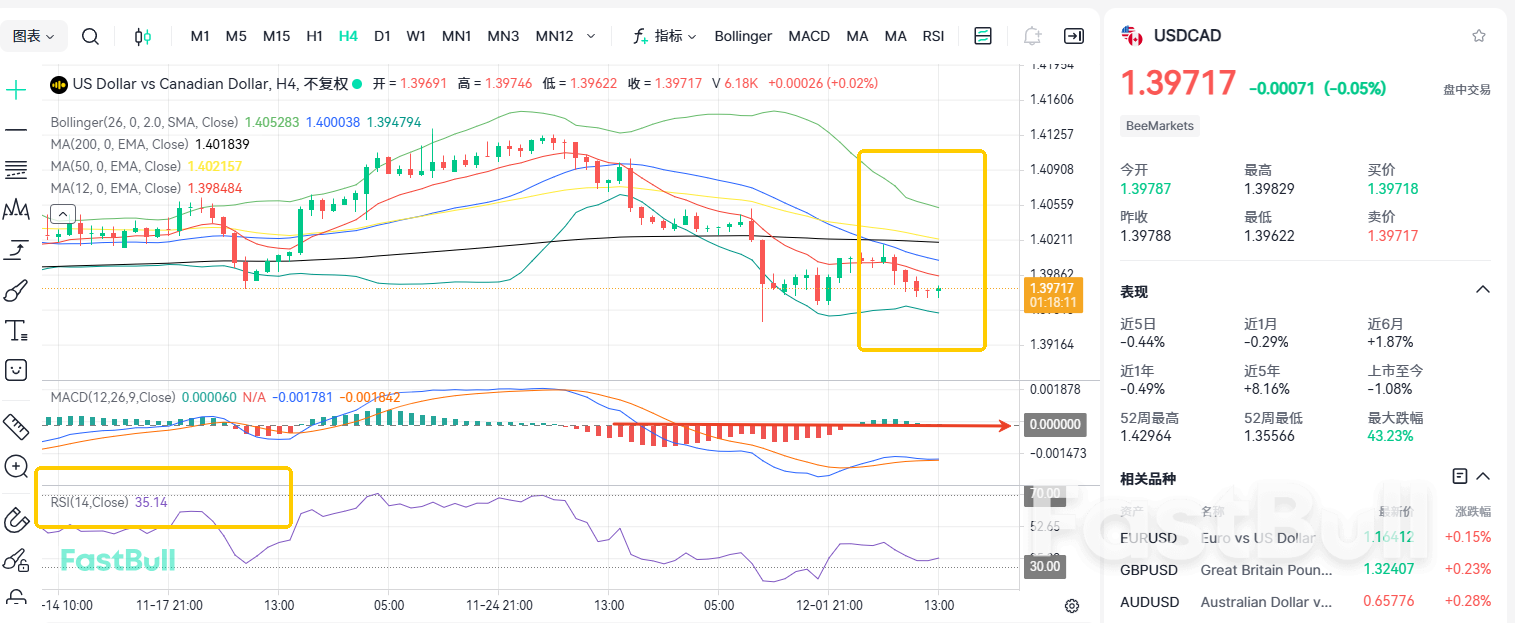
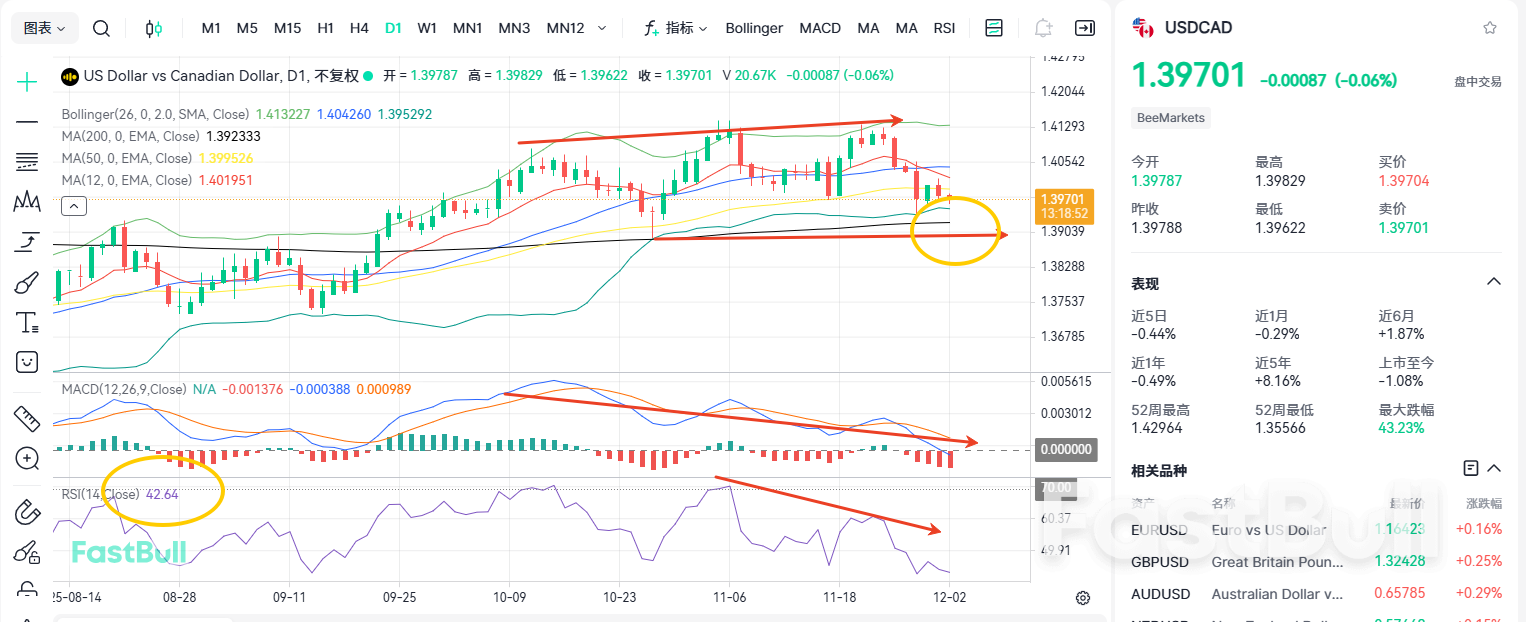
          In the 1D timeframe, the Bollinger Bands are narrowing, indicating decreasing volatility. The short-term EMA12 has reversed downward, with prices oscillating between the EMA50 and the lower Bollinger Band. The MACD momentum is weakening; the MACD line and signal line have produced a death cross, suggesting a high probability of price decline toward the EMA200, around 1.392. The RSI stands at 42, reflecting strong market bearish sentiment and suggesting the short-term correction is ongoing. In the 4H timeframe, the Bollinger Bands are expanding downward. Following the MACD golden cross, the MACD line and signal line are retracing toward the zero-axis; however, they still remain some distance apart, indicating the correction has not yet concluded. Support levels are identified at the lower Bollinger Band and key round numbers, specifically around 1.394 and 1.39. The RSI is at 36, entering oversold territory. Therefore, it is recommended to go short at the highs.
          Pressured at 1.4! Will USDCAD Fall to 1.38?_1Pressured at 1.4! Will USDCAD Fall to 1.38?_2

          Trading Recommendations

          Trading Direction: Sell
          Entry Price: 1.399
          Target Price: 1.386
          Stop Loss: 1.41
          Support: 1.393, 1.39, 1.386
          Resistance: 1.414, 1.42, 1.44
          Risk Warnings and Disclaimers
          You understand and acknowledge that there is a high degree of risk involved in trading. Following any strategies or investment methods may lead to potential losses. The content on the site is provided by our contributors and analysts for information purposes only. You are solely responsible for determining whether any trading assets, securities, strategy, or any other product is suitable for investing based on your own investment objectives and financial situation.
          Add to Favorites
          Share

          Flash Crash! Has Silver Plummeted Like a Waterfall?

          Tank

          Commodity

          Forex

          Summary:

          Since the beginning of this year, silver prices have risen by more than 99%. In October, tight silver supply pushed its price up to $50 per ounce. At that time, analysts explained the situation as a temporary relocation of metal.

          SELL XAGUSD
          Close Time
          CLOSED

          58.054

          Entry Price

          50.000

          TP

          60.000

          SL

          58.162 +1.062 +1.86%

          38.9

          Pips

          Profit

          50.000

          TP

          57.665

          Exit Price

          58.054

          Entry Price

          60.000

          SL

          Fundamentals

          Since the start of the year, silver prices have surged by over 99%. In October, constrained silver supply drove prices to $50 per ounce. Analysts at the time attributed this to a temporary shift in metal holdings. Last spring, due to tariff concerns, large amounts of silver flowed into the U.S., causing a shortage in London. According to Bloomberg, the amount of freely circulating silver (silver not locked in ETFs or other funds) plummeted from a high of 850 million ounces to just 200 million ounces — a drop of 75%. Metals Focus estimated that the silver supply at one point fell as low as 150 million ounces. Unprecedented silver demand in India pushed the market to the brink of collapse. As gold prices repeatedly hit new highs, Indians turned to silver, further intensifying pressure on London's silver supply. Eventually, as metal flowed back from New York to London, the market adjusted and pressure eased. However, after a brief pullback, silver prices resumed their upward trend. According to an analyst at ANZ Group, recent sell-offs in London's stock market have caused global supply shortages, and the impact of this shortage is still ongoing. The problem is not that London lacks enough silver, but that there is not enough silver anywhere. Bloomberg reports that recent inflows of silver into London have worsened supply tightness elsewhere. Silver inventories in warehouses related to the Shanghai Futures Exchange have fallen to their lowest level in nearly a decade. Meanwhile, silver lease rates have risen, reflecting strong demand and limited metal availability. This issue cannot be solved simply by moving metal from one warehouse to another. The crux is that demand has exceeded supply for years. Metals Focus reports that silver is on track for a fifth consecutive year of structural market deficit. After hitting record highs in 2024, industrial demand is expected to fall about 2% due to price pressures, leading to an overall demand decline of around 4%. Yet with the silver mine output flat, production remains insufficient to meet market needs. Metals Focus forecasts that gold demand this year will exceed supply by 95 million ounces. This would bring the cumulative market gap over the past five years to 820 million ounces, equivalent to the average annual output of mines in one year. Since 2010, the cumulative silver supply shortfall has exceeded 580 million ounces. Even with higher prices, mined supply is unlikely to grow quickly enough to close the gap. Silver mine output peaked in 2016 at 900 million ounces and has since declined by an average of 1.4% annually until last year. Output is projected to reach 814 million ounces in 2023. It appears we will have to rely on drawdowns in above-ground silver stocks to cover the deficit for at least the next few years. Expectations that the Federal Reserve will continue easing monetary policy are also boosting silver prices. The U.S. recently added silver to its list of strategic minerals, which could intensify demand pressures and supply shortages. The director of gold and silver at Metals Focus said, "There's definitely going to be far more tightness in the silver market.” Bloomberg notes that, due to fears of a sudden spike in U.S. metal prices, some traders are reluctant to ship metal out of the U.S., and if global markets tighten further, there is little hope for relief. There are also concerns that the U.S. may impose tariffs on silver to protect the domestic supply. These fundamental supply–demand dynamics should continue to support silver prices at least in the medium term.
          According to the CME FedWatch tool, the probability of the Fed cutting rates by 25 basis points in December is as high as 89%, up from about 63% a month ago. Fed expectations dominate market movements. New York Fed President Williams stated that Fed policy is still "slightly restrictive," suggesting room to move toward neutral. Lower rate expectations reduce the relative return on U.S. assets, and when traders grow more confident in easing, the dollar index typically comes under pressure. Wall Street institutions are largely aligned in their forecasts. Bank of America currently leans toward a December cut, citing soaring unemployment, weak private-sector hiring, and Powell's reluctance to alter the dovish pricing stance. Such consensus tends to bolster market confidence and prompt investors to further unwind dollar positions. Fiscal uncertainty exacerbates dollar weakness. A $4.1 trillion tax reform plan, tariff uncertainties, and questions about Fed independence are dampening foreign investor appetite for U.S. assets, reducing the capital inflows that normally support the dollar.

          Technical Analysis

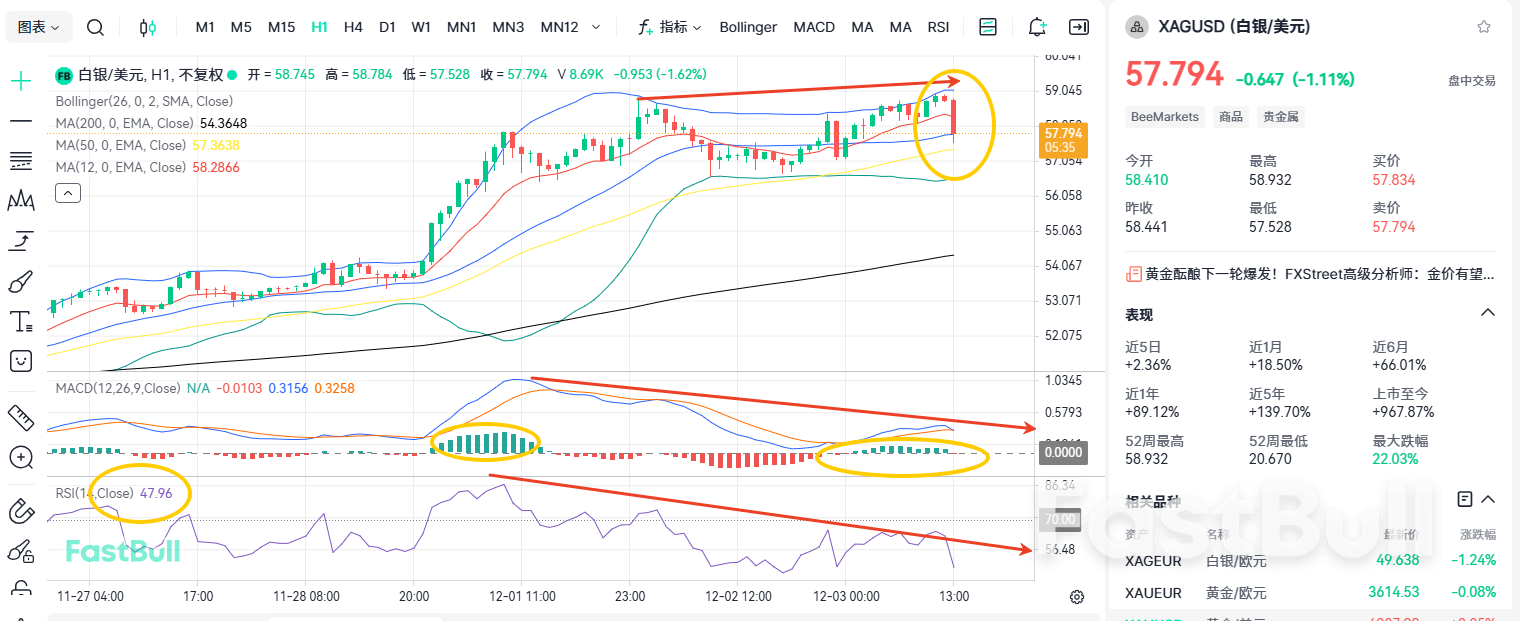
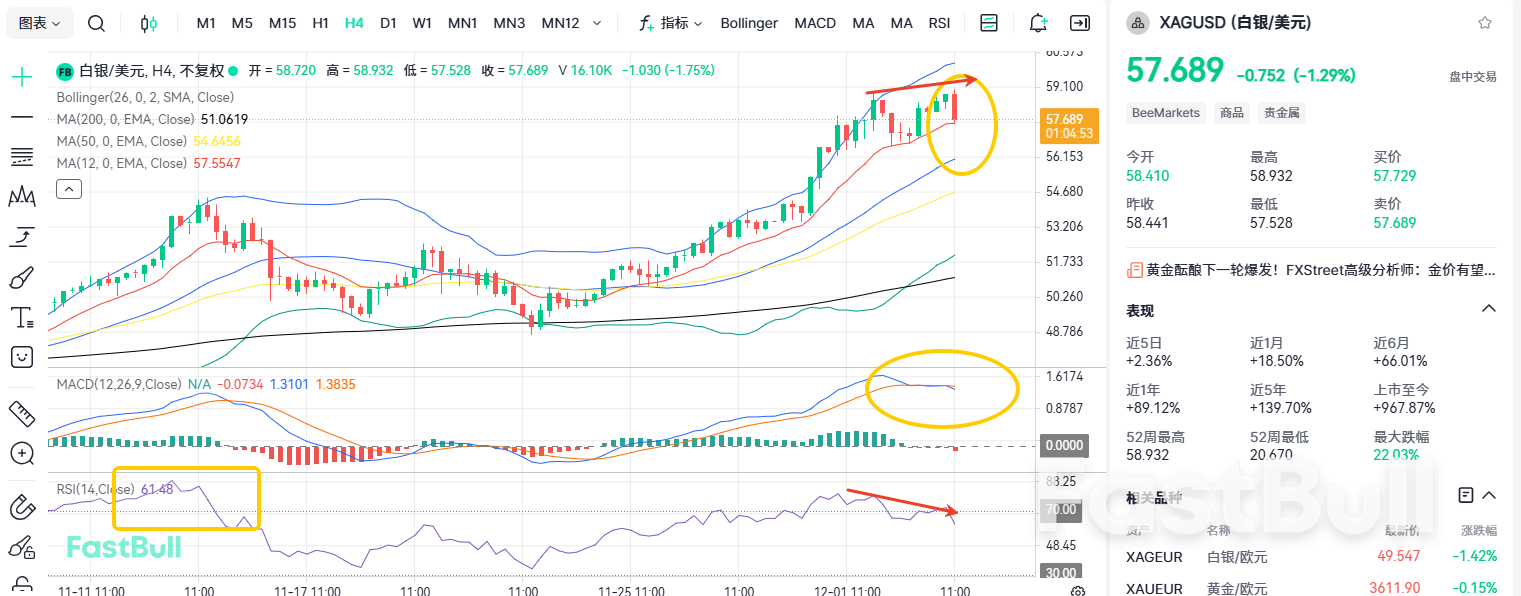
          As shown in the 1H chart, the Bollinger Bands are narrowing, and the moving averages are flattening. After being pressured by the upper band, silver is oscillating near the middle band. MACD shows a death cross, and upward momentum is gradually weakening — a sign of bearish divergence indicating further declines. RSI is at 47, signaling market hesitation. Support lies near EMA50 and the Bollinger lower Band at approximately 57.3 and 56.5, respectively. Regarding the 4-hour chart, Bollinger Bands are expanding upward, moving averages are diverging upward, and the bullish trend remains intact. However, a large bearish candle has pulled the price back to EMA12. If this level is breached, the trend could reverse. MACD shows a death cross as well, while the RSI is at 61. However, successive highs are getting lower, potentially signaling a turning point. Selling at highs is recommended.
          Flash Crash! Has Silver Plummeted Like a Waterfall?_1Flash Crash! Has Silver Plummeted Like a Waterfall?_2

          Trading Recommendations:

          Trading direction: Sell
          Entry price: 58
          Target price: 50
          Stop loss: 60
          Support: 55/53/50
          Resistance: 59/60/65
          Risk Warnings and Disclaimers
          You understand and acknowledge that there is a high degree of risk involved in trading. Following any strategies or investment methods may lead to potential losses. The content on the site is provided by our contributors and analysts for information purposes only. You are solely responsible for determining whether any trading assets, securities, strategy, or any other product is suitable for investing based on your own investment objectives and financial situation.
          Add to Favorites
          Share

          Bearish Trendline Could Open Opportunities for Short Positions

          Manuel

          Forex

          Economic

          Summary:

          This divergence signals that buying strength is exhausted, potentially opening the door for a decisive move to the downside.

          SELL USDJPY
          Close Time
          CLOSED

          155.774

          Entry Price

          154.800

          TP

          156.400

          SL

          154.602 -0.506 -0.33%

          35.8

          Pips

          Profit

          154.800

          TP

          155.416

          Exit Price

          155.774

          Entry Price

          156.400

          SL

          Bank of Japan (BoJ) Governor Kazuo Ueda reiterated on Monday that the Japanese central bank remains on track to raise interest rates, provided that prices and the broader economy continue to develop as anticipated. Ueda added that the probability of the BoJ's base-case scenario for growth and inflation is gradually increasing. This potential for tightening, however, is offset by domestic concerns. Rising Japanese Government Bond (JGB) yields are actively increasing the country's debt servicing costs, effectively limiting the BoJ’s capacity for aggressive tightening and posing a structural obstacle for the Yen (JPY).
          U.S. economic data released on Monday painted a softer picture for the manufacturing sector. The ISM Manufacturing Purchasing Managers' Index (PMI) fell to 48.2 in November from 48.7, missing the forecast and marking the ninth consecutive month of contraction. The underlying details were equally concerning: the New Orders Index fell to 47.4, extending its losing streak, while the Employment Index dropped to 44, suggesting ongoing momentum loss in the labor market. The only area of resilience was the Prices Paid Index, which ticked up to 58.5, signaling persistent cost pressures.
          Following the consistently weaker U.S. economic data, market participants have aggressively increased their bets on Fed interest rate cuts. Traders are now pricing in an 87% probability of a 0.25% rate cut at the Federal Reserve's meeting next week, a sharp acceleration from 63% just one month ago, according to the CME FedWatch Tool. Adding fuel to the dovish speculation is an unconfirmed report suggesting that former White House Economic Advisor, Kevin Hassett, has emerged as the favored candidate to be the next Fed Chair. Hassett is seen as an ally who supports U.S. President Donald Trump's call for a faster and deeper reduction in interest rates to stimulate the economy. U.S. Treasury yields remain firm, with the 10-year Treasury yield sitting at 4.086%, while real yields hold stable at 1.856%.
          In geopolitical news, Russian President Vladimir Putin met with U.S. President Donald Trump's special envoy, Steve Witkoff, and son-in-law, Jared Kushner, in the Kremlin for talks on a possible resolution to the conflict in Europe. Just before the meeting, Putin issued a warning that Europe would face a swift defeat if it entered into a war with Russia, and he dismissed European counter-proposals on Ukraine as being "absolutely unacceptable" to Russia. Trump has repeatedly voiced his desire to end the conflict, but his efforts to date have yet to secure a peace deal.Bearish Trendline Could Open Opportunities for Short Positions_1

          Technical Analysis

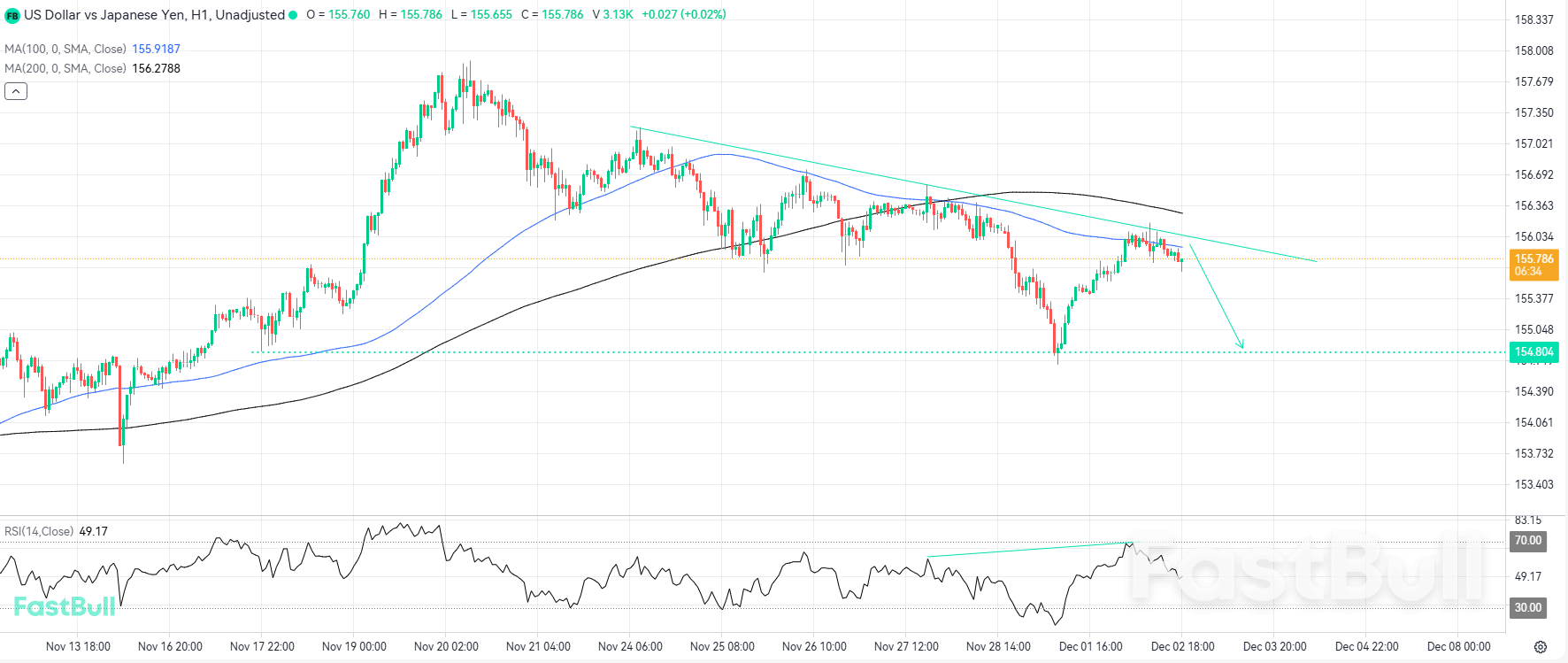
          The USD/JPY pair is clearly positioned within a prevailing downtrend, evidenced by a defined bearish trendline and the failure to print new higher highs. This suggests that the downward trajectory could continue. The price has recently retested the confluence zone created by the bearish trendline and the 100-period Moving Average (MA), which sits at 155.91. The 200-period MA is positioned slightly higher at 156.27. This critical confluence zone offers a high-probability opportunity for entering short (sell) positions, with a target set near the recent local low of 154.80, the next key support level.
          The Relative Strength Index (RSI) is currently at the neutral 47 level, having recently fallen from a high of 70 (overbought territory). Crucially, the clearest technical signal is a bearish divergence on the RSI compared to the previous touch of the trendline. This divergence signals that buying strength is exhausted, potentially opening the door for a decisive move to the downside. Conversely, a strong break and close above the bearish trendline would invalidate the current short setup and suggest that further gains are likely.
          Trading Recommendations
          Trading direction: Sell
          Entry price: 155.75
          Target price: 154.80
          Stop loss: 156.40
          Validity: Dec 12, 2025 15:00:00
          Risk Warnings and Disclaimers
          You understand and acknowledge that there is a high degree of risk involved in trading. Following any strategies or investment methods may lead to potential losses. The content on the site is provided by our contributors and analysts for information purposes only. You are solely responsible for determining whether any trading assets, securities, strategy, or any other product is suitable for investing based on your own investment objectives and financial situation.
          Add to Favorites
          Share

          Bullish Breakout Could Fuel the Upward Momentum

          Manuel

          Forex

          Economic

          Summary:

          This suggests that the underlying momentum remains strong, signaling room for continued upside.

          BUY EURUSD
          Close Time
          CLOSED

          1.16327

          Entry Price

          1.17580

          TP

          1.15401

          SL

          1.16572 +0.00127 +0.11%

          26.7

          Pips

          Profit

          1.15401

          SL

          1.16594

          Exit Price

          1.16327

          Entry Price

          1.17580

          TP

          The latest figures from the Eurozone painted a mixed but relatively stable inflation picture for November. The Harmonized Index of Consumer Prices (HICP) rose 2.2% year-over-year (YoY), coming in fractionally above the consensus of 2.1% and matching the pace seen in October. The Core HICP, which excludes volatile components, increased by 2.4% YoY, just missing the 2.5% forecast and remaining unchanged from the October rate.
          On a monthly basis, Core HICP fell by 0.5% in November, reversing the 0.3% increase recorded in October. The headline HICP decreased by 0.3% in November, compared to an increase of 0.2% in October. These inflation data points bolstered the case for the European Central Bank (ECB) to maintain its current policy stance, reinforcing market expectations that interest rates will remain steady as inflation stays slightly above the ECB’s 2% medium-term target. With policymakers signaling little urgency to adjust policy, attention now focuses on the ECB’s next rate decision, scheduled for December 18th. ECB Governing Council member Joachim Nagel recently commented that the Eurozone had "practically reached" its inflation objective and that the rate would continue to fluctuate around this level in the near future.
          Meanwhile, the U.S. economic data released on Monday painted a softer picture for the manufacturing sector. The ISM Manufacturing Purchasing Managers' Index (PMI) fell to 48.2 in November from 48.7, missing the 48.6 forecast and marking the ninth consecutive month of contraction. The underlying details were equally soft. The New Orders Index fell to 47.4 from 49.4, extending its recent string of losses, while the Employment Index dropped to 44 from 46. The only firm spot came from the Prices Paid Index, which remained in expansion, ticking up to 58.5 from 58.
          Following the consistently weaker U.S. economic data, market participants have aggressively increased their bets on interest rate cuts. Traders are now pricing in an 87% probability of a 0.25% rate cut at the Federal Reserve's meeting next week, a sharp increase from 63% just one month ago, according to the CME FedWatch Tool. U.S. Treasury yields remain firm, with the 10-year Treasury yield sitting at 4.086%. U.S. real yields, which correlate inversely with gold prices, are stable at 1.856%.
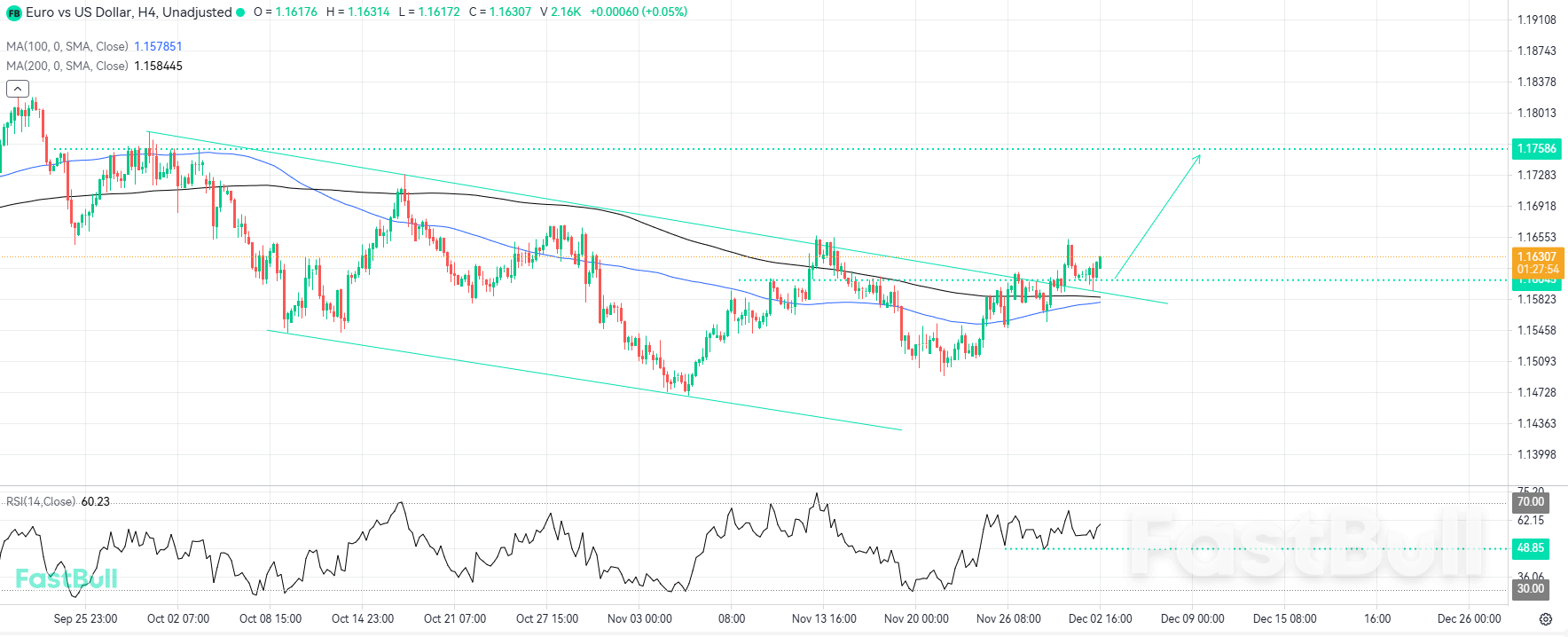
          In geopolitical news, Russian President Vladimir Putin met with U.S. President Donald Trump's special envoy, Steve Witkoff, and son-in-law, Jared Kushner, in the Kremlin for talks on a possible resolution to the conflict in Europe. Just before the meeting, Putin issued a warning that Europe would face a swift defeat if it entered into a war with Russia, and he dismissed European counter-proposals on Ukraine as being "absolutely unacceptable" to Russia. Trump has repeatedly voiced his desire to end the conflict, but his efforts to date have yet to secure a peace deal.Bullish Breakout Could Fuel the Upward Momentum_1

          Technical Analysis

          The EUR/USD pair appears to have broken out of a bearish channel that had been in place since October 1st, originating from 1.1778 and finding a local low at 1.1469 on November 5th. Following this local low, the price initiated a strong recovery that was initially rejected by the channel's upper boundary. However, a subsequent attempt resulted in a decisive breakout to the upside.
          Crucially, on a recent pullback, the price retested the bearish trendline—now acting as support—and rebounded strongly, confirming the flip of resistance into support. This change in technical dynamic strongly suggests a bullish breakout that could propel the price toward the next significant resistance level at 1.1758.
          The 100-period and 200-period Moving Averages (MAs) on the 4-hour chart are tightly grouped at 1.1578 and 1.1584, respectively, sitting just below the upper channel line and the recent rebound point. This positioning indicates that the MAs are now acting as solid dynamic support. Furthermore, the Relative Strength Index (RSI) only reached a minimum of 48 during the recent pullback, failing to enter oversold territory even after the breakout. This suggests that the underlying momentum remains strong, signaling room for continued upside. Current purchases are favored from the 1.1604 zone. Conversely, a strong downward move that places the price back inside the bearish channel would invalidate the current bullish setup.
          Trading Recommendations
          Trading direction: Buy
          Entry price: 1.1630
          Target price: 1.1758
          Stop loss: 1.1540
          Validity: Dec 12, 2025 15:00:00
          Risk Warnings and Disclaimers
          You understand and acknowledge that there is a high degree of risk involved in trading. Following any strategies or investment methods may lead to potential losses. The content on the site is provided by our contributors and analysts for information purposes only. You are solely responsible for determining whether any trading assets, securities, strategy, or any other product is suitable for investing based on your own investment objectives and financial situation.
          Add to Favorites
          Share

          AUD/USD spikes on hot Australian GDP

          Gerik

          Forex

          Summary:

          AUD/USD is trading around 0.6550–0.6560 after a stronger-than-expected Australian Q3 GDP print, while markets still price a high probability of a Fed rate cut at the December meeting...

          SELL AUDUSD
          Close Time
          CLOSED

          0.65565

          Entry Price

          0.65200

          TP

          0.66000

          SL

          0.66209 +0.00118 +0.18%

          43.5

          Pips

          Loss

          0.65200

          TP

          0.66000

          Exit Price

          0.65565

          Entry Price

          0.66000

          SL

          Overview

          During early Asian trading on 3 December 2025, AUD/USD is hovering in the 0.6550–0.6560 region, near the top of today’s intraday range, after having traded roughly between 0.6538 and 0.6571 so far. The immediate catalyst for the latest push higher has been Australia’s Q3 2025 GDP, which printed at 0.7% q/q versus a 0.6% forecast, the strongest quarterly pace since late 2022 and lifting annual growth to about 2.2%.
          This data reinforces the narrative that the Australian economy is still expanding at or slightly above the Reserve Bank of Australia’s trend estimate, with government spending and business investment doing most of the heavy lifting.
          Paradoxically, that strength reduces the odds of near-term RBA easing. Recent commentary suggests markets now expect the RBA to keep the cash rate on hold well into 2026, as policymakers remain uneasy about sticky inflation and surging housing wealth.
          A “higher-for-longer” stance from the RBA is structurally AUD-supportive, but it also raises concerns that restrictive policy will eventually bite into household demand, especially given elevated debt levels and high mortgage sensitivity in Australia.
          On the US side, the macro backdrop is different. The ISM Manufacturing PMI has slipped to 48.2 in November, marking the softest reading in four months and pointing to renewed contraction in the industrial sector. Fed funds futures now price more than an 80% probability of a rate cut at the 9–10 December FOMC meeting, effectively confirming that the Fed is moving deeper into an easing cycle.
          However, the external environment is not purely AUD-bullish. China’s private-sector manufacturing PMIs have dipped back below 50, with the Caixin manufacturing index printing 49.9 in November versus 50.5 expected and 50.6 prior, signalling borderline contraction and soft external demand.
          For an export-sensitive, China-linked currency like the AUD, this acts as a medium-term drag, especially if the market starts to question how long Australia can outgrow a slowing regional backdrop.

          Market sentiment

          Risk sentiment going into today’s session is cautiously constructive but no longer euphoric. The VIX, Wall Street’s “fear gauge”, has retreated to the mid-teens after spiking above 20 during recent tariff headlines, with the latest close around 16.7–17.0, signalling moderate rather than extreme risk aversion. Global equities have stabilised and, in some markets, are pushing back toward recent highs, supported by expectations of further monetary easing across the major economies and by the OECD’s projection of global GDP growth around 3.2% for 2025.
          For AUD specifically, the sentiment picture is nuanced. On one hand, the stronger-than-expected GDP print has attracted fresh buying interest from macro and systematic funds that allocate toward economies with relative growth and yield advantages. The Australian housing market’s renewed strength and the record A$12 trillion value of housing stock also bolster perceptions of wealth and balance sheet resilience, which can support consumption in the near term.
          On the other hand, that same strength is problematic for the RBA’s inflation fight, undermining the case for rate cuts and raising the risk of a policy stance that remains restrictive for longer than markets or households can comfortably digest.
          In the very short term, intraday positioning suggests that the knee-jerk AUD buying after the GDP surprise may be getting stretched. The pair has already repriced a more hawkish RBA path against a more dovish Fed, while at the same time China’s sub-50 PMI and mixed Asian factory data highlight that the external demand story is far from robust.
          This “good domestic news versus weak external backdrop” mix often produces asymmetric risk on short intraday timeframes: traders happily chase the first spike higher, but once the obvious data surprise is priced in, they become more willing to fade extended moves, especially ahead of risk events such as the US ISM Services PMI later in the day.

          Technical analysis

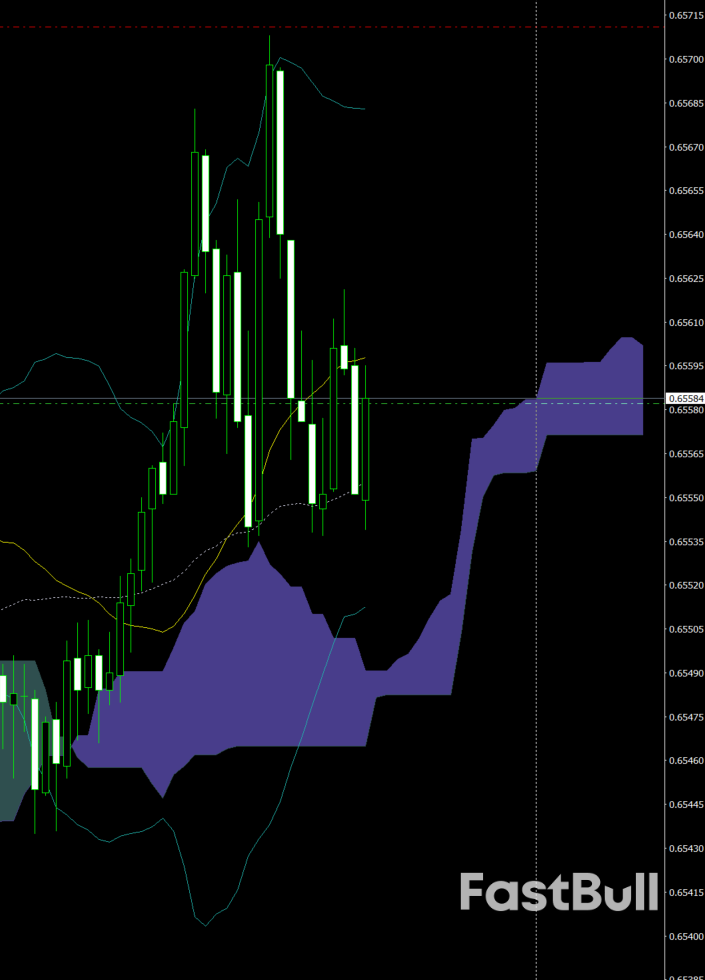
          AUD/USD spikes on hot Australian GDP_1
          On the M15 chart, AUD/USD’s intraday structure since the GDP release is that of a sharp impulsive move higher from the lower 0.65s into the mid-0.65s, followed by increasingly hesitant candles as price tests resistance near 0.6565–0.6570, close to the top of today’s range. Given the reported high around 0.6571 and low near 0.6538, the 20-period Bollinger Bands (20,0,2) on M15 are likely anchored around a mid-band roughly at 0.6550, with the upper band extending toward 0.6570–0.6580 and the lower band near 0.6535–0.6540.
          Price currently trades near or slightly above the upper band, which statistically corresponds to an overextended move relative to the last 20 M15 candles. When price repeatedly “rides” the upper band and then begins to print smaller real bodies or wicks on the topside, it often signals that buying momentum is losing steam and that a mean-reversion move back toward the middle band is becoming more likely.
          Under the Ichimoku Kinko Hyo settings of 9,26,52 on the same M15 chart, the short-term bullish impulse is visible in the way price has broken above the Kumo cloud after the data release, with the Tenkan-sen (conversion line) initially pointing steeply upward. However, as AUD/USD consolidates around 0.6565, the Tenkan-sen begins to flatten and the gap between Tenkan-sen and Kijun-sen widens. That distance between price and the Kijun-sen is a classic sign of overextension; short-term price momentum has outrun its “fair value” equilibrium zone, increasing the probability that price will either move sideways until the Kijun catches up, or pull back toward the Kijun itself, which on M15 is likely clustering around 0.6550. The Kumo ahead is relatively thin, suggesting that if price does rotate lower and re-enters the cloud, support may not be particularly strong, opening the door for a deeper dip toward the lower 0.65s.
          The Stochastic Oscillator (5,3,3) on M15 reinforces this mean-reversion narrative. After the GDP-driven spike, Stoch has pushed decisively into the overbought zone above 80, indicating that recent gains have been fast and concentrated. Now, as price stalls near resistance, the %K line is likely beginning to curl lower and approach a bearish crossover with %D, a pattern that often precedes short-term pullbacks when it happens at or near a key resistance zone.

          Trade Recommendations

          Entry: 0.65565
          Take Profit: 0.6520
          Stop Loss: 0.6600
          Risk Warnings and Disclaimers
          You understand and acknowledge that there is a high degree of risk involved in trading. Following any strategies or investment methods may lead to potential losses. The content on the site is provided by our contributors and analysts for information purposes only. You are solely responsible for determining whether any trading assets, securities, strategy, or any other product is suitable for investing based on your own investment objectives and financial situation.
          Add to Favorites
          Share

          CAD/JPY stalls near 111.5 as oil momentum fades and BoJ hints at further hikes

          Gerik

          Forex

          Summary:

          CAD/JPY is trading around 111.1–111.7, close to the upper end of its 52-week range of roughly 101.3–112.3, while WTI hovers just below 60 USD/bbl and the Bank of Canada sits at 2.25% after back-to-back cuts...

          SELL CADJPY
          Close Time
          CLOSED

          111.500

          Entry Price

          110.800

          TP

          112.100

          SL

          110.831 -0.302 -0.27%

          70.0

          Pips

          Profit

          110.800

          TP

          110.800

          Exit Price

          111.500

          Entry Price

          112.100

          SL

          Overview

          CAD/JPY is pressing into the high part of its yearly envelope, with Bloomberg showing spot around 111.1 and a day range near 111.0–111.7, only a little below the 52-week high at 112.29. That level is expensive historically, especially given how the macro story has shifted against the Canadian side over the past few months. The Bank of Canada has already delivered two consecutive 25 bp cuts, taking its policy rate down to 2.25% on 29 October and explicitly framing the move as a response to weakening growth, soft labor markets and trade-sensitive sectors under pressure. Inflation is hovering near target, but the Bank’s own projections show sub-trend GDP until at least 2027, which makes an aggressive hiking cycle very unlikely and flattens the future carry advantage of CAD.
          On the Japanese side, the Bank of Japan already lifted its short-term policy rate to 0.5% in January, the highest in 17 years, and in its latest communications has signaled that another hike to 0.75% is under active discussion even if the most recent proposal was voted down. The important point for CAD/JPY is not that Japan suddenly offers high yield, but that the era of completely free money in JPY is ending, which incrementally reduces the structural incentive to be short yen at any price. At the same time, WTI is trading around 59–59.5 USD/bbl, essentially in a sideways band, after a series of small, choppy sessions rather than a trend breakout.
          That means Canada’s terms-of-trade tailwind is neutral rather than booming: oil is not collapsing, but it is also not driving a new leg higher in CAD. When you put this together, you get a cross sitting near its yearly highs while the central bank behind the high-yield leg is cutting and the central bank behind the low-yield leg is talking about further hikes. That is classic asymmetry for a tactical short: the macro story no longer justifies chasing CAD/JPY higher at these levels.

          Market sentiment

          Sentiment around CAD/JPY has quietly shifted from “buy every dip” to “respect the top of the range.” Broad CAD performance in November was helped by a risk-on mood and modest oil resilience, which allowed CAD/JPY to grind up from around 108–109 toward the current 111+ region as investors searched for yield and carry after the Fed started cutting.
          However, the marginal flows are no longer purely CAD-positive. Canadian data have confirmed the BoC’s narrative of soft growth, while rate-cut expectations have flattened out near 2.25% with forward curves and BoC commentary both pointing to stability, not to a renewed hiking cycle.
          In contrast, positioning in JPY has become more two-sided as traders increasingly respect BoJ and Ministry of Finance rhetoric. The BoJ’s October decision to keep rates at 0.5% was accompanied by a summary of opinions that highlighted a growing faction favoring another hike, while recent remarks from Governor Ueda have “rattled global bond markets” by explicitly raising the prospect of a move as early as this month.
          In such a “cautiously optimistic” regime, investors are willing to hold carry trades like CAD/JPY, but they also become more sensitive to valuation and policy asymmetries. The result is a sentiment mix that favors fading CAD/JPY into rich levels rather than blindly adding longs near the top of its yearly range, particularly when the central bank behind the quote currency (BoJ) may be the next mover.

          Technical analysis

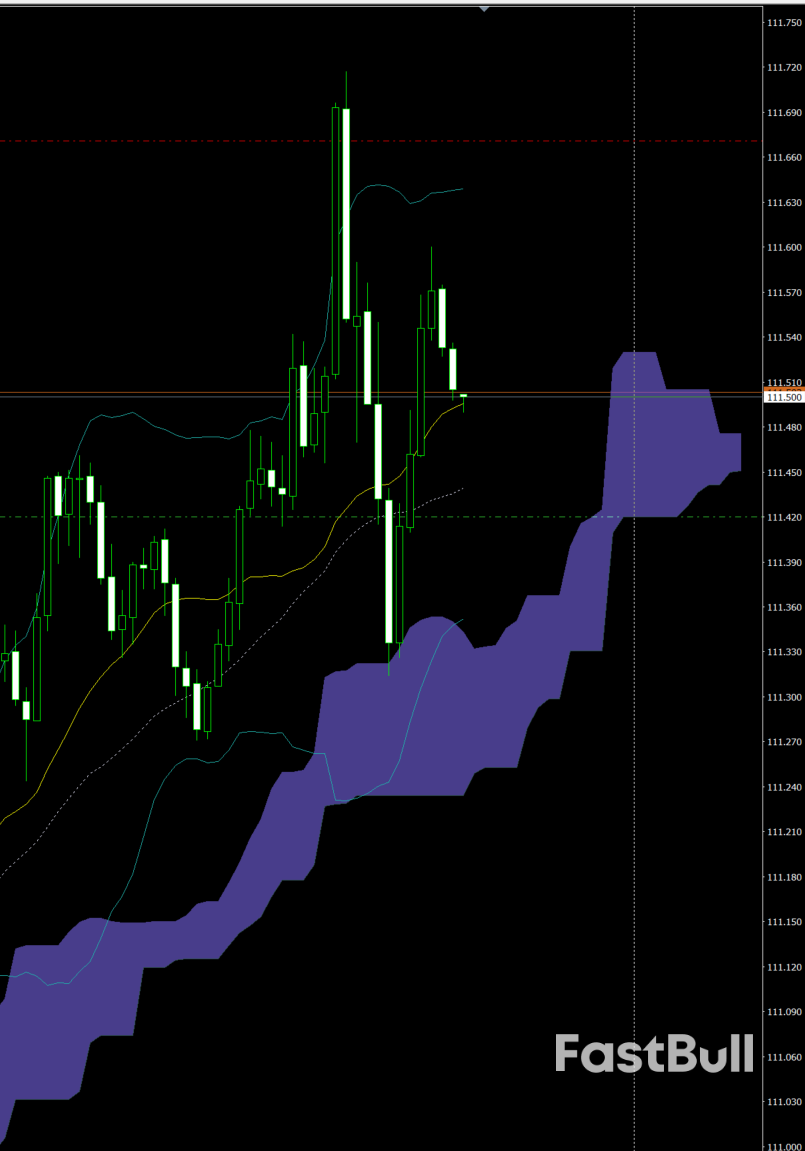
          CAD/JPY stalls near 111.5 as oil momentum fades and BoJ hints at further hikes_1
          On the M15 timeframe, CAD/JPY looks less like a clean up-trend and more like a market distributing near resistance. Recent intraday data show spot oscillating in a relatively tight band around 111.1, with repeated pushes into the 111.5–111.7 area failing to hold.
          Using Bollinger Bands set to 20,0,2, price has shifted from hugging the upper band during November’s climb to repeatedly mean-reverting to and even slightly under the 20-period mid-line. The upper band in the 111.6–111.8 zone is no longer acting as a magnet; instead, each approach is followed by swift rejection back toward the mid-line. That transition from upper-band walk to mid-line rejection is usually the first technical sign that buying pressure is exhausting and that the path of least resistance is starting to tilt lower.
          The Ichimoku profile with 9,26,52 parameters reinforces this idea. Earlier in the move, price lived comfortably above the M15 Kumo, with Tenkan consistently above Kijun and the forward cloud sloping higher. More recently, however, candles have begun to probe into the top of the cloud, and in some sequences to close inside it, with the Kumo flattening around the 111.0–111.2 region.
          The Tenkan line has slipped back toward or even below Kijun on minor rebounds, indicating that short-term momentum is no longer in sync with the prior trend. When price oscillates around a flat cloud top near a long-term resistance zone, it often signals a distribution phase where large players gradually unwind longs rather than a fresh markup phase.
          Stochastic (5,3,3) on M15 adds the timing element for a short. After several overbought readings above 80 during the earlier grind higher, %K has been rolling over from the 60–70 band, repeatedly crossing below %D without managing to reset to oversold before bouncing again. This kind of “tired oscillator” behavior lower highs in Stoch while price struggles to make new highs is a classic early divergence. The ideal tactical entry for a sell comes when %K turns down from the mid-range (around 50–60) as price retests the Bollinger mid-line or the underside of the recent local high, with the Kumo top just below acting as the first objective. Given that the upper band and prior spike highs cluster around 111.6–111.7, while the cloud base and prior support sit closer to 110.7–110.8, the risk-reward for a short from near the top of this micro-range is attractive as long as price fails to make a clean, high-volume break above 112.0.

          Trade Recommendations

          Entry: 111.50
          TP: 110.80
          SL: 112.10
          Risk Warnings and Disclaimers
          You understand and acknowledge that there is a high degree of risk involved in trading. Following any strategies or investment methods may lead to potential losses. The content on the site is provided by our contributors and analysts for information purposes only. You are solely responsible for determining whether any trading assets, securities, strategy, or any other product is suitable for investing based on your own investment objectives and financial situation.
          Add to Favorites
          Share

          After a Deep Pullback, Prices Remain Trapped in a Pressure Zone; Bearish Dominance Persists

          Eva Chen

          Cryptocurrency

          Summary:

          Ethereum's price has plummeted, attracting speculative investments. However, the price currently sits well below the key downtrend line in the 1D timeframe, with resistance at US$3,260.

          SELL ETH-USDT
          EXP
          TRADING

          2966.89

          Entry Price

          1959.00

          TP

          3250.00

          SL

          3162.90 -45.10 -1.41%

          0.0

          Pips

          Flat

          1959.00

          TP

          Exit Price

          2966.89

          Entry Price

          3250.00

          SL

          Fundamentals

          Ethereum's price has fallen below US$2,800, triggering a significant surge in speculative trading. BitMine Immersion, a key fund management firm focused on Ethereum, continues to actively accumulate the cryptocurrency, adding US$83 million worth of Ethereum to its holdings. Notable figures like Tom Lee of BitMine Immersion and Ki Young Ju of CryptoQuant have highlighted institutional investor interest, noting that Ethereum is undervalued according to multiple valuation models.
          Despite the price decline, it triggered a wave of buying activity. Speculators increased their positions, adding US$654 million in bets. On-chain data indicates that market leverage has been reset, reducing downside risk in the Ethereum futures market.
          As prices remain under pressure, financial markets are sending mixed signals, yet there are also signs of potential stabilization emerging. These include robust on-chain fundamentals and growing developer activity, both of which underpin Ethereum's valuation.
          Past price corrections of a similar nature have triggered leverage resets followed by phases of increased institutional buying. Historical data indicates that such maneuvers often precede bull markets, signaling potential future trends.
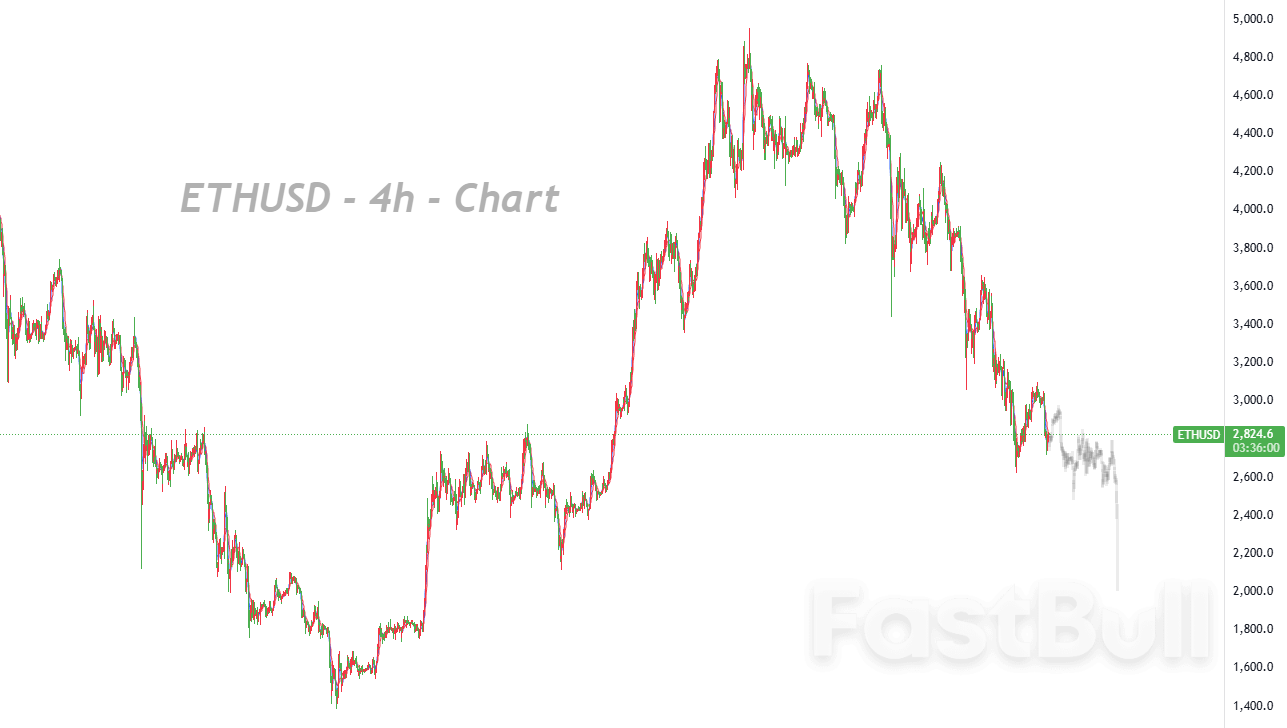
          After a Deep Pullback, Prices Remain Trapped in a Pressure Zone; Bearish Dominance Persists_1

          Technical Analysis

          However, the technical outlook is not particularly optimistic. The Ethereum price rebound that began at US$2,620 saw bulls push the price above US$3,000 before encountering resistance.
          In the 1D timeframe, prices remain well below the 100-day SMA. Bears have defended the US$3,050 resistance level, with prices failing to even test the 50% retracement of the decline from the US$3,655 high to the US$2,616 low. The current price action indicates increasing bearish pressure. Should a rebound occur, prices may encounter resistance near the US$3,000 level.
          The next major resistance level is near US$3,050. Currently, key resistance is forming around the US$3,250 area and the trendline. If the daily closing price breaks above the US$3,250 resistance zone, it could trigger a new round of steady gains. In this scenario, prices may rise toward the US$3,500 level.
          On the downside, as the head-and-shoulders top pattern continues to play out, the bearish targets remain intact. Key support lies near US$2,500, and a break below this level could see prices test US$2,350. Should prices decline further, a drop to US$2,200 becomes possible.

          Trading Recommendations

          Trading Direction: Sell
          Entry Price: 3000
          Target Price: 1959
          Stop Loss: 3250
          Valid Until: December 22, 2025 23:55:00
          Support: 2720, 2620, 2529
          Resistance: 2935, 3105, 3245
          Risk Warnings and Disclaimers
          You understand and acknowledge that there is a high degree of risk involved in trading. Following any strategies or investment methods may lead to potential losses. The content on the site is provided by our contributors and analysts for information purposes only. You are solely responsible for determining whether any trading assets, securities, strategy, or any other product is suitable for investing based on your own investment objectives and financial situation.
          Add to Favorites
          Share
          FastBull
          Copyright © 2025 FastBull Ltd

          728 RM B 7/F GEE LOK IND BLDG NO 34 HUNG TO RD KWUN TONG KLN HONG KONG

          TelegramInstagramTwitterfacebooklinkedin
          App Store Google Play Google Play
          Products
          Charts

          Chats

          Q&A with Experts
          Screeners
          Economic Calendar
          Data
          Tools
          Membership
          Features
          Function
          Markets
          Copy Trading
          Latest Signals
          Contests
          News
          Analysis
          24/7
          Columns
          Education
          Company
          Careers
          About Us
          Contact Us
          Advertising
          Help Center
          Feedback
          User Agreement
          Privacy Policy
          Business

          White Label

          Data API

          Web Plug-ins

          Poster Maker

          Affiliate Program

          Risk Disclosure

          The risk of loss in trading financial instruments such as stocks, FX, commodities, futures, bonds, ETFs and crypto can be substantial. You may sustain a total loss of the funds that you deposit with your broker. Therefore, you should carefully consider whether such trading is suitable for you in light of your circumstances and financial resources.

          No decision to invest should be made without thoroughly conducting due diligence by yourself or consulting with your financial advisors. Our web content might not suit you since we don't know your financial conditions and investment needs. Our financial information might have latency or contain inaccuracy, so you should be fully responsible for any of your trading and investment decisions. The company will not be responsible for your capital loss.

          Without getting permission from the website, you are not allowed to copy the website's graphics, texts, or trademarks. Intellectual property rights in the content or data incorporated into this website belong to its providers and exchange merchants.

          Not Logged In

          Log in to access more features

          FastBull Membership

          Not yet

          Purchase

          Become a signal provider
          Help Center
          Customer Service
          Dark Mode
          Price Up/Down Colors

          Log In

          Sign Up

          Position
          Layout
          Fullscreen
          Default to Chart
          The chart page opens by default when you visit fastbull.com