• Trade
  • Markets
  • Copy
  • Contests
  • News
  • 24/7
  • Calendar
  • Q&A
  • Chats
Trending
Screeners
SYMBOL
LAST
BID
ASK
HIGH
LOW
NET CHG.
%CHG.
SPREAD
SPX
S&P 500 Index
6870.39
6870.39
6870.39
6895.79
6858.28
+13.27
+ 0.19%
--
DJI
Dow Jones Industrial Average
47954.98
47954.98
47954.98
48133.54
47871.51
+104.05
+ 0.22%
--
IXIC
NASDAQ Composite Index
23578.12
23578.12
23578.12
23680.03
23506.00
+72.99
+ 0.31%
--
USDX
US Dollar Index
98.830
98.910
98.830
98.960
98.810
-0.120
-0.12%
--
EURUSD
Euro / US Dollar
1.16539
1.16547
1.16539
1.16553
1.16341
+0.00113
+ 0.10%
--
GBPUSD
Pound Sterling / US Dollar
1.33395
1.33405
1.33395
1.33420
1.33151
+0.00083
+ 0.06%
--
XAUUSD
Gold / US Dollar
4208.56
4208.95
4208.56
4213.06
4190.61
+10.65
+ 0.25%
--
WTI
Light Sweet Crude Oil
59.885
59.922
59.885
60.063
59.752
+0.076
+ 0.13%
--

Community Accounts

Signal Accounts
--
Profit Accounts
--
Loss Accounts
--
View More

Become a signal provider

Sell trading signals to earn additional income

View More

Guide to Copy Trading

Get started with ease and confidence

View More

Signal Accounts for Members

All Signal Accounts

Best Return
  • Best Return
  • Best P/L
  • Best MDD
Past 1W
  • Past 1W
  • Past 1M
  • Past 1Y

All Contests

  • All
  • Trump Updates
  • Recommend
  • Stocks
  • Cryptocurrencies
  • Central Banks
  • Featured News
Top News Only
Share

Governor: Russian Drone Strike On Ukraine's Sumy Injures At Least Seven

Share

Inida's Nifty Psu Bank Index Down 1.3%

Share

India Markets Regulator Official: Have Created A Platform For Real Time Monitoring Of Algo Returns

Share

Cambodia Provincial Official: 3 Cambodian Civilians Seriously Injured In Thai-Cambodia Fighting

Share

Russia's Air Defences Destroy 67 Ukrainian Drones Overnight, RIA Agency Reports

Share

India's Nifty 50 Index Down 0.37%

Share

Hsi Down 287 Pts, Hsti Down 13 Pts, Pop Mart Down Over 8%, Ping An Hit New Highs

Share

China's November Coal Imports Down 20% Year-On-Year

Share

At Least One Thai Soldier Killed And 7 Wounded - Thai Army Spokesman

Share

India's Nifty Bank Futures Up 0.73% In Pre-Open Trade

Share

Cambodia Has Expanded Clashes To Several New Locations - Thai Army Spokesman

Share

Cambodian Military Has Increased Deployment Of Troops And Weapons - Thai Army Spokesman

Share

India's Nifty 50 Futures Up 0.53% In Pre-Open Trade

Share

India's Nifty 50 Index Down 0.1% In Pre-Open Trade

Share

Indian Rupee Opens Down 0.1% At 90.0625 Per USA Dollar, Versus 89.98 Previous Close

Share

China November Copper Imports At 427000 Tonnes

Share

China November Coal Imports At 44.05 Million Tonnes

Share

China November Iron Ore Imports At 110.54 Million Tonnes, Down 0.7 % From October

Share

China November Meat Imports At 393000 Tonnes

Share

China Imported 8.11 Million Tonnes Of Soy In November

TIME
ACT
FCST
PREV
U.S. Personal Income MoM (Sept)

A:--

F: --

P: --

U.S. PCE Price Index YoY (SA) (Sept)

A:--

F: --

P: --

U.S. PCE Price Index MoM (Sept)

A:--

F: --

P: --

U.S. Personal Outlays MoM (SA) (Sept)

A:--

F: --

P: --

U.S. Core PCE Price Index MoM (Sept)

A:--

F: --

P: --

U.S. Core PCE Price Index YoY (Sept)

A:--

F: --

P: --

U.S. UMich 5-Year-Ahead Inflation Expectations Prelim YoY (Dec)

A:--

F: --

P: --

U.S. Real Personal Consumption Expenditures MoM (Sept)

A:--

F: --

P: --

U.S. UMich Current Economic Conditions Index Prelim (Dec)

A:--

F: --

P: --

U.S. UMich Consumer Sentiment Index Prelim (Dec)

A:--

F: --

P: --

U.S. UMich 1-Year-Ahead Inflation Expectations Prelim (Dec)

A:--

F: --

P: --

U.S. UMich Consumer Expectations Index Prelim (Dec)

A:--

F: --

P: --

U.S. Weekly Total Rig Count

A:--

F: --

P: --

U.S. Weekly Total Oil Rig Count

A:--

F: --

P: --

U.S. Unit Labor Cost Prelim (SA) (Q3)

--

F: --

P: --

U.S. Consumer Credit (SA) (Oct)

A:--

F: --

P: --

China, Mainland Foreign Exchange Reserves (Nov)

A:--

F: --

P: --

Japan Wages MoM (Oct)

A:--

F: --

P: --

Japan Trade Balance (Oct)

A:--

F: --

P: --

Japan Nominal GDP Revised QoQ (Q3)

A:--

F: --

P: --

Japan Trade Balance (Customs Data) (SA) (Oct)

A:--

F: --

P: --

Japan GDP Annualized QoQ Revised (Q3)

A:--

F: --

P: --
China, Mainland Exports YoY (CNH) (Nov)

A:--

F: --

P: --

China, Mainland Imports YoY (CNH) (Nov)

A:--

F: --

P: --

China, Mainland Exports (Nov)

A:--

F: --

P: --

China, Mainland Imports (CNH) (Nov)

A:--

F: --

P: --

China, Mainland Trade Balance (CNH) (Nov)

A:--

F: --

P: --

China, Mainland Imports YoY (USD) (Nov)

A:--

F: --

P: --

China, Mainland Exports YoY (USD) (Nov)

A:--

F: --

P: --

China, Mainland Trade Balance (USD) (Nov)

A:--

F: --

P: --

Germany Industrial Output MoM (SA) (Oct)

--

F: --

P: --

Euro Zone Sentix Investor Confidence Index (Dec)

--

F: --

P: --

Canada Leading Index MoM (Nov)

--

F: --

P: --

Canada National Economic Confidence Index

--

F: --

P: --

U.S. Dallas Fed PCE Price Index YoY (Sept)

--

F: --

P: --

China, Mainland Trade Balance (USD) (Nov)

--

F: --

P: --

U.S. 3-Year Note Auction Yield

--

F: --

P: --

U.K. BRC Overall Retail Sales YoY (Nov)

--

F: --

P: --

U.K. BRC Like-For-Like Retail Sales YoY (Nov)

--

F: --

P: --

Australia Overnight (Borrowing) Key Rate

--

F: --

P: --

RBA Rate Statement
RBA Press Conference
Germany Exports MoM (SA) (Oct)

--

F: --

P: --

U.S. NFIB Small Business Optimism Index (SA) (Nov)

--

F: --

P: --

Mexico Core CPI YoY (Nov)

--

F: --

P: --

Mexico 12-Month Inflation (CPI) (Nov)

--

F: --

P: --

Mexico PPI YoY (Nov)

--

F: --

P: --

Mexico CPI YoY (Nov)

--

F: --

P: --

U.S. Weekly Redbook Index YoY

--

F: --

P: --

U.S. JOLTS Job Openings (SA) (Oct)

--

F: --

P: --

China, Mainland M2 Money Supply YoY (Nov)

--

F: --

P: --

China, Mainland M0 Money Supply YoY (Nov)

--

F: --

P: --

China, Mainland M1 Money Supply YoY (Nov)

--

F: --

P: --

U.S. EIA Short-Term Crude Production Forecast For The Next Year (Dec)

--

F: --

P: --

U.S. EIA Short-Term Crude Production Forecast For The Year (Dec)

--

F: --

P: --

U.S. EIA Natural Gas Production Forecast For The Next Year (Dec)

--

F: --

P: --

EIA Monthly Short-Term Energy Outlook
U.S. 10-Year Note Auction Avg. Yield

--

F: --

P: --

U.S. API Weekly Cushing Crude Oil Stocks

--

F: --

P: --

U.S. API Weekly Crude Oil Stocks

--

F: --

P: --

Q&A with Experts
    • All
    • Chatrooms
    • Groups
    • Friends
    Connecting
    .
    .
    .
    Type here...
    Add Symbol or Code

      No matching data

      All
      Trump Updates
      Recommend
      Stocks
      Cryptocurrencies
      Central Banks
      Featured News
      • All
      • Russia-Ukraine Conflict
      • Middle East Flashpoint
      • All
      • Russia-Ukraine Conflict
      • Middle East Flashpoint

      Search
      Products

      Charts Free Forever

      Chats Q&A with Experts
      Screeners Economic Calendar Data Tools
      Membership Features
      Data Warehouse Market Trends Institutional Data Policy Rates Macro

      Market Trends

      Market Sentiment Order Book Forex Correlations

      Top Indicators

      Charts Free Forever
      Markets

      News

      News Analysis 24/7 Columns Education
      From Institutions From Analysts
      Topics Columnists

      Latest Views

      Latest Views

      Trending Topics

      Top Columnists

      Latest Update

      Signals

      Copy Rankings Latest Signals Become a signal provider AI Rating
      Contests
      Brokers

      Overview Brokers Assessment Rankings Regulators News Claims
      Broker listing Forex Brokers Comparison Tool Live Spread Comparison Scam
      Q&A Complaint Scam Alert Videos Tips to Detect Scam
      More

      Business
      Events
      Careers About Us Advertising Help Center

      White Label

      Data API

      Web Plug-ins

      Affiliate Program

      Awards Institution Evaluation IB Seminar Salon Event Exhibition
      Vietnam Thailand Singapore Dubai
      Fans Party Investment Sharing Session
      FastBull Summit BrokersView Expo
      Recent Searches
        Top Searches
          Markets
          News
          Analysis
          User
          24/7
          Economic Calendar
          Education
          Data
          • Names
          • Latest
          • Prev

          View All

          No data

          Scan to Download

          Faster Charts, Chat Faster!

          Download App
          English
          • English
          • Español
          • العربية
          • Bahasa Indonesia
          • Bahasa Melayu
          • Tiếng Việt
          • ภาษาไทย
          • Français
          • Italiano
          • Türkçe
          • Русский язык
          • 简中
          • 繁中
          Open Account
          Search
          Products
          Charts Free Forever
          Markets
          News
          Signals

          Copy Rankings Latest Signals Become a signal provider AI Rating
          Contests
          Brokers

          Overview Brokers Assessment Rankings Regulators News Claims
          Broker listing Forex Brokers Comparison Tool Live Spread Comparison Scam
          Q&A Complaint Scam Alert Videos Tips to Detect Scam
          More

          Business
          Events
          Careers About Us Advertising Help Center

          White Label

          Data API

          Web Plug-ins

          Affiliate Program

          Awards Institution Evaluation IB Seminar Salon Event Exhibition
          Vietnam Thailand Singapore Dubai
          Fans Party Investment Sharing Session
          FastBull Summit BrokersView Expo

          Powell’s Hawkish Rhetoric Weakens Kiwi, Downside Risks Intensify

          Eva Chen

          Forex

          Summary:

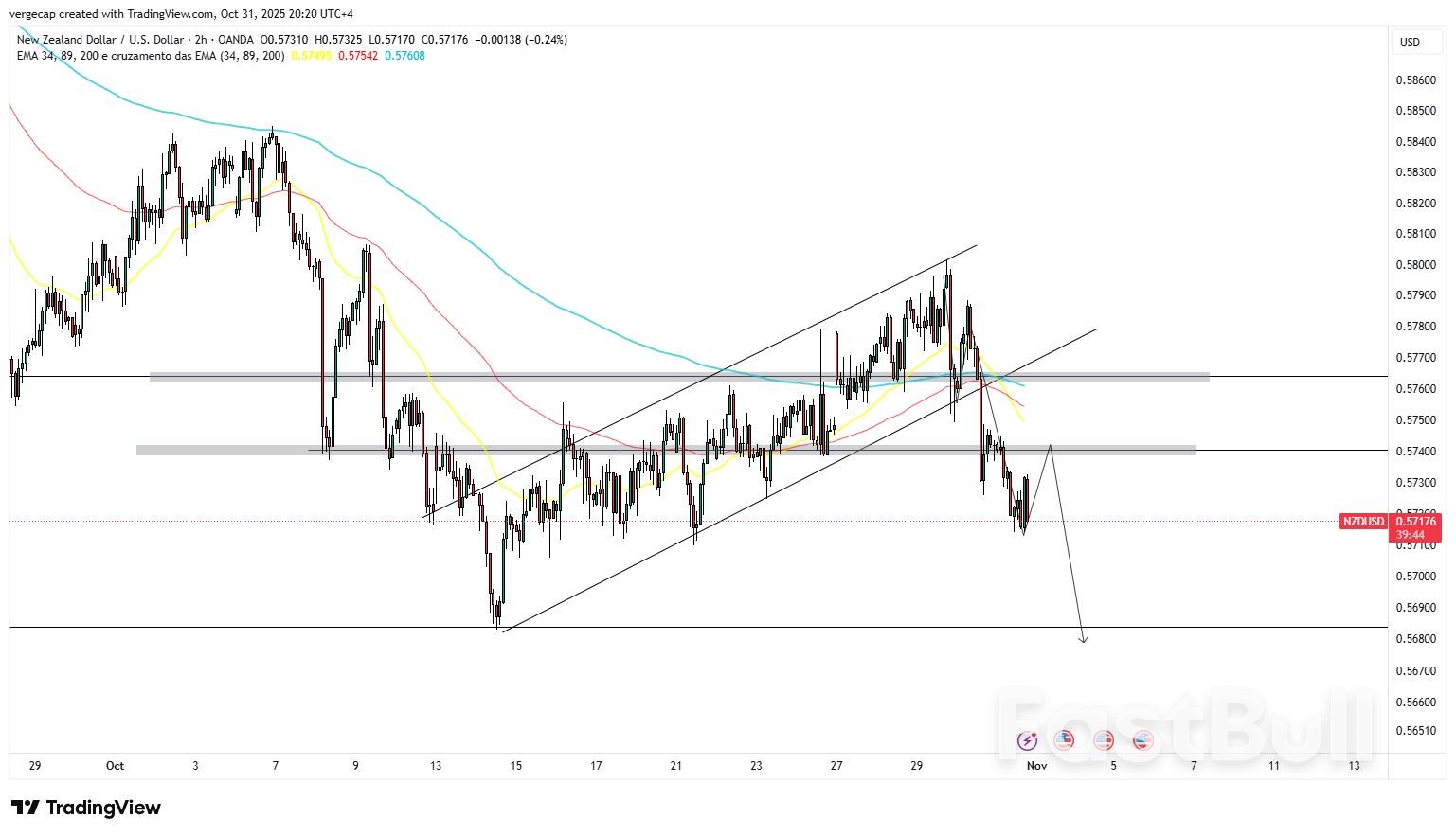
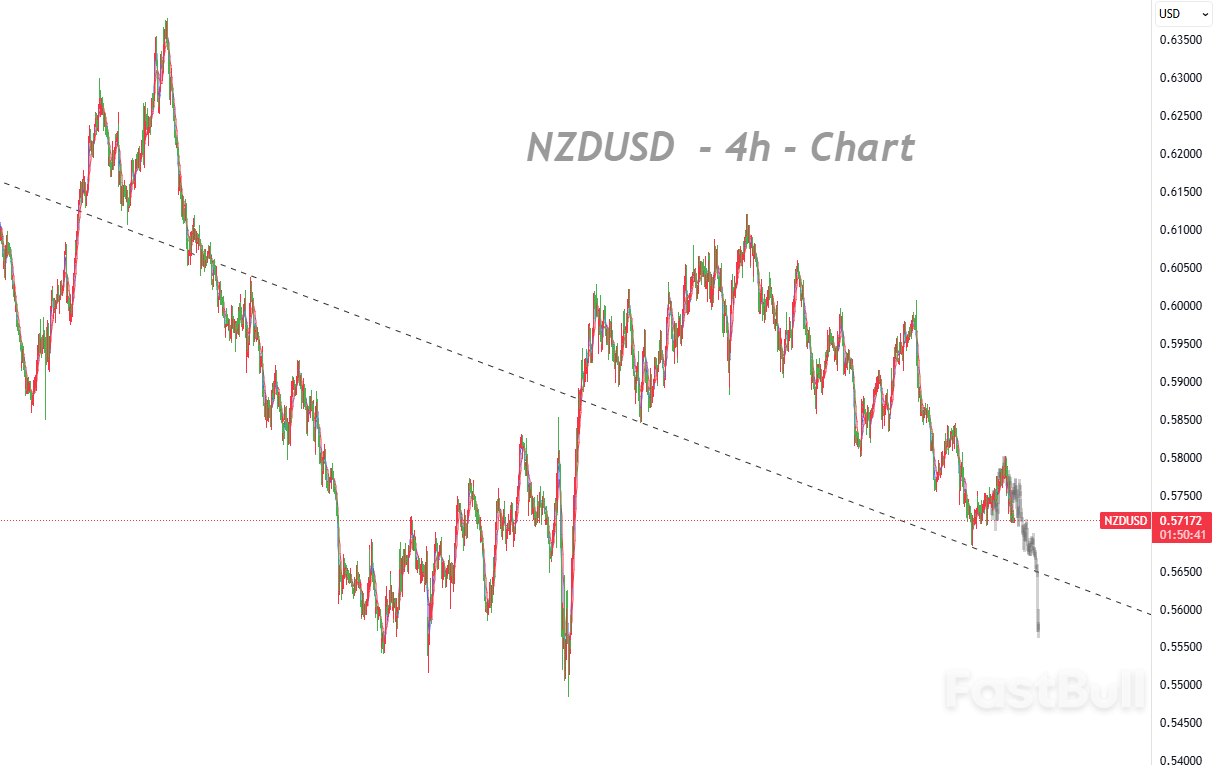
          Powell’s hawkish pivot has turned NZDUSD structurally bearish. Next week’s NZ labour print is now the critical input for the RBNZ’s policy path. Technically, the rising-wedge break targets a probe of the October cycle lows.

          SELL NZDUSD
          Close Time
          CLOSED

          0.57125

          Entry Price

          0.56000

          TP

          0.58350

          SL

          0.57847 +0.00093 +0.16%

          42.6

          Pips

          Profit

          0.56000

          TP

          0.56699

          Exit Price

          0.57125

          Entry Price

          0.58350

          SL
          Fundamentals

          NZDUSD slid sharply last week, driven predominantly by a resurgent U.S. dollar. Chair Powell’s hawkish post-meeting remarks at the October FOMC forced markets to re-price the probability of a December rate cut, propelling the USD higher across the board as Treasury yields jumped. Prior consensus had priced in a third consecutive 25 bp reduction, which was abruptly unwound, weighing on risk assets and commodity prices and dragging the Kiwi lower.
          The Chair’s push-back not only reversed NZDUSD’s earlier uptrend but also left a weekly shooting-star candle, flagging downside momentum. Attention now turns to New Zealand’s Q3 labour-market report, the key domestic input for the RBNZ’s 27 November MPS. While the Bank’s inflation-targeting mandate remains paramount, a softening labour market is increasingly guiding its reaction function. The unemployment rate has drifted higher and participation has rolled over, keeping domestic inflationary pressures muted.
          Should this week’s release show no sign of a turnaround, priced-in odds for a fourth straight 25 bp cut at the November meeting will harden, and OIS contracts could nudge the terminal cash-rate sub-2%. Conversely, an upside surprise in employment and wage prints would temper easing expectations. The RBNZ’s own projection sees Q3 unemployment at 5.3% and private-sector wages rising 2.1% YoY both consistent with only tepid inflation pressure.
          Powell’s Hawkish Rhetoric Weakens Kiwi, Downside Risks Intensify_1

          Technical Analysis

          NZDUSD’s inverse correlation with U.S. Treasury yields has tightened markedly: the five-day rolling correlations with 2- and 10-year benchmarks are ‑0.92 and ‑0.93, respectively, implying that any backup in Treasury yields is almost mechanically accompanied by Kiwi weakness. Concurrently, the currency exhibits high beta to both offshore CNH and SGX whole-milk-powder futures, underscoring its sensitivity to global cyclical-risk sentiment.
          On the daily chart, NZDUSD printed a key reversal candle after stalling near 0.5800 and subsequently broke the rising-wedge support, technically confirming a bearish shift. Layered supports follow at 0.5683, 0.5678 and 0.5640. Momentum gauges align with the down-move: RSI has sliced below its own uptrend line and is drifting away from the neutral zone, while MACD is curling lower and entrenched in negative territory, flagging building downside pressure.
          During the day, any bounce that fades ahead of 0.5755 can be treated as a sell-the-rip opportunity, with stops parked just above the level to guard against a reversal. A daily close back above 0.5755 would nullify the near-term bearish setup and reopen a retest of 0.5800.
          Overall, the pair remains skewed lower under the double weight of a hawkish Fed and RBNZ easing bets. Unless this week’s labour data deliver a material upside surprise, Kiwi topside is likely to remain capped and the October low remains in play.

          Trading Recommendations

          Trading Direction: Sell
          Entry Price: 0.5725
          Target Price: 0.5835
          Stop Loss: 0.5600
          Valid Until: 18 November, 2025, 23:55:00
          Support: 0.5735/0.5710/0.5682
          Resistance: 0.5802/0.5820/0.5845
          Risk Warnings and Disclaimers
          You understand and acknowledge that there is a high degree of risk involved in trading. Following any strategies or investment methods may lead to potential losses. The content on the site is provided by our contributors and analysts for information purposes only. You are solely responsible for determining whether any trading assets, securities, strategy, or any other product is suitable for investing based on your own investment objectives and financial situation.
          Add to Favorites
          Share

          Rate-Cut Delayed, EU & US in Free-Fall?

          Tank

          Forex

          Technical Analysis

          Summary:

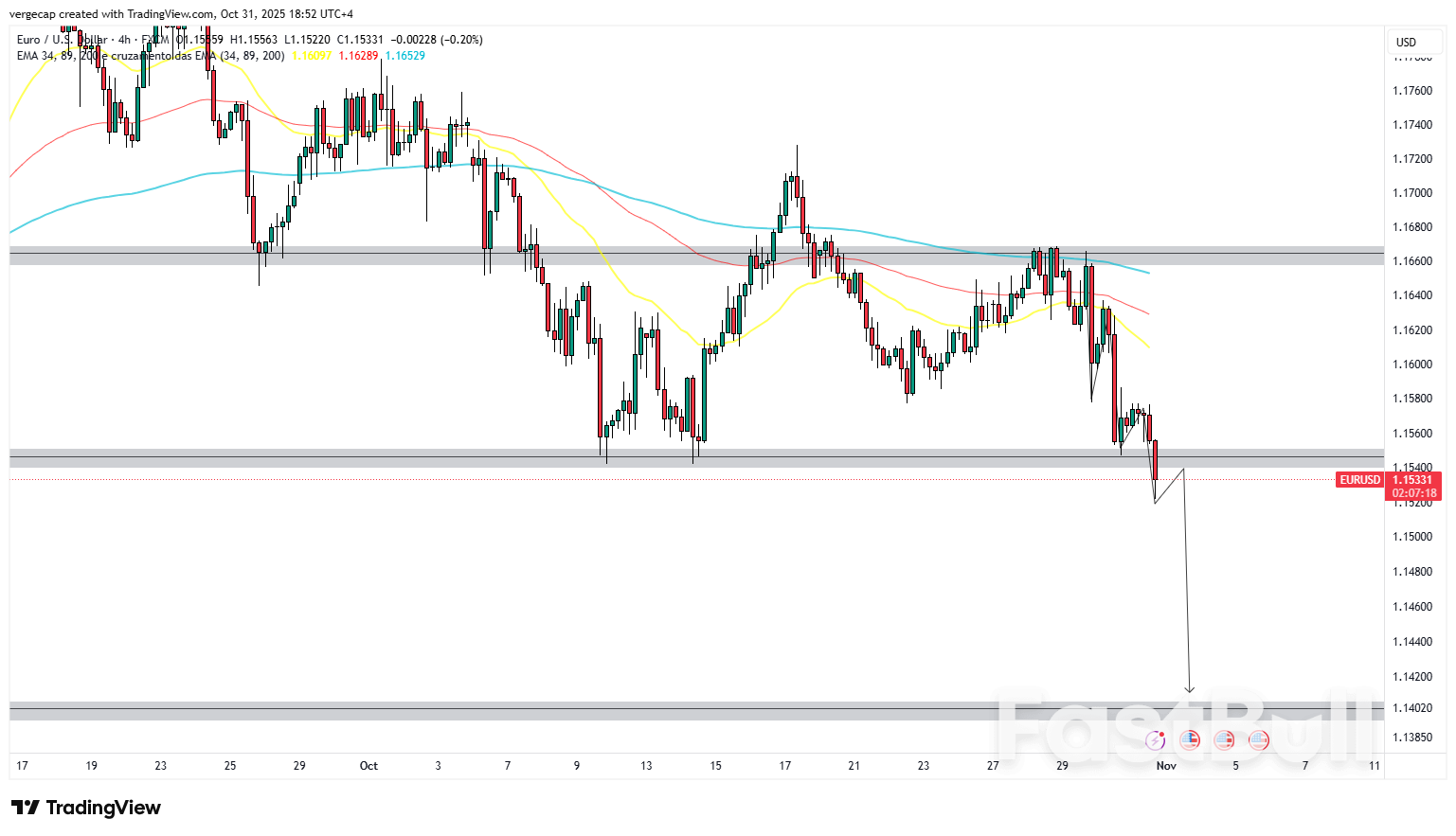
          ECB left rates unchanged as widely expected. The decision left the euro unmoved. EURUSD extended this week's slide once the news was priced in.

          SELL EURUSD
          Close Time
          CLOSED

          1.15194

          Entry Price

          1.12000

          TP

          1.17300

          SL

          1.16539 +0.00113 +0.10%

          4.0

          Pips

          Profit

          1.12000

          TP

          1.15154

          Exit Price

          1.15194

          Entry Price

          1.17300

          SL

          Fundamentals

          The ECB announced its monetary-policy decision on Thursday. As widely expected, the Governing Council left the three key policy rates unchanged: the main refinancing operations (MRO) rate at 2.15%, the marginal lending facility (MLF) rate at 2.40% and the deposit facility (DF) rate at 2.00%. The hold was fully priced in, given both the Council's prior guidance and the fact that the euro-area easing cycle started well ahead of the Fed's.
          The ECB has been cutting rates since June 2024, with a cumulative total of eight rate cuts. These measures have finally brought the rates to a relatively comfortable neutral level, without any signs of rising price pressures, while the economy has maintained moderate and stable growth. Christine Lagarde, President of the ECB, reiterated at the subsequent press conference that the ECB is currently in a good position. She further emphasized that officials are prepared to ensure inflation stabilizes at the 2% target level over the medium term. Finally, Lagarde noted that some downside risks to growth have eased, but this is not the case for inflation. The ECB's decision had no real impact on the euro. After market participants digested this news, EURUSD continued its downward trend for the week.
          The FOMC lowered the federal funds target range by 25 bp to 3.75%–4.00%.
          Governor Stephen Miran dissented in favor of 50 bp, while Kansas-City Fed president Jeffrey Schmid preferred no change. The Committee also announced an immediate end to quantitative tightening. The statement itself moved markets little. However, the reaction came only after Chair Jerome Powell's press conference. Powell struck a distinctly hawkish tone, framing the cut as a risk-management move but stressing that a December reduction is "not a given. "On speculative repricing, the DXY spiked and equities closed marginally lower, while the probability of a December cut fell sharply.
          Furthermore, Powell also emphasized the challenges posed by the government shutdown to assessing the economic situation, which has led to a lack of official data, particularly employment-related figures. "Perhaps we should be more cautious," Powell noted. "I am not making a commitment here; I am simply saying that there is indeed a possibility that we might say, 'We really can't see the situation clearly right now, so let's slow down.'"
          At the moment, the U.S. government shutdown has entered its fourth week. Federal coffers ran dry on 1 Oct and the Senate has yet to coalesce around a continuing-resolution bill. After the Fed's announcement, price action shows markets are pricing in a protracted closure, but overall sentiment remains relatively orderly.
          Trade-war headlines again dominated the newswires this week. After a Seoul sidebar between President Trump and President Xi Jinping, the news-flow turned constructive: Washington will roll back its fentanyl-linked tariff to 10%, while Beijing pledged stepped-up U.S. farm purchases, suspended rare-earth export curbs and agreed to launch energy-sector talks.
          Separately, the U.S. unveiled an Enhanced Trade Agreement with Tokyo aimed at aligning critical-mineral supply chains and reaffirming prior joint pledges. Following a Tuesday meeting with Prime Minister Takashi Tachibana, President Trump confirmed that the previously threatened 25% levy on Japanese goods will be set at 15%. In return, Japan committed to a $550 bn industrial-investment package and market-opening steps for U.S. rice, autos and defence hardware.

          Technical Analysis

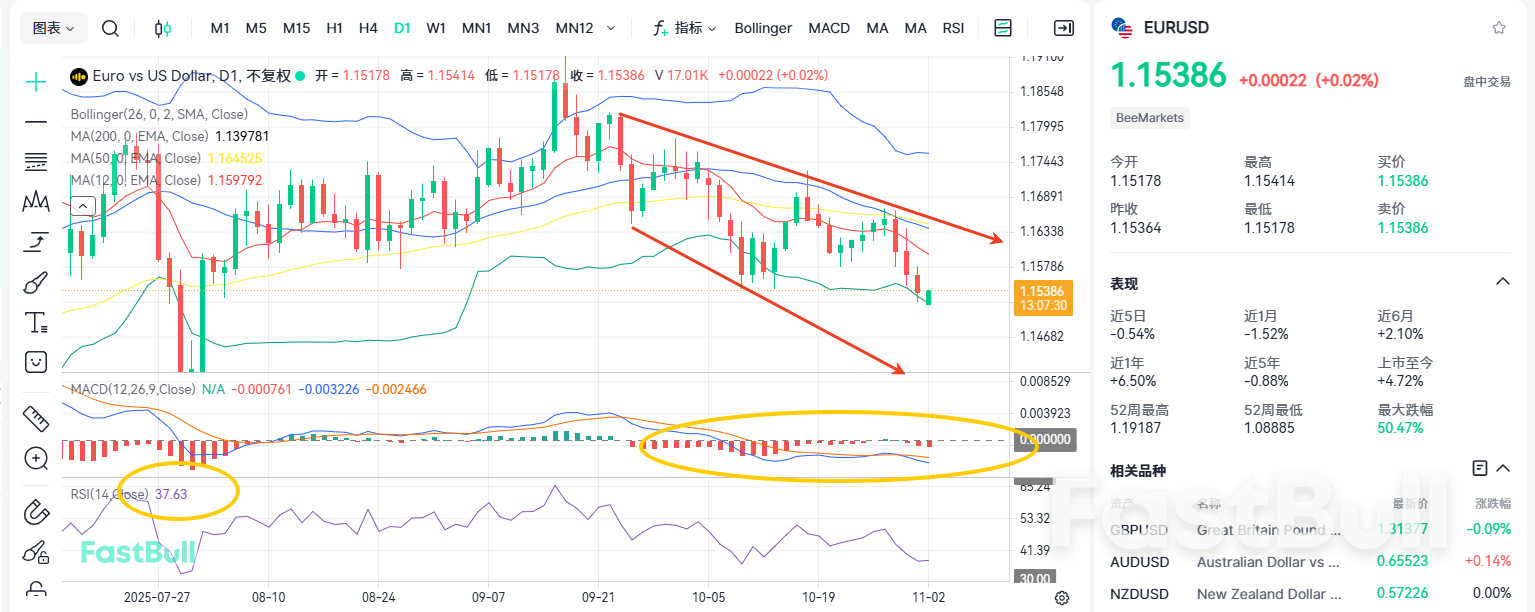
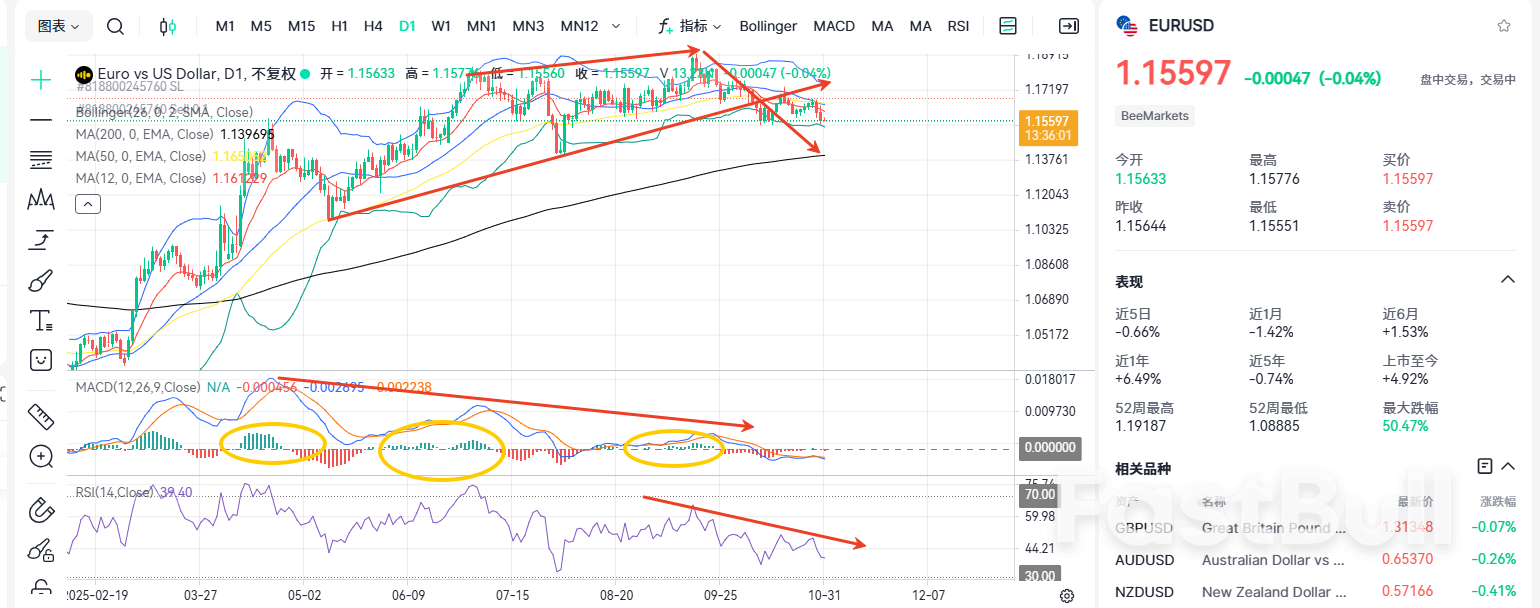
          On the daily timeframe, after the MACD on the EURUSD formed a death cross signal, the fast and slow lines fell below the 0-axis. This indicates the market has entered a bearish phase. The Bollinger Bands are opening downward, and the moving averages are diverging downward. The price is fluctuating downward along the EMA12. The RSI reads 37, meaning the market has entered the oversold zone. If the price breaks below 1.16 again, it will most likely drop to the integer level of 1.15 and around 1.139 (near the EMA200).
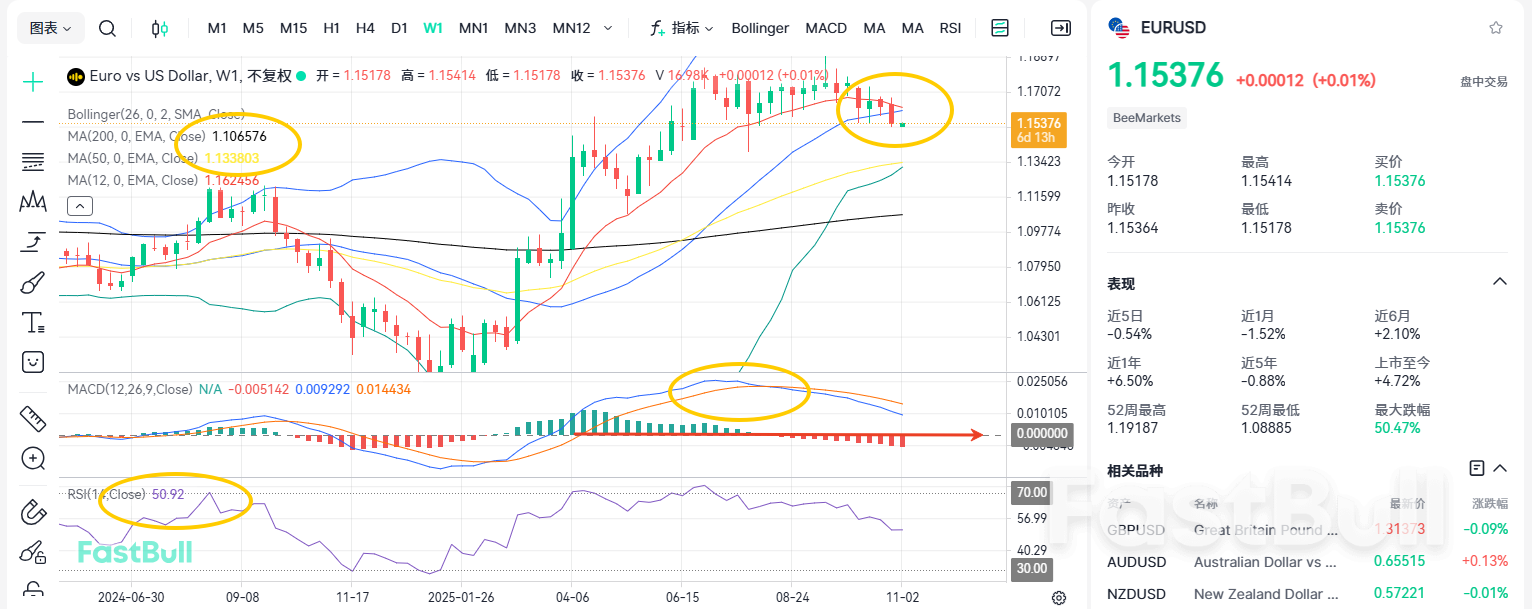
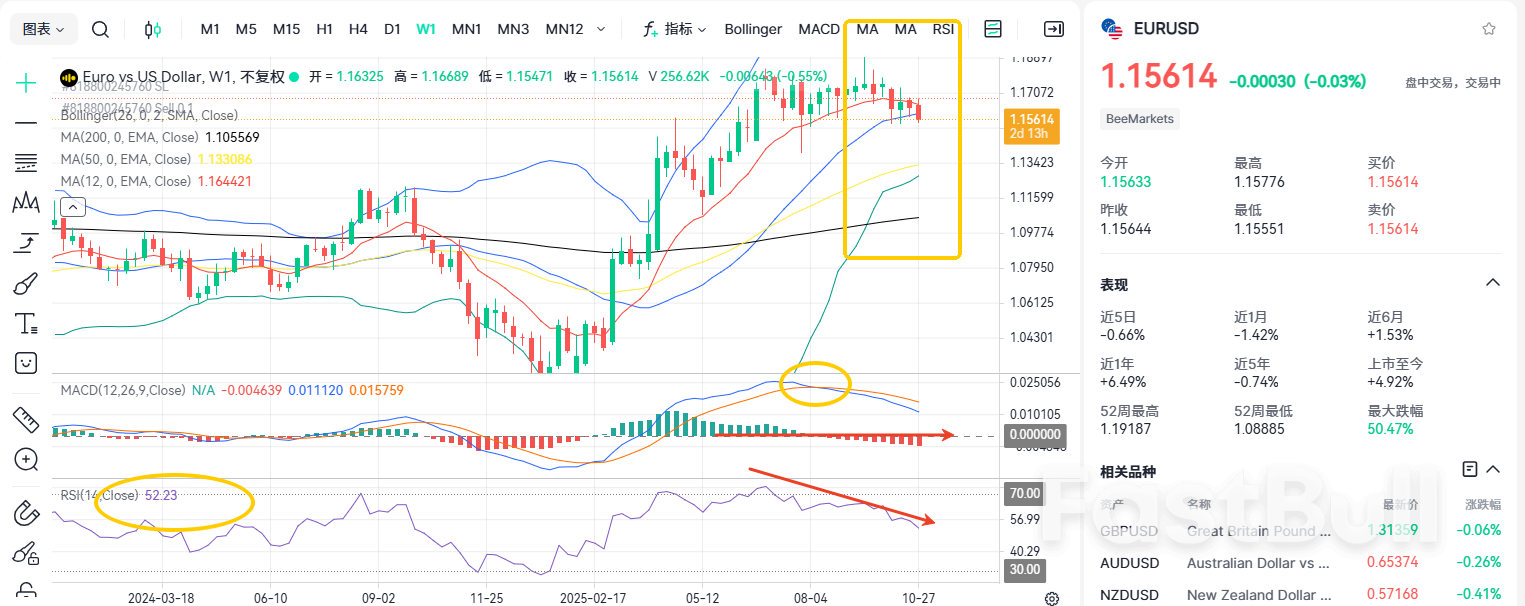
          From the weekly perspective, the Bollinger Band channels are narrowing. The price broke below the Bollinger Middle Band in a large bearish candlestick pattern. After the MACD formed a death cross, the fast and slow lines are pulling back toward the 0-axis but still have a certain distance to cover, indicating the correction is not yet complete. The RSI reads 50, and the highs are gradually lowering, showing the market has entered a wait-and-see sentiment. Once the price fails to hold above the Bollinger Middle Band after a rebound, it will most likely fall to the EMA50 or even near the Bollinger Lower Band.
          Therefore, the short-term trading strategy is recommended to focus on selling at highs.
          Rate-Cut Delayed, EU & US in Free-Fall?_1Rate-Cut Delayed, EU & US in Free-Fall?_2

          Trading Recommendations

          Trading Direction: Sell
          Entry Price: 1.1526
          Target Price: 1.12
          Stop Loss: 1.173
          Support: 1.145/1.14/1.12
          Resistance: 1.182/1.192/1.2
          Risk Warnings and Disclaimers
          You understand and acknowledge that there is a high degree of risk involved in trading. Following any strategies or investment methods may lead to potential losses. The content on the site is provided by our contributors and analysts for information purposes only. You are solely responsible for determining whether any trading assets, securities, strategy, or any other product is suitable for investing based on your own investment objectives and financial situation.
          Add to Favorites
          Share

          Rebound Resumes! USDCAD Poised to Break Through 1.5?

          Tank

          Forex

          Technical Analysis

          Summary:

          The Federal Reserve has implemented its second rate cut of the year, lowering the target range for the federal funds rate to 3.75%–4.0%. This has diminished market expectations for a December rate cut, providing support to the U.S. dollar. Consequently, the USDCAD currency pair may recover recent losses and continue its upward trajectory for the third consecutive trading session.

          BUY USDCAD
          Close Time
          CLOSED

          1.40170

          Entry Price

          1.44000

          TP

          1.38000

          SL

          1.38226 +0.00079 +0.06%

          14.6

          Pips

          Profit

          1.38000

          SL

          1.40316

          Exit Price

          1.40170

          Entry Price

          1.44000

          TP

          Fundamentals

          The strengthening of the Canadian dollar driven by rising oil prices has led to a subdued USDCAD exchange rate. Notably, Canada is the U.S.' largest crude oil export partner. West Texas Intermediate (WTI) crude oil prices have remained around US$61 per barrel. The increase in crude oil prices is attributed to OPEC+ signaling a pause in production hikes. On Sunday, OPEC+ announced that after a slight increase in output next month, plans are set to suspend further production increases into the first quarter of 2026. Last Wednesday, the Bank of Canada reduced its policy interest rate to 2.25%, indicating that the easing cycle may be nearing completion. The central bank announced a 25 basis point reduction in the overnight rate target to 2.25%, with the bank rate set at 2.5% and the deposit rate at 2.20%. In its policy statement, the Bank noted that, given the increasingly transparent impact of U.S. trade actions on economic growth and inflation, the monetary policy report has resumed its forecasts for the global and Canadian economies. Due to the persistent high uncertainty surrounding U.S. trade policies, these projections now face broader risk ranges than before. The Canadian economy is undergoing a structural transition. Long-term damages from trade conflicts have diminished potential output capacity and increased production costs, thereby constraining the monetary policy space to stimulate demand and maintain low inflation. The Bank of Canada emphasized its commitment to ensuring public confidence in price stability during global economic fluctuations. The next scheduled announcement of the overnight rate target is December 10, 2025, with the upcoming monetary policy report due for release on January 28, 2026.
          The Federal Reserve has implemented its second rate cut of the year, lowering the target range for the federal funds rate to 3.75%–4.0%. This has diminished market expectations for a December rate cut, providing support to the U.S. dollar. Consequently, the USDCAD currency pair may recover recent losses and continue its upward trajectory for the third consecutive trading session. Federal Reserve Chairman Jerome Powell stated at the post-meeting press conference that a December rate cut remains highly uncertain. Powell also cautioned that policymakers might need to adopt a wait-and-see approach until official economic data is released. According to the FedWatch tool by the Chicago Mercantile Exchange, traders currently estimate a 69% probability of a rate decrease in December, down from 93% a week earlier. However, due to the prolonged government shutdown, traders are likely to remain cautious, potentially heightening fears about the U.S. economy. The government impasse has entered its sixth week, with Congress deadlocked over an appropriations bill backed by Republicans, and no straightforward resolution currently in sight.

          Technical Analysis

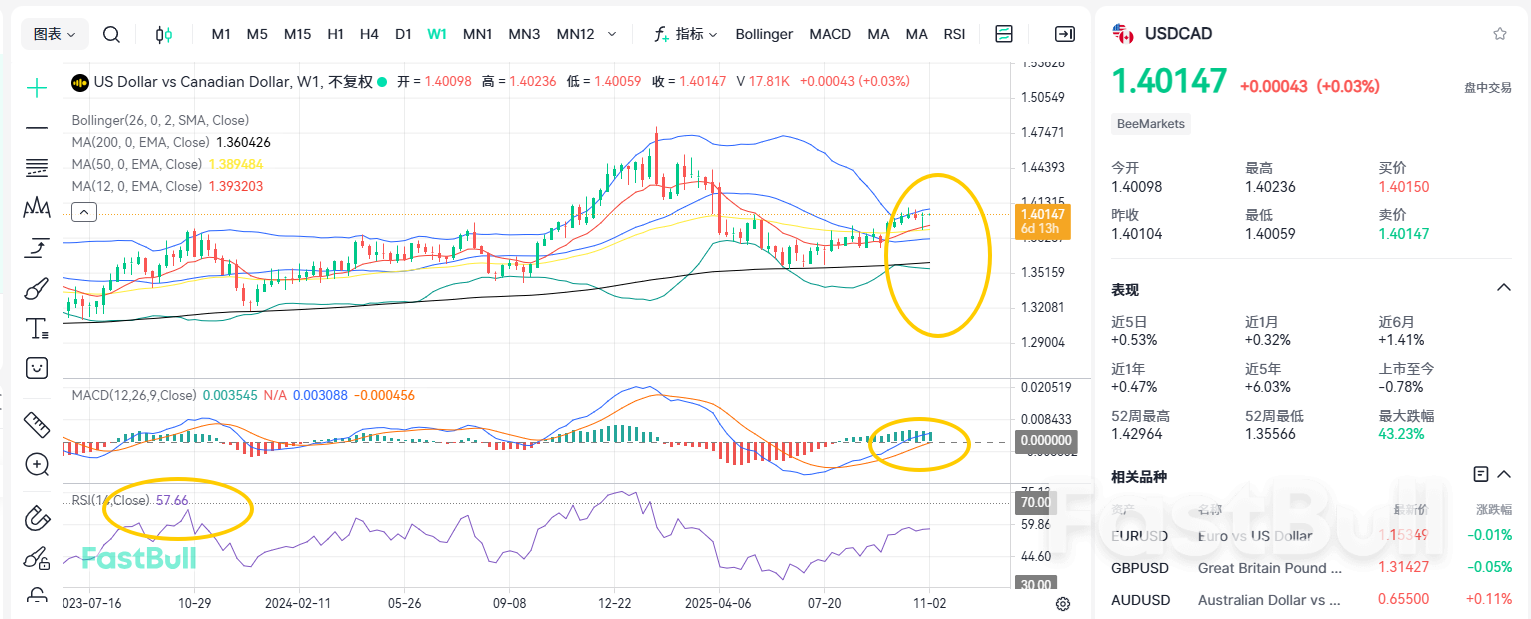
          In the 1D timeframe, the Bollinger Bands are contracting, indicating narrowing volatility. The short-term EMA12 has stabilized, and the price has regained support above the EMA12 and the middle Bollinger Band, signaling a shift back to bullish momentum. A golden cross in the MACD would further accelerate the upward trend. The RSI stands at 58, reflecting strong bullish sentiment. Resistance levels are near the upper Bollinger Band and previous highs around 1.407 and 1.44. In the 1W timeframe, the Bollinger Bands are expanding upward, with MACD exhibiting sustained bullish momentum. Price action oscillates near the upper Bollinger Band, and following a MACD golden cross, the MACD line and signal line have moved above the zero-axis. The RSI is at 57, with higher lows, indicating improving market confidence in continued upward movement. Therefore, it is recommended to go long at the lows.
          Rebound Resumes! USDCAD Poised to Break Through 1.5?_1Rebound Resumes! USDCAD Poised to Break Through 1.5?_2

          Trading Recommendations

          Trading Direction: Buy
          Entry Price: 1.4017
          Target Price: 1.44
          Stop Loss: 1.38
          Support: 1.378, 1.37, 1.357
          Resistance: 1.41, 1.42, 1.44
          Risk Warnings and Disclaimers
          You understand and acknowledge that there is a high degree of risk involved in trading. Following any strategies or investment methods may lead to potential losses. The content on the site is provided by our contributors and analysts for information purposes only. You are solely responsible for determining whether any trading assets, securities, strategy, or any other product is suitable for investing based on your own investment objectives and financial situation.
          Add to Favorites
          Share

          Production Hike Paused — Does This Mean the Bearish Trend Is Over?

          Alan

          Commodity

          Summary:

          OPEC+'s latest decision plans a modest production increase in December, followed by a halt in output growth in Q1 2026. While this provides short-term support for oil prices, it remains a drop in the bucket amid the current oversupplied market conditions.

          SELL WTI
          Close Time
          CLOSED

          60.900

          Entry Price

          56.500

          TP

          62.500

          SL

          59.885 +0.076 +0.13%

          103.0

          Pips

          Profit

          56.500

          TP

          59.870

          Exit Price

          60.900

          Entry Price

          62.500

          SL

          Fundamentals​

          The newly announced OPEC+ decision indicates that the group has agreed to a slight production increase of approximately 137,000 barrels per day in December 2025, while pausing any further output growth in Q1 2026. This move is seen in the market as a precautionary measure against the risk of "potential supply flooding," thereby temporarily boosting sentiment of support in the crude oil market. Specifically, the crude oil market is under pressure due to global inventory accumulation, record-high U.S. shale production growth, and expectations of a slowdown in global demand recovery.
          OPEC+'s decision to pause production growth helps alleviate oversupply concerns, which is fundamentally positive for oil prices. However, this positive also carries a "half-signal" nature: First, although the increase is paused, there is no reduction in output, nor is there a significant voluntary contraction in capacity. This means that if demand continues to weaken or U.S. shale production accelerates, the risk of oversupply still persists. Second, the pause is limited to Q1 only; subsequent resumption of production or increased output from new members could trigger another round of downward pressure. Additionally, global economic growth—especially the weak recovery in factory activity and demand in major consuming countries such as China, India, and the EU—leaves demand-side uncertainty still in play.
          Therefore, OPEC+'s policy provides interim support for oil prices, but it won't fundamentally eliminate downside risks.

          Technical Analysis

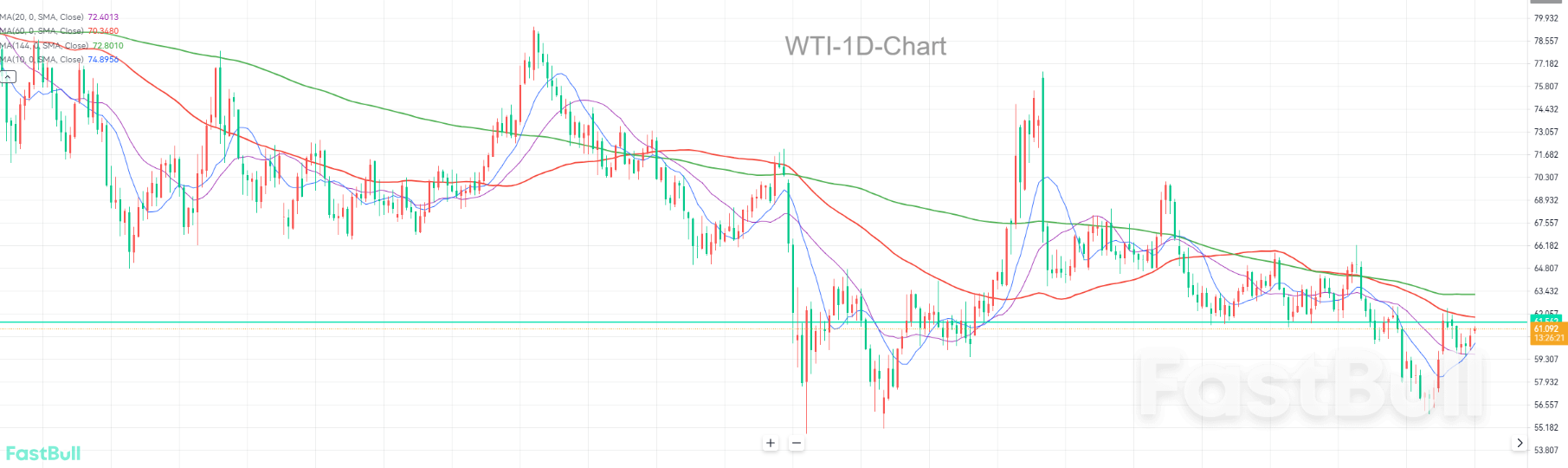
          Production Hike Paused — Does This Mean the Bearish Trend Is Over?_1
          Based on the daily chart, WTI opened with a gap higher, driven by the short-term positive news that OPEC+ will halt production growth in Q1 2026. However, it still failed to break through the key resistance level of 61.60 and entered a phase of consolidation.
          On the downside, WTI may extend the depreciation if it fails to cross above 61.60 shortly, testing 56.00 again.
          On the upside, WTI is likely to ascend towards 63.00 if it breaks above 61.60 in the short term.

          Trading Recommendations

          Trading direction: Sell
          Entry price: 61.15
          Target price: 56.50
          Stop loss: 62.50
          Valid Until: November 17, 2025, 23:00:00
          Support: 59.47/56.00
          Resistance: 61.60/62.37
          Risk Warnings and Disclaimers
          You understand and acknowledge that there is a high degree of risk involved in trading. Following any strategies or investment methods may lead to potential losses. The content on the site is provided by our contributors and analysts for information purposes only. You are solely responsible for determining whether any trading assets, securities, strategy, or any other product is suitable for investing based on your own investment objectives and financial situation.
          Add to Favorites
          Share

          Kiwi Slips for Third Straight Day as Hawkish Fed and Weak China Data Weigh on Sentiment

          Warren Takunda

          Traders' Opinions

          Summary:

          The New Zealand Dollar extended losses on Friday, pressured by weak Chinese manufacturing data, hawkish remarks from the Federal Reserve, and cautious comments from the RBNZ.

          SELL NZDUSD
          Close Time
          CLOSED

          0.57200

          Entry Price

          0.56600

          TP

          0.57700

          SL

          0.57847 +0.00093 +0.16%

          17.1

          Pips

          Profit

          0.56600

          TP

          0.57029

          Exit Price

          0.57200

          Entry Price

          0.57700

          SL

          The New Zealand Dollar (NZD) remained under pressure on Friday, marking its third consecutive daily decline as global risk sentiment soured and the U.S. Dollar strengthened across the board. The Kiwi traded around 0.5720, down roughly 0.45% for the week, retreating from its failed attempt to breach the 0.5800 resistance earlier in the week.
          The decline comes amid a combination of soft economic data from China, hawkish rhetoric from the Federal Reserve, and renewed caution among investors over the global growth outlook — a mix that has left high-beta currencies like the NZD exposed.
          Fresh signs of slowing momentum in China — New Zealand’s largest trading partner — added to the Kiwi’s woes. The National Bureau of Statistics (NBS) Manufacturing Purchasing Managers’ Index (PMI) for October fell to 49.0, down from 49.8 in September and missing market forecasts of 49.6. This marks the second straight month of contraction, driven by weak domestic demand, supply chain bottlenecks, and subdued external orders.
          The disappointing figures underscored the lingering headwinds facing China’s post-pandemic recovery. For New Zealand, whose export economy is heavily reliant on Chinese demand for agricultural and dairy products, such readings often translate into weaker trade prospects and a softer currency outlook.
          “The ongoing deterioration in Chinese manufacturing activity continues to dampen regional sentiment,” said a Wellington-based trader. “The NZD is particularly vulnerable when investors start reducing risk exposure in Asia-Pacific markets.”
          Further weighing on the Kiwi were remarks from Prasanna Gai, a member of the Reserve Bank of New Zealand’s Monetary Policy Committee, who warned that escalating U.S. tariffs and global trade disruptions are creating a “negative demand shock” for the New Zealand economy. Speaking at a policy forum in Melbourne, Gai cautioned that these headwinds could amplify the challenges already facing New Zealand’s restrained growth outlook.
          He added that while the RBNZ’s easing measures have provided some support, “the cumulative impact of global uncertainty and tighter financial conditions has offset much of the stimulus,” hinting at the potential need for additional rate cuts in the coming months.
          Gai’s comments echoed the RBNZ’s dovish tone in recent meetings, where policymakers have signaled growing concern over persistent inflationary pressures coupled with slowing growth momentum. The combination of weak global demand and domestic fragility has put the central bank in a difficult balancing act — easing enough to support activity without reigniting price pressures.
          Adding to the NZD’s downward pressure was a stronger U.S. Dollar, which extended its gains after Federal Reserve Chair Jerome Powell signaled a more hawkish stance than markets anticipated. Following a widely expected 25 basis point rate cut on Wednesday, Powell stressed that another reduction in December was “not a foregone conclusion,” suggesting the central bank remains cautious about over-easing monetary policy amid resilient labor data and sticky inflation.
          That message triggered a rebound in U.S. Treasury yields, with short-term maturities climbing sharply as traders scaled back expectations for aggressive Fed easing into year-end. The resulting dollar strength has weighed heavily on most G10 currencies, particularly those sensitive to shifts in global risk sentiment like the Kiwi and Aussie.
          “Powell’s tone caught investors off guard,” said a currency strategist at ANZ. “Markets were positioned for a dovish confirmation, but instead they got a reminder that the Fed is still data-dependent. That pivot sent yields and the dollar higher, leaving the Kiwi on the defensive.”

          Technical AnalysisKiwi Slips for Third Straight Day as Hawkish Fed and Weak China Data Weigh on Sentiment_1

          From a technical perspective, NZD/USD has broken below a key short-term bullish channel, intensifying downside momentum. The pair’s failure to hold above the 50-day Exponential Moving Average (EMA50) confirms renewed selling pressure, with the next immediate support seen near 0.5700, followed by 0.5660 — the October low.
          Momentum indicators, including the Relative Strength Index (RSI), have turned south, reflecting an increase in bearish momentum and signaling the potential for deeper losses if sentiment fails to stabilize. On the upside, the 0.5800 level now stands as a critical resistance zone, and only a decisive break above it could shift the near-term outlook back toward neutrality.

          TRADE RECOMMENDATION

          SELL NZDUSD
          ENTRY PRICE: 0.5720
          STOP LOSS: 0.5770
          TAKE PROFIT: 0.5660
          Risk Warnings and Disclaimers
          You understand and acknowledge that there is a high degree of risk involved in trading. Following any strategies or investment methods may lead to potential losses. The content on the site is provided by our contributors and analysts for information purposes only. You are solely responsible for determining whether any trading assets, securities, strategy, or any other product is suitable for investing based on your own investment objectives and financial situation.
          Add to Favorites
          Share

          EUR/USD Slips as Hawkish Fed and Weak Eurozone Data Weigh on Sentiment

          Warren Takunda

          Technical Analysis

          Summary:

          EUR/USD drifted lower to 1.1560 on Friday, pressured by a stronger dollar following the Fed’s hawkish tone and lackluster Eurozone inflation data.

          SELL EURUSD
          Close Time
          CLOSED

          1.15350

          Entry Price

          1.14000

          TP

          1.15900

          SL

          1.16539 +0.00113 +0.10%

          17.5

          Pips

          Profit

          1.14000

          TP

          1.15175

          Exit Price

          1.15350

          Entry Price

          1.15900

          SL

          The euro weakened against the dollar on Friday, slipping to around 1.1560 as risk sentiment soured and the Federal Reserve’s hawkish policy tone boosted the greenback. The move came after a largely directionless Asian and early European session, where the pair hovered just above key support near 1.1540. Despite a brief attempt to steady, the broader trend remains firmly tilted toward the downside as the market adjusts to diminishing prospects for further U.S. rate cuts this year.
          Investors continue to digest Wednesday’s Federal Reserve decision, where the central bank delivered a quarter-point rate cut but paired it with a distinctly hawkish message. Fed Chair Jerome Powell said that another rate reduction at the December meeting was “not a foregone conclusion,” effectively curbing expectations for additional easing. His remarks painted a picture of a central bank intent on staying data-dependent, even as economic visibility remains clouded by disruptions from the U.S. government shutdown, which has delayed key economic releases. The tone reinforced the notion that the Fed is entering a cautious holding phase rather than embarking on a deeper easing cycle.
          Markets reacted swiftly. Treasury yields ticked higher, and the dollar rallied as investors interpreted Powell’s stance as a sign of policy restraint rather than further accommodation. The Fed’s message, while signaling flexibility, also underscored its belief that the economy remains relatively resilient. This narrative has provided strong footing for the dollar and left little room for the euro to regain lost ground.
          The greenback also found additional support from improving sentiment surrounding global trade. U.S. President Donald Trump and China’s President Xi Jinping reaffirmed a truce in their trade dispute, agreeing to maintain existing terms and suspend further escalation. While the agreement has been described as fragile and temporary, it was sufficient to boost confidence in U.S. assets. The development helped reinforce the dollar’s appeal, given the United States’ perceived economic resilience compared to Europe’s subdued outlook.
          In contrast, Eurozone data continued to disappoint. Preliminary October figures for the Harmonized Index of Consumer Prices (HICP) showed inflation slowing slightly to 2.1% year-on-year from 2.2% in September. Core inflation held steady at 2.4%, indicating little underlying price momentum. On a monthly basis, consumer prices rose by 0.2%, marginally above the prior month’s 0.1%, while the core index advanced to 0.3%. These figures suggest inflationary pressures in the bloc remain contained, giving the European Central Bank limited room to maneuver.
          The ECB, as expected, left interest rates unchanged at 2% during its latest meeting. President Christine Lagarde maintained a calm tone, stating that the central bank is “in a good place” and signaling confidence that current policy settings remain appropriate. Lagarde’s comments briefly lifted the euro, but the bounce proved short-lived as traders refocused on the widening yield gap between the Eurozone and the United States. Market participants largely interpreted her remarks as confirmation that the ECB is content to maintain its stance for now, rather than hinting at any tightening path ahead.

          Technical AnalysisEUR/USD Slips as Hawkish Fed and Weak Eurozone Data Weigh on Sentiment_1

          Technically, the euro remains on fragile footing. The 200-day simple moving average continues to act as a ceiling, repeatedly rejecting bullish attempts to push higher. A recent break below the SMA 786 level confirmed renewed bearish momentum, slicing through dynamic support that had previously cushioned declines. The technical setup points to sustained downward bias, with momentum indicators favoring a continuation toward the 1.1400 handle in the short term. The failed attempts to reclaim resistance levels suggest that sellers remain firmly in control, and unless the pair stages a decisive recovery above 1.1620, rallies are likely to be sold into.
          The current structure fits well with a disciplined short-side strategy that focuses on precision and patience rather than aggressive chasing. The rejection at the 200 SMA underscores the broader weakness in the euro, while the breakdown through support zones validates the dominance of bearish sentiment. For now, the path of least resistance remains lower, with traders likely to test deeper support levels should the U.S. data continue to outperform or if Eurozone indicators fail to show meaningful improvement.

          TRADE RECOMMENDATION

          SELL EURUSD
          ENTRY PRICE: 1.15350
          STOP LOSS: 1.1590
          TAKE PROFIT: 1.1400
          Risk Warnings and Disclaimers
          You understand and acknowledge that there is a high degree of risk involved in trading. Following any strategies or investment methods may lead to potential losses. The content on the site is provided by our contributors and analysts for information purposes only. You are solely responsible for determining whether any trading assets, securities, strategy, or any other product is suitable for investing based on your own investment objectives and financial situation.
          Add to Favorites
          Share

          EURUSD Breaks below 1.16! Will It Keep Falling?

          Tank

          Forex

          Technical Analysis

          Economic

          Summary:

          The European Central Bank maintained its key deposit rate at 2% for the third consecutive decision on Thursday, citing that inflation remains near the medium-term target of 2%. Policymakers exhibit divergent views on potential future rate cuts, which could temper traders' bullish expectations for the euro and constrain movements in the EURUSD currency pair.

          SELL EURUSD
          Close Time
          CLOSED

          1.15600

          Entry Price

          1.12000

          TP

          1.18200

          SL

          1.16539 +0.00113 +0.10%

          32.8

          Pips

          Profit

          1.12000

          TP

          1.15272

          Exit Price

          1.15600

          Entry Price

          1.18200

          SL

          Fundamentals

          The euro is expected to weaken, with the strengthening dollar exerting additional downward pressure on the EURUSD. The European Central Bank (ECB) maintained its interest rates at the October policy meeting, reaffirming its commitment to restoring inflation to the 2% target over the medium term. Policy decisions will continue to be data-dependent and assessed incrementally through successive meetings. Analysts suggest that the ECB is unlikely to cut rates in the near future. The deposit facility rate remains steady at 2%, with the main refinancing rate and marginal lending rate unchanged at 2.15% and 2.40% respectively, aligning with market expectations and reflecting confidence in the resilience of the Eurozone economy and easing inflationary pressures. Lagarde also stated at Thursday's press conference that the current monetary policy interest rate is at a "favorable levels." Although the so-called "favorable level" is not fixed, the ECB will do its utmost to maintain monetary policy within this range. With the trade agreement reached between Europe and the U.S. during the summer, the recent ceasefire in the Middle East, and today's latest developments, some downside risks to economic growth have been offset.
          After the Federal Reserve's consecutive second rate cut of 25 basis points, justified by "risk management" considerations, Federal Reserve Chair Powell's remarks signaled no predetermined path toward easing and warned of significant disagreement within the FOMC regarding December policy actions. He emphasized that a rate cut in December remains "far from a fait accompli." Meanwhile, Powell highlighted the uncertainty surrounding upcoming economic data before the December meeting, noting that the lack of economic indicators could justify pausing interest rate adjustments. Furthermore, the Federal Reserve announced that it will pause its balance sheet reduction starting December 1st and will reinvest maturing principal into short-term Treasury securities. Following the announcement, U.S. Treasury yields flattened during the press conference, and futures markets showed a significant reduction in expectations for a December rate cut. The dollar initially appreciated then depreciated, reflecting the interplay between policy normalization and market pricing adjustments. Analysis indicates that the current U.S. Dollar Index and the Federal Reserve's monetary policy trajectory are approaching three critical inflection points.

          Technical Analysis

          Following the MACD death cross on the EURUSD 1D chart, with both the MACD line and signal line crossing below the zero-axis, the market signal indicates a bearish trend. The Bollinger Bands are expanding downward, while the SMAs are diverging downward, with price oscillating along the EMA12 support level. The RSI reading at 39 suggests increasing market pessimism. The current market has once again breached the 1.16 support level, likely approaching the EMA200 around 1.139. In the 1W timeframe, Bollinger Bands are narrowing, with prices oscillating near the middle band. Following a MACD death cross, the MACD line and signal line are pulling back toward the zero-axis, indicating ongoing correction yet to be complete. The RSI value is at 52, with peaks gradually declining, reflecting a cautious market sentiment. If the price fails to hold the middle Bollinger Band, a decline towards the EMA50 or even the lower Bollinger Band is highly probable. Therefore, it is recommended to go short at the highs in the short term.
          EURUSD Breaks below 1.16! Will It Keep Falling?_1EURUSD Breaks below 1.16! Will It Keep Falling?_2

          Trading Recommendations

          Trading Direction: Sell
          Entry Price: 1.156
          Target Price: 1.12
          Stop Loss: 1.182
          Support: 1.145, 1.14, 1.12
          Resistance: 1.182, 1.192, 1.2
          Risk Warnings and Disclaimers
          You understand and acknowledge that there is a high degree of risk involved in trading. Following any strategies or investment methods may lead to potential losses. The content on the site is provided by our contributors and analysts for information purposes only. You are solely responsible for determining whether any trading assets, securities, strategy, or any other product is suitable for investing based on your own investment objectives and financial situation.
          Add to Favorites
          Share
          FastBull
          Copyright © 2025 FastBull Ltd

          728 RM B 7/F GEE LOK IND BLDG NO 34 HUNG TO RD KWUN TONG KLN HONG KONG

          TelegramInstagramTwitterfacebooklinkedin
          App Store Google Play Google Play
          Products
          Charts

          Chats

          Q&A with Experts
          Screeners
          Economic Calendar
          Data
          Tools
          Membership
          Features
          Function
          Markets
          Copy Trading
          Latest Signals
          Contests
          News
          Analysis
          24/7
          Columns
          Education
          Company
          Careers
          About Us
          Contact Us
          Advertising
          Help Center
          Feedback
          User Agreement
          Privacy Policy
          Business

          White Label

          Data API

          Web Plug-ins

          Poster Maker

          Affiliate Program

          Risk Disclosure

          The risk of loss in trading financial instruments such as stocks, FX, commodities, futures, bonds, ETFs and crypto can be substantial. You may sustain a total loss of the funds that you deposit with your broker. Therefore, you should carefully consider whether such trading is suitable for you in light of your circumstances and financial resources.

          No decision to invest should be made without thoroughly conducting due diligence by yourself or consulting with your financial advisors. Our web content might not suit you since we don't know your financial conditions and investment needs. Our financial information might have latency or contain inaccuracy, so you should be fully responsible for any of your trading and investment decisions. The company will not be responsible for your capital loss.

          Without getting permission from the website, you are not allowed to copy the website's graphics, texts, or trademarks. Intellectual property rights in the content or data incorporated into this website belong to its providers and exchange merchants.

          Not Logged In

          Log in to access more features

          FastBull Membership

          Not yet

          Purchase

          Become a signal provider
          Help Center
          Customer Service
          Dark Mode
          Price Up/Down Colors

          Log In

          Sign Up

          Position
          Layout
          Fullscreen
          Default to Chart
          The chart page opens by default when you visit fastbull.com