• Trade
  • Markets
  • Copy
  • Contests
  • News
  • 24/7
  • Calendar
  • Q&A
  • Chats
Trending
Screeners
SYMBOL
LAST
BID
ASK
HIGH
LOW
NET CHG.
%CHG.
SPREAD
SPX
S&P 500 Index
6827.42
6827.42
6827.42
6899.86
6801.80
-73.58
-1.07%
--
DJI
Dow Jones Industrial Average
48458.04
48458.04
48458.04
48886.86
48334.10
-245.98
-0.51%
--
IXIC
NASDAQ Composite Index
23195.16
23195.16
23195.16
23554.89
23094.51
-398.69
-1.69%
--
USDX
US Dollar Index
97.830
97.910
97.830
98.070
97.810
-0.120
-0.12%
--
EURUSD
Euro / US Dollar
1.17564
1.17572
1.17564
1.17596
1.17262
+0.00170
+ 0.14%
--
GBPUSD
Pound Sterling / US Dollar
1.33925
1.33935
1.33925
1.33940
1.33546
+0.00218
+ 0.16%
--
XAUUSD
Gold / US Dollar
4341.54
4341.88
4341.54
4350.16
4294.68
+42.15
+ 0.98%
--
WTI
Light Sweet Crude Oil
56.993
57.023
56.993
57.601
56.878
-0.240
-0.42%
--

Community Accounts

Signal Accounts
--
Profit Accounts
--
Loss Accounts
--
View More

Become a signal provider

Sell trading signals to earn additional income

View More

Guide to Copy Trading

Get started with ease and confidence

View More

Signal Accounts for Members

All Signal Accounts

Best Return
  • Best Return
  • Best P/L
  • Best MDD
Past 1W
  • Past 1W
  • Past 1M
  • Past 1Y

All Contests

  • All
  • Trump Updates
  • Recommend
  • Stocks
  • Cryptocurrencies
  • Central Banks
  • Featured News
Top News Only
Share

Security Source: Ukrainian Drones Hits Russian Oil Infrastructure In Caspian Sea For Third Time

Share

Spot Palladium Extends Gains, Last Up 5% To $1562.7/Oz

Share

Mexico's Economy Ministry Announces Start Of Anti-Dumping Investigation And Anti-Subsidy Investigations Into USA Pork Imports

Share

Canada Nov CPI Common +2.8%, CPI Median +2.8%, CPI Trim +2.8% On Year

Share

NY Fed's Empire State Prices Paid Index +37.6 In December Versus+49.0 In November

Share

Canada Nov Consumer Prices +0.1% On Month, +2.2% On Year

Share

Canada Nov CPI Core -0.1% On Month, +2.9% On Year

Share

Canada Nov Core CPI, Seasonally Adjusted +0.2% On Month, Oct +0.3% (Unrevised)

Share

UK Health Minister Streeting On Doctors' Strike: Vote To Go Ahead Reveals The Bma's Shocking Disregard For Patient Safety

Share

Venezuelan State Oil Company Pdvsa Says Was Subject To Cyber Attack But Operations Unaffected

Share

Russia Central Bank Says January-October Current Account Surplus At $37.1 Billion

Share

Polish Current Account Balance At +1924 Million Euros In October Versus+130 Million Euros Seen In Reuters Poll

Share

Statement: Germany, Ukraine Propose 10-Point Plan To Strengthen Armament Cooperation

Share

London Metal Exchange Three Month Copper Falls More Than 3% To $11541.50 A Metric Ton

Share

[Market Update] Spot Silver Surged $2.00 During The Day, Returning To $64/ounce, A Gain Of 3.23%

Share

European Central Bank: Italy's Recurrent Ad Hoc Tax Provisions Cause Uncertainty, Damage Investor Confidence, And May Affect Banks' Funding Costs

Share

Stats Office: Nigeria Consumer Inflation At 14.45% Year-On-Year In November

Share

European Central Bank: Italy's Budget Measures Weighing On Domestic Banks Could Have "Negative Implications" On Their Credit Liquidity

Share

Azerbaijan's January-November Oil Exports Via Btc Pipeline Down 7.1% Year-On-Year Data Shows

Share

Azerbaijan's Aliyev Plans A Large-Scale Prisoner Amnesty, Azertac Reports

TIME
ACT
FCST
PREV
Japan Tankan Small Manufacturing Outlook Index (Q4)

A:--

F: --

P: --

Japan Tankan Large Non-Manufacturing Outlook Index (Q4)

A:--

F: --

P: --

Japan Tankan Large Manufacturing Outlook Index (Q4)

A:--

F: --

P: --

Japan Tankan Small Manufacturing Diffusion Index (Q4)

A:--

F: --

P: --

Japan Tankan Large Manufacturing Diffusion Index (Q4)

A:--

F: --

P: --

Japan Tankan Large-Enterprise Capital Expenditure YoY (Q4)

A:--

F: --

P: --

U.K. Rightmove House Price Index YoY (Dec)

A:--

F: --

P: --

China, Mainland Industrial Output YoY (YTD) (Nov)

A:--

F: --

P: --

China, Mainland Urban Area Unemployment Rate (Nov)

A:--

F: --

P: --

Saudi Arabia CPI YoY (Nov)

A:--

F: --

P: --

Euro Zone Industrial Output YoY (Oct)

A:--

F: --

P: --

Euro Zone Industrial Output MoM (Oct)

A:--

F: --

P: --

Canada Existing Home Sales MoM (Nov)

A:--

F: --

P: --

Canada National Economic Confidence Index

A:--

F: --

P: --

Canada New Housing Starts (Nov)

A:--

F: --

P: --
U.S. NY Fed Manufacturing Employment Index (Dec)

A:--

F: --

P: --

U.S. NY Fed Manufacturing Index (Dec)

A:--

F: --

P: --

Canada Core CPI YoY (Nov)

A:--

F: --

P: --

Canada Manufacturing Unfilled Orders MoM (Oct)

A:--

F: --

P: --

U.S. NY Fed Manufacturing Prices Received Index (Dec)

A:--

F: --

P: --

U.S. NY Fed Manufacturing New Orders Index (Dec)

A:--

F: --

P: --

Canada Manufacturing New Orders MoM (Oct)

A:--

F: --

P: --

Canada Core CPI MoM (Nov)

A:--

F: --

P: --

Canada Trimmed CPI YoY (SA) (Nov)

A:--

F: --

P: --

Canada Manufacturing Inventory MoM (Oct)

A:--

F: --

P: --

Canada CPI YoY (Nov)

A:--

F: --

P: --

Canada CPI MoM (Nov)

A:--

F: --

P: --

Canada CPI YoY (SA) (Nov)

A:--

F: --

P: --

Canada Core CPI MoM (SA) (Nov)

A:--

F: --

P: --

Canada CPI MoM (SA) (Nov)

A:--

F: --

P: --

Federal Reserve Board Governor Milan delivered a speech
U.S. NAHB Housing Market Index (Dec)

--

F: --

P: --

Australia Composite PMI Prelim (Dec)

--

F: --

P: --

Australia Services PMI Prelim (Dec)

--

F: --

P: --

Australia Manufacturing PMI Prelim (Dec)

--

F: --

P: --

Japan Manufacturing PMI Prelim (SA) (Dec)

--

F: --

P: --

U.K. 3-Month ILO Employment Change (Oct)

--

F: --

P: --

U.K. Unemployment Claimant Count (Nov)

--

F: --

P: --

U.K. Unemployment Rate (Nov)

--

F: --

P: --

U.K. 3-Month ILO Unemployment Rate (Oct)

--

F: --

P: --

U.K. Average Weekly Earnings (3-Month Average, Including Bonuses) YoY (Oct)

--

F: --

P: --

U.K. Average Weekly Earnings (3-Month Average, Excluding Bonuses) YoY (Oct)

--

F: --

P: --

France Services PMI Prelim (Dec)

--

F: --

P: --

France Composite PMI Prelim (SA) (Dec)

--

F: --

P: --

France Manufacturing PMI Prelim (Dec)

--

F: --

P: --

Germany Services PMI Prelim (SA) (Dec)

--

F: --

P: --

Q&A with Experts
    • All
    • Chatrooms
    • Groups
    • Friends
    Connecting
    .
    .
    .
    Type here...
    Add Symbol or Code

      No matching data

      All
      Trump Updates
      Recommend
      Stocks
      Cryptocurrencies
      Central Banks
      Featured News
      • All
      • Russia-Ukraine Conflict
      • Middle East Flashpoint
      • All
      • Russia-Ukraine Conflict
      • Middle East Flashpoint

      Search
      Products

      Charts Free Forever

      Chats Q&A with Experts
      Screeners Economic Calendar Data Tools
      Membership Features
      Data Warehouse Market Trends Institutional Data Policy Rates Macro

      Market Trends

      Market Sentiment Order Book Forex Correlations

      Top Indicators

      Charts Free Forever
      Markets

      News

      News Analysis 24/7 Columns Education
      From Institutions From Analysts
      Topics Columnists

      Latest Views

      Latest Views

      Trending Topics

      Top Columnists

      Latest Update

      Signals

      Copy Rankings Latest Signals Become a signal provider AI Rating
      Contests
      Brokers

      Overview Brokers Assessment Rankings Regulators News Claims
      Broker listing Forex Brokers Comparison Tool Live Spread Comparison Scam
      Q&A Complaint Scam Alert Videos Tips to Detect Scam
      More

      Business
      Events
      Careers About Us Advertising Help Center

      White Label

      Data API

      Web Plug-ins

      Affiliate Program

      Awards Institution Evaluation IB Seminar Salon Event Exhibition
      Vietnam Thailand Singapore Dubai
      Fans Party Investment Sharing Session
      FastBull Summit BrokersView Expo
      Recent Searches
        Top Searches
          Markets
          News
          Analysis
          User
          24/7
          Economic Calendar
          Education
          Data
          • Names
          • Latest
          • Prev

          View All

          No data

          Scan to Download

          Faster Charts, Chat Faster!

          Download App
          English
          • English
          • Español
          • العربية
          • Bahasa Indonesia
          • Bahasa Melayu
          • Tiếng Việt
          • ภาษาไทย
          • Français
          • Italiano
          • Türkçe
          • Русский язык
          • 简中
          • 繁中
          Open Account
          Search
          Products
          Charts Free Forever
          Markets
          News
          Signals

          Copy Rankings Latest Signals Become a signal provider AI Rating
          Contests
          Brokers

          Overview Brokers Assessment Rankings Regulators News Claims
          Broker listing Forex Brokers Comparison Tool Live Spread Comparison Scam
          Q&A Complaint Scam Alert Videos Tips to Detect Scam
          More

          Business
          Events
          Careers About Us Advertising Help Center

          White Label

          Data API

          Web Plug-ins

          Affiliate Program

          Awards Institution Evaluation IB Seminar Salon Event Exhibition
          Vietnam Thailand Singapore Dubai
          Fans Party Investment Sharing Session
          FastBull Summit BrokersView Expo

          Euro Gains as Fed Rate-Cut Bets Weigh on the Dollar; Focus Turns to U.S. Jobs Data

          Warren Takunda

          Traders' Opinions

          Summary:

          The euro climbed toward a one-week high against the U.S. dollar on Monday as expectations for Federal Reserve rate cuts weighed on the greenback.

          BUY EURUSD
          Close Time
          CLOSED

          1.17203

          Entry Price

          1.19000

          TP

          1.16500

          SL

          1.17564 +0.00170 +0.14%

          22.6

          Pips

          Profit

          1.16500

          SL

          1.17429

          Exit Price

          1.17203

          Entry Price

          1.19000

          TP
          The euro extended its advance on Monday, with EUR/USD approaching a one-week high near 1.1730 during the European session. The common currency’s strength came as the U.S. dollar continued to underperform its peers, pressured by mounting expectations that the Federal Reserve will resume monetary easing as soon as September.
          At the time of writing, the U.S. Dollar Index (DXY)—a benchmark tracking the greenback’s value against six major currencies—was hovering close to its August low around 97.55. This decline reflects broad investor sentiment that the Fed may struggle to maintain its current stance in the face of rising economic risks.
          According to the CME FedWatch tool, markets are assigning an 87.6% probability that the Fed will lower its benchmark rate by 25 basis points at its upcoming September meeting. Such odds underscore how decisively sentiment has shifted in recent weeks, as softer economic data and growing labor market concerns reinforce a dovish outlook for U.S. monetary policy.
          The move comes against the backdrop of fresh tariffs imposed by U.S. President Donald Trump, which investors fear could exacerbate labor market strains. Fed Chair Jerome Powell and other members of the Federal Open Market Committee (FOMC) have signaled unease about these risks, emphasizing the potential drag on hiring and broader economic momentum.
          “The combination of weaker job creation, tariff-related disruptions, and ongoing uncertainty over global demand continues to challenge the U.S. growth outlook,” said one analyst at a European investment bank. “Markets are increasingly convinced the Fed will have no choice but to ease.”
          Investors will gain more clarity this week from a series of key labor market releases, including the JOLTS Job Openings report for July, ADP’s private-sector employment survey, and the closely watched August Nonfarm Payrolls (NFP) report. These datasets will provide crucial insight into whether labor market weakness is worsening enough to force the Fed’s hand.
          Technical Analysis Euro Gains as Fed Rate-Cut Bets Weigh on the Dollar; Focus Turns to U.S. Jobs Data_1
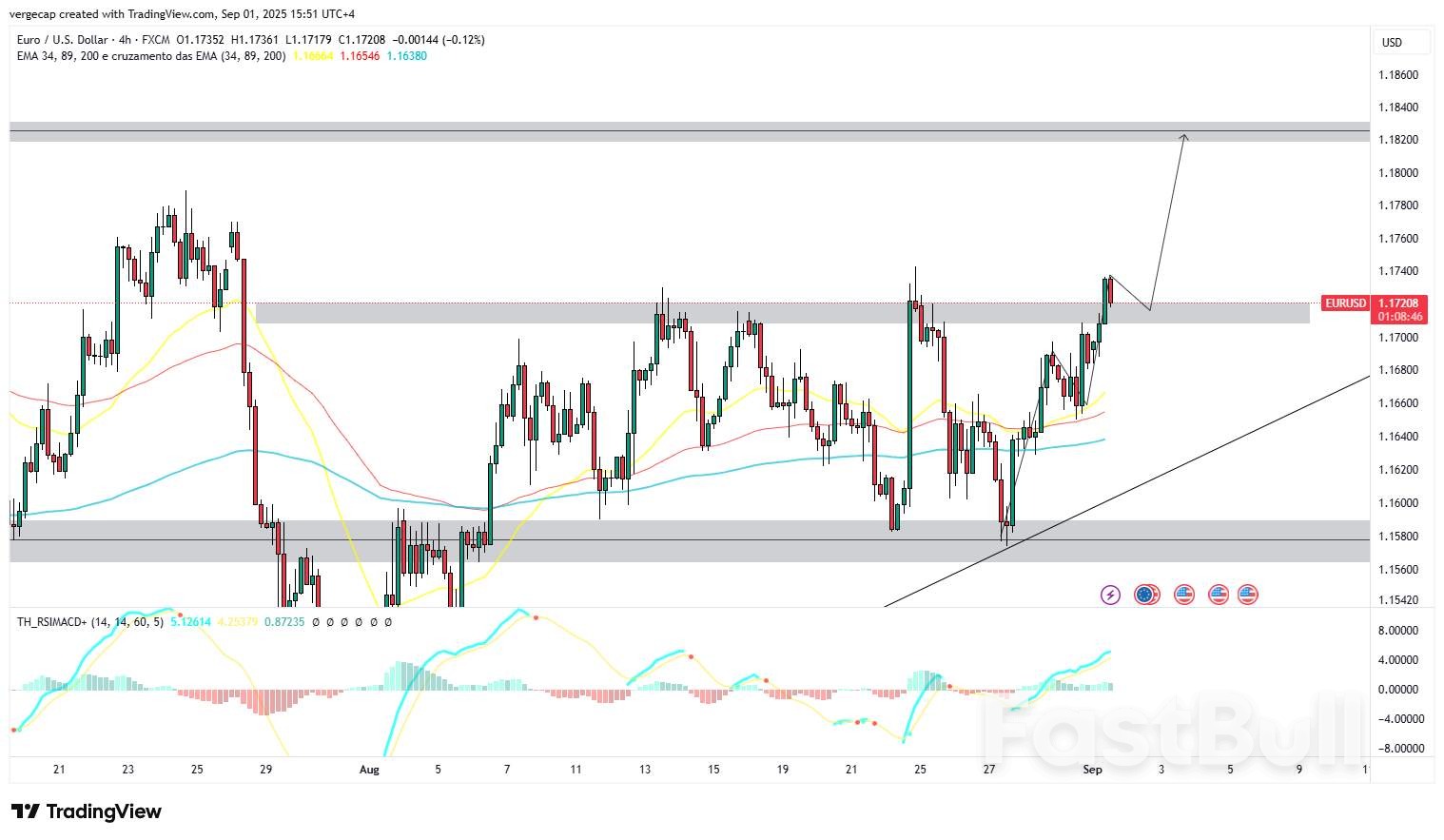
          From a technical perspective, EUR/USD is consolidating its recent rebound after bouncing strongly from support around the 1.1700 handle. The pair’s ability to hold above that threshold has reinforced bullish sentiment, particularly as price action respects an ascending trendline that has defined the short-term uptrend.
          The 50-day Exponential Moving Average (EMA) continues to provide an underlying floor, with recent intraday closes above it confirming the pair’s resilience. Momentum indicators are also constructive; the Relative Strength Index (RSI) has reset from overbought territory, leaving room for further upside without the immediate risk of exhaustion.
          As long as EUR/USD remains above the 1.1700 level, the bullish bias appears intact. Traders are watching for a possible extension toward the next resistance zone near 1.1850. A sustained move beyond that level could open the door to a test of 1.1900, while failure to hold above current support could invite renewed selling pressure.

          TRADE RECOMMENDATION

          BUY EURUSD
          ENTRY PRICE: 1.17190
          STOP LOSS: 1.16500
          TAKE PROFIT: 1.1900
          Risk Warnings and Disclaimers
          You understand and acknowledge that there is a high degree of risk involved in trading. Following any strategies or investment methods may lead to potential losses. The content on the site is provided by our contributors and analysts for information purposes only. You are solely responsible for determining whether any trading assets, securities, strategy, or any other product is suitable for investing based on your own investment objectives and financial situation.
          Add to Favorites
          Share

          Swiss Franc Pushes USD/CHF Toward 0.8000 as Fed Turmoil and Safe-Haven Demand Weigh on Dollar

          Warren Takunda

          Traders' Opinions

          Summary:

          The Swiss Franc extended its rally to a fourth straight day on Friday, with USD/CHF sliding toward the 0.8000 handle as traders bet on a September Fed rate cut despite sticky US inflation.

          SELL USDCHF
          Close Time
          CLOSED

          0.79965

          Entry Price

          0.79000

          TP

          0.81030

          SL

          0.79558 -0.00024 -0.03%

          27.9

          Pips

          Profit

          0.79000

          TP

          0.79686

          Exit Price

          0.79965

          Entry Price

          0.81030

          SL

          The Swiss Franc strengthened for a fourth consecutive session on Friday, pushing the USD/CHF exchange rate closer to the psychologically significant 0.8000 mark as investors increasingly price in a September interest rate cut from the Federal Reserve and seek shelter amid growing political and policy uncertainty in Washington.
          In late New York trade, USD/CHF was hovering around 0.7997, retreating from early intraday gains and marking fresh one-month lows. The pair’s decline closely mirrored the US Dollar Index (DXY), which slipped back below 98.00 to 97.76, underscoring a broader softening in the Greenback’s momentum.
          The move comes despite US data that—at first glance—suggested economic resilience. The Bureau of Economic Analysis reported that the Core Personal Consumption Expenditures (PCE) Price Index, the Fed’s preferred inflation gauge, rose 0.3% month-on-month in July, matching consensus forecasts. On an annual basis, core PCE accelerated to 2.9%, its highest level since February, from 2.8% in June. Headline inflation was more subdued, holding at 2.6% year-on-year with a modest 0.2% monthly increase.
          Household demand appeared equally firm, with personal spending rising 0.5% in July, up from 0.3% in June, while personal income increased 0.4% month-on-month. Taken together, the data painted a picture of sticky inflation accompanied by robust consumer activity—a mix that in another market environment might have lifted the Dollar on expectations of a more hawkish Fed.
          Yet traders largely ignored the stronger demand backdrop, focusing instead on the policy outlook. Fed funds futures are now pricing an 89% probability of a 25 basis-point cut at the September FOMC meeting, cementing expectations that the central bank will move toward easing after holding rates steady since May. Yields on the front end of the Treasury curve slipped as investors positioned for a policy shift, though longer-dated yields were steadier, reflecting confidence that long-run inflation risks remain contained.
          Adding to the Dollar’s vulnerability was intensifying political tension surrounding the independence of the Fed. The legal dispute between President Donald Trump and Fed Governor Lisa Cook escalated this week, with Cook filing an emergency motion to block her removal after Trump attempted to oust her. The Fed submitted its own brief in the case Friday, while the Justice Department signaled it would not oppose converting Cook’s request into a preliminary injunction. Legal experts note that the battle hinges on the interpretation of “for cause” under the Federal Reserve Act, a term traditionally associated with misconduct but now potentially subject to broader interpretation. Market observers warn the case could ultimately find its way to the Supreme Court, raising fresh uncertainty about the Fed’s autonomy.
          Against this backdrop, the Swiss Franc has been a prime beneficiary. Long regarded as a safe-haven currency, the Franc’s appeal has been reinforced by both macroeconomic and political risks that undermine the Greenback. Ongoing trade frictions, questions about US institutional stability, and the dovish recalibration of Fed expectations have driven investors toward the security of the Swissie.
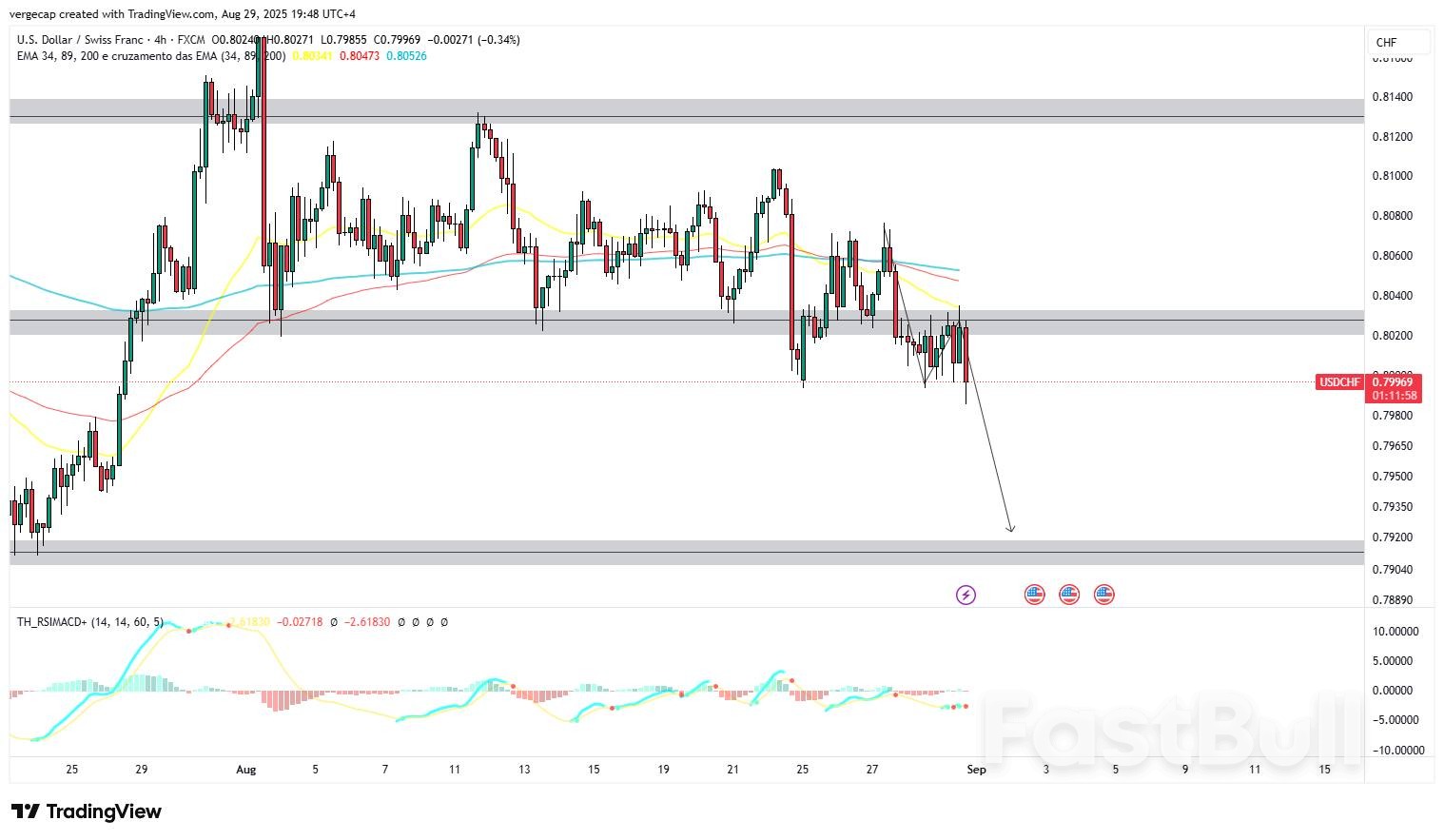
          Technical AnalysisSwiss Franc Pushes USD/CHF Toward 0.8000 as Fed Turmoil and Safe-Haven Demand Weigh on Dollar_1
          From a technical perspective, USD/CHF remains under pronounced bearish pressure, with the pair breaking through key support at 0.8020. The move places the pair firmly below the 50-day Exponential Moving Average (EMA50), reinforcing the dominance of the corrective downtrend on the short-term charts. The broader bearish structure remains intact, with the pair trending alongside a supportive channel that favors additional downside.
          However, momentum indicators suggest near-term caution for bears. The Relative Strength Index (RSI) has entered oversold territory, flashing early positive signals that could prompt a temporary pause or modest rebound in losses.
          Still, technical setups highlight further downside risk. The current sell entry is pegged at 0.8030, aligning with a pullback resistance and the 38.2% Fibonacci retracement. A stop loss is recommended near 0.8100, coinciding with a swing high and the 127.2% Fibonacci extension. On the downside, the take-profit target lies at 0.7900, which aligns with a Fibonacci extension support zone around 161.8%.

          TRADE RECOMMENDATION

          SELL USDCHF
          ENTRY PRICE: 0.8000
          STOP LOSS: 0.8100
          TAKE PROFIT: 0.7900
          Risk Warnings and Disclaimers
          You understand and acknowledge that there is a high degree of risk involved in trading. Following any strategies or investment methods may lead to potential losses. The content on the site is provided by our contributors and analysts for information purposes only. You are solely responsible for determining whether any trading assets, securities, strategy, or any other product is suitable for investing based on your own investment objectives and financial situation.
          Add to Favorites
          Share

          Options Market Wagers on Further Dollar Weakness Over Next 3–6 Months

          Eva Chen

          Central Bank

          Forex

          Summary:

          The Dollar Index slid roughly 2% in August, as both technical and fundamental indicators point to additional downside.

          SELL USDX
          Close Time
          CLOSED

          97.670

          Entry Price

          95.100

          TP

          99.980

          SL

          97.830 -0.120 -0.12%

          41.0

          Pips

          Profit

          95.100

          TP

          97.260

          Exit Price

          97.670

          Entry Price

          99.980

          SL

          Fundamentals

          The U.S. Dollar Index shed about 2% last month, erasing a portion of July's advance—the first monthly gain since President Donald Trump took office. With the economy flashing slowdown signals and the Fed poised to resume monetary easing, the greenback is on track to extend its year-to-date retreat of more than 8%.
          President Trump's public questioning of the Fed's credibility and the reliability of official data is further undercutting the dollar's allure. Recent policy moves by the U.S. administration are also sowing doubts over the currency's long-term standing, eroding its safe-haven premium and paving the way for a persistent risk discount.
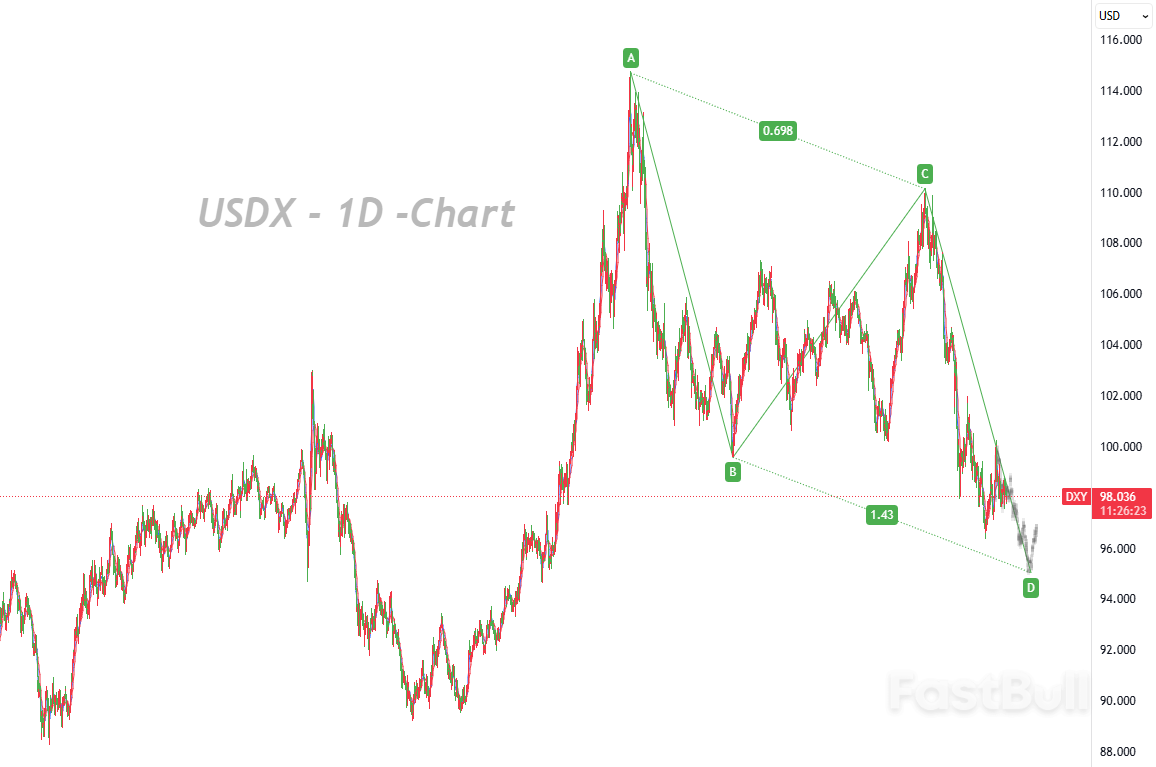
          Options Market Wagers on Further Dollar Weakness Over Next 3–6 Months_1

          Technical Analysis

          After three consecutive down-days, the Dollar Index has attempted a modest rebound, trading near 98.00 in European hours on Friday.
          On the daily chart, the mild bearish momentum remains intact, with the RSI continuing to track lower. During this period, downside risks dominate. The support is 97.60, followed by 97.10. And the Resistances are 98.40 (MA21), 98.80 (MA100), and 99.60.
          Thursday's options pricing shows investors pricing in a modest depreciation over the next three to six months. The index broke below its MA100 in early March and has remained pressured ever since. Two failed attempts to reclaim the average this month have reinforced 98.80 as a key cap.

          Trading Recommendations

          Trading Direction: Sell
          Entry Price: 98.00
          Target Price: 95.10
          Stop Loss: 99.98
          Valid Until: September 13, 2025, 23:55:00
          Support: 97.60/97.10/96.38
          Resistance: 98.40/98.80/99.60
          Risk Warnings and Disclaimers
          You understand and acknowledge that there is a high degree of risk involved in trading. Following any strategies or investment methods may lead to potential losses. The content on the site is provided by our contributors and analysts for information purposes only. You are solely responsible for determining whether any trading assets, securities, strategy, or any other product is suitable for investing based on your own investment objectives and financial situation.
          Add to Favorites
          Share

          AUD/USD Climbs as Fed Rate Cut Bets Rise, Australian Inflation Surprises

          Warren Takunda

          Traders' Opinions

          Summary:

          The Australian dollar climbed toward 0.6530 on Thursday as the US dollar sold off sharply, with markets growing confident that the Federal Reserve will cut rates in September.

          BUY AUDUSD
          Close Time
          CLOSED

          0.65371

          Entry Price

          0.66000

          TP

          0.65000

          SL

          0.66549 +0.00029 +0.04%

          7.4

          Pips

          Profit

          0.65000

          SL

          0.65445

          Exit Price

          0.65371

          Entry Price

          0.66000

          TP

          The Australian dollar strengthened against its US counterpart on Thursday, pushing toward the 0.6530 level in the European session, as the greenback came under broad selling pressure amid mounting speculation that the Federal Reserve will cut interest rates as early as September.
          The move comes as traders position for a dovish turn by the Fed, with US economic data increasingly signaling that growth momentum is fading. At the time of writing, the US Dollar Index (DXY), which tracks the dollar against six major peers, slipped toward 97.90. According to the CME FedWatch Tool, futures markets are now pricing in an 87% probability that the Fed will lower its benchmark rate at its September meeting.
          That level of conviction suggests investors see the Fed pivoting away from its aggressive stance to prevent the economy from tipping into a deeper slowdown.
          Markets were bolstered further on Wednesday when New York Fed President John Williams hinted at the likelihood of rate reductions in the months ahead. While Williams stopped short of endorsing a September cut outright, his comments underscored growing concerns that the US economy’s slowdown warrants a more accommodative policy stance.
          “The Fed doesn’t want to wait too long before supporting growth,” one trader in London said. “The risk is that if they wait, the slowdown could accelerate into something more difficult to contain.”
          Still, Williams stressed that policymakers need more data before finalizing their decision. That puts Friday’s release of the July Personal Consumption Expenditures (PCE) Price Index firmly in focus. The PCE is the Fed’s preferred inflation gauge, and a softer print could strengthen the case for September easing.
          The bullish tone in the Aussie was amplified by domestic economic developments. On Wednesday, the Australian Bureau of Statistics reported that consumer prices rose more than expected in July. The Monthly CPI increased at an annual pace of 2.8%, outpacing forecasts of 2.3% and accelerating sharply from June’s 1.9%.
          The upside surprise complicates the outlook for the Reserve Bank of Australia (RBA). Markets had been pricing in a possible rate cut at the central bank’s September meeting, but the latest data challenges that assumption. Inflation above expectations suggests underlying price pressures remain sticky, potentially limiting the RBA’s ability to ease policy without risking a rebound in consumer prices.
          Investors now find themselves weighing a dovish Fed against a potentially cautious RBA. That divergence in policy expectations is likely to keep the Aussie underpinned in the near term, particularly if US data continues to reinforce the need for Fed cuts.
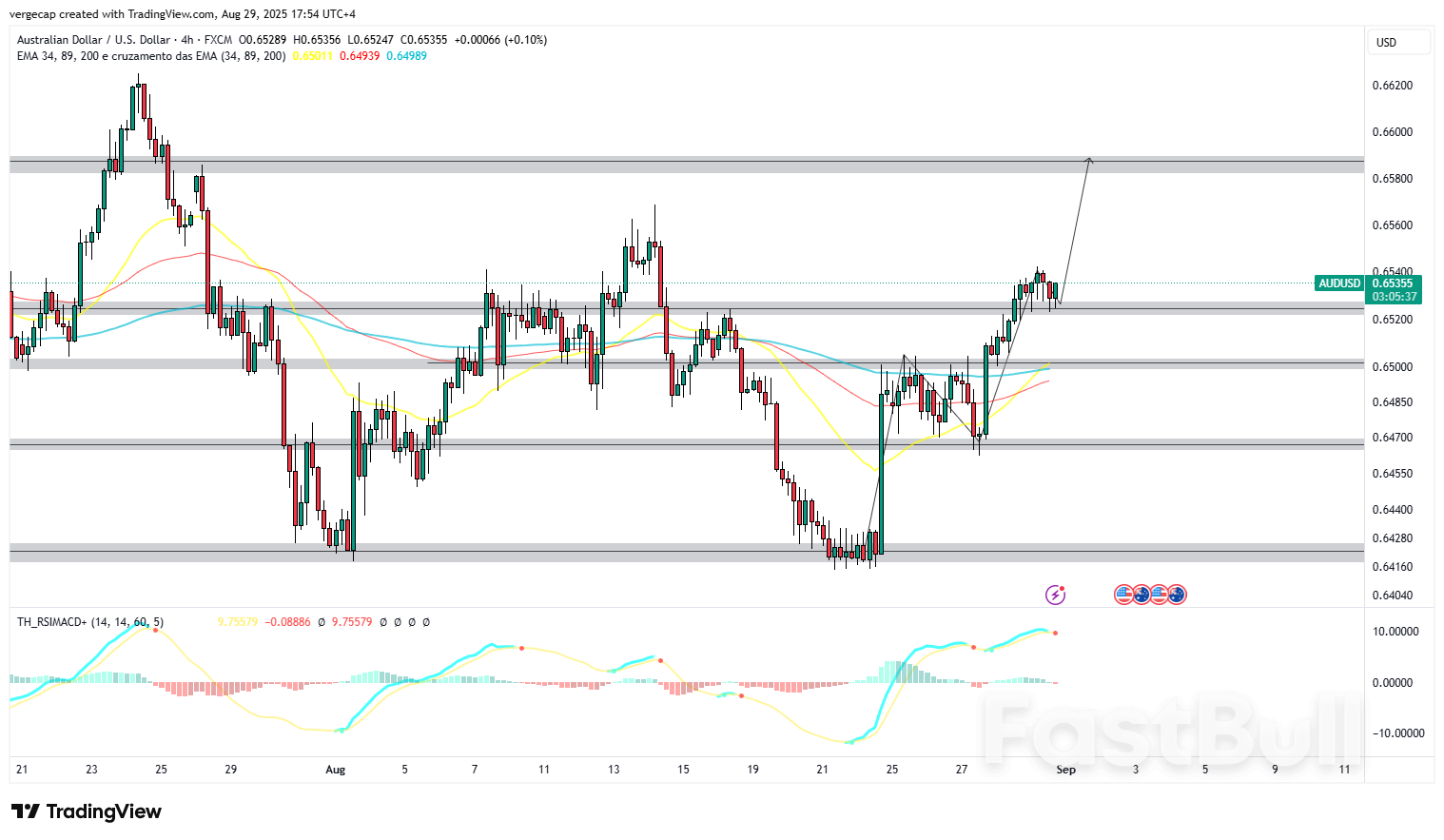
          Technical AnalysisAUD/USD Climbs as Fed Rate Cut Bets Rise, Australian Inflation Surprises_1
          From a technical perspective, the AUD/USD pair has extended its bullish momentum, with price action firmly supported by short-term correctional waves. The pair recently broke above resistance at 0.6535, a level now serving as a key target for bulls.
          Momentum indicators reinforce the upside bias. The pair trades comfortably above the 50-day Exponential Moving Average (EMA50), signaling dynamic support beneath current levels. Meanwhile, the Relative Strength Index (RSI) shows sustained bullish momentum, though it has entered overbought territory—suggesting that while the trend remains positive, some short-term consolidation cannot be ruled out.
          If the bullish momentum continues, the next upside levels to watch lie near 0.6560 and 0.6600. On the downside, initial support sits around 0.6480, followed by stronger buying interest near 0.6450.

          TRADE RECOMMENDATION

          BUY AUDUSD
          ENTRY PRICE: 0.6537
          STOP LOSS: 0.6500
          TAKE PROFIT: 0.6600
          Risk Warnings and Disclaimers
          You understand and acknowledge that there is a high degree of risk involved in trading. Following any strategies or investment methods may lead to potential losses. The content on the site is provided by our contributors and analysts for information purposes only. You are solely responsible for determining whether any trading assets, securities, strategy, or any other product is suitable for investing based on your own investment objectives and financial situation.
          Add to Favorites
          Share

          Gold Corrects Lower but Market Still Poised for Gains on Rate-Cut Bets

          Warren Takunda

          Traders' Opinions

          Summary:

          Gold slipped on Friday from a one-month high as investors awaited U.S. PCE inflation data, but the metal remains set for strong monthly gains.

          BUY XAUUSD
          Close Time
          CLOSED

          3415.00

          Entry Price

          3450.00

          TP

          3395.00

          SL

          4341.54 +42.15 +0.98%

          187.9

          Pips

          Profit

          3395.00

          SL

          3433.79

          Exit Price

          3415.00

          Entry Price

          3450.00

          TP

          Gold prices edged lower on Friday, retreating slightly from their strongest level in more than a month as traders locked in profits and repositioned ahead of the release of critical U.S. inflation data. Despite the modest decline, the yellow metal remains firmly within a bullish trend, supported by softer dollar expectations, policy uncertainty, and enduring geopolitical risks.
          In the European session, spot gold was last seen trading near $3,407 per ounce, down around 0.30% on the day. The pullback followed a rally to levels not seen since July 23 during Thursday’s session, when investors pushed the precious metal higher on expectations that the Federal Reserve is drawing closer to cutting interest rates as soon as September. Month-end profit-taking has since weighed on sentiment, though the broader uptrend remains intact.
          The main driver of caution in Friday’s trade is anticipation of the U.S. Bureau of Economic Analysis report on the core Personal Consumption Expenditures Price Index, the Fed’s preferred measure of inflation. The July release is expected to show a 0.3% monthly rise, matching June’s pace, while the annual rate is projected to inch higher to 2.9% from 2.8% previously. Traders are bracing for a potentially market-moving outcome. A weaker-than-expected reading would likely reinforce expectations for a September rate cut, providing fresh support to gold. By contrast, a stronger number could temper dovish speculation, boost Treasury yields, and offer the U.S. dollar a renewed lift, thereby applying downward pressure on bullion.
          Market strategists have warned that Friday’s PCE release could trigger sharp, immediate swings in gold prices. A London-based metals strategist noted that while a higher-than-expected print could send gold lower in the short run, the broader trend remains intact because of the Fed’s shifting stance and the ongoing demand for safe-haven assets. “If inflation looks sticky, we might see a knee-jerk selloff in gold,” the strategist said. “But the broader uptrend remains hard to dismiss given the policy backdrop and geopolitical noise.”
          Beyond the immediate impact of inflation data, gold’s safe-haven allure continues to strengthen. Investors are increasingly concerned about the independence of the Federal Reserve, with political interventions raising questions about whether the central bank can act free of external pressures. Such concerns tend to elevate gold’s role as a hedge against policy uncertainty. This comes alongside persistent global risks, including geopolitical flashpoints, uneven U.S. growth dynamics, and fragile confidence in parts of the global economy. These factors have combined to ensure that dips in gold remain shallow and often attract strong buying interest.

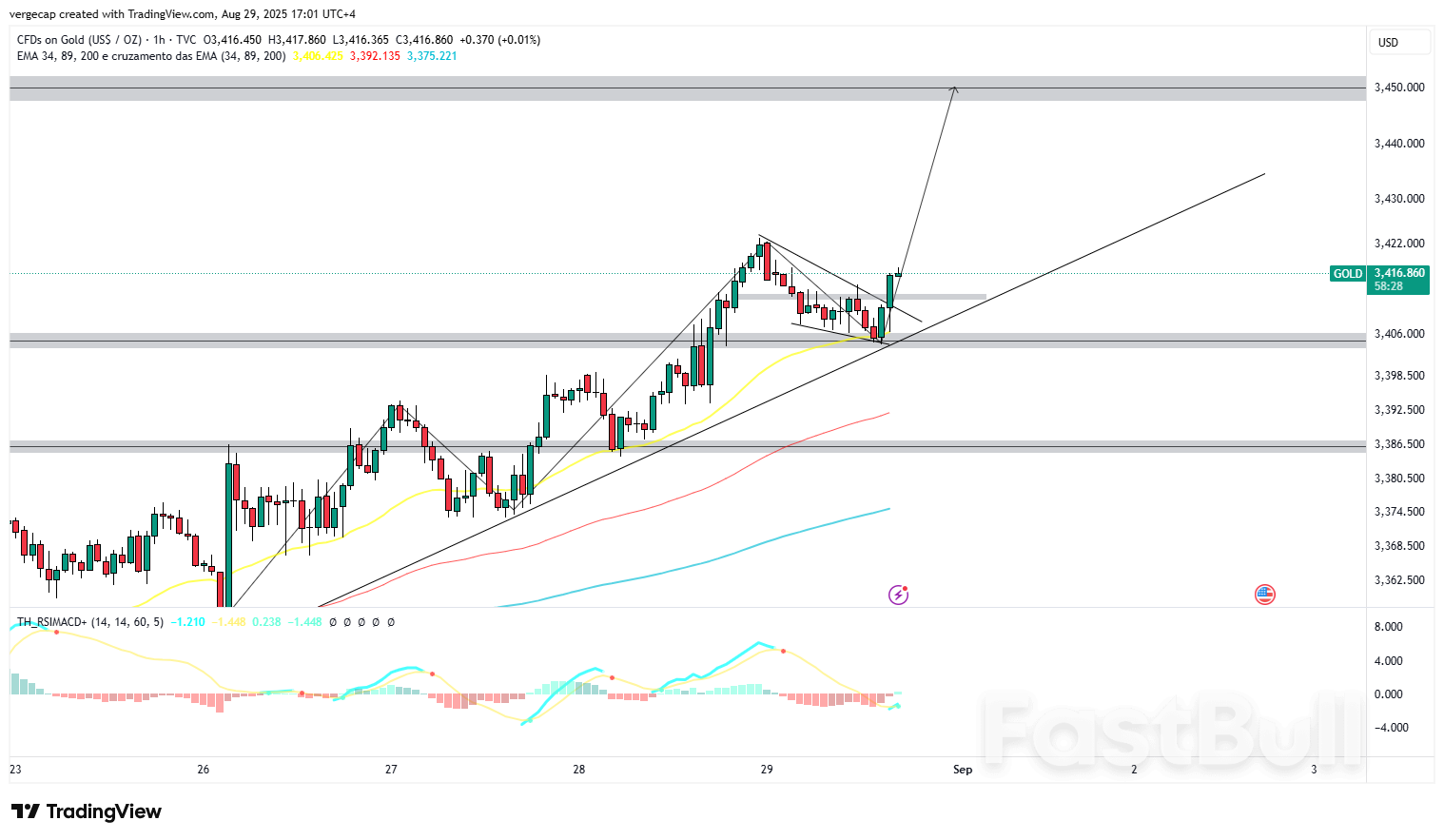
          Technical AnalysisGold Corrects Lower but Market Still Poised for Gains on Rate-Cut Bets_1

          From a technical perspective, the market still carries a clear bullish tone. Gold has stabilized above the $3,402 level, which traders view as a critical support area. The rally that began earlier this month remains intact, with buyers continuing to press toward higher resistance levels. The next significant upside level is seen around $3,429, and momentum is expected to remain constructive so long as the price holds above the recent support base. Short-term pullbacks, including a possible correction back to the $3,402 level, are considered likely to be temporary in nature. If the PCE data meets or undershoots expectations, bullish momentum is expected to resume quickly, potentially propelling the metal toward $3,420 and then on to $3,436 and $3,450.
          TRADE RECOMMENDATION
          BUY GOLD
          ENTRY PRICE: 3415
          STOP LOSS: 3395
          TAKE PROFIT: 3450
          Risk Warnings and Disclaimers
          You understand and acknowledge that there is a high degree of risk involved in trading. Following any strategies or investment methods may lead to potential losses. The content on the site is provided by our contributors and analysts for information purposes only. You are solely responsible for determining whether any trading assets, securities, strategy, or any other product is suitable for investing based on your own investment objectives and financial situation.
          Add to Favorites
          Share

          GBPUSD Faces a Significant Challenge! Is the PCE a Double-edged Sword?

          Tank

          Forex

          Economic

          Technical Analysis

          Summary:

          The Bank of England has set a historical record in short-term monetary market operations by allocating £75.652 billion in seven-day liquidity injections, reflecting its policy intent to maintain market liquidity during the quantitative tightening process.

          SELL GBPUSD
          Close Time
          CLOSED

          1.34800

          Entry Price

          1.33700

          TP

          1.36000

          SL

          1.33925 +0.00218 +0.16%

          110.0

          Pips

          Profit

          1.33700

          TP

          1.33699

          Exit Price

          1.34800

          Entry Price

          1.36000

          SL

          Fundamentals

          The UK automotive manufacturing sector exhibited a complex trajectory in July, with data from the Society of Motor Manufacturers and Traders (SMMT) indicating a 5.6% increase in vehicle production to 69,127 units. However, the overall automotive output declined by 10.8%, primarily due to a downturn in commercial vehicle manufacturing. SMMT CEO Mike Hawes highlighted challenges such as waning consumer confidence and volatile trade flows, urging the government to implement more effective strategies to foster industry growth. Despite the U.S.-UK trade agreement, tariff-related disruptions continue to impact export strategies. Industry forecasts suggest a recovery in production volumes by 2026. Concurrently, confidence within the UK services sector remains subdued, with the CBI's August survey revealing a decline in optimism and activity levels among service providers, amid persistent cost pressures and difficulties passing costs onto consumers. The organization called on Chancellor of the Exchequer Rachel Reeves to avoid increasing corporate taxes in the upcoming autumn budget and to reassess labor policies that could impose additional burdens on employers, aiming to provide short-term economic certainty. Additionally, the Bank of England has set a historical record in short-term monetary market operations by allocating £75.652 billion in seven-day liquidity injections, reflecting its policy intent to maintain market liquidity during the quantitative tightening process.
          Despite widespread market consensus on a potential interest rate cut in September, there remains significant internal disagreement within the Federal Reserve regarding the future policy trajectory. Policymakers appear to be divided into three main factions: dovish members advocating for multiple rate reductions, hawkish officials opposing easing measures, and centrist policymakers adopting a cautious approach. Chairman Powell is navigating a delicate balancing act—acknowledging downside risks to the labor market while warning that tariffs could prolong inflationary pressures. According to Matthew Luzzetti of Deutsche Bank, considering the divergent views within the committee, the most straightforward approach may be a gradual rate reduction, with subsequent actions increasingly data-dependent. Goldman Sachs emphasizes that if further signs of labor market softening emerge, the Fed may need to capitalize on the current policy window. The institution projects that, regardless of whether the economy slows or normalizes, the Fed is likely to complete this easing cycle by the first half of 2026, prior to the appointment of the next chair. Market expectations for a rate cut in September have risen to 89%, with the anticipated cumulative easing by year-end reaching 55 basis points. Consequently, weaker-than-expected data could reinforce rate cut expectations, exerting further downward pressure on the U.S. dollar index and potentially strengthening the British pound indirectly.

          Technical Analysis

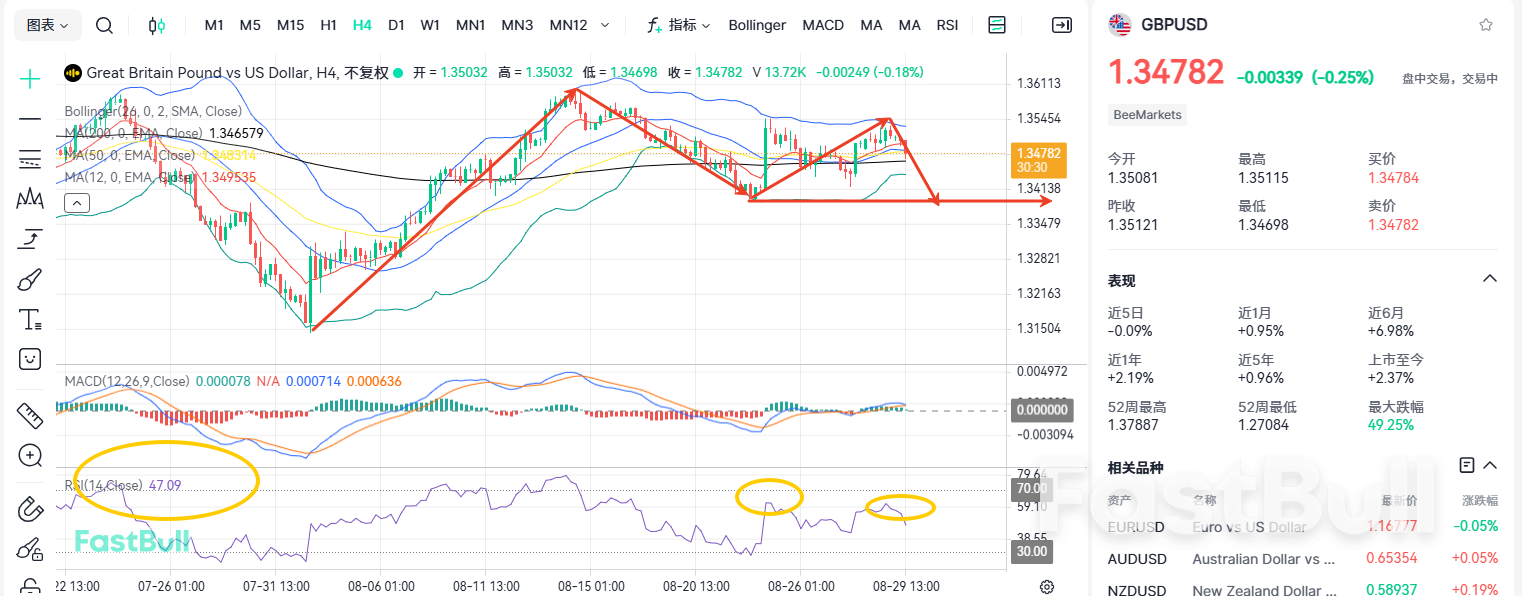
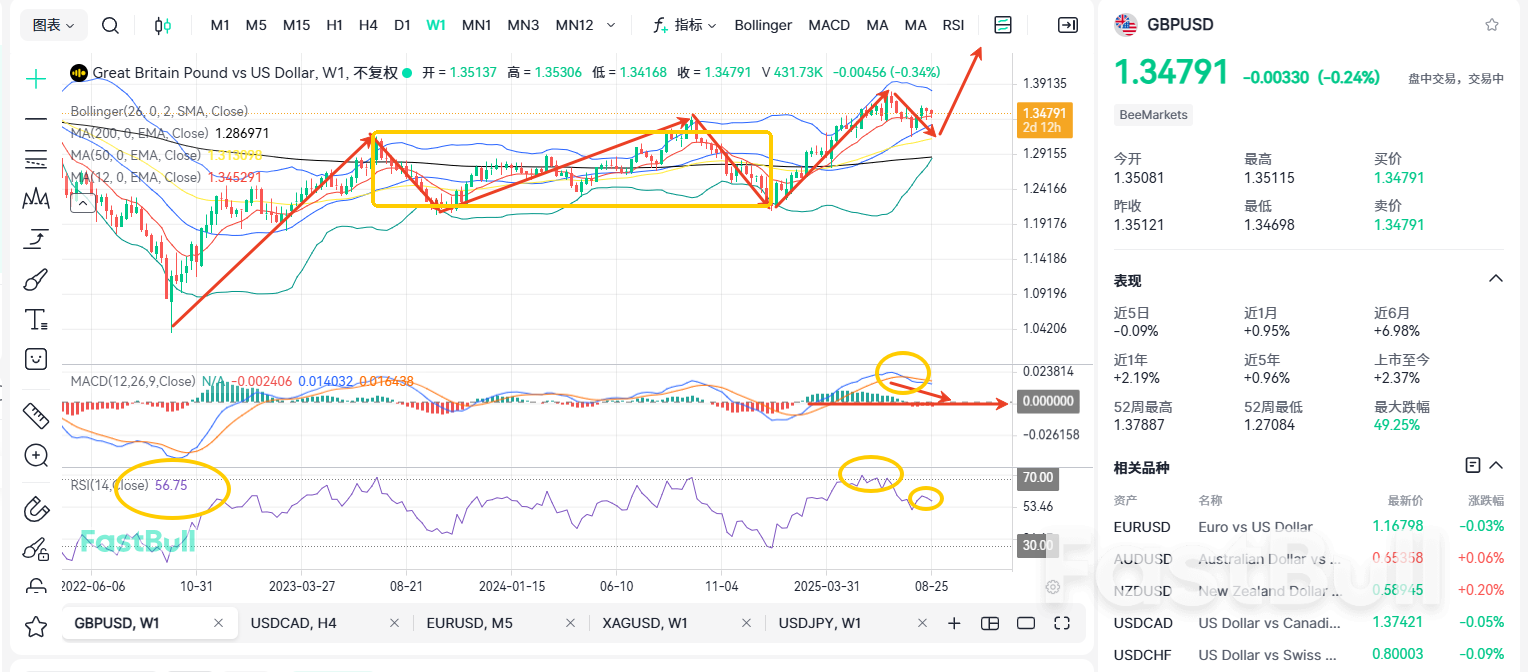
          In the 4H timeframe, the GBPUSD is oscillating between the upper and lower Bollinger Bands, with the Bollinger channels narrowing and SMAs flattening and converging, indicating a potential trend reversal. Currently, the price has formed a bearish candlestick pattern, breaking below the middle Bollinger Band. The MACD line and signal line are approaching a death cross, and the RSI is at 47, suggesting a higher probability of a downward move. If the price fails to hold above the middle band, it may test the lower Bollinger Band or previous lows at approximately 1.344 and 1.340. In the 1W timeframe, after breaking above the EMA12, the price is retesting this level; a successful hold could lead to further gains toward 1.380 or even 1.400. Conversely, failure to sustain could result in declines toward 1.310 and 1.300. Following the MACD death cross, the MACD line and signal line are retracing toward the zero-axis, with the RSI at 56, not overbought, but with decreasing highs, indicating a possible correction. Overall, the correction phase appears incomplete. It is recommended to go short initially and then go long.
          GBPUSD Faces a Significant Challenge! Is the PCE a Double-edged Sword?_1
          GBPUSD Faces a Significant Challenge! Is the PCE a Double-edged Sword?_2

          Trading Recommendations

          Trading Direction: Sell
          Entry Price: 1.348
          Target Price: 1.337
          Stop Loss: 1.36
          Support: 1.345, 1.34, 1.337
          Resistance: 1.36, 1.362, 1.378
          Risk Warnings and Disclaimers
          You understand and acknowledge that there is a high degree of risk involved in trading. Following any strategies or investment methods may lead to potential losses. The content on the site is provided by our contributors and analysts for information purposes only. You are solely responsible for determining whether any trading assets, securities, strategy, or any other product is suitable for investing based on your own investment objectives and financial situation.
          Add to Favorites
          Share

          Japan Maintains Expectations of Interest Rate Hikes! When Will the USDJPY Stabilize?

          Tank

          Economic

          Forex

          Technical Analysis

          Summary:

          Data released by the Japan Statistics Bureau on Friday indicate that Tokyo's overall Consumer Price Index increased by 2.6% year-on-year in August, down from 2.9%. The inflation report for Tokyo sustains market expectations of the Bank of Japan resuming interest rate hikes, thereby supporting the Japanese yen.

          SELL USDJPY
          Close Time
          CLOSED

          147.400

          Entry Price

          146.200

          TP

          148.600

          SL

          155.050 -0.764 -0.49%

          120.0

          Pips

          Loss

          146.200

          TP

          148.601

          Exit Price

          147.400

          Entry Price

          148.600

          SL

          Fundamentals

          The data released by Japan's Statistics Bureau on Friday indicates that the Consumer Price Index (CPI) in the Tokyo metropolitan area increased by 2.6% year-over-year in August, down from 2.9%. Concurrently, the core CPI in Tokyo rose by 2.5% year-over-year, also below the previous 2.9%, aligning with market expectations. As of August 29, 2025, Tokyo's core CPI declined to 2.5% year-over-year, consistent with market forecasts. The Bank of Japan (BoJ) monitors Tokyo's CPI excluding fresh food and energy, which rose by 3.0% in August, slightly below the previous 3.1%. The inflation report in Tokyo sustains market expectations of a potential resumption of interest rate hikes by the BoJ, supporting the Japanese yen. According to a Reuters survey of economists conducted in August, nearly two-thirds anticipate the BoJ will implement at least a 25 basis point rate increase later this year, with this expectation having increased over the past two weeks.
          The Q2 preliminary estimate of the U.S. Gross Domestic Product (GDP) indicates an annualized growth rate of 3.3%, surpassing the prior estimate of 3.0%, highlighting a robust rebound from the sluggish Q1. Initial unemployment insurance claims last week declined to 229,000, suggesting that despite softening employment growth, the labor market remains resilient; continued claims slightly decreased to 1.95 million. The Personal Consumption Expenditures (PCE) Price Index, released concurrently with GDP, was marginally revised downward to 2.0% for the Q2, while the core PCE remained steady at 2.5%, underscoring persistent underlying inflationary pressures. The strong economic indicators have contributed to a rebound in the U.S. dollar.

          Technical Analysis

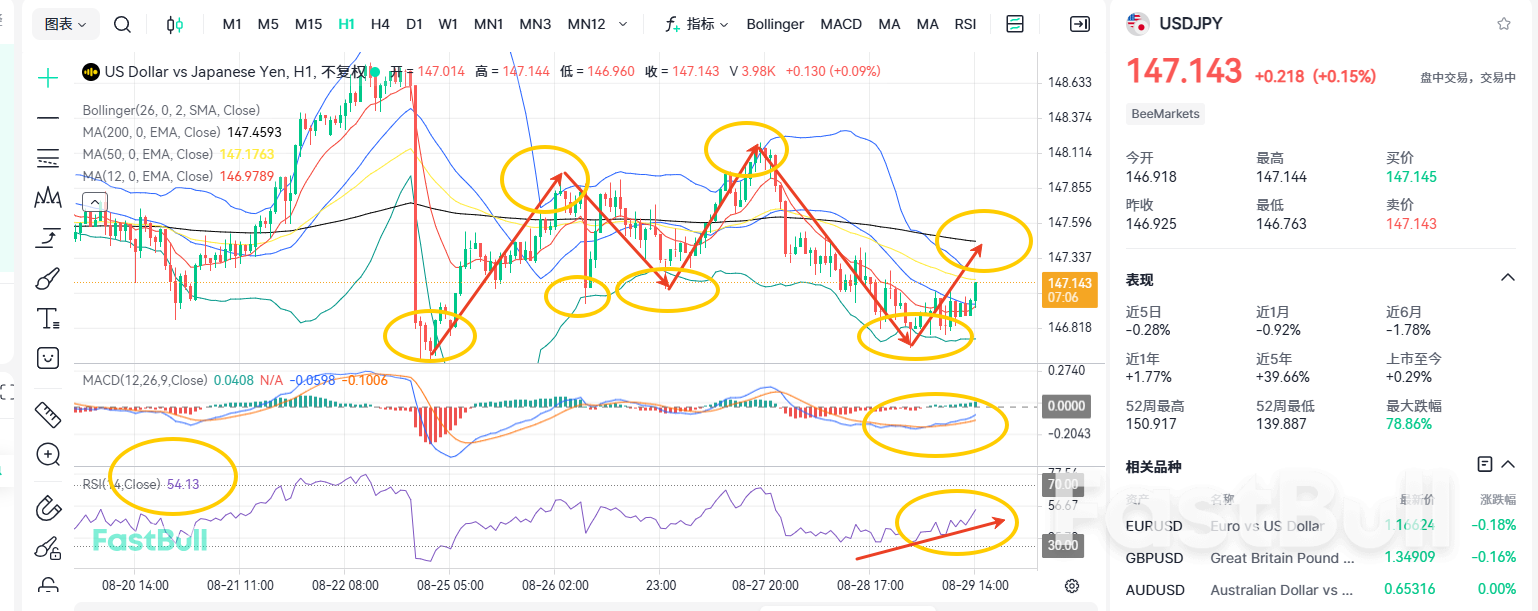
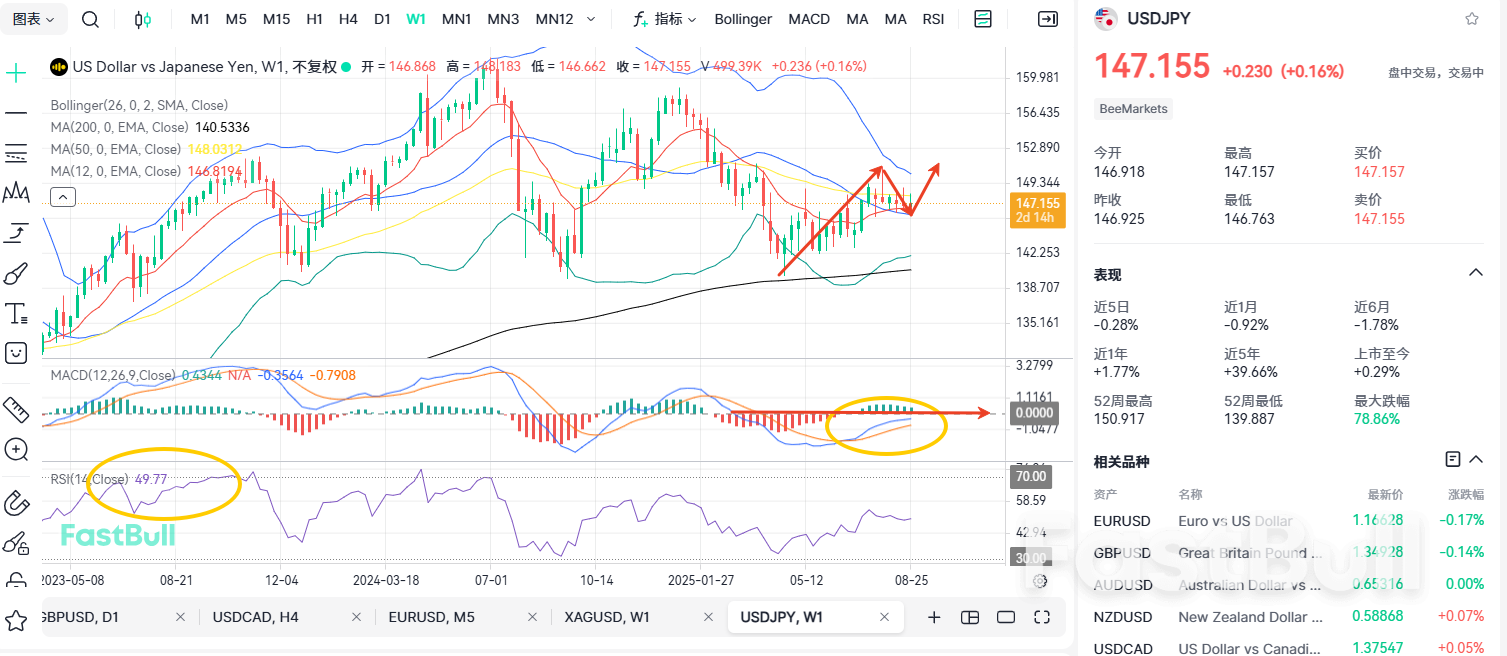
          In the 1H timeframe, the USDJPY price oscillates around the Bollinger Bands' upper and lower bands, currently consolidating near the middle band. Following a golden cross in the MACD, the MACD line and signal line have reverted to around the zero-axis, with the RSI at 54, indicating a neutral market sentiment and potential for a trend reversal. A decisive break above the middle Bollinger Band could propel the price toward the EMA200 and previous resistance levels at approximately 147.46 and 148.18; failure to do so may lead to a decline toward 145.8. In the 1W timeframe, the Bollinger Bands are narrowing, with price oscillating around the middle band. After a MACD golden cross, the MACD line and signal line have pulled back toward the zero-axis, and the RSI stands at 49, reflecting a predominantly sideways trend with imminent potential for a trend shift. The key focus is on whether the price can hold above the middle Bollinger Band; a successful hold could lead to an upward breakout beyond 150, while failure might see a decline toward 146. In the short term, the strategy is to go short initially and then go long.
          Japan Maintains Expectations of Interest Rate Hikes! When Will the USDJPY Stabilize?_1Japan Maintains Expectations of Interest Rate Hikes! When Will the USDJPY Stabilize?_2

          Trading Recommendations

          Trading Direction: Sell
          Entry Price: 147.4
          Target Price: 146.2
          Stop Loss: 148.6
          Support: 145.8, 142.6, 141.6
          Resistance: 148.5, 149.6, 151
          Risk Warnings and Disclaimers
          You understand and acknowledge that there is a high degree of risk involved in trading. Following any strategies or investment methods may lead to potential losses. The content on the site is provided by our contributors and analysts for information purposes only. You are solely responsible for determining whether any trading assets, securities, strategy, or any other product is suitable for investing based on your own investment objectives and financial situation.
          Add to Favorites
          Share
          FastBull
          Copyright © 2025 FastBull Ltd

          728 RM B 7/F GEE LOK IND BLDG NO 34 HUNG TO RD KWUN TONG KLN HONG KONG

          TelegramInstagramTwitterfacebooklinkedin
          App Store Google Play Google Play
          Products
          Charts

          Chats

          Q&A with Experts
          Screeners
          Economic Calendar
          Data
          Tools
          Membership
          Features
          Function
          Markets
          Copy Trading
          Latest Signals
          Contests
          News
          Analysis
          24/7
          Columns
          Education
          Company
          Careers
          About Us
          Contact Us
          Advertising
          Help Center
          Feedback
          User Agreement
          Privacy Policy
          Business

          White Label

          Data API

          Web Plug-ins

          Poster Maker

          Affiliate Program

          Risk Disclosure

          The risk of loss in trading financial instruments such as stocks, FX, commodities, futures, bonds, ETFs and crypto can be substantial. You may sustain a total loss of the funds that you deposit with your broker. Therefore, you should carefully consider whether such trading is suitable for you in light of your circumstances and financial resources.

          No decision to invest should be made without thoroughly conducting due diligence by yourself or consulting with your financial advisors. Our web content might not suit you since we don't know your financial conditions and investment needs. Our financial information might have latency or contain inaccuracy, so you should be fully responsible for any of your trading and investment decisions. The company will not be responsible for your capital loss.

          Without getting permission from the website, you are not allowed to copy the website's graphics, texts, or trademarks. Intellectual property rights in the content or data incorporated into this website belong to its providers and exchange merchants.

          Not Logged In

          Log in to access more features

          FastBull Membership

          Not yet

          Purchase

          Become a signal provider
          Help Center
          Customer Service
          Dark Mode
          Price Up/Down Colors

          Log In

          Sign Up
          Position
          Layout
          Fullscreen
          Default to Chart
          The chart page opens by default when you visit fastbull.com