• Trade
  • Markets
  • Copy
  • Contests
  • News
  • 24/7
  • Calendar
  • Q&A
  • Chats
Trending
Screeners
SYMBOL
LAST
BID
ASK
HIGH
LOW
NET CHG.
%CHG.
SPREAD
SPX
S&P 500 Index
6870.39
6870.39
6870.39
6895.79
6858.28
+13.27
+ 0.19%
--
DJI
Dow Jones Industrial Average
47954.98
47954.98
47954.98
48133.54
47871.51
+104.05
+ 0.22%
--
IXIC
NASDAQ Composite Index
23578.12
23578.12
23578.12
23680.03
23506.00
+72.99
+ 0.31%
--
USDX
US Dollar Index
98.880
98.960
98.880
98.960
98.730
-0.070
-0.07%
--
EURUSD
Euro / US Dollar
1.16520
1.16528
1.16520
1.16717
1.16341
+0.00094
+ 0.08%
--
GBPUSD
Pound Sterling / US Dollar
1.33277
1.33286
1.33277
1.33462
1.33136
-0.00035
-0.03%
--
XAUUSD
Gold / US Dollar
4206.92
4207.26
4206.92
4218.85
4190.61
+9.01
+ 0.21%
--
WTI
Light Sweet Crude Oil
59.379
59.409
59.379
60.084
59.291
-0.430
-0.72%
--

Community Accounts

Signal Accounts
--
Profit Accounts
--
Loss Accounts
--
View More

Become a signal provider

Sell trading signals to earn additional income

View More

Guide to Copy Trading

Get started with ease and confidence

View More

Signal Accounts for Members

All Signal Accounts

Best Return
  • Best Return
  • Best P/L
  • Best MDD
Past 1W
  • Past 1W
  • Past 1M
  • Past 1Y

All Contests

  • All
  • Trump Updates
  • Recommend
  • Stocks
  • Cryptocurrencies
  • Central Banks
  • Featured News
Top News Only
Share

Kremlin: India Buys Energy Where It Is Profitable To And As Far As We Understand They Will Continue To Do That

Share

Turkey's Main Banking Index Up 2.5%

Share

Turkey's Main BIST-100 Index Up 1.9%

Share

Hungary's Preliminary November Budget Balance Huf -403 Billion

Share

Indian Rupee Down 0.1% At 90.07 Per USA Dollar As Of 3:30 P.M. Ist, Previous Close 89.98

Share

India's Nifty 50 Index Provisionally Ends 0.96% Lower

Share

[JPMorgan: US Stock Rally May Stagnate Following Fed Rate Cut] JPMorgan Strategists Say The Recent Rally In US Stocks May Stall As Investors Take Profits Following The Anticipated Fed Rate Cut. The Market Currently Predicts A 92% Probability Of The Fed Lowering Borrowing Costs On Wednesday. Expectations Of A Rate Cut Have Continued To Rise, Fueled By Positive Signals From Policymakers In Recent Weeks. "Investors May Be More Inclined To Lock In Gains At The End Of The Year Rather Than Increase Directional Exposure," Mislav Matejka's Team Wrote In A Report

Share

Russian Defence Ministry: Russian Forces Take Control Of Novodanylivka In Ukraine's Zaporizhzhia Region

Share

Russian Defence Ministry: Russian Forces Take Control Of Chervone In Ukraine's Donetsk Region

Share

French Finance Ministry: Government Started Process To Block Temporarily Shein Platform

Share

Finance Minister: Indonesia To Impose Coal Export Tax Of Up To 5% Next Year

Share

[Trump Considering Fired Homeland Security Secretary Noem? White House Denies] According To Reports From US Media Outlets Such As The Daily Beast And The UK's Independent, The White House Has Denied Reports That US President Trump Is Considering Firing Homeland Security Secretary Noem. White House Spokesperson Abigail Jackson Posted On Social Media On The 7th Local Time, Calling The Claims "fake News" And Stating That "Secretary Noem Has Done An Excellent Job Implementing The President's Agenda And 'making America Safe Again'."

Share

HKEX: Standard Chartered Bought Back 571604 Total Shares On Other Exchanges For Gbp9.5 Million On Dec 5

Share

Morgan Stanley Reiterates Bullish Outlook On US Stocks Due To Fed Rate Cut Expectations. Morgan Stanley Strategists Believe That The US Stock Market Faces A "bullish Outlook" Given Improved Earnings Expectations And Anticipated Fed Rate Cuts. They Expect Strong Corporate Earnings By 2026, And Anticipate The Fed Will Cut Rates Based On Lagging Or Mildly Weak Labor Markets. They Expect The US Consumer Discretionary Sector And Small-cap Stocks To Continue To Outperform

Share

China's National Development And Reform Commission Announced That Starting From 24:00 On December 8, The Retail Price Limit For Gasoline And Diesel In China Will Be Reduced By 55 Yuan Per Ton, Which Translates To A Reduction Of 0.04 Yuan Per Liter For 92-octane Gasoline, 0.05 Yuan Per Liter For 95-octane Gasoline, And 0.05 Yuan Per Liter For 0# Diesel

Share

Tkms CEO: US Security Strategy Highlights Need For Europe To Take Care Of Its Own Defences

Share

USA S&P 500 E-Mini Futures Up 0.1%, NASDAQ 100 Futures Up 0.18%, Dow Futures Down 0.02%

Share

London Metal Exchange (LME): Copper Inventories Increased By 2,000 Tons, Aluminum Inventories Decreased By 2,500 Tons, Nickel Inventories Increased By 228 Tons, Zinc Inventories Increased By 2,375 Tons, Lead Inventories Decreased By 3,725 Tons, And Tin Inventories Decreased By 10 Tons

Share

Swiss Sight Deposits Of Domestic Banks At 440.519 Billion Sfr In Week Ending December 5 Versus 437.298 Billion Sfr A Week Earlier

Share

Czech November Jobless Rate 4.6% Versus Mkt Fcast 4.7%

TIME
ACT
FCST
PREV
France Industrial Output MoM (SA) (Oct)

A:--

F: --

P: --
France Trade Balance (SA) (Oct)

A:--

F: --

P: --
Euro Zone Employment YoY (SA) (Q3)

A:--

F: --

P: --
Canada Part-Time Employment (SA) (Nov)

A:--

F: --

P: --

Canada Unemployment Rate (SA) (Nov)

A:--

F: --

P: --

Canada Full-time Employment (SA) (Nov)

A:--

F: --

P: --

Canada Labor Force Participation Rate (SA) (Nov)

A:--

F: --

P: --

Canada Employment (SA) (Nov)

A:--

F: --

P: --

U.S. PCE Price Index MoM (Sept)

A:--

F: --

P: --

U.S. Personal Income MoM (Sept)

A:--

F: --

P: --

U.S. Core PCE Price Index MoM (Sept)

A:--

F: --

P: --

U.S. PCE Price Index YoY (SA) (Sept)

A:--

F: --

P: --

U.S. Core PCE Price Index YoY (Sept)

A:--

F: --

P: --

U.S. Personal Outlays MoM (SA) (Sept)

A:--

F: --

P: --
U.S. 5-10 Year-Ahead Inflation Expectations (Dec)

A:--

F: --

P: --

U.S. Real Personal Consumption Expenditures MoM (Sept)

A:--

F: --

P: --
U.S. Weekly Total Rig Count

A:--

F: --

P: --

U.S. Weekly Total Oil Rig Count

A:--

F: --

P: --

U.S. Consumer Credit (SA) (Oct)

A:--

F: --

P: --
China, Mainland Foreign Exchange Reserves (Nov)

A:--

F: --

P: --

Japan Trade Balance (Oct)

A:--

F: --

P: --

Japan Nominal GDP Revised QoQ (Q3)

A:--

F: --

P: --

China, Mainland Imports YoY (CNH) (Nov)

A:--

F: --

P: --

China, Mainland Exports (Nov)

A:--

F: --

P: --

China, Mainland Imports (CNH) (Nov)

A:--

F: --

P: --

China, Mainland Trade Balance (CNH) (Nov)

A:--

F: --

P: --

China, Mainland Exports YoY (USD) (Nov)

A:--

F: --

P: --

China, Mainland Imports YoY (USD) (Nov)

A:--

F: --

P: --

Germany Industrial Output MoM (SA) (Oct)

A:--

F: --

P: --
Euro Zone Sentix Investor Confidence Index (Dec)

A:--

F: --

P: --

Canada National Economic Confidence Index

--

F: --

P: --

U.K. BRC Like-For-Like Retail Sales YoY (Nov)

--

F: --

P: --

U.K. BRC Overall Retail Sales YoY (Nov)

--

F: --

P: --

Australia Overnight (Borrowing) Key Rate

--

F: --

P: --

RBA Rate Statement
RBA Press Conference
Germany Exports MoM (SA) (Oct)

--

F: --

P: --

U.S. NFIB Small Business Optimism Index (SA) (Nov)

--

F: --

P: --

Mexico 12-Month Inflation (CPI) (Nov)

--

F: --

P: --

Mexico Core CPI YoY (Nov)

--

F: --

P: --

Mexico PPI YoY (Nov)

--

F: --

P: --

U.S. Weekly Redbook Index YoY

--

F: --

P: --

U.S. JOLTS Job Openings (SA) (Oct)

--

F: --

P: --

China, Mainland M1 Money Supply YoY (Nov)

--

F: --

P: --

China, Mainland M0 Money Supply YoY (Nov)

--

F: --

P: --

China, Mainland M2 Money Supply YoY (Nov)

--

F: --

P: --

U.S. EIA Short-Term Crude Production Forecast For The Year (Dec)

--

F: --

P: --

U.S. EIA Natural Gas Production Forecast For The Next Year (Dec)

--

F: --

P: --

U.S. EIA Short-Term Crude Production Forecast For The Next Year (Dec)

--

F: --

P: --

EIA Monthly Short-Term Energy Outlook
U.S. API Weekly Gasoline Stocks

--

F: --

P: --

U.S. API Weekly Cushing Crude Oil Stocks

--

F: --

P: --

U.S. API Weekly Crude Oil Stocks

--

F: --

P: --

U.S. API Weekly Refined Oil Stocks

--

F: --

P: --

South Korea Unemployment Rate (SA) (Nov)

--

F: --

P: --

Japan Reuters Tankan Non-Manufacturers Index (Dec)

--

F: --

P: --

Japan Reuters Tankan Manufacturers Index (Dec)

--

F: --

P: --

Japan Domestic Enterprise Commodity Price Index MoM (Nov)

--

F: --

P: --

Japan Domestic Enterprise Commodity Price Index YoY (Nov)

--

F: --

P: --

China, Mainland PPI YoY (Nov)

--

F: --

P: --

Q&A with Experts
    • All
    • Chatrooms
    • Groups
    • Friends
    Connecting
    .
    .
    .
    Type here...
    Add Symbol or Code

      No matching data

      All
      Trump Updates
      Recommend
      Stocks
      Cryptocurrencies
      Central Banks
      Featured News
      • All
      • Russia-Ukraine Conflict
      • Middle East Flashpoint
      • All
      • Russia-Ukraine Conflict
      • Middle East Flashpoint

      Search
      Products

      Charts Free Forever

      Chats Q&A with Experts
      Screeners Economic Calendar Data Tools
      Membership Features
      Data Warehouse Market Trends Institutional Data Policy Rates Macro

      Market Trends

      Market Sentiment Order Book Forex Correlations

      Top Indicators

      Charts Free Forever
      Markets

      News

      News Analysis 24/7 Columns Education
      From Institutions From Analysts
      Topics Columnists

      Latest Views

      Latest Views

      Trending Topics

      Top Columnists

      Latest Update

      Signals

      Copy Rankings Latest Signals Become a signal provider AI Rating
      Contests
      Brokers

      Overview Brokers Assessment Rankings Regulators News Claims
      Broker listing Forex Brokers Comparison Tool Live Spread Comparison Scam
      Q&A Complaint Scam Alert Videos Tips to Detect Scam
      More

      Business
      Events
      Careers About Us Advertising Help Center

      White Label

      Data API

      Web Plug-ins

      Affiliate Program

      Awards Institution Evaluation IB Seminar Salon Event Exhibition
      Vietnam Thailand Singapore Dubai
      Fans Party Investment Sharing Session
      FastBull Summit BrokersView Expo
      Recent Searches
        Top Searches
          Markets
          News
          Analysis
          User
          24/7
          Economic Calendar
          Education
          Data
          • Names
          • Latest
          • Prev

          View All

          No data

          Scan to Download

          Faster Charts, Chat Faster!

          Download App
          English
          • English
          • Español
          • العربية
          • Bahasa Indonesia
          • Bahasa Melayu
          • Tiếng Việt
          • ภาษาไทย
          • Français
          • Italiano
          • Türkçe
          • Русский язык
          • 简中
          • 繁中
          Open Account
          Search
          Products
          Charts Free Forever
          Markets
          News
          Signals

          Copy Rankings Latest Signals Become a signal provider AI Rating
          Contests
          Brokers

          Overview Brokers Assessment Rankings Regulators News Claims
          Broker listing Forex Brokers Comparison Tool Live Spread Comparison Scam
          Q&A Complaint Scam Alert Videos Tips to Detect Scam
          More

          Business
          Events
          Careers About Us Advertising Help Center

          White Label

          Data API

          Web Plug-ins

          Affiliate Program

          Awards Institution Evaluation IB Seminar Salon Event Exhibition
          Vietnam Thailand Singapore Dubai
          Fans Party Investment Sharing Session
          FastBull Summit BrokersView Expo

          Bearish News Has Materialized! Has the USDJPY Peaked?

          Tank

          Forex

          Technical Analysis

          Summary:

          Japan's Prime Minister, Sanae Takaichi, earlier this week emphasized the importance of close policy coordination with the Bank of Japan to stimulate economic growth and indicated a government preference for maintaining ultra-loose monetary policy. This stance has heightened market uncertainty regarding the Bank of Japan's potential tightening trajectory, which has historically been a significant factor contributing to the yen's relative weakness.

          SELL USDJPY
          Close Time
          CLOSED

          154.650

          Entry Price

          151.400

          TP

          156.000

          SL

          155.435 +0.090 +0.06%

          35.6

          Pips

          Profit

          151.400

          TP

          154.294

          Exit Price

          154.650

          Entry Price

          156.000

          SL
          Fundamentals

          Influenced by rising food prices, Japan's wholesale price index in October exceeded market expectations, indicating persistent inflationary pressures and potentially increasing the Bank of Japan's (BOJ) difficulty in resuming interest rate hikes. Data shows that due to high rice and other food prices, Japan's corporate goods price index rose by 2.7% year-over-year in October, slightly below September's 2.8% but still surpassing the forecasted 2.5%. Although import prices in yen declined by 1.5% YoY, rising domestic food and non-ferrous metal prices contributed to the overall increase in wholesale prices. Analysts suggest that if Prime Minister Sanae Takaichi's government proceeds with policies to reduce utility costs as part of stimulus measures, wholesale inflation could slow. However, expansionary fiscal policies may also weaken the yen, elevating import costs and maintaining upward pressure on inflation. Kazuo Ueda further emphasized in the Diet that domestic consumer resilience, the tightening labor market driving wage growth, and the resulting moderate increases in wages and prices constitute a positive feedback loop. Aside from raw material cost inflation, rising prices in the service sector and other goods reflect underlying economic recovery momentum. He believes that core inflation, excluding temporary factors, is accelerating, indicating that Japan is progressing toward the 2% inflation target. However, the BOJ's policy capacity is constrained by government fiscal expansion. Since ending the monetary easing measures implemented during Kuroda Haruhiko's tenure, the BOJ has raised short-term interest rates twice to 0.5% but has maintained stability to assess impacts from global economic shifts. Analysts suggest that the BOJ is attempting to adjust interest rates toward a neutral level—approximately 1% to 1.5%—though large-scale government expenditure plans and appointments of officials supporting accommodative policies may delay this adjustment. Fiscal expansion has raised market concerns, pushing long-term bond yields higher and contributing to yen depreciation, which in turn escalates import costs and inflationary pressures. Some former policymakers warn that this trend could undermine household purchasing power and threaten the sustainability of Japan's economic recovery.
          The U.S. on the other side of the Pacific faces ongoing economic and policy uncertainties. After a record-breaking 43-day government shutdown, the federal government has finally reopened. During the impasse, air traffic was disrupted, food assistance programs were interrupted, and over a million federal employees experienced prolonged unpaid leave. Although Congress approved funding through an appropriations bill extending until the end of January next year, core partisan disagreements remain unresolved. Within the Democratic Party, fissures have emerged over strategies toward the Trump administration, with progressives demanding a tough stance and moderates advocating for pragmatic collaboration. Polling indicates that the shutdown has negatively impacted public opinion for both parties. The Congressional Budget Office estimates a 1.5% decline in U.S. GDP, approximately US$50 billion in delayed expenditures, with US$14 billion of losses deemed irrecoverable. Disruptions to economic data releases have complicated Federal Reserve and investor assessments of the economic outlook, adding uncertainty to holiday spending behavior. In this context, Federal Reserve officials exhibit increased caution regarding future policy adjustments. Federal Reserve Chair Mary Daly indicated that the risks between achieving price stability and employment goals have become balanced, leading to an open stance on the possibility of a rate cut in December. She emphasized that future policy decisions will depend on newly released data, and it is premature to assert a rate cut at this stage. Despite inflation not yet stabilizing at 2%, the labor market shows some signs of softening. Consequently, market expectations for a December rate reduction have decreased significantly from 67% to 47%. Other officials, such as Minneapolis Fed President Kashkari and Boston Fed President Collins, also expressed cautious views, suggesting that policy easing should only occur if employment deteriorates substantially. Federal Reserve Chair Jerome Powell stated that a rate cut in December is "far from certain", citing data uncertainties caused by the government shutdown. Market analysts believe that there is no consensus within the Fed on the next policy direction, with balancing inflation and employment remaining a primary consideration.

          Technical Analysis

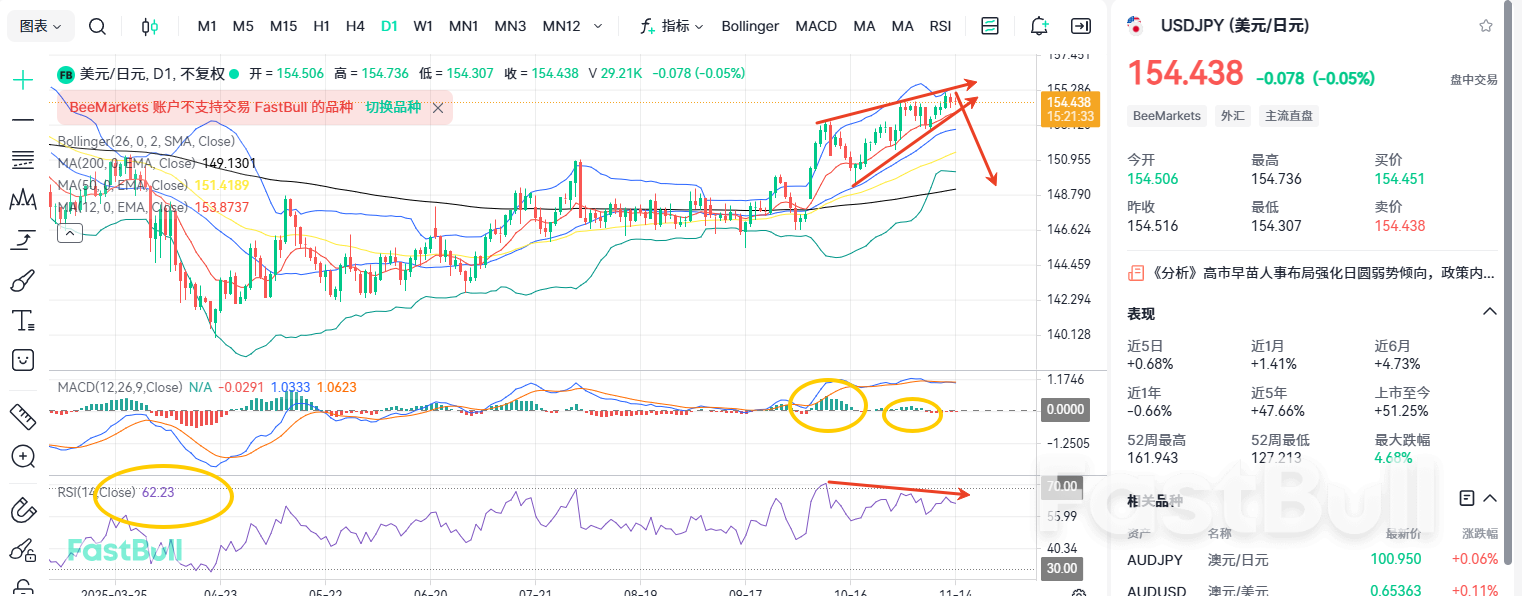
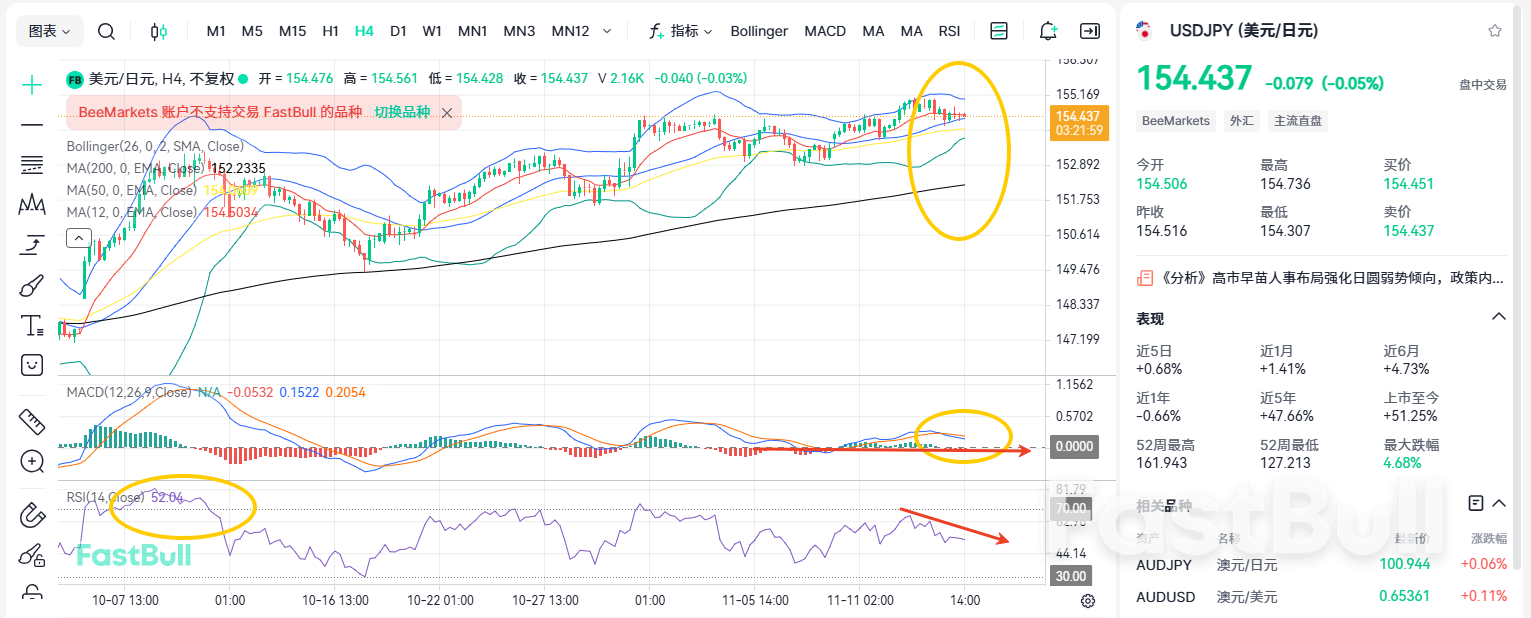
          In the 1D timeframe, the Bollinger Bands are expanding upward, with the SMAs diverging, indicating an ongoing bullish trend. However, the candlestick pattern forms a wedge, and the MACD momentum is diminishing, while the RSI stands at 62, reflecting strong bullish market sentiment. Nonetheless, the recent highs are progressively declining, suggesting a probable correction to the EMA12 or the middle band of the Bollinger, at levels of approximately 153.8 and 152.8, respectively. In the 4H timeframe, the Bollinger Bands are contracting, and the SMAs are flattening. After the MACD formed a death cross, the MACD line and signal line are beginning to reapproach the zero-axis, currently at a considerable distance, indicating that the correction phase is still underway. The RSI is at 52, signifying that market participants are largely in a wait-and-see stance. Should the price break below the middle Bollinger band, a correction toward the EMA200 at approximately 152.2 is probable; conversely, if the price maintains above the middle band, further upward movement towards 156 is likely. It is recommended to go short initially before going long in the short term.
          Bearish News Has Materialized! Has the USDJPY Peaked?_1Bearish News Has Materialized! Has the USDJPY Peaked?_2

          Trading Recommendations

          Trading Direction: Sell
          Entry Price: 154.6
          Target Price: 151.4
          Stop Loss: 156
          Support: 150, 148.5, 146.6
          Resistance: 155, 156.7, 158.8
          Risk Warnings and Disclaimers
          You understand and acknowledge that there is a high degree of risk involved in trading. Following any strategies or investment methods may lead to potential losses. The content on the site is provided by our contributors and analysts for information purposes only. You are solely responsible for determining whether any trading assets, securities, strategy, or any other product is suitable for investing based on your own investment objectives and financial situation.
          Add to Favorites
          Share

          Fundamentals Point Upward, Yet Gold Fails to Rally – Why?

          Tank

          Commodity

          Forex

          Summary:

          The global shift in risk sentiment is evident from the broadly weak tone in equity markets, which has supported the safe-haven status of gold. At the same time, due to a lack of major economic data releases, an increasing number of Federal Reserve policymakers expressed caution about further easing, leading traders to scale back expectations for another rate cut in December. This, in turn, may dampen the price momentum of non-yielding gold.

          SELL XAUUSD
          EXP
          EXPIRED

          4190.00

          Entry Price

          3800.00

          TP

          4500.00

          SL

          4206.81 +8.90 +0.21%

          --

          Pips

          EXPIRED

          3800.00

          TP

          4117.95

          Exit Price

          4190.00

          Entry Price

          4500.00

          SL

          Fundamentals

          A wave of recent commentary from Federal Reserve officials has collectively built a wall of consensus around the idea of "cautious rate cuts." While figures like Daly, Mussarelm, Kashkari, and Hammack have varied slightly in tone—some more hawkish, others more dovish—their core message has been remarkably consistent: policy is now close to neutral, future actions will depend heavily on incoming data, and no preset path is being followed. This unified "verbal intervention" has successfully tempered overly aggressive market expectations for rate cuts. As a result, the U.S. dollar index pulled back, yet gold did not benefit accordingly. The more critical factor is the market's reassessment of the interest rate trajectory, with potential upward revisions to real interest rate expectations undermining the appeal of non-interest-bearing gold. However, it may be premature to interpret the recent pullback in gold as a signal of a trend reversal. First, structural concerns over the credibility of the U.S. dollar are forming a foundational pillar for gold's long-term bullish outlook. European officials have discussed creating alternative dollar liquidity mechanisms outside the Federal Reserve. Although such plans face practical hurdles, the mere intention is symbolic—it reflects growing global apprehension over the weaponization of the dollar and the inward turn of U.S. policy, thereby driving diversification within the international reserve system. Long-term dollar bear Stephen Jen predicts that the U.S. Dollar Index could decline significantly further. If such a scenario unfolds, it would fundamentally bolster the value of gold priced in dollars.
          In other news, the longest government shutdown in U.S. history ended on Thursday after President Trump signed a funding bill to reopen the government. The House of Representatives passed the bill earlier in the day by a vote of 222 to 209, with nearly all Republicans and a handful of Democrats voting in favor. Markets anticipate that once the shutdown ends, upcoming U.S. economic data may reveal signs of labor market weakness, which could weigh on the dollar and provide short-term support for dollar-denominated commodities. On Thursday, White House economic advisor Kevin Hassett stated that the October employment report will be released. Still, because no household survey was conducted that month, the unemployment rate will not be published. On the other hand, cautious commentary from Fed officials may continue to pressure gold prices. Boston Fed President Susan Collins struck a cautious tone in expressing her policy view, stating that in the current highly uncertain environment, maintaining the policy rate for some time may be appropriate to balance risks to inflation and employment. Similarly, Atlanta Fed President Raphael Bostic on Wednesday and Cleveland Fed President Loretta Mester on Thursday also signaled a preference for keeping rates unchanged. According to the CME Group's FedWatch Tool, markets are now pricing in a probability of just over 51% that the Fed will cut the benchmark overnight lending rate by 25 basis points at its December meeting—down from 62.9% a day earlier.

          Technical Analysis

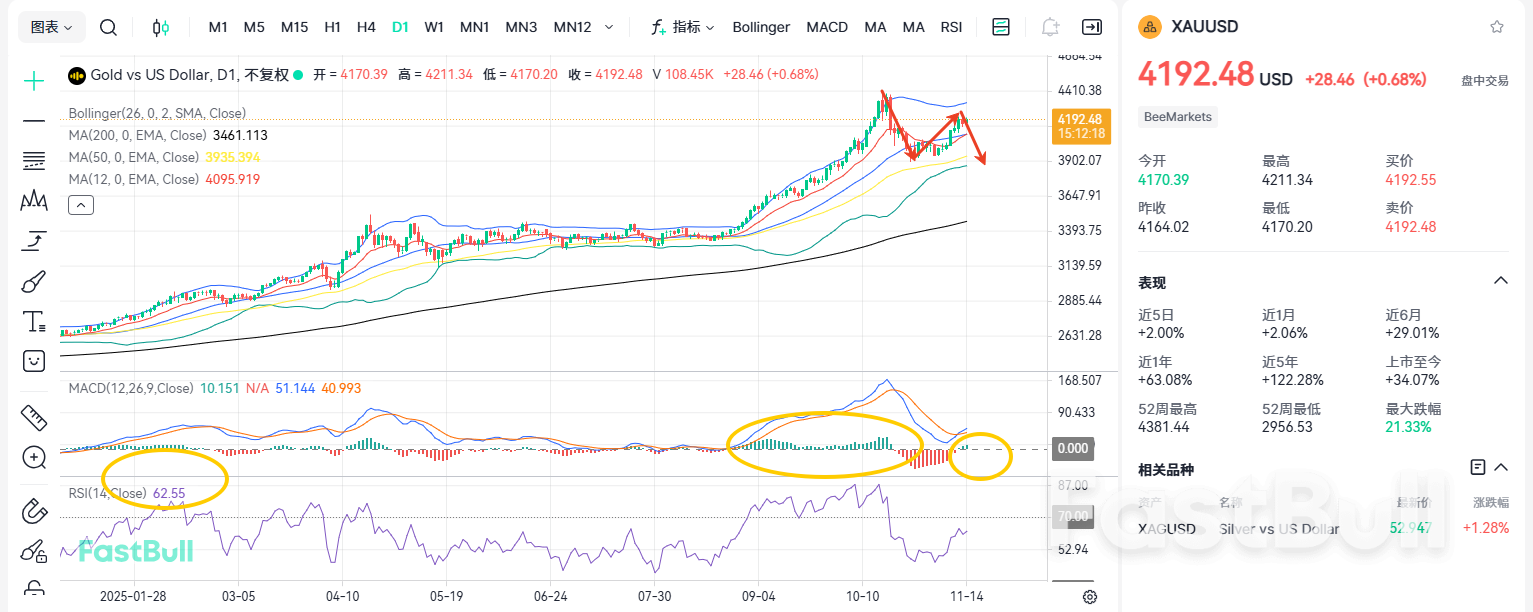
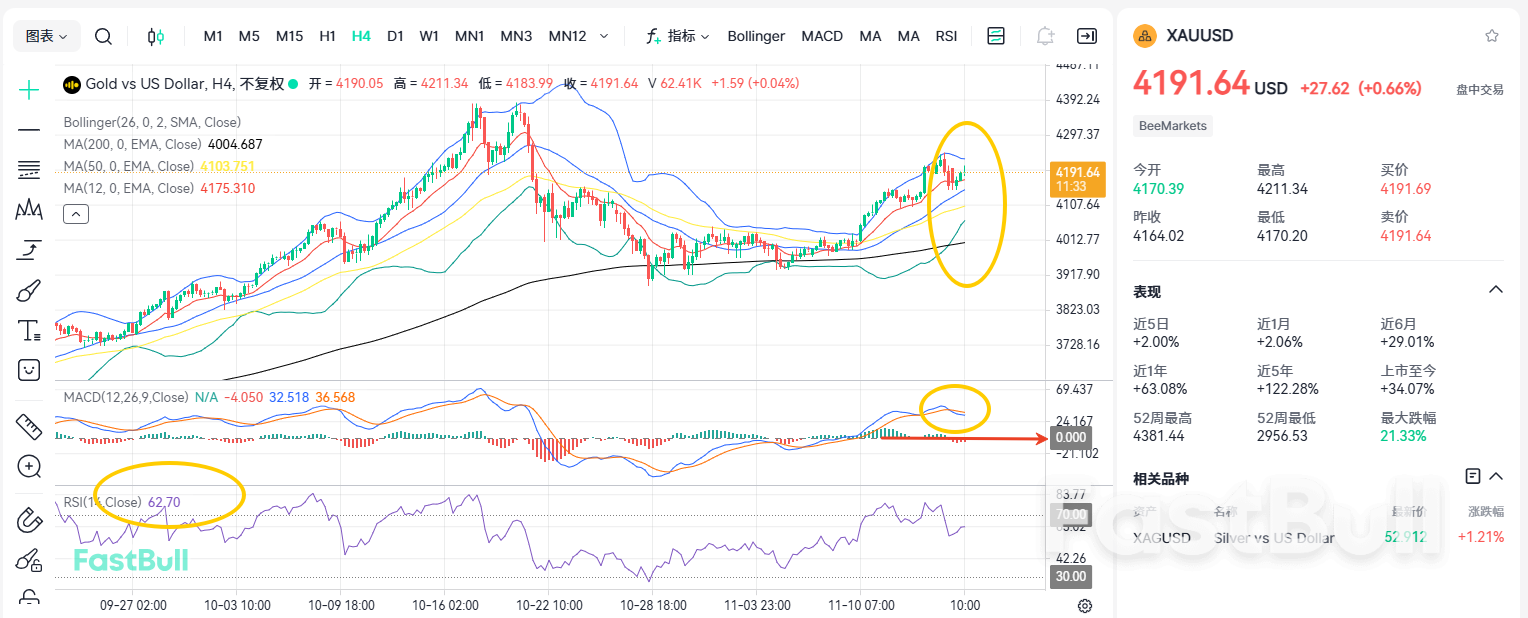
          Regarding the four-hour chart, the Bollinger Bands are beginning to contract, and the candlestick has formed a doji star pattern, signaling that a potential turning point could emerge at any time. Besides, a death cross is formed with the MACD line and the signal line pulling back toward the zero axis—though they still have some distance to go. This reinforces the signal that the adjustment phase is not yet complete. The RSI stands at 62, reflecting strong bullish sentiment in the market. From a daily perspective, the MACD's bullish momentum is gradually weakening, even as the price fails to make new highs—a classic sign of a bearish divergence. This increases the likelihood of a short-term downward move. Key support levels lie at the lower Bollinger Band and the 50-day EMA, at 3860 and 3935, respectively. With the RSI at 62, the price remains in bullish territory, but the recent highs are gradually lowering. Thus, it is better to sell at highs.
          Fundamentals Point Upward, Yet Gold Fails to Rally – Why?_1Fundamentals Point Upward, Yet Gold Fails to Rally – Why?_2

          Trading Recommendations:

          Trading direction: Sell
          Entry price: 4190
          Target price: 3800
          Stop loss: 4500
          Support: 3900/3800/3600
          Resistance: 4380/4500/5000
          Risk Warnings and Disclaimers
          You understand and acknowledge that there is a high degree of risk involved in trading. Following any strategies or investment methods may lead to potential losses. The content on the site is provided by our contributors and analysts for information purposes only. You are solely responsible for determining whether any trading assets, securities, strategy, or any other product is suitable for investing based on your own investment objectives and financial situation.
          Add to Favorites
          Share

          Channel Resistance and Overbought RSI Signal Potential Bearish Turn

          Manuel

          Forex

          Central Bank

          Summary:

          Upon touching this channel resistance, the price has shown an immediate bearish reaction, suggesting that a significant downward correction from this level is highly probable.

          SELL EURUSD
          Close Time
          CLOSED

          1.16326

          Entry Price

          1.15180

          TP

          1.17100

          SL

          1.16520 +0.00094 +0.08%

          43.0

          Pips

          Profit

          1.15180

          TP

          1.15896

          Exit Price

          1.16326

          Entry Price

          1.17100

          SL

          Industrial sector activity within the Eurozone showed a modest expansion in September following a contraction in August, according to the latest data released by Eurostat on Wednesday.
          Specifically, industrial production across the Euro-area increased by 0.2% month-over-month (MoM) in September. This figure was a notable disappointment, falling short of the market's forecast for a 0.7% surge. For August, the data was also revised lower, showing a steeper decline of 1.1% from the initial reading of 1.2%. On an annual basis, Eurozone industrial production grew by 1.2% over the same period, slightly up from the previous 1.1%, but still substantially lower than the consensus estimate of 2.1%.
          In a separate communication, the European Central Bank (ECB) Economic Bulletin reiterated its view that the Eurozone’s growth outlook remains subdued. The bulletin highlighted that domestic demand is holding up reasonably well, supported by an improvement in real incomes. However, it noted that manufacturing and exports continue to face significant pressure due to persistent global weakness and the lingering impact of trade tensions. The ECB also emphasized its expectation for wage growth to soften gradually, while inflation indicators remain close to the 2% target, stressing that future policy decisions will remain data-dependent.
          Meanwhile, in the United States, the House of Representatives approved a temporary funding bill late Wednesday by a vote of 222-209. This measure restores government operations until January 30, 2026, with some key departments fully funded through September 2026. Despite this short-term solution, fears of another government shutdown remain a concern as the next deadline approaches in early February 2026.
          Federal Reserve officials offered mixed signals regarding the policy trajectory. Minneapolis Fed President Neel Kashkari acknowledged seeing diverse data from the economy but stressed that inflation remains unacceptably high, "around 3%." Conversely, San Francisco Fed President Mary Daly adopted a more cautious tone, stating, "it is premature to say definitively that there will not be a cut or definitely that there will be a cut" in December. She underscored that the Fed's dual mandate is currently in balance but pointed to a discernible deterioration in the labor market.
          Further data from the U.S. labor market paints a complex, yet generally softer, picture. Last week's ADP Employment Change report indicated that private payrolls increased by 42,000 in October, surpassing the 25,000 forecast and offsetting September's 29,000 decline. However, the Challenger Job Cuts report presented a darker scenario, revealing that U.S. employers announced 153,074 job cuts in October—the highest monthly total since 2003. This was slightly mitigated by data showing the U.S. shed an average of 11,250 private-sector jobs in the four weeks ending October 25th, a slight improvement from the 14,250 loss recorded in the prior month.Channel Resistance and Overbought RSI Signal Potential Bearish Turn_1

          Technical Analysis

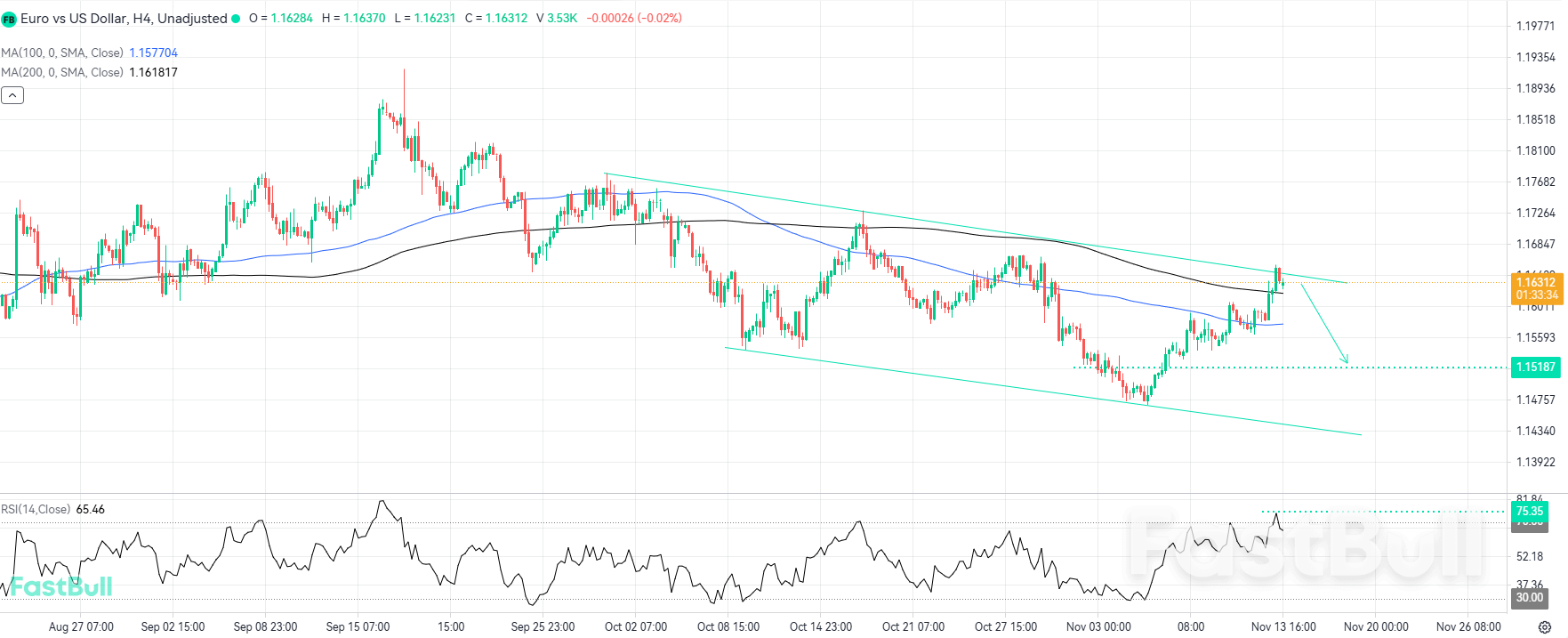
          The EUR/USD pair has recently undergone a sharp, aggressive ascent, driving the price toward the upper boundary of its established bearish channel. This rapid movement has pushed the Relative Strength Index (RSI) to the 75 level, indicating the pair has entered a state of being clearly overbought. Upon touching this channel resistance, the price has shown an immediate bearish reaction, suggesting that a significant downward correction from this level is highly probable. Furthermore, a crucial element for a potential reversal is the presence of a bearish divergence on the RSI; the recent price peak is associated with a much higher RSI reading compared to previous price highs, signaling that buying momentum is overextended and sellers may soon regain control.
          Turning to key moving averages (MAs) on the 4-hour chart, the 100-period MA is positioned at 1.1577 and the 200-period MA at 1.1618. Should the price quickly fall back and breach the 200-period MA, it would serve as strong confirmation of an accelerated bearish trend. Conversely, a definitive and powerful break above the bearish channel trendline would invalidate the current bearish setup, potentially opening the door for a new sustained upward impulse.
          Trading Recommendations
          Trading direction: Sell
          Entry price: 1.1630
          Target price: 1.1518
          Stop loss: 1.1710
          Validity: Nov 25, 2025 15:00:00
          Risk Warnings and Disclaimers
          You understand and acknowledge that there is a high degree of risk involved in trading. Following any strategies or investment methods may lead to potential losses. The content on the site is provided by our contributors and analysts for information purposes only. You are solely responsible for determining whether any trading assets, securities, strategy, or any other product is suitable for investing based on your own investment objectives and financial situation.
          Add to Favorites
          Share

          Bitcoin stabilizes after volatile week

          Gerik

          Cryptocurrency

          Summary:

          BTC/USD is consolidating after a three-day slide that briefly pushed spot toward the high-$99k area, while the U.S. Dollar Index eased to ~98.99 on 13/11 and equity volatility held in the high-teens. ...

          BUY BTC-USDT
          Close Time
          CLOSED

          100200.0

          Entry Price

          104800.0

          TP

          8400.0

          SL

          91996.0 +2441.2 +2.73%

          5891.5

          Pips

          Loss

          8400.0

          SL

          94308.5

          Exit Price

          100200.0

          Entry Price

          104800.0

          TP

          Overview

          BTC closed 13/11 near ~$99.2k after a choppy stretch that saw closes north of $103–107k earlier in the week, with Asia trade today starting from a lower base but not accelerating the downside. Macro drivers are balanced: the Fed’s 25 bp cut on 29/10 lowered the policy range to 3.75%–4.00% but officials signaled that another move in December is “not a foregone conclusion,” keeping the dollar in a broad range instead of a trend and leaving risk assets sensitive to incremental data.
          The DXY’s pullback to ~98.99 on 13/11 modestly loosens financial conditions compared with the early-week test of 100, a tailwind for non-yielding assets if it persists. The tape therefore looks like digestion rather than capitulation, with levels resetting toward $100k as traders reassess the dollar and the Fed path.

          Market sentiment

          Positioning is cautious after heavy redemptions earlier this month, but not one-way. U.S. spot Bitcoin ETFs printed a strong $524m net inflow on 11/11 the best single day since early October before flipping back to outflows on 12/11, illustrating that larger allocators are testing the waters rather than abandoning exposure. With VIX anchored in the high-teens to low-20s regime, the absence of disorderly cross-asset stress allows crypto to trade its own levels, and dollar slippage below 99 reduces immediate headwinds.
          The lesson for near-term risk is that flow volatility remains a feature, but macro conditions no longer argue for forced selling so long as DXY stays sub-99.5.

          Technical analysis

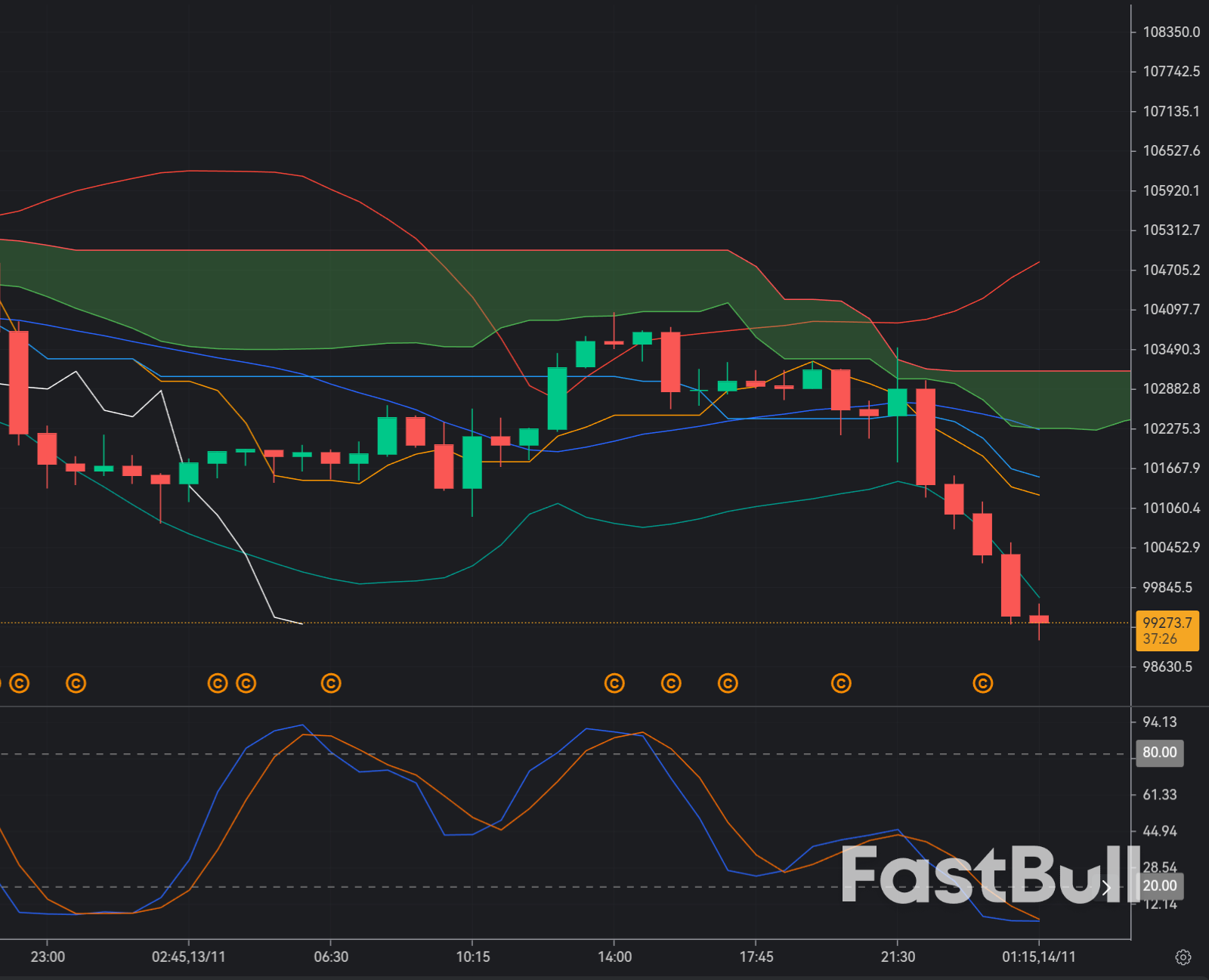
          Bitcoin stabilizes after volatile week_1
          The M15 structure is rebuilding from oversold conditions. Price is rotating back toward the Bollinger mid-line after tagging the lower band near the high-$99ks; sustained holds of the 20-period mean would typically precede a retest of the upper band into the $102–104k zone.
          Ichimoku shows price attempting to reclaim the cloud after spending hours below it; a clean recapture and hold of the Kumo top would convert the ~$100k–$100.5k pocket into dynamic support, with Tenkan crossing up through Kijun as the tell that momentum is turning.
          Stoch (5/3/3) has curled up from mid-range; a %K cross above %D from roughly the 40–50 band on a shallow dip often foreshadows an upper-band extension. Failure to hold the cloud would risk another sweep toward ~$98.5–$99k, but with DXY easing and ETF flows mixed rather than uniformly negative, the path of least resistance on M15 favors buying controlled pullbacks. Recent closes and the 13/11 settle near $99.2k corroborate these levels.

          Trade Recommendations

          Entry: 100,200
          TP: 104,800
          SL: 98,400
          Risk Warnings and Disclaimers
          You understand and acknowledge that there is a high degree of risk involved in trading. Following any strategies or investment methods may lead to potential losses. The content on the site is provided by our contributors and analysts for information purposes only. You are solely responsible for determining whether any trading assets, securities, strategy, or any other product is suitable for investing based on your own investment objectives and financial situation.
          Add to Favorites
          Share

          USD/JPY grinds higher as DXY slips back below 99

          Gerik

          Forex

          Summary:

          USD/JPY is firm near 154.5–155.0 as the US Dollar Index softens toward the high-98s/low-99s and US 10-year yields hover around 4.09%. Market tone is shaped by a calmer VIX in the high-teens and a Bank of Japan path that remains gradual even as officials acknowledge a growing case for future hikes, leaving yen strength contained unless risk aversion spikes....

          BUY USDJPY
          Close Time
          CLOSED

          154.626

          Entry Price

          155.250

          TP

          154.050

          SL

          155.435 +0.090 +0.06%

          57.6

          Pips

          Loss

          154.050

          SL

          154.047

          Exit Price

          154.626

          Entry Price

          155.250

          TP

          Overview

          Spot quotes in Asia show USD/JPY holding a tight 154.3–155.0 envelope after multiple sessions defending the mid-154s. The dollar backdrop is two-sided but not hostile to USD/JPY upside: DXY has retreated to ~99.0 after failing to sustain above 100 last week, while Treasury yields are steady near 4.09% as surveyed strategists see only modest upside absent fresh inflation shocks.
          On the Japan side, the latest BOJ summary of opinions flagged more board members open to a near-term hike, yet communication still emphasizes caution, which tempers aggressive yen bids. The net effect is carry support intact for USD/JPY so long as DXY doesn’t spike and US yields remain anchored.

          Market sentiment

          Positioning is “risk-aware but not defensive.” The VIX sits in the 17–19 zone, consistent with orderly conditions rather than a dash for safe havens; in this regime, JPY typically underperforms high-carry peers unless BOJ surprises or equities wobble.
          Political headlines in Tokyo point to gradualism rather than an abrupt tightening cycle, reinforcing a bias to fade yen strength on calm days while watching the dollar’s path around the 99 handle.

          Technical analysis

          USD/JPY grinds higher as DXY slips back below 99_1
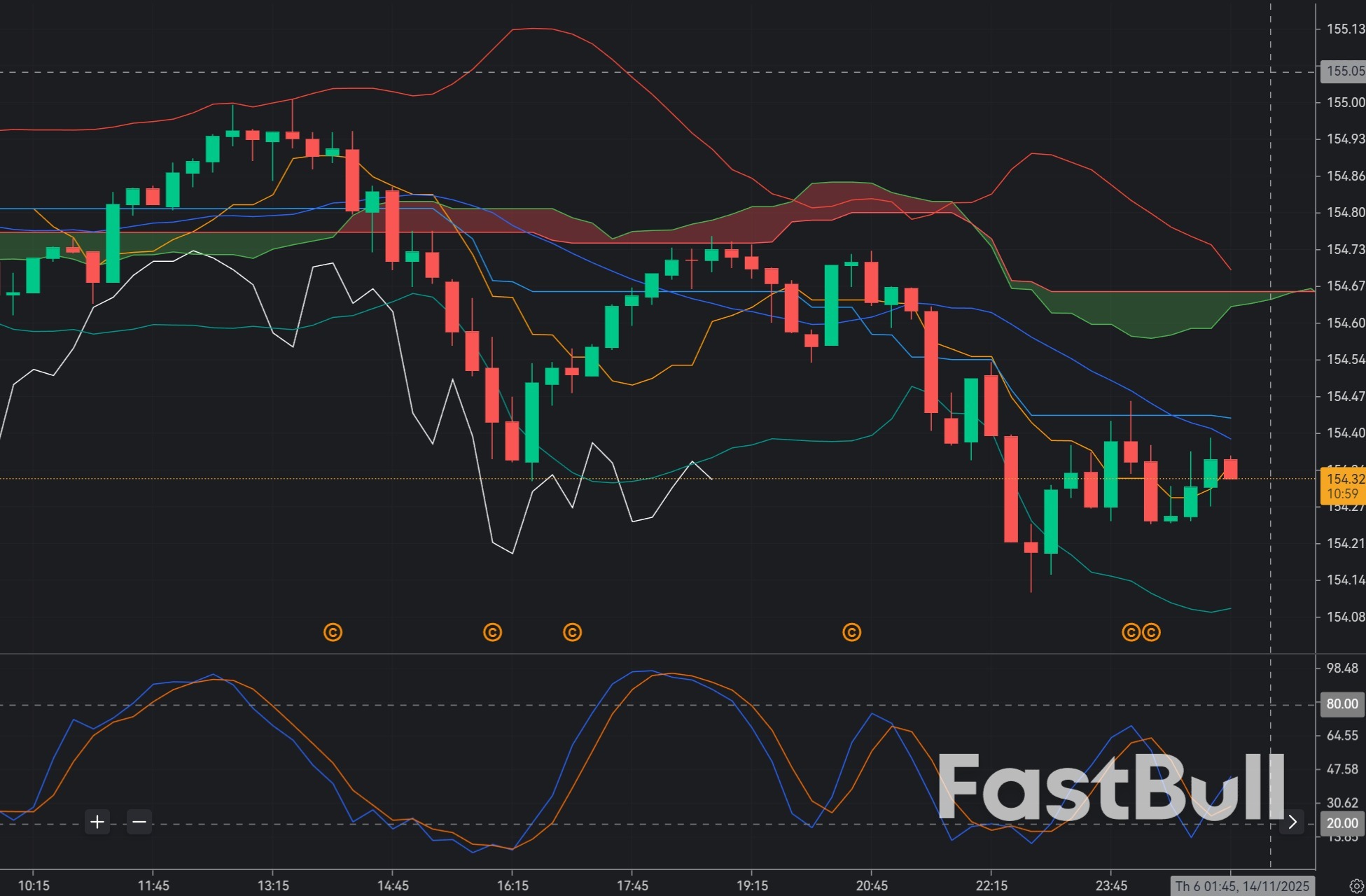
          Price is spending more time above the Bollinger mid-line than below and has repeatedly defended the 20-period mean on dips into the mid-154s, a continuation pattern that often precedes fresh upper-band checks toward the 155.0 region noted on public boards.
          On Ichimoku, spot is rotating on or just above the cloud, with the Kumo top aligning as dynamic support around recent pullback lows; Tenkan is attempting to hold at or slightly above Kijun on rebounds, consistent with a shallow-pullback up-swing. Stochastic has been cycling higher from mid-range, and another %K cross above %D from the 40–50 band on a minor retrace would typically cue an upper-band extension. A sustained loss of the cloud would only neutralize the bias while DXY hovers near ~99; otherwise, dips that hold the cloud/Mid-BB confluence remain buyable. Real-time dashboards corroborate today’s 154.3–155.0 range.

          Trade Recommendations

          Entry: 154.35
          TP: 155.25
          SL: 154.05
          Risk Warnings and Disclaimers
          You understand and acknowledge that there is a high degree of risk involved in trading. Following any strategies or investment methods may lead to potential losses. The content on the site is provided by our contributors and analysts for information purposes only. You are solely responsible for determining whether any trading assets, securities, strategy, or any other product is suitable for investing based on your own investment objectives and financial situation.
          Add to Favorites
          Share

          GBP/JPY Steadies Near Two-Week Highs as Traders Weigh Weak UK Data

          Warren Takunda

          Traders' Opinions

          Summary:

          The Pound held firm near two-week highs against the Yen on Thursday despite a grim batch of UK economic data revealing weaker-than-expected growth and contracting industrial output, suggesting that the Bank of England could be nearing another rate cut. Meanwhile, the Japanese Yen struggled to find strength as political pressure kept the Bank of Japan’s policy stance dovish.

          BUY GBPJPY
          Close Time
          CLOSED

          203.801

          Entry Price

          205.500

          TP

          202.200

          SL

          207.161 +0.061 +0.03%

          28.6

          Pips

          Profit

          202.200

          SL

          204.087

          Exit Price

          203.801

          Entry Price

          205.500

          TP

          The British Pound managed to hold its ground against the Japanese Yen on Thursday, hovering around ¥203.50 — close to two-week highs — despite a string of disappointing UK macroeconomic figures that once again raised fears about Britain’s fragile economic health. The currency pair’s resilience highlights that, for now, broader sentiment and yield differentials remain supportive of the Pound, even as the data paints a bleak picture of an economy losing steam.
          According to preliminary data released earlier in the day, the UK economy expanded by just 0.1% in the third quarter, falling short of the 0.2% forecast and down sharply from the 0.3% growth recorded in the second quarter. On an annual basis, growth came in at 1.3%, slightly below the anticipated 1.4%, underscoring the challenges the British economy faces amid weak demand, high borrowing costs, and ongoing fiscal strain.
          Manufacturing and industrial output were particularly alarming. Manufacturing production contracted by 1.7%, a much deeper fall than the 0.3% decline economists had expected, while industrial production slumped by 2.0% month-on-month, far worse than the projected 0.2% dip. The data followed a downward revision in August’s manufacturing output, which now shows a modest 0.6% increase, pointing to a broader industrial slowdown.
          These figures add to mounting evidence that the UK’s post-pandemic recovery is losing momentum faster than policymakers at the Bank of England (BoE) had hoped. With inflation easing but growth faltering, pressure is intensifying on Governor Andrew Bailey and his colleagues to deliver a rate cut by December to prevent a deeper contraction. Markets are now pricing in a higher probability of a policy pivot, especially as consumer confidence remains subdued and the housing sector shows further signs of fatigue.
          Still, the Pound’s muted reaction suggests traders are already looking past the near-term data, focusing instead on relative monetary policy differentials. While the BoE may soon shift toward easing, the Bank of Japan (BoJ) remains locked in ultra-loose monetary settings — a key factor limiting the Yen’s ability to recover.
          In Japan, the Yen continues to face persistent weakness, failing to capitalize on the disappointing UK numbers. Recent remarks from Prime Minister Sanae Takaichi, urging the BoJ to maintain its accommodative stance, have further dampened speculation about a near-term policy tightening. That message effectively squashed hopes for a December rate hike, keeping the Yen under heavy selling pressure. The currency’s underperformance has been exacerbated by widening yield spreads, as Japanese investors continue seeking higher returns overseas amid stagnant domestic rates.

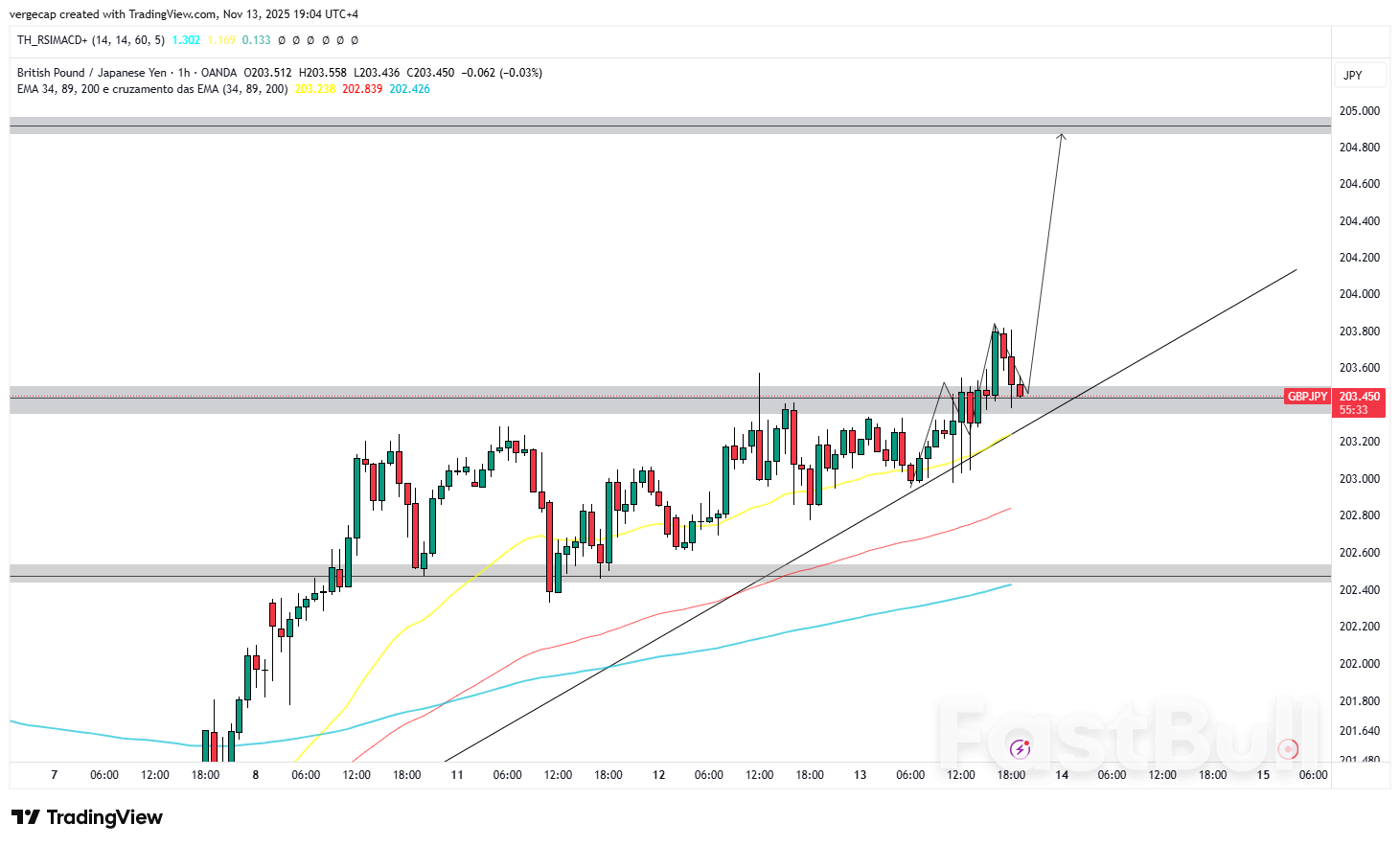
          Technical AnalysisGBP/JPY Steadies Near Two-Week Highs as Traders Weigh Weak UK Data_1

          From a technical perspective, the GBP/JPY pair has entered a consolidation phase after rallying strongly in previous sessions. The pair remains supported above the 201.70 level — a critical line in confirming the broader bullish bias. Despite stochastic indicators signaling temporary exhaustion near overbought territory, the pair’s sideways movement suggests a phase of accumulation before another potential upward move.
          If buyers manage to maintain momentum above the 203.10 region, a break above 203.95 could open the door to fresh gains targeting 204.65 and 205.50. Conversely, a drop below 202.50 might trigger a short-term pullback, but overall sentiment remains constructive as long as the pair stays above its near-term support zone.

          TRADE RECOMMENDATION

          BUY GBPJPY
          ENTRY PRICE: 203.50
          STOP LOSS: 202.200
          TAKE PROFIT: 205.50
          Risk Warnings and Disclaimers
          You understand and acknowledge that there is a high degree of risk involved in trading. Following any strategies or investment methods may lead to potential losses. The content on the site is provided by our contributors and analysts for information purposes only. You are solely responsible for determining whether any trading assets, securities, strategy, or any other product is suitable for investing based on your own investment objectives and financial situation.
          Add to Favorites
          Share

          Gold Breaks Above $4,200 as Fed Cut Bets Fuel Momentum — Can the Rally Reach New Highs?

          Warren Takunda

          Traders' Opinions

          Summary:

          Gold prices surged past $4,200 on Thursday, extending a five-day winning streak as expectations for a December Fed rate cut and a weaker U.S. Dollar fuel bullish sentim

          BUY XAUUSD
          Close Time
          CLOSED

          4204.09

          Entry Price

          4381.00

          TP

          4180.00

          SL

          4206.81 +8.90 +0.21%

          240.9

          Pips

          Loss

          4180.00

          SL

          4179.81

          Exit Price

          4204.09

          Entry Price

          4381.00

          TP

          Gold (XAU/USD) extended its impressive advance on Thursday, climbing decisively above the $4,200 psychological threshold and marking its fifth consecutive daily gain. The precious metal, often viewed as the ultimate safe-haven asset, has now recovered nearly all the ground lost during its recent corrective pullback from the record high of $4,381 set earlier this year. At the time of writing, gold trades near $4,235 per ounce, up more than 5.5% for the week, with its bullish momentum showing few signs of fatigue.
          The renewed strength in gold comes against a backdrop of improving risk sentiment in global markets following the U.S. government’s decision to end its historic shutdown. While the resolution was initially expected to dampen demand for safe-haven assets, it has done little to slow gold’s ascent. Instead, traders have shifted their attention toward a wave of delayed U.S. economic data releases — reports that could heavily influence the Federal Reserve’s policy trajectory heading into year-end.
          The market narrative continues to be dominated by growing speculation that the Federal Reserve will deliver another rate cut in December. Recent statements from key policymakers have suggested a willingness to provide further accommodation should economic momentum falter under the weight of high borrowing costs. The anticipated rate cut has pressured the U.S. Dollar, pushing it lower across the board, while simultaneously keeping Treasury yields subdued.
          For gold, this combination of a weaker dollar and lower yields is a potent cocktail. As a non-yielding asset, gold tends to benefit when real returns on U.S. bonds decline, making it relatively more attractive to investors seeking stability and long-term value preservation. The latest move above $4,200 reflects not only technical strength but also deepening market conviction that the Fed’s tightening cycle is effectively over.
          Beyond monetary policy, broader macroeconomic trends continue to favor gold. Persistent geopolitical uncertainty — from ongoing trade disputes to the fragility of global growth — remains a key driver of demand. Moreover, with inflation expectations still elevated and the U.S. fiscal picture deteriorating due to prolonged government spending, many investors are seeking protection from potential currency debasement and policy missteps.
          The upcoming wave of U.S. economic reports — including retail sales, CPI, and labor market data — will be crucial in determining whether the Fed’s dovish tilt gains further traction. Any sign of economic cooling is likely to reinforce the case for rate cuts, potentially setting the stage for another leg higher in gold.

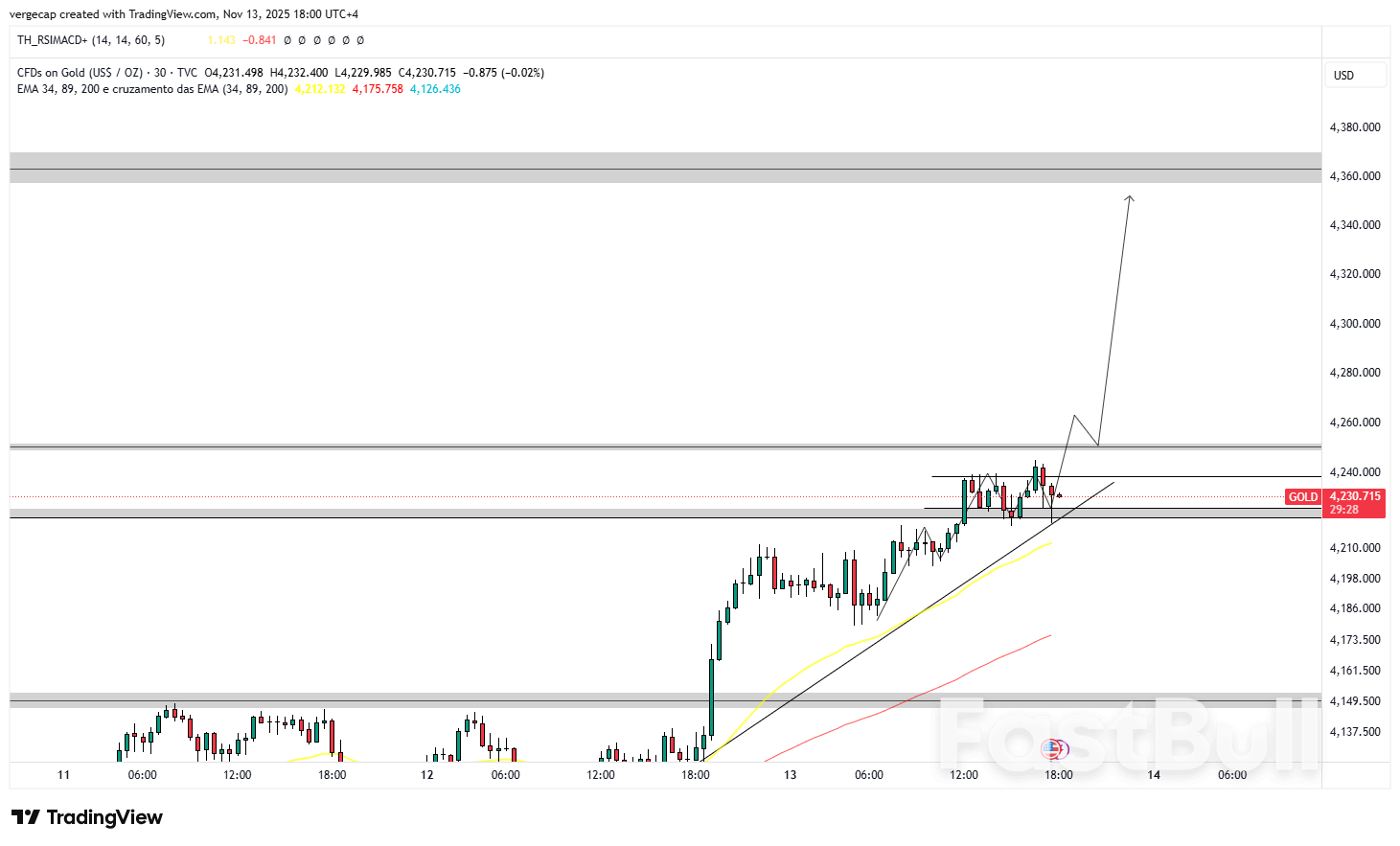
          Technical Analysis Gold Breaks Above $4,200 as Fed Cut Bets Fuel Momentum — Can the Rally Reach New Highs?_1

          From a technical perspective, gold’s price action continues to exhibit remarkable strength. The metal has maintained its position above the 50-day Exponential Moving Average (EMA50), a key dynamic support zone that has underpinned the broader bullish structure since mid-year. The short-term trend remains decisively upward, supported by a minor bullish wave pattern visible on intraday charts.
          Momentum indicators such as the Relative Strength Index (RSI) remain in overbought territory, yet they continue to flash positive signals — a reflection of sustained buying interest rather than exhaustion. Traders should, however, keep a close eye on the immediate support zone around the $4,220–$4,200 area. A firm hold above this range will likely confirm the continuation of the bullish trend, paving the way for a retest of the $4,300–$4,381 resistance zone — and potentially, a fresh all-time high.
          Conversely, a decisive break below $4,200 could trigger a brief technical correction, but given the current macro setup, any dip is likely to be viewed as a buying opportunity rather than a reversal signal.

          TRADE RECOMMENDATION

          BUY GOLD
          ENTRY PRICE: 4210
          STOP LOSS: 4180
          TAKE PROFIT: 4381
          Risk Warnings and Disclaimers
          You understand and acknowledge that there is a high degree of risk involved in trading. Following any strategies or investment methods may lead to potential losses. The content on the site is provided by our contributors and analysts for information purposes only. You are solely responsible for determining whether any trading assets, securities, strategy, or any other product is suitable for investing based on your own investment objectives and financial situation.
          Add to Favorites
          Share
          FastBull
          Copyright © 2025 FastBull Ltd

          728 RM B 7/F GEE LOK IND BLDG NO 34 HUNG TO RD KWUN TONG KLN HONG KONG

          TelegramInstagramTwitterfacebooklinkedin
          App Store Google Play Google Play
          Products
          Charts

          Chats

          Q&A with Experts
          Screeners
          Economic Calendar
          Data
          Tools
          Membership
          Features
          Function
          Markets
          Copy Trading
          Latest Signals
          Contests
          News
          Analysis
          24/7
          Columns
          Education
          Company
          Careers
          About Us
          Contact Us
          Advertising
          Help Center
          Feedback
          User Agreement
          Privacy Policy
          Business

          White Label

          Data API

          Web Plug-ins

          Poster Maker

          Affiliate Program

          Risk Disclosure

          The risk of loss in trading financial instruments such as stocks, FX, commodities, futures, bonds, ETFs and crypto can be substantial. You may sustain a total loss of the funds that you deposit with your broker. Therefore, you should carefully consider whether such trading is suitable for you in light of your circumstances and financial resources.

          No decision to invest should be made without thoroughly conducting due diligence by yourself or consulting with your financial advisors. Our web content might not suit you since we don't know your financial conditions and investment needs. Our financial information might have latency or contain inaccuracy, so you should be fully responsible for any of your trading and investment decisions. The company will not be responsible for your capital loss.

          Without getting permission from the website, you are not allowed to copy the website's graphics, texts, or trademarks. Intellectual property rights in the content or data incorporated into this website belong to its providers and exchange merchants.

          Not Logged In

          Log in to access more features

          FastBull Membership

          Not yet

          Purchase

          Become a signal provider
          Help Center
          Customer Service
          Dark Mode
          Price Up/Down Colors

          Log In

          Sign Up
          Position
          Layout
          Fullscreen
          Default to Chart
          The chart page opens by default when you visit fastbull.com