• Trade
  • Markets
  • Copy
  • Contests
  • News
  • 24/7
  • Calendar
  • Q&A
  • Chats
Trending
Screeners
SYMBOL
LAST
BID
ASK
HIGH
LOW
NET CHG.
%CHG.
SPREAD
SPX
S&P 500 Index
6846.50
6846.50
6846.50
6878.28
6827.18
-23.90
-0.35%
--
DJI
Dow Jones Industrial Average
47739.31
47739.31
47739.31
47971.51
47611.93
-215.67
-0.45%
--
IXIC
NASDAQ Composite Index
23545.89
23545.89
23545.89
23698.93
23455.05
-32.22
-0.14%
--
USDX
US Dollar Index
99.000
99.080
99.000
99.000
99.000
+0.050
+ 0.05%
--
EURUSD
Euro / US Dollar
1.16337
1.16390
1.16337
1.16365
1.16322
-0.00027
-0.02%
--
GBPUSD
Pound Sterling / US Dollar
1.33213
1.33264
1.33213
1.33213
1.33140
+0.00008
+ 0.01%
--
XAUUSD
Gold / US Dollar
4189.70
4190.14
4189.70
4218.85
4175.92
-8.21
-0.20%
--
WTI
Light Sweet Crude Oil
58.555
58.807
58.555
60.084
58.495
-1.254
-2.10%
--

Community Accounts

Signal Accounts
--
Profit Accounts
--
Loss Accounts
--
View More

Become a signal provider

Sell trading signals to earn additional income

View More

Guide to Copy Trading

Get started with ease and confidence

View More

Signal Accounts for Members

All Signal Accounts

Best Return
  • Best Return
  • Best P/L
  • Best MDD
Past 1W
  • Past 1W
  • Past 1M
  • Past 1Y

All Contests

  • All
  • Trump Updates
  • Recommend
  • Stocks
  • Cryptocurrencies
  • Central Banks
  • Featured News
Top News Only
Share

Israeli Military Says It Has Struck Infrastructure Belonging To Hezbollah In Several Areas In Southern Lebanon

Share

SPDR Gold Holdings Down 0.11%, Or 1.14 Tonnes

Share

On Monday (December 8), In Late New York Trading, S&P 500 Futures Fell 0.21%, Dow Jones Futures Fell 0.43%, NASDAQ 100 Futures Fell 0.08%, And Russell 2000 Futures Fell 0.04%

Share

Morgan Stanley: Data Center ABS Spreads Are Expected To Widen In 2026

Share

(US Stocks) The Philadelphia Gold And Silver Index Closed Down 2.34% At 311.01 Points. (Global Session) The NYSE Arca Gold Miners Index Closed Down 2.17%, Hitting A Daily Low Of 2235.45 Points; US Stocks Remained Slightly Down Before The Opening Bell—holding Steady Around 2280 Points—before Briefly Rising Slightly

Share

IMF: IMF Executive Board Approves Extension Of The Extended Credit Facility Arrangement With Nepal

Share

Trump: Same Approach Will Apply To Amd, Intel, And Other Great American Companies

Share

Trump: Department Of Commerce Is Finalizing Details

Share

Trump: $25% Will Be Paid To United States Of America

Share

Trump: President Xi Responded Positively

Share

[Consumer Discretionary ETFs Fell Over 1.4%, Leading The Decline Among US Sector ETFs; Semiconductor ETFs Rose Over 1.1%] On Monday (December 8), The Consumer Discretionary ETF Fell 1.45%, The Energy ETF Fell 1.09%, The Internet ETF Fell 0.18%, The Regional Banks ETF Rose 0.34%, The Technology ETF Rose 0.70%, The Global Technology ETF Rose 0.93%, And The Semiconductor ETF Rose 1.13%

Share

Trump: I Have Informed President Xi, Of China, That United States Will Allow Nvidia To Ship Its H200 Products To Approved Customers In China

Share

Argentina's Merval Index Closed Up 0.02% At 3.047 Million Points. It Rose To A New Daily High Of 3.165 Million Points In Early Trading In Buenos Aires Before Gradually Giving Back Its Gains

Share

US Stock Market Closing Report | On Monday (December 8), The Magnificent 7 Index Fell 0.20% To 208.33 Points. The "mega-cap" Tech Stock Index Fell 0.33% To 405.00 Points

Share

Pentagon - USA State Dept Approves Potential Sale Of Hellfire Missiles To Belgium For An Estimated $79 Million

Share

Toronto Stock Index .GSPTSE Unofficially Closes Down 141.44 Points, Or 0.45 Percent, At 31169.97

Share

The Nasdaq Golden Dragon China Index Closed Up Less Than 0.1%. Nxtt Rose 21%, Microalgo Rose 7%, Daqo New Energy Rose 4.3%, And 21Vianet, Baidu, And Miniso All Rose More Than 3%

Share

The S&P 500 Initially Closed Down More Than 0.4%, With The Telecom Sector Down 1.9%, And Materials, Consumer Discretionary, Utilities, Healthcare, And Energy Sectors Down By As Much As 1.6%, While The Technology Sector Rose 0.7%. The NASDAQ 100 Initially Closed Down 0.3%, With Marvell Technology Down 7%, Fortinet Down 4%, And Netflix And Tesla Down 3.4%

Share

IMF: Review Pakistan Authorities To Draw The Equivalent Of About US$1 Billion

Share

President Trump Is Committed To The Continued Cessation Of Violence And Expects The Governments Of Cambodia And Thailand To Fully Honor Their Commitments To End This Conflict - Senior White House Official

TIME
ACT
FCST
PREV
France Trade Balance (SA) (Oct)

A:--

F: --

P: --
Euro Zone Employment YoY (SA) (Q3)

A:--

F: --

P: --
Canada Part-Time Employment (SA) (Nov)

A:--

F: --

P: --

Canada Unemployment Rate (SA) (Nov)

A:--

F: --

P: --

Canada Full-time Employment (SA) (Nov)

A:--

F: --

P: --

Canada Labor Force Participation Rate (SA) (Nov)

A:--

F: --

P: --

Canada Employment (SA) (Nov)

A:--

F: --

P: --

U.S. PCE Price Index MoM (Sept)

A:--

F: --

P: --

U.S. Personal Income MoM (Sept)

A:--

F: --

P: --

U.S. Core PCE Price Index MoM (Sept)

A:--

F: --

P: --

U.S. PCE Price Index YoY (SA) (Sept)

A:--

F: --

P: --

U.S. Core PCE Price Index YoY (Sept)

A:--

F: --

P: --

U.S. Personal Outlays MoM (SA) (Sept)

A:--

F: --

P: --
U.S. 5-10 Year-Ahead Inflation Expectations (Dec)

A:--

F: --

P: --

U.S. Real Personal Consumption Expenditures MoM (Sept)

A:--

F: --

P: --
U.S. Weekly Total Rig Count

A:--

F: --

P: --

U.S. Weekly Total Oil Rig Count

A:--

F: --

P: --

U.S. Consumer Credit (SA) (Oct)

A:--

F: --

P: --
China, Mainland Foreign Exchange Reserves (Nov)

A:--

F: --

P: --

Japan Trade Balance (Oct)

A:--

F: --

P: --

Japan Nominal GDP Revised QoQ (Q3)

A:--

F: --

P: --

China, Mainland Imports YoY (CNH) (Nov)

A:--

F: --

P: --

China, Mainland Exports (Nov)

A:--

F: --

P: --

China, Mainland Imports (CNH) (Nov)

A:--

F: --

P: --

China, Mainland Trade Balance (CNH) (Nov)

A:--

F: --

P: --

China, Mainland Exports YoY (USD) (Nov)

A:--

F: --

P: --

China, Mainland Imports YoY (USD) (Nov)

A:--

F: --

P: --

Germany Industrial Output MoM (SA) (Oct)

A:--

F: --

P: --
Euro Zone Sentix Investor Confidence Index (Dec)

A:--

F: --

P: --

Canada National Economic Confidence Index

A:--

F: --

P: --

U.K. BRC Like-For-Like Retail Sales YoY (Nov)

--

F: --

P: --

U.K. BRC Overall Retail Sales YoY (Nov)

--

F: --

P: --

Australia Overnight (Borrowing) Key Rate

--

F: --

P: --

RBA Rate Statement
RBA Press Conference
Germany Exports MoM (SA) (Oct)

--

F: --

P: --

U.S. NFIB Small Business Optimism Index (SA) (Nov)

--

F: --

P: --

Mexico 12-Month Inflation (CPI) (Nov)

--

F: --

P: --

Mexico Core CPI YoY (Nov)

--

F: --

P: --

Mexico PPI YoY (Nov)

--

F: --

P: --

U.S. Weekly Redbook Index YoY

--

F: --

P: --

U.S. JOLTS Job Openings (SA) (Oct)

--

F: --

P: --

China, Mainland M1 Money Supply YoY (Nov)

--

F: --

P: --

China, Mainland M0 Money Supply YoY (Nov)

--

F: --

P: --

China, Mainland M2 Money Supply YoY (Nov)

--

F: --

P: --

U.S. EIA Short-Term Crude Production Forecast For The Year (Dec)

--

F: --

P: --

U.S. EIA Natural Gas Production Forecast For The Next Year (Dec)

--

F: --

P: --

U.S. EIA Short-Term Crude Production Forecast For The Next Year (Dec)

--

F: --

P: --

EIA Monthly Short-Term Energy Outlook
U.S. API Weekly Gasoline Stocks

--

F: --

P: --

U.S. API Weekly Cushing Crude Oil Stocks

--

F: --

P: --

U.S. API Weekly Crude Oil Stocks

--

F: --

P: --

U.S. API Weekly Refined Oil Stocks

--

F: --

P: --

South Korea Unemployment Rate (SA) (Nov)

--

F: --

P: --

Japan Reuters Tankan Non-Manufacturers Index (Dec)

--

F: --

P: --

Japan Reuters Tankan Manufacturers Index (Dec)

--

F: --

P: --

Japan Domestic Enterprise Commodity Price Index MoM (Nov)

--

F: --

P: --

Japan Domestic Enterprise Commodity Price Index YoY (Nov)

--

F: --

P: --

China, Mainland PPI YoY (Nov)

--

F: --

P: --

China, Mainland CPI MoM (Nov)

--

F: --

P: --

Italy Industrial Output YoY (SA) (Oct)

--

F: --

P: --

Q&A with Experts
    • All
    • Chatrooms
    • Groups
    • Friends
    Connecting
    .
    .
    .
    Type here...
    Add Symbol or Code

      No matching data

      All
      Trump Updates
      Recommend
      Stocks
      Cryptocurrencies
      Central Banks
      Featured News
      • All
      • Russia-Ukraine Conflict
      • Middle East Flashpoint
      • All
      • Russia-Ukraine Conflict
      • Middle East Flashpoint

      Search
      Products

      Charts Free Forever

      Chats Q&A with Experts
      Screeners Economic Calendar Data Tools
      Membership Features
      Data Warehouse Market Trends Institutional Data Policy Rates Macro

      Market Trends

      Market Sentiment Order Book Forex Correlations

      Top Indicators

      Charts Free Forever
      Markets

      News

      News Analysis 24/7 Columns Education
      From Institutions From Analysts
      Topics Columnists

      Latest Views

      Latest Views

      Trending Topics

      Top Columnists

      Latest Update

      Signals

      Copy Rankings Latest Signals Become a signal provider AI Rating
      Contests
      Brokers

      Overview Brokers Assessment Rankings Regulators News Claims
      Broker listing Forex Brokers Comparison Tool Live Spread Comparison Scam
      Q&A Complaint Scam Alert Videos Tips to Detect Scam
      More

      Business
      Events
      Careers About Us Advertising Help Center

      White Label

      Data API

      Web Plug-ins

      Affiliate Program

      Awards Institution Evaluation IB Seminar Salon Event Exhibition
      Vietnam Thailand Singapore Dubai
      Fans Party Investment Sharing Session
      FastBull Summit BrokersView Expo
      Recent Searches
        Top Searches
          Markets
          News
          Analysis
          User
          24/7
          Economic Calendar
          Education
          Data
          • Names
          • Latest
          • Prev

          View All

          No data

          Scan to Download

          Faster Charts, Chat Faster!

          Download App
          English
          • English
          • Español
          • العربية
          • Bahasa Indonesia
          • Bahasa Melayu
          • Tiếng Việt
          • ภาษาไทย
          • Français
          • Italiano
          • Türkçe
          • Русский язык
          • 简中
          • 繁中
          Open Account
          Search
          Products
          Charts Free Forever
          Markets
          News
          Signals

          Copy Rankings Latest Signals Become a signal provider AI Rating
          Contests
          Brokers

          Overview Brokers Assessment Rankings Regulators News Claims
          Broker listing Forex Brokers Comparison Tool Live Spread Comparison Scam
          Q&A Complaint Scam Alert Videos Tips to Detect Scam
          More

          Business
          Events
          Careers About Us Advertising Help Center

          White Label

          Data API

          Web Plug-ins

          Affiliate Program

          Awards Institution Evaluation IB Seminar Salon Event Exhibition
          Vietnam Thailand Singapore Dubai
          Fans Party Investment Sharing Session
          FastBull Summit BrokersView Expo

          AUD/USD Drops as U.S. Dollar Rebounds from NFP Selloff

          Warren Takunda

          Traders' Opinions

          Summary:

          AUD/USD slipped below the 0.6450 mark during Tuesday’s European session, dragged down by a strengthening U.S. Dollar and growing expectations of rate cuts by the Reserve Bank of Australia.

          SELL AUDUSD
          Close Time
          CLOSED

          0.64600

          Entry Price

          0.63700

          TP

          0.65100

          SL

          0.66226 -0.00007 -0.01%

          50.0

          Pips

          Loss

          0.63700

          TP

          0.65148

          Exit Price

          0.64600

          Entry Price

          0.65100

          SL
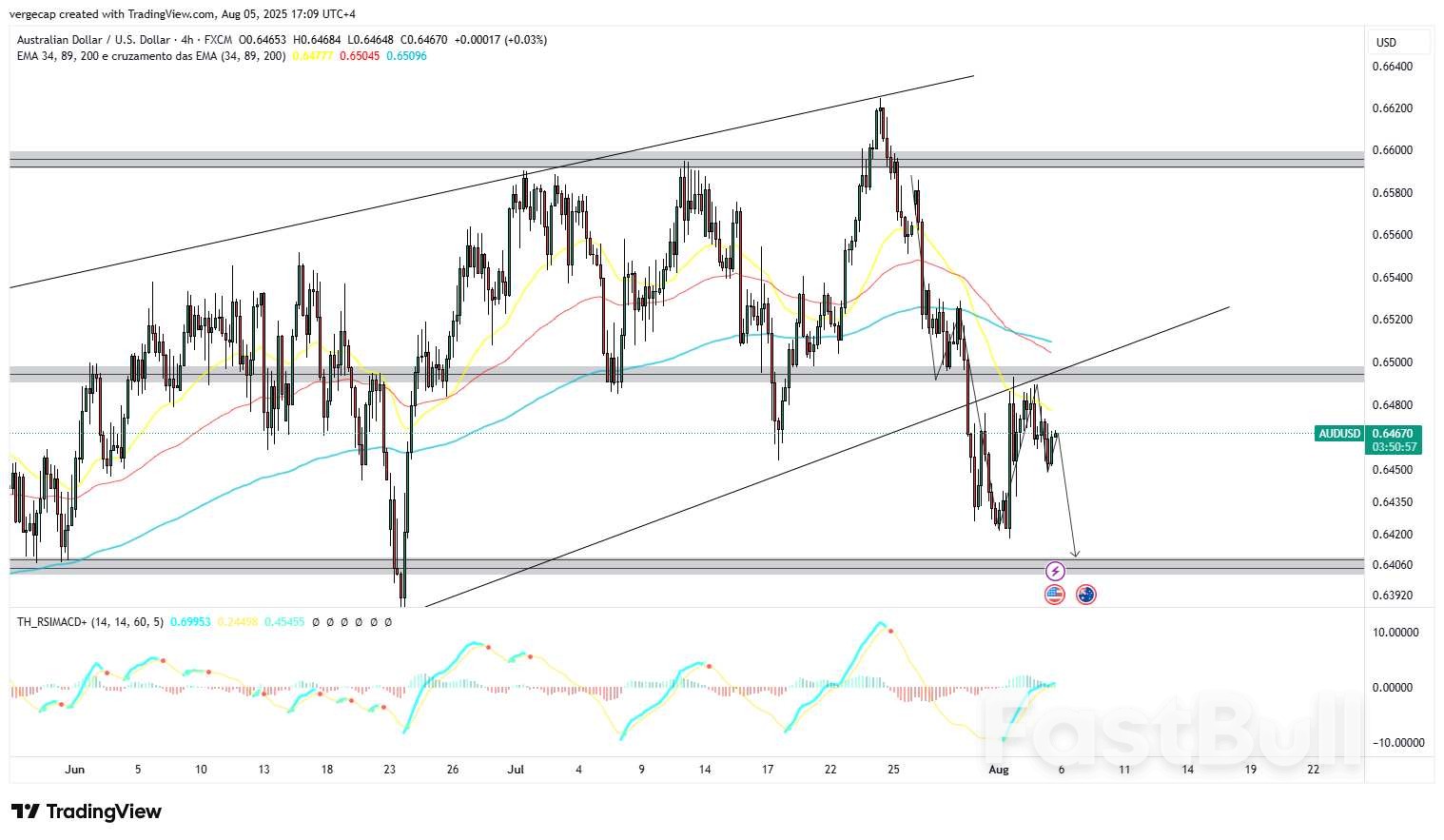
          The Australian Dollar extended its retreat against the U.S. Dollar on Tuesday, with AUD/USD trading close to 0.6450 in the European session. This decline marks a continuation of recent bearish momentum for the pair, as the Aussie remains weighed down by dovish expectations for the Reserve Bank of Australia, while the greenback recovers after last week's sharp drop triggered by weaker-than-expected U.S. labor market data.
          Despite the U.S. Dollar Index (DXY) plunging over 1.4% on Friday in the aftermath of the July Nonfarm Payrolls (NFP) report, it has since clawed back some losses, gaining 0.25% to trade around the 99.00 level. Friday’s data signaled a meaningful cooling in U.S. labor market activity, leading to a dramatic shift in rate expectations. Payroll growth fell short of forecasts, wage growth moderated, and previous months were revised lower. The data painted a picture of an economy that is still growing but no longer showing the overheating signals that justified the Federal Reserve’s aggressive rate hikes over the past two years.
          The market’s response was immediate. Interest rate futures began pricing in a high likelihood of a Federal Reserve pivot. According to the CME FedWatch Tool, the probability of a 25 basis point rate cut in September soared to 92.2%—a significant leap from the 41.2% probability recorded just a day before the release. Such a sharp repricing suggests that market participants are convinced that the Fed’s tightening cycle is over and that easing may begin sooner rather than later.
          Yet, in a twist that underscores the complex nature of currency markets, the U.S. Dollar has not continued to weaken. Instead, the greenback has stabilized, supported by a combination of factors. These include position adjustments, renewed safe-haven demand, and anticipation of the upcoming U.S. ISM and S&P Global Services PMI reports. Investors are hoping these readings—especially the ISM Services PMI, forecast to rise slightly to 51.5 from 50.8—will provide clearer guidance on the resilience of the U.S. economy outside of manufacturing and jobs data.
          Even amid rising Fed rate-cut bets, the dollar's ability to recover suggests that investors are still hesitant to abandon the currency altogether. The U.S. remains in a relatively stronger economic position compared to many of its developed-market peers, particularly Australia, where the outlook is becoming increasingly dovish.
          In contrast to the Fed, the Reserve Bank of Australia is facing mounting pressure to ease policy. Inflation in Australia has cooled more quickly than expected, with the latest CPI data showing a meaningful decline in price growth. Combined with weaker-than-expected retail sales and a softening labor market, these developments have fueled speculation that the RBA could cut rates as early as its next policy meeting. Market participants are increasingly positioning for this outcome, further weighing on the Australian Dollar.
          The contrast between the two central banks’ trajectories is becoming a key driver of AUD/USD price action. While both economies are showing signs of moderation, the U.S. appears to be decelerating from a position of strength, whereas Australia’s economy looks increasingly fragile. This asymmetry is making it difficult for the Aussie to find support, especially against a dollar that is still benefiting from global demand and relative outperformance.

          Technical AnalysisAUD/USD Drops as U.S. Dollar Rebounds from NFP Selloff_1

          From a technical standpoint, the AUD/USD pair appears to be setting up for a deeper correction. After briefly rallying during Monday’s session, supported by a minor bullish signal on the Relative Strength Index and a short-term break of a descending trendline, the pair quickly lost momentum. It failed to sustain gains above the key 0.6514 resistance zone—an area reinforced by the 200-day exponential moving average—and was rejected with conviction.
          This failure marks a rejection at a significant supply zone, confirming that sellers are still firmly in control. The market structure is shifting toward a series of lower highs and lower lows, a classic signal of bearish momentum building. Price remains well below the 50-day EMA, adding to the downward pressure. While temporary rebounds may occur, the medium-term outlook remains tilted to the downside unless a major fundamental surprise disrupts the trend.
          The next meaningful support lies near the 0.6370 area, which has served as a strong floor in past trading cycles. If momentum continues in the current direction, this level could be tested in the near future. Risk sentiment will also play a role—global growth concerns, geopolitical uncertainty, or renewed volatility in equity markets could further bolster the dollar’s position as a safe-haven asset, putting additional pressure on the Aussie.

          TRADE RECOMMENDATION

          SELL AUDUSD
          ENTRY PRICE: 0.6460
          STOP LOSS: 0.6510
          TAKE PROFIT: 0.6370
          Risk Warnings and Disclaimers
          You understand and acknowledge that there is a high degree of risk involved in trading. Following any strategies or investment methods may lead to potential losses. The content on the site is provided by our contributors and analysts for information purposes only. You are solely responsible for determining whether any trading assets, securities, strategy, or any other product is suitable for investing based on your own investment objectives and financial situation.
          Add to Favorites
          Share

          AUD Remains Under Pressure. Has the Trend Reversed?

          Tank

          Economic

          Forex

          Summary:

          The AUD is facing a tough market environment, with domestic monetary easing expectations intertwined with global uncertainty and a stronger dollar. Although Australia holds a relatively favorable position in the current landscape of trade disputes, the AUD remains under pressure.

          SELL AUDUSD
          Close Time
          CLOSED

          0.64600

          Entry Price

          0.63800

          TP

          0.65000

          SL

          0.66226 -0.00007 -0.01%

          40.0

          Pips

          Loss

          0.63800

          TP

          0.65000

          Exit Price

          0.64600

          Entry Price

          0.65000

          SL

          Fundamentals

          The Australian dollar is facing a tough market environment, with domestic monetary easing expectations intertwined with global uncertainty and a stronger dollar. Although Australia holds a relatively favorable position in the current landscape of trade disputes, the AUD remains under pressure. The expectation of the Reserve Bank of Australia's interest rate cut has put downward pressure on the AUD, and the short-term bearish sentiment prevails. Meanwhile, global trade tensions and a stronger dollar add extra resistance. The Reserve Bank of Australia's policy decision on August 12, the upcoming release of Australian PMI data, and any progress in Sino-US trade relations will be crucial. Further escalation of global trade tensions or an unexpected tough stance from the Reserve Bank of Australia could change the current trend.
          Currently, the market expects an 84% chance of the Federal Reserve cutting interest rates in September and a 60-basis-point cut by the end of the year. Meanwhile, Trump's dismissal of the Bureau of Labor Statistics director and the resignation of Federal Reserve Governor Kugler have exacerbated policy uncertainty and market caution. After a sharp sell-off on Friday due to a disappointing jobs report, an unexpected resignation from the Fed, and political interference in statistical agencies, there was a modest recovery. The dollar is still expected to be volatile in the short term.

          Technical Analysis

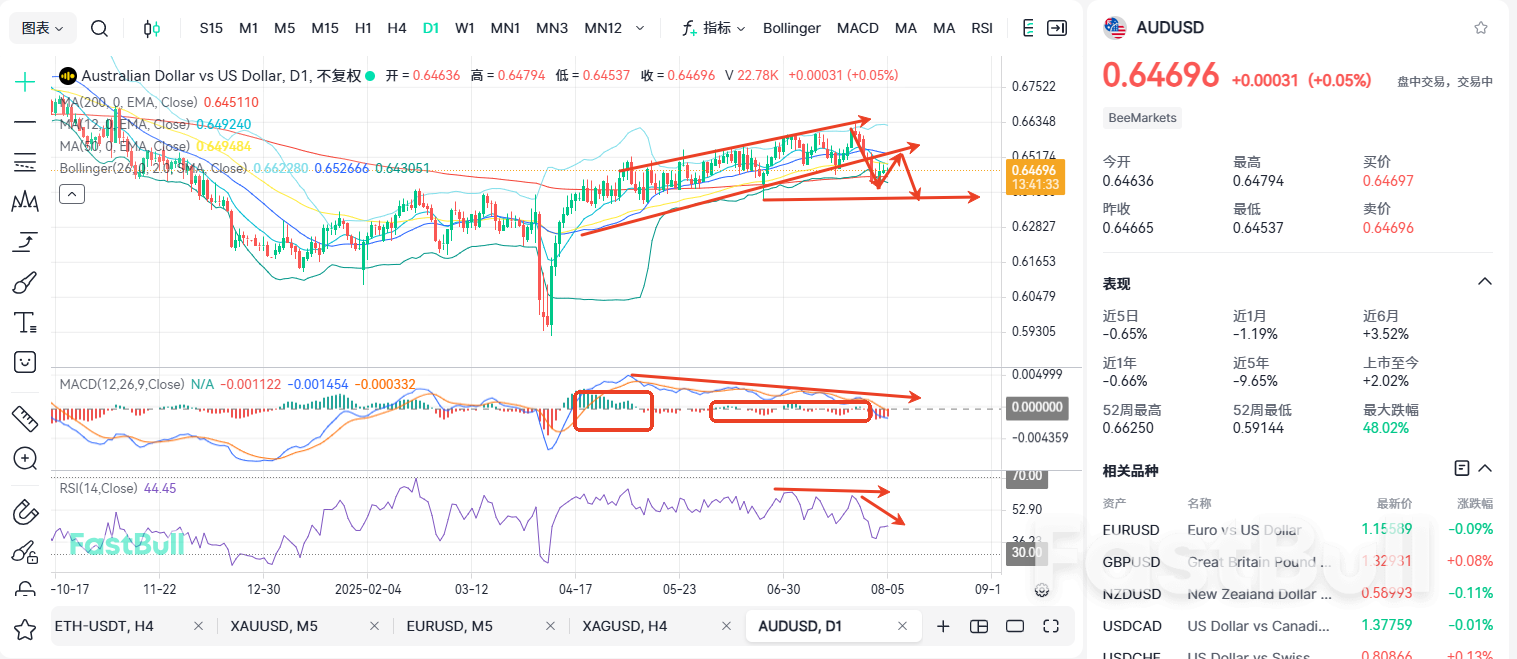
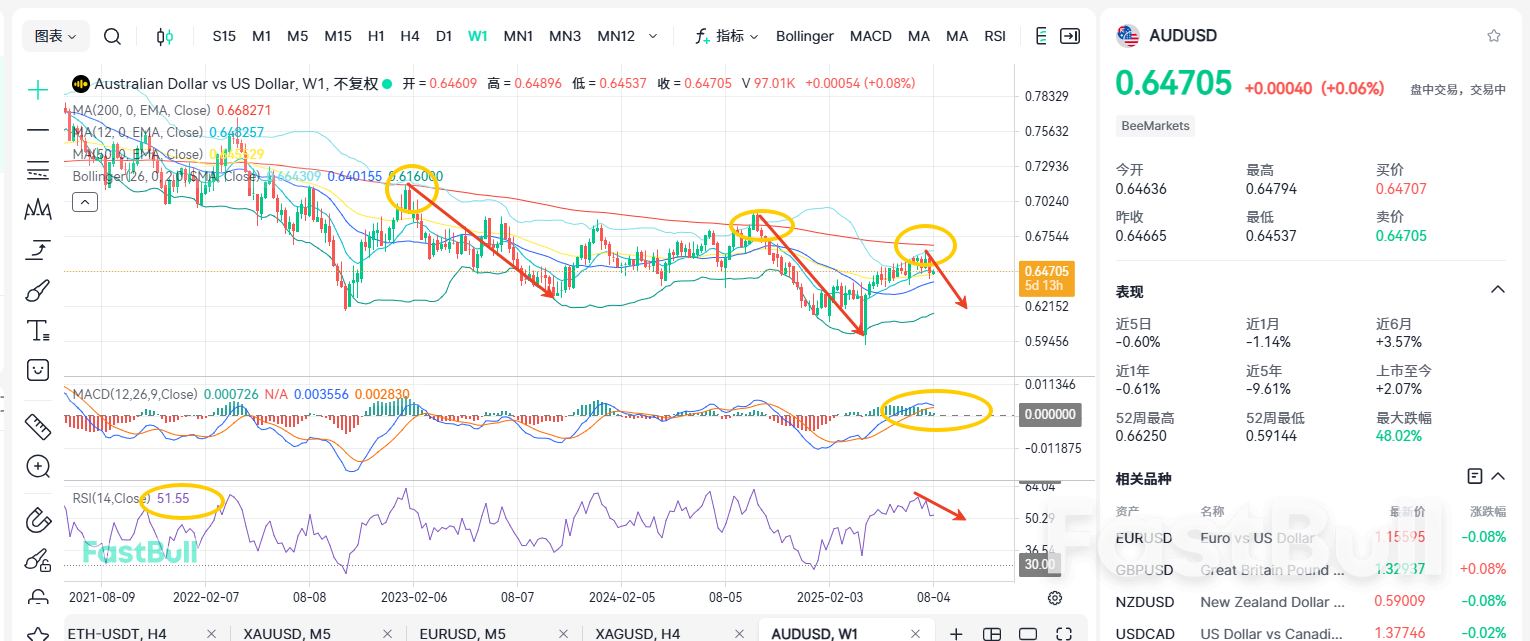
          From the daily chart perspective, the price of Australia and the United States fell below the upward trend channel. If it fails to return to the upward trend channel after the rebound, it will open up a downward space. The MACD histogram shows diminishing bullish momentum with the MACD line and signal line below the zero line. Concurrently, the RSI is forming lower highs, indicating a bearish divergence signal that typically precedes downward movement. Further support can be seen at the previous low of 0.637. From the weekly perspective, the price rebound is very close to the EMA200. Each time it rebounded to the EMA200, there was a significant adjustment. This time, it is likely to be no exception. Because the MACD line and signal line are about to form a MACD death cross, the high point of RSI is gradually decreasing, and the RSI value is around 51, not oversold. Further support can be seen at the middle and lower bands of the Bollinger bands, which are 0.64 and 0.616, respectively. For the strategy, it is recommended to go short at highs.
          AUD Remains Under Pressure. Has the Trend Reversed?_1
          AUD Remains Under Pressure. Has the Trend Reversed?_2

          Trading Recommendations

          Trading direction: Sell
          Entry price: 0.646
          Target price: 0.638
          Stop loss: 0.65
          Support: 0.64, 0.638, 0.63
          Resistance: 0.652, 0.663, 0.7
          Risk Warnings and Disclaimers
          You understand and acknowledge that there is a high degree of risk involved in trading. Following any strategies or investment methods may lead to potential losses. The content on the site is provided by our contributors and analysts for information purposes only. You are solely responsible for determining whether any trading assets, securities, strategy, or any other product is suitable for investing based on your own investment objectives and financial situation.
          Add to Favorites
          Share

          With OPEC+ Boosting Output Again, Where Will Oil Prices Head?

          Alan

          Commodity

          Summary:

          OPEC+ has decided to increase production again at its latest meeting. This decision has brought greater supply pressure to the market, and crude oil prices are expected to continue to face a bearish outlook.

          SELL WTI
          Close Time
          CLOSED

          65.900

          Entry Price

          63.500

          TP

          67.100

          SL

          58.555 -1.254 -2.10%

          240.0

          Pips

          Profit

          63.500

          TP

          63.498

          Exit Price

          65.900

          Entry Price

          67.100

          SL

          Fundamentals

          Recently, OPEC+ decided at its latest meeting to increase production by 547,000 b/d in September. This decision has exerted obvious supply pressure on the market. Although the production increase aims to maintain market share, the market is worried that the rise in output may further drive down oil prices.
          On the other hand, US President Trump reiterated that the U.S. will impose secondary sanctions on countries that continue to import Russian crude oil. This has intensified market concerns about the disruption of Russian crude oil supply, which to some extent supports the tight-supply situation.
          In addition, the European Union has lowered the price cap on Russian crude oil from $60 to $47.6 and plans to implement it in September. This move may force Russia to adjust its export routes, increasing transportation costs and insurance premiums. In the short term, this may provide a floor support for crude oil prices in the European market, but in the long run, it may trigger the risk of regional supply glut.
          Regarding global demand, JP Morgan Chase has warned that the risks of economic slowdown in the U.S. and China are rising, which has made the market worried about the outlook for crude oil demand. The Asia-Pacific region is about to enter the traditional peak refining season. However, if economic activities fall short of expectations, its driving effect on crude oil demand will be limited.
          In the United States, the US Energy Information Administration (EIA) will release the latest weekly crude oil inventory data this Wednesday (August 6). The market generally expects a slight decline in inventory, which will be the key to whether oil prices can stop falling and stabilize in the short term.

          Technical AnalysisWith OPEC+ Boosting Output Again, Where Will Oil Prices Head?_1

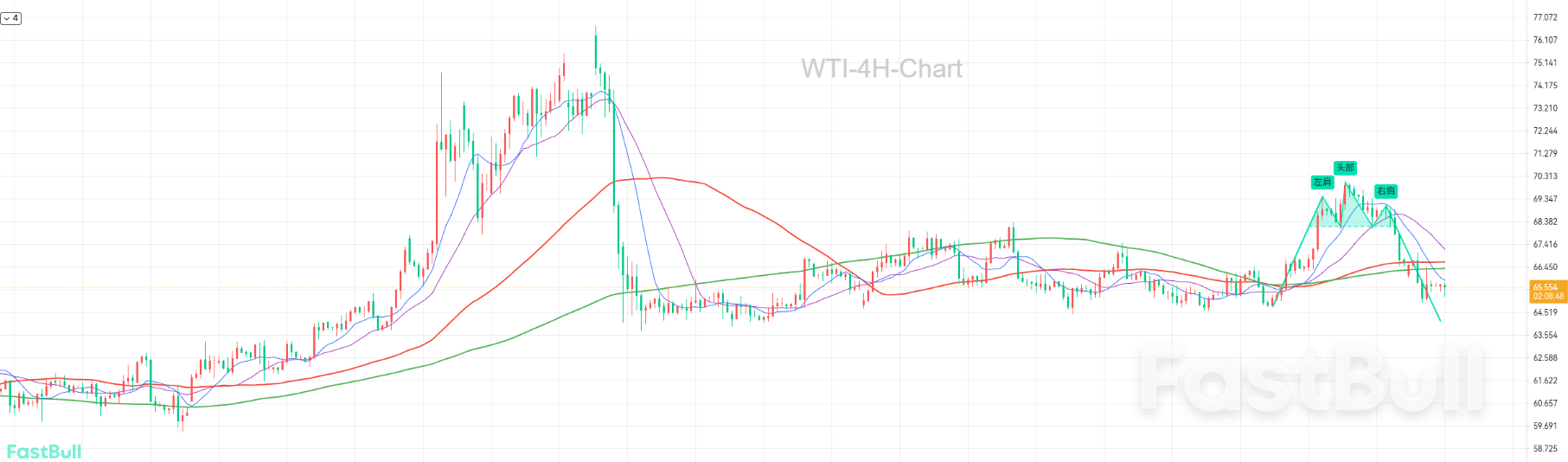
          From the 4-hour chart, the recent chart of WTI crude oil has formed a head-and-shoulders top pattern. In the short term, the downward trend may continue, and the first target could be to break below the support level of $64.50.
          Meanwhile, the moving average system shows that the MA10 is gradually crossing below the MA60 and the MA144, forming a death cross. This further increases the likelihood of the oil price continuing to decline in the short term.
          Currently, WTI crude oil has obtained temporary support around $65.00. However, the technical pattern indicates that the bears are in the dominant position, and the rebound space may be limited. The short-term resistance level above is around $66.00.
          Taking both fundamental and technical factors into comprehensive consideration, traders are recommended to go short on rallies.

          Trading Recommendations

          Trading Direction: Sell
          Entry Price: 65.90
          Target Price: 63.50
          Stop Loss: 67.10
          Valid Until: August 19, 2025, 23:00:00
          Support: 64.50/63.70
          Resistance: 65.96/67.04
          Risk Warnings and Disclaimers
          You understand and acknowledge that there is a high degree of risk involved in trading. Following any strategies or investment methods may lead to potential losses. The content on the site is provided by our contributors and analysts for information purposes only. You are solely responsible for determining whether any trading assets, securities, strategy, or any other product is suitable for investing based on your own investment objectives and financial situation.
          Add to Favorites
          Share

          Pullbacks Are Opportunities: USD/JPY Still Has Upside Potential

          Tank

          Economic

          Forex

          Summary:

          The Japanese yen is facing a complex set of bearish factors. While weak U.S. data and safe-haven demand have provided short-term support, the Bank of Japan's cautious policy stance and domestic political uncertainty are limiting the yen's upside potential.

          BUY USDJPY
          Close Time
          CLOSED

          147.099

          Entry Price

          148.500

          TP

          146.600

          SL

          155.862 -0.056 -0.04%

          26.1

          Pips

          Profit

          146.600

          SL

          147.360

          Exit Price

          147.099

          Entry Price

          148.500

          TP

          Fundamentals

          The USD/JPY pair edged higher on Monday but remained capped below the 148 level before pulling back sharply. Weak U.S. employment data and expectations of Federal Reserve rate cuts continued to weigh on the U.S. dollar. Investors remained cautious ahead of the release of PMI data on Tuesday. In addition, the resignation of Federal Reserve Governor Adriana Kugler added further pressure. As a hawkish policymaker, her departure opens the door for a Trump-nominated candidate with a more dovish policy stance, heightening concerns about further easing of the Fed's policy bias and undermining the U.S. dollar's recovery prospects. Meanwhile, signals from the Bank of Japan are mixed. The central bank maintained its gradual tightening stance but did not specify a timeline for its next rate hike. Although the yen's weakness is somewhat reassuring, the lack of concrete details failed to provide meaningful support. In this environment, USD/JPY remains vulnerable, and a break below 145 could trigger further depreciation. If U.S. data continues to disappoint and risk-off sentiment drives renewed capital inflows into the yen, the pair could decline even further.

          ​Technical Analysis

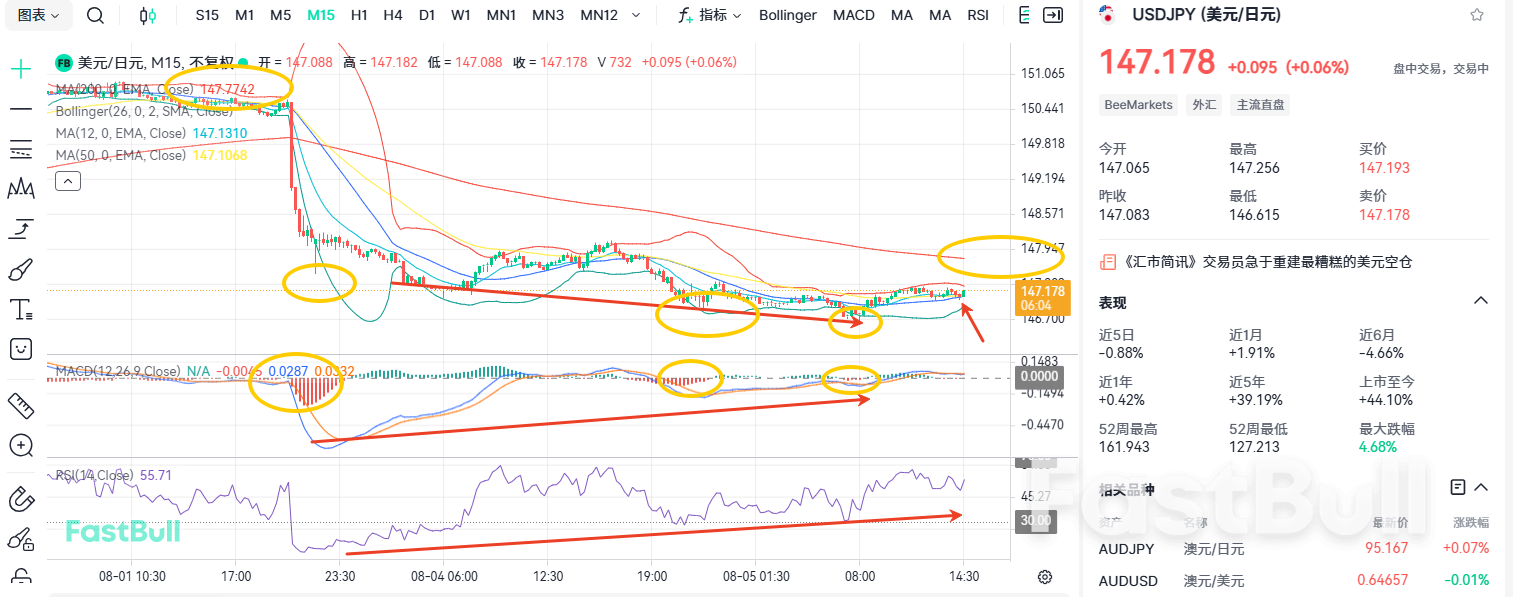
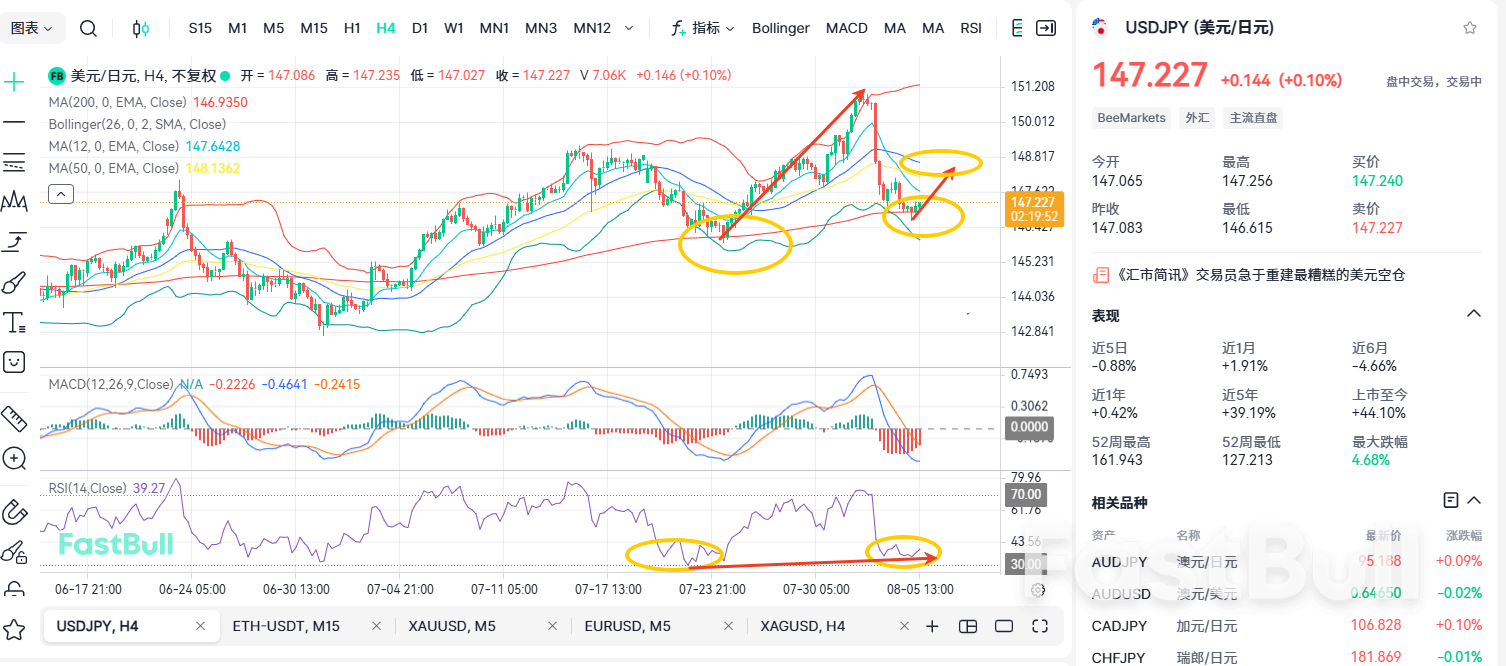
          As the 15-minute chart indicates, the Bollinger Bands are currently narrowing, with the price holding steadily above the middle band (midline). Additionally, lower lows are forming while the corresponding MACD bearish momentum bars are gradually weakening, and RSI lows are also rising, a classic sign of a ​bullish divergence. This indicates potential upward movement. The immediate resistance levels to watch are the ​EMA 200 at 147.7​ and the previous high at ​148.08. USD/JPY is supported at EMA200 in the 4H chart, and a new high may stand out if this level is secured. Otherwise, further downside toward the ​144 level​ may occur. Previously, after finding support at the EMA 200, the pair surged up to ​150.9, and a similar bullish move could be unfolding again. Key resistance levels to monitor are the ​Bollinger middle bands at 148.5​ and the previous high at ​151. Buying at lows is recommended.
          Pullbacks Are Opportunities: USD/JPY Still Has Upside Potential_1Pullbacks Are Opportunities: USD/JPY Still Has Upside Potential_2

          Trading Recommendations

          Trading direction: Buy
          Entry price: 147.1
          Target price: 148.5
          Stop loss: 146.6
          Support: 147/146.6/144
          Resistance: 147.7/148.5/151
          Risk Warnings and Disclaimers
          You understand and acknowledge that there is a high degree of risk involved in trading. Following any strategies or investment methods may lead to potential losses. The content on the site is provided by our contributors and analysts for information purposes only. You are solely responsible for determining whether any trading assets, securities, strategy, or any other product is suitable for investing based on your own investment objectives and financial situation.
          Add to Favorites
          Share

          Bearish Setup Developing Near Key Resistance Zone

          Manuel

          Economic

          Central Bank

          Summary:

          Should the price face strong rejection from this resistance band, a renewed bearish leg could take shape, potentially driving the pair back down to retest the 1.1390 low.

          SELL EURUSD
          Close Time
          CLOSED

          1.16170

          Entry Price

          1.14000

          TP

          1.16900

          SL

          1.16337 -0.00027 -0.02%

          73.0

          Pips

          Loss

          1.14000

          TP

          1.16900

          Exit Price

          1.16170

          Entry Price

          1.16900

          SL

          Investor confidence in the Eurozone took a sharp downturn in August, as revealed by the latest Sentix Investor Confidence Index. According to the data provider, their weekly survey—covering thousands of investors across more than 20 countries—highlighted a notable deterioration in sentiment. The results suggested that recent developments had “dampened the mood,” with the U.S. and President Trump perceived as the main beneficiaries of recent trade decisions, seemingly at the expense of the Eurozone.
          The headline index plunged to -3.7 from July’s 4.5 reading, marking the first negative print since March. Both the current situation and expectation components dropped substantially, as analysts cited mounting concerns over the evolving tariff framework between the U.S. and EU. “The tariff deal is proving to be a real mood killer,” commented Sentix managing director Manfred Huebner in a statement.
          On July 27, the U.S. and the EU reached a preliminary trade agreement that will raise import tariffs on most EU goods to 15%, effective August 7—up significantly from the previous average of 4.8%. While the deal helped avoid a potentially more damaging 30% tariff that President Trump had threatened under a self-imposed August 1 deadline, investor sentiment has nonetheless deteriorated.
          Earlier on Monday, a European Commission spokesperson confirmed that the EU would suspend any retaliatory trade measures against the U.S. for a six-month period. The spokesperson also noted that negotiations are ongoing to finalize a Joint Declaration, as initially outlined on July 27, though no formal agreement has yet been signed.
          In the U.S., San Francisco Federal Reserve President Mary C. Daly made headlines late Monday, stating that while there are “plenty of reasons” to consider interest rate cuts, lingering uncertainty continues to limit the Fed’s ability to act swiftly. Her comments added further weight to speculation surrounding potential easing.
          Economic data added fuel to the fire: the July Non-Farm Payrolls (NFP) report delivered a notable disappointment, with only 73,000 jobs added compared to the forecast of 110,000. Even more concerning were the substantial downward revisions to the May and June figures, which together saw a reduction of 258,000 jobs. These revisions reinforce concerns about a weakening labor market and fading hiring momentum.
          Despite the weaker employment data raising the likelihood of Federal Reserve rate cuts, President Trump’s response was to dismiss the head of the Bureau of Labor Statistics. Following the release, markets dramatically adjusted their expectations for monetary policy, with the CME FedWatch Tool showing the probability of a rate cut at the September 17 meeting jumping to 80%, up from the previous 40–45% range.Bearish Setup Developing Near Key Resistance Zone_1

          Technical Analysis

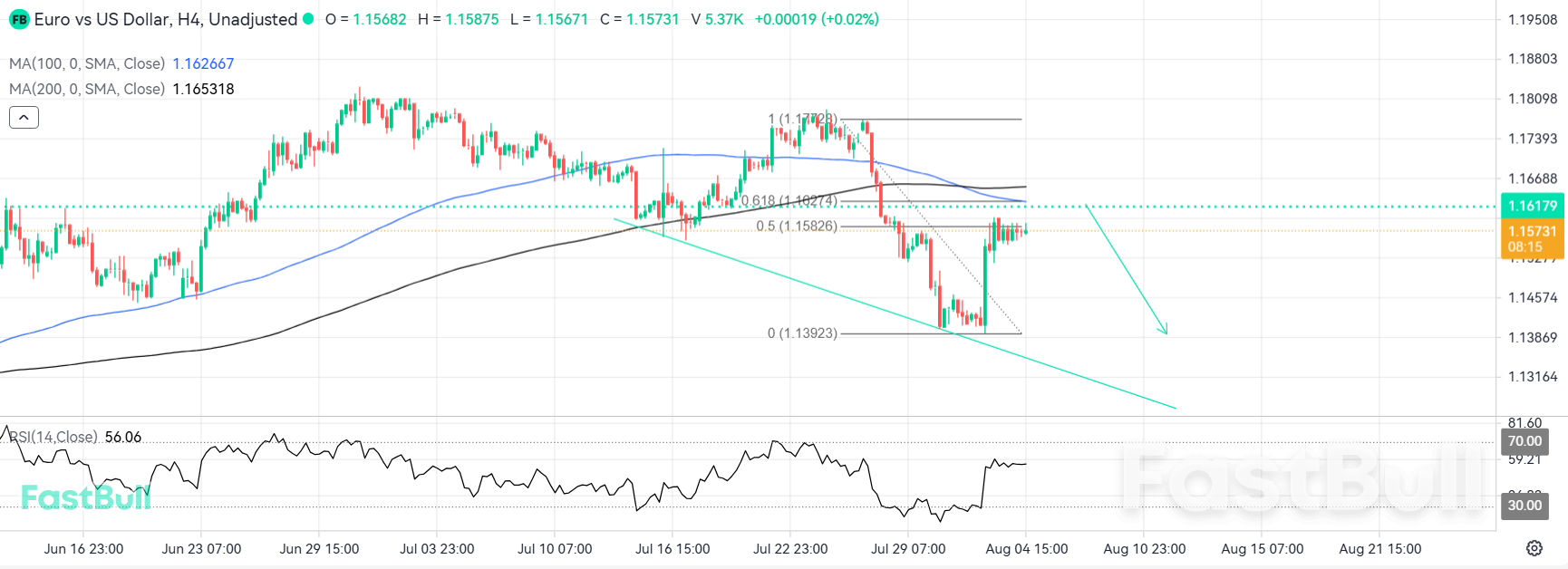
          From a technical perspective, EURUSD reached a local low at 1.1390 on August 1, and has since begun a corrective rally pushing toward the 1.1600 region. This area is beginning to look increasingly attractive for potential short positions, as it falls between the 0.50 and 0.618 Fibonacci retracement levels—a common zone for corrective pullbacks to stall. Adding to this confluence, the 100- and 200-period moving averages on the daily chart are currently sitting just above this zone, at 1.1626 and 1.1653 respectively.
          Should the price face strong rejection from this resistance band, a renewed bearish leg could take shape, potentially driving the pair back down to retest the 1.1390 low.
          Meanwhile, the RSI currently stands at 56—above the midpoint but still far from overbought territory. This leaves room for a final push higher, which could lead to a bearish RSI divergence if price fails to break through resistance. However, if EURUSD manages to close decisively above the 100- and 200-period moving averages, the bearish outlook would be invalidated, opening the door to further gains.
          Trading Recommendations
          Trading direction: Sell
          Entry price: 1.1617
          Target price: 1.1400
          Stop loss: 1.1690
          Validity: Aug 15, 2025 15:00:00
          Risk Warnings and Disclaimers
          You understand and acknowledge that there is a high degree of risk involved in trading. Following any strategies or investment methods may lead to potential losses. The content on the site is provided by our contributors and analysts for information purposes only. You are solely responsible for determining whether any trading assets, securities, strategy, or any other product is suitable for investing based on your own investment objectives and financial situation.
          Add to Favorites
          Share

          EUR/USD Retracement Faces Key Test; Macro Risks Mount

          Warren Takunda

          Traders' Opinions

          Summary:

          The Euro is holding firm against the US Dollar, underpinned by growing bets on Federal Reserve rate cuts after a disappointing US jobs report.

          SELL EURUSD
          Close Time
          CLOSED

          1.15400

          Entry Price

          1.11400

          TP

          1.17000

          SL

          1.16337 -0.00027 -0.02%

          160.0

          Pips

          Loss

          1.11400

          TP

          1.17001

          Exit Price

          1.15400

          Entry Price

          1.17000

          SL

          The Euro maintained its recent gains against the US Dollar on Monday, consolidating a sharp rebound that followed Friday’s weaker-than-expected US Nonfarm Payrolls (NFP) report. The data miss has meaningfully shifted interest rate expectations in favor of the Federal Reserve cutting rates as early as September—a tailwind for the single currency. Yet, even as EUR/USD traded near 1.1557 in the New York session, it struggled to convincingly push through the psychologically significant 1.1600 level, restrained by mounting unease over transatlantic trade relations and the broader outlook for the Eurozone economy.
          At the core of that unease is a contentious new trade framework agreed between the United States and the European Union on July 27. The deal, which imposes a 15% import tariff on most EU goods starting August 7—up from an average of 4.8%—was pitched by Washington as a diplomatic win averting a harsher 30% levy. However, the compromise has not been well received in Europe, where officials and market participants alike have criticized it as a lopsided agreement that benefits the US disproportionately while exposing EU exporters to long-term competitiveness risks.
          This tension was underscored Monday by fresh data from Sentix, whose widely followed Investor Confidence Index for August fell into negative territory for the first time since March. The headline gauge dropped to -3.7 from 4.5 in July, reflecting deteriorating sentiment across both current conditions and forward-looking expectations. “The tariff agreement is proving to be a real mood killer,” said Sentix Managing Director Manfred Huebner, citing a growing perception among investors that the EU “came out of this deal as the loser.”
          The findings reinforce a broader narrative of economic fragility in the Eurozone just as the bloc enters a critical phase of recovery from last year’s stagflation scare. The timing of the US-EU tariff deal couldn’t be worse, as key indicators from Germany and France already suggest a downturn in industrial momentum. Moreover, with the European Central Bank signaling policy restraint until later this year, the bloc now faces a dual challenge: a slowing domestic economy and a trade environment that is increasingly tilted against its interests.
          Across the Atlantic, the macro picture is hardly rosier. Friday’s US NFP report revealed that the economy added just 109,000 jobs in June—well below consensus forecasts of 190,000—and followed downward revisions to prior months. The miss prompted an immediate reassessment of Fed policy expectations, with Fed Funds Futures now pricing in a 77% probability of a 25 basis point cut in September.
          Adding to the bearish tone for the dollar, Monday’s Factory Orders data painted a dim picture of manufacturing demand. Orders declined 4.8% in June, slightly better than the 4.9% expected drop, but far weaker than May’s revised 8.3% gain. While the data suggests a soft landing is still in play, the direction of travel is clearly downward. For markets, the implication is clear: the Fed may need to shift from pause to pivot sooner than previously assumed.

          Technical AnalysisEUR/USD Retracement Faces Key Test; Macro Risks Mount_1

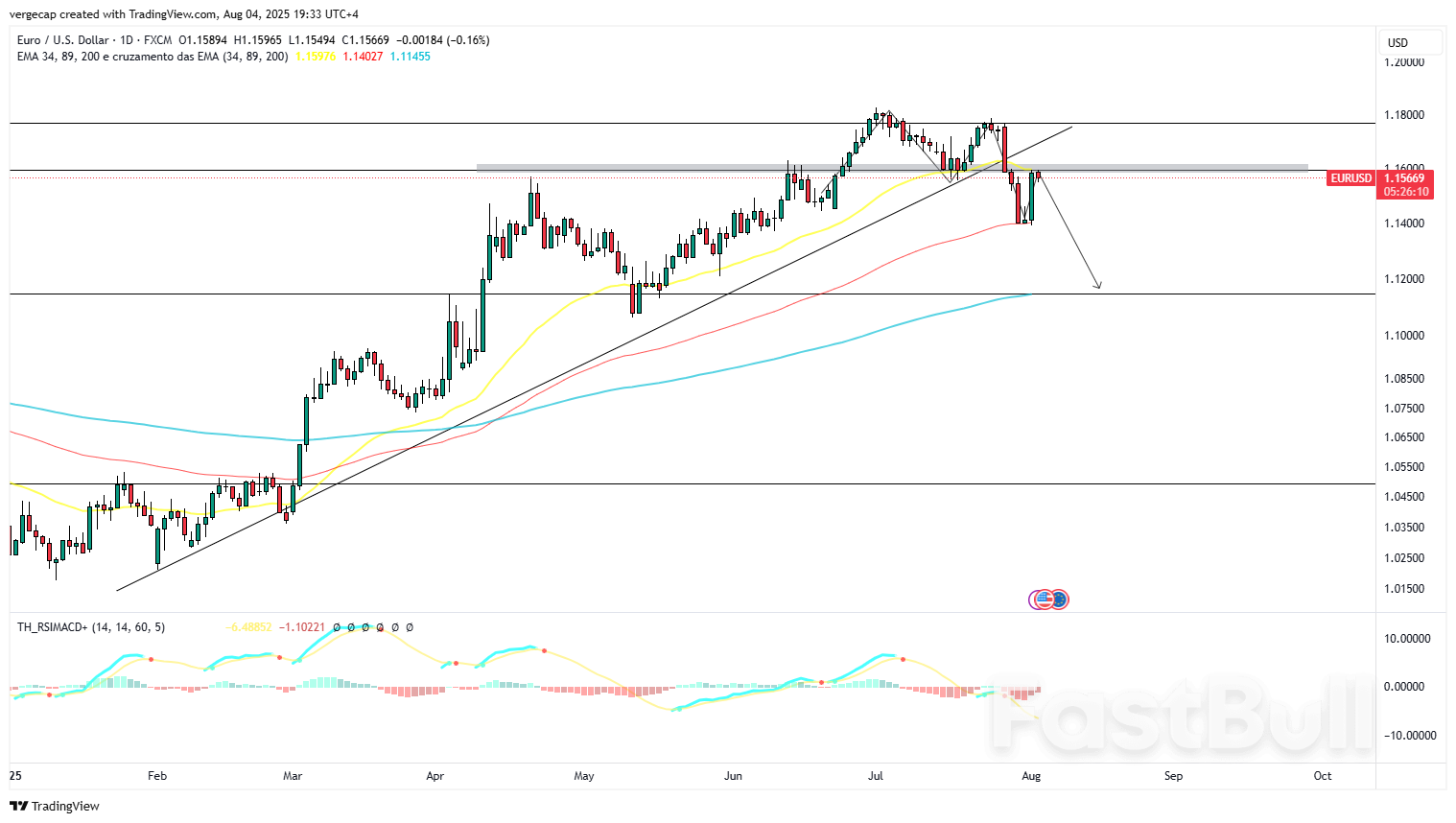
          From a market structure standpoint, the EUR/USD appears to be undergoing a classic corrective retracement within a broader bearish trend. Technical indicators show the pair attempting to climb back toward a former support-turned-resistance zone, likely near the broken trendline just above 1.1600. As long as the pair remains below this threshold, the technical bias favors a renewed move lower once the pullback loses steam.
          According to Fibonacci projections, the next key downside target lies at the 1.618 extension level near 1.1140, aligning with the broader bearish framework under Dow Theory. Should the pair fail to breach resistance convincingly this week, sellers may regain control, with momentum likely accelerating as macro uncertainty deepens heading into Q3.
          TRADE RECOMMENDATION
          SELL EURUSD
          ENTRY PRICE: 1.1540
          STOP LOSS: 1.1700
          TAKE PROFIT: 1.1140
          Risk Warnings and Disclaimers
          You understand and acknowledge that there is a high degree of risk involved in trading. Following any strategies or investment methods may lead to potential losses. The content on the site is provided by our contributors and analysts for information purposes only. You are solely responsible for determining whether any trading assets, securities, strategy, or any other product is suitable for investing based on your own investment objectives and financial situation.
          Add to Favorites
          Share

          US Dollar Struggles Near 148 as Fed Rate Cut Expectations Weigh on USD/JPY

          Warren Takunda

          Economic

          Summary:

          The U.S. dollar is struggling to hold gains against the Japanese yen following soft U.S. jobs data and heightened expectations for Federal Reserve rate cuts.

          SELL USDJPY
          Close Time
          CLOSED

          147.000

          Entry Price

          142.000

          TP

          149.000

          SL

          155.862 -0.056 -0.04%

          18.6

          Pips

          Loss

          142.000

          TP

          147.186

          Exit Price

          147.000

          Entry Price

          149.000

          SL

          The U.S. dollar is trading with modest gains against the Japanese yen at the start of the week, yet those gains appear fragile and constrained, particularly after Friday’s sharp drop from multi-month highs near ¥151.00. On Monday, USD/JPY hovered beneath the psychologically significant 148.00 level, lacking momentum for a full recovery amid rising expectations that the Federal Reserve will shift toward a more accommodative policy stance in the months ahead.
          The greenback’s vulnerability was laid bare after a disappointing U.S. jobs report released on Friday rattled markets. July’s nonfarm payroll data fell short of expectations, and, more critically, the Bureau of Labor Statistics delivered sizeable downward revisions to job growth in May and June. These revisions raised fresh doubts about the supposed resilience of the U.S. labor market, leading to an aggressive repricing in interest rate expectations. According to CME’s FedWatch tool, markets are now pricing in over an 80% chance of a 25-basis-point rate cut by September—double the probability priced in prior to the report. Futures markets also indicate traders are now expecting as much as 63 basis points in cuts by year-end.
          The data was not just weak—it was disorienting. For months, the prevailing narrative on Wall Street was that the U.S. economy, particularly the labor market, was defying gravity amid higher interest rates and persistent inflation. But with job creation now appearing tepid, and previous strong figures walking back into the shadows of revision, the Fed may soon be compelled to act more forcefully to stimulate economic growth.
          Adding further pressure on the dollar, Fed Governor Adriana Kugler, regarded as a hawkish voice and an influential voting member of the Federal Open Market Committee (FOMC), announced her resignation. Her departure creates an opening for U.S. President Donald Trump to nominate a replacement—a decision that could materially shift the balance of power on the board. With Trump known for advocating lower interest rates and publicly criticizing the Fed’s past tightening cycle, the next appointee is likely to align with a more dovish outlook, compounding the market’s anticipation of looser policy.
          While the resignation does not immediately alter the Fed’s stance, it introduces a significant element of political risk and uncertainty into the rate path narrative. If Trump's nominee is confirmed before the Fed's pivotal meetings in late summer or early autumn, the odds of a cut—not just one, but potentially multiple—could rise further.
          Across the Pacific, the Bank of Japan (BoJ) maintained its cautious approach to normalization last week, reiterating its intention to proceed gradually with tightening. However, it provided little in the way of concrete guidance regarding the timeline of future hikes. The central bank appeared relatively untroubled by the yen’s persistent weakness, prompting a muted market reaction. Instead of rallying on tightening hopes, the yen extended losses, with investors perceiving the BoJ’s statement as lacking conviction.
          Yet despite Japan’s continued ultra-loose stance, the tide may be shifting in favor of the yen—ironically, not because of BoJ strength, but due to U.S. dollar softness. The BoJ may be slow-moving, but if the Fed pivots more decisively, relative rate differentials could begin to narrow.
          Technical Analysis US Dollar Struggles Near 148 as Fed Rate Cut Expectations Weigh on USD/JPY_1
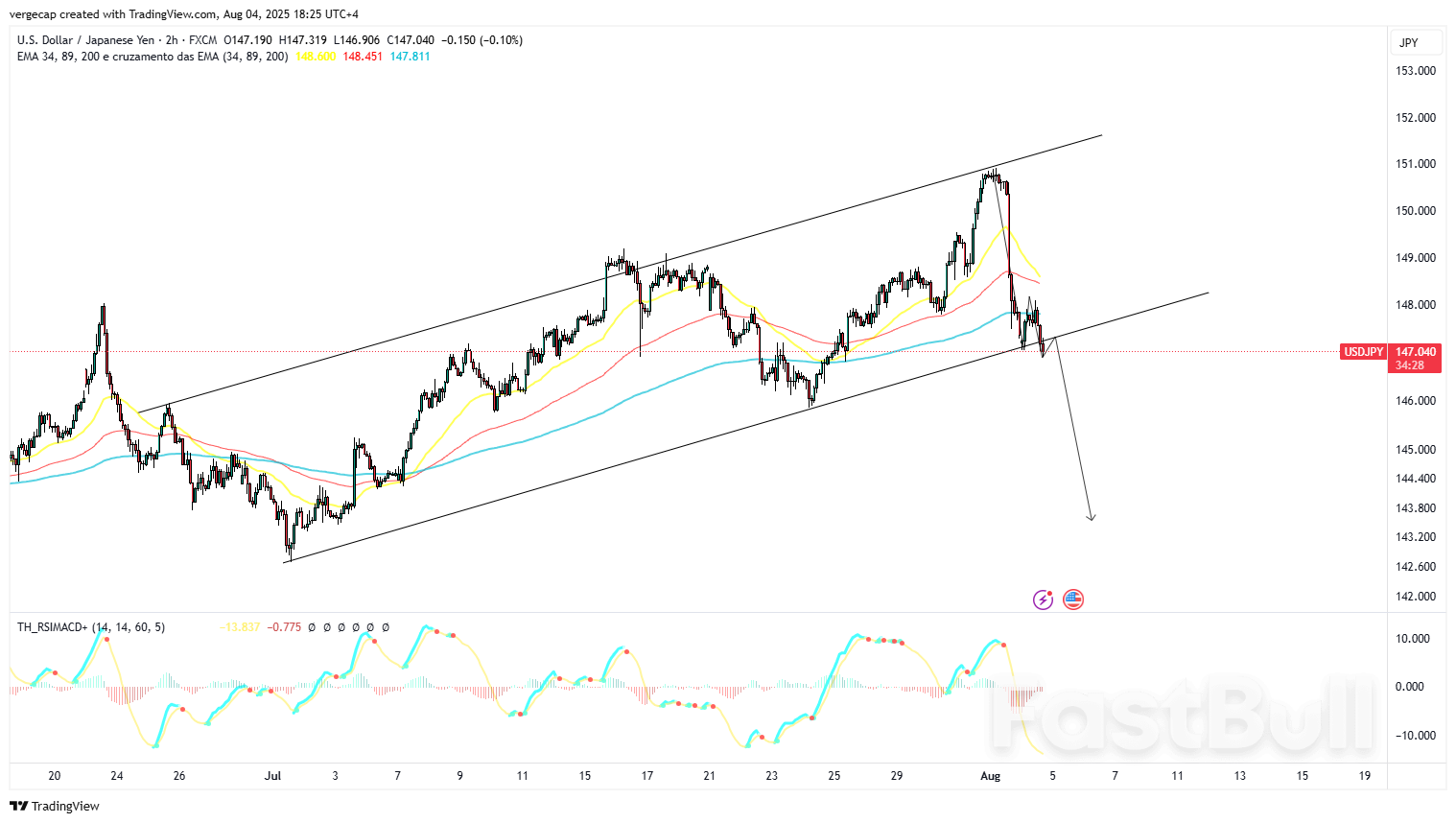
          From a technical perspective, the USD/JPY pair is flashing warning signs for dollar bulls. On the daily chart, the pair has broken structure, establishing a lower high—a classic indicator of trend reversal. The formation of a bearish engulfing candle near the 151.00 resistance zone last week further reinforces the view that momentum is shifting in favor of the bears.
          Immediate support lies around the 142.00 level, a critical zone that may attract buying interest. A firm break below this threshold could accelerate the decline, opening the door to a steeper drop, possibly toward the 140.00 handle. Conversely, any bullish retracement faces stiff resistance at 151.30, the recent high and now a formidable ceiling that could limit upside attempts. Unless a catalyst shifts the broader sentiment, any climb toward that level is likely to invite renewed selling pressure.
          TRADE RECOMMENDATION
          SELL USDJPY
          ENTRY PRICE: 147.00
          STOP LOSS: 149.00
          TAKE PROFIT: 142.00
          Risk Warnings and Disclaimers
          You understand and acknowledge that there is a high degree of risk involved in trading. Following any strategies or investment methods may lead to potential losses. The content on the site is provided by our contributors and analysts for information purposes only. You are solely responsible for determining whether any trading assets, securities, strategy, or any other product is suitable for investing based on your own investment objectives and financial situation.
          Add to Favorites
          Share
          FastBull
          Copyright © 2025 FastBull Ltd

          728 RM B 7/F GEE LOK IND BLDG NO 34 HUNG TO RD KWUN TONG KLN HONG KONG

          TelegramInstagramTwitterfacebooklinkedin
          App Store Google Play Google Play
          Products
          Charts

          Chats

          Q&A with Experts
          Screeners
          Economic Calendar
          Data
          Tools
          Membership
          Features
          Function
          Markets
          Copy Trading
          Latest Signals
          Contests
          News
          Analysis
          24/7
          Columns
          Education
          Company
          Careers
          About Us
          Contact Us
          Advertising
          Help Center
          Feedback
          User Agreement
          Privacy Policy
          Business

          White Label

          Data API

          Web Plug-ins

          Poster Maker

          Affiliate Program

          Risk Disclosure

          The risk of loss in trading financial instruments such as stocks, FX, commodities, futures, bonds, ETFs and crypto can be substantial. You may sustain a total loss of the funds that you deposit with your broker. Therefore, you should carefully consider whether such trading is suitable for you in light of your circumstances and financial resources.

          No decision to invest should be made without thoroughly conducting due diligence by yourself or consulting with your financial advisors. Our web content might not suit you since we don't know your financial conditions and investment needs. Our financial information might have latency or contain inaccuracy, so you should be fully responsible for any of your trading and investment decisions. The company will not be responsible for your capital loss.

          Without getting permission from the website, you are not allowed to copy the website's graphics, texts, or trademarks. Intellectual property rights in the content or data incorporated into this website belong to its providers and exchange merchants.

          Not Logged In

          Log in to access more features

          FastBull Membership

          Not yet

          Purchase

          Become a signal provider
          Help Center
          Customer Service
          Dark Mode
          Price Up/Down Colors

          Log In

          Sign Up

          Position
          Layout
          Fullscreen
          Default to Chart
          The chart page opens by default when you visit fastbull.com