Markets
News
Analysis
User
24/7
Economic Calendar
Education
Data
- Names
- Latest
- Prev


Signal Accounts for Members
All Signal Accounts
All Contests


France Trade Balance (SA) (Oct)A:--
F: --
Euro Zone Employment YoY (SA) (Q3)A:--
F: --
Canada Part-Time Employment (SA) (Nov)A:--
F: --
P: --
Canada Unemployment Rate (SA) (Nov)A:--
F: --
P: --
Canada Full-time Employment (SA) (Nov)A:--
F: --
P: --
Canada Labor Force Participation Rate (SA) (Nov)A:--
F: --
P: --
Canada Employment (SA) (Nov)A:--
F: --
P: --
U.S. PCE Price Index MoM (Sept)A:--
F: --
P: --
U.S. Personal Income MoM (Sept)A:--
F: --
P: --
U.S. Core PCE Price Index MoM (Sept)A:--
F: --
P: --
U.S. PCE Price Index YoY (SA) (Sept)A:--
F: --
P: --
U.S. Core PCE Price Index YoY (Sept)A:--
F: --
P: --
U.S. Personal Outlays MoM (SA) (Sept)A:--
F: --
U.S. 5-10 Year-Ahead Inflation Expectations (Dec)A:--
F: --
P: --
U.S. Real Personal Consumption Expenditures MoM (Sept)A:--
F: --
U.S. Weekly Total Rig CountA:--
F: --
P: --
U.S. Weekly Total Oil Rig CountA:--
F: --
P: --
U.S. Consumer Credit (SA) (Oct)A:--
F: --
China, Mainland Foreign Exchange Reserves (Nov)A:--
F: --
P: --
Japan Trade Balance (Oct)A:--
F: --
P: --
Japan Nominal GDP Revised QoQ (Q3)A:--
F: --
P: --
China, Mainland Imports YoY (CNH) (Nov)A:--
F: --
P: --
China, Mainland Exports (Nov)A:--
F: --
P: --
China, Mainland Imports (CNH) (Nov)A:--
F: --
P: --
China, Mainland Trade Balance (CNH) (Nov)A:--
F: --
P: --
China, Mainland Exports YoY (USD) (Nov)A:--
F: --
P: --
China, Mainland Imports YoY (USD) (Nov)A:--
F: --
P: --
Germany Industrial Output MoM (SA) (Oct)A:--
F: --
Euro Zone Sentix Investor Confidence Index (Dec)A:--
F: --
P: --
Canada National Economic Confidence IndexA:--
F: --
P: --
U.K. BRC Like-For-Like Retail Sales YoY (Nov)--
F: --
P: --
U.K. BRC Overall Retail Sales YoY (Nov)--
F: --
P: --
Australia Overnight (Borrowing) Key Rate--
F: --
P: --
RBA Rate Statement
RBA Press Conference
Germany Exports MoM (SA) (Oct)--
F: --
P: --
U.S. NFIB Small Business Optimism Index (SA) (Nov)--
F: --
P: --
Mexico 12-Month Inflation (CPI) (Nov)--
F: --
P: --
Mexico Core CPI YoY (Nov)--
F: --
P: --
Mexico PPI YoY (Nov)--
F: --
P: --
U.S. Weekly Redbook Index YoY--
F: --
P: --
U.S. JOLTS Job Openings (SA) (Oct)--
F: --
P: --
China, Mainland M1 Money Supply YoY (Nov)--
F: --
P: --
China, Mainland M0 Money Supply YoY (Nov)--
F: --
P: --
China, Mainland M2 Money Supply YoY (Nov)--
F: --
P: --
U.S. EIA Short-Term Crude Production Forecast For The Year (Dec)--
F: --
P: --
U.S. EIA Natural Gas Production Forecast For The Next Year (Dec)--
F: --
P: --
U.S. EIA Short-Term Crude Production Forecast For The Next Year (Dec)--
F: --
P: --
EIA Monthly Short-Term Energy Outlook
U.S. API Weekly Gasoline Stocks--
F: --
P: --
U.S. API Weekly Cushing Crude Oil Stocks--
F: --
P: --
U.S. API Weekly Crude Oil Stocks--
F: --
P: --
U.S. API Weekly Refined Oil Stocks--
F: --
P: --
South Korea Unemployment Rate (SA) (Nov)--
F: --
P: --
Japan Reuters Tankan Non-Manufacturers Index (Dec)--
F: --
P: --
Japan Reuters Tankan Manufacturers Index (Dec)--
F: --
P: --
Japan Domestic Enterprise Commodity Price Index MoM (Nov)--
F: --
P: --
Japan Domestic Enterprise Commodity Price Index YoY (Nov)--
F: --
P: --
China, Mainland PPI YoY (Nov)--
F: --
P: --
China, Mainland CPI MoM (Nov)--
F: --
P: --


No matching data
Latest Views
Latest Views
Trending Topics
Top Columnists
Latest Update
White Label
Data API
Web Plug-ins
Affiliate Program
View All

No data
Trump announces $200 billion in deals with UAE as Middle East tour concludes; Powell hints at Fed 'Scrapping' its monetary policy framework revamp, revisits average inflation targeting; New round of Israel-Hamas negotiations begins, significant differences limit progress......
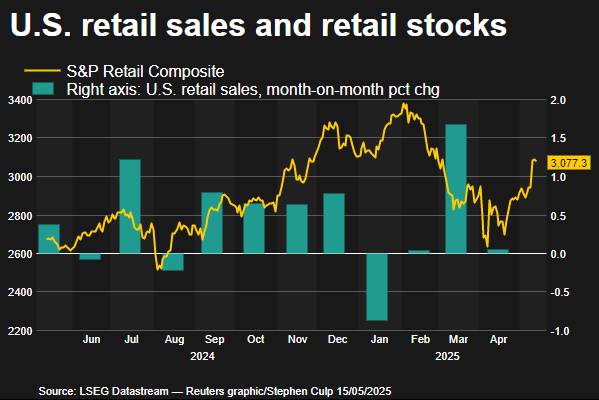
U.S. retail sales growth slowed in April as the boost from households front-loading motor vehicle purchases ahead of tariffs faded and consumers pulled back on spending elsewhere against the backdrop of an uncertain economic outlook.
The apprehension over the economy's prospects, sparked by President Donald Trump's on-again, off-again tariffs policy, was underscored by retail giant Walmart (WMT.N), opens new tab, which on Thursday joined the list of companies from airlines to auto manufacturers that have either withdrawn or refrained from giving financial guidance.
Wholesale prices for services like airline tickets and hotel rooms fell last month, other data showed, also flagging softening demand, which does not bode well for an anticipated rebound in growth this quarter after the economy contracted in the January-March period for the first time in three years.
"We are now witnessing the first-order effects of tariffs on the economy through reduced spending," said Tuan Nguyen, a U.S. economist at RSM US. "While a recession is no longer our base case over the next 12 months due to the recent reduction in tariffs, the likelihood has increased that the U.S. economy will experience several quarters of sluggish growth."
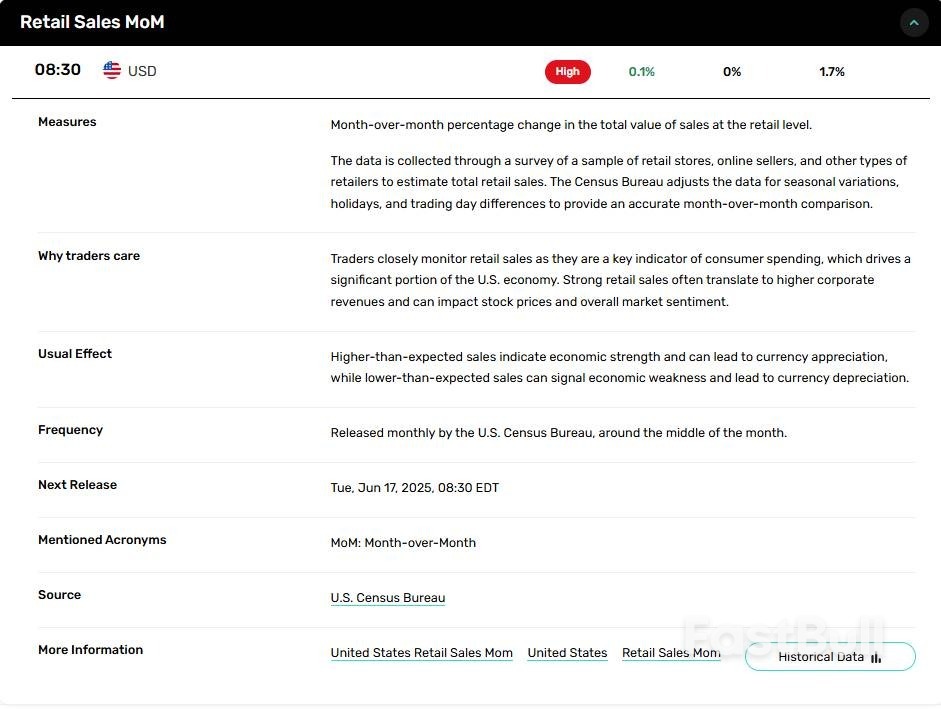
Retail sales edged up 0.1% last month after an upwardly revised 1.7% surge in March, the Commerce Department's Census Bureau said. Economists polled by Reuters had forecast retail sales, which are mostly goods and are not adjusted for inflation, would be unchanged after a previously reported 1.5% jump in March. Estimates ranged from a 0.6% decline to a 0.4% gain.
Retail sales have see-sawed this year amid Trump's announcements of import duties. Though Washington and Beijing struck a 90-day truce in their trade war last weekend, slashing tariffs on imports, uncertainty remained over what happens thereafter.
Sales at auto dealerships dipped 0.1% after accelerating by 5.5% in March. Receipts at sporting goods, hobby and musical instrument stores slumped 2.5%, while receipts at miscellaneous store retailers fell 2.1%.
Online retail store sales rose 0.2% while receipts at food services and drinking places, the only services component in the report, increased 1.2% after rebounding by 3.0% in March.

Economists view dining out as a key indicator of household finances. An analysis of Bank of America credit card data suggested most households remained financially sound, thanks to a resilient labor market characterized by low layoffs.
Bank of America Institute, however, noted "we see some increase in the share of households making only the minimum payment on their credit cards, suggesting building pressures for some households."
Stocks on Wall Street were trading lower. The dollar fell against a basket of currencies. U.S. Treasury yields declined.
Retail sales excluding automobiles, gasoline, building materials and food services fell 0.2% in April after an upwardly revised 0.5% gain in March.
These so-called core retail sales correspond most closely with the consumer spending component of gross domestic product. Economists had forecast core retail sales would climb 0.3% after a previously reported 0.4% advance in March.
Consumer spending ended the first quarter on a strong note, putting consumption on a higher growth trajectory heading into the second quarter.
Economists expect a modest rebound after the economy contracted at a 0.3% rate pace last quarter amid a flood of imports, triggered by businesses trying to beat tariffs.
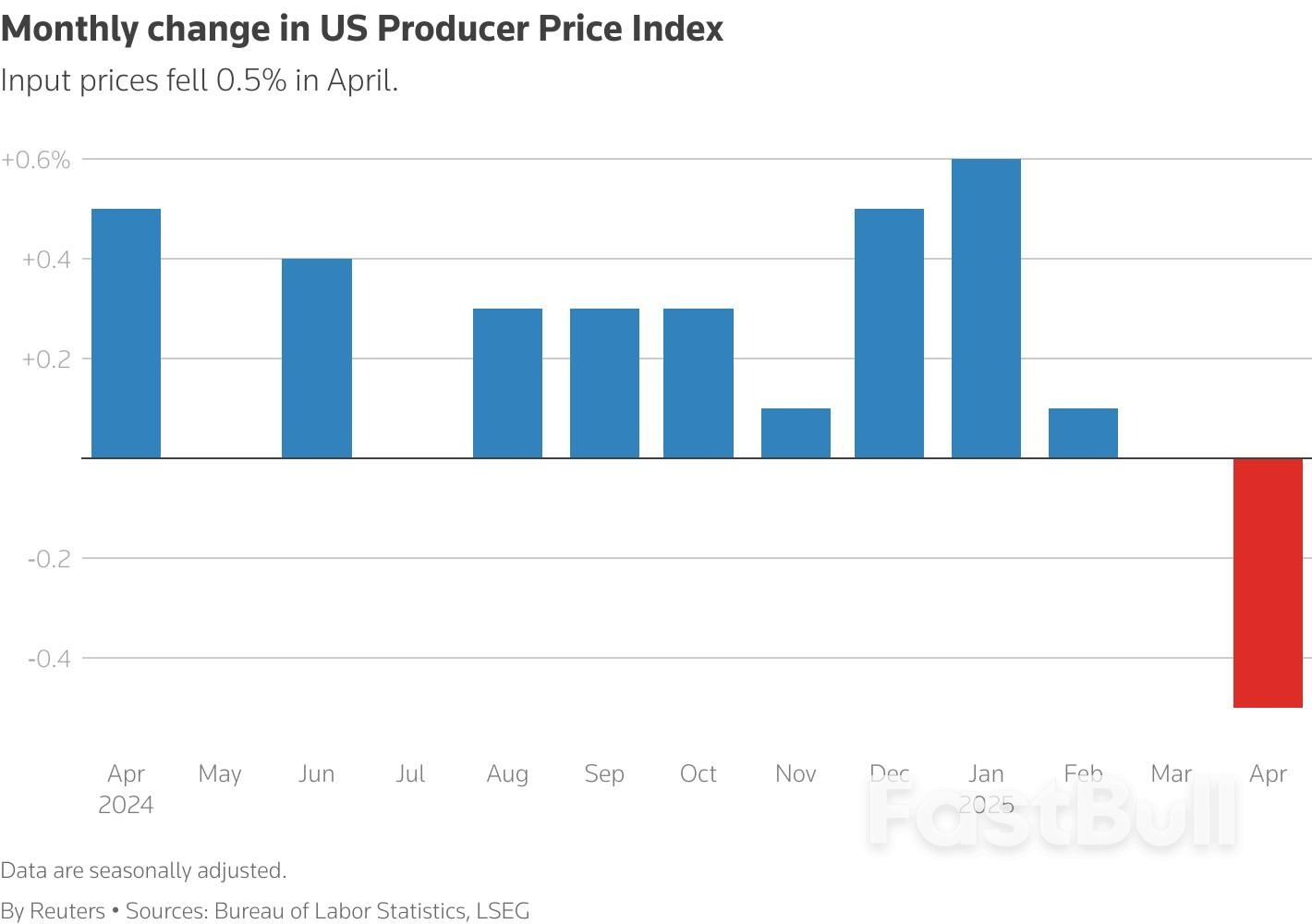
A separate report from the Labor Department showed the Producer Price Index for final demand dropped 0.5% in April as the cost of services declined by the most since 2009, pulled down by ebbing demand for air travel and hotel accommodation.
The PPI was unchanged in March. Economists had forecast the PPI would rise 0.2%. In the 12 months through April, the PPI increased 2.4% after climbing 3.4% in March.

A column chart titled "Monthly change in US Producer Price Index" that tracks the metric over the past year.
In addition to his protectionist trade policy, Trump has cracked down on immigration and repeatedly expressed his desire to make Canada the 51st U.S. state and acquire Greenland. Those actions have been followed by a sharp drop in tourism, with lower airline ticket sales and hotel and motel bookings.
Wholesale services prices dropped 0.7%, the largest decline since the government started tracking the series in December 2009, after rising 0.4% in March. Prices for hotel and motel rooms dropped 3.1% after easing 0.5% in March. Portfolio management fees plunged 6.9%, while airline fares fell 1.5%.
Portfolio management fees, hotel and motel accommodation and airline fares are among the components that go into the calculation of the core Personal Consumption Expenditures (PCE) Price Index, one of the inflation measures tracked by the Federal Reserve for its 2% target.
Combined with tame consumer price readings in April, economists estimated that core PCE inflation rose 0.1% after being unchanged in March. Core PCE inflation was forecast to have increased 2.5% on a year-over-year basis in April after rising 2.6% in March. With retailers like Walmart and automakers like Ford Motor, however, raising prices in response to tariffs, any moderation in inflation is likely to be temporary.
Fed Chair Jerome Powell warned on Thursday that "we may be entering a period of more frequent, and potentially more persistent, supply shocks - a difficult challenge for the economy and for central banks."
Economists expected core PCE inflation to peak at around 3.6% this year and that the U.S. central bank would resume cutting interest rates either in September or December. The Fed left its benchmark overnight interest rate in the 4.24%-4.50% range earlier this month.
"The pendulum keeps swinging in a hawkish direction as Powell talks about supply shocks and reiterates the importance of keeping inflation expectations anchored," said David Russell, global head of market strategy at TradeStation. "While recent data has been benign, there could be pressures building toward higher inflation."
Reporting by Lucia Mutikani; Editing by Chizu Nomiyama, Nick Zieminski and Paul Simao
U.S. retail sales rose just 0.1% in April, sharply down from March’s revised 1.7% surge, according to Commerce Department data released Thursday. Economists had anticipated flat sales, and the weak print underscores consumer fatigue as tariff-induced buying fades. Households, previously front-loading vehicle purchases ahead of a 25% global car tariff, appear to be retreating, particularly on discretionary spending.
Stripping out autos, gasoline, building materials, and food services, core retail sales fell 0.2%—a disappointment versus the 0.3% gain forecast. This core measure, key to GDP calculations, suggests consumer momentum may be stalling as broader economic uncertainty weighs on sentiment.

The Producer Price Index (PPI) for final demand fell 0.5% in April, its largest drop in over a year. Final demand services drove the decline, down 0.7%, led by steep margin compression in trade services—especially machinery and vehicle wholesaling, which sank 6.1%. Goods prices were flat, despite notable declines in energy (-0.4%) and food (-1.0%).
Core PPI, which excludes volatile food, energy, and trade services, edged down 0.1%—its first decline since April 2020. Year-over-year, the index rose 2.4%, suggesting producer inflation remains moderate. For traders, the combination of weakening services pricing and soft core readings raises red flags for corporate margins, especially in the retail and transportation sectors.
The Philadelphia Fed’s May Manufacturing Business Outlook Survey signaled ongoing weakness, with the current activity index at -4.0—up from -26.4 in April, yet still in contraction. New orders rebounded into positive territory, but shipments declined again, and elevated input costs remain a concern. Still, expectations for future growth rose sharply, with the six-month outlook index climbing to 47.2.
In contrast, the NY Fed’s Empire State index dropped to -9.2 from -8.1, marking a third consecutive monthly decline. While new orders improved, hiring and confidence lagged. Prices paid surged to 59.0, the highest in over two years, complicating any dovish outlook from the Federal Reserve.
Initial jobless claims held steady at 229,000 for the week ending May 10, while the four-week average edged up to 230,500. Continued claims also rose marginally, suggesting the labor market remains stable but is not tightening further—a critical input for Fed policy expectations.
The combination of soft retail sales, a declining PPI, and weak regional manufacturing data suggests headwinds for consumer demand and corporate revenue growth. Despite isolated signs of resilience, such as steady employment and future business optimism in Philadelphia, the broader signal leans bearish in the short term for consumer discretionary and retail sectors. Traders should monitor further consumer data and Fed commentary closely, especially with inflation pressures diverging between goods and services.
President Donald Trump can help bring peace to Gaza, a senior Hamas official said as he confirmed that the Palestinian group has told the US it is willing to hand over governance of the territory.
In an interview with Sky News on Thursday, Basem Naim said his organization has shared a ceasefire plan directly with officials in Washington and offered to hand over administration of Gaza “immediately if we reach an end of this war.”
The proposal called for “a prisoner exchange, total withdrawal of Israeli forces, allowing all the aid to get into Gaza, and rebuilding of the Gaza Strip without forceful immigration,” he added.
Naim said he believes Trump “has the capability and the will to reach this peaceful situation.”
He continued: “President Trump can do it if he exercises enough pressure on the Israelis to end this war immediately. We are ready to cooperate with him to achieve this goal of a more peaceful region.”
Hamas released American Israeli hostage Edan Alexander on Monday as Trump was beginning a tour of the Middle East, which included visits to Saudi Arabia, Qatar and the UAE. The group said the same day that it was in direct negotiations with Washington.
Hamas spokesperson Basem Naim tells Sky's @SkyYaldaHakim that they believe Donald Trump has the capability and the will' to reach a peaceful situation for Gaza
“We urge the Trump administration to continue its efforts to end this brutal war waged by the war criminal (Israeli Prime Minister Benjamin) Netanyahu against children, women and defenseless civilians in the Gaza Strip,” the group said.
Alexander was serving as an Israeli soldier when he was captured during the Hamas-led October 2023 attacks, in which 1,200 people were killed and more than 250 were taken hostage.
Israeli authorities responded with a brutal military offensive that has killed more than 50,000 Palestinians and reduced Gaza to rubble. A blockade on humanitarian aid since early March has prompted warnings that the territory could soon be gripped by famine.
Naim’s comments suggest Hamas, which is designated as a terrorist group by the US, believes Trump can play a key role in helping to secure an end to Israel’s ongoing offensive, which claimed the lives of scores more people on Thursday.
He said Hamas has accepted an Egyptian peace proposal under which a politically independent body would be formed to run Gaza.
“Before that, as long as we are still occupied people, we have all the right to continue defending our people and resisting the occupation,” Naim said.
Earlier reports that the US and Hamas were engaged in direct talks reportedly angered Israeli authorities. And despite the comments from Hamas officials this week, US officials maintain that the group is still not doing enough to end the war.
“Hamas has not demonstrated they are serious about peace,” a White House National Security Council spokesperson told Sky News, adding that Trump has demanded that the group lays down its weapons.
“Hamas continues to wrongfully hold hostages, including American bodies, in the dungeons of Gaza who could easily be freed, and have shown no changes in behavior to indicate they will cease to attack civilians,” he added.
The ranks of Hamas has been heavily depleted during the war against Israel, with thousands of its members killed, including a number of senior leaders. However, it continues to maintain a strong presence in Gaza and remains key to any ceasefire agreement.
Israel has ramped up its military operations in recent weeks as it moves to gain control of large sections of Gaza and take over aid distribution throughout the territory.
Federal Reserve Chair Jerome Powell said Thursday that longer-term interest rates are likely to be higher as the economy changes and policy is in flux.
In remarks that focused on the central bank's policy framework review, last done in the summer of 2020, Powell noted that conditions have changed significantly over the past five years.
During the period, the Fed witnessed a period of surging inflation, pushing it to historically aggressive interest rate hikes. Powell said that even with longer-term inflation expectations largely in line with the Fed's 2% target, the era of near-zero rates is not likely to return anytime soon.
"Higher real rates may also reflect the possibility that inflation could be more volatile going forward than in the inter-crisis period of the 2010s," Powell said in prepared remarks for the Thomas Laubach Research Conference in Washington, D.C. "We may be entering a period of more frequent, and potentially more persistent, supply shocks — a difficult challenge for the economy and for central banks."
The Fed held its benchmark borrowing rate near zero for seven years following the financial crisis in 2008. Since December 2024, the overnight lending rate has been in a range between 4.25%-4.5%, most recently trading at 4.33%.
The "supply shocks" remarks are similar to those Powell has delivered over the past several weeks cautioning that policy changes could put the Fed in a difficult balancing act between supporting employment and controlling inflation.
Though he did not mention President Donald Trump's tariffs in his Thursday remarks, the central bank chief in recent days has noted the likelihood that tariffs will slow growth and boost inflation. However, the extent of either impact is difficult to gauge, particularly as Trump recently has backed off the more aggressive duties pending a 90-day negotiating window.
Nevertheless, the Fed has been reluctant to ease policy after cutting its benchmark rate by a full percentage point last year.
As for the ongoing framework review, the Fed will seed to develop a five-year plan for how it will guide decisions and the way the moves will be relayed to the public.
Powell said the process this time will look at a number of factors.
They include the way the Fed communicates its expectations for the future, while also entailing a look back at ways it can adjust the last review.
During the tumult of the summer of 2020, the Fed announced a "flexible average inflation target" approach that would allow inflation to run a little hotter than normal in the interest of providing full and inclusive employment. However, inflation targeting soon became a dead issue as prices soared in the wake of the Covid pandemic, forcing the Fed into a series of historically aggressive rate hikes.
The current review will look at how the Fed considers "shortfalls" in its inflation and employment goals.
Powell and his colleagues initially dismissed the 2021 inflation surge as "transitory" because of pandemic-specific factors. However, several Fed officials have said the 2020 framework adoption did not factor into their decision to hold rates near zero even as inflation was rising.
"In our discussions so far, participants have indicated that they thought it would be appropriate to reconsider the language around shortfalls," he said. "And at our meeting last week, we had a similar take on average inflation targeting. We will ensure that our new consensus statement is robust to a wide range of economic environments and developments."
Further addressing the idea of potential supply shocks and their policy impact, Powell said the review will focus on communication.
"While academics and market participants generally have viewed the [Fed's] communications as effective, there is always room for improvement," he said. "In periods with larger, more frequent, or more disparate shocks, effective communication requires that we convey the uncertainty that surrounds our understanding of the economy and the outlook. We will examine ways to improve along that dimension as we move forward."
Powell did not give a specific date on when the review will be completed, only saying that he expects it in "coming months." For the last review, Powell used his annual remarks at the Fed's Jackson Hole, Wyoming retreat to outline the policy.
White Label
Data API
Web Plug-ins
Poster Maker
Affiliate Program
The risk of loss in trading financial instruments such as stocks, FX, commodities, futures, bonds, ETFs and crypto can be substantial. You may sustain a total loss of the funds that you deposit with your broker. Therefore, you should carefully consider whether such trading is suitable for you in light of your circumstances and financial resources.
No decision to invest should be made without thoroughly conducting due diligence by yourself or consulting with your financial advisors. Our web content might not suit you since we don't know your financial conditions and investment needs. Our financial information might have latency or contain inaccuracy, so you should be fully responsible for any of your trading and investment decisions. The company will not be responsible for your capital loss.
Without getting permission from the website, you are not allowed to copy the website's graphics, texts, or trademarks. Intellectual property rights in the content or data incorporated into this website belong to its providers and exchange merchants.
Not Logged In
Log in to access more features

FastBull Membership
Not yet
Purchase
Log In
Sign Up